GUMROAD eBook link:-
BY SHAILENDRA KUMAR VERMA
| 1. | CHALLENGING SYLLOGISM |
| https://skverma29.gumroad.com/l/ktxvzi | |
| 2. | STRAIT OF HORMUZ: STRATEGIC & ECONOMIC ROLE |
| https://skverma29.gumroad.com/l/upobrv | |
| 4. | STATIC GENERAL KNOWLEDGE |
| https://skverma29.gumroad.com/l/kzmca | |
| 5. | SSC ENGLISH PREVIOUS YEAR QUESTIONS MCQ |
| https://skverma29.gumroad.com/l/vtotyp | |
| 6. | SSC REASONING PREVIOUS YEAR QUESTIONS MCQ |
| https://skverma29.gumroad.com/l/fsyvp | |
| 7. | SSC MATH PREVIOUS YEAR QUESTIONS (MCQ): TIER I |
| https://skverma29.gumroad.com/l/nesioq | |
| 8. | BANKING KNOWLEDGE QUESTIONS AND ANSWERS MCQ |
| https://skverma29.gumroad.com/l/sgbbul | |
| 9. | BIHAR ANM, GNM & PHARMACIST EXAM: PAST MCQ QUESTIONS & ANSWERS – |
| https://skverma29.gumroad.com/l/yotjat | |
| 10. | ARAVALLI MOUNTAIN RANGE: THE ANCIENT SPINE OF INDIA |
| https://skverma29.gumroad.com/l/khpakf | |
| 11. | मौर्य काल (322 ईसा पूर्व – 185 ईसा पूर्व): पीएसयू परीक्षा हेतु प्रश्नोत्तर सहित विस्तृत अध्ययन |
| https://skverma29.gumroad.com/l/kgmrw | |
| 12. | VOLCANOES AND EARTHQUAKES: A COMPLETE GUIDE |
| https://share.google/gMZLAnx4hcCV82NTI | |
| 13. | TERMINOLOGY: RAILWAY, COMPUTER, SHARE MARKET, BIOLOGY, BADMINTON, CRICKET, FOOTBALL, KABBADI AND HOCKEY |
| https://share.google/fvdFN53HtyXlqTCgd | |
| 14. | भारतीय संसद का सत्र: प्रक्रिया, नियमऔर एस ओ पी; पी एस यू परीक्षा के लिए संपूर्ण मार्ग दर्शिका |
| https://share.google/1HFwXZA3qUiKyrI1l | |
| 15. | REITs AND InvITs IN INDIA: COMPLETE GUIDE (SCOPE, RISKS & FUTURE) |
| https://share.google/EChDc9heQmPPeyhoi | |
| 16. | GK SSC TIER I PREVIOUS YEAR MCQ |
| https://share.google/5pLzqYKQtg822wk3Y | |
| 17. | PETROLEUM REFINERY PROCESS: WITH 200 MCQ |
| https://skverma29.gumroad.com/l/jgydi | |
| 18. | SET THEORY: A COMPLETE GUIDE WITH 400 MCQ |
| https://skverma29.gumroad.com/l/zkhqzm | |
| 19. | WORLD’S SMALLEST, LONGEST, THINNEST, THICKEST AND TALLEST |
| https://skverma29.gumroad.com/l/kzaenh | |
| 20. | HIGH TIDE AND LOW TIDE: A COMPLETE GUIDE https://skverma29.gumroad.com/l/virke |
| 21. | 1000 HISTORY QESTIONS & ANSWERS FOR PSU |
| https://skverma29.gumroad.com/l/fjapus | |
| 22. | नालंदा विश्वविद्यालय : सम्पूर्ण अध्ययन |
| https://skverma29.gumroad.com/l/pmjab?wanted=true | |
| 23. | भगवान शिव के 12 ज्योतिर्लिंग: इतिहास, महत्व और दर्शन क्रम |
| https://skverma29.gumroad.com/l/wdkgo | |
| 24 | NISM-SERIES-V-A MUTUAL FUND DISTRIBUTOR: COMPLETE STUDY GUIDE & EXAM PREPARATION |
| https://skverma29.gumroad.com/l/qgcviu | |
| 25. | WORKSHOP TECHNOLOGY & MANUFACTURING PROCESSES COMPLETE EXAM GUIDE |
| https://skverma29.gumroad.com/l/xvqxnp |
AMAZON eBook link:-
BY SHAILENDRA KUMAR VERMA
| 1. | SSC MATH PREVIOUS YEAR MCQ: SSC MATH |
| https://amzn.in/d/097Ocsnl | |
| 2. | SSC REASONING PREVIOUS YEAR MCQ: SSC REASONING |
| https://amzn.in/d/00EHQGE8 | |
| 3. | SSC ENGLISH PREVIOUS YEAR MCQ: SSC ENGLISH |
| https://amzn.in/d/0f8sxJoy | |
| 4. | STATIC GENERAL KNOWLEDGE : WITH 620 MCQs |
| https://amzn.in/d/09xNEWmt |
PLAYSTORE eBook link:-
BY SHAILENDRA KUMAR VERMA
| 1. | SSC MATH PREVIOUS YEAR MCQ | |
| https://share.google/KzWbvkFuNk51PEpiu | ||
| 2. | SSC REASONING PREVIOUS YEAR MCQ | |
| https://play.google.com/books/publish/a/12574378860292240754#book/GGKEY:EUPQZ9ZUAFR/review | ||
| 3. | STATIC GENERAL KNOWLEDGE | |
| https://play.google.com/books/publish/a/12574378860292240754#book/GGKEY:CQDT2G4CCQP/review | ||
| 4. | CHALLENGING SYLLOGISM | |
| https://share.google/w9xLMwyiJdNVnpHxI | ||
| 5. | STRAIT OF HORMUZ: STRATEGIC & ECONOMIC ROLE | |
| https://share.google/V10H7UKeTkstLIMmc | ||
| 6. | BIHAR TEACHER ELIGIBILITY TEST (BIHAR TET) : COMPLETE GUIDE | |
| https://share.google/AcCXPFa69dAWyYaZZ | ||
| 7. | SSC ENGLISH PREVIOUS YEAR MCQ | |
| https://share.google/pr7b0YhDoDwttaq2s | ||
| 8. | BANKING KNOWLEDGE QUESTIONS AND ANSWERS MCQ | |
| https://share.google/yqYOabKhNppcz89hl | ||
| 9. | BIHAR ANM, GNM & PHARMACIST EXAM: PAST MCQ QUESTIONS & ANSWERS – | |
| https://share.google/NFhtU1JoBfxPS4wa3 | ||
| 10. | ARAVALLI MOUNTAIN RANGE: THE ANCIENT SPINE OF INDIA | |
| https://share.google/Yo4RYnaZrbRu9qwzj | ||
| 11. | GK SSC TIER I PREVIOUS YEAR MCQ | |
| https://share.google/sBdCcsEeebM44QZ0X | ||
| 12. | REITs AND InvITs IN INDIA: COMPLETE GUIDE (SCOPE, RISKS & FUTURE) | |
| https://share.google/XAwUio1deUOxFe2M7 | ||
| 13. | भारतीय संसद का सत्र: प्रक्रिया, नियमऔर एस ओ पी ; पी एस यू परीक्षा के लिए संपूर्ण मार्ग दर्शिका | |
| https://share.google/6XVrfQ2PcuWmqvKol | ||
| 14. | मौर्य काल (322 ईसा पूर्व – 185 ईसा पूर्व): पीएसयू परीक्षा हेतु प्रश्नोत्तर सहित विस्तृत अध्ययन | |
| https://share.google/Lwu7JKHE54kxsL5e2 | ||
| 15. | TERMINOLOGY: RAILWAY, COMPUTER, SHARE MARKET, BIOLOGY, BADMINTON, CRICKET, FOOTBALL, KABBADI AND HOCKEY | |
| https://share.google/WWVO9ZFd81R9G9h69 | ||
| 16. | VOLCANOES AND EARTHQUAKES: A COMPLETE GUIDE | |
| https://share.google/aXi2evRVgmzpQguye | ||
| 17. | PETROLEUM REFINERY PROCESS: WITH 200 MCQ | |
| https://play.google.com/books/publish/u/0/a/12574378860292240754#book/GGKEY:P34SQBHUJ7F/review | ||
| 18. | SET THEORY: A COMPLETE GUIDE WITH 400 MCQ | SET THEORY: A COMPLETE GUIDE WITH 400 MCQ |
| https://play.google.com/books/publish/u/0/a/12574378860292240754#book/GGKEY:83LKH7QHRQH/review | ||
| 19. | WORLD’S SMALLEST, LONGEST, THINNEST, THICKEST AND TALLEST | |
| https://play.google.com/books/publish/u/0/a/12574378860292240754#book/GGKEY:9LE49HEDZJE/review | ||
| 20. | HIGH TIDE AND LOW TIDE: A COMPLETE GUIDE | |
| https://play.google.com/books/publish/u/0/a/12574378860292240754#book/GGKEY:TKR79QBDE7R/review | ||
| 21. | 1000 HISTORY QESTIONS & ANSWERS FOR PSU | |
| https://play.google.com/books/publish/u/0/a/12574378860292240754#book/GGKEY:1SGWQKT7BDF/review | ||
| 22. | नालंदा विश्वविद्यालय : सम्पूर्ण अध्ययन | |
| https://play.google.com/books/publish/u/0/a/12574378860292240754#book/GGKEY:RY0EDLDK7TL/review | ||
| 23. | भगवान शिव के 12 ज्योतिर्लिंग: इतिहास, महत्व और दर्शन क्रम | |
| https://play.google.com/books/publish/u/0/a/12574378860292240754#book/GGKEY:KNT0X6L8YCQ/review | ||
| 24. | NISM-SERIES-V-A MUTUAL FUND DISTRIBUTOR: COMPLETE STUDY GUIDE & EXAM PREPARATION | |
| https://play.google.com/books/publish/u/0/a/12574378860292240754#book/GGKEY:YP1PQ8RQY07/review | ||
| 25. | WORKSHOP TECHNOLOGY & MANUFACTURING PROCESSES COMPLETE EXAM GUIDE | |
| https://play.google.com/books/publish/u/0/a/12574378860292240754#book/GGKEY:PK621P1ZHXX/review |
| OPEN DMAT ACCONT FROM THI LINK IN ANGEL ONE:- |
| Open your Trading & Investment account with Angel One for FREE* |
| You will get: |
| All trades in Rs.20 |
| Quick SIP in Direct MF |
| 1Lac MTF @ 0% interest |
| Download only using my referral link to get Free Demat Account⬇ |
| https://angel-one.onelink.me/Wjgr/2o2au42h |
| _link may expire within 48hrs_ |
| _T&C Apply_ |
| CLICK TO APPLY: |
| Click the application link below: 👉 Apply Here for SBI Credit Card (Referral Code: 243zfQ0yYm3) |
| OPEN DMAT ACCOUNT FROM THIS LINK: |
| HI THERE, I SEE YOU HAVEN’T BOUGHT THE FREEDOM PLAN ON INDIAN BANK YET. DON’T MISS OUT ON UNLIMITED TRADING AT A POCKET-FRIENDLY COST. GO BROKERAGE-FREE AND SAVE BIG WITH THE FREEDOM PLAN. USE MY REFERRAL CODE, SHAI0634 TO DOWNLOAD THE APP NOW. |
| https://play.google.com/store/apps/details?id=com.finwizard.fisdom |
DISCLAIMER
This content on UNIT 1: DIVERSITY IN THE LIVING WORLD has been prepared for educational and examination-preparation purposes only. It includes multiple-choice questions (MCQs), answers and explanations intended to help students understand and revise important concepts.
While reasonable care has been taken to maintain accuracy, students are advised to verify important facts, terminology and concepts with their official syllabus, standard textbooks, NCERT publications and other authoritative educational sources.
The questions and explanations are provided for practice and learning purposes and should not be considered an official question paper, official answer key or material issued by any examination authority.
The author/website owner does not guarantee that the same questions will appear in any particular examination and shall not be responsible for any error, omission or difference in interpretation.
For NEET and other examinations, candidates should always follow the latest official syllabus and instructions issued by the concerned examination authority.
This material is intended solely to support learning, revision, and self-assessment.
CHAPTER 1
THE LIVING WORLD & TAXONOMIC CONCEPTS
Chapter Overview
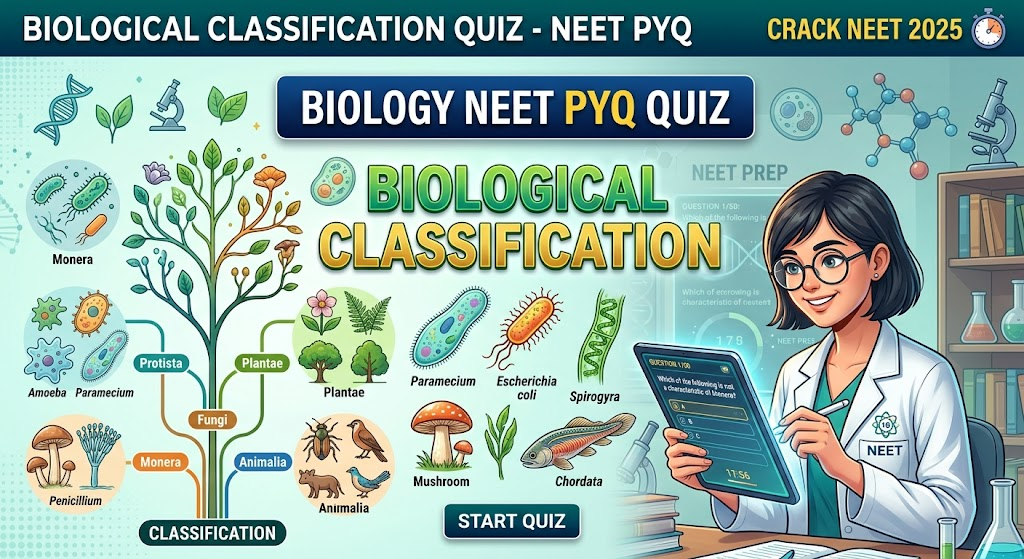
The living world around us is extremely diverse. It includes microscopic organisms such as bacteria and large organisms such as trees, elephants, and whales. Organisms differ in their structure, form, size, habitat, nutrition, reproduction, and many other characteristics.
Because of this enormous diversity, it is necessary to identify, name, classify, and study organisms systematically.
This chapter deals with the fundamental concepts required to understand biological diversity:
What is Living?
Biodiversity
Need for Classification
Taxonomy
Systematics
Species Concept
Taxonomical Hierarchy
Binomial Nomenclature
1. WHAT IS LIVING?
1.1 Meaning of Living
A living organism is a biological entity that possesses characteristic features of life such as cellular organisation, metabolism, growth, reproduction and the ability to respond to stimuli.
However, no single characteristic alone can perfectly define all living organisms.
The major characteristics associated with living organisms are:
- Growth
- Reproduction
- Metabolism
- Cellular organisation
- Response to stimuli
- Consciousness
1.2 Growth
Growth refers to a permanent and irreversible increase in size, mass or number of cells of an organism.
In living organisms, growth generally occurs due to:
Cell division
Increase in cell size
Accumulation of cellular materials
Growth in Plants
Plants may continue to grow throughout their life because certain tissues, particularly meristematic tissues, retain the ability to divide.
Growth in Animals
In most animals, growth occurs mainly during the early stages of life and becomes limited after maturity.
1.3 Growth in Non-Living Objects
Growth is not exclusively a characteristic of living organisms.
Non-living objects can also increase in size through the external accumulation of materials.
Examples:
Crystals
Sand dunes
Mountains
In these cases, growth occurs through the deposition of materials from outside.
In living organisms, growth occurs mainly through internal biological processes such as cell division and synthesis of cellular components.
1.4 Reproduction
Reproduction is the biological process by which organisms produce new individuals of their own kind.
It is broadly divided into two types:
A. Asexual Reproduction
Asexual reproduction generally involves a single parent and does not involve the fusion of gametes.
Examples:
Binary fission in Amoeba
Budding in Yeast
Budding in Hydra
Vegetative propagation in plants
Asexual reproduction generally produces offspring that are genetically very similar to the parent.
B. Sexual Reproduction
Sexual reproduction generally involves the formation and fusion of male and female gametes.
It contributes significantly to genetic variation among offspring.
1.5 Is Reproduction a Defining Property of Life?
Reproduction is an important characteristic of living organisms, but it cannot be considered an all-inclusive defining property of life.
Examples:
Mule is generally sterile.
Worker bees are generally sterile females.
Some individuals may be incapable of reproduction.
Despite being unable to reproduce, such organisms are living.
1.6 Metabolism
Metabolism refers to the sum total of all chemical and biochemical reactions occurring within a living organism or cell.
Metabolic reactions are essential for:
Energy production
Growth
Repair
Synthesis of biomolecules
Maintenance of cellular activities
Metabolism is broadly divided into:
Anabolism
Anabolism involves the synthesis of complex molecules from simpler molecules.
Example:
Amino acids → Proteins
Anabolic reactions generally require energy.
Catabolism
Catabolism involves the breakdown of complex molecules into simpler molecules.
Example:
Glucose → Carbon dioxide + Water + Energy
Catabolic reactions often release energy.
Therefore:
Metabolism = Anabolism + Catabolism
1.7 Importance of Metabolism
All living cells continuously perform numerous metabolic reactions.
For example:
Plants perform photosynthesis.
Cells perform cellular respiration.
Proteins are synthesized.
Complex substances are broken down.
DNA and other biomolecules are produced.
1.8 Cellular Organisation
All living organisms are composed of cells or are cellular in their organisation.
The cell is regarded as the basic structural and functional unit of life.
Organisms can be broadly classified according to the number of cells as:
Unicellular Organisms
These organisms consist of a single cell.
Examples:
Amoeba
Paramecium
Many bacteria
Many unicellular algae
A single cell performs all essential life functions.
Multicellular Organisms
These organisms consist of many cells.
Examples:
Plants
Humans
Most animals
In multicellular organisms, cells may become specialised for different functions.
1.9 Response to Stimuli
Living organisms can detect and respond to changes in their surroundings.
Such changes are called stimuli.
Examples of stimuli include:
Light
Temperature
Touch
Sound
Chemicals
Water availability
Gravity
The ability of an organism to respond to stimuli is an important characteristic of life.
1.10 Response to Stimuli in Plants
Plants also respond to environmental stimuli.
Examples:
Phototropism
Geotropism
Thigmotropism
Response of Mimosa pudica to touch
Although plants do not possess a nervous system like animals, they can detect environmental changes and respond through various physiological mechanisms.
1.11 Consciousness
Consciousness refers to the ability to sense and respond to changes in the internal and external environment.
In humans, consciousness is highly developed.
Animals also respond to their surroundings through specialised sensory and nervous systems.
1.12 Viruses and the Living–Non-Living Boundary
Viruses occupy a special position when discussing the distinction between living and non-living entities.
Outside a host cell, viruses generally remain inactive and do not carry out independent metabolic activities.
Inside a suitable host cell, however, they can:
Replicate
Use the host’s cellular machinery
Produce viral components
Thus, viruses are often described as lying at the boundary between living and non-living states.
1.13 Major Characteristics of Living Organisms
| Characteristic | Description |
| Growth | Increase in size, mass, or cell number |
| Reproduction | Production of new individuals |
| Metabolism | Sum total of biochemical reactions |
| Cellular organisation | Cellular basis of life |
| Response to stimuli | Ability to respond to environmental changes |
| Consciousness | Ability to sense and respond to surroundings |
Important Conclusion
Growth and reproduction are important characteristics, but neither alone can be used as a universal defining property of life.
Metabolism and cellular organisation are particularly fundamental characteristics.
2. BIODIVERSITY
2.1 Definition of Biodiversity
The term biodiversity refers to the variety and variability of living organisms present on Earth.
The living world contains an enormous number of organisms that differ in:
Structure
Size
Shape
Habitat
Nutrition
Reproduction
Behaviour
Genetic composition
This variety is collectively referred to as biological diversity or biodiversity.
2.2 Levels of Biodiversity
Biodiversity can be studied at different levels.
1. Genetic Diversity
Variation in genetic composition among individuals or populations of the same species is called genetic diversity.
Examples:
Different varieties of rice
Different varieties of wheat
Genetic variation among human populations
2. Species Diversity
The variety of species present in a particular region or ecosystem is called species diversity.
For example, a forest may contain numerous species of:
Plants
Birds
Mammals
Insects
Microorganisms
3. Ecosystem Diversity
The variety of ecosystems present in a geographical region is called ecosystem diversity.
Examples:
Forest ecosystems
Grassland ecosystems
Desert ecosystems
Wetland ecosystems
Marine ecosystems
2.3 Importance of Biodiversity
Biodiversity is important because it:
Maintains ecological balance.
Provides food resources.
Provides medicinal resources.
Provides genetic resources.
Supports ecosystem functioning.
Provides raw materials.
Contributes to ecosystem stability.
Supports various ecological interactions.
3. NEED FOR CLASSIFICATION
3.1 Meaning of Classification
Classification is the systematic arrangement of organisms into groups and categories based on their similarities and differences.
The enormous diversity of organisms makes their individual study difficult.
Classification provides an organised framework for studying this diversity.
3.2 Why is Classification Necessary?
1. Easy Identification
Classification helps scientists identify unknown organisms based on their characteristics.
2. Easy Study
Similar organisms can be studied together.
3. Understanding Similarities and Differences
Classification helps identify common and contrasting characteristics among organisms.
4. Organisation of Biodiversity
The enormous diversity of organisms can be arranged into manageable groups.
5. Understanding Relationships
Classification helps scientists understand relationships among organisms.
6. Scientific Communication
Standard classification and scientific names allow scientists around the world to communicate about organisms without confusion caused by local names.
3.3 Identification vs Classification
These two terms should not be confused.
Identification
Identification is the process of determining the identity of an unknown organism.
Classification
Classification is the process of arranging organisms into groups based on their similarities and differences.
4. TAXONOMY
4.1 Definition
Taxonomy is the branch of biology concerned with the identification, nomenclature, and classification of organisms.
Therefore:
Taxonomy = Identification + Nomenclature + Classification
4.2 Identification
Identification is the process of recognising an organism and determining its correct identity.
Identification is generally based on:
Morphological characters
Anatomical characters
Physiological characters
Reproductive characters
Molecular characteristics
4.3 Nomenclature
Nomenclature is the process of assigning standard scientific names to organisms according to internationally accepted rules.
Examples:
Human — Homo sapiens
Mango — Mangifera indica
Tiger — Panthera tigris
4.4 Classification
Classification involves arranging organisms into groups based on their similarities, differences and relationships.
Classification provides a hierarchical framework for studying living organisms.
5. SYSTEMATICS
5.1 Definition
Systematics is the scientific study of biological diversity and the relationships among organisms, including their evolutionary relationships.
Systematics therefore has a broader scope than traditional taxonomy.
5.2 Taxonomy vs Systematics
| Taxonomy | Systematics |
| Deals with identification, nomenclature, and classification | Deals with diversity and relationships among organisms |
| Relatively narrower concept | Broader concept |
| Focuses strongly on classification | Includes evolutionary relationships |
| Forms an important part of systematic biology | Uses taxonomic and evolutionary information |
6. SPECIES CONCEPT
6.1 What is a Species?
Species is the basic unit of biological classification.
According to the biological species concept, a species is generally defined as a group of organisms that can interbreed under natural conditions and produce fertile offspring.
6.2 Important Features of a Species
Members of the same species generally:
Share several common characteristics.
Have a common gene pool.
Can interbreed under natural conditions.
Produce fertile offspring.
6.3 Example of a Species
Humans belong to the species:
Homo sapiens
Members of this species can reproduce with one another and normally produce fertile offspring.
6.4 Reproductive Isolation
Different species are generally separated by reproductive barriers.
If two populations cannot successfully reproduce and produce fertile offspring, they may be considered separate species under the biological species concept.
6.5 Mule as an Example
A horse and a donkey can produce a mule.
However, a mule is generally sterile.
This illustrates that producing an offspring is not sufficient for considering two organisms members of the same biological species; the ability to produce fertile offspring is important.
7. TAXONOMICAL HIERARCHY
7.1 Definition
Organisms are classified into a series of categories arranged in a definite order.
The arrangement of these taxonomic categories from lower to higher levels is called the taxonomical hierarchy.
7.2 Major Taxonomic Categories
The major taxonomic categories are:
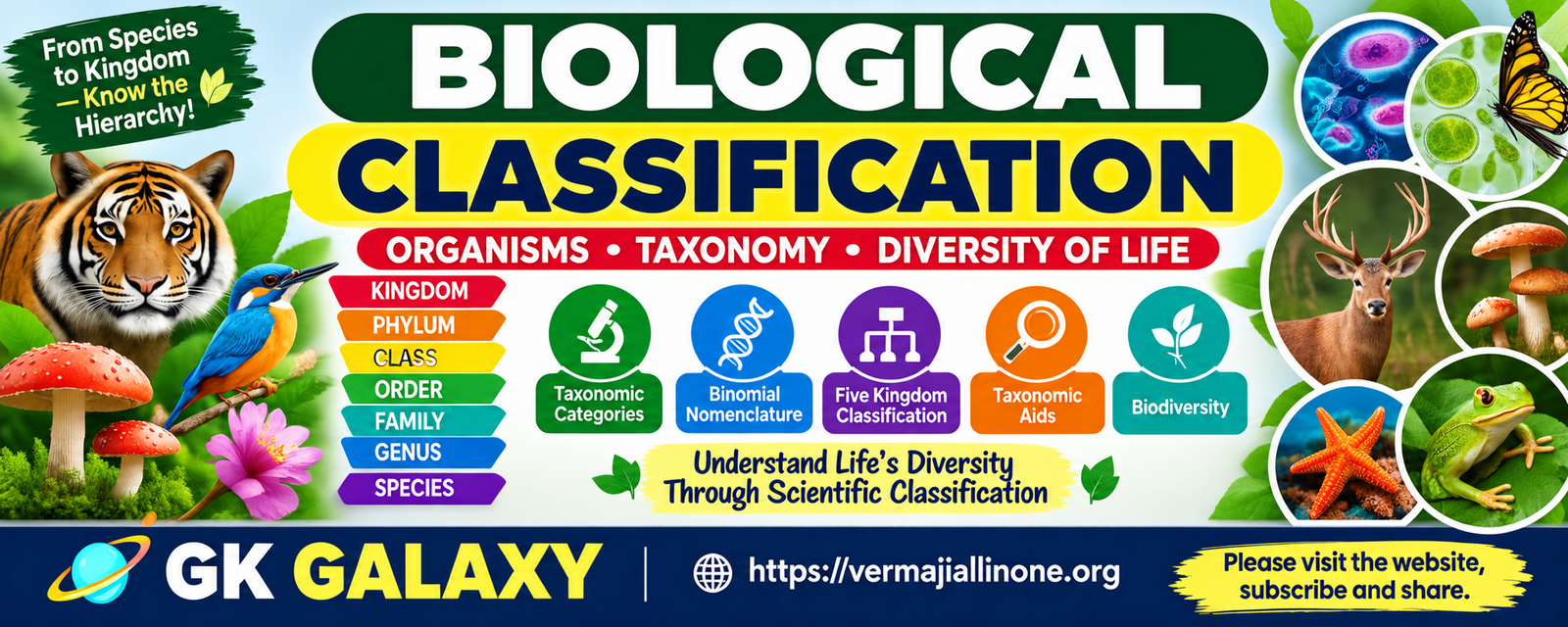
Species → Genus → Family → Order → Class → Phylum/Division → Kingdom
7.3 Species
Species is the lowest and most specific major taxonomic category.
Examples:
Homo sapiens
Panthera tigris
Mangifera indica
7.4 Genus
A genus is a group of closely related species.
Example:
The genus Panthera includes:
Panthera leo
Panthera tigris
Thus, closely related species are placed within the same genus.
7.5 Family
A family consists of one or more related genera.
For example:
Felidae is a family containing several genera of cats.
7.6 Order
An order consists of related families.
Example:
Carnivora is an order containing several related families.
7.7 Class
A class consists of related orders.
Example:
Mammalia is a class containing several orders.
7.8 Phylum
In animal classification, related classes are grouped into a phylum.
Example:
Chordata is a phylum containing several classes.
7.9 Division
In plant classification, the term division is traditionally used for a category comparable to phylum.
7.10 Kingdom
A kingdom is a broad taxonomic category containing related phyla or divisions.
Examples:
Plantae
Animalia
7.11 Hierarchy from Lower to Higher
The sequence is:
Species → Genus → Family → Order → Class → Phylum/Division → Kingdom
As we move upward:
The number of organisms generally increases.
Similarity among members generally decreases.
The category becomes broader.
7.12 Hierarchy from Higher to Lower
The reverse sequence is:
Kingdom → Phylum/Division → Class → Order → Family → Genus → Species
As we move downward:
The number of organisms generally decreases.
Similarity among members generally increases.
The category becomes more specific.
7.13 Taxon
A taxon is a group of organisms representing any category in the taxonomic hierarchy.
Examples:
Kingdom Animalia
Class Mammalia
Family Felidae
Genus Panthera
Species Homo sapiens
Each of these represents a taxon.
8. BINOMIAL NOMENCLATURE
8.1 Definition
Binomial nomenclature is the scientific system of naming organisms using two words.
The term “binomial” means:
Bi = two
Thus, each scientific name consists of two components.
8.2 Development of Binomial Nomenclature
Carolus Linnaeus (Carl Linnaeus) is widely associated with the development and standardisation of the binomial system of nomenclature.
He played a major role in establishing the systematic naming of organisms.
8.3 Components of a Scientific Name
A scientific name consists of:
1. Genus
The first word represents the genus.
Its first letter is capitalised.
2. Specific Epithet
The second word is the specific epithet.
It begins with a lowercase letter.
Example:
Homo sapiens
Homo = Genus
sapiens = Specific epithet
Together, the two words form the scientific name of the species.
8.4 Examples of Binomial Names
| Common Name | Scientific Name |
| Human | Homo sapiens |
| Mango | Mangifera indica |
| Tiger | Panthera tigris |
| Lion | Panthera leo |
| Potato | Solanum tuberosum |
8.5 Rules of Binomial Nomenclature
Rule 1: Two Words
The scientific name consists of two words.
Example:
Homo sapiens
Rule 2: Genus Begins with a Capital Letter
Example:
Homo
Rule 3: Specific Epithet Begins with a Lowercase Letter
Example:
sapiens
Rule 4: Italicisation
When printed or typed, the scientific name is written in italics.
Example:
Mangifera indica
Rule 5: Underlining in Handwriting
When handwritten, the two words are underlined separately.
Example:
Homo sapiens
Rule 6: Latin or Latinised Form
Scientific names are generally written in Latin or Latinised form.
8.6 Importance of Binomial Nomenclature
Common names vary between:
Countries
Regions
Languages
Local communities
A single organism may therefore have several common names.
Scientific names solve this problem by providing a standardised international name.
Advantages include:
Universal scientific communication
Avoidance of local-name confusion
Standardised identification
Better organisation of biological information
9. COMPLETE TAXONOMIC CLASSIFICATION OF HUMAN
| Taxonomic Category | Human |
| Kingdom | Animalia |
| Phylum | Chordata |
| Class | Mammalia |
| Order | Primates |
| Family | Hominidae |
| Genus | Homo |
| Species | Homo sapiens |
10. COMPLETE TAXONOMIC CLASSIFICATION OF MANGO
| Taxonomic Category | Mango |
| Kingdom | Plantae |
| Division | Angiospermae* |
| Class | Dicotyledonae* |
| Order | Sapindales |
| Family | Anacardiaceae |
| Genus | Mangifera |
| Species | Mangifera indica |
Note: The terms Angiospermae and Dicotyledonae represent traditional classification terminology commonly encountered in school-level biology. Modern classification systems may use different higher-level groupings.
11. IMPORTANT COMPARISONS
11.1 Taxonomy vs Systematics
| Taxonomy | Systematics |
| Identification, nomenclature and classification | Study of diversity and relationships |
| Relatively narrower | Broader |
| Classification is a major focus | Classification plus evolutionary relationships |
11.2 Classification vs Nomenclature
| Classification | Nomenclature |
| Arranges organisms into groups | Gives organisms scientific names |
| Based on similarities and differences | Based on internationally accepted naming rules |
| Helps organise biological diversity | Helps standardise biological communication |
11.3 Species vs Genus
| Species | Genus |
| Basic unit of classification | Category above species |
| More specific | More inclusive |
| Contains organisms belonging to the same species | Contains closely related species |
12. IMPORTANT NEET CONCEPTS
Concept 1
Growth alone is not a defining property of life.
Concept 2
Reproduction alone is not an all-inclusive defining property of life.
Concept 3
Metabolism is a fundamental characteristic of living organisms.
Concept 4
Cellular organisation is a fundamental feature of life.
Concept 5
Response to stimuli is an important characteristic of living organisms.
Concept 6
Species is the basic unit of biological classification.
Concept 7
Taxonomy includes identification, nomenclature, and classification.
Concept 8
Systematics is broader than taxonomy.
Concept 9
Scientific names follow internationally accepted rules.
Concept 10
The scientific name has two components: genus and specific epithet.
13. QUICK REVISION TABLE
| Topic | Key Point |
| Living | Shows characteristic features of life |
| Growth | Increase in size, mass, or cell number |
| Reproduction | Production of new individuals |
| Metabolism | Sum total of biochemical reactions |
| Biodiversity | Variety of living organisms |
| Classification | Arrangement of organisms into groups |
| Identification | Determination of the identity of an organism |
| Taxonomy | Identification + Nomenclature + Classification |
| Systematics | Diversity + relationships among organisms |
| Species | Basic unit of classification |
| Genus | Group of closely related species |
| Family | Group of related genera |
| Order | Group of related families |
| Class | Group of related orders |
| Phylum | Group of related classes |
| Division | Plant equivalent traditionally used for phylum |
| Kingdom | Broad taxonomic category |
| Binomial nomenclature | Two-word scientific naming system |
| Genus | First word; initial capital |
| Specific epithet | Second word; lowercase |
| Printed scientific name | Italicised |
| Handwritten scientific name | Words underlined separately |
14. CHAPTER SUMMARY
The living world contains enormous biological diversity. Organisms differ in their structure, function, habitat, behaviour, and genetic composition.
Living organisms generally exhibit characteristics such as cellular organisation, metabolism, growth, reproduction, response to stimuli, and consciousness. However, growth and reproduction individually cannot be considered universal defining characteristics of life.
The variety of organisms is called biodiversity. It can be considered at genetic, species, and ecosystem levels.
Because the number of organisms is enormous, classification is necessary to organise biological diversity. Classification makes identification, study, comparison, and scientific communication easier.
Taxonomy deals with the identification, nomenclature, and classification of organisms. Systematics has a broader scope and also considers relationships, particularly evolutionary relationships, among organisms.
The species is the basic unit of biological classification. Taxonomic categories are arranged in a hierarchy:
Species → Genus → Family → Order → Class → Phylum/Division → Kingdom
Scientific names are assigned using binomial nomenclature, in which each organism receives a two-word name consisting of a genus and a specific epithet.
For example:
Homo sapiens
Here, Homo is the genus and sapiens is the specific epithet.
Binomial nomenclature provides a standardised system of naming organisms and eliminates much of the confusion caused by different common or regional names.
15. EXAM-READY TAKEAWAYS
- The cell is the basic structural and functional unit of life.
- Metabolism includes all biochemical reactions occurring in an organism.
- Metabolism consists broadly of anabolism and catabolism.
- Growth alone cannot define life.
- Reproduction alone cannot define life.
- Biodiversity refers to the variety and variability of living organisms.
- Classification organises organisms into groups based on their characteristics.
- Identification determines the identity of an organism.
- Taxonomy includes identification, nomenclature, and classification.
- Systematics is broader than taxonomy.
- Species is the basic unit of biological classification.
- Genus is a group of closely related species.
- Family consists of related genera.
- Order consists of related families.
- Class consists of related orders.
- Phylum consists of related classes.
- Division is traditionally used for plants in place of phylum.
- Kingdom is a broad taxonomic category.
- Binomial nomenclature uses two words for the scientific name.
- The first word represents the genus.
- The genus begins with a capital letter.
- The second word is the specific epithet.
- The specific epithet begins with a lowercase letter.
- Printed scientific names are italicised.
- Handwritten scientific names are underlined separately.
- Homo sapiens is the scientific name of humans.
- Mangifera indica is the scientific name of mango.
- Panthera tigris is the scientific name of tiger.
- Panthera leo is the scientific name of lion.
- Solanum tuberosum is the scientific name of potato.