GUMROAD eBook link:-
BY SHAILENDRA KUMAR VERMA
| Affiliate link of GUMROAD eBook | |
| https://skverma29.gumroad.com/affiliates | |
| 1. | CHALLENGING SYLLOGISM |
| https://skverma29.gumroad.com/l/ktxvzi | |
| 2. | STRAIT OF HORMUZ: STRATEGIC & ECONOMIC ROLE |
| https://skverma29.gumroad.com/l/upobrv | |
| 4. | STATIC GENERAL KNOWLEDGE |
| https://skverma29.gumroad.com/l/kzmca | |
| 5. | SSC ENGLISH PREVIOUS YEAR QUESTIONS MCQ |
| https://skverma29.gumroad.com/l/vtotyp | |
| 6. | SSC REASONING PREVIOUS YEAR QUESTIONS MCQ |
| https://skverma29.gumroad.com/l/fsyvp | |
| 7. | SSC MATH PREVIOUS YEAR QUESTIONS (MCQ): TIER I |
| https://skverma29.gumroad.com/l/nesioq | |
| 8. | BANKING KNOWLEDGE QUESTIONS AND ANSWERS MCQ |
| https://skverma29.gumroad.com/l/sgbbul | |
| 9. | BIHAR ANM, GNM & PHARMACIST EXAM: PAST MCQ QUESTIONS & ANSWERS – |
| https://skverma29.gumroad.com/l/yotjat | |
| 10. | ARAVALLI MOUNTAIN RANGE: THE ANCIENT SPINE OF INDIA |
| https://skverma29.gumroad.com/l/khpakf | |
| 11. | मौर्य काल (322 ईसा पूर्व – 185 ईसा पूर्व): पीएसयू परीक्षा हेतु प्रश्नोत्तर सहित विस्तृत अध्ययन |
| https://skverma29.gumroad.com/l/kgmrw | |
| 12. | VOLCANOES AND EARTHQUAKES: A COMPLETE GUIDE |
| https://share.google/gMZLAnx4hcCV82NTI | |
| 13. | TERMINOLOGY: RAILWAY, COMPUTER, SHARE MARKET, BIOLOGY, BADMINTON, CRICKET, FOOTBALL, KABBADI AND HOCKEY |
| https://share.google/fvdFN53HtyXlqTCgd | |
| 14. | भारतीय संसद का सत्र: प्रक्रिया, नियमऔर एस ओ पी; पी एस यू परीक्षा के लिए संपूर्ण मार्ग दर्शिका |
| https://share.google/1HFwXZA3qUiKyrI1l | |
| 15. | REITs AND InvITs IN INDIA: COMPLETE GUIDE (SCOPE, RISKS & FUTURE) |
| https://share.google/EChDc9heQmPPeyhoi | |
| 16. | GK SSC TIER I PREVIOUS YEAR MCQ |
| https://share.google/5pLzqYKQtg822wk3Y | |
| 17. | PETROLEUM REFINERY PROCESS: WITH 200 MCQ |
| https://skverma29.gumroad.com/l/jgydi | |
| 18. | SET THEORY: A COMPLETE GUIDE WITH 400 MCQ |
| https://skverma29.gumroad.com/l/zkhqzm | |
| 19. | WORLD’S SMALLEST, LONGEST, THINNEST, THICKEST AND TALLEST |
| https://skverma29.gumroad.com/l/kzaenh | |
| 20. | HIGH TIDE AND LOW TIDE: A COMPLETE GUIDE https://skverma29.gumroad.com/l/virke |
| 21. | 1000 HISTORY QESTIONS & ANSWERS FOR PSU |
| https://skverma29.gumroad.com/l/fjapus | |
| 22. | नालंदा विश्वविद्यालय : सम्पूर्ण अध्ययन |
| https://skverma29.gumroad.com/l/pmjab?wanted=true | |
| 23. | भगवान शिव के 12 ज्योतिर्लिंग: इतिहास, महत्व और दर्शन क्रम |
| https://skverma29.gumroad.com/l/wdkgo | |
| 24 | NISM-SERIES-V-A MUTUAL FUND DISTRIBUTOR: COMPLETE STUDY GUIDE & EXAM PREPARATION |
| https://skverma29.gumroad.com/l/qgcviu | |
| 25. | WORKSHOP TECHNOLOGY & MANUFACTURING PROCESSES COMPLETE EXAM GUIDE |
| https://skverma29.gumroad.com/l/xvqxnp | |
| 26. | उगना महादेव और महाकवि विद्यापति |
| https://skverma29.gumroad.com/l/xjehig | |
AMAZON eBook link:-
BY SHAILENDRA KUMAR VERMA
| 1. | SSC MATH PREVIOUS YEAR MCQ: SSC MATH |
| https://amzn.in/d/097Ocsnl | |
| 2. | SSC REASONING PREVIOUS YEAR MCQ: SSC REASONING |
| https://amzn.in/d/00EHQGE8 | |
| 3. | SSC ENGLISH PREVIOUS YEAR MCQ: SSC ENGLISH |
| https://amzn.in/d/0f8sxJoy | |
| 4. | STATIC GENERAL KNOWLEDGE : WITH 620 MCQs |
| https://amzn.in/d/09xNEWmt |
PLAYSTORE eBook link:-
BY SHAILENDRA KUMAR VERMA
| 1. | SSC MATH PREVIOUS YEAR MCQ |
| https://share.google/KzWbvkFuNk51PEpiu | |
| 2. | SSC REASONING PREVIOUS YEAR MCQ |
| https://play.google.com/books/publish/a/12574378860292240754#book/GGKEY:EUPQZ9ZUAFR/review | |
| 3. | STATIC GENERAL KNOWLEDGE |
| https://play.google.com/books/publish/a/12574378860292240754#book/GGKEY:CQDT2G4CCQP/review | |
| 4. | CHALLENGING SYLLOGISM |
| https://share.google/w9xLMwyiJdNVnpHxI | |
| 5. | STRAIT OF HORMUZ: STRATEGIC & ECONOMIC ROLE |
| https://share.google/V10H7UKeTkstLIMmc | |
| 6. | BIHAR TEACHER ELIGIBILITY TEST (BIHAR TET) : COMPLETE GUIDE |
| https://share.google/AcCXPFa69dAWyYaZZ | |
| 7. | SSC ENGLISH PREVIOUS YEAR MCQ |
| https://share.google/pr7b0YhDoDwttaq2s | |
| 8. | BANKING KNOWLEDGE QUESTIONS AND ANSWERS MCQ |
| https://share.google/yqYOabKhNppcz89hl | |
| 9. | BIHAR ANM, GNM & PHARMACIST EXAM: PAST MCQ QUESTIONS & ANSWERS – |
| https://share.google/NFhtU1JoBfxPS4wa3 | |
| 10. | ARAVALLI MOUNTAIN RANGE: THE ANCIENT SPINE OF INDIA |
| https://share.google/Yo4RYnaZrbRu9qwzj | |
| 11. | GK SSC TIER I PREVIOUS YEAR MCQ |
| https://share.google/sBdCcsEeebM44QZ0X | |
| 12. | REITs AND InvITs IN INDIA: COMPLETE GUIDE (SCOPE, RISKS & FUTURE) |
| https://share.google/XAwUio1deUOxFe2M7 | |
| 13. | भारतीय संसद का सत्र: प्रक्रिया, नियमऔर एस ओ पी ; पी एस यू परीक्षा के लिए संपूर्ण मार्ग दर्शिका |
| https://share.google/6XVrfQ2PcuWmqvKol | |
| 14. | मौर्य काल (322 ईसा पूर्व – 185 ईसा पूर्व): पीएसयू परीक्षा हेतु प्रश्नोत्तर सहित विस्तृत अध्ययन |
| https://share.google/Lwu7JKHE54kxsL5e2 | |
| 15. | TERMINOLOGY: RAILWAY, COMPUTER, SHARE MARKET, BIOLOGY, BADMINTON, CRICKET, FOOTBALL, KABBADI AND HOCKEY |
| https://share.google/WWVO9ZFd81R9G9h69 | |
| 16. | VOLCANOES AND EARTHQUAKES: A COMPLETE GUIDE |
| https://share.google/aXi2evRVgmzpQguye | |
| 17. | PETROLEUM REFINERY PROCESS: WITH 200 MCQ |
| https://play.google.com/books/publish/u/0/a/12574378860292240754#book/GGKEY:P34SQBHUJ7F/review | |
| 18. | SET THEORY: A COMPLETE GUIDE WITH 400 MCQ |
| https://play.google.com/books/publish/u/0/a/12574378860292240754#book/GGKEY:83LKH7QHRQH/review | |
| 19. | WORLD’S SMALLEST, LONGEST, THINNEST, THICKEST AND TALLEST |
| https://play.google.com/books/publish/u/0/a/12574378860292240754#book/GGKEY:9LE49HEDZJE/review | |
| 20. | HIGH TIDE AND LOW TIDE: A COMPLETE GUIDE |
| https://play.google.com/books/publish/u/0/a/12574378860292240754#book/GGKEY:TKR79QBDE7R/review | |
| 21. | 1000 HISTORY QESTIONS & ANSWERS FOR PSU |
| https://play.google.com/books/publish/u/0/a/12574378860292240754#book/GGKEY:1SGWQKT7BDF/review | |
| 22. | नालंदा विश्वविद्यालय : सम्पूर्ण अध्ययन |
| https://play.google.com/books/publish/u/0/a/12574378860292240754#book/GGKEY:RY0EDLDK7TL/review | |
| 23. | भगवान शिव के 12 ज्योतिर्लिंग: इतिहास, महत्व और दर्शन क्रम |
| https://play.google.com/books/publish/u/0/a/12574378860292240754#book/GGKEY:KNT0X6L8YCQ/review | |
| 24. | NISM-SERIES-V-A MUTUAL FUND DISTRIBUTOR: COMPLETE STUDY GUIDE & EXAM PREPARATION |
| https://play.google.com/books/publish/u/0/a/12574378860292240754#book/GGKEY:YP1PQ8RQY07/review | |
| 25. | WORKSHOP TECHNOLOGY & MANUFACTURING PROCESSES COMPLETE EXAM GUIDE |
| https://play.google.com/books/publish/u/0/a/12574378860292240754#book/GGKEY:PK621P1ZHXX/review | |
| 26. | उगना महादेव और महाकवि विद्यापति |
| https://play.google.com/books/publish/u/0/a/12574378860292240754#book/GGKEY:QXG2TUGW955/review |
| OPEN DMAT ACCONT FROM THI LINK IN ANGEL ONE:- |
| Open your Trading & Investment account with Angel One for FREE* |
| You will get: |
| All trades in Rs.20 |
| Quick SIP in Direct MF |
| 1Lac MTF @ 0% interest |
| Download only using my referral link to get Free Demat Account⬇ |
| https://angel-one.onelink.me/Wjgr/2o2au42h |
| _link may expire within 48hrs_ |
| _T&C Apply_ |
| CLICK TO APPLY: |
| Click the application link below: 👉 Apply Here for SBI Credit Card (Referral Code: 243zfQ0yYm3) |
| OPEN DMAT ACCOUNT FROM THIS LINK: |
| HI THERE, I SEE YOU HAVEN’T BOUGHT THE FREEDOM PLAN ON INDIAN BANK YET. DON’T MISS OUT ON UNLIMITED TRADING AT A POCKET-FRIENDLY COST. GO BROKERAGE-FREE AND SAVE BIG WITH THE FREEDOM PLAN. USE MY REFERRAL CODE, SHAI0634 TO DOWNLOAD THE APP NOW. |
| https://play.google.com/store/apps/details?id=com.finwizard.fisdom |
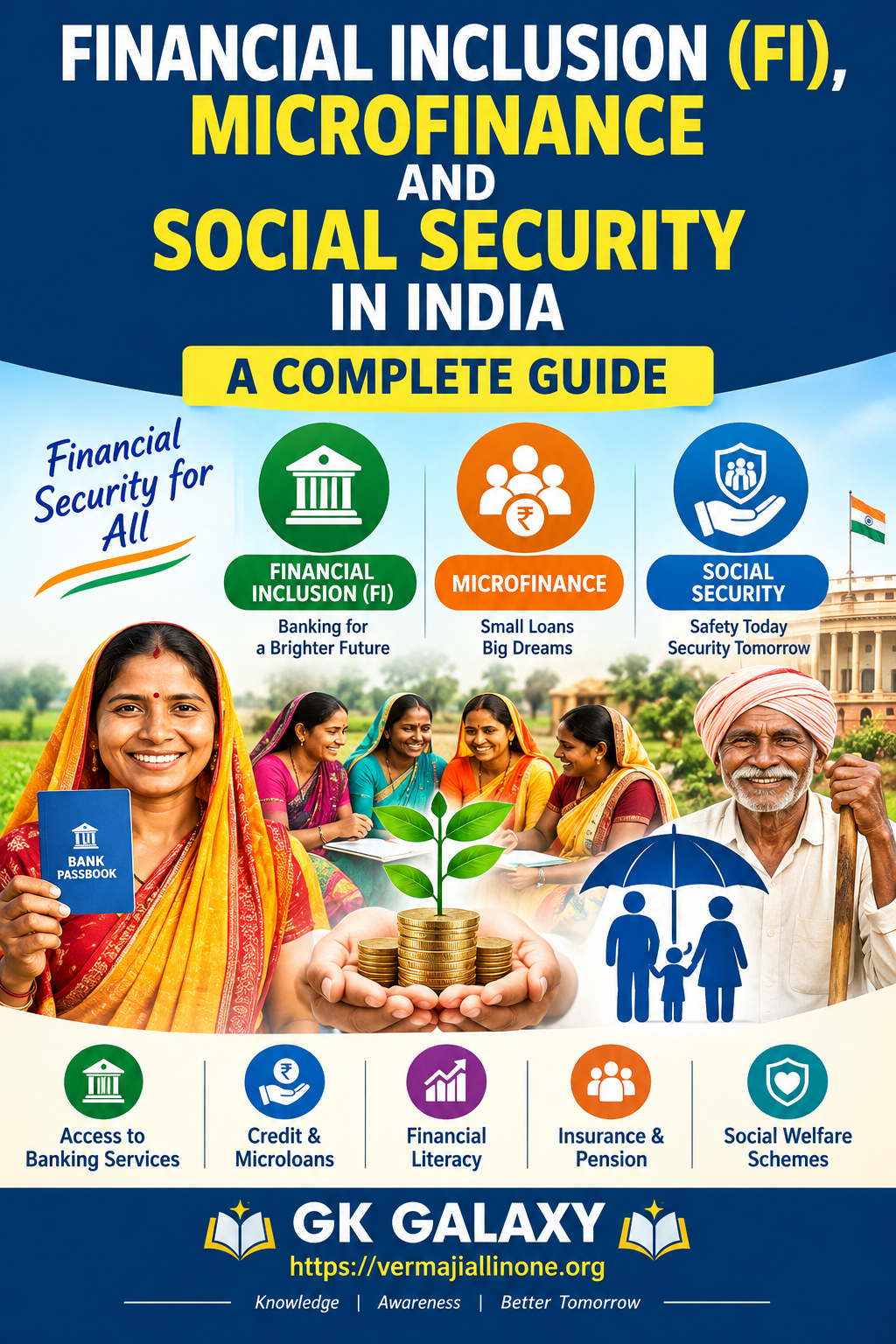
FINANCIAL INCLUSION (FI), MICROFINANCE AND SOCIAL SECURITY IN INDIA:A COMPLETE GUIDE
DISCLAIMER
This article is published by GK GALAXY for educational and general informational purposes only. It is not financial, investment, insurance, legal or tax advice. Scheme information, eligibility requirements, premiums, interest rates and benefits may change over time. Readers should verify the latest details through the relevant official government departments, regulatory authorities and financial institutions before making a financial decision. The website owner does not guarantee the accuracy or completeness of every detail and shall not be responsible for losses arising from reliance on this article, subject to applicable law.
1. INTRODUCTION
Financial Inclusion (FI), Microfinance and Social Security are three important pillars of inclusive economic development. They help individuals and families access formal financial services, improve their livelihoods, manage financial risks and protect themselves against unexpected economic difficulties.
In a developing country such as India, economic progress depends not only on the growth of industries, businesses and national income but also on whether ordinary citizens can participate in the financial system. Farmers, agricultural labourers, street vendors, small shopkeepers, artisans, domestic workers, women entrepreneurs and low-income households require suitable financial services to meet their daily needs and build a more secure future.
For many years, sections of India’s population faced difficulties accessing formal banking services. Some people lived far from bank branches, while others lacked sufficient documentation, financial literacy, regular income or confidence in dealing with financial institutions. Consequently, they often depended on informal lenders, relatives or other costly sources of credit.
Financial inclusion seeks to reduce these barriers by making appropriate financial products and services accessible and affordable. Microfinance supports people who need relatively small loans and related financial services, particularly those who have limited access to conventional credit. Social security provides protection against risks such as death, accidents, old age, disability, unemployment and poverty.
These three concepts are closely connected. A bank account can help a family save money and receive government benefits. A responsible microfinance loan can help a woman establish a small enterprise. Insurance can protect her family against the financial consequences of an accident or death. Pension arrangements can provide income during old age.
India has introduced several initiatives to expand access to banking, credit, insurance and pensions. The Pradhan Mantri Jan-Dhan Yojana (PMJDY), Pradhan Mantri Mudra Yojana (PMMY), Pradhan Mantri Jeevan Jyoti Bima Yojana (PMJJBY), Pradhan Mantri Suraksha Bima Yojana (PMSBY) and Atal Pension Yojana (APY) are important examples.
According to the Press Information Bureau, as of 1 July 2026, approximately 58.63 crore PMJDY accounts had been opened, while cumulative enrolments under PMJJBY and PMSBY had reached 27.84 crore and 58.78 crore, respectively. These figures illustrate the extensive reach of India’s financial inclusion initiatives. They represent account openings and cumulative enrolments, however, and should not automatically be interpreted as the number of unique individuals currently receiving benefits.
Official source: Ministry of Finance — Financial Inclusion Mission.
This article explains the meaning, objectives, importance, mechanisms, benefits, limitations and future prospects of Financial Inclusion, Microfinance and Social Security in India.
2. MEANING OF FINANCIAL INCLUSION (FI)
Financial Inclusion refers to the process of ensuring that individuals and businesses can access and appropriately use affordable, useful and responsible financial products and services.
These services generally include:
Savings and deposit accounts.
Payments and money transfers.
Credit and loans.
Insurance.
Pension products.
Digital banking facilities.
Financial education and consumer protection.
Financial inclusion does not simply mean opening a bank account. An account is an important first step, but meaningful inclusion requires people to use suitable financial services safely and effectively.
For example, a person may possess a bank account but rarely use it because the nearest banking facility is too far away. Another person may receive government payments through a bank but lack the knowledge needed to protect their account from fraud. In both situations, account ownership alone does not guarantee complete financial inclusion.
A successful financial inclusion system must therefore address access, affordability, availability, usability, awareness and consumer protection.
2.1 ACCESS TO FINANCIAL SERVICES
Access means that people can obtain financial services when and where they need them.
Banks, regional rural banks, small finance banks, cooperative banks, business correspondents and authorised digital channels can help extend services to rural and underserved areas.
Banking access is particularly important for people who live far from urban centres or have limited opportunities to visit conventional bank branches.
2.2 AFFORDABILITY
Financial services should be reasonably priced for the people who need them.
High fees, expensive credit, hidden charges and complicated procedures may discourage low-income households from using formal financial services.
Affordable banking and transparent loan terms can encourage people to move away from unsafe or expensive informal financial arrangements.
2.3 AVAILABILITY
A financial service must be available when a customer needs it.
This requires functioning bank branches, accessible customer support, reliable payment systems, adequate cash availability and dependable digital infrastructure.
In remote areas, business correspondents and mobile banking services may improve availability.
2.4 FINANCIAL LITERACY
Financial literacy means understanding basic financial concepts and using that knowledge to make informed decisions.
It includes understanding interest rates, loan repayment, savings, inflation, insurance premiums, pension contributions, digital payments and fraud prevention.
Financially literate customers are generally better equipped to compare products, identify misleading offers and assess whether a loan is affordable.
2.5 RESPONSIBLE FINANCIAL SERVICES
Financial inclusion must protect customers from unsuitable products, excessive borrowing, misleading information and unfair recovery practices.
A loan should not be promoted merely because a customer qualifies for it. The loan should serve a reasonable purpose, have transparent terms and be affordable under realistic household income conditions.
Financial inclusion is most effective when access is accompanied by responsibility, transparency and consumer protection.
3. OBJECTIVES OF FINANCIAL INCLUSION
The major objectives of Financial Inclusion are explained below.
3.1 PROVIDING UNIVERSAL BANKING ACCESS
One important objective is to connect people who lack formal banking facilities with the regulated financial system.
A basic bank account enables people to deposit money, withdraw funds, receive transfers and conduct eligible transactions.
The Pradhan Mantri Jan-Dhan Yojana is a major Indian initiative designed to expand access to basic banking services.
3.2 ENCOURAGING SAVINGS
Savings help households prepare for emergencies, education, healthcare, business investment and other future expenses.
When people have access to secure deposit accounts, they can keep money in the formal financial system rather than relying entirely on cash kept at home.
Formal savings can also create a financial record that may assist customers when applying for suitable financial products.
3.3 IMPROVING ACCESS TO CREDIT
Small businesses and low-income households may require credit for working capital, equipment, livestock, education or other productive purposes.
Financial inclusion aims to improve access to suitable formal credit while reducing dependence on informal lenders who may charge excessive interest or impose unfair conditions.
However, expanding credit must not encourage people to borrow beyond their repayment capacity.
3.4 PROMOTING INSURANCE COVERAGE
Insurance helps protect households against specified financial losses.
Life insurance can provide a benefit to eligible nominees following the insured person’s death. Accident insurance can provide benefits for covered accidental death or disability. Health insurance can help cover eligible medical expenses under the policy’s terms.
Insurance is an important component of financial inclusion because even a financially stable household may experience severe difficulties following an unexpected event.
3.5 SUPPORTING PENSION SECURITY
Many workers in the informal economy do not have access to employer-sponsored pensions.
Financial inclusion can connect eligible people with pension arrangements that help them prepare for retirement.
Pension products differ in their contribution requirements, eligibility rules, benefits and risks. People should understand these conditions before enrolling.
3.6 EMPOWERING WOMEN
Financial inclusion can strengthen women’s economic participation by improving access to savings, credit, insurance and financial decision-making.
Women’s self-help groups, bank accounts and microfinance arrangements may support income-generating activities, entrepreneurship and household financial management.
However, genuine empowerment requires that women retain control over their accounts, loans, businesses and financial decisions.
3.7 SUPPORTING RURAL DEVELOPMENT
Farmers, agricultural workers, artisans and rural entrepreneurs need financial services that reflect their income patterns and local economic conditions.
Suitable banking, credit and insurance services can help them invest in productive activities, manage seasonal expenses and reduce financial vulnerability.
3.8 REDUCING FINANCIAL EXCLUSION
Financial exclusion can arise from poverty, geographical isolation, inadequate documentation, disability, limited literacy, language barriers or insufficient access to digital technology.
Financial inclusion initiatives aim to remove these barriers and improve opportunities for disadvantaged groups.
4. MEANING OF MICROFINANCE
Microfinance refers to the provision of relatively small-scale financial services to individuals, households and microenterprises that may have difficulty accessing conventional financial products.
These services can include small loans, savings facilities, insurance, payment services and financial education, depending on the institution and its regulatory permissions.
Microfinance is often associated with low-income households, rural communities, women entrepreneurs, street vendors, artisans and small business owners.
A microfinance loan may help someone purchase raw materials, buy a sewing machine, expand a small grocery shop, acquire livestock or meet another eligible financial need.
Microfinance is not limited to charitable lending. It may operate through regulated banks, non-banking financial companies, microfinance institutions, self-help groups and other permitted arrangements.
The essential objective is to improve access to suitable financial services while maintaining responsible lending and sustainable repayment practices.
4.1 EXAMPLE OF MICROFINANCE
Consider a woman who operates a small tailoring business from her home.
She receives regular orders but cannot purchase enough fabric and equipment to expand production. A suitable small business loan may allow her to buy additional materials, improve her equipment and accept more orders.
If her business generates sufficient additional income, she may repay the loan and increase her household earnings.
However, the result depends on actual demand, operating costs, competition, loan interest and repayment conditions. A loan does not automatically guarantee business success.
The borrower should prepare a realistic budget and assess whether expected income will cover business expenses and loan repayments.
4.2 MAIN CHARACTERISTICS OF MICROFINANCE
Small-scale financial assistance: Microfinance often focuses on smaller financing requirements rather than large corporate loans.
Targeted customer groups: It commonly serves individuals and enterprises with limited access to conventional financial services.
Alternative delivery models: Services may be provided through branches, field officers, group-based arrangements, business correspondents or digital channels.
Income-generation potential: Credit may support small enterprises, agriculture-related activities and other productive purposes.
Financial education: Some providers combine financial services with budgeting, entrepreneurship training and repayment awareness.
Responsible lending requirements: Regulated lenders must comply with applicable rules and assess the borrower’s financial circumstances.
Repayment obligations: A microfinance loan is generally a debt that must be repaid according to the agreed terms. It should never be confused with a grant or subsidy.
5. Difference Between Financial Inclusion and Microfinance
Financial Inclusion and Microfinance are related concepts, but they are not identical.
| Basis | Financial Inclusion | Microfinance |
| Meaning | Broad access to appropriate financial services | Provision of small-scale financial services |
| Main objective | Reduce financial exclusion | Meet the financial needs of underserved customers |
| Scope | Banking, savings, payments, credit, insurance and pensions | Often focuses on small loans and related services |
| Target groups | Individuals and businesses across underserved and other population groups | Frequently low-income households and microenterprises |
| Services | Includes many types of financial products | Includes services permitted by the provider’s business model |
| Role of credit | One component among several | Often an important component |
| Examples | PMJDY, banking access and digital payments | Small enterprise loans and eligible SHG lending |
Financial inclusion is the broader objective. Microfinance is one of the mechanisms that can contribute to that objective.
A person who opens a basic savings account becomes connected to formal banking even if they never take a microfinance loan. Similarly, a microfinance borrower may still need better access to insurance, pensions, savings and digital financial services.
6. MEANING OF SOCIAL SECURITY
Social Security refers to arrangements intended to protect people against specified social and economic risks that may threaten their income, health, dignity or ability to meet essential needs.
These risks include old age, disability, death of an earning family member, illness, workplace injury, unemployment and poverty.
Social security may be provided through government programmes, statutory benefits, social insurance, contributory pension schemes, employer arrangements and other legally established systems.
In India, social security includes a combination of contributory insurance and pension programmes, welfare assistance and other forms of protection.
The exact benefits available to an individual depend on the relevant scheme, eligibility criteria, contributions, state-level rules and applicable legislation.
6.1 WHY SOCIAL SECURITY IS NECESSARY
A household may work hard and manage its money carefully but still experience a major financial shock.
For example:
The death of an earning member may reduce family income.
An accident may prevent a worker from earning.
Medical expenses may consume accumulated savings.
Old age may reduce the ability to continue working.
Disability may create additional living and care expenses.
A prolonged employment interruption may make it difficult to pay for food, housing and education.
Social security seeks to reduce the financial impact of such events.
It does not eliminate every risk, and no single programme covers all possible needs. Effective protection often requires a combination of savings, insurance, pensions, public assistance and appropriate employment-related benefits.
7. RELATIONSHIP BETWEEN FINANCIAL INCLUSION, MICROFINANCE AND SOCIAL SECURITY
These three concepts reinforce one another.
Financial inclusion provides access to the financial system. Microfinance can help eligible borrowers obtain small-scale credit. Social security can protect households against specified financial shocks.
Consider a hypothetical rural household.
First, an adult opens a bank account and begins saving small amounts regularly. The account may also enable eligible government benefits to be received directly.
Second, a family member obtains an appropriately assessed microfinance loan to expand a small business. If the business succeeds, the additional income may support household expenses and loan repayment.
Third, eligible family members enrol in suitable insurance or pension programmes. These arrangements may provide benefits if the events covered by the relevant schemes occur and all applicable conditions are met.
The household may become better prepared for financial difficulties through this combination of services.
Nevertheless, these benefits are not automatic. Savings depend on the household’s ability to set money aside, business income depends on market conditions, and insurance or pension benefits depend on the terms of the relevant scheme.
The objective is not simply to provide more financial products. It is to help people use appropriate products to improve financial stability and long-term well-being.
8. IMPORTANCE OF FINANCIAL INCLUSION IN INDIA
Financial inclusion is important because India’s population includes people with widely differing income levels, occupations, educational backgrounds and access to infrastructure.
8.1 CONNECTING PEOPLE WITH FORMAL BANKING
A bank account gives people a formal channel for deposits, withdrawals and eligible transfers.
It may also provide access to additional services, subject to the customer’s eligibility and the bank’s terms.
8.2 IMPROVING GOVERNMENT BENEFIT DELIVERY
Eligible government benefits can be transferred directly into beneficiaries’ bank accounts through Direct Benefit Transfer arrangements.
This can reduce the need for physical cash distribution and improve the traceability of payments. However, successful delivery still depends on correct beneficiary information, functioning accounts, reliable payment systems and accessible grievance mechanisms.
8.3 SUPPORTING SMALL BUSINESSES
Small enterprises frequently need working capital and equipment financing.
Access to appropriate formal credit can help them purchase inventory, improve productivity and manage business operations.
8.4 REDUCING DEPENDENCE ON INFORMAL CREDIT
Formal financial services may offer clearer contracts, regulated practices and documented repayment terms.
They can provide alternatives to informal borrowing, although formal credit is not necessarily affordable in every case. Customers must compare the total cost and repayment obligations of available options.
8.5 ENCOURAGING DIGITAL TRANSACTIONS
Digital payments can reduce the need to travel to bank branches and make certain transactions more convenient.
Their benefits depend on reliable connectivity, accessible technology, user awareness and effective protection against fraud.
8.6 PROMOTING WOMEN’S ECONOMIC PARTICIPATION
Access to financial services can help women save independently, participate in self-help groups, establish businesses and build financial confidence.
Financial education and control over funds are essential if these opportunities are to translate into meaningful empowerment.
8.7 STRENGTHENING HOUSEHOLD RESILIENCE
Savings, appropriate insurance, affordable credit and pension arrangements can help households prepare for unexpected expenses and changes in income.
Financial inclusion is therefore relevant to both economic development and social welfare.
9. MAJOR FINANCIAL INCLUSION INITIATIVES IN INDIA
India has introduced a range of initiatives to expand banking access, support entrepreneurship and improve social security coverage.
The following programmes illustrate important components of this system. Their eligibility criteria, premiums, benefits and operating rules can change; prospective beneficiaries should check the latest official guidance before applying.
9.1 PRADHAN MANTRI JAN-DHAN YOJANA (PMJDY)
The Pradhan Mantri Jan-Dhan Yojana was launched on 28 August 2014 as a national financial inclusion mission.
Its purpose is to provide access to basic banking services, including savings accounts, remittances, eligible credit facilities, insurance and pensions.
Major features include:
Basic savings bank deposit accounts for eligible unbanked individuals.
No minimum balance requirement for PMJDY basic accounts.
Interest on eligible account deposits according to applicable bank terms.
RuPay debit card facilities.
Access to eligible direct benefit transfers.
Potential access to an overdraft facility, subject to conditions.
Links to eligible insurance and pension programmes.
PMJDY is important because a bank account can act as an entry point to a wider range of financial services.
However, account holders should understand that the availability of an overdraft, insurance benefit or other facility is subject to the relevant scheme and eligibility conditions. Opening an account does not guarantee every associated benefit.
Official website: https://www.pmjdy.gov.in/
9.2 PRADHAN MANTRI MUDRA YOJANA (PMMY)
The Pradhan Mantri Mudra Yojana supports eligible non-corporate, non-farm micro and small enterprises through institutional lending.
It is intended to improve access to finance for income-generating business activities in sectors such as manufacturing, trading, services and eligible agriculture-allied activities.
Potential applicants may include small shopkeepers, service providers, artisans and other qualifying microenterprise operators.
The loan amount, applicable interest rate, repayment period, documentation and approval depend on the lending institution, the borrower’s circumstances and the applicable scheme rules.
A MUDRA loan is not automatically a government grant. Borrowers must repay the loan according to the agreed terms.
Applicants should prepare a business plan, estimate revenue and expenses, calculate repayment capacity and understand all charges before accepting an offer.
Official website: https://www.mudra.org.in/
9.3 SELF-HELP GROUPS (SHGS)
Self-help groups are collectives whose members commonly save money regularly and may access loans through group funds or linkages with financial institutions.
SHGs have become an important mechanism for expanding financial access, particularly among rural women.
Their activities may include:
Regular savings.
Internal lending to members.
Collective financial decision-making.
Bank linkage.
Livelihood and enterprise activities.
Financial literacy and community development.
Group-based arrangements may reduce some barriers to formal credit, especially for people who lack conventional collateral or an extensive credit history.
However, a group loan creates repayment responsibilities. Members should understand the terms and ensure that group decisions are transparent and fair.
9.4 JOINT LIABILITY GROUPS (JLGS)
Joint Liability Groups are arrangements through which members may obtain loans under specified lending structures.
They can be useful for small borrowers, including some farmers and microentrepreneurs, depending on the lender’s programme.
The group structure may support access to credit, but members must understand the precise liability provisions in the loan agreement. They should never assume that joining a group removes their financial obligations.
9.5 BUSINESS CORRESPONDENTS AND BANKING OUTREACH
Business correspondents help banks deliver selected services beyond conventional branches.
Depending on their authorisation and available infrastructure, they may facilitate account-related services, cash transactions, transfers and customer assistance.
These arrangements can be especially useful in remote communities where a full-service branch is not readily accessible.
Customers should use authorised service providers, obtain transaction receipts and avoid sharing confidential PINs or passwords.
9.6 DIGITAL FINANCIAL INCLUSION
Digital financial inclusion involves the use of technology to provide or access financial services.
Examples include mobile banking, internet banking, electronic transfers, QR-based payments and other authorised digital payment channels.
Digital services may improve convenience and reduce travel costs, but they also introduce risks such as phishing, impersonation, fraudulent payment requests and unauthorised transactions.
Financial education and secure digital practices must therefore accompany digital expansion.
10. MICROFINANCE INSTITUTIONS IN INDIA
Microfinance services in India are delivered through several types of institutions and arrangements. Their legal status, permissible activities and regulatory obligations may differ.
10.1 BANKS
Commercial banks, regional rural banks, small finance banks and eligible cooperative banks may provide loans and other financial services to qualifying customers.
Banks can support financial inclusion through savings accounts, credit facilities, insurance distribution where authorised, pension products and digital payments.
Their lending decisions generally depend on eligibility, repayment capacity, documentation, internal policies and applicable regulations.
10.2 NON-BANKING FINANCIAL COMPANIES (NBFCS)
NBFCs are financial institutions registered under the applicable legal framework and subject to relevant regulatory requirements.
Some NBFCs specialise in microfinance, while others serve different customer segments or provide different financial products.
NBFCs can help extend credit to underserved households and small businesses. Customers should verify the institution’s identity, understand the loan agreement and check the total repayment obligation before borrowing.
10.3 NBFC-MICROFINANCE INSTITUTIONS
NBFC-MFIs are a category of non-banking financial companies that meet the applicable regulatory definition and requirements for microfinance institutions.
They may specialise in lending to low-income households and customers who have limited access to conventional credit.
Their operations can involve field-based customer assessment, group meetings, loan servicing and financial awareness activities.
Borrowers should remember that the term microfinance institution does not mean that all its services are free or that every applicant is entitled to a loan.
10.4 SELF-HELP GROUPS AND THEIR FEDERATIONS
Self-help groups can pool savings, make internal loans and establish relationships with banks.
In many rural communities, they also provide a platform for women to develop business skills, share information and participate in collective livelihood activities.
Federations and support organisations may help groups access training, market opportunities and institutional assistance.
Effective governance, transparent recordkeeping and fair decision-making are essential to their success.
10.5 NON-GOVERNMENTAL ORGANISATIONS
Some non-governmental organisations contribute to financial inclusion by providing financial education, supporting self-help groups, facilitating access to formal institutions and promoting livelihood development.
Their role depends on their legal status, funding, programme design and any applicable permissions.
An organisation that offers training or community support should not automatically be assumed to be authorised to accept deposits or provide regulated financial products.
10.6 FINTECH COMPANIES AND DIGITAL LENDING PLATFORMS
Financial technology companies use software, digital communication and data-processing systems to support financial services.
Some work with regulated lenders, while others provide technology or customer-service functions.
Digital channels can make certain services more convenient, but customers must verify which regulated institution is actually providing the loan.
Before accepting a digital loan, borrowers should examine the lender’s identity, annual percentage cost where disclosed, interest rate, fees, repayment schedule, privacy permissions and grievance process.
Customers should avoid unknown applications that demand unnecessary access to contacts, photographs or other sensitive information.
11. REGULATORY FRAMEWORK FOR MICROFINANCE IN INDIA
Regulation is essential for protecting borrowers and maintaining confidence in the financial system.
The Reserve Bank of India (RBI) is an important regulator of banks and specified non-banking financial institutions. Its rules govern relevant aspects of lending, customer assessment, disclosures and fair practices.
The RBI issued the Master Direction — Reserve Bank of India (Regulatory Framework for Microfinance Loans) Directions, 2022, effective from 1 April 2022, with subsequent updates. The RBI’s published FAQ on the framework was updated on 30 January 2025.
Official reference: RBI — Regulatory Framework for Microfinance Loans FAQ.
11.1 DEFINITION OF A MICROFINANCE LOAN
Under the RBI framework, a microfinance loan is a collateral-free loan given to a household with annual income of up to ₹3 lakh.
The definition is important because it identifies the household income threshold used for this regulatory classification.
A loan secured by collateral does not qualify as a microfinance loan under this definition merely because the amount is small.
11.2 HOUSEHOLD INCOME ASSESSMENT
Lenders must follow the applicable framework for assessing household income and indebtedness.
This assessment helps them evaluate whether a borrower can reasonably manage the proposed repayment obligations.
The household assessment does not mean that every member must become a borrower. The RBI’s FAQ clarifies that a loan may be provided to an individual household member, subject to the applicable rules and the lender’s policies.
11.3 REPAYMENT CAPACITY
A responsible lender must consider the household’s repayment capacity under the applicable framework.
Household income, existing debt obligations and other relevant financial information help establish whether the proposed loan is suitable.
Borrowers should also disclose existing loans accurately. Concealing debt can lead to unsuitable borrowing and financial stress.
11.4 INTEREST RATES AND CHARGES
Customers should receive clear information about the applicable interest rate and charges.
A borrower should compare the total amount payable, rather than relying solely on a small advertised instalment.
Two loans with similar instalments may have different total costs because of differences in tenure, fees or repayment structures.
The RBI framework contains requirements concerning the pricing and disclosure of microfinance loans. Customers should consult the latest applicable rules and the lender’s written documents before accepting a loan.
11.5 FAIR RECOVERY PRACTICES
Loan recovery must follow applicable legal and regulatory requirements.
Borrowers should not be subjected to unlawful intimidation, public humiliation, harassment or other prohibited practices.
If a borrower encounters unfair recovery behaviour, they should retain relevant records and use the lender’s grievance mechanism. Depending on the institution and the issue, further complaint channels may be available through the relevant regulator or legal authorities.
11.6 WHY REGULATION MATTERS
Effective regulation can help:
Improve transparency.
Establish minimum customer-protection standards.
Encourage responsible lending.
Reduce unfair lending and recovery practices.
Strengthen complaint-handling processes.
Support trust in formal financial institutions.
Regulation cannot eliminate every financial risk. Customers still need to compare products, understand contracts and borrow cautiously.
12. BENEFITS OF MICROFINANCE
Microfinance can contribute to household welfare and local economic development when products are suitable, costs are reasonable and borrowing supports a realistic financial plan.
12.1 ACCESS TO SMALL LOANS
Traditional lenders may find it difficult to serve some customers with very small financing needs.
Microfinance can provide an additional channel for eligible borrowers who need relatively modest amounts for business or other permitted purposes.
The suitability of a loan depends on the customer’s circumstances and the provider’s assessment.
12.2 SUPPORT FOR MICROENTERPRISES
Small enterprises often need funds to purchase raw materials, maintain inventory, repair equipment or meet seasonal operating expenses.
An appropriately structured loan can help a business manage these needs.
For example, a small food vendor may need working capital to purchase ingredients in bulk. If the expected increase in revenue exceeds the additional expenses and financing cost, the loan may be economically useful.
The vendor should still consider changes in demand, food prices, competition and unexpected costs.
12.3 WOMEN’S ECONOMIC PARTICIPATION
Microfinance programmes often serve women who operate small enterprises or participate in self-help groups.
Access to credit can provide opportunities to invest in a business, improve working capital and develop independent income sources.
However, borrowing in a woman’s name does not necessarily mean that she controls the money. Programmes should encourage informed consent, financial independence and genuine participation in decisions.
12.4 EMPLOYMENT AND LIVELIHOOD OPPORTUNITIES
Successful microenterprises may generate self-employment and, in some cases, additional jobs.
A small tailoring business, food-processing unit, repair shop or handicraft enterprise may expand when demand and management capacity support growth.
Employment outcomes are not guaranteed. Business performance depends on the quality of the product or service, market access, costs, skills and broader economic conditions.
12.5 REDUCED DEPENDENCE ON INFORMAL LENDERS
Responsible formal lending may provide an alternative to informal credit sources that offer limited documentation or impose excessive charges.
Borrowers should nevertheless compare all available options carefully. A formal loan can still become burdensome if its cost is high or repayment terms are unsuitable.
12.6 FINANCIAL DISCIPLINE
Regular loan repayments may encourage borrowers to maintain records, prepare budgets and monitor income and expenditure.
These practices can improve financial management when instalments remain affordable.
They can have the opposite effect if repayment pressure forces households to reduce essential spending or take new loans merely to repay older ones.
12.7 COMMUNITY-LEVEL ECONOMIC ACTIVITY
When credit supports viable enterprises, local communities may benefit through increased production, services and trade.
Small enterprises may also create demand for local suppliers and workers.
The extent of these benefits depends on whether the financed activities generate sustainable economic value.
12.8 ACCESS TO FINANCIAL EXPERIENCE
Customers who enter the formal financial system may gain experience with account management, loan documentation, digital payments and other services.
Such experience can help them make more informed decisions about future financial needs.
Financial education remains important because participation alone does not guarantee that customers understand every product.
13. RISKS AND LIMITATIONS OF MICROFINANCE
Microfinance can create opportunities, but it also involves risks. Responsible lending requires an honest assessment of these limitations.
13.1 OVER-INDEBTEDNESS
Over-indebtedness occurs when a household’s debt obligations become difficult to manage using its available income.
This can happen when borrowers take multiple loans, experience reduced income, underestimate expenses or use new borrowing to repay existing debt.
For example, a household that takes loans from several lenders may find that its combined monthly instalments exceed the amount available after food, housing, healthcare and other essential expenses.
The borrower may then miss repayments, sell productive assets or borrow again at additional cost.
Household income and indebtedness assessment, transparent disclosures and responsible borrowing can help reduce this risk.
13.2 IRREGULAR INCOME
Many microfinance customers earn income from agriculture, daily-wage work, seasonal employment or small businesses.
Their income may fluctuate from month to month.
A fixed repayment schedule can become difficult to manage during a period of low income, even when the business is viable over the longer term.
Borrowers should assess their income pattern before choosing a repayment arrangement.
13.3 BUSINESS FAILURE
A loan does not guarantee that a business will succeed.
Demand may fall, competitors may enter the market, equipment may break down or the cost of raw materials may rise.
If a business fails, the repayment obligation generally remains unless the lender agrees to a permitted restructuring, settlement or other arrangement.
Borrowers should prepare a realistic business plan and avoid assuming that future profits are certain.
13.4 HIGH FINANCING COSTS
The cost of borrowing may include interest, fees and other permitted charges.
Even a seemingly small instalment can add up to a substantial total repayment amount over the loan term.
Customers should ask for written information showing the amount borrowed, interest rate, fees, repayment schedule and total amount payable.
They should also understand whether any additional products are optional or required under applicable rules.
13.5 GROUP PRESSURE
Group-based lending may encourage peer support and financial discipline, but it can also create pressure among members.
Borrowers should not be forced to take loans they do not need or cannot repay.
Group leaders and members should maintain transparent records and avoid coercion.
13.6 INADEQUATE FINANCIAL LITERACY
Some borrowers may not fully understand loan agreements, repayment calculations or the consequences of default.
They may focus on the amount received without considering the total cost.
Financial education should explain interest, instalments, late-payment consequences, complaint procedures and the importance of borrowing only what is necessary.
13.7 FRAUD AND MISREPRESENTATION
Fraudulent agents may promise guaranteed loans, subsidies or debt waivers in exchange for advance payments.
Borrowers should verify the institution and avoid paying unknown intermediaries for supposed guaranteed approvals.
They should never disclose OTPs, PINs or banking passwords to callers claiming to represent a lender.
13.8 ECONOMIC SHOCKS
Floods, droughts, illness, local business disruptions and other unexpected events can reduce household income.
A household that was able to repay a loan when it was issued may later experience difficulty.
Emergency savings, suitable insurance and accessible complaint or support mechanisms can help, but they cannot eliminate every consequence of an economic shock.
13.9 RESPONSIBLE USE OF MICROFINANCE
The purpose of microfinance should not be reduced to increasing the number of loans distributed.
A responsible programme should consider whether borrowers understand the terms, whether repayment is realistic, whether the product suits the customer’s needs and whether the customer is treated fairly.
The quality and sustainability of lending matter as much as access.
14. SOCIAL SECURITY SCHEMES IN INDIA
Social security programmes help eligible individuals and families manage specified risks.
India’s social security framework includes insurance, pensions, welfare assistance and employment-related benefits. The following schemes are particularly relevant to financial inclusion.
Important: Scheme conditions and amounts may change. The details below should be checked against the latest official scheme documents before publication or application.
14.1 PRADHAN MANTRI JEEVAN JYOTI BIMA YOJANA (PMJJBY)
The Pradhan Mantri Jeevan Jyoti Bima Yojana is a renewable term life insurance scheme.
Under the published scheme terms, eligible subscribers generally receive life cover of ₹2 lakh for death due to any cause, subject to the policy’s conditions.
The commonly published eligibility age for entry is 18–50 years, with renewal provisions applying according to scheme rules.
The annual premium reported in official scheme information is ₹436. Premiums are generally collected through an authorised automatic debit arrangement from the linked bank account.
Key points include:
It provides life insurance rather than a savings account or investment return.
The benefit is payable to the eligible nominee or beneficiary when the claim meets the scheme conditions.
Enrolment, renewal and continuation are subject to the applicable rules.
Subscribers should maintain sufficient funds for the premium debit.
Nominee details should be accurate and kept updated.
The scheme can help reduce the financial impact of an insured person’s death on the family. However, a ₹2 lakh benefit may not be sufficient to replace many years of household income, so families may need to assess additional protection.
Official information: Department of Financial Services.
14.2 PRADHAN MANTRI SURAKSHA BIMA YOJANA (PMSBY)
The Pradhan Mantri Suraksha Bima Yojana is a renewable personal accident insurance scheme.
Under the published terms, eligible subscribers generally receive:
₹2 lakh for accidental death or permanent total disability covered by the scheme.
₹1 lakh for permanent partial disability covered by the scheme.
The commonly published annual premium is ₹20, subject to the scheme’s current rules.
The usual eligible entry-age range is 18–70 years.
PMSBY is specifically associated with covered accidental events. It should not be confused with life insurance covering death from every cause.
Applicants should read the policy conditions carefully, including the definitions of covered disability, exclusions, claim documentation and renewal provisions.
Official information: Department of Financial Services.
14.3 ATAL PENSION YOJANA (APY)
The Atal Pension Yojana is a contributory pension scheme intended to help eligible subscribers prepare for retirement.
Under the established scheme structure, eligible subscribers who meet the applicable joining and contribution conditions can qualify for a guaranteed minimum monthly pension of ₹1,000, ₹2,000, ₹3,000, ₹4,000 or ₹5,000 from age 60, depending on their chosen pension amount and contribution requirements.
The contribution depends on factors such as the subscriber’s age at joining and the selected pension benefit.
The scheme has eligibility restrictions, including rules concerning age and certain categories of income-tax payers. Applicants must check the current rules rather than assuming that every adult can join.
APY is useful because it encourages long-term pension planning. However, the chosen pension amount should be evaluated in relation to expected living costs and inflation.
A fixed nominal pension may buy less in the future if prices rise significantly.
Official information: National Pension System Trust and the Department of Financial Services.
14.4 NATIONAL SOCIAL ASSISTANCE PROGRAMME (NSAP)
The National Social Assistance Programme has historically provided social assistance to eligible elderly people, widows and persons with disabilities, along with other assistance under its constituent programmes.
Eligibility, pension amounts and administrative procedures can involve both central and state-level rules.
Beneficiaries should check the current programme structure, applicable income or deprivation criteria, documentation and the rules of their state or union territory.
For website publication, the latest official government notification should be consulted because programme names, funding arrangements and benefit amounts may be revised.
Official information can be sought through the Ministry of Rural Development.
14.5 PUBLIC PROVIDENT FUND (PPF)
The Public Provident Fund is a long-term savings scheme that can help eligible individuals build financial resources over time.
It differs from a social assistance pension because it primarily depends on the subscriber’s contributions and the scheme’s interest provisions.
PPF may be suitable for some long-term savings objectives, but its contribution rules, tenure, withdrawal provisions and tax treatment should be considered before investing.
People with limited disposable income should first assess essential expenses, emergency savings and expensive outstanding debt before committing to a long-term savings arrangement.
Official information: India Post.
14.6 EMPLOYEES’ PROVIDENT FUND (EPF)
The Employees’ Provident Fund is an important retirement savings arrangement for covered employees and establishments under the applicable legal framework.
Contributions accumulate according to the scheme rules, and eligible members may also have access to other benefits under the broader provident fund and social security system.
EPF coverage depends on the applicable law and employment circumstances. It should not be assumed that every informal worker is automatically covered.
Employees should check their membership, contribution records and nomination details through the authorised channels.
Official information: Employees’ Provident Fund Organisation.
14.7 EMPLOYEE STATE INSURANCE (ESI)
The Employees’ State Insurance scheme provides specified social insurance benefits to eligible employees and their families under applicable coverage and contribution rules.
Depending on the circumstances and scheme provisions, benefits may include medical care and cash benefits relating to certain sickness, maternity, disability or employment-injury situations.
Coverage depends on the relevant legal requirements, establishment and employee eligibility.
Employees should verify their registration and understand the process for accessing covered benefits.
Official information: Employees’ State Insurance Corporation.
14.8 AYUSHMAN BHARAT — PRADHAN MANTRI JAN AROGYA YOJANA (AB PM-JAY)
AB PM-JAY is a publicly funded health assurance initiative for eligible beneficiaries under the applicable scheme rules.
Its coverage, eligibility criteria, participating hospitals and authorised treatment packages are governed by official programme provisions.
Eligible beneficiaries should use official channels to confirm their entitlement and identify participating hospitals.
Health assurance can help reduce certain eligible treatment expenses, but it should not be interpreted as unlimited coverage for every medical service or every individual.
Official information: National Health Authority.
14.9 STATE GOVERNMENT SOCIAL SECURITY PROGRAMMES
State governments may operate pensions, scholarships, welfare assistance, insurance arrangements and other programmes for eligible residents.
The details differ across states.
A person should therefore verify whether a central scheme, state scheme or both are applicable to their circumstances.
Documents commonly requested by particular programmes may include identity records, bank details, age or income evidence, disability certificates or other scheme-specific documents. The exact requirements must be checked with the relevant authority.
15. HOW FINANCIAL INCLUSION SUPPORTS SOCIAL SECURITY
Financial inclusion and social security can reinforce each other in several ways.
15.1 BANK ACCOUNTS FOR BENEFIT TRANSFERS
An eligible beneficiary may receive a government payment through a linked bank account when the scheme’s requirements are satisfied.
This can reduce dependence on physical cash distribution and help create a record of the payment.
Beneficiaries should keep their bank details updated and verify that the account remains accessible.
15.2 INSURANCE PREMIUM PAYMENTS
Banking arrangements can make it easier for eligible subscribers to pay recurring insurance premiums through authorised automatic debit mechanisms.
Customers should monitor their accounts and confirm that the relevant policy remains active.
A premium debit alone should not be treated as proof that every claim will be payable; policy conditions still apply.
15.3 PENSION CONTRIBUTIONS
Formal financial channels can help eligible subscribers make pension contributions and maintain records of their participation.
Long-term pension planning is more effective when customers understand the required contributions, eligibility rules and benefit structure.
15.4 FINANCIAL RECORDS
Formal account and payment records may help people track their income, expenses, savings and loan repayments.
Accurate records can also assist with resolving certain payment disputes.
Customers should regularly check account statements and report suspicious transactions promptly.
15.5 REDUCING FINANCIAL VULNERABILITY
A household that combines appropriate savings, insurance, pensions and responsible borrowing may be better prepared for certain financial shocks.
However, each product serves a different purpose. Credit provides borrowed funds that generally must be repaid, insurance pays specified benefits when policy conditions are met, and pensions provide benefits according to their rules.
These products are complementary, not interchangeable.
16. FINANCIAL INCLUSION AND WOMEN EMPOWERMENT
Women’s economic empowerment is an important dimension of financial inclusion.
In many communities, women contribute significantly to household income, agriculture, caregiving, small businesses and local production. Yet some women have limited control over financial resources or face barriers to obtaining formal credit.
Financial inclusion can help address these challenges.
16.1 INDEPENDENT BANK ACCOUNTS
An account that a woman can access and manage independently may help her save money, receive eligible payments and build confidence in financial decision-making.
Access should include the ability to understand transactions and use the account safely.
16.2 SELF-HELP GROUPS
SHGs can provide a collective structure for regular savings, internal lending, business training and bank linkages.
They may also give members opportunities to discuss shared financial challenges and develop community networks.
Their success depends on transparent governance and meaningful participation by members.
16.3 WOMEN ENTREPRENEURS
Suitable credit may help women purchase equipment, develop products, expand a shop or improve working capital.
Entrepreneurship programmes can be more effective when finance is combined with training, market access, bookkeeping and mentoring.
16.4 FINANCIAL INDEPENDENCE
Women should understand the financial products taken in their names and retain appropriate access to account information and funds.
Programmes should avoid treating women merely as channels for distributing loans to other household members.
16.5 LONG-TERM SECURITY
Savings, eligible insurance and pension arrangements can help women prepare for future financial needs.
This is particularly important for women whose income opportunities may be affected by caregiving responsibilities, interrupted employment or unequal access to assets.
17. FINANCIAL INCLUSION IN RURAL INDIA
Rural financial inclusion must respond to the practical conditions in which people live and work.
Agricultural households may receive income seasonally rather than at regular monthly intervals. Small enterprises may depend on local demand, transport facilities and access to markets.
Financial products should therefore be appropriate for the customer’s income pattern and repayment capacity.
17.1 AGRICULTURAL CREDIT
Farmers may need finance for seeds, fertilisers, equipment, irrigation and other eligible agricultural expenses.
Suitable institutional credit can help meet these needs, but borrowers must consider the timing of expected income and the risks associated with weather and market prices.
17.2 BANKING ACCESS IN REMOTE AREAS
Business correspondents, mobile banking and other authorised service channels can improve access where conventional branches are difficult to reach.
Reliable service requires adequate cash availability, connectivity, trained personnel and clear complaint-handling arrangements.
17.3 LIVESTOCK AND RURAL ENTERPRISES
Some households may use suitable finance to support dairy activities, poultry, handicrafts, food processing or other livelihood activities.
Before borrowing, they should estimate operating expenses, possible income, market demand and the impact of illness or other disruptions.
17.4 DIGITAL LITERACY
Digital tools may make financial services more accessible, but only if users understand how to operate them safely.
Rural financial education should include local-language guidance, fraud awareness and practical assistance.
17.5 FINANCIAL INCLUSION AND POVERTY REDUCTION
Access to appropriate financial services can support poverty reduction by helping households save, invest and manage risks.
However, financial inclusion alone cannot eliminate poverty. Education, healthcare, employment, infrastructure, social protection and broader economic opportunities remain essential.
18. DIGITAL FINANCIAL INCLUSION IN INDIA
Digital financial services have changed the way many people access and use financial products.
Mobile applications, internet banking, electronic fund transfers and interoperable payment systems can reduce certain transaction costs and improve convenience.
18.1 BENEFITS OF DIGITAL BANKING
Digital banking may allow customers to check balances, transfer money, review transactions and make payments without visiting a branch for every task.
It can be particularly helpful for people who live far from a bank or have limited time to travel.
18.2 DIRECT BENEFIT TRANSFERS
Direct Benefit Transfer systems can send eligible government payments to beneficiaries through designated financial channels.
Successful transfers depend on accurate records, correct account details and the functioning of the payment infrastructure.
Beneficiaries should verify payment status through official channels when a payment is delayed or missing.
18.3 DIGITAL PAYMENTS
Authorised digital payment systems can facilitate transfers between individuals, merchants and institutions.
Users should verify the recipient and transaction details before authorising payments.
They should remember that receiving money normally does not require sharing an OTP or entering a UPI PIN to approve an incoming credit.
18.4 CYBERSECURITY RISKS
Digital financial services may expose users to phishing messages, fake customer-care numbers, fraudulent links and impersonation attempts.
Users should never share their PINs, passwords or OTPs with callers or unknown parties.
They should install applications from trusted sources, protect their devices and report unauthorised transactions immediately through the relevant bank or payment service provider.
18.5 DIGITAL EXCLUSION
Not everyone has a smartphone, reliable internet access, sufficient digital literacy or the ability to use an application independently.
People with disabilities and those who prefer local-language services may face additional barriers.
A strong financial inclusion system should retain accessible alternatives and provide support for customers who cannot rely entirely on digital channels.
19. MAJOR CHALLENGES IN FINANCIAL INCLUSION
Despite substantial progress, several challenges continue to affect the quality and reach of financial services in India.
19.1 LIMITED FINANCIAL AWARENESS
Some individuals may not understand the difference between savings accounts, insurance policies, pensions, loans and investment products.
This can result in unsuitable decisions, missed benefits or vulnerability to misleading offers.
Possible solutions: Conduct financial literacy programmes in local languages, explain product conditions in simple terms and encourage customers to ask questions before signing documents.
19.2 GEOGRAPHICAL BARRIERS
People living in remote villages may have difficulty reaching bank branches, insurance offices or other service providers.
Travel costs and time away from work can make small transactions inconvenient.
Possible solutions: Expand reliable banking outreach, strengthen authorised business correspondent networks and improve access to digital services while retaining appropriate offline support.
19.3 IRREGULAR INCOME
Daily-wage workers, seasonal labourers and some agricultural households do not receive a predictable monthly income.
They may struggle with fixed financial commitments during periods when earnings fall.
Possible solutions: Improve financial planning education and ensure that lenders assess repayment capacity realistically. Customers should select products whose contribution or repayment requirements fit their financial circumstances.
19.4 DOCUMENTATION AND IDENTITY BARRIERS
Some people may encounter difficulties with identity verification, address documentation, account access or errors in their records.
Possible solutions: Provide clear guidance on the applicable requirements, accessible assistance for completing documentation and effective procedures for correcting errors.
Customers should use official channels rather than relying on agents who promise guaranteed account opening or benefit approval.
19.5 DORMANT OR INACTIVE ACCOUNTS
An account may remain unused after it has been opened.
Reasons may include limited awareness, inconvenient access, lack of regular income, digital barriers or a mismatch between the account and the customer’s needs.
Possible solutions: Improve customer awareness, ensure reliable access to services and help account holders understand the facilities available to them.
The success of financial inclusion should be assessed through meaningful use and customer outcomes, not solely by the number of accounts opened.
19.6 LOW TRUST IN FORMAL INSTITUTIONS
Past experiences, confusing documentation, unsuccessful transactions or poor complaint resolution may reduce customer confidence.
Possible solutions: Strengthen transparency, communicate clearly, provide receipts, resolve complaints promptly and ensure that customers understand their rights.
19.7 OVER-INDEBTEDNESS
Borrowers may take multiple loans without fully assessing their combined repayment obligations.
This can lead to financial stress and reduce household spending on essential needs.
Possible solutions: Conduct appropriate income and indebtedness assessments, disclose total loan costs, improve financial education and discourage coercive or unsuitable lending.
19.8 DIGITAL FRAUD
Fraudsters may exploit unfamiliarity with online payments, banking applications and customer-service procedures.
Possible solutions: Promote practical cybersecurity education, encourage immediate reporting of suspicious transactions and make complaint channels easier to access.
19.9 INADEQUATE SOCIAL SECURITY AWARENESS
Some eligible people may not know that a pension, insurance or welfare programme exists.
Others may be confused about enrolment requirements, renewal, contributions or claims.
Possible solutions: Provide accurate information through official portals, local institutions and community outreach. Beneficiaries should receive clear guidance about eligibility and the documentation required for claims.
19.10 UNEQUAL ACCESS TO SERVICES
Financial exclusion may affect people differently because of income, location, disability, age, language or social circumstances.
Possible solutions: Design services around the needs of underserved groups and monitor whether those services are genuinely accessible.
20. THE ROLE OF GOVERNMENT IN FINANCIAL INCLUSION AND SOCIAL SECURITY
Government has an important role in establishing policy, supporting infrastructure, developing social protection programmes and coordinating financial inclusion initiatives.
20.1 POLICY DEVELOPMENT
Government policies can establish objectives for banking access, entrepreneurship, digital payments and social security.
Clear policies can help institutions coordinate their efforts and identify gaps in service delivery.
20.2 PUBLIC FINANCIAL INCLUSION PROGRAMMES
Programmes such as PMJDY aim to expand basic banking access.
Other initiatives support eligible small enterprises, insurance participation, pension planning and welfare assistance.
Their effectiveness depends on appropriate implementation, public awareness and accessible grievance procedures.
20.3 INFRASTRUCTURE DEVELOPMENT
Reliable electricity, telecommunications, roads and digital connectivity can improve access to financial services.
Infrastructure investment is especially important in areas where physical access and internet reliability remain limited.
20.4 FINANCIAL LITERACY
Government departments, banks, educational institutions and other organisations can help people understand savings, credit, insurance, pensions and digital security.
Financial education should focus on practical decisions rather than simply encouraging people to enrol in more products.
20.5 CONSUMER PROTECTION
Authorities establish and enforce applicable rules intended to protect customers from unfair practices.
Consumers should know where to raise complaints and how to retain records of transactions, agreements and communications.
20.6 SOCIAL ASSISTANCE
Government-supported social assistance can provide relief to eligible individuals who face poverty, disability, old age or other specified circumstances.
Such programmes complement rather than replace the need for appropriate banking, insurance, pensions and sustainable employment opportunities.
21. THE ROLE OF BANKS IN FINANCIAL INCLUSION
Banks are central to India’s formal financial system.
Their contribution extends beyond opening accounts.
21.1 PROVIDING BASIC BANKING SERVICES
Banks offer eligible customers deposit accounts, payments, withdrawals, transfers and other financial facilities.
Accessible service channels can help underserved customers participate in the formal financial system.
21.2 RESPONSIBLE LENDING
Banks assess applications according to applicable rules, their lending policies and the customer’s circumstances.
Responsible lending should focus on suitability and repayment capacity rather than simply maximising loan disbursement.
21.3 PROMOTING SAVINGS
Banks can help customers understand deposit products and develop regular saving habits.
Customers should compare account conditions, access requirements and applicable charges before selecting a product.
21.4 FACILITATING INSURANCE AND PENSION ACCESS
Banks may facilitate access to insurance and pension schemes where authorised.
Customers should understand the distinction between the bank’s role as a service provider and the organisation responsible for the insurance or pension arrangement.
21.5 CUSTOMER EDUCATION
Banks can explain account operations, fraud prevention, loan terms and complaint procedures.
Clear communication is particularly important for first-time banking customers.
22. THE ROLE OF MICROFINANCE INSTITUTIONS IN ECONOMIC DEVELOPMENT
Microfinance institutions can contribute to economic development by serving customers whose financing needs may be too small or difficult for some conventional lending models.
Their contribution is strongest when finance supports viable activities and customers are treated fairly.
22.1 SUPPORTING LIVELIHOODS
Small loans may help customers buy equipment, maintain inventory or finance eligible income-generating activities.
The outcome depends on how funds are used and whether the business can generate sufficient income.
22.2 IMPROVING ACCESS TO CREDIT
Microfinance can widen the range of potential lending channels available to eligible households.
However, access must be accompanied by appropriate assessment, clear pricing and safeguards against over-indebtedness.
22.3 STRENGTHENING FINANCIAL RECORDS
Formal borrowing and repayment may create documented financial records.
Such records can help customers monitor obligations and may be relevant to future credit assessments, although they do not guarantee approval for another loan.
22.4 SUPPORTING LOCAL MARKETS
Successful small enterprises can increase the supply of local goods and services.
They may also generate business for suppliers and create employment opportunities.
22.5 PROMOTING FINANCIAL AWARENESS
Responsible providers can explain repayment obligations, interest rates and budgeting.
Education should also cover customers’ rights, complaint procedures and the dangers of borrowing from multiple sources without a clear repayment plan.
23. PRACTICAL EXAMPLE: A HOUSEHOLD USING FINANCIAL SERVICES RESPONSIBLY
Consider a hypothetical household in a rural area of India.
One adult earns income from a small retail business, while another family member performs seasonal work.
The household has limited savings and is concerned about unexpected expenses.
STEP 1: ESTABLISHING BANKING ACCESS
An eligible adult opens a basic bank account and learns how to check balances, make deposits and receive authorised transfers.
The account provides a formal place to keep available savings and manage eligible payments.
STEP 2: BUILDING EMERGENCY SAVINGS
The household begins setting aside a small amount whenever income permits.
The target is not a particular fixed amount but a realistic reserve that can gradually help cover essential expenses during periods of low income.
STEP 3: ASSESSING BUSINESS FINANCE
The retail business needs additional inventory.
Before applying for a loan, the household estimates expected sales, purchase costs, operating expenses and the proposed repayment obligation.
The family considers whether the business can generate enough surplus income to pay instalments without sacrificing essential expenses.
STEP 4: COMPARING LOAN OFFERS
The borrower compares available regulated lenders, interest rates, fees, repayment schedules and total amounts payable.
The family does not assume that the smallest instalment represents the cheapest loan.
STEP 5: REVIEWING SOCIAL SECURITY OPTIONS
Eligible family members check whether they qualify for relevant life insurance, accident insurance or pension schemes.
They review the applicable premiums, contribution requirements, benefits and exclusions before enrolling.
STEP 6: PROTECTING FINANCIAL INFORMATION
The household keeps account records, protects its PINs and passwords and avoids sharing OTPs.
Family members learn how to identify fraudulent messages and report suspicious transactions.
STEP 7: REVIEWING FINANCIAL PROGRESS
The household periodically checks its savings, outstanding debt and essential expenses.
If income falls, it reassesses its budget and contacts the lender through official channels if repayment difficulties arise.
This example demonstrates how financial inclusion, microfinance and social security can work together. The outcome depends on responsible decisions, suitable products and the family’s actual financial circumstances.
24. FINANCIAL PLANNING FOR LOW-INCOME HOUSEHOLDS
Financial planning is useful for households at every income level. It is particularly important when income is limited or irregular.
24.1 TRACK INCOME AND EXPENSES
Record income from employment, business, agriculture and other sources.
List essential expenses such as food, housing, utilities, healthcare, education and transportation.
This provides a clearer picture of the amount available for savings and financial commitments.
24.2 PRIORITISE ESSENTIAL NEEDS
A household should not take on financial commitments that make it impossible to meet essential needs.
Before accepting a loan or a long-term contribution commitment, assess whether the payment can be sustained under realistic income conditions.
24.3 BUILD EMERGENCY SAVINGS GRADUALLY
Even small, regular savings can help build a financial reserve over time.
The appropriate target depends on income stability, household responsibilities and existing resources.
Emergency funds should be reasonably accessible when needed.
24.4 UNDERSTAND THE TOTAL COST OF DEBT
Review the principal amount, interest, fees, repayment period and total repayment obligation.
Do not rely solely on verbal promises or promotional messages.
Keep a written record of loan terms and payment receipts.
24.5 REVIEW INSURANCE NEEDS
Consider which risks could create serious financial difficulties for the household.
Understand the benefits, premiums, exclusions and claim conditions of any proposed insurance product.
Insurance should be selected according to actual needs and affordability.
24.6 PREPARE FOR OLD AGE
Where eligible and affordable, consider suitable pension arrangements and long-term savings.
Review contribution requirements and expected benefits carefully.
A pension product should be assessed in the context of future living expenses and inflation.
24.7 AVOID UNNECESSARY BORROWING
Do not take a loan merely because it is offered.
Borrow only after assessing the purpose, cost, repayment capacity and alternatives.
Using one loan to repay another can create a cycle of debt if the underlying financial problem remains unresolved.
25. FINANCIAL INCLUSION AND SUSTAINABLE DEVELOPMENT
Financial inclusion supports several broader development objectives.
25.1 POVERTY REDUCTION
Access to savings, suitable credit, insurance and social assistance may help households manage financial shocks and pursue livelihood opportunities.
However, poverty reduction also requires productive employment, education, healthcare and effective public services.
25.2 GENDER EQUALITY
Access to financial services can expand women’s economic opportunities and participation in financial decisions.
The benefits are greater when women have genuine control over their accounts and businesses.
25.3 DECENT WORK AND ENTREPRENEURSHIP
Suitable financing can help some microenterprises establish or expand operations.
Enterprise development may support employment, although results depend on demand, skills, infrastructure and business conditions.
25.4 REDUCED INEQUALITY
Accessible financial services can help underserved populations participate in economic activity.
However, unequal access may persist unless services are designed for people with different needs and circumstances.
25.5 ECONOMIC RESILIENCE
Savings, suitable insurance and sustainable borrowing can help households prepare for unexpected difficulties.
Effective social security can complement these measures by protecting eligible people against specified risks.
26. FUTURE PROSPECTS OF FINANCIAL INCLUSION, MICROFINANCE AND SOCIAL SECURITY IN INDIA
The future of financial inclusion will depend on improving not only access but also service quality, affordability and customer outcomes.
26.1 GREATER USE OF DIGITAL SERVICES
Digital banking and payment systems may continue to improve convenience and expand service availability.
Future development should place equal emphasis on security, accessibility and reliable complaint resolution.
26.2 IMPROVED FINANCIAL EDUCATION
Financial education can help customers understand the implications of borrowing, insurance, pensions and digital payments.
Programmes should use practical examples and local languages.
26.3 BETTER ASSESSMENT OF BORROWER NEEDS
Responsible lending requires a realistic understanding of income, existing obligations and the intended use of funds.
Appropriate assessment can help reduce unsuitable lending and the risk of over-indebtedness.
26.4 STRONGER CUSTOMER PROTECTION
Clear disclosures, fair recovery practices and effective grievance systems can improve confidence in financial services.
Customers should have accessible ways to challenge errors and report misconduct.
26.5 MORE ACCESSIBLE SOCIAL SECURITY
Awareness campaigns and simpler, accessible procedures may help eligible people understand and use relevant programmes.
Authorities should communicate changes to eligibility and benefits clearly.
26.6 FINANCIAL SERVICES FOR UNDERSERVED COMMUNITIES
Future initiatives should consider the needs of rural households, persons with disabilities, older adults, small entrepreneurs and people with limited digital access.
Financial services are more inclusive when they can be accessed safely and conveniently by people with different circumstances.
26.7 MEASURING REAL OUTCOMES
The number of accounts opened, loans disbursed or people enrolled in schemes is useful information, but it does not tell the whole story.
Long-term evaluation should also consider whether customers use services effectively, remain protected from harmful debt, receive eligible benefits and experience improvements in financial resilience.
27. FREQUENTLY ASKED QUESTIONS (FAQS)
Q1. What is Financial Inclusion?
Financial Inclusion means providing individuals and businesses with access to appropriate and affordable financial services, including banking, savings, payments, credit, insurance and pensions.
Q2. What is the full form of FI?
In the context of banking and economic development, FI stands for Financial Inclusion.
Q3. What is microfinance?
Microfinance refers to small-scale financial services intended to meet the needs of individuals, households and microenterprises that may have limited access to conventional financial services.
Q4. What is the difference between Financial Inclusion and Microfinance?
Financial Inclusion is the broader goal of making financial services accessible and usable. Microfinance is one approach that can help achieve this goal by providing small-scale financial services.
Q5. What is Social Security?
Social Security refers to arrangements that protect eligible individuals and families against specified risks such as old age, disability, death, illness and poverty.
Q6. What is the role of RBI in microfinance?
The Reserve Bank of India regulates relevant financial institutions and establishes applicable rules for microfinance lending, including requirements concerning borrower assessment, pricing disclosures and fair practices.
Q7. What is PMJDY?
The Pradhan Mantri Jan-Dhan Yojana is a national financial inclusion programme that aims to provide access to basic banking and related financial services.
Q8. What is PMMY?
The Pradhan Mantri Mudra Yojana supports eligible micro and small enterprises through institutional financing for income-generating activities.
Q9. Is a microfinance loan a government grant?
No. A microfinance loan is generally a repayable financial obligation. Borrowers must follow the agreed terms unless an authorised change is made.
Q10. Can microfinance help women entrepreneurs?
Yes. Suitable financing can help eligible women entrepreneurs invest in equipment, inventory and business activities. Success depends on business viability, affordability and market conditions.
Q11. What is PMJJBY?
PMJJBY is a renewable term life insurance scheme that provides the specified benefit to eligible beneficiaries when the claim satisfies the applicable scheme conditions.
Q12. What is PMSBY?
PMSBY is a renewable personal accident insurance scheme that provides specified benefits for covered accidental death and disability.
Q13. What is APY?
Atal Pension Yojana is a contributory pension scheme for eligible subscribers, with pension benefits determined by the scheme rules and the subscriber’s selected option.
Q14. Does opening a bank account guarantee a government benefit?
No. A bank account can facilitate payment, but eligibility depends on the particular government programme and its conditions.
Q15. What is over-indebtedness?
Over-indebtedness occurs when a person or household has debt obligations that become difficult to meet from available income and resources.
Q16. How can borrowers avoid excessive debt?
They should assess repayment capacity, disclose existing obligations accurately, compare total loan costs and avoid borrowing merely to repay older loans without addressing the underlying problem.
Q17. Why is financial literacy important?
Financial literacy helps people understand financial products, compare costs, plan savings, manage debt and protect themselves against fraud.
Q18. How does digital banking support Financial Inclusion?
Digital banking can improve access to transfers, payments and account information. Its benefits depend on accessibility, reliable technology and protection against fraud.
Q19. Can Financial Inclusion eliminate poverty?
Financial inclusion can support poverty reduction, but it cannot eliminate poverty by itself. Employment, education, healthcare, infrastructure and effective social protection are also necessary.
Q20. Where should people check official scheme information?
People should consult the official websites of the relevant government department, RBI, bank, insurance provider or pension authority. They should verify eligibility, benefits and current rules before enrolling.
28. Conclusion
Financial Inclusion, Microfinance and Social Security are interconnected elements of inclusive economic development.
Financial inclusion helps individuals and businesses access the formal financial system. Microfinance can provide suitable small-scale financial services to underserved customers. Social security helps protect eligible individuals and families against specified economic and social risks.
India’s financial inclusion initiatives have expanded access to banking and created important links between accounts, payments, credit, insurance and pensions. Programmes such as PMJDY, PMMY, PMJJBY, PMSBY and APY illustrate different aspects of this wider framework.
However, meaningful financial inclusion requires more than account ownership or loan distribution. People must understand their financial products, receive transparent information, have access to fair treatment and be able to use services safely.
Microfinance can support enterprise development, but irresponsible lending and excessive debt can undermine household welfare. Insurance and pension arrangements can provide valuable protection, but their benefits depend on eligibility, contributions and scheme conditions.
The way forward is to combine accessible financial services with financial literacy, responsible lending, consumer protection, reliable digital infrastructure and effective social security.
For individuals, the practical approach is to understand available services, save according to their means, borrow carefully, protect financial information and verify government benefits through official sources.
For institutions and policymakers, the priority should be to improve the quality and accessibility of services while ensuring that customers are treated fairly.
Ultimately, the success of Financial Inclusion, Microfinance and Social Security should be judged not only by the number of accounts opened or loans issued, but also by whether people become more financially secure, economically capable and better prepared for the future.
Official References and Useful Links
- Pradhan Mantri Jan-Dhan Yojana: https://www.pmjdy.gov.in/
- Reserve Bank of India — Microfinance Loan Framework FAQ: https://www.rbi.org.in/commonperson/English/Scripts/FAQs.aspx?Id=3366
- Department of Financial Services: https://financialservices.gov.in/
- Pradhan Mantri MUDRA Yojana: https://www.mudra.org.in/
- National Pension System Trust: https://npstrust.org.in/
- Employees’ Provident Fund Organisation: https://www.epfindia.gov.in/
- Employees’ State Insurance Corporation: https://www.esic.gov.in/
- National Health Authority: https://nha.gov.in/
- Ministry of Rural Development: https://rural.gov.in/
- India Post: https://www.indiapost.gov.in/
FINANCIAL INCLUSION, MICROFINANCE AND
SOCIAL SECURITY IN INDIA :150 MCQS
GK GALAXY | EDUCATIONAL PRACTICE SET | PRACTICE EDITION: 2026
PART 1: FINANCIAL INCLUSION — QUESTIONS 1–25
Q1. What is the full form of FI in banking?
A. Financial Investment
B. Financial Inclusion
C. Fiscal Institution
D. Fund Insurance
Correct Answer: B. Financial Inclusion
Explanation: Financial Inclusion means providing access to appropriate and affordable financial services, including banking, savings, credit, insurance and pensions.
Q2. What is the primary objective of Financial Inclusion?
A. To promote cash-only transactions
B. To restrict banking services
C. To expand access to financial services
D. To eliminate all commercial banks
Correct Answer: C. To expand access to financial services
Explanation: Financial Inclusion seeks to connect underserved individuals and businesses with suitable formal financial services.
Q3. Which institution is India’s central bank?
A. NABARD
B. SEBI
C. Reserve Bank of India
D. SIDBI
Correct Answer: C. Reserve Bank of India
Explanation: The RBI is India’s central bank and performs functions including monetary policy, currency management and regulation of specified financial institutions.
Q4. Which scheme was launched to expand access to basic banking services in India?
A. PMJDY
B. PMGSY
C. PMAY
D. PMKSY
Correct Answer: A. PMJDY
Explanation: The Pradhan Mantri Jan-Dhan Yojana was launched on 28 August 2014 to promote financial inclusion through access to basic banking services.
Q5. In which year was the Pradhan Mantri Jan-Dhan Yojana launched?
A. 2010
B. 2012
C. 2014
D. 2016
Correct Answer: C. 2014
Explanation: PMJDY was launched on 28 August 2014 as a national financial inclusion mission.
Q6. What does DBT stand for?
A. Direct Banking Transaction
B. Direct Benefit Transfer
C. Deposit Balance Transfer
D. Digital Banking Tax
Correct Answer: B. Direct Benefit Transfer
Explanation: DBT is a mechanism for transferring eligible government benefits directly to beneficiaries through designated payment channels, commonly linked to bank accounts.
Q7. Which organisation regulates commercial banks in India?
A. RBI
B. UPSC
C. NITI Aayog
D. Election Commission of India
Correct Answer: A. RBI
Explanation: The RBI regulates commercial banks under the applicable banking laws and regulatory framework.
Q8. What is a basic purpose of a savings bank account?
A. To guarantee business profits
B. To provide a facility for deposits and withdrawals
C. To eliminate all financial risk
D. To provide unlimited interest-free loans
Correct Answer: B. To provide a facility for deposits and withdrawals
Explanation: A savings account provides a formal facility for holding money and conducting permitted transactions, subject to account conditions.
Q9. Which of the following is NOT a typical component of Financial Inclusion?
A. Banking access
B. Insurance access
C. Access to suitable credit
D. Compulsory borrowing by every citizen
Correct Answer: D. Compulsory borrowing by every citizen
Explanation: Financial inclusion aims to provide access to suitable financial services; it does not require everyone to take a loan.
Q10. Which institution is especially associated with agricultural and rural development finance in India?
A. NABARD
B. TRAI
C. UGC
D. IRCTC
Correct Answer: A. NABARD
Explanation: The National Bank for Agriculture and Rural Development supports agriculture and rural development through refinance, institutional development and other functions.
Q11. What does NABARD stand for?
A. National Bank for Agriculture and Rural Development
B. National Association of Banking and Rural Deposits
C. National Board for Agricultural Revenue Development
D. National Bureau of Accounts and Rural Deposits
Correct Answer: A. National Bank for Agriculture and Rural Development
Explanation: NABARD is an apex development financial institution focused on agriculture and rural development.
Q12. What is the primary purpose of a bank’s business correspondent network?
A. To replace all financial regulations
B. To extend selected banking services beyond conventional branches
C. To guarantee loan approval
D. To provide free insurance to every citizen
Correct Answer: B. To extend selected banking services beyond conventional branches
Explanation: Authorised business correspondents help banks reach customers in underserved and remote locations.
Q13. What is financial literacy?
A. Knowledge of financial concepts and products
B. Knowledge of computer programming only
C. The ability to print currency
D. A method of avoiding all taxes
Correct Answer: A. Knowledge of financial concepts and products
Explanation: Financial literacy helps people understand savings, borrowing, interest, insurance, pensions and financial risks.
Q14. Which organisation is responsible for regulating securities markets in India?
A. NABARD
B. SEBI
C. RBI alone
D. EPFO
Correct Answer: B. SEBI
Explanation: The Securities and Exchange Board of India regulates the securities market and protects investors under the applicable legal framework.
Q15. Which of the following is an example of a digital payment system in India?
A. UPI
B. A paper ration card
C. A physical postage stamp
D. A land survey map
Correct Answer: A. UPI
Explanation: The Unified Payments Interface enables interoperable digital payments through participating banks and authorised applications.
Q16. What is the main purpose of Direct Benefit Transfer?
A. To transfer eligible benefits directly to beneficiaries
B. To guarantee profits on investments
C. To replace all bank accounts with cash
D. To cancel every outstanding loan
Correct Answer: A. To transfer eligible benefits directly to beneficiaries
Explanation: DBT is intended to improve the delivery of eligible government benefits through designated payment channels.
Q17. What is a dormant or inactive bank account generally associated with?
A. No account activity for a specified period under applicable rules
B. Automatic unlimited credit C. Guaranteed interest-free borrowing
D. Automatic pension approval
Correct Answer:
A. No account activity for a specified period under applicable rules
Explanation: Banks classify accounts according to applicable rules on customer-initiated transactions and periods of inactivity.
Q18. Which action is safest when receiving a suspicious banking call?
A. Share the OTP immediately
B. Reveal the banking PIN
C. End the call and verify through an official channel
D. Install any application the caller recommends
Correct Answer: C. End the call and verify through an official channel
Explanation: Customers should never disclose confidential credentials or OTPs to unknown callers and should contact their bank through verified channels.
Q19. Why is financial inclusion important for rural households?
A. It removes the need for income
B. It can improve access to banking, suitable credit and insurance
C. It guarantees that every business succeeds
D. It eliminates agricultural risks completely
Correct Answer: B. It can improve access to banking, suitable credit and insurance
Explanation: Appropriate financial services can help rural households manage money, finance productive activities and prepare for certain financial shocks.
Q20. Which of the following best describes a financial safety net?
A. A combination of resources and protections that help manage financial shocks B. A compulsory loan for every household
C. A guarantee of stock-market profits
D. A restriction on savings accounts
Correct Answer: A. A combination of resources and protections that help manage financial shocks
Explanation: Emergency savings, appropriate insurance and eligible social security benefits can help households respond to unexpected expenses or income loss.
Q21. Which of the following is a common barrier to Financial Inclusion?
A. Reliable access to a bank
B. Financial literacy
C. Geographical isolation
D. Transparent loan documents
Correct Answer: C. Geographical isolation
Explanation: Distance from banking facilities, limited connectivity and inadequate documentation can make financial services harder to access.
Q22. What is the principal function of a credit bureau?
A. To manufacture currency
B. To collect and provide credit-related information under applicable rules
C. To guarantee every loan application
D. To set all retail prices
Correct Answer: B. To collect and provide credit-related information under applicable rules
Explanation: Credit information companies maintain credit-related records and provide reports or scores that lenders may use when assessing applications.
Q23. Why should borrowers compare the total cost of a loan?
A. The advertised instalment always reveals every charge
B. Interest rates and fees can affect the total repayment
C. All lenders charge identical amounts
D. Loan tenure has no financial effect
Correct Answer: B. Interest rates and fees can affect the total repayment
Explanation: Comparing the complete cost, including applicable interest and charges, helps borrowers evaluate the affordability of different offers.
Q24. What is the purpose of an emergency fund?
A. To finance only luxury purchases
B. To cover unexpected expenses or income disruptions
C. To avoid every financial obligation
D. To guarantee investment returns
Correct Answer: B. To cover unexpected expenses or income disruptions
Explanation: An accessible emergency fund can help a household manage unexpected expenses without immediately resorting to additional borrowing.
Q25. Which statement best describes inclusive growth?
A. Economic growth whose benefits reach a broad section of society
B. Growth limited exclusively to large companies
C. Growth without employment or public services
D. Growth that prevents access to banking
Correct Answer: A. Economic growth whose benefits reach a broad section of society
Explanation: Inclusive growth seeks to broaden participation in economic opportunities and improve access to the benefits of development.
PART 2: MICROFINANCE AND RBI REGULATIONS: QUESTIONS 26–50
Q26. What is the main purpose of microfinance?
A. To finance only large multinational corporations
B. To provide small-scale financial services to underserved customers
C. To replace the central bank
D. To guarantee profits to every borrower
Correct Answer: B. To provide small-scale financial services to underserved customers
Explanation: Microfinance can provide small loans and related financial services to eligible low-income households and microenterprises.
Q27. Which institution regulates relevant microfinance lending activities of banks and specified NBFCs in India?
A. RBI
B. Election Commission
C. UPSC
D. UGC
Correct Answer: A. RBI
Explanation: The RBI establishes regulatory requirements for relevant regulated entities engaged in microfinance lending.
Q28. Under the RBI’s 2022 microfinance framework, a microfinance loan is generally defined as which of the following?
A. Any secured loan of any amount
B. A collateral-free loan to a household with annual income up to ₹3 lakh
C. Only a loan given to a large company
D. A loan that never needs repayment
Correct Answer: B. A collateral-free loan to a household with annual income up to ₹3 lakh
Explanation: The RBI’s regulatory definition uses the household income threshold of ₹3 lakh per year and the collateral-free nature of the loan.
Q29. When did the RBI’s Regulatory Framework for Microfinance Loans take effect?
A. 1 April 2020
B. 1 January 2021
C. 1 April 2022
D. 1 April 2024
Correct Answer: C. 1 April 2022
Explanation: The RBI’s microfinance regulatory directions became effective on 1 April 2022.
Q30. Under the RBI framework, must every member of a household become a borrower when one household member applies for a microfinance loan?
A. Yes, in every case
B. No, the loan can be provided to an individual household member
C. Yes, if the household is rural
D. Yes, if the borrower is a woman
Correct Answer: B. No, the loan can be provided to an individual household member
Explanation: Household income and indebtedness must be assessed as required, but every household member is not required to become a borrower.
Q31. Which of the following is an important purpose of assessing household indebtedness?
A. To encourage unlimited borrowing
B. To assess whether repayment obligations are manageable
C. To guarantee business success
D. To remove all documentation
Correct Answer: B. To assess whether repayment obligations are manageable
Explanation: Assessing existing debt and income helps regulated lenders evaluate the household’s capacity to meet repayment obligations.
Q32. Which loan would generally fall outside the RBI’s definition of a collateral-free microfinance loan?
A. A qualifying collateral-free loan
B. A loan to a qualifying low-income household without collateral
C. A loan backed by hypothecation of an asset
D. A qualifying loan disbursed digitally without collateral
Correct Answer: C. A loan backed by hypothecation of an asset
Explanation: The RBI FAQ states that loans backed by hypothecation of security are not treated as collateral-free microfinance loans.
Q33. Which of the following is an example of a microenterprise?
A. A small tailoring business
B. A central bank
C. A national parliament
D. A high court
Correct Answer: A. A small tailoring business
Explanation: A small tailoring business is an example of a small commercial activity that may qualify for appropriate microenterprise finance.
Q34. What does over-indebtedness mean?
A. Having no financial obligations
B. Having debt obligations that are difficult to manage from available resources C. Saving money regularly
D. Holding a basic savings account
Correct Answer: B. Having debt obligations that are difficult to manage from available resources
Explanation: Over-indebtedness can arise when debt repayments exceed a household’s realistic repayment capacity.
Q35. Which factor should a borrower examine before accepting a microfinance loan?
A. Repayment capacity
B. Only the colour of the loan application
C. The lender’s advertising slogan alone
D. An agent’s unsupported promise of a waiver
Correct Answer: A. Repayment capacity
Explanation: Borrowers should estimate income, essential expenses, existing debts and the total cost of the proposed loan.
Q36. What does NBFC stand for?
A. National Banking Finance Corporation
B. Non-Banking Financial Company
C. New Business Fund Council
D. National Bureau of Foreign Currency
Correct Answer: B. Non-Banking Financial Company
Explanation: NBFCs are financial institutions operating under the applicable legal and regulatory framework, although their permitted activities differ from those of banks.
Q37. What is a major purpose of microfinance loan disclosures?
A. To hide charges from customers
B. To help borrowers understand loan terms and costs
C. To remove repayment obligations
D. To guarantee approval for future loans
Correct Answer: B. To help borrowers understand loan terms and costs
Explanation: Transparent disclosures allow customers to assess the interest rate, charges and repayment conditions before borrowing.
Q38. Which practice is inconsistent with responsible loan recovery?
A. Communicating through permitted channels
B. Providing accurate repayment information
C. Using unlawful intimidation or harassment
D. Maintaining appropriate transaction records
Correct Answer: C. Using unlawful intimidation or harassment
Explanation: Borrowers are entitled to fair treatment under applicable laws and regulations. Unlawful intimidation and prohibited recovery practices should be reported.
Q39. What is the main function of a microfinance institution?
A. To provide eligible customers with microfinance services
B. To issue India’s currency notes
C. To conduct national elections
D. To regulate all stock exchanges
Correct Answer: A. To provide eligible customers with microfinance services
Explanation: Depending on its legal status and permissions, a microfinance institution may provide small loans and related financial services.
Q40. Why might a microfinance borrower need working capital?
A. To finance day-to-day business operations
B. To eliminate all future expenses
C. To guarantee a fixed profit
D. To avoid keeping business records
Correct Answer: A. To finance day-to-day business operations
Explanation: Working capital can be used for business needs such as inventory, raw materials and other operating expenses.
Q41. Which of the following is a possible risk of microfinance?
A. Over-borrowing
B. Better understanding of loan terms
C. Transparent repayment schedules
D. Accurate account statements
Correct Answer: A. Over-borrowing
Explanation: Borrowing from multiple lenders without sufficient repayment capacity can create financial stress.
Q42. What should a borrower do if unable to repay an instalment on time?
A. Immediately borrow from any unverified agent
B. Ignore all communications
C. Contact the lender through an official channel and discuss available options
D. Share banking credentials with a recovery caller
Correct Answer: C. Contact the lender through an official channel and discuss available options
Explanation: Early communication may help the borrower understand permitted remedies or restructuring options, if available. It does not automatically cancel the debt.
Q43. Which institution is particularly associated with the development of small industries and MSME finance?
A. SIDBI
B. TRAI
C. CBSE
D. FSSAI
Correct Answer: A. SIDBI
Explanation: The Small Industries Development Bank of India supports the development and financing ecosystem for micro, small and medium enterprises.
Q44. What is the main purpose of credit assessment?
A. To evaluate creditworthiness and repayment ability
B. To guarantee the borrower will never default
C. To eliminate interest on all loans
D. To provide insurance automatically
Correct Answer: A. To evaluate creditworthiness and repayment ability
Explanation: Credit assessment helps lenders evaluate risk and determine whether proposed lending is appropriate under their policies and applicable rules.
Q45. What is a collateral-free loan?
A. A loan that never requires repayment
B. A loan not secured by collateral
C. A loan available only to large corporations
D. A loan that always carries zero interest
Correct Answer: B. A loan not secured by collateral
Explanation: Collateral-free means that the loan is not secured by an asset pledged as collateral. The borrower remains responsible for repayment.
Q46. Which activity can microfinance help support when the loan is suitable and affordable?
A. Purchasing equipment for a small business
B. Printing legal currency without authority
C. Avoiding every financial regulation
D. Guaranteeing stock-market profits
Correct Answer: A. Purchasing equipment for a small business
Explanation: A suitable loan can finance productive business assets, although the investment’s success depends on demand, costs and business management.
Q47. Why should a microfinance borrower keep repayment receipts?
A. To prove payments and help resolve disputes
B. To guarantee a new loan
C. To avoid all interest
D. To obtain automatic insurance claims
Correct Answer: A. To prove payments and help resolve disputes
Explanation: Receipts and account statements provide evidence of transactions and can assist when reconciling a loan balance or raising a complaint.
Q48. What is the role of a regulated lender’s grievance mechanism?
A. To provide a channel for customers to report and resolve complaints
B. To prevent customers from asking questions
C. To guarantee approval of every loan
D. To remove all customer documentation
Correct Answer: A. To provide a channel for customers to report and resolve complaints
Explanation: Grievance mechanisms help customers report errors, unfair practices and other service problems.
Q49. Which statement about microfinance is correct?
A. Every microfinance loan is a grant
B. Every borrower is guaranteed a profit
C. Microfinance can expand access to finance but carries repayment risks
D. Microfinance eliminates the need for financial planning
Correct Answer: C. Microfinance can expand access to finance but carries repayment risks
Explanation: Microfinance may support livelihoods, but borrowers must consider affordability, business uncertainty and contractual repayment obligations.
Q50. Which of the following best supports responsible microfinance?
A. Lending without assessing repayment capacity
B. Transparent terms and appropriate borrower assessment
C. Hiding the total cost of credit
D. Encouraging borrowers to take unnecessary loans
Correct Answer: B. Transparent terms and appropriate borrower assessment
Explanation: Responsible lending combines clear information, suitable loan assessment, fair treatment and compliance with applicable regulations.
PART 3: SELF-HELP GROUPS, MUDRA AND RURAL
FINANCE:QUESTIONS 51–75
Q51. What is the full form of SHG?
A. Social Housing Group
B. Self-Help Group
C. Small Holding Government
D. Savings Headquarters Group
Correct Answer: B. Self-Help Group
Explanation: Self-Help Groups are member-based groups that commonly promote regular savings, internal lending and collective economic activities.
Q52. Which group is particularly associated with many SHG-based livelihood initiatives in rural India?
A. Women
B. Stock exchanges
C. Central banks
D. Large multinational corporations only
Correct Answer: A. Women
Explanation: Many rural livelihood programmes support women’s SHGs to strengthen savings, access to finance and income-generating activities.
Q53. What is the primary purpose of the SHG–Bank Linkage Programme?
A. To connect eligible self-help groups with formal banking services
B. To prevent groups from saving
C. To replace all commercial banks
D. To guarantee every group a subsidy
Correct Answer: A. To connect eligible self-help groups with formal banking services
Explanation: The programme promotes access to institutional savings and credit for SHGs through linkages with banks.
Q54. Which institution has played an important role in promoting the SHG–Bank Linkage Programme?
A. NABARD
B. SEBI
C. UPSC
D. TRAI
Correct Answer: A. NABARD
Explanation: NABARD has played a major role in developing and promoting SHG–Bank Linkage as part of rural financial inclusion.
Q55. What is the full form of MUDRA in the name of India’s microenterprise financing institution?
A. Micro Units Development and Refinance Agency
B. Monetary Unit Deposit Regulation Authority
C. Micro Urban Development Revenue Association
D. Multiple Unit Debt Recovery Agency
Correct Answer: A. Micro Units Development and Refinance Agency
Explanation: MUDRA stands for Micro Units Development and Refinance Agency. It is associated with financing support for eligible microenterprise activities.
Q56. In which year was the Pradhan Mantri Mudra Yojana launched?
A. 2005
B. 2010
C. 2015
D. 2020
Correct Answer: C. 2015
Explanation: PMMY was launched in April 2015 to improve institutional credit access for eligible micro and small business activities.
Q57. Which ministry is associated with PMMY at the central government level?
A. Ministry of Finance
B. Ministry of External Affairs
C. Ministry of Culture
D. Ministry of Parliamentary Affairs
Correct Answer: A. Ministry of Finance
Explanation: PMMY is a financial inclusion and enterprise-financing initiative associated with the Department of Financial Services, Ministry of Finance.
Q58. Which of the following may be an eligible type of MUDRA borrower?
A. A qualifying small fruit vendor
B. A foreign central bank seeking currency issuance rights
C. A large corporation seeking sovereign powers
D. A person seeking to print currency illegally
Correct Answer: A. A qualifying small fruit vendor
Explanation: PMMY is intended to support eligible microenterprise activities, including qualifying small trading and service businesses.
Q59. Is a MUDRA loan automatically a government grant?
A. Yes, all MUDRA loans are grants
B. No, it is generally a repayable loan
C. Yes, repayment is never required
D. Yes, interest and terms never apply
Correct Answer: B. No, it is generally a repayable loan
Explanation: PMMY facilitates institutional lending; the borrower must repay the approved loan according to the lender’s terms.
Q60. Which of the following is an important objective of rural finance?
A. Supporting suitable agricultural and rural economic activities
B. Preventing rural savings
C. Eliminating all rural enterprises
D. Restricting access to formal credit
Correct Answer: A. Supporting suitable agricultural and rural economic activities
Explanation: Rural finance can support agriculture, rural enterprises and other eligible activities when financial products match borrowers’ needs.
Q61. What is the full form of JLG in group-based lending?
A. Joint Liability Group
B. Junior Lending Government
C. Joint Liquidity Guarantee
D. Judicial Loan Group
Correct Answer: A. Joint Liability Group
Explanation: A Joint Liability Group is a group-based arrangement through which members may access credit under specified lending and liability terms.
Q62. Which feature is commonly associated with SHGs?
A. Regular member savings
B. Guaranteed profits from every business
C. Unlimited interest-free credit
D. Automatic exemption from all debts
Correct Answer: A. Regular member savings
Explanation: Regular savings are a common foundation of SHG operations and can support internal lending and financial discipline.
Q63. What is an important benefit of internal lending within an SHG?
A. Members may access group funds under agreed rules
B. Members never have to repay loans
C. The group becomes a central bank
D. Every member automatically receives a government pension
Correct Answer: A. Members may access group funds under agreed rules
Explanation: SHGs may lend pooled savings to members according to group procedures and repayment conditions.
Q64. Why are transparent records important in an SHG?
A. They support accountability and help track savings and loans
B. They remove the need for group decisions
C. They guarantee government funding
D. They eliminate every repayment risk
Correct Answer: A. They support accountability and help track savings and loans
Explanation: Accurate records help members monitor contributions, loan balances, repayments and group decisions.
Q65. Which is a possible use of a suitable microenterprise loan?
A. Purchasing inventory for a small shop
B. Guaranteeing a stock-market return
C. Avoiding every business expense
D. Printing legal tender without permission
Correct Answer: A. Purchasing inventory for a small shop
Explanation: Working capital may be used to purchase stock, raw materials or other inputs needed for business operations.
Q66. Which factor is essential when a rural entrepreneur estimates loan affordability?
A. Expected income and operating costs
B. Advertising alone
C. The number of social media followers alone
D. A verbal promise of guaranteed profit
Correct Answer: A. Expected income and operating costs
Explanation: A realistic estimate of revenue, expenses and existing obligations helps determine whether repayments are manageable.
Q67. Which institution is primarily associated with refinancing and development support for agriculture and rural development?
A. NABARD
B. SEBI
C. IRDAI
D. UGC
Correct Answer: A. NABARD
Explanation: NABARD supports agriculture and rural development through refinance, institutional development and related activities.
Q68. What does MSME stand for?
A. Micro, Small and Medium Enterprises
B. Monetary Savings and Market Exchange
C. Multiple State Management Entity
D. Micro Securities and Money Exchange
Correct Answer: A. Micro, Small and Medium Enterprises
Explanation: MSME is the standard abbreviation for Micro, Small and Medium Enterprises, a category of businesses recognised under India’s applicable framework.
Q69. Which institution is particularly associated with the development and financing ecosystem for MSMEs?
A. SIDBI
B. Election Commission
C. CBSE
D. Ministry of Tourism alone
Correct Answer: A. SIDBI
Explanation: SIDBI supports the development and financing ecosystem of micro, small and medium enterprises.
Q70. What is one possible economic benefit of successful microenterprise development?
A. Additional livelihood and employment opportunities
B. Guaranteed elimination of poverty
C. Automatic cancellation of every loan
D. Elimination of market competition
Correct Answer: A. Additional livelihood and employment opportunities
Explanation: Successful enterprises may generate self-employment and sometimes additional jobs, although outcomes depend on business conditions.
Q71. Why may women-led SHGs contribute to financial inclusion?
A. They can encourage savings, financial participation and bank linkages
B. They prevent members from opening bank accounts
C. They guarantee all members a fixed income
D. They eliminate the need for financial literacy
Correct Answer: A. They can encourage savings, financial participation and bank linkages
Explanation: SHGs can provide collective financial structures that help members build savings habits and access formal financial services.
Q72. What should a group member check before accepting a group loan?
A. The loan conditions and individual obligations
B. Only the group’s name
C. Whether repayment is legally unnecessary
D. Whether the loan guarantees business success
Correct Answer: A. The loan conditions and individual obligations
Explanation: Members should understand the repayment schedule and the precise liability terms before accepting a group-based loan.
Q73. Which of the following best describes financial empowerment?
A. The ability to understand and make informed financial decisions
B. Borrowing the maximum possible amount
C. Avoiding all financial records
D. Depending entirely on verbal promises
Correct Answer: A. The ability to understand and make informed financial decisions
Explanation: Financial empowerment involves knowledge, access, informed choice and meaningful control over financial resources.
Q74. What is an important limitation of microenterprise lending?
A. Business income and demand can be uncertain
B. Every enterprise earns the same profit
C. Loan repayments are never required
D. Market conditions cannot change
Correct Answer: A. Business income and demand can be uncertain
Explanation: Changes in costs, demand, competition or operating conditions can affect a borrower’s ability to repay.
Q75. Which combination is most likely to support sustainable microenterprise development?
A. Suitable finance, business skills and market access
B. Borrowing without planning
C. Hidden loan charges and no records
D. Unlimited debt without income assessment
Correct Answer: A. Suitable finance, business skills and market access
Explanation: Finance is more likely to help when combined with viable business planning, appropriate skills and access to customers.
PART 4: INSURANCE, PENSIONS AND SOCIAL SECURITY:
QUESTIONS 76–100
Q76. What is the main purpose of Social Security?
A. To increase financial vulnerability
B. To protect eligible people against specified social and economic risks
C. To guarantee profits on investments
D. To eliminate all taxation
Correct Answer: B. To protect eligible people against specified social and economic risks
Explanation: Social security programmes can help protect eligible individuals against risks such as old age, disability, death, illness and poverty.
Q77. What is the full form of PMJJBY?
A. Pradhan Mantri Jeevan Jyoti Bima Yojana
B. Pradhan Mantri Jan Jeevan Banking Yojana
C. Public Monetary Jeevan Jan Yojana
D. Pradhan Mantri Joint Benefit Yojana
Correct Answer: A. Pradhan Mantri Jeevan Jyoti Bima Yojana
Explanation: PMJJBY is a renewable term life insurance scheme administered through participating financial institutions and insurers.
Q78. What type of insurance does PMJJBY provide?
A. Crop insurance only
B. Term life insurance
C. Motor insurance only
D. Marine cargo insurance
Correct Answer: B. Term life insurance
Explanation: PMJJBY provides life insurance cover for death due to any cause, subject to the applicable scheme conditions.
Q79. What is the life insurance benefit under the published PMJJBY scheme terms?
A. ₹20,000
B. ₹50,000
C. ₹2 lakh
D. ₹20 lakh
Correct Answer: C. ₹2 lakh
Explanation: The published scheme benefit is ₹2 lakh for a qualifying death claim, subject to policy conditions.
Q80. What is the published annual premium for PMJJBY?
A. ₹20
B. ₹100
C. ₹436
D. ₹5,000
Correct Answer: C. ₹436
Explanation: The official scheme information lists an annual premium of ₹436, with applicable rules for eligible enrolment and renewal. Always verify the latest terms before enrolment.
Q81. What is the usual entry-age range for PMJJBY?
A. 5–15 years
B. 18–50 years
C. 25–70 years
D. 60–80 years
Correct Answer: B. 18–50 years
Explanation: The scheme permits eligible individuals to join within the published entry-age range of 18–50 years, subject to its terms.
Q82. What is the full form of PMSBY?
A. Pradhan Mantri Suraksha Bima Yojana
B. Public Monetary Savings Banking Yojana
C. Pradhan Mantri Small Business Yojana
D. Pension Management Security Benefit Yojana
Correct Answer: A. Pradhan Mantri Suraksha Bima Yojana
Explanation: PMSBY is a renewable personal accident insurance scheme.
Q83. What type of risk is primarily covered by PMSBY?
A. Every business loss
B. Covered accidental death and disability
C. Every decline in share prices
D. Every agricultural loss
Correct Answer: B. Covered accidental death and disability
Explanation: PMSBY provides specified benefits for covered accidental death and disability, subject to the scheme’s conditions.
Q84. What is the published annual premium for PMSBY?
A. ₹20
B. ₹436
C. ₹1,000
D. ₹2,000
Correct Answer: A. ₹20
Explanation: The published annual premium is ₹20 per member, subject to current scheme rules.
Q85. What is the usual eligible age range for joining PMSBY?
A. 5–15 years
B. 18–70 years
C. 40–80 years
D. 60–90 years
Correct Answer: B. 18–70 years
Explanation: The published scheme terms allow eligible account holders aged 18–70 to join, subject to enrolment requirements.
Q86. What is the specified benefit for covered accidental death under PMSBY?
A. ₹10,000
B. ₹50,000
C. ₹2 lakh
D. ₹10 lakh
Correct Answer: C. ₹2 lakh
Explanation: The scheme provides a ₹2 lakh benefit for covered accidental death, subject to its terms and claim requirements.
Q87. What is the specified benefit for a covered permanent partial disability under PMSBY?
A. ₹10,000
B. ₹1 lakh
C. ₹5 lakh
D. ₹10 lakh
Correct Answer: B. ₹1 lakh
Explanation: PMSBY provides ₹1 lakh for specified covered permanent partial disability, as defined by the scheme.
Q88. What is the full form of APY?
A. Atal Pension Yojana
B. Agricultural Payment Yojana
C. Annual Provident Yield
D. Automatic Pension Yield
Correct Answer: A. Atal Pension Yojana
Explanation: APY is a contributory pension scheme intended to support retirement income for eligible subscribers.
Q89. At what age does the standard APY pension become payable under the established scheme structure?
A. 30 years
B. 40 years
C. 50 years
D. 60 years
Correct Answer: D. 60 years
Explanation: Under the established APY structure, eligible subscribers receive the selected pension benefit from age 60, subject to scheme rules and required contributions.
Q90. Which of the following is a minimum monthly pension option under the established APY structure?
A. ₹100
B. ₹500
C. ₹1,000
D. ₹50,000
Correct Answer: C. ₹1,000
Explanation: The established scheme structure offers minimum guaranteed monthly pension options of ₹1,000, ₹2,000, ₹3,000, ₹4,000 or ₹5,000 for eligible subscribers, subject to its terms.
Q91. What is the main purpose of a pension?
A. To support income during retirement
B. To guarantee business profits
C. To eliminate all living expenses
D. To provide an unlimited loan facility
Correct Answer: A. To support income during retirement
Explanation: A pension can provide income in old age, helping eligible recipients meet their living expenses.
Q92. What is the full form of EPF?
A. Employees’ Provident Fund
B. Economic Pension Finance
C. External Payment Facility
D. Enterprise Protection Fund
Correct Answer: A. Employees’ Provident Fund
Explanation: EPF is a retirement savings arrangement for covered employees and establishments under the applicable legal framework.
Q93. Which organisation administers the Employees’ Provident Fund?
A. EPFO
B. SEBI
C. NABARD alone
D. NITI Aayog alone
Correct Answer: A. EPFO
Explanation: The Employees’ Provident Fund Organisation administers the EPF system and related schemes under the applicable framework.
Q94. What does ESI stand for in India’s employee social insurance system?
A. Employee Savings Investment
B. Employees’ State Insurance
C. Economic Security Index
D. Enterprise Support Initiative
Correct Answer: B. Employees’ State Insurance
Explanation: Employees’ State Insurance provides specified social insurance benefits to eligible employees and their families under applicable rules.
Q95. Which institution administers the Employees’ State Insurance scheme?
A. ESIC
B. SEBI
C. SIDBI
D. Election Commission
Correct Answer: A. ESIC
Explanation: The Employees’ State Insurance Corporation administers the ESI scheme under the relevant legal framework.
Q96. What is the primary purpose of health insurance?
A. To provide financial protection against covered healthcare expenses
B. To guarantee that a person never becomes ill
C. To guarantee investment profits
D. To eliminate all medical exclusions
Correct Answer: A. To provide financial protection against covered healthcare expenses
Explanation: Health insurance can help pay eligible medical costs under the terms, limits and exclusions of the policy.
Q97. Which programme is associated with publicly funded health assurance for eligible beneficiaries in India?
A. AB PM-JAY
B. PMMY only
C. PMJDY only
D. MUDRA only
Correct Answer: A. AB PM-JAY
Explanation: Ayushman Bharat–Pradhan Mantri Jan Arogya Yojana provides health assurance to eligible beneficiaries according to official programme rules.
Q98. What is the main purpose of life insurance?
A. To provide a specified benefit when an insured event covered by the policy occurs
B. To guarantee that every investment rises in value
C. To provide automatic loan cancellation in all circumstances
D. To eliminate every financial risk
Correct Answer: A. To provide a specified benefit when an insured event covered by the policy occurs
Explanation: Life insurance provides benefits according to the policy’s coverage, exclusions and claim requirements.
Q99. Why should an insurance policyholder nominate an appropriate beneficiary?
A. To help identify the person entitled to receive benefits under applicable rules
B. To guarantee that every claim is accepted
C. To eliminate all policy conditions
D. To avoid paying required premiums
Correct Answer: A. To help identify the person entitled to receive benefits under applicable rules
Explanation: Accurate nomination details can help facilitate claims, although the insurer must still apply the policy conditions and relevant law.
Q100. What should a subscriber check before joining an insurance or pension scheme?
A. Eligibility, contribution or premium, benefits and conditions
B. Only the scheme’s abbreviation
C. An agent’s verbal guarantee alone
D. Whether all conditions can be ignored
Correct Answer: A. Eligibility, contribution or premium, benefits and conditions
Explanation: Reviewing official terms helps subscribers understand their obligations and the benefits they may qualify to receive.
Part 5: Government Programmes, Digital Banking
and Financial Literacy: Questions 101–125
Q101. What is the full form of DBT?
A. Digital Banking Tax
B. Direct Benefit Transfer
C. Deposit Banking Transaction
D. Direct Borrowing Technique
Correct Answer: B. Direct Benefit Transfer
Explanation: DBT facilitates the transfer of eligible government benefits directly to beneficiaries through designated payment channels.
Q102. Which of the following is a major advantage of digital banking?
A. It guarantees all transactions are risk-free
B. It can provide convenient access to banking services
C. It eliminates the need for passwords in every situation
D. It guarantees loan approval
Correct Answer: B. It can provide convenient access to banking services
Explanation: Digital banking enables customers to access selected services remotely, although security and accessibility remain important concerns.
Q103. What does UPI stand for?
A. Unified Payments Interface
B. Universal Pension Investment
C. United Payment Insurance
D. Unique Provident Institution
Correct Answer: A. Unified Payments Interface
Explanation: UPI is an interoperable digital payment system that facilitates transactions through participating banks and authorised applications.
Q104. Which organisation operates the UPI payment system?
A. National Payments Corporation of India
B. Employees’ Provident Fund Organisation
C. University Grants Commission
D. Securities and Exchange Board of India
Correct Answer: A. National Payments Corporation of India
Explanation: The National Payments Corporation of India (NPCI) operates UPI as part of India’s retail payments infrastructure.
Q105. What should a person do before approving a digital payment?
A. Ignore the recipient’s details
B. Verify the recipient and transaction amount
C. Share the PIN with the recipient
D. Accept every payment request automatically
Correct Answer: B. Verify the recipient and transaction amount
Explanation: Checking transaction details helps prevent mistakes and fraudulent transfers.
Q106. What is phishing?
A. A legitimate pension contribution
B. A fraudulent attempt to obtain sensitive information
C. A form of bank deposit
D. A government insurance benefit
Correct Answer: B. A fraudulent attempt to obtain sensitive information
Explanation: Phishing uses deceptive messages, websites or communications to steal information such as passwords and banking credentials.
Q107. Which information should never be shared with an unknown caller claiming to be a bank employee?
A. A publicly available bank branch address
B. An OTP, PIN or banking password
C. The published bank helpline number
D. The bank’s official website address
Correct Answer: B. An OTP, PIN or banking password
Explanation: Confidential authentication details must be protected. Banks do not need customers to disclose their secret PINs or OTPs to callers.
Q108. What is the principal purpose of a financial grievance mechanism?
A. To prevent complaints
B. To help customers report and resolve financial service problems
C. To guarantee investment returns
D. To remove all contractual obligations
Correct Answer: B. To help customers report and resolve financial service problems
Explanation: Grievance mechanisms provide a channel for reporting service deficiencies, transaction errors and unfair practices.
Q109. What does KYC stand for?
A. Know Your Customer
B. Keep Your Currency
C. Know Your Credit
D. Keep Your Capital
Correct Answer: A. Know Your Customer
Explanation: KYC refers to customer identification and verification procedures used by regulated institutions under applicable requirements.
Q110. What is a major purpose of KYC procedures?
A. To establish customer identity and support compliance
B. To guarantee every loan application
C. To eliminate all financial documentation
D. To provide free credit to every customer
Correct Answer: A. To establish customer identity and support compliance
Explanation: KYC helps financial institutions verify customers and comply with applicable anti-money-laundering and other regulatory requirements.
Q111. What is the full form of ATM?
A. Automated Teller Machine
B. Automatic Tax Management
C. Authorised Transfer Method
D. Account Tracking Mechanism
Correct Answer: A. Automated Teller Machine
Explanation: An ATM allows customers to perform supported banking transactions, commonly including cash withdrawals and balance enquiries.
Q112. Which of the following is a formal financial service?
A. A regulated bank deposit account
B. An undocumented promise from an unknown lender
C. A fraudulent investment offer
D. An unauthorised deposit collection arrangement
Correct Answer: A. A regulated bank deposit account
Explanation: A bank deposit account is a formal financial service governed by applicable banking rules and account terms.
Q113. What is the primary purpose of a financial budget?
A. To plan income, expenses and savings
B. To guarantee a higher salary
C. To eliminate all unexpected events
D. To avoid keeping financial records
Correct Answer: A. To plan income, expenses and savings
Explanation: A budget helps households understand how money is earned and spent and identify realistic opportunities to save.
Q114. Which practice can help a household avoid excessive borrowing?
A. Ignoring existing debt
B. Assessing repayment capacity before taking another loan
C. Borrowing from every available lender
D. Ignoring interest and fees
Correct Answer: B. Assessing repayment capacity before taking another loan
Explanation: Reviewing existing obligations, income and essential expenses helps borrowers judge whether additional debt is manageable.
Q115. What is the main purpose of a credit score?
A. To provide an indicator of credit history and creditworthiness
B. To guarantee a government subsidy
C. To guarantee an insurance claim
D. To calculate a person’s pension automatically
Correct Answer: A. To provide an indicator of credit history and creditworthiness
Explanation: Lenders may use credit scores alongside other information when assessing applications; a score alone does not guarantee approval.
Q116. Which of the following best describes an emergency expense?
A. A planned luxury purchase
B. An unexpected urgent medical bill
C. A regular monthly subscription
D. A planned annual holiday
Correct Answer: B. An unexpected urgent medical bill
Explanation: Emergency expenses arise unexpectedly and may require readily accessible savings or other appropriate resources.
Q117. Which institution is India’s insurance sector regulator?
A. IRDAI
B. NABARD
C. UPSC
D. UGC
Correct Answer: A. IRDAI
Explanation: The Insurance Regulatory and Development Authority of India regulates the insurance sector under the applicable legal framework.
Q118. What is the full form of IRDAI?
A. Insurance Regulatory and Development Authority of India
B. Indian Rural Deposit Association
C. International Revenue Development Authority of India
D. Investment Regulation Department of India
Correct Answer: A. Insurance Regulatory and Development Authority of India
Explanation: IRDAI is the statutory authority responsible for regulating and developing India’s insurance sector.
Q119. What does inflation generally mean?
A. A sustained increase in the general price level
B. A guaranteed increase in every person’s income
C. A reduction in every price
D. The cancellation of all bank deposits
Correct Answer: A. A sustained increase in the general price level
Explanation: Inflation reduces the purchasing power of money when prices rise faster than available income or savings returns.
Q120. Why is inflation important when planning retirement?
A. It can reduce the purchasing power of a fixed pension
B. It guarantees that pension payments rise automatically
C. It eliminates the need for savings
D. It prevents all future expenses
Correct Answer: A. It can reduce the purchasing power of a fixed pension
Explanation: A fixed nominal pension may buy fewer goods and services in the future if prices rise.
Q121. What is the principal objective of consumer protection in financial services?
A. To promote fair treatment and informed decisions
B. To prevent customers from reading contracts
C. To guarantee profits on every product
D. To remove all regulatory requirements
Correct Answer: A. To promote fair treatment and informed decisions
Explanation: Consumer protection supports transparency, appropriate disclosures, fair practices and accessible complaint procedures.
Q122. What should a customer do after discovering an unauthorised bank transaction?
A. Ignore it
B. Report it promptly through official bank channels
C. Share banking credentials publicly
D. Wait indefinitely before taking action
Correct Answer: B. Report it promptly through official bank channels
Explanation: Prompt reporting helps the bank investigate the transaction and enables the customer to follow the applicable dispute-resolution and liability procedures.
Q123. Which of the following is a key feature of responsible digital financial inclusion?
A. Access combined with security and user awareness
B. Digital access without customer protection
C. Mandatory borrowing through mobile apps
D. Elimination of offline support for everyone
Correct Answer: A. Access combined with security and user awareness
Explanation: Digital inclusion is most effective when services are accessible, reliable, secure and understandable to customers.
Q124. Which of the following is a possible disadvantage of relying exclusively on digital banking?
A. Exposure to connectivity and digital literacy barriers
B. Guaranteed elimination of fraud
C. Guaranteed access for every person
D. Automatic cancellation of banking charges
Correct Answer: A. Exposure to connectivity and digital literacy barriers
Explanation: Some people lack reliable internet access, suitable devices or the skills needed to use digital services independently.
Q125. Which approach is most suitable for improving financial literacy in underserved communities?
A. Providing clear explanations in accessible local languages
B. Using only complex legal terminology
C. Avoiding questions from customers
D. Promoting loans without explaining their costs
Correct Answer: A. Providing clear explanations in accessible local languages
Explanation: Practical, understandable financial education helps people compare products, manage debt and recognise fraud.
PART 6: APPLICATION-BASED AND ADVANCED MCQS :
QUESTIONS 126–150
Q126. A family wants to receive an eligible government benefit directly into its bank account. Which mechanism is most relevant?
A. Direct Benefit Transfer
B. Stock exchange settlement
C. Corporate dividend declaration
D. Foreign currency speculation
Correct Answer: A. Direct Benefit Transfer
Explanation: DBT facilitates the transfer of eligible government benefits through designated payment channels.
Q127. A woman needs finance to purchase equipment for her tailoring business. What should she assess first?
A. Expected business income and repayment affordability
B. Whether a loan guarantees profit
C. Whether she can avoid all records
D. Whether the lender promises automatic debt cancellation
Correct Answer: A. Expected business income and repayment affordability
Explanation: A realistic business budget helps determine whether the expected income can cover expenses and loan repayments.
Q128. A borrower already has several loans and is considering another. Which action is most responsible?
A. Accept every loan offer
B. Assess total outstanding debt and repayment capacity
C. Ignore monthly instalments
D. Borrow without reading the agreement
Correct Answer: B. Assess total outstanding debt and repayment capacity
Explanation: Reviewing all existing obligations helps identify the risk of over-indebtedness.
Q129. A first-time banking customer wants to protect savings against unauthorised access. Which practice is most appropriate?
A. Share the PIN with friends
B. Write the OTP in a public post
C. Keep credentials confidential and use official banking channels
D. Install applications sent by unknown callers
Correct Answer: C. Keep credentials confidential and use official banking channels
Explanation: Protecting authentication information and using verified channels reduces exposure to common banking frauds.
Q130. A household wants protection against specified accidental death and disability risks. Which scheme is most directly relevant?
A. PMSBY
B. PMMY
C. PMJDY alone
D. PPF alone
Correct Answer: A. PMSBY
Explanation: PMSBY is a personal accident insurance scheme providing specified benefits for covered accidental death and disability.
Q131. An eligible person wants to prepare for retirement through a contributory pension arrangement. Which scheme may be relevant?
A. Atal Pension Yojana
B. UPI
C. PMMY only
D. MUDRA only
Correct Answer: A. Atal Pension Yojana
Explanation: APY is a contributory pension scheme for eligible subscribers, subject to its enrolment and contribution rules.
Q132. A household’s annual income is ₹2.5 lakh and it applies for a collateral-free loan. Which statement best describes the RBI microfinance definition?
A. The loan can never be microfinance
B. The loan may fall within the definition, subject to the applicable conditions
C. Every such loan must be interest-free
D. The borrower is guaranteed loan approval
Correct Answer: B. The loan may fall within the definition, subject to the applicable conditions
Explanation: The RBI definition includes collateral-free loans to households with annual income up to ₹3 lakh. Classification does not guarantee loan approval.
Q133. A borrower has a low monthly instalment but a very long repayment period. What should the borrower compare?
A. Only the first instalment
B. The total repayment amount and all applicable charges
C. Only the colour of the loan document
D. Only the lender’s advertising
Correct Answer: B. The total repayment amount and all applicable charges
Explanation: A smaller instalment does not necessarily mean a cheaper loan; the repayment period and applicable costs matter.
Q134. A member of a self-help group is unsure how much she owes. Which record should she examine?
A. The group’s savings, loan and repayment records
B. A newspaper advertisement
C. A general tourism brochure
D. An unrelated stock-market chart
Correct Answer: A. The group’s savings, loan and repayment records
Explanation: Accurate group records help members verify their contributions, outstanding balances and repayment history.
Q135. A family wants to protect itself against the financial consequences of an insured member’s death. Which type of product is most directly relevant?
A. Suitable life insurance
B. A debit card alone
C. A payment QR code alone
D. A business registration certificate
Correct Answer: A. Suitable life insurance
Explanation: Life insurance can provide a specified benefit following a covered death, subject to policy terms and claim conditions.
Q136. A person receives a message promising a guaranteed government loan if an advance fee is paid to an unknown agent. What is the safest response?
A. Pay immediately
B. Share all banking information
C. Verify the offer through official channels before taking action
D. Send an OTP to confirm identity
Correct Answer: C. Verify the offer through official channels before taking action
Explanation: Fraudsters may use false loan or subsidy promises to collect money or steal personal information.
Q137. A rural worker has no convenient bank branch nearby. Which service may improve access to selected banking facilities?
A. An authorised business correspondent
B. An unknown social media account
C. An unverified loan agent
D. A private message promising free cash
Correct Answer: A. An authorised business correspondent
Explanation: Business correspondents can deliver selected authorised banking services in locations where conventional branch access is limited.
Q138. A pensioner is concerned that prices may rise during retirement. Which concept should be considered in financial planning?
A. Inflation
B. Account nomination alone
C. Loan collateral alone
D. Digital payment authentication alone
Correct Answer: A. Inflation
Explanation: Inflation reduces purchasing power, so retirement planning should consider how future living costs may change.
Q139. A borrower is being subjected to suspected unlawful recovery harassment. What is the appropriate first step?
A. Ignore all evidence
B. Retain relevant records and complain through the lender’s official grievance channel
C. Share banking passwords with the recovery agent
D. Take another unverified loan immediately
Correct Answer: B. Retain relevant records and complain through the lender’s official grievance channel
Explanation: Documentation and formal complaint channels can help address suspected misconduct. Additional escalation options depend on the institution and issue.
Q140. Which approach is most likely to make a financial inclusion programme effective?
A. Measuring only the number of accounts opened
B. Combining access with usability, financial literacy and consumer protection
C. Encouraging every person to borrow
D. Eliminating complaint mechanisms
Correct Answer: B. Combining access with usability, financial literacy and consumer protection
Explanation: Meaningful inclusion requires people to access and use suitable services safely, not merely to possess an account.
Q141. Which institution is most closely associated with India’s national financial inclusion mission PMJDY?
A. Department of Financial Services, Ministry of Finance
B. Ministry of Space
C. Ministry of Culture alone
D. Election Commission of India
Correct Answer: A. Department of Financial Services, Ministry of Finance
Explanation: PMJDY is administered as a national financial inclusion initiative associated with the Ministry of Finance’s Department of Financial Services.
Q142. Which of the following best distinguishes insurance from a loan?
A. Insurance provides specified protection under a policy, while a loan generally creates a repayment obligation
B. Both always provide free money
C. A loan never requires repayment
D. Insurance always provides an investment profit
Correct Answer: A. Insurance provides specified protection under a policy, while a loan generally creates a repayment obligation
Explanation: Insurance and lending serve different financial purposes. Insurance benefits depend on covered events and policy terms, while loans must generally be repaid.
Q143. A person wants to check whether a government insurance scheme’s premium has changed. Which source should be prioritised?
A. An old social media post
B. An unofficial message from an unknown person
C. The latest official scheme website or notification
D. An unrelated investment advertisement
Correct Answer: C. The latest official scheme website or notification
Explanation: Official sources provide the most appropriate reference for current scheme terms, premiums and eligibility requirements.
Q144. Which is the most appropriate measure of successful microfinance?
A. Loan disbursement alone
B. Sustainable access to suitable finance without harmful repayment burdens
C. The largest possible number of loans to every household
D. The absence of all borrower assessments
Correct Answer: B. Sustainable access to suitable finance without harmful repayment burdens
Explanation: Responsible microfinance should serve genuine needs while protecting borrowers from unsuitable debt and unfair treatment.
Q145. What is the primary objective of a contributory pension scheme?
A. To build retirement benefits through contributions under scheme rules
B. To provide an unlimited emergency loan
C. To guarantee business profits
D. To eliminate all household expenses
Correct Answer: A. To build retirement benefits through contributions under scheme rules
Explanation: Contributory pension schemes help eligible participants prepare for retirement by making contributions according to applicable rules.
Q146. Which combination best helps a low-income household prepare for unexpected financial shocks?
A. Emergency savings, suitable insurance and responsible borrowing
B. Multiple unnecessary loans
C. No financial records and no savings
D. Reliance on unverified promises of debt waivers
Correct Answer: A. Emergency savings, suitable insurance and responsible borrowing
Explanation: These measures serve complementary purposes: savings provide accessible funds, insurance covers specified risks, and responsible borrowing helps avoid excessive debt.
Q147. Why is customer consent important when enrolling in a financial product?
A. It supports informed and authorised participation
B. It guarantees that the customer will never face a loss
C. It removes all product conditions
D. It eliminates the need to understand the agreement
Correct Answer: A. It supports informed and authorised participation
Explanation: Customers should understand and authorise enrolment, premium deductions and other commitments in accordance with the applicable rules.
Q148. Which of the following is a major objective of social assistance programmes?
A. Providing eligible support to people facing specified vulnerabilities
B. Guaranteeing profits to every business
C. Replacing every form of employment
D. Making all insurance policies identical
Correct Answer: A. Providing eligible support to people facing specified vulnerabilities
Explanation: Social assistance programmes provide support to eligible groups under the relevant rules, often addressing old age, disability, poverty or other specified needs.
Q149. What is the most appropriate way to use a financial education article on a website?
A. Treat it as a substitute for every official notification
B. Use it for general learning and verify current scheme conditions through official sources
C. Assume every loan offer is safe
D. Ignore changes in government policy
Correct Answer: B. Use it for general learning and verify current scheme conditions through official sources
Explanation: Educational content supports understanding, but current eligibility, rates and benefits should be checked against authoritative information.
Q150. Which statement best summarises the relationship between Financial Inclusion, Microfinance and Social Security?
A. They are unrelated concepts
B. Financial inclusion expands access, microfinance provides small-scale financial services, and social security protects against specified risks
C. All three guarantee unlimited income
D. All three require every person to take a loan
Correct Answer: B. Financial inclusion expands access, microfinance provides small-scale financial services, and social security protects against specified risks
Explanation: These three concepts complement one another by improving access to financial services, supporting suitable borrowing and providing protection against specified economic and social risks.
ATAL PENSION YOJNA
(JAN DHAN TO JAN SURAKSHA)
HIGHLIGHTS OF ATAL PENSION YOJNA:-
IN THE APY SCHEME, THERE IS GUARANTEED MINIMUM MONTHLY PENSION BETWEEN RS 1000/- TO RS 5000/-.
GOVERNMENT OF INDIA WILL CO-CONTRIBUTE 50 PERCENTAGES OF THE SUBSCRIBERS CONTRIBUTION OR RS 1000/- PER ANNUM, WHICHEVER IS LOWER. GOVERNMENT CO-CONTRIBUTION IS AVAILABLE FOR THOSE WHO ARE NOT COVERED BY ANY STATUTORY SOCIAL SECURITY SCHEMES AND WHO ARE NOT INCOME TAXPAYER.
SUBSCRIBERS CAN CONTRIBUTE FOR A MINIMUM OF 20 YEARS AND START RECEIVING THEIR PENSION AT AGE OF 60. THE AMOUNT OF THE PENSION IS BASED ON THE SUBSCRIBER CONTRIBUTIONS.
APY CONTRIBUTIONS ARE ELIGIBLE FOR AN INCOME TAX EXEMPTION OF RS 50,000/- UNDER SECTION 80 CCD (1B) OF THE INCOME TX ACT 1961.
THE MONTHLY CONTRIBUTION REQUIRED FOR THE ATAL PENSION YOJNA (APY) DEPENDS ON THE AGE OF THE SUBSCRIBER AND THE DESIRED MONTHLY PENION.
APY CAN BE OPENED IN ANY BANK OR POST OFFICE ALSO.
ELIGIBILITY:-
AGE: – BETWEEN 18 TO 40 YEARS.
A SUBSCRIBER JOINING AT THE AGE 18 WOULD NEED TO CONTRIBUTE BETWEEN RS 42 AND RS 210 PER MONTH TO RECEIVE A MONTHLY PENSION BETWEEN RS 1000/- AND RS 5000.
AADHAR WILL BE PRIMARY KYC. IF AADHAR IS NOT AVAILABLE AT THE TIME OF REGISTRATION, IT MAY BE SUBMITTED AT A LATER STAGE.
MOBILE NO, SPOUSE NAME FOR THOSE WHO ARE MARRIED AND NOMINEE DETAILS ARE MANDATORY TO JOIN UNDER APY
EXIT:-
ON ATTAINING THE AGE OF 60YEARS:-
THE EXIT FROM APY IS SUBMITTED AT THE AGE OF 60 YEARS WITH 100 PERCENTAGES ANNUITISATION OF PENSION WEALTH.ON EXIT, PENSION WOULD BE AVAILABLE TO SUBSCRIBER.
IN CASE OF DEATH OF SUBSCRIBER DUE TO ANY CAUSE:-
IN CASE OF DEATH OF SUBSCRIBER, PENSION WOULD BE AVAILABLE TO SPOUSE AND IN CASE DEATH OF BOTH (SUBSCRIBER AND SPOUSE), THE PENSION CORPUS RETUNED TO NOMINEE.
EXIT BEFORE THE AGE OF 60 YEARS:-
EXIT BEFORE 60 YEARS IS NOT PERMITTED. HOWEVER, IT IS PERMITTED ONLY IN EXCEPTIONAL CIRCUMSTANCES I.E. IN THE EVENT OF DEATH OF BENEFICIARY OR TERMINAL DISEASE.
INDICATIVE APY CONTRIBUTION CHART (AGEWISE):-
| SL NO | AGE OF ENTRY | YEARS OF CONTRIBUTION | MONTHLY PENSION OF RS 1000 | MONTHLY PENSION OF RS 2000 | MONTHLY PENSION OF RS 3000 | MONTHLY PENSION OF RS 4000 | MONTHLY PENSION OF RS 5000 |
| 1. | 18 | 42 | 42 | 84 | 126 | 168 | 210 |
| 2. | 19 | 41 | 46 | 92 | 138 | 183 | 228 |
| 3. | 20 | 40 | 50 | 100 | 150 | 198 | 248 |
| 4. | 21 | 39 | 54 | 108 | 162 | 215 | 269 |
| 5. | 22 | 38 | 59 | 117 | 177 | 234 | 292 |
| 6. | 23 | 37 | 64 | 127 | 192 | 254 | 318 |
| 7. | 24 | 36 | 70 | 139 | 208 | 277 | 346 |
| 8. | 25 | 35 | 76 | 151 | 226 | 301 | 376 |
| 9. | 26 | 34 | 82 | 164 | 246 | 327 | 409 |
| 10. | 27 | 33 | 90 | 178 | 268 | 356 | 446 |
| 11. | 28 | 32 | 97 | 194 | 292 | 388 | 485 |
| 12. | 29 | 31 | 106 | 212 | 318 | 423 | 529 |
| 13. | 30 | 30 | 116 | 231 | 347 | 462 | 577 |
| 14. | 31 | 29 | 126 | 252 | 379 | 504 | 630 |
| 15. | 32 | 28 | 138 | 276 | 414 | 551 | 689 |
| 16. | 33 | 27 | 151 | 302 | 453 | 602 | 752 |
| 17. | 34 | 26 | 165 | 330 | 495 | 659 | 824 |
| 18.. | 35 | 25 | 181 | 362 | 543 | 722 | 902 |
| 19. | 36 | 24 | 198 | 396 | 594 | 792 | 990 |
| 20. | 37 | 23 | 218 | 436 | 654 | 870 | 1087 |
| 21. | 38 | 22 | 240 | 480 | 720 | 957 | 1196 |
| 22. | 39 | 21 | 264 | 528 | 792 | 1054 | 1318 |
| 23. | 40 | 20 | 291 | 582 | 873 | 1164 | 1454 |
THANKS.
EMPLOYEE PROVIDENT FUND (EPF)
THE EMPLOYEE PROVIDENT FUND (EPF) IS A GOVERNMENT-BACKED SAVINGS SCHEME DESIGNED TO PROVIDE FINANCIAL SECURITY TO EMPLOYEES POST-RETIREMENT. IT SERVES AS A LONG-TERM INVESTMENT AVENUE, ENSURING THAT INDIVIDUALS HAVE A STABLE SOURCE OF INCOME DURING THEIR GOLDEN YEARS. HERE, WE EXPLORE THE FUNDAMENTALS, BENEFITS, AND MECHANISMS OF THE EPF.
WHAT IS THE EMPLOYEE PROVIDENT FUND?
THE EPF IS A MANDATORY SAVINGS SCHEME FOR SALARIED INDIVIDUALS, WHERE BOTH THE EMPLOYER AND THE EMPLOYEE CONTRIBUTE A PERCENTAGE OF THE EMPLOYEE’S BASIC SALARY AND DEARNESS ALLOWANCE TO THE FUND. THE CONTRIBUTIONS ARE POOLED TOGETHER AND MANAGED BY THE EMPLOYEE PROVIDENT FUND ORGANIZATION (EPFO), WHICH INVESTS THE FUNDS TO YIELD RETURNS OVER TIME.
KEY FEATURES OF EPF:-
COMPULSORY SAVINGS:-
EMPLOYEES AND EMPLOYERS ARE OBLIGATED TO CONTRIBUTE A FIXED PERCENTAGE (USUALLY 12%) OF THE EMPLOYEE’S SALARY EACH MONTH, FOSTERING A DISCIPLINED SAVING HABIT.
TAX BENEFITS:-
CONTRIBUTIONS TO THE EPF ARE ELIGIBLE FOR TAX DEDUCTIONS UNDER SECTION 80C OF THE INCOME TAX ACT, AND THE INTEREST EARNED IS TAX-FREE UNDER CERTAIN CONDITIONS.
SECURE RETURNS:-
THE EPF OFFERS A PRE-DETERMINED INTEREST RATE SET BY THE GOVERNMENT, PROVIDING A RELIABLE AND SAFE INVESTMENT OPTION.
ACCESSIBILITY:-
EMPLOYEES CAN WITHDRAW FUNDS UNDER SPECIFIC CIRCUMSTANCES, SUCH AS RETIREMENT, UNEMPLOYMENT, MEDICAL EMERGENCIES, OR FOR MAJOR LIFE EVENTS LIKE MARRIAGE OR HIGHER EDUCATION.
BENEFITS OF THE EPF:-
RETIREMENT SAVINGS:-
THE EPF ENSURES THAT EMPLOYEES ACCUMULATE SIGNIFICANT SAVINGS OVER THEIR WORKING YEARS, PROVIDING FINANCIAL STABILITY POST-RETIREMENT.
EMERGENCY SUPPORT:-
EMPLOYEES CAN MAKE PARTIAL WITHDRAWALS FOR EMERGENCIES, ENSURING LIQUIDITY DURING UNFORESEEN CIRCUMSTANCES.
EMPLOYER CONTRIBUTIONS:-
EMPLOYERS CONTRIBUTE AN EQUAL SHARE TO THE EPF, ENHANCING THE EMPLOYEE’S SAVINGS WITHOUT ADDITIONAL BURDEN ON THEIR TAKE-HOME PAY.
PENSION SCHEME:-
A PORTION OF THE EMPLOYER’S CONTRIBUTION GOES TOWARD THE EMPLOYEE PENSION SCHEME (EPS), PROVIDING A MONTHLY PENSION POST-RETIREMENT.
HOW TO MANAGE YOUR EPF ACCOUNT:-
UNIVERSAL ACCOUNT NUMBER (UAN):-
EVERY EPF MEMBER IS ASSIGNED A UAN, WHICH SERVES AS A SINGLE IDENTIFIER FOR ALL THEIR EPF ACCOUNTS. THIS ENSURES SEAMLESS MANAGEMENT OF ACCOUNTS ACROSS JOB CHANGES.
ONLINE ACCESS:-
THE EPFO’S ONLINE PORTAL ALLOWS MEMBERS TO CHECK THEIR BALANCE, UPDATE PERSONAL DETAILS, AND PROCESS WITHDRAWALS, ENHANCING CONVENIENCE AND TRANSPARENCY.
REGULAR UPDATES:-
EMPLOYEES SHOULD REGULARLY REVIEW THEIR EPF STATEMENTS TO ENSURE CONTRIBUTIONS ARE BEING MADE CORRECTLY AND INTEREST IS BEING CREDITED AS EXPECTED.
TIPS FOR MAXIMIZING EPF BENEFITS
AVOID PREMATURE WITHDRAWALS:-
WHILE THE EPF ALLOWS PARTIAL WITHDRAWALS, IT IS ADVISABLE TO USE THIS OPTION SPARINGLY TO MAXIMIZE LONG-TERM GROWTH.
CONSIDER VOLUNTARY PROVIDENT FUND (VPF):-
EMPLOYEES CAN CONTRIBUTE MORE THAN THE MANDATORY 12% THROUGH THE VPF, WHICH ALSO EARNS THE SAME INTEREST RATE AS THE EPF.
LEVERAGE TAX BENEFITS:-
PLAN YOUR FINANCES TO MAKE THE MOST OF THE TAX ADVANTAGES OFFERED BY THE EPF.
CONCLUSION:-
THE EMPLOYEE PROVIDENT FUND IS A ROBUST TOOL FOR ENSURING FINANCIAL SECURITY AND STABILITY FOR EMPLOYEES. BY UNDERSTANDING ITS FEATURES AND BENEFITS, INDIVIDUALS CAN MAKE INFORMED DECISIONS TO OPTIMIZE THEIR SAVINGS AND ENJOY A WORRY-FREE RETIREMENT. WHETHER YOU ARE A NEW ENTRANT TO THE WORKFORCE OR A SEASONED PROFESSIONAL, MANAGING YOUR EPF EFFECTIVELY CAN PAVE THE WAY FOR A SECURE FINANCIAL FUTURE.
DIFFERENCE BETWEEN EPF AND PPF
UNDERSTANDING THE EMPLOYEE PROVIDENT FUND (EPF)
THE EMPLOYEE PROVIDENT FUND (EPF) IS A GOVERNMENT-BACKED SAVINGS SCHEME DESIGNED TO PROVIDE FINANCIAL SECURITY TO EMPLOYEES POST-RETIREMENT. IT SERVES AS A LONG-TERM INVESTMENT AVENUE, ENSURING THAT INDIVIDUALS HAVE A STABLE SOURCE OF INCOME DURING THEIR GOLDEN YEARS. HERE, WE EXPLORE THE FUNDAMENTALS, BENEFITS, AND MECHANISMS OF THE EPF.
WHAT IS THE EMPLOYEE PROVIDENT FUND?
THE EPF IS A MANDATORY SAVINGS SCHEME FOR SALARIED INDIVIDUALS, WHERE BOTH THE EMPLOYER AND THE EMPLOYEE CONTRIBUTE A PERCENTAGE OF THE EMPLOYEE’S BASIC SALARY AND DEARNESS ALLOWANCE TO THE FUND. THE CONTRIBUTIONS ARE POOLED TOGETHER AND MANAGED BY THE EMPLOYEE PROVIDENT FUND ORGANIZATION (EPFO), WHICH INVESTS THE FUNDS TO YIELD RETURNS OVER TIME.
KEY FEATURES OF EPF
COMPULSORY SAVINGS:-
EMPLOYEES AND EMPLOYERS ARE OBLIGATED TO CONTRIBUTE A FIXED PERCENTAGE (USUALLY 12%) OF THE EMPLOYEE’S SALARY EACH MONTH, FOSTERING A DISCIPLINED SAVING HABIT.
TAX BENEFITS:-
CONTRIBUTIONS TO THE EPF ARE ELIGIBLE FOR TAX DEDUCTIONS UNDER SECTION 80C OF THE INCOME TAX ACT, AND THE INTEREST EARNED IS TAX-FREE UNDER CERTAIN CONDITIONS.
SECURE RETURNS:-
THE EPF OFFERS A PRE-DETERMINED INTEREST RATE SET BY THE GOVERNMENT, PROVIDING A RELIABLE AND SAFE INVESTMENT OPTION.
ACCESSIBILITY:-
EMPLOYEES CAN WITHDRAW FUNDS UNDER SPECIFIC CIRCUMSTANCES, SUCH AS RETIREMENT, UNEMPLOYMENT, MEDICAL EMERGENCIES, OR FOR MAJOR LIFE EVENTS LIKE MARRIAGE OR HIGHER EDUCATION.
BENEFITS OF THE EPF:-
RETIREMENT SAVINGS:-
THE EPF ENSURES THAT EMPLOYEES ACCUMULATE SIGNIFICANT SAVINGS OVER THEIR WORKING YEARS, PROVIDING FINANCIAL STABILITY POST-RETIREMENT.
EMERGENCY SUPPORT:-
EMPLOYEES CAN MAKE PARTIAL WITHDRAWALS FOR EMERGENCIES, ENSURING LIQUIDITY DURING UNFORESEEN CIRCUMSTANCES.
EMPLOYER CONTRIBUTIONS:-
EMPLOYERS CONTRIBUTE AN EQUAL SHARE TO THE EPF, ENHANCING THE EMPLOYEE’S SAVINGS WITHOUT ADDITIONAL BURDEN ON THEIR TAKE-HOME PAY.
PENSION SCHEME:-
A PORTION OF THE EMPLOYER’S CONTRIBUTION GOES TOWARD THE EMPLOYEE PENSION SCHEME (EPS), PROVIDING A MONTHLY PENSION POST-RETIREMENT.
HOW TO MANAGE YOUR EPF ACCOUNT
UNIVERSAL ACCOUNT NUMBER (UAN):–
EVERY EPF MEMBER IS ASSIGNED A UAN, WHICH SERVES AS A SINGLE IDENTIFIER FOR ALL THEIR EPF ACCOUNTS. THIS ENSURES SEAMLESS MANAGEMENT OF ACCOUNTS ACROSS JOB CHANGES.
ONLINE ACCESS:-
THE EPFO’S ONLINE PORTAL ALLOWS MEMBERS TO CHECK THEIR BALANCE, UPDATE PERSONAL DETAILS, AND PROCESS WITHDRAWALS, ENHANCING CONVENIENCE AND TRANSPARENCY.
REGULAR UPDATES:-
EMPLOYEES SHOULD REGULARLY REVIEW THEIR EPF STATEMENTS TO ENSURE CONTRIBUTIONS ARE BEING MADE CORRECTLY AND INTEREST IS BEING CREDITED AS EXPECTED.
TIPS FOR MAXIMIZING EPF BENEFITS:-
AVOID PREMATURE WITHDRAWALS:-
WHILE THE EPF ALLOWS PARTIAL WITHDRAWALS, IT IS ADVISABLE TO USE THIS OPTION SPARINGLY TO MAXIMIZE LONG-TERM GROWTH.
CONSIDER VOLUNTARY PROVIDENT FUND (VPF):-
EMPLOYEES CAN CONTRIBUTE MORE THAN THE MANDATORY 12% THROUGH THE VPF, WHICH ALSO EARNS THE SAME INTEREST RATE AS THE EPF.
LEVERAGE TAX BENEFITS:-
PLAN YOUR FINANCES TO MAKE THE MOST OF THE TAX ADVANTAGES OFFERED BY THE EPF.
CONCLUSION:-
THE EMPLOYEE PROVIDENT FUND IS A ROBUST TOOL FOR ENSURING FINANCIAL SECURITY AND STABILITY FOR EMPLOYEES. BY UNDERSTANDING ITS FEATURES AND BENEFITS, INDIVIDUALS CAN MAKE INFORMED DECISIONS TO OPTIMIZE THEIR SAVINGS AND ENJOY A WORRY-FREE RETIREMENT. WHETHER YOU ARE A NEW ENTRANT TO THE WORKFORCE OR A SEASONED PROFESSIONAL, MANAGING YOUR EPF EFFECTIVELY CAN PAVE THE WAY FOR A SECURE FINANCIAL FUTURE.
DIFFERENCE BETWEEN EMPLOYEE PROVIDENT FUND (EPF) AND PUBLIC PROVIDENT FUND (PPF):-
PROVIDENT FUNDS ARE INTEGRAL TO FINANCIAL PLANNING, AND BOTH THE EMPLOYEE PROVIDENT FUND (EPF) AND PUBLIC PROVIDENT FUND (PPF) ARE POPULAR OPTIONS IN INDIA. WHILE THEY SERVE THE COMMON PURPOSE OF PROMOTING SAVINGS, THEY DIFFER SIGNIFICANTLY IN THEIR STRUCTURE, ELIGIBILITY, AND BENEFITS. LET’S BREAK DOWN THE KEY DIFFERENCES BETWEEN EPF AND PPF TO HELP YOU MAKE AN INFORMED CHOICE.
WHAT IS THE EMPLOYEE PROVIDENT FUND (EPF)?
EPF IS A RETIREMENT SAVINGS SCHEME MANDATED FOR SALARIED EMPLOYEES WORKING IN ORGANIZATIONS REGISTERED UNDER THE EPF ACT. BOTH THE EMPLOYER AND EMPLOYEE CONTRIBUTE A SPECIFIC PERCENTAGE OF THE EMPLOYEE’S SALARY TO THIS FUND, WHICH IS MANAGED BY THE EMPLOYEE PROVIDENT FUND ORGANIZATION (EPFO).
WHAT IS THE PUBLIC PROVIDENT FUND (PPF)?
PPF IS A GOVERNMENT-SPONSORED SAVINGS SCHEME AVAILABLE TO ALL INDIAN CITIZENS, INCLUDING SELF-EMPLOYED INDIVIDUALS AND NON-SALARIED PERSONS. IT IS A VOLUNTARY INVESTMENT OPTION, PRIMARILY DESIGNED TO ENCOURAGE LONG-TERM SAVINGS WITH ATTRACTIVE RETURNS AND TAX BENEFITS.
KEY DIFFERENCES BETWEEN EPF AND PPF:-
| FEATURE | EMPLOYEE PROVIDENT FUND (EPF) | PUBLIC PROVIDENT FUND (PPF) |
| ELIGIBILITY | MANDATORY FOR SALARIED EMPLOYEES IN ELIGIBLE COMPANIES | OPEN TO ALL INDIAN CITIZENS |
| CONTRIBUTIONS | EMPLOYER AND EMPLOYEE CONTRIBUTE 12% OF SALARY EACH | VOLUNTARY; MINIMUM RS 500 AND MAXIMUM RS 1.5 LAKH ANNUALLY |
| TENURE | TILL RETIREMENT OR CHANGE OF JOB | FIXED TENURE OF 15 YEARS, EXTENDABLE IN 5-YEAR BLOCKS |
| INTEREST RATE | DETERMINED ANNUALLY BY THE EPFO | DETERMINED QUARTERLY BY THE GOVERNMENT |
| TAX BENEFITS | CONTRIBUTIONS QUALIFY UNDER SECTION 80C; WITHDRAWALS MAY BE TAX-FREE UNDER CERTAIN CONDITIONS | CONTRIBUTIONS AND INTEREST EARNED ARE TAX-EXEMPT UNDER SECTION 80C (EEE STATUS) |
| LIQUIDITY | PARTIAL WITHDRAWALS ALLOWED UNDER SPECIFIC CONDITIONS | PARTIAL WITHDRAWALS ALLOWED AFTER THE 7TH YEAR |
| EMPLOYER CONTRIBUTION | YES | NO |
| MANAGEMENT | MANAGED BY THE EPFO | MANAGED BY THE GOVERNMENT OF INDIA |
WHICH IS RIGHT FOR YOU?
EPF:-
BEST SUITED FOR SALARIED INDIVIDUALS WHO WANT A STRUCTURED AND DISCIPLINED APPROACH TO RETIREMENT SAVINGS, WITH THE ADDED BENEFIT OF EMPLOYER CONTRIBUTIONS.
PPF–
IDEAL FOR INDIVIDUALS WHO ARE SELF-EMPLOYED, NOT COVERED BY EPF, OR LOOKING FOR AN ADDITIONAL SAVINGS INSTRUMENT WITH LONG-TERM BENEFITS.
CONCLUSION
BOTH EPF AND PPF ARE EXCELLENT SAVINGS TOOLS, BUT THEIR SUITABILITY DEPENDS ON YOUR EMPLOYMENT STATUS, FINANCIAL GOALS, AND RISK APPETITE. WHILE EPF IS MANDATORY AND PROVIDES DUAL CONTRIBUTIONS, PPF OFFERS FLEXIBILITY AND IS OPEN TO EVERYONE. UNDERSTANDING THEIR DIFFERENCES CAN HELP YOU ALIGN YOUR INVESTMENT STRATEGY WITH YOUR FINANCIAL OBJECTIVES.
THANKS.
PUBLIC PROVIDENT FUND (PPF)
THE PUBLIC PROVIDENT FUND (PPF) IS ONE OF THE MOST POPULAR AND TRUSTED LONG-TERM INVESTMENT SCHEMES IN INDIA. IT IS BACKED BY THE GOVERNMENT OF INDIA AND PROVIDES A SAFE AND SECURE AVENUE FOR INDIVIDUALS TO GROW THEIR SAVINGS WHILE ENJOYING ATTRACTIVE RETURNS AND TAX BENEFITS.
THE PUBLIC PROVIDENT FUND (PPF) IS REGULATED BY THE DEPARTMENT OF ECONOMIC AFFAIRS IN THE MINISTRY OF FINANCE OF THE GOVERNMENT OF INDIA. THE NATIONAL SAVINGS INSTITUTE, WHICH IS UNDER THE MINISTRY OF FINANCE, IMPLEMENTS THE PPF AND OTHER SMALL SAVINGS SCHEMES
WHAT IS PPF?
PPF IS A GOVERNMENT-SPONSORED SAVINGS SCHEME DESIGNED TO ENCOURAGE INDIVIDUALS TO INVEST SMALL AMOUNTS REGULARLY OVER THE LONG TERM. INTRODUCED IN 1968 UNDER THE PUBLIC PROVIDENT FUND ACT, THIS SCHEME IS PARTICULARLY SUITABLE FOR RISK-AVERSE INVESTORS SEEKING GUARANTEED RETURNS.
KEY FEATURES OF PPF:-
TENURE: THE PPF HAS A FIXED MATURITY PERIOD OF 15 YEARS, WHICH CAN BE EXTENDED IN BLOCKS OF 5 YEARS UPON MATURITY.
INTEREST RATE: THE INTEREST RATE IS DETERMINED BY THE GOVERNMENT AND IS REVISED QUARTERLY. THE CURRENT RATE OFFERS COMPETITIVE RETURNS COMPARED TO OTHER FIXED-INCOME INSTRUMENTS.
MINIMUM AND MAXIMUM DEPOSIT: INVESTORS CAN DEPOSIT A MINIMUM OF ₹500 AND A MAXIMUM OF ₹1.5 LAKH IN A FINANCIAL YEAR.
INVESTMENT FREQUENCY: CONTRIBUTIONS CAN BE MADE IN LUMP SUM OR INSTALLMENTS (MAXIMUM OF 12 IN A YEAR).
TAX BENEFITS: PPF FALLS UNDER THE EEE (EXEMPT-EXEMPT-EXEMPT) CATEGORY, MEANING THE INVESTMENT, INTEREST EARNED, AND MATURITY AMOUNT ARE ALL TAX-FREE.
HOW TO OPEN A PPF ACCOUNT
YOU CAN OPEN A PPF ACCOUNT AT ANY DESIGNATED BANK OR POST OFFICE. MOST MAJOR BANKS ALSO OFFER ONLINE ACCOUNT OPENING FACILITIES. HERE’S WHAT YOU NEED TO DO::–
FILL OUT THE PPF ACCOUNT OPENING FORM.
SUBMIT REQUIRED DOCUMENTS, SUCH AS PROOF OF IDENTITY, PROOF OF ADDRESS, AND A PASSPORT-SIZED PHOTOGRAPH.
DEPOSIT THE INITIAL AMOUNT (MINIMUM ₹500).
BENEFITS OF INVESTING IN PPF
TAX SAVINGS: CONTRIBUTIONS ARE ELIGIBLE FOR DEDUCTIONS UNDER SECTION 80C OF THE INCOME TAX ACT.
RISK-FREE INVESTMENT: BEING GOVERNMENT-BACKED, PPF ENSURES CAPITAL PROTECTION.
COMPOUND GROWTH: THE POWER OF COMPOUNDING HELPS YOUR SAVINGS GROW SIGNIFICANTLY OVER TIME.
LOAN FACILITY: YOU CAN AVAIL OF A LOAN AGAINST YOUR PPF BALANCE BETWEEN THE 3RD AND 6TH FINANCIAL YEARS.
PARTIAL WITHDRAWALS: FROM THE 7TH YEAR, PARTIAL WITHDRAWALS ARE ALLOWED, OFFERING LIQUIDITY.
LIMITATIONS OF PPF
LOCK-IN PERIOD: THE 15-YEAR TENURE MAY SEEM LONG FOR SOME INVESTORS.
LOW FLEXIBILITY: THERE IS A CAP ON THE MAXIMUM ANNUAL DEPOSIT.
FIXED RETURNS: UNLIKE MARKET-LINKED INSTRUMENTS, PPF DOES NOT PROVIDE INFLATION-BEATING RETURNS IN THE LONG TERM.
WHO SHOULD INVEST IN PPF?
INDIVIDUALS LOOKING FOR SAFE AND LONG-TERM INVESTMENT OPTIONS.
TAXPAYERS AIMING TO SAVE UNDER SECTION 80C.
THOSE PLANNING FOR A SECURE POST-RETIREMENT CORPUS.
CONCLUSION:-
THE PUBLIC PROVIDENT FUND IS A VERSATILE AND RELIABLE INVESTMENT OPTION FOR ANYONE LOOKING TO SECURE THEIR FINANCIAL FUTURE. IT COMBINES SAFETY, STEADY RETURNS, AND TAX EFFICIENCY, MAKING IT AN ESSENTIAL COMPONENT OF A WELL-DIVERSIFIED INVESTMENT PORTFOLIO. START YOUR PPF JOURNEY TODAY AND WATCH YOUR SAVINGS GROW WITH PEACE OF MIND.
THANKS.
.