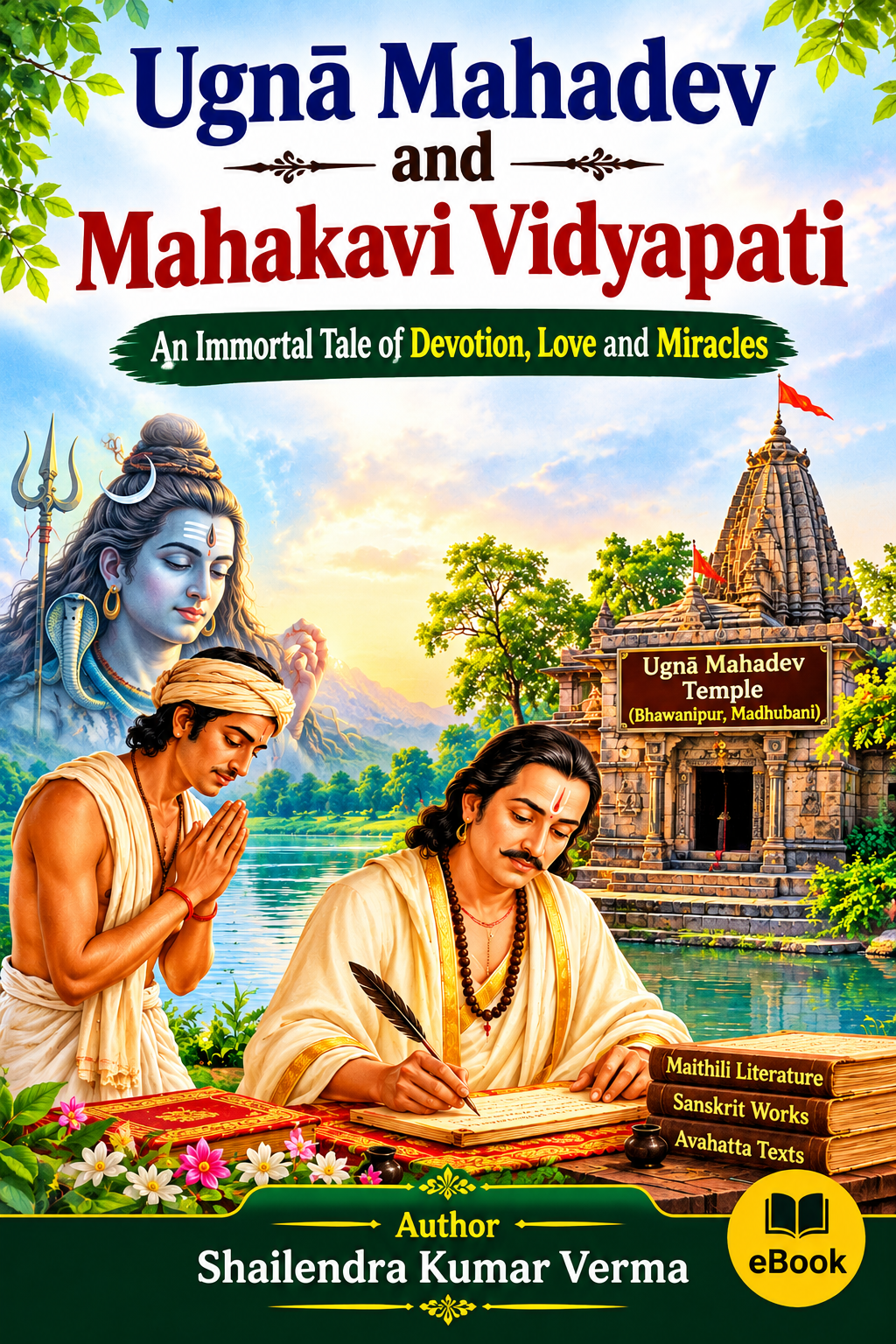
AN IMMORTAL TALE OF DEVOTION LOVE AND MIRACLES
GUMROAD eBook link:-
BY SHAILENDRA KUMAR VERMA
| Affiliate link of GUMROAD eBook | |
| https://skverma29.gumroad.com/affiliates | |
| 1. | CHALLENGING SYLLOGISM |
| https://skverma29.gumroad.com/l/ktxvzi | |
| 2. | STRAIT OF HORMUZ: STRATEGIC & ECONOMIC ROLE |
| https://skverma29.gumroad.com/l/upobrv | |
| 4. | STATIC GENERAL KNOWLEDGE |
| https://skverma29.gumroad.com/l/kzmca | |
| 5. | SSC ENGLISH PREVIOUS YEAR QUESTIONS MCQ |
| https://skverma29.gumroad.com/l/vtotyp | |
| 6. | SSC REASONING PREVIOUS YEAR QUESTIONS MCQ |
| https://skverma29.gumroad.com/l/fsyvp | |
| 7. | SSC MATH PREVIOUS YEAR QUESTIONS (MCQ): TIER I |
| https://skverma29.gumroad.com/l/nesioq | |
| 8. | BANKING KNOWLEDGE QUESTIONS AND ANSWERS MCQ |
| https://skverma29.gumroad.com/l/sgbbul | |
| 9. | BIHAR ANM, GNM & PHARMACIST EXAM: PAST MCQ QUESTIONS & ANSWERS – |
| https://skverma29.gumroad.com/l/yotjat | |
| 10. | ARAVALLI MOUNTAIN RANGE: THE ANCIENT SPINE OF INDIA |
| https://skverma29.gumroad.com/l/khpakf | |
| 11. | मौर्य काल (322 ईसा पूर्व – 185 ईसा पूर्व): पीएसयू परीक्षा हेतु प्रश्नोत्तर सहित विस्तृत अध्ययन |
| https://skverma29.gumroad.com/l/kgmrw | |
| 12. | VOLCANOES AND EARTHQUAKES: A COMPLETE GUIDE |
| https://share.google/gMZLAnx4hcCV82NTI | |
| 13. | TERMINOLOGY: RAILWAY, COMPUTER, SHARE MARKET, BIOLOGY, BADMINTON, CRICKET, FOOTBALL, KABBADI AND HOCKEY |
| https://share.google/fvdFN53HtyXlqTCgd | |
| 14. | भारतीय संसद का सत्र: प्रक्रिया, नियमऔर एस ओ पी; पी एस यू परीक्षा के लिए संपूर्ण मार्ग दर्शिका |
| https://share.google/1HFwXZA3qUiKyrI1l | |
| 15. | REITs AND InvITs IN INDIA: COMPLETE GUIDE (SCOPE, RISKS & FUTURE) |
| https://share.google/EChDc9heQmPPeyhoi | |
| 16. | GK SSC TIER I PREVIOUS YEAR MCQ |
| https://share.google/5pLzqYKQtg822wk3Y | |
| 17. | PETROLEUM REFINERY PROCESS: WITH 200 MCQ |
| https://skverma29.gumroad.com/l/jgydi | |
| 18. | SET THEORY: A COMPLETE GUIDE WITH 400 MCQ |
| https://skverma29.gumroad.com/l/zkhqzm | |
| 19. | WORLD’S SMALLEST, LONGEST, THINNEST, THICKEST AND TALLEST |
| https://skverma29.gumroad.com/l/kzaenh | |
| 20. | HIGH TIDE AND LOW TIDE: A COMPLETE GUIDE https://skverma29.gumroad.com/l/virke |
| 21. | 1000 HISTORY QESTIONS & ANSWERS FOR PSU |
| https://skverma29.gumroad.com/l/fjapus | |
| 22. | नालंदा विश्वविद्यालय : सम्पूर्ण अध्ययन |
| https://skverma29.gumroad.com/l/pmjab?wanted=true | |
| 23. | भगवान शिव के 12 ज्योतिर्लिंग: इतिहास, महत्व और दर्शन क्रम |
| https://skverma29.gumroad.com/l/wdkgo | |
| 24 | NISM-SERIES-V-A MUTUAL FUND DISTRIBUTOR: COMPLETE STUDY GUIDE & EXAM PREPARATION |
| https://skverma29.gumroad.com/l/qgcviu | |
| 25. | WORKSHOP TECHNOLOGY & MANUFACTURING PROCESSES COMPLETE EXAM GUIDE |
| https://skverma29.gumroad.com/l/xvqxnp | |
AMAZON eBook link:-
BY SHAILENDRA KUMAR VERMA
| 1. | SSC MATH PREVIOUS YEAR MCQ: SSC MATH |
| https://amzn.in/d/097Ocsnl | |
| 2. | SSC REASONING PREVIOUS YEAR MCQ: SSC REASONING |
| https://amzn.in/d/00EHQGE8 | |
| 3. | SSC ENGLISH PREVIOUS YEAR MCQ: SSC ENGLISH |
| https://amzn.in/d/0f8sxJoy | |
| 4. | STATIC GENERAL KNOWLEDGE : WITH 620 MCQs |
| https://amzn.in/d/09xNEWmt |
PLAYSTORE eBook link:-
BY SHAILENDRA KUMAR VERMA
| 1. | SSC MATH PREVIOUS YEAR MCQ |
| https://share.google/KzWbvkFuNk51PEpiu | |
| 2. | SSC REASONING PREVIOUS YEAR MCQ |
| https://play.google.com/books/publish/a/12574378860292240754#book/GGKEY:EUPQZ9ZUAFR/review | |
| 3. | STATIC GENERAL KNOWLEDGE |
| https://play.google.com/books/publish/a/12574378860292240754#book/GGKEY:CQDT2G4CCQP/review | |
| 4. | CHALLENGING SYLLOGISM |
| https://share.google/w9xLMwyiJdNVnpHxI | |
| 5. | STRAIT OF HORMUZ: STRATEGIC & ECONOMIC ROLE |
| https://share.google/V10H7UKeTkstLIMmc | |
| 6. | BIHAR TEACHER ELIGIBILITY TEST (BIHAR TET) : COMPLETE GUIDE |
| https://share.google/AcCXPFa69dAWyYaZZ | |
| 7. | SSC ENGLISH PREVIOUS YEAR MCQ |
| https://share.google/pr7b0YhDoDwttaq2s | |
| 8. | BANKING KNOWLEDGE QUESTIONS AND ANSWERS MCQ |
| https://share.google/yqYOabKhNppcz89hl | |
| 9. | BIHAR ANM, GNM & PHARMACIST EXAM: PAST MCQ QUESTIONS & ANSWERS – |
| https://share.google/NFhtU1JoBfxPS4wa3 | |
| 10. | ARAVALLI MOUNTAIN RANGE: THE ANCIENT SPINE OF INDIA |
| https://share.google/Yo4RYnaZrbRu9qwzj | |
| 11. | GK SSC TIER I PREVIOUS YEAR MCQ |
| https://share.google/sBdCcsEeebM44QZ0X | |
| 12. | REITs AND InvITs IN INDIA: COMPLETE GUIDE (SCOPE, RISKS & FUTURE) |
| https://share.google/XAwUio1deUOxFe2M7 | |
| 13. | भारतीय संसद का सत्र: प्रक्रिया, नियमऔर एस ओ पी ; पी एस यू परीक्षा के लिए संपूर्ण मार्ग दर्शिका |
| https://share.google/6XVrfQ2PcuWmqvKol | |
| 14. | मौर्य काल (322 ईसा पूर्व – 185 ईसा पूर्व): पीएसयू परीक्षा हेतु प्रश्नोत्तर सहित विस्तृत अध्ययन |
| https://share.google/Lwu7JKHE54kxsL5e2 | |
| 15. | TERMINOLOGY: RAILWAY, COMPUTER, SHARE MARKET, BIOLOGY, BADMINTON, CRICKET, FOOTBALL, KABBADI AND HOCKEY |
| https://share.google/WWVO9ZFd81R9G9h69 | |
| 16. | VOLCANOES AND EARTHQUAKES: A COMPLETE GUIDE |
| https://share.google/aXi2evRVgmzpQguye | |
| 17. | PETROLEUM REFINERY PROCESS: WITH 200 MCQ |
| https://play.google.com/books/publish/u/0/a/12574378860292240754#book/GGKEY:P34SQBHUJ7F/review | |
| 18. | SET THEORY: A COMPLETE GUIDE WITH 400 MCQ |
| https://play.google.com/books/publish/u/0/a/12574378860292240754#book/GGKEY:83LKH7QHRQH/review | |
| 19. | WORLD’S SMALLEST, LONGEST, THINNEST, THICKEST AND TALLEST |
| https://play.google.com/books/publish/u/0/a/12574378860292240754#book/GGKEY:9LE49HEDZJE/review | |
| 20. | HIGH TIDE AND LOW TIDE: A COMPLETE GUIDE |
| https://play.google.com/books/publish/u/0/a/12574378860292240754#book/GGKEY:TKR79QBDE7R/review | |
| 21. | 1000 HISTORY QESTIONS & ANSWERS FOR PSU |
| https://play.google.com/books/publish/u/0/a/12574378860292240754#book/GGKEY:1SGWQKT7BDF/review | |
| 22. | नालंदा विश्वविद्यालय : सम्पूर्ण अध्ययन |
| https://play.google.com/books/publish/u/0/a/12574378860292240754#book/GGKEY:RY0EDLDK7TL/review | |
| 23. | भगवान शिव के 12 ज्योतिर्लिंग: इतिहास, महत्व और दर्शन क्रम |
| https://play.google.com/books/publish/u/0/a/12574378860292240754#book/GGKEY:KNT0X6L8YCQ/review | |
| 24. | NISM-SERIES-V-A MUTUAL FUND DISTRIBUTOR: COMPLETE STUDY GUIDE & EXAM PREPARATION |
| https://play.google.com/books/publish/u/0/a/12574378860292240754#book/GGKEY:YP1PQ8RQY07/review | |
| 25. | WORKSHOP TECHNOLOGY & MANUFACTURING PROCESSES COMPLETE EXAM GUIDE |
| https://play.google.com/books/publish/u/0/a/12574378860292240754#book/GGKEY:PK621P1ZHXX/review |
| OPEN DMAT ACCONT FROM THI LINK IN ANGEL ONE:- |
| Open your Trading & Investment account with Angel One for FREE* |
| You will get: |
| All trades in Rs.20 |
| Quick SIP in Direct MF |
| 1Lac MTF @ 0% interest |
| Download only using my referral link to get Free Demat Account⬇ |
| https://angel-one.onelink.me/Wjgr/2o2au42h |
| _link may expire within 48hrs_ |
| _T&C Apply_ |
| CLICK TO APPLY: |
| Click the application link below: 👉 Apply Here for SBI Credit Card (Referral Code: 243zfQ0yYm3) |
| OPEN DMAT ACCOUNT FROM THIS LINK: |
| HI THERE, I SEE YOU HAVEN’T BOUGHT THE FREEDOM PLAN ON INDIAN BANK YET. DON’T MISS OUT ON UNLIMITED TRADING AT A POCKET-FRIENDLY COST. GO BROKERAGE-FREE AND SAVE BIG WITH THE FREEDOM PLAN. USE MY REFERRAL CODE, SHAI0634 TO DOWNLOAD THE APP NOW. |
| https://play.google.com/store/apps/details?id=com.finwizard.fisdom |
AUTHOR: SHAILENDRA KUMAR VERMA
DISCLAIMER:-
This book is being written solely for educational, literary, cultural and religious informational purposes. Its objective is to introduce readers to the rich cultural heritage of Mithila, the literary contributions of Mahakavi Vidyapati and the popular folk legend associated with UGNĀ MAHADEV.
Some of the events described in this book concerning Ugnā Mahadev and Mahakavi Vidyapati are based on religious beliefs, oral traditions and folk narratives. They are not intended to be presented as verified historical events. Wherever historical facts are discussed, an effort will be made to provide information based on reliable sources available.
The author does not intend to impose any religious belief, tradition or historical interpretation on any individual or community. Readers are requested to study this book while understanding the distinction between religious narratives and historical facts.
The author does not provide any absolute guarantee regarding the completeness, accuracy or current validity of the information contained in this book. For serious historical or academic research, readers should consult original texts, authentic historical books, and reliable references.
This book is not intended to infringe upon the copyrights of any other author, publisher, or organization. Quotations and references should be used with appropriate acknowledgment wherever necessary.
All rights are reserved by the author to the extent permitted by applicable law. Without prior permission, reproduction, republication, or commercial use of the entire contents of this book is prohibited.
PREFACE
THE LAND OF MITHILA, DEVOTION TO LORD SHIVA
AND MAHAKAVI VIDYAPATI
Mithila occupies a distinctive place in India’s cultural traditions. Connected with the northern region of present-day Bihar and the Terai region of Nepal, this cultural landscape is renowned for its literary heritage, religious beliefs, folk songs, painting traditions and philosophical thought.
Mahakavi Vidyapati holds a place of great honour in this rich tradition of Mithila. Through his compositions, he expressed love, devotion and human emotions with remarkable depth, earning recognition among the prominent poets of Indian literature.
Vidyapati’s literary identity is particularly associated with Maithili verses, descriptions of the love of Radha and Krishna, and compositions devoted to Lord Shiva. His poetry reflects linguistic sweetness, emotional depth, and a close connection with everyday life.
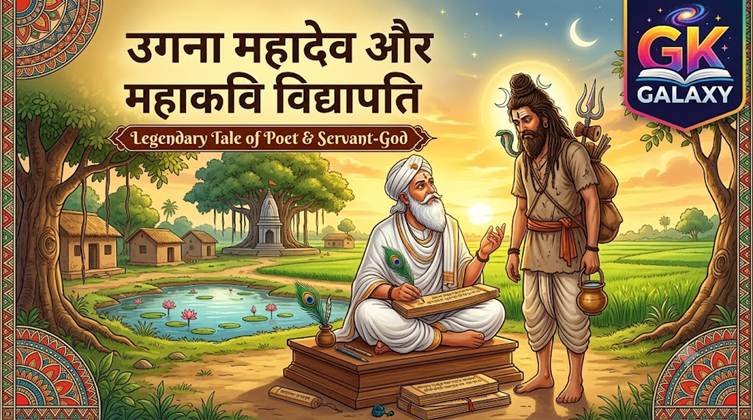
One of the most popular religious folk legends associated with Mahakavi Vidyapati concerns Lord Shiva’s arrival in his life in the guise of a servant named Ugnā.
According to popular belief, Vidyapati was an ardent devotee of Lord Shiva. Pleased with his devotion, Lord Shiva assumed the name Ugnā and began living with him as his servant. This story presents the relationship between a devotee and God in a unique way. Here, God is not merely a deity worshipped in a temple but also an intimate companion who shares the joys and sorrows of his devotee.
The story of Ugnā Mahadev portrays not only devotion but also love, trust, service, dedication and human emotions. This is why the tale has been passed down from generation to generation and has become an important part of Mithila’s religious and cultural memory.
In this book, we will explore three major subjects. First, the life and literature of Mahakavi Vidyapati. Second, the famous folk legend associated with Ugnā Mahadev. Third, the influence of this tradition on the culture and society of Mithila.
The purpose of this journey is not merely to narrate a miraculous story but also to understand the cultural world in which poetry, devotion and folk beliefs are interconnected.
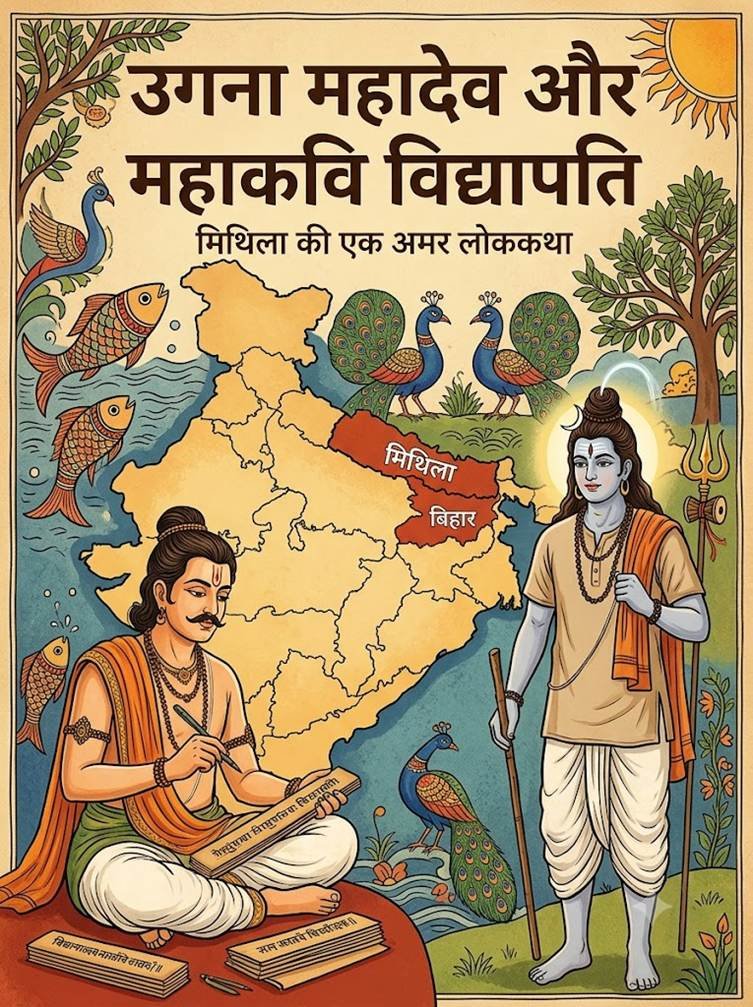
Chapter 1
Historical, Cultural, and Religious Background of Mithila
1.1 INTRODUCTION TO MITHILA
Mithila is an important region associated with the ancient cultural and historical traditions of the Indian subcontinent. It is primarily identified with the present-day Mithilanchal region of Bihar and certain Terai areas of Nepal.
The name Mithila evokes several cultural symbols, including the Maithili language, folk songs, Madhubani painting, distinctive marriage traditions, religious rituals, and a rich heritage of scholarship.
Ancient Indian literature refers to Videha and Mithila. The tradition of King Janaka and the religious and cultural memories associated with Sita have also contributed to the wider identity of this region. However, traditions described in ancient texts and evidence established through modern historical research must be examined using appropriate and separate sources.
Mithila is not merely a geographical region; it also represents a distinctive cultural identity shaped by language, literature, philosophy, and folk culture.
1.2 LITERARY TRADITION OF MITHILA
The history of Mithila has long been associated with education, logic, philosophy, and literary traditions. Sanskrit learning and scholarly debate have held particular importance in the region. Over time, local languages and folk literature also developed distinctive identities.
Verses and songs composed in Maithili have played an important role in expressing the emotions of everyday life. Themes such as love, separation, devotion, nature, and family life have been presented through lyrical forms.
Mahakavi Vidyapati’s contribution is particularly noteworthy within this literary environment. His compositions establish an important connection between classical literary traditions and the natural expression of the local language.
Vidyapati’s importance lies not only in his fame but also in the contribution his works made to the recognition and emotional richness of Maithili literature.
1.3 WORSHIP OF LORD SHIVA IN MITHILA
Lord Shiva occupies a prominent position in Indian religious traditions. He is worshipped under many names, including Mahadev, Shankar, and Bholenath. His worship takes different religious and cultural forms across various regions of India.
Mithila also has a rich folk tradition of devotion to Shiva. Fasts, worship ceremonies, folk songs, and temples associated with Shiva form an integral part of the region’s religious life.
One important aspect of Shiva’s personality is his simplicity and compassion toward his devotees. In folk narratives, he is often portrayed as a deity who is pleased by the sincere feelings of his worshippers. This perspective gives greater importance to faith and dedication than to social status or outward displays of religious devotion.
The story of Ugnā Mahadev is connected with this understanding of devotion. In this folk legend, Lord Shiva appears in the life of his devotee in the form of a servant. This idea gives the relationship between God and devotee an intimate and deeply human character.
1.4 CULTURAL IMPORTANCE OF FOLK TALES
Folk tales form an important part of a society’s cultural memory. They are passed down through oral traditions over generations and express a community’s beliefs, ideals and values.
The purpose of a folk tale is not always to describe historical events. Many stories help preserve religious faith, convey moral lessons and strengthen cultural identity.
The story of Ugnā Mahadev can also be understood within this broader context. Through the relationship between Lord Shiva and Vidyapati, the story conveys the idea that true devotion has no place for arrogance and that love for God can be expressed through service and personal closeness.
The emotional nature of this story is another reason for its popularity. Through the relationship between a great poet and his servant, the tale portrays the closeness between a devotee and God.
1.5 THE TRADITION OF UGNĀ MAHADEV
Within Mithila’s religious folk traditions, the name Ugnā Mahadev is closely associated with Mahakavi Vidyapati. The Ugnā Mahadev Temple, located in Bhawanipur in Bihar’s Madhubani district, is known as a prominent religious site associated with this tradition.
The importance of this place is not limited to the temple itself. It is also connected with the collective folk memory through which the story of Vidyapati and Ugnā has remained alive among people.
When writing about this tradition, it is necessary to understand two distinct aspects. The first concerns established information about the temple, the location, and the relevant literary sources. The second concerns the religious folk belief that Lord Shiva appeared in the form of Ugnā.
Both may have cultural significance, but historical research must clearly distinguish between the available evidence and the nature of religious belief.
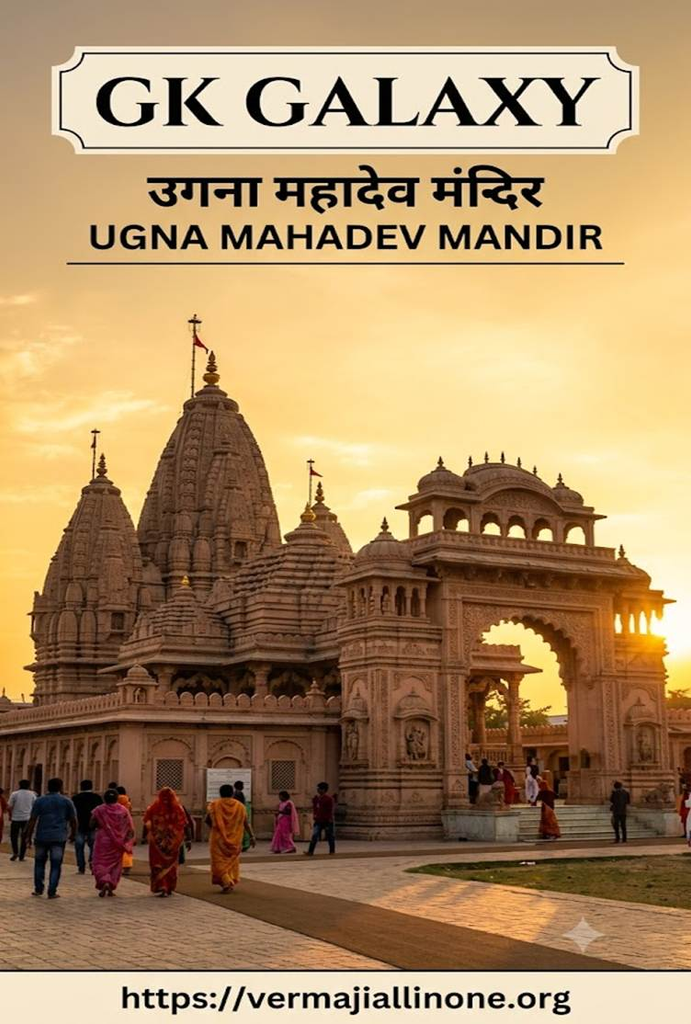
1.6 What Can We Understand from This Background?
Understanding Mithila’s cultural background helps us read the story of Ugnā Mahadev and Vidyapati more meaningfully.
The story is not limited to a single individual or religious site. It is connected with Maithili literature, devotion to Shiva, folk traditions, and collective cultural memory.
Mahakavi Vidyapati’s literary achievements are subjects of historical and literary study, whereas the events associated with Ugnā Mahadev are primarily known through a popular religious folk legend.
Chapter 2
Life and Biography of Mahakavi Vidyapati
Birth, Family, Education, and Literary Personality
2.1 INTRODUCTION TO VIDYAPATI
Mahakavi Vidyapati is regarded as one of the prominent poets of medieval Indian literature. He occupies an exceptionally important position in the history of Maithili literature. His compositions beautifully portray love, separation, devotion, nature, and human emotions.
Vidyapati is particularly renowned for his lyrical poetry in Maithili. His language is sweet, his emotions are profound, and his expressions are natural. As a result, his verses have not remained confined to literary scholars; they have also become part of folk life and musical traditions.
Another important foundation of Vidyapati’s reputation is his poetry devoted to Lord Shiva. The popular story of Ugnā Mahadev, associated with his name, has given him a distinctive place in the religious folk memory of Mithila.
However, not all details concerning Vidyapati’s life are equally well established. Scholars differ regarding his birth year, certain events in his life, and his relationships with various rulers. Therefore, historical sources and later folk traditions should be examined separately when studying his biography.
2.2 VIDYAPATI’S BIRTH AND HISTORICAL PERIOD
Historical literature contains differing opinions about Vidyapati’s birthplace and birth year. His life is generally placed between the fourteenth and fifteenth centuries. He belonged to the Mithila region, and his literary works were connected with the social, cultural, and political environment of his time.
To understand his lifetime, it is necessary to consider the conditions prevailing in Mithila during that period. It was an era in which regional kingdoms, Sanskrit scholarship, religious traditions, and the literary development of local languages were interconnected.
Vidyapati composed poetry in a language that local people could understand. This was an important reason for the popularity of his literary works.
Many details about his life have been transmitted through tradition. Therefore, unless reliable sources support a particular date or event, it would be inappropriate to present it as a definite historical fact.
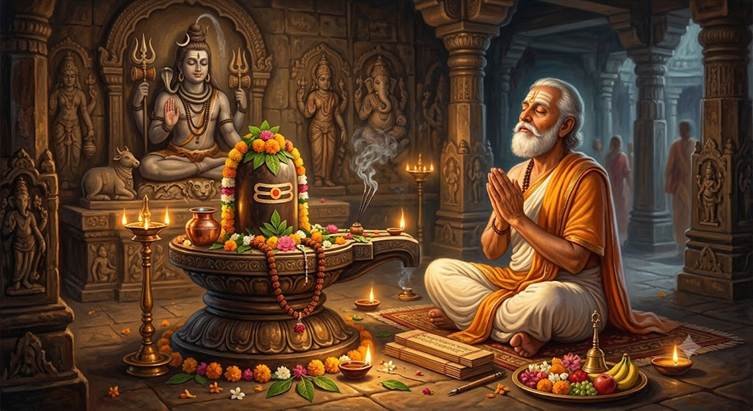
2.3 VIDYAPATI’S FAMILY
Vidyapati is believed to have belonged to a scholarly family. His father’s name is traditionally given as Ganapati Thakur. Traditional biographies describe his family as being associated with education, Sanskrit learning and religious and cultural activities.
Growing up in such a scholarly family would have provided Vidyapati with opportunities to become familiar with literature, scriptures, and the intellectual environment of his time. However, detailed contemporary evidence concerning every aspect of his childhood and family life is not available.
In medieval India, scholarly families contributed to more than religious education. They also participated in administration, royal courts, classical studies, and literary activities. This broader social context is important for understanding the scholarship reflected in Vidyapati’s works.
2.4 EDUCATION AND INTELLECTUAL DEVELOPMENT
Vidyapati’s compositions indicate the breadth of his scholarship. He was familiar with Sanskrit literature, religious texts, and the classical traditions of his time. His works reflect literary influences associated with Sanskrit, Avahaṭṭa, and Maithili.
Sanskrit was one of the principal languages of knowledge, philosophy, religious studies, and scholarly debate during that period. Local languages, meanwhile, played an important role in everyday communication, songs, and emotional expression.
Vidyapati’s distinctive achievement was his ability to create influential literature in a local language while remaining familiar with classical traditions. His literary work thus became an important bridge between scholarship and popular sensibility.
The rhythm of his compositions, his choice of words, and the intensity of his emotions demonstrate his skill as a poet.
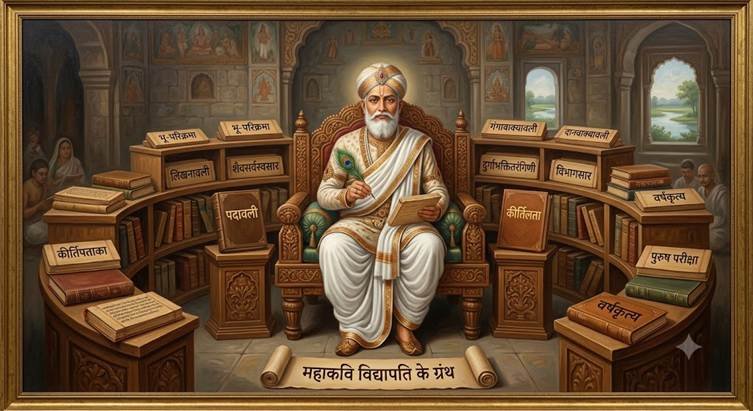
2.5 VIDYAPATI AND THE ROYAL COURT OF MITHILA
Vidyapati is also believed to have been associated with the royal court of Mithila. The rulers of the Oinwar dynasty receive particular attention in accounts of his life and literary career.
His name is especially associated with King Shiv Singh. Literary and traditional accounts also mention Shiv Singh’s wife, Lakhima Devi, in connection with Vidyapati’s life.
In medieval India, royal courts were important centres for scholars and poets. Literary composition, religious ceremonies, administrative activities, and intellectual discussions often took place within these settings.
Some of Vidyapati’s works also contain indications of the political and social life of his period. This helps us understand that he was not merely a poet of love and devotion but was also connected with the cultural world of his time.
However, the evidence available for every event in his courtly life is not equally conclusive. Reliable literary and historical references should therefore be consulted before making specific claims.
2.6 VIDYAPATI’S LANGUAGES AND LITERARY IDENTITY
One of the most important aspects of Vidyapati’s literary identity is his multilingual creativity. Works associated with his name include compositions in Sanskrit, Avahaṭṭa, and Maithili.
Maithili: Vidyapati’s songs gave Maithili literature considerable recognition. His language reflects the closeness of everyday life and the sweetness of poetic expression.
Sanskrit: His Sanskrit compositions demonstrate his classical scholarship and his engagement with religious and literary studies.
Avahaṭṭa: Some of his works are associated with the Avahaṭṭa literary tradition, which is important for understanding the linguistic development of medieval India.
In Vidyapati’s works, language is more than a means of conveying information. It brings emotions to life, expresses the inner states of characters, and evokes feelings in readers and listeners.
2.7 THE POET OF LOVE AND SEPARATION
A major foundation of Vidyapati’s fame is his poetry of love. His verses offer subtle portrayals of the happiness of love, anticipation, separation, union, and human emotions.
In his songs associated with Radha and Krishna, love is not merely physical attraction. It also involves emotional complexity, inner restlessness, and the longing for union.
When describing separation, the poet expresses the emotions experienced by a lover with exceptional sensitivity. This is one reason his songs have gained importance in both literature and music.
The study of Vidyapati’s love poetry also involves examining its worldly and devotional meanings. In some compositions, human experience is central, while many verses have also been interpreted spiritually within Vaishnava traditions.
2.8 DEVOTION TO SHIVA AND VIDYAPATI
Another important aspect of Vidyapati’s literary heritage is his devotion to Lord Shiva. His Shiva-related devotional verses hold a special place in Mithila’s religious and cultural traditions.
These compositions express the devotee’s humility, affection for God, and awareness of the limitations of human life. They present the relationship between humanity and the divine through emotional expression.
The popular story of Ugnā Mahadev has further strengthened Vidyapati’s association with Shiva devotion. According to folk tradition, Lord Shiva began living with Vidyapati in the form of a servant named Ugnā.
In this story, Shiva appears as an intimate companion rather than a distant deity. He becomes part of his devotee’s everyday life.
It is important to distinguish between the literary study of Vidyapati’s devotional compositions and the study of the Ugnā Mahadev legend. The former concerns literary works and literary history, while the latter primarily belongs to religious folklore and cultural tradition.
2.9 VIDYAPATI’S PERSONALITY
Vidyapati’s literature reveals several aspects of his personality. He is remembered as a scholar, a sensitive poet and a literary figure connected with religious and cultural traditions.
His compositions express a wide range of human experiences. The tenderness of love, the pain of separation, the humility of devotion, and the artistic quality of language make his literature distinctive.
His poetry possesses an expressive power that has continued to attract readers and listeners across different periods.
Vidyapati’s enduring popularity also demonstrates that the lasting power of literature is not confined to a particular age. When a work expresses human experiences effectively, it can remain alive across generations.
2.10 VIDYAPATI’S LEGACY
Vidyapati’s literature occupies an important position in the study of the Maithili language and Indian poetic traditions. The influence of his songs can be seen in literature, music, folk traditions, and religious expression.
In Mithila, Vidyapati is remembered not merely as a historical poet but also as an important symbol of regional cultural identity.
His memory continues through folk songs, cultural programmes, and literary discussions. The story of Ugnā Mahadev associated with his name has also helped connect his popular image with the region’s religious folk traditions.
While studying this legacy, we should examine literary achievements, historical facts, and folk beliefs respectfully and critically.
CHAPTER 3
THE LITERARY WORLD OF MAHAKAVI VIDYAPATI
MAITHILI VERSES, SANSKRIT COMPOSITIONS, LOVE POETRY, AND DEVOTION
3.1 VIDYAPATI’S LITERARY GENIUS
Mahakavi Vidyapati possessed a literary personality distinguished by many qualities. He was not merely a poet of love and devotion; he was also familiar with the classical Sanskrit tradition, the intellectual environment of his time, and the expressive potential of local languages.
His works contain subtle portrayals of human emotions. Love, separation, union, humility, devotion, and the transience of life provide his literature with a broad emotional foundation.
One of Vidyapati’s greatest strengths was his ability to use language as a powerful medium for expressing feelings. His songs combine musicality and rhythm so effectively that they are enjoyable to read, sing, and hear.
His contribution to the development of Maithili literature earned him a distinctive position. His works also demonstrate that a local language can support sophisticated literary expression.
3.2 CHARACTERISTICS OF VIDYAPATI’S MAITHILI VERSES
The most widely recognised aspect of Vidyapati’s literary identity is his Maithili poetry. These verses beautifully express emotions associated with love, separation, romantic sentiment, and devotion.
The sweetness of the Maithili language is particularly evident in his songs. Through simple words, vivid imagery, and rhythmic expression, he brings the inner feelings of his characters to life.
The following are some of the principal characteristics of his verses:
1. Emotional depth: Subtle expression of love, separation, and devotion.
2. Musicality: An effective combination of words and rhythm that makes the verses suitable for singing.
3. Power of the vernacular: Expression of profound human feelings through the local language.
4. Depiction of nature: Use of seasons, surroundings, and natural symbols to convey emotions.
5. Human psychology: Portrayal of anticipation, hope, hesitation, happiness, and suffering.
These qualities made Vidyapati’s verses popular not only within literary traditions but also in everyday life.
3.3 VIDYAPATI’S CONTRIBUTION TO LOVE POETRY
Vidyapati is regarded as one of the influential poets of love and romantic expression. His love poetry presents human emotions with remarkable sensitivity.
He does not restrict love to the happiness of union. His poetry also explores anticipation, uncertainty, separation, persuasion, and emotional conflict.
His verses associated with Radha and Krishna hold particular importance. They portray different stages of love through Radha’s feelings, her attraction to Krishna, and experiences of union and separation. Through these experiences, the poet expresses the complexities of the human mind.
Later Vaishnava literary traditions also interpreted Vidyapati’s love songs in spiritual terms. His works thus created a dialogue between worldly love and devotional experience.
It is important, however, not to interpret every love song exclusively as a religious symbol. Each composition should be understood according to its literary context, language, and emotional background.
3.4 CHARACTERISTICS OF THE DEPICTION OF SEPARATION
Separation is an important theme in Vidyapati’s poetry. It does not merely mean being physically apart from a beloved; it also refers to the emotional state that develops in the beloved’s absence.
Poetry of separation often expresses anticipation, restlessness, memories, and hope for reunion. Poets use nature, seasons, and everyday experiences to convey these emotions.
A distinctive feature of Vidyapati’s poetic style is that emotions are not simply described; readers are also encouraged to experience the inner state of the characters.
The literary importance of separation lies in its ability to reveal the depth of love and the power of human emotion. The experience of distance makes the intensity of love and the value of a beloved’s presence more apparent.
3.5 VIDYAPATI AND DEVOTIONAL LITERATURE
The tradition of devotion is extensive within Indian literature. It gives importance to love for God, dedication, humility, and an intimate relationship with the divine.
Devotion appears in several forms in Vidyapati’s compositions. His Krishna-related devotional verses are well known, and his works associated with devotion to Shiva are also significant.
An important feature of devotional literature is that God is not viewed merely as a distant power. For a devotee, God may also be a beloved, friend, master, companion, or compassionate source of support.
The folk legend of Ugnā Mahadev is connected with this sense of intimate devotion. In the story, Lord Shiva appears as a servant, bringing the devotee and the divine closer together.
Nevertheless, this folk legend should be distinguished from Vidyapati’s historically established biography. The story has its own religious and cultural significance, while verification of a historical event requires separate evidence.
3.6 DEVOTION TO SHIVA AND VIDYAPATI’S POETIC TRADITION
The tradition of Shiva devotion associated with Vidyapati is particularly popular in Mithila. His Shiva-related verses emphasise the devotee’s humility, faith in God, and awareness of the limitations of human existence.
Within this tradition, Lord Shiva is regarded as accessible, compassionate and close to his devotees.
The story of Ugnā, which explains the relationship between Vidyapati and Shiva in popular tradition, is understood to have developed within this devotional context. In the story, devotion means more than worship alone; it also includes love, service and personal closeness.
When studying Vidyapati’s Shiva-devotional verses, researchers should consult original texts and reliable editions. Different collections may contain textual variations, so identifying the source of a quoted verse is useful.
3.7 VIDYAPATI IN SANSKRIT LITERATURE
Vidyapati’s literary talent was not limited to Maithili verses. Several works in Sanskrit are also associated with his name.
Sanskrit was one of the principal languages of religious study, philosophy, law, classical learning, and scholarly discussion during that period. Composing in Sanskrit was considered an indication of scholarship and familiarity with classical traditions.
The presence of religious and classical subjects in works attributed to Vidyapati indicates the breadth of his learning. This aspect of his literature demonstrates that he was connected with the Sanskrit scholarly tradition as well as being a poet of the local language.
When studying his Sanskrit works systematically, the title, subject, available text, and authorship of each work should be verified through reliable literary references.
3.8 VIDYAPATI IN AVAHAṬṬA LITERATURE
Another aspect of Vidyapati’s literary identity is his association with Avahaṭṭa. Avahaṭṭa is regarded as an important literary tradition in the linguistic development of medieval India.
Studying this tradition helps us understand the development of languages in northern India and the literary expression of the medieval period.
Works associated with Vidyapati and Avahaṭṭa are important because they reflect a literary environment in which Sanskrit, Apabhraṃśa traditions, and regional languages interacted.
This demonstrates that medieval literature cannot be understood solely through one language or style. Writers of the period were influenced by different linguistic traditions and used different languages for different purposes.
3.9 MAJOR WORKS ASSOCIATED WITH VIDYAPATI
Several literary and classical works are associated with Vidyapati’s name. In addition to his verses, references are also made to works connected with Sanskrit and Avahaṭṭa.
When discussing his writings, it is necessary to distinguish between popular verses and independent literary works. Different scholarly collections may vary in their titles, textual readings, and classification.
3.10 WHY IS VIDYAPATI’S LITERATURE STILL RELEVANT TODAY?
Vidyapati’s literature remains important because the emotions it expresses transcend the boundaries of time and place.
Love, separation, hope, dedication, and devotion are human experiences that remain relevant across different eras.
Studying his works helps us understand the development of the Maithili language, medieval society, religious traditions, and Indian poetics.
Moreover, Vidyapati’s cultural legacy is deeply connected with Mithila’s identity. His songs and the folk traditions associated with him connect literature with the everyday life of society.
Thus, Vidyapati’s literature is not merely a heritage of the past; it is also a living foundation for the study of language, culture, and human emotions.
CHAPTER 4
THE FAMOUS FOLK LEGEND OF UGNĀ MAHADEV
WHEN LORD SHIVA BECAME THE SERVANT OF MAHAKAVI VIDYAPATI
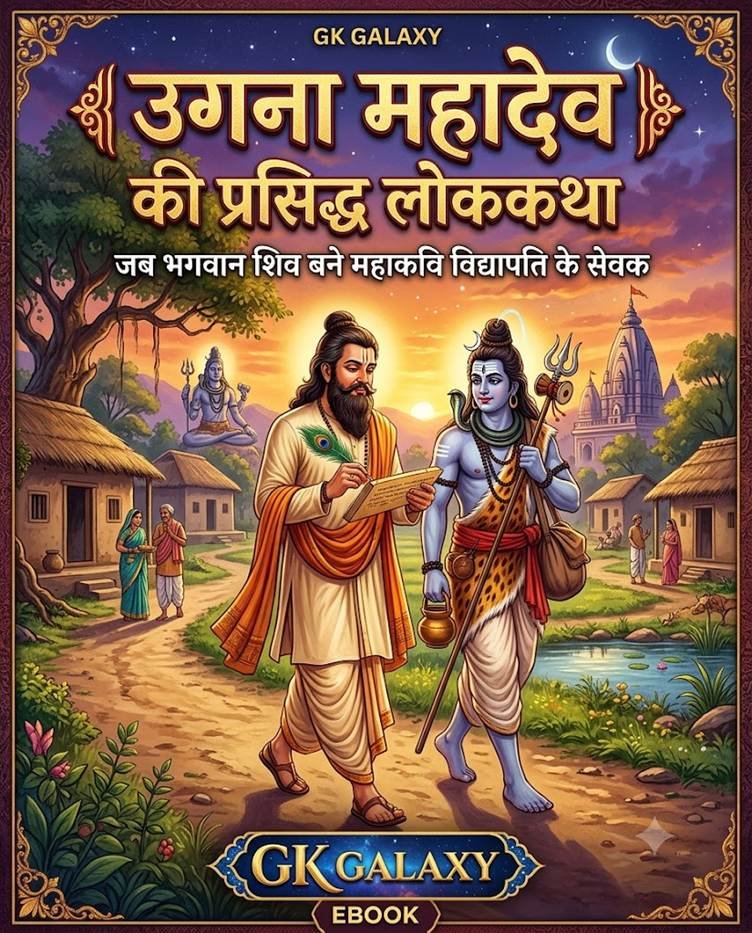
4.1 THE BEGINNING OF THE STORY
In the folk traditions of Mithila, the story of Mahakavi Vidyapati and Ugnā Mahadev is narrated with deep faith and affection. It portrays the intimate relationship between Lord Shiva and his devotee.
According to the popular version of the story, Vidyapati was an ardent devotee of Lord Shiva. His mind remained devoted to the worship of Shiva. Even while pursuing his literary work and attending to his daily responsibilities, he maintained deep faith in his chosen deity.
According to popular belief, Lord Shiva was pleased with his devotee’s devotion. The story conveys the idea that true devotion does not depend solely on elaborate religious ceremonies or outward displays of worship; it also resides in the sincerity of a devotee’s heart.
According to this folk legend, Lord Shiva assumed the name Ugnā and began living with Vidyapati as his servant.
From this point, the story takes a remarkable turn in which the distance between God and devotee seems to disappear. Lord Shiva becomes involved in his devotee’s everyday life and reveals his presence through service.
4.2 UGNĀ’S ARRIVAL IN VIDYAPATI’S LIFE
In the popular narration of the legend, Ugnā appears before Vidyapati as an ordinary servant. Vidyapati accepts him into his household, and Ugnā begins helping him with his daily activities.
Initially, Vidyapati does not know Ugnā’s divine identity. He considers him an ordinary human being and makes him part of his life.
This part of the story conveys an important idea: a person’s true nature cannot always be determined merely by looking at their outward appearance.
Ugnā’s life as a servant symbolises the belief that God may come close to a devotee in any form. From the perspective of devotion, even the act of serving someone becomes meaningful.
The story encourages us to reflect on the importance of respecting others, regardless of their position, appearance, or social status.
4.3 THE RELATIONSHIP BETWEEN SERVICE AND AFFECTION
The relationship between Ugna and Vidyapati gradually develops beyond that of a master and servant. According to the popular folk tradition, their shared experiences and daily interactions create a deep sense of affection and closeness.
Ugna assists Vidyapati and remains by his side. Throughout this period, the divine identity of Lord Shiva remains concealed behind the ordinary activities of everyday life.
This aspect of the story presents a distinctive ideal of devotion. God does not merely accept worship from a devotee but also assumes the role of someone who serves the devotee.
From a religious perspective, this idea symbolizes humility and love. If even the supreme divine being can approach a devotee through service, then human beings should not consider serving others an insignificant task.
However, this account belongs to the realm of folk tradition and should not be treated as a historically verified event in Vidyapati’s life.
4.4 SPIRITUAL MESSAGES IN THE STORY
The story of Ugna Mahadev contains several values that hold special significance in the devotional tradition.
The first is faithfulness. The relationship between the devotee and God is founded on trust and belief.
The second is service. Ugna’s role as a servant demonstrates that service can be regarded as an honourable and meaningful act.
The third is humility. The divine appears in an ordinary form in the story, highlighting the limitations of outward prestige and ostentation.
The fourth is affection. The relationship between God and the devotee is not restricted to formal worship but becomes connected with the closeness of everyday life.
Because of these values, the story of Ugna Mahadev is not merely a tale of a religious miracle. It also provides an opportunity to reflect on human relationships and moral values.
4.5 THE NEXT STAGE OF THE STORY
Different oral versions of the popular story of Ugna Mahadev exist. One of its best-known episodes is associated with the River Ganga. During a journey, the need for water arises, and Ugna’s divine identity becomes connected with a mysterious revelation.
This episode is considered an important turning point in the story. It brings to light Ugna’s true identity, Vidyapati’s devotion, and the depth of their relationship.
In the next section, we will examine the episode involving the Ganga, the revelation of Ugna’s identity, and the emotional dimensions of the story in greater detail. This episode will be presented as a popular folk tradition rather than as an independently verified historical event.
CHAPTER 4 (PART 2): THE FAMOUS FOLK TALE OF UGNA MAHADEV
THE EPISODE OF THE GANGA, DIVINE IDENTITY AND THE TEST OF DEVOTION
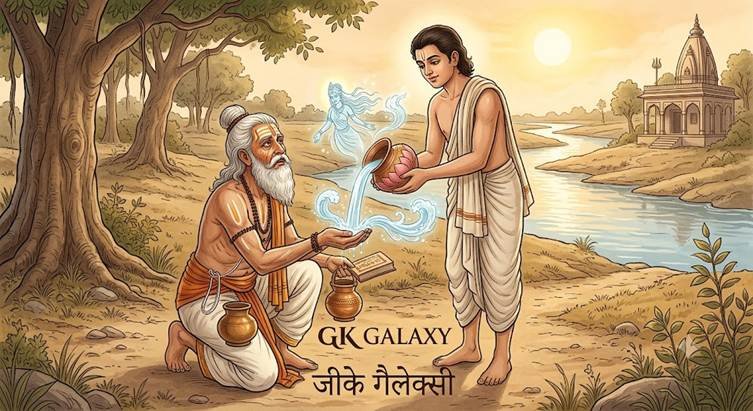
4.6 THIRST DURING THE JOURNEY
One of the most famous episodes in the popular folk tale of Ugna Mahadev takes place when Mahakavi Vidyapati is travelling and Ugna accompanies him.
The details of events may vary across different oral versions of the story. In a popular version, Vidyapati becomes extremely thirsty during the journey. There appears to be no source of water nearby. His thirst increases because of the heat and exhaustion.
He asks his servant, Ugna, to arrange some water.
For Vidyapati, this is an ordinary situation. He does not know that, according to popular belief, the divine form of his revered deity, Lord Shiva, is concealed within the very servant whom he has asked to fetch water.
Ugna now has an opportunity to quench his devotee’s thirst. According to the story, he decides to use his divine power.
4.7 THE MIRACULOUS EPISODE OF GANGA WATER
According to a popular version of the folk tale, Ugna obtains the sacred water of the Ganga from his matted locks and gives it to Vidyapati to drink.
Vidyapati drinks the water and finds its taste and experience extraordinary. According to the story, he becomes suspicious and wonders how Ugna could obtain such sacred water under such difficult circumstances.
When Vidyapati asks about the source of the water, it becomes difficult for Ugna to continue concealing his identity.
The reference to the Ganga in this episode is not limited to quenching thirst. In Indian religious traditions, the Ganga is regarded as a symbol of purity and spiritual cleansing. Therefore, the appearance of Ganga water in the story becomes an indication of Ugna’s transition from an ordinary servant to a divine presence.
It is important to clarify that the episode of obtaining Ganga water from Shiva’s matted locks belongs to folk tradition. Independent evidence would be necessary to establish it as a historically verified event.
4.8 VIDYAPATI BECOMES SUSPICIOUS
After the episode involving Ganga water, Vidyapati develops a curiosity about Ugna’s true nature.
He can no longer regard his servant merely as an ordinary human being. He begins to wonder how Ugna obtained such extraordinary water and why his behaviour reveals such unusual abilities.
In the folk tale, this moment becomes a decisive stage in the devotee’s spiritual recognition and experience.
The message of the story is that even seemingly ordinary circumstances can sometimes inspire people to reflect on deeper questions.
However, in this episode, Vidyapati’s curiosity is not resolved through logical reasoning or physical evidence. Instead, the mystery is resolved through the revelation of Ugna’s divine identity.
4.9 UGNA REVEALS HIS TRUE IDENTITY
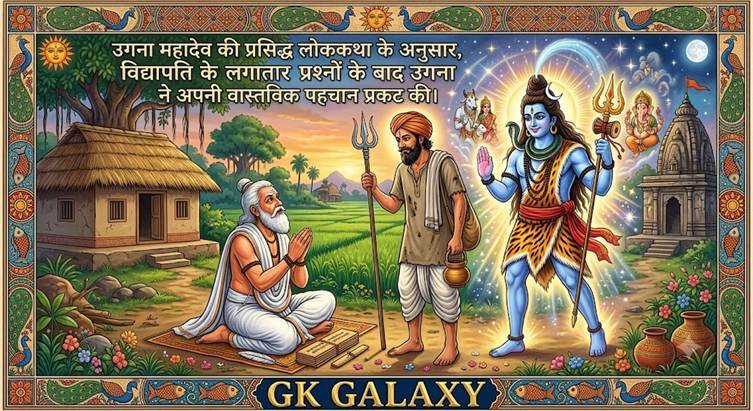
According to the famous folk tale of Ugna Mahadev, Ugna reveals his true identity after Vidyapati repeatedly questions him.
The story explains that Ugna is not an ordinary servant but Lord Shiva Himself, who has assumed human form to serve His beloved devotee and live beside him.
This revelation is the most significant part of the story. Vidyapati discovers that the very deity to whom he has devoted himself has been living near him and assisting him.
In this episode, Lord Shiva appears as a deity who can participate intimately in the everyday life of His devotee.
According to popular belief, Lord Shiva assumed this form because He was pleased with Vidyapati’s devotion.
From a religious perspective, this episode is deeply moving. From a literary perspective, it is also dramatic: a character who initially appears to be an ordinary servant reveals his true identity at the end, transforming the meaning of the entire story.
4.10 VIDYAPATI’S EMOTIONAL RESPONSE
The revelation of Ugna’s true identity is associated with deep reverence and emotion in the folk tale.
The very Lord whom Vidyapati worships has been living beside him in the role of a servant. It is natural that this realization fills him with wonder, devotion, and affection.
This episode illustrates the closeness between a devotee and God. For Vidyapati, Shiva is no longer merely a deity worshipped in a temple but a beloved presence who has participated in his daily life.
While interpreting this episode, it is important to remember that the primary purpose of the folk tale is not to document an event in the manner of a historical record. Its central theme is the ideal of love, trust, and complete surrender between a devotee and God.
4.11 HOW THE STORY CHANGES AFTER THE REVELATION
Once Ugna’s identity is revealed, the nature of the story changes. Vidyapati no longer remains unaware of who his servant really is.
According to a popular version of the folk tale, Ugna requests Vidyapati to keep his true identity secret. This request plays an important role in the events that follow.
An interesting contradiction emerges here. For Vidyapati, discovering the true identity of his beloved deity is an immensely joyful experience. For Ugna, however, keeping that identity concealed remains essential.
Thus, a new challenge is added to the relationship between love and trust. Vidyapati must now do more than rejoice in discovering God’s identity; he must also accept responsibility for protecting the secret.
4.12 THE IMPORTANCE OF PROTECTING THE SECRET
In the story of Ugna Mahadev, the request to conceal an identity is not merely a literary device. It is also connected with the ideas of trust and keeping one’s word.
Respecting something entrusted to us by another person can be an expression of regard and affection. The folk tale presents this principle within the relationship between a devotee and God.
Vidyapati now faces a moral responsibility. He knows Ugna’s true identity, but managing this knowledge appropriately becomes equally important.
The subsequent popular version of the story describes the protection of this secret and the circumstances in which it is eventually broken.
This is the emotional dimension of the tale, as it brings together human feelings such as devotion, anger, helplessness, and separation.
CHAPTER 5: THE RELATIONSHIP BETWEEN UGNA AND VIDYAPATI
THE HEART-RENDING STORY OF TRUST, PROMISES AND SEPARATION
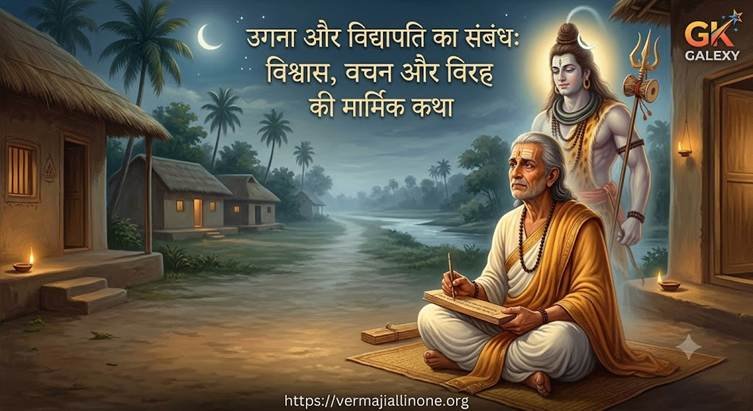
5.1 AN EXTRAORDINARY RELATIONSHIP
The central theme of the folk tale of Ugna Mahadev is not limited to Lord Shiva becoming a servant. Another important aspect is the relationship that develops between Ugna and Vidyapati.
Generally, the relationship between a servant and a master is based on their respective social roles. In this story, however, the relationship acquires a special spiritual meaning.
Ugna assists Vidyapati in his daily activities and lives beside him. Vidyapati considers him a servant, whereas, according to popular belief, Ugna is actually Lord Shiva.
The story therefore operates on two levels. On the external level, it presents the everyday life of a master and his servant. On the inner level, it depicts the intimate relationship between a devotee and God.
This dual nature makes the story interesting and emotionally powerful.
5.2 BECOMING A SERVANT OF GOD: A SYMBOLIC MEANING
The episode in which Lord Shiva lives as a servant can be interpreted within the devotional tradition as a symbol of humility and compassion.
From an ordinary human perspective, a person who serves others may sometimes be regarded as having a lower social standing. The story of Ugna challenges this assumption by presenting Lord Shiva Himself in the role of a servant.
The message is that service is never an insignificant activity. Helping others, understanding their suffering, and supporting them in their lives are all honourable acts.
This aspect of the story remains relevant in modern society. Treating people with respect within families, communities, and workplaces is an important human value.
5.3 PROMISES AND TRUST
According to the popular folk tale, after revealing his true identity, Ugna asks Vidyapati to keep it secret.
A test of trust begins at this point. Vidyapati knows the true identity of his revered deity, but protecting this secret also becomes important.
The importance of a promise lies not merely in the words spoken but in fulfilling them. When one person asks another to keep something confidential and the other agrees, a relationship of trust develops between them.
In the story, this trust eventually faces a challenge. The episode highlights how difficult it can be for a person to control words and behaviour during moments of intense emotion.
5.4 HUMAN EMOTIONS IN THE STORY
Reading the story of Ugna and Vidyapati merely as a sequence of divine events is not sufficient. It also reveals several dimensions of human emotion.
Vidyapati’s reverence, Ugna’s affectionate service, the astonishment caused by the revelation of his identity, and the sorrow associated with later events give the story its human depth.
Folk tales often communicate complex moral ideas through simple events. This story similarly presents an engaging exploration of the relationship between trust, secrecy, and emotion.
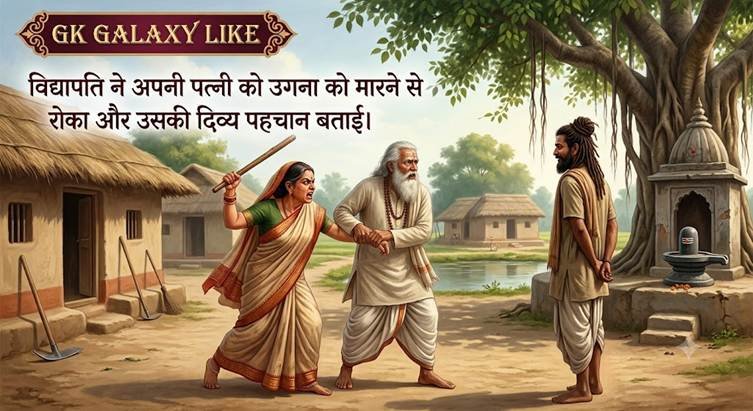
5.5 THE EPISODE OF UGNA’S DEPARTURE
One popular version of the story of Ugna Mahadev describes a situation in which Vidyapati, overwhelmed by emotion, inadvertently calls Ugna by his divine identity.
The details of this episode may differ among oral versions. In the popular account, Ugna’s departure is associated with Vidyapati revealing his true identity.
This event can be understood as a conflict between keeping a promise and experiencing intense emotions. Vidyapati’s behaviour is not portrayed as arising from malicious intent. Instead, his emotional state and the circumstances of the moment are given special importance.
Ugna’s departure introduces the theme of separation into the story. The divine presence that Vidyapati had experienced in his everyday life now moves away from him.
5.6 SEPARATION AND DEVOTION
Separation, or viraha, is an important theme in Vidyapati’s literature. In the story of Ugna Mahadev, the episode of separation acquires particular emotional significance.
Here, separation is not merely the pain of being parted from a familiar person. According to popular belief, Vidyapati loses the immediate divine presence that he had experienced so closely.
In devotional literature, the experience of separation sometimes becomes a means of expressing the depth of one’s love for God. The feeling of God’s absence reveals that the devotee’s relationship with the divine extends beyond religious rituals.
The story of Ugna conveys this emotion through the language of folk tradition and simple human experiences.
5.7 MORAL LESSONS FROM THE STORY
The relationship between Ugna and Vidyapati offers several valuable lessons:
Respect for service: Helping others is never an insignificant task.
Protection of trust: Maintaining trust is essential in relationships.
Control over emotions: Words and behaviour require particular care during moments of intense emotion.
Humility: A person’s outward position does not fully reveal their true worth.
Love and surrender: A deep relationship is founded not merely on authority but also on trust and affection.
Readers may understand these lessons as human values regardless of whether they share the religious beliefs associated with the story.
CHAPTER 6: THE UGNA MAHADEV TEMPLE AT BHAWANIPUR
FAITH, POPULAR BELIEFS, AND CULTURAL HERITAGE OF MITHILA
6.1 INTRODUCTION TO BHAWANIPUR
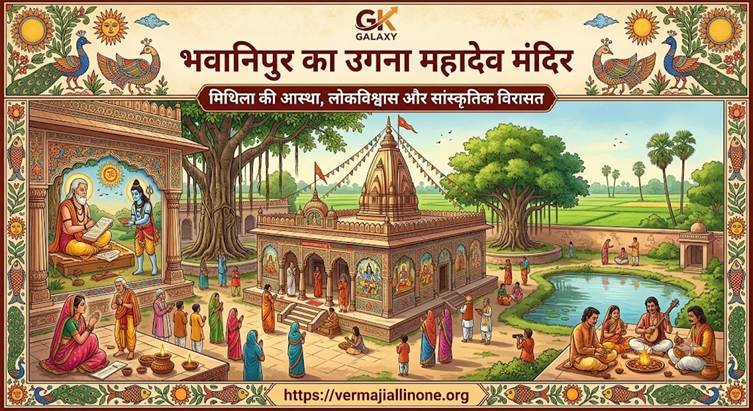
Bhawanipur village, located in Madhubani district of Bihar, is associated with the famous religious folk tale of Mahakavi Vidyapati and Ugna Mahadev. The place holds special significance in the religious and cultural traditions of Mithila.
According to the source material for this chapter, the tourism-related information published by the Madhubani district administration identifies Bhawanipur as a place associated with the Ugna Mahadev Temple and the tradition connected with Vidyapati.
The identity of this place is not limited to its status as a religious site. It is also connected with the collective memory through which the story of Vidyapati and Ugna has been passed down among generations.
Two aspects must be distinguished when discussing Bhawanipur. The first concerns the geographical location, temple, and present-day information about the village. The second concerns the religious folk tale that Lord Shiva lived beside Vidyapati in the form of Ugna.
Both aspects have cultural significance, but historical facts and popular beliefs should be identified separately.
6.2 RELIGIOUS IDENTITY OF THE UGNA MAHADEV TEMPLE
The Ugna Mahadev Temple at Bhawanipur holds an important place in local religious tradition. Devotees associate the temple with the popular story of Lord Shiva and Mahakavi Vidyapati.
According to popular belief, Lord Shiva was pleased with Vidyapati’s devotion and assumed the form of a servant named Ugna. The location where the divine identity is said to have been revealed in the story is associated with the temple’s tradition.
The temple’s distinctive religious identity is closely connected with this narrative. For devotees, visiting the site provides an opportunity not only to worship Lord Shiva but also to connect with the memory of Vidyapati.
It is important to distinguish the temple’s present-day religious identity from the historical details of the associated folk tale. Before mentioning a specific date of construction or the name of its founder, reliable documentary records should be examined.
6.3 THE RELATIONSHIP BETWEEN UGNA MAHADEV AND VIDYAPATI
Understanding the story of Vidyapati and Ugna is essential for appreciating the temple’s cultural identity.
According to the folk tale, Vidyapati was a devoted follower of Lord Shiva. Pleased with his devotion, Shiva became his servant and began living beside him under the name Ugna.
The major episodes include Ugna serving Vidyapati, providing Ganga water to quench his thirst during a journey, and revealing his divine identity.
These events should be presented as part of religious folk tradition. Through them, the relationship between the devotee and God is explained in terms of love, service, trust, and surrender.
The temple at Bhawanipur is an important centre of this collective cultural memory. Its study is therefore useful not only for understanding religious tourism but also for exploring the oral traditions and cultural history of Mithila.
6.4 THE TEMPLE AND LOCAL SOCIETY
Religious sites perform several functions in community life. Along with serving as centres of worship, they can support social interaction, preserve cultural memory, and contribute to local identity.
The significance of the Ugna Mahadev Temple can also be understood in this broader context. The story of Vidyapati is connected with local religious consciousness, and the temple provides a place where this tradition can be remembered.
Visitors to such sites may become familiar with the cultural heritage of the region while expressing their religious faith.
However, before publishing details about specific fairs, annual celebrations, or local arrangements at the temple, it is necessary to verify the latest information from reliable local or temple authorities.
6.5 GEOGRAPHICAL IMPORTANCE OF BHAWANIPUR
According to the tourism-related information referenced in the source material, Bhawanipur is located near the Pandaul area of Madhubani district. Pandaul railway station is one of the possible transport access points for reaching the location.
This information may be useful to readers who wish to visit the Ugna Mahadev Temple in the future.
However, current train services, road routes, local transport, temple visiting hours, and available facilities should be checked separately before travelling, as these details may change over time.
6.6 RELIGIOUS TOURISM AND CULTURAL PRESERVATION
The importance of religious tourism extends beyond visiting places of worship. It can also increase awareness of regional cultural heritage, local history, and folk traditions.
When studying places such as Bhawanipur, it is useful to document local oral traditions respectfully. At the same time, historical records, published literature, and administrative sources can help make factual information more reliable.
Preserving temples and their associated traditions also requires attention to cleanliness, the local environment, the maintenance of historic structures, and the convenience of devotees.
Thus, religious tourism can contribute to the preservation of cultural heritage, provided that development and conservation remain balanced.
CHAPTER 7: THE TRADITION OF SHIVA DEVOTION IN MITHILA
WORSHIP, FOLK SONGS, FAITH AND CULTURAL LIFE
7.1 RELIGIOUS CULTURE OF MITHILA
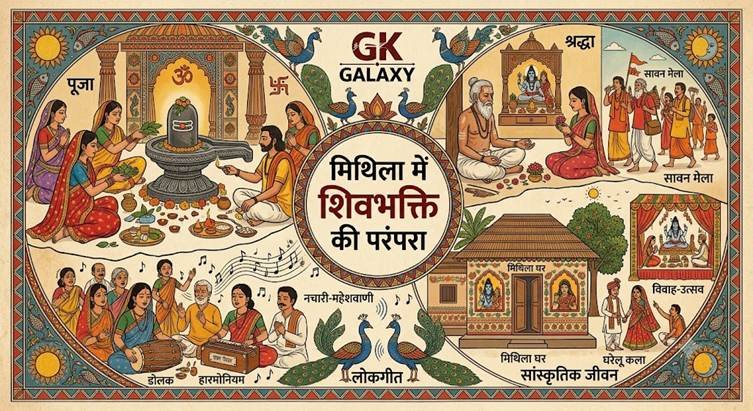
The cultural identity of Mithila has long been associated with a close relationship between religion, literature, and everyday life. Religious traditions in the region are not confined to worship alone; they are also reflected in folk songs, family rituals, festivals, and community life.
The worship of Lord Shiva is an important part of Indian religious tradition. Shiva devotion has also been practised in various forms throughout Mithila.
Lord Shiva is remembered by names such as Bholenath and Mahadev. Within devotional traditions, He is regarded as a simple, compassionate, and benevolent deity who cares for His devotees.
The story of Ugna Mahadev belongs to this religious and cultural background. In the tale, Lord Shiva appears in the life of His devotee in the form of a servant, symbolizing compassion and a deep personal connection with the devotee.
7.2 THE IMPORTANCE OF SIMPLICITY IN SHIVA DEVOTION
Many folk traditions associated with Shiva devotion place special emphasis on simplicity and sincere faith.
Devotion does not necessarily mean performing elaborate religious rituals. It also involves sincerity of heart, ethical conduct, compassion towards others, and trust in one’s chosen deity.
In the story of Ugna Mahadev, Lord Shiva does not appear with royal splendour or a dramatic display of divine power. Instead, He appears as an ordinary servant.
This literary portrayal expresses an important concept of devotion: love for God is based more on inner feeling than on outward prestige.
The same principle can be applied to human life. A person’s true dignity is not determined solely by their position or wealth. Their conduct, honesty, and willingness to help others are equally important.
7.3 SHIVA DEVOTION AND FOLK SONGS
Folk songs are a powerful means of preserving the cultural memory of a region. They express religious beliefs, family experiences, social relationships, and historical memories through accessible language.
The folk-song traditions of Mithila include themes related to marriage, seasons, festivals, family life, and religious faith.
One important aspect of Vidyapati’s popularity is the musical quality of his verses. The tradition of singing and listening to his compositions has connected his work with cultural life beyond written literature.
The story of Ugna Mahadev has also reached people through oral tradition. Some variations may be found in accounts from different places. Such variations are a natural feature of folk tales.
Therefore, before presenting a particular song or verse as an original composition by Vidyapati, its authentic text and source should be verified.
7.4 FESTIVALS AND COMMUNITY LIFE
Religious festivals help maintain collective participation and cultural continuity within society.
Among festivals associated with Lord Shiva, Maha Shivaratri and worship during the month of Shravan are particularly well known. On these occasions, devotees visit Shiva temples in many places to offer prayers.
Such festivals provide opportunities for families and communities to come together while expressing their religious beliefs.
For details about the present-day festival arrangements, local events, and special rituals at the Ugna Mahadev Temple, the latest information should be obtained from the relevant temple or local administration.
7.5 VIDYAPATI’S LEGACY AND MAITHILI IDENTITY
Vidyapati’s legacy is deeply connected with Maithili literature and the cultural identity of Mithila.
His compositions demonstrate the expressive power of language, sensitivity towards everyday life, and the enduring significance of literature.
Studying Vidyapati’s works helps readers understand the literary world, linguistic traditions, and cultural development of medieval Mithila.
The story of Ugna Mahadev presents another aspect of his popular cultural image. While his literary compositions reveal his poetic personality, the folk tale portrays him as a symbol of devotion and surrender to God.
Considering both aspects provides a broader understanding of Vidyapati’s legacy.
7.6 POPULAR BELIEFS AND HISTORICAL STUDY
Popular beliefs are an important part of a society’s religious and cultural identity. Studying them helps us understand its ideas, values, and collective memory.
However, popular belief and verified history are not the same thing.
Historians examine available documents, inscriptions, literary sources, and other evidence when investigating an event. Folk tales, on the other hand, are often transmitted orally across generations and may develop different versions.
The story of Ugna Mahadev should be understood with this distinction in mind. Its religious and cultural significance is one matter, while the historical verification of individual episodes is a separate question.
This approach does not diminish religious faith. Instead, it helps readers understand the nature of the story and the sources associated with it more clearly.
CHAPTER 8: MAHAKAVI VIDYAPATI’S DEVOTION TO LORD SHIVA
FAITH, SURRENDER, AND LITERATURE
8.1 INTRODUCTION
Mahakavi Vidyapati is held in high esteem in Indian literature and devotional traditions. He is particularly known for his Maithili love songs and verses associated with the devotion of Radha and Krishna. Devotion to Lord Shiva also occupies an important place in his broader literary tradition.
In the folk tradition of Mithila, the story of Vidyapati and Ugna Mahadev is regarded as a distinctive example of Shiva devotion.
In this story, Lord Shiva does not appear in a royal palace or an elaborate temple. Instead, He assumes the form of an ordinary servant. He lives beside Vidyapati, serves him, and conceals His divine identity.
The story does not merely describe a miracle. It also explores the relationship between a devotee and God through love, trust, humility, and personal affection.
8.2 THE NATURE OF VIDYAPATI’S DEVOTION TO LORD SHIVA
To understand Vidyapati’s devotion to Lord Shiva, it is necessary to examine his religious compositions, the traditions of Mithila, and the folk tales associated with him from distinct perspectives.
His literary identity is not restricted to a single religious subject. His works explore love, separation, devotion, morality, religion, and different aspects of contemporary society. His creative talent is evident in several linguistic traditions, including Sanskrit and Maithili, as well as literary traditions associated with Avahatta.
Three particular values are important when discussing Shiva devotion:
1. Surrender: A devotee expresses reverence for God by setting aside the ego.
2. Affection: The relationship between God and the devotee need not be limited to fear or formal worship; it can also be based on love and trust.
3. Humility: Spiritual greatness is not defined by outward splendour alone but also by inner purity and simplicity.
All three values are especially evident in the folk tale of Ugna.
8.3 SHIVA DEVOTION IN THE STORY OF UGNA MAHADEV
According to the popular story in Mithila, Lord Shiva was pleased with Mahakavi Vidyapati’s devotion and began living beside him in the form of a servant. He introduced Himself as Ugna.
Ugna behaves like an ordinary servant in the story. He assists Vidyapati in his daily life, and his true identity becomes apparent only under particular circumstances.
According to one famous episode, Vidyapati becomes thirsty during a journey. When no water is available, Ugna uses his divine power to provide Ganga water. Vidyapati subsequently becomes suspicious and discovers Ugna’s true identity.
This episode is regarded as a symbol of the special relationship between God and His devotee. However, the story belongs to religious folk belief and tradition and should not be presented as an independently verified historical event.
8.4 GOD BECOMING A SERVANT: THE SPIRITUAL MEANING OF THE STORY
The most striking aspect of the story of Ugna Mahadev is that Lord Shiva assumes the role of His devotee’s servant.
In the usual religious understanding, the devotee serves God. In this story, however, God Himself serves the devotee.
This reversal reveals a deeper meaning of devotion: genuine love can transcend the limitations of rank, prestige, and authority.
The story suggests that God cannot be understood only through grand temples, elaborate rituals, or outward displays. From the devotee’s perspective, the divine can also be experienced amid the ordinary activities of everyday life.
This does not mean that religious traditions and forms of worship lose their importance. Rather, the story suggests that outward worship should be accompanied by inner faith, compassion, and humility.
8.5 PROMISES, TRUST AND SEPARATION
Another important aspect of the folk tale is the promise made between Vidyapati and Ugna.
According to the story, after Vidyapati discovers Ugna’s true identity, he promises not to reveal the secret to anyone.
Later, in a difficult situation, Vidyapati breaks this promise, and Ugna leaves him. This episode gives the story considerable emotional depth.
Its literary significance can be understood on several levels:
The importance of a promise: Trust and commitment are essential to relationships.
Human weakness: Even a great person may make a mistake when overwhelmed by emotion.
The emotion of separation: The pain caused by the departure of a beloved presence becomes a profound source of feeling in devotional literature.
Memory and faith: The influence of a beloved presence can continue even after that presence has departed.
The purpose of the story is not merely to depict punishment for a mistake. It also reveals the complexities of trust, love, and separation.
8.6 Shiva Devotion and Folk Culture
The worship of Lord Shiva, folk songs, festivals and local religious traditions hold special significance in Mithila. The story of Ugna Mahadev is an important part of this cultural world.
Through the story, people connect their religious feelings with literature and collective memory. Vidyapati is remembered not only as a poet but also as a symbol of Mithila’s cultural identity.
The tradition of Ugna Mahadev demonstrates how literary personalities and religious folk beliefs can become interconnected over time. Such stories help transmit a community’s cultural memory from one generation to another.
8.7 THE LITERARY IMPORTANCE OF VIDYAPATI’S DEVOTION TO SHIVA
When studying Vidyapati’s religious compositions, it is necessary to distinguish between his historically attested literature, established textual versions, and later folk traditions.
It would not be appropriate to assume, without verification, that every popular story or verse associated with Vidyapati was written by him.
To establish the authenticity of a particular verse, researchers should consult reliable edited collections, manuscripts, and scholarly studies.
This precaution is important for maintaining the credibility of the book. Faith and literary research are not opposed to one another. We can respect the cultural significance of a folk tale while remaining clear about the status of its historical evidence.
CHAPTER 9: MAJOR LITERARY WORKS OF MAHAKAVI VIDYAPATI
AND THEIR SIGNIFICANCE
9.1 INTRODUCTION
Mahakavi Vidyapati was a versatile writer in medieval Indian literature. He is regarded as a major poet of the Maithili literary tradition.
His works explore various aspects of love, separation, devotion, morality, religion, and the political and cultural life of his time.
Vidyapati’s literary contribution was not limited to songs. He contributed to the literary traditions of Sanskrit, Avahatta and Maithili.
Some of his works are associated with religious and philosophical subjects, while others discuss history, politics, social conduct, and religious practices.
9.2 THE MAITHILI PADAVALI
Vidyapati’s most famous literary identity is associated with his collection of lyrical verses, commonly known as the Padavali.
These verses express a wide range of emotions, including love, separation, union, beauty, emotional conflict, and devotion.
The musical quality of his language and the natural expression of feelings are particularly noteworthy. As a result, his songs have not remained confined to written literature but have also become part of singing traditions and cultural life.
Major Features of the Padavali
1. Emotional depth: The powerful expression of experiences of love and separation.
2. Musical language: A combination of words and rhythm suited to singing.
3. Closeness to folk life: Reflections of local cultural experiences in language and emotion.
4. Human sensitivity: The expression of universal emotions such as love, anticipation, pain, and hope.
9.2 MAITHILI PADAVALI (CONTINUED)
Experience of Devotion: Presenting love for God in an intimate and emotionally expressive manner.
The importance of Vidyapati’s Padavali also lies in its contribution to establishing Maithili as an influential language of poetry.
9.3 SONGS OF LOVE AND SEPARATION
Vidyapati’s love songs express not only the joy of union but also the pain of separation. In his poetry, love is not merely a pleasant experience; it also involves waiting, restlessness, memories, and emotional conflict.
While describing separation, the poet pays attention to the subtle states of the human mind. The feeling that time passes slowly when a beloved is far away, memories repeatedly returning, and the hope of reunion remaining alive bring readers closer to universal human experiences.
These compositions can be read not only from a religious perspective but also from literary and humanistic perspectives. This multidimensional quality keeps Vidyapati’s poetry relevant across generations.
9.4 CREATIVE CONTRIBUTIONS IN SANSKRIT
Vidyapati also composed important works in Sanskrit. His Sanskrit compositions reflect his scholarly learning and familiarity with the classical traditions of his time.
The following works are associated with his name:
Purusha-Pariksha: A work concerning ethics, conduct, and human qualities.
Bhu-Parikrama: Mentioned as a work associated with geographical, religious, or pilgrimage-related traditions.
Danavakyavali: A text concerning charity and related religious and social subjects.
Gangavakyavali: A compilation of subjects associated with the Ganges and religious beliefs.
Durgabhaktitarangini: A work related to the worship of Goddess Durga.
Shaivasarvasvasara: A text concerning the Shaiva tradition and subjects related to Lord Shiva.
The names of these works appear in various literary studies and reference lists. It is advisable to verify their titles, texts, and authorship against reliable editions before relying on any particular version.
9.5 CONTRIBUTION TO AVAHAṬṬA LITERATURE
Vidyapati is also associated with the literary tradition of the Avahaṭṭa language. Avahaṭṭa represents an important stage in the linguistic development of medieval North India.
The diversity of languages and literary styles found in his works reflects the multilingual nature of society during that period. Writing in both a classical language such as Sanskrit and regional language traditions also provided a means of reaching wider communities of readers and listeners.
9.6 LITERATURE AND CONTEMPORARY SOCIETY
The study of Vidyapati’s works should not be limited to their poetic beauty. His literature also provides opportunities to understand the social values, religious beliefs, political environment, and cultural life of his time.
Medieval Mithila had various relationships among royal courts, scholars, religious institutions, and local communities. Vidyapati’s literature developed within this broader environment.
Nevertheless, ideas expressed in a poem or religious composition should not be treated as direct proof of the actual condition of the entire society. Literary works can be important sources for understanding their period, but reading them alongside other historical evidence is a more reliable approach.
9.7 THE LASTING IMPORTANCE OF VIDYAPATI’S WORKS
The importance of Vidyapati’s literary legacy can be understood through the following points:
Enrichment of the Maithili poetic tradition.
Subtle expression of emotions such as love and separation.
Literary integration of devotion and human sensitivity.
Creative connections between Sanskrit and regional-language literature.
Contribution to the wider recognition of Mithila’s language, culture, and literary identity.
Influence on later poetic and singing traditions.
CHAPTER 10: MORAL AND SPIRITUAL LESSONS FROM
THE STORY OF UGNA MAHADEV
10.1 INTRODUCTION
In Mithila’s folk tradition, the story of Ugna Mahadev and Mahakavi Vidyapati is not merely a tale of Lord Shiva’s miracles. It encompasses many human emotions and values, including devotion, love, trust, humility, commitment to promises, and separation.
According to the story, Lord Shiva assumed the form of a servant named Ugna to serve his devotee Vidyapati. Vidyapati later discovered Ugna’s true identity. The story then progresses through episodes involving promises, emotional circumstances, and eventual separation.
The account presented in this book is based on Mithila’s religious and cultural folklore. It is important both to understand its spiritual meanings and to distinguish it from independently verified historical events.
10.2 FIRST LESSON: THERE IS NO PLACE FOR EGO IN TRUE DEVOTION
In the story of Ugna Mahadev, Lord Shiva lives with Vidyapati in the form of an ordinary servant. The most important message of this episode is that spiritual greatness does not depend on external position, prestige, or wealth.
People sometimes begin to consider themselves superior to others because of their wealth, knowledge, position, or social status. However, devotional traditions place great importance on humility and self-control.
The story inspires us to use our knowledge and achievements to help others rather than becoming arrogant about them.
Practical application in life: Respect people not only for their positions or wealth but also for their behaviour, honesty, and humane qualities.
10.3 SECOND LESSON: SERVICE IS ALSO AN EXPRESSION OF LOVE
Ugna plays the role of a servant in the story. He stays with his master and helps meet his needs. This episode can be understood in terms of the relationship between service and love.
Service is not merely a responsibility associated with a high or low position. Caring for elderly family members, helping people in need, teaching a student, or standing beside someone in a crisis are also forms of service.
When service is motivated by compassion and goodwill rather than selfish interests, it strengthens human relationships.
Practical application in life: When helping others, do not focus on what you will gain in return. Help as much as you reasonably can while respecting the other person’s dignity.
10.4 THIRD LESSON: TRUST IS THE FOUNDATION OF RELATIONSHIPS
Trust holds special importance in the folk tale about Vidyapati and Ugna. After Ugna’s identity is revealed, the story introduces a promise. Later, when that promise is broken, the relationship between the two changes.
This episode teaches us that trust is an important foundation of every relationship. In families, friendships, society, and workplaces, mutual trust provides stability.
Trust does not mean that a person should never ask questions or investigate something. It means being honest with others, taking promises seriously, and choosing communication when misunderstandings arise.
Practical application in life: Try to keep the promises you make. If circumstances make it impossible to fulfil a promise, communicate clearly and in good time.
10.5 FOURTH LESSON: CONTROL ANGER AND EMOTIONAL IMPULSES
In popular versions of the story, an episode occurs in which emotions cause the situation between Vidyapati and Ugna to change. This episode can be understood in terms of human emotions and self-control.
When angry or stressed, people sometimes say things or take actions that they later regret. Wisdom lies not only in knowing what is right but also in expressing it at the right time and in an appropriate manner.
Practical application in life:
Avoid reacting immediately when angry.
Listen fully to the other person during a disagreement.
Consider the situation calmly before making a decision.
Accept mistakes and try to correct them.
10.6 FIFTH LESSON: LOVE REQUIRES RESPECT, NOT POSSESSIVENESS
The story of Vidyapati and Ugna expresses a sense of closeness and affection. This feeling can be connected to the importance of respecting relationships in modern life.
Love does not mean exercising complete control over another person. True love respects the other person’s freedom, dignity, and emotions.
The same principle applies to friendships, families, and married life. Relationships cannot be sustained through control alone; they require trust, communication, and mutual respect.
Practical application in life: Try to understand the feelings of your loved ones. When differences arise, rely on communication rather than insults or pressure.
10.7 SIXTH LESSON: SEPARATION IS ALSO PART OF LIFE
The separation episode in the story of Ugna Mahadev gives it emotional depth. Losing the presence of a loved one, missing an opportunity, or experiencing the end of an important phase of life can cause pain.
Separation is not confined to religious literature. It appears in many human experiences. Parting from a loved one, leaving a familiar place, or remembering the past can also create feelings of separation.
The story encourages us to understand that it is possible to accept grief while continuing to find meaning in life.
Practical application in life: During difficult times, talk to your loved ones, understand your emotions, and seek help when necessary. Hiding grief is not the only sign of strength; accepting it in a healthy way is also an act of courage.
10.8 SEVENTH LESSON: DO NOT SEEK GOD ONLY IN EXTERNAL GRANDEUR
In the story of Ugna Mahadev, Lord Shiva appears in the form of an ordinary person. Through this symbolic portrayal, the folk tradition conveys that experiencing the divine should not be limited to grandeur or outward display.
Temples, worship, rituals, and pilgrimages have their own importance in religious life. At the same time, qualities such as truthfulness, compassion, honesty, and service also give meaning to spiritual life.
If someone worships regularly but treats others unjustly, a gap becomes evident between their conduct and their religious sentiments.
Practical application in life: Along with religious faith, give importance to ethical conduct, integrity, and sensitivity towards people in need.
10.9 EIGHTH LESSON: DISCERNMENT IS NECESSARY TO UNDERSTAND GREAT INDIVIDUALS
Mahakavi Vidyapati’s literary importance is a subject of historical and literary study, whereas the story of Ugna Mahadev is primarily transmitted through folk belief and religious tradition.
A thoughtful approach is necessary to understand both aspects. A person of faith may draw spiritual inspiration from the story, while a student of history may investigate the kinds of evidence available to support a particular event.
There is no need to create an unnecessary conflict between these two perspectives. Folktales help us understand a society’s emotions, values, and cultural memory, even when every episode cannot be verified as historical fact.
Practical application in life: Check the source before sharing religious or historical information. Present folk traditions as folk traditions and verified facts as verified facts.
10.10 NINTH LESSON: RESPECT CULTURE AND LANGUAGE
Vidyapati’s name is deeply connected with the language and culture of Mithila. His works demonstrate that emotions expressed in a regional language can acquire broad human significance.
A regional language is more than a means of communication. It preserves folk songs, sayings, family memories, religious traditions, and the experiences of generations.
Studying the literary heritage of languages such as Maithili is an important way to understand India’s cultural diversity.
Practical application in life: Respect your mother tongue, preserve folk songs and literature, and give children opportunities to learn about their language and culture.
10.11 TENTH LESSON: KNOWLEDGE AND DEVOTION CAN GO HAND IN HAND
Vidyapati is known as a learned poet and a writer associated with religious traditions. His literary legacy inspires us to recognise that study, reflection, and spiritual sensitivity can complement one another.
Knowledge teaches people to ask questions, while devotion can strengthen faith and self-reflection. A balanced approach requires neither accepting every claim without thought nor dismissing cultural traditions without understanding them.
Practical application in life: Develop the habit of reading, asking questions, checking evidence, and respecting the faith of others.
10.12 INSPIRATION FOR STUDENTS
The story of Ugna Mahadev and Mahakavi Vidyapati offers useful lessons for students as well.
Knowledge grows through regular study and practice.
Humility should be maintained alongside success.
Respect teachers, parents, and classmates.
Learn from your mistakes.
Explore your language, literature, and cultural heritage.
Check facts, sources, and evidence while preparing for examinations.
By applying these lessons in life, students can prepare themselves not only for examinations but also to become responsible citizens.
CHAPTER 11: MAHAKAVI VIDYAPATI’S CONTRIBUTION TO
MITHILA’S LANGUAGE, CULTURE AND LITERATURE
11.1 INTRODUCTION
Mithila is a cultural region of India whose identity has been shaped by its language, literature, folk songs, religious traditions, and scholarly heritage. Mahakavi Vidyapati is one of the most celebrated figures in this cultural tradition.
His literature helps us understand the prestige of Maithili poetry, the expression of love and separation, and the diversity of devotional literature. Vidyapati’s legacy is not preserved only in books; his name also remains alive in popular memory, cultural events, and singing traditions.
11.2 CONTRIBUTION TO THE DEVELOPMENT OF THE MAITHILI LANGUAGE
Vidyapati occupies a special place in the literary tradition of the Maithili language. The language, emotional expression, and musical quality of his verses contributed to the wider recognition of Maithili poetry.
His songs combine local life with human emotions in ways that make the language vibrant. He gave powerful poetic expression to subjects such as love, separation, waiting, beauty, and devotion.
It is appropriate to regard Vidyapati as a major Maithili poet. However, the history of Maithili literature includes many writers and traditions both before and after him. The development of the language should therefore not be attributed to a single individual alone.
11.3 INFLUENCE ON FOLK SONGS AND SINGING TRADITIONS
Vidyapati’s verses have also been associated with singing traditions. Their rhythm and emotional expression make them well suited to musical performance.
In Mithila and other regions, Vidyapati’s songs have been sung on religious, cultural, and family occasions. The way his verses are recited and performed may vary from place to place.
In oral traditions, the words of a composition may change over time. Therefore, a popular version of a song is not necessarily identical to its authenticated literary text.
11.4 RELIGIOUS AND CULTURAL MEMORY
Vidyapati’s name is associated with Radha-Krishna devotion, Shiva devotion, and the religious traditions of Mithila. The story of Ugna Mahadev is a well-known example of this cultural memory.
The story connects a literary figure with religious folk belief. For local communities, such traditions may be more than entertainment; they can form part of cultural identity and spiritual life.
When studying this tradition, it is important to remember that religious memory and historical evidence are different kinds of sources. Both are important, but the conclusions drawn from them should not be treated as identical.
11.5 MITHILA’S CULTURAL IDENTITY
Vidyapati’s name is so closely associated with Mithila’s identity that he is often regarded as a symbol of regional literary pride.
His literary legacy helps us understand how regional languages and literature enrich Indian culture. A work written in a regional language can express universal human emotions while remaining rooted in its local context.
The study of Vidyapati is therefore not limited to the history of Mithila. It is also useful for understanding the development of Indian languages, medieval literature, and devotional expression.
11.6 VIDYAPATI’S RELEVANCE IN MODERN TIMES
Vidyapati’s legacy remains important today for several reasons:
- Linguistic pride: His works encourage interest in the Maithili language and literature.
- Literary study: His verses provide opportunities to study emotion, rhythm, and poetic craft.
- Cultural preservation: His legacy inspires efforts to preserve folk songs and traditional singing.
- Educational importance: His contribution is useful in research on medieval Indian literature and the development of regional languages.
- Human sensitivity: Themes such as love, waiting, separation, and devotion continue to influence readers.
11.7 WAYS TO PASS THE LEGACY ON TO THE NEXT GENERATION
Several efforts can help preserve Vidyapati’s literary and cultural legacy for future generations:
Encourage the study of Maithili literature in schools and colleges.
Provide simple Hindi explanations alongside authenticated texts.
Document the contributions of folk singers and traditional performers.
Digitise old literary works carefully.
Organise lectures, readings, and cultural programmes about regional languages and literature.
Publish material that clearly distinguishes folk traditions from historical facts.
Digital media now allows literature and cultural material to reach a wider readership. Nevertheless, checking sources and respecting copyright remain essential when publishing digitally.
Chapter 12: Mahakavi Vidyapati and Ugna Mahadev:
Important Questions and Answers
12.1 INTRODUCTION
This chapter presents important questions and answers about Mahakavi Vidyapati, the popular story of Ugna Mahadev, Mithila’s culture, and Vidyapati’s literature. These questions are intended to help readers revise the main points covered in the book.
Where a subject is based on folk tradition, it is presented as such. Reliable references should be consulted to verify historical information and literary facts.
12.2 GENERAL KNOWLEDGE AND FACTUAL QUESTIONS
Question 1. Which cultural region is Mahakavi Vidyapati particularly associated with?
Answer: The Mithila region, which is associated with Maithili cultural traditions in present-day Bihar and parts of Nepal.
Question 2. Vidyapati is primarily regarded as a major poet of which language?
Answer: Maithili.
Question 3. Which languages are associated with Vidyapati’s literary works?
Answer: His literary tradition is associated with Maithili, Sanskrit and Avahaṭṭa.
Question 4. What is one major reason for Vidyapati’s fame?
Answer: His emotionally expressive love songs, descriptions of separation, and devotional poetry.
Question 5. Which major emotions are found in Vidyapati’s poetry?
Answer: Love, separation, union, devotion, beauty, and human sensitivity.
Question 6. The story of Ugna Mahadev is particularly associated with the folk tradition of which region?
Answer: Mithila.
Question 7. Who is Ugna in the story of Ugna Mahadev?
Answer: According to the folk tale, Ugna is the form assumed by Lord Shiva when he lives as a servant of Mahakavi Vidyapati.
Question 8. Where is the famous temple associated with Ugna Mahadev located?
Answer: The Ugna Mahadev Temple is located in Bhawanipur, Madhubani district, Bihar.
Question 9. In what form does Lord Shiva appear in the story of Ugna Mahadev?
Answer: According to the folk tradition, he appears in the form of a servant named Ugna.
Question 10. Which themes become important after Vidyapati discovers Ugna’s true identity?
Answer: Promises, trust, secrecy, and the relationship between a devotee and God.
12.3 QUESTIONS RELATED TO LITERATURE
Question 11. What are the main features of Vidyapati’s Padavali?
Answer: Emotional depth, musicality, and powerful expressions of love and separation.
Question 12. What does separation (viraha) mean?
Answer: The emotional pain caused by being separated from a loved one or having that person remain far away.
Question 13. Why are Vidyapati’s love songs still relevant today?
Answer: They portray love, waiting, memories, and human emotions in ways that can move readers across different periods.
Question 14. Why is Vidyapati’s literary contribution not limited to love songs?
Answer: His literary tradition also includes religious, ethical, classical, and cultural subjects.
Question 15. Why is Avahaṭṭa important in the context of Vidyapati?
Answer: It helps us understand the linguistic and literary traditions of medieval North India.
Question 16. Why is textual authenticity important when studying Vidyapati’s works?
Answer: It helps distinguish the poet’s authentic compositions from later versions and popular folk traditions.
Question 17. What precaution should be taken when using a literary work as a historical source?
Answer: Its literary purpose should be distinguished from its historical claims, which should be corroborated with other evidence when necessary.
Question 18. What is Vidyapati’s importance in Maithili literature?
Answer: He is one of the major writers in the Maithili poetic tradition and made an important contribution to the literary prestige of the language.
12.4 Questions About the Story of Ugna Mahadev
Question 19. What is the central idea of the story of Ugna Mahadev?
Answer: The relationship of love, trust, service, and surrender between a devotee and God.
Question 20. What can Lord Shiva becoming a servant symbolise in the story?
Answer: Humility, love, and an intimate connection with the devotee.
Question 21. Why is the episode involving Ganga water famous in the story of Ugna?
Answer: According to the folk tale, when Vidyapati becomes thirsty during a journey, Ugna uses his divine power to provide Ganga water. This episode is an important turning point involving a miracle and the revelation of identity.
Question 22. What is the importance of the promise between Vidyapati and Ugna?
Answer: It highlights the importance of trust and commitment to one’s word.
Question 23. What lesson can be learned from the separation episode in the story?
Answer: We should avoid making decisions under intense emotional pressure and recognise the importance of trust and communication in relationships.
Question 24. Can every episode in the story of Ugna Mahadev be considered a verified historical event?
Answer: No. The story should primarily be understood as part of Mithila’s religious folklore. It would be inappropriate to assume that every episode has independent historical verification.
Question 25. What is the cultural importance of the Ugna Mahadev Temple?
Answer: It is regarded as an important centre of Mithila’s religious faith and the cultural memory associated with Vidyapati.
12.5 MORAL AND SPIRITUAL QUESTIONS
Question 26. What lesson about humility can be learned from the story of Ugna Mahadev?
Answer: People should not become arrogant because of their position, wealth, or prestige. Respecting others and maintaining an attitude of service are important.
Question 27. Why can service be described as an expression of love?
Answer: Because genuine service gives importance to another person’s needs, dignity, and well-being.
Question 28. What is necessary to maintain trust?
Answer: Honesty, commitment to promises, clear communication, and respect for others’ feelings.
Question 29. Why is discernment necessary alongside religious faith?
Answer: Discernment helps people distinguish folk beliefs, historical facts, and literary imagination while continuing to respect their cultural traditions.
Question 30. What inspiration can students draw from this story?
Answer: Humility, discipline, integrity, a spirit of service, and respect for their language and culture.
CHAPTER 13: MULTIPLE-CHOICE QUESTIONS (MCQS) :PRACTICE SET
Instructions: Each question has four options. The correct answer and an explanation are provided below each question.
Question 1. Which region is Mahakavi Vidyapati primarily associated with?
(A) Malwa
(B) Mithila
(C) Kashmir
(D) Mewar
Correct Answer: (B) Mithila
Explanation: Vidyapati’s name is particularly associated with Mithila’s literary and cultural traditions.
Question 2. Vidyapati is considered a major poet of which language?
(A) Maithili
(B) Tamil
(C) Marathi
(D) Punjabi
Correct Answer: (A) Maithili
Explanation: Vidyapati is one of the most important writers in the Maithili poetic tradition.
Question 3. Whose form is Ugna believed to represent in the story of Ugna Mahadev?
(A) Lord Vishnu
(B) Lord Brahma
(C) Lord Shiva
(D) Lord Indra
Correct Answer: (C) Lord Shiva
Explanation: According to Mithila’s popular folk tale, Lord Shiva assumes the form of a servant named Ugna.
Question 4. In which district is the famous Ugna Mahadev Temple located?
(A) Madhubani
(B) Gaya
(C) Bhojpur
(D) Rohtas
Correct Answer: (A) Madhubani
Explanation: The Ugna Mahadev Temple is located in Bhawanipur, Madhubani district, Bihar.
Question 5. What does viraha in Vidyapati’s poetry refer to?
(A) Military strategy
(B) The pain of separation from a loved one
(C) Agricultural production
(D) Trade
Correct Answer: (B) The pain of separation from a loved one
Explanation: In literature, viraha describes the emotional pain arising from separation from a lover or a beloved person.
Question 6. What is one major message of the story of Ugna Mahadev?
(A) Increasing one’s arrogance
(B) Insulting others
(C) Humility and surrender
(D) Treating wealth as supreme
Correct Answer: (C) Humility and surrender
Explanation: Through service and affection, the story highlights the importance of humility and surrender.
Question 7. What should be done before treating a folktale as a historical fact?
(A) Consider only its popularity
(B) Ignore all sources
(C) Examine available evidence and reliable sources
(D) Treat oral accounts alone as conclusive proof
Correct Answer: (C) Examine available evidence and reliable sources
Explanation: Folk traditions can be important sources of cultural history, but the historical authenticity of each episode may require separate verification.
Question 8. Which is a major feature of Vidyapati’s Padavali?
(A) Descriptions exclusively of warfare
(B) Emotional expression and musicality
(C) Scientific formulas alone
(D) Commercial rules alone
Correct Answer: (B) Emotional expression and musicality
Explanation: Vidyapati’s verses are known for their emotional depth and rhythmic expression.
Question 9. Which languages are mentioned in the literary tradition associated with Vidyapati?
(A) English alone
(B) Persian alone
(C) Maithili, Sanskrit, and Avahaṭṭa
(D) Portuguese alone
Correct Answer: (C) Maithili, Sanskrit, and Avahaṭṭa
Explanation: Vidyapati’s literary legacy is associated with these linguistic traditions.
Question 10. What does the promise in the story of Ugna Mahadev relate to?
(A) Trust and responsibility
(B) Wealth accumulation alone
(C) Military training
(D) Commercial competition
Correct Answer: (A) Trust and responsibility
Explanation: The promise episode encourages reflection on trust in relationships and the importance of keeping one’s word.
Question 11. What is a good way to preserve Mithila’s cultural heritage?
(A) Abandoning the local language
(B) Documenting folk songs and literature
(C) Destroying old texts
(D) Stopping the verification of sources
Correct Answer: (B) Documenting folk songs and literature
Explanation: Documentation, research, and responsible publication can help pass cultural heritage on to future generations.
Question 12. What subjects can the study of Vidyapati’s literature help us understand?
(A) Modern space science alone
(B) Industrial production alone
(C) Medieval literature and Maithili culture
(D) Maritime trade alone
Correct Answer: (C) Medieval literature and Maithili culture
Explanation: Vidyapati’s literature is important for studying language, poetry, religious traditions, and cultural history.
Chapter 14: Conclusion — An Immortal Story of Devotion,
Love and Cultural Heritage
14.1 VIDYAPATI AND UGNA MAHADEV: THE CONFLUENCE OF TWO TRADITIONS
The story of Mahakavi Vidyapati and Ugna Mahadev forms an important part of Mithila’s literary heritage and religious folk memory. Vidyapati’s literary identity is a subject of historical study, whereas the story of Ugna Mahadev has primarily been passed down through folk belief and religious tradition.
Considering both together shows how the memory of a great poet can become connected over time with folktales, songs, and religious faith.
Vidyapati’s compositions give literary expression to love, separation, and devotion. The story of Ugna Mahadev presents these emotions through a folk narrative that imagines an intimate relationship between God and the devotee.
14.2 BALANCING FAITH AND DISCERNMENT
The purpose of this book is not to establish a folktale forcibly as historical fact. Rather, it is to understand the story’s cultural significance, religious sentiments, and moral messages.
Faith can provide spiritual inspiration, while discernment teaches people to examine sources and distinguish facts from traditions. By balancing these two approaches, readers can respect their cultural heritage while studying its history seriously.
14.3 THE STORY’S RELEVANCE TO MODERN LIFE
The tradition of Ugna Mahadev and Vidyapati offers the following lessons:
Choose humility instead of arrogance.
Value helping and serving others.
Maintain trust and respect in relationships.
Avoid making decisions under intense emotional pressure.
Preserve your language and cultural heritage.
Study literature and history using reliable sources.
Alongside religious faith, value integrity and human sensitivity.
These messages are not limited to a story from the past. They can also be relevant to modern family life, education, society, and personal relationships.
14.4 A NOTE FROM THE AUTHOR
Through this book, I have attempted to present the literary legacy of Mahakavi Vidyapati and the popular folk tale of Ugna Mahadev to readers in simple Hindi.
Mithila has an exceptionally rich cultural tradition. Its language, literature, religious beliefs, and folk songs form an important part of India’s cultural diversity. Studying and preserving this heritage is essential.
I request readers to consider this book introductory material for literary, cultural, and religious study. For more in-depth research, readers should also consult authenticated literary editions of Vidyapati’s works, scholarly publications, and authoritative cultural sources.
Author: Shailendra Kumar Verma
REFERENCES AND SOURCES FOR FURTHER STUDY
The following sources may help readers investigate Vidyapati’s literary life, Mithila’s cultural background, and information relating to Ugna Mahadev.
1. Sahitya Akademi — Study of Vidyapati: https://sahitya-akademi.gov.in/pdf/Vidyapati.pdf
2. Indira Gandhi National Centre for the Arts (IGNCA) — Introduction to Vidyapati: https://ignca.gov.in/coilnet/vp001.htm
3. UCLA — Vidyapati in South Asian Literature: https://southasia.ucla.edu/culture/literature/vidyapati/
4. Madhubani District Administration — Ugna Mahadev: https://madhubani.nic.in/tourist-place/ugana-mahadev/
5. Madhubani District Administration — Tourism Information: https://madhubani.nic.in/tourism/
6. Oxford Academic — Vidyapati and the Political History of Fifteenth-Century Literature: https://academic.oup.com/book/27840/chapter-abstract/198146633
Note on the Use of References: The descriptions of the folk tale used in this book should be understood as part of Mithila’s popular religious tradition. Before final publication, verify Vidyapati’s dates of life, the names of his works, original verses, and claims concerning specific historical events against reliable editions and scholarly sources.
ABOUT THE AUTHOR
Shailendra Kumar Verma is interested in preparing educational, literary and general-knowledge material. His work aims to provide readers with information on a variety of subjects in simple language and to encourage interest in Indian literature, culture and traditions of knowledge.
Through this book, he has attempted to present to Hindi readers the famous Mithila tradition associated with Mahakavi Vidyapati and Ugna Mahadev.
The End.