DISCLAIMER
This educational material is prepared for Biology learning and NEET-UG preparation. Questions are intended for practice and revision. The year and examination name should be included only when the question’s appearance in that examination can be established from a reliable source. Some questions may be adapted from previous-year question patterns and should not be treated as verbatim official questions unless verified against the original paper. The author and website are not responsible for discrepancies in unofficial question compilations. Refer to the official NTA/NEET question papers and answer keys for confirmation.
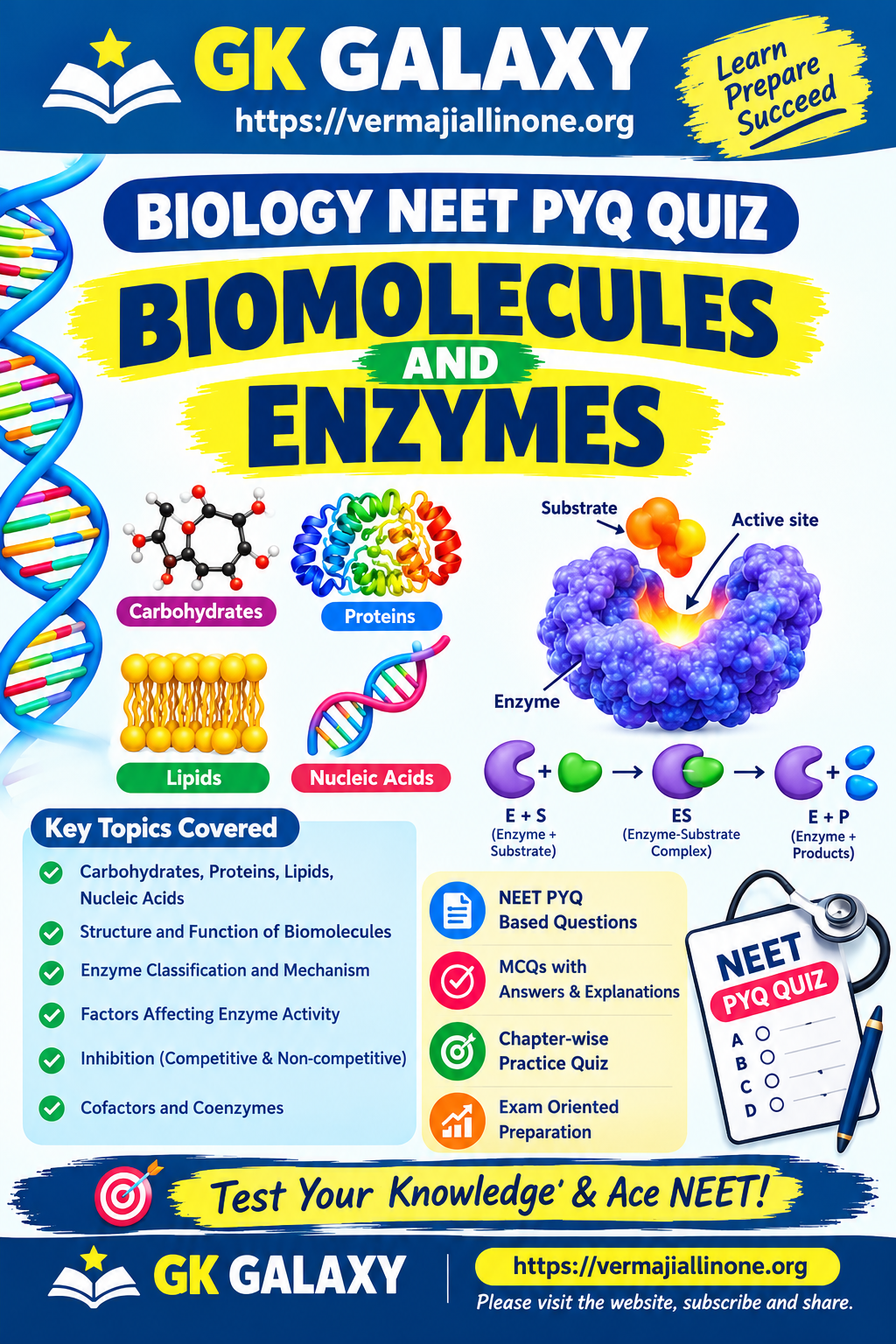
Part 1: Complete Theory
1. INTRODUCTION TO BIOMOLECULES
Biomolecules are chemical compounds found in living organisms. They form cellular structures, store and release energy, regulate metabolism and carry genetic information.
The major biomolecules include carbohydrates, proteins, lipids, nucleic acids, and several smaller molecules such as amino acids, nucleotides, vitamins and metabolic intermediates.
1.1 CHEMICAL COMPOSITION OF LIVING ORGANISMS
Living organisms contain both inorganic and organic substances.
Inorganic constituents: Water, mineral salts and dissolved ions.
Organic constituents: Carbohydrates, proteins, lipids, nucleic acids and other carbon-containing compounds.
Water is generally the most abundant chemical component of cells. Organic compounds are essential for cell structure, energy storage, catalysis and heredity.
1.2 ANALYSIS OF CHEMICAL CONSTITUENTS
Biologists study cellular composition by analysing living tissues and their chemical components.
- Elemental analysis: Determines the elements present in biological material, such as carbon, hydrogen, oxygen, nitrogen, phosphorus and sulphur.
- Compound analysis: Identifies individual compounds such as glucose, amino acids, fatty acids and nucleotides.
- Acid-soluble fraction: Generally contains small molecules, including sugars, amino acids, nucleotides and organic acids.
- Acid-insoluble fraction: Generally contains macromolecules and cellular structures, including proteins, nucleic acids, polysaccharides and membrane-associated lipids.
NEET concept: Lipids have relatively low molecular masses compared with many macromolecules, but they are commonly recovered in the acid-insoluble fraction because they occur largely in membranes and other aggregates.
2. CARBOHYDRATES
Carbohydrates are organic compounds composed mainly of carbon, hydrogen and oxygen. They are important energy sources and structural materials.
2.1 Classification of carbohydrates
Monosaccharides
The simplest carbohydrates; they cannot be hydrolysed into smaller carbohydrate units.
Examples: glucose, fructose, ribose and deoxyribose.
Oligosaccharides
Contain a small number of monosaccharide units. Disaccharides are particularly important.
Examples: sucrose, maltose and lactose.
Polysaccharides
Long chains of monosaccharide units that serve storage or structural functions.
Examples: starch, glycogen, cellulose and chitin.
2.2 IMPORTANT MONOSACCHARIDES
| Monosaccharide | Importance |
| Glucose | Major cellular respiratory substrate |
| Fructose | Common fruit sugar |
| Ribose | Component of RNA and ATP |
| Deoxyribose | Component of DNA |
| Galactose | Component of lactose |
Monosaccharides can be classified by the number of carbon atoms. For example, glucose is a hexose, while ribose is a pentose.
2.3 DISACCHARIDES
Disaccharides consist of two monosaccharides joined by a glycosidic bond.
| Disaccharide | Components |
| Sucrose | Glucose + fructose |
| Maltose | Glucose + glucose |
| Lactose | Glucose + galactose |
Sucrose is a non-reducing sugar, whereas maltose and lactose are reducing sugars.
2.4 POLYSACCHARIDES
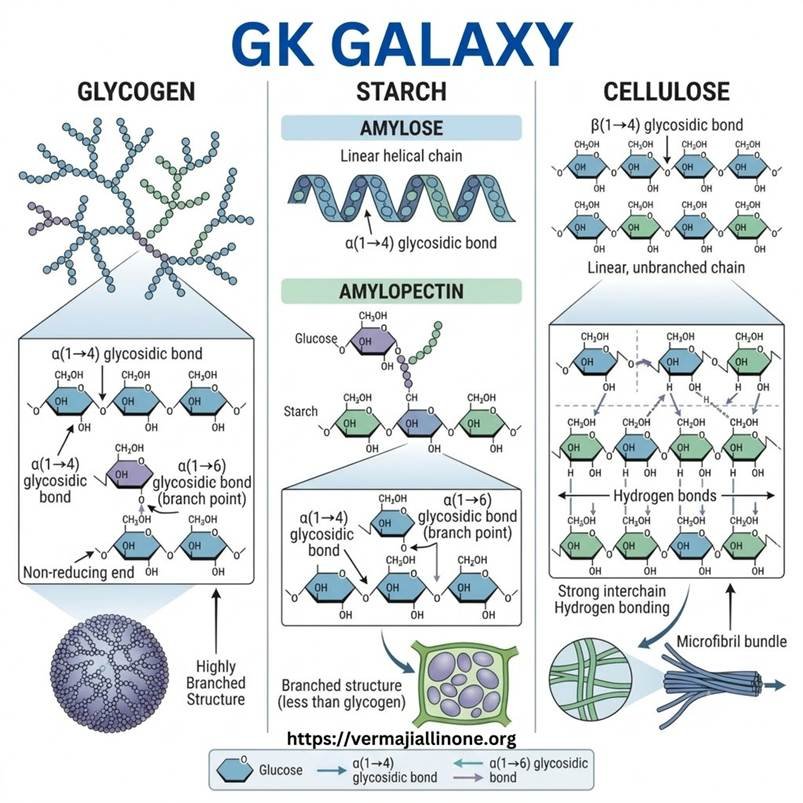
Starch: The principal storage carbohydrate in plants. It contains amylose and amylopectin.
Glycogen: The principal storage polysaccharide in animals; it is highly branched and is also present in fungi.
Cellulose: A structural polysaccharide of plant cell walls, composed of β-glucose units.
Chitin: A structural polysaccharide found in arthropod exoskeletons and fungal cell walls.
NEET distinction: Humans can digest starch but lack the enzyme cellulase needed to digest cellulose.
3. LIPIDS
Lipids are a diverse group of hydrophobic or amphipathic compounds. They are important for energy storage, membrane formation, insulation and cell signalling.
3.1 TYPES OF LIPIDS
Fats and oils: Composed mainly of glycerol and fatty acids; serve as energy reserves.
Phospholipids: Major components of biological membranes, with hydrophilic heads and hydrophobic tails.
Waxes: Provide protective, water-resistant coatings.
Steroids: Include cholesterol and several steroid hormones.
3.2 FATTY ACIDS
Fatty acids contain a carboxyl group and a hydrocarbon chain.
Saturated fatty acids: Contain no carbon–carbon double bonds in the hydrocarbon chain.
Unsaturated fatty acids: Contain one or more carbon–carbon double bonds.
Triglycerides contain one glycerol molecule linked to three fatty acids by ester bonds. Unlike proteins and nucleic acids, most lipids are not true polymers composed of repeating monomer units.
NEET focus: Phospholipids are amphipathic, whereas triglycerides are primarily energy-storage molecules.
4. PROTEINS
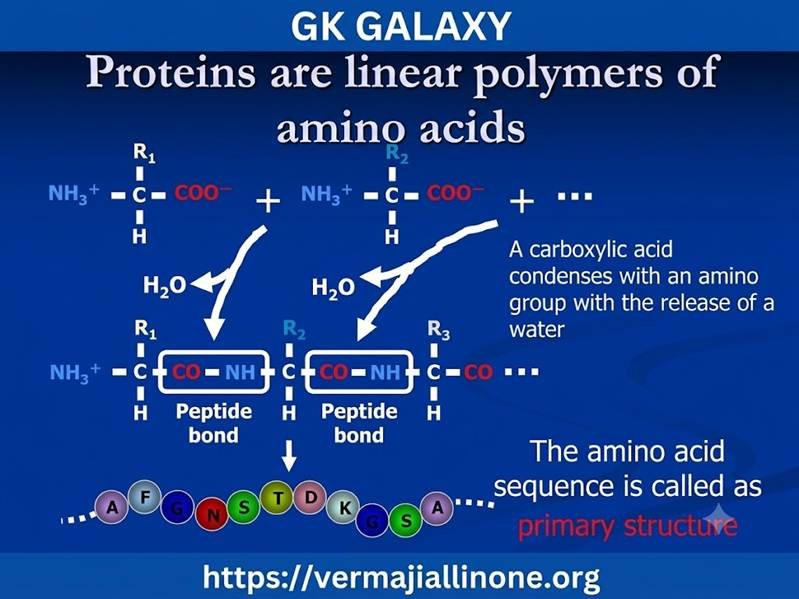
Proteins are biological macromolecules composed of amino acids joined by peptide bonds. They perform structural, catalytic, transport, regulatory, defensive and contractile functions.
4.1 AMINO ACIDS
A typical amino acid contains:
An amino group (–NH₂)
A carboxyl group (–COOH)
A hydrogen atom
A variable side chain (R group)
These groups are attached to the alpha carbon in most protein-forming amino acids.
There are 20 standard amino acids commonly used to build proteins. Their different R groups determine their chemical properties.
4.2 PEPTIDE BOND
A peptide bond forms between the carboxyl group of one amino acid and the amino group of another, with the elimination of water in the conventional condensation representation.
Two amino acids form a dipeptide; additional amino acids form longer peptides and polypeptides.
4.3 LEVELS OF PROTEIN STRUCTURE
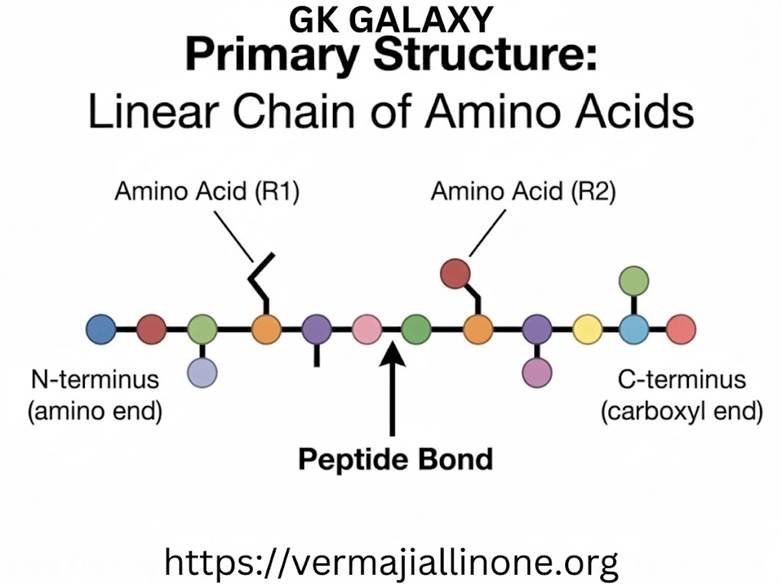
Primary structure
The specific sequence of amino acids in a polypeptide chain.
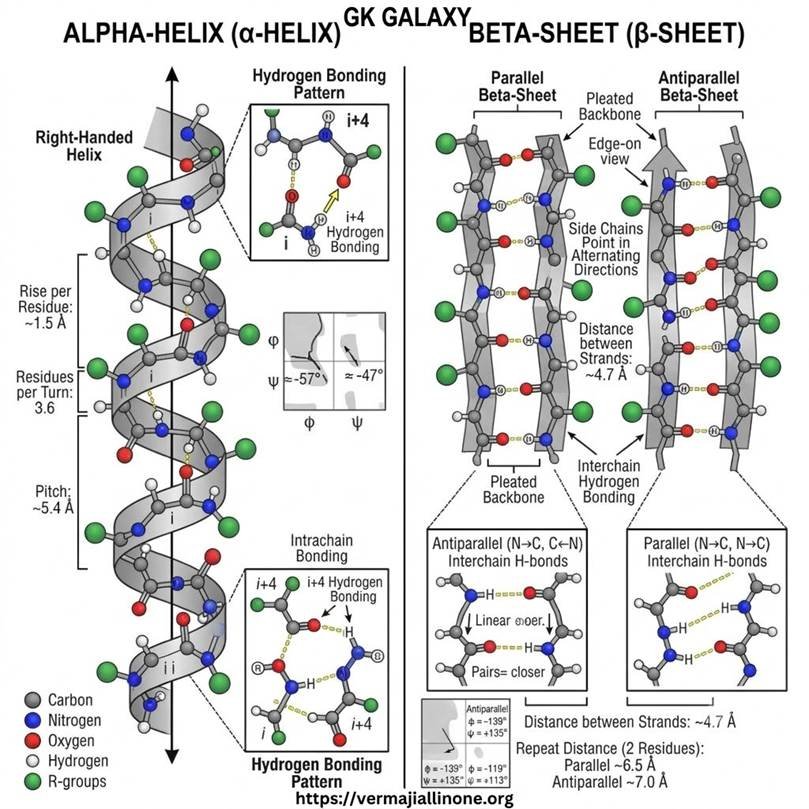
Secondary structure
Local folding, especially the alpha helix and beta-pleated sheet, stabilised mainly by hydrogen bonds between backbone groups.
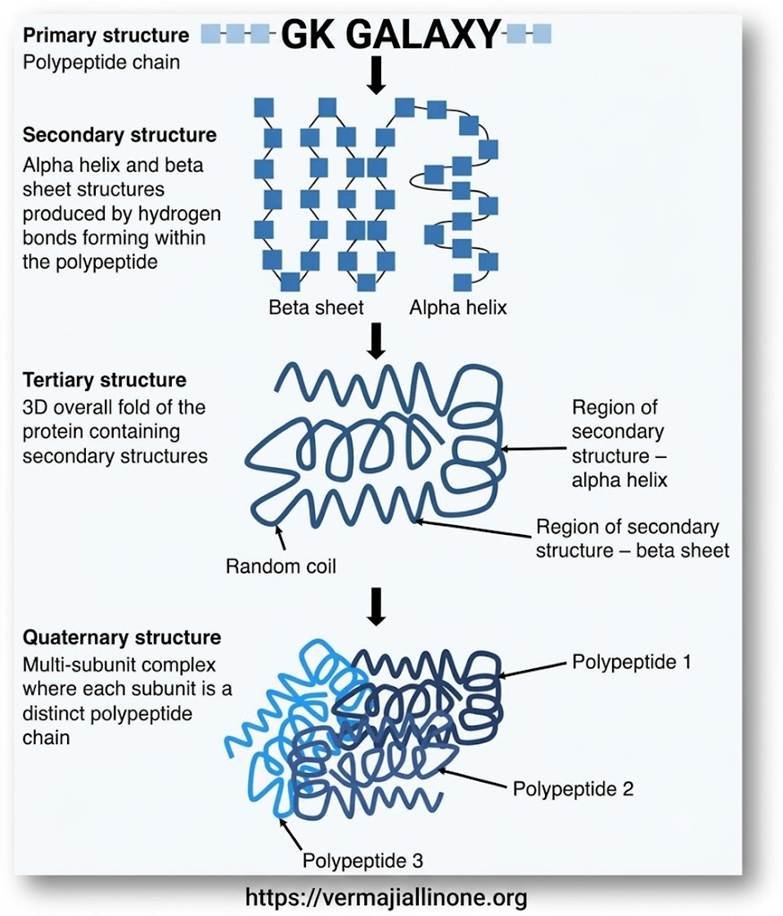
Tertiary structure
The overall three-dimensional folding of a single polypeptide chain.
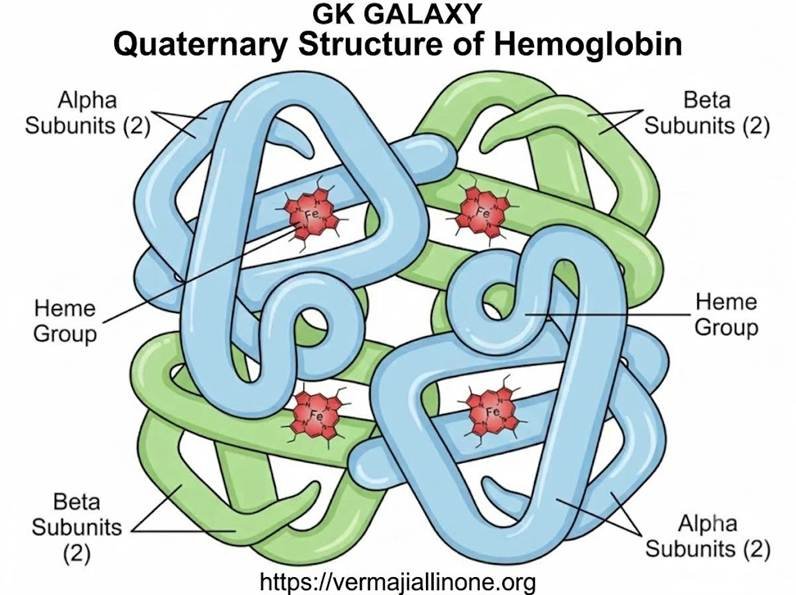
Quaternary structure
The arrangement of multiple polypeptide subunits in a functional protein, as in haemoglobin.
4.4 FIBROUS AND GLOBULAR PROTEINS
| Feature | Fibrous proteins | Globular proteins |
| General shape | Long and fibre-like | Compact and rounded |
| Solubility | Often poorly soluble | Often water-soluble |
| Main role | Structural support | Diverse functional roles |
| Examples | Collagen, keratin | Haemoglobin, many enzymes |
4.5 DENATURATION OF PROTEINS
Denaturation is the disruption of a protein’s native conformation by factors such as heat, extreme pH or certain chemicals.
It commonly affects secondary, tertiary and quaternary structures without breaking all the peptide bonds of the primary structure.
Example: Heating egg white causes its proteins to denature and coagulate.
5. NUCLEIC ACIDS
Nucleic acids store, transmit and help express genetic information. The two principal types are DNA and RNA.
5.1 NUCLEOSIDES AND NUCLEOTIDES
Nitrogenous base + pentose sugar = nucleoside.
Nucleoside + phosphate group(s) = nucleotide.
The nitrogenous bases are classified into two groups:
Purines: Adenine (A) and guanine (G).
Pyrimidines: Cytosine (C), thymine (T) and uracil (U).
5.2 DNA AND RNA
| Feature | DNA | RNA |
| Sugar | Deoxyribose | Ribose |
| Bases | A, G, C, T | A, G, C, U |
| Usual structure | Double-stranded | Often single-stranded |
| Major role | Genetic information storage | Gene expression and other cellular functions |
DNA nucleotides are connected through 3′–5′ phosphodiester bonds. In double-stranded DNA, adenine pairs with thymine and guanine pairs with cytosine.
RNA includes messenger RNA (mRNA), transfer RNA (tRNA) and ribosomal RNA (rRNA), among other functional types.
5.3 ATP
Adenosine triphosphate (ATP) consists of adenine, ribose and three phosphate groups. It is a major energy-transfer molecule in cells.
ATP supports biosynthesis, active transport, muscle contraction and numerous other cellular processes.
6. OTHER IMPORTANT BIOMOLECULES
Vitamins
Vitamins are organic compounds required in small quantities for normal physiological functions.
| Vitamin | General importance |
| A | Vision and epithelial health |
| B₁ | Carbohydrate metabolism |
| B₉ | DNA synthesis and cell division |
| B₁₂ | Red blood cell formation and nervous system function |
| C | Collagen synthesis and antioxidant functions |
| D | Calcium and phosphate homeostasis |
| E | Antioxidant protection |
| K | Blood clotting |
MINERALS AND COFACTORS
Mineral ions such as magnesium, iron, zinc and calcium participate in biological processes. Some enzymes require non-protein components called cofactors.
Cofactor: A non-protein component required for the activity of certain enzymes.
Coenzyme: An organic cofactor, often derived from vitamins.
Prosthetic group: A cofactor that is tightly bound to its associated protein.
Apoenzyme: The protein portion of an enzyme without its required cofactor.
Holoenzyme: The complete, active enzyme system consisting of the apoenzyme and its required cofactor.
7. ENZYMES
Enzymes are biological catalysts that increase the rate of chemical reactions by lowering the activation energy. Most enzymes are proteins, although some RNA molecules, called ribozymes, also catalyse reactions.
Enzymes accelerate reactions without being consumed in the overall process. They do not change the overall free-energy difference between reactants and products or the equilibrium constant.
7.1 PROPERTIES OF ENZYMES
- Enzymes are highly efficient biological catalysts.
- They often show specificity for their substrates and reactions.
- Their activity depends on conditions such as temperature and pH.
- Many require metal ions or organic cofactors.
- They can be regulated by inhibitors, activators and cellular conditions.
- They do not change the final equilibrium position of a reversible reaction.
7.2 ENZYME–SUBSTRATE COMPLEX
An enzyme binds to its substrate at a specific region called the active site.
The reaction takes place in the following steps:
E + S ⇌ ES → E + P
Where:
E = Enzyme
S = Substrate
ES = Enzyme-substrate complex
P = Product
At the end of the reaction, the product is released, and the enzyme remains unchanged. It can be used again for another reaction.
7.3 LOCK-AND-KEY AND INDUCED-FIT MODELS
Lock-and-key model: The active site is described as complementary to the substrate.
Induced-fit model: Substrate binding promotes a change in enzyme conformation that helps achieve an effective catalytic arrangement.
The induced-fit model better captures the flexibility of many enzyme active sites.
7.4 FACTORS AFFECTING ENZYME ACTIVITY
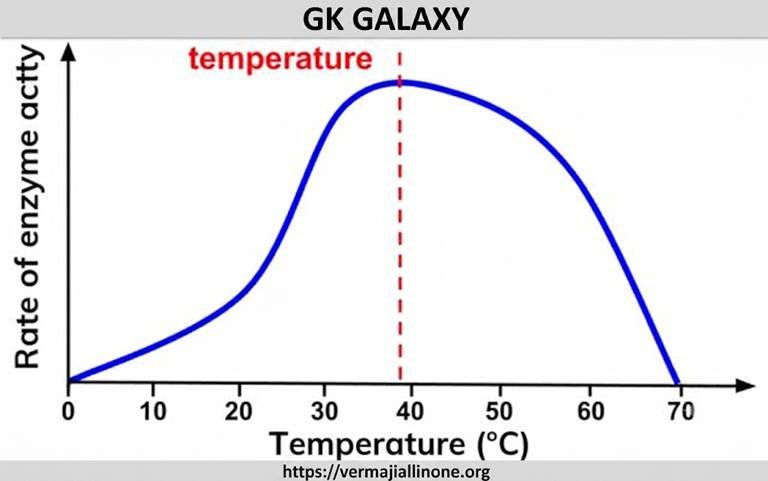
Temperature
Activity generally increases with temperature up to an optimum. Beyond this range, many enzymes lose activity because their structures are disrupted.
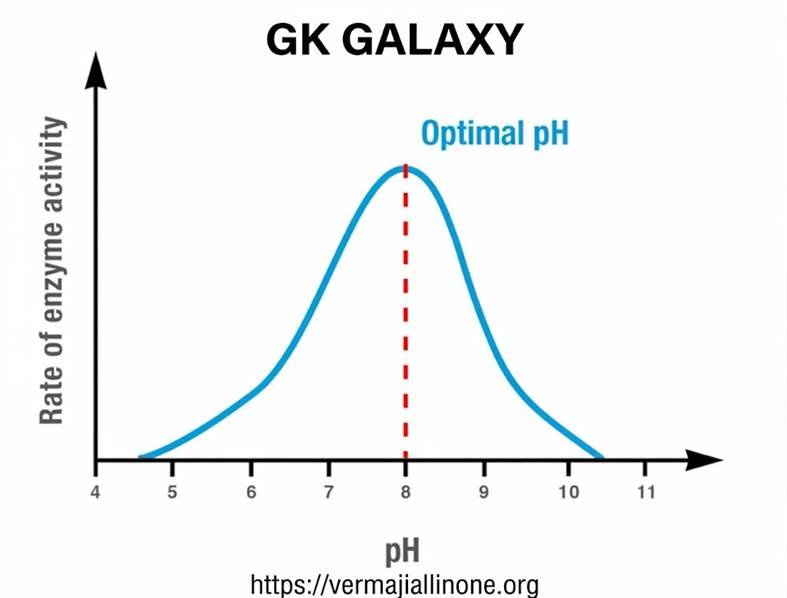
pH
Each enzyme has a suitable pH range. Changes in pH can alter the ionisation of active-site residues and the enzyme’s structure.
Substrate concentration
When the substrate concentration is low, increasing the substrate concentration usually increases the reaction rate.
When the substrate concentration becomes high, most of the enzyme active sites become occupied. The enzyme reaches saturation, and the reaction rate approaches its maximum value, called Vmax.
7.5 MICHAELIS–MENTEN EQUATION
For a simple enzyme-catalysed reaction, the reaction rate can be calculated using the Michaelis-Menten equation:
v = (Vmax x [S]) / (Km + [S])
Where:
v = Initial reaction rate
Vmax = Maximum reaction rate under specific conditions
[S] = Substrate concentration
Km = Michaelis constant
Important points:
- When the substrate concentration ([S]) is equal to Km, the reaction rate (v) is half of Vmax.
- A lower Km value can indicate greater apparent affinity between an enzyme and its substrate under the simple Michaelis-Menten model.
- Km is not always a direct measure of binding affinity because it depends on the rates of the enzyme-catalysed reaction.
Top of Form
Bottom of Form
7.6 ENZYME INHIBITION
Types of Enzyme Inhibition
1. Competitive Inhibition: The inhibitor competes with the substrate for the active site of the enzyme. In this type of inhibition, the apparent Km value increases, but Vmax remains unchanged. Increasing the substrate concentration can reduce the effect of competitive inhibition.
2. Pure Non-Competitive Inhibition: The inhibitor reduces the effective activity of the enzyme. In this type of inhibition, Vmax decreases, but Km remains unchanged.
3. Uncompetitive Inhibition: The inhibitor binds only to the enzyme-substrate complex. In this type of inhibition, both the apparent Km and Vmax values decrease.
7.7 CLASSIFICATION OF ENZYMES
The traditional NCERT/NEET presentation commonly uses six major classes:
| Class | Main reaction type | Example |
| Oxidoreductases | Oxidation–reduction | Dehydrogenases |
| Transferases | Transfer of functional groups | Transaminases |
| Hydrolases | Bond cleavage using water | Lipases |
| Lyases | Addition or removal of groups without hydrolysis or oxidation | Decarboxylases |
| Isomerases | Intramolecular rearrangements | Phosphoglucose isomerase |
| Ligases | Joining molecules, often coupled to ATP hydrolysis | DNA ligase |
Modern enzyme nomenclature also recognises a seventh class, translocases, which catalyse the movement of ions or molecules across membranes or their separation within membranes. For NEET questions, follow the classification specified in the relevant NCERT edition or examination syllabus.
7.8 ENZYMES IN DIGESTION
| Enzyme | Substrate | Major product(s) |
| Salivary amylase | Starch | Smaller carbohydrates |
| Pepsin | Proteins | Smaller peptides |
| Trypsin | Proteins and peptides | Smaller peptides |
| Pancreatic lipase | Triglycerides | Fatty acids and monoacylglycerols, with further products depending on conditions |
| Maltase | Maltose | Glucose |
| Lactase | Lactose | Glucose and galactose |
Important distinction: Enzymes are not limited to digestion. They also function in DNA replication, transcription, respiration, photosynthesis, cell signalling and metabolic regulation.
GUMROAD eBook link:-
BY SHAILENDRA KUMAR VERMA
| Affiliate link of GUMROAD eBook | |
| https://skverma29.gumroad.com/affiliates | |
| 1. | CHALLENGING SYLLOGISM |
| https://skverma29.gumroad.com/l/ktxvzi | |
| 2. | STRAIT OF HORMUZ: STRATEGIC & ECONOMIC ROLE |
| https://skverma29.gumroad.com/l/upobrv | |
| 4. | STATIC GENERAL KNOWLEDGE |
| https://skverma29.gumroad.com/l/kzmca | |
| 5. | SSC ENGLISH PREVIOUS YEAR QUESTIONS MCQ |
| https://skverma29.gumroad.com/l/vtotyp | |
| 6. | SSC REASONING PREVIOUS YEAR QUESTIONS MCQ |
| https://skverma29.gumroad.com/l/fsyvp | |
| 7. | SSC MATH PREVIOUS YEAR QUESTIONS (MCQ): TIER I |
| https://skverma29.gumroad.com/l/nesioq | |
| 8. | BANKING KNOWLEDGE QUESTIONS AND ANSWERS MCQ |
| https://skverma29.gumroad.com/l/sgbbul | |
| 9. | BIHAR ANM, GNM & PHARMACIST EXAM: PAST MCQ QUESTIONS & ANSWERS – |
| https://skverma29.gumroad.com/l/yotjat | |
| 10. | ARAVALLI MOUNTAIN RANGE: THE ANCIENT SPINE OF INDIA |
| https://skverma29.gumroad.com/l/khpakf | |
| 11. | मौर्य काल (322 ईसा पूर्व – 185 ईसा पूर्व): पीएसयू परीक्षा हेतु प्रश्नोत्तर सहित विस्तृत अध्ययन |
| https://skverma29.gumroad.com/l/kgmrw | |
| 12. | VOLCANOES AND EARTHQUAKES: A COMPLETE GUIDE |
| https://share.google/gMZLAnx4hcCV82NTI | |
| 13. | TERMINOLOGY: RAILWAY, COMPUTER, SHARE MARKET, BIOLOGY, BADMINTON, CRICKET, FOOTBALL, KABBADI AND HOCKEY |
| https://share.google/fvdFN53HtyXlqTCgd | |
| 14. | भारतीय संसद का सत्र: प्रक्रिया, नियमऔर एस ओ पी; पी एस यू परीक्षा के लिए संपूर्ण मार्ग दर्शिका |
| https://share.google/1HFwXZA3qUiKyrI1l | |
| 15. | REITs AND InvITs IN INDIA: COMPLETE GUIDE (SCOPE, RISKS & FUTURE) |
| https://share.google/EChDc9heQmPPeyhoi | |
| 16. | GK SSC TIER I PREVIOUS YEAR MCQ |
| https://share.google/5pLzqYKQtg822wk3Y | |
| 17. | PETROLEUM REFINERY PROCESS: WITH 200 MCQ |
| https://skverma29.gumroad.com/l/jgydi | |
| 18. | SET THEORY: A COMPLETE GUIDE WITH 400 MCQ |
| https://skverma29.gumroad.com/l/zkhqzm | |
| 19. | WORLD’S SMALLEST, LONGEST, THINNEST, THICKEST AND TALLEST |
| https://skverma29.gumroad.com/l/kzaenh | |
| 20. | HIGH TIDE AND LOW TIDE: A COMPLETE GUIDE https://skverma29.gumroad.com/l/virke |
| 21. | 1000 HISTORY QESTIONS & ANSWERS FOR PSU |
| https://skverma29.gumroad.com/l/fjapus | |
| 22. | नालंदा विश्वविद्यालय : सम्पूर्ण अध्ययन |
| https://skverma29.gumroad.com/l/pmjab?wanted=true | |
| 23. | भगवान शिव के 12 ज्योतिर्लिंग: इतिहास, महत्व और दर्शन क्रम |
| https://skverma29.gumroad.com/l/wdkgo | |
| 24 | NISM-SERIES-V-A MUTUAL FUND DISTRIBUTOR: COMPLETE STUDY GUIDE & EXAM PREPARATION |
| https://skverma29.gumroad.com/l/qgcviu | |
| 25. | WORKSHOP TECHNOLOGY & MANUFACTURING PROCESSES COMPLETE EXAM GUIDE |
| https://skverma29.gumroad.com/l/xvqxnp | |
| 26. | उगना महादेव और महाकवि विद्यापति |
| https://skverma29.gumroad.com/l/xjehig | |
| 27. | FINANCIAL INCLUSION (FI), MICROFINANCE AND SOCIAL SECURITY IN INDIA:A COMPLETE GUIDE |
| https://skverma29.gumroad.com/l/lpendf | |
| 28. | Vermaji’s Cute Animals Coloring Book |
| https://skverma29.gumroad.com/l/chrxrc | |
AMAZON eBook link:-
BY SHAILENDRA KUMAR VERMA
| 1. | SSC MATH PREVIOUS YEAR MCQ: SSC MATH |
| https://amzn.in/d/097Ocsnl | |
| 2. | SSC REASONING PREVIOUS YEAR MCQ: SSC REASONING |
| https://amzn.in/d/00EHQGE8 | |
| 3. | SSC ENGLISH PREVIOUS YEAR MCQ: SSC ENGLISH |
| https://amzn.in/d/0f8sxJoy | |
| 4. | STATIC GENERAL KNOWLEDGE : WITH 620 MCQs |
| https://amzn.in/d/09xNEWmt |
PLAYSTORE eBook link:-
BY SHAILENDRA KUMAR VERMA
| 1. | SSC MATH PREVIOUS YEAR MCQ |
| https://share.google/KzWbvkFuNk51PEpiu | |
| 2. | SSC REASONING PREVIOUS YEAR MCQ |
| https://play.google.com/books/publish/a/12574378860292240754#book/GGKEY:EUPQZ9ZUAFR/review | |
| 3. | STATIC GENERAL KNOWLEDGE |
| https://play.google.com/books/publish/a/12574378860292240754#book/GGKEY:CQDT2G4CCQP/review | |
| 4. | CHALLENGING SYLLOGISM |
| https://share.google/w9xLMwyiJdNVnpHxI | |
| 5. | STRAIT OF HORMUZ: STRATEGIC & ECONOMIC ROLE |
| https://share.google/V10H7UKeTkstLIMmc | |
| 6. | BIHAR TEACHER ELIGIBILITY TEST (BIHAR TET) : COMPLETE GUIDE |
| https://share.google/AcCXPFa69dAWyYaZZ | |
| 7. | SSC ENGLISH PREVIOUS YEAR MCQ |
| https://share.google/pr7b0YhDoDwttaq2s | |
| 8. | BANKING KNOWLEDGE QUESTIONS AND ANSWERS MCQ |
| https://share.google/yqYOabKhNppcz89hl | |
| 9. | BIHAR ANM, GNM & PHARMACIST EXAM: PAST MCQ QUESTIONS & ANSWERS – |
| https://share.google/NFhtU1JoBfxPS4wa3 | |
| 10. | ARAVALLI MOUNTAIN RANGE: THE ANCIENT SPINE OF INDIA |
| https://share.google/Yo4RYnaZrbRu9qwzj | |
| 11. | GK SSC TIER I PREVIOUS YEAR MCQ |
| https://share.google/sBdCcsEeebM44QZ0X | |
| 12. | REITs AND InvITs IN INDIA: COMPLETE GUIDE (SCOPE, RISKS & FUTURE) |
| https://share.google/XAwUio1deUOxFe2M7 | |
| 13. | भारतीय संसद का सत्र: प्रक्रिया, नियमऔर एस ओ पी ; पी एस यू परीक्षा के लिए संपूर्ण मार्ग दर्शिका |
| https://share.google/6XVrfQ2PcuWmqvKol | |
| 14. | मौर्य काल (322 ईसा पूर्व – 185 ईसा पूर्व): पीएसयू परीक्षा हेतु प्रश्नोत्तर सहित विस्तृत अध्ययन |
| https://share.google/Lwu7JKHE54kxsL5e2 | |
| 15. | TERMINOLOGY: RAILWAY, COMPUTER, SHARE MARKET, BIOLOGY, BADMINTON, CRICKET, FOOTBALL, KABBADI AND HOCKEY |
| https://share.google/WWVO9ZFd81R9G9h69 | |
| 16. | VOLCANOES AND EARTHQUAKES: A COMPLETE GUIDE |
| https://share.google/aXi2evRVgmzpQguye | |
| 17. | PETROLEUM REFINERY PROCESS: WITH 200 MCQ |
| https://play.google.com/books/publish/u/0/a/12574378860292240754#book/GGKEY:P34SQBHUJ7F/review | |
| 18. | SET THEORY: A COMPLETE GUIDE WITH 400 MCQ |
| https://play.google.com/books/publish/u/0/a/12574378860292240754#book/GGKEY:83LKH7QHRQH/review | |
| 19. | WORLD’S SMALLEST, LONGEST, THINNEST, THICKEST AND TALLEST |
| https://play.google.com/books/publish/u/0/a/12574378860292240754#book/GGKEY:9LE49HEDZJE/review | |
| 20. | HIGH TIDE AND LOW TIDE: A COMPLETE GUIDE |
| https://play.google.com/books/publish/u/0/a/12574378860292240754#book/GGKEY:TKR79QBDE7R/review | |
| 21. | 1000 HISTORY QESTIONS & ANSWERS FOR PSU |
| https://play.google.com/books/publish/u/0/a/12574378860292240754#book/GGKEY:1SGWQKT7BDF/review | |
| 22. | नालंदा विश्वविद्यालय : सम्पूर्ण अध्ययन |
| https://play.google.com/books/publish/u/0/a/12574378860292240754#book/GGKEY:RY0EDLDK7TL/review | |
| 23. | भगवान शिव के 12 ज्योतिर्लिंग: इतिहास, महत्व और दर्शन क्रम |
| https://play.google.com/books/publish/u/0/a/12574378860292240754#book/GGKEY:KNT0X6L8YCQ/review | |
| 24. | NISM-SERIES-V-A MUTUAL FUND DISTRIBUTOR: COMPLETE STUDY GUIDE & EXAM PREPARATION |
| https://play.google.com/books/publish/u/0/a/12574378860292240754#book/GGKEY:YP1PQ8RQY07/review | |
| 25. | WORKSHOP TECHNOLOGY & MANUFACTURING PROCESSES COMPLETE EXAM GUIDE |
| https://play.google.com/books/publish/u/0/a/12574378860292240754#book/GGKEY:PK621P1ZHXX/review | |
| 26. | उगना महादेव और महाकवि विद्यापति |
| https://play.google.com/books/publish/u/0/a/12574378860292240754#book/GGKEY:QXG2TUGW955/review | |
| 27. | FINANCIAL INCLUSION (FI), MICROFINANCE AND SOCIAL SECURITY IN INDIA:A COMPLETE GUIDE |
| 28. | Vermaji’s Cute Animals Coloring Book |
| https://play.google.com/books/publish/u/0/a/12574378860292240754#book/GGKEY:WFBA8EL20KT/review |
| OPEN DMAT ACCONT FROM THI LINK IN ANGEL ONE:- |
| Open your Trading & Investment account with Angel One for FREE* |
| You will get: |
| All trades in Rs.20 |
| Quick SIP in Direct MF |
| 1Lac MTF @ 0% interest |
| Download only using my referral link to get Free Demat Account⬇ |
| https://angel-one.onelink.me/Wjgr/2o2au42h |
| _link may expire within 48hrs_ |
| _T&C Apply_ |
| CLICK TO APPLY: |
| Click the application link below: 👉 Apply Here for SBI Credit Card (Referral Code: 243zfQ0yYm3) |
| OPEN DMAT ACCOUNT FROM THIS LINK: |
| HI THERE, I SEE YOU HAVEN’T BOUGHT THE FREEDOM PLAN ON INDIAN BANK YET. DON’T MISS OUT ON UNLIMITED TRADING AT A POCKET-FRIENDLY COST. GO BROKERAGE-FREE AND SAVE BIG WITH THE FREEDOM PLAN. USE MY REFERRAL CODE, SHAI0634 TO DOWNLOAD THE APP NOW. |
| https://play.google.com/store/apps/details?id=com.finwizard.fisdom |