GUMROAD eBook link:-
BY SHAILENDRA KUMAR VERMA
| Affiliate link of GUMROAD eBook | |
| https://skverma29.gumroad.com/affiliates | |
| 1. | CHALLENGING SYLLOGISM |
| https://skverma29.gumroad.com/l/ktxvzi | |
| 2. | STRAIT OF HORMUZ: STRATEGIC & ECONOMIC ROLE |
| https://skverma29.gumroad.com/l/upobrv | |
| 4. | STATIC GENERAL KNOWLEDGE |
| https://skverma29.gumroad.com/l/kzmca | |
| 5. | SSC ENGLISH PREVIOUS YEAR QUESTIONS MCQ |
| https://skverma29.gumroad.com/l/vtotyp | |
| 6. | SSC REASONING PREVIOUS YEAR QUESTIONS MCQ |
| https://skverma29.gumroad.com/l/fsyvp | |
| 7. | SSC MATH PREVIOUS YEAR QUESTIONS (MCQ): TIER I |
| https://skverma29.gumroad.com/l/nesioq | |
| 8. | BANKING KNOWLEDGE QUESTIONS AND ANSWERS MCQ |
| https://skverma29.gumroad.com/l/sgbbul | |
| 9. | BIHAR ANM, GNM & PHARMACIST EXAM: PAST MCQ QUESTIONS & ANSWERS – |
| https://skverma29.gumroad.com/l/yotjat | |
| 10. | ARAVALLI MOUNTAIN RANGE: THE ANCIENT SPINE OF INDIA |
| https://skverma29.gumroad.com/l/khpakf | |
| 11. | मौर्य काल (322 ईसा पूर्व – 185 ईसा पूर्व): पीएसयू परीक्षा हेतु प्रश्नोत्तर सहित विस्तृत अध्ययन |
| https://skverma29.gumroad.com/l/kgmrw | |
| 12. | VOLCANOES AND EARTHQUAKES: A COMPLETE GUIDE |
| https://share.google/gMZLAnx4hcCV82NTI | |
| 13. | TERMINOLOGY: RAILWAY, COMPUTER, SHARE MARKET, BIOLOGY, BADMINTON, CRICKET, FOOTBALL, KABBADI AND HOCKEY |
| https://share.google/fvdFN53HtyXlqTCgd | |
| 14. | भारतीय संसद का सत्र: प्रक्रिया, नियमऔर एस ओ पी; पी एस यू परीक्षा के लिए संपूर्ण मार्ग दर्शिका |
| https://share.google/1HFwXZA3qUiKyrI1l | |
| 15. | REITs AND InvITs IN INDIA: COMPLETE GUIDE (SCOPE, RISKS & FUTURE) |
| https://share.google/EChDc9heQmPPeyhoi | |
| 16. | GK SSC TIER I PREVIOUS YEAR MCQ |
| https://share.google/5pLzqYKQtg822wk3Y | |
| 17. | PETROLEUM REFINERY PROCESS: WITH 200 MCQ |
| https://skverma29.gumroad.com/l/jgydi | |
| 18. | SET THEORY: A COMPLETE GUIDE WITH 400 MCQ |
| https://skverma29.gumroad.com/l/zkhqzm | |
| 19. | WORLD’S SMALLEST, LONGEST, THINNEST, THICKEST AND TALLEST |
| https://skverma29.gumroad.com/l/kzaenh | |
| 20. | HIGH TIDE AND LOW TIDE: A COMPLETE GUIDE https://skverma29.gumroad.com/l/virke |
| 21. | 1000 HISTORY QESTIONS & ANSWERS FOR PSU |
| https://skverma29.gumroad.com/l/fjapus | |
| 22. | नालंदा विश्वविद्यालय : सम्पूर्ण अध्ययन |
| https://skverma29.gumroad.com/l/pmjab?wanted=true | |
| 23. | भगवान शिव के 12 ज्योतिर्लिंग: इतिहास, महत्व और दर्शन क्रम |
| https://skverma29.gumroad.com/l/wdkgo | |
| 24 | NISM-SERIES-V-A MUTUAL FUND DISTRIBUTOR: COMPLETE STUDY GUIDE & EXAM PREPARATION |
| https://skverma29.gumroad.com/l/qgcviu | |
| 25. | WORKSHOP TECHNOLOGY & MANUFACTURING PROCESSES COMPLETE EXAM GUIDE |
| https://skverma29.gumroad.com/l/xvqxnp | |
AMAZON eBook link:-
BY SHAILENDRA KUMAR VERMA
| 1. | SSC MATH PREVIOUS YEAR MCQ: SSC MATH |
| https://amzn.in/d/097Ocsnl | |
| 2. | SSC REASONING PREVIOUS YEAR MCQ: SSC REASONING |
| https://amzn.in/d/00EHQGE8 | |
| 3. | SSC ENGLISH PREVIOUS YEAR MCQ: SSC ENGLISH |
| https://amzn.in/d/0f8sxJoy | |
| 4. | STATIC GENERAL KNOWLEDGE : WITH 620 MCQs |
| https://amzn.in/d/09xNEWmt |
PLAYSTORE eBook link:-
BY SHAILENDRA KUMAR VERMA
| 1. | SSC MATH PREVIOUS YEAR MCQ |
| https://share.google/KzWbvkFuNk51PEpiu | |
| 2. | SSC REASONING PREVIOUS YEAR MCQ |
| https://play.google.com/books/publish/a/12574378860292240754#book/GGKEY:EUPQZ9ZUAFR/review | |
| 3. | STATIC GENERAL KNOWLEDGE |
| https://play.google.com/books/publish/a/12574378860292240754#book/GGKEY:CQDT2G4CCQP/review | |
| 4. | CHALLENGING SYLLOGISM |
| https://share.google/w9xLMwyiJdNVnpHxI | |
| 5. | STRAIT OF HORMUZ: STRATEGIC & ECONOMIC ROLE |
| https://share.google/V10H7UKeTkstLIMmc | |
| 6. | BIHAR TEACHER ELIGIBILITY TEST (BIHAR TET) : COMPLETE GUIDE |
| https://share.google/AcCXPFa69dAWyYaZZ | |
| 7. | SSC ENGLISH PREVIOUS YEAR MCQ |
| https://share.google/pr7b0YhDoDwttaq2s | |
| 8. | BANKING KNOWLEDGE QUESTIONS AND ANSWERS MCQ |
| https://share.google/yqYOabKhNppcz89hl | |
| 9. | BIHAR ANM, GNM & PHARMACIST EXAM: PAST MCQ QUESTIONS & ANSWERS – |
| https://share.google/NFhtU1JoBfxPS4wa3 | |
| 10. | ARAVALLI MOUNTAIN RANGE: THE ANCIENT SPINE OF INDIA |
| https://share.google/Yo4RYnaZrbRu9qwzj | |
| 11. | GK SSC TIER I PREVIOUS YEAR MCQ |
| https://share.google/sBdCcsEeebM44QZ0X | |
| 12. | REITs AND InvITs IN INDIA: COMPLETE GUIDE (SCOPE, RISKS & FUTURE) |
| https://share.google/XAwUio1deUOxFe2M7 | |
| 13. | भारतीय संसद का सत्र: प्रक्रिया, नियमऔर एस ओ पी ; पी एस यू परीक्षा के लिए संपूर्ण मार्ग दर्शिका |
| https://share.google/6XVrfQ2PcuWmqvKol | |
| 14. | मौर्य काल (322 ईसा पूर्व – 185 ईसा पूर्व): पीएसयू परीक्षा हेतु प्रश्नोत्तर सहित विस्तृत अध्ययन |
| https://share.google/Lwu7JKHE54kxsL5e2 | |
| 15. | TERMINOLOGY: RAILWAY, COMPUTER, SHARE MARKET, BIOLOGY, BADMINTON, CRICKET, FOOTBALL, KABBADI AND HOCKEY |
| https://share.google/WWVO9ZFd81R9G9h69 | |
| 16. | VOLCANOES AND EARTHQUAKES: A COMPLETE GUIDE |
| https://share.google/aXi2evRVgmzpQguye | |
| 17. | PETROLEUM REFINERY PROCESS: WITH 200 MCQ |
| https://play.google.com/books/publish/u/0/a/12574378860292240754#book/GGKEY:P34SQBHUJ7F/review | |
| 18. | SET THEORY: A COMPLETE GUIDE WITH 400 MCQ |
| https://play.google.com/books/publish/u/0/a/12574378860292240754#book/GGKEY:83LKH7QHRQH/review | |
| 19. | WORLD’S SMALLEST, LONGEST, THINNEST, THICKEST AND TALLEST |
| https://play.google.com/books/publish/u/0/a/12574378860292240754#book/GGKEY:9LE49HEDZJE/review | |
| 20. | HIGH TIDE AND LOW TIDE: A COMPLETE GUIDE |
| https://play.google.com/books/publish/u/0/a/12574378860292240754#book/GGKEY:TKR79QBDE7R/review | |
| 21. | 1000 HISTORY QESTIONS & ANSWERS FOR PSU |
| https://play.google.com/books/publish/u/0/a/12574378860292240754#book/GGKEY:1SGWQKT7BDF/review | |
| 22. | नालंदा विश्वविद्यालय : सम्पूर्ण अध्ययन |
| https://play.google.com/books/publish/u/0/a/12574378860292240754#book/GGKEY:RY0EDLDK7TL/review | |
| 23. | भगवान शिव के 12 ज्योतिर्लिंग: इतिहास, महत्व और दर्शन क्रम |
| https://play.google.com/books/publish/u/0/a/12574378860292240754#book/GGKEY:KNT0X6L8YCQ/review | |
| 24. | NISM-SERIES-V-A MUTUAL FUND DISTRIBUTOR: COMPLETE STUDY GUIDE & EXAM PREPARATION |
| https://play.google.com/books/publish/u/0/a/12574378860292240754#book/GGKEY:YP1PQ8RQY07/review | |
| 25. | WORKSHOP TECHNOLOGY & MANUFACTURING PROCESSES COMPLETE EXAM GUIDE |
| https://play.google.com/books/publish/u/0/a/12574378860292240754#book/GGKEY:PK621P1ZHXX/review |
| OPEN DMAT ACCONT FROM THI LINK IN ANGEL ONE:- |
| Open your Trading & Investment account with Angel One for FREE* |
| You will get: |
| All trades in Rs.20 |
| Quick SIP in Direct MF |
| 1Lac MTF @ 0% interest |
| Download only using my referral link to get Free Demat Account⬇ |
| https://angel-one.onelink.me/Wjgr/2o2au42h |
| _link may expire within 48hrs_ |
| _T&C Apply_ |
| CLICK TO APPLY: |
| Click the application link below: 👉 Apply Here for SBI Credit Card (Referral Code: 243zfQ0yYm3) |
| OPEN DMAT ACCOUNT FROM THIS LINK: |
| HI THERE, I SEE YOU HAVEN’T BOUGHT THE FREEDOM PLAN ON INDIAN BANK YET. DON’T MISS OUT ON UNLIMITED TRADING AT A POCKET-FRIENDLY COST. GO BROKERAGE-FREE AND SAVE BIG WITH THE FREEDOM PLAN. USE MY REFERRAL CODE, SHAI0634 TO DOWNLOAD THE APP NOW. |
| https://play.google.com/store/apps/details?id=com.finwizard.fisdom |
Disclaimer :
This educational content on Anatomy of Flowering Plants is published on GK GALAXY (https://vermajiallinone.org) for educational and exam-preparation purposes only.
The theory, explanations, practice MCQs, answers and illustrations are intended to help students prepare for NEET-UG and improve their understanding of Biology. Every effort is made to maintain accuracy; however, no guarantee is given that all information is completely error-free or up to date.
Any Previous Year Questions (PYQs), examination names, years and related references should be verified against reliable examination sources. Practice questions must not be treated as actual NEET questions unless appropriately verified.
This material is not an official publication of the National Testing Agency (NTA), NCERT or any government authority. GK GALAXY is not affiliated with or endorsed by these organizations.
The content is prepared with the intention of avoiding unauthorized copying of copyrighted material. However, GK GALAXY does not guarantee that every item is free from all possible copyright or intellectual property claims. If any material is believed to infringe copyright, the concerned rights holder may contact the website owner for review and appropriate action.
Students are advised to consult official NCERT textbooks, NEET notifications and other authorized educational resources for confirmation.
The website owner shall not be held responsible for any loss, damage, error, omission or decision arising from the use of this educational content, to the extent permitted by applicable law.
By using this content, readers acknowledge that it is provided for educational and informational purposes only.
1. Introduction to Plant Anatomy
Plant anatomy is the branch of botany that deals with the internal structure of plants. It studies the organization of plant cells, tissues, and organs, including roots, stems, and leaves.
The internal structure of a plant is closely related to its functions. For example, root hairs increase the surface area available for absorption, xylem conducts water, and sclerenchyma provides mechanical strength.
Importance of plant anatomy
Helps explain the transport of water, minerals, and food.
Shows how plants obtain mechanical support.
Helps distinguish monocot and dicot structures.
Explains the internal adaptations of plants to different environments.
Provides a basis for understanding primary and secondary growth.
2. Plant Tissues
A tissue is a group of cells that are organized to perform one or more related functions.
Plant tissues are broadly classified into two major groups:
A. Meristematic tissues
These contain actively dividing cells and are responsible for plant growth.
B. Permanent tissues
These arise through cell differentiation and perform functions such as storage, photosynthesis, support, and conduction.
2.1 Meristematic tissues
Meristematic tissues contain young cells capable of repeated cell division. Their cells generally have thin primary walls, dense cytoplasm, prominent nuclei, and small or absent vacuoles.
On the basis of position, meristems are classified as follows.
| Type | Location | Main function |
| Apical meristem | Tips of roots and shoots | Increases length |
| Intercalary meristem | Certain regions near nodes or leaf bases | Elongation and regrowth |
| Lateral meristem | Along the sides of stems and roots | Increases girth |
Primary growth increases the length of plant organs. Secondary growth increases their thickness or girth.
Intercalary meristems are especially important in grasses because they enable regrowth after grazing or cutting.
2.2 Permanent tissues
Permanent tissues develop when meristematic cells differentiate and acquire specialized structures and functions.
They are divided into simple permanent tissues and complex permanent tissues.
A. Simple permanent tissues
Simple permanent tissues consist mainly of one type of cell.
1. Parenchyma
Parenchyma is composed of living cells, usually with thin cell walls. The cells often have intercellular spaces.
Functions include:
Storage of food and water.
Photosynthesis when chloroplasts are present.
Wound healing and regeneration.
Gas exchange and buoyancy in some aquatic plants.
Special forms include:
Chlorenchyma: Parenchyma containing chloroplasts and performing photosynthesis.
Aerenchyma: Tissue with prominent air spaces that can assist gas exchange and buoyancy.
2. Collenchyma
Collenchyma consists of living, elongated cells with unevenly thickened primary walls, especially at the corners.
Functions:
Provides flexible mechanical support.
Supports growing stems and leaf petioles.
Allows plant parts to bend without breaking easily.
It commonly occurs beneath the epidermis of young dicot stems and in leaf petioles.
3. Sclerenchyma
Sclerenchyma cells generally develop thick, lignified secondary walls and are dead at maturity.
Two principal forms are:
Fibres: Elongated cells that provide tensile strength.
Sclereids: Cells with variable shapes and thick walls, contributing to the hardness of seed coats and the gritty texture of pear pulp.
| Feature | Parenchyma | Collenchyma | Sclerenchyma |
| Living at maturity | Yes | Yes | Usually no |
| Cell walls | Usually thin | Unevenly thickened | Thick, often lignified |
| Main role | Storage and metabolism | Flexible support | Rigidity and strength |
| Intercellular spaces | Often present | Usually limited | Variable |
B. Complex permanent tissues
Complex permanent tissues contain different cell types that work together to perform a common function.
The two principal complex tissues are xylem and phloem.
2.3 Xylem
Xylem conducts water and dissolved mineral substances and also contributes to mechanical support.
Its four principal elements are:
- Tracheids
- Vessels
- Xylem fibres
- Xylem parenchyma
Tracheids: Elongated cells with tapering ends and thickened walls. They conduct water through pits and provide support.
Vessels: Tubular conducting structures formed from vessel elements joined end to end. They are especially prominent in angiosperms.
Xylem fibres: Thick-walled cells that primarily provide mechanical strength.
Xylem parenchyma: The principal living component of xylem. It stores substances and assists in lateral transport.
Key point: The conducting elements of xylem—tracheids and vessel elements—are generally dead at maturity.
2.4 Phloem
Phloem transports sugars and other organic substances from source regions to sink regions.
Its principal elements in angiosperms are:
- Sieve tube elements
- Companion cells
- Phloem parenchyma
- Phloem fibres
Sieve tube elements: Living conducting cells that lack a nucleus at maturity. Their end walls contain sieve plates.
Companion cells: Living cells associated with sieve tube elements. They assist in maintaining their functions and participate in the loading and unloading of sugars.
Phloem parenchyma: Living cells involved in storage and transport. It is absent in many monocots.
Phloem fibres: Usually dead at maturity and provide mechanical support.
Remember that phloem transport depends on source–sink relationships and can occur in different directions in different sieve tubes.
3. The Three Tissue Systems
The primary plant body has three major tissue systems.
3.1 Epidermal tissue system
The epidermal system forms the outer protective covering of the plant.
Its components include the epidermis, stomata, guard cells, trichomes, and root hairs.
Epidermis: Usually a single layer of compactly arranged cells. A cuticle often covers the aerial epidermis and helps reduce water loss.
Stomata: Small pores that permit gaseous exchange and regulate transpiration. Each stomatal apparatus includes the pore and its guard cells, together with subsidiary cells when present.
Guard cells: These control the opening and closing of stomata. They contain chloroplasts. In most dicots, they are kidney-shaped; in grasses, they are commonly dumbbell-shaped.
Trichomes: Epidermal outgrowths on aerial plant parts. They can protect the plant and reduce water loss.
Root hairs: Unicellular extensions of root epidermal cells that increase the surface area available for water and mineral absorption.
3.2 Ground tissue system
The ground tissue system includes the plant tissues other than the epidermal and vascular systems.
Its components may include parenchyma, collenchyma, and sclerenchyma.
Important regions include:
Cortex: Tissue between the epidermis and vascular region in many organs.
Endodermis: The innermost cortical layer, especially distinct in roots.
Pericycle: A region inside the endodermis that gives rise to lateral roots.
Pith: The central region of many stems and some roots.
Mesophyll: The photosynthetic tissue between the upper and lower epidermis of leaves.
3.3 Vascular tissue system
The vascular system contains xylem and phloem.
Vascular bundles are classified according to the arrangement of their conducting tissues.
| Type | Structure | Typical location |
| Radial | Xylem and phloem occur on alternate radii | Roots |
| Conjoint | Xylem and phloem occur together | Stems and leaves |
| Open | Cambium is present between xylem and phloem | Typical dicot stem |
| Closed | Cambium is absent from the bundle | Typical monocot stem |
Conjoint bundles may be collateral, with phloem toward the outside of xylem, or bicollateral, with phloem on both sides of xylem.
4. Anatomy of Roots
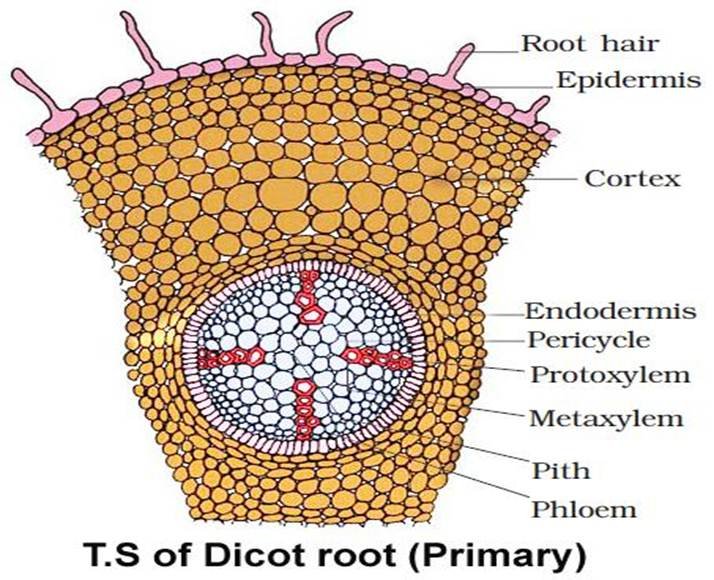
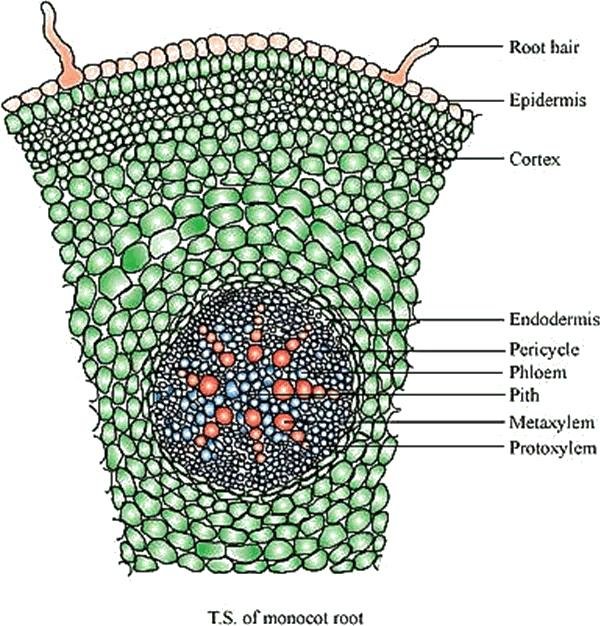
Roots anchor plants, absorb water and minerals, and sometimes store food.
4.1 Dicot root
The main tissues of a typical young dicot root are arranged from outside to inside as follows.
- Epiblema: The outer layer, often bearing root hairs.
- Cortex: Mainly parenchymatous tissue.
- Endodermis: A distinct inner cortical layer with Casparian strips.
- Pericycle: Located inside the endodermis; produces lateral roots.
- Vascular tissues: Xylem and phloem alternate with one another.
- Pith: Usually small or inconspicuous.
The Casparian strips contain hydrophobic substances, particularly suberin, that help regulate movement through the endodermis.
Exarch xylem: Protoxylem lies toward the outside, while metaxylem lies toward the centre. This arrangement is characteristic of roots.
4.2 Monocot root
Monocot roots have the same basic tissue organization but commonly show:
Numerous xylem strands, often polyarch.
A large, well-developed pith.
Exarch xylem.
Little or no typical secondary growth.
| Feature | Dicot root | Monocot root |
| Xylem strands | Usually fewer | Usually numerous |
| Pith | Small or inconspicuous | Usually large |
| Xylem maturation | Exarch | Exarch |
| Secondary growth | May occur | Usually absent |
5. Anatomy of Stems
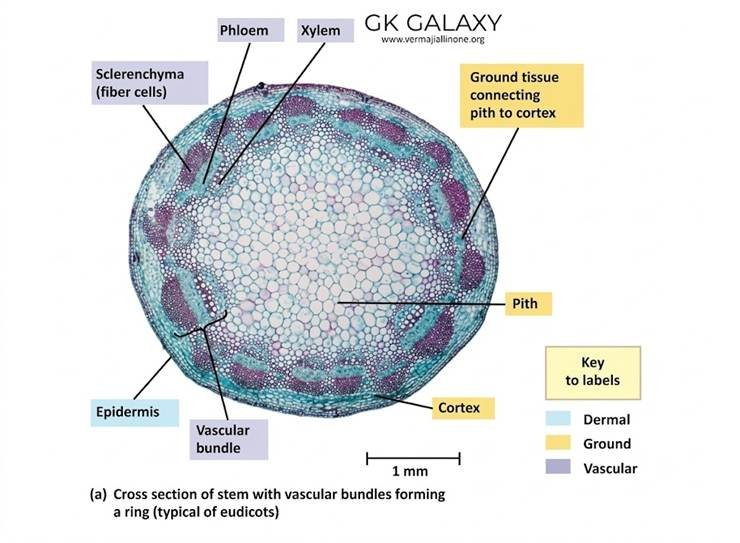
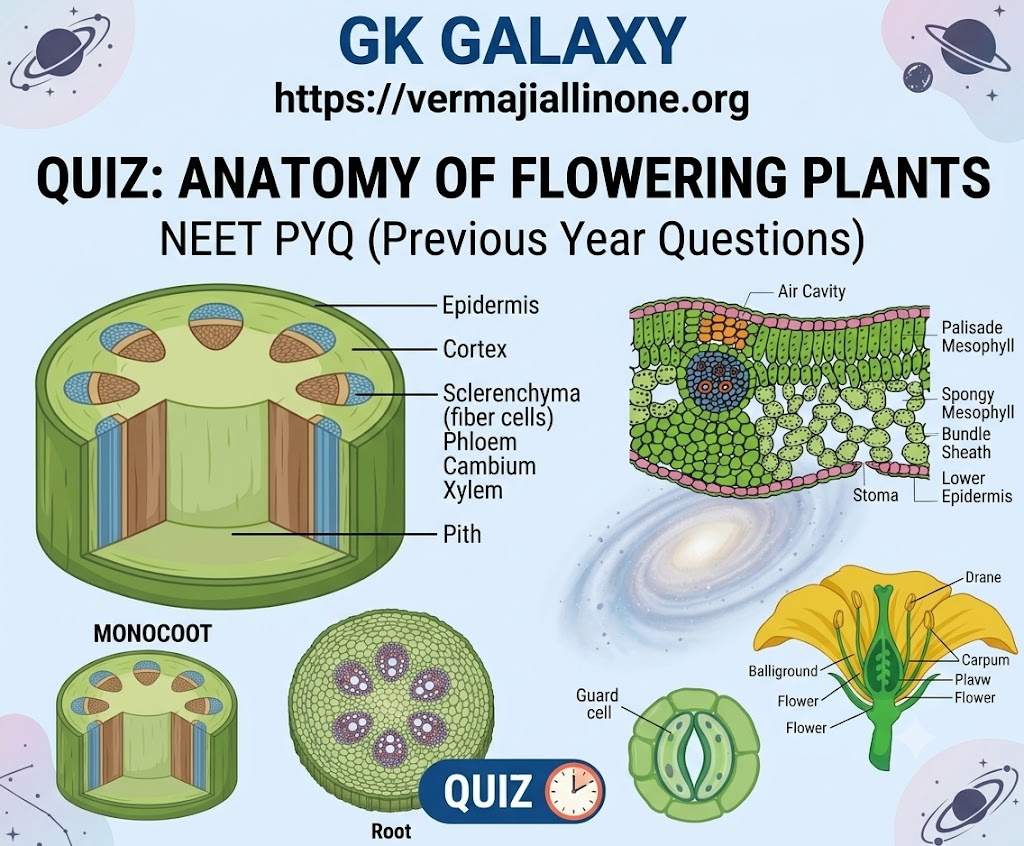
5.1 Dicot stem
A typical young dicot stem has the following features:
Epidermis: The protective outermost layer, commonly covered by a cuticle.
Hypodermis: Often collenchymatous, providing flexible support.
Cortex: Located beneath the hypodermis.
Endodermis: Often rich in starch and described as the starch sheath.
Pericycle: May occur outside the vascular bundles.
Vascular bundles: Usually arranged in a ring and conjoint, collateral, and open.
Pith: A central region composed mainly of parenchyma.
The xylem is typically endarch: protoxylem lies toward the centre and metaxylem toward the outside.
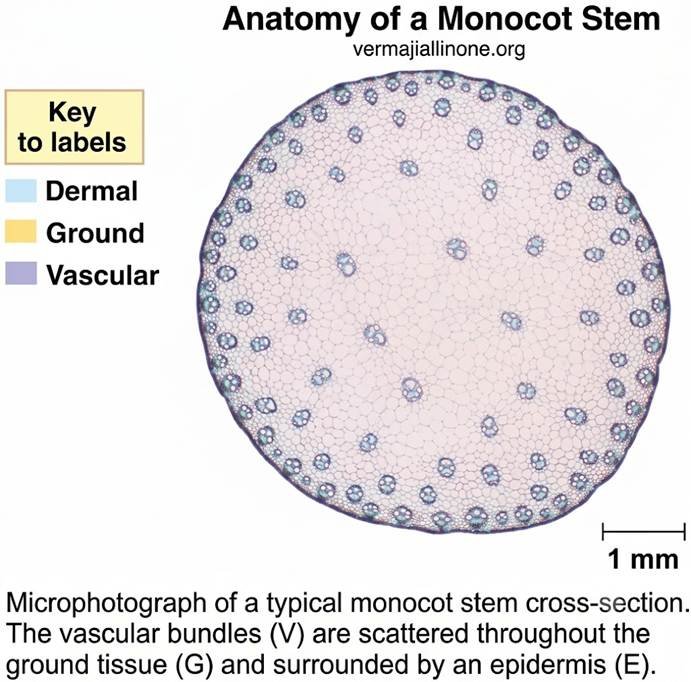
5.2 Monocot stem
A typical monocot stem exhibits:
Sclerenchymatous hypodermis.
Numerous vascular bundles scattered through the ground tissue.
Conjoint, collateral, closed vascular bundles.
A bundle sheath, commonly sclerenchymatous.
Generally undifferentiated ground tissue.
A protoxylem lacuna in many mature bundles.
Usually absent phloem parenchyma.
Most monocot stems do not undergo typical vascular-cambium-driven secondary growth.
5.3 Comparison of dicot and monocot stems
| Characteristic | Dicot stem | Monocot stem |
| Vascular bundles | Usually arranged in a ring | Scattered |
| Vascular cambium | Usually present | Absent |
| Bundles | Usually open | Closed |
| Hypodermis | Often collenchymatous | Often sclerenchymatous |
| Ground tissue | Often differentiated | Usually undifferentiated |
| Typical secondary growth | Common in woody plants | Generally absent |
6. Anatomy of Leaves
6.1 Dorsiventral leaf
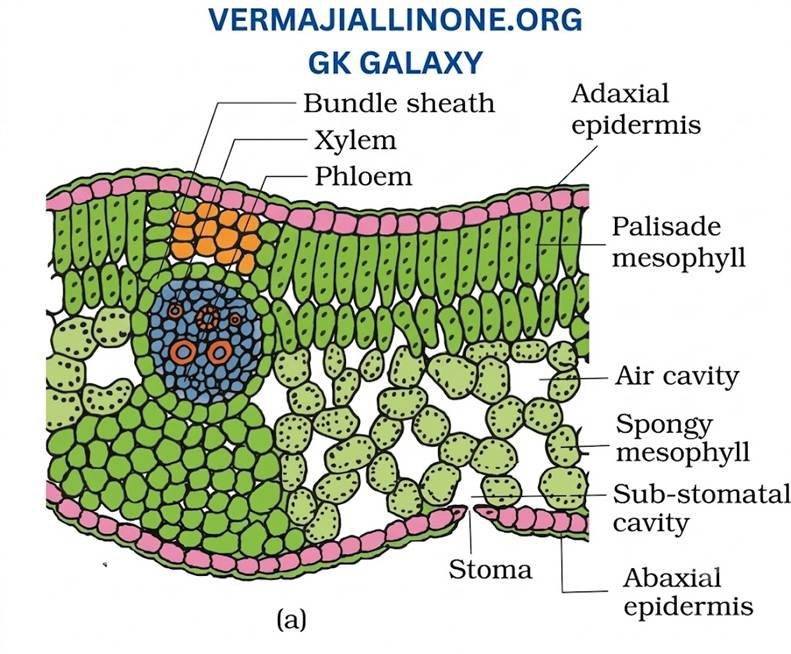
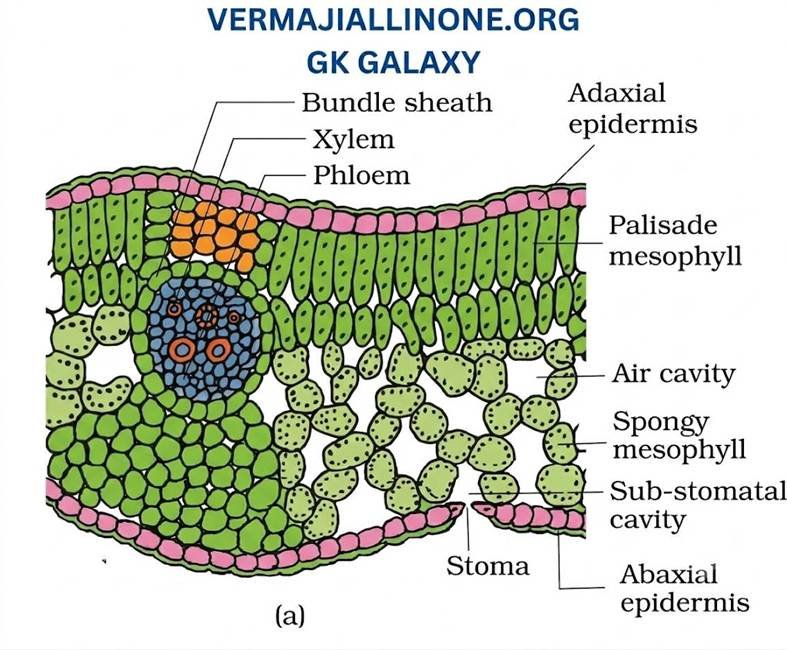
Dorsiventral leaves are typical of many dicotyledonous plants.
The upper epidermis is commonly covered by a cuticle.
Palisade parenchyma generally lies beneath the upper epidermis.
Spongy parenchyma contains large intercellular air spaces.
The lower epidermis often bears more stomata than the upper epidermis.
In vascular bundles, xylem usually faces the upper surface and phloem the lower surface.
6.2 Isobilateral leaf
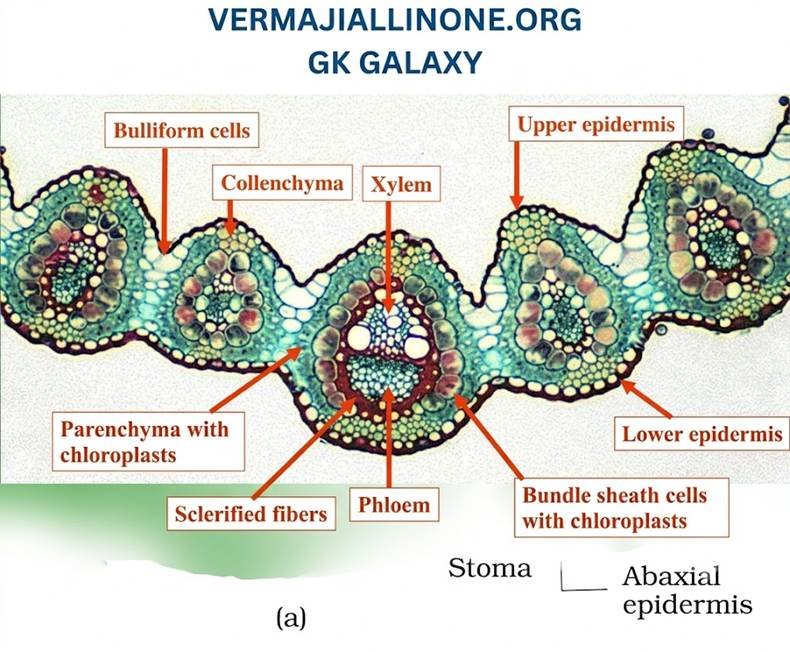
Isobilateral leaves are common in monocots, particularly grasses.
Their features include:
Anatomical similarity between the two surfaces.
Mesophyll often not differentiated into distinct palisade and spongy regions.
Stomata commonly present on both surfaces.
Parallel venation in many monocots.
Bulliform cells in the upper epidermis of many grasses.
Bulliform cells are large, thin-walled epidermal cells that help bring about leaf rolling and unrolling through changes in turgor.
6.3 Comparison of leaf types
| Characteristic | Dorsiventral leaf | Isobilateral leaf |
| Typical association | Many dicots | Many monocots |
| Mesophyll | Palisade and spongy regions differentiated | Often undifferentiated in grasses |
| Stomata | Often more numerous below | Often present on both surfaces |
| Bulliform cells | Usually absent | Common in grasses |
| Venation | Often reticulate | Often parallel |
7. Secondary Growth
Secondary growth increases the girth of plant organs through the activity of lateral meristems. It occurs in many dicots and gymnosperms.
7.1 Vascular cambium
In a typical dicot stem, the cambium between primary xylem and primary phloem is called intrafascicular cambium. Cambium develops between vascular bundles from suitable intervening cells, often associated with medullary rays.
These regions join to form a continuous cambial ring.
The cambial ring produces:
Secondary xylem toward the inside.
Secondary phloem toward the outside.
Secondary xylem accumulates to form wood.
7.2 Annual rings
Seasonal differences in the formation of secondary xylem may produce annual rings.
Early wood: Commonly has larger conducting elements and lower density.
Late wood: Commonly has smaller lumens and higher density.
Annual rings may help estimate a tree’s age where annual growth cycles are distinct.
7.3 Heartwood and sapwood
| Heartwood | Sapwood |
| Older inner secondary xylem | Younger outer secondary xylem |
| Often darker | Often lighter |
| Commonly contains deposited substances | More actively conducts water |
| Provides mechanical support | Participates in water conduction |
7.4 Cork cambium and periderm
Cork cambium, also called phellogen, forms protective secondary tissues.
Phellem: Produced toward the outside; cork cells are generally dead and suberized at maturity.
Phelloderm: Produced toward the inside; usually composed of living parenchymatous cells.
Phellem, phellogen and phelloderm together form the periderm.
Lenticels are regions in the periderm that facilitate gaseous exchange between internal tissues and the atmosphere.
7.5 Secondary growth in roots
In a typical dicot root, vascular cambium develops from tissues associated with the vascular region, including residual procambial cells and portions of the pericycle.
The resulting cambial ring produces secondary xylem inward and secondary phloem outward. Cork cambium also develops to produce protective tissues.
PART II — RAPID REVISION AND IMPORTANT FACTS
- Apical meristems contribute to primary growth.
- Lateral meristems contribute to an increase in girth.
- Parenchyma is generally living and thin-walled.
- Collenchyma provides flexible mechanical support.
- Sclerenchyma is usually dead at maturity.
- Xylem consists of tracheids, vessels, xylem fibres, and xylem parenchyma.
- Phloem contains sieve tube elements, companion cells, phloem parenchyma, and phloem fibres.
- Xylem parenchyma is living.
- Sieve tube elements are living but lack a nucleus at maturity.
- Root hairs are unicellular extensions of epidermal cells.
- Casparian strips occur in the root endodermis.
- Lateral roots originate from the pericycle.
- Root xylem is typically exarch.
- Stem xylem is typically endarch.
- Root vascular bundles are radial.
- Typical dicot stem vascular bundles are arranged in a ring.
- Typical monocot stem vascular bundles are scattered.
- Open vascular bundles possess cambium.
- Closed vascular bundles lack cambium.
- Palisade parenchyma is important for photosynthesis.
- Bulliform cells are characteristic of many grass leaves.
- Secondary xylem is produced toward the inside by vascular cambium.
- Secondary phloem is produced toward the outside by vascular cambium.
- Cork cambium produces phellem and phelloderm.
- Lenticels facilitate gaseous exchange.
- Heartwood is older inner secondary xylem.
- Sapwood is the younger outer secondary xylem.
- The periderm consists of phellem, phellogen, and phelloderm.