GUMROAD eBook link:-
BY SHAILENDRA KUMAR VERMA
| 1. | CHALLENGING SYLLOGISM |
| https://skverma29.gumroad.com/l/ktxvzi | |
| 2. | STRAIT OF HORMUZ: STRATEGIC & ECONOMIC ROLE |
| https://skverma29.gumroad.com/l/upobrv | |
| 4. | STATIC GENERAL KNOWLEDGE |
| https://skverma29.gumroad.com/l/kzmca | |
| 5. | SSC ENGLISH PREVIOUS YEAR QUESTIONS MCQ |
| https://skverma29.gumroad.com/l/vtotyp | |
| 6. | SSC REASONING PREVIOUS YEAR QUESTIONS MCQ |
| https://skverma29.gumroad.com/l/fsyvp | |
| 7. | SSC MATH PREVIOUS YEAR QUESTIONS (MCQ): TIER I |
| https://skverma29.gumroad.com/l/nesioq | |
| 8. | BANKING KNOWLEDGE QUESTIONS AND ANSWERS MCQ |
| https://skverma29.gumroad.com/l/sgbbul | |
| 9. | BIHAR ANM, GNM & PHARMACIST EXAM: PAST MCQ QUESTIONS & ANSWERS – |
| https://skverma29.gumroad.com/l/yotjat | |
| 10. | ARAVALLI MOUNTAIN RANGE: THE ANCIENT SPINE OF INDIA |
| https://skverma29.gumroad.com/l/khpakf | |
| 11. | मौर्य काल (322 ईसा पूर्व – 185 ईसा पूर्व): पीएसयू परीक्षा हेतु प्रश्नोत्तर सहित विस्तृत अध्ययन |
| https://skverma29.gumroad.com/l/kgmrw | |
| 12. | VOLCANOES AND EARTHQUAKES: A COMPLETE GUIDE |
| https://share.google/gMZLAnx4hcCV82NTI | |
| 13. | TERMINOLOGY: RAILWAY, COMPUTER, SHARE MARKET, BIOLOGY, BADMINTON, CRICKET, FOOTBALL, KABBADI AND HOCKEY |
| https://share.google/fvdFN53HtyXlqTCgd | |
| 14. | भारतीय संसद का सत्र: प्रक्रिया, नियमऔर एस ओ पी; पी एस यू परीक्षा के लिए संपूर्ण मार्ग दर्शिका |
| https://share.google/1HFwXZA3qUiKyrI1l | |
| 15. | REITs AND InvITs IN INDIA: COMPLETE GUIDE (SCOPE, RISKS & FUTURE) |
| https://share.google/EChDc9heQmPPeyhoi | |
| 16. | GK SSC TIER I PREVIOUS YEAR MCQ |
| https://share.google/5pLzqYKQtg822wk3Y | |
| 17. | PETROLEUM REFINERY PROCESS: WITH 200 MCQ |
| https://skverma29.gumroad.com/l/jgydi | |
| 18. | SET THEORY: A COMPLETE GUIDE WITH 400 MCQ |
| https://skverma29.gumroad.com/l/zkhqzm | |
| 19. | WORLD’S SMALLEST, LONGEST, THINNEST, THICKEST AND TALLEST |
| https://skverma29.gumroad.com/l/kzaenh | |
| 20. | HIGH TIDE AND LOW TIDE: A COMPLETE GUIDE https://skverma29.gumroad.com/l/virke |
| 21. | 1000 HISTORY QESTIONS & ANSWERS FOR PSU |
| https://skverma29.gumroad.com/l/fjapus | |
| 22. | नालंदा विश्वविद्यालय : सम्पूर्ण अध्ययन |
| https://skverma29.gumroad.com/l/pmjab?wanted=true | |
| 23. | भगवान शिव के 12 ज्योतिर्लिंग: इतिहास, महत्व और दर्शन क्रम |
| https://skverma29.gumroad.com/l/wdkgo | |
| 24 | NISM-SERIES-V-A MUTUAL FUND DISTRIBUTOR: COMPLETE STUDY GUIDE & EXAM PREPARATION |
| https://skverma29.gumroad.com/l/qgcviu | |
| 25. | WORKSHOP TECHNOLOGY & MANUFACTURING PROCESSES COMPLETE EXAM GUIDE |
| https://skverma29.gumroad.com/l/xvqxnp |
AMAZON eBook link:-
BY SHAILENDRA KUMAR VERMA
| 1. | SSC MATH PREVIOUS YEAR MCQ: SSC MATH |
| https://amzn.in/d/097Ocsnl | |
| 2. | SSC REASONING PREVIOUS YEAR MCQ: SSC REASONING |
| https://amzn.in/d/00EHQGE8 | |
| 3. | SSC ENGLISH PREVIOUS YEAR MCQ: SSC ENGLISH |
| https://amzn.in/d/0f8sxJoy | |
| 4. | STATIC GENERAL KNOWLEDGE : WITH 620 MCQs |
| https://amzn.in/d/09xNEWmt |
PLAYSTORE eBook link:-
BY SHAILENDRA KUMAR VERMA
| 1. | SSC MATH PREVIOUS YEAR MCQ | |
| https://share.google/KzWbvkFuNk51PEpiu | ||
| 2. | SSC REASONING PREVIOUS YEAR MCQ | |
| https://play.google.com/books/publish/a/12574378860292240754#book/GGKEY:EUPQZ9ZUAFR/review | ||
| 3. | STATIC GENERAL KNOWLEDGE | |
| https://play.google.com/books/publish/a/12574378860292240754#book/GGKEY:CQDT2G4CCQP/review | ||
| 4. | CHALLENGING SYLLOGISM | |
| https://share.google/w9xLMwyiJdNVnpHxI | ||
| 5. | STRAIT OF HORMUZ: STRATEGIC & ECONOMIC ROLE | |
| https://share.google/V10H7UKeTkstLIMmc | ||
| 6. | BIHAR TEACHER ELIGIBILITY TEST (BIHAR TET) : COMPLETE GUIDE | |
| https://share.google/AcCXPFa69dAWyYaZZ | ||
| 7. | SSC ENGLISH PREVIOUS YEAR MCQ | |
| https://share.google/pr7b0YhDoDwttaq2s | ||
| 8. | BANKING KNOWLEDGE QUESTIONS AND ANSWERS MCQ | |
| https://share.google/yqYOabKhNppcz89hl | ||
| 9. | BIHAR ANM, GNM & PHARMACIST EXAM: PAST MCQ QUESTIONS & ANSWERS – | |
| https://share.google/NFhtU1JoBfxPS4wa3 | ||
| 10. | ARAVALLI MOUNTAIN RANGE: THE ANCIENT SPINE OF INDIA | |
| https://share.google/Yo4RYnaZrbRu9qwzj | ||
| 11. | GK SSC TIER I PREVIOUS YEAR MCQ | |
| https://share.google/sBdCcsEeebM44QZ0X | ||
| 12. | REITs AND InvITs IN INDIA: COMPLETE GUIDE (SCOPE, RISKS & FUTURE) | |
| https://share.google/XAwUio1deUOxFe2M7 | ||
| 13. | भारतीय संसद का सत्र: प्रक्रिया, नियमऔर एस ओ पी ; पी एस यू परीक्षा के लिए संपूर्ण मार्ग दर्शिका | |
| https://share.google/6XVrfQ2PcuWmqvKol | ||
| 14. | मौर्य काल (322 ईसा पूर्व – 185 ईसा पूर्व): पीएसयू परीक्षा हेतु प्रश्नोत्तर सहित विस्तृत अध्ययन | |
| https://share.google/Lwu7JKHE54kxsL5e2 | ||
| 15. | TERMINOLOGY: RAILWAY, COMPUTER, SHARE MARKET, BIOLOGY, BADMINTON, CRICKET, FOOTBALL, KABBADI AND HOCKEY | |
| https://share.google/WWVO9ZFd81R9G9h69 | ||
| 16. | VOLCANOES AND EARTHQUAKES: A COMPLETE GUIDE | |
| https://share.google/aXi2evRVgmzpQguye | ||
| 17. | PETROLEUM REFINERY PROCESS: WITH 200 MCQ | |
| https://play.google.com/books/publish/u/0/a/12574378860292240754#book/GGKEY:P34SQBHUJ7F/review | ||
| 18. | SET THEORY: A COMPLETE GUIDE WITH 400 MCQ | SET THEORY: A COMPLETE GUIDE WITH 400 MCQ |
| https://play.google.com/books/publish/u/0/a/12574378860292240754#book/GGKEY:83LKH7QHRQH/review | ||
| 19. | WORLD’S SMALLEST, LONGEST, THINNEST, THICKEST AND TALLEST | |
| https://play.google.com/books/publish/u/0/a/12574378860292240754#book/GGKEY:9LE49HEDZJE/review | ||
| 20. | HIGH TIDE AND LOW TIDE: A COMPLETE GUIDE | |
| https://play.google.com/books/publish/u/0/a/12574378860292240754#book/GGKEY:TKR79QBDE7R/review | ||
| 21. | 1000 HISTORY QESTIONS & ANSWERS FOR PSU | |
| https://play.google.com/books/publish/u/0/a/12574378860292240754#book/GGKEY:1SGWQKT7BDF/review | ||
| 22. | नालंदा विश्वविद्यालय : सम्पूर्ण अध्ययन | |
| https://play.google.com/books/publish/u/0/a/12574378860292240754#book/GGKEY:RY0EDLDK7TL/review | ||
| 23. | भगवान शिव के 12 ज्योतिर्लिंग: इतिहास, महत्व और दर्शन क्रम | |
| https://play.google.com/books/publish/u/0/a/12574378860292240754#book/GGKEY:KNT0X6L8YCQ/review | ||
| 24. | NISM-SERIES-V-A MUTUAL FUND DISTRIBUTOR: COMPLETE STUDY GUIDE & EXAM PREPARATION | |
| https://play.google.com/books/publish/u/0/a/12574378860292240754#book/GGKEY:YP1PQ8RQY07/review | ||
| 25. | WORKSHOP TECHNOLOGY & MANUFACTURING PROCESSES COMPLETE EXAM GUIDE | |
| https://play.google.com/books/publish/u/0/a/12574378860292240754#book/GGKEY:PK621P1ZHXX/review |
| OPEN DMAT ACCONT FROM THI LINK IN ANGEL ONE:- |
| Open your Trading & Investment account with Angel One for FREE* |
| You will get: |
| All trades in Rs.20 |
| Quick SIP in Direct MF |
| 1Lac MTF @ 0% interest |
| Download only using my referral link to get Free Demat Account⬇ |
| https://angel-one.onelink.me/Wjgr/2o2au42h |
| _link may expire within 48hrs_ |
| _T&C Apply_ |
| CLICK TO APPLY: |
| Click the application link below: 👉 Apply Here for SBI Credit Card (Referral Code: 243zfQ0yYm3) |
| OPEN DMAT ACCOUNT FROM THIS LINK: |
| HI THERE, I SEE YOU HAVEN’T BOUGHT THE FREEDOM PLAN ON INDIAN BANK YET. DON’T MISS OUT ON UNLIMITED TRADING AT A POCKET-FRIENDLY COST. GO BROKERAGE-FREE AND SAVE BIG WITH THE FREEDOM PLAN. USE MY REFERRAL CODE, SHAI0634 TO DOWNLOAD THE APP NOW. |
| https://play.google.com/store/apps/details?id=com.finwizard.fisdom |
DISCLAIMER
This chapter, “Morphology of Flowering Plants,” has been prepared for educational and examination-preparation purposes only, particularly for students preparing for NEET and other competitive examinations.
The chapter may contain theory, important concepts, NCERT-based facts, MCQs, previous-year questions (PYQs), memory-based questions, answers, explanations, examples, tables, comparisons and other study material related to the topic.
Important Notice
The website owner is not responsible for any error, omission, discrepancy, or unintended mistake that may occur in the questions, answers, explanations, dates, examination names, terminology, examples or other educational content.
The MCQ answers and explanations are provided for educational and revision purposes. Students are advised to verify important answers and concepts with the latest NCERT Biology textbook, official NEET/NTA information and other authentic sources.
Some previous-year questions may be presented in memory-based or reconstructed form where the original question paper/source is not available in an officially verifiable form. Such questions should not automatically be considered an exact reproduction of the official question paper.
Where a question has appeared in more than one examination/year, the available examination name and year may be mentioned together. Repeated questions are consolidated wherever possible to avoid unnecessary duplication.
The inclusion of an examination name or year does not constitute an official endorsement, affiliation, or association with NTA, NEET any examination authority, government department, educational institution or other organization.
NEET, NTA, NCERT and other examination-related names and trademarks belong to their respective owners. This educational material is independently prepared and is not an official publication of these organizations.
Students should always refer to the latest official syllabus and NCERT material because examination patterns, syllabi, terminology and question formats may change.
The website owner does not guarantee that any particular question, topic or concept included in this chapter will appear in any future examination.
This material is intended only as a study and revision resource and should not be considered a substitute for the prescribed NCERT textbook or official examination materials.
Educational Purpose
The primary purpose of this chapter is to help students understand Morphology of Flowering Plants and practise questions through theory, MCQs, answers, explanations, and previous-year/memory-based questions.
Students are advised to cross-check important information with the latest NCERT textbook and official examination sources before relying on it for examination purposes.
© Educational Content : For Study & Examination Preparation
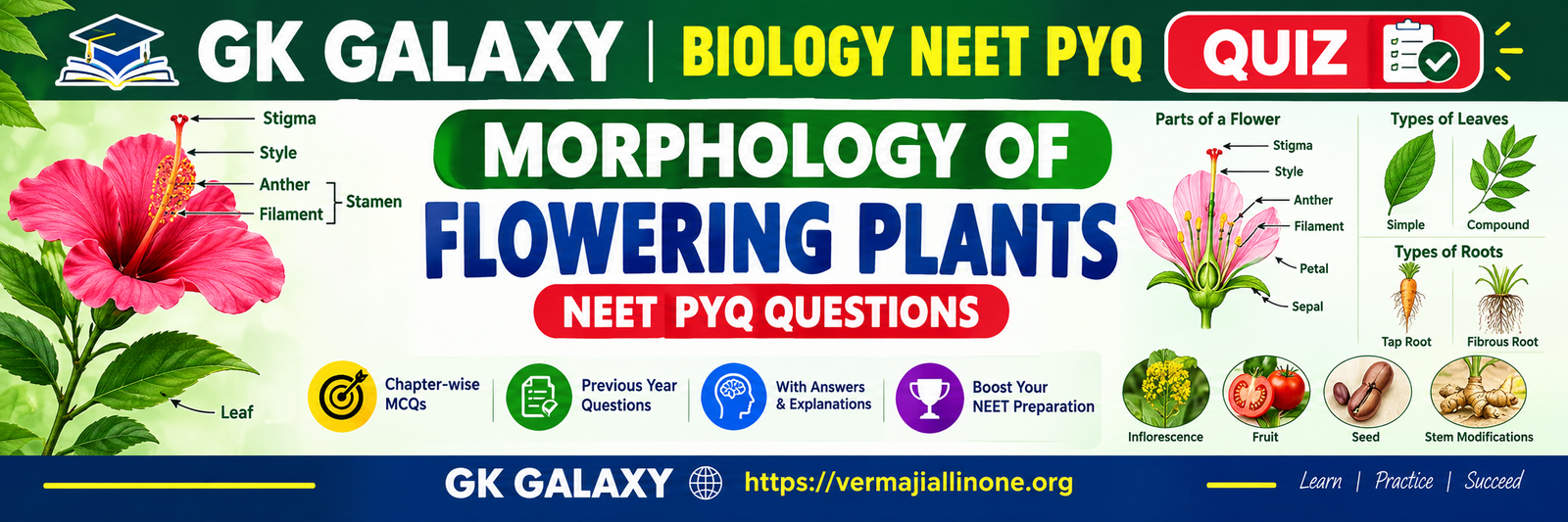
CHAPTER 4 : MORPHOLOGY OF FLOWERING PLANTS
PART A — COMPLETE THEORY
1. Introduction
Morphology is the study of the external form, structure and features of an organism or its parts.
In flowering plants, the plant body is broadly differentiated into:
Vegetative parts
Root
Stem
Leaf
Reproductive parts
Flower
Fruit
Seed
Other important morphological features include:
Inflorescence
Floral arrangement
Placentation
Aestivation
Floral symmetry
Floral formula
Floral diagram
2. THE ROOT
The root is generally the descending, non-green part of the plant axis that develops from the radicle of the embryo.
Major functions of roots
- Anchorage of the plant in the soil.
- Absorption of water and minerals.
- Conduction of absorbed water and minerals.
- Storage of reserve food in modified roots.
- Special functions such as respiration and mechanical support in certain plants.
2.1 Types of Root Systems
There are mainly three types of root systems:
A. Tap Root System
The primary root develops directly from the radicle and persists as the main root.
It produces:
Primary root
Secondary roots
Tertiary roots
Examples:
Mustard
Gram
Pea
Mango
Carrot
Turnip
The tap-root system is characteristic of most dicotyledonous plants.
B. Fibrous Root System
In this type, the primary root is short-lived and is replaced by a cluster of thin roots arising from the base of the stem.
Examples:
Wheat
Rice
Maize
Grasses
It is characteristic of most monocotyledonous plants.
C. Adventitious Roots
Roots arising from plant parts other than the radicle are called adventitious roots.
They may arise from:
Stem
Leaves
Other non-root parts
Examples:
Grass
Banyan
Maize
Sweet potato
3. REGIONS OF THE ROOT
A young root can be differentiated into several regions.
3.1 Root Cap
The root tip is covered by a thimble-shaped structure called the root cap.
Functions:
Protects the delicate root apex.
Helps the root move through the soil.
Protects the actively dividing cells behind it.
3.2 Region of Meristematic Activity
This region lies just behind the root cap.
Cells here:
Divide actively.
Are small.
Have dense cytoplasm.
Have prominent nuclei.
Have relatively thin cell walls.
This region is responsible for the production of new cells.
3.3 Region of Elongation
Cells in this region undergo considerable elongation.
This elongation contributes to the increase in length of the root.
3.4 Region of Maturation
Cells differentiate and mature in this region.
Some epidermal cells form very fine, thread-like structures called root hairs.
Important NEET point:
Root hairs arise from the region of maturation. This was tested in NEET 2026.
4. MODIFICATIONS OF ROOTS
Roots may undergo modifications to perform specialized functions.
4.1 Storage Roots
Roots may become swollen because they store food.
Examples
| Plant | Modification |
| Carrot | Conical storage tap root |
| Turnip | Napiform storage tap root |
| Radish | Fusiform storage tap root |
| Sweet potato | Adventitious storage root |
Important distinction
Sweet potato = modified root
Potato = modified stem
This distinction is frequently tested in competitive examinations.
5. SUPPORTING ROOT MODIFICATIONS
Some roots provide additional mechanical support.
5.1 Prop Roots
Prop roots arise from branches of the stem and grow downward into the soil.
Example: Banyan
The hanging roots ultimately reach the ground and provide mechanical support.
5.2 Stilt Roots
Stilt roots arise from the lower nodes of the stem and grow obliquely into the soil.
Examples:
Maize
Sugarcane
Pandanus
They provide additional support to the plant.
6. RESPIRATORY ROOTS
Plants growing in swampy or waterlogged areas may develop special roots that grow vertically upward and emerge above the soil or water surface.
These roots are called pneumatophores.
Example
Rhizophora
Their main function is to facilitate gaseous exchange and respiration in oxygen-deficient soils.
7. THE STEM
The stem is the ascending part of the plant axis that develops from the plumule of the embryo.
A typical stem possesses:
Nodes
Internodes
Terminal bud
Axillary buds
Leaves
Flowers and branches in appropriate stages
7.1 Nodes
The points on the stem where leaves arise are called nodes.
7.2 Internodes
The portions of the stem between two successive nodes are called internodes.
Important point
The presence of nodes and internodes is an important characteristic of a stem.
8. FUNCTIONS OF STEM
The stem performs several functions:
- Supports leaves.
- Supports flowers and fruits.
- Conducts water and minerals.
- Conducts organic food.
- Stores food in some plants.
- May perform photosynthesis when green.
- May undergo modifications for protection, storage or vegetative propagation.
9. MODIFICATIONS OF STEM
Stem modifications can occur:
Underground
Sub-aerially
Aerially
9.1 Underground Stem Modifications
These stems remain underground but retain stem characteristics such as:
Nodes
Internodes
Scale leaves
Buds
A. Rhizome
A rhizome is a horizontally growing underground stem.
Examples:
Ginger
Turmeric
Characteristics:
Thickened stem
Distinct nodes and internodes
Scale leaves
Adventitious roots
Terminal and axillary buds
NEET point: A rhizome is a modified underground stem, not a root.
B. Tuber
A tuber is a swollen underground stem containing stored food.
Example: Potato
The “eyes” of potato are actually buds.
Therefore, potato is a stem modification.
C. Bulb
A bulb has a reduced stem surrounded by fleshy storage leaves.
Examples:
Onion
Garlic
D. Corm
A corm is a short, swollen, vertical underground stem.
Examples:
Colocasia
Gladiolus
10. SUB-AERIAL STEM MODIFICATIONS
These stems partly remain above the soil and are commonly associated with vegetative propagation.
Runner
A runner is a slender stem that grows horizontally along the soil surface.
Example: Grass
Stolon
A stolon initially grows horizontally and later develops roots and shoots.
Sucker
A sucker arises from the underground portion of the stem and grows obliquely upward.
Example: Mint
Offset
An offset is a short, one-internode branch arising from the main stem.
Examples:
Pistia
Eichhornia
11. AERIAL STEM MODIFICATIONS
Stem Tendrils
In some plants, axillary buds are modified into tendrils.
Examples:
Cucumber
Pumpkin
Grapevine
They help the plant in climbing.
Thorns
Axillary buds may be modified into hard, pointed structures called thorns.
Examples:
Citrus
Bougainvillea
A NEET 2022 question tested this concept along with other stem and leaf modifications.
Phylloclade
A stem may become flattened or cylindrical, green and photosynthetic and perform the function of leaves.
Examples:
Opuntia
Euphorbia
In Opuntia, the stem is flattened, green and fleshy.
12. THE LEAF
The leaf is a lateral, generally flattened structure borne on the stem.
It develops from the node and has an axillary bud in its axil.
The major functions of leaves include:
Photosynthesis
Transpiration
Gaseous exchange
13. PARTS OF A TYPICAL LEAF
A typical leaf consists of:
- Leaf base
- Petiole
- Lamina
13.1 Leaf Base
The leaf base connects the leaf to the stem.
In some plants, the leaf base may become swollen.
Example
Leguminous plants
In grasses, the leaf base commonly expands into a sheath surrounding the stem.
13.2 Petiole
The stalk connecting the leaf base with the lamina is called the petiole.
A petiole:
Holds the leaf blade in a suitable position.
Helps expose the leaf to light.
Provides a connection between the lamina and stem.
13.3 Lamina
The broad, flat portion of the leaf is called the lamina or leaf blade.
It contains:
Midrib
Veins
Veinlets
The veins help in:
Transport
Mechanical support
14. VENATION
The arrangement of veins and veinlets in the lamina is called venation.
Two major types are:
A. Reticulate Venation
Veins form a network.
Commonly found in dicots.
Examples:
Mango
Guava
B. Parallel Venation
Veins run approximately parallel to one another.
Commonly found in monocots.
Examples:
Banana
Grass
Wheat
15. SIMPLE AND COMPOUND LEAVES
Simple Leaf
The lamina is entire or incised but the incisions do not reach the midrib to divide the lamina into distinct leaflets.
Examples:
Mango
China rose
Compound Leaf
The leaf lamina is divided into several leaflets.
The leaflets may be arranged in different ways.
Pinnately Compound
Leaflets are arranged along a common axis.
Examples:
Neem
Rose
Palmately Compound
Leaflets arise from a common point.
Examples:
Silk cotton
Lupin
16. PHYLLOTAXY
The arrangement of leaves on the stem or branch is called phyllotaxy.
Three important types are:
Alternate
One leaf occurs at each node.
Examples:
China rose
Mustard
Sunflower
Opposite
Two leaves occur at each node and lie opposite each other.
Examples:
Guava
Calotropis
Whorled
More than two leaves occur at each node.
Example:
Alstonia
17. LEAF MODIFICATIONS
Leaves can become modified to perform special functions.
Leaf Tendrils
Leaves or parts of leaves may become tendrils for climbing.
Example: Pea
Spines
Leaves may become modified into spines for protection.
Insectivorous Leaves
Some leaves are modified to trap insects.
Examples:
Pitcher plant
Venus flytrap
Storage Leaves
Leaves may become thick and fleshy for storage.
Example: Onion
18. INFLORESCENCE
The arrangement of flowers on the floral axis is called inflorescence.
Two major types are:
- Racemose
- Cymose
18.1 Racemose Inflorescence
In racemose inflorescence:
The main axis continues to grow.
Flowers are borne laterally.
The oldest flowers are generally at the base.
Younger flowers occur toward the apex.
This arrangement is called acropetal succession.
18.2 Cymose Inflorescence
In cymose inflorescence:
The main axis terminates in a flower.
Growth of the main axis is limited.
The oldest flower is generally at the apex or centre.
Younger flowers occur toward the base or outside.
This is called basipetal succession.
19. THE FLOWER
The flower is the reproductive unit of angiosperms.
A typical flower consists of four floral whorls:
- Calyx
- Corolla
- Androecium
- Gynoecium
The first two are collectively called accessory or non-essential whorls, while androecium and gynoecium constitute the reproductive whorls.
20. CALYX
The calyx is the outermost floral whorl.
Its individual members are called sepals.
Functions:
Protect the flower during the bud stage.
May become photosynthetic.
21. COROLLA
The corolla consists of petals.
Functions:
Attract pollinators.
Protect inner reproductive structures.
22. AESTIVATION
Aestivation refers to the arrangement of sepals or petals in a floral bud with respect to one another.
Important types:
Valvate
Margins touch but do not overlap.
Example: Calotropis
Twisted
One margin overlaps the next and so on.
Examples: China rose, cotton, lady’s finger
Imbricate
Margins overlap irregularly.
Examples: Cassia, Gulmohar
Vexillary
A special type of imbricate aestivation found in papilionaceous flowers.
Example: Pea
Arrangement:
One large standard petal
Two lateral wing petals
Two innermost keel petals
23. ANDROECIUM
The androecium is the male reproductive whorl.
Its individual units are called stamens.
Each stamen generally consists of:
Filament
Anther
The anther generally contains pollen sacs in which pollen grains develop.
24. GYNOECIUM
The gynoecium is the female reproductive whorl.
It consists of one or more carpels.
A carpel has:
- Stigma
- Style
- Ovary
The ovary contains ovules.
25. MONOCARPELLARY AND POLYCARPELLARY GYNOECIUM
Monocarpellary
Gynoecium consists of one carpel.
Polycarpellary
Gynoecium consists of more than one carpel.
If carpels are fused, the gynoecium is syncarpous.
If carpels are free, it is apocarpous.
26. PLACENTATION
The arrangement of ovules within the ovary is called placentation.
Important types:
Marginal
Ovules develop along the ventral suture of a single-carpel ovary.
Example: Pea
Axile
Ovules develop on the central axis, with septa dividing the ovary into chambers.
Examples: Tomato, lemon
Parietal
Ovules develop on the inner wall or peripheral region of the ovary.
Examples: Mustard, Argemone
Free Central
Ovules develop on a central axis without septa.
Example: Primrose
Basal
A single ovule develops at the base of the ovary.
Example: Marigold
These placentation examples are repeatedly tested in NEET. For example, a 2026 question matched marginal–pea, axile–lemon, parietal–mustard and basal–marigold.
27. POSITION OF OVARY
Based on the position of the ovary relative to other floral parts:
Hypogynous Flower
The ovary is superior.
Other floral parts arise below the ovary.
Examples:
Mustard
China rose
Brinjal
Perigynous Flower
The ovary is generally described as half-inferior in the NCERT treatment, with other floral parts arising around the ovary at approximately the same level.
Example: Rose
Epigynous Flower
The ovary is inferior.
Other floral parts appear to arise above the ovary.
Examples:
Guava
Cucumber
Sunflower
28. FLORAL SYMMETRY
Actinomorphic
A flower that can be divided into two equal halves through any vertical plane passing through the centre.
Symbol: ⊕
Examples:
Mustard
Datura
Chilli
Zygomorphic
A flower that can be divided into two equal halves through only one particular vertical plane.
Examples:
Pea
Bean
Gulmohar
29. SEXUALITY OF FLOWERS
Bisexual Flower
Contains both:
Androecium
Gynoecium
Examples:
Mustard
China rose
Pea
Unisexual Flower
Contains either androecium or gynoecium.
Examples:
Papaya
Maize
30. FRUIT
A fruit is generally the mature or ripened ovary developed after fertilisation.
The wall of the fruit is called the pericarp.
True Fruit
A fruit developing mainly from the ovary is called a true fruit.
Example: Mango
False Fruit / Accessory Fruit
When parts other than the ovary also contribute substantially to fruit formation, it is called a false or accessory fruit.
Example: Apple
In apple, the edible fleshy part is largely derived from the thalamus, making it an important NEET example.
31. TYPES OF FRUITS
Simple Fruit
Develops from a single ovary of one flower.
Aggregate Fruit
Develops from several free carpels of a single flower.
Example: Strawberry / custard apple depending on the specific fruit type.
Multiple Fruit
Develops from an entire inflorescence.
Examples:
Pineapple
Jackfruit
32. SEED
A seed is a mature ovule formed after fertilisation.
A typical seed contains:
Seed coat
Embryo
Stored food/endosperm in many plants
33. DICOT SEED
A typical dicot seed contains:
Seed coat
Two cotyledons
Embryonal axis
Plumule
Radicle
The embryonal axis lies between the cotyledons.
The radicle develops into the root system, while the plumule develops into the shoot system.
34. MONOCOT SEED
A typical monocot seed such as maize has:
One cotyledon
Large endosperm
Embryo
Scutellum
The single cotyledon of maize is called the scutellum.
The protective sheaths are:
Coleoptile → protects plumule
Coleorhiza → protects radicle
35. IMPORTANT TERMS FOR NEET
Albuminous Seed
Seeds that retain endosperm after maturity.
Examples:
Wheat
Maize
Castor
Non-albuminous Seed
Seeds in which the endosperm is consumed during embryo development.
Examples:
Pea
Groundnut
Perisperm
Persistent nucellus in the mature seed.
Example: Black pepper
36. IMPORTANT FAMILIES
Three important families emphasized in the NCERT practical syllabus are:
Fabaceae
Solanaceae
Liliaceae
These families should be studied through:
Floral characters
Floral formula
Floral diagram
Important examples
Economic importance
We will cover these in detail later in this chapter.