GUMROAD eBook link:-
BY SHAILENDRA KUMAR VERMA
| 1. | CHALLENGING SYLLOGISM |
| https://skverma29.gumroad.com/l/ktxvzi | |
| 2. | STRAIT OF HORMUZ: STRATEGIC & ECONOMIC ROLE |
| https://skverma29.gumroad.com/l/upobrv | |
| 4. | STATIC GENERAL KNOWLEDGE |
| https://skverma29.gumroad.com/l/kzmca | |
| 5. | SSC ENGLISH PREVIOUS YEAR QUESTIONS MCQ |
| https://skverma29.gumroad.com/l/vtotyp | |
| 6. | SSC REASONING PREVIOUS YEAR QUESTIONS MCQ |
| https://skverma29.gumroad.com/l/fsyvp | |
| 7. | SSC MATH PREVIOUS YEAR QUESTIONS (MCQ): TIER I |
| https://skverma29.gumroad.com/l/nesioq | |
| 8. | BANKING KNOWLEDGE QUESTIONS AND ANSWERS MCQ |
| https://skverma29.gumroad.com/l/sgbbul | |
| 9. | BIHAR ANM, GNM & PHARMACIST EXAM: PAST MCQ QUESTIONS & ANSWERS – |
| https://skverma29.gumroad.com/l/yotjat | |
| 10. | ARAVALLI MOUNTAIN RANGE: THE ANCIENT SPINE OF INDIA |
| https://skverma29.gumroad.com/l/khpakf | |
| 11. | मौर्य काल (322 ईसा पूर्व – 185 ईसा पूर्व): पीएसयू परीक्षा हेतु प्रश्नोत्तर सहित विस्तृत अध्ययन |
| https://skverma29.gumroad.com/l/kgmrw | |
| 12. | VOLCANOES AND EARTHQUAKES: A COMPLETE GUIDE |
| https://share.google/gMZLAnx4hcCV82NTI | |
| 13. | TERMINOLOGY: RAILWAY, COMPUTER, SHARE MARKET, BIOLOGY, BADMINTON, CRICKET, FOOTBALL, KABBADI AND HOCKEY |
| https://share.google/fvdFN53HtyXlqTCgd | |
| 14. | भारतीय संसद का सत्र: प्रक्रिया, नियमऔर एस ओ पी; पी एस यू परीक्षा के लिए संपूर्ण मार्ग दर्शिका |
| https://share.google/1HFwXZA3qUiKyrI1l | |
| 15. | REITs AND InvITs IN INDIA: COMPLETE GUIDE (SCOPE, RISKS & FUTURE) |
| https://share.google/EChDc9heQmPPeyhoi | |
| 16. | GK SSC TIER I PREVIOUS YEAR MCQ |
| https://share.google/5pLzqYKQtg822wk3Y | |
| 17. | PETROLEUM REFINERY PROCESS: WITH 200 MCQ |
| https://skverma29.gumroad.com/l/jgydi | |
| 18. | SET THEORY: A COMPLETE GUIDE WITH 400 MCQ |
| https://skverma29.gumroad.com/l/zkhqzm | |
| 19. | WORLD’S SMALLEST, LONGEST, THINNEST, THICKEST AND TALLEST |
| https://skverma29.gumroad.com/l/kzaenh | |
| 20. | HIGH TIDE AND LOW TIDE: A COMPLETE GUIDE https://skverma29.gumroad.com/l/virke |
| 21. | 1000 HISTORY QESTIONS & ANSWERS FOR PSU |
| https://skverma29.gumroad.com/l/fjapus | |
| 22. | नालंदा विश्वविद्यालय : सम्पूर्ण अध्ययन |
| https://skverma29.gumroad.com/l/pmjab?wanted=true | |
| 23. | भगवान शिव के 12 ज्योतिर्लिंग: इतिहास, महत्व और दर्शन क्रम |
| https://skverma29.gumroad.com/l/wdkgo | |
| 24 | NISM-SERIES-V-A MUTUAL FUND DISTRIBUTOR: COMPLETE STUDY GUIDE & EXAM PREPARATION |
| https://skverma29.gumroad.com/l/qgcviu | |
| 25. | WORKSHOP TECHNOLOGY & MANUFACTURING PROCESSES COMPLETE EXAM GUIDE |
| https://skverma29.gumroad.com/l/xvqxnp |
AMAZON eBook link:-
BY SHAILENDRA KUMAR VERMA
| 1. | SSC MATH PREVIOUS YEAR MCQ: SSC MATH |
| https://amzn.in/d/097Ocsnl | |
| 2. | SSC REASONING PREVIOUS YEAR MCQ: SSC REASONING |
| https://amzn.in/d/00EHQGE8 | |
| 3. | SSC ENGLISH PREVIOUS YEAR MCQ: SSC ENGLISH |
| https://amzn.in/d/0f8sxJoy | |
| 4. | STATIC GENERAL KNOWLEDGE : WITH 620 MCQs |
| https://amzn.in/d/09xNEWmt |
PLAYSTORE eBook link:-
BY SHAILENDRA KUMAR VERMA
| 1. | SSC MATH PREVIOUS YEAR MCQ | |
| https://share.google/KzWbvkFuNk51PEpiu | ||
| 2. | SSC REASONING PREVIOUS YEAR MCQ | |
| https://play.google.com/books/publish/a/12574378860292240754#book/GGKEY:EUPQZ9ZUAFR/review | ||
| 3. | STATIC GENERAL KNOWLEDGE | |
| https://play.google.com/books/publish/a/12574378860292240754#book/GGKEY:CQDT2G4CCQP/review | ||
| 4. | CHALLENGING SYLLOGISM | |
| https://share.google/w9xLMwyiJdNVnpHxI | ||
| 5. | STRAIT OF HORMUZ: STRATEGIC & ECONOMIC ROLE | |
| https://share.google/V10H7UKeTkstLIMmc | ||
| 6. | BIHAR TEACHER ELIGIBILITY TEST (BIHAR TET) : COMPLETE GUIDE | |
| https://share.google/AcCXPFa69dAWyYaZZ | ||
| 7. | SSC ENGLISH PREVIOUS YEAR MCQ | |
| https://share.google/pr7b0YhDoDwttaq2s | ||
| 8. | BANKING KNOWLEDGE QUESTIONS AND ANSWERS MCQ | |
| https://share.google/yqYOabKhNppcz89hl | ||
| 9. | BIHAR ANM, GNM & PHARMACIST EXAM: PAST MCQ QUESTIONS & ANSWERS – | |
| https://share.google/NFhtU1JoBfxPS4wa3 | ||
| 10. | ARAVALLI MOUNTAIN RANGE: THE ANCIENT SPINE OF INDIA | |
| https://share.google/Yo4RYnaZrbRu9qwzj | ||
| 11. | GK SSC TIER I PREVIOUS YEAR MCQ | |
| https://share.google/sBdCcsEeebM44QZ0X | ||
| 12. | REITs AND InvITs IN INDIA: COMPLETE GUIDE (SCOPE, RISKS & FUTURE) | |
| https://share.google/XAwUio1deUOxFe2M7 | ||
| 13. | भारतीय संसद का सत्र: प्रक्रिया, नियमऔर एस ओ पी ; पी एस यू परीक्षा के लिए संपूर्ण मार्ग दर्शिका | |
| https://share.google/6XVrfQ2PcuWmqvKol | ||
| 14. | मौर्य काल (322 ईसा पूर्व – 185 ईसा पूर्व): पीएसयू परीक्षा हेतु प्रश्नोत्तर सहित विस्तृत अध्ययन | |
| https://share.google/Lwu7JKHE54kxsL5e2 | ||
| 15. | TERMINOLOGY: RAILWAY, COMPUTER, SHARE MARKET, BIOLOGY, BADMINTON, CRICKET, FOOTBALL, KABBADI AND HOCKEY | |
| https://share.google/WWVO9ZFd81R9G9h69 | ||
| 16. | VOLCANOES AND EARTHQUAKES: A COMPLETE GUIDE | |
| https://share.google/aXi2evRVgmzpQguye | ||
| 17. | PETROLEUM REFINERY PROCESS: WITH 200 MCQ | |
| https://play.google.com/books/publish/u/0/a/12574378860292240754#book/GGKEY:P34SQBHUJ7F/review | ||
| 18. | SET THEORY: A COMPLETE GUIDE WITH 400 MCQ | SET THEORY: A COMPLETE GUIDE WITH 400 MCQ |
| https://play.google.com/books/publish/u/0/a/12574378860292240754#book/GGKEY:83LKH7QHRQH/review | ||
| 19. | WORLD’S SMALLEST, LONGEST, THINNEST, THICKEST AND TALLEST | |
| https://play.google.com/books/publish/u/0/a/12574378860292240754#book/GGKEY:9LE49HEDZJE/review | ||
| 20. | HIGH TIDE AND LOW TIDE: A COMPLETE GUIDE | |
| https://play.google.com/books/publish/u/0/a/12574378860292240754#book/GGKEY:TKR79QBDE7R/review | ||
| 21. | 1000 HISTORY QESTIONS & ANSWERS FOR PSU | |
| https://play.google.com/books/publish/u/0/a/12574378860292240754#book/GGKEY:1SGWQKT7BDF/review | ||
| 22. | नालंदा विश्वविद्यालय : सम्पूर्ण अध्ययन | |
| https://play.google.com/books/publish/u/0/a/12574378860292240754#book/GGKEY:RY0EDLDK7TL/review | ||
| 23. | भगवान शिव के 12 ज्योतिर्लिंग: इतिहास, महत्व और दर्शन क्रम | |
| https://play.google.com/books/publish/u/0/a/12574378860292240754#book/GGKEY:KNT0X6L8YCQ/review | ||
| 24. | NISM-SERIES-V-A MUTUAL FUND DISTRIBUTOR: COMPLETE STUDY GUIDE & EXAM PREPARATION | |
| https://play.google.com/books/publish/u/0/a/12574378860292240754#book/GGKEY:YP1PQ8RQY07/review | ||
| 25. | WORKSHOP TECHNOLOGY & MANUFACTURING PROCESSES COMPLETE EXAM GUIDE | |
| https://play.google.com/books/publish/u/0/a/12574378860292240754#book/GGKEY:PK621P1ZHXX/review |
| OPEN DMAT ACCONT FROM THI LINK IN ANGEL ONE:- |
| Open your Trading & Investment account with Angel One for FREE* |
| You will get: |
| All trades in Rs.20 |
| Quick SIP in Direct MF |
| 1Lac MTF @ 0% interest |
| Download only using my referral link to get Free Demat Account⬇ |
| https://angel-one.onelink.me/Wjgr/2o2au42h |
| _link may expire within 48hrs_ |
| _T&C Apply_ |
| CLICK TO APPLY: |
| Click the application link below: 👉 Apply Here for SBI Credit Card (Referral Code: 243zfQ0yYm3) |
| OPEN DMAT ACCOUNT FROM THIS LINK: |
| HI THERE, I SEE YOU HAVEN’T BOUGHT THE FREEDOM PLAN ON INDIAN BANK YET. DON’T MISS OUT ON UNLIMITED TRADING AT A POCKET-FRIENDLY COST. GO BROKERAGE-FREE AND SAVE BIG WITH THE FREEDOM PLAN. USE MY REFERRAL CODE, SHAI0634 TO DOWNLOAD THE APP NOW. |
| https://play.google.com/store/apps/details?id=com.finwizard.fisdom |
DISCLAIMER
This chapter, “Morphology of Flowering Plants,” has been prepared for educational and examination-preparation purposes only, particularly for students preparing for NEET and other competitive examinations.
The chapter may contain theory, important concepts, NCERT-based facts, MCQs, previous-year questions (PYQs), memory-based questions, answers, explanations, examples, tables, comparisons and other study material related to the topic.
Important Notice
The website owner is not responsible for any error, omission, discrepancy, or unintended mistake that may occur in the questions, answers, explanations, dates, examination names, terminology, examples or other educational content.
The MCQ answers and explanations are provided for educational and revision purposes. Students are advised to verify important answers and concepts with the latest NCERT Biology textbook, official NEET/NTA information and other authentic sources.
Some previous-year questions may be presented in memory-based or reconstructed form where the original question paper/source is not available in an officially verifiable form. Such questions should not automatically be considered an exact reproduction of the official question paper.
Where a question has appeared in more than one examination/year, the available examination name and year may be mentioned together. Repeated questions are consolidated wherever possible to avoid unnecessary duplication.
The inclusion of an examination name or year does not constitute an official endorsement, affiliation, or association with NTA, NEET any examination authority, government department, educational institution or other organization.
NEET, NTA, NCERT and other examination-related names and trademarks belong to their respective owners. This educational material is independently prepared and is not an official publication of these organizations.
Students should always refer to the latest official syllabus and NCERT material because examination patterns, syllabi, terminology and question formats may change.
The website owner does not guarantee that any particular question, topic or concept included in this chapter will appear in any future examination.
This material is intended only as a study and revision resource and should not be considered a substitute for the prescribed NCERT textbook or official examination materials.
Educational Purpose
The primary purpose of this chapter is to help students understand Morphology of Flowering Plants and practise questions through theory, MCQs, answers, explanations, and previous-year/memory-based questions.
Students are advised to cross-check important information with the latest NCERT textbook and official examination sources before relying on it for examination purposes.
© Educational Content : For Study & Examination Preparation
CHAPTER 4 : MORPHOLOGY OF FLOWERING PLANTS
PART A — COMPLETE THEORY
1. Introduction
Morphology is the study of the external form, structure and features of an organism or its parts.
In flowering plants, the plant body is broadly differentiated into:
Vegetative parts
Root
Stem
Leaf
Reproductive parts
Flower
Fruit
Seed
Other important morphological features include:
Inflorescence
Floral arrangement
Placentation
Aestivation
Floral symmetry
Floral formula
Floral diagram
2. THE ROOT
The root is generally the descending, non-green part of the plant axis that develops from the radicle of the embryo.
Major functions of roots
- Anchorage of the plant in the soil.
- Absorption of water and minerals.
- Conduction of absorbed water and minerals.
- Storage of reserve food in modified roots.
- Special functions such as respiration and mechanical support in certain plants.
2.1 Types of Root Systems
There are mainly three types of root systems:
A. Tap Root System
The primary root develops directly from the radicle and persists as the main root.
It produces:
Primary root
Secondary roots
Tertiary roots
Examples:
Mustard
Gram
Pea
Mango
Carrot
Turnip
The tap-root system is characteristic of most dicotyledonous plants.
B. Fibrous Root System
In this type, the primary root is short-lived and is replaced by a cluster of thin roots arising from the base of the stem.
Examples:
Wheat
Rice
Maize
Grasses
It is characteristic of most monocotyledonous plants.
C. Adventitious Roots
Roots arising from plant parts other than the radicle are called adventitious roots.
They may arise from:
Stem
Leaves
Other non-root parts
Examples:
Grass
Banyan
Maize
Sweet potato
3. REGIONS OF THE ROOT
A young root can be differentiated into several regions.
3.1 Root Cap
The root tip is covered by a thimble-shaped structure called the root cap.
Functions:
Protects the delicate root apex.
Helps the root move through the soil.
Protects the actively dividing cells behind it.
3.2 Region of Meristematic Activity
This region lies just behind the root cap.
Cells here:
Divide actively.
Are small.
Have dense cytoplasm.
Have prominent nuclei.
Have relatively thin cell walls.
This region is responsible for the production of new cells.
3.3 Region of Elongation
Cells in this region undergo considerable elongation.
This elongation contributes to the increase in length of the root.
3.4 Region of Maturation
Cells differentiate and mature in this region.
Some epidermal cells form very fine, thread-like structures called root hairs.
Important NEET point:
Root hairs arise from the region of maturation. This was tested in NEET 2026.
4. MODIFICATIONS OF ROOTS
Roots may undergo modifications to perform specialized functions.
4.1 Storage Roots
Roots may become swollen because they store food.
Examples
| Plant | Modification |
| Carrot | Conical storage tap root |
| Turnip | Napiform storage tap root |
| Radish | Fusiform storage tap root |
| Sweet potato | Adventitious storage root |
Important distinction
Sweet potato = modified root
Potato = modified stem
This distinction is frequently tested in competitive examinations.
5. SUPPORTING ROOT MODIFICATIONS
Some roots provide additional mechanical support.
5.1 Prop Roots
Prop roots arise from branches of the stem and grow downward into the soil.
Example: Banyan
The hanging roots ultimately reach the ground and provide mechanical support.
5.2 Stilt Roots
Stilt roots arise from the lower nodes of the stem and grow obliquely into the soil.
Examples:
Maize
Sugarcane
Pandanus
They provide additional support to the plant.
6. RESPIRATORY ROOTS
Plants growing in swampy or waterlogged areas may develop special roots that grow vertically upward and emerge above the soil or water surface.
These roots are called pneumatophores.
Example
Rhizophora
Their main function is to facilitate gaseous exchange and respiration in oxygen-deficient soils.
7. THE STEM
The stem is the ascending part of the plant axis that develops from the plumule of the embryo.
A typical stem possesses:
Nodes
Internodes
Terminal bud
Axillary buds
Leaves
Flowers and branches in appropriate stages
7.1 Nodes
The points on the stem where leaves arise are called nodes.
7.2 Internodes
The portions of the stem between two successive nodes are called internodes.
Important point
The presence of nodes and internodes is an important characteristic of a stem.
8. FUNCTIONS OF STEM
The stem performs several functions:
- Supports leaves.
- Supports flowers and fruits.
- Conducts water and minerals.
- Conducts organic food.
- Stores food in some plants.
- May perform photosynthesis when green.
- May undergo modifications for protection, storage or vegetative propagation.
9. MODIFICATIONS OF STEM
Stem modifications can occur:
Underground
Sub-aerially
Aerially
9.1 Underground Stem Modifications
These stems remain underground but retain stem characteristics such as:
Nodes
Internodes
Scale leaves
Buds
A. Rhizome
A rhizome is a horizontally growing underground stem.
Examples:
Ginger
Turmeric
Characteristics:
Thickened stem
Distinct nodes and internodes
Scale leaves
Adventitious roots
Terminal and axillary buds
NEET point: A rhizome is a modified underground stem, not a root.
B. Tuber
A tuber is a swollen underground stem containing stored food.
Example: Potato
The “eyes” of potato are actually buds.
Therefore, potato is a stem modification.
C. Bulb
A bulb has a reduced stem surrounded by fleshy storage leaves.
Examples:
Onion
Garlic
D. Corm
A corm is a short, swollen, vertical underground stem.
Examples:
Colocasia
Gladiolus
10. SUB-AERIAL STEM MODIFICATIONS
These stems partly remain above the soil and are commonly associated with vegetative propagation.
Runner
A runner is a slender stem that grows horizontally along the soil surface.
Example: Grass
Stolon
A stolon initially grows horizontally and later develops roots and shoots.
Sucker
A sucker arises from the underground portion of the stem and grows obliquely upward.
Example: Mint
Offset
An offset is a short, one-internode branch arising from the main stem.
Examples:
Pistia
Eichhornia
11. AERIAL STEM MODIFICATIONS
Stem Tendrils
In some plants, axillary buds are modified into tendrils.
Examples:
Cucumber
Pumpkin
Grapevine
They help the plant in climbing.
Thorns
Axillary buds may be modified into hard, pointed structures called thorns.
Examples:
Citrus
Bougainvillea
A NEET 2022 question tested this concept along with other stem and leaf modifications.
Phylloclade
A stem may become flattened or cylindrical, green and photosynthetic and perform the function of leaves.
Examples:
Opuntia
Euphorbia
In Opuntia, the stem is flattened, green and fleshy.
12. THE LEAF
The leaf is a lateral, generally flattened structure borne on the stem.
It develops from the node and has an axillary bud in its axil.
The major functions of leaves include:
Photosynthesis
Transpiration
Gaseous exchange
13. PARTS OF A TYPICAL LEAF
A typical leaf consists of:
- Leaf base
- Petiole
- Lamina
13.1 Leaf Base
The leaf base connects the leaf to the stem.
In some plants, the leaf base may become swollen.
Example
Leguminous plants
In grasses, the leaf base commonly expands into a sheath surrounding the stem.
13.2 Petiole
The stalk connecting the leaf base with the lamina is called the petiole.
A petiole:
Holds the leaf blade in a suitable position.
Helps expose the leaf to light.
Provides a connection between the lamina and stem.
13.3 Lamina
The broad, flat portion of the leaf is called the lamina or leaf blade.
It contains:
Midrib
Veins
Veinlets
The veins help in:
Transport
Mechanical support
14. VENATION
The arrangement of veins and veinlets in the lamina is called venation.
Two major types are:
A. Reticulate Venation
Veins form a network.
Commonly found in dicots.
Examples:
Mango
Guava
B. Parallel Venation
Veins run approximately parallel to one another.
Commonly found in monocots.
Examples:
Banana
Grass
Wheat
15. SIMPLE AND COMPOUND LEAVES
Simple Leaf
The lamina is entire or incised but the incisions do not reach the midrib to divide the lamina into distinct leaflets.
Examples:
Mango
China rose
Compound Leaf
The leaf lamina is divided into several leaflets.
The leaflets may be arranged in different ways.
Pinnately Compound
Leaflets are arranged along a common axis.
Examples:
Neem
Rose
Palmately Compound
Leaflets arise from a common point.
Examples:
Silk cotton
Lupin
16. PHYLLOTAXY
The arrangement of leaves on the stem or branch is called phyllotaxy.
Three important types are:
Alternate
One leaf occurs at each node.
Examples:
China rose
Mustard
Sunflower
Opposite
Two leaves occur at each node and lie opposite each other.
Examples:
Guava
Calotropis
Whorled
More than two leaves occur at each node.
Example:
Alstonia
17. LEAF MODIFICATIONS
Leaves can become modified to perform special functions.
Leaf Tendrils
Leaves or parts of leaves may become tendrils for climbing.
Example: Pea
Spines
Leaves may become modified into spines for protection.
Insectivorous Leaves
Some leaves are modified to trap insects.
Examples:
Pitcher plant
Venus flytrap
Storage Leaves
Leaves may become thick and fleshy for storage.
Example: Onion
18. INFLORESCENCE
The arrangement of flowers on the floral axis is called inflorescence.
Two major types are:
- Racemose
- Cymose
18.1 Racemose Inflorescence
In racemose inflorescence:
The main axis continues to grow.
Flowers are borne laterally.
The oldest flowers are generally at the base.
Younger flowers occur toward the apex.
This arrangement is called acropetal succession.
18.2 Cymose Inflorescence
In cymose inflorescence:
The main axis terminates in a flower.
Growth of the main axis is limited.
The oldest flower is generally at the apex or centre.
Younger flowers occur toward the base or outside.
This is called basipetal succession.
19. THE FLOWER
The flower is the reproductive unit of angiosperms.
A typical flower consists of four floral whorls:
- Calyx
- Corolla
- Androecium
- Gynoecium
The first two are collectively called accessory or non-essential whorls, while androecium and gynoecium constitute the reproductive whorls.
20. CALYX
The calyx is the outermost floral whorl.
Its individual members are called sepals.
Functions:
Protect the flower during the bud stage.
May become photosynthetic.
21. COROLLA
The corolla consists of petals.
Functions:
Attract pollinators.
Protect inner reproductive structures.
22. AESTIVATION
Aestivation refers to the arrangement of sepals or petals in a floral bud with respect to one another.
Important types:
Valvate
Margins touch but do not overlap.
Example: Calotropis
Twisted
One margin overlaps the next and so on.
Examples: China rose, cotton, lady’s finger
Imbricate
Margins overlap irregularly.
Examples: Cassia, Gulmohar
Vexillary
A special type of imbricate aestivation found in papilionaceous flowers.
Example: Pea
Arrangement:
One large standard petal
Two lateral wing petals
Two innermost keel petals
23. ANDROECIUM
The androecium is the male reproductive whorl.
Its individual units are called stamens.
Each stamen generally consists of:
Filament
Anther
The anther generally contains pollen sacs in which pollen grains develop.
24. GYNOECIUM
The gynoecium is the female reproductive whorl.
It consists of one or more carpels.
A carpel has:
- Stigma
- Style
- Ovary
The ovary contains ovules.
25. MONOCARPELLARY AND POLYCARPELLARY GYNOECIUM
Monocarpellary
Gynoecium consists of one carpel.
Polycarpellary
Gynoecium consists of more than one carpel.
If carpels are fused, the gynoecium is syncarpous.
If carpels are free, it is apocarpous.
26. PLACENTATION
The arrangement of ovules within the ovary is called placentation.
Important types:
Marginal
Ovules develop along the ventral suture of a single-carpel ovary.
Example: Pea
Axile
Ovules develop on the central axis, with septa dividing the ovary into chambers.
Examples: Tomato, lemon
Parietal
Ovules develop on the inner wall or peripheral region of the ovary.
Examples: Mustard, Argemone
Free Central
Ovules develop on a central axis without septa.
Example: Primrose
Basal
A single ovule develops at the base of the ovary.
Example: Marigold
These placentation examples are repeatedly tested in NEET. For example, a 2026 question matched marginal–pea, axile–lemon, parietal–mustard and basal–marigold.
27. POSITION OF OVARY
Based on the position of the ovary relative to other floral parts:
Hypogynous Flower
The ovary is superior.
Other floral parts arise below the ovary.
Examples:
Mustard
China rose
Brinjal
Perigynous Flower
The ovary is generally described as half-inferior in the NCERT treatment, with other floral parts arising around the ovary at approximately the same level.
Example: Rose
Epigynous Flower
The ovary is inferior.
Other floral parts appear to arise above the ovary.
Examples:
Guava
Cucumber
Sunflower
28. FLORAL SYMMETRY
Actinomorphic
A flower that can be divided into two equal halves through any vertical plane passing through the centre.
Symbol: ⊕
Examples:
Mustard
Datura
Chilli
Zygomorphic
A flower that can be divided into two equal halves through only one particular vertical plane.
Examples:
Pea
Bean
Gulmohar
29. SEXUALITY OF FLOWERS
Bisexual Flower
Contains both:
Androecium
Gynoecium
Examples:
Mustard
China rose
Pea
Unisexual Flower
Contains either androecium or gynoecium.
Examples:
Papaya
Maize
30. FRUIT
A fruit is generally the mature or ripened ovary developed after fertilisation.
The wall of the fruit is called the pericarp.
True Fruit
A fruit developing mainly from the ovary is called a true fruit.
Example: Mango
False Fruit / Accessory Fruit
When parts other than the ovary also contribute substantially to fruit formation, it is called a false or accessory fruit.
Example: Apple
In apple, the edible fleshy part is largely derived from the thalamus, making it an important NEET example.
31. TYPES OF FRUITS
Simple Fruit
Develops from a single ovary of one flower.
Aggregate Fruit
Develops from several free carpels of a single flower.
Example: Strawberry / custard apple depending on the specific fruit type.
Multiple Fruit
Develops from an entire inflorescence.
Examples:
Pineapple
Jackfruit
32. SEED
A seed is a mature ovule formed after fertilisation.
A typical seed contains:
Seed coat
Embryo
Stored food/endosperm in many plants
33. DICOT SEED
A typical dicot seed contains:
Seed coat
Two cotyledons
Embryonal axis
Plumule
Radicle
The embryonal axis lies between the cotyledons.
The radicle develops into the root system, while the plumule develops into the shoot system.
34. MONOCOT SEED
A typical monocot seed such as maize has:
One cotyledon
Large endosperm
Embryo
Scutellum
The single cotyledon of maize is called the scutellum.
The protective sheaths are:
Coleoptile → protects plumule
Coleorhiza → protects radicle
35. IMPORTANT TERMS FOR NEET
Albuminous Seed
Seeds that retain endosperm after maturity.
Examples:
Wheat
Maize
Castor
Non-albuminous Seed
Seeds in which the endosperm is consumed during embryo development.
Examples:
Pea
Groundnut
Perisperm
Persistent nucellus in the mature seed.
Example: Black pepper
36. IMPORTANT FAMILIES
Three important families emphasized in the NCERT practical syllabus are:
Fabaceae
Solanaceae
Liliaceae
These families should be studied through:
Floral characters
Floral formula
Floral diagram
Important examples
Economic importance
We will cover these in detail later in this chapter.
PART B — NEET PREVIOUS-YEAR QUESTIONS
PYQ 1
Question
In angiosperms, root hairs arise from which one of the following regions of the root?
Exam: NEET 2026
A. Root cap zone
B. Region of meristematic activity
C. Region of elongation
D. Region of maturation
Correct Answer:
D. Region of maturation
Explanation:
Root hairs arise from certain epidermal cells in the region of maturation. These are fine, delicate, thread-like structures that increase the surface area available for absorption of water and minerals.
This question is directly reported as a NEET 2026 Morphology of Flowering Plants question.
PYQ 2
Question
Which one of the following plants shows vexillary aestivation and diadelphous stamens?
Exam: NEET 2022 Phase 1
A. Colchicum autumnale
B. Pisum sativum
C. Allium cepa
D. Solanum nigrum
Correct Answer:
B. Pisum sativum
Explanation:
Pisum sativum (pea) belongs to Fabaceae.
Its characteristic features include:
Vexillary aestivation
Papilionaceous corolla
Diadelphous stamens, generally (9)+1
Zygomorphic, bisexual flowers
Therefore, pea is the correct answer.
PYQ 3
Question
Identify the correct set of statements:
- Axillary buds form slender and spirally coiled tendrils in cucumber and pumpkin.
- Stem is flattened and fleshy in Opuntia and modified to perform the function of leaves.
- Rhizophora shows vertically upward-growing roots that help in respiration.
- Sub-aerial stems in grasses and strawberry help in vegetative propagation.
Exam: NEET 2022 Phase 1
A. 1 and 2 only
B. 1 and 4 only
C. 1, 2, 3 and 4
D. 2 and 3 only
Correct Answer:
C. 1, 2, 3 and 4
Explanation:
All four statements are correct.
Cucumber and pumpkin: axillary buds can form tendrils.
Opuntia: flattened, green stem performs photosynthetic functions.
Rhizophora: pneumatophores facilitate gaseous exchange.
Grass and strawberry: sub-aerial modifications can facilitate vegetative propagation.
The original NEET 2022 question tested this combination of modifications.
PYQ 4
Question
Which of the following statements about a rhizome is not correct?
Exam: NEET 2022 Phase 2
A. Rhizome is thick, prostrate and branched.
B. Rhizome is a condensed form of stem.
C. The apical bud in rhizome always remains above the ground.
D. Rhizome is an underground stem with distinct nodes and internodes.
Correct Answer:
C. The apical bud in rhizome always remains above the ground.
Explanation:
A rhizome is an underground stem. It possesses:
Nodes
Internodes
Scale leaves
Buds
Adventitious roots
Its apical bud does not necessarily remain above the ground. Therefore, statement C is incorrect.
The question is recorded as a NEET 2022 Phase 2 Morphology question.
PYQ 5
Question
Which of the following is correctly matched?
Exam: NEET 2026
A. Marginal placentation — Pea
B. Axile placentation — Mustard
C. Parietal placentation — Lemon
D. Basal placentation — Pea
Correct Answer:
A. Marginal placentation — Pea
Explanation:
| Type of placentation | Example |
| Marginal | Pea |
| Axile | Lemon |
| Parietal | Mustard |
| Basal | Marigold |
Thus, marginal placentation in pea is correctly matched. The same set of relationships was tested in the NEET 2026 paper.
PART C — FAMILIES OF FLOWERING PLANTS
1. FAMILY FABACEAE
Fabaceae is commonly known as the legume family.
Important examples
Pea — Pisum sativum
Gram — Cicer arietinum
Bean — Phaseolus
Soybean — Glycine max
Groundnut — Arachis hypogaea
Pigeon pea — Cajanus cajan
Sunhemp — Crotalaria juncea
1.1 Habit
Members of Fabaceae may occur as:
Herbs
Shrubs
Trees
1.2 Root
The root system is generally a tap-root system.
Root nodules are commonly present and contain nitrogen-fixing bacteria such as Rhizobium.
Important point
Fabaceae → root nodules → biological nitrogen fixation
1.3 Stem
The stem may be:
Herbaceous
Woody
Erect
Climbing
1.4 Leaves
Leaves are generally:
Alternate
Usually compound
Often pinnately compound
Stipulate
The leaf base may bear pulvini.
1.5 Inflorescence
Inflorescence is commonly:
Racemose
Or raceme-like
The eact arrangement varies among members.
1.6 Flower
Flowers of typical papilionaceous Fabaceae are:
Bisexual
Zygomorphic
Usually pentamerous
Complete
Very important
Pea has a zygomorphic flower.
This means the flower can be divided into two equal halves through only one particular vertical plane.
1.7 Calyx
The calyx consists of five sepals.
The sepals are generally united (gamosepalous).
Thus:
K(5)
1.8 Corolla
The corolla is papilionaceous.
It consists of five petals arranged in vexillary/descending imbricate aestivation.
The five petals are:
- Standard/Vexillum — largest posterior petal
- Two wings — lateral petals
- Two keel petals — anterior petals
The two keel petals are generally united.
Remember
Fabaceae → Papilionaceous corolla → Vexillary aestivation
1.9 Androecium
There are generally 10 stamens.
The typical arrangement is:
(9) + 1
Nine stamens are united and one stamen remains free.
This condition is called diadelphous.
Important NEET point
Fabaceae → Diadelphous stamens → (9)+1
The anthers are generally dithecous.
A NEET 2023 question specifically tested the characteristic combination of diadelphous and dithecous stamens in Fabaceae.
1.10 Gynoecium
The gynoecium is:
Monocarpellary
Ovary superior
Unilocular
Usually with marginal placentation
The ovary contains several ovules.
Important
Pea → Marginal placentation
1.11 Fruit
The characteristic fruit is a legume/pod.
Example:
Pea pod
1.12 Floral Formula — Fabaceae
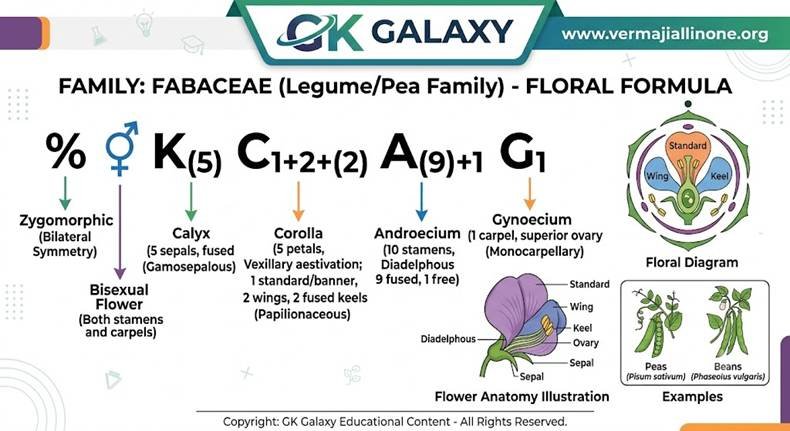
A simplified NCERT-style representation is:
Br ⊕/⚥ K(5) C1+2+(2) A(9)+1 G1
1.13 Economic Importance of Fabaceae
Fabaceae contains many economically important plants.
Food
Pea
Gram
Beans
Soybean
Groundnut
Oil
Groundnut
Soybean
Fodder
Several legumes are used as fodder.
Nitrogen enrichment
Members with root nodules contribute to nitrogen fixation, improving soil fertility.
2. FAMILY SOLANACEAE
Solanaceae is commonly known as the nightshade family.
Important examples
Potato — Solanum tuberosum
Tomato — Solanum lycopersicum
Brinjal — Solanum melongena
Chilli — Capsicum
Tobacco — Nicotiana
Datura — Datura
Petunia — Petunia
2.1 Habit
Members may be:
Herbs
Shrubs
Small trees
2.2 Root
Generally a tap-root system is present.
2.3 Stem
Stem may be:
Herbaceous
Woody
Erect
Branched
2.4 Leaves
Leaves are generally:
Alternate
Simple
Exstipulate
Venation is generally reticulate.
2.5 Inflorescence
Inflorescence may be:
Solitary
Cymose
Sometimes appearing as a cluster depending on the species.
2.6 Flower
Flowers are generally:
Bisexual
Actinomorphic
Complete
Pentamerous
Hypogynous
Important
Solanaceae → Actinomorphic + Bisexual + Pentamerous
A recent NEET/Re-NEET 2026 question tested the characteristic features of Solanaceae, including bisexual actinomorphic flowers, united five-sepal calyx and five epipetalous stamens.
2.7 Calyx
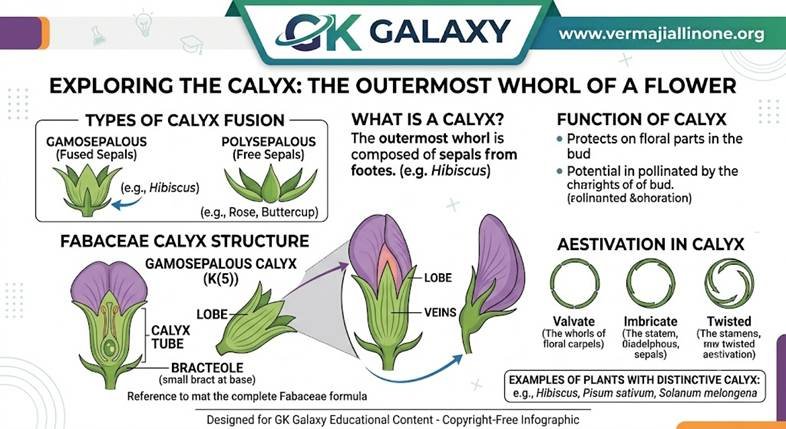
The calyx consists of five united sepals.
Therefore:
K(5)
It is generally persistent.
2.8 Corolla
The corolla consists of five united petals.
This condition is called gamopetalous.
Therefore:
C(5)
The corolla is generally:
Rotate
Funnel-shaped or tubular in different members
2.9 Androecium
There are five stamens.
They are:
Epipetalous
Alternating with petals
Important
Solanaceae → 5 epipetalous stamens
This provides an important contrast with:
Fabaceae → diadelphous
Liliaceae → epiphyllous
2.10 Gynoecium
The gynoecium is:
Bicarpellary
Syncarpous
Ovary superior
Usually bilocular
Axile placentation
Thus:
G(2)
Important examples
Tomato → Axile placentation
Brinjal → Axile placentation
2.11 Fruit
The fruit is generally:
Berry
Capsule
Examples
Tomato → Berry
Potato → Berry
Datura → Capsule
2.12 Seeds
Seeds are generally:
Numerous
Endospermic
2.13 Floral Formula — Solanaceae
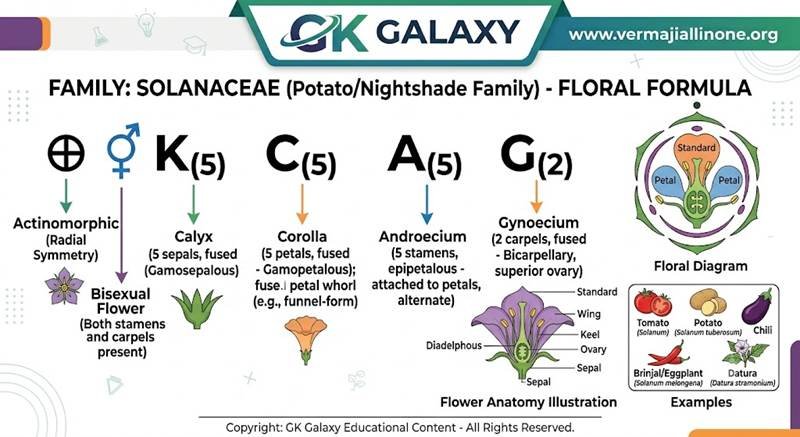
The standard simplified formula is:
Br ⊕ ⚥ K(5) C(5) A5 G(2)
The ovary is superior.
2.14 Economic Importance of Solanaceae
Food crops
Potato
Tomato
Brinjal
Chilli
Medicinal plants
Some members contain important alkaloids and are used medicinally.
Examples include:
Atropa
Datura
Withania
Tobacco
Nicotiana tabacum is an economically important but health-hazardous tobacco plant.
3. FAMILY LILIACEAE
Liliaceae is commonly known as the lily family.
It is an important monocot family.
Important examples
Lily
Tulip
Onion — Allium cepa
Garlic — Allium sativum
Aloe
Asparagus
Gloriosa
3.1 Habit
Members are generally:
Perennial herbs
Often possessing underground storage structures
3.2 Root
The root system is generally fibrous/adventitious.
3.3 Stem
The stem may be:
Reduced
Underground
Modified for storage
Examples
Onion → bulb
Some Liliaceae members → rhizome or other underground structures
3.4 Leaves
Leaves are generally:
Simple
Alternate
Parallel-veined
Often sessile
Exstipulate
Important
Liliaceae → Monocot → Parallel venation
3.5 Inflorescence
Inflorescence may be:
Racemose
Cymose
Umbellate depending on the member.
3.6 Flower
Flowers are generally:
Bisexual
Actinomorphic
Complete
Trimerous
Hypogynous
Important
Liliaceae → Trimerous flowers
This means the floral parts generally occur in multiples of three.
3.7 Perianth
In monocots such as Liliaceae, the perianth is generally not clearly differentiated into calyx and corolla.
It consists of six tepals arranged in two whorls of three each.
Thus:
P3+3
3.8 Androecium
There are generally six stamens.
They are:
Arranged in two whorls
Usually epiphyllous
Epiphyllous means stamens are attached to the perianth/tepals.
Important
Liliaceae → 6 epiphyllous stamens
3.9 Gynoecium
The gynoecium is:
Tricarpellary
Syncarpous
Ovary superior
Trilocular
Axile placentation
Thus:
G(3)
3.10 Fruit
The fruit may be:
Capsule
Berry
3.11 Seeds
Seeds may be endospermic.
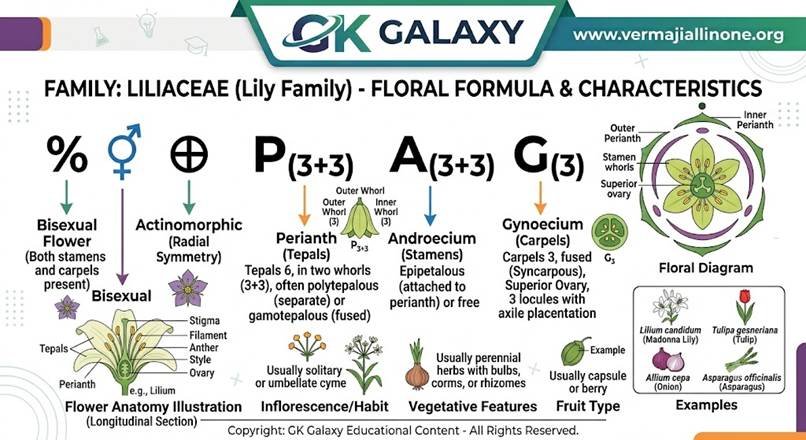
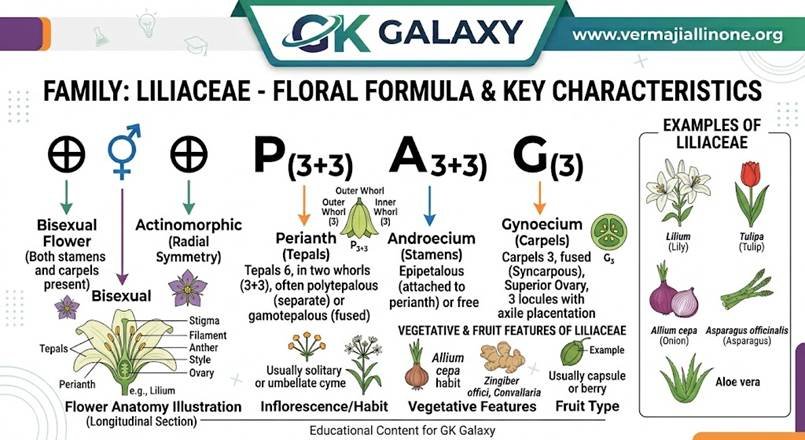
3.12 Floral Formula — Liliaceae
Simplified representation:
Br ⊕ ⚥ P3+3 A3+3 G(3)
The ovary is superior.
3.13 Economic Importance of Liliaceae
Food
Onion
Garlic
Asparagus
Ornamental plants
Lily
Tulip
Gloriosa
Medicinal importance
Several members are used in traditional and modern medicinal preparations.
4. THREE FAMILIES — QUICK COMPARISON
| Character | Fabaceae | Solanaceae | Liliaceae |
| Major group | Dicot | Dicot | Monocot |
| Flower | Zygomorphic | Actinomorphic | Actinomorphic |
| Sexuality | Bisexual | Bisexual | Bisexual |
| Merosity | Usually 5 | 5 | 3 |
| Calyx | 5, united | 5, united | Perianth |
| Corolla/Perianth | Papilionaceous | 5 united petals | 6 tepals |
| Aestivation | Vexillary | Usually twisted | Imbricate/valvate in many members |
| Stamens | 10, usually (9)+1 | 5 | 6 |
| Stamen attachment | Diadelphous | Epipetalous | Epiphyllous |
| Gynoecium | Monocarpellary | Bicarpellary | Tricarpellary |
| Ovary | Superior | Superior | Superior |
| Placentation | Marginal | Axile | Axile |
| Fruit | Legume | Berry/capsule | Capsule/berry |
| Example | Pea | Tomato | Lily |
PART D — NEET PYQs: FAMILIES OF FLOWERING PLANTS
PYQ 6 — Fabaceae
Question:
Family Fabaceae differs from Solanaceae and Liliaceae. With respect to the stamens, which characteristic is specific to Fabaceae but not found in Solanaceae or Liliaceae?
Exam: NEET 2023
A. Epiphyllous and dithecous anthers
B. Diadelphous and dithecous anthers
C. Polyadelphous and epipetalous stamens
D. Monoadelphous and monothecous anthers
Answer:
B. Diadelphous and dithecous anthers
Explanation:
Fabaceae typically possesses 10 stamens arranged as (9)+1, making them diadelphous. The anthers are dithecous.
Solanaceae has epipetalous stamens, whereas Liliaceae has epiphyllous stamens.
Therefore, option B is correct. This exact question is documented as a NEET 2023 question.
PYQ 7 — Solanaceae
Question:
Which of the following are characteristic features of the Solanaceae family?
(a) Flowers are bisexual and actinomorphic
(b) Calyx has five sepals and is united
(c) Androecium has five stamens and is epipetalous
(d) Ovary is inferior
Choose the correct answer.
Exam: Re-NEET 2026
A. (a), (b) and (c) only
B. (d) only
C. (a) and (b) only
D. (b), (c) and (d) only
Answer:
A. (a), (b) and (c) only
Explanation:
Solanaceae generally has:
Bisexual flowers
Actinomorphic flowers
Five united sepals
Five epipetalous stamens
Superior ovary
Therefore, statement (d), “ovary is inferior,” is incorrect.
The question is listed for Re-NEET 2026.
PYQ 8 — Floral Structure
Question:
A flower is defined as a modified shoot in which the shoot apical meristem changes to a floral meristem. Which statement correctly explains this modification?
Exam: NEET 2023
A. Both assertion and reason are true, and the reason correctly explains the assertion.
B. Both are true, but the reason does not explain the assertion.
C. Assertion is true, but reason is false.
D. Assertion is false, but reason is true.
Answer:
A. Both assertion and reason are true, and the reason correctly explains the assertion.
Explanation:
A flower is considered a modified shoot. During floral development:
The shoot apical meristem becomes a floral meristem.
Internodes become condensed.
Floral appendages arise at successive nodes.
Therefore, both statements are correct and the reason explains the assertion. The question is recorded as NEET 2023.
PYQ 9 — Phyllotaxy
Question:
Phyllotaxy is the pattern of arrangement of ________.
Exam: Re-NEET 2026
A. Leaves
B. Flowers
C. Fruits
D. Sepals
Answer:
A. Leaves
Explanation:
Phyllotaxy means the arrangement of leaves on the stem or branches.
The major types are:
Alternate
Opposite
Whorled
The arrangement of flowers is called inflorescence, not phyllotaxy. This question is documented as Re-NEET 2026.
PYQ 10 — Placentation
Question:
Axile placentation is observed in which of the following groups?
Exam: NEET 2023
A. Mustard, Cucumber and Primrose
B. China rose, Beans and Lupin
C. Tomato, Dianthus and Pea
D. China rose, Petunia and Lemon
Answer:
D. China rose, Petunia and Lemon
Explanation:
Axile placentation occurs when the ovules are attached to the central axis of a multilocular ovary.
Important examples include:
Tomato
Lemon
China rose
Petunia
Brinjal
Pea has marginal placentation, while mustard has parietal placentation.
This question is listed as NEET 2023.
Important Consolidated PYQ Note
Some concepts recur across different years in slightly changed formats. For example:
Fabaceae → diadelphous stamens
Solanaceae → epipetalous stamens
Liliaceae → epiphyllous stamens
Pea → marginal placentation
Tomato/Lemon → axile placentation
Mustard → parietal placentation
Marigold → basal placentation
PART E — HIGH-YIELD FLORAL MORPHOLOGY
1. FLORAL SYMMETRY
The arrangement of floral parts around the floral axis determines the symmetry of a flower.
1.1 Actinomorphic Flower
A flower that can be divided into two equal halves by any vertical plane passing through the centre is called actinomorphic or radially symmetrical.
Symbol
⊕
Examples
Mustard
Datura
Chilli
NEET Key Point
Actinomorphic = many possible vertical planes of symmetry.
1.2 Zygomorphic Flower
A flower that can be divided into two equal halves by only one particular vertical plane is called zygomorphic or bilaterally symmetrical.
Examples
Pea
Bean
Gulmohar
NEET Key Point
Zygomorphic = only one vertical plane of symmetry.
1.3 Asymmetric Flower
A flower that cannot be divided into two equal halves by any vertical plane is called asymmetric.
Example
Canna
2. SEXUALITY OF FLOWERS
2.1 Bisexual Flower
A flower containing both:
Androecium
Gynoecium
is called bisexual.
Examples
Mustard
China rose
Pea
Datura
2.2 Unisexual Flower
A flower possessing only one reproductive whorl is called unisexual.
Staminate Flower
Contains only androecium.
Pistillate Flower
Contains only gynoecium.
Examples
Papaya
Maize
3. PLANTS BASED ON SEXUALITY
Monoecious
Male and female flowers occur on the same plant.
Examples
Maize
Castor
Dioecious
Male and female flowers occur on different plants.
Examples
Papaya
Date palm
Important distinction
Monoecious → one plant has both sexes
Dioecious → male and female plants are separate
4. MEROSITY
Merosity refers to the number of floral parts in a whorl.
Dicot flowers
Floral parts commonly occur in multiples of 4 or 5.
Monocot flowers
Floral parts commonly occur in multiples of 3.
Example
Liliaceae → trimerous
5. AESTIVATION
Aestivation is the arrangement of sepals or petals in a floral bud with respect to one another.
The major types important for NEET are:
- Valvate
- Twisted
- Imbricate
- Vexillary
5.1 Valvate Aestivation
The margins of adjacent petals or sepals touch one another without overlapping.
Example
Calotropis
Memory aid
Valvate = Touching, not overlapping
5.2 Twisted Aestivation
One margin of the appendage overlaps the margin of the next one and so on.
Examples
China rose
Cotton
Lady’s finger
Memory aid
Twisted = one overlaps the next in a regular sequence
5.3 Imbricate Aestivation
The margins overlap one another, but the overlapping arrangement is irregular.
Examples
Cassia
Gulmohar
5.4 Vexillary Aestivation
Vexillary aestivation is a special type of imbricate aestivation.
It is characteristic of the papilionaceous corolla of Fabaceae.
The five petals are:
One large posterior standard
Two lateral wings
Two anterior keel petals
Example
Pea
Very Important
Pea → Vexillary aestivation
6. ANDROECIUM
The androecium is the male reproductive whorl of a flower.
Its individual members are called stamens.
A typical stamen consists of:
Filament
Anther
7. FILAMENT
The filament is the stalk that supports the anther.
It may be:
Long
Short
Absent in some flowers
8. ANTHER
A typical anther is generally bilobed.
Each lobe commonly contains two pollen sacs, making a typical anther dithecous.
Thus:
One typical anther → two lobes → four pollen sacs
The pollen grains develop inside the pollen sacs.
9. STAMEN ADHESION
Stamens may be attached to other floral parts or may be united with one another.
9.1 Epipetalous
Stamens are attached to the petals.
Example
Solanaceae
Remember
Solanaceae → 5 epipetalous stamens
9.2 Epiphyllous
Stamens are attached to the tepals/perianth.
Example
Liliaceae
Remember
Liliaceae → 6 epiphyllous stamens
10. STAMEN COHESION
Stamens may be united with one another.
Monadelphous
Filaments are united into one bundle.
Example
China rose
Diadelphous
Filaments are united into two bundles.
Example
Pea
Typically:
9 + 1
Polyadelphous
Filaments are united into more than two bundles.
Example
Citrus
11. GYNOECIUM
The gynoecium is the female reproductive whorl.
Its individual units are called carpels.
A carpel consists of:
- Stigma
- Style
- Ovary
12. STIGMA
The stigma is the terminal portion of the carpel.
Its major function is to:
Receive pollen grains
- Provide a suitable surface for pollen germination
13. STYLE
The style connects:
Stigma ↔ Ovary
The pollen tube generally grows through the style toward the ovary.
14. OVARY
The ovary is the basal portion of the carpel.
It contains:
Ovules
After fertilisation:
Ovary → Fruit
Ovule → Seed
This is one of the most important basic relationships in the chapter.
15. APocarpous GYNOECIUM
When two or more carpels are free from one another, the gynoecium is called apocarpous.
Example
Michelia
16. SYNCARPOUS GYNOECIUM
When two or more carpels are fused, the gynoecium is called syncarpous.
Examples
Tomato
Brinjal
Mustard
17. OVARY POSITION
The position of the ovary relative to other floral parts is an important NEET topic.
17.1 Hypogynous Flower
In a hypogynous flower, the ovary is superior.
Other floral parts arise below the ovary.
Examples
Mustard
China rose
Brinjal
Formula concept
Superior ovary → Hypogynous
17.2 Perigynous Flower
In a perigynous flower, the gynoecium occupies the centre and the other floral parts arise around it at approximately the same level.
The ovary is generally described as half-inferior in the NCERT treatment.
Example
Rose
17.3 Epigynous Flower
In an epigynous flower, the ovary is inferior.
Other floral parts appear to arise above the ovary.
Examples
Guava
Cucumber
Sunflower
Memory aid
Epi = above → floral parts above the ovary
18. PLACENTATION — COMPLETE REVISION
Placentation is the arrangement of ovules within the ovary.
18.1 Marginal Placentation
Ovules develop along the ventral suture of a monocarpellary ovary.
Example
Pea
18.2 Axile Placentation
Ovules develop on the central axis and the ovary is divided into chambers.
Examples
Tomato
Lemon
China rose
Brinjal
18.3 Parietal Placentation
Ovules develop on the inner wall or peripheral region of the ovary.
Examples
Mustard
Argemone
18.4 Free-Central Placentation
Ovules are borne on a central axis but septa are absent.
Example
Dianthus / Primrose
18.5 Basal Placentation
A single ovule or a few ovules are attached near the base of the ovary.
Example
Sunflower / Marigold
19. INFLORESCENCE — DETAILED REVISION
Inflorescence means the arrangement of flowers on the floral axis.
Two major categories:
Racemose
Main axis continues to grow.
Cymose
Main axis terminates in a flower.
20. RACEMOSE INFLORESCENCE
In racemose inflorescence:
Main axis continues to grow.
Flowers arise laterally.
Older flowers occur toward the base.
Younger flowers occur toward the apex.
This arrangement is called:
Acropetal succession
In condensed inflorescences, the arrangement may be described as centripetal.
21. CYMOSE INFLORESCENCE
In cymose inflorescence:
Main axis terminates in a flower.
Growth of the main axis is limited.
Older flowers occur toward the centre/apex.
Younger flowers occur toward the outside/base.
This is called:
Basipetal succession
In condensed inflorescences, the corresponding arrangement is centrifugal.
22. SPECIAL INFLORESCENCE TYPES
Some important special inflorescences include:
Cyathium
Characteristic of Euphorbia.
The inflorescence resembles a single flower but actually consists of highly reduced flowers surrounded by involucre.
Hypanthodium
Characteristic of Ficus.
The receptacle becomes hollow and encloses numerous small flowers.
Verticillaster
Characteristic of Ocimum and some members of Lamiaceae.
23. FRUIT — DETAILED REVISION
Fruit is generally the mature ovary formed after fertilisation.
The fruit wall is called the:
Pericarp
It may be:
Dry
Fleshy
24. TRUE FRUIT
A fruit developing from the ovary alone is called a true fruit.
Examples
Mango
Tomato
Pea
25. FALSE FRUIT
When some floral parts other than the ovary contribute to the fruit, it is called a false/accessory fruit.
Important example
Apple
The edible fleshy part develops largely from the thalamus.
Another important example is strawberry, where the fleshy receptacle contributes substantially to the apparent fruit.
26. PARTHENOCARPIC FRUIT
Fruit development may sometimes occur without fertilisation.
Such fruits are called parthenocarpic fruits.
Example
Banana
Parthenocarpic fruits are generally seedless.
27. SEED — DETAILED REVISION
A seed develops from the ovule after fertilisation.
A typical seed contains:
Seed coat
Embryo
Stored food/endosperm in many species
28. DICOT SEED
A typical dicot embryo has:
Two cotyledons
Plumule
Radicle
Hypocotyl
Epicotyl
Example
Bean
The seed coat consists mainly of:
Testa
Tegmen
The scar where the seed was attached to the fruit wall is called the hilum.
A small pore near the hilum is called the micropyle.
29. MONOCOT SEED
A typical maize grain is a monocot seed.
It has:
One cotyledon
Large endosperm
Embryo
Scutellum
Protective structures
Coleoptile → protects plumule
Coleorhiza → protects radicle
30. ALBUMINOUS AND NON-ALBUMINOUS SEEDS
Albuminous Seeds
Endosperm persists in the mature seed.
Examples
Wheat
Maize
Castor
Non-albuminous Seeds
Endosperm is consumed during embryo development.
Examples
Pea
Groundnut
Bean
31. PERISPERM
Perisperm is the persistent nucellus present in some mature seeds.
Examples
Black pepper
Beet
Important distinction
Endosperm → develops after double fertilisation
Perisperm → persistent nucellus
PART F — ADDITIONAL NEET PYQs
PYQ 11 — Placentation
Question
Which type of placentation is characteristic of pea?
Exam: NEET — Previous Year
A. Axile
B. Marginal
C. Parietal
D. Basal
Answer
B. Marginal
Explanation
Pea has a monocarpellary ovary, and the ovules are arranged along the ventral suture. This is marginal placentation.
Pea → Marginal
This concept has appeared repeatedly in NEET-level papers; occurrences are consolidated here rather than repeating essentially identical questions.
PYQ 12 — Aestivation
Question
Vexillary aestivation is characteristic of:
A. Solanaceae
B. Fabaceae
C. Liliaceae
D. Brassicaceae
Answer
B. Fabaceae
Explanation
In Fabaceae, the corolla is papilionaceous and has vexillary aestivation.
The large standard overlaps the two wings, and the wings overlap the keel petals.
Fabaceae → Papilionaceous corolla → Vexillary aestivation
PYQ 13 — Stem Modification
Question
Which one of the following is a modified stem?
A. Sweet potato
B. Carrot
C. Potato
D. Radish
Answer
C. Potato
Explanation
Potato is a stem tuber.
The “eyes” of potato represent buds, confirming its stem nature.
By contrast:
Sweet potato → modified root
Carrot → modified root
Radish → modified root
PYQ 14 — Root Modification
Question
Which one of the following is a modified adventitious root?
A. Potato
B. Sweet potato
C. Ginger
D. Onion
Answer
B. Sweet potato
Explanation
Sweet potato is a modified adventitious root used for food storage.
Potato and ginger are modified stems, while onion is a bulb consisting primarily of a reduced stem with fleshy scale leaves.
PYQ 15 — Leaf Modification
Question
In pea, the tendrils are modifications of:
A. Roots
B. Stems
C. Leaves
D. Stipules only
Answer
C. Leaves
Explanation
In pea, the leaf or parts of the leaf are modified into tendrils that help the plant climb.
This is an important distinction from:
Cucumber → stem tendril
Pumpkin → stem tendril
Grapevine → stem tendril
PYQ 16 — Stem Modification
Question
In which plant is the stem modified into a flattened, green, photosynthetic structure?
A. Opuntia
B. Pea
C. Mustard
D. Potato
Answer
A. Opuntia
Explanation
In Opuntia, the stem becomes flattened, green and photosynthetic. Such a modified stem is called a phylloclade.
PYQ 17 — Inflorescence
Question
Which type of inflorescence has a main axis that terminates in a flower?
A. Racemose
B. Cymose
C. Spadix
D. Raceme
Answer
B. Cymose
Explanation
In cymose inflorescence, the main axis terminates in a flower. Therefore, its growth is limited.
Cymose → Main axis ends in a flower
PYQ 18 — Root Modification
Question
Pneumatophores are characteristic of plants growing in:
A. Desert conditions
B. Waterlogged, oxygen-deficient soils
C. Alpine regions
D. Dry grasslands
Answer
B. Waterlogged, oxygen-deficient soils
Explanation
Pneumatophores are specialized respiratory roots that project above the soil or water surface and facilitate gaseous exchange.
Example: Rhizophora
PYQ 19 — Seed
Question
The single cotyledon of a maize grain is called:
A. Coleoptile
B. Coleorhiza
C. Scutellum
D. Plumule
Answer
C. Scutellum
Explanation
Maize is a monocot. Its single cotyledon is called the scutellum.
Scutellum → cotyledon
Coleoptile → protects plumule
Coleorhiza → protects radicle
PYQ 20 — Fruit
Question
Which of the following is a false/accessory fruit?
A. Pea
B. Tomato
C. Apple
D. Mango
Answer
C. Apple
Explanation
In apple, the fleshy edible portion develops largely from the thalamus, along with contribution from other floral tissues. Therefore, it is classified as an accessory/false fruit.
RAPID REVISION — MUST REMEMBER
| Topic | Correct association |
| Pea | Marginal placentation |
| Tomato | Axile placentation |
| Mustard | Parietal placentation |
| Marigold | Basal placentation |
| Pea | Vexillary aestivation |
| Calotropis | Valvate aestivation |
| China rose | Twisted aestivation |
| Cassia | Imbricate aestivation |
| Fabaceae | Diadelphous stamens |
| Solanaceae | Epipetalous stamens |
| Liliaceae | Epiphyllous stamens |
| Potato | Stem tuber |
| Sweet potato | Modified root |
| Ginger | Rhizome |
| Onion | Bulb |
| Opuntia | Phylloclade |
| Pea | Leaf tendril |
| Cucumber | Stem tendril |
| Banyan | Prop roots |
| Maize | Stilt roots |
| Rhizophora | Pneumatophores |
| Pea | Zygomorphic flower |
| Mustard | Actinomorphic flower |
| Apple | False/accessory fruit |
| Banana | Parthenocarpic fruit |
| Maize | Scutellum |
| Wheat | Albuminous seed |
| Pea | Non-albuminous seed |
| Black pepper | Perisperm |
PART G — ADDITIONAL NEET PYQs
Root, Stem, Leaf, Inflorescence, Flower, Fruit and Seed
PYQ 21 — Root System
Question
Which type of root system is generally found in monocotyledonous plants?
A. Tap root system
B. Fibrous root system
C. Primary root system
D. Storage tap-root system
Answer:
B. Fibrous root system
Explanation:
In most monocotyledonous plants, the primary root is short-lived. It is replaced by numerous roots arising from the base of the stem, forming a fibrous root system.
Examples: Wheat, rice and grasses.
PYQ 22 — Root Modification
Question
Which of the following is correctly matched?
A. Banyan — Stilt roots
B. Maize — Prop roots
C. Rhizophora — Pneumatophores
D. Carrot — Respiratory roots
Answer:
C. Rhizophora — Pneumatophores
Explanation:
Rhizophora grows in swampy, waterlogged habitats. Its specialized respiratory roots, called pneumatophores, project above the soil and facilitate gaseous exchange.
Other associations:
Banyan → prop roots
Maize → stilt roots
Carrot → storage root
PYQ 23 — Stem
Question
Which of the following is a characteristic feature of a stem?
A. Root cap
B. Root hairs
C. Nodes and internodes
D. Only underground growth
Answer:
C. Nodes and internodes
Explanation:
A typical stem possesses distinct nodes and internodes.
Leaves and branches arise at nodes, while the region between two successive nodes is called an internode.
PYQ 24 — Underground Stem
Question
Which of the following is correctly identified as an underground stem?
A. Sweet potato
B. Carrot
C. Ginger
D. Radish
Answer:
C. Ginger
Explanation:
Ginger is a rhizome, which is a modified underground stem.
It possesses characteristic stem features such as:
Nodes
Internodes
Scale leaves
Buds
Adventitious roots
PYQ 25 — Potato
Question
The “eyes” of potato represent:
A. Lenticels
B. Adventitious roots
C. Buds
D. Leaf scars
Answer:
C. Buds
Explanation:
Potato is a stem tuber. The eyes present on its surface are axillary buds.
This provides strong morphological evidence that potato is a modified stem rather than a root.
PYQ 26 — Stem Modification
Question
Which underground stem modification has a reduced stem surrounded by fleshy scale leaves?
A. Rhizome
B. Bulb
C. Tuber
D. Runner
Answer:
B. Bulb
Explanation:
A bulb consists of a greatly reduced stem surrounded by fleshy scale leaves that store food.
Examples: Onion and garlic.
PYQ 27 — Leaf Base
Question
In grasses, the leaf base commonly becomes:
A. A tendril
B. A sheath surrounding the stem
C. A thorn
D. A storage organ
Answer:
B. A sheath surrounding the stem
Explanation:
In grasses, the leaf base expands into a sheath that surrounds the stem.
This is an important morphological characteristic of grass leaves.
PYQ 28 — Venation
Question
Which type of venation is generally associated with monocotyledonous leaves?
A. Reticulate
B. Parallel
C. Dichotomous only
D. Marginal
Answer:
B. Parallel
Explanation:
Monocot leaves generally exhibit parallel venation, in which the veins run approximately parallel to each other.
Example: Grass, wheat and banana.
PYQ 29 — Compound Leaf
Question
Which statement correctly describes a compound leaf?
A. Its lamina is never divided.
B. Its lamina is divided into distinct leaflets.
C. It always has parallel venation.
D. It lacks a leaf base.
Answer:
B. Its lamina is divided into distinct leaflets.
Explanation:
In a compound leaf, the lamina is divided into two or more distinct leaflets.
Examples include:
Neem
Rose
Silk cotton
An important point is that leaflets are not equivalent to individual leaves because they do not possess axillary buds at their bases.
PYQ 30 — Phyllotaxy
Question
In which type of phyllotaxy are two leaves present at each node and opposite to each other?
A. Alternate
B. Opposite
C. Whorled
D. Spiral
Answer:
B. Opposite
Explanation:
Alternate
One leaf per node.
Opposite
Two leaves per node.
Whorled
More than two leaves per node.
Examples of opposite phyllotaxy: Guava and Calotropis.
PYQ 31 — Whorled Phyllotaxy
Question
Which of the following shows whorled phyllotaxy?
A. China rose
B. Mustard
C. Alstonia
D. Guava
Answer:
C. Alstonia
Explanation:
In whorled phyllotaxy, more than two leaves arise at each node.
Alstonia is a standard NCERT example.
PYQ 32 — Leaf Modification
Question
In pea, the tendrils that help the plant in climbing are modifications of:
A. Roots
B. Leaves
C. Stems
D. Flowers
Answer:
B. Leaves
Explanation:
In pea, the leaves or parts of leaves are modified into tendrils.
This should be distinguished from cucumber and pumpkin, where the tendrils are stem modifications.
PYQ 33 — Inflorescence
Question
The arrangement of flowers on a floral axis is called:
A. Phyllotaxy
B. Placentation
C. Inflorescence
D. Aestivation
Answer:
C. Inflorescence
Explanation:
Phyllotaxy → arrangement of leaves
Inflorescence → arrangement of flowers
Placentation → arrangement of ovules inside ovary
Aestivation → arrangement of sepals/petals in a floral bud
PYQ 34 — Racemose Inflorescence
Question
In racemose inflorescence, the main axis:
A. Terminates in a flower
B. Continues to grow
C. Is always underground
D. Produces only one flower
Answer:
B. Continues to grow
Explanation:
In racemose inflorescence, the main axis continues its growth.
Flowers develop laterally, with older flowers generally toward the base and younger flowers toward the apex.
This is called acropetal succession.
PYQ 35 — Cymose Inflorescence
Question
Which statement is correct for cymose inflorescence?
A. Main axis continues indefinitely.
B. Main axis terminates in a flower.
C. Youngest flower is always at the centre.
D. Flowers are never lateral.
Answer:
B. Main axis terminates in a flower.
Explanation:
In cymose inflorescence, the main axis terminates in a flower, making its growth limited.
The oldest flower is generally towards the apex/centre, while younger flowers occur toward the base/outside.
PYQ 36 — Flower
Question
A flower is considered a modified:
A. Root
B. Leaf
C. Shoot
D. Fruit
Answer:
C. Shoot
Explanation:
A flower is a modified shoot in which the shoot apical meristem changes into a floral meristem.
The internodes become condensed and floral leaves/appendages develop at successive nodes.
PYQ 37 — Calyx
Question
The individual members of the calyx are called:
A. Petals
B. Sepals
C. Tepals
D. Carpels
Answer:
B. Sepals
Explanation:
Calyx → Sepals
Corolla → Petals
The calyx is the outermost floral whorl and usually protects the flower during the bud stage.
PYQ 38 — Corolla
Question
The individual members of the corolla are called:
A. Sepals
B. Stamens
C. Petals
**D. Carpels
Answer:
C. Petals
Explanation:
The corolla consists of petals.
Petals are often brightly coloured and help attract pollinators.
PYQ 39 — Perianth
Question
When the calyx and corolla cannot be distinguished from each other, the floral members are collectively called:
A. Tepals
B. Carpels
C. Sepals
D. Bracts
Answer:
A. Tepals
Explanation:
In many monocots, the outer and inner floral whorls are not clearly differentiated into sepals and petals.
Such members are collectively called tepals.
Liliaceae is an important example.
PYQ 40 — Androecium
Question
The androecium represents the:
A. Female reproductive whorl
B. Male reproductive whorl
C. Protective whorl
D. Non-floral axis
Answer:
B. Male reproductive whorl
Explanation:
The androecium is composed of stamens, the male reproductive structures of a flower.
Each typical stamen consists of:
Filament
Anther
PYQ 41 — Gynoecium
Question
The gynoecium is composed of:
A. Sepals
B. Petals
C. Stamens
**D. Carpels
Answer:
D. Carpels
Explanation:
The gynoecium is the female reproductive whorl and consists of one or more carpels.
A typical carpel has:
Stigma + Style + Ovary
PYQ 42 — Apocarpous Gynoecium
Question
A gynoecium having two or more free carpels is called:
A. Syncarpous
B. Apocarpous
C. Monocarpellary
D. Epigynous
Answer:
B. Apocarpous
Explanation:
Apocarpous → carpels free
Syncarpous → carpels fused
This distinction is frequently used in questions involving gynoecium structure.
PYQ 43 — Syncarpous Gynoecium
Question
Which condition is present when two or more carpels are fused?
A. Apocarpous
B. Syncarpous
C. Polyandrous
D. Monadelphous
Answer:
B. Syncarpous
Explanation:
In a syncarpous gynoecium, two or more carpels are fused.
Examples include tomato and brinjal.
PYQ 44 — Superior Ovary
Question
A flower with a superior ovary and floral parts arising below the ovary is:
A. Epigynous
B. Perigynous
C. Hypogynous
D. Zygomorphic
Answer:
C. Hypogynous
Explanation:
In a hypogynous flower:
Ovary → superior
The other floral parts arise below the ovary.
Examples:
Mustard
China rose
Brinjal
PYQ 45 — Inferior Ovary
Question
Which type of flower has an inferior ovary?
A. Hypogynous
B. Epigynous
C. Actinomorphic
D. Zygomorphic
Answer:
B. Epigynous
Explanation:
In an epigynous flower, the ovary is inferior, while the other floral parts appear to arise above it.
Examples:
Guava
Cucumber
Sunflower
PYQ 46 — Floral Symmetry
Question
A flower that can be divided into two equal halves through only one particular vertical plane is:
A. Actinomorphic
B. Zygomorphic
C. Asymmetric
D. Radial
Answer:
B. Zygomorphic
Explanation:
A zygomorphic flower has bilateral symmetry and can be divided into two equal halves through only one particular vertical plane.
Pea is a classic example.
PYQ 47 — Monoecious Plant
Question
Which of the following is a monoecious plant?
A. Papaya
B. Maize
C. Date palm
D. Cycas
Answer:
B. Maize
Explanation:
In a monoecious plant, male and female flowers occur on the same individual plant.
Maize is monoecious.
Papaya and date palm are classic examples of dioecious plants.
PYQ 48 — Dioecious Plant
Question
Which of the following is dioecious?
A. Maize
B. Castor
C. Papaya
D. Cucumber
Answer:
C. Papaya
Explanation:
In a dioecious plant, male and female flowers occur on different individual plants.
Papaya is a standard example.
PYQ 49 — Fruit
Question
After fertilisation, the ovary generally develops into:
A. Seed
B. Fruit
C. Embryo
D. Endosperm
Answer:
B. Fruit
Explanation:
The basic post-fertilisation relationship is:
Ovary → Fruit
Ovule → Seed
This is a fundamental morphology concept.
PYQ 50 — Ovule
Question
After fertilisation, the ovule develops into:
A. Fruit
B. Seed
C. Pericarp
D. Stigma
Answer:
B. Seed
Explanation:
Following fertilisation, the ovule develops into a seed, while the ovary develops into a fruit.
HIGH-YIELD ONE-LINERS — PART G
| Root cap protects the root apex. |
| Root hairs occur in the region of maturation. |
| Tap root develops from the radicle. |
| Fibrous roots are characteristic of most monocots. |
| Banyan → prop roots. |
| Maize → stilt roots. |
| Rhizophora → pneumatophores. |
| Ginger → rhizome. |
| Potato → stem tuber. |
| Onion → bulb. |
| Nodes and internodes are characteristic of stems. |
| Pea → leaf tendril. |
| Cucumber → stem tendril. |
| Opuntia → phylloclade. |
| Phyllotaxy refers to arrangement of leaves. |
| Alstonia → whorled phyllotaxy. |
| Guava → opposite phyllotaxy. |
| China rose → alternate phyllotaxy. |
| Racemose → main axis continues growing. |
| Cymose → main axis terminates in a flower. |
| Calyx → sepals. |
| Corolla → petals. |
| Androecium → stamens. |
| Gynoecium → carpels. |
| Apocarpous → free carpels. |
| Syncarpous → fused carpels. |
| Hypogynous → superior ovary. |
| Epigynous → inferior ovary. |
| Pea → zygomorphic. |
| Mustard → actinomorphic. |
| Maize → monoecious. |
| Papaya → dioecious. |
| Ovary → fruit. |
| Ovule → seed. |
Q51. Pentamerous, actinomorphic flowers, bicarpellate ovary with oblique septa and fruit either a capsule or berry are characteristic features of:
Exam: AIPMT 2006
A. Brassicaceae
B. Solanaceae
C. Liliaceae
D. Asteraceae
Answer: B. Solanaceae
Explanation:
Solanaceae generally has pentamerous and actinomorphic flowers. The ovary is bicarpellary and syncarpous, with a superior ovary and axile placentation. The fruit may be a berry or capsule.
Q52. An aggregate fruit develops from:
Exam: NEET 2014
A. Multicarpellary syncarpous gynoecium
B. Multicarpellary apocarpous gynoecium
C. Complete inflorescence
D. Multicarpellary superior ovary
Answer: B. Multicarpellary apocarpous gynoecium
Explanation:
An aggregate fruit develops from a single flower having several free carpels. Since the carpels are free, the gynoecium is apocarpous. Examples include strawberry and custard apple.
Q53. Coconut water from a tender coconut represents:
Exam: NEET 2015 Re-Examination
A. Free-nuclear endosperm
B. Innermost layer of the seed coat
C. Degenerated nucellus
D. Immature embryo
Answer: A. Free-nuclear endosperm
Explanation:
In a tender coconut, the liquid coconut water represents free-nuclear endosperm. As the seed matures, the endosperm becomes increasingly cellular and solid, forming the edible coconut kernel.
Q54. Which one of the following is a true fruit?
Exam: AIPMT 1996
A. Apple
B. Pear
C. Cashew nut
D. Coconut
Answer: D. Coconut
Explanation:
A true fruit develops exclusively from the ovary after fertilisation. Coconut is a true fruit. Apple, pear and cashew involve additional floral parts in fruit formation and are therefore classified as false/accessory fruits.
Q55. Aril represents the edible part of:
Exam: AIPMT 1997; AIPMT 1999; AIPMT 2005; AIPMT 2006
A. Banana
B. Litchi
C. Mango
D. Apple
Answer: B. Litchi
Explanation:
The fleshy edible covering of litchi seed is called an aril. It develops from tissue associated with the funicular region of the seed and forms the edible portion. The same question/concept has been reported in multiple AIPMT years, so the occurrences are consolidated here rather than repeated.
Q56. Which part of coconut produces coir?
Exam: AIPMT 1996
A. Seed coat
B. Mesocarp
C. Epicarp
D. Pericarp
Answer: B. Mesocarp
Explanation:
Coir is obtained from the fibrous mesocarp of the coconut fruit. The coconut mesocarp contains tough fibres that are commercially used to make ropes, mats and other products.
Q57. Which of the following is NOT a correct floral character of family Fabaceae?
Exam: NEET/AIPMT PYQ
A. Calyx — five sepals, gamosepalous
B. Corolla — five petals with vexillary aestivation
C. Androecium — ten stamens, diadelphous
D. Gynoecium — inferior, bicarpellary, unilocular ovary
Answer: D. Gynoecium — inferior, bicarpellary, unilocular ovary
Explanation:
Fabaceae generally has a monocarpellary, superior ovary with marginal placentation. The androecium usually contains ten stamens arranged as 9+1 (diadelphous). The corolla is papilionaceous with vexillary aestivation. Therefore, option D is incorrect.
Q58. Which flower formula represents the family Solanaceae?
Exam: NEET 2015
A. Allium
B. Sesbania
C. Petunia
D. Brassica
Answer: C. Petunia
Explanation:
Petunia belongs to Solanaceae. Its floral characteristics include a bisexual, actinomorphic, pentamerous flower; gamosepalous calyx; gamopetalous corolla; five epipetalous stamens; and a bicarpellary, syncarpous, superior ovary with axile placentation.
Q59. Which family is characterised by pentamerous, actinomorphic flowers and a bicarpellary ovary with axile placentation?
Exam: NEET 2015
A. Fabaceae
B. Solanaceae
C. Liliaceae
D. Poaceae
Answer: B. Solanaceae
Explanation:
Solanaceae is typically pentamerous and actinomorphic. Its gynoecium is bicarpellary and syncarpous, with a superior, usually bilocular ovary and axile placentation.
Q60. Which one of the following combinations correctly represents the three major families discussed in Morphology of Flowering Plants?
Exam: NEET 2015
A. Fabaceae — marginal placentation; Solanaceae — axile placentation; Liliaceae — axile placentation
B. Fabaceae — basal placentation; Solanaceae — marginal placentation; Liliaceae — free-central placentation
C. Fabaceae — axile placentation; Solanaceae — basal placentation; Liliaceae — marginal placentation
D. Fabaceae — free-central placentation; Solanaceae — basal placentation; Liliaceae — marginal placentation
Answer: A. Fabaceae — marginal placentation; Solanaceae — axile placentation; Liliaceae — axile placentation
Explanation:
The characteristic placentation patterns are:
Fabaceae: Marginal
Solanaceae: Axile
Liliaceae: Axile
These are important family-identification characters and should be memorised together.
QUICK REVISION — QUESTIONS 51–60
| Question | Main Concept | Answer |
| 51 | Solanaceae characters | Solanaceae |
| 52 | Aggregate fruit | Multicarpellary apocarpous gynoecium |
| 53 | Coconut water | Free-nuclear endosperm |
| 54 | True fruit | Coconut |
| 55 | Aril | Litchi |
| 56 | Coconut coir | Mesocarp |
| 57 | Fabaceae incorrect character | Inferior bicarpellary ovary |
| 58 | Solanaceae floral formula identification | Petunia |
| 59 | Solanaceae placentation | Axile |
| 60 | Family-wise placentation | Fabaceae–marginal; Solanaceae–axile; Liliaceae–axile |
Q61. How many plants in the following list have marginal placentation?
Mustard, Gram, Tulip, Asparagus, Arhar, Sun hemp, Chilli, Colchicum, Onion, Moong, Pea, Tobacco, Lupin
Exam: NEET/AIPMT
A. Four
B. Five
C. Six
D. Three
Answer: C. Six
Explanation:
Marginal placentation is characteristic of the Fabaceae members in the list:
Gram
Arhar
Sun hemp
Moong
Pea
Lupin
Q62. Which of the following correctly represents the relationship between free-central and axile placentation?
Exam: NEET/AIPMT
A. Both have septa dividing the ovary into chambers
B. Free-central placentation has a central axis without septa, whereas axile placentation has septa forming locules
C. Axile placentation occurs only in monocots
D. Free-central placentation is characteristic of Fabaceae
Answer: B. Free-central placentation has a central axis without septa, whereas axile placentation has septa forming locules
Explanation:
In free-central placentation, ovules are borne on the central axis but septa are absent. Examples include Dianthus and Primrose. In axile placentation, the placenta is located on the central axis and septa divide the ovary into chambers, as in tomato and lemon.
Q63. The placenta is attached to the developing seed near the:
Exam: NEET/AIPMT
A. Testa
B. Hilum
C. Micropyle
D. Chalaza
Answer: B. Hilum
Explanation:
The hilum is the scar on the seed marking the point where the seed was attached to the funiculus. The placenta is connected with the developing seed through this region.
Q64. Which one of the following pairs is correctly matched?
Exam: NEET/AIPMT
A. Pea — axile placentation
B. Tomato — marginal placentation
C. Dianthus — free-central placentation
D. Sunflower — parietal placentation
Answer: C. Dianthus — free-central placentation
Explanation:
| Plant | Placentation |
| Pea | Marginal |
| Tomato | Axile |
| Dianthus | Free-central |
| Sunflower | Basal |
Therefore, Dianthus — free-central is the correctly matched pair.
Q65. Which of the following correctly identifies the family of a plant having six tepals arranged in two whorls, six epitepalous stamens and a tricarpellary syncarpous ovary?
Exam: NEET/AIPMT
A. Fabaceae
B. Solanaceae
C. Liliaceae
D. Brassicaceae
Answer: C. Liliaceae
Explanation:
Liliaceae is a characteristic monocot family. Its flowers generally have:
Perianth: 6 tepals in two whorls
Androecium: 6 stamens
Stamens: epitepalous
Gynoecium: tricarpellary and syncarpous
Ovary: superior
Placentation: axile
Q66. Which family has a papilionaceous corolla and vexillary aestivation?
Exam: NEET/AIPMT
A. Solanaceae
B. Fabaceae
C. Liliaceae
D. Asteraceae
Answer: B. Fabaceae
Explanation:
The corolla of Fabaceae is papilionaceous. It consists of:
One large standard or vexillum
Two lateral wings
Two anterior keel petals
The arrangement is called vexillary or descending imbricate aestivation.
Q67. Which of the following combinations is correct for Liliaceae?
Exam: NEET/AIPMT
A. Pentamerous flowers, five epipetalous stamens
B. Trimerous flowers, six epitepalous stamens
C. Tetramerous flowers, four stamens
D. Zygomorphic flowers, ten diadelphous stamens
Answer: B. Trimerous flowers, six epitepalous stamens
Explanation:
Liliaceae is a monocot family and therefore typically shows trimerous floral organisation. Its perianth has six tepals and its six stamens are arranged in two whorls and are epitepalous.
Q68. Which of the following is correctly matched with its type of tendril?
Exam: NEET/AIPMT
A. Pea — stem tendril
B. Cucumber — leaf tendril
C. Pea — leaf tendril
D. Pumpkin — leaf tendril
Answer: C. Pea — leaf tendril
Explanation:
Different plants possess tendrils of different origins:
Pea: leaf modification
Cucumber: stem modification
Pumpkin: stem modification
Grapevine: stem modification
The NCERT Exemplar specifically distinguishes pea from cucumber and pumpkin on this basis.
Q69. In which type of placentation does the placenta form a ridge along the ventral suture of the ovary?
Exam: NEET/AIPMT
A. Axile
B. Marginal
C. Basal
D. Free-central
Answer: B. Marginal
Explanation:
In marginal placentation, the placenta forms a ridge along the ventral suture of a monocarpellary ovary. The ovules are arranged in two rows along this ridge. Pea is the standard NCERT example.
Q70. Which one of the following statements about Liliaceae is correct?
Exam: NEET/AIPMT
A. Ovary is inferior and unilocular
B. Ovary is superior, tricarpellary and syncarpous
C. Stamens are epipetalous and only five in number
D. Flowers are generally zygomorphic and pentamerous
Answer: B. Ovary is superior, tricarpellary and syncarpous
Explanation:
According to the NCERT description of Liliaceae:
Flowers are bisexual and actinomorphic.
Perianth consists of six tepals.
There are six stamens.
Gynoecium is tricarpellary and syncarpous.
Ovary is superior and trilocular.
Placentation is axile.
QUICK REVISION — Q61–Q70
| Q. | Concept | Correct Answer |
| 61 | Marginal placentation | Six plants |
| 62 | Free-central vs axile | Central axis without septa vs septate |
| 63 | Seed attachment region | Hilum |
| 64 | Correct placentation pair | Dianthus — free-central |
| 65 | Six tepals + six epitepalous stamens | Liliaceae |
| 66 | Papilionaceous corolla | Fabaceae |
| 67 | Liliaceae floral organisation | Trimerous, 6 epitepalous stamens |
| 68 | Leaf tendril | Pea |
| 69 | Ventral-suture ridge | Marginal placentation |
| 70 | Liliaceae ovary | Superior, tricarpellary, syncarpous |
HIGH-YIELD FAMILY COMPARISON
| Character | Fabaceae | Solanaceae | Liliaceae |
| Floral symmetry | Zygomorphic | Actinomorphic | Actinomorphic |
| Merosity | Pentamerous | Pentamerous | Trimerous |
| Corolla/Perianth | Papilionaceous | 5 united petals | 6 tepals |
| Stamens | 10, usually 9+1 | 5, epipetalous | 6, epitepalous |
| Gynoecium | Monocarpellary | Bicarpellary | Tricarpellary |
| Ovary | Superior | Superior | Superior |
| Placentation | Marginal | Axile | Axile |
| Typical fruit | Legume | Berry/Capsule | Capsule/Berry |
Q71. Sweet potato is a modified:
Exam: AIPMT 2009
A. Tap root
B. Fibrous root
C. Stem
D. Leaf
Answer: A. Tap root
Explanation:
Sweet potato (Ipomoea batatas) is a modified adventitious/tuberous root used for food storage. It should not be confused with potato, which is a modified stem.
Q72. Pneumatophores are found in:
Exam: NEET 2018
A. Mangrove plants
B. Desert plants
C. Aquatic plants
D. Epiphytes
Answer: A. Mangrove plants
Explanation:
Pneumatophores are specialized respiratory roots found in plants growing in waterlogged and oxygen-deficient soils. They grow upward and facilitate gaseous exchange. Mangrove plants such as Rhizophora possess specialized respiratory roots.
Q73. Velamen tissue is found in:
Exam: NEET 2021
A. Roots of orchids
B. Stem of cactus
C. Leaves of pine
D. Roots of mangroves
Answer: A. Roots of orchids
Explanation:
Velamen is a multilayered tissue present in the aerial roots of many epiphytic orchids. It helps absorb and retain atmospheric moisture.
Q74. Potato is a modified:
Exam: AIPMT 2010
A. Root
B. Stem
C. Leaf
D. Tendril
Answer: B. Stem
Explanation:
Potato is an underground stem tuber. Its characteristic eyes are nodes bearing buds, which can develop into new shoots. The presence of nodes and buds confirms its stem nature.
Q75. Which of the following is NOT a stem modification?
Exam: NEET 2017
A. Tuber of potato
B. Bulb of onion
C. Rhizome of ginger
D. Tap root of carrot
Answer: D. Tap root of carrot
Explanation:
Potato tuber, onion bulb and ginger rhizome are stem modifications. Carrot is a modified tap root, specifically a conical storage root. Therefore, option D is correct.
Q76. Phylloclades are found in:
Exam: NEET 2020
A. Opuntia
B. Asparagus
C. Euphorbia
D. Casuarina
Answer: A. Opuntia
Explanation:
In Opuntia, the stem is modified into a flattened, green phylloclade and performs photosynthesis. The leaves are reduced to spines, thereby reducing water loss.
Q77. In Opuntia, the spine is a modified:
Exam: AIPMT 2011
A. Leaf
B. Stem
C. Root
D. Tendril
Answer: A. Leaf
Explanation:
The leaves of Opuntia are highly reduced and modified into spines. The green stem performs photosynthesis. This is an important distinction:
Opuntia → stem = phylloclade; leaf = spine.
Q78. Which one of the following is a characteristic of dicotyledonous leaves?
Exam: NEET 2019
A. Parallel venation
B. Isobilateral orientation
C. Reticulate venation
D. Presence of bulliform cells
Answer: C. Reticulate venation
Explanation:
Typical dicot leaves generally show reticulate venation and a dorsiventral organisation. Monocot leaves generally show parallel venation and are commonly isobilateral.
Q79. In a typical dicot leaf, the presence of palisade parenchyma and spongy parenchyma indicates:
Exam: NEET 2022
A. Dorsiventral leaf
B. Isobilateral leaf
C. Centric leaf
D. Needle leaf
Answer: A. Dorsiventral leaf
Explanation:
A typical dorsiventral dicot leaf has:
Palisade parenchyma toward the upper surface
Spongy parenchyma toward the lower surface
Distinct upper and lower surfaces
Therefore, the described organisation is characteristic of a dorsiventral leaf.
Q80. Which of the following has racemose inflorescence?
Exam: AIPMT 2012
A. China rose
B. Jasmine
C. Calotropis
D. Mustard
Answer: D. Mustard
Explanation:
Mustard (Brassica) has a racemose inflorescence. In racemose inflorescence, the main axis continues to grow and flowers generally show acropetal succession—older flowers occur toward the base and younger flowers toward the apex.
QUICK REVISION — Q71–Q80
| Q. | Topic | Answer |
| 71 | Sweet potato | Modified tap root |
| 72 | Pneumatophores | Mangrove plants |
| 73 | Velamen | Orchid roots |
| 74 | Potato | Modified stem |
| 75 | Non-stem modification | Carrot tap root |
| 76 | Phylloclade | Opuntia |
| 77 | Opuntia spine | Modified leaf |
| 78 | Dicot leaf | Reticulate venation |
| 79 | Palisade + spongy tissue | Dorsiventral leaf |
| 80 | Racemose inflorescence | Mustard |
IMPORTANT MEMORY POINTS
Root:
Sweet potato → modified root
Stem:
Potato → tuber
Ginger → rhizome
Onion → bulb
Opuntia → phylloclade
Leaf:
Opuntia → spine
Pea → tendril
Dicot → usually reticulate venation
Inflorescence:
Mustard → racemose
Racemose → acropetal succession
Cymose → basipetal succession
Q81. Which one of the following is a false fruit?
Exam: NEET 2018
A. Tomato
B. Mango
C. Apple
D. Pea
Answer: C. Apple
Explanation:
Apple is a false/accessory fruit because the edible fleshy portion develops mainly from the thalamus/receptacle, in addition to the ovary. A true fruit develops from the ovary alone.
Q82. The edible part of coconut is:
Exam: AIPMT 2012
A. Pericarp
B. Endosperm
C. Seed coat
D. Embryo
Answer: B. Endosperm
Explanation:
The edible portion of coconut consists of endosperm. In a young coconut, the endosperm is largely liquid and is called coconut water; later, part of it becomes the solid white kernel.
Q83. Which one of the following is a characteristic feature of a monocot seed?
Exam: NEET 2020
A. Two cotyledons
B. One cotyledon called scutellum
C. Absence of endosperm
D. Two embryonal axes
Answer: B. One cotyledon called scutellum
Explanation:
A typical monocot seed such as maize has a single cotyledon called the scutellum. The embryo is situated laterally in the seed and the endosperm forms the major food-storage tissue.
Q84. In maize grain, the sheath covering the plumule is called:
Exam: NEET 2016
A. Coleorhiza
B. Coleoptile
C. Scutellum
D. Tegmen
Answer: B. Coleoptile
Explanation:
In a monocot embryo:
Coleoptile protects the plumule.
Coleorhiza protects the radicle.
Scutellum is the single cotyledon.
The endosperm stores food.
Thus, the sheath surrounding the plumule is the coleoptile.
Q85. Which one of the following represents a non-albuminous seed?
Exam: AIPMT 2011
A. Castor
B. Maize
C. Wheat
D. Pea
Answer: D. Pea
Explanation:
In non-albuminous seeds, the endosperm is consumed during embryo development. Examples include pea, groundnut and bean.
In contrast, castor, maize and wheat retain endosperm in the mature seed and are albuminous/endospermic seeds.
Q86. Which of the following is an example of a seed with persistent endosperm?
Exam: NEET 2019
A. Pea
B. Groundnut
C. Castor
D. Bean
Answer: C. Castor
Explanation:
Castor is an albuminous/endospermic seed because considerable endosperm remains in the mature seed.
Pea, groundnut and bean are generally non-albuminous because the endosperm is consumed during seed development.
Q87. Perisperm is the persistent:
Exam: NEET 2017
A. Endosperm
B. Nucellus
C. Integument
D. Embryo
Answer: B. Nucellus
Explanation:
Perisperm is the persistent remnant of the nucellus in a mature seed. Examples include black pepper and beet.
Do not confuse it with endosperm: endosperm develops following fertilisation, whereas perisperm represents persistent maternal nucellar tissue.
Q88. Which one of the following combinations is correctly matched?
Exam: AIPMT 2010
A. Maize — two cotyledons
B. Pea — one cotyledon
C. Maize — scutellum
D. Castor — scutellum
Answer: C. Maize — scutellum
Explanation:
Maize is a monocot and has a single cotyledon called the scutellum. Pea and castor are dicot seeds and possess two cotyledons.
Q89. Which of the following correctly describes the fruit of Fabaceae?
Exam: NEET 2021
A. Berry
B. Capsule
C. Legume
D. Caryopsis
Answer: C. Legume
Explanation:
The characteristic fruit of Fabaceae is a legume or pod. It generally develops from a monocarpellary ovary and typically opens along two sutures when mature.
Q90. Which one of the following is correctly matched with its fruit type?
Exam: NEET 2022
A. Solanaceae — legume
B. Fabaceae — legume
C. Liliaceae — caryopsis
D. Fabaceae — berry
Answer: B. Fabaceae — legume
Explanation:
Important family–fruit associations are:
Fabaceae → Legume
Solanaceae → Berry or capsule
Liliaceae → Capsule or berry
Therefore, Fabaceae — legume is the correct combination.
QUICK REVISION — Q81–Q90
| Q. | Topic | Correct Answer |
| 81 | False/accessory fruit | Apple |
| 82 | Edible coconut portion | Endosperm |
| 83 | Monocot seed | Scutellum |
| 84 | Plumule protective sheath | Coleoptile |
| 85 | Non-albuminous seed | Pea |
| 86 | Persistent endosperm | Castor |
| 87 | Perisperm | Persistent nucellus |
| 88 | Maize | Scutellum |
| 89 | Fabaceae fruit | Legume |
| 90 | Family–fruit association | Fabaceae — legume |
HIGH-YIELD SEED REVISION
Dicot seed
Two cotyledons
Plumule
Radicle
Embryonal axis
Testa and tegmen
Hilum
Micropyle
Monocot seed — Maize
One cotyledon → Scutellum
Plumule → protected by coleoptile
Radicle → protected by coleorhiza
Large endosperm
Embryo positioned laterally
Seed reserve terms
Albuminous/endospermic → endosperm retained
Non-albuminous/non-endospermic → endosperm consumed
Perisperm → persistent nucellus
HIGH-YIELD FRUIT REVISION
True fruit → develops from ovary
False/accessory fruit → other floral parts also contribute
Simple fruit → one ovary of one flower
Aggregate fruit → several free carpels of one flower
Multiple fruit → develops from an entire inflorescence
Parthenocarpic fruit → develops without fertilisation; banana is a common example
Family-wise fruit
| Family | Typical fruit |
| Fabaceae | Legume |
| Solanaceae | Berry/Capsule |
| Liliaceae | Capsule/Berry |
Q91. Sweet potato is a modified:
Exam: AIPMT 2009
A. Tap root
B. Fibrous root
C. Stem
D. Leaf
Answer: A. Tap root
Explanation:
Sweet potato is a tuberous modified root used for food storage. It should be distinguished from potato, which is a modified stem tuber.
Q92. Pneumatophores are found in:
Exam: NEET 2018
A. Mangrove plants
B. Desert plants
C. Aquatic plants
D. Epiphytes
Answer: A. Mangrove plants
Explanation:
Pneumatophores are specialized respiratory roots that project above the soil surface in waterlogged habitats. They facilitate gaseous exchange where oxygen availability in the soil is low.
Q93. Velamen tissue is found in:
Exam: NEET 2021
A. Roots of orchids
B. Stem of cactus
C. Leaves of pine
D. Roots of mangroves
Answer: A. Roots of orchids
Explanation:
Velamen is a multilayered tissue associated with the aerial roots of many epiphytic orchids. It assists in absorbing and retaining atmospheric moisture.
Q94. Potato is a modified:
Exam: AIPMT 2010
A. Root
B. Stem
C. Leaf
D. Tendril
Answer: B. Stem
Explanation:
Potato is a stem tuber. The presence of eyes, which are nodes bearing buds, is an important indication of its stem nature.
Q95. Which of the following is NOT a stem modification?
Exam: NEET 2017
A. Tuber of potato
B. Bulb of onion
C. Rhizome of ginger
D. Tap root of carrot
Answer: D. Tap root of carrot
Explanation:
Potato, onion and ginger represent stem modifications:
Potato → tuber
Onion → bulb
Ginger → rhizome
Carrot is a modified tap root, not a stem modification.
Q96. Phylloclades are found in:
Exam: NEET 2020
A. Opuntia
B. Asparagus
C. Euphorbia
D. Casuarina
Answer: A. Opuntia
Explanation:
In Opuntia, the green flattened stem performs photosynthesis and functions as a phylloclade. The leaves are highly reduced and modified into spines.
Q97. In Opuntia, the spine is a modified:
Exam: AIPMT 2011
A. Leaf
B. Stem
C. Root
D. Tendril
Answer: A. Leaf
Explanation:
The leaves of Opuntia are reduced to spines. The green stem carries out photosynthesis.
Remember:
Opuntia → stem = photosynthetic; leaf = spine.
Q98. Which one of the following is a characteristic of dicotyledonous leaves?
Exam: NEET 2019
A. Parallel venation
B. Isobilateral orientation
C. Reticulate venation
D. Presence of bulliform cells
Answer: C. Reticulate venation
Explanation:
Typical dicot leaves generally possess reticulate venation and a dorsiventral organisation. Parallel venation is characteristic of most monocot leaves.
Q99. Which one of the following has racemose inflorescence?
Exam: AIPMT 2012
A. China rose
B. Jasmine
C. Calotropis
D. Mustard
Answer: D. Mustard
Explanation:
Mustard has a racemose inflorescence. In racemose inflorescence, the main axis continues to grow and flowers generally show acropetal succession—older flowers are toward the base and younger flowers toward the apex.
Q100. Which one of the following is a correct description of the floral formula of Fabaceae?
Exam: AIPMT 2014
A. Actinomorphic flower with five epipetalous stamens
B. Zygomorphic flower with ten stamens, usually arranged as 9+1
C. Trimerous flower with six epitepalous stamens
D. Actinomorphic flower with five united stamens
Answer: B. Zygomorphic flower with ten stamens, usually arranged as 9+1
Explanation:
Fabaceae typically possesses:
Zygomorphic flower
Bisexual flower
Five sepals
Papilionaceous corolla
Ten stamens, generally diadelphous (9+1)
Monocarpellary superior ovary
Marginal placentation
The characteristic 9+1 stamen arrangement is an important identifying feature of Fabaceae.
QUICK REVISION — Q91–Q100
| Q. | Exam | Main Concept | Answer |
| 91 | AIPMT 2009 | Sweet potato | Modified tap root |
| 92 | NEET 2018 | Pneumatophores | Mangrove plants |
| 93 | NEET 2021 | Velamen | Orchid roots |
| 94 | AIPMT 2010 | Potato | Modified stem |
| 95 | NEET 2017 | Non-stem modification | Carrot |
| 96 | NEET 2020 | Phylloclade | Opuntia |
| 97 | AIPMT 2011 | Opuntia spine | Leaf |
| 98 | NEET 2019 | Dicot venation | Reticulate |
| 99 | AIPMT 2012 | Racemose inflorescence | Mustard |
| 100 | AIPMT 2014 | Fabaceae | Zygomorphic, 9+1 stamens |
Q101. Identify the type of flowers represented by the given two floral diagrams according to the position of calyx, corolla and androecium relative to the ovary.
Exam: NEET 2024
A. (a) Hypogynous; (b) Epigynous
B. (a) Perigynous; (b) Epigynous
C. (a) Perigynous; (b) Hypogynous
D. (a) Epigynous; (b) Perigynous
Answer: A. (a) Hypogynous; (b) Epigynous
Explanation:
In a hypogynous flower, the gynoecium occupies the highest position, while the other floral whorls arise below it; therefore, the ovary is superior.
In an epigynous flower, the other floral parts appear above the ovary because the ovary is inferior.
Q102. In a seed diagram, which labelled structure develops into the root during germination?
Exam: NEET 2024
A. A
B. B
C. C
D. D
Answer: The label corresponding to the radicle
Explanation:
The radicle is the embryonic structure that develops into the primary root during seed germination.
The plumule develops into the shoot system.
Because the original NEET 2024 question was diagram-based, the exact A/B/C/D answer depends on the labels in the original figure. The source confirms that the question asks for the part destined to form the root.
Q103. Which of the following is an example of an actinomorphic flower?
Exam: NEET 2024
A. Cassia
B. Pisum
C. Sesbania
D. Datura
Answer: D. Datura
Explanation:
An actinomorphic flower can be divided into two equal halves by any vertical plane passing through the centre.
Examples include:
Mustard
Datura
Chilli
Pisum (pea), Cassia and Sesbania have zygomorphic flowers.
Therefore, Datura is the correct answer.
Q104. Match the following plants with their corresponding morphological characters.
Exam: NEET 2024
List I
A. Rose
B. Pea
C. Cotton
D. Mango
List II
I. Twisted aestivation
II. Perigynous flower
III. Drupe
IV. Marginal placentation
Choose the correct combination:
A. A-II, B-IV, C-I, D-III
B. A-I, B-II, C-III, D-IV
C. A-IV, B-III, C-II, D-I
D. A-II, B-III, C-IV, D-I
Answer: A. A-II, B-IV, C-I, D-III
Explanation:
Rose → Perigynous flower
Pea → Marginal placentation
Cotton → Twisted aestivation
Mango → Drupe
Therefore:
A-II, B-IV, C-I, D-III
is the correct matching.
Q105. Match the type of stamen with its appropriate example.
Exam: NEET 2024
List I — Type of stamens
A. Monadelphous
B. Diadelphous
C. Polyadelphous
D. Epiphyllous
List II — Example
I. Citrus
II. Pea
III. Lily
IV. China rose
Choose the correct combination:
A. A-IV, B-II, C-I, D-III
B. A-IV, B-I, C-II, D-III
C. A-I, B-II, C-IV, D-III
D. A-III, B-I, C-IV, D-II
Answer: A. A-IV, B-II, C-I, D-III
Explanation:
Monadelphous → China rose
Diadelphous → Pea
Polyadelphous → Citrus
Epiphyllous → Lily
Thus:
A-IV, B-II, C-I, D-III
is correct.
Q106. Which of the following statements correctly describes marginal placentation?
Exam: NEET 2024
A. Ovules are attached to the central axis of a multilocular ovary
B. Ovules develop along the ventral suture of a monocarpellary ovary
C. A single ovule is attached at the base of the ovary
D. Ovules occur on the inner wall of a unilocular ovary
Answer: B. Ovules develop along the ventral suture of a monocarpellary ovary
Explanation:
In marginal placentation, the placenta forms a ridge along the ventral suture of a monocarpellary ovary. The ovules are arranged along this ridge in two rows.
Pea is the standard NCERT example.
This concept is also directly tested in the NEET 2024 matching question where Pea → marginal placentation.
QUICK REVISION — Q101–Q106
| Q. | Exam | Main Concept | Answer |
| 101 | NEET 2024 | Ovary position | Diagram-dependent |
| 102 | NEET 2024 | Seed embryo | Radicle |
| 103 | NEET 2024 | Actinomorphic flower | Datura |
| 104 | NEET 2024 | Placentation/aestivation/fruit | A |
| 105 | NEET 2024 | Stamen types | A |
| 106 | NEET 2024 | Marginal placentation | Ventral suture |
NEET 2024 HIGH-YIELD REVISION
Floral position
Hypogynous
→ Ovary superior
→ Other floral parts below ovary
→ Mustard, China rose, brinjal
Perigynous
→ Floral parts arise around the ovary
→ Ovary is commonly described as half-inferior in NCERT treatment
→ Rose
Epigynous
→ Ovary inferior
→ Other floral parts appear above ovary
→ Guava, cucumber, sunflower
Floral symmetry
Actinomorphic
→ Radial symmetry
→ Mustard, Datura, chilli
Zygomorphic
→ Bilateral symmetry
→ Pea, bean, Cassia, Gulmohar
Aestivation
| Type | Example |
| Valvate | Calotropis |
| Twisted | Cotton, China rose |
| Imbricate | Cassia |
| Vexillary | Pea, bean |
Stamen cohesion/attachment
| Type | Example |
| Monadelphous | China rose |
| Diadelphous | Pea |
| Polyadelphous | Citrus |
| Epiphyllous | Lily |
The NEET 2024 questions specifically tested these family and floral-character associations.
Q107. The proximal end of the filament of a stamen is attached to the:
Exam: NEET
A. Anther
B. Connective
C. Placenta
D. Thalamus or petal
Answer: D. Thalamus or petal
Explanation:
The filament is the stalk of the stamen. Its proximal end is attached to the thalamus or petal, while its distal end bears the anther. In epipetalous stamens, the filament is attached to the petal.
Q108. Which of the following correctly describes the arrangement of flowers in a racemose inflorescence?
Exam: NEET
A. Main axis terminates in a flower and growth is limited
B. Main axis continues to grow and flowers show acropetal succession
C. Main axis continues to grow and flowers show basipetal succession
D. Main axis terminates in a flower and flowers show centrifugal succession
Answer: B. Main axis continues to grow and flowers show acropetal succession
Explanation:
In racemose inflorescence, the main axis continues to grow and does not terminate in a flower. Flowers are generally arranged in acropetal succession: older flowers are toward the base and younger flowers toward the apex.
Q109. The arrangement of ovules within the ovary is known as:
Exam: NEET
A. Aestivation
B. Placentation
C. Vernation
D. Phyllotaxy
Answer: B. Placentation
Explanation:
Placentation refers to the arrangement of ovules within the ovary. Major types described in NCERT include marginal, axile, parietal, free-central and basal placentation.
Q110. In which type of placentation are the ovules borne on the ventral suture of a monocarpellary ovary?
Exam: NEET
A. Axile
B. Basal
C. Marginal
D. Free-central
Answer: C. Marginal
Explanation:
In marginal placentation, the placenta forms a ridge along the ventral suture of the ovary and the ovules occur in two rows on this ridge. Pea is the standard example.
Q111. Which one of the following pairs is correctly matched?
Exam: NEET
A. Pea — Axile placentation
B. Tomato — Marginal placentation
C. Mustard — Parietal placentation
D. Sunflower — Free-central placentation
Answer: C. Mustard — Parietal placentation
Explanation:
Pea → Marginal
Tomato → Axile
Mustard → Parietal
Sunflower → Basal
In parietal placentation, ovules develop on the inner wall or peripheral region of the ovary. In mustard, false septa may make the ovary appear bilocular.
Q112. In free-central placentation, the ovules are borne:
Exam: NEET
A. On the ventral suture
B. On the inner wall of the ovary
C. On the central axis without septa
D. Only at the base of the ovary
Answer: C. On the central axis without septa
Explanation:
In free-central placentation, ovules are attached to the central axis of a unilocular ovary, and septa are absent. Dianthus and Primrose are standard examples.
Q113. In basal placentation, the placenta develops:
Exam: NEET
A. Along the ventral suture
B. On the central axis
C. On the inner wall
D. At the base of the ovary
Answer: D. At the base of the ovary
Explanation:
In basal placentation, the placenta develops at the base of the ovary and generally bears a single ovule. Sunflower and marigold are common examples.
Q114. Which of the following correctly represents the sequence of root zones from the root tip upward?
Exam: NEET
A. Root cap → meristematic zone → elongation zone → maturation/root-hair zone
B. Root cap → elongation zone → meristematic zone → maturation zone
C. Maturation zone → elongation zone → meristematic zone → root cap
D. Meristematic zone → root cap → maturation zone → elongation zone
Answer: A. Root cap → meristematic zone → elongation zone → maturation/root-hair zone
Explanation:
Starting from the root tip, the major regions occur in this order:
- Root cap
- Meristematic zone
- Zone of elongation
- Zone of maturation
Root hairs arise in the maturation zone. The NCERT Exemplar gives the same sequence as a morphology question.
QUICK REVISION — Q107–Q114
| Q. | Concept | Answer |
| 107 | Proximal filament attachment | Thalamus or petal |
| 108 | Racemose inflorescence | Acropetal succession |
| 109 | Arrangement of ovules | Placentation |
| 110 | Ventral-suture placentation | Marginal |
| 111 | Correct pair | Mustard — Parietal |
| 112 | Free-central | Central axis without septa |
| 113 | Basal placentation | Base of ovary |
| 114 | Root-zone sequence | Root cap → meristematic → elongation → maturation |
PLACENTATION — MUST REMEMBER
Pea → Marginal
China rose, Tomato, Lemon → Axile
Mustard, Argemone → Parietal
Dianthus, Primrose → Free-central
Sunflower, Marigold → Basal
These associations are consistent with the NCERT/SATHEE treatment of placentation.
Q115. Which of the following correctly represents the type of aestivation in pea?
Exam: NEET 2024
A. Valvate
B. Twisted
C. Imbricate
D. Vexillary
Answer: D. Vexillary
Explanation:
Pea belongs to Fabaceae and has a papilionaceous corolla. Its petals show vexillary or descending imbricate aestivation.
The large posterior petal is the standard/vexillum, the two lateral petals are the wings, and the two anterior petals form the keel.
Q116. Which of the following combinations is correctly matched?
Exam: NEET 2024
A. China rose — Diadelphous stamens
B. Pea — Monadelphous stamens
C. Citrus — Polyadelphous stamens
D. Lily — Monadelphous stamens
Answer: C. Citrus — Polyadelphous stamens
Explanation:
China rose → Monadelphous
Pea → Diadelphous
Citrus → Polyadelphous
Lily → Epiphyllous
In polyadelphous condition, stamens are united into more than two bundles.
Q117. Which one of the following is correctly matched with its floral character?
Exam: NEET 2024
A. Pea — Actinomorphic
B. Datura — Zygomorphic
C. Rose — Perigynous
D. Lily — Zygomorphic
Answer: C. Rose — Perigynous
Explanation:
In a perigynous flower, the gynoecium is surrounded by the thalamus and other floral parts arise around the ovary. Rose is a standard NCERT example.
Pea is zygomorphic, Datura is actinomorphic, and Lily is generally actinomorphic.
Q118. Which of the following pairs is correctly matched?
Exam: NEET 2024
A. Pea — Axile placentation
B. Rose — Perigynous flower
C. Cotton — Valvate aestivation
D. Mango — Berry
Answer: B. Rose — Perigynous flower
Explanation:
Pea → Marginal placentation
Rose → Perigynous
Cotton → Twisted aestivation
Mango → Drupe
Therefore, Rose — Perigynous flower is correct.
Q119. Which of the following correctly describes a diadelphous condition?
Exam: NEET 2024
A. Stamens are united by their filaments into one bundle
B. Stamens are united by their filaments into two bundles
C. Stamens are united by their anthers only
D. Stamens are attached to the perianth
Answer: B. Stamens are united by their filaments into two bundles
Explanation:
In diadelphous stamens, the filaments are united into two bundles.
The classic example is pea, where the stamens are generally arranged as 9+1.
Compare:
Monadelphous → one bundle
Diadelphous → two bundles
Polyadelphous → more than two bundles
Epiphyllous → attached to tepals
Q120. Which one of the following is correctly matched?
Exam: NEET 2024
A. China rose — Polyadelphous
B. Pea — Diadelphous
C. Citrus — Monadelphous
D. Lily — Diadelphous
Answer: B. Pea — Diadelphous
Explanation:
The characteristic associations are:
China rose → Monadelphous
Pea → Diadelphous
Citrus → Polyadelphous
Lily → Epiphyllous
Therefore, Pea — Diadelphous is correct.
QUICK REVISION — Q115–Q120
| Q. | Exam | Concept | Answer |
| 115 | NEET 2024 | Pea aestivation | Vexillary |
| 116 | NEET 2024 | Citrus stamens | Polyadelphous |
| 117 | NEET 2024 | Floral character | Rose — Perigynous |
| 118 | NEET 2024 | Correct matching | Rose — Perigynous |
| 119 | NEET 2024 | Diadelphous | Two bundles |
| 120 | NEET 2024 | Stamen association | Pea — Diadelphous |
MUST-REMEMBER STAMEN ASSOCIATIONS
| Condition | Meaning | Example |
| Monadelphous | One bundle | China rose |
| Diadelphous | Two bundles | Pea |
| Polyadelphous | More than two bundles | Citrus |
| Epiphyllous | Attached to tepals | Lily |
MUST-REMEMBER AESTIVATION
| Aestivation | Example |
| Valvate | Calotropis |
| Twisted | China rose, Cotton |
| Imbricate | Cassia, Gulmohar |
| Vexillary | Pea |
Q121. The edible part of mango is:
Exam: AIPMT 2013
A. Pericarp
B. Mesocarp
C. Endocarp
D. Epicarp
Answer: B. Mesocarp
Explanation:
Mango is a drupe. The fruit wall consists of:
Epicarp — outer skin
Mesocarp — fleshy edible portion
Endocarp — hard inner layer surrounding the seed
Therefore, the edible fleshy portion of mango is the mesocarp.
Q122. A zygomorphic flower is found in:
Exam: NEET 2019
A. Mustard
B. Datura
C. Pea
D. Tomato
Answer: C. Pea
Explanation:
A zygomorphic flower can be divided into two equal halves only through one particular vertical plane.
Pea has a zygomorphic, papilionaceous flower.
Examples of zygomorphic flowers include:
Pea
Bean
Cassia
Gulmohar
In contrast, mustard, Datura and tomato have generally actinomorphic flowers.
Q123. Which of the following is a characteristic of family Solanaceae?
Exam: NEET 2023
A. Pentamerous actinomorphic flowers
B. Trimerous zygomorphic flowers
C. Tetramerous actinomorphic flowers
D. Pentamerous zygomorphic flowers
Answer: A. Pentamerous actinomorphic flowers
Explanation:
Solanaceae generally possesses pentamerous and actinomorphic flowers.
Important characteristics include:
Flower → bisexual
Symmetry → actinomorphic
Merosity → pentamerous
Calyx → 5, united
Corolla → 5, united
Stamens → 5, epipetalous
Gynoecium → bicarpellary and syncarpous
Ovary → superior
Placentation → axile
Fruit → berry or capsule
Examples include potato, tomato, brinjal, chilli, Datura and Petunia.
Q124. In a cymose inflorescence, the flowers are generally arranged in:
Exam: NEET 2018
A. Acropetal succession
B. Basipetal succession
C. Centripetal succession only
D. Random succession
Answer: B. Basipetal succession
Explanation:
In a cymose inflorescence, the main axis terminates in a flower, so its growth is limited.
The oldest flower is generally at the apex or centre, while younger flowers occur toward the base or periphery. This arrangement is called basipetal succession.
Racemose → Acropetal
Cymose → Basipetal
Q125. Head or capitulum inflorescence is characteristic of:
Exam: NEET 2021
A. Sunflower
B. China rose
C. Jasmine
D. Mustard
Answer: A. Sunflower
Explanation:
A head/capitulum is a condensed inflorescence in which numerous small sessile flowers are borne on a common receptacle.
Sunflower is the classic example.
In Asteraceae, the capitulum commonly contains:
Ray florets — generally peripheral
Disc florets — generally central
Thus, sunflower is the correct answer.
Q126. Which of the following correctly describes a racemose inflorescence?
Exam: AIPMT 2012
A. Main axis terminates in a flower
B. Main axis continues to grow and flowers show acropetal succession
C. Main axis terminates in a flower and flowers show basipetal succession
D. Growth of the main axis is always completely absent
Answer: B. Main axis continues to grow and flowers show acropetal succession
Explanation:
In racemose inflorescence, the main floral axis continues to grow and does not terminate in a flower.
The flowers generally show acropetal succession:
Older flowers → base
Younger flowers → apex
Mustard is a common example of racemose inflorescence.
QUICK REVISION — Q121–Q126
| Q. | Exam & Year | Concept | Answer |
| 121 | AIPMT 2013 | Mango edible part | Mesocarp |
| 122 | NEET 2019 | Zygomorphic flower | Pea |
| 123 | NEET 2023 | Solanaceae | Pentamerous actinomorphic |
| 124 | NEET 2018 | Cymose succession | Basipetal |
| 125 | NEET 2021 | Head inflorescence | Sunflower |
| 126 | AIPMT 2012 | Racemose inflorescence | Acropetal |
RAPID REVISION
Floral Symmetry
Actinomorphic
→ Radial symmetry
→ Mustard, Datura, Chilli, Tomato
Zygomorphic
→ Bilateral symmetry
→ Pea, Bean, Cassia, Gulmohar
Inflorescence
Racemose
→ Main axis continues growing
→ Older flowers at base
→ Younger flowers toward apex
→ Acropetal
Cymose
→ Main axis terminates in a flower
→ Older flower at apex/centre
→ Younger flowers toward base/periphery
→ Basipetal
Capitulum/Head
→ Sessile flowers on common receptacle
→ Sunflower
Fruit
Mango
→ Drupe
→ Edible portion = mesocarp
Solanaceae
Pentamerous + actinomorphic + bisexual
Important examples:
Potato, tomato, brinjal, chilli, Datura, Petunia
MORPHOLOGY OF FLOWERING PLANTS — NEET PYQs
Questions 127–140
Q127. In Calotropis, the type of aestivation is:
Exam: NEET 2023 Manipur
A. Valvate
B. Vexillary
C. Imbricate
D. Twisted
Answer: A. Valvate
Explanation:
In valvate aestivation, the margins of adjacent sepals or petals touch one another without overlapping. Calotropis shows valvate aestivation. Vexillary aestivation occurs in pea, twisted aestivation in China rose, and imbricate aestivation in Cassia.
Q128. In a pea flower, the five petals are arranged with one posterior, two lateral and two anterior petals. These are respectively called:
Exam: NEET 2023 Manipur
A. Standard, wings and keel
B. Wings, standard and keel
C. Keel, wings and standard
D. Standard, keel and wings
Answer: A. Standard, wings and keel
Explanation:
The papilionaceous corolla of pea has:
One large posterior petal = standard or vexillum
Two lateral petals = wings
Two anterior petals = keel or carina
This arrangement is associated with vexillary aestivation.
Q129. Match the following:
| Type of flower | Example |
| A. Zygomorphic | I. Mustard |
| B. Hypogynous | II. Plum |
| C. Perigynous | III. Cassia |
| D. Epigynous | IV. Cucumber |
Choose the correct combination:
A. A-III, B-I, C-II, D-IV
B. A-II, B-III, C-I, D-IV
C. A-III, B-II, C-IV, D-I
D. A-I, B-III, C-II, D-IV
Exam: NEET 2023 Manipur
Answer: A. A-III, B-I, C-II, D-IV
Explanation:
Zygomorphic → Cassia
Hypogynous → Mustard
Perigynous → Plum
Epigynous → Cucumber
In hypogynous flowers the ovary is superior; in perigynous flowers the ovary is half-inferior in the NCERT treatment; and in epigynous flowers the ovary is inferior.
Q130. Which of the following examples show a monocarpellary, unilocular ovary with many ovules?
A. Sesbania
B. Brinjal
C. Indigofera
D. Tobacco
E. Asparagus
Choose the correct answer:
A. B and E only
B. C, D and E only
C. A, B and D only
D. A and C only
Exam: NEET 2024 Re-Examination
Answer: D. A and C only
Explanation:
Sesbania and Indigofera, both members of Fabaceae, have a monocarpellary, unilocular ovary containing many ovules. Brinjal and tobacco belong to Solanaceae, while Asparagus belongs to Liliaceae.
Q131. Bulliform cells are responsible for:
Exam: NEET 2024
A. Protecting the plant from salt stress
B. Increasing photosynthesis in monocots
C. Providing large spaces for storage of sugars
D. Inward curling of leaves in monocots
Answer: D. Inward curling of leaves in monocots
Explanation:
Bulliform cells are large, specialised epidermal cells found in the leaves of grasses. During water stress they lose turgor, causing the leaf to curl inward, thereby reducing exposed surface area and helping to minimise water loss.
Q132. The type of tissue commonly found in the fruit wall of nuts is:
Exam: NEET 2022 Phase 2
A. Parenchyma
B. Collenchyma
C. Sclerenchyma
D. Sclereid
Answer: D. Sclereid
Explanation:
Sclereids, commonly called stone cells, are specialised sclerenchymatous cells with thick, lignified walls. They contribute to the hard texture of the fruit wall in many nuts.
Q133. Free-central placentation is found in:
Exam: NEET 2016 Phase 2
A. Dianthus
B. Argemone
C. Brassica
D. Citrus
Answer: A. Dianthus
Explanation:
In free-central placentation, ovules are borne on a central axis while septa are absent. Dianthus and Primrose are examples. Argemone and Brassica show parietal placentation, whereas Citrus shows axile placentation.
Q134. The term “polyadelphous” is related to:
Exam: NEET 2016 Phase 2
A. Gynoecium
B. Androecium
C. Corolla
D. Calyx
Answer: B. Androecium
Explanation:
Polyadelphous refers to stamens whose filaments are united into more than two groups or bundles. It is therefore a condition of the androecium. Citrus is a common example.
Q135. Radial symmetry is found in the flowers of:
Exam: NEET 2016 Phase 2
A. Brassica
B. Trifolium
C. Pisum
D. Cassia
Answer: A. Brassica
Explanation:
Radial symmetry is also called actinomorphic symmetry. Flowers of Brassica (mustard) are actinomorphic and can be divided into similar halves through more than one vertical plane.
Q136. How many plants in the following list have stamens with different lengths in their flowers?
Indigofera, Sesbania, Salvia, Allium, Aloe, mustard, groundnut, radish, gram and turnip
A. Three
B. Four
C. Five
D. Six
Exam: NEET 2016 Phase 2
Answer: C. Five
Explanation:
The plants showing didynamous or tetradynamous conditions, in which stamens differ in length, are counted from the given list. The relevant examples include plants such as Salvia and members of Brassicaceae showing tetradynamous stamens. The correct count for the given list is five.
Q137. How many plants in the following list have composite fruits that develop from an inflorescence?
Walnut, poppy, radish, fig, pineapple, apple, tomato, mulberry
A. Four
B. Five
C. Two
D. Three
Exam: AIPMT 2012 Prelims
Answer: D. Three
Explanation:
The three plants producing composite/multiple fruits from an inflorescence in the given list are:
Fig → syconus
Pineapple → multiple fruit
Mulberry → multiple fruit
Thus, the number is three.
Q138. The gynoecium consists of many free pistils in flowers of:
A. Aloe
B. Tomato
C. Papaver
D. Michelia
Exam: AIPMT 2012 Prelims
Answer: D. Michelia
Explanation:
A gynoecium consisting of many free carpels/pistils is called apocarpous. Michelia has an apocarpous gynoecium. Tomato has a syncarpous gynoecium, in which the carpels are fused.
Q139. Whorled, simple leaves with reticulate venation are present in:
A. China rose
B. Alstonia
C. Calotropis
D. Neem
Exam: AIPMT 2011 Mains
Answer: B. Alstonia
Explanation:
Alstonia is a dicot plant with simple, whorled leaves and reticulate venation. This combination distinguishes it from the other options given.
Q140. Which one of the following pairs is wrongly matched?
A. Bryophyllum — Leaf buds
B. Agave — Bulbils
C. Penicillium — Conidia
D. Water hyacinth — Runner
Exam: AIPMT 2011 Mains
Answer: D. Water hyacinth — Runner
Explanation:
The first three associations are correct:
Bryophyllum → leaf buds
Agave → bulbils
Penicillium → conidia
Water hyacinth is associated with offsets, not runners. Therefore, Water hyacinth — Runner is the wrongly matched pair.
Q141. Coconut fruit is a:
Exam: NEET 2017
A. Drupe
B. Berry
C. Nut
D. Capsule
Answer: A. Drupe
Explanation:
Coconut is a fibrous one-seeded drupe. Its fruit wall consists of epicarp, fibrous mesocarp and hard endocarp. The familiar coconut “shell” is the hard endocarp surrounding the seed.
Q142. In Bougainvillea, the thorns are modifications of:
Exam: NEET 2017
A. Stipules
B. Adventitious roots
C. Stem
D. Leaf
Answer: C. Stem
Explanation:
The thorns of Bougainvillea are modified stems. Stem modifications may perform functions such as protection, climbing, storage or vegetative propagation.
Q143. Placentation in which ovules develop on the inner wall of the ovary or in the peripheral part is:
Exam: NEET 2019
A. Basal
B. Axile
C. Parietal
D. Free-central
Answer: C. Parietal
Explanation:
In parietal placentation, ovules develop on the inner wall or peripheral region of the ovary. Examples include mustard and Argemone.
Q144. Ray florets of sunflower have:
Exam: NEET 2020
A. Hypogynous ovary
B. Half-inferior ovary
C. Inferior ovary
D. Superior ovary
Answer: C. Inferior ovary
Explanation:
In sunflower, the ovary is inferior. The ray florets are associated with the characteristic capitulum/head inflorescence of Asteraceae.
Q145. The roots that originate from the base of the stem are called:
Exam: NEET 2020
A. Prop roots
B. Lateral roots
C. Fibrous roots
D. Primary roots
Answer: C. Fibrous roots
Explanation:
In a fibrous root system, the primary root is short-lived and is replaced by numerous roots arising from the base of the stem. This is characteristic of many monocotyledonous plants.
Q146. Which of the following plants shows zygomorphic flowers?
Exam: NEET 2022
A. Mustard, Gulmohar and Cassia
B. Gulmohar and Cassia
C. Datura and Chilli
D. Cassia, Datura and Chilli
Answer: B. Gulmohar and Cassia
Explanation:
Zygomorphic flowers can be divided into two equal halves only through one particular vertical plane. Gulmohar and Cassia are examples. Mustard, Datura and Chilli are actinomorphic.
Q147. Which one of the following plants shows vexillary aestivation and diadelphous stamens?
Exam: NEET 2022
A. Colchicum autumnale
B. Pisum sativum
C. Allium cepa
D. Solanum nigrum
Answer: B. Pisum sativum
Explanation:
Pea (Pisum sativum) belongs to Fabaceae. Its papilionaceous corolla shows vexillary aestivation, and its ten stamens are typically diadelphous (9)+1.
Q148. Which part of a fruit makes it a false fruit in the given fruit diagram?
Exam: NEET 2022
A. Mesocarp
B. Endocarp
C. Thalamus
D. Seed
Answer: C. Thalamus
Explanation:
A false/accessory fruit develops not only from the ovary but also involves other floral parts. In apple, the thalamus contributes substantially to the edible fruit portion, making it a false fruit.
Q149. Which of the following statements about plant modifications is correct?
Exam: NEET 2022
A. Only the leaflets of Citrus and Bougainvillea form thorns
B. Cucumber and pumpkin tendrils arise from axillary buds
C. Opuntia has a flattened stem that performs the function of leaves
D. Rhizophora has downward-growing roots for respiration
Answer: C. Opuntia has a flattened stem that performs the function of leaves
Explanation:
The stem of Opuntia is flattened, green and photosynthetic, forming a phylloclade. This stem modification performs functions normally associated with leaves. Rhizophora develops specialized upward-growing respiratory roots, while cucumber and pumpkin have stem tendrils.
Q150. Axile placentation is observed in:
Exam: NEET 2023 Phase 1
A. Mustard, cucumber and primrose
B. China rose, beans and lupin
C. Tomato, Dianthus and pea
D. China rose, Petunia and lemon
Answer: D. China rose, Petunia and lemon
Explanation:
In axile placentation, the ovules are attached to the central axis of a multilocular ovary. Examples include China rose, tomato, brinjal, lemon and Petunia.
Q151. Vegetative propagation in Pistia occurs by:
Exam: AIPMT 2010
A. Offset
B. Runner
C. Sucker
D. Stolon
Answer: A. Offset
Explanation:
Pistia reproduces vegetatively through offsets. An offset is a short, horizontal branch arising from the main stem and ending in a cluster of leaves and roots. Water hyacinth (Eichhornia) is another familiar example of vegetative propagation by offset.
Q152. Vegetative propagation in mint occurs by:
Exam: AIPMT 2009
A. Runner
B. Offset
C. Rhizome
D. Sucker
Answer: D. Sucker
Explanation:
Mint commonly propagates vegetatively by suckers. A sucker is a sub-aerial branch that arises from the underground portion of the stem and grows horizontally before producing a new aerial shoot.
Q153. The “eyes” of a potato tuber are:
Exam: AIPMT 2011
A. Flower buds
B. Shoot buds
C. Axillary buds
D. Root buds
Answer: C. Axillary buds
Explanation:
The eyes of a potato are axillary buds located at the nodes of the modified underground stem. Their presence is one of the important pieces of evidence showing that potato is a modified stem, not a root.
Q154. Phyllode is present in:
Exam: AIPMT 2012
A. Asparagus
B. Euphorbia
C. Australian Acacia
D. Opuntia
Answer: C. Australian Acacia
Explanation:
A phyllode is a flattened, green petiole that performs the photosynthetic function of a leaf. It is characteristic of Australian Acacia. In Opuntia, the stem is modified into a phylloclade, whereas Asparagus has cladodes.
Q155. In China rose, the flowers are:
Exam: AIPMT 2013
A. Actinomorphic, epigynous with valvate aestivation
B. Zygomorphic, hypogynous with imbricate aestivation
C. Zygomorphic, epigynous with twisted aestivation
D. Actinomorphic, hypogynous with twisted aestivation
Answer: D. Actinomorphic, hypogynous with twisted aestivation
Explanation:
China rose (Hibiscus) has:
Actinomorphic flowers
Hypogynous ovary
Twisted/contorted aestivation
Thus, option D is correct.
Q156. Among the following plants, how many have hypogynous flowers?
Plants: Bitter gourd, mustard, brinjal, pumpkin, China rose, lupin, cucumber, sunn hemp, gram, guava, bean, chilli, plum, petunia, tomato, rose, Withania, potato, onion, aloe and tulip.
A. 10
B. 15
C. 18
D. 6
Exam: AIPMT 2013
Answer: B. 15
Explanation:
The hypogynous flowers in the list include mustard, brinjal, China rose, lupin, sunn hemp, gram, bean, chilli, petunia, tomato, Withania, potato, onion, aloe and tulip.
Therefore, the total is 15.
Q157. Which one of the following statements is correct?
A. Seeds of orchids have oil-rich endosperm.
B. Placentation in primrose is basal.
C. Flower of a tulip is a modified shoot.
D. In tomato, the fruit is a capsule.
Exam: AIPMT 2011
Answer: C. Flower of a tulip is a modified shoot
Explanation:
A flower is considered a modified shoot in which the shoot apical meristem changes into a floral meristem and the internodes become condensed.
The other statements are incorrect:
Orchid seeds are generally extremely small and lack a substantial endosperm.
Primrose shows free-central placentation.
Tomato produces a berry, not a capsule.
Q158. In a unilocular ovary containing a single ovule, the type of placentation is:
Exam: AIPMT 2010
A. Marginal
B. Basal
C. Free-central
D. Axile
Answer: B. Basal
Explanation:
In basal placentation, the placenta develops at the base of the ovary and usually bears a single ovule. Sunflower and marigold are standard examples of plants showing basal placentation.
Q159. Which of the following represents the correct floral formula of soybean?
Exam: AIPMT 2010
A. % K₅ C₁+(₂)+₂ A₍₉₎+₁ G₁
B. % K₍₅₎ C₁+₂+(₂) A₍₉₎+₁ G₁
C. % K₍₅₎ C₁+₂+(₂) A₁+₍₉₎ G₁
D. % K₍₅₎ C₁+(₂)+₂ A₍₉₎+₁ G₁
Answer: B. % K₍₅₎ C₁+₂+(₂) A₍₉₎+₁ G₁
Explanation:
Soybean belongs to Fabaceae. Its papilionaceous corolla consists of 1 standard + 2 wings + 2 keel petals, while the ten stamens are typically diadelphous, (9)+1. The ovary is monocarpellary and superior.
Q160. The ovary is half-inferior in the flowers of:
Exam: AIPMT 2011
A. Cucumber
B. Cotton
C. Guava
D. Peach
Answer: D. Peach
Explanation:
In a perigynous flower, the gynoecium occupies the centre while the other floral parts arise from the rim of the thalamus at approximately the same level. In the NCERT treatment, the ovary is considered half-inferior in such flowers. Peach is an example.
By contrast:
Cucumber and guava → inferior ovary
Cotton → superior ovary.
Q161. Placenta and pericarp are both edible portions in:
Exam: AIPMT 2014
A. Apple
B. Banana
C. Tomato
D. Potato
Answer: C. Tomato
Explanation:
In tomato, both the pericarp and the placental tissue contribute to the edible portion of the fruit. Tomato is a berry developing from a superior ovary.
Q162. When the margins of sepals or petals overlap one another without any particular direction, the condition is termed:
Exam: AIPMT 2014
A. Vexillary
B. Imbricate
C. Twisted
D. Valvate
Answer: B. Imbricate
Explanation:
In imbricate aestivation, the margins of sepals or petals overlap one another, but the overlapping does not follow a fixed directional pattern. Cassia and Gulmohar are examples of imbricate aestivation.
Q163. Which one of the following statements is correct?
Exam: AIPMT 2014
A. The seed in grasses is not endospermic.
B. Mango is a parthenocarpic fruit.
C. A proteinaceous aleurone layer is present in maize grain.
D. A sterile pistil is called a staminode.
Answer: C. A proteinaceous aleurone layer is present in maize grain.
Explanation:
The aleurone layer is the protein-rich outer layer of the endosperm in cereal grains such as maize. The other statements are incorrect in the context of the question. A sterile stamen, not a sterile pistil, is called a staminode.
Q164. Seed coat is not thin and membranous in:
Exam: AIPMT 2013
A. Coconut
B. Groundnut
C. Gram
D. Maize
Answer: A. Coconut
Explanation:
The seed coat of coconut is relatively thick and not thin/membranous. Groundnut, gram and maize are treated as having thin, membranous seed coats in this PYQ.
Q165. A fruit developed from hypanthodium inflorescence is called:
Exam: AIPMT 2009
A. Sorosis
B. Syconus
C. Caryopsis
D. Hesperidium
Answer: B. Syconus
Explanation:
Syconus is the characteristic fruit type associated with the hypanthodium inflorescence of Ficus. Numerous small flowers occur inside the hollow, fleshy receptacle.
Q166. The fruit is chambered, develops from an inferior ovary and has seeds with a succulent testa in:
Exam: AIPMT 2008
A. Guava
B. Pomegranate
C. Cucumber
D. Orange
Answer: B. Pomegranate
Explanation:
Pomegranate develops from a multilocular syncarpous inferior ovary. The fruit becomes chambered, and its seeds have a characteristic succulent testa, which forms the edible portion.
Q167. Replum is present in the ovary of the flower of:
Exam: AIPMT 2008
A. Sunflower
B. Pea
C. Lemon
D. Mustard
Answer: D. Mustard
Explanation:
A replum is a false partition that develops between the two valves of the ovary and is characteristic of Brassicaceae. Mustard belongs to Brassicaceae and therefore shows a replum.
Q168. A dry, indehiscent, single-seeded fruit formed from a bicarpellary, syncarpous, inferior ovary is:
Exam: AIPMT 2008
A. Caryopsis
B. Cypsela
C. Legume
D. Capsule
Answer: B. Cypsela
Explanation:
A cypsela is a dry, indehiscent, single-seeded fruit developing from an inferior ovary. It is characteristic of members of Asteraceae, such as sunflower. The ovary is bicarpellary and syncarpous.
Q169. Juicy hair-like structures observed in the lemon fruit develop from:
Exam: AIPMT 2003
A. Exocarp
B. Mesocarp
C. Endocarp
D. Mesocarp and endocarp
Answer: C. Endocarp
Explanation:
The juicy hair-like structures, or juice vesicles, of lemon develop from the inner side of the endocarp. They contain the characteristic citrus juice.
Q170. A seed possessing endosperm, perisperm and caruncle is:
Exam: AIPMT 2009
A. Coffee
B. Lily
C. Castor
D. Cotton
Answer: C. Castor
Explanation:
Castor (Ricinus communis) is an albuminous seed containing endosperm. It also has persistent nucellus forming perisperm and a specialised outgrowth near the micropyle called the caruncle.
Q171. Which of the following is a flowering plant whose roots contain nodules with filamentous nitrogen-fixing microorganisms?
Exam: AIPMT 2007
A. Crotalaria juncea
B. Cycas revoluta
C. Cicer arietinum
D. Casuarina equisetifolia
Answer: D. Casuarina equisetifolia
Explanation:
Casuarina equisetifolia belongs to Casuarinaceae and develops root nodules containing the filamentous nitrogen-fixing actinomycete Frankia. This association enables biological nitrogen fixation.
Q172. Pineapple (Ananas) fruit develops from:
Exam: AIPMT 2006
A. A multilocular monocarpellary flower
B. A unilocular polycarpellary flower
C. A multipistillate syncarpous flower
D. A cluster of compactly borne flowers on a common axis
Answer: D. A cluster of compactly borne flowers on a common axis
Explanation:
Pineapple is a multiple/composite fruit. It develops from an entire inflorescence, in which numerous flowers and associated floral parts contribute to the mature fruit.
Q173. Long filamentous threads protruding at the end of a young cob of maize are:
Exam: AIPMT 2006
A. Hairs
B. Anthers
C. Styles
D. Ovaries
Answer: C. Styles
Explanation:
The long thread-like structures emerging from the maize cob are the styles associated with the ovaries of female flowers. They help receive pollen grains at their stigmatic surfaces.
Q174. The edible portion of banana is:
Exam: AIPMT 2001
A. Epicarp
B. Mesocarp and less-developed endocarp
C. Endocarp and less-developed mesocarp
D. Epicarp and mesocarp
Answer: C. Endocarp and less-developed mesocarp
Explanation:
Banana is a berry. Its epicarp forms the outer rind, while the fleshy edible portion is mainly the endocarp together with the less-developed mesocarp, according to the traditional botanical description used in this PYQ.
Q175. In which of the following plants are sunken stomata found?
Exam: AIPMT 2001
A. Nerium
B. Hydrilla
C. Mango
D. Guava
Answer: A. Nerium
Explanation:
Nerium is a xerophytic plant. Its sunken stomata, particularly on the lower epidermis, help reduce excessive transpiration by restricting direct exposure of the stomatal pores to the atmosphere.
Q176. Tetradynamous stamens occur in:
Exam: AIPMT 2001
A. Cruciferae
B. Malvaceae
C. Solanaceae
D. Liliaceae
Answer: A. Cruciferae
Explanation:
The tetradynamous condition consists of six stamens, of which four are long and two are short. It is characteristic of the family Brassicaceae (Cruciferae), for example mustard.
Q177. Bicarpellary gynoecium and an oblique ovary occur in:
Exam: AIPMT 2001
A. Mustard
B. Banana
C. Pisum
D. Brinjal
Answer: D. Brinjal
Explanation:
Brinjal (Solanum melongena) belongs to Solanaceae. Its gynoecium is bicarpellary and syncarpous, and the ovary is characteristically oblique.
Q178. Which of the following is the correctly matched family and plant pair?
Exam: AIPMT 2001
A. Brassicaceae — Sunflower
B. Malvaceae — Cotton
C. Papilionaceae — Catechu
D. Liliaceae — Wheat
Answer: B. Malvaceae — Cotton
Explanation:
Cotton (Gossypium) belongs to Malvaceae. The other pairs are incorrect:
Sunflower → Asteraceae
Catechu → traditionally placed in Mimosaceae
Wheat → Poaceae
Thus, Malvaceae — Cotton is the correct pair.
Q179. Geocarpic fruit is found in:
Exam: AIPMT 2002
A. Potato
B. Peanut
C. Onion
D. Garlic
Answer: B. Peanut
Explanation:
A geocarpic fruit develops underground. In groundnut/peanut, after fertilisation the gynophore grows downward and carries the developing pods into the soil, where the fruits mature.
Q180. Why is vivipary considered an undesirable character for annual crop plants?
Exam: AIPMT 2005
A. It reduces the vigour of the plant.
B. It adversely affects the fertility of the plant.
C. The seeds exhibit long dormancy.
D. The seeds cannot be stored under normal conditions for the next season.
Answer: D. The seeds cannot be stored under normal conditions for the next season.
Explanation:
In vivipary, seeds begin to germinate while still attached to or enclosed within the parent plant. For annual crops, this premature germination interferes with normal seed storage and preservation for the following growing season.
Q181. Roots play an insignificant role in absorption of water in:
Exam: AIPMT 2015
A. Pea
B. Wheat
C. Sunflower
D. Pistia
Answer: D. Pistia
Explanation:
In Pistia, the roots are mainly adapted to remain near the water surface and do not play the same major role in water absorption as roots of terrestrial plants. Water can also be absorbed directly from the surrounding aquatic environment.
Q182. The hilum is a scar on the:
Exam: AIPMT 2015
A. Seed, where the funicle was attached
B. Fruit, where it was attached to the pedicel
C. Fruit, where the style was present
D. Seed, where the micropyle was present
Answer: A. Seed, where the funicle was attached
Explanation:
The hilum is the scar on the seed marking the point where the funicle was attached to the ovule/seed. The micropyle is a separate small opening near the hilum.
Q183. The fleshy receptacle of the syconus of fig encloses a number of:
Exam: AIPMT 2008
A. Achenes
B. Samaras
C. Berries
D. Mericarps
Answer: A. Achenes
Explanation:
The syconus is the characteristic fruit type of Ficus. Its fleshy hollow receptacle encloses numerous tiny flowers, which later develop into small achenes embedded in the fleshy receptacle.
Q184. Among the following flowers, how many have valvate aestivation?
Plants: Calotropis, tulip, Sesbania, Asparagus, Colchicum, sweet pea, Petunia, Indigofera, mustard, soybean, tobacco and groundnut.
A. Six
B. Seven
C. Eight
D. Five
Exam: NEET 2013 Karnataka
Answer: B. Seven
Explanation:
The plants in the list showing valvate aestivation are:
- Calotropis
- Tulip
- Asparagus
- Colchicum
- Petunia
- Mustard
- Tobacco
Thus, the number is seven. The Fabaceae members in the list, such as Sesbania, sweet pea, Indigofera, soybean and groundnut, show vexillary aestivation.
Q185. How many plants among China rose, Ocimum, sunflower, mustard, Alstonia, guava, Calotropis and Nerium have opposite phyllotaxy?
A. Three
B. Four
C. Five
D. Two
Exam: NEET 2013 Karnataka
Answer: A. Three
Explanation:
The plants from the list having opposite phyllotaxy are:
Ocimum
Guava
Calotropis
Therefore, the total is three. In opposite phyllotaxy, two leaves arise at each node on opposite sides of the stem.
Q186. In a cymose inflorescence, the main axis:
A. Has unlimited growth
B. Bears a solitary flower
C. Has unlimited growth but lateral branches end in flowers
D. Terminates in a flower
Exam: NEET 2013 Karnataka
Answer: D. Terminates in a flower
Explanation:
In a cymose inflorescence, the main axis has limited growth because its growing point terminates in a flower. Further growth occurs through lateral branches, which may also terminate in flowers.
Q187. Assertion: Caryopsis fruits differ from typical achenes with respect to the fusion of the pericarp with the seed coat.
Reason: Caryopsis fruits commonly occur in members of the family Poaceae.
A. Both Assertion and Reason are true, and Reason is the correct explanation of Assertion
B. Both Assertion and Reason are true, but Reason is not the correct explanation of Assertion
C. Assertion is true, but Reason is false
D. Both Assertion and Reason are false
Exam: AIIMS 2018
Answer: B. Both Assertion and Reason are true, but Reason is not the correct explanation of Assertion
Explanation:
Both statements are true.
In a caryopsis, the pericarp is fused with the seed coat.
Caryopsis is characteristic of Poaceae, such as wheat and maize.
However, the fact that caryopsis occurs in Poaceae does not explain why its pericarp is fused with the seed coat. Therefore, the correct answer is B.
Q188. Which of the following represents the correct sequence of aestivation types shown in the given figures?
A. Imbricate → Quincuncial → Valvate → Twisted → Vexillary
B. Vexillary → Valvate → Twisted → Imbricate → Quincuncial
C. Quincuncial → Twisted → Vexillary → Imbricate → Valvate
D. Valvate → Twisted → Imbricate → Quincuncial → Vexillary
Exam: AIIMS 2018
Answer: D. Valvate → Twisted → Imbricate → Quincuncial → Vexillary
Explanation:
The five aestivation types represented in the figures are identified by the arrangement and overlapping pattern of their petals:
Valvate → margins touch without overlapping.
Twisted → each petal overlaps the next and is overlapped by the preceding one.
Imbricate → overlapping occurs without a regular direction.
Quincuncial → two petals are completely external, two completely internal and one partially external/internal.
Vexillary → characteristic of papilionaceous flowers such as pea.
Thus, the correct sequence is D.
Q189. Which of the following statements is incorrect?
A. Mango and coconut are drupe fruits.
B. Apple is a true fruit.
C. Apple is an accessory/false fruit.
D. Mango develops from a superior ovary.
Exam: AIIMS 2019
Answer: B. Apple is a true fruit.
Explanation:
Apple is an accessory or false fruit because the edible fleshy portion develops largely from the thalamus, in addition to the ovary. Therefore, the statement that apple is a true fruit is incorrect.
Mango and coconut are classified as drupes, and mango develops from a superior ovary.
Q190. Among China rose, mustard, brinjal, potato, guava, cucumber, onion and tulip, how many plants have a superior ovary?
A. Three
B. Four
C. Five
D. Six
Exam: AIPMT 2015
Answer: D. Six
Explanation:
The plants in the list with superior ovaries are:
- China rose
- Mustard
- Brinjal
- Potato
- Onion
- Tulip
Guava and cucumber have inferior ovaries.
Therefore, the total number of plants with superior ovaries is six.
Q191. Match List-I with List-II:
| List-I | List-II |
| A. Vexillary aestivation | I. Brinjal |
| B. Epipetalous stamens | II. Peach |
| C. Epiphyllous stamens | III. Pea |
| D. Perigynous flower | IV. Lily |
Choose the correct answer:
A. A-III, B-I, C-IV, D-II
B. A-III, B-IV, C-I, D-II
C. A-III, B-II, C-I, D-IV
D. A-II, B-I, C-IV, D-III
Exam: NEET 2024 Re-Examination
Answer: A. A-III, B-I, C-IV, D-II
Explanation:
Vexillary aestivation → Pea
Epipetalous stamens → Brinjal
Epiphyllous stamens → Lily
Perigynous flower → Peach
Therefore, A-III, B-I, C-IV, D-II is correct.
Q192. Family Fabaceae differs from Solanaceae and Liliaceae with respect to stamens. Which characteristic is specific to Fabaceae?
A. Epiphyllous and dithecous anthers
B. Diadelphous and dithecous anthers
C. Polyadelphous and epipetalous stamens
D. Monadelphous and monothecous anthers
Exam: NEET 2023
Answer: B. Diadelphous and dithecous anthers
Explanation:
Fabaceae characteristically possesses diadelphous stamens, generally arranged as (9)+1. Its anthers are typically dithecous. Solanaceae has epipetalous stamens, while Liliaceae has epiphyllous stamens.
Q193. Four floral formulae represent four families: Fabaceae, Solanaceae, Liliaceae and Brassicaceae. Which sequence correctly matches the formulae with these families?
Exam: NEET 2021
A. Fabaceae → Solanaceae → Liliaceae → Brassicaceae
B. Liliaceae → Brassicaceae → Solanaceae → Fabaceae
C. Fabaceae → Solanaceae → Liliaceae → Brassicaceae
D. Brassicaceae → Liliaceae → Fabaceae → Solanaceae
Answer: C. Fabaceae → Solanaceae → Liliaceae → Brassicaceae
Explanation:
The diagnostic floral features identify the families:
Fabaceae: zygomorphic flower, papilionaceous corolla, diadelphous stamens.
Solanaceae: actinomorphic flower, five fused petals and five epipetalous stamens.
Liliaceae: trimerous flower, six tepals and six stamens.
Brassicaceae: four sepals, four petals and tetradynamous stamens.
The PYQ’s formula-matching key gives the sequence corresponding to Fabaceae, Solanaceae, Liliaceae and Brassicaceae.
Q194. Bicarpellary ovary with an obliquely placed septum is seen in:
A. Brassica
B. Aloe
C. Solanum
D. Sesbania
Exam: NEET 2020
Answer: C. Solanum
Explanation:
Solanum belongs to Solanaceae. Its gynoecium is bicarpellary and syncarpous, and the ovary is characteristically obliquely placed. Brassica has a bicarpellary ovary with a false septum/replum, while Aloe and Sesbania belong to different families.
Q195. Which of the following is not a stem modification?
A. Thorns of Citrus
B. Tendrils of cucumber
C. Flattened structures of Opuntia
D. Pitcher of Nepenthes
Exam: NEET 2016
Answer: D. Pitcher of Nepenthes
Explanation:
The thorns of Citrus, tendrils of cucumber, and flattened photosynthetic structures of Opuntia are stem modifications. The pitcher of Nepenthes is a modified leaf, adapted for insect capture.
Q196. Keel is the characteristic feature of the flower of:
A. Tulip
B. Indigofera
C. Aloe
D. Tomato
Exam: NEET 2015
Answer: B. Indigofera
Explanation:
Indigofera belongs to Fabaceae and has a papilionaceous corolla. The two anterior petals form the keel or carina, which encloses the stamens and gynoecium.
Q197. In ginger, vegetative propagation occurs through:
A. Rhizome
B. Offset
C. Bulbils
D. Runners
Exam: NEET 2015
Answer: A. Rhizome
Explanation:
Ginger has a rhizome, an underground modified stem. It bears nodes, internodes and buds, and these buds can produce new aerial shoots, allowing vegetative propagation.
Q198. Which of the following represents the correct floral formula of chilli?
A. ⊕ ⚥ K₅ C₅ A₅ G(2)
B. ⊕ ⚥ K₅ C₅ A₅ G₂
C. ⊕ ⚥ K(5) C(5) A₅ G(2)
D. ⊕ ⚥ K(5) C₅ A₅ G(2)
Exam: AIPMT 2011
Answer: C. ⊕ ⚥ K(5) C(5) A₅ G(2)
Explanation:
Chilli belongs to Solanaceae. Its flower is:
Actinomorphic (⊕)
Bisexual (⚥)
Calyx: K(5), five fused sepals
Corolla: C(5), five fused petals
Androecium: A₅, five epipetalous stamens
Gynoecium: G(2), bicarpellary and syncarpous
Hence, option C represents the correct formula.
Q199. Placentation in which ovules develop on the inner wall of the ovary or in its peripheral region is called:
A. Free-central
B. Basal
C. Axile
D. Parietal
Exam: NEET 2019
Answer: D. Parietal
Explanation:
In parietal placentation, ovules arise from the inner wall or peripheral region of the ovary. Mustard and Argemone are standard examples.
Q200. Which of the following is the correct association for a plant with a tricarpellary, syncarpous gynoecium?
A. Fabaceae — three fused carpels
B. Solanaceae — three fused carpels
C. Liliaceae — three fused carpels
D. Poaceae — three fused carpels
Exam: NEET 2016
Answer: C. Liliaceae — three fused carpels
Explanation:
The gynoecium of Liliaceae is tricarpellary and syncarpous. The three carpels are fused and form a superior, trilocular ovary with axile placentation. Fabaceae is generally monocarpellary, while Solanaceae is bicarpellary.
Q201. Which of the following represents the edible parts of French bean and coconut respectively?
Exam: AIPMT 2006
A. Cotyledons and endosperm
B. Endosperm and cotyledons
C. Testa and endosperm
D. Cotyledons and testa
Answer: A. Cotyledons and endosperm
Explanation:
In French bean, the fleshy cotyledons form the major edible part of the seed. In coconut, the edible white kernel is the solid endosperm, while coconut water represents the liquid endosperm.
Q202. The plant which bears clinging roots is:
Exam: AIPMT 2005
A. Screw pine
B. Podostemon
C. Trapa
D. Orchid
Answer: D. Orchid
Explanation:
Epiphytic orchids develop specialised clinging or climbing roots that help the plant attach firmly to the supporting tree. These roots also commonly possess a velamen, which assists in absorption of atmospheric moisture.
Q203. Which of the following is a true nut?
Exam: BHU 2008
A. Walnut
B. Cashew nut
C. Groundnut
D. Pistachio
Answer: A. Walnut
Explanation:
A true nut is a dry, indehiscent, generally one-seeded fruit developing from a superior ovary, with a hard pericarp. Walnut is classified as a true nut in the context of this question. Cashew and groundnut are not true botanical nuts.
Q204. The fruit of wheat is:
Exam: BHU 2008
A. Achene
B. Cypsela
C. Caryopsis
D. Endosperm
Answer: C. Caryopsis
Explanation:
The fruit of wheat is a caryopsis, a characteristic fruit type of the family Poaceae. In a caryopsis, the pericarp is fused with the seed coat, so the fruit and seed are closely united.
Q205. In which of the following is the stem highly reduced and represented mainly by a condensed basal structure?
Exam: BHU 2007
A. Rhizome
B. Corm
C. Bulb
D. Tuber
Answer: C. Bulb
Explanation:
In a bulb, the stem is highly reduced and forms a short basal disc. The fleshy storage leaves arise from this condensed stem. Onion and garlic are common examples of bulb modifications.
Q206. The thorn of Bougainvillea and the tendril of Cucurbita are examples of:
Exam: AIPMT 2008
A. Analogous organs
B. Homologous organs
C. Vestigial organs
D. Retrogressive structures
Answer: B. Homologous organs
Explanation:
The thorn of Bougainvillea and the tendril of Cucurbita are both modifications of the stem. Although they perform different functions—protection and climbing—their common origin makes them homologous structures.
Q207. The technical term for the condition in which the filaments of stamens are united into a single bundle, as in China rose, is:
Exam: AIPMT 2010
A. Diadelphous
B. Polyadelphous
C. Monadelphous
D. Polyandrous
Answer: C. Monadelphous
Explanation:
In monadelphous stamens, all the filaments are united into one bundle while the anthers generally remain free. China rose (Hibiscus) is the standard example.
Q208. Which of the following is characteristic of the family Liliaceae?
Exam: BHU 2008
A. Trimerous flower, superior ovary and axile placentation
B. Tetramerous flower, inferior ovary and parietal placentation
C. Pentamerous flower, superior ovary and marginal placentation
D. Zygomorphic flower, inferior ovary and free-central placentation
Answer: A. Trimerous flower, superior ovary and axile placentation
Explanation:
Liliaceae is a monocot family. Its flowers are typically trimerous, with six tepals and six stamens. The gynoecium is tricarpellary and syncarpous, with a superior ovary and axile placentation.
Q209. In Punica granatum (pomegranate), the edible portion associated with the seeds is:
Exam: AIIMS 2007
A. Mesocarp
B. Juicy testa
C. Endocarp
D. Pericarp
Answer: B. Juicy testa
Explanation:
In pomegranate, the edible juicy structures surrounding the seeds are derived from the seed coat/testa. These fleshy, juicy coverings are called sarcotesta in botanical descriptions.
Q210. Which statement correctly describes the relation between a bulb and a rhizome?
Exam: BHU 2007
A. Both are modified roots
B. Both are modified leaves
C. Both are underground stem modifications, but their structures differ
D. Bulb is a fruit whereas rhizome is a root
Answer: C. Both are underground stem modifications, but their structures differ
Explanation:
Both bulb and rhizome are underground stem modifications.
Rhizome: a horizontally growing underground stem with distinct nodes, internodes and buds; examples include ginger and turmeric.
Bulb: has a highly reduced stem or basal disc surrounded by fleshy scale leaves; examples include onion and garlic.
Thus, their common feature is stem origin, but their structural organisation is different.
Q211. Which of the following represents the correct family–plant pairing?
Exam: AIPMT 2000
A. Brassicaceae – Sunflower
B. Malvaceae – Cotton
C. Papilionaceae – Catechu
D. Liliaceae – Wheat
Answer: B. Malvaceae – Cotton
Explanation:
Cotton belongs to the family Malvaceae. Sunflower belongs to Asteraceae, Catechu belongs to Fabaceae, and wheat belongs to Poaceae. Therefore, Malvaceae–Cotton is the correct pairing.
Q212. Before the arrival of European invaders, which of the following vegetables was absent in India?
Exam: AIPMT 2001
A. Potato and tomato
B. Shimla mirch and brinjal
C. Maize and chichinda
D. Bitter gourd
Answer: A. Potato and tomato
Explanation:
Potato and tomato originated in the Americas and were introduced into India after European contact. They are now important members of the Solanaceae family cultivated in India.
Q213. The aleurone layer of a maize grain is especially rich in:
Exam: AIPMT 2003
A. Proteins
B. Starch
C. Lipids
D. Auxins
Answer: A. Proteins
Explanation:
The aleurone layer is the protein-rich outer layer of the endosperm of cereal grains such as maize. It contains enzymes and proteins important during seed germination.
Q214. Which of the following represents a condition in which four stamens are long and two are short?
Exam: AIPMT 2001
A. Didynamous
B. Tetradynamous
C. Monadelphous
D. Diadelphous
Answer: B. Tetradynamous
Explanation:
In the tetradynamous condition, there are six stamens arranged as four long stamens and two short stamens. This condition is characteristic of the family Brassicaceae.
Q215. Which of the following is a characteristic feature of the family Solanaceae?
Exam: AIPMT 2006
A. Trimerous flowers with inferior ovary
B. Pentamerous, actinomorphic flowers with a bicarpellary ovary
C. Zygomorphic flowers with a monocarpellary ovary
D. Tetramerous flowers with marginal placentation
Answer: B. Pentamerous, actinomorphic flowers with a bicarpellary ovary
Explanation:
Solanaceae generally has bisexual, actinomorphic and pentamerous flowers. The gynoecium is typically bicarpellary and syncarpous, with a superior ovary and axile placentation. The fruit is commonly a berry or capsule.
Q216. Which of the following is the correct statement regarding the edible parts of the listed plants?
Exam: AIPMT 2001
A. Tomato – thalamus
B. Maize – cotyledons
C. Guava – mesocarp
D. Date palm – pericarp
Answer: D. Date palm – pericarp
Explanation:
The edible portion of the date is mainly the fleshy pericarp. The other combinations given are incorrect. In maize, the edible grain includes the endosperm rather than merely the cotyledon.
Q217. The viability of seeds can be tested using:
Exam: NEET 2013
A. 2,6-Dichlorophenol indophenol
B. 2,3,5-Triphenyl tetrazolium chloride
C. Dimethyl sulfoxide (DMSO)
D. Safranin
Answer: B. 2,3,5-Triphenyl tetrazolium chloride
Explanation:
The tetrazolium test is used to determine seed viability. Living tissues reduce 2,3,5-triphenyl tetrazolium chloride (TTC) to a coloured compound, allowing viable embryos to be distinguished from non-viable ones.
Q218. In which of the following plants is the inflorescence racemose?
Exam: NEET 2013
A. Brinjal
B. Tulip
C. Aloe
D. Soybean
Answer: D. Soybean
Explanation:
Soybean belongs to Fabaceae, in which the inflorescence is racemose. In a racemose inflorescence, the main axis continues to grow and flowers generally show acropetal succession, with older flowers toward the base and younger flowers toward the apex.
Q219. Cymose inflorescence is present in:
Exam: AIPMT 2012
A. Solanum
B. Sesbania
C. Trifolium
D. Brassica
Answer: A. Solanum
Explanation:
Solanum shows a cymose type of inflorescence. In a cymose inflorescence, the main axis terminates in a flower, so its growth is limited. The oldest flower is generally at the apex or centre.
Q220. What type of placentation is found in sweet pea?
Exam: AIPMT 2006
A. Basal
B. Axile
C. Free-central
D. Marginal
Answer: D. Marginal
Explanation:
Sweet pea belongs to Fabaceae and has a monocarpellary ovary with marginal placentation. In marginal placentation, ovules are arranged along the ventral suture of the ovary.
Q221. Which of the following is the correct family–plant association?
Exam: AIPMT 2000
A. Brassicaceae – Sunflower
B. Malvaceae – Cotton
C. Papilionaceae – Catechu
D. Liliaceae – Wheat
Answer: B. Malvaceae – Cotton
Explanation:
Cotton belongs to the family Malvaceae. Sunflower belongs to Asteraceae, Catechu belongs to Fabaceae, and wheat belongs to Poaceae. Therefore, Malvaceae–Cotton is the correct association.
Q222. Before the arrival of European invaders, which of the following vegetables was absent in India?
Exam: AIPMT 2001
A. Potato and tomato
B. Shimla mirch and brinjal
C. Maize and chichinda
D. Bitter gourd
Answer: A. Potato and tomato
Explanation:
Potato and tomato originated in the Americas and were introduced into India after European contact. Both are members of the family Solanaceae. The question is listed as an AIPMT 2001 Morphology of Flowering Plants PYQ.
Q223. In which of the following plants are sunken stomata found?
Exam: AIPMT 2001
A. Nerium
B. Hydrilla
C. Mango
D. Guava
Answer: A. Nerium
Explanation:
Nerium is a xerophytic plant. Its stomata are sunken in pits, which helps reduce water loss by limiting direct exposure of stomata to the atmosphere.
Q224. Which of the following represents the edible part of banana?
Exam: AIPMT 2001
A. Epicarp
B. Mesocarp and less-developed endocarp
C. Endocarp and less-developed mesocarp
D. Epicarp and mesocarp
Answer: C. Endocarp and less-developed mesocarp
Explanation:
According to the traditional AIPMT treatment of banana fruit, the edible portion is described as endocarp together with the less-developed mesocarp. The question is recorded under Fruits and their Types for AIPMT 2001.
Q225. What is the eye of a potato?
Exam: AIPMT 2001
A. Axillary bud
B. Accessory bud
C. Adventitious bud
D. Apical bud
Answer: A. Axillary bud
Explanation:
The potato tuber is a modified underground stem. Its eyes represent axillary buds, each of which can develop into a new plant.
Q226. In a longitudinal section of a root, starting from the tip upward, the four zones occur in which order?
Exam: AIPMT 2004
A. Root cap → cell division → cell maturation → cell enlargement
B. Cell division → cell enlargement → cell maturation → root cap
C. Cell division → cell maturation → cell enlargement → root cap
D. Root cap → cell division → cell enlargement → cell maturation
Answer: D. Root cap → cell division → cell enlargement → cell maturation
Explanation:
Starting from the root tip and moving upward, the sequence is:
Root cap → meristematic zone (cell division) → zone of elongation → zone of maturation.
The root cap protects the delicate apical meristem. Cells produced in the meristematic region subsequently elongate and then differentiate in the maturation region, where root hairs develop. The question is listed as AIPMT 2004 in the Morphology of Flowering Plants PYQ database.
Q227. Pappus helps in dispersal in members of which family?
Exam: AIIMS 2011
A. Asteraceae
B. Brassicaceae
C. Malvaceae
D. Solanaceae
Answer: A. Asteraceae
Explanation:
In Asteraceae, the calyx is frequently modified into a hairy structure called pappus. It remains attached to the fruit and assists mainly in wind dispersal of the fruit/seed. The original AIIMS question is commonly listed as “Pappus helps in dispersal of pollen”; botanically, pappus is associated with dispersal of the fruit/seed (cypsela), not pollen.
Q228. Feathery stigma belongs to:
Exam: AIIMS 2011
A. Wheat
B. Pea
C. Datura
D. Caesalpinia
Answer: A. Wheat
Explanation:
Wheat is wind-pollinated. Its feathery stigma provides a large surface area for trapping pollen grains carried by air. Such stigmas are an adaptation associated with anemophily (wind pollination).
Q229. The inflorescence of Liliaceae is:
Exam: AIIMS 2011
A. Actinomorphic
B. Trimerous
C. Pentamerous
D. Imperfect
Answer: A. Actinomorphic
Explanation:
The term actinomorphic refers to radial symmetry. Flowers of Liliaceae are generally actinomorphic, bisexual and trimerous. Among the given options, actinomorphic is the appropriate answer.
Q230. The stalk of the inflorescence is called:
Exam: NEET 2025
A. Pedicel
B. Petiole
C. Peduncle
D. Phyllode
Answer: C. Peduncle
Explanation:
The peduncle is the stalk of an inflorescence. A pedicel is the stalk of an individual flower within an inflorescence. A petiole connects a leaf to the stem, while a phyllode is a modified leaf petiole that performs the function of a leaf.
Q231. Which one of the following organisms is correctly matched with its three characteristics?
Exam: AIPMT 2012
A. Tomato: Twisted aestivation, axile placentation, berry
B. Onion: Bulb, imbricate aestivation, axile placentation
C. Maize: C₃ pathway, closed vascular bundles, scutellum
D. Pea: C₃ pathway, endospermic seed, vexillary aestivation
Answer: A. Tomato: Twisted aestivation, axile placentation, berry
Explanation:
Tomato belongs to Solanaceae. Its flower has twisted aestivation, axile placentation, and its fruit is a berry.
Onion has a bulb, but its floral characters in option B are not correctly matched.
Maize is a C₄ plant, not C₃.
Pea has a non-endospermic seed and vexillary aestivation.
Therefore, option A is correct.
Q232. In the ovary, many ovules can be seen in all, except:
Exam: NEET 2025
A. Fabaceae
B. Solanaceae
C. Brassicaceae
D. Poaceae
Answer: D. Poaceae
Explanation:
Members of Fabaceae, Solanaceae and Brassicaceae generally possess ovaries containing several ovules. In Poaceae, the ovary is typically monocarpellary, unilocular and contains a single ovule.
Hence, Poaceae is the exception.
Q233. The members of family Liliaceae have six:
I. Tepals
II. Fused carpels in the ovary
III. Stamens
Exam: NEET 2025
A. Only I and II
B. Only I and III
C. Only II and III
D. I, II and III
Answer: B. Only I and III
Explanation:
Liliaceae flowers are generally trimerous.
There are six tepals arranged in two whorls of three.
There are six stamens.
The gynoecium is generally tricarpellary and syncarpous, meaning three fused carpels, not six.
Therefore, only statements I and III are correct.
Q234. Identify the incorrectly matched pair:
Exam: NEET 2025
A. Having the sepals united — Gamosepalous
B. Sterile stamen — Staminate
C. Stamens attached to perianth — Epiphyllous
D. Having the carpels of the gynoecium fused in a compound ovary — Syncarpous
Answer: B. Sterile stamen — Staminate
Explanation:
A sterile or non-functional stamen is called a staminode, not a staminate.
Gamosepalous → sepals are united.
Epiphyllous → stamens are attached to the perianth/tepals.
Syncarpous → carpels are fused.
Therefore, option B is the incorrectly matched pair.
Quick Revision — Q230–Q234
| Topic | Key Point |
| Inflorescence stalk | Peduncle |
| Tomato | Twisted aestivation + axile placentation + berry |
| Single ovule family among options | Poaceae |
| Liliaceae | 6 tepals + 6 stamens |
| Sterile stamen | Staminode |
Q235. Which one of the following statements about Malvaceae is correct?
Exam: AIPMT
A. Stamens are diadelphous and form two bundles
B. Stamens are monadelphous and form a staminal tube
C. Stamens are polyadelphous and form several bundles
D. Stamens are syngenesious and anthers are united
Answer: B. Stamens are monadelphous and form a staminal tube
Explanation:
In Malvaceae, the filaments of the stamens are united into a single bundle, producing a monadelphous condition. The resulting staminal tube surrounds the gynoecium. Cotton and China rose are familiar examples of this family. The underlying assertion–reason question is documented in morphology question compilations.
Q236. Which of the following is the correct description of a phylloclade?
Exam: AIPMT/medical entrance PYQ compilation
A. A modified root performing storage
B. A modified leaf petiole performing photosynthesis
C. A modified stem that becomes green and performs the function of leaves
D. A modified flower axis involved in reproduction
Answer: C. A modified stem that becomes green and performs the function of leaves
Explanation:
A phylloclade is a modified, usually flattened or cylindrical stem that becomes green and performs photosynthetic functions.
Q237. Which of the following statements correctly describes an aggregate fruit?
Exam: AIPMT 2014
A. It develops from the entire inflorescence
B. It develops from a multicarpellary syncarpous gynoecium
C. It develops from a multicarpellary apocarpous gynoecium
D. It develops only from an inferior ovary
Answer: C. It develops from a multicarpellary apocarpous gynoecium
Explanation:
An aggregate fruit develops from a single flower having many free carpels (apocarpous gynoecium). Each carpel develops into a small fruitlet, and all fruitlets together form the aggregate fruit. Examples include strawberry, custard apple and raspberry.
Q238. Which one of the following is an example of an edible underground stem?
Exam: AIPMT 2014
A. Carrot
B. Groundnut
C. Sweet potato
D. Potato
Answer: D. Potato
Explanation:
Potato is an underground modified stem called a tuber. The presence of eyes (axillary buds) confirms its stem nature. Carrot and sweet potato are modified roots, whereas groundnut is a seed/legume.
FINAL RAPID REVISION + IMPORTANT ONE-LINERS
PART A — ROOT: RAPID REVISION
1. Root Basics
Root usually develops from the radicle of the embryo.
The primary root and its branches constitute the tap root system.
Tap root system is characteristic of most dicot plants.
Fibrous root system is characteristic of most monocot plants.
Roots arising from parts of the plant other than the radicle are called adventitious roots.
Root generally grows underground and lacks nodes and internodes.
Main functions of roots include anchorage, absorption, conduction and storage.
2. Regions of Root
From the root tip upward:
Root cap → Region of meristematic activity → Region of elongation → Region of maturation
Root cap protects the root apex.
Cells of the meristematic region divide actively.
Cells elongate in the elongation zone.
Differentiation occurs in the maturation zone.
Root hairs arise in the region of maturation.
Root hairs increase the surface area available for absorption.
3. Important Root Modifications
| Modification | Example | Main Function |
| Storage tap root | Carrot | Food storage |
| Storage tap root | Turnip | Food storage |
| Storage tap root | Radish | Food storage |
| Tuberous adventitious root | Sweet potato | Food storage |
| Prop root | Banyan | Mechanical support |
| Stilt root | Maize | Support |
| Stilt root | Sugarcane | Support |
| Pneumatophore | Rhizophora | Respiration |
4. High-Yield Root Traps
Carrot = root
Turnip = root
Radish = root
Sweet potato = root
Potato = stem
Banyan prop roots = roots
Maize stilt roots = roots
Rhizophora pneumatophores = roots
PART B — STEM: RAPID REVISION
5. Stem Basics
Stem develops from the plumule.
Stem possesses nodes and internodes.
Leaves arise at nodes.
Axillary buds occur in the axil of leaves.
The terminal bud occurs at the apex of the stem.
Stem generally conducts water, minerals and food and provides support.
6. Underground Stem Modifications
| Modification | Example |
| Rhizome | Ginger |
| Rhizome | Turmeric |
| Tuber | Potato |
| Bulb | Onion |
| Bulb | Garlic |
| Corm | Colocasia |
| Corm | Gladiolus |
7. Remember Potato
Potato = underground stem tuber
Evidence of stem nature:
Eyes are buds.
Buds can produce new shoots.
Potato has nodes represented by the eye arrangement.
8. Sub-aerial Stem Modifications
Important examples:
Runner — grass, strawberry
Stolon — jasmine
Sucker — mint
Offset — Pistia, Eichhornia
9. Aerial Stem Modifications
Stem tendril — cucumber, pumpkin, grapevine
Stem thorn — Citrus, Bougainvillea
Phylloclade — Opuntia
Green phylloclade performs photosynthesis.
10. Stem vs Root — Quick Trap
Potato → stem
Sweet potato → root
Cucumber tendril → stem
Pea tendril → leaf
Bougainvillea thorn → stem
Opuntia green flattened structure → stem
PART C — LEAF: RAPID REVISION
11. Main Parts of a Typical Leaf
A typical leaf consists of:
- Leaf base
- Petiole
- Lamina
The leaf base attaches the leaf to the stem.
Petiole connects the lamina to the stem.
Lamina is the broad photosynthetic portion.
Midrib is the prominent central vein.
Veins arise from the midrib.
Veinlets form a network or parallel arrangement depending on the leaf.
12. Venation
Reticulate venation → generally dicots
Parallel venation → generally monocots
Examples:
Mango — reticulate
Guava — reticulate
Grass — parallel
Maize — parallel
13. Simple and Compound Leaves
Simple leaf:
The lamina is entire or incised, but the incisions do not reach the midrib to divide it into distinct leaflets.
Compound leaf:
The lamina is divided into distinct leaflets.
Examples:
Neem — compound
Rose — compound
Pea — compound
14. Important Leaf Modification
Pea tendril → modified leaf
Opuntia spine → modified leaf
Pitcher of pitcher plant → modified leaf
Onion fleshy scales → modified leaves
Australian Acacia phyllode → modified petiole
15. Phyllotaxy
Phyllotaxy means the arrangement of leaves on the stem or branch.
Alternate
One leaf occurs at each node.
Examples:
China rose
Mustard
Sunflower
Opposite
Two leaves occur at each node.
Examples:
Guava
Calotropis
Whorled
More than two leaves occur at a node.
Example:
Alstonia
16. Major Leaf Traps
Pea tendril = leaf
Cucumber tendril = stem
Bougainvillea thorn = stem
Opuntia spine = leaf
Australian Acacia phyllode = modified petiole
Alstonia = whorled phyllotaxy
PART D — INFLORESCENCE
17. Definition
Inflorescence is the arrangement of flowers on the floral axis.
Racemose Inflorescence
Main axis continues to grow.
Flowers arise laterally.
Older flowers are generally towards the base.
Younger flowers are towards the apex.
Order is acropetal.
Memory key:
Racemose → main axis keeps growing → acropetal succession
Cymose Inflorescence
Main axis terminates in a flower.
Growth of the main axis is limited.
Oldest flower is generally at the apex or centre.
Younger flowers occur towards the base or outside.
Order is basipetal.
Memory key:
Cymose → main axis ends in flower → basipetal succession
18. Special Inflorescences
Cyathium → Euphorbia
Hypanthodium → Ficus
Verticillaster → Ocimum
19. Capitulum / Head
Inflorescence of sunflower is capitulum/head.
Numerous small florets are arranged on a common receptacle.
PART E — FLOWER
20. Flower Definition
A flower is the reproductive unit of angiosperms.
It is generally considered a modified shoot.
21. Four Floral Whorls
From outside to inside:
Calyx → Corolla → Androecium → Gynoecium
Calyx = sepals
Corolla = petals
Androecium = stamens
Gynoecium = carpels
22. Accessory vs Essential Whorls
Accessory whorls:
Calyx
Corolla
Essential/reproductive whorls:
Androecium
Gynoecium
PART F — AESTIVATION
Aestivation = arrangement of sepals or petals in a floral bud.
23. Valvate
Margins touch but do not overlap.
Example: Calotropis
24. Twisted
One margin overlaps the next and the other margin is overlapped.
Examples:
China rose
Cotton
Lady’s finger
25. Imbricate
Margins overlap irregularly.
Examples:
Cassia
Gulmohar
26. Vexillary
Special type of imbricate aestivation.
Typical of Fabaceae.
Petals:
Standard
Wings
Keel
27. Aestivation Memory Table
| Aestivation | Example |
| Valvate | Calotropis |
| Twisted | China rose |
| Imbricate | Cassia |
| Vexillary | Pea |
PART G — ANDROECIUM
28. Stamen
A typical stamen consists of:
Filament + Anther
29. Anther
Typical angiosperm anther:
Bilobed
Dithecous
Usually contains four pollen sacs/microsporangia in the young condition.
30. Staminal Attachment
Epipetalous
Stamens attached to petals.
Example:
Solanaceae
Epiphyllous / Epitepalous
Stamens attached to tepals/perianth.
Example:
Liliaceae
31. Cohesion of Stamens
Monadelphous
Filaments united into one bundle.
Example:
China rose
Diadelphous
Filaments united into two bundles.
Example:
Pea
Typical pea condition:
9 + 1
Polyadelphous
Filaments united into more than two bundles.
Example:
Citrus
32. Length of Stamens
Didynamous
Four stamens:
2 long + 2 short
Tetradynamous
Six stamens:
4 long + 2 short
Characteristic of Brassicaceae.
PART H — GYNOECIUM
33. Carpel
A carpel consists of:
- Stigma
- Style
- Ovary
34. Apocarpous
Carpels are free.
35. Syncarpous
Carpels are fused.
36. Important Examples
Apocarpous → Michelia
Syncarpous → Tomato, Liliaceae, Solanaceae
PART I — PLACENTATION
Placentation refers to the arrangement of ovules within the ovary.
37. Marginal
Monocarpellary ovary
Ovules occur along the ventral suture.
Example: Pea
38. Axile
Ovules are attached to the central axis.
Ovary is divided into locules.
Examples:
Tomato
Lemon
China rose
Brinjal
39. Parietal
Ovules develop on the inner wall/peripheral region of the ovary.
Examples:
Mustard
Argemone
40. Free-central
Ovules are borne on a central axis without septa dividing the ovary into locules.
Examples:
Dianthus
Primrose
41. Basal
Placenta occurs at the base of the ovary.
Examples:
Sunflower
Marigold
42. Placentation Memory
Pea → Marginal
Tomato → Axile
Lemon → Axile
Mustard → Parietal
Dianthus → Free-central
Sunflower → Basal
PART J — OVARY POSITION
43. Hypogynous Flower
Ovary is superior.
Other floral parts arise below the ovary.
Examples:
Mustard
China rose
Brinjal
44. Perigynous Flower
Floral parts arise around the ovary; in the NCERT treatment, the ovary is described as half-inferior.
Examples:
Rose
Plum
Peach
45. Epigynous Flower
Floral parts arise above the ovary.
Ovary is inferior.
Examples:
Guava
Cucumber
Sunflower
46. Quick Memory
Hypogynous → superior ovary
Perigynous → half-inferior
Epigynous → inferior ovary
PART K — FLORAL SYMMETRY
47. Actinomorphic
Radially symmetrical.
Examples:
Mustard
Datura
Chilli
48. Zygomorphic
Bilaterally symmetrical.
Examples:
Pea
Bean
Cassia
Gulmohar
49. Asymmetric
Cannot be divided into two equal halves by any vertical plane.
Example:
Canna
PART L — SEXUALITY
50. Bisexual Flower
Contains both:
Androecium
Gynoecium
51. Unisexual Flower
Contains either androecium or gynoecium.
52. Monoecious
Male and female flowers occur on the same plant.
Examples:
Maize
Castor
53. Dioecious
Male and female flowers occur on different plants.
Examples:
Papaya
Date palm
PART M — FRUIT
54. Fruit
A fruit is generally the mature or ripened ovary developed after fertilisation.
55. True Fruit
Develops mainly from the ovary.
56. False / Accessory Fruit
Other floral parts also contribute to fruit formation.
Examples:
Apple → thalamus
Strawberry → receptacle
57. Parthenocarpic Fruit
Fruit develops without fertilisation.
Example:
Banana
58. Fruit Categories
Simple fruit
Develops from one ovary of one flower.
Aggregate fruit
Develops from several free carpels of a single flower.
Multiple/composite fruit
Develops from an entire inflorescence.
Examples of multiple fruits:
Pineapple
Jackfruit
Mulberry
Fig
PART N — IMPORTANT FRUIT TERMS
59. Drupe
Examples:
Mango
Coconut
60. Berry
Examples:
Tomato
Brinjal
61. Legume
Characteristic fruit of Fabaceae.
Example:
Pea
62. Caryopsis
Characteristic fruit of grasses such as:
Wheat
Maize
63. Cypsela
Characteristic fruit associated with Asteraceae.
Example:
Sunflower
PART O — SEED
64. Seed
A seed is the mature ovule formed after fertilisation.
65. Dicot Seed
Typical dicot seed contains:
Seed coat
Two cotyledons
Embryonal axis
Plumule
Radicle
66. Monocot Seed
Typical monocot seed has:
One cotyledon
Scutellum
Coleoptile
Coleorhiza
Endosperm
67. Maize Seed
Important terms:
Scutellum → cotyledon
Coleoptile → protects plumule
Coleorhiza → protects radicle
68. Albuminous Seeds
Endosperm persists in mature seed.
Examples:
Wheat
Maize
Castor
69. Non-albuminous Seeds
Endosperm is generally consumed during development.
Examples:
Pea
Groundnut
Bean
70. Perisperm
Persistent nucellus in the seed.
Examples:
Black pepper
Beet
71. Hilum
Scar on the seed coat marking the point where the seed was attached to the funicle.
72. Micropyle
Small opening in the seed coat.
PART P — FABACEAE: COMPLETE NEET REVISION
73. Family
Fabaceae
74. Flower
Bisexual
Zygomorphic
Papilionaceous
Vexillary aestivation
75. Calyx
5 sepals
Usually gamosepalous.
76. Corolla
1 + 2 + (2)
Standard
Two wings
Two fused keel petals
77. Androecium
10 stamens
Usually:
9 + 1
Condition:
Diadelphous
78. Gynoecium
Monocarpellary
Superior ovary
Unilocular
Marginal placentation
79. Fruit
Legume
80. Fabaceae Memory Chain
Pea → zygomorphic → vexillary → 9+1 stamens → diadelphous → marginal placentation → legume
PART Q — SOLANACEAE: COMPLETE NEET REVISION
81. Family
Solanaceae
82. Flower
Bisexual
Actinomorphic
Pentamerous
83. Calyx
5 sepals
Usually united.
84. Corolla
5 petals
Usually united.
85. Androecium
5 stamens
Condition:
Epipetalous
86. Gynoecium
Bicarpellary
Syncarpous
Superior ovary
Axile placentation
87. Fruit
Usually:
Berry
Capsule
88. Solanaceae Examples
Tomato
Potato
Brinjal
Chilli
Petunia
Tobacco
Datura
89. Solanaceae Memory Chain
Solanaceae → actinomorphic → pentamerous → 5 epipetalous stamens → bicarpellary syncarpous ovary → axile placentation
PART R — LILIACEAE: COMPLETE NEET REVISION
90. Family
Liliaceae
91. Nature
A typical monocot family.
92. Perianth
6 tepals
Arranged:
3 + 3
93. Androecium
6 stamens
Arranged:
3 + 3
Stamens are generally epiphyllous/epitepalous.
94. Gynoecium
Tricarpellary
Syncarpous
Superior ovary
Axile placentation
95. Fruit
Usually:
Capsule
Berry
96. Liliaceae Examples
Onion
Garlic
Aloe
Tulip
Asparagus
97. Liliaceae Memory Chain
Liliaceae → monocot → trimerous → 6 tepals → 6 stamens → epiphyllous → tricarpellary syncarpous → superior ovary → axile placentation
PART S — THREE FAMILIES: FINAL COMPARISON
| Character | Fabaceae | Solanaceae | Liliaceae |
| Major group | Dicot | Dicot | Monocot |
| Symmetry | Zygomorphic | Actinomorphic | Actinomorphic |
| Merosity | Usually pentamerous | Pentamerous | Trimerous |
| Aestivation | Vexillary | Twisted | Valvate |
| Stamens | 10 | 5 | 6 |
| Staminal condition | Diadelphous | Epipetalous | Epiphyllous |
| Ovary | Superior | Superior | Superior |
| Placentation | Marginal | Axile | Axile |
| Fruit | Legume | Berry/Capsule | Capsule/Berry |
PART T — 100 IMPORTANT NEET ONE-LINERS
1–20: Root and Stem
- Root develops from the radicle.
- Stem develops from the plumule.
- Root cap protects the root apex.
- Root hairs occur in the maturation zone.
- Carrot is a modified root.
- Turnip is a modified root.
- Radish is a modified root.
- Sweet potato is an adventitious root modification.
- Banyan develops prop roots.
- Maize develops stilt roots.
- Rhizophora develops pneumatophores.
- Ginger is a rhizome.
- Turmeric is a rhizome.
- Potato is a stem tuber.
- Onion is a bulb.
- Colocasia is a corm.
- Pistia produces offsets.
- Mint produces suckers.
- Cucumber tendril is a stem modification.
- Bougainvillea thorn is a modified stem.
21–40: Leaf and Inflorescence
- Pea tendril is a modified leaf.
- Opuntia spines are modified leaves.
- Pitcher of Nepenthes is a modified leaf.
- Onion fleshy scales are modified leaves.
- Australian Acacia possesses phyllodes.
- Reticulate venation is typical of dicots.
- Parallel venation is typical of monocots.
- Neem has a compound leaf.
- Pea has a compound leaf.
- Alstonia shows whorled phyllotaxy.
- Guava shows opposite phyllotaxy.
- China rose shows alternate phyllotaxy.
- Racemose inflorescence has an indeterminate main axis.
- Cymose inflorescence has a determinate main axis.
- Racemose succession is acropetal.
- Cymose succession is basipetal.
- Euphorbia has cyathium.
- Ficus has hypanthodium.
- Ocimum has verticillaster.
- Sunflower has a capitulum/head.
41–60: Flower
- Flower is the reproductive unit of angiosperms.
- A flower is generally a modified shoot.
- Calyx is the outermost floral whorl.
- Corolla lies inside the calyx.
- Androecium is the male reproductive whorl.
- Gynoecium is the female reproductive whorl.
- Calotropis shows valvate aestivation.
- China rose shows twisted aestivation.
- Cassia shows imbricate aestivation.
- Pea shows vexillary aestivation.
- Pea has a papilionaceous corolla.
- Standard is the largest petal of papilionaceous corolla.
- The two lateral petals are wings.
- The two innermost petals form the keel.
- Typical anther is bilobed.
- Typical anther is dithecous.
- Solanaceae has epipetalous stamens.
- Liliaceae has epiphyllous stamens.
- China rose has monadelphous stamens.
- Pea has diadelphous stamens.
61–80: Gynoecium, Placentation and Fruit
- Citrus has polyadelphous stamens.
- Gynoecium consists of carpels.
- A carpel consists of stigma, style and ovary.
- Free carpels form an apocarpous gynoecium.
- Fused carpels form a syncarpous gynoecium.
- Pea has marginal placentation.
- Tomato has axile placentation.
- Lemon has axile placentation.
- Mustard has parietal placentation.
- Dianthus has free-central placentation.
- Sunflower has basal placentation.
- Mustard has a superior ovary.
- Rose is perigynous.
- Guava has an inferior ovary.
- Cucumber has an inferior ovary.
- Apple is a false/accessory fruit.
- Banana is a parthenocarpic fruit.
- Coconut is a drupe.
- Tomato is a berry.
- Pea produces a legume.
81–100: Seed and Families
- Wheat fruit is a caryopsis.
- Sunflower fruit is a cypsela.
- Seed develops from the ovule.
- Fruit develops mainly from the ovary.
- Maize has one cotyledon.
- The cotyledon of maize is called scutellum.
- Coleoptile protects the plumule.
- Coleorhiza protects the radicle.
- Wheat is an albuminous seed.
- Castor is an albuminous seed.
- Pea is a non-albuminous seed.
- Persistent nucellus is called perisperm.
- Black pepper has perisperm.
- Fabaceae has a marginal placenta.
- Solanaceae has axile placentation.
- Liliaceae has axile placentation.
- Fabaceae has diadelphous stamens.
- Solanaceae has epipetalous stamens.
- Liliaceae has epiphyllous stamens.
- Liliaceae is characteristically trimerous.
FINAL NEET MEMORY MAP
ROOT
Radicle → root
STEM
Plumule → stem
LEAF
Pea → tendril
INFLORESCENCE
Racemose → acropetal
Cymose → basipetal
AESTIVATION
Calotropis → valvate
China rose → twisted
Cassia → imbricate
Pea → vexillary
PLACENTATION
Pea → marginal
Tomato → axile
Mustard → parietal
Dianthus → free-central
Sunflower → basal
OVARY
Mustard → superior
Rose → perigynous
Guava → inferior
FAMILY
Fabaceae → 9+1 → diadelphous → marginal → legume
Solanaceae → 5 epipetalous → axile → berry/capsule
Liliaceae → 6 epiphyllous → axile → capsule/berry