GUMROAD eBook link:-
BY SHAILENDRA KUMAR VERMA
| Affiliate link of GUMROAD eBook | |
| https://skverma29.gumroad.com/affiliates | |
| 1. | CHALLENGING SYLLOGISM |
| https://skverma29.gumroad.com/l/ktxvzi | |
| 2. | STRAIT OF HORMUZ: STRATEGIC & ECONOMIC ROLE |
| https://skverma29.gumroad.com/l/upobrv | |
| 4. | STATIC GENERAL KNOWLEDGE |
| https://skverma29.gumroad.com/l/kzmca | |
| 5. | SSC ENGLISH PREVIOUS YEAR QUESTIONS MCQ |
| https://skverma29.gumroad.com/l/vtotyp | |
| 6. | SSC REASONING PREVIOUS YEAR QUESTIONS MCQ |
| https://skverma29.gumroad.com/l/fsyvp | |
| 7. | SSC MATH PREVIOUS YEAR QUESTIONS (MCQ): TIER I |
| https://skverma29.gumroad.com/l/nesioq | |
| 8. | BANKING KNOWLEDGE QUESTIONS AND ANSWERS MCQ |
| https://skverma29.gumroad.com/l/sgbbul | |
| 9. | BIHAR ANM, GNM & PHARMACIST EXAM: PAST MCQ QUESTIONS & ANSWERS – |
| https://skverma29.gumroad.com/l/yotjat | |
| 10. | ARAVALLI MOUNTAIN RANGE: THE ANCIENT SPINE OF INDIA |
| https://skverma29.gumroad.com/l/khpakf | |
| 11. | मौर्य काल (322 ईसा पूर्व – 185 ईसा पूर्व): पीएसयू परीक्षा हेतु प्रश्नोत्तर सहित विस्तृत अध्ययन |
| https://skverma29.gumroad.com/l/kgmrw | |
| 12. | VOLCANOES AND EARTHQUAKES: A COMPLETE GUIDE |
| https://share.google/gMZLAnx4hcCV82NTI | |
| 13. | TERMINOLOGY: RAILWAY, COMPUTER, SHARE MARKET, BIOLOGY, BADMINTON, CRICKET, FOOTBALL, KABBADI AND HOCKEY |
| https://share.google/fvdFN53HtyXlqTCgd | |
| 14. | भारतीय संसद का सत्र: प्रक्रिया, नियमऔर एस ओ पी; पी एस यू परीक्षा के लिए संपूर्ण मार्ग दर्शिका |
| https://share.google/1HFwXZA3qUiKyrI1l | |
| 15. | REITs AND InvITs IN INDIA: COMPLETE GUIDE (SCOPE, RISKS & FUTURE) |
| https://share.google/EChDc9heQmPPeyhoi | |
| 16. | GK SSC TIER I PREVIOUS YEAR MCQ |
| https://share.google/5pLzqYKQtg822wk3Y | |
| 17. | PETROLEUM REFINERY PROCESS: WITH 200 MCQ |
| https://skverma29.gumroad.com/l/jgydi | |
| 18. | SET THEORY: A COMPLETE GUIDE WITH 400 MCQ |
| https://skverma29.gumroad.com/l/zkhqzm | |
| 19. | WORLD’S SMALLEST, LONGEST, THINNEST, THICKEST AND TALLEST |
| https://skverma29.gumroad.com/l/kzaenh | |
| 20. | HIGH TIDE AND LOW TIDE: A COMPLETE GUIDE https://skverma29.gumroad.com/l/virke |
| 21. | 1000 HISTORY QESTIONS & ANSWERS FOR PSU |
| https://skverma29.gumroad.com/l/fjapus | |
| 22. | नालंदा विश्वविद्यालय : सम्पूर्ण अध्ययन |
| https://skverma29.gumroad.com/l/pmjab?wanted=true | |
| 23. | भगवान शिव के 12 ज्योतिर्लिंग: इतिहास, महत्व और दर्शन क्रम |
| https://skverma29.gumroad.com/l/wdkgo | |
| 24 | NISM-SERIES-V-A MUTUAL FUND DISTRIBUTOR: COMPLETE STUDY GUIDE & EXAM PREPARATION |
| https://skverma29.gumroad.com/l/qgcviu | |
| 25. | WORKSHOP TECHNOLOGY & MANUFACTURING PROCESSES COMPLETE EXAM GUIDE |
| https://skverma29.gumroad.com/l/xvqxnp | |
| 26. | उगना महादेव और महाकवि विद्यापति |
| https://skverma29.gumroad.com/l/xjehig | |
| 27. | FINANCIAL INCLUSION (FI), MICROFINANCE AND SOCIAL SECURITY IN INDIA:A COMPLETE GUIDE |
| https://skverma29.gumroad.com/l/lpendf | |
| 28. | Vermaji’s Cute Animals Coloring Book |
| https://skverma29.gumroad.com/l/chrxrc | |
| 29. | Verma Ji’s Cute Birds Coloring Book |
| https://skverma29.gumroad.com/l/tdnqyi | |
AMAZON eBook link:-
BY SHAILENDRA KUMAR VERMA
| 1. | SSC MATH PREVIOUS YEAR MCQ: SSC MATH |
| https://amzn.in/d/097Ocsnl | |
| 2. | SSC REASONING PREVIOUS YEAR MCQ: SSC REASONING |
| https://amzn.in/d/00EHQGE8 | |
| 3. | SSC ENGLISH PREVIOUS YEAR MCQ: SSC ENGLISH |
| https://amzn.in/d/0f8sxJoy | |
| 4. | STATIC GENERAL KNOWLEDGE : WITH 620 MCQs |
| https://amzn.in/d/09xNEWmt |
PLAYSTORE eBook link:-
BY SHAILENDRA KUMAR VERMA
| 1. | SSC MATH PREVIOUS YEAR MCQ |
| https://share.google/KzWbvkFuNk51PEpiu | |
| 2. | SSC REASONING PREVIOUS YEAR MCQ |
| https://play.google.com/books/publish/a/12574378860292240754#book/GGKEY:EUPQZ9ZUAFR/review | |
| 3. | STATIC GENERAL KNOWLEDGE |
| https://play.google.com/books/publish/a/12574378860292240754#book/GGKEY:CQDT2G4CCQP/review | |
| 4. | CHALLENGING SYLLOGISM |
| https://share.google/w9xLMwyiJdNVnpHxI | |
| 5. | STRAIT OF HORMUZ: STRATEGIC & ECONOMIC ROLE |
| https://share.google/V10H7UKeTkstLIMmc | |
| 6. | BIHAR TEACHER ELIGIBILITY TEST (BIHAR TET) : COMPLETE GUIDE |
| https://share.google/AcCXPFa69dAWyYaZZ | |
| 7. | SSC ENGLISH PREVIOUS YEAR MCQ |
| https://share.google/pr7b0YhDoDwttaq2s | |
| 8. | BANKING KNOWLEDGE QUESTIONS AND ANSWERS MCQ |
| https://share.google/yqYOabKhNppcz89hl | |
| 9. | BIHAR ANM, GNM & PHARMACIST EXAM: PAST MCQ QUESTIONS & ANSWERS – |
| https://share.google/NFhtU1JoBfxPS4wa3 | |
| 10. | ARAVALLI MOUNTAIN RANGE: THE ANCIENT SPINE OF INDIA |
| https://share.google/Yo4RYnaZrbRu9qwzj | |
| 11. | GK SSC TIER I PREVIOUS YEAR MCQ |
| https://share.google/sBdCcsEeebM44QZ0X | |
| 12. | REITs AND InvITs IN INDIA: COMPLETE GUIDE (SCOPE, RISKS & FUTURE) |
| https://share.google/XAwUio1deUOxFe2M7 | |
| 13. | भारतीय संसद का सत्र: प्रक्रिया, नियमऔर एस ओ पी ; पी एस यू परीक्षा के लिए संपूर्ण मार्ग दर्शिका |
| https://share.google/6XVrfQ2PcuWmqvKol | |
| 14. | मौर्य काल (322 ईसा पूर्व – 185 ईसा पूर्व): पीएसयू परीक्षा हेतु प्रश्नोत्तर सहित विस्तृत अध्ययन |
| https://share.google/Lwu7JKHE54kxsL5e2 | |
| 15. | TERMINOLOGY: RAILWAY, COMPUTER, SHARE MARKET, BIOLOGY, BADMINTON, CRICKET, FOOTBALL, KABBADI AND HOCKEY |
| https://share.google/WWVO9ZFd81R9G9h69 | |
| 16. | VOLCANOES AND EARTHQUAKES: A COMPLETE GUIDE |
| https://share.google/aXi2evRVgmzpQguye | |
| 17. | PETROLEUM REFINERY PROCESS: WITH 200 MCQ |
| https://play.google.com/books/publish/u/0/a/12574378860292240754#book/GGKEY:P34SQBHUJ7F/review | |
| 18. | SET THEORY: A COMPLETE GUIDE WITH 400 MCQ |
| https://play.google.com/books/publish/u/0/a/12574378860292240754#book/GGKEY:83LKH7QHRQH/review | |
| 19. | WORLD’S SMALLEST, LONGEST, THINNEST, THICKEST AND TALLEST |
| https://play.google.com/books/publish/u/0/a/12574378860292240754#book/GGKEY:9LE49HEDZJE/review | |
| 20. | HIGH TIDE AND LOW TIDE: A COMPLETE GUIDE |
| https://play.google.com/books/publish/u/0/a/12574378860292240754#book/GGKEY:TKR79QBDE7R/review | |
| 21. | 1000 HISTORY QESTIONS & ANSWERS FOR PSU |
| https://play.google.com/books/publish/u/0/a/12574378860292240754#book/GGKEY:1SGWQKT7BDF/review | |
| 22. | नालंदा विश्वविद्यालय : सम्पूर्ण अध्ययन |
| https://play.google.com/books/publish/u/0/a/12574378860292240754#book/GGKEY:RY0EDLDK7TL/review | |
| 23. | भगवान शिव के 12 ज्योतिर्लिंग: इतिहास, महत्व और दर्शन क्रम |
| https://play.google.com/books/publish/u/0/a/12574378860292240754#book/GGKEY:KNT0X6L8YCQ/review | |
| 24. | NISM-SERIES-V-A MUTUAL FUND DISTRIBUTOR: COMPLETE STUDY GUIDE & EXAM PREPARATION |
| https://play.google.com/books/publish/u/0/a/12574378860292240754#book/GGKEY:YP1PQ8RQY07/review | |
| 25. | WORKSHOP TECHNOLOGY & MANUFACTURING PROCESSES COMPLETE EXAM GUIDE |
| https://play.google.com/books/publish/u/0/a/12574378860292240754#book/GGKEY:PK621P1ZHXX/review | |
| 26. | उगना महादेव और महाकवि विद्यापति |
| https://play.google.com/books/publish/u/0/a/12574378860292240754#book/GGKEY:QXG2TUGW955/review | |
| 27. | FINANCIAL INCLUSION (FI), MICROFINANCE AND SOCIAL SECURITY IN INDIA:A COMPLETE GUIDE |
| 28. | Vermaji’s Cute Animals Coloring Book eBook |
| https://play.google.com/books/publish/u/0/a/12574378860292240754#book/GGKEY:WFBA8EL20KT/review | |
| 29. | Verma Ji’s Cute Birds Coloring Book Paperback |
| https://play.google.com/books/publish/u/0/a/12574378860292240754#book/GGKEY:TYQCU6P32GE/review | |
| 30 | Verma Ji’s Cute Birds Coloring Book eBook |
| 31. | Vermaji’s Cute Animals Coloring Book Paperback |
| https://play.google.com/books/publish/u/0/a/12574378860292240754#book/GGKEY:Z5E48HP2H19/review |
| OPEN DMAT ACCONT FROM THI LINK IN ANGEL ONE:- |
| Open your Trading & Investment account with Angel One for FREE* |
| You will get: |
| All trades in Rs.20 |
| Quick SIP in Direct MF |
| 1Lac MTF @ 0% interest |
| Download only using my referral link to get Free Demat Account⬇ |
| https://angel-one.onelink.me/Wjgr/2o2au42h |
| _link may expire within 48hrs_ |
| _T&C Apply_ |
| CLICK TO APPLY: |
| Click the application link below: 👉 Apply Here for SBI Credit Card (Referral Code: 243zfQ0yYm3) |
| OPEN DMAT ACCOUNT FROM THIS LINK: |
| HI THERE, I SEE YOU HAVEN’T BOUGHT THE FREEDOM PLAN ON INDIAN BANK YET. DON’T MISS OUT ON UNLIMITED TRADING AT A POCKET-FRIENDLY COST. GO BROKERAGE-FREE AND SAVE BIG WITH THE FREEDOM PLAN. USE MY REFERRAL CODE, SHAI0634 TO DOWNLOAD THE APP NOW. |
| https://play.google.com/store/apps/details?id=com.finwizard.fisdom |
DISCLAIMER:-
This chapter has been prepared for educational and examination-preparation purposes. The theory and original practice questions are intended to support students studying Cell Cycle and Cell Division for NEET-UG.
Previous-year question references are attributed to the examination name and year wherever identified. Some question wording may have been standardised for readability. Readers should consult the relevant official question papers and answer keys for authoritative verification.
Although reasonable care has been taken to ensure accuracy, the author does not guarantee that all information, question classifications or examination references are error-free. The author shall not be responsible for errors, omissions or any consequences arising from the use of this material.
This resource is independently prepared for educational purposes and is not affiliated with or endorsed by the National Testing Agency (NTA), the National Medical Commission (NMC) or any other examination authority.
Author: Shailendra Kumar Verma
PART 1: COMPLETE THEORY
1. INTRODUCTION TO CELL CYCLE AND CELL DIVISION
All living organisms are composed of cells. New cells arise from pre-existing cells through cell division. Cell division is essential for growth, repair, replacement of damaged cells, reproduction, and the continuity of life.
In unicellular organisms, cell division usually results in reproduction. In multicellular organisms, it supports growth, tissue repair, and the replacement of old or damaged cells.
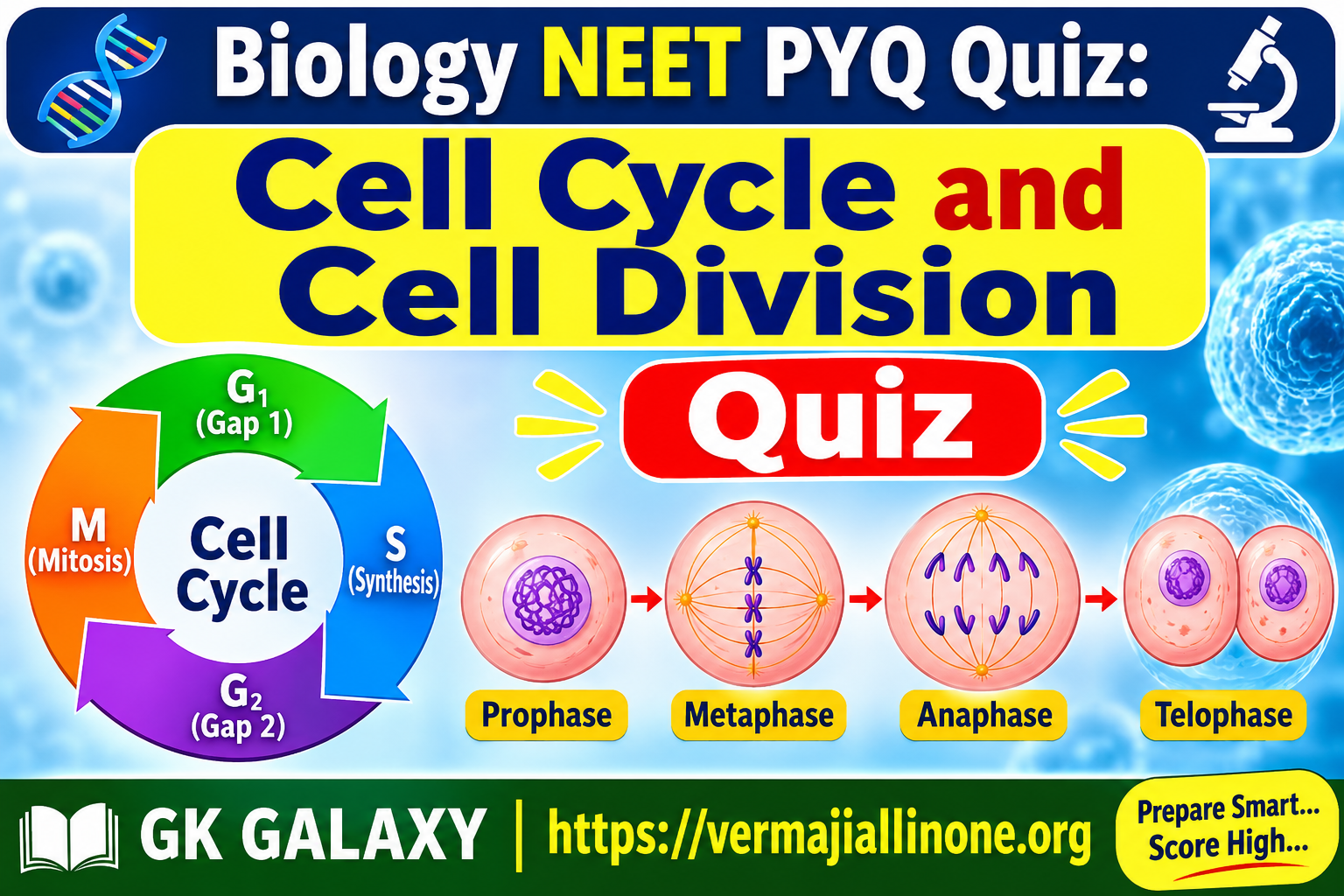
The sequence of events through which a cell grows, duplicates its genetic material, and divides into daughter cells is called the cell cycle.
Cell division is broadly classified into two major types:
- Mitosis: Produces daughter cells that generally retain the chromosome number of the parent cell.
- Meiosis: Reduces the chromosome number by half and is involved in sexual reproduction.
Before examining the stages of cell division, it is essential to understand chromosomes, DNA replication, and the cell cycle.
2. IMPORTANT TERMS
Cell cycle: The ordered sequence of growth, DNA replication and division through which a cell passes.
Chromosome: A DNA-containing structure associated with proteins that carries genetic information.
Chromatin: The DNA-protein material that forms chromosomes. It is generally less condensed during interphase.
Chromatid: One of the DNA-containing copies of a replicated chromosome. Sister chromatids remain attached, especially at the centromere, until they separate.
Centromere: The chromosome region where sister chromatids remain associated and where the kinetochore forms.
Kinetochore: A protein structure assembled at the centromere that enables spindle microtubules to attach to the chromosome.
Spindle fibres: Microtubules involved in chromosome movement during cell division.
Cytokinesis: Division of the cytoplasm to form separate daughter cells.
Karyokinesis: Division of the nucleus.
Homologous chromosomes: A pair of chromosomes carrying the same types of genes at corresponding loci, one usually inherited from each parent in a diploid organism.
Synapsis: Pairing of homologous chromosomes during prophase I of meiosis.
Crossing over: Exchange of corresponding DNA segments between non-sister chromatids of homologous chromosomes during meiosis.
Chiasma (plural: chiasmata): The visible manifestation of a crossing-over connection between homologous chromosomes during later stages of prophase I.
Diploid (2n): A cell containing two sets of chromosomes.
Haploid (n): A cell containing one set of chromosomes.
Checkpoints: Regulatory mechanisms that help determine whether a cell can proceed to the next stage of the cell cycle.
3. THE CELL CYCLE
The cell cycle consists of two major phases:
- Interphase
- M phase (mitotic phase)
Interphase includes G1, S, and G2 phases. The M phase includes nuclear division and, usually, cytoplasmic division.
3.1 Interphase
Interphase is the period between successive cell divisions. It is traditionally divided into three phases:
G1 phase
S phase
G2 phase
Although chromosomes are not usually visible as distinct structures under an ordinary light microscope during interphase, the cell is metabolically active.
Interphase is not a resting phase. It involves growth, biosynthesis, DNA replication, and preparation for division.
3.2 G1 Phase (First Gap Phase)
G1 is the period between the completion of the previous M phase and the beginning of DNA replication.
Major events include:
Cell growth.
Synthesis of RNA and proteins.
Production of enzymes required for DNA replication.
Increase in the number of cell components and organelles.
Preparation for the S phase.
The cell assesses whether conditions are suitable for DNA replication and further division.
Some cells exit the active cell cycle and enter a non-dividing state called G0 phase.
Examples include many mature nerve cells and certain other differentiated cells. The ability to re-enter the cell cycle varies with cell type and physiological conditions.
3.3 S Phase (Synthesis Phase)
The S phase is the period during which DNA replication takes place.
Important events include:
Duplication of nuclear DNA.
Formation of sister chromatids for each replicated chromosome.
Duplication of the centrosome in typical animal cells.
Critical NEET concept: DNA content doubles during the S phase, but the chromosome number, counted by centromeres, generally remains unchanged until sister chromatids separate.
For example, in a diploid cell with 2n = 46 chromosomes:
Before S phase: 46 chromosomes and 46 chromatids.
After S phase: 46 replicated chromosomes and 92 sister chromatids.
The DNA content increases from 2C to 4C, where C represents the DNA content of one haploid genome.
3.4 G2 Phase (Second Gap Phase)
G2 follows DNA replication and precedes mitosis.
Major events include:
Further cell growth.
Synthesis of proteins required for mitosis.
Preparation of cellular structures for chromosome segregation.
Checking and repair of DNA damage where possible.
The cell prepares to distribute its replicated chromosomes accurately between daughter cells.
3.5 M Phase
The M phase is the phase of actual cell division.
It includes:
- Karyokinesis.
- Cytokinesis.
Karyokinesis is conventionally divided into four stages:
Prophase.
Metaphase.
Anaphase.
Telophase.
In many textbooks, the early stages of mitosis are described with additional detail, including prometaphase. For NEET preparation, the standard four-stage classification is especially important.
4. MITOSIS
Mitosis is a type of cell division in which one parent nucleus divides to form two daughter nuclei that generally contain the same chromosome number as the parent nucleus.
In a typical diploid somatic cell, mitosis produces two diploid daughter cells.
Mitosis is also called equational division because the chromosome number is maintained.
4.1 Importance of Mitosis
Mitosis performs several essential functions:
- Growth of multicellular organisms.
- Replacement of old and damaged cells.
- Wound healing and tissue repair.
- Asexual reproduction in many organisms.
- Maintenance of chromosome number across successive cell generations.
- Genetic continuity between parent and daughter cells, barring mutations or other changes.
4.2 Prophase
Prophase is the first major stage of mitosis.
Important events include:
Chromatin condenses to form visible chromosomes.
Each replicated chromosome consists of two sister chromatids.
The nucleolus gradually disappears.
The mitotic spindle begins to form.
In typical animal cells, centrosomes move towards opposite poles.
As mitosis progresses, the chromosomes become more compact and easier to distinguish.
NEET point: Chromosome condensation begins during prophase.
4.3 Prometaphase
In the detailed description of mitosis, prometaphase follows prophase.
Major events include:
Breakdown of the nuclear envelope.
Attachment of spindle microtubules to kinetochores.
Movement of chromosomes towards the equatorial region.
Some textbooks include these events in the broader description of prophase.
NEET point: Spindle microtubules attach to kinetochores, not to telomeres.
4.4 Metaphase
Metaphase is the stage during which chromosomes align at the equatorial plane of the cell.
Major events include:
Chromosomes attain a highly condensed state.
Chromosomes become arranged at the metaphase plate.
Sister chromatids remain attached to each other.
Spindle microtubules connect with chromosome kinetochores.
The position of chromosomes at the equator allows their genetic material to be distributed accurately.
NEET point: The best stage for studying chromosome morphology is generally metaphase because chromosomes are maximally condensed and clearly visible.
4.5 Anaphase
Anaphase begins when sister chromatids separate.
Major events include:
Cohesion between sister chromatids is released.
Centromeric regions separate in typical mitosis.
Sister chromatids move towards opposite poles.
Each separated chromatid is now regarded as an individual chromosome.
The separation of sister chromatids ensures that each daughter nucleus receives one copy of each replicated chromosome.
Important distinction: During anaphase, the chromosome number within the undivided cell is temporarily counted differently because the separated sister chromatids are now individual chromosomes.
For example, in a human somatic cell, 46 replicated chromosomes are present before anaphase. Once sister chromatids separate, 92 individual chromosomes are present temporarily within the same cell, with 46 moving towards each pole.
4.6 Telophase
Telophase is the final major stage of mitosis.
Major events include:
Chromosomes reach opposite poles.
Chromosomes begin to decondense.
Nuclear envelopes re-form around the chromosome sets.
Nucleoli reappear.
The spindle apparatus disassembles.
At the end of telophase, two daughter nuclei have formed.
4.7 Cytokinesis
Cytokinesis divides the cytoplasm and usually follows nuclear division.
In animal cells:
A cleavage furrow develops.
A contractile ring helps constrict the cell membrane.
The parent cell separates into two daughter cells.
In plant cells:
The rigid cell wall prevents the formation of a typical cleavage furrow.
Golgi-derived vesicles gather in the centre of the cell.
These vesicles fuse to form a cell plate.
The cell plate expands outwards and develops into the new partition between daughter cells.
NEET comparison:
| Feature | Animal cell | Plant cell |
| Cytokinesis | Cleavage furrow | Cell plate |
| Direction of development | Inward constriction | Generally from centre towards the periphery |
| Main mechanism | Contractile ring | Fusion of vesicles and cell plate formation |
4.8 Significance of Mitosis
Mitosis maintains genetic continuity, supports organismal growth, replaces damaged cells, and enables asexual reproduction in many organisms.
However, mitosis alone does not create the normal reduction in chromosome number required for sexual reproduction.
5. Meiosis
Meiosis is a specialised type of cell division in which one round of DNA replication is followed by two successive nuclear divisions.
It usually produces four haploid products from one diploid parent cell, although the number of functional gametes or spores ultimately formed depends on the organism and its reproductive biology.
Meiosis consists of:
- Meiosis I.
- Meiosis II.
Meiosis I is reductional division because homologous chromosomes separate, reducing the chromosome-set number from diploid to haploid.
Meiosis II is equational division because sister chromatids separate without a further reduction in chromosome-set number.
5.1 Importance of Meiosis
Meiosis is essential because it:
Reduces the chromosome-set number in reproductive cells.
Helps maintain the characteristic chromosome number of a species across sexual generations.
Generates genetic variation through crossing over.
Produces new combinations of maternal and paternal chromosomes through independent assortment.
Supports sexual reproduction and evolution.
5.2 Meiosis I
Meiosis I is divided into prophase I, metaphase I, anaphase I, and telophase I.
Prophase I is especially important because homologous chromosomes pair and crossing over occurs.
5.3 Prophase I: Five Substages
Prophase I is divided into five substages:
- Leptotene.
- Zygotene.
- Pachytene.
- Diplotene.
- Diakinesis.
A. Leptotene
During leptotene:
Chromosomes begin to condense.
Thin, thread-like chromosomes become visible.
Chromosomes are progressively organised into recognisable structures.
NEET point: Chromosomes become progressively visible during leptotene.
B. Zygotene
During zygotene:
Homologous chromosomes pair with each other.
This pairing is called synapsis.
The synaptonemal complex develops between paired homologous chromosomes.
A pair of synapsed homologous chromosomes is called a bivalent.
NEET point: Synapsis occurs during zygotene.
C. Pachytene
During pachytene:
Chromosomes become shorter and thicker.
Synapsis is generally complete.
Crossing over occurs between non-sister chromatids of homologous chromosomes.
Recombination nodules are associated with sites of genetic recombination.
A bivalent contains two homologous chromosomes and four chromatids; it is therefore also called a tetrad.
NEET point: Crossing over occurs during pachytene.
D. Diplotene
During diplotene:
The synaptonemal complex disassembles.
Homologous chromosomes begin to separate.
They remain connected at visible chiasmata, which are associated with previous crossing-over events.
In certain organisms, oocytes may remain arrested for extended periods at a stage of diplotene.
NEET point: Chiasmata become clearly visible during diplotene.
E. Diakinesis
During diakinesis:
Chromosomes become highly condensed.
Chiasmata move towards the ends of chromosomes in a process called terminalisation.
The nucleolus disappears.
The nuclear envelope breaks down as the cell prepares for metaphase I.
NEET point: Terminalisation of chiasmata is characteristic of diakinesis.
5.4 Metaphase I
During metaphase I:
Homologous chromosome pairs align at the equatorial plane.
Each homolog is oriented towards an opposite pole.
The orientation of different pairs contributes to independent assortment.
Important distinction: Homologous chromosomes align as pairs during metaphase I. Individual replicated chromosomes align at the metaphase plate during mitotic metaphase.
5.5 Anaphase I
During anaphase I:
Homologous chromosomes separate.
One homolog from each pair moves towards each pole.
Sister chromatids generally remain attached.
Centromeres do not undergo the usual separation seen in anaphase of mitosis or anaphase II.
As a result, the chromosome-set number is reduced.
NEET point: Homologous chromosomes separate during anaphase I.
5.6 Telophase I
During telophase I:
Homologous chromosomes reach opposite poles.
Nuclear envelopes may re-form, depending on the organism.
Cytokinesis may occur.
Two haploid cells or nuclei are produced.
Each chromosome still consists of two sister chromatids.
5.7 Interkinesis
Interkinesis is the interval between meiosis I and meiosis II in organisms where such an interval occurs.
It is not equivalent to a complete interphase.
Critical point: No new round of DNA replication occurs between meiosis I and meiosis II.
5.8 Meiosis II
Meiosis II resembles mitosis in the way sister chromatids separate, but it begins with haploid cells whose chromosomes are still replicated.
Prophase II
Chromosomes condense if they had partially decondensed.
The spindle apparatus forms.
Nuclear envelopes, if present, break down.
Metaphase II
Chromosomes align individually at the equatorial plane.
Sister chromatids are oriented towards opposite poles.
Anaphase II
Sister chromatids separate.
Centromeric cohesion is released.
The separated chromatids move towards opposite poles.
NEET point: Centromeres separate during anaphase II.
Telophase II
Chromosomes reach the poles.
Nuclear envelopes re-form where applicable.
Chromosomes decondense.
Cytokinesis produces the final cellular products.
Meiosis typically generates four haploid products, with genetic differences resulting from recombination and chromosome assortment.
6. Mitosis Versus Meiosis
| Feature | Mitosis | Meiosis |
| Number of nuclear divisions | One | Two |
| DNA replication before division | One round | One round before meiosis I |
| Synapsis of homologous chromosomes | Absent | Present during prophase I |
| Crossing over | Not a normal feature of mitosis | Occurs during prophase I |
| Homologous chromosome separation | Not the defining event | Anaphase I |
| Sister chromatid separation | Anaphase | Anaphase II |
| Chromosome-set number | Generally maintained | Reduced during meiosis I |
| Typical products | Two daughter cells | Four haploid products |
| Genetic similarity | Usually very similar | Usually genetically different |
| Major biological role | Growth and repair | Sexual reproduction and genetic variation |
7. Chromosome Number and DNA Content
This is one of the most important numerical concepts in this chapter.
Let a diploid cell contain 2n = 4 chromosomes.
| Stage | Chromosome number | Chromatid status | DNA content |
| G1 phase | 4 | Four unreplicated chromosomes | 2C |
| After S phase | 4 | Eight sister chromatids | 4C |
| Metaphase of mitosis | 4 | Eight sister chromatids | 4C |
| Anaphase of mitosis, within the undivided cell | 8 | Sister chromatids have separated | 4C |
| Each daughter cell after mitosis | 4 | Four unreplicated chromosomes | 2C |
| After S phase before meiosis I | 4 | Eight sister chromatids | 4C |
| Metaphase I | 4 | Eight sister chromatids | 4C |
| Each product after meiosis I | 2 | Four sister chromatids | 2C |
| Each product after meiosis II | 2 | Two unreplicated chromosomes | 1C |
Here, C represents the DNA content of one haploid genome.
The table assumes normal division without errors and uses chromosome number counted by centromeres. It describes a typical diploid cell and should not be applied without adjustment to organisms with unusual life cycles.
Remember these rules:
DNA replication doubles DNA content but does not immediately double chromosome number.
Separation of sister chromatids increases the chromosome count within the still-undivided cell.
Meiosis I separates homologous chromosomes.
Meiosis II separates sister chromatids.
DNA does not replicate again between meiosis I and meiosis II.
8. REGULATION OF THE CELL CYCLE
Cell-cycle progression is controlled by regulatory proteins and checkpoints.
8.1 G1 Checkpoint
The G1 checkpoint assesses cell size, nutrients, growth signals, and DNA integrity before the cell proceeds towards DNA replication.
8.2 G2 Checkpoint
The G2 checkpoint helps ensure that DNA replication has been completed and that significant DNA damage is addressed before mitosis.
8.3 Spindle Assembly Checkpoint
This checkpoint helps prevent the cell from proceeding into chromosome separation until chromosomes have achieved appropriate spindle attachment.
Defects in cell-cycle regulation may contribute to uncontrolled cell proliferation and cancer.
9. QUICK REVISION: HIGH-YIELD NEET FACTS
- Interphase consists of G1, S, and G2 phases.
- DNA replication occurs during the S phase.
- G0 is a quiescent state outside the active cell-cycle sequence.
- Mitosis includes prophase, metaphase, anaphase, and telophase.
- Chromosomes are highly condensed during metaphase.
- Spindle microtubules attach to kinetochores.
- Animal-cell cytokinesis occurs through cleavage-furrow formation.
- Plant-cell cytokinesis generally involves cell-plate formation.
- Synapsis occurs during zygotene.
- Crossing over occurs during pachytene.
- Chiasmata become visible during diplotene.
- Terminalisation of chiasmata is associated with diakinesis.
- Homologous chromosomes separate during anaphase I.
- Sister chromatids separate during anaphase II.
- No DNA replication occurs between meiosis I and meiosis II.
- Meiosis I is reductional division.
- Meiosis II is equational division.
- Mitosis generally preserves chromosome number.
- Meiosis contributes to genetic variation.
- DNA content and chromosome number are not interchangeable measurements.