GUMROAD eBook link:-
BY SHAILENDRA KUMAR VERMA
| Affiliate link of GUMROAD eBook | |
| https://skverma29.gumroad.com/affiliates | |
| 1. | CHALLENGING SYLLOGISM |
| https://skverma29.gumroad.com/l/ktxvzi | |
| 2. | STRAIT OF HORMUZ: STRATEGIC & ECONOMIC ROLE |
| https://skverma29.gumroad.com/l/upobrv | |
| 4. | STATIC GENERAL KNOWLEDGE |
| https://skverma29.gumroad.com/l/kzmca | |
| 5. | SSC ENGLISH PREVIOUS YEAR QUESTIONS MCQ |
| https://skverma29.gumroad.com/l/vtotyp | |
| 6. | SSC REASONING PREVIOUS YEAR QUESTIONS MCQ |
| https://skverma29.gumroad.com/l/fsyvp | |
| 7. | SSC MATH PREVIOUS YEAR QUESTIONS (MCQ): TIER I |
| https://skverma29.gumroad.com/l/nesioq | |
| 8. | BANKING KNOWLEDGE QUESTIONS AND ANSWERS MCQ |
| https://skverma29.gumroad.com/l/sgbbul | |
| 9. | BIHAR ANM, GNM & PHARMACIST EXAM: PAST MCQ QUESTIONS & ANSWERS – |
| https://skverma29.gumroad.com/l/yotjat | |
| 10. | ARAVALLI MOUNTAIN RANGE: THE ANCIENT SPINE OF INDIA |
| https://skverma29.gumroad.com/l/khpakf | |
| 11. | मौर्य काल (322 ईसा पूर्व – 185 ईसा पूर्व): पीएसयू परीक्षा हेतु प्रश्नोत्तर सहित विस्तृत अध्ययन |
| https://skverma29.gumroad.com/l/kgmrw | |
| 12. | VOLCANOES AND EARTHQUAKES: A COMPLETE GUIDE |
| https://share.google/gMZLAnx4hcCV82NTI | |
| 13. | TERMINOLOGY: RAILWAY, COMPUTER, SHARE MARKET, BIOLOGY, BADMINTON, CRICKET, FOOTBALL, KABBADI AND HOCKEY |
| https://share.google/fvdFN53HtyXlqTCgd | |
| 14. | भारतीय संसद का सत्र: प्रक्रिया, नियमऔर एस ओ पी; पी एस यू परीक्षा के लिए संपूर्ण मार्ग दर्शिका |
| https://share.google/1HFwXZA3qUiKyrI1l | |
| 15. | REITs AND InvITs IN INDIA: COMPLETE GUIDE (SCOPE, RISKS & FUTURE) |
| https://share.google/EChDc9heQmPPeyhoi | |
| 16. | GK SSC TIER I PREVIOUS YEAR MCQ |
| https://share.google/5pLzqYKQtg822wk3Y | |
| 17. | PETROLEUM REFINERY PROCESS: WITH 200 MCQ |
| https://skverma29.gumroad.com/l/jgydi | |
| 18. | SET THEORY: A COMPLETE GUIDE WITH 400 MCQ |
| https://skverma29.gumroad.com/l/zkhqzm | |
| 19. | WORLD’S SMALLEST, LONGEST, THINNEST, THICKEST AND TALLEST |
| https://skverma29.gumroad.com/l/kzaenh | |
| 20. | HIGH TIDE AND LOW TIDE: A COMPLETE GUIDE https://skverma29.gumroad.com/l/virke |
| 21. | 1000 HISTORY QESTIONS & ANSWERS FOR PSU |
| https://skverma29.gumroad.com/l/fjapus | |
| 22. | नालंदा विश्वविद्यालय : सम्पूर्ण अध्ययन |
| https://skverma29.gumroad.com/l/pmjab?wanted=true | |
| 23. | भगवान शिव के 12 ज्योतिर्लिंग: इतिहास, महत्व और दर्शन क्रम |
| https://skverma29.gumroad.com/l/wdkgo | |
| 24 | NISM-SERIES-V-A MUTUAL FUND DISTRIBUTOR: COMPLETE STUDY GUIDE & EXAM PREPARATION |
| https://skverma29.gumroad.com/l/qgcviu | |
| 25. | WORKSHOP TECHNOLOGY & MANUFACTURING PROCESSES COMPLETE EXAM GUIDE |
| https://skverma29.gumroad.com/l/xvqxnp | |
AMAZON eBook link:-
BY SHAILENDRA KUMAR VERMA
| 1. | SSC MATH PREVIOUS YEAR MCQ: SSC MATH |
| https://amzn.in/d/097Ocsnl | |
| 2. | SSC REASONING PREVIOUS YEAR MCQ: SSC REASONING |
| https://amzn.in/d/00EHQGE8 | |
| 3. | SSC ENGLISH PREVIOUS YEAR MCQ: SSC ENGLISH |
| https://amzn.in/d/0f8sxJoy | |
| 4. | STATIC GENERAL KNOWLEDGE : WITH 620 MCQs |
| https://amzn.in/d/09xNEWmt |
PLAYSTORE eBook link:-
BY SHAILENDRA KUMAR VERMA
| 1. | SSC MATH PREVIOUS YEAR MCQ |
| https://share.google/KzWbvkFuNk51PEpiu | |
| 2. | SSC REASONING PREVIOUS YEAR MCQ |
| https://play.google.com/books/publish/a/12574378860292240754#book/GGKEY:EUPQZ9ZUAFR/review | |
| 3. | STATIC GENERAL KNOWLEDGE |
| https://play.google.com/books/publish/a/12574378860292240754#book/GGKEY:CQDT2G4CCQP/review | |
| 4. | CHALLENGING SYLLOGISM |
| https://share.google/w9xLMwyiJdNVnpHxI | |
| 5. | STRAIT OF HORMUZ: STRATEGIC & ECONOMIC ROLE |
| https://share.google/V10H7UKeTkstLIMmc | |
| 6. | BIHAR TEACHER ELIGIBILITY TEST (BIHAR TET) : COMPLETE GUIDE |
| https://share.google/AcCXPFa69dAWyYaZZ | |
| 7. | SSC ENGLISH PREVIOUS YEAR MCQ |
| https://share.google/pr7b0YhDoDwttaq2s | |
| 8. | BANKING KNOWLEDGE QUESTIONS AND ANSWERS MCQ |
| https://share.google/yqYOabKhNppcz89hl | |
| 9. | BIHAR ANM, GNM & PHARMACIST EXAM: PAST MCQ QUESTIONS & ANSWERS – |
| https://share.google/NFhtU1JoBfxPS4wa3 | |
| 10. | ARAVALLI MOUNTAIN RANGE: THE ANCIENT SPINE OF INDIA |
| https://share.google/Yo4RYnaZrbRu9qwzj | |
| 11. | GK SSC TIER I PREVIOUS YEAR MCQ |
| https://share.google/sBdCcsEeebM44QZ0X | |
| 12. | REITs AND InvITs IN INDIA: COMPLETE GUIDE (SCOPE, RISKS & FUTURE) |
| https://share.google/XAwUio1deUOxFe2M7 | |
| 13. | भारतीय संसद का सत्र: प्रक्रिया, नियमऔर एस ओ पी ; पी एस यू परीक्षा के लिए संपूर्ण मार्ग दर्शिका |
| https://share.google/6XVrfQ2PcuWmqvKol | |
| 14. | मौर्य काल (322 ईसा पूर्व – 185 ईसा पूर्व): पीएसयू परीक्षा हेतु प्रश्नोत्तर सहित विस्तृत अध्ययन |
| https://share.google/Lwu7JKHE54kxsL5e2 | |
| 15. | TERMINOLOGY: RAILWAY, COMPUTER, SHARE MARKET, BIOLOGY, BADMINTON, CRICKET, FOOTBALL, KABBADI AND HOCKEY |
| https://share.google/WWVO9ZFd81R9G9h69 | |
| 16. | VOLCANOES AND EARTHQUAKES: A COMPLETE GUIDE |
| https://share.google/aXi2evRVgmzpQguye | |
| 17. | PETROLEUM REFINERY PROCESS: WITH 200 MCQ |
| https://play.google.com/books/publish/u/0/a/12574378860292240754#book/GGKEY:P34SQBHUJ7F/review | |
| 18. | SET THEORY: A COMPLETE GUIDE WITH 400 MCQ |
| https://play.google.com/books/publish/u/0/a/12574378860292240754#book/GGKEY:83LKH7QHRQH/review | |
| 19. | WORLD’S SMALLEST, LONGEST, THINNEST, THICKEST AND TALLEST |
| https://play.google.com/books/publish/u/0/a/12574378860292240754#book/GGKEY:9LE49HEDZJE/review | |
| 20. | HIGH TIDE AND LOW TIDE: A COMPLETE GUIDE |
| https://play.google.com/books/publish/u/0/a/12574378860292240754#book/GGKEY:TKR79QBDE7R/review | |
| 21. | 1000 HISTORY QESTIONS & ANSWERS FOR PSU |
| https://play.google.com/books/publish/u/0/a/12574378860292240754#book/GGKEY:1SGWQKT7BDF/review | |
| 22. | नालंदा विश्वविद्यालय : सम्पूर्ण अध्ययन |
| https://play.google.com/books/publish/u/0/a/12574378860292240754#book/GGKEY:RY0EDLDK7TL/review | |
| 23. | भगवान शिव के 12 ज्योतिर्लिंग: इतिहास, महत्व और दर्शन क्रम |
| https://play.google.com/books/publish/u/0/a/12574378860292240754#book/GGKEY:KNT0X6L8YCQ/review | |
| 24. | NISM-SERIES-V-A MUTUAL FUND DISTRIBUTOR: COMPLETE STUDY GUIDE & EXAM PREPARATION |
| https://play.google.com/books/publish/u/0/a/12574378860292240754#book/GGKEY:YP1PQ8RQY07/review | |
| 25. | WORKSHOP TECHNOLOGY & MANUFACTURING PROCESSES COMPLETE EXAM GUIDE |
| https://play.google.com/books/publish/u/0/a/12574378860292240754#book/GGKEY:PK621P1ZHXX/review |
| OPEN DMAT ACCONT FROM THI LINK IN ANGEL ONE:- |
| Open your Trading & Investment account with Angel One for FREE* |
| You will get: |
| All trades in Rs.20 |
| Quick SIP in Direct MF |
| 1Lac MTF @ 0% interest |
| Download only using my referral link to get Free Demat Account⬇ |
| https://angel-one.onelink.me/Wjgr/2o2au42h |
| _link may expire within 48hrs_ |
| _T&C Apply_ |
| CLICK TO APPLY: |
| Click the application link below: 👉 Apply Here for SBI Credit Card (Referral Code: 243zfQ0yYm3) |
| OPEN DMAT ACCOUNT FROM THIS LINK: |
| HI THERE, I SEE YOU HAVEN’T BOUGHT THE FREEDOM PLAN ON INDIAN BANK YET. DON’T MISS OUT ON UNLIMITED TRADING AT A POCKET-FRIENDLY COST. GO BROKERAGE-FREE AND SAVE BIG WITH THE FREEDOM PLAN. USE MY REFERRAL CODE, SHAI0634 TO DOWNLOAD THE APP NOW. |
| https://play.google.com/store/apps/details?id=com.finwizard.fisdom |
Disclaimer :
This educational content on Anatomy of Flowering Plants is published on GK GALAXY (https://vermajiallinone.org) for educational and exam-preparation purposes only.
The theory, explanations, practice MCQs, answers and illustrations are intended to help students prepare for NEET-UG and improve their understanding of Biology. Every effort is made to maintain accuracy; however, no guarantee is given that all information is completely error-free or up to date.
Any Previous Year Questions (PYQs), examination names, years and related references should be verified against reliable examination sources. Practice questions must not be treated as actual NEET questions unless appropriately verified.
This material is not an official publication of the National Testing Agency (NTA), NCERT or any government authority. GK GALAXY is not affiliated with or endorsed by these organizations.
The content is prepared with the intention of avoiding unauthorized copying of copyrighted material. However, GK GALAXY does not guarantee that every item is free from all possible copyright or intellectual property claims. If any material is believed to infringe copyright, the concerned rights holder may contact the website owner for review and appropriate action.
Students are advised to consult official NCERT textbooks, NEET notifications and other authorized educational resources for confirmation.
The website owner shall not be held responsible for any loss, damage, error, omission or decision arising from the use of this educational content, to the extent permitted by applicable law.
By using this content, readers acknowledge that it is provided for educational and informational purposes only.
1. Introduction to Plant Anatomy
Plant anatomy is the branch of botany that deals with the internal structure of plants. It studies the organization of plant cells, tissues, and organs, including roots, stems, and leaves.
The internal structure of a plant is closely related to its functions. For example, root hairs increase the surface area available for absorption, xylem conducts water, and sclerenchyma provides mechanical strength.
Importance of plant anatomy
Helps explain the transport of water, minerals, and food.
Shows how plants obtain mechanical support.
Helps distinguish monocot and dicot structures.
Explains the internal adaptations of plants to different environments.
Provides a basis for understanding primary and secondary growth.
2. Plant Tissues
A tissue is a group of cells that are organized to perform one or more related functions.
Plant tissues are broadly classified into two major groups:
A. Meristematic tissues
These contain actively dividing cells and are responsible for plant growth.
B. Permanent tissues
These arise through cell differentiation and perform functions such as storage, photosynthesis, support, and conduction.
2.1 Meristematic tissues
Meristematic tissues contain young cells capable of repeated cell division. Their cells generally have thin primary walls, dense cytoplasm, prominent nuclei, and small or absent vacuoles.
On the basis of position, meristems are classified as follows.
| Type | Location | Main function |
| Apical meristem | Tips of roots and shoots | Increases length |
| Intercalary meristem | Certain regions near nodes or leaf bases | Elongation and regrowth |
| Lateral meristem | Along the sides of stems and roots | Increases girth |
Primary growth increases the length of plant organs. Secondary growth increases their thickness or girth.
Intercalary meristems are especially important in grasses because they enable regrowth after grazing or cutting.
2.2 Permanent tissues
Permanent tissues develop when meristematic cells differentiate and acquire specialized structures and functions.
They are divided into simple permanent tissues and complex permanent tissues.
A. Simple permanent tissues
Simple permanent tissues consist mainly of one type of cell.
1. Parenchyma
Parenchyma is composed of living cells, usually with thin cell walls. The cells often have intercellular spaces.
Functions include:
Storage of food and water.
Photosynthesis when chloroplasts are present.
Wound healing and regeneration.
Gas exchange and buoyancy in some aquatic plants.
Special forms include:
Chlorenchyma: Parenchyma containing chloroplasts and performing photosynthesis.
Aerenchyma: Tissue with prominent air spaces that can assist gas exchange and buoyancy.
2. Collenchyma
Collenchyma consists of living, elongated cells with unevenly thickened primary walls, especially at the corners.
Functions:
Provides flexible mechanical support.
Supports growing stems and leaf petioles.
Allows plant parts to bend without breaking easily.
It commonly occurs beneath the epidermis of young dicot stems and in leaf petioles.
3. Sclerenchyma
Sclerenchyma cells generally develop thick, lignified secondary walls and are dead at maturity.
Two principal forms are:
Fibres: Elongated cells that provide tensile strength.
Sclereids: Cells with variable shapes and thick walls, contributing to the hardness of seed coats and the gritty texture of pear pulp.
| Feature | Parenchyma | Collenchyma | Sclerenchyma |
| Living at maturity | Yes | Yes | Usually no |
| Cell walls | Usually thin | Unevenly thickened | Thick, often lignified |
| Main role | Storage and metabolism | Flexible support | Rigidity and strength |
| Intercellular spaces | Often present | Usually limited | Variable |
B. Complex permanent tissues
Complex permanent tissues contain different cell types that work together to perform a common function.
The two principal complex tissues are xylem and phloem.
2.3 Xylem
Xylem conducts water and dissolved mineral substances and also contributes to mechanical support.
Its four principal elements are:
- Tracheids
- Vessels
- Xylem fibres
- Xylem parenchyma
Tracheids: Elongated cells with tapering ends and thickened walls. They conduct water through pits and provide support.
Vessels: Tubular conducting structures formed from vessel elements joined end to end. They are especially prominent in angiosperms.
Xylem fibres: Thick-walled cells that primarily provide mechanical strength.
Xylem parenchyma: The principal living component of xylem. It stores substances and assists in lateral transport.
Key point: The conducting elements of xylem—tracheids and vessel elements—are generally dead at maturity.
2.4 Phloem
Phloem transports sugars and other organic substances from source regions to sink regions.
Its principal elements in angiosperms are:
- Sieve tube elements
- Companion cells
- Phloem parenchyma
- Phloem fibres
Sieve tube elements: Living conducting cells that lack a nucleus at maturity. Their end walls contain sieve plates.
Companion cells: Living cells associated with sieve tube elements. They assist in maintaining their functions and participate in the loading and unloading of sugars.
Phloem parenchyma: Living cells involved in storage and transport. It is absent in many monocots.
Phloem fibres: Usually dead at maturity and provide mechanical support.
Remember that phloem transport depends on source–sink relationships and can occur in different directions in different sieve tubes.
3. The Three Tissue Systems
The primary plant body has three major tissue systems.
3.1 Epidermal tissue system
The epidermal system forms the outer protective covering of the plant.
Its components include the epidermis, stomata, guard cells, trichomes, and root hairs.
Epidermis: Usually a single layer of compactly arranged cells. A cuticle often covers the aerial epidermis and helps reduce water loss.
Stomata: Small pores that permit gaseous exchange and regulate transpiration. Each stomatal apparatus includes the pore and its guard cells, together with subsidiary cells when present.
Guard cells: These control the opening and closing of stomata. They contain chloroplasts. In most dicots, they are kidney-shaped; in grasses, they are commonly dumbbell-shaped.
Trichomes: Epidermal outgrowths on aerial plant parts. They can protect the plant and reduce water loss.
Root hairs: Unicellular extensions of root epidermal cells that increase the surface area available for water and mineral absorption.
3.2 Ground tissue system
The ground tissue system includes the plant tissues other than the epidermal and vascular systems.
Its components may include parenchyma, collenchyma, and sclerenchyma.
Important regions include:
Cortex: Tissue between the epidermis and vascular region in many organs.
Endodermis: The innermost cortical layer, especially distinct in roots.
Pericycle: A region inside the endodermis that gives rise to lateral roots.
Pith: The central region of many stems and some roots.
Mesophyll: The photosynthetic tissue between the upper and lower epidermis of leaves.
3.3 Vascular tissue system
The vascular system contains xylem and phloem.
Vascular bundles are classified according to the arrangement of their conducting tissues.
| Type | Structure | Typical location |
| Radial | Xylem and phloem occur on alternate radii | Roots |
| Conjoint | Xylem and phloem occur together | Stems and leaves |
| Open | Cambium is present between xylem and phloem | Typical dicot stem |
| Closed | Cambium is absent from the bundle | Typical monocot stem |
Conjoint bundles may be collateral, with phloem toward the outside of xylem, or bicollateral, with phloem on both sides of xylem.
4. Anatomy of Roots
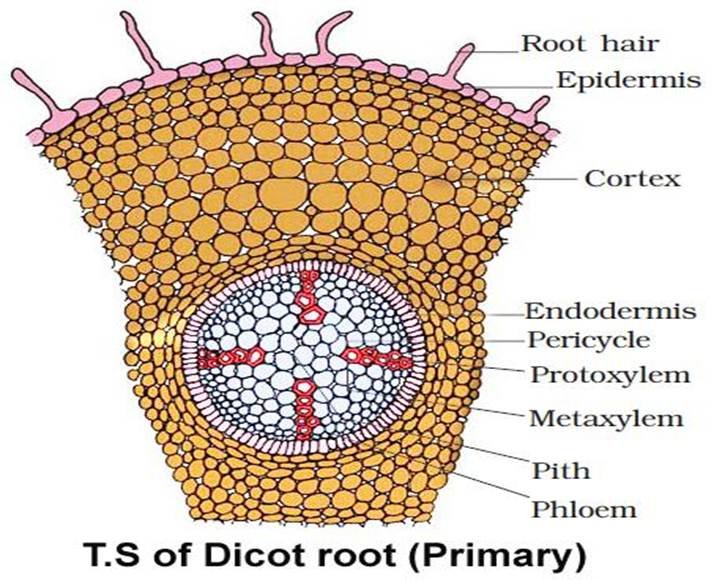
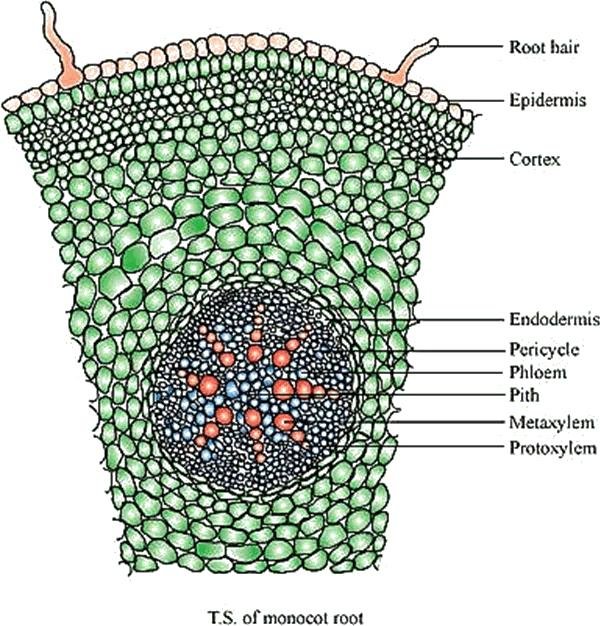
Roots anchor plants, absorb water and minerals, and sometimes store food.
4.1 Dicot root
The main tissues of a typical young dicot root are arranged from outside to inside as follows.
- Epiblema: The outer layer, often bearing root hairs.
- Cortex: Mainly parenchymatous tissue.
- Endodermis: A distinct inner cortical layer with Casparian strips.
- Pericycle: Located inside the endodermis; produces lateral roots.
- Vascular tissues: Xylem and phloem alternate with one another.
- Pith: Usually small or inconspicuous.
The Casparian strips contain hydrophobic substances, particularly suberin, that help regulate movement through the endodermis.
Exarch xylem: Protoxylem lies toward the outside, while metaxylem lies toward the centre. This arrangement is characteristic of roots.
4.2 Monocot root
Monocot roots have the same basic tissue organization but commonly show:
Numerous xylem strands, often polyarch.
A large, well-developed pith.
Exarch xylem.
Little or no typical secondary growth.
| Feature | Dicot root | Monocot root |
| Xylem strands | Usually fewer | Usually numerous |
| Pith | Small or inconspicuous | Usually large |
| Xylem maturation | Exarch | Exarch |
| Secondary growth | May occur | Usually absent |
5. Anatomy of Stems
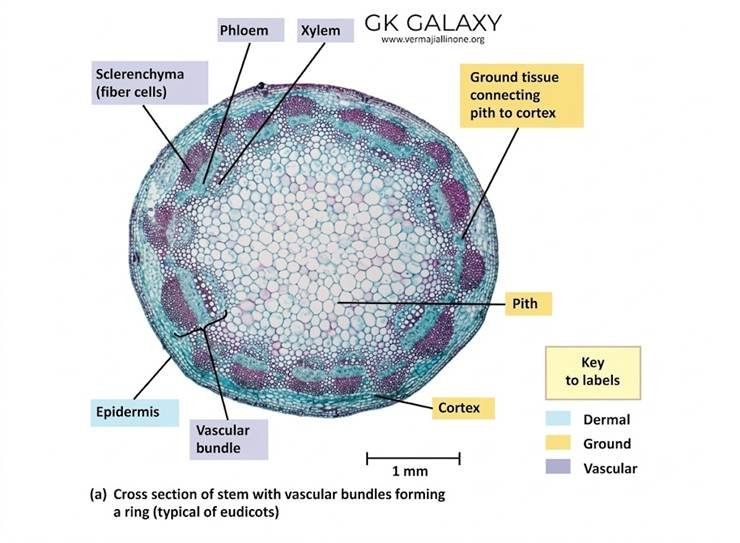
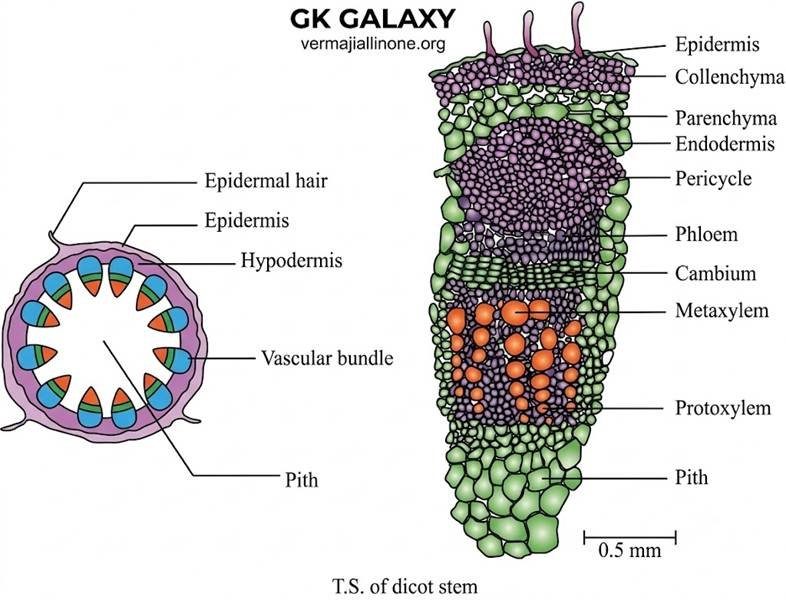
5.1 Dicot stem
A typical young dicot stem has the following features:
Epidermis: The protective outermost layer, commonly covered by a cuticle.
Hypodermis: Often collenchymatous, providing flexible support.
Cortex: Located beneath the hypodermis.
Endodermis: Often rich in starch and described as the starch sheath.
Pericycle: May occur outside the vascular bundles.
Vascular bundles: Usually arranged in a ring and conjoint, collateral, and open.
Pith: A central region composed mainly of parenchyma.
The xylem is typically endarch: protoxylem lies toward the centre and metaxylem toward the outside.
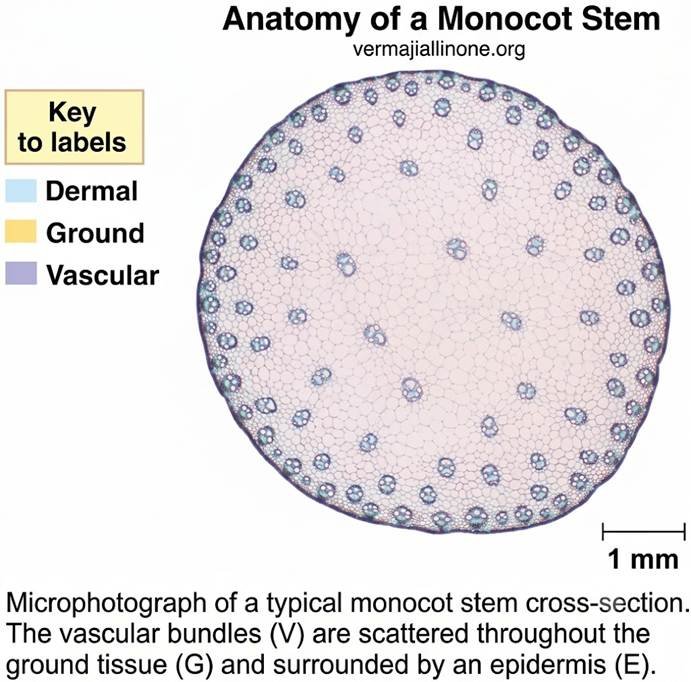
5.2 Monocot stem
A typical monocot stem exhibits:
Sclerenchymatous hypodermis.
Numerous vascular bundles scattered through the ground tissue.
Conjoint, collateral, closed vascular bundles.
A bundle sheath, commonly sclerenchymatous.
Generally undifferentiated ground tissue.
A protoxylem lacuna in many mature bundles.
Usually absent phloem parenchyma.
Most monocot stems do not undergo typical vascular-cambium-driven secondary growth.
5.3 Comparison of dicot and monocot stems
| Characteristic | Dicot stem | Monocot stem |
| Vascular bundles | Usually arranged in a ring | Scattered |
| Vascular cambium | Usually present | Absent |
| Bundles | Usually open | Closed |
| Hypodermis | Often collenchymatous | Often sclerenchymatous |
| Ground tissue | Often differentiated | Usually undifferentiated |
| Typical secondary growth | Common in woody plants | Generally absent |
6. Anatomy of Leaves
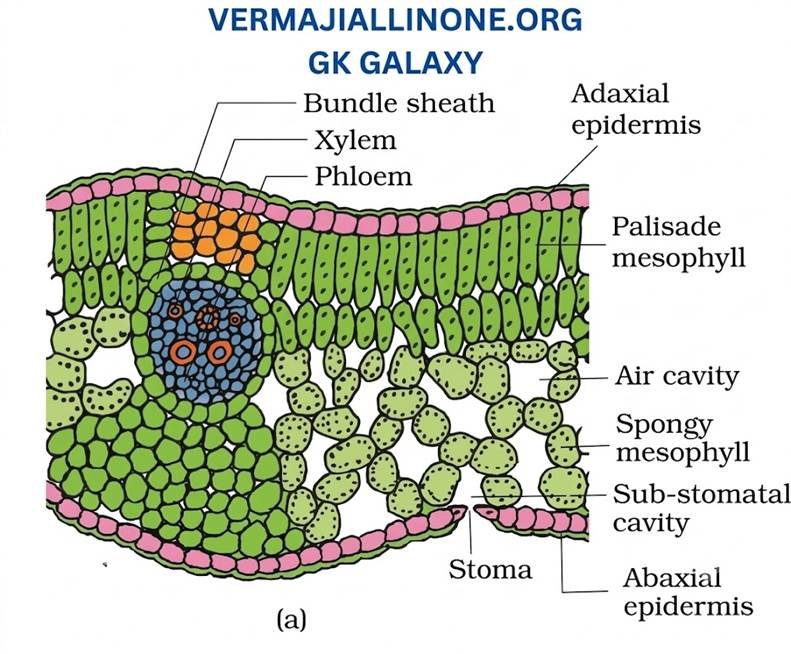
6.1 Dorsiventral leaf
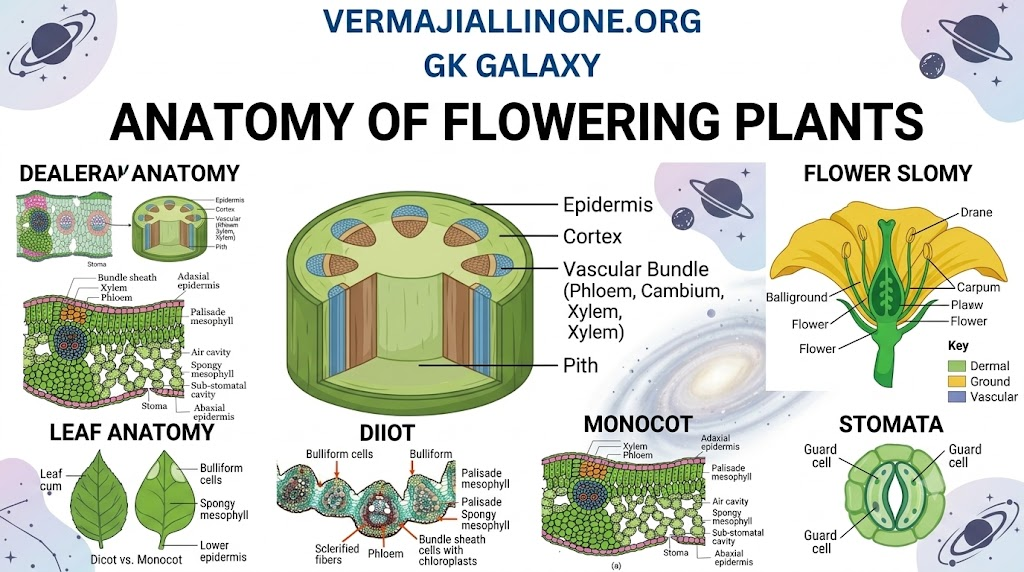
Dorsiventral leaves are typical of many dicotyledonous plants.
The upper epidermis is commonly covered by a cuticle.
Palisade parenchyma generally lies beneath the upper epidermis.
Spongy parenchyma contains large intercellular air spaces.
The lower epidermis often bears more stomata than the upper epidermis.
In vascular bundles, xylem usually faces the upper surface and phloem the lower surface.
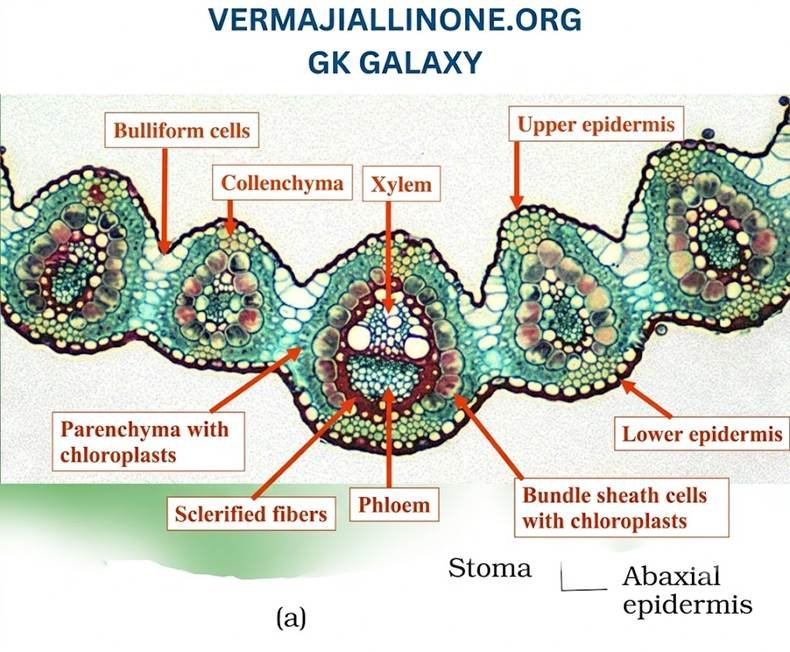
6.2 Isobilateral leaf
Isobilateral leaves are common in monocots, particularly grasses.
Their features include:
Anatomical similarity between the two surfaces.
Mesophyll often not differentiated into distinct palisade and spongy regions.
Stomata commonly present on both surfaces.
Parallel venation in many monocots.
Bulliform cells in the upper epidermis of many grasses.
Bulliform cells are large, thin-walled epidermal cells that help bring about leaf rolling and unrolling through changes in turgor.
6.3 Comparison of leaf types
| Characteristic | Dorsiventral leaf | Isobilateral leaf |
| Typical association | Many dicots | Many monocots |
| Mesophyll | Palisade and spongy regions differentiated | Often undifferentiated in grasses |
| Stomata | Often more numerous below | Often present on both surfaces |
| Bulliform cells | Usually absent | Common in grasses |
| Venation | Often reticulate | Often parallel |
7. Secondary Growth
Secondary growth increases the girth of plant organs through the activity of lateral meristems. It occurs in many dicots and gymnosperms.
7.1 Vascular cambium
In a typical dicot stem, the cambium between primary xylem and primary phloem is called intrafascicular cambium. Cambium develops between vascular bundles from suitable intervening cells, often associated with medullary rays.
These regions join to form a continuous cambial ring.
The cambial ring produces:
Secondary xylem toward the inside.
Secondary phloem toward the outside.
Secondary xylem accumulates to form wood.
7.2 Annual rings
Seasonal differences in the formation of secondary xylem may produce annual rings.
Early wood: Commonly has larger conducting elements and lower density.
Late wood: Commonly has smaller lumens and higher density.
Annual rings may help estimate a tree’s age where annual growth cycles are distinct.
7.3 Heartwood and sapwood
| Heartwood | Sapwood |
| Older inner secondary xylem | Younger outer secondary xylem |
| Often darker | Often lighter |
| Commonly contains deposited substances | More actively conducts water |
| Provides mechanical support | Participates in water conduction |
7.4 Cork cambium and periderm
Cork cambium, also called phellogen, forms protective secondary tissues.
Phellem: Produced toward the outside; cork cells are generally dead and suberized at maturity.
Phelloderm: Produced toward the inside; usually composed of living parenchymatous cells.
Phellem, phellogen and phelloderm together form the periderm.
Lenticels are regions in the periderm that facilitate gaseous exchange between internal tissues and the atmosphere.
7.5 Secondary growth in roots
In a typical dicot root, vascular cambium develops from tissues associated with the vascular region, including residual procambial cells and portions of the pericycle.
The resulting cambial ring produces secondary xylem inward and secondary phloem outward. Cork cambium also develops to produce protective tissues.
PART II — RAPID REVISION AND IMPORTANT FACTS
- Apical meristems contribute to primary growth.
- Lateral meristems contribute to an increase in girth.
- Parenchyma is generally living and thin-walled.
- Collenchyma provides flexible mechanical support.
- Sclerenchyma is usually dead at maturity.
- Xylem consists of tracheids, vessels, xylem fibres, and xylem parenchyma.
- Phloem contains sieve tube elements, companion cells, phloem parenchyma, and phloem fibres.
- Xylem parenchyma is living.
- Sieve tube elements are living but lack a nucleus at maturity.
- Root hairs are unicellular extensions of epidermal cells.
- Casparian strips occur in the root endodermis.
- Lateral roots originate from the pericycle.
- Root xylem is typically exarch.
- Stem xylem is typically endarch.
- Root vascular bundles are radial.
- Typical dicot stem vascular bundles are arranged in a ring.
- Typical monocot stem vascular bundles are scattered.
- Open vascular bundles possess cambium.
- Closed vascular bundles lack cambium.
- Palisade parenchyma is important for photosynthesis.
- Bulliform cells are characteristic of many grass leaves.
- Secondary xylem is produced toward the inside by vascular cambium.
- Secondary phloem is produced toward the outside by vascular cambium.
- Cork cambium produces phellem and phelloderm.
- Lenticels facilitate gaseous exchange.
- Heartwood is older inner secondary xylem.
- Sapwood is the younger outer secondary xylem.
- The periderm consists of phellem, phellogen, and phelloderm.
Topic 1: Plant Tissues and Meristematic Tissues
Q1. Which characteristic is generally associated with meristematic cells?
Exam: NEET-UG Practice Set 2026
(A) Large central vacuole and dead protoplasm
(B) Active cell division and dense cytoplasm
(C) Thick, lignified walls in all cells
(D) Absence of a nucleus
Correct Answer: (B) Active cell division and dense cytoplasm
Explanation: Meristematic cells actively divide and generally contain dense cytoplasm, a prominent nucleus, and little or no large central vacuole. They are responsible for plant growth. Apical meristems increase the length of roots and shoots, while lateral meristems contribute to an increase in girth.
Q2. Which meristem is primarily responsible for the increase in length of a plant root?
Exam: NEET-UG Practice Set 2026
(A) Lateral meristem
(B) Cork cambium
(C) Apical meristem
(D) Vascular cambium
Correct Answer: (C) Apical meristem
Explanation: The apical meristem occurs at the growing tips of roots and shoots. Its cell divisions contribute to primary growth, increasing the length of the plant. Vascular cambium and cork cambium are lateral meristems associated with secondary growth.
Q3. Intercalary meristems are commonly found in which group of plants?
Exam: NEET-UG Practice Set 2026
(A) Grasses
(B) Most mature dicot tree trunks only
(C) Fungi
(D) Non-vascular algae only
Correct Answer: (A) Grasses
Explanation: Intercalary meristems occur at the bases of leaves or internodes in many grasses. They allow rapid regrowth after grazing or cutting. Apical meristems occur at root and shoot tips, whereas lateral meristems increase the girth of stems and roots.
Q4. Which statement best describes permanent plant tissues?
Exam: NEET-UG Practice Set 2026
(A) All their cells divide continuously
(B) They consist exclusively of dead cells
(C) Their cells have generally differentiated and usually lost the capacity for division (D) They are found only at root and shoot tips
Correct Answer: (C) Their cells have generally differentiated and usually lost the capacity for division
Explanation: Permanent tissues develop from meristematic cells through differentiation. Their cells acquire specific structures and functions. Many permanent tissue cells no longer divide, although some living plant cells may retain the capacity to divide under suitable conditions.
Q5. Which of the following is a simple permanent tissue?
Exam: NEET-UG Practice Set 2026 Question type: Concept-based MCQ
(A) Xylem
(B) Phloem
(C) Parenchyma
(D) Vascular bundle
Correct Answer: (C) Parenchyma
Explanation: Parenchyma is a simple permanent tissue made mainly of one type of cell. Collenchyma and sclerenchyma are also simple permanent tissues. Xylem and phloem are complex permanent tissues because each consists of different cell types working together in transport.
Q6. Which simple permanent tissue is primarily responsible for storing food in many plant organs?
Exam: NEET-UG Practice Set 2026
(A) Sclerenchyma
(B) Parenchyma
(C) Xylem
(D) Phloem
Correct Answer: (B) Parenchyma
Explanation: Parenchyma consists mainly of living cells with relatively thin cell walls. It commonly stores food and water. Depending on its location and specialization, parenchyma can also perform photosynthesis, provide buoyancy, and help in gaseous exchange.
Q7. Which tissue provides flexible mechanical support to growing plant parts?
Exam: NEET-UG Practice Set 2026
(A) Collenchyma
(B) Cork
(C) Sclerenchyma
(D) Xylem vessels
Correct Answer: (A) Collenchyma
Explanation: Collenchyma is generally composed of living, elongated cells with unevenly thickened walls, particularly at the corners. It provides mechanical strength while allowing flexibility in young stems, petioles, and leaf regions.
Q8. The thickening at the corners of collenchyma cells is mainly due to the deposition of:
Exam: NEET-UG Practice Set 2026
(A) Suberin only
(B) Cutin only
(C) Cellulose, hemicellulose and pectin
(D) Lignin exclusively
Correct Answer: (C) Cellulose, hemicellulose and pectin
Explanation: Collenchyma cell walls show uneven thickening at the corners due largely to cellulose, hemicellulose, and pectin. This wall arrangement provides both strength and flexibility. Lignified, rigid walls are characteristic of many sclerenchyma cells.
Q9. Which feature is most characteristic of mature sclerenchyma cells?
Exam: NEET-UG Practice Set 2026
(A) Thin walls and large intercellular spaces in every cell
(B) Thick, lignified secondary walls
(C) Continuous cell division
(D) Absence of cell walls
Correct Answer: (B) Thick, lignified secondary walls
Explanation: Sclerenchyma cells typically possess thick, lignified secondary walls that provide rigidity and mechanical strength. Many mature sclerenchyma cells are dead at maturity. The tissue includes fibres and sclereids.
Q10. Which of the following is an example of a sclereid-containing structure?
Exam: NEET-UG Practice Set 2026
(A) Soft pulp of a ripe tomato
(B) Gritty portion of a pear
(C) Root apical meristem
(D) Leaf stomatal pore
Correct Answer: (B) Gritty portion of a pear
Explanation: Sclereids are a type of sclerenchyma cell. The gritty texture of pear flesh is associated with stone cells, which are sclereids. Their thick walls provide hardness and protection.
Q11. Which statement correctly distinguishes fibres from sclereids?
Exam: NEET-UG Practice Set 2026
(A) Fibres are always living, while sclereids are always meristematic
(B) Fibres are generally elongated, whereas sclereids often have varied shapes
(C) Fibres occur only in leaves, whereas sclereids occur only in roots
(D) Both are thin-walled photosynthetic cells
Correct Answer: (B) Fibres are generally elongated, whereas sclereids often have varied shapes
Explanation: Sclerenchyma fibres are usually long, narrow cells with thick walls. Sclereids are generally shorter or differently shaped and can occur in many plant organs. Both commonly have thick, lignified walls.
Q12. A leaf contains abundant chloroplast-rich parenchyma. What is the principal function of these cells?
Exam: NEET-UG Practice Set 2026
(A) Absorption of minerals from soil
(B) Photosynthesis
(C) Formation of pollen grains
(D) Secondary growth of the stem
Correct Answer: (B) Photosynthesis
Explanation: Chloroplast-containing parenchyma is called chlorenchyma. It performs photosynthesis and is commonly present in the mesophyll of leaves and in green stems.
Q13. Which plant tissue may contain large air spaces that help aquatic plants maintain buoyancy?
Exam: NEET-UG Practice Set 2026
(A) Aerenchyma
(B) Sclerenchyma fibres
(C) Cork
(D) Vascular cambium
Correct Answer: (A) Aerenchyma
Explanation: Aerenchyma is a specialized form of parenchyma containing conspicuous air spaces. These spaces facilitate gas exchange and help many aquatic plants maintain buoyancy.
Q14. Which statement about parenchyma is correct?
Exam: NEET-UG Practice Set 2026
(A) It is composed exclusively of dead cells
(B) Its cells generally have thick, uniformly lignified walls
(C) Its cells are generally living and thin-walled
(D) It is responsible only for water transport
Correct Answer: (C) Its cells are generally living and thin-walled
Explanation: Parenchyma generally consists of living cells with thin primary walls. Depending on specialization, it performs storage, photosynthesis, secretion, and other functions. It is not restricted to a single function.
Q15. Which tissue is best suited to support a young stem without preventing it from bending?
Exam: NEET-UG Practice Set 2026
(A) Collenchyma
(B) Cork
(C) Mature xylem vessels alone
(D) Sclereids alone
Correct Answer: (A) Collenchyma
Explanation: Collenchyma strengthens growing plant organs while retaining flexibility. This is important in young stems and petioles, which need support without becoming excessively rigid.
Q16. Which of the following is NOT a component of xylem?
Exam: NEET-UG Practice Set 2026
(A) Tracheids
(B) Vessels
(C) Companion cells
(D) Xylem parenchyma
Correct Answer: (C) Companion cells
Explanation: Xylem consists of tracheids, vessels, xylem fibres, and xylem parenchyma. Companion cells are associated with sieve-tube elements in the phloem, where they help maintain their functioning.
Q17. Which xylem element is generally living at maturity?
Exam: NEET-UG Practice Set 2026
(A) Vessel element
(B) Tracheid
(C) Xylem fibre
(D) Xylem parenchyma
Correct Answer: (D) Xylem parenchyma
Explanation: Xylem parenchyma consists of living cells and helps store food and other substances. Tracheids, vessels, and most xylem fibres are dead at maturity and have important roles in water conduction or mechanical support.
Q18. Which component of xylem is especially important for lateral conduction and storage?
Exam: NEET-UG Practice Set 2026
(A) Xylem parenchyma
(B) Vessel elements only
(C) Tracheids only
(D) Sclereids
Correct Answer: (A) Xylem parenchyma
Explanation: Xylem parenchyma stores substances such as starch and participates in the lateral or radial movement of water and dissolved substances. Tracheids and vessels are primarily involved in water conduction.
Q19. Which statement correctly describes vessel elements?
Exam: NEET-UG Practice Set 2026
(A) They are living cells that transport sugars
(B) They are generally dead at maturity and join end-to-end to conduct water
(C) They are found only in phloem
(D) They lack cell walls
Correct Answer: (B) They are generally dead at maturity and join end-to-end to conduct water
Explanation: Vessel elements are elongated cells that usually lose their protoplasts at maturity. Their end walls have perforations, allowing vessel elements to connect and form conduits for water and dissolved minerals. Vessels are particularly characteristic of angiosperms, although they also occur in some other plant groups.
Q20. Which phloem element is responsible for transporting sugars in most flowering plants?
Exam: NEET-UG Practice Set 2026
(A) Sieve-tube element
(B) Xylem vessel
(C) Tracheid
(D) Cork cell
Correct Answer: (A) Sieve-tube element
Explanation: Sieve-tube elements form conducting tubes in angiosperm phloem. They transport organic substances, especially sucrose, from source regions to sink regions. Companion cells assist sieve-tube elements in their metabolic functioning.
Q21. Which phloem component is generally dead at maturity?
Exam: NEET-UG Practice Set 2026
(A) Companion cell
(B) Phloem parenchyma
(C) Phloem fibre
(D) Sieve-tube element
Correct Answer: (C) Phloem fibre
Explanation: Phloem fibres, also known as bast fibres, are sclerenchymatous cells and are generally dead at maturity. Companion cells and phloem parenchyma are living. Mature sieve-tube elements are living but lack a nucleus.
Q22. What is the primary role of companion cells in angiosperm phloem?
Exam: NEET-UG Practice Set 2026
(A) Formation of root hairs
(B) Supporting the metabolic activities of sieve-tube elements
(C) Producing lignin for xylem vessels
(D) Absorbing water directly from the soil
Correct Answer: (B) Supporting the metabolic activities of sieve-tube elements
Explanation: Companion cells are closely associated with sieve-tube elements through specialized connections. They help maintain sieve-tube function and participate in the loading and unloading of sugars, depending on the plant and tissue.
Q23. Which statement about sieve-tube elements is correct?
Exam: NEET-UG Practice Set 2026
(A) They are always dead at maturity
(B) They retain a prominent nucleus throughout maturity
(C) They are living cells that generally lack a nucleus at maturity
(D) They conduct only water and mineral salts
Correct Answer: (C) They are living cells that generally lack a nucleus at maturity
Explanation: Mature sieve-tube elements are living cells but lose their nucleus during development. They depend on companion cells for important metabolic support. Their principal function is the translocation of organic nutrients.
Q24. Which of the following correctly matches a tissue with its principal function?
Exam: NEET-UG Practice Set 2026
(A) Xylem — transport of organic food only
(B) Phloem — transport of sugars and other organic substances
(C) Collenchyma — long-distance transport of water
(D) Cork — active photosynthesis as its main function
Correct Answer: (B) Phloem — transport of sugars and other organic substances
Explanation: Phloem transports sugars and other organic substances between source and sink regions. Xylem mainly conducts water and mineral nutrients. Collenchyma provides flexible support, while cork forms a protective outer tissue.
Q25. A plant tissue contains sieve tubes, companion cells, phloem parenchyma, and phloem fibres. Which tissue is being described?
Exam: NEET-UG Practice Set 2026
(A) Xylem
(B) Epidermis
(C) Phloem
(D) Collenchyma
Correct Answer: (C) Phloem
Explanation: Phloem is a complex permanent tissue consisting of several cell types. In angiosperms, these commonly include sieve-tube elements, companion cells, phloem parenchyma, and phloem fibres. Together, they carry out transport and support functions.
Section 4: Tissue Systems and Plant Anatomy (Q26–Q33)
Q26. In a typical plant organ, the cortex is generally located between which two regions?
Exam: NEET-UG 2016 Phase II
(A) Epidermis and stele
(B) Pericycle and vascular cambium
(C) Pith and vascular bundles
(D) Endodermis and pericycle
Correct Answer: (A) Epidermis and stele
Explanation: The cortex is generally located inside the epidermis and outside the stele, which contains the vascular tissues and associated internal tissues. The endodermis usually forms the innermost layer of the cortex.
Q27. What are the specialized epidermal cells associated with the guard cells of stomata called?
Exam: NEET-UG 2016 Phase I
(A) Bulliform cells
(B) Subsidiary cells
(C) Sclereids
(D) Tracheids
Correct Answer: (B) Subsidiary cells
Explanation: Subsidiary cells are specialized epidermal cells associated with the guard cells of stomata. Their structure and arrangement vary among plant species, and they may assist in stomatal functioning. Bulliform cells, in contrast, are associated with leaf rolling in many grasses.
Q28. Root hairs usually develop from which region of a root?
Exam: NEET-UG 2017
(A) Root cap
(B) Region of cell division
(C) Region of maturation
(D) Region of elongation only
Correct Answer: (C) Region of maturation
Explanation: Root hairs develop from specialized epidermal cells in the region of maturation, also called the zone of differentiation. They increase the surface area available for absorbing water and mineral nutrients from the soil.
Q29. Which of the following plant tissues consists of dead cells at maturity?
Exam: NEET-UG 2017
(A) Xylem parenchyma
(B) Collenchyma
(C) Phellem
(D) Phloem parenchyma
Correct Answer: (C) Phellem
Explanation: Phellem, or cork, is produced outward by the cork cambium. Its cells become dead at maturity and contain suberin in their walls, helping reduce water loss and protecting internal tissues.
Q30. Which tissue is normally produced by the vascular cambium during secondary growth?
Exam: NEET-UG 2017
(A) Phelloderm
(B) Secondary xylem
(C) Root cap
(D) Primary epidermis
Correct Answer: (B) Secondary xylem
Explanation: The vascular cambium produces secondary xylem toward the inside and secondary phloem toward the outside. Phelloderm, by contrast, is produced by the cork cambium. Secondary xylem forms a major part of the wood in many woody plants.
Q31. Which anatomical feature can help distinguish an older dicot root from an older dicot stem?
Exam: NEET-UG 2014
(A) Presence of epidermal cells
(B) Position of protoxylem
(C) Presence of parenchyma
(D) Presence of a vascular system
Correct Answer: (B) Position of protoxylem
Explanation: In a typical root, the xylem is exarch, meaning protoxylem lies toward the outside and metaxylem toward the inside. In a typical stem, the xylem is endarch, with protoxylem toward the inside and metaxylem toward the outside. This distinction can remain useful when examining older organs.
Q32. Which statement is incorrect regarding the typical structure of a monocot stem?
Exam: NEET-UG 2025
(A) Vascular bundles are scattered in the ground tissue.
(B) Vascular bundles are generally conjoint and closed.
(C) Phloem parenchyma is generally absent.
(D) The hypodermis is typically parenchymatous.
Correct Answer: (D) The hypodermis is typically parenchymatous.
Explanation: A typical monocot stem has a sclerenchymatous hypodermis, scattered vascular bundles, and undifferentiated ground tissue. Its vascular bundles are generally closed, meaning vascular cambium is absent within them. Phloem parenchyma is generally absent.
Q33. What is the principal role of bulliform cells in the leaves of many grasses?
Exam: NEET-UG 2026
(A) Absorption of minerals from the soil
(B) Transport of sugars through phloem
(C) Rolling and unrolling of leaves in response to water status
(D) Formation of secondary xylem
Correct Answer: (C) Rolling and unrolling of leaves in response to water status
Explanation: Bulliform cells are large, thin-walled epidermal cells found in the leaves of many grasses. Changes in their turgidity can contribute to leaf rolling during water stress and unrolling when water becomes available, helping reduce water loss.
Q34. What is the characteristic arrangement of vascular tissues in a typical dicot root?
Exam: NEET-UG Practice Question — 2026
(A) Xylem and phloem occur in separate concentric rings
(B) Xylem is central and star-shaped, with phloem between its arms
(C) Vascular bundles are scattered throughout the ground tissue
(D) Xylem and phloem are arranged in a conjoint, closed bundle
Correct Answer: (B) Xylem is central and star-shaped, with phloem between its arms
Explanation: In a typical dicot root, the xylem is often star-shaped in cross-section. Phloem patches alternate with the arms of the xylem. The number of xylem arms varies among species.
Q35. The Casparian strips of a root are mainly associated with which tissue?
Exam: NEET-UG Practice Question — 2026
(A) Epidermis
(B) Cortex
(C) Endodermis
(D) Pericycle
Correct Answer: (C) Endodermis
Explanation: The endodermis is the innermost layer of the root cortex. Its cells contain Casparian strips, impregnated with suberin, in their radial and transverse walls. These strips help regulate the movement of water and dissolved minerals into the vascular cylinder.
Q36. Which layer of a typical root gives rise to lateral roots?
Exam: NEET-UG Practice Question — 2026
(A) Epidermis
(B) Pericycle
(C) Endodermis
(D) Root cap
Correct Answer: (B) Pericycle
Explanation: Lateral roots generally originate endogenously from the pericycle, a layer located just inside the endodermis. Their origin within the root allows them to emerge through the outer tissues as they develop.
Q37. In a typical dicot root, the xylem condition is described as:
Exam: NEET-UG Practice Question — 2026
(A) Endarch
(B) Exarch
(C) Mesarch in every case
(D) Centarch
Correct Answer: (B) Exarch
Explanation: In an exarch arrangement, protoxylem lies toward the periphery and metaxylem toward the centre. This is characteristic of typical roots. In a typical stem, the primary xylem is generally endarch.
Q38. Which feature commonly distinguishes a monocot root from a dicot root?
Exam: NEET-UG Practice Question — 2026
(A) Monocot roots never possess endodermis
(B) Monocot roots commonly have a large number of xylem bundles
(C) Dicot roots always have scattered vascular bundles
(D) Monocot roots lack phloem
Correct Answer: (B) Monocot roots commonly have a large number of xylem bundles
Explanation: Monocot roots commonly exhibit a polyarch condition, meaning they have many xylem bundles. Dicot roots often have fewer xylem arms. Both types possess xylem, phloem, endodermis, and pericycle.
Q39. What is the principal function of passage cells in the root endodermis?
Exam: NEET-UG Practice Question — 2026
(A) Production of pollen grains
(B) Facilitating the movement of water and minerals across the endodermis
(C) Formation of cork
(D) Transporting sugars through sieve tubes
Correct Answer: (B) Facilitating the movement of water and minerals across the endodermis
Explanation: Passage cells are endodermal cells that remain relatively thin-walled and unsuberized compared with the surrounding cells. They facilitate the passage of water and dissolved minerals into the vascular tissues.
Q40. What is the usual arrangement of xylem and phloem in a typical root?
Exam: NEET-UG Practice Question — 2026
(A) Conjoint and collateral
(B) Radial, with xylem and phloem on alternate radii
(C) Scattered without a definite pattern
(D) Concentric, with phloem completely surrounding xylem in every case
Correct Answer: (B) Radial, with xylem and phloem on alternate radii
Explanation: Root vascular tissues are typically arranged radially. Xylem and phloem occur in separate strands on alternate radii. In a typical stem, the vascular bundles are usually conjoint, with xylem and phloem together in each bundle.
Q41. Which structure is located immediately inside the endodermis in a typical root?
Exam: NEET-UG Practice Question — 2026
(A) Pericycle
(B) Epidermis
(C) Root cap
(D) Cortex
Correct Answer: (A) Pericycle
Explanation: Moving inward from the root cortex, the endodermis forms the innermost cortical layer. The pericycle lies immediately inside it and surrounds the vascular tissues. It contributes to lateral root formation and, in many plants, secondary growth.
Q42. Why is secondary growth generally absent in most monocot roots?
Exam: NEET-UG Practice Question — 2026
(A) They lack xylem and phloem
(B) They lack all meristematic tissues
(C) They generally lack the typical vascular cambium responsible for secondary growth
(D) Their endodermis is absent
Correct Answer: (C) They generally lack the typical vascular cambium responsible for secondary growth
Explanation: Most monocots do not develop the conventional vascular cambium that produces secondary xylem and secondary phloem in typical woody dicots. Some monocot groups have specialized forms of secondary thickening, so the statement is a general rule rather than an absolute for every monocot.
Q43. Which statement correctly describes the pith in a typical monocot root?
Exam: NEET-UG Practice Question — 2026
(A) It is always absent
(B) It is commonly well developed
(C) It consists entirely of sieve-tube elements
(D) It forms the outermost protective layer
Correct Answer: (B) It is commonly well developed
Explanation: A typical monocot root generally has a large, well-developed central pith composed mainly of parenchymatous cells. In many dicot roots, the pith is small or inconspicuous, although root anatomy varies among species.
Q44. In a typical dicot stem, where are the vascular bundles usually located?
Exam: NEET-UG Practice Question — 2026
(A) Scattered throughout the ground tissue
(B) Arranged in a ring
(C) Restricted to the central pith
(D) Present only beneath the epidermis
Correct Answer: (B) Arranged in a ring
Explanation: In a typical dicot stem, vascular bundles are arranged in a ring. The ground tissue is differentiated into regions such as cortex, endodermis, pericycle and pith. In contrast, vascular bundles in a typical monocot stem are scattered throughout the ground tissue.
Q45. The vascular bundles of a typical dicot stem are described as:
Exam: NEET-UG Practice Question — 2026
(A) Radial and exarch
(B) Conjoint, collateral and open
(C) Concentric and closed
(D) Radial and polyarch
Correct Answer: (B) Conjoint, collateral and open
Explanation: In a typical dicot stem, xylem and phloem occur together in each vascular bundle, making it conjoint. They are collateral because phloem lies outside the xylem. The presence of vascular cambium between them makes the bundle open.
Q46. What is the primary significance of vascular cambium in a dicot stem?
Exam: NEET-UG Practice Question — 2026
(A) Formation of root hairs
(B) Production of secondary vascular tissues
(C) Formation of stomatal pores
(D) Absorption of minerals from the soil
Correct Answer: (B) Production of secondary vascular tissues
Explanation: Vascular cambium is a lateral meristem. It produces secondary xylem toward the inside and secondary phloem toward the outside, contributing to the increase in stem girth during secondary growth.
Q47. Which feature is characteristic of a typical monocot stem?
Exam: NEET-UG Practice Question — 2026
(A) Vascular bundles arranged in a single ring
(B) Vascular bundles scattered in the ground tissue
(C) Vascular cambium present in every vascular bundle
(D) A clearly differentiated central pith in every species
Correct Answer: (B) Vascular bundles scattered in the ground tissue
Explanation: A typical monocot stem has scattered vascular bundles embedded in ground tissue that is not clearly differentiated into cortex and pith. Its vascular bundles are generally closed, lacking vascular cambium within the bundles.
Q48. Why are typical monocot stem vascular bundles described as closed?
Exam: NEET-UG Practice Question — 2026
(A) They contain no xylem
(B) They lack vascular cambium between xylem and phloem
(C) They are completely surrounded by epidermal cells
(D) Their phloem is absent
Correct Answer: (B) They lack vascular cambium between xylem and phloem
Explanation: Closed vascular bundles lack vascular cambium between the xylem and phloem. Consequently, they generally do not undergo the conventional secondary growth seen in open vascular bundles of many dicot stems.
Q49. What is the function of the bundle sheath around a vascular bundle?
Exam: NEET-UG Practice Question — 2026
(A) It surrounds and supports or separates the vascular bundle from surrounding tissues
(B) It produces pollen grains
(C) It forms the root cap
(D) It replaces all xylem elements
Correct Answer: (A) It surrounds and supports or separates the vascular bundle from surrounding tissues
Explanation: A bundle sheath is a layer or group of cells surrounding a vascular bundle. Depending on the plant and organ, it may provide mechanical support, regulate exchanges with surrounding tissues, or have specialized photosynthetic functions, as in many C4 leaves.
Q50. Which tissue commonly forms the hypodermis of a typical dicot stem?
Exam: NEET-UG Practice Question — 2026
(A) Collenchyma
(B) Sieve-tube elements
(C) Xylem parenchyma only
(D) Cork cambium
Correct Answer: (A) Collenchyma
Explanation: In a typical dicot stem, the hypodermis beneath the epidermis is commonly collenchymatous. It provides flexible mechanical support. In a typical monocot stem, the hypodermis is generally sclerenchymatous.
Q51. Which tissue generally forms the hypodermis in a typical monocot stem?
Exam: NEET-UG Practice Question — 2026
(A) Parenchyma
(B) Sclerenchyma
(C) Phloem parenchyma
(D) Meristematic epidermis
Correct Answer: (B) Sclerenchyma
Explanation: The hypodermis of a typical monocot stem is usually made of sclerenchyma, which provides rigidity and mechanical strength. This differs from the collenchymatous hypodermis commonly described in a typical dicot stem.
Q52. In a typical dicot stem, which region is located between the vascular bundles and the epidermis?
Exam: NEET-UG Practice Question — 2026
(A) Cortex
(B) Pith
(C) Medullary cavity
(D) Secondary xylem
Correct Answer: (A) Cortex
Explanation: The cortex lies beneath the epidermis and outside the vascular cylinder. It may contain collenchyma, parenchyma and other tissues. The pith lies toward the centre of the stem, inside the ring of vascular bundles.
Q53. Which statement correctly compares the ground tissue of typical dicot and monocot stems?
Exam: NEET-UG Practice Question — 2026
(A) Both always have an identical cortex and pith arrangement
(B) Monocot ground tissue is generally undifferentiated, whereas dicot stem ground tissue shows clearer regional differentiation
(C) Dicot stems never contain parenchyma
(D) Monocot stems lack ground tissue
Correct Answer: (B) Monocot ground tissue is generally undifferentiated, whereas dicot stem ground tissue shows clearer regional differentiation
Explanation: In a typical dicot stem, the ground tissue is differentiated into regions, including cortex and pith. In a typical monocot stem, the ground tissue is generally not clearly divided into these regions. These are standard patterns, although anatomical variation exists among plant species.
Section 7: Dicot Leaf, Monocot Leaf, Mesophyll and Stomata (Q54–Q63)
Q54. Which feature is characteristic of a typical dorsiventral leaf?
Exam: NEET-UG Practice Question — 2026
(A) Mesophyll is always undifferentiated
(B) Palisade parenchyma is generally present toward the upper epidermis
(C) Stomata occur exclusively on the upper surface
(D) Bulliform cells are always present
Correct Answer: (B) Palisade parenchyma is generally present toward the upper epidermis
Explanation: A typical dorsiventral leaf, commonly found in dicots, has palisade parenchyma toward the upper epidermis and spongy parenchyma toward the lower epidermis. The two surfaces differ anatomically.
Q55. What is the principal function of palisade parenchyma in a leaf?
Exam: NEET-UG Practice Question — 2026
(A) Absorption of water from soil
(B) Photosynthesis
(C) Production of secondary xylem
(D) Formation of root hairs
Correct Answer: (B) Photosynthesis
Explanation: Palisade parenchyma contains numerous chloroplasts and is a major site of photosynthesis in many leaves. Its elongated cells are generally arranged closely together beneath the upper epidermis.
Q56. What is the principal significance of the large intercellular spaces in spongy mesophyll?
Exam: NEET-UG Practice Question — 2026
(A) They prevent all gaseous exchange
(B) They facilitate gaseous exchange within the leaf
(C) They form secondary phloem
(D) They absorb minerals directly from the soil
Correct Answer: (B) They facilitate gaseous exchange within the leaf
Explanation: Spongy mesophyll has loosely arranged cells with conspicuous intercellular spaces. These spaces help carbon dioxide, oxygen and water vapour move through the leaf and connect with the substomatal chambers.
Q57. Which statement describes a typical isobilateral leaf?
Exam: NEET-UG Practice Question — 2026
(A) Its two surfaces are generally similar in anatomical organization
(B) It has no epidermis
(C) Its vascular tissues are absent
(D) It contains only dead mesophyll cells
Correct Answer: (A) Its two surfaces are generally similar in anatomical organization
Explanation: Isobilateral leaves, commonly found in many monocots, have broadly similar upper and lower surfaces. Their stomata may occur on both surfaces, and the mesophyll is often not differentiated into distinct palisade and spongy regions.
Q58. Which cell type directly controls the opening and closing of stomata?
Exam: NEET-UG Practice Question — 2026
(A) Companion cells
(B) Guard cells
(C) Sieve-tube elements
(D) Xylem fibres
Correct Answer: (B) Guard cells
Explanation: Guard cells surround each stomatal pore. Changes in their turgor pressure regulate pore opening and closing, helping control gaseous exchange and water loss through transpiration.
Q59. Which statement about the guard cells of most grasses is correct?
Exam: NEET-UG Practice Question — 2026
(A) They are typically dumbbell-shaped
(B) They lack cell walls
(C) They are dead at maturity
(D) They form the main water-conducting tissue
Correct Answer: (A) They are typically dumbbell-shaped
Explanation: In many grasses, guard cells are dumbbell-shaped. In many other flowering plants, they are kidney-shaped. Guard-cell shape is an important comparative feature in plant anatomy.
Q60. Which leaf structure provides a pathway for water vapour to leave the leaf during transpiration?
Exam: NEET-UG Practice Question — 2026
(A) Stomatal pore
(B) Vascular cambium
(C) Root cap
(D) Cork cambium
Correct Answer: (A) Stomatal pore
Explanation: Water evaporates from moist internal leaf surfaces and diffuses outward mainly through stomatal pores. The opening of stomata also permits carbon dioxide entry for photosynthesis and oxygen exchange.
Q61. Bulliform cells are especially associated with which plant structure?
Exam: NEET-UG Practice Question — 2026
(A) Root epidermis of all dicots
(B) Upper epidermis of many grass leaves
(C) Phloem fibres in woody stems
(D) Root cap of aquatic plants only
Correct Answer: (B) Upper epidermis of many grass leaves
Explanation: Bulliform cells are large epidermal cells found in many grass leaves, often on the upper surface. Changes in their turgidity can contribute to leaf rolling during water stress and unrolling when water becomes available.
Q62. In a typical leaf vascular bundle, which tissue is generally oriented toward the upper surface?
Exam: NEET-UG Practice Question — 2026
(A) Phloem
(B) Xylem
(C) Cork
(D) Pericycle only
Correct Answer: (B) Xylem
Explanation: In the typical vascular bundles of leaves, xylem is oriented toward the upper (adaxial) surface, while phloem is toward the lower (abaxial) surface. This arrangement is useful when interpreting leaf cross-sections.
Q63. Which statement about the mesophyll of a typical monocot leaf is generally correct?
Exam: NEET-UG Practice Question — 2026
(A) It is always absent
(B) It is often not differentiated into palisade and spongy parenchyma
(C) It consists exclusively of sclerenchyma
(D) It contains no chloroplasts
Correct Answer: (B) It is often not differentiated into palisade and spongy parenchyma
Explanation: In many monocot leaves, including typical grass leaves, the mesophyll is not clearly differentiated into palisade and spongy layers. Instead, photosynthetic parenchyma occupies the region between the upper and lower epidermis, although variations occur among monocots.
Section 8: Secondary Growth, Annual Rings, Heartwood and Sapwood (Q64–Q73)
Q64. Which meristem is primarily responsible for producing secondary xylem and secondary phloem?
Exam: NEET-UG Practice Question — 2026
(A) Apical meristem
(B) Vascular cambium
(C) Intercalary meristem
(D) Root cap meristem
Correct Answer: (B) Vascular cambium
Explanation: Vascular cambium is a lateral meristem that produces secondary xylem toward the inside and secondary phloem toward the outside. Its activity increases the girth of many dicot stems and roots.
Q65. Which tissue produces cork during secondary growth?
Exam: NEET-UG Practice Question — 2026
(A) Vascular cambium
(B) Cork cambium
(C) Apical meristem
(D) Intercalary meristem
Correct Answer: (B) Cork cambium
Explanation: Cork cambium, also called phellogen, produces phellem (cork) toward the outside and usually phelloderm toward the inside. Together, these tissues form the periderm, which replaces the epidermis as a protective covering during secondary growth.
Q66. What is the main function of suberin in cork cell walls?
Exam: NEET-UG Practice Question — 2026
(A) Increasing chlorophyll production
(B) Reducing water loss and limiting permeability
(C) Conducting sugars through sieve tubes
(D) Promoting cell division in the apical meristem
Correct Answer: (B) Reducing water loss and limiting permeability
Explanation: Suberin is a hydrophobic substance deposited in cork cell walls. It helps make cork relatively impermeable to water and gases, providing protection against desiccation and external damage.
Q67. Annual rings in the wood of many temperate trees develop mainly because of:
Exam: NEET-UG Practice Question — 2026
(A) Alternating seasonal patterns of secondary xylem formation
(B) Repeated formation of root caps
(C) Annual disappearance of all phloem
(D) Repeated formation of stomata
Correct Answer: (A) Alternating seasonal patterns of secondary xylem formation
Explanation: Seasonal changes in cambial activity and the characteristics of the secondary xylem produce growth rings in many temperate trees. Earlywood and latewood often differ in vessel size, cell-wall thickness, and density, creating visible annual rings.
Q68. Which statement correctly describes heartwood?
Exam: NEET-UG Practice Question — 2026
(A) It is the youngest secondary xylem near the cambium
(B) It is the older, inner secondary xylem that generally no longer conducts water efficiently
(C) It consists exclusively of secondary phloem
(D) It is formed outside the cork cambium
Correct Answer: (B) It is the older, inner secondary xylem that generally no longer conducts water efficiently
Explanation: Heartwood is the older, inner portion of secondary xylem. It often contains deposited substances such as tannins, resins, oils, and gums. It mainly provides mechanical support rather than functioning as the principal water-conducting region.
Q69. Which feature generally distinguishes sapwood from heartwood?
Exam: NEET-UG Practice Question — 2026
(A) Sapwood is the outer, younger secondary xylem that usually conducts water
(B) Sapwood consists entirely of cork cells
(C) Sapwood is always dead phloem
(D) Sapwood is formed outside the epidermis
Correct Answer: (A) Sapwood is the outer, younger secondary xylem that usually conducts water
Explanation: Sapwood is the relatively younger secondary xylem located toward the outside of the wood. It generally conducts water and dissolved minerals. Heartwood lies farther inward and usually has a greater role in support.
Q70. What is the principal source of secondary phloem in a woody dicot stem?
Exam: NEET-UG Practice Question — 2026
(A) Vascular cambium
(B) Cork cambium
(C) Root cap
(D) Epidermis
Correct Answer: (A) Vascular cambium
Explanation: The vascular cambium produces secondary phloem outward and secondary xylem inward. As secondary growth continues, older secondary phloem may be compressed or otherwise altered by the expanding stem.
Q71. What is the periderm composed of?
Exam: NEET-UG Practice Question — 2026
(A) Phellem, phellogen and phelloderm
(B) Xylem, phloem and cambium only
(C) Epidermis, mesophyll and stomata
(D) Cortex, pith and root cap
Correct Answer: (A) Phellem, phellogen and phelloderm
Explanation: The periderm is a secondary protective tissue system comprising phellem (cork), phellogen (cork cambium), and phelloderm. It develops during secondary growth and replaces the epidermis in many older stems and roots.
Q72. Lenticels in woody stems are primarily associated with:
Exam: NEET-UG Practice Question — 2026
(A) Gas exchange through the periderm
(B) Production of pollen grains
(C) Formation of the root cap
(D) Long-distance transport of sugars
Correct Answer: (A) Gas exchange through the periderm
Explanation: Lenticels are regions of loosely arranged cells in the periderm that facilitate gaseous exchange between internal tissues and the atmosphere. They are important because cork generally restricts the movement of gases.
Q73. Which statement about secondary growth in a typical dicot stem is correct?
Exam: NEET-UG Practice Question — 2026
(A) It is caused exclusively by the root apical meristem
(B) It increases the girth through the activity of lateral meristems
(C) It occurs without producing any new tissues
(D) It always occurs in every monocot stem in the same way
Correct Answer: (B) It increases the girth through the activity of lateral meristems
Explanation: Secondary growth increases the thickness or girth of stems and roots. Vascular cambium produces secondary vascular tissues, while cork cambium produces the periderm. This pattern is typical of many dicots and gymnosperms, but it is not universal across all flowering plants.
Section 9: Plant Anatomy — NCERT Concepts and Comparative Questions (Q74–Q83)
Q74. Which of the following is correctly matched with its principal function?
Exam: NEET-UG Practice Question — 2026
(A) Endodermis — formation of pollen grains
(B) Pericycle — origin of lateral roots
(C) Cork cambium — formation of primary xylem
(D) Guard cells — transport of sugars through phloem
Correct Answer: (B) Pericycle — origin of lateral roots
Explanation: Lateral roots generally originate from the pericycle in roots. The endodermis regulates the movement of water and dissolved minerals into the stele, cork cambium produces periderm, and guard cells control stomatal opening and closing.
Q75. Which tissue is primarily responsible for the mechanical strength of mature coconut husk fibres?
Exam: NEET-UG Practice Question — 2026
(A) Parenchyma
(B) Collenchyma
(C) Sclerenchyma
(D) Epidermis
Correct Answer: (C) Sclerenchyma
Explanation: Coconut husk contains strong sclerenchymatous fibres. These cells have thick walls that provide mechanical strength and resistance to stretching. Sclerenchyma fibres are commercially important in products such as coir.
Q76. Which statement about the epidermis of a typical leaf is correct?
Exam: NEET-UG Practice Question — 2026
(A) It is always composed of dead cells
(B) It commonly has a cuticle that helps reduce water loss
(C) It produces all secondary xylem
(D) It contains only vascular tissue
Correct Answer: (B) It commonly has a cuticle that helps reduce water loss
Explanation: The leaf epidermis provides protection and is often covered by a cuticle containing cutin. The cuticle reduces excessive water loss. Stomata allow regulated gaseous exchange, while the vascular tissues transport water, minerals and organic substances.
Q77. Which tissue forms the principal water-conducting pathway from roots toward the aerial parts of a plant?
Exam: NEET-UG Practice Question — 2026
(A) Phloem
(B) Xylem
(C) Collenchyma
(D) Cork
Correct Answer: (B) Xylem
Explanation: Xylem transports water and dissolved mineral nutrients from the roots to stems and leaves. Tracheids and vessels are the principal conducting elements in many vascular plants. Xylem also contributes to mechanical support.
Q78. Which feature is characteristic of a typical dicot root but not of a typical monocot root?
Exam: NEET-UG Practice Question — 2026
(A) Presence of an endodermis
(B) Presence of a pericycle
(C) A relatively small or inconspicuous pith
(D) Presence of xylem and phloem
Correct Answer: (C) A relatively small or inconspicuous pith
Explanation: In many typical dicot roots, the central pith is small or inconspicuous, while the xylem occupies much of the central region. Monocot roots commonly possess a large, well-developed pith. Both root types have endodermis, pericycle, xylem and phloem.
Q79. Which tissue is responsible for the radial movement of water and nutrients between vascular tissues and surrounding regions in many woody plants?
Exam: NEET-UG Practice Question — 2026
(A) Vascular rays
(B) Root cap
(C) Guard cells
(D) Apical meristem only
Correct Answer: (A) Vascular rays
Explanation: Vascular rays, which include xylem and phloem rays, are involved in radial transport and storage. They allow substances to move across the tissues in a direction perpendicular to the main longitudinal conducting pathway.
Q80. Which of the following is a complex permanent tissue?
Exam: NEET-UG Practice Question — 2026
(A) Parenchyma
(B) Collenchyma
(C) Phloem
(D) Sclerenchyma
Correct Answer: (C) Phloem
Explanation: Phloem is a complex permanent tissue because it consists of several different cell types, including sieve-tube elements, companion cells, phloem parenchyma and, in many plants, phloem fibres. Parenchyma, collenchyma and sclerenchyma are classified as simple permanent tissues.
Q81. What is the primary role of the root cap?
Exam: NEET-UG Practice Question — 2026
(A) Protecting the delicate root apical meristem
(B) Producing secondary phloem
(C) Conducting sugars to leaves
(D) Forming the stomatal apparatus
Correct Answer: (A) Protecting the delicate root apical meristem
Explanation: The root cap covers the growing root tip and protects the apical meristem as the root moves through soil. Root-cap cells also contribute to sensing gravity and help the root orient its growth.
Q82. Which tissue is generally associated with the storage of starch in many plant organs?
Exam: NEET-UG Practice Question — 2026
(A) Storage parenchyma
(B) Mature xylem vessels
(C) Sclerenchyma fibres only
(D) Cork cambium only
Correct Answer: (A) Storage parenchyma
Explanation: Storage parenchyma occurs in organs such as roots, tubers, seeds and stems. Its living cells can store starch, oils, proteins and other substances. The exact stored material depends on the plant organ and species.
Q83. Which statement correctly distinguishes primary growth from secondary growth?
Exam: NEET-UG Practice Question — 2026
(A) Primary growth increases length, while secondary growth generally increases girth
(B) Primary growth occurs only in dead tissues
(C) Secondary growth always decreases stem diameter
(D) Both processes occur exclusively in leaves
Correct Answer: (A) Primary growth increases length, while secondary growth generally increases girth
Explanation: Primary growth results mainly from the activity of apical meristems and increases the length of roots and shoots. Secondary growth results from lateral meristems, particularly vascular cambium and cork cambium, and increases girth in plants that undergo this process.
Section 10: Tissue Identification, Anatomical Structures and Application-Based Questions (Q84–Q93)
**GK GALAXY | https://vermajiallinone.org**
Q84. A plant tissue consists of living cells with uneven wall thickening, especially at the corners. Identify the tissue.
Exam: NEET-UG Practice Question — 2026
(A) Sclerenchyma
(B) Collenchyma
(C) Xylem
(D) Cork
Correct Answer: (B) Collenchyma
Explanation: Collenchyma is composed of living cells with unevenly thickened walls, particularly at the corners. It provides flexible mechanical support to young stems, petioles and leaves.
Q85. Which of the following structures is derived from the activity of cork cambium?
Exam: NEET-UG Practice Question — 2026
(A) Secondary xylem
(B) Secondary phloem
(C) Phellem
(D) Primary root cap
Correct Answer: (C) Phellem
Explanation: Cork cambium, or phellogen, produces phellem toward the outside and generally produces phelloderm toward the inside. These tissues form the periderm, which serves as a secondary protective covering.
Q86. A transverse section of a stem shows scattered vascular bundles, a sclerenchymatous hypodermis and no typical vascular cambium within the bundles. Which stem is most likely being examined?
Exam: NEET-UG Practice Question — 2026
(A) Typical dicot stem
(B) Typical monocot stem
(C) Typical dicot root
(D) Typical dorsiventral leaf
Correct Answer: (B) Typical monocot stem
Explanation: A typical monocot stem has scattered vascular bundles embedded in ground tissue. Its hypodermis is generally sclerenchymatous, and its vascular bundles are usually closed, lacking vascular cambium.
Q87. Which structure is responsible for producing new cells that contribute to the increase in length of a root?
Exam: NEET-UG Practice Question — 2026
(A) Root apical meristem
(B) Cork cambium
(C) Mature xylem
(D) Phloem fibres
Correct Answer: (A) Root apical meristem
Explanation: The root apical meristem contains actively dividing cells near the root tip. Its activity contributes to primary growth, increasing root length. The root cap protects this delicate growing region.
Q88. In a typical dicot leaf, which tissue usually contains loosely arranged cells and large intercellular spaces?
Exam: NEET-UG Practice Question — 2026
(A) Palisade parenchyma
(B) Spongy parenchyma
(C) Cork
(D) Sclerenchymatous hypodermis
Correct Answer: (B) Spongy parenchyma
Explanation: Spongy parenchyma contains loosely arranged cells with conspicuous intercellular spaces. These spaces facilitate gaseous exchange within the leaf. Palisade parenchyma is generally more closely packed and rich in chloroplasts.
Q89. Which tissue transports manufactured organic food from source regions to sink regions in a plant?
Exam: NEET-UG Practice Question — 2026
(A) Xylem
(B) Phloem
(C) Cork
(D) Collenchyma
Correct Answer: (B) Phloem
Explanation: Phloem carries sugars and other organic substances from source regions, such as mature photosynthetic leaves, to sink regions, such as growing tissues, roots, fruits and storage organs. The direction of transport depends on source–sink relationships.
Q90. Which statement about tracheids is correct?
Exam: NEET-UG Practice Question — 2026
(A) They are living cells that transport sucrose
(B) They are elongated, dead-at-maturity conducting cells with tapering ends
(C) They are found only in the epidermis
(D) They form the stomatal pore
Correct Answer: (B) They are elongated, dead-at-maturity conducting cells with tapering ends
Explanation: Tracheids are elongated xylem cells with thickened walls and tapering ends. They conduct water through pits and provide mechanical support. They are important water-conducting elements in ferns and gymnosperms and also occur in angiosperms.
Q91. Which type of meristem is primarily associated with the increase in girth of a woody stem?
Exam: NEET-UG Practice Question — 2026
(A) Apical meristem only
(B) Intercalary meristem only
(C) Lateral meristem
(D) Root cap
Correct Answer: (C) Lateral meristem
Explanation: Lateral meristems, particularly vascular cambium and cork cambium, contribute to secondary growth. Vascular cambium produces secondary vascular tissues, while cork cambium forms the periderm.
Q92. Which anatomical feature helps distinguish a typical root vascular system from that of a typical stem?
Exam: NEET-UG Practice Question — 2026
(A) Root vascular tissue is typically radial
(B) Roots never contain xylem
(C) Stems never contain phloem
(D) Root vascular tissues are always scattered in the ground tissue
Correct Answer: (A) Root vascular tissue is typically radial
Explanation: In a typical root, xylem and phloem occur in separate strands on alternate radii, forming a radial vascular arrangement. In a typical stem, vascular bundles are generally conjoint, with xylem and phloem together in each bundle.
Q93. Which statement about the activity of vascular cambium is correct?
Exam: NEET-UG Practice Question — 2026
(A) It produces secondary xylem toward the inside and secondary phloem toward the outside
(B) It produces only epidermal cells
(C) It forms the root cap
(D) It produces pollen grains in all flowering plants
Correct Answer: (A) It produces secondary xylem toward the inside and secondary phloem toward the outside
Explanation: Vascular cambium is a lateral meristem involved in secondary growth. Its activity adds secondary xylem inward and secondary phloem outward, increasing the girth of many stems and roots.
Section 11: Advanced Comparisons and NCERT-Based Practice (Q94–Q103)
**GK GALAXY | https://vermajiallinone.org**
Q94. Which of the following correctly describes an open vascular bundle?
Exam: NEET-UG Practice Question — 2026
(A) Vascular cambium is present between xylem and phloem
(B) Xylem is absent
(C) Phloem is absent
(D) It contains only dead cells
Correct Answer: (A) Vascular cambium is present between xylem and phloem
Explanation: An open vascular bundle contains vascular cambium between xylem and phloem. This cambium can produce secondary vascular tissues. Typical dicot stem vascular bundles are open, whereas typical monocot stem vascular bundles are generally closed.
Q95. Which statement about the endodermis of a typical root is correct?
Exam: NEET-UG Practice Question — 2026
(A) It is the outermost layer of the root
(B) It forms the innermost layer of the cortex
(C) It consists exclusively of sieve-tube elements
(D) It produces all the secondary xylem
Correct Answer: (B) It forms the innermost layer of the cortex
Explanation: The endodermis separates the cortex from the stele and forms the innermost layer of the cortex. Its Casparian strips help regulate the movement of water and minerals into the vascular cylinder.
Q96. Which of the following is a living component of phloem in flowering plants?
Exam: NEET-UG Practice Question — 2026
(A) Phloem fibre
(B) Companion cell
(C) Cork cell
(D) Mature vessel element
Correct Answer: (B) Companion cell
Explanation: Companion cells are living phloem cells closely associated with sieve-tube elements. They support the metabolic activities of sieve tubes. Phloem fibres are generally dead at maturity, while mature vessel elements belong to xylem.
Q97. Which tissue is primarily responsible for the formation of secondary xylem in a woody dicot root?
Exam: NEET-UG Practice Question — 2026
(A) Vascular cambium
(B) Epidermis
(C) Root cap
(D) Primary endodermis
Correct Answer: (A) Vascular cambium
Explanation: Vascular cambium produces secondary xylem toward the inside and secondary phloem toward the outside. Its activity contributes to the thickening of many dicot roots during secondary growth.
Q98. Which feature is generally associated with the epidermis of aerial plant organs?
Exam: NEET-UG Practice Question — 2026
(A) A protective outer layer that may bear a cuticle
(B) A continuous layer of vessel elements
(C) A ring of vascular cambium in every organ
(D) A tissue made exclusively of sclereids
Correct Answer: (A) A protective outer layer that may bear a cuticle
Explanation: The epidermis protects aerial plant organs against mechanical injury and water loss. A cuticle often covers the epidermis of leaves and young stems. Stomata and trichomes may also occur as specialized epidermal structures.
Q99. Which structure in a leaf connects the vascular tissue with the intercellular spaces involved in gaseous exchange?
Exam: NEET-UG Practice Question — 2026
(A) Stomatal apparatus and substomatal chamber
(B) Cork cambium and phelloderm
(C) Root cap and pericycle
(D) Vascular cambium and annual ring
Correct Answer: (A) Stomatal apparatus and substomatal chamber
Explanation: The stomatal pore opens into a substomatal chamber connected with the intercellular spaces of the mesophyll. This pathway facilitates the movement of carbon dioxide, oxygen and water vapour between the leaf interior and the atmosphere.
Q100. Which plant tissue is most closely associated with the storage of food and lateral transport within the xylem?
Exam: NEET-UG Practice Question — 2026
(A) Xylem parenchyma
(B) Xylem vessels
(C) Tracheids only
(D) Cork
Correct Answer: (A) Xylem parenchyma
Explanation: Xylem parenchyma consists of living cells that store substances such as starch and contribute to radial transport. Vessels and tracheids primarily conduct water and mineral nutrients.
Q101. Which statement correctly describes the arrangement of primary xylem in a typical stem?
Exam: NEET-UG Practice Question — 2026
(A) Protoxylem is generally toward the centre in an endarch arrangement
(B) Protoxylem is always absent
(C) Xylem occurs only in the epidermis
(D) All stems have a radial root-like arrangement
Correct Answer: (A) Protoxylem is generally toward the centre in an endarch arrangement
Explanation: In a typical stem, primary xylem is endarch, with protoxylem toward the centre and metaxylem toward the periphery. In a typical root, primary xylem is exarch, with protoxylem toward the outside.
Q102. Which statement about sclerenchyma is correct?
Exam: NEET-UG Practice Question — 2026
(A) It is always composed of living, thin-walled cells
(B) It provides mechanical strength through thick-walled cells
(C) It conducts sugars through sieve plates
(D) It is the primary site of photosynthesis in all leaves
Correct Answer: (B) It provides mechanical strength through thick-walled cells
Explanation: Sclerenchyma cells generally have thick secondary walls, often lignified, and provide strength and rigidity. Fibres and sclereids are its main forms. Most mature sclerenchyma cells are dead.
Q103. A transverse section shows a ring of vascular bundles, a collenchymatous hypodermis and a distinct central pith. Which organ is most likely being examined?
Exam: NEET-UG Practice Question — 2026
(A) Typical dicot stem
(B) Typical monocot stem
(C) Typical monocot root
(D) Root cap
Correct Answer: (A) Typical dicot stem
Explanation: A typical dicot stem has vascular bundles arranged in a ring, a commonly collenchymatous hypodermis and a distinct pith. A typical monocot stem instead has scattered vascular bundles and a generally sclerenchymatous hypodermis.
Q104. Which statement correctly describes the guard cells of stomata in most dicot leaves?
Exam: NEET-UG Practice Question — 2026
A. They are kidney-shaped and have unevenly thickened walls.
B. They are dumbbell-shaped and lack chloroplasts.
C. They are dead cells at maturity.
D. They are always surrounded by four subsidiary cells.
Correct Answer: A. They are kidney-shaped and have unevenly thickened walls.
Explanation: In most dicot leaves, guard cells are kidney-shaped. Their inner walls, facing the stomatal pore, are thicker than their outer walls. In grasses, guard cells are typically dumbbell-shaped. Guard cells contain chloroplasts and regulate the opening and closing of stomata.
Q105. Which of the following correctly distinguishes root hairs from trichomes?
Exam: NEET-UG Practice Question — 2026
A. Root hairs arise from the pericycle, whereas trichomes arise from xylem.
B. Root hairs are epidermal extensions that help absorb water and minerals, whereas shoot trichomes may serve protective functions.
C. Root hairs are always multicellular, whereas all trichomes are unicellular.
D. Both are exclusively involved in photosynthesis.
Correct Answer: B. Root hairs are epidermal extensions that help absorb water and minerals, whereas shoot trichomes may serve protective functions.
Explanation: Root hairs are usually unicellular extensions of root epidermal cells that increase the surface area for absorption. Trichomes develop from the shoot epidermis and may be unicellular or multicellular. They can reduce water loss and protect the plant against herbivores or environmental stress.
Q106. In a typical monocot stem, the protoxylem may break down and form a cavity known as the:
Exam: NEET-UG Practice Question — 2026
A. Lenticel
B. Casparian strip
C. Protoxylem lacuna
D. Medullary ray
Correct Answer: C. Protoxylem lacuna
Explanation: In many monocot stems, the protoxylem elements may disintegrate during growth, creating a cavity called the protoxylem lacuna. This is a characteristic feature commonly described in the anatomy of a maize stem. It should not be confused with lenticels, which are associated with gaseous exchange through the periderm.
Q107. Which plant tissue system includes the epidermis, stomata and epidermal appendages?
Exam: NEET-UG Practice Question — 2026
A. Ground tissue system
B. Vascular tissue system
C. Epidermal tissue system
D. Secondary vascular system
Correct Answer: C. Epidermal tissue system
Explanation: The epidermal tissue system forms the outer protective covering of the plant body. It includes the epidermis, stomata and epidermal appendages such as root hairs and trichomes. The ground tissue system includes tissues such as parenchyma, collenchyma and sclerenchyma, while the vascular tissue system consists mainly of xylem and phloem.
Q108. In a dorsiventral dicot leaf, the palisade parenchyma is generally located:
Exam: NEET-UG Practice Question — 2026
A. Below the lower epidermis only
B. Just beneath the upper epidermis
C. Inside the vascular cambium
D. Outside the cuticle
Correct Answer: B. Just beneath the upper epidermis
Explanation: In a typical dorsiventral dicot leaf, mesophyll is differentiated into palisade and spongy parenchyma. Palisade parenchyma lies beneath the upper epidermis and contains many chloroplasts, making it an important site of photosynthesis. Spongy parenchyma generally occurs toward the lower epidermis and has prominent intercellular spaces.
Q109. Which statement about bulliform cells is correct?
Exam: NEET-UG Practice Question — 2026
A. They are found mainly in the lower epidermis of dicot roots.
B. They are large epidermal cells commonly found in many monocot leaves and help in leaf rolling.
C. They are lignified cells that transport water.
D. They form the vascular cambium in mature stems.
Correct Answer: B. They are large epidermal cells commonly found in many monocot leaves and help in leaf rolling.
Explanation: Bulliform cells are large, thin-walled epidermal cells commonly present in the upper epidermis of many grass leaves. Changes in their turgidity can cause leaves to roll or unroll. Leaf rolling during water stress can help reduce water loss.
Q110. A vascular bundle in which xylem and phloem are arranged on different radii is described as:
Exam: NEET-UG Practice Question — 2026
A. Conjoint
B. Radial
C. Concentric
D. Collateral
Correct Answer: B. Radial
Explanation: In radial vascular bundles, xylem and phloem occur on alternate radii. This arrangement is characteristic of roots. In conjoint vascular bundles, xylem and phloem occur together within the same bundle, as commonly seen in stems and leaves.
Q111. Which component of phloem is primarily responsible for transporting sugars in angiosperms?
Exam: NEET-UG Practice Question — 2026
A. Sieve tube elements
B. Tracheids
C. Vessels
D. Fibres of xylem
Correct Answer: A. Sieve tube elements
Explanation: Sieve tube elements are the principal conducting cells of phloem in angiosperms. They transport sugars and other organic substances from source regions, such as mature leaves, to sink regions, such as roots, fruits and growing tissues. Companion cells support sieve tube elements metabolically and help regulate their functioning.
Q112. Which structure is primarily responsible for gaseous exchange through the periderm of older woody stems?
Exam: NEET-UG Practice Question — 2026
A. Root cap
B. Lenticels
C. Casparian strips
D. Bulliform cells
Correct Answer: B. Lenticels
Explanation: Lenticels are regions of the periderm containing loosely arranged cells with intercellular spaces. They facilitate gaseous exchange between internal tissues and the atmosphere. Casparian strips occur in the endodermis of roots and certain other plant organs; they help regulate the movement of water and dissolved substances.
Q113. During secondary growth in a typical dicot stem, vascular cambium produces:
Exam: NEET-UG Practice Question — 2026
A. Secondary xylem toward the outside and secondary phloem toward the inside
B. Secondary xylem toward the inside and secondary phloem toward the outside
C. Cork only toward the inside
D. Epidermis toward both sides
Correct Answer: B. Secondary xylem toward the inside and secondary phloem toward the outside
Explanation: Vascular cambium is a lateral meristem responsible for secondary growth in thickness. It generally produces secondary xylem toward the inner side and secondary phloem toward the outer side. The accumulation of secondary xylem forms much of the wood in woody dicot stems.
Q114. Which meristem is primarily responsible for increasing the length of roots and shoots?
Exam: NEET-UG Practice Question — 2026
A. Lateral meristem
B. Apical meristem
C. Cork cambium
D. Vascular cambium
Correct Answer: B. Apical meristem
Explanation: Apical meristems occur at the tips of roots and shoots. Their active cell division contributes to primary growth, increasing the length of the plant body. Lateral meristems, including vascular cambium and cork cambium, are mainly involved in increasing thickness.
Q115. Which of the following is a characteristic feature of collenchyma?
Exam: NEET-UG Practice Question — 2026
A. Cells are dead at maturity and heavily lignified.
B. Cells have unevenly thickened walls, especially at the corners.
C. Cells lack a cell wall.
D. Cells are specialised exclusively for water conduction.
Correct Answer: B. Cells have unevenly thickened walls, especially at the corners.
Explanation: Collenchyma consists of living cells with unevenly thickened primary walls, commonly at the corners. It provides mechanical support while allowing flexibility in growing parts, such as young stems and leaf stalks. Sclerenchyma, in contrast, generally consists of cells with thick, lignified walls that are dead at maturity.
Q116. Which of the following correctly describes the endodermis of a typical root?
Exam: NEET-UG Practice Question — 2026
A. It is the innermost layer of the cortex and commonly contains Casparian strips.
B. It is the outermost layer of the epidermis.
C. It consists exclusively of sieve tube elements.
D. It forms the central pith in all roots.
Correct Answer: A. It is the innermost layer of the cortex and commonly contains Casparian strips.
Explanation: The endodermis forms the innermost layer of the cortex in a typical root. Its cells commonly possess Casparian strips containing suberin, which help regulate the movement of water and dissolved minerals into the stele. Passage cells may remain comparatively thin-walled in certain regions.
Q117. Which of the following tissues is mainly responsible for the storage of food in many plant organs?
Exam: NEET-UG Practice Question — 2026
A. Sclerenchyma
B. Parenchyma
C. Xylem vessels
D. Cork
Correct Answer: B. Parenchyma
Explanation: Parenchyma is a simple permanent tissue composed of living cells with relatively thin walls. Depending on its location and specialisation, it can store starch, oils, proteins and other substances. Chlorenchyma performs photosynthesis, while aerenchyma contains prominent air spaces that aid aeration and buoyancy in many aquatic plants.
Q118. In a typical dicot stem, the vascular bundles are generally:
Exam: NEET-UG Practice Question — 2026
A. Scattered throughout the ground tissue and usually closed
B. Arranged in a ring and usually open
C. Radial, with xylem and phloem on alternate radii
D. Absent from the stem
Correct Answer: B. Arranged in a ring and usually open
Explanation: In a typical dicot stem, vascular bundles are arranged in a ring. They are generally conjoint, collateral and open because a strip of vascular cambium occurs between xylem and phloem. In many monocot stems, vascular bundles are scattered and closed, meaning vascular cambium is absent from the bundles.
Q119. Which tissue forms the major conducting elements responsible for the upward transport of water in flowering plants?
Exam: NEET-UG Practice Question — 2026
A. Phloem fibres
B. Companion cells
C. Xylem
D. Cork cambium
Correct Answer: C. Xylem
Explanation: Xylem conducts water and dissolved mineral salts, mainly from the roots toward the aerial parts of the plant. Its conducting elements include tracheids and, in angiosperms, vessels. Xylem also provides mechanical support through its thick-walled elements.
Q120. Which statement about cork cambium is correct?
Exam: NEET-UG Practice Question — 2026
A. It is a lateral meristem involved in forming the periderm.
B. It produces only primary xylem.
C. It occurs exclusively at the root tip.
D. It is the main conducting tissue for sugars.
Correct Answer: A. It is a lateral meristem involved in forming the periderm.
Explanation: Cork cambium, also called phellogen, is a lateral meristem that produces cork or phellem toward the outside and usually phelloderm toward the inside. These tissues together form the periderm, which replaces the epidermis as the protective covering in many organs undergoing secondary growth.
Q121. Which statement correctly describes the pith in a typical monocot root?
Exam: NEET-UG Practice Question — 2026
A. It is generally large and well developed.
B. It is always completely absent.
C. It consists exclusively of secondary phloem.
D. It is formed by cork cambium.
Correct Answer: A. It is generally large and well developed.
Explanation: A typical monocot root generally has a large, well-developed central pith composed mainly of parenchymatous cells. In many dicot roots, the pith is small or inconspicuous, although root anatomy varies among species.
Q122. Which of the following is a complex permanent tissue?
Exam: NEET-UG Practice Question — 2026
A. Parenchyma
B. Collenchyma
C. Phloem
D. Epidermis
Correct Answer: C. Phloem
Explanation: Complex permanent tissues contain more than one type of cell working together to perform a common function. Phloem transports organic nutrients and consists of sieve elements, companion cells in angiosperms, phloem parenchyma and, in many plants, phloem fibres. Parenchyma and collenchyma are simple permanent tissues.
Q123. The annual rings of a woody stem are mainly associated with variations in the formation of:
Exam: NEET-UG Practice Question — 2026
A. Epidermis during primary growth
B. Secondary xylem during different periods of the year
C. Root hairs during absorption
D. Primary phloem at the root tip
Correct Answer: B. Secondary xylem during different periods of the year
Explanation: In trees growing under seasonal conditions, the vascular cambium may produce secondary xylem with different characteristics during different parts of the growing season. The resulting growth layers can form annual rings. Their visibility and reliability for determining age depend on the species and environmental conditions.
Q124. Which of the following best describes the arrangement of vascular tissues in a typical root?
Exam: NEET-UG Practice Question — 2026
A. Xylem and phloem occur together on the same radius.
B. Xylem and phloem are arranged on alternate radii.
C. Phloem completely surrounds the xylem in every root.
D. Vascular tissues are restricted to the epidermis.
Correct Answer: B. Xylem and phloem are arranged on alternate radii.
Explanation: Roots typically possess a radial vascular arrangement, in which xylem and phloem occur on alternate radii. In many roots, the primary xylem is exarch, meaning protoxylem lies toward the outside and metaxylem toward the centre.
Q125. Which of the following cells is generally dead at maturity and helps provide mechanical strength to plants?
Exam: NEET-UG Practice Question — 2026
A. Companion cell
B. Sieve tube element
C. Sclerenchyma fibre
D. Phloem parenchyma
Correct Answer: C. Sclerenchyma fibre
Explanation: Sclerenchyma fibres usually have thick, lignified secondary walls and are dead at maturity. They provide mechanical strength and support. Companion cells, sieve tube elements and phloem parenchyma are living components of phloem in angiosperms.
Q126. Which tissue is mainly responsible for the formation of secondary xylem and secondary phloem?
Exam: NEET-UG Practice Question — 2026
A. Apical meristem
B. Vascular cambium
C. Root cap
D. Epidermis
Correct Answer: B. Vascular cambium
Explanation: Vascular cambium is a lateral meristem. During secondary growth, it produces secondary xylem toward the inner side and secondary phloem toward the outer side. The activity of this cambium contributes to the increase in thickness of many dicot stems and roots.
Q127. Which statement about the epidermis of a typical aerial plant organ is correct?
Exam: NEET-UG Practice Question — 2026
A. It is always several layers thick and lacks a protective role.
B. It commonly forms a protective outer covering and may bear a cuticle.
C. It consists entirely of xylem vessels.
D. It is responsible for producing all secondary xylem.
Correct Answer: B. It commonly forms a protective outer covering and may bear a cuticle.
Explanation: The epidermis protects the plant body from mechanical injury and excessive water loss. In many aerial organs, its outer surface is covered by a cuticle containing cutin. The cuticle generally reduces water loss, while stomata permit regulated gaseous exchange.
Q128. Which of the following is a characteristic feature of a typical dorsiventral leaf?
Exam: NEET-UG Practice Question — 2026
A. Mesophyll is commonly differentiated into palisade and spongy tissues.
B. Vascular bundles are entirely absent.
C. Both surfaces always have identical internal anatomy.
D. The leaf contains only sclerenchyma tissue.
Correct Answer: A. Mesophyll is commonly differentiated into palisade and spongy tissues.
Explanation: Dorsiventral leaves, commonly found in dicots, have distinguishable upper and lower surfaces. The mesophyll is generally differentiated into palisade parenchyma, rich in chloroplasts, and spongy parenchyma, which has numerous intercellular spaces. The exact arrangement varies among species.
Q129. Which of the following is correctly matched?
Exam: NEET-UG Practice Question — 2026
A. Xylem — transport of manufactured sugars
B. Phloem — transport of water only
C. Collenchyma — flexible mechanical support
D. Cork — primary photosynthetic tissue
Correct Answer: C. Collenchyma — flexible mechanical support
Explanation: Collenchyma provides flexible mechanical support to growing plant parts. Xylem mainly conducts water and mineral salts, while phloem transports sugars and other organic substances. Cork is a protective tissue formed by cork cambium during periderm development.
Q130. The presence of a cambium strip between xylem and phloem in a vascular bundle indicates that the bundle is:
Exam: NEET-UG Practice Question — 2026
A. Closed
B. Open
C. Radial
D. Concentric
Correct Answer: B. Open
Explanation: An open vascular bundle contains cambium between xylem and phloem and can participate in secondary growth. A closed vascular bundle lacks this cambium. Typical dicot stems have open vascular bundles, whereas the vascular bundles of typical monocot stems are usually closed.
Q131. Which structure protects the delicate growing tip of a root as it moves through the soil?
Exam: NEET-UG Practice Question — 2026
A. Root cap
B. Vascular cambium
C. Lenticel
D. Companion cell
Correct Answer: A. Root cap
Explanation: The root cap covers the root apical meristem and protects the growing tip during penetration through soil. Its cells also contribute to gravity perception in roots. The root cap is distinct from the zone of cell division, elongation and maturation located behind the tip.
Q132. Which of the following is primarily associated with the transport of organic food materials in flowering plants?
Exam: NEET-UG Practice Question — 2026
A. Tracheids
B. Vessel elements
C. Sieve tube elements
D. Cork cells
Correct Answer: C. Sieve tube elements
Explanation: Sieve tube elements are the main conducting cells of angiosperm phloem. They transport sugars and other organic solutes from source regions to sink regions. Companion cells are closely associated with sieve tube elements and support their metabolic activities.
Q133. Which statement correctly describes the function of Casparian strips?
Exam: NEET-UG Practice Question — 2026
A. They increase the surface area of leaves for photosynthesis.
B. They help regulate the movement of water and dissolved substances through the root endodermis.
C. They conduct sugars through sieve tubes.
D. They produce annual rings in woody stems.
Correct Answer: B. They help regulate the movement of water and dissolved substances through the root endodermis.
Explanation: Casparian strips are bands containing suberin in the radial and transverse walls of root endodermal cells. They restrict unrestricted apoplastic movement and help direct water and dissolved substances through selective cellular pathways before entering the vascular tissues.
Q134. Which of the following tissues is composed of living cells with thin cellulose walls and commonly performs storage functions?
Exam: NEET-UG Practice Question — 2026
A. Sclerenchyma
B. Parenchyma
C. Cork
D. Xylem fibres
Correct Answer: B. Parenchyma
Explanation: Parenchyma consists of living cells, generally with thin cellulose walls and intercellular spaces. It performs functions such as storage, photosynthesis when specialised as chlorenchyma, and gaseous exchange. Sclerenchyma fibres and cork cells are generally dead at maturity.
Q135. In a typical dicot root, the protoxylem is located:
Exam: NEET-UG Practice Question — 2026
A. Toward the centre of the root
B. Toward the periphery of the stele
C. Outside the epidermis
D. Only within the pith
Correct Answer: B. Toward the periphery of the stele
Explanation: The primary xylem in a typical root is exarch. The protoxylem lies toward the periphery, while the metaxylem lies toward the centre. This arrangement contrasts with the endarch primary xylem commonly found in stems.
Q136. Which of the following correctly describes a typical monocot stem vascular bundle?
Exam: NEET-UG Practice Question — 2026
A. It is usually open, with a well-developed vascular cambium.
B. It is usually closed, without vascular cambium.
C. It is radial, with xylem and phloem on alternate radii.
D. It contains no xylem.
Correct Answer: B. It is usually closed, without vascular cambium.
Explanation: Typical monocot stems have vascular bundles scattered in the ground tissue. Their bundles are generally conjoint, collateral and closed because vascular cambium is absent. Consequently, the usual secondary growth seen in typical dicot stems does not occur in the same manner.
Q137. Which component of xylem consists of living cells and may store food materials?
Exam: NEET-UG Practice Question — 2026
A. Vessel elements
B. Tracheids
C. Xylem parenchyma
D. Xylem fibres
Correct Answer: C. Xylem parenchyma
Explanation: Xylem parenchyma is the living component of xylem. It stores substances such as starch and fats and may assist in the lateral transport of water and other materials. Tracheids, vessels and most xylem fibres are dead at maturity.
Q138. Which structure is formed when the epidermis is replaced by protective tissues during secondary growth?
Exam: NEET-UG Practice Question — 2026
A. Periderm
B. Mesophyll
C. Root cap
D. Endosperm
Correct Answer: A. Periderm
Explanation: During secondary growth, the epidermis may rupture as the organ increases in thickness. The periderm then provides protection. It consists of phellem (cork), phellogen (cork cambium) and phelloderm. The phellogen produces phellem outward and phelloderm inward.
Q139. Which type of vascular bundle is commonly found in a typical dicot stem?
Exam: NEET-UG Practice Question — 2026
A. Radial and closed
B. Conjoint, collateral and open
C. Concentric and always closed
D. Radial and exarch only
Correct Answer: B. Conjoint, collateral and open
Explanation: In a typical dicot stem, xylem and phloem occur together in each vascular bundle, making it conjoint. Phloem generally lies toward the outside and xylem toward the inside, making the bundle collateral. A cambium strip between them makes it open.
Q140. Which of the following is the principal function of the cuticle on many aerial plant surfaces?
Exam: NEET-UG Practice Question — 2026
A. Increasing uncontrolled water loss
B. Reducing water loss and providing surface protection
C. Transporting sugars from leaves to roots
D. Producing secondary xylem
Correct Answer: B. Reducing water loss and providing surface protection
Explanation: The cuticle is a protective layer containing cutin that covers the epidermis of many aerial plant organs. It reduces excessive water loss and provides some protection against environmental stresses. Stomata allow regulated gas exchange despite the protective surface covering.
Q141. Which statement about phloem fibres is correct?
Exam: NEET-UG Practice Question — 2026
A. They are the main water-conducting elements of phloem.
B. They are generally sclerenchymatous and provide mechanical strength.
C. They are always living sieve elements.
D. They form the Casparian strips of roots.
Correct Answer: B. They are generally sclerenchymatous and provide mechanical strength.
Explanation: Phloem fibres, also called bast fibres, are generally elongated sclerenchymatous cells with thick walls. They provide mechanical strength. The main conducting elements of angiosperm phloem are sieve tube elements, which are associated with companion cells.
Q142. Which statement correctly compares primary growth and secondary growth?
Exam: NEET-UG Practice Question — 2026
A. Primary growth increases length, while secondary growth generally increases thickness.
B. Primary growth occurs only in old woody trunks.
C. Secondary growth is caused exclusively by the root cap.
D. Both terms refer only to leaf expansion.
Correct Answer: A. Primary growth increases length, while secondary growth generally increases thickness.
Explanation: Primary growth results mainly from the activity of apical meristems and increases the length of roots and shoots. Secondary growth results mainly from lateral meristems, such as vascular cambium and cork cambium, and increases the girth of many stems and roots.
Q143. In a typical isobilateral monocot leaf, which feature is commonly observed?
Exam: NEET-UG Practice Question — 2026
A. Mesophyll is always differentiated into distinct palisade and spongy layers.
B. Both leaf surfaces are structurally more similar than in a typical dorsiventral leaf. C. Vascular bundles are absent.
D. The leaf has no epidermis.
Correct Answer: B. Both leaf surfaces are structurally more similar than in a typical dorsiventral leaf.
Explanation: Isobilateral leaves, common in many monocots, have upper and lower surfaces that are structurally similar in several respects. Their mesophyll is often not differentiated into distinct palisade and spongy layers. Many grass leaves also possess bulliform cells in the upper epidermis.
Q144. Which of the following is classified as a lateral meristem?
Exam: NEET-UG Practice Question — 2026
A. Root apical meristem
B. Shoot apical meristem
C. Vascular cambium
D. Intercalary meristem
Correct Answer: C. Vascular cambium
Explanation: Lateral meristems occur along the sides of stems and roots and contribute to an increase in girth. Vascular cambium produces secondary xylem and secondary phloem. Cork cambium is another lateral meristem. Apical meristems are responsible mainly for primary growth in length, while intercalary meristems occur between mature tissues, commonly at the bases of grass leaves or internodes.
Q145. Which of the following is correctly matched with its principal function?
Exam: NEET-UG Practice Question — 2026
A. Aerenchyma — buoyancy and internal aeration
B. Collenchyma — long-distance water conduction
C. Sclerenchyma — sugar translocation
D. Xylem vessels — food storage as their primary function
Correct Answer: A. Aerenchyma — buoyancy and internal aeration
Explanation: Aerenchyma is parenchymatous tissue containing large air spaces. It helps with internal gas movement and buoyancy in many aquatic plants. Collenchyma provides flexible support, sclerenchyma provides mechanical strength, and xylem vessels mainly conduct water and dissolved minerals.
Q146. Which xylem element is characteristically long, narrow and tapered, with pits that allow water movement between adjacent cells?
Exam: NEET-UG Practice Question — 2026
A. Sieve tube element
B. Tracheid
C. Companion cell
D. Phloem parenchyma
Correct Answer: B. Tracheid
Explanation: Tracheids are elongated, usually tapered xylem cells with lignified walls. They conduct water through pits and also provide mechanical support. Vessel elements are generally shorter and wider, with perforation plates that allow efficient water conduction through vessels.
Q147. Which statement correctly describes companion cells in angiosperms?
Exam: NEET-UG Practice Question — 2026
A. They are dead cells that conduct water.
B. They are living cells closely associated with sieve tube elements.
C. They form the cork layer of the periderm.
D. They are the main lignified fibres of xylem.
Correct Answer: B. They are living cells closely associated with sieve tube elements.
Explanation: Companion cells are living phloem cells closely associated with sieve tube elements in angiosperms. They support sieve tube elements metabolically and participate in loading and unloading sugars. Mature sieve tube elements lack a nucleus, making their close association with companion cells especially important.
Q148. Which feature is generally characteristic of a typical dicot root when compared with a typical monocot root?
Exam: NEET-UG Practice Question — 2026
A. The dicot root always lacks xylem.
B. The dicot root commonly has fewer xylem poles and may undergo secondary growth.
C. The monocot root always has secondary growth.
D. The dicot root has a conjoint vascular bundle.
Correct Answer: B. The dicot root commonly has fewer xylem poles and may undergo secondary growth.
Explanation: Typical dicot roots often have fewer xylem poles than typical monocot roots. Secondary growth commonly occurs in many dicot roots through the development and activity of vascular cambium and cork cambium. Monocot roots generally have many xylem poles and usually do not undergo the usual secondary growth found in dicot roots.
Q149. A vascular bundle in which phloem occurs on both the outer and inner sides of xylem is called:
Exam: NEET-UG Practice Question — 2026
A. Radial
B. Bicollateral
C. Concentric amphicribral
D. Closed collateral
Correct Answer: B. Bicollateral
Explanation: In a bicollateral vascular bundle, xylem is positioned between outer and inner phloem. This arrangement occurs in certain plant families, including Cucurbitaceae. In a typical collateral bundle, phloem lies on one side of xylem.
Q150. Which of the following correctly describes heartwood in a typical older woody stem?
Exam: NEET-UG Practice Question — 2026
A. It is the outer, actively conducting secondary xylem.
B. It is the central, older secondary xylem that generally no longer conducts water efficiently.
C. It consists entirely of primary phloem.
D. It is produced by the root cap.
Correct Answer: B. It is the central, older secondary xylem that generally no longer conducts water efficiently.
Explanation: Heartwood is the older, inner secondary xylem. It commonly becomes darker because of deposited substances such as tannins, resins and oils. It generally no longer functions as the main water-conducting region but contributes to mechanical support. The outer sapwood is the younger secondary xylem and usually remains involved in water conduction.
Q151. Which sequence correctly represents the tissues produced by cork cambium in a typical developing periderm?
Exam: NEET-UG Practice Question — 2026
A. Phellem inward, phelloderm outward
B. Phellem outward, phelloderm inward
C. Xylem outward, phloem inward
D. Epidermis inward, root cap outward
Correct Answer: B. Phellem outward, phelloderm inward
Explanation: Cork cambium, or phellogen, produces cork (phellem) toward the outside and phelloderm toward the inside. These tissues, together with cork cambium, form the periderm. Cork cells are generally dead at maturity and have suberised walls that help reduce water loss.
Q152. Which type of vascular bundle has one vascular tissue completely surrounding the other?
Exam: NEET-UG Practice Question — 2026
A. Radial
B. Collateral
C. Concentric
D. Bicollateral
Correct Answer: C. Concentric
Explanation: In a concentric vascular bundle, one vascular tissue completely surrounds the other. In an amphicribral bundle, phloem surrounds xylem; in an amphivasal bundle, xylem surrounds phloem. In radial bundles, xylem and phloem lie on alternate radii.
Q153. Which of the following is the most appropriate distinction between primary xylem and secondary xylem?
Exam: NEET-UG Practice Question — 2026
A. Primary xylem develops from procambium, whereas secondary xylem develops from vascular cambium.
B. Primary xylem develops from cork cambium, whereas secondary xylem develops from epidermis.
C. Primary xylem occurs only in leaves, whereas secondary xylem occurs only in roots.
D. Both are produced exclusively by the root cap.
Correct Answer: A. Primary xylem develops from procambium, whereas secondary xylem develops from vascular cambium.
Explanation: Primary xylem develops from procambium during primary growth and includes protoxylem and metaxylem. Secondary xylem is formed by vascular cambium during secondary growth and contributes substantially to wood in plants that undergo this process.
Q154. Which type of meristem is commonly found at the base of grass leaves and helps them regrow after cutting?
Exam: NEET-UG Practice Question — 2026
A. Apical meristem
B. Intercalary meristem
C. Vascular cambium
D. Cork cambium
Correct Answer: B. Intercalary meristem
Explanation: Intercalary meristems occur between mature tissues, commonly at the bases of leaves or internodes in grasses. Their activity allows rapid elongation and regrowth after grazing or cutting. Apical meristems occur at root and shoot tips, while vascular cambium and cork cambium are lateral meristems.
Q155. Which of the following is a characteristic feature of sclerenchyma?
Exam: NEET-UG Practice Question — 2026
A. Thin primary walls and large intercellular spaces in all cells
B. Uneven wall thickening at the corners
C. Thick, usually lignified secondary walls
D. Absence of a cell wall
Correct Answer: C. Thick, usually lignified secondary walls
Explanation: Sclerenchyma cells commonly have thick, lignified secondary walls and are usually dead at maturity. They provide mechanical strength. Uneven corner thickening is characteristic of collenchyma, whereas thin-walled living cells are typical of parenchyma.
Q156. Which of the following correctly describes the arrangement of xylem and phloem in a radial vascular bundle?
Exam: NEET-UG Practice Question — 2026
A. Xylem and phloem occur together on the same radius.
B. Xylem and phloem occur on alternate radii.
C. Xylem completely surrounds phloem in every case.
D. Phloem is absent.
Correct Answer: B. Xylem and phloem occur on alternate radii.
Explanation: In radial vascular bundles, xylem and phloem occur on alternate radii. This arrangement is typical of roots. In conjoint vascular bundles, xylem and phloem occur together within the same bundle, as commonly found in stems and leaves.
Q157. Which of the following is the principal function of phloem parenchyma?
Exam: NEET-UG Practice Question — 2026
A. Water conduction through hollow dead vessels
B. Storage and assistance in the lateral transport of organic substances
C. Formation of the root cap
D. Production of cutin in the epidermis
Correct Answer: B. Storage and assistance in the lateral transport of organic substances
Explanation: Phloem parenchyma consists of living cells that store food and may assist in the lateral transport of organic substances. It is absent in the phloem of many monocots. Sieve elements are the main conducting components of phloem in angiosperms.
Q158. Which tissue is responsible for producing the primary xylem and primary phloem during primary growth?
Exam: NEET-UG Practice Question — 2026
A. Procambium
B. Cork cambium
C. Phelloderm
D. Mature epidermis
Correct Answer: A. Procambium
Explanation: Procambium is a primary meristem that gives rise to primary vascular tissues, including primary xylem and primary phloem. Vascular cambium produces secondary vascular tissues during secondary growth.
Q159. Which statement correctly describes the bundle sheath in a leaf?
Exam: NEET-UG Practice Question — 2026
A. It surrounds the vascular bundle and may consist of specialised cells.
B. It is the outermost layer of the root cap.
C. It is always made exclusively of dead cork cells.
D. It transports water independently of the xylem.
Correct Answer: A. It surrounds the vascular bundle and may consist of specialised cells.
Explanation: The bundle sheath is a layer of cells surrounding a vascular bundle. In leaves, it can provide structural support and participate in exchanges between vascular tissues and surrounding mesophyll. In C₄ plants, bundle sheath cells are especially important in the carbon-concentrating mechanism.
Q160. In a typical dicot stem, which tissue lies immediately outside the vascular cambium within an open collateral vascular bundle?
Exam: NEET-UG Practice Question — 2026
A. Primary xylem
B. Phloem
C. Pith
D. Endodermis
Correct Answer: B. Phloem
Explanation: In a typical collateral vascular bundle of a dicot stem, phloem lies toward the outside and xylem toward the inside, with vascular cambium between them. The cambium produces secondary phloem outward and secondary xylem inward.
Q161. Which of the following is correctly matched with its location?
Exam: NEET-UG Practice Question — 2026
A. Root cap — covering the root tip
B. Lenticel — conducting tissue in leaves
C. Bulliform cell — central pith of dicot roots
D. Companion cell — principal water-conducting element of xylem
Correct Answer: A. Root cap — covering the root tip
Explanation: The root cap protects the growing root tip as it penetrates the soil. Lenticels occur in the periderm of many woody organs and facilitate gaseous exchange. Bulliform cells occur in many grass leaves, while companion cells are associated with sieve tube elements in angiosperm phloem.
Q162. Which of the following best explains why xylem fibres provide mechanical strength?
Exam: NEET-UG Practice Question — 2026
A. They contain large air spaces and thin walls.
B. They have thick, commonly lignified cell walls.
C. They possess sieve plates for sugar transport.
D. They contain chloroplasts for photosynthesis as their main function.
Correct Answer: B. They have thick, commonly lignified cell walls.
Explanation: Xylem fibres are supportive cells with thick, commonly lignified walls. They strengthen the vascular tissue and plant body. Their main role differs from that of xylem vessels and tracheids, which are specialised primarily for water conduction.
Q163. Which statement about secondary growth in a typical woody dicot stem is correct?
Exam: NEET-UG Practice Question — 2026
A. It results exclusively from the activity of the shoot apical meristem.
B. Vascular cambium produces secondary xylem inward and secondary phloem outward.
C. Cork cambium produces vessels and sieve tube elements.
D. It decreases the girth of the stem.
Correct Answer: B. Vascular cambium produces secondary xylem inward and secondary phloem outward.
Explanation: Secondary growth increases the girth of many dicot stems and roots. Vascular cambium produces secondary xylem toward the inside and secondary phloem toward the outside. Cork cambium forms protective periderm tissues rather than secondary vascular tissues.
Q164. Which of the following is a characteristic feature of meristematic cells?
A. They are generally dead and heavily lignified.
B. They actively divide and typically have dense cytoplasm.
C. They always contain large intercellular spaces.
D. They have no nucleus.
Correct Answer: B. They actively divide and typically have dense cytoplasm.
Explanation: Meristematic cells actively divide and generally have dense cytoplasm, a prominent nucleus and thin primary cell walls. They usually have small or absent vacuoles and little or no intercellular space. Their divisions produce cells that differentiate into permanent tissues.
Q165. Which of the following is correctly matched with its cell-wall composition?
A. Cork — walls containing suberin
B. Collenchyma — walls composed exclusively of lignin
C. Sclerenchyma — walls containing no secondary thickening
D. Xylem vessels — walls composed exclusively of cutin
Correct Answer: A. Cork — walls containing suberin
Explanation: Cork cells develop suberised walls that help reduce water loss and provide protection. Collenchyma has unevenly thickened primary walls, while sclerenchyma generally has thick, lignified secondary walls. Xylem vessels commonly have lignified walls.
Q166. In a typical dicot root, which tissue is located immediately inside the endodermis?
A. Epidermis
B. Cortex
C. Pericycle
D. Cuticle
Correct Answer: C. Pericycle
Explanation: In a typical root, the endodermis forms the innermost layer of the cortex. The pericycle lies immediately inside the endodermis and surrounds the vascular tissues. Lateral roots commonly originate from the pericycle.
Q167. Which statement about lateral roots is correct?
A. They originate exclusively from the epidermis.
B. They commonly arise endogenously from the pericycle.
C. They develop from the leaf mesophyll.
D. They are produced by the cork layer.
Correct Answer: B. They commonly arise endogenously from the pericycle.
Explanation: Lateral roots generally originate from pericycle cells within the root. Their endogenous origin means they develop from internal tissues and subsequently grow outward through the overlying tissues.
Q168. Which of the following correctly describes the primary xylem arrangement in a typical stem?
A. Exarch, with protoxylem toward the outside
B. Endarch, with protoxylem toward the centre
C. Radial, with xylem and phloem on alternate radii
D. Xylem is absent from stems
Correct Answer: B. Endarch, with protoxylem toward the centre
Explanation: In typical stems, the primary xylem is endarch: protoxylem lies toward the centre and metaxylem toward the outside. In typical roots, primary xylem is exarch, with protoxylem toward the periphery.
Q169. Which structure allows gaseous exchange through the protective covering of many woody stems?
A. Root hairs
B. Lenticels
C. Casparian strips
D. Sieve plates
Correct Answer: B. Lenticels
Explanation: Lenticels are regions of the periderm with loosely arranged cells and intercellular spaces. They facilitate gaseous exchange between internal tissues and the atmosphere. Casparian strips are associated with the root endodermis, whereas sieve plates occur between adjacent sieve tube elements.
Q170. Which of the following is a correct distinction between tracheids and vessel elements?
A. Tracheids are phloem cells, whereas vessel elements are epidermal cells.
B. Vessel elements typically have perforation plates, whereas tracheids conduct water through pits.
C. Tracheids are always living, whereas vessel elements are always living.
D. Vessel elements transport sugars, whereas tracheids store starch exclusively.
Correct Answer: B. Vessel elements typically have perforation plates, whereas tracheids conduct water through pits.
Explanation: Both tracheids and vessel elements are water-conducting xylem cells that are generally dead at maturity. Vessel elements connect end to end through perforation plates to form vessels. Tracheids lack perforation plates and conduct water through pits in their walls.
Q171. Which of the following tissues is most directly associated with photosynthesis in the mesophyll of a typical leaf?
A. Chlorenchyma
B. Cork
C. Sclerenchyma fibres
D. Mature xylem fibres
Correct Answer: A. Chlorenchyma
Explanation: Chlorenchyma is parenchymatous tissue containing chloroplasts and performing photosynthesis. Palisade parenchyma is particularly rich in chloroplasts in many dorsiventral leaves. Cork and sclerenchyma fibres are primarily protective and supportive tissues, respectively.
Q172. Which statement about sapwood is correct?
A. It is the outer, younger secondary xylem that generally conducts water.
B. It consists entirely of secondary phloem.
C. It is formed by the root cap.
D. It is always older than heartwood.
Correct Answer: A. It is the outer, younger secondary xylem that generally conducts water.
Explanation: Sapwood is the younger, outer region of secondary xylem and usually remains active in water conduction. Heartwood is the older, inner region, which generally no longer conducts water efficiently and often contains deposited substances.
Q173. Which statement correctly describes the relationship between vascular cambium and annual rings?
A. Annual rings are formed by the root cap.
B. Seasonal variations in the secondary xylem produced by vascular cambium may form annual rings.
C. Annual rings are formed exclusively by primary phloem.
D. Vascular cambium produces annual rings by forming new epidermis each year.
Correct Answer: B. Seasonal variations in the secondary xylem produced by vascular cambium may form annual rings.
Explanation: In many trees growing under seasonal conditions, the vascular cambium produces secondary xylem with differing characteristics during different parts of the growing season. These layers may form annual rings. Their visibility and reliability for determining age depend on the species and growing conditions.
Q174. Which of the following best describes the arrangement of tissues in a typical dicot leaf vascular bundle?
A. Xylem faces the lower epidermis and phloem faces the upper epidermis.
B. Xylem faces the upper epidermis and phloem faces the lower epidermis.
C. Xylem and phloem are always arranged on alternate radii.
D. Phloem completely surrounds xylem in every leaf.
Correct Answer: B. Xylem faces the upper epidermis and phloem faces the lower epidermis.
Explanation: In a typical leaf vascular bundle, xylem is oriented toward the upper (adaxial) surface and phloem toward the lower (abaxial) surface. This arrangement is characteristic of the vascular bundles of many leaves.
Q175. Which of the following is a function of the endodermis in roots?
A. Producing pollen grains
B. Regulating the entry of water and dissolved minerals into the stele
C. Conducting sugars through sieve tubes
D. Forming the cuticle of aerial organs
Correct Answer: B. Regulating the entry of water and dissolved minerals into the stele
Explanation: The root endodermis commonly possesses Casparian strips containing suberin. These strips restrict unrestricted apoplastic movement and help regulate the passage of water and dissolved substances into the vascular cylinder or stele.
Q176. Which of the following correctly identifies the tissue that forms the central region of many plant stems?
A. Pith
B. Epidermis
C. Cork
D. Root cap
Correct Answer: A. Pith
Explanation: The pith is the central region of many stems and commonly consists of parenchymatous cells. It may function in storage. Its size and prominence vary between plant groups; in a typical dicot stem, the vascular bundles often surround the pith.
Q177. Which of the following is the main function of stomata?
A. Absorption of minerals from soil
B. Regulated gaseous exchange and transpiration
C. Production of secondary xylem
D. Formation of lateral roots
Correct Answer: B. Regulated gaseous exchange and transpiration
Explanation: Stomata are pores in the epidermis controlled by guard cells. They allow carbon dioxide to enter for photosynthesis and oxygen and water vapour to move out. Their opening and closing help regulate transpiration and gaseous exchange.
Q178. Which plant tissue is most directly associated with the transport of water from roots to leaves?
A. Phloem
B. Xylem
C. Collenchyma
D. Cork
Correct Answer: B. Xylem
Explanation: Xylem conducts water and dissolved mineral salts from the roots toward aerial parts of the plant. Tracheids and vessel elements are its principal conducting elements. Xylem also contributes to mechanical support.
Q179. Which of the following is correctly matched?
A. Phellogen — cork cambium
B. Phellem — vascular cambium
C. Phelloderm — sieve tube element
D. Pericycle — leaf mesophyll
Correct Answer: A. Phellogen — cork cambium
Explanation: Phellogen is another name for cork cambium. It produces phellem (cork) toward the outside and phelloderm toward the inside. Together, these tissues form the periderm, which provides protection during secondary growth.
Q180. Which of the following best describes the vascular bundles in a typical monocot stem?
A. Arranged in a ring, open and capable of typical secondary growth
B. Scattered in the ground tissue and generally closed
C. Radial, with xylem and phloem on alternate radii
D. Completely lacking phloem
Correct Answer: B. Scattered in the ground tissue and generally closed
Explanation: Typical monocot stems have vascular bundles scattered throughout the ground tissue. These bundles are generally conjoint, collateral and closed because vascular cambium is absent. This contrasts with the ring-shaped arrangement of open vascular bundles in a typical dicot stem.
Q181. Which statement about root hairs is correct?
A. They are multicellular xylem extensions.
B. They are usually unicellular extensions of root epidermal cells.
C. They develop from vascular cambium.
D. Their main function is to form annual rings.
Correct Answer: B. They are usually unicellular extensions of root epidermal cells.
Explanation: Root hairs are usually unicellular extensions of epidermal cells in the region of maturation. They increase the surface area available for absorption of water and mineral nutrients from the soil.
Q182. Which tissue is mainly responsible for the formation of cork in an organ undergoing secondary growth?
A. Vascular cambium
B. Cork cambium
C. Apical meristem
D. Procambium
Correct Answer: B. Cork cambium
Explanation: Cork cambium, or phellogen, produces cork (phellem) toward the outside. Cork cells generally develop suberised walls and are dead at maturity, helping reduce water loss and protecting the underlying tissues.
Q183. Which of the following statements about primary and secondary xylem is correct?
A. Both are produced exclusively by cork cambium.
B. Primary xylem develops from procambium, whereas secondary xylem develops from vascular cambium.
C. Primary xylem is found only in leaves.
D. Secondary xylem is always formed in all monocot stems.
Correct Answer: B. Primary xylem develops from procambium, whereas secondary xylem develops from vascular cambium.
Explanation: Primary xylem develops from procambium during primary growth. Secondary xylem develops from vascular cambium during secondary growth. Typical monocot stems generally lack the vascular cambium arrangement responsible for the usual secondary growth seen in woody dicot stems.
Q184. Which of the following cells are commonly called stone cells?
A. Tracheids
B. Sclereids
C. Companion cells
D. Sieve tube elements
Correct answer: B. Sclereids
Explanation: Sclereids are sclerenchyma cells with thick, lignified walls. They contribute to the gritty texture of pear fruit and occur in the shells of many nuts.
Q185. Which feature best distinguishes sclerenchyma fibres from sclereids?
A. Fibres are always living, whereas sclereids are dead.
B. Fibres are generally elongated, whereas sclereids are often shorter and irregular in shape.
C. Fibres lack cell walls, whereas sclereids possess them.
D. Fibres transport food, whereas sclereids transport water.
Correct answer: B. Fibres are generally elongated, whereas sclereids are often shorter and irregular in shape.
Explanation: Both are commonly dead at maturity and have thick, lignified walls. Fibres are typically long and narrow, while sclereids vary considerably in shape.
Q186. In a typical dicot stem, the endodermis is commonly referred to as the:
A. Bundle sheath
B. Starch sheath
C. Pericycle
D. Phelloderm
Correct answer: B. Starch sheath
Explanation: The endodermis forms the innermost layer of the cortex in a typical dicot stem. It is often called the starch sheath because its cells commonly contain starch grains.
Q187. The hypodermis of a typical dicot stem is generally composed of:
A. Collenchyma
B. Sclerenchyma
C. Xylem vessels
D. Sieve tubes
Correct answer: A. Collenchyma
Explanation: Collenchymatous hypodermis provides mechanical support while allowing flexibility in a typical dicot stem.
Q188. The hypodermis of a typical monocot stem is generally:
A. Parenchymatous
B. Collenchymatous
C. Sclerenchymatous
D. Meristematic
Correct answer: C. Sclerenchymatous
Explanation: In a typical monocot stem, the hypodermis is sclerenchymatous and provides mechanical strength.
Q189. Medullary rays in a typical dicot stem are located:
A. Inside the epidermis
B. Between adjacent vascular bundles
C. Only inside the root cap
D. Within the stomatal pores
Correct answer: B. Between adjacent vascular bundles
Explanation: Medullary rays are radial strips of parenchymatous tissue between vascular bundles. They assist in lateral transport and storage.
Q190. A typical monocot root usually has:
A. Diarch xylem and a very small pith
B. Polyarch xylem and a well-developed pith
C. Conjoint vascular bundles and no endodermis
D. An open vascular bundle with a continuous cambium ring
Correct answer: B. Polyarch xylem and a well-developed pith
Explanation: Monocot roots typically have numerous xylem poles, described as polyarch, and a relatively large, well-developed pith.
Q191. Springwood, also called earlywood, is generally characterized by:
A. Narrow vessels and greater density
B. Wider vessels and relatively lower density
C. Complete absence of xylem vessels
D. Only dead phloem fibres
Correct answer: B. Wider vessels and relatively lower density
Explanation: Springwood develops during favourable growing conditions. Its xylem elements generally have wider lumens and thinner walls than those of autumnwood.
Q192. Autumnwood, also called latewood, generally has:
A. Wider vessels and lower density
B. Narrower vessels and relatively greater density
C. No lignified cells
D. Only primary phloem
Correct answer: B. Narrower vessels and relatively greater density
Explanation: Autumnwood forms under less favourable growth conditions. Its xylem elements tend to have narrower lumens and thicker walls, making the wood relatively denser.
Q193. During secondary growth in a typical dicot root, the vascular cambium develops partly from:
A. Root cap cells only
B. Pericycle cells and cells between primary xylem and phloem
C. Epidermal cells only
D. Root hair cells
Correct answer: B. Pericycle cells and cells between primary xylem and phloem
Explanation: Cambial strips arise from cells between the primary xylem and phloem, together with pericycle cells opposite the protoxylem poles. These strips join to form a cambial ring.
Q194. Bulliform cells are characteristically found in the epidermis of:
A. Dicot roots
B. Monocot leaves
C. Dicot stems
D. Root caps
Correct answer: B. Monocot leaves
Explanation: Bulliform cells are large, thin-walled epidermal cells commonly found on the upper surface of many monocot leaves, especially grasses. They help in leaf rolling and unrolling in response to changes in water status.
Q195. In a typical isobilateral monocot leaf, stomata are generally present:
A. Only on the upper epidermis
B. Only on the lower epidermis
C. On both upper and lower epidermises
D. Only in the vascular bundles
Correct answer: C. On both upper and lower epidermises
Explanation: Many isobilateral monocot leaves have stomata on both surfaces. This differs from the typical dorsiventral dicot leaf, where stomata are usually more numerous on the lower epidermis.
Q196. In a typical leaf vascular bundle, xylem is located toward the:
A. Lower epidermis only
B. Upper or adaxial surface
C. Outer margin of the epidermis
D. Stomatal pore
Correct answer: B. Upper or adaxial surface
Explanation: In a typical leaf vascular bundle, xylem faces the upper (adaxial) surface, while phloem faces the lower (abaxial) surface.
Q197. Which tissue is primarily responsible for the formation of secondary xylem and secondary phloem?
A. Apical meristem
B. Vascular cambium
C. Root cap
D. Epidermis
Correct answer: B. Vascular cambium
Explanation: Vascular cambium is a lateral meristem. It produces secondary xylem toward the inside and secondary phloem toward the outside during secondary growth.
Q198. In a typical dicot root undergoing secondary growth, the cork cambium commonly originates from:
A. Root cap cells
B. Pericycle cells
C. Root hair cells
D. Vessel elements
Correct answer: B. Pericycle cells
Explanation: In many dicot roots, the pericycle gives rise to cork cambium, which produces protective periderm tissues during secondary growth.
Q199. Which statement about the protoxylem lacuna in a typical monocot stem is correct?
A. It is formed by the breakdown of protoxylem elements.
B. It is the main site of phloem loading.
C. It contains the root cap.
D. It is a chamber inside the epidermis containing stomata.
Correct answer: A. It is formed by the breakdown of protoxylem elements.
Explanation: In a typical monocot stem, the protoxylem may break down during elongation, creating a cavity known as the protoxylem lacuna.
Q200. Which statement correctly describes a typical dicot stem vascular bundle?
A. It is radial and always closed.
B. It is conjoint, collateral and generally open.
C. It contains only phloem.
D. It has xylem and phloem arranged on separate radii.
Correct answer: B. It is conjoint, collateral and generally open.
Explanation: In a typical dicot stem, xylem and phloem occur together in each vascular bundle, with phloem toward the outside and xylem toward the inside. The presence of cambium makes the bundle open.
Q201. Which of the following is correctly matched?
A. Tracheids — transport of sugars through sieve plates
B. Companion cells — associated with sieve tube elements
C. Sclereids — photosynthesis in leaf mesophyll
D. Cork cells — actively dividing cells at maturity
Correct answer: B. Companion cells — associated with sieve tube elements
Explanation: Companion cells are closely associated with sieve tube elements in angiosperm phloem and support their functioning. Tracheids conduct water, sclereids provide mechanical strength, and mature cork cells are generally dead.
Q202. Which statement about heartwood is correct?
A. It is the youngest secondary xylem near the cambium.
B. It is generally the inner, older, non-conducting secondary xylem.
C. It is made exclusively of secondary phloem.
D. It forms the outermost layer of the epidermis.
Correct answer: B. It is generally the inner, older, non-conducting secondary xylem.
Explanation: Heartwood consists of older secondary xylem that generally no longer conducts water. It often contains deposited substances that give it a darker colour and greater durability.
Q203. Which tissue system includes xylem and phloem?
A. Epidermal tissue system
B. Ground tissue system
C. Vascular tissue system
D. Meristematic tissue system
Correct answer: C. Vascular tissue system
Explanation: The vascular tissue system consists of xylem and phloem. Xylem primarily conducts water and minerals, while phloem transports organic nutrients.
Q204. Which of the following correctly describes the arrangement of vascular tissues in a typical root?
A. Xylem and phloem occur together in the same bundles.
B. Xylem and phloem occur on alternate radii.
C. Phloem completely surrounds the xylem.
D. Xylem is absent from the root stele.
Correct answer: B. Xylem and phloem occur on alternate radii.
Explanation: Roots typically have a radial vascular arrangement, with xylem and phloem occupying separate, alternating radii.
Q205. Which of the following is a characteristic feature of a typical dicot root?
A. Polyarch xylem with a large pith
B. Endarch xylem and scattered vascular bundles
C. Usually fewer xylem poles and a relatively small or inconspicuous pith
D. Closed vascular bundles arranged in a ring
Correct answer: C. Usually fewer xylem poles and a relatively small or inconspicuous pith
Explanation: Typical dicot roots usually have fewer xylem poles than monocot roots. Their pith is generally small or inconspicuous, whereas monocot roots commonly have a large, well-developed pith.
Q206. The Casparian strips of a root endodermis contain deposits of:
A. Starch
B. Suberin
C. Cellulose only
D. Chlorophyll
Correct answer: B. Suberin
Explanation: Casparian strips contain suberin, a water-resistant substance deposited in the radial and transverse walls of endodermal cells. They help regulate the movement of water and dissolved substances into the vascular cylinder.
Q207. Which cells in the root endodermis may remain thin-walled and facilitate water movement toward the vascular tissues?
A. Guard cells
B. Passage cells
C. Sclereids
D. Companion cells
Correct answer: B. Passage cells
Explanation: Passage cells are endodermal cells, commonly located opposite the protoxylem poles, that remain relatively unsuberised and facilitate the passage of water and minerals.
Q208. Which tissue is primarily responsible for the storage of food in many plant organs?
A. Parenchyma
B. Tracheids
C. Sclerenchyma fibres
D. Guard cells
Correct answer: A. Parenchyma
Explanation: Parenchyma consists of living cells that commonly perform storage, photosynthesis when chloroplasts are present, and other metabolic functions.
Q209. Which statement about sieve tube elements is correct?
A. They are the main water-conducting elements of xylem.
B. They are living phloem cells that generally lack a nucleus at maturity.
C. They are dead cells with heavily lignified walls.
D. They occur only in roots.
Correct answer: B. They are living phloem cells that generally lack a nucleus at maturity.
Explanation: Mature sieve tube elements are living cells that generally lose their nucleus and depend on associated companion cells for important metabolic support.
Q210. Which of the following is correctly matched?
A. Phellogen — cork cambium
B. Phellem — vascular cambium
C. Phelloderm — cork cells produced outward
D. Pericycle — the outermost epidermal layer
Correct answer: A. Phellogen — cork cambium
Explanation: Phellogen is cork cambium. It typically produces phellem (cork) toward the outside and phelloderm toward the inside.
Q211. Which feature is characteristic of a typical monocot stem?
A. Vascular bundles arranged in a single ring, each with cambium
B. Vascular bundles scattered throughout the ground tissue and generally closed
C. Radial vascular bundles with exarch xylem
D. A continuous ring of vascular cambium producing annual rings
Correct answer: B. Vascular bundles scattered throughout the ground tissue and generally closed
Explanation: Typical monocot stems have scattered, conjoint collateral vascular bundles that lack vascular cambium and are therefore closed.
Q212. Which plant tissue provides flexibility to growing stems and leaf stalks?
A. Collenchyma
B. Sclerenchyma
C. Cork
D. Vessel elements
Correct answer: A. Collenchyma
Explanation: Collenchyma cells have unevenly thickened primary walls and provide mechanical support while allowing flexibility in young stems and petioles.
Q213. Which statement correctly compares primary and secondary growth?
A. Primary growth increases girth, while secondary growth increases length.
B. Both types of growth are caused exclusively by the root cap.
C. Primary growth increases length, while secondary growth increases girth.
D. Secondary growth occurs only in leaves.
Correct answer: C. Primary growth increases length, while secondary growth increases girth.
Explanation: Primary growth is associated with apical meristems and increases plant length. Secondary growth, where it occurs, is driven by lateral meristems such as vascular cambium and cork cambium and increases thickness.
Q214. Which meristem is responsible for the increase in length of internodes in many grasses?
A. Lateral meristem
B. Intercalary meristem
C. Cork cambium
D. Vascular cambium
Correct answer: B. Intercalary meristem
Explanation: Intercalary meristems occur at the bases of leaves or internodes in many grasses. They allow rapid elongation and regrowth after grazing or cutting.
Q215. Which of the following is a living component of xylem?
A. Vessel element
B. Tracheid
C. Xylem parenchyma
D. Xylem fibre
Correct answer: C. Xylem parenchyma
Explanation: Xylem parenchyma consists of living cells and commonly performs storage and lateral transport. Tracheids, vessel elements and xylem fibres are generally dead at maturity.
Q216. Which statement about phloem fibres is correct?
A. They are living cells that transport sugars.
B. They are generally dead, thick-walled supportive cells.
C. They are responsible for water absorption from soil.
D. They form the Casparian strips of roots.
Correct answer: B. They are generally dead, thick-walled supportive cells.
Explanation: Phloem fibres, also called bast fibres, are sclerenchymatous cells that provide mechanical strength. They do not conduct food like sieve tube elements.
Q217. In a typical dorsiventral dicot leaf, the mesophyll is differentiated into:
A. Cortex and pith
B. Palisade and spongy parenchyma
C. Pericycle and endodermis
D. Phellem and phelloderm
Correct answer: B. Palisade and spongy parenchyma
Explanation: Palisade parenchyma is usually located beneath the upper epidermis and is rich in chloroplasts. Spongy parenchyma has large intercellular spaces that facilitate gas exchange.
Q218. Which feature helps distinguish a typical dorsiventral dicot leaf from an isobilateral monocot leaf?
A. Presence of vascular tissue
B. Presence of an epidermis
C. Differentiation of mesophyll into palisade and spongy regions
D. Presence of chloroplasts in mesophyll cells
Correct answer: C. Differentiation of mesophyll into palisade and spongy regions
Explanation: In a typical dorsiventral dicot leaf, the mesophyll is differentiated into palisade and spongy tissues. In a typical isobilateral monocot leaf, the mesophyll is generally not differentiated into these two distinct regions.
Q219. The vascular bundles in a typical monocot stem are described as closed because they:
A. Lack phloem
B. Lack vascular cambium
C. Lack xylem
D. Are surrounded by epidermis only
Correct answer: B. Lack vascular cambium
Explanation: Closed vascular bundles lack a vascular cambium between xylem and phloem. Consequently, they do not normally undergo secondary growth through the usual vascular-cambium mechanism.
Q220. Which tissue forms the protective outer covering of a plant during secondary growth?
A. Mesophyll
B. Periderm
C. Primary xylem
D. Sieve tube tissue
Correct answer: B. Periderm
Explanation: Periderm is a protective tissue system that replaces the epidermis in many organs undergoing secondary growth. It comprises phellem, phellogen and phelloderm.
Q221. Which of the following correctly describes sapwood?
A. It is the older, usually non-conducting inner secondary xylem.
B. It is the younger, usually conducting outer secondary xylem.
C. It is made entirely of secondary phloem.
D. It is the outermost layer of cork.
Correct answer: B. It is the younger, usually conducting outer secondary xylem.
Explanation: Sapwood is the younger, outer secondary xylem that generally conducts water and minerals. Heartwood is the older inner region and generally no longer conducts water.
Q222. Which structure allows gaseous exchange between the internal tissues of woody stems and the atmosphere?
A. Casparian strip
B. Lenticel
C. Root cap
D. Companion cell
Correct answer: B. Lenticel
Explanation: Lenticels are regions in the periderm containing loosely arranged cells and intercellular spaces. They facilitate gaseous exchange in woody organs.
Q223. Which statement about annual rings is correct?
A. Each ring always represents two years of growth.
B. Annual rings result from seasonal differences in secondary xylem formation.
C. Annual rings are formed by secondary phloem alone.
D. Annual rings occur only in herbaceous leaves.
Correct answer: B. Annual rings result from seasonal differences in secondary xylem formation.
Explanation: Seasonal variations in cambial activity produce differences between earlywood and latewood. In trees growing under suitable seasonal conditions, these differences can form annual rings.
Q224. Which of the following is correctly matched with its meristematic function?
A. Apical meristem — increase in girth only
B. Lateral meristem — increase in thickness
C. Intercalary meristem — formation of cork only
D. Cork cambium — increase in root length
Correct answer: B. Lateral meristem — increase in thickness
Explanation: Lateral meristems, including vascular cambium and cork cambium, contribute to secondary growth and increase the girth of stems and roots.
Q225. Which of the following tissues is characterised by living cells with uneven thickening at the corners?
A. Sclerenchyma
B. Collenchyma
C. Cork
D. Xylem fibres
Correct answer: B. Collenchyma
Explanation: Collenchyma cells have living protoplasts and unevenly thickened primary walls, particularly at the corners. They provide flexible mechanical support.
Q226. Which component of xylem is mainly responsible for lateral conduction and storage?
A. Vessel elements
B. Tracheids
C. Xylem parenchyma
D. Xylem fibres
Correct answer: C. Xylem parenchyma
Explanation: Xylem parenchyma consists of living cells that store food and assist in the lateral movement of water and dissolved substances.
Q227. In a typical dicot stem, the vascular bundles are arranged:
A. Randomly throughout the pith
B. In a ring around the central pith
C. In alternating xylem and phloem radii
D. Only beneath the epidermis
Correct answer: B. In a ring around the central pith
Explanation: A typical dicot stem has vascular bundles arranged in a ring. This differs from the scattered vascular bundles characteristic of a typical monocot stem.
Q228. Which statement about a typical monocot root is correct?
A. It generally has a large, well-developed pith.
B. Its vascular bundles are conjoint and collateral.
C. Its xylem is generally endarch.
D. It normally has a continuous vascular cambium ring responsible for ordinary secondary growth.
Correct answer: A. It generally has a large, well-developed pith.
Explanation: Monocot roots commonly have a large pith and polyarch xylem. Their vascular arrangement is radial, with xylem and phloem on alternate radii.
Q229. Which structure is formed by the activity of cork cambium?
A. Secondary xylem only
B. Secondary phloem only
C. Cork and phelloderm
D. Primary xylem and primary phloem
Correct answer: C. Cork and phelloderm
Explanation: Cork cambium (phellogen) produces cork (phellem) toward the outside and phelloderm toward the inside.
Q230. Which statement correctly distinguishes tracheids from vessel elements?
A. Tracheids have perforation plates at both ends in typical angiosperms.
B. Vessel elements are generally shorter and wider and join end-to-end to form vessels.
C. Tracheids are living phloem cells.
D. Vessel elements transport sugars through sieve plates.
Correct answer: B. Vessel elements are generally shorter and wider and join end-to-end to form vessels.
Explanation: Vessel elements connect through perforation plates to form vessels. Tracheids are elongated, tapering xylem cells that conduct water through pits and lack perforation plates.
Q231. Which tissue is most directly associated with photosynthesis in a typical leaf?
A. Chlorenchyma
B. Cork
C. Sclerenchyma fibres
D. Phellem
Correct answer: A. Chlorenchyma
Explanation: Chlorenchyma is parenchymatous tissue containing chloroplasts. In leaves, the mesophyll is the major photosynthetic tissue.
Q232. In a typical dorsiventral dicot leaf, spongy parenchyma is characterised by:
A. Closely packed cells without intercellular spaces
B. Large intercellular spaces that facilitate gas exchange
C. Thick, lignified walls in every cell
D. An absence of living cells
Correct answer: B. Large intercellular spaces that facilitate gas exchange
Explanation: Spongy mesophyll contains loosely arranged cells with prominent intercellular spaces, supporting the movement of carbon dioxide, oxygen and water vapour within the leaf.
Q233. Which statement about secondary phloem is correct?
A. It is produced toward the inside by vascular cambium.
B. It is produced toward the outside by vascular cambium.
C. It forms the central pith of a typical dicot stem.
D. It is another name for cork.
Correct answer: B. It is produced toward the outside by vascular cambium.
Explanation: During secondary growth, vascular cambium produces secondary xylem inward and secondary phloem outward.
Q234. Which of the following is a characteristic feature of sclereids?
A. Thin, non-lignified walls and active cell division
B. Thick, lignified walls and variable shapes
C. Presence of sieve plates
D. Formation of Casparian strips
Correct answer: B. Thick, lignified walls and variable shapes
Explanation: Sclereids are sclerenchyma cells with thick, lignified secondary walls. They occur in various shapes and provide mechanical strength, as in the gritty texture of pear fruit.
Q235. Which tissue forms the main conducting elements for water and minerals in angiosperms?
A. Phloem
B. Xylem
C. Collenchyma
D. Epidermis
Correct answer: B. Xylem
Explanation: Xylem conducts water and dissolved mineral substances from the roots toward other parts of the plant. Its conducting elements include tracheids and vessel elements.
Q236. In a typical dicot root, the pericycle is located immediately inside the:
A. Epidermis
B. Cortex
C. Endodermis
D. Root cap
Correct answer: C. Endodermis
Explanation: The pericycle lies just inside the endodermis and surrounds the vascular tissues. It contributes to lateral root formation and can participate in secondary growth.
Q237. Which statement about the epidermal tissue system is correct?
A. It consists exclusively of xylem and phloem.
B. It includes the epidermis, stomata and epidermal appendages such as trichomes and root hairs.
C. It forms only the central pith.
D. It is responsible exclusively for secondary growth.
Correct answer: B. It includes the epidermis, stomata and epidermal appendages such as trichomes and root hairs.
Explanation: The epidermal tissue system forms the outer protective covering of the plant body and includes structures involved in protection, gas exchange and absorption.
Q238. Which component of phloem is generally dead at maturity and provides mechanical support?
A. Companion cell
B. Sieve tube element
C. Phloem fibre
D. Phloem parenchyma
Correct answer: C. Phloem fibre
Explanation: Phloem fibres are sclerenchymatous cells that are generally dead at maturity. They provide mechanical strength rather than conducting sugars.
Q239. Which of the following correctly describes the vascular bundles of a typical dicot root?
A. Conjoint and collateral
B. Radial, with xylem and phloem on alternate radii
C. Scattered and closed
D. Concentric, with phloem completely surrounding xylem
Correct answer: B. Radial, with xylem and phloem on alternate radii
Explanation: Roots typically have a radial vascular arrangement. Xylem and phloem occupy separate radii rather than occurring together in conjoint bundles.
Q240. Which tissue is responsible for producing the primary plant body during initial growth?
A. Apical meristem
B. Cork cambium
C. Vascular cambium
D. Mature sclerenchyma
Correct answer: A. Apical meristem
Explanation: Apical meristems at the root and shoot tips contribute to primary growth, increasing the length of roots and shoots and producing primary tissues.
Q241. Which statement about the bundle sheath in a typical monocot stem is correct?
A. It surrounds each vascular bundle.
B. It replaces the root endodermis.
C. It forms the outermost layer of the epidermis.
D. It is composed exclusively of sieve tube elements.
Correct answer: A. It surrounds each vascular bundle.
Explanation: In a typical monocot stem, each vascular bundle is surrounded by a bundle sheath, commonly sclerenchymatous, that provides mechanical support.
Q242. Which of the following is correctly matched?
A. Phellem — cork
B. Phellogen — secondary xylem
C. Phelloderm — sieve tube elements
D. Vascular cambium — root cap
Correct answer: A. Phellem — cork
Explanation: Phellem is cork, produced outward by cork cambium (phellogen). Phelloderm is produced inward, whereas vascular cambium forms secondary xylem and secondary phloem.
Q243. Which feature is characteristic of a typical dicot leaf but not generally found in the same form in a typical isobilateral monocot leaf?
A. Epidermis
B. Vascular bundles
C. Distinct palisade and spongy mesophyll
D. Xylem and phloem
Correct answer: C. Distinct palisade and spongy mesophyll
Explanation: In a typical dorsiventral dicot leaf, the mesophyll is differentiated into palisade and spongy regions. In a typical isobilateral monocot leaf, the mesophyll is generally undifferentiated.