GUMROAD eBook link:-
BY SHAILENDRA KUMAR VERMA
| Affiliate link of GUMROAD eBook | |
| https://skverma29.gumroad.com/affiliates | |
| 1. | CHALLENGING SYLLOGISM |
| https://skverma29.gumroad.com/l/ktxvzi | |
| 2. | STRAIT OF HORMUZ: STRATEGIC & ECONOMIC ROLE |
| https://skverma29.gumroad.com/l/upobrv | |
| 4. | STATIC GENERAL KNOWLEDGE |
| https://skverma29.gumroad.com/l/kzmca | |
| 5. | SSC ENGLISH PREVIOUS YEAR QUESTIONS MCQ |
| https://skverma29.gumroad.com/l/vtotyp | |
| 6. | SSC REASONING PREVIOUS YEAR QUESTIONS MCQ |
| https://skverma29.gumroad.com/l/fsyvp | |
| 7. | SSC MATH PREVIOUS YEAR QUESTIONS (MCQ): TIER I |
| https://skverma29.gumroad.com/l/nesioq | |
| 8. | BANKING KNOWLEDGE QUESTIONS AND ANSWERS MCQ |
| https://skverma29.gumroad.com/l/sgbbul | |
| 9. | BIHAR ANM, GNM & PHARMACIST EXAM: PAST MCQ QUESTIONS & ANSWERS – |
| https://skverma29.gumroad.com/l/yotjat | |
| 10. | ARAVALLI MOUNTAIN RANGE: THE ANCIENT SPINE OF INDIA |
| https://skverma29.gumroad.com/l/khpakf | |
| 11. | मौर्य काल (322 ईसा पूर्व – 185 ईसा पूर्व): पीएसयू परीक्षा हेतु प्रश्नोत्तर सहित विस्तृत अध्ययन |
| https://skverma29.gumroad.com/l/kgmrw | |
| 12. | VOLCANOES AND EARTHQUAKES: A COMPLETE GUIDE |
| https://share.google/gMZLAnx4hcCV82NTI | |
| 13. | TERMINOLOGY: RAILWAY, COMPUTER, SHARE MARKET, BIOLOGY, BADMINTON, CRICKET, FOOTBALL, KABBADI AND HOCKEY |
| https://share.google/fvdFN53HtyXlqTCgd | |
| 14. | भारतीय संसद का सत्र: प्रक्रिया, नियमऔर एस ओ पी; पी एस यू परीक्षा के लिए संपूर्ण मार्ग दर्शिका |
| https://share.google/1HFwXZA3qUiKyrI1l | |
| 15. | REITs AND InvITs IN INDIA: COMPLETE GUIDE (SCOPE, RISKS & FUTURE) |
| https://share.google/EChDc9heQmPPeyhoi | |
| 16. | GK SSC TIER I PREVIOUS YEAR MCQ |
| https://share.google/5pLzqYKQtg822wk3Y | |
| 17. | PETROLEUM REFINERY PROCESS: WITH 200 MCQ |
| https://skverma29.gumroad.com/l/jgydi | |
| 18. | SET THEORY: A COMPLETE GUIDE WITH 400 MCQ |
| https://skverma29.gumroad.com/l/zkhqzm | |
| 19. | WORLD’S SMALLEST, LONGEST, THINNEST, THICKEST AND TALLEST |
| https://skverma29.gumroad.com/l/kzaenh | |
| 20. | HIGH TIDE AND LOW TIDE: A COMPLETE GUIDE https://skverma29.gumroad.com/l/virke |
| 21. | 1000 HISTORY QESTIONS & ANSWERS FOR PSU |
| https://skverma29.gumroad.com/l/fjapus | |
| 22. | नालंदा विश्वविद्यालय : सम्पूर्ण अध्ययन |
| https://skverma29.gumroad.com/l/pmjab?wanted=true | |
| 23. | भगवान शिव के 12 ज्योतिर्लिंग: इतिहास, महत्व और दर्शन क्रम |
| https://skverma29.gumroad.com/l/wdkgo | |
| 24 | NISM-SERIES-V-A MUTUAL FUND DISTRIBUTOR: COMPLETE STUDY GUIDE & EXAM PREPARATION |
| https://skverma29.gumroad.com/l/qgcviu | |
| 25. | WORKSHOP TECHNOLOGY & MANUFACTURING PROCESSES COMPLETE EXAM GUIDE |
| https://skverma29.gumroad.com/l/xvqxnp | |
| 26. | उगना महादेव और महाकवि विद्यापति |
| https://skverma29.gumroad.com/l/xjehig | |
| 27. | FINANCIAL INCLUSION (FI), MICROFINANCE AND SOCIAL SECURITY IN INDIA:A COMPLETE GUIDE |
| https://skverma29.gumroad.com/l/lpendf | |
| 28. | Vermaji’s Cute Animals Coloring Book |
| https://skverma29.gumroad.com/l/chrxrc | |
| 29. | Verma Ji’s Cute Birds Coloring Book |
| https://skverma29.gumroad.com/l/tdnqyi | |
| 30. | राजभाषा हिंदी :सम्पूर्ण अध्ययन एवं प्रतियोगी परीक्षा मार्गदर्शिका |
| https://skverma29.gumroad.com/l/fvodlm | |
AMAZON eBook link:-
BY SHAILENDRA KUMAR VERMA
| 1. | SSC MATH PREVIOUS YEAR MCQ: SSC MATH |
| https://amzn.in/d/097Ocsnl | |
| 2. | SSC REASONING PREVIOUS YEAR MCQ: SSC REASONING |
| https://amzn.in/d/00EHQGE8 | |
| 3. | SSC ENGLISH PREVIOUS YEAR MCQ: SSC ENGLISH |
| https://amzn.in/d/0f8sxJoy | |
| 4. | STATIC GENERAL KNOWLEDGE : WITH 620 MCQs |
| https://amzn.in/d/09xNEWmt |
PLAYSTORE eBook link:-
BY SHAILENDRA KUMAR VERMA
| 1. | SSC MATH PREVIOUS YEAR MCQ |
| https://share.google/KzWbvkFuNk51PEpiu | |
| 2. | SSC REASONING PREVIOUS YEAR MCQ |
| https://play.google.com/books/publish/a/12574378860292240754#book/GGKEY:EUPQZ9ZUAFR/review | |
| 3. | STATIC GENERAL KNOWLEDGE |
| https://play.google.com/books/publish/a/12574378860292240754#book/GGKEY:CQDT2G4CCQP/review | |
| 4. | CHALLENGING SYLLOGISM |
| https://share.google/w9xLMwyiJdNVnpHxI | |
| 5. | STRAIT OF HORMUZ: STRATEGIC & ECONOMIC ROLE |
| https://share.google/V10H7UKeTkstLIMmc | |
| 6. | BIHAR TEACHER ELIGIBILITY TEST (BIHAR TET) : COMPLETE GUIDE |
| https://share.google/AcCXPFa69dAWyYaZZ | |
| 7. | SSC ENGLISH PREVIOUS YEAR MCQ |
| https://share.google/pr7b0YhDoDwttaq2s | |
| 8. | BANKING KNOWLEDGE QUESTIONS AND ANSWERS MCQ |
| https://share.google/yqYOabKhNppcz89hl | |
| 9. | BIHAR ANM, GNM & PHARMACIST EXAM: PAST MCQ QUESTIONS & ANSWERS – |
| https://share.google/NFhtU1JoBfxPS4wa3 | |
| 10. | ARAVALLI MOUNTAIN RANGE: THE ANCIENT SPINE OF INDIA |
| https://share.google/Yo4RYnaZrbRu9qwzj | |
| 11. | GK SSC TIER I PREVIOUS YEAR MCQ |
| https://share.google/sBdCcsEeebM44QZ0X | |
| 12. | REITs AND InvITs IN INDIA: COMPLETE GUIDE (SCOPE, RISKS & FUTURE) |
| https://share.google/XAwUio1deUOxFe2M7 | |
| 13. | भारतीय संसद का सत्र: प्रक्रिया, नियमऔर एस ओ पी ; पी एस यू परीक्षा के लिए संपूर्ण मार्ग दर्शिका |
| https://share.google/6XVrfQ2PcuWmqvKol | |
| 14. | मौर्य काल (322 ईसा पूर्व – 185 ईसा पूर्व): पीएसयू परीक्षा हेतु प्रश्नोत्तर सहित विस्तृत अध्ययन |
| https://share.google/Lwu7JKHE54kxsL5e2 | |
| 15. | TERMINOLOGY: RAILWAY, COMPUTER, SHARE MARKET, BIOLOGY, BADMINTON, CRICKET, FOOTBALL, KABBADI AND HOCKEY |
| https://share.google/WWVO9ZFd81R9G9h69 | |
| 16. | VOLCANOES AND EARTHQUAKES: A COMPLETE GUIDE |
| https://share.google/aXi2evRVgmzpQguye | |
| 17. | PETROLEUM REFINERY PROCESS: WITH 200 MCQ |
| https://play.google.com/books/publish/u/0/a/12574378860292240754#book/GGKEY:P34SQBHUJ7F/review | |
| 18. | SET THEORY: A COMPLETE GUIDE WITH 400 MCQ |
| https://play.google.com/books/publish/u/0/a/12574378860292240754#book/GGKEY:83LKH7QHRQH/review | |
| 19. | WORLD’S SMALLEST, LONGEST, THINNEST, THICKEST AND TALLEST |
| https://play.google.com/books/publish/u/0/a/12574378860292240754#book/GGKEY:9LE49HEDZJE/review | |
| 20. | HIGH TIDE AND LOW TIDE: A COMPLETE GUIDE |
| https://play.google.com/books/publish/u/0/a/12574378860292240754#book/GGKEY:TKR79QBDE7R/review | |
| 21. | 1000 HISTORY QESTIONS & ANSWERS FOR PSU |
| https://play.google.com/books/publish/u/0/a/12574378860292240754#book/GGKEY:1SGWQKT7BDF/review | |
| 22. | नालंदा विश्वविद्यालय : सम्पूर्ण अध्ययन |
| https://play.google.com/books/publish/u/0/a/12574378860292240754#book/GGKEY:RY0EDLDK7TL/review | |
| 23. | भगवान शिव के 12 ज्योतिर्लिंग: इतिहास, महत्व और दर्शन क्रम |
| https://play.google.com/books/publish/u/0/a/12574378860292240754#book/GGKEY:KNT0X6L8YCQ/review | |
| 24. | NISM-SERIES-V-A MUTUAL FUND DISTRIBUTOR: COMPLETE STUDY GUIDE & EXAM PREPARATION |
| https://play.google.com/books/publish/u/0/a/12574378860292240754#book/GGKEY:YP1PQ8RQY07/review | |
| 25. | WORKSHOP TECHNOLOGY & MANUFACTURING PROCESSES COMPLETE EXAM GUIDE |
| https://play.google.com/books/publish/u/0/a/12574378860292240754#book/GGKEY:PK621P1ZHXX/review | |
| 26. | उगना महादेव और महाकवि विद्यापति |
| https://play.google.com/books/publish/u/0/a/12574378860292240754#book/GGKEY:QXG2TUGW955/review | |
| 27. | FINANCIAL INCLUSION (FI), MICROFINANCE AND SOCIAL SECURITY IN INDIA:A COMPLETE GUIDE |
| 28. | Vermaji’s Cute Animals Coloring Book eBook |
| https://play.google.com/books/publish/u/0/a/12574378860292240754#book/GGKEY:WFBA8EL20KT/review | |
| 29. | Verma Ji’s Cute Birds Coloring Book Paperback |
| https://play.google.com/books/publish/u/0/a/12574378860292240754#book/GGKEY:TYQCU6P32GE/review | |
| 30 | Verma Ji’s Cute Birds Coloring Book eBook |
| https://play.google.com/books/publish/u/0/a/12574378860292240754#book/GGKEY:KXY8L92YX97/review | |
| 31. | Vermaji’s Cute Animals Coloring Book Paperback |
| https://play.google.com/books/publish/u/0/a/12574378860292240754#book/GGKEY:Z5E48HP2H19/review | |
| 32. | राजभाषा हिंदी :सम्पूर्ण अध्ययन एवं प्रतियोगी परीक्षा मार्गदर्शिका |
| https://play.google.com/books/publish/u/0/a/12574378860292240754#book/GGKEY:8UEG8EUW718/review |
| OPEN DMAT ACCONT FROM THI LINK IN ANGEL ONE:- |
| Open your Trading & Investment account with Angel One for FREE* |
| You will get: |
| All trades in Rs.20 |
| Quick SIP in Direct MF |
| 1Lac MTF @ 0% interest |
| Download only using my referral link to get Free Demat Account⬇ |
| https://angel-one.onelink.me/Wjgr/2o2au42h |
| _link may expire within 48hrs_ |
| _T&C Apply_ |
| CLICK TO APPLY: |
| Click the application link below: 👉 Apply Here for SBI Credit Card (Referral Code: 243zfQ0yYm3) |
| OPEN DMAT ACCOUNT FROM THIS LINK: |
| HI THERE, I SEE YOU HAVEN’T BOUGHT THE FREEDOM PLAN ON INDIAN BANK YET. DON’T MISS OUT ON UNLIMITED TRADING AT A POCKET-FRIENDLY COST. GO BROKERAGE-FREE AND SAVE BIG WITH THE FREEDOM PLAN. USE MY REFERRAL CODE, SHAI0634 TO DOWNLOAD THE APP NOW. |
| https://play.google.com/store/apps/details?id=com.finwizard.fisdom |
PART 1: COMPLETE THEORY
1. Introduction to Photosynthesis
Photosynthesis is the biological process by which green plants and certain other photosynthetic organisms prepare organic food from inorganic substances, primarily carbon dioxide and water, using light energy.
During this process, light energy is converted into chemical energy, which is stored in carbohydrates.
Photosynthesis is one of the most important biological processes because:
- It provides food directly or indirectly to almost all living organisms.
- It releases oxygen into the atmosphere.
- It maintains the balance of oxygen and carbon dioxide.
- It converts solar energy into chemical energy.
- It forms the foundation of most food chains and food webs.
Definition: Photosynthesis is the process by which green plants synthesize carbohydrates from carbon dioxide and water in the presence of sunlight and chlorophyll, releasing oxygen as a by-product.
2. Historical Background of Photosynthesis
Several scientists contributed to our understanding of photosynthesis.
| Scientist | Contribution |
| Joseph Priestley (1770s) | Demonstrated that plants restore air damaged by burning candles and respiration. |
| Jan Ingenhousz (1779) | Demonstrated that sunlight is necessary for plants to release oxygen. |
| Jean Senebier | Established that plants absorb carbon dioxide during photosynthesis. |
| Nicolas de Saussure | Demonstrated the importance of water in photosynthesis. |
| Julius von Sachs (1864) | Demonstrated that green parts of plants produce glucose, which is stored as starch. |
| T.W. Engelmann (1882) | Demonstrated the action spectrum of photosynthesis using aerobic bacteria and a filamentous alga. |
| F.F. Blackman (1905) | Proposed the law of limiting factors. |
| Cornelius van Niel | Proposed that oxygen released during photosynthesis comes from water. |
| Robert Hill | Demonstrated light-dependent oxygen evolution in isolated chloroplasts. |
| Melvin Calvin and colleagues | Explained the pathway of carbon fixation, known as the Calvin cycle. |
Important NEET facts:
Engelmann’s experiment demonstrated the action spectrum of photosynthesis.
Blackman proposed the law of limiting factors.
Calvin’s work established the pathway of carbon fixation.
The oxygen released during photosynthesis originates from water, not carbon dioxide.
3. Site of Photosynthesis
Photosynthesis mainly occurs in the green parts of plants, particularly in leaves.
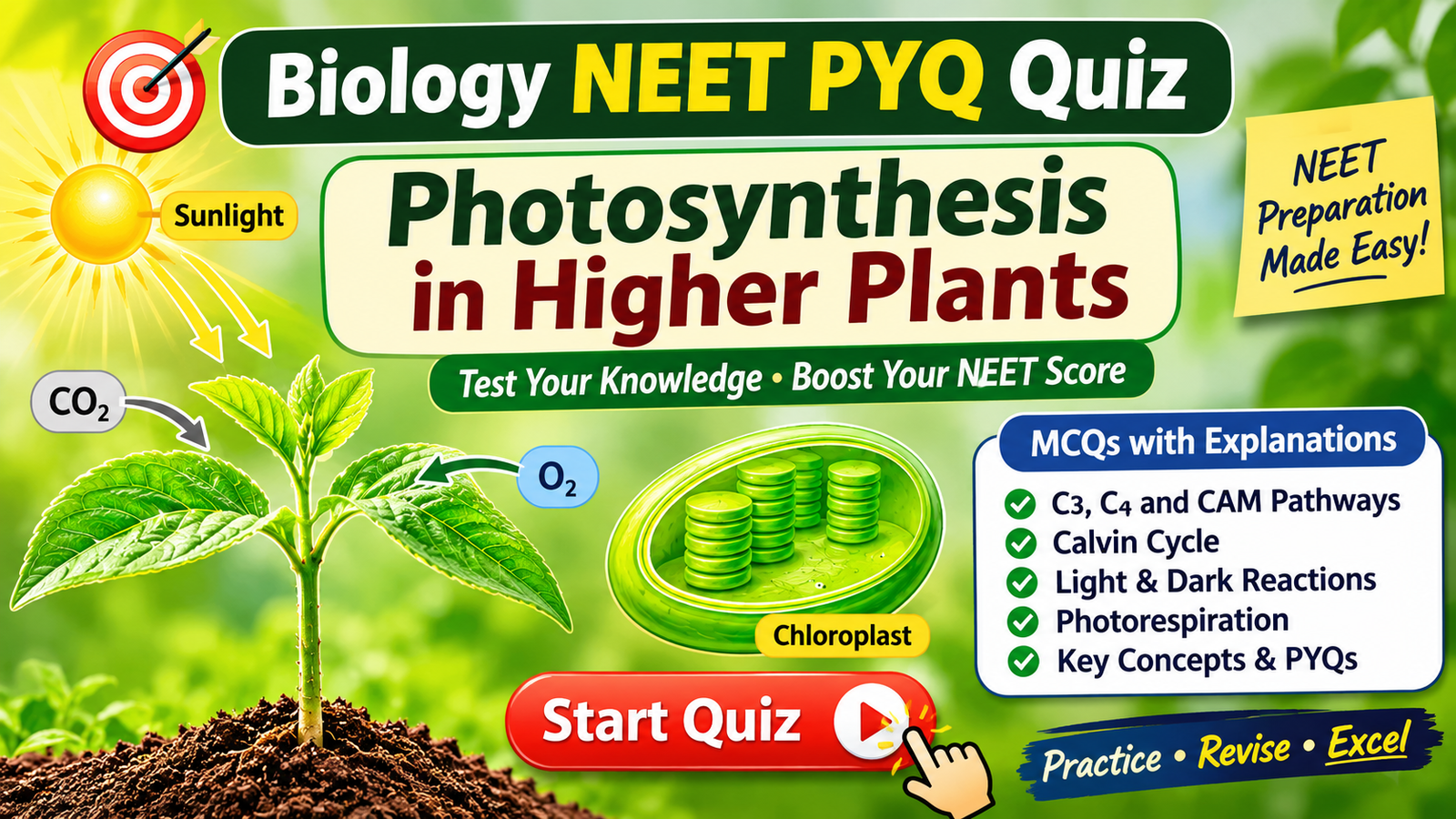
The principal photosynthetic organelle is the chloroplast.
3.1 Structure of Chloroplast
Chloroplasts are green plastids containing photosynthetic pigments.
A typical chloroplast consists of:
A. Envelope
Chloroplast is surrounded by two membranes.
The outer membrane is relatively permeable.
The inner membrane regulates the movement of substances into and out of the chloroplast.
The space between the two membranes is called the intermembrane space.
B. Stroma
The fluid-filled matrix inside the inner membrane.
Contains enzymes required for carbon fixation.
Contains circular DNA, RNA and 70S ribosomes.
Calvin cycle takes place in the stroma.
Starch grains and lipid droplets may also be present.
C. Thylakoids
Flattened, membrane-bound sacs inside the chloroplast.
Contain chlorophyll and other photosynthetic pigments.
Light-dependent reactions occur on the thylakoid membranes.
D. Grana
Stacks of thylakoids are called grana.
Singular: Granum.
Grana increase the surface area available for light-dependent reactions.
E. Stroma Lamellae
Membranous connections between different grana.
Also called intergranal lamellae.
Connect the thylakoid membranes of different grana.
NEET Important Points:
| Structure | Main function |
| Stroma | Carbon fixation |
| Thylakoid membrane | Light reaction |
| Grana | Stacks of thylakoids |
| Stroma lamellae | Connect grana |
| Chlorophyll | Absorption of light |
| Chloroplast DNA | Genetic information |
4. Photosynthetic Pigments
Photosynthetic pigments absorb light energy of different wavelengths.
The major photosynthetic pigments found in higher plants are:
- Chlorophyll a
- Chlorophyll b
- Xanthophylls
- Carotenoids
A. Chlorophyll a
It is the chief photosynthetic pigment.
Directly participates in the conversion of light energy into chemical energy.
It is blue-green in colour.
It is present in the reaction centres of photosystems.
B. Chlorophyll b
It is an accessory pigment.
It is yellow-green in colour.
It absorbs light at wavelengths that are not absorbed efficiently by chlorophyll a.
Transfers absorbed energy to chlorophyll a.
C. Carotenoids
Yellow, orange or yellow-orange pigments.
Act as accessory pigments.
Absorb light in the blue region.
Protect chlorophyll from photo-oxidative damage.
D. Xanthophylls
Yellow pigments.
Belong to the carotenoid group.
Help in light absorption and photoprotection.
Important: Chlorophyll a is the universal chief pigment of oxygenic photosynthesis.
5. Absorption Spectrum and Action Spectrum
These two concepts are important for NEET examinations.
Absorption Spectrum
It represents the amount of light absorbed by a photosynthetic pigment at different wavelengths.
Action Spectrum
It represents the effectiveness of different wavelengths of light in driving photosynthesis.
Important observations:
Photosynthesis is most effective in blue and red regions of the visible spectrum.
Green light is absorbed relatively poorly and is largely reflected or transmitted.
Chlorophyll a and chlorophyll b have different absorption spectra.
The action spectrum of photosynthesis broadly resembles the combined absorption spectra of photosynthetic pigments.
6. Light and Photosynthesis
Light is an essential factor for photosynthesis.
Important characteristics of light:
- Light intensity
- Light quality (wavelength)
- Duration of illumination
Photosynthesis generally increases with increasing light intensity until it reaches a saturation point.
At very high light intensities, the rate may decrease because of photoinhibition or damage to the photosynthetic machinery.
7. Photosynthetically Active Radiation (PAR)
Photosynthetically Active Radiation refers to the spectral region of light used by photosynthetic organisms.
Wavelength range: 400–700 nm.
It includes visible light.
Chlorophyll and accessory pigments absorb light within this region.
NEET Fact: Approximately 2–10% of the total incident solar radiation is PAR, as given in standard NCERT treatment.
8. Two Main Phases of Photosynthesis
Photosynthesis is broadly divided into two phases:
- Light-dependent reaction (Photochemical phase)
- Light-independent reaction (Biosynthetic phase)
| Feature | Light Reaction | Biosynthetic Phase |
| Other name | Photochemical phase | Dark reaction |
| Location | Thylakoid membrane | Stroma |
| Light | Directly required | Not directly required |
| Main events | ATP and NADPH formation | CO2 fixation |
| Oxygen | Released | Not released |
| Main products | ATP, NADPH, O2 | Carbohydrates |
Important clarification: The term dark reaction does not mean that it occurs only at night. The Calvin cycle does not directly require light, but it depends on ATP and NADPH produced during the light reaction.
9. Light-Dependent Reactions
The light-dependent reactions convert light energy into chemical energy in the form of ATP and NADPH.
They take place in the thylakoid membranes of chloroplasts.
The major events are:
- Absorption of light by photosynthetic pigments.
- Excitation of electrons.
- Splitting of water (photolysis).
- Electron transport.
- Formation of ATP.
- Reduction of NADP⁺ to NADPH.
9.1 Photosystems
A photosystem is a functional unit consisting of photosynthetic pigments, proteins and a reaction centre.
There are two major photosystems:
Photosystem II (PS II)
Reaction centre: P680.
Maximum absorption peak: 680 nm.
Functions before Photosystem I in non-cyclic electron transport.
Participates in the photolysis of water.
Replaces its lost electrons using electrons obtained from water.
Photosystem I (PS I)
Reaction centre: P700.
Maximum absorption peak: 700 nm.
Participates in both cyclic and non-cyclic photophosphorylation.
Helps in the reduction of NADP⁺ to NADPH during non-cyclic electron transport.
| Feature | Photosystem I | Photosystem II |
| Reaction centre | P700 | P680 |
| Absorption peak | 700 nm | 680 nm |
| Main function | Electron transfer towards NADP⁺ | Water oxidation and electron supply |
| Photophosphorylation | Cyclic and non-cyclic | Non-cyclic |
| Location | Grana and stroma lamellae | Mainly grana thylakoids |
Important: Although PS II is named Photosystem II, it acts before PS I in the non-cyclic electron transport chain.
9.2 Photolysis of Water
Photolysis means splitting of water molecules using light energy.
During the light reaction, water is split into electrons, protons and oxygen.
Overall representation:
2H₂O → 4H⁺ + 4e⁻ + O₂
Importance:
Supplies electrons to Photosystem II.
Provides protons for the proton gradient.
Releases oxygen as a by-product.
NEET Fact: Oxygen released during photosynthesis comes from water.
9.3 Electron Transport Chain
The electron transport chain consists of several electron carriers present in the thylakoid membrane.
Important components include:
- Photosystem II
- Plastoquinone (PQ)
- Cytochrome b6f complex
- Plastocyanin (PC)
- Photosystem I
- Ferredoxin (Fd)
- Ferredoxin-NADP⁺ reductase (FNR)
Sequence of non-cyclic electron transport:
PS II → Plastoquinone → Cytochrome b6f → Plastocyanin → PS I → Ferredoxin → NADP⁺ reductase.
The final electron acceptor is NADP⁺, which is reduced to NADPH.
9.4 Photophosphorylation
Photophosphorylation is the formation of ATP from ADP and inorganic phosphate using light energy.
Two types:
A. Cyclic Photophosphorylation
Only Photosystem I participates.
Electrons return to the same photosystem.
ATP is produced.
NADPH is not produced.
Oxygen is not released.
Photolysis of water does not occur.
B. Non-Cyclic Photophosphorylation
Both Photosystem II and Photosystem I participate.
Electrons do not return to their original photosystem.
ATP and NADPH are produced.
Oxygen is released.
Water undergoes photolysis.
| Feature | Cyclic | Non-Cyclic |
| Photosystem | PSI only | PSI and PSII |
| Electron flow | Cyclic | Linear |
| ATP | Yes | Yes |
| NADPH | No | Yes |
| Oxygen release | No | Yes |
| Photolysis | No | Yes |
9.5 Chemiosmotic Hypothesis
The chemiosmotic hypothesis explains ATP formation through the movement of protons across a membrane.
In chloroplasts, ATP synthesis occurs because of a proton gradient across the thylakoid membrane.
Three major events help establish this gradient:
- Splitting of water releases protons into the thylakoid lumen.
- Electron transport through the cytochrome b6f complex contributes to proton accumulation in the lumen.
- Reduction of NADP⁺ to NADPH removes protons from the stroma.
Consequently:
Proton concentration becomes higher inside the thylakoid lumen.
Proton concentration becomes lower in the stroma.
Protons move back into the stroma through ATP synthase.
ATP is synthesized from ADP and inorganic phosphate.
Important NEET Points:
CF₀ forms the membrane-embedded proton channel.
CF₁ is the catalytic portion of ATP synthase.
Proton movement through ATP synthase drives ATP formation.
10. Light-Independent Reactions: Calvin Cycle
The Calvin cycle is also known as the C3 cycle because the first stable product of carbon dioxide fixation is a three-carbon compound, 3-phosphoglyceric acid (3-PGA).
It occurs in the stroma of chloroplasts.
It was elucidated by Melvin Calvin, Andrew Benson and their colleagues.
The Calvin cycle consists of three major stages:
- Carboxylation
- Reduction
- Regeneration of RuBP
10.1 Carboxylation
Carbon dioxide combines with ribulose-1,5-bisphosphate (RuBP).
The reaction is catalysed by RuBisCO.
The unstable six-carbon intermediate immediately breaks down.
Two molecules of 3-PGA are formed.
RuBP + CO₂ → Unstable 6-carbon intermediate → 2 molecules of 3-PGA.
RuBisCO: Ribulose-1,5-bisphosphate carboxylase-oxygenase.
It is an important enzyme responsible for carbon fixation in the Calvin cycle.
10.2 Reduction
3-PGA is converted into glyceraldehyde-3-phosphate (G3P or PGAL).
ATP provides energy.
NADPH provides reducing power.
Some G3P molecules are used for carbohydrate synthesis.
10.3 Regeneration
The remaining G3P molecules are used to regenerate RuBP.
ATP is required.
RuBP is regenerated to continue the Calvin cycle.
10.4 Energy Requirement of Calvin Cycle
For fixation of 3 molecules of CO₂:
| Requirement | Number |
| CO₂ | 3 |
| ATP | 9 |
| NADPH | 6 |
| Net G3P | 1 molecule |
For the synthesis of one glucose molecule:
| Requirement | Number |
| CO₂ | 6 |
| ATP | 18 |
| NADPH | 12 |
| Net G3P | 2 molecules |
Important NEET calculation: One glucose molecule requires six turns of the Calvin cycle because each turn fixes one molecule of CO₂.
11. C3 Pathway and C4 Pathway
Plants are classified into C3 and C4 plants based on their initial carbon fixation products.
11.1 C3 Plants
In C3 plants, the first stable product of carbon fixation is 3-phosphoglyceric acid (3-PGA), which contains three carbon atoms.
Examples:
Wheat
Rice
Potato
Soybean
Sunflower
Characteristics:
- The primary CO₂ acceptor is RuBP.
- The first stable product is 3-PGA.
- RuBisCO catalyses the initial carbon fixation.
- The Calvin cycle occurs in mesophyll cells.
- Photorespiration may occur.
11.2 C4 Plants
In C4 plants, the first stable product of carbon fixation is a four-carbon compound, oxaloacetic acid (OAA).
Examples:
Maize
Sugarcane
Sorghum
Amaranthus
Characteristics:
- Primary CO₂ acceptor is phosphoenolpyruvate (PEP).
- The first stable product is oxaloacetic acid (OAA).
- Initial carbon fixation is catalysed by PEP carboxylase.
- Calvin cycle takes place in bundle sheath cells.
- Photorespiration is negligible under normal conditions because CO₂ is concentrated around RuBisCO.
11.3 Hatch and Slack Pathway
The C4 pathway is also called the Hatch-Slack pathway.
Steps:
- CO₂ combines with PEP in mesophyll cells.
- PEP carboxylase catalyses this reaction.
- Oxaloacetic acid is formed.
- OAA is converted into malate or aspartate.
- The four-carbon compound is transported to bundle sheath cells.
- CO₂ is released.
- The released CO₂ enters the Calvin cycle.
- The remaining three-carbon compound returns to mesophyll cells.
- PEP is regenerated using ATP.
11.4 Kranz Anatomy
Kranz anatomy is a special arrangement of cells found in the leaves of C4 plants.
Characteristics:
Vascular bundles are surrounded by large bundle sheath cells.
Bundle sheath cells contain numerous chloroplasts.
Mesophyll cells are arranged around the bundle sheath cells.
Two different types of cells participate in carbon fixation.
NEET Fact: Kranz means wreath or ring.
11.5 Difference Between C3 and C4 Plants
| Feature | C3 Plants | C4 Plants |
| First stable product | 3-PGA | OAA |
| Carbon atoms | 3 | 4 |
| Initial CO₂ acceptor | RuBP | PEP |
| Initial enzyme | RuBisCO | PEP carboxylase |
| Kranz anatomy | Absent | Present |
| Photorespiration | Considerable possibility | Negligible under normal conditions |
| CO₂ fixation | Mesophyll cells | Mesophyll and bundle sheath cells |
| ATP requirement per CO₂ fixed | 3 | 5 (overall pathway) |
| Examples | Wheat, rice | Maize, sugarcane |
12. Photorespiration
Photorespiration is a process in which RuBisCO acts as an oxygenase instead of a carboxylase.
It occurs when RuBisCO combines RuBP with oxygen rather than carbon dioxide.
The process involves three organelles:
- Chloroplast
- Peroxisome
- Mitochondrion
Important steps:
In chloroplasts, RuBisCO catalyses oxygenation of RuBP.
This produces one molecule of 3-PGA and one molecule of 2-phosphoglycolate.
Further reactions take place in peroxisomes and mitochondria.
CO₂ is released during the pathway.
Some previously fixed carbon is lost.
Characteristics:
- It is prominent in C3 plants under high temperature and low CO₂ conditions.
- It does not produce ATP.
- It does not produce sugars.
- It reduces photosynthetic efficiency.
- It does not occur significantly in C4 plants under normal conditions.
Important: Photorespiration is considered a wasteful process because it consumes oxygen and releases carbon dioxide without producing ATP or carbohydrates.
13. Factors Affecting Photosynthesis
Photosynthesis is influenced by external and internal factors.
13.1 External Factors
A. Light
Light intensity affects the rate of photosynthesis.
Photosynthesis increases with increasing light intensity up to a saturation point.
Excessively intense light can cause photoinhibition.
B. Carbon Dioxide Concentration
CO₂ is a raw material for photosynthesis.
Increasing CO₂ concentration can increase the rate of photosynthesis up to a certain limit.
C3 plants generally respond more strongly to elevated CO₂ than C4 plants under comparable conditions.
C. Temperature
Photosynthesis is an enzyme-controlled process.
Temperature affects enzyme activity.
C4 plants generally have higher temperature optima than C3 plants.
D. Water
Water is a raw material for photosynthesis.
Water deficiency causes stomatal closure.
Stomatal closure reduces CO₂ entry into leaves.
Severe water stress decreases photosynthesis.
13.2 Internal Factors
- Number and size of leaves.
- Chlorophyll content.
- Internal CO₂ concentration.
- Leaf anatomy.
- Age of leaves.
- Enzyme activity.
14. Blackman’s Law of Limiting Factors
F.F. Blackman proposed the law of limiting factors in 1905.
According to this law, when a process is controlled by several factors, its rate is limited by the factor that is nearest to its minimum value.
For example:
If light, water and CO₂ are all required for photosynthesis but CO₂ is insufficient, increasing light alone may not increase the rate of photosynthesis.
NEET Fact: The factor present in the shortest supply relative to its requirement becomes the limiting factor.
15. Important Comparisons for NEET
| Concept | Correct fact |
| P680 | Reaction centre of PS II |
| P700 | Reaction centre of PS I |
| Oxygen source | Water |
| First stable C3 product | 3-PGA |
| First stable C4 product | OAA |
| Calvin cycle location | Stroma |
| Light reaction location | Thylakoid membrane |
| C3 CO₂ acceptor | RuBP |
| C4 CO₂ acceptor | PEP |
| C3 initial enzyme | RuBisCO |
| C4 initial enzyme | PEP carboxylase |
| Cyclic photophosphorylation | PSI only |
| Non-cyclic photophosphorylation | PSI and PSII |
| PAR | 400–700 nm |
| Calvin cycle discoverer | Melvin Calvin and colleagues |
| Limiting factor law | Blackman |
16. Important NCERT-Based Revision Points
- Chlorophyll a is the chief photosynthetic pigment.
- Chlorophyll b, carotenoids and xanthophylls are accessory pigments.
- Photosystem II has P680 as its reaction centre.
- Photosystem I has P700 as its reaction centre.
- Photolysis of water occurs in the light-dependent reaction.
- Oxygen released during photosynthesis comes from water.
- ATP synthesis is associated with the chemiosmotic mechanism.
- Calvin cycle occurs in the chloroplast stroma.
- RuBisCO functions as both carboxylase and oxygenase.
- The first stable product in C3 plants is 3-PGA.
- The first stable product in C4 plants is OAA.
- PEP carboxylase fixes CO₂ in C4 plants.
- C4 plants possess Kranz anatomy.
- Photorespiration involves chloroplasts, peroxisomes and mitochondria.
- C4 plants generally show higher photosynthetic efficiency under high-temperature conditions.