GUMROAD eBook link:-
BY SHAILENDRA KUMAR VERMA
| Affiliate link of GUMROAD eBook | |
| https://skverma29.gumroad.com/affiliates | |
| 1. | CHALLENGING SYLLOGISM |
| https://skverma29.gumroad.com/l/ktxvzi | |
| 2. | STRAIT OF HORMUZ: STRATEGIC & ECONOMIC ROLE |
| https://skverma29.gumroad.com/l/upobrv | |
| 4. | STATIC GENERAL KNOWLEDGE |
| https://skverma29.gumroad.com/l/kzmca | |
| 5. | SSC ENGLISH PREVIOUS YEAR QUESTIONS MCQ |
| https://skverma29.gumroad.com/l/vtotyp | |
| 6. | SSC REASONING PREVIOUS YEAR QUESTIONS MCQ |
| https://skverma29.gumroad.com/l/fsyvp | |
| 7. | SSC MATH PREVIOUS YEAR QUESTIONS (MCQ): TIER I |
| https://skverma29.gumroad.com/l/nesioq | |
| 8. | BANKING KNOWLEDGE QUESTIONS AND ANSWERS MCQ |
| https://skverma29.gumroad.com/l/sgbbul | |
| 9. | BIHAR ANM, GNM & PHARMACIST EXAM: PAST MCQ QUESTIONS & ANSWERS – |
| https://skverma29.gumroad.com/l/yotjat | |
| 10. | ARAVALLI MOUNTAIN RANGE: THE ANCIENT SPINE OF INDIA |
| https://skverma29.gumroad.com/l/khpakf | |
| 11. | मौर्य काल (322 ईसा पूर्व – 185 ईसा पूर्व): पीएसयू परीक्षा हेतु प्रश्नोत्तर सहित विस्तृत अध्ययन |
| https://skverma29.gumroad.com/l/kgmrw | |
| 12. | VOLCANOES AND EARTHQUAKES: A COMPLETE GUIDE |
| https://share.google/gMZLAnx4hcCV82NTI | |
| 13. | TERMINOLOGY: RAILWAY, COMPUTER, SHARE MARKET, BIOLOGY, BADMINTON, CRICKET, FOOTBALL, KABBADI AND HOCKEY |
| https://share.google/fvdFN53HtyXlqTCgd | |
| 14. | भारतीय संसद का सत्र: प्रक्रिया, नियमऔर एस ओ पी; पी एस यू परीक्षा के लिए संपूर्ण मार्ग दर्शिका |
| https://share.google/1HFwXZA3qUiKyrI1l | |
| 15. | REITs AND InvITs IN INDIA: COMPLETE GUIDE (SCOPE, RISKS & FUTURE) |
| https://share.google/EChDc9heQmPPeyhoi | |
| 16. | GK SSC TIER I PREVIOUS YEAR MCQ |
| https://share.google/5pLzqYKQtg822wk3Y | |
| 17. | PETROLEUM REFINERY PROCESS: WITH 200 MCQ |
| https://skverma29.gumroad.com/l/jgydi | |
| 18. | SET THEORY: A COMPLETE GUIDE WITH 400 MCQ |
| https://skverma29.gumroad.com/l/zkhqzm | |
| 19. | WORLD’S SMALLEST, LONGEST, THINNEST, THICKEST AND TALLEST |
| https://skverma29.gumroad.com/l/kzaenh | |
| 20. | HIGH TIDE AND LOW TIDE: A COMPLETE GUIDE https://skverma29.gumroad.com/l/virke |
| 21. | 1000 HISTORY QESTIONS & ANSWERS FOR PSU |
| https://skverma29.gumroad.com/l/fjapus | |
| 22. | नालंदा विश्वविद्यालय : सम्पूर्ण अध्ययन |
| https://skverma29.gumroad.com/l/pmjab?wanted=true | |
| 23. | भगवान शिव के 12 ज्योतिर्लिंग: इतिहास, महत्व और दर्शन क्रम |
| https://skverma29.gumroad.com/l/wdkgo | |
| 24 | NISM-SERIES-V-A MUTUAL FUND DISTRIBUTOR: COMPLETE STUDY GUIDE & EXAM PREPARATION |
| https://skverma29.gumroad.com/l/qgcviu | |
| 25. | WORKSHOP TECHNOLOGY & MANUFACTURING PROCESSES COMPLETE EXAM GUIDE |
| https://skverma29.gumroad.com/l/xvqxnp | |
| 26. | उगना महादेव और महाकवि विद्यापति |
| https://skverma29.gumroad.com/l/xjehig | |
| 27. | FINANCIAL INCLUSION (FI), MICROFINANCE AND SOCIAL SECURITY IN INDIA:A COMPLETE GUIDE |
| https://skverma29.gumroad.com/l/lpendf | |
| 28. | Vermaji’s Cute Animals Coloring Book |
| https://skverma29.gumroad.com/l/chrxrc | |
| 29. | Verma Ji’s Cute Birds Coloring Book |
| https://skverma29.gumroad.com/l/tdnqyi | |
| 30. | राजभाषा हिंदी :सम्पूर्ण अध्ययन एवं प्रतियोगी परीक्षा मार्गदर्शिका |
| https://skverma29.gumroad.com/l/fvodlm | |
AMAZON eBook link:-
BY SHAILENDRA KUMAR VERMA
| 1. | SSC MATH PREVIOUS YEAR MCQ: SSC MATH |
| https://amzn.in/d/097Ocsnl | |
| 2. | SSC REASONING PREVIOUS YEAR MCQ: SSC REASONING |
| https://amzn.in/d/00EHQGE8 | |
| 3. | SSC ENGLISH PREVIOUS YEAR MCQ: SSC ENGLISH |
| https://amzn.in/d/0f8sxJoy | |
| 4. | STATIC GENERAL KNOWLEDGE : WITH 620 MCQs |
| https://amzn.in/d/09xNEWmt |
PLAYSTORE eBook link:-
BY SHAILENDRA KUMAR VERMA
| 1. | SSC MATH PREVIOUS YEAR MCQ |
| https://share.google/KzWbvkFuNk51PEpiu | |
| 2. | SSC REASONING PREVIOUS YEAR MCQ |
| https://play.google.com/books/publish/a/12574378860292240754#book/GGKEY:EUPQZ9ZUAFR/review | |
| 3. | STATIC GENERAL KNOWLEDGE |
| https://play.google.com/books/publish/a/12574378860292240754#book/GGKEY:CQDT2G4CCQP/review | |
| 4. | CHALLENGING SYLLOGISM |
| https://share.google/w9xLMwyiJdNVnpHxI | |
| 5. | STRAIT OF HORMUZ: STRATEGIC & ECONOMIC ROLE |
| https://share.google/V10H7UKeTkstLIMmc | |
| 6. | BIHAR TEACHER ELIGIBILITY TEST (BIHAR TET) : COMPLETE GUIDE |
| https://share.google/AcCXPFa69dAWyYaZZ | |
| 7. | SSC ENGLISH PREVIOUS YEAR MCQ |
| https://share.google/pr7b0YhDoDwttaq2s | |
| 8. | BANKING KNOWLEDGE QUESTIONS AND ANSWERS MCQ |
| https://share.google/yqYOabKhNppcz89hl | |
| 9. | BIHAR ANM, GNM & PHARMACIST EXAM: PAST MCQ QUESTIONS & ANSWERS – |
| https://share.google/NFhtU1JoBfxPS4wa3 | |
| 10. | ARAVALLI MOUNTAIN RANGE: THE ANCIENT SPINE OF INDIA |
| https://share.google/Yo4RYnaZrbRu9qwzj | |
| 11. | GK SSC TIER I PREVIOUS YEAR MCQ |
| https://share.google/sBdCcsEeebM44QZ0X | |
| 12. | REITs AND InvITs IN INDIA: COMPLETE GUIDE (SCOPE, RISKS & FUTURE) |
| https://share.google/XAwUio1deUOxFe2M7 | |
| 13. | भारतीय संसद का सत्र: प्रक्रिया, नियमऔर एस ओ पी ; पी एस यू परीक्षा के लिए संपूर्ण मार्ग दर्शिका |
| https://share.google/6XVrfQ2PcuWmqvKol | |
| 14. | मौर्य काल (322 ईसा पूर्व – 185 ईसा पूर्व): पीएसयू परीक्षा हेतु प्रश्नोत्तर सहित विस्तृत अध्ययन |
| https://share.google/Lwu7JKHE54kxsL5e2 | |
| 15. | TERMINOLOGY: RAILWAY, COMPUTER, SHARE MARKET, BIOLOGY, BADMINTON, CRICKET, FOOTBALL, KABBADI AND HOCKEY |
| https://share.google/WWVO9ZFd81R9G9h69 | |
| 16. | VOLCANOES AND EARTHQUAKES: A COMPLETE GUIDE |
| https://share.google/aXi2evRVgmzpQguye | |
| 17. | PETROLEUM REFINERY PROCESS: WITH 200 MCQ |
| https://play.google.com/books/publish/u/0/a/12574378860292240754#book/GGKEY:P34SQBHUJ7F/review | |
| 18. | SET THEORY: A COMPLETE GUIDE WITH 400 MCQ |
| https://play.google.com/books/publish/u/0/a/12574378860292240754#book/GGKEY:83LKH7QHRQH/review | |
| 19. | WORLD’S SMALLEST, LONGEST, THINNEST, THICKEST AND TALLEST |
| https://play.google.com/books/publish/u/0/a/12574378860292240754#book/GGKEY:9LE49HEDZJE/review | |
| 20. | HIGH TIDE AND LOW TIDE: A COMPLETE GUIDE |
| https://play.google.com/books/publish/u/0/a/12574378860292240754#book/GGKEY:TKR79QBDE7R/review | |
| 21. | 1000 HISTORY QESTIONS & ANSWERS FOR PSU |
| https://play.google.com/books/publish/u/0/a/12574378860292240754#book/GGKEY:1SGWQKT7BDF/review | |
| 22. | नालंदा विश्वविद्यालय : सम्पूर्ण अध्ययन |
| https://play.google.com/books/publish/u/0/a/12574378860292240754#book/GGKEY:RY0EDLDK7TL/review | |
| 23. | भगवान शिव के 12 ज्योतिर्लिंग: इतिहास, महत्व और दर्शन क्रम |
| https://play.google.com/books/publish/u/0/a/12574378860292240754#book/GGKEY:KNT0X6L8YCQ/review | |
| 24. | NISM-SERIES-V-A MUTUAL FUND DISTRIBUTOR: COMPLETE STUDY GUIDE & EXAM PREPARATION |
| https://play.google.com/books/publish/u/0/a/12574378860292240754#book/GGKEY:YP1PQ8RQY07/review | |
| 25. | WORKSHOP TECHNOLOGY & MANUFACTURING PROCESSES COMPLETE EXAM GUIDE |
| https://play.google.com/books/publish/u/0/a/12574378860292240754#book/GGKEY:PK621P1ZHXX/review | |
| 26. | उगना महादेव और महाकवि विद्यापति |
| https://play.google.com/books/publish/u/0/a/12574378860292240754#book/GGKEY:QXG2TUGW955/review | |
| 27. | FINANCIAL INCLUSION (FI), MICROFINANCE AND SOCIAL SECURITY IN INDIA:A COMPLETE GUIDE |
| 28. | Vermaji’s Cute Animals Coloring Book eBook |
| https://play.google.com/books/publish/u/0/a/12574378860292240754#book/GGKEY:WFBA8EL20KT/review | |
| 29. | Verma Ji’s Cute Birds Coloring Book Paperback |
| https://play.google.com/books/publish/u/0/a/12574378860292240754#book/GGKEY:TYQCU6P32GE/review | |
| 30 | Verma Ji’s Cute Birds Coloring Book eBook |
| https://play.google.com/books/publish/u/0/a/12574378860292240754#book/GGKEY:KXY8L92YX97/review | |
| 31. | Vermaji’s Cute Animals Coloring Book Paperback |
| https://play.google.com/books/publish/u/0/a/12574378860292240754#book/GGKEY:Z5E48HP2H19/review | |
| 32. | राजभाषा हिंदी :सम्पूर्ण अध्ययन एवं प्रतियोगी परीक्षा मार्गदर्शिका |
| https://play.google.com/books/publish/u/0/a/12574378860292240754#book/GGKEY:8UEG8EUW718/review |
| OPEN DMAT ACCONT FROM THI LINK IN ANGEL ONE:- |
| Open your Trading & Investment account with Angel One for FREE* |
| You will get: |
| All trades in Rs.20 |
| Quick SIP in Direct MF |
| 1Lac MTF @ 0% interest |
| Download only using my referral link to get Free Demat Account⬇ |
| https://angel-one.onelink.me/Wjgr/2o2au42h |
| _link may expire within 48hrs_ |
| _T&C Apply_ |
| CLICK TO APPLY: |
| Click the application link below: 👉 Apply Here for SBI Credit Card (Referral Code: 243zfQ0yYm3) |
| OPEN DMAT ACCOUNT FROM THIS LINK: |
| HI THERE, I SEE YOU HAVEN’T BOUGHT THE FREEDOM PLAN ON INDIAN BANK YET. DON’T MISS OUT ON UNLIMITED TRADING AT A POCKET-FRIENDLY COST. GO BROKERAGE-FREE AND SAVE BIG WITH THE FREEDOM PLAN. USE MY REFERRAL CODE, SHAI0634 TO DOWNLOAD THE APP NOW. |
| https://play.google.com/store/apps/details?id=com.finwizard.fisdom |
PART 1: COMPLETE THEORY
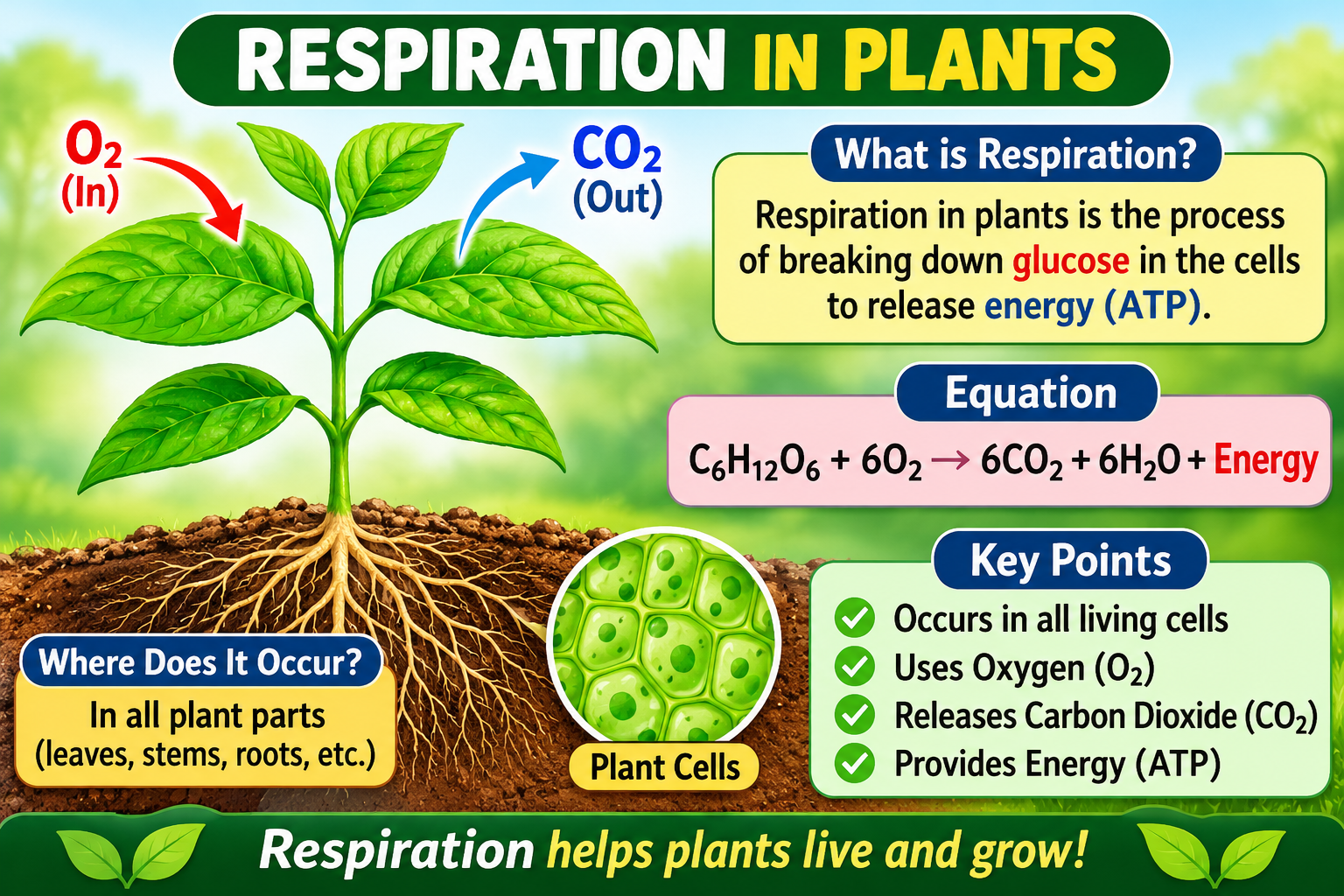
1. Introduction to Respiration in Plants
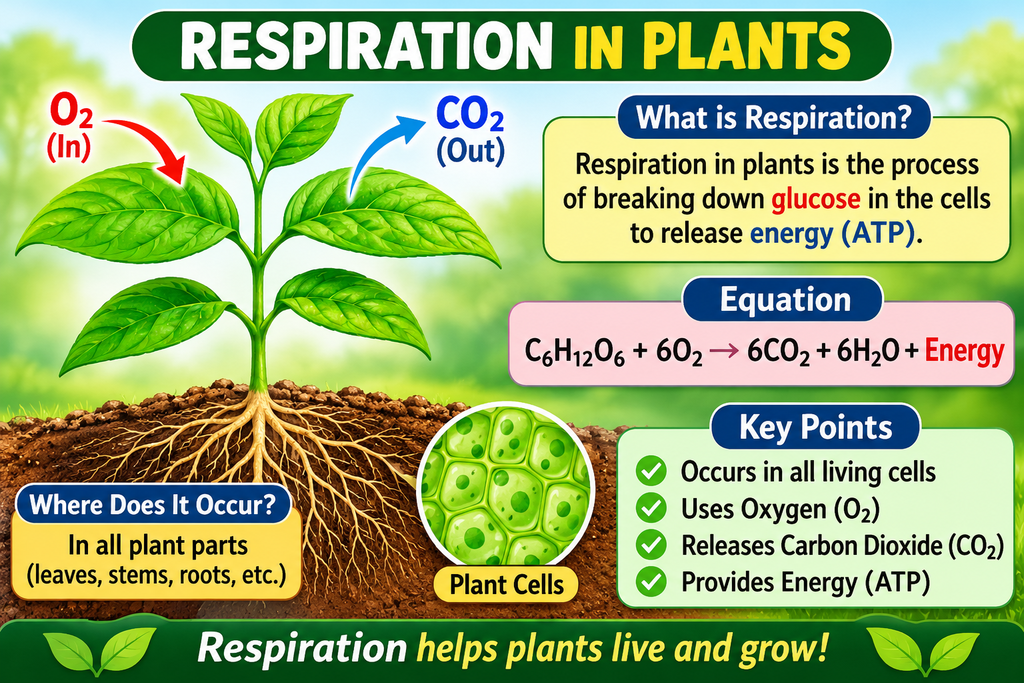
Respiration is a biochemical process in which food substances, particularly carbohydrates, are broken down inside living cells to release energy.
The released energy is stored mainly in the form of ATP (Adenosine Triphosphate), which is used to perform various metabolic activities.
All living cells require energy for:
Growth and development.
Cell division.
Active transport.
Absorption of minerals.
Synthesis of proteins and other biomolecules.
Movement and other cellular activities.
Plants, like animals, continuously respire to obtain energy.
Important: Plants do not have specialised respiratory organs such as lungs or gills. Gaseous exchange occurs mainly through stomata, lenticels and root surfaces by diffusion.
2. Difference Between Respiration and Photosynthesis
Photosynthesis and respiration are two important metabolic processes in plants.
| Photosynthesis | Respiration |
| Food is synthesised. | Food is broken down. |
| Energy is stored. | Energy is released. |
| Occurs in chloroplasts. | Mainly occurs in cytoplasm and mitochondria. |
| Requires light for the light-dependent reactions. | Does not directly require light. |
| Carbon dioxide is consumed. | Carbon dioxide is released during aerobic respiration. |
| Oxygen is released. | Oxygen is consumed during aerobic respiration. |
Important NEET Point: Photosynthesis occurs only in photosynthetic cells, whereas respiration occurs in all living cells.
3. Types of Respiration
Based on the requirement of oxygen, respiration is classified into two main types.
3.1 Aerobic Respiration
Aerobic respiration is the process in which glucose is completely oxidised in the presence of oxygen to produce carbon dioxide, water and energy.
The overall equation is:
C₆H₁₂O₆ + 6O₂ → 6CO₂ + 6H₂O + Energy (ATP)
Characteristics:
- Requires oxygen.
- Complete oxidation of glucose takes place.
- Carbon dioxide and water are the final products.
- Produces a comparatively large amount of ATP.
- In eukaryotic cells, glycolysis occurs in the cytoplasm, while subsequent major stages occur in mitochondria.
3.2 Anaerobic Respiration
Anaerobic respiration refers to the breakdown of glucose in the absence of oxygen.
In many textbook examples, fermentation is used to explain anaerobic breakdown of glucose.
Two important types are:
A. Alcoholic Fermentation
It occurs in yeast and some microorganisms.
Glucose → Ethanol + Carbon dioxide + Energy
The process involves two major steps:
- Pyruvic acid is converted into acetaldehyde with the release of CO₂.
- Acetaldehyde is reduced to ethanol by NADH.
B. Lactic Acid Fermentation
It occurs in certain bacteria and in oxygen-deficient animal muscle cells.
Pyruvic acid + NADH → Lactic acid + NAD⁺
Important points:
No carbon dioxide is released during lactic acid fermentation.
NAD⁺ is regenerated.
Fermentation yields a net gain of 2 ATP per glucose molecule through glycolysis.
4. Respiratory Quotient (RQ)
Respiratory Quotient is the ratio of the volume of carbon dioxide (CO2) released to the volume of oxygen (O2) consumed during respiration.
Formula:
RQ = Volume of CO2 released / Volume of O2 consumed
In simple words:
RQ tells us how much carbon dioxide is produced compared to the amount of oxygen used during respiration.
The RQ value depends upon the nature of the respiratory substrate.
| Respiratory substrate | RQ value |
| Carbohydrates | 1.0 |
| Fats | Less than 1 |
| Proteins | Approximately 0.8–0.9 |
| Organic acids | Usually greater than 1 |
| Anaerobic respiration | Not defined by the usual aerobic RQ calculation |
Examples:
For glucose:
C₆H₁₂O₆ + 6O₂ → 6CO₂ + 6H₂O
RQ = 6/6 = 1
For fats, more oxygen is generally required for complete oxidation relative to the carbon dioxide released; therefore, RQ is usually less than 1.
NEET Important
RQ of carbohydrates = 1, fats = less than 1 and organic acids = generally greater than 1.
5. Glycolysis
Glycolysis is the first step of cellular respiration in which one molecule of glucose (6-carbon compound) is broken down into two molecules of pyruvic acid (3-carbon compounds).
It is also known as the EMP pathway (Embden–Meyerhof–Parnas pathway).
Location: Cytoplasm (cytosol) of the cell.
Important characteristics:
- It occurs in both aerobic and anaerobic respiration.
- It does not directly require oxygen.
- One glucose molecule produces two molecules of pyruvic acid.
- Two ATP molecules are consumed.
- Four ATP molecules are produced.
- Net gain is 2 ATP molecules.
- Two NADH molecules are produced.
5.1 Major Steps of Glycolysis
Glycolysis consists of ten enzyme-catalysed reactions.
Phase I: Energy Investment Phase
Step 1: Glucose is converted into glucose-6-phosphate.
Enzyme: Hexokinase (or glucokinase in certain tissues).
ATP is consumed.
Step 2: Glucose-6-phosphate is converted into fructose-6-phosphate.
Enzyme: Phosphoglucose isomerase.
Step 3: Fructose-6-phosphate is converted into fructose-1,6-bisphosphate.
Enzyme: Phosphofructokinase-1 (PFK-1).
ATP is consumed.
Phase II: Splitting Phase
Step 4: Fructose-1,6-bisphosphate is split into two three-carbon compounds:
Glyceraldehyde-3-phosphate (PGAL or G3P).
Dihydroxyacetone phosphate (DHAP).
Enzyme: Aldolase.
Step 5: DHAP is converted into G3P.
Enzyme: Triose phosphate isomerase.
At this stage, two molecules of G3P are available from one glucose molecule.
Phase III: Energy Generation Phase
Step 6: G3P is oxidised to 1,3-bisphosphoglycerate.
Enzyme: Glyceraldehyde-3-phosphate dehydrogenase.
Two NADH molecules are formed per glucose molecule.
Step 7: 1,3-bisphosphoglycerate is converted into 3-phosphoglycerate.
Enzyme: Phosphoglycerate kinase.
ATP is produced by substrate-level phosphorylation.
Step 8: 3-phosphoglycerate is converted into 2-phosphoglycerate.
Enzyme: Phosphoglycerate mutase.
Step 9: 2-phosphoglycerate is converted into phosphoenolpyruvate (PEP).
Enzyme: Enolase.
Water is released.
Step 10: PEP is converted into pyruvic acid.
Enzyme: Pyruvate kinase.
ATP is produced.
5.2 Net Gain During Glycolysis
| Component | ATP/NADH |
| ATP consumed | 2 |
| ATP produced | 4 |
| Net ATP gain | 2 |
| NADH produced | 2 |
| Pyruvic acid produced | 2 |
Overall simplified equation:
Glucose + 2ADP + 2Pi + 2NAD⁺
→ 2 Pyruvate + 2ATP + 2NADH + 2H⁺ + 2H₂O
NEET Important
One glucose molecule produces two pyruvate molecules, two net ATP and two NADH during glycolysis.
6. Fermentation
Fermentation is an anaerobic process in which pyruvic acid is converted into simpler organic products such as ethanol or lactic acid.
It takes place in the absence of oxygen.
6.1 Alcoholic Fermentation
Alcoholic fermentation commonly occurs in yeast.
It involves two major reactions.
Reaction 1: Decarboxylation
Pyruvic acid → Acetaldehyde + CO₂
Enzyme: Pyruvate decarboxylase.
Reaction 2: Reduction
Acetaldehyde + NADH + H⁺ → Ethanol + NAD⁺
Enzyme: Alcohol dehydrogenase.
Overall:
Glucose → 2 Ethanol + 2CO₂ + Energy
6.2 Lactic Acid Fermentation
Lactic acid fermentation occurs in certain bacteria and oxygen-deficient animal muscle cells.
Reaction:
2 Pyruvate + 2NADH + 2H⁺
→ 2 Lactate + 2NAD⁺
Enzyme: Lactate dehydrogenase.
Important differences
| Alcoholic fermentation | Lactic acid fermentation |
| Produces ethanol | Produces lactic acid |
| Releases CO₂ | Does not release CO₂ |
| Common in yeast | Common in lactic acid bacteria |
| Involves acetaldehyde | Does not involve acetaldehyde as an intermediate |
6.3 Energy Yield in Fermentation
Fermentation itself does not produce additional ATP beyond glycolysis.
The net gain is:
2 ATP molecules per glucose molecule.
The main purpose of fermentation is to regenerate NAD⁺ so that glycolysis can continue.
6.4 Limitations of Fermentation
- It is an incomplete oxidation process.
- It produces very little ATP.
- Ethanol accumulation can be toxic to yeast.
- The energy remaining in the final products is not completely extracted.
7. Aerobic Respiration
Aerobic respiration is the complete oxidation of glucose in the presence of oxygen.
It involves four major stages:
- Glycolysis.
- Formation of acetyl-CoA (link reaction).
- Krebs cycle.
- Electron transport system and oxidative phosphorylation.
7.1 Oxidative Decarboxylation of Pyruvate
After glycolysis, pyruvic acid enters the mitochondrial matrix in eukaryotic cells.
Each pyruvate molecule is converted into acetyl-CoA.
This process is called oxidative decarboxylation.
Reaction:
Pyruvate + CoA + NAD⁺
→ Acetyl-CoA + CO₂ + NADH + H⁺
Enzyme system: Pyruvate dehydrogenase complex.
Products from one glucose molecule:
2 Acetyl-CoA.
2 CO₂.
2 NADH.
NEET Point: Acetyl-CoA is the connecting link between glycolysis and the Krebs cycle.
7.2 Krebs Cycle (Citric Acid Cycle or TCA Cycle)
The Krebs cycle is a cyclic series of biochemical reactions in which acetyl-CoA is oxidised to carbon dioxide.
It was discovered by Sir Hans Adolf Krebs.
Location: Mitochondrial matrix in eukaryotic cells.
Important exception: Succinate dehydrogenase is located in the inner mitochondrial membrane.
Steps of Krebs Cycle
Step 1: Formation of Citrate
Acetyl-CoA (2C) combines with oxaloacetic acid (4C) to form citric acid (6C).
Enzyme: Citrate synthase.
Step 2: Formation of Isocitrate
Citrate is converted into isocitrate.
Enzyme: Aconitase.
Step 3: Formation of Alpha-Ketoglutarate
Isocitrate undergoes oxidative decarboxylation to form alpha-ketoglutarate (5C).
Products:
CO₂.
NADH.
Enzyme: Isocitrate dehydrogenase.
Step 4: Formation of Succinyl-CoA
Alpha-ketoglutarate undergoes oxidative decarboxylation to form succinyl-CoA (4C).
Products:
CO₂.
NADH.
Enzyme: Alpha-ketoglutarate dehydrogenase complex.
Step 5: Formation of Succinate
Succinyl-CoA is converted into succinate.
Enzyme: Succinyl-CoA synthetase.
GTP or ATP is formed through substrate-level phosphorylation, depending on the system.
Step 6: Formation of Fumarate
Succinate is oxidised to fumarate.
Enzyme: Succinate dehydrogenase.
FAD is reduced to FADH₂.
Step 7: Formation of Malate
Fumarate is converted into malate.
Enzyme: Fumarase.
Water is added.
Step 8: Regeneration of Oxaloacetate
Malate is oxidised to oxaloacetate.
Enzyme: Malate dehydrogenase.
NADH is produced.
The regenerated oxaloacetate combines with another acetyl-CoA molecule, and the cycle continues.
7.3 Products of One Turn of Krebs Cycle
One acetyl-CoA molecule produces:
| Product | Quantity |
| CO₂ | 2 |
| NADH | 3 |
| FADH₂ | 1 |
| GTP/ATP | 1 |
Since one glucose molecule produces two acetyl-CoA molecules, the Krebs cycle operates twice per glucose molecule.
Products per glucose:
| Product | Quantity |
| CO₂ | 4 |
| NADH | 6 |
| FADH₂ | 2 |
| GTP/ATP | 2 |
NEET Important
The Krebs cycle produces 3 NADH, 1 FADH₂, 1 GTP/ATP and 2 CO₂ per acetyl-CoA.
8. Electron Transport System (ETS)
The electron transport system is a series of electron carriers located in the inner mitochondrial membrane.
Electrons from NADH and FADH₂ are transferred through different complexes and finally accepted by oxygen.
8.1 Major Components of ETS
Complex I – NADH Dehydrogenase
Receives electrons from NADH.
Transfers electrons to ubiquinone.
Pumps protons across the inner mitochondrial membrane.
Complex II – Succinate Dehydrogenase
Receives electrons from FADH₂ generated during succinate oxidation.
Transfers electrons to ubiquinone.
Does not pump protons.
Complex III – Cytochrome bc₁ Complex
Transfers electrons from reduced ubiquinone to cytochrome c.
Pumps protons.
Complex IV – Cytochrome c Oxidase
Transfers electrons to oxygen.
Oxygen acts as the final electron acceptor.
Water is formed.
Pumps protons.
Ubiquinone (Coenzyme Q): A mobile electron carrier that transfers electrons from Complex I and Complex II to Complex III.
Cytochrome c: A mobile electron carrier that transfers electrons from Complex III to Complex IV.
8.2 ATP Synthase (Complex V)
ATP synthase is located in the inner mitochondrial membrane.
It has two major components:
F₀: Embedded in the membrane and forms the proton channel.
F₁: Projects into the mitochondrial matrix and contains the catalytic site for ATP synthesis.
Protons move down their electrochemical gradient through F₀, causing conformational changes in F₁ that facilitate ATP formation.
ADP + Pi → ATP
9. Oxidative Phosphorylation
Oxidative phosphorylation is the process of ATP synthesis using the energy released during electron transport.
The chemiosmotic hypothesis was proposed by Peter Mitchell.
According to this hypothesis:
- Electron transport releases energy.
- This energy is used to pump protons from the mitochondrial matrix to the intermembrane space.
- A proton gradient is established across the inner mitochondrial membrane.
- Protons move back into the matrix through ATP synthase.
- The energy released drives ATP synthesis.
Important NEET facts:
The inner mitochondrial membrane is the site of ETS.
The intermembrane space accumulates protons.
Oxygen is the terminal electron acceptor.
Water is formed at Complex IV.
ATP synthase is also known as Complex V.
10. Respiratory Balance Sheet
A respiratory balance sheet represents the ATP and reduced coenzymes produced during the complete oxidation of one glucose molecule.
10.1 Traditional NCERT Calculation
The traditional theoretical calculation uses:
1 NADH = 3 ATP.
1 FADH₂ = 2 ATP.
| Stage | ATP directly produced | NADH | FADH₂ |
| Glycolysis | 2 | 2 | 0 |
| Pyruvate oxidation | 0 | 2 | 0 |
| Krebs cycle (two turns) | 2 | 6 | 2 |
| Total | 4 | 10 | 2 |
Traditional theoretical ATP calculation:
10 NADH × 3 = 30 ATP.
2 FADH₂ × 2 = 4 ATP.
Direct ATP/GTP = 4 ATP.
Total = 38 ATP (theoretical maximum under the traditional calculation).
Some older textbooks and examination questions use 36 ATP for eukaryotic respiration because of the accounting of cytosolic NADH.
Modern biochemical understanding: The actual ATP yield is not a fixed 36 or 38. It is generally estimated at approximately 30–32 ATP per glucose in many eukaryotic cells, depending on the shuttle system and cellular conditions.
Important for NEET: Understand the NCERT convention and the exact wording of the question. Do not confuse the traditional theoretical balance sheet with actual cellular ATP yield.
11. Amphibolic Pathway
The respiratory pathway is called an amphibolic pathway because it participates in both catabolism and anabolism.
Catabolism: Breakdown of molecules to release energy.
Anabolism: Synthesis of complex molecules from simpler substances.
Examples:
A. Carbohydrates
Carbohydrates are broken down into glucose, which enters glycolysis.
B. Fats
Fats are broken down into glycerol and fatty acids.
Glycerol enters glycolysis after conversion into an intermediate.
Fatty acids undergo beta-oxidation to form acetyl-CoA.
C. Proteins
Proteins are broken down into amino acids.
After deamination, their carbon skeletons can enter respiration at different stages.
Important NEET Point: The respiratory pathway is not exclusively catabolic because its intermediates are also used in biosynthetic processes.
12. Respiratory Quotient (RQ): Advanced Concepts
RQ is calculated as:
RQ = CO₂ evolved / O₂ consumed
| Substrate | RQ |
| Glucose | 1.0 |
| Sucrose | 1.0 |
| Tripalmitin (fat) | Less than 1 |
| Proteins | Approximately 0.8–0.9 |
| Organic acids | Greater than 1 |
For example, complete oxidation of an organic acid may release more CO₂ relative to the oxygen consumed, producing an RQ greater than 1.
NEET Numerical Example:
If 6 moles of CO₂ are released and 6 moles of O₂ are consumed:
RQ = 6/6 = 1.
If 4 moles of CO₂ are released and 8 moles of O₂ are consumed:
RQ = 4/8 = 0.5.
13. Do Plants Breathe?
Plants require oxygen for cellular respiration and release carbon dioxide during aerobic respiration.
However, plants do not possess specialised respiratory organs.
Gas exchange takes place through different structures:
| Plant part | Structure for gaseous exchange |
| Leaves | Stomata |
| Green stems | Stomata |
| Woody stems | Lenticels |
| Roots | Root surface and root hairs |
Important Characteristics
- Each plant part largely exchanges gases independently according to its requirements.
- Gases move through diffusion.
- Intercellular spaces facilitate the movement of gases inside plant tissues.
- The rate of diffusion depends on concentration gradients and the availability of gases.
- Photosynthesis and respiration occur simultaneously in green plant cells when light and other required conditions are available.
Important: During the day, photosynthesis may exceed respiration, resulting in net oxygen release and carbon dioxide uptake. At night, photosynthesis stops, but respiration continues.
14. Important Differences: Aerobic and Anaerobic Respiration
| Feature | Aerobic respiration | Anaerobic respiration/fermentation |
| Oxygen | Required | Not required |
| Glucose oxidation | Complete | Incomplete |
| Final products | CO₂ and H₂O | Ethanol and CO₂ or lactate |
| ATP from glycolysis | 2 net | 2 net |
| Further ATP production | Oxidative phosphorylation | No additional ATP from fermentation |
| Major location | Cytoplasm and mitochondria | Cytoplasm |
15. Important Enzymes and Their Functions
| Enzyme | Function |
| Hexokinase | Glucose to glucose-6-phosphate |
| Phosphofructokinase | Fructose-6-phosphate to fructose-1,6-bisphosphate |
| Aldolase | Splitting of fructose-1,6-bisphosphate |
| Enolase | 2-phosphoglycerate to PEP |
| Pyruvate kinase | PEP to pyruvate |
| Pyruvate dehydrogenase | Pyruvate to acetyl-CoA |
| Citrate synthase | Formation of citrate |
| Isocitrate dehydrogenase | Isocitrate to alpha-ketoglutarate |
| Succinate dehydrogenase | Succinate to fumarate |
| Malate dehydrogenase | Malate to oxaloacetate |
| ATP synthase | ATP synthesis |
16. Important NEET One-Liners
- Glycolysis is also called the EMP pathway.
- Glycolysis occurs in the cytoplasm.
- One glucose produces two molecules of pyruvate.
- Net ATP gain in glycolysis is 2 ATP.
- Two NADH molecules are produced during glycolysis.
- Fermentation occurs in the absence of oxygen.
- Alcoholic fermentation produces ethanol and CO₂.
- Lactic acid fermentation does not release CO₂.
- Acetyl-CoA is the connecting link between glycolysis and the Krebs cycle.
- Krebs cycle was discovered by Hans Krebs.
- Krebs cycle occurs in the mitochondrial matrix.
- Succinate dehydrogenase is located in the inner mitochondrial membrane.
- One turn of Krebs cycle produces 3 NADH and 1 FADH₂.
- Complex I is NADH dehydrogenase.
- Complex II is succinate dehydrogenase.
- Complex III is cytochrome bc₁ complex.
- Complex IV is cytochrome c oxidase.
- Oxygen is the final electron acceptor in aerobic respiration.
- Water is formed at the terminal stage of the electron transport chain.
- ATP synthase is Complex V.
- Peter Mitchell proposed the chemiosmotic hypothesis.
- The respiratory pathway is an amphibolic pathway.
- RQ of carbohydrates is 1.
- RQ of fats is less than 1.
- RQ of organic acids is generally greater than 1.
17. Chapter Revision: Important Numerical Facts
| Parameter | Value |
| ATP consumed in glycolysis | 2 |
| ATP produced in glycolysis | 4 |
| Net ATP in glycolysis | 2 |
| Pyruvate from one glucose | 2 |
| NADH from glycolysis | 2 |
| Acetyl-CoA from one glucose | 2 |
| Krebs cycle turns per glucose | 2 |
| NADH per Krebs cycle turn | 3 |
| FADH₂ per Krebs cycle turn | 1 |
| ATP/GTP per Krebs cycle turn | 1 |
| CO₂ per Krebs cycle turn | 2 |
| Traditional theoretical ATP yield | 36–38, depending on accounting |
PART 2: NEET PREVIOUS YEAR QUESTIONS (PYQs)
PYQ 1. NEET (UG) 2019
Topic: Glycolysis
Conversion of glucose to glucose-6-phosphate, the first irreversible reaction of glycolysis, is catalysed by:
A. Aldolase
B. Hexokinase
C. Enolase
D. Phosphofructokinase
Correct Answer: B. Hexokinase
Explanation:
The first step of glycolysis involves phosphorylation of glucose to glucose-6-phosphate.
Reaction:
Glucose + ATP → Glucose-6-phosphate + ADP
The enzyme responsible is hexokinase.
Hexokinase transfers a phosphate group from ATP to glucose. This reaction is considered irreversible under cellular conditions.
PYQ 2. NEET (UG) 2019
Topic: Respiratory Quotient
The Respiratory Quotient (RQ) value of tripalmitin is:
A. 0.9
B. 0.7
C. 0.07
D. 0.09
Correct Answer: B. 0.7
Explanation:
Tripalmitin is a fat. Its molecular formula is C₅₁H₉₈O₆.
The balanced oxidation equation is:
2C₅₁H₉₈O₆ + 145O₂ → 102CO₂ + 98H₂O
Therefore:
RQ = 102/145
RQ = 0.703 approximately.
Thus, the correct answer is 0.7.
PYQ 3. NEET (UG) 2020
Topic: Krebs Cycle
The number of substrate-level phosphorylations in one turn of the citric acid cycle is:
A. One
B. Two
C. Three
D. Zero
Correct Answer: A. One
Explanation:
One substrate-level phosphorylation occurs during the conversion of succinyl-CoA into succinate.
During this reaction, energy released from the high-energy thioester bond is used to produce GTP (or ATP in certain systems).
Reaction:
Succinyl-CoA + GDP + Pi → Succinate + CoA + GTP
Therefore, one turn of the Krebs cycle produces one GTP/ATP through substrate-level phosphorylation.
PYQ 4. NEET (UG) 2021
Topic: Electron Transport Chain
Which of the following statements is incorrect?
A. Oxidation-reduction reactions produce a proton gradient in respiration.
B. During aerobic respiration, the role of oxygen is limited to the terminal stage.
C. In the ETC, one molecule of NADH + H⁺ gives rise to 2 ATP molecules, and one molecule of FADH₂ gives rise to 3 ATP molecules.
D. ATP is synthesised through Complex V.
Correct Answer: C
Explanation:
The statement reverses the traditional ATP yields.
According to the traditional textbook calculation:
1 NADH produces 3 ATP.
1 FADH₂ produces 2 ATP.
Modern biochemical estimates are approximately:
1 mitochondrial NADH = 2.5 ATP.
1 FADH₂ = 1.5 ATP.
Therefore, option C is incorrect in either convention.
PYQ 5. NEET (UG) 2022
Topic: Glycolysis
What is the net gain of ATP when each molecule of glucose is converted into two molecules of pyruvic acid?
A. Eight
B. Four
C. Six
D. Two
Correct Answer: D. Two
Explanation:
During glycolysis:
ATP consumed = 2
ATP produced = 4
Net gain = 4 − 2 = 2 ATP.
Therefore, the correct answer is two ATP molecules.
NEET Master Academy
PYQ 6. NEET (UG) 2022
Topic: Fermentation
What amount of energy is released from glucose during lactic acid fermentation?
A. Less than 7%
B. Approximately 15%
C. More than 18%
D. About 10%
Correct Answer: A. Less than 7%
Explanation:
During lactic acid fermentation, glucose is incompletely broken down into lactic acid.
Only a small proportion of the total chemical energy of glucose is released.
Approximately 6.8% of the energy is released in the conversion of glucose to lactic acid.
Therefore, the correct answer is less than 7%.
Exam takeaway: Fermentation is an incomplete oxidation process and has a low energy yield.
NEET Master Academy
PYQ 7. NEET (UG) 2023
Topic: Glycolysis – Assertion and Reason
Assertion (A): ATP is used at two steps in glycolysis.
Reason (R): The first ATP is used in converting glucose into glucose-6-phosphate, and the second ATP is used in converting fructose-6-phosphate into fructose-1,6-bisphosphate.
Choose the correct answer:
A. Both A and R are true, but R is not the correct explanation of A.
B. A is true, but R is false.
C. A is false, but R is true.
D. Both A and R are true, and R is the correct explanation of A.
Correct Answer: D
Explanation:
Both statements are correct.
Two ATP molecules are consumed during the energy-investment phase of glycolysis.
First reaction:
Glucose → Glucose-6-phosphate
Second reaction:
Fructose-6-phosphate → Fructose-1,6-bisphosphate
The reason correctly explains the assertion.
PYQ 8. NEET (UG) 2024
Topic: Krebs Cycle
Identify the step in the tricarboxylic acid cycle that does not involve oxidation of the substrate.
A. Succinyl-CoA → Succinic acid
B. Isocitrate → Alpha-ketoglutaric acid
C. Malic acid → Oxaloacetic acid
D. Succinic acid → Malic acid
Correct Answer: A
Explanation:
The conversion of succinyl-CoA into succinate involves substrate-level phosphorylation.
GTP is formed, and CoA is released.
No NADH or FADH₂ is produced in this reaction.
The other listed pathways involve oxidation steps, either directly or as part of the conversion sequence.
Therefore, option A is correct.
PYQ 9. NEET (UG) 2025
Topic: Electron Transport System
Complex II of the mitochondrial electron transport chain is also known as:
A. NADH dehydrogenase
B. Cytochrome bc₁
C. Succinate dehydrogenase
D. Cytochrome c oxidase
Correct Answer: C. Succinate dehydrogenase
Explanation:
Complex II is succinate dehydrogenase.
It catalyses the conversion of succinate into fumarate during the Krebs cycle.
FAD is reduced to FADH₂, and the electrons are transferred to ubiquinone.
Important comparison:
| Complex | Name |
| I | NADH dehydrogenase |
| II | Succinate dehydrogenase |
| III | Cytochrome bc₁ |
| IV | Cytochrome c oxidase |
| V | ATP synthase |
Exam takeaway: Succinate dehydrogenase is the only Krebs cycle enzyme located in the inner mitochondrial membrane.
18. PYQ Repetition Audit
The questions above have been arranged without duplicating the same question.
| Year | Questions included |
| NEET 2019 | 2 |
| NEET 2020 | 1 |
| NEET 2021 | 1 |
| NEET 2022 | 2 |
| NEET 2023 | 1 |
| NEET 2024 | 1 |
| NEET 2025 | 1 |
| Total | 9 |
Repetition policy: Glycolysis, ATP production and Krebs cycle concepts have appeared in different forms across examinations. Similar concepts are retained because they test different knowledge. Exact duplicate questions are not counted twice.
19. Important Accuracy and Publishing Notes
Before publishing this chapter in your ebook, keep these distinctions:
- The 36/38 ATP calculation is the traditional theoretical calculation, not a universal actual yield.
- Modern ATP estimates are approximately 30–32 per glucose in eukaryotic cells.
- Fermentation produces 2 net ATP through glycolysis, not through the fermentation reactions themselves.
- The NEET 2025 question about frog respiration is not included because it belongs to animal respiration, even though some question archives classify it under this chapter.
- Historical PYQs must retain their actual examination names and years. Practice questions must not be falsely labelled as PYQs.
Disclaimer:-
This educational material has been prepared for Biology and NEET-UG examination preparation. Previous-year questions are presented for educational and revision purposes. Question wording may be adapted for clarity. Students should refer to official NTA question papers and answer keys for final verification. The author does not claim affiliation with NTA, NCERT or any examination authority.
PART 3: NEET PREVIOUS YEAR QUESTIONS (2016–2018)
Chapter: Respiration in Plants
PYQ 10. NEET (UG) 2018
Topic: Oxidative Phosphorylation
Which of the following statements is incorrect?
A. Enzymes of the TCA cycle are present in the mitochondrial matrix.
B. Glycolysis occurs in the cytosol.
C. Glycolysis operates as long as it is supplied with NAD⁺ that can pick up hydrogen atoms.
D. Oxidative phosphorylation takes place in the outer mitochondrial membrane.
Correct Answer: D
Explanation:
Oxidative phosphorylation takes place across the inner mitochondrial membrane, not the outer mitochondrial membrane.
TCA cycle enzymes are located mainly in the mitochondrial matrix.
Glycolysis occurs in the cytoplasm.
NAD⁺ acts as an electron acceptor during glycolysis.
ATP synthase and electron transport chain complexes are located in the inner mitochondrial membrane.
PYQ 11. NEET (UG) 2018
Topic: Role of NAD⁺ in Cellular Respiration
What is the role of NAD⁺ in cellular respiration?
A. It functions as an enzyme.
B. It functions as an electron carrier.
C. It is a nucleotide source for ATP synthesis.
D. It is the final electron acceptor for anaerobic respiration.
Correct Answer: B
Explanation:
NAD⁺ (Nicotinamide Adenine Dinucleotide) is an important coenzyme that accepts electrons and hydrogen during oxidation reactions.
It is reduced to NADH.
NAD⁺ + 2e⁻ + H⁺ → NADH
NADH subsequently transfers electrons to the electron transport system during aerobic respiration.
PYQ 12. NEET (UG) 2017
Topic: Krebs Cycle
Which statement is wrong for the Krebs cycle?
A. There is one point in the cycle where FAD is reduced to FADH₂.
B. During conversion of succinyl-CoA to succinic acid, a molecule of GTP is synthesised.
C. The cycle starts with condensation of acetyl group (acetyl-CoA) with pyruvic acid to yield citric acid.
D. There are three points in the cycle where NAD⁺ is reduced to NADH + H⁺.
Correct Answer: C
Explanation:
The Krebs cycle starts when acetyl-CoA combines with oxaloacetic acid (OAA), not pyruvic acid.
Acetyl-CoA (2C) + Oxaloacetate (4C) → Citrate (6C)
The other statements are correct:
FAD is reduced during succinate to fumarate conversion.
GTP is produced during succinyl-CoA to succinate conversion.
Three NADH molecules are produced per turn of the cycle.
PYQ 13. NEET (UG) 2016
Topic: Oxidative Phosphorylation
Oxidative phosphorylation is:
A. Formation of ATP by transfer of phosphate group from a substrate to ADP.
B. Oxidation of phosphate group in ATP.
C. Addition of phosphate group to ATP.
D. Formation of ATP by energy released from electrons removed during substrate oxidation.
Correct Answer: D
Explanation:
Oxidative phosphorylation involves ATP synthesis using energy released during the electron transport process.
The electrons are donated by NADH and FADH₂.
Their movement through the electron transport chain generates a proton gradient across the inner mitochondrial membrane.
ATP synthase uses this gradient to synthesise ATP.
Important distinction:
Substrate-level phosphorylation: Direct transfer of phosphate to ADP.
Oxidative phosphorylation: ATP formation driven by the proton gradient generated through electron transport.
PYQ 14. NEET (UG) 2016
Topic: Amphibolic Nature of Respiration
Which of the following biomolecules is common to respiration-mediated breakdown of fats, carbohydrates and proteins?
A. Glucose-6-phosphate
B. Fructose-1,6-bisphosphate
C. Pyruvic acid
D. Acetyl-CoA
Correct Answer: D. Acetyl-CoA
Explanation:
Acetyl-CoA is an important common metabolic intermediate.
Carbohydrates are converted into pyruvate, which forms acetyl-CoA.
Fatty acids are broken down by beta-oxidation to produce acetyl-CoA.
Certain amino acids are also converted into acetyl-CoA after deamination and other reactions.
Acetyl-CoA enters the Krebs cycle by combining with oxaloacetate.
20. Quick Revision of NEET 2016–2018 Questions
| Year | Topic | Correct answer |
| 2018 | Site of oxidative phosphorylation | Inner mitochondrial membrane |
| 2018 | Function of NAD⁺ | Electron carrier |
| 2017 | Initial acceptor in Krebs cycle | Oxaloacetate |
| 2016 | Oxidative phosphorylation | ATP formation using energy from electron transport |
| 2016 | Common metabolic intermediate | Acetyl-CoA |
Important: These five questions test five different concepts. None is an exact duplicate of another.
PART 4: AIPMT PREVIOUS YEAR QUESTIONS (2008–2014)
PYQ 15. AIPMT 2014
Topic: Fermentation
In which one of the following processes is CO₂ not released?
A. Aerobic respiration in plants
B. Aerobic respiration in animals
C. Alcoholic fermentation
D. Lactate fermentation
Correct Answer: D. Lactate fermentation
Explanation:
During lactic acid fermentation, pyruvic acid is directly reduced to lactic acid.
Pyruvate + NADH + H⁺ → Lactate + NAD⁺
No decarboxylation occurs, so carbon dioxide is not released.
Alcoholic fermentation, in contrast, releases CO₂ during the conversion of pyruvate into acetaldehyde.
PYQ 16. AIPMT 2013
Topic: Amphibolic Nature of Respiration
Which of the following metabolites is common to respiration-mediated breakdown of fats, carbohydrates and proteins?
A. Fructose-1,6-bisphosphate
B. Pyruvic acid
C. Acetyl-CoA
D. Glucose-6-phosphate
Correct Answer: C. Acetyl-CoA
Explanation:
Acetyl-CoA is a common metabolic intermediate.
Carbohydrates produce acetyl-CoA through pyruvate oxidation.
Fatty acids produce acetyl-CoA through beta-oxidation.
Some amino acids also produce acetyl-CoA through their metabolic breakdown.
Therefore, acetyl-CoA connects the metabolism of carbohydrates, fats and proteins.
PYQ 17. AIPMT 2013
Topic: Aerobic Respiration
The three boxes in the given diagram represent the three major stages of aerobic respiration. Arrows represent net reactants or products.
Arrows numbered 4, 8 and 12 can all represent:
A. FAD⁺ or FADH₂
B. NADH
C. ATP
D. H₂O
Correct Answer: C. ATP
Explanation:
The three major stages represented are:
- Glycolysis.
- Krebs cycle.
- Electron transport system.
ATP can be produced in all three stages:
Glycolysis: Substrate-level phosphorylation.
Krebs cycle: Substrate-level phosphorylation.
Electron transport system: Oxidative phosphorylation.
Therefore, ATP is the correct answer.
PYQ 18. AIPMT 2011 Mains
Topic: Oxidative Phosphorylation
In mitochondria, protons accumulate in the:
A. Matrix
B. Outer membrane
C. Inner membrane
D. Intermembrane space
Correct Answer: D. Intermembrane space
Explanation:
During electron transport, protons are pumped from the mitochondrial matrix into the intermembrane space.
This creates an electrochemical proton gradient.
When protons flow back into the matrix through ATP synthase, energy is released and ATP is synthesised.
PYQ 19. AIPMT 2009
Topic: Amphibolic Nature of Respiration
Aerobic respiratory pathway is appropriately termed:
A. Catabolic
B. Parabolic
C. Amphibolic
D. Anabolic
Correct Answer: C. Amphibolic
Explanation:
The respiratory pathway performs both catabolic and anabolic functions.
Catabolic function: Breakdown of glucose, fats and other respiratory substrates to release energy.
Anabolic function: Intermediates of respiration are used in the synthesis of amino acids, fatty acids and other cellular components.
Thus, respiration is described as an amphibolic pathway.
PYQ 20. AIPMT 2008
Topic: Fermentation
The energy-releasing metabolic process in which a substrate is oxidised without an external electron acceptor is called:
A. Photorespiration
B. Glycolysis
C. Fermentation
D. Aerobic respiration
Correct Answer: C. Fermentation
Explanation:
Fermentation is an anaerobic process in which an organic substrate is broken down without an external electron acceptor such as oxygen.
An organic molecule derived from the substrate accepts electrons.
Examples:
Alcoholic fermentation in yeast.
Lactic acid fermentation in certain bacteria.
PYQ 21. AIPMT 2008
Topic: Chemiosmotic Hypothesis
The chemiosmotic coupling hypothesis of oxidative phosphorylation proposes that ATP is formed because:
A. A proton gradient is established across the inner mitochondrial membrane.
B. Oxygen directly combines with ADP.
C. NADH directly transfers phosphate to ADP.
D. Carbon dioxide is released during the Krebs cycle.
Correct Answer: A
Explanation:
Peter Mitchell proposed the chemiosmotic hypothesis.
According to this hypothesis:
- Electron transport causes proton pumping.
- Protons accumulate in the intermembrane space.
- A proton gradient is established across the inner mitochondrial membrane.
- Protons flow back into the matrix through ATP synthase.
- ATP is synthesised from ADP and inorganic phosphate.
PART 5: AIPMT PREVIOUS YEAR QUESTIONS (2007–1998)
PYQ 22. AIPMT 2007
Topic: Overall Goal of Cellular Respiration
The overall goal of glycolysis, Krebs cycle and electron transport system is the formation of:
A. ATP in one large oxidation reaction
B. Sugars
C. Nucleic acids
D. ATP in small stepwise units
Correct Answer: D
Explanation:
Cellular respiration releases energy through a series of controlled biochemical reactions.
Energy is released in small steps and captured in the form of ATP.
This controlled release prevents the excessive loss of energy as heat.
Therefore, ATP is formed in small stepwise units.
PYQ 23. AIPMT 2007
Topic: Krebs Cycle Enzyme Location
All enzymes of the TCA cycle are located in the mitochondrial matrix except one, which is located in the inner mitochondrial membrane in eukaryotes. Identify the enzyme.
A. Isocitrate dehydrogenase
B. Malate dehydrogenase
C. Succinate dehydrogenase
D. Lactate dehydrogenase
Correct Answer: C
Explanation:
Succinate dehydrogenase catalyses:
Succinate → Fumarate
It is located in the inner mitochondrial membrane.
It is also a component of Complex II of the electron transport system.
Important: It is the only Krebs cycle enzyme directly associated with the inner mitochondrial membrane.
PYQ 24. AIPMT 2006
Topic: Theoretical Maximum ATP Production
Complete oxidation of one mole of glucose releases 686 kcal of energy. If the useful chemical energy available in one mole of ATP is 12 kcal, what is the maximum theoretical number of ATP molecules that could be generated?
A. 2
B. 30
C. 57
D. 1
Correct Answer: C. 57
Explanation:
Given:
Energy released by glucose = 686 kcal
Energy stored in one mole of ATP = 12 kcal
Maximum ATP:
686 ÷ 12 = 57.16
Therefore, approximately 57 ATP molecules could theoretically be generated if all the released energy were captured in ATP.
Important distinction: This is a theoretical maximum based on the energy values supplied in the question, not the actual ATP yield of cellular respiration.
PYQ 25. AIPMT 2005
Topic: Electron Transport Chain
During which stage of complete oxidation of glucose are the greatest number of ATP molecules formed from ADP?
A. Glycolysis
B. Krebs cycle
C. Conversion of pyruvic acid into acetyl-CoA
D. Electron transport chain
Correct Answer: D
Explanation:
Most ATP during aerobic respiration is generated through oxidative phosphorylation.
Electrons from NADH and FADH₂ pass through the electron transport chain.
The resulting proton gradient drives ATP synthase.
Therefore, the electron transport chain is responsible for the greatest ATP production.
PYQ 26. AIPMT 2004
Topic: Glycolysis – Oxidation
During oxidation in glycolysis, electrons are removed by:
A. ATP
B. Glyceraldehyde-3-phosphate
C. NAD⁺
D. Molecular oxygen
Correct Answer: C. NAD⁺
Explanation:
During glycolysis, glyceraldehyde-3-phosphate undergoes oxidation.
NAD⁺ accepts electrons and is reduced to NADH.
Reaction:
G3P + NAD⁺ + Pi → 1,3-BPG + NADH + H⁺
Thus, NAD⁺ acts as the electron acceptor.
PYQ 27. AIPMT 2003
Topic: Alcoholic Fermentation
In alcoholic fermentation:
A. Triose phosphate is the electron donor while acetaldehyde is the electron acceptor.
B. Triose phosphate is the electron donor while pyruvic acid is the electron acceptor.
C. There is no electron donor.
D. Oxygen is the electron acceptor.
Correct Answer: A
Explanation:
During alcoholic fermentation, acetaldehyde acts as the electron acceptor.
NADH transfers electrons to acetaldehyde, converting it into ethanol.
The reducing equivalents ultimately originate from the oxidation reactions of glycolysis.
Therefore, acetaldehyde is the electron acceptor and the first option is correct.
PYQ 28. AIPMT 2003
Topic: Krebs Cycle – Alternative Names
Which pair of names refers to the same biochemical pathway?
A. Krebs cycle and Calvin cycle
B. Tricarboxylic acid cycle and citric acid cycle
C. Citric acid cycle and Calvin cycle
D. Tricarboxylic acid cycle and urea cycle
Correct Answer: B
Explanation:
The Krebs cycle is also called:
Citric acid cycle.
Tricarboxylic acid (TCA) cycle.
These names refer to the same cyclic pathway involved in aerobic respiration.
The Calvin cycle is a separate pathway involved in carbon fixation during photosynthesis.
PYQ 29. AIPMT 2003
Topic: Glycolysis
Glycolysis is:
A. Oxidation of glucose to glutamate
B. Conversion of pyruvate to citrate
C. Oxidation of glucose to pyruvate
D. Conversion of glucose to haem
Correct Answer: C
Explanation:
Glycolysis is the enzymatic breakdown of one glucose molecule into two molecules of pyruvate.
It occurs in the cytoplasm.
Net products per glucose:
2 pyruvate.
2 ATP.
2 NADH.
PYQ 30. AIPMT 2002
Topic: Aerobic Respiration – ATP Yield
According to the traditional theoretical respiratory balance sheet, how many ATP molecules are produced by the complete aerobic oxidation of one glucose molecule?
A. 2
B. 4
C. 38
D. 34
Correct Answer: C. 38
Explanation:
The traditional calculation is:
Glycolysis: 2 net ATP.
Krebs cycle: 2 ATP/GTP.
Oxidative phosphorylation: 34 ATP.
Total:
2 + 2 + 34 = 38 ATP.
Note: This is the traditional theoretical calculation. Modern estimates for eukaryotic cells are generally around 30–32 ATP.
PYQ 31. AIPMT 2001
Topic: Cytochromes
Cytochromes are:
A. Metallo-flavoproteins
B. Iron-containing porphyrin pigments
C. Glycoproteins
D. Lipids
Correct Answer: B
Explanation:
Cytochromes are electron-transfer proteins containing a haem group.
The haem group contains iron, which undergoes reversible oxidation and reduction.
These proteins participate in electron transport during aerobic respiration.
Important: Cytochromes are essential components of the mitochondrial electron transport chain.
PYQ 32. AIPMT 1999
Topic: ATP Yield During Aerobic Respiration
According to the traditional theoretical calculation used in this examination, how many ATP molecules are formed by oxidation of one glucose molecule?
A. 36
B. 40
C. 24
D. 32
Correct Answer: A. 36
Explanation:
The older eukaryotic ATP accounting commonly gave 36 ATP because the transfer of glycolytic NADH reducing equivalents into mitochondria was accounted for differently.
PYQ 33. AIPMT 1998
Topic: Fat Metabolism and ATP Production
The number of ATP molecules produced in the lipid metabolism of one molecule of palmitic acid, according to the traditional calculation, is:
A. 56
B. 36
C. 130
D. 86
Correct Answer: C. 130
Explanation:
Palmitic acid contains 16 carbon atoms.
It undergoes beta-oxidation, producing:
8 Acetyl-CoA molecules.
7 NADH molecules.
7 FADH₂ molecules.
Under the older ATP accounting, the total ATP yield is approximately 129 ATP after subtracting the activation cost. The option 130 reflects the older gross-yield convention used in this question bank.
PART 6: AIPMT PREVIOUS YEAR QUESTIONS (1997–1990)
PYQ 34. AIPMT 1997
Topic: Link Reaction – Acetyl-CoA
Which of the following is the key intermediate compound linking glycolysis to the Krebs cycle?
A. Malic acid
B. Acetyl-CoA
C. NADH
D. ATP
Correct Answer: B. Acetyl-CoA
Explanation:
Glycolysis produces pyruvic acid.
Pyruvic acid undergoes oxidative decarboxylation to form acetyl-CoA.
Acetyl-CoA then combines with oxaloacetate to produce citrate.
Therefore, acetyl-CoA connects glycolysis with the Krebs cycle.
PYQ 35. AIPMT 1997
Topic: Krebs Cycle – FAD as Electron Acceptor
In the Krebs cycle, FAD acts as an electron acceptor during the conversion of:
A. Fumaric acid into malic acid
B. Succinic acid into fumaric acid
C. Succinyl-CoA into succinic acid
D. Alpha-ketoglutarate into succinyl-CoA
Correct Answer: B
Explanation:
Succinate is oxidised to fumarate by succinate dehydrogenase.
During this reaction:
FAD → FADH₂
This is the only FAD-dependent oxidation step in the Krebs cycle.
PYQ 36. AIPMT 1996
Topic: Anaerobic Respiration in Yeast
Which of the following products can be obtained through the anaerobic activity of yeast?
A. Beer and wine
B. Alcohols
C. Bread-making products
D. All of these
Correct Answer: D. All of these
Explanation:
Yeast performs alcoholic fermentation.
Glucose → Ethanol + CO₂ + Energy
Applications:
Ethanol production is used in alcoholic beverage manufacturing.
Carbon dioxide helps bread dough rise.
Fermentation is used in various food-processing industries.
Therefore, all the listed applications are correct.
PYQ 37. AIPMT 1996
Topic: Glycolysis – End Product
At the end of glycolysis, the six-carbon compound glucose is ultimately converted into:
A. Ethyl alcohol
B. Acetyl-CoA
C. Pyruvic acid
D. ATP
Correct Answer: C. Pyruvic acid
Explanation:
One molecule of glucose (6C) is converted into two molecules of pyruvic acid (3C each).
The net products are:
2 pyruvate.
2 ATP.
2 NADH.
Ethyl alcohol is formed only after the fermentation of pyruvate.
PYQ 38. AIPMT 1994
Topic: Respiratory Substrates
Which respiratory substrate generally produces the maximum amount of ATP per molecule when completely oxidised?
A. Glucose
B. Fatty acid
C. Amino acid
D. Lactic acid
Correct Answer: B. Fatty acid
Explanation:
Fatty acids are highly reduced molecules and contain a large amount of stored chemical energy.
Their oxidation involves beta-oxidation, producing acetyl-CoA, NADH and FADH₂.
These products enter the Krebs cycle and electron transport system, generating substantial ATP.
PYQ 39. AIPMT 1994
Topic: Glyoxylate Cycle
Plants, unlike animals, can convert fatty acids into sugars through a series of reactions known as:
A. Calvin cycle
B. Glyoxylate cycle
C. Krebs cycle
D. EMP pathway
Correct Answer: B. Glyoxylate cycle
Explanation:
The glyoxylate cycle allows certain plants and microorganisms to convert acetyl-CoA derived from fatty acid oxidation into four-carbon compounds that can contribute to glucose synthesis.
It involves two important enzymes:
- Isocitrate lyase.
- Malate synthase.
This pathway is particularly important in germinating oil-rich seeds.
PYQ 40. AIPMT 1993
Topic: Respiration Without Oxygen
Life without oxygen would be associated with which process?
A. Photosynthesis
B. Fermentation
C. Oxidative phosphorylation
D. Aerobic respiration
Correct Answer: B. Fermentation
Explanation:
Fermentation is an anaerobic metabolic process.
It enables cells to regenerate NAD⁺ and continue glycolysis in the absence of oxygen.
It produces a small amount of ATP compared with aerobic respiration.
PYQ 41. AIPMT 1993
Topic: Krebs Cycle
Which compound is regenerated at the end of the Krebs cycle to allow the cycle to continue?
A. Pyruvic acid
B. Acetyl-CoA
C. Oxaloacetic acid
D. Succinic acid
Correct Answer: C. Oxaloacetic acid
Explanation:
Oxaloacetate (4C) combines with acetyl-CoA (2C) to form citrate (6C).
After a series of reactions, oxaloacetate is regenerated.
It is therefore not consumed permanently during the Krebs cycle.
PYQ 42. AIPMT 1992
Topic: Measurement of Respiration
Which apparatus is commonly used to measure the rate of respiration and respiratory quotient?
A. Potometer
B. Respirometer
C. Auxanometer
D. Manometer
Correct Answer: B. Respirometer
Explanation:
A respirometer is used to study respiratory gas exchange and estimate the rate of respiration.
A classical Ganong’s respirometer can be used for studying respiratory quotient.
Potometer: Estimates the rate of water uptake associated with transpiration.
Auxanometer: Measures plant growth.
Respirometer: Studies respiration.
PYQ 43. AIPMT 1992
Topic: Oxidative Phosphorylation
Oxidative phosphorylation refers to the production of:
A. Glucose from carbon dioxide
B. ATP from ADP and inorganic phosphate using energy from electron transport
C. NADH from NAD⁺ during glycolysis
D. Pyruvate from glucose
Correct Answer: B
Explanation:
Oxidative phosphorylation takes place across the inner mitochondrial membrane.
Energy from electron transport generates a proton gradient, which drives ATP synthesis through ATP synthase.
PYQ 44. AIPMT 1992
Topic: Link Between Glycolysis and Krebs Cycle
The connecting link between glycolysis and the Krebs cycle is:
A. Oxaloacetate
B. Acetyl-CoA
C. Citrate
D. Fumarate
Correct Answer: B. Acetyl-CoA
Explanation:
Pyruvate formed during glycolysis is converted into acetyl-CoA by the pyruvate dehydrogenase complex.
Acetyl-CoA then enters the Krebs cycle.
PYQ 45. AIPMT 1992
Topic: Electron Transport Chain
Which cytochrome acts as the terminal electron carrier and transfers electrons to oxygen?
A. Cytochrome b
B. Cytochrome c
C. Cytochrome a₃
D. Cytochrome f
Correct Answer: C. Cytochrome a₃
Explanation:
Cytochrome a₃ is a component of Complex IV (cytochrome c oxidase).
It participates in the transfer of electrons to molecular oxygen, the final electron acceptor.
Water is formed as the final product.
PYQ 46. AIPMT 1990
Topic: Glycolysis – EMP Pathway
The EMP pathway produces a net gain of how many ATP molecules per glucose molecule?
A. 1
B. 2
C. 4
D. 8
Correct Answer: B. 2
Explanation:
During glycolysis:
2 ATP are consumed.
4 ATP are produced.
Net gain:
4 − 2 = 2 ATP.
PYQ 47. AIPMT 1990
Topic: Respiratory Quotient
Respiratory quotient is the ratio of:
A. Oxygen consumed to carbon dioxide released
B. Carbon dioxide released to oxygen consumed
C. ATP produced to glucose consumed
D. Glucose consumed to oxygen consumed
Correct Answer: B
Explanation:
Respiratory quotient is calculated as:
RQ = Volume of CO₂ evolved / Volume of O₂ consumed.
For complete oxidation of glucose, RQ = 1.
PART 8: ADVANCED NEET PRACTICE MCQs
SECTION A: NUMERICAL-BASED MCQs
Question 1. Glycolysis
If 5 molecules of glucose undergo glycolysis, how many net ATP molecules will be produced?
A. 5
B. 10
C. 15
D. 20
Answer: B. 10
Explanation:
Net ATP produced from one glucose molecule = 2.
For 5 glucose molecules:
5 × 2 = 10 ATP.
Question 2. Glycolysis – NADH Production
How many NADH molecules are produced when 8 molecules of glucose undergo glycolysis?
A. 8
B. 12
C. 16
D. 24
Answer: C. 16
Explanation:
One glucose molecule produces 2 NADH during glycolysis.
Therefore:
8 × 2 = 16 NADH.
Question 3. Krebs Cycle
How many NADH molecules are produced during the Krebs cycle when 6 molecules of glucose are completely oxidised?
A. 12
B. 18
C. 24
D. 36
Answer: D. 36
Explanation:
One glucose produces two acetyl-CoA molecules.
Each acetyl-CoA produces 3 NADH in one turn of the Krebs cycle.
Therefore:
6 × 2 × 3 = 36 NADH.
Question 4. Krebs Cycle – FADH₂
How many FADH₂ molecules are produced during the Krebs cycle from 4 glucose molecules?
A. 4
B. 8
C. 12
D. 16
Answer: B. 8
Explanation:
One glucose gives two turns of the Krebs cycle.
Each turn produces one FADH₂.
Therefore:
4 × 2 × 1 = 8 FADH₂.
Question 5. Respiratory Quotient
A respiratory experiment shows that 15 litres of carbon dioxide are released while 30 litres of oxygen are consumed. Calculate the RQ.
A. 0.25
B. 0.5
C. 1.0
D. 2.0
Answer: B. 0.5
Explanation:
RQ = CO₂ evolved / O₂ consumed
= 15/30
= 0.5.
This value is characteristic of a substrate with a relatively low RQ, such as certain fats.
Question 6. ATP Accounting
According to the traditional theoretical ATP accounting, what is the total ATP production from 3 glucose molecules if the yield is 38 ATP per glucose?
A. 76
B. 96
C. 108
D. 114
Answer: D. 114
Explanation:
Traditional theoretical ATP yield = 38 per glucose.
For 3 glucose:
3 × 38 = 114 ATP.
This is a theoretical textbook calculation, not a universal actual cellular yield.
Question 7. Pyruvate Oxidation
How many CO₂ molecules are released during oxidative decarboxylation of pyruvate derived from 7 glucose molecules?
A. 7
B. 14
C. 21
D. 28
Answer: B. 14
Explanation:
One glucose produces two pyruvate molecules.
Each pyruvate releases one CO₂ during oxidative decarboxylation.
Therefore:
7 × 2 = 14 CO₂.
Question 8. Complete Oxidation
How many CO₂ molecules are released during complete aerobic oxidation of 5 glucose molecules?
A. 10
B. 15
C. 20
D. 30
Answer: D. 30
Explanation:
One glucose molecule produces six CO₂ molecules during complete oxidation.
Therefore:
5 × 6 = 30 CO₂.
SECTION B: CONCEPTUAL MCQs
Question 9. Glycolysis
Which enzyme catalyses the conversion of phosphoenolpyruvate into pyruvate?
A. Enolase
B. Pyruvate kinase
C. Aldolase
D. Hexokinase
Answer: B. Pyruvate kinase
Explanation:
Pyruvate kinase catalyses the final reaction of glycolysis.
PEP + ADP → Pyruvate + ATP.
This reaction produces ATP through substrate-level phosphorylation.
Question 10. Krebs Cycle
Which intermediate is a four-carbon compound?
A. Citrate
B. Isocitrate
C. Oxaloacetate
D. Alpha-ketoglutarate
Answer: C. Oxaloacetate
Explanation:
Oxaloacetate contains four carbon atoms.
Other compounds:
Citrate: 6C.
Isocitrate: 6C.
Alpha-ketoglutarate: 5C.
Question 11. Electron Transport System
Which electron transport complex does not pump protons across the inner mitochondrial membrane?
A. Complex I
B. Complex II
C. Complex III
D. Complex IV
Answer: B. Complex II
Explanation:
Complex II transfers electrons from succinate oxidation to ubiquinone but does not pump protons.
Complexes I, III and IV pump protons.
Question 12. Fermentation
What is the primary purpose of converting pyruvate into ethanol or lactate during fermentation?
A. To produce oxygen
B. To regenerate NAD⁺
C. To produce additional ATP directly
D. To synthesise glucose
Answer: B. To regenerate NAD⁺
Explanation:
NAD⁺ is required for glycolysis.
Fermentation converts NADH back into NAD⁺, allowing glycolysis to continue under anaerobic conditions.
Question 13. Mitochondria
The inner mitochondrial membrane is folded into structures called:
A. Cristae
B. Grana
C. Stroma
D. Thylakoids
Answer: A. Cristae
Explanation:
Cristae increase the surface area of the inner mitochondrial membrane.
They accommodate electron transport complexes and ATP synthase.
Question 14. Respiratory Substrate
Which of the following generally has an RQ greater than one?
A. Fats
B. Proteins
C. Organic acids
D. Glucose
Answer: C. Organic acids
Explanation:
Organic acids often have a higher oxygen content relative to their carbon content.
Their oxidation may result in an RQ greater than one.
Question 15. Cellular Respiration
Which of the following is common to both aerobic and anaerobic respiration?
A. Krebs cycle
B. Electron transport chain
C. Glycolysis
D. Oxidative phosphorylation
Answer: C. Glycolysis
Explanation:
Glycolysis occurs in both aerobic and anaerobic breakdown of glucose.
It does not directly require oxygen.
SECTION C: ASSERTION–REASON MCQs
Directions: Select the correct option.
A. Both Assertion and Reason are true, and Reason is the correct explanation of Assertion.
B. Both Assertion and Reason are true, but Reason is not the correct explanation of Assertion.
C. Assertion is true, but Reason is false.
D. Assertion is false, but Reason is true.
Question 16
Assertion: Glycolysis occurs in the cytoplasm.
Reason: Glycolysis does not directly require molecular oxygen.
Answer: B
Explanation:
Both statements are true, but the absence of a direct oxygen requirement does not explain the cellular location of glycolysis.
Question 17
Assertion: Complex II does not pump protons.
Reason: Complex II transfers electrons from succinate oxidation to ubiquinone.
Answer: B
Explanation:
Both statements are true.
Complex II transfers electrons to ubiquinone but does not have proton-pumping activity.
Question 18
Assertion: Fermentation produces less ATP than aerobic respiration.
Reason: Fermentation involves incomplete oxidation of glucose.
Answer: A
Explanation:
Fermentation leaves considerable chemical energy in the final products, such as ethanol or lactate. Therefore, only a small amount of ATP is obtained.
Question 19
Assertion: The Krebs cycle is an amphibolic pathway.
Reason: Intermediates of the Krebs cycle participate in anabolic processes.
Answer: A
Explanation:
The Krebs cycle participates in the breakdown of respiratory substrates and supplies intermediates for biosynthesis.
Question 20
Assertion: Oxygen is the final electron acceptor during aerobic respiration.
Reason: Oxygen combines with electrons and protons to form water.
Answer: A
Explanation:
At Complex IV, oxygen accepts electrons and combines with protons to form water.
SECTION D: MATCH THE FOLLOWING
Question 21
Match Column I with Column II.
| Column I | Column II |
| A. Hexokinase | 1. Formation of citrate |
| B. Citrate synthase | 2. Glucose phosphorylation |
| C. Succinate dehydrogenase | 3. ATP synthesis |
| D. ATP synthase | 4. Succinate oxidation |
Options:
A. A-2, B-1, C-4, D-3
B. A-1, B-2, C-3, D-4
C. A-3, B-4, C-1, D-2
D. A-4, B-3, C-2, D-1
Answer: A
Explanation:
Hexokinase: Glucose phosphorylation.
Citrate synthase: Formation of citrate.
Succinate dehydrogenase: Succinate oxidation.
ATP synthase: ATP synthesis.
Question 22
Match the following:
| Column I | Column II |
| A. Complex I | 1. Cytochrome c oxidase |
| B. Complex II | 2. NADH dehydrogenase |
| C. Complex III | 3. Succinate dehydrogenase |
| D. Complex IV | 4. Cytochrome bc₁ |
Options:
A. A-2, B-3, C-4, D-1
B. A-3, B-2, C-1, D-4
C. A-1, B-4, C-2, D-3
D. A-4, B-1, C-3, D-2
Answer: A
Explanation:
The four complexes have distinct electron transport functions and should be memorised for NEET.
SECTION E: STATEMENT-BASED MCQs
Question 23
Consider the following statements about glycolysis:
- It occurs in the cytoplasm.
- It produces two molecules of pyruvate per glucose.
- It requires oxygen directly.
- It produces a net gain of two ATP.
Select the correct combination.
A. 1, 2 and 4 only
B. 1 and 3 only
C. 2 and 3 only
D. All four statements
Answer: A
Explanation:
Statements 1, 2 and 4 are correct.
Statement 3 is incorrect because glycolysis does not directly require oxygen.
Question 24
Consider the following statements about the Krebs cycle:
- It takes place in the mitochondrial matrix.
- It produces NADH.
- It produces FADH₂.
- It directly produces most of the ATP formed during aerobic respiration.
A. 1 and 2 only
B. 1, 2 and 3 only
C. 2, 3 and 4 only
D. All four statements
Answer: B
Explanation:
The Krebs cycle produces NADH, FADH₂ and one GTP/ATP per turn.
Most ATP in aerobic respiration is produced through oxidative phosphorylation, not directly in the Krebs cycle.
Question 25
Which statements about the electron transport system are correct?
- It is located in the inner mitochondrial membrane.
- Oxygen is the final electron acceptor.
- Complex II pumps protons.
- ATP synthase uses a proton gradient.
A. 1, 2 and 4 only
B. 1 and 3 only
C. 2 and 3 only
D. All four statements
Answer: A
Explanation:
Complex II does not pump protons. The remaining statements are correct.
SECTION F: HIGHER-ORDER APPLICATION MCQs
Question 26
A poison completely blocks Complex IV of the mitochondrial electron transport chain. Which immediate consequence is most likely?
A. Increased electron transfer to oxygen
B. Inhibition of electron transfer to oxygen
C. Increased oxidative phosphorylation
D. Increased water formation
Answer: B
Explanation:
Complex IV transfers electrons to oxygen.
If Complex IV is blocked, electrons cannot be transferred efficiently to oxygen. Electron transport and oxidative phosphorylation are consequently inhibited.
Question 27
If the inner mitochondrial membrane becomes freely permeable to protons, what will happen?
A. Proton gradient will increase
B. ATP synthesis by oxidative phosphorylation will decrease
C. Krebs cycle will stop immediately
D. Oxygen production will increase
Answer: B
Explanation:
The proton gradient is essential for ATP synthase activity.
If protons freely cross the membrane, the gradient dissipates and ATP synthesis decreases.
Question 28
A germinating oil seed requires conversion of stored fat into carbohydrates. Which organelle is particularly important in this process?
A. Chloroplast
B. Glyoxysome
C. Ribosome
D. Golgi apparatus
Answer: B. Glyoxysome
Explanation:
Glyoxysomes contain enzymes of fatty acid oxidation and the glyoxylate cycle.
They help convert stored lipids into carbohydrate precursors during seed germination.
Question 29
A cell is supplied with sufficient glucose but lacks oxygen. Which process can continue to provide ATP?
A. Oxidative phosphorylation
B. Glycolysis coupled with fermentation
C. Krebs cycle at its normal aerobic rate
D. Electron transport through Complex IV
Answer: B
Explanation:
Glycolysis can continue if NAD⁺ is regenerated through fermentation.
This provides a net gain of 2 ATP per glucose molecule.
Question 30
Which of the following would directly decrease ATP synthesis by ATP synthase without necessarily stopping electron transfer immediately?
A. Dissipation of the proton gradient
B. Increased availability of ADP
C. Increased availability of inorganic phosphate
D. Increased oxygen availability
Answer: A
Explanation:
ATP synthase requires a proton-motive force.
Dissipation of the proton gradient removes the driving force for ATP synthesis.
PART 9: ANSWER KEY – PRACTICE MCQs
| Question | Answer | Topic |
| 1 | B | Glycolysis |
| 2 | C | NADH production |
| 3 | D | Krebs cycle |
| 4 | B | FADH₂ |
| 5 | B | RQ |
| 6 | D | ATP calculation |
| 7 | B | Pyruvate oxidation |
| 8 | D | CO₂ production |
| 9 | B | Pyruvate kinase |
| 10 | C | Oxaloacetate |
| 11 | B | Complex II |
| 12 | B | Fermentation |
| 13 | A | Cristae |
| 14 | C | RQ |
| 15 | C | Glycolysis |
| 16 | B | Assertion–Reason |
| 17 | B | Assertion–Reason |
| 18 | A | Assertion–Reason |
| 19 | A | Assertion–Reason |
| 20 | A | Assertion–Reason |
| 21 | A | Matching |
| 22 | A | Matching |
| 23 | A | Statements |
| 24 | B | Statements |
| 25 | A | Statements |
| 26 | B | Application |
| 27 | B | Application |
| 28 | B | Glyoxysome |
| 29 | B | Fermentation |
| 30 | A | Chemiosmosis |
12.1 AIPMT 2010 Prelims – Fermentation
Q1. The energy-releasing metabolic process in which a substrate is oxidised without an external electron acceptor is called:
A. Photorespiration
B. Glycolysis
C. Fermentation
D. Aerobic respiration
Correct Answer: C. Fermentation
Explanation: Fermentation is an anaerobic process in which an organic molecule derived from the substrate acts as the final electron acceptor. During alcoholic fermentation, acetaldehyde accepts electrons from NADH and is reduced to ethanol. During lactic acid fermentation, pyruvate is reduced to lactate. Thus, an external electron acceptor such as oxygen is not required.
12.2 AIPMT 2015 Cancelled Paper – Cytochromes
Q2. Cytochromes are found in:
A. Cristae of mitochondria
B. Lysosomes
C. Matrix of mitochondria
D. Outer wall of mitochondria
Correct Answer: A. Cristae of mitochondria
Explanation: Cytochromes are electron-carrier proteins containing haem groups. They are components of the electron transport system located in the inner mitochondrial membrane. The inner membrane forms folds called cristae, which increase the surface area available for oxidative phosphorylation. Therefore, the best answer is cristae of mitochondria.
12.3 AIPMT 1988 – Respiratory Quotient (RQ)
Q3. R.Q. is:
A. C/N
B. N/C
C. CO₂ evolved / O₂ consumed
D. O₂ consumed / CO₂ evolved
Correct Answer: C. CO₂ evolved / O₂ consumed
Explanation: Respiratory quotient (RQ) is the ratio of the volume of carbon dioxide released to the volume of oxygen consumed during respiration.
Respiratory Quotient (RQ) Formula:
RQ = Volume of CO2 evolved / Volume of O2 consumed
For complete aerobic respiration of glucose:
C6H12O6 + 6O2 → 6CO2 + 6H2O
Calculation:
RQ = 6 / 6
RQ = 1
Conclusion: The Respiratory Quotient (RQ) of glucose during complete aerobic respiration is 1.
12.4 AIPMT 1988 – NADP⁺ Reduction (Historical Supplement)
Q4. NADP⁺ is reduced to NADPH in which of the following pathways?
A. HMP pathway
B. Calvin cycle
C. Glycolysis
D. EMP pathway
Correct Answer: A. HMP pathway
Explanation: The hexose monophosphate (HMP) pathway, also known as the pentose phosphate pathway, generates NADPH during the oxidation of glucose-6-phosphate. Glycolysis/EMP generates NADH rather than NADPH. The Calvin cycle consumes NADPH; it does not produce it.
PART 13 – Verified NEET Previous-Year Questions (2023–2025)
Q1. Complex II of the mitochondrial electron transport chain is also known as:
A. NADH dehydrogenase
B. Cytochrome bc₁
C. Succinate dehydrogenase
D. Cytochrome c oxidase
Correct answer: C
Explanation: Complex II is succinate dehydrogenase. It catalyses the oxidation of succinate to fumarate in the Krebs cycle and transfers electrons from FADH₂ to ubiquinone. Unlike Complexes I, III and IV, Complex II does not pump protons across the inner mitochondrial membrane.
Exam: NEET (UG) 2025, Biology, Question 180.
Q2. Identify the step in the tricarboxylic acid cycle that does not involve oxidation of the substrate.
A. Succinyl-CoA → Succinic acid
B. Isocitrate → α-Ketoglutaric acid
C. Malic acid → Oxaloacetic acid
D. Succinic acid → Malic acid
Correct answer: A
Explanation: Conversion of succinyl-CoA into succinate is associated with substrate-level phosphorylation. The energy released from the high-energy thioester bond is used to produce GTP from GDP and inorganic phosphate.
No NADH or FADH₂ is produced in this step; therefore, it is not an oxidation step.
Exam: NEET (UG) 2024, Biology, Question 141.
Q3. Match List I with List II.
| List I | List II |
| A. Citric acid cycle | I. Cytoplasm |
| B. Glycolysis | II. Mitochondrial matrix |
| C. Electron transport system | III. Intermembrane space of mitochondria |
| D. Proton gradient | IV. Inner mitochondrial membrane |
Choose the correct answer:
A. A-III, B-IV, C-I, D-II
B. A-IV, B-III, C-II, D-I
C. A-I, B-II, C-III, D-IV
D. A-II, B-I, C-IV, D-III
Correct answer: D
Explanation:
Citric acid cycle – mitochondrial matrix.
Glycolysis – cytoplasm.
Electron transport system – inner mitochondrial membrane.
Proton gradient – mainly across the inner mitochondrial membrane, with protons accumulating in the intermembrane space.
Exam: NEET (UG) 2024, Biology, Question 142.
Q4. Assertion–Reason Question
Assertion (A): ATP is used at two steps in glycolysis.
Reason (R): The first ATP is used in converting glucose into glucose-6-phosphate, and the second ATP is used in converting fructose-6-phosphate into fructose-1,6-bisphosphate.
Choose the correct answer:
A. Both A and R are true, but R is not the correct explanation of A.
B. A is true, but R is false.
C. A is false, but R is true.
D. Both A and R are true, and R is the correct explanation of A.
Correct answer: D
Explanation: Glycolysis has an energy-investment phase in which two ATP molecules are consumed.
- Glucose → Glucose-6-phosphate (hexokinase).
- Fructose-6-phosphate → Fructose-1,6-bisphosphate (phosphofructokinase).
Thus, both statements are correct, and the Reason correctly explains the Assertion.
Exam: NEET (UG) 2023, Biology, Question 124.
Q5. Match List I with List II.
| List I | List II |
| A. Oxidative decarboxylation | I. Citrate synthase |
| B. Glycolysis | II. Pyruvate dehydrogenase |
| C. Oxidative phosphorylation | III. Electron transport system |
| D. Tricarboxylic acid cycle | IV. EMP pathway |
Choose the correct answer:
A. A-II, B-IV, C-I, D-III
B. A-III, B-I, C-II, D-IV
C. A-II, B-IV, C-III, D-I
D. A-III, B-IV, C-II, D-I
Correct answer: C
Explanation:
Oxidative decarboxylation of pyruvate – pyruvate dehydrogenase complex.
Glycolysis – EMP pathway (Embden–Meyerhof–Parnas pathway).
Oxidative phosphorylation – electron transport system.
Tricarboxylic acid cycle – citrate synthase catalyses the initial condensation of acetyl-CoA with oxaloacetate to form citrate.
Exam: NEET (UG) 2023, Biology, Question 148.
PART 15 – NEET Previous-Year Questions (2019–2022)
NEET 2022 – Phase 1
Q1. What amount of energy is released from glucose during lactic acid fermentation?
A. More than 18%
B. About 10%
C. Less than 7%
D. Approximately 15%
Correct answer: C. Less than 7%
Explanation: Lactic acid fermentation involves incomplete breakdown of glucose. Only a small fraction of the energy stored in glucose is released. NCERT describes the energy released during fermentation as less than 7% of the energy released by complete aerobic oxidation of glucose.
NEET 2022 – Phase 1
Q2. What is the net gain of ATP when each molecule of glucose is converted to two molecules of pyruvic acid?
A. Six
B. Two
C. Eight
D. Four
Correct answer: B. Two
Explanation: During glycolysis, one glucose molecule is converted into two molecules of pyruvate.
ATP consumed: 2
ATP produced: 4
Net ATP gain: 4 − 2 = 2 ATP
Two NADH molecules are also produced per glucose molecule.
NEET 2022 – Phase 2
Q3. The number of times decarboxylation of isocitrate occurs during a single turn of the TCA cycle is:
A. Four
B. One
C. Two
D. Three
Correct answer: B. One
Explanation: Isocitrate undergoes oxidative decarboxylation to form α-ketoglutarate. One molecule of carbon dioxide is released in this reaction. The next decarboxylation in the cycle occurs when α-ketoglutarate is converted into succinyl-CoA; it is a different substrate.
NEET 2021
Q4. Which of the following statements is incorrect?
A. Oxidation-reduction reactions produce a proton gradient during respiration.
B. During aerobic respiration, the role of oxygen is limited to the terminal stage.
C. In the electron transport chain, one molecule of NADH + H⁺ gives rise to 2 ATP molecules, and one molecule of FADH₂ gives rise to 3 ATP molecules.
D. ATP is synthesised through Complex V.
Correct answer: C
Explanation: The statement reverses the conventional ATP yields used in the question’s textbook framework. In the traditional NCERT accounting, NADH oxidation is associated with 3 ATP and FADH₂ oxidation with 2 ATP. Complex V is ATP synthase, which synthesises ATP using the proton gradient.
Exam note: This is the conventional textbook convention used in older NEET questions; do not confuse it with revised P/O ratios used in some advanced biochemistry references.
NEET 2020
Q5. The number of substrate-level phosphorylations in one turn of the citric acid cycle is:
A. Two
B. Three
C. Zero
D. One
Correct answer: D. One
Explanation: One substrate-level phosphorylation occurs during the conversion of succinyl-CoA into succinate. The energy released from the thioester bond is used to form GTP from GDP and inorganic phosphate. GTP can subsequently transfer its phosphate group to ADP to form ATP.
NEET 2019
Q6. Respiratory Quotient (RQ) value of tripalmitin is:
A. 1.0
B. 0.7
C. 1.5
D. 0.5
Correct answer: B. 0.7
Explanation: Tripalmitin is a fat. During fat oxidation, the oxygen consumed is relatively greater than the carbon dioxide released. Therefore, the RQ of fats is generally about 0.7.
RQ = CO2 evolved / O2 consumed
NEET 2019
Q7. Conversion of glucose to glucose-6-phosphate, the first irreversible reaction of glycolysis, is catalysed by:
A. Phosphofructokinase
B. Aldolase
C. Hexokinase
D. Enolase
Correct answer: C. Hexokinase
Explanation: Hexokinase catalyses the phosphorylation of glucose using ATP:
Glucose + ATP → Glucose-6-phosphate + ADP
This is the first step of glycolysis and is essentially irreversible under cellular conditions.
PART 17 – NEET/AIPMT Previous-Year Questions: 2016–2018
NEET 2018 – Q1. Identify the incorrect statement.
A. Enzymes of the TCA cycle are present in the mitochondrial matrix.
B. Glycolysis occurs in the cytosol.
C. Glycolysis operates as long as it is supplied with NAD⁺ that can pick up hydrogen atoms.
D. Oxidative phosphorylation takes place in the outer mitochondrial membrane.
Correct answer: D
Explanation: Oxidative phosphorylation occurs on the inner mitochondrial membrane, not the outer membrane. The electron transport chain and ATP synthase are located in the inner membrane. The TCA cycle enzymes are mostly in the mitochondrial matrix, while glycolysis occurs in the cytosol.
NEET 2018 – Q2. What is the role of NAD⁺ in cellular respiration?
A. It functions as an enzyme.
B. It functions as an electron carrier.
C. It is a nucleotide source for ATP synthesis.
D. It is the final electron acceptor for anaerobic respiration.
Correct answer: B
Explanation: NAD⁺ is an electron acceptor. During oxidation of respiratory substrates, it accepts electrons and hydrogen and is reduced to NADH. NADH subsequently transfers high-energy electrons to the mitochondrial electron transport system during aerobic respiration.
NEET 2017 – Q3. Which statement is wrong for the Krebs cycle?
A. There is one point in the cycle where FAD is reduced to FADH₂.
B. During conversion of succinyl-CoA to succinate, a molecule of GTP is synthesised.
C. The cycle starts with condensation of acetyl-CoA with pyruvic acid to yield citric acid.
D. There are three points in the cycle where NAD⁺ is reduced to NADH + H⁺.
Correct answer: C
Explanation: The Krebs cycle begins when the acetyl group of acetyl-CoA combines with oxaloacetate (OAA), not pyruvic acid, to form citrate. This reaction is catalysed by citrate synthase.
NEET 2016 – Q4. Oxidative phosphorylation is:
A. Formation of ATP by transfer of a phosphate group from a substrate to ADP.
B. Oxidation of phosphate group in ATP.
C. Addition of a phosphate group to ATP.
D. Formation of ATP by energy released from electrons removed during substrate oxidation.
Correct answer: D
Explanation: Oxidative phosphorylation is the synthesis of ATP using the energy released during electron transport. Electrons from NADH and FADH₂ pass through the electron transport chain, creating a proton gradient across the inner mitochondrial membrane. ATP synthase uses this gradient to synthesise ATP.
NEET 2016 – Q5. Which biomolecule is common to the respiration-mediated breakdown of fats, carbohydrates and proteins?
A. Glucose-6-phosphate
B. Fructose-1,6-bisphosphate
C. Pyruvic acid
D. Acetyl-CoA
Correct answer: D
Explanation: Carbohydrates, fats and proteins enter respiratory metabolism through different pathways. Their breakdown products can enter the common respiratory pathway at different points. Acetyl-CoA is an important common intermediate that enters the Krebs cycle by combining with oxaloacetate to form citrate.