GUMROAD eBook link:-
BY SHAILENDRA KUMAR VERMA
| 1. | CHALLENGING SYLLOGISM |
| https://skverma29.gumroad.com/l/ktxvzi | |
| 2. | STRAIT OF HORMUZ: STRATEGIC & ECONOMIC ROLE |
| https://skverma29.gumroad.com/l/upobrv | |
| 4. | STATIC GENERAL KNOWLEDGE |
| https://skverma29.gumroad.com/l/kzmca | |
| 5. | SSC ENGLISH PREVIOUS YEAR QUESTIONS MCQ |
| https://skverma29.gumroad.com/l/vtotyp | |
| 6. | SSC REASONING PREVIOUS YEAR QUESTIONS MCQ |
| https://skverma29.gumroad.com/l/fsyvp | |
| 7. | SSC MATH PREVIOUS YEAR QUESTIONS (MCQ): TIER I |
| https://skverma29.gumroad.com/l/nesioq | |
| 8. | BANKING KNOWLEDGE QUESTIONS AND ANSWERS MCQ |
| https://skverma29.gumroad.com/l/sgbbul | |
| 9. | BIHAR ANM, GNM & PHARMACIST EXAM: PAST MCQ QUESTIONS & ANSWERS – |
| https://skverma29.gumroad.com/l/yotjat | |
| 10. | ARAVALLI MOUNTAIN RANGE: THE ANCIENT SPINE OF INDIA |
| https://skverma29.gumroad.com/l/khpakf | |
| 11. | मौर्य काल (322 ईसा पूर्व – 185 ईसा पूर्व): पीएसयू परीक्षा हेतु प्रश्नोत्तर सहित विस्तृत अध्ययन |
| https://skverma29.gumroad.com/l/kgmrw | |
| 12. | VOLCANOES AND EARTHQUAKES: A COMPLETE GUIDE |
| https://share.google/gMZLAnx4hcCV82NTI | |
| 13. | TERMINOLOGY: RAILWAY, COMPUTER, SHARE MARKET, BIOLOGY, BADMINTON, CRICKET, FOOTBALL, KABBADI AND HOCKEY |
| https://share.google/fvdFN53HtyXlqTCgd | |
| 14. | भारतीय संसद का सत्र: प्रक्रिया, नियमऔर एस ओ पी; पी एस यू परीक्षा के लिए संपूर्ण मार्ग दर्शिका |
| https://share.google/1HFwXZA3qUiKyrI1l | |
| 15. | REITs AND InvITs IN INDIA: COMPLETE GUIDE (SCOPE, RISKS & FUTURE) |
| https://share.google/EChDc9heQmPPeyhoi | |
| 16. | GK SSC TIER I PREVIOUS YEAR MCQ |
| https://share.google/5pLzqYKQtg822wk3Y | |
| 17. | PETROLEUM REFINERY PROCESS: WITH 200 MCQ |
| https://skverma29.gumroad.com/l/jgydi | |
| 18. | SET THEORY: A COMPLETE GUIDE WITH 400 MCQ |
| https://skverma29.gumroad.com/l/zkhqzm | |
| 19. | WORLD’S SMALLEST, LONGEST, THINNEST, THICKEST AND TALLEST |
| https://skverma29.gumroad.com/l/kzaenh | |
| 20. | HIGH TIDE AND LOW TIDE: A COMPLETE GUIDE https://skverma29.gumroad.com/l/virke |
| 21. | 1000 HISTORY QESTIONS & ANSWERS FOR PSU |
| https://skverma29.gumroad.com/l/fjapus | |
| 22. | नालंदा विश्वविद्यालय : सम्पूर्ण अध्ययन |
| https://skverma29.gumroad.com/l/pmjab?wanted=true | |
| 23. | भगवान शिव के 12 ज्योतिर्लिंग: इतिहास, महत्व और दर्शन क्रम |
| https://skverma29.gumroad.com/l/wdkgo | |
| 24 | NISM-SERIES-V-A MUTUAL FUND DISTRIBUTOR: COMPLETE STUDY GUIDE & EXAM PREPARATION |
| https://skverma29.gumroad.com/l/qgcviu | |
| 25. | WORKSHOP TECHNOLOGY & MANUFACTURING PROCESSES COMPLETE EXAM GUIDE |
| https://skverma29.gumroad.com/l/xvqxnp |
AMAZON eBook link:-
BY SHAILENDRA KUMAR VERMA
| 1. | SSC MATH PREVIOUS YEAR MCQ: SSC MATH |
| https://amzn.in/d/097Ocsnl | |
| 2. | SSC REASONING PREVIOUS YEAR MCQ: SSC REASONING |
| https://amzn.in/d/00EHQGE8 | |
| 3. | SSC ENGLISH PREVIOUS YEAR MCQ: SSC ENGLISH |
| https://amzn.in/d/0f8sxJoy | |
| 4. | STATIC GENERAL KNOWLEDGE : WITH 620 MCQs |
| https://amzn.in/d/09xNEWmt |
PLAYSTORE eBook link:-
BY SHAILENDRA KUMAR VERMA
| 1. | SSC MATH PREVIOUS YEAR MCQ | |
| https://share.google/KzWbvkFuNk51PEpiu | ||
| 2. | SSC REASONING PREVIOUS YEAR MCQ | |
| https://play.google.com/books/publish/a/12574378860292240754#book/GGKEY:EUPQZ9ZUAFR/review | ||
| 3. | STATIC GENERAL KNOWLEDGE | |
| https://play.google.com/books/publish/a/12574378860292240754#book/GGKEY:CQDT2G4CCQP/review | ||
| 4. | CHALLENGING SYLLOGISM | |
| https://share.google/w9xLMwyiJdNVnpHxI | ||
| 5. | STRAIT OF HORMUZ: STRATEGIC & ECONOMIC ROLE | |
| https://share.google/V10H7UKeTkstLIMmc | ||
| 6. | BIHAR TEACHER ELIGIBILITY TEST (BIHAR TET) : COMPLETE GUIDE | |
| https://share.google/AcCXPFa69dAWyYaZZ | ||
| 7. | SSC ENGLISH PREVIOUS YEAR MCQ | |
| https://share.google/pr7b0YhDoDwttaq2s | ||
| 8. | BANKING KNOWLEDGE QUESTIONS AND ANSWERS MCQ | |
| https://share.google/yqYOabKhNppcz89hl | ||
| 9. | BIHAR ANM, GNM & PHARMACIST EXAM: PAST MCQ QUESTIONS & ANSWERS – | |
| https://share.google/NFhtU1JoBfxPS4wa3 | ||
| 10. | ARAVALLI MOUNTAIN RANGE: THE ANCIENT SPINE OF INDIA | |
| https://share.google/Yo4RYnaZrbRu9qwzj | ||
| 11. | GK SSC TIER I PREVIOUS YEAR MCQ | |
| https://share.google/sBdCcsEeebM44QZ0X | ||
| 12. | REITs AND InvITs IN INDIA: COMPLETE GUIDE (SCOPE, RISKS & FUTURE) | |
| https://share.google/XAwUio1deUOxFe2M7 | ||
| 13. | भारतीय संसद का सत्र: प्रक्रिया, नियमऔर एस ओ पी ; पी एस यू परीक्षा के लिए संपूर्ण मार्ग दर्शिका | |
| https://share.google/6XVrfQ2PcuWmqvKol | ||
| 14. | मौर्य काल (322 ईसा पूर्व – 185 ईसा पूर्व): पीएसयू परीक्षा हेतु प्रश्नोत्तर सहित विस्तृत अध्ययन | |
| https://share.google/Lwu7JKHE54kxsL5e2 | ||
| 15. | TERMINOLOGY: RAILWAY, COMPUTER, SHARE MARKET, BIOLOGY, BADMINTON, CRICKET, FOOTBALL, KABBADI AND HOCKEY | |
| https://share.google/WWVO9ZFd81R9G9h69 | ||
| 16. | VOLCANOES AND EARTHQUAKES: A COMPLETE GUIDE | |
| https://share.google/aXi2evRVgmzpQguye | ||
| 17. | PETROLEUM REFINERY PROCESS: WITH 200 MCQ | |
| https://play.google.com/books/publish/u/0/a/12574378860292240754#book/GGKEY:P34SQBHUJ7F/review | ||
| 18. | SET THEORY: A COMPLETE GUIDE WITH 400 MCQ | SET THEORY: A COMPLETE GUIDE WITH 400 MCQ |
| https://play.google.com/books/publish/u/0/a/12574378860292240754#book/GGKEY:83LKH7QHRQH/review | ||
| 19. | WORLD’S SMALLEST, LONGEST, THINNEST, THICKEST AND TALLEST | |
| https://play.google.com/books/publish/u/0/a/12574378860292240754#book/GGKEY:9LE49HEDZJE/review | ||
| 20. | HIGH TIDE AND LOW TIDE: A COMPLETE GUIDE | |
| https://play.google.com/books/publish/u/0/a/12574378860292240754#book/GGKEY:TKR79QBDE7R/review | ||
| 21. | 1000 HISTORY QESTIONS & ANSWERS FOR PSU | |
| https://play.google.com/books/publish/u/0/a/12574378860292240754#book/GGKEY:1SGWQKT7BDF/review | ||
| 22. | नालंदा विश्वविद्यालय : सम्पूर्ण अध्ययन | |
| https://play.google.com/books/publish/u/0/a/12574378860292240754#book/GGKEY:RY0EDLDK7TL/review | ||
| 23. | भगवान शिव के 12 ज्योतिर्लिंग: इतिहास, महत्व और दर्शन क्रम | |
| https://play.google.com/books/publish/u/0/a/12574378860292240754#book/GGKEY:KNT0X6L8YCQ/review | ||
| 24. | NISM-SERIES-V-A MUTUAL FUND DISTRIBUTOR: COMPLETE STUDY GUIDE & EXAM PREPARATION | |
| https://play.google.com/books/publish/u/0/a/12574378860292240754#book/GGKEY:YP1PQ8RQY07/review | ||
| 25. | WORKSHOP TECHNOLOGY & MANUFACTURING PROCESSES COMPLETE EXAM GUIDE | |
| https://play.google.com/books/publish/u/0/a/12574378860292240754#book/GGKEY:PK621P1ZHXX/review |
| OPEN DMAT ACCONT FROM THI LINK IN ANGEL ONE:- |
| Open your Trading & Investment account with Angel One for FREE* |
| You will get: |
| All trades in Rs.20 |
| Quick SIP in Direct MF |
| 1Lac MTF @ 0% interest |
| Download only using my referral link to get Free Demat Account⬇ |
| https://angel-one.onelink.me/Wjgr/2o2au42h |
| _link may expire within 48hrs_ |
| _T&C Apply_ |
| CLICK TO APPLY: |
| Click the application link below: 👉 Apply Here for SBI Credit Card (Referral Code: 243zfQ0yYm3) |
| OPEN DMAT ACCOUNT FROM THIS LINK: |
| HI THERE, I SEE YOU HAVEN’T BOUGHT THE FREEDOM PLAN ON INDIAN BANK YET. DON’T MISS OUT ON UNLIMITED TRADING AT A POCKET-FRIENDLY COST. GO BROKERAGE-FREE AND SAVE BIG WITH THE FREEDOM PLAN. USE MY REFERRAL CODE, SHAI0634 TO DOWNLOAD THE APP NOW. |
| https://play.google.com/store/apps/details?id=com.finwizard.fisdom |
DISCLAIMER : BIOLOGICAL CLASSIFICATION
The content provided on this webpage/article on “BIOLOGICAL CLASSIFICATION” is intended strictly for educational, informational and examination-preparation purposes only. This material is designed to help students prepare for NEET and other competitive examinations.
This webpage may contain MCQ questions, answers, previous-year questions (PYQs), exam names, examination years, explanations, practice questions and NCERT-oriented study material. The questions and answers, including their exam names and years, have been compiled or presented for educational practice and revision. Although reasonable efforts have been made to maintain accuracy, the website owner does not guarantee that every question, answer, explanation, exam year, wording or classification is completely accurate or identical to the original official examination paper.
Some questions may be memory-based, reconstructed, adapted, paraphrased or compiled from publicly available educational/reference material. Therefore, students should verify the original question, answer, examination year and official examination details from the relevant official examination authority or original source wherever required.
The content relating to Biological Classification, including Monera, Protista, Fungi, viruses, viroids, prions, lichens, mycorrhiza and related topics, is presented primarily from an NCERT/NEET preparation perspective. Scientific classification and terminology may change with advances in scientific knowledge; therefore, the latest NCERT textbook and authoritative scientific sources should be consulted where applicable.
The website owner makes no representation or guarantee regarding the accuracy, completeness or current validity of any MCQ, answer, explanation, examination year or PYQ information provided on this webpage.
The website owner shall not be responsible or liable for any error, omission, incorrect answer, incorrect examination year, discrepancy, academic loss, examination result, or any other consequence arising from the use of these MCQs, answers, PYQs or study materials. Students are advised to verify important information with the latest NCERT textbook and official examination sources before relying upon it for examination purposes.
This website and its content are not affiliated with, endorsed by, sponsored by or officially associated with NTA, NEET, NCERT, the Government of India, or any examination authority, unless specifically stated.
For educational purposes only. Verify important questions, answers, exam years and syllabus information with official sources.
Website Owner: The website owner shall not be responsible for any discrepancy or consequence arising from the use of the information, MCQs, answers, PYQs or examination-year details provided on this webpage.
PART A : COMPLETE THEORY
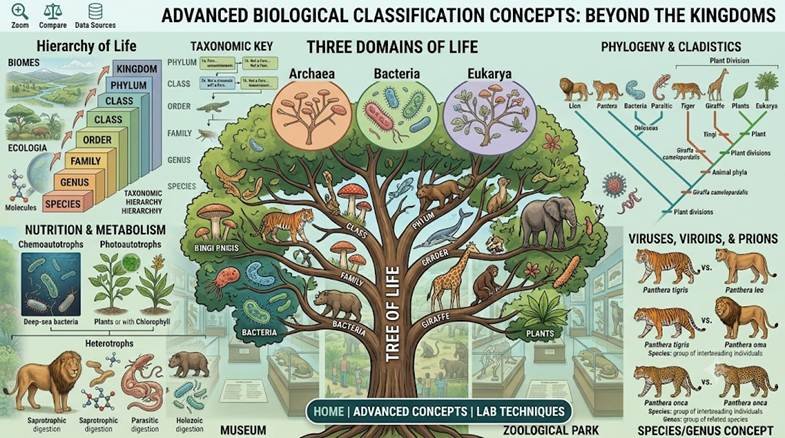
2.1 Introduction
The living world contains an enormous variety of organisms. They differ in their structure, mode of nutrition, habitat, reproduction, cellular organisation and evolutionary relationships.
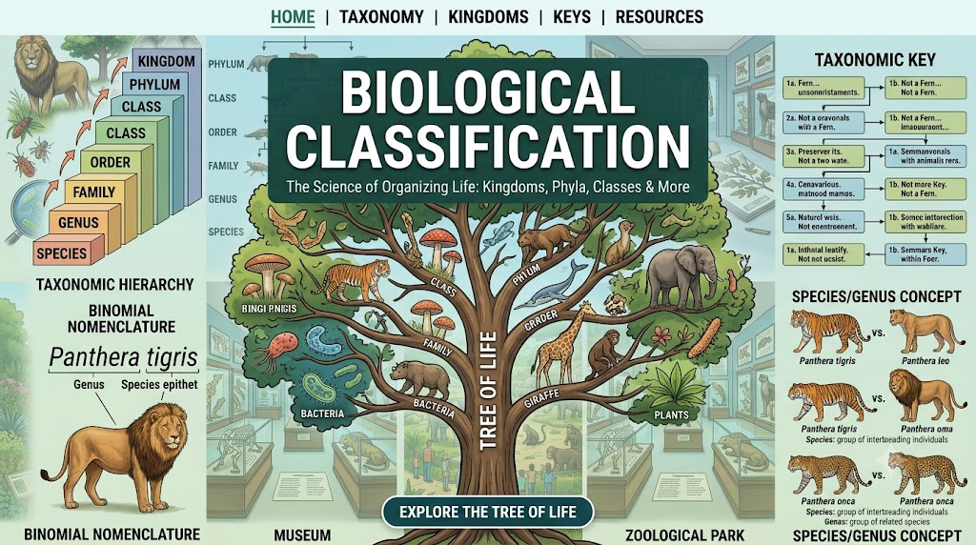
To study this enormous diversity systematically, organisms are classified into groups and sub-groups based on their similarities and differences.
The process of grouping organisms into convenient categories is called biological classification.
Classification helps us to:
Identify organisms.
Study their characteristics systematically.
Understand relationships among organisms.
Study evolutionary relationships.
Organise the enormous diversity of living organisms.
2.2 Early Systems of Classification
Two-Kingdom Classification
The earliest widely used classification system divided organisms into two kingdoms:
- Plantae
- Animalia
This system was associated with Carolus Linnaeus.
Major limitations
The two-kingdom system could not satisfactorily distinguish:
Prokaryotes from eukaryotes
Unicellular organisms from multicellular organisms
Autotrophs from heterotrophs
Organisms with different types of cell walls
Fungi from plants
Single-celled eukaryotic organisms
Therefore, more comprehensive classification systems were developed.
2.3 Three-Kingdom Classification
Ernst Haeckel proposed the three-kingdom classification.
The three kingdoms were:
- Plantae
- Animalia
- Protista
Protista was created mainly to accommodate organisms that did not fit properly into Plantae or Animalia.
2.4 Four-Kingdom Classification
H.F. Copeland proposed a four-kingdom system.
The four kingdoms were:
- Monera
- Protista
- Plantae
- Animalia
This system separated prokaryotic organisms from eukaryotic organisms.
2.5 Five-Kingdom Classification
The most important classification system for NEET is the five-kingdom classification proposed by R.H. Whittaker in 1969.
The five kingdoms are:
- Monera
- Protista
- Fungi
- Plantae
- Animalia
Major criteria used by Whittaker
Whittaker considered:
Cell structure
Body organisation
Mode of nutrition
Reproduction
Phylogenetic relationships
These criteria are repeatedly tested in NEET.
2.6 Five Kingdoms — Quick Comparison
| Kingdom | Cell type | Organisation | Nutrition | Cell wall |
| Monera | Prokaryotic | Mainly unicellular | Autotrophic/heterotrophic | Usually present |
| Protista | Eukaryotic | Mainly unicellular | Autotrophic/heterotrophic | Variable |
| Fungi | Eukaryotic | Mostly multicellular | Heterotrophic, absorptive | Chitin |
| Plantae | Eukaryotic | Multicellular | Mainly autotrophic | Cellulose |
| Animalia | Eukaryotic | Multicellular | Heterotrophic, ingestive | Absent |
2.7 KINGDOM MONERA
Kingdom Monera includes prokaryotic organisms.
Important examples include:
Bacteria
Cyanobacteria
Archaebacteria
Mycoplasma
General characteristics
Monerans generally:
Are prokaryotic.
Lack a true nucleus.
Lack membrane-bound organelles.
Usually possess a cell wall.
May be autotrophic or heterotrophic.
Are generally unicellular.
Their genetic material is not enclosed within a nuclear membrane.
2.8 Bacteria
Bacteria are extremely diverse organisms.
They can occur in:
Soil
Water
Air
Living organisms
Extreme environments
Based on shape, bacteria are commonly classified as:
1. Coccus
Spherical or nearly spherical.
2. Bacillus
Rod-shaped.
3. Vibrio
Comma-shaped.
4. Spirillum
Spiral-shaped.
2.9 Bacterial Cell Structure
A typical bacterial cell may contain:
Cell wall
Plasma membrane
Cytoplasm
Ribosomes
Genetic material
Flagellum
Pili
Fimbriae
Capsule/slime layer in some species
Important NEET point
Bacteria do not possess membrane-bound organelles such as:
Mitochondria
Chloroplasts
Endoplasmic reticulum
Golgi apparatus
2.10 Bacterial Cell Wall
The bacterial cell wall is generally composed of peptidoglycan.
The cell wall provides:
Shape
Mechanical support
Protection against osmotic pressure
2.11 Flagella
Some bacteria possess flagella for locomotion.
The bacterial flagellum has three main components:
- Filament
- Hook
- Basal body
2.12 Pili and Fimbriae
Pili and fimbriae are hair-like structures found on some bacteria.
They can have roles in:
Attachment
Conjugation
Interaction with surfaces
NEET trap
Pili and fimbriae should not simply be considered structures mainly responsible for bacterial locomotion.
2.13 Archaebacteria
Archaebacteria are distinctive prokaryotes that can live in extreme environments.
Important groups include:
Methanogens
They produce methane and occur in anaerobic environments.
They are found in:
Marshy areas
Anaerobic environments
Rumen of cattle and other ruminants
Halophiles
They live in environments with very high salt concentration.
Thermoacidophiles
They can survive high temperatures and acidic conditions.
Important difference
Archaebacterial cell walls differ chemically from those of typical eubacteria.
This difference is an important NEET topic.
2.14 EUBACTERIA
Eubacteria are often referred to as true bacteria.
They include a very large variety of bacterial forms.
Their cell wall generally contains peptidoglycan.
2.15 Cyanobacteria
Cyanobacteria are photosynthetic prokaryotes.
They are commonly called:
Blue-green algae
However, they are bacteria, not true algae.
Examples:
Nostoc
Anabaena
They contain photosynthetic pigments and can perform photosynthesis.
Nitrogen Fixation
Some cyanobacteria can fix atmospheric nitrogen.
Specialised cells called heterocysts are associated with nitrogen fixation in certain cyanobacteria.
Examples
Nostoc
Anabaena
2.16 Mycoplasma
Mycoplasma are unusual bacteria because they lack a cell wall.
Therefore:
They are very small.
They can pass through very fine filters.
They are resistant to antibiotics that target bacterial cell walls.
They possess a plasma membrane.
Extremely important NEET fact
Mycoplasma = wall-less bacteria.
2.17 KINGDOM PROTISTA
Kingdom Protista contains mainly unicellular eukaryotic organisms.
They possess:
True nucleus
Membrane-bound organelles
Important groups include:
Chrysophytes
Dinoflagellates
Euglenoids
Slime moulds
Protozoans
2.18 Chrysophytes
Chrysophytes include:
Diatoms
Golden algae
They are mostly found in:
Freshwater
Marine environments
Diatoms have a characteristic cell wall containing silica.
Their accumulated remains can form diatomaceous earth.
Uses of diatomaceous earth
It has applications including:
Filtration
Polishing
Insulation
2.19 Dinoflagellates
Dinoflagellates are primarily marine organisms.
Many are photosynthetic.
Their cell wall may contain cellulose plates.
Some dinoflagellates produce toxins.
Red tides
Rapid multiplication of certain red-coloured dinoflagellates can cause red tides.
Some species release toxins that may kill fish and other marine animals.
2.20 Euglenoids
Euglenoids are mostly freshwater organisms.
Important example:
Euglena
They possess a flexible covering called a:
Pellicle
The pellicle provides flexibility.
Nutrition
Euglenoids can show both:
Photosynthetic/autotrophic nutrition
Heterotrophic nutrition
Therefore, they are often described as mixotrophic.
2.21 Slime Moulds
Slime moulds are saprophytic protists.
They generally feed on:
Decaying organic matter
Microorganisms
Under favourable conditions they form a multinucleate mass called a plasmodium.
Under unfavourable conditions they may form fruiting structures that produce spores.
2.22 Protozoans
Protozoans are animal-like protists.
They are generally heterotrophic.
Important groups include:
Amoeboid protozoans
They move using pseudopodia.
Example:
Amoeba
Flagellated protozoans
They possess flagella.
Example:
Trypanosoma
Ciliated protozoans
They possess cilia.
Example:
Paramecium
Sporozoans
They generally possess an infectious spore-like stage.
Example:
Plasmodium
Plasmodium causes malaria.
2.23 KINGDOM FUNGI
Fungi are:
Eukaryotic
Heterotrophic
Mostly multicellular
Non-photosynthetic
Their cell wall is primarily composed of:
Chitin
Their nutrition is generally absorptive.
2.24 Fungal Body
The body of a fungus consists of thread-like structures called:
Hyphae
A network of hyphae is called:
Mycelium
Hyphae may be:
Septate
Aseptate/coenocytic
2.25 Fungal Nutrition
Fungi may be:
Saprophytic
Parasitic
Symbiotic
Saprophytic fungi
Obtain nutrients from dead and decaying organic matter.
Parasitic fungi
Obtain nutrients from living hosts.
Symbiotic fungi
Live in association with other organisms.
Examples include:
Lichens
Mycorrhiza
2.26 Fungal Reproduction
Fungi reproduce by:
Vegetative methods
Fragmentation
Fission
Budding
Asexual reproduction
Common asexual spores include:
Conidia
Sporangiospores
Zoospores
Sexual reproduction
The three major events are:
- Plasmogamy
- Karyogamy
- Meiosis
2.27 Plasmogamy
Fusion of the protoplasm of two compatible cells is called:
Plasmogamy
2.28 Karyogamy
Fusion of two nuclei is called:
Karyogamy
2.29 Meiosis
Meiosis restores the haploid condition and leads to the formation of haploid sexual spores in fungi.
NEET sequence
Plasmogamy → Karyogamy → Meiosis
However, the timing between these events varies among fungal groups.
2.30 Major Groups of Fungi
For traditional NCERT/NEET classification, fungi are discussed under:
- Phycomycetes
- Ascomycetes
- Basidiomycetes
- Deuteromycetes
Phycomycetes
Important characteristics include:
Aseptate/coenocytic mycelium
Asexual spores commonly produced in sporangia
Sexual reproduction may occur
Examples:
Rhizopus
Mucor
Albugo
Rhizopus
Commonly known as:
Bread mould
2.31 Ascomycetes
Ascomycetes are commonly called:
Sac fungi
Sexual spores are called:
Ascospores
They are produced inside:
Asci
Examples:
Aspergillus
Penicillium
Saccharomyces
Claviceps
Neurospora
2.32 Basidiomycetes
Basidiomycetes are commonly called:
Club fungi
Sexual spores are:
Basidiospores
They are produced externally on:
Basidia
Examples:
Agaricus
Ustilago
Puccinia
Important associations
Agaricus → Mushroom
Ustilago → Smut
Puccinia → Rust
2.33 Deuteromycetes
Deuteromycetes are commonly called:
Imperfect fungi
The term reflects the fact that the sexual stage was not known for the fungi placed in this group in the traditional classification.
They reproduce primarily through asexual spores.
Examples include:
Alternaria
Colletotrichum
Trichoderma
2.34 LICHENS
Lichens represent a symbiotic association between:
Alga + Fungus
The algal partner is called the:
Phycobiont
The fungal partner is called the:
Mycobiont
Functions
The algal partner:
Performs photosynthesis.
Provides organic food.
The fungal partner:
Provides shelter.
Helps absorb water and minerals.
NEET point
Lichens are good indicators of air pollution, particularly because they are sensitive to atmospheric pollutants.
2.35 MYCORRHIZA
Mycorrhiza represents a symbiotic association between:
Fungus + Roots of higher plants
The fungus helps in:
Water absorption
Mineral absorption, especially phosphorus
The plant provides organic nutrients to the fungus.
2.36 KINGDOM PLANTAE
Plants are:
Eukaryotic
Multicellular
Primarily autotrophic
Usually photosynthetic
Possess cellulose-containing cell walls
Their reserve food is generally:
Starch
2.37 KINGDOM ANIMALIA
Animals are:
Eukaryotic
Multicellular
Heterotrophic
Generally ingestive in nutrition
Without cell walls
2.38 VIRUSES
Viruses are acellular infectious entities.
They do not have a typical cellular organisation.
A virus generally consists of:
Genetic material
Protein coat
The genetic material may be:
DNA
RNA
A virus generally contains either DNA or RNA as its genetic material, not both as its genomic material.
2.39 Viral Nature
Viruses show a unique position between living and non-living systems.
Outside a host cell, they may behave like non-living particles.
Inside a suitable host cell, they replicate using the host’s machinery.
Important properties
Viruses:
Lack cellular organisation.
Lack independent metabolism.
Cannot reproduce independently outside a suitable host.
Can be crystallised in certain circumstances.
2.40 Bacteriophages
Viruses that infect bacteria are called:
Bacteriophages
They are also called:
Phages
2.41 VIROIDS
Viroids are smaller infectious agents than viruses.
They consist of:
Small circular RNA molecules without a protein coat.
They primarily cause diseases in plants.
Important example:
Potato spindle tuber disease
NEET key point
Viroid = naked infectious RNA.
2.42 PRIONS
Prions are infectious protein particles.
They are associated with certain neurodegenerative diseases.
Examples include:
Scrapie
Bovine spongiform encephalopathy (BSE), commonly called mad cow disease
Creutzfeldt–Jakob disease
Key distinction
| Agent | Basic nature |
| Virus | Nucleic acid + protein coat |
| Viroid | Naked RNA |
| Prion | Infectious protein |
2.43 MOST IMPORTANT NEET ONE-LINERS
- Five-kingdom classification → R.H. Whittaker
- Five kingdoms proposed → 1969
- Monera → Prokaryotic
- Protista → Mainly unicellular eukaryotes
- Fungi cell wall → Chitin
- Plant cell wall → Cellulose
- Mycoplasma → Wall-less bacteria
- Archaebacteria → Distinctive cell-wall chemistry
- Methanogens → Methane production
- Cyanobacteria → Photosynthetic bacteria
- Heterocysts → Nitrogen fixation in certain cyanobacteria
- Euglena → Mixotrophic
- Diatoms → Silica-containing cell walls
- Red tide → Certain dinoflagellates
- Plasmodium → Sporozoan
- Fungal body → Mycelium
- Hyphal network → Mycelium
- Fungal cell wall → Chitin
- Plasmogamy → Fusion of protoplasm
- Karyogamy → Fusion of nuclei
- Ascomycetes → Ascospores
- Basidiomycetes → Basidiospores
- Agaricus → Mushroom
- Ustilago → Smut
- Puccinia → Rust
- Rhizopus → Bread mould
- Lichen → Alga + fungus
- Mycorrhiza → Fungus + plant root
- Virus → Acellular infectious entity
- Bacteriophage → Virus infecting bacteria
- Viroid → Naked infectious RNA
- Prion → Infectious protein