GUMROAD eBook link:-
BY SHAILENDRA KUMAR VERMA
| 1. | CHALLENGING SYLLOGISM |
| https://skverma29.gumroad.com/l/ktxvzi | |
| 2. | STRAIT OF HORMUZ: STRATEGIC & ECONOMIC ROLE |
| https://skverma29.gumroad.com/l/upobrv | |
| 4. | STATIC GENERAL KNOWLEDGE |
| https://skverma29.gumroad.com/l/kzmca | |
| 5. | SSC ENGLISH PREVIOUS YEAR QUESTIONS MCQ |
| https://skverma29.gumroad.com/l/vtotyp | |
| 6. | SSC REASONING PREVIOUS YEAR QUESTIONS MCQ |
| https://skverma29.gumroad.com/l/fsyvp | |
| 7. | SSC MATH PREVIOUS YEAR QUESTIONS (MCQ): TIER I |
| https://skverma29.gumroad.com/l/nesioq | |
| 8. | BANKING KNOWLEDGE QUESTIONS AND ANSWERS MCQ |
| https://skverma29.gumroad.com/l/sgbbul | |
| 9. | BIHAR ANM, GNM & PHARMACIST EXAM: PAST MCQ QUESTIONS & ANSWERS – |
| https://skverma29.gumroad.com/l/yotjat | |
| 10. | ARAVALLI MOUNTAIN RANGE: THE ANCIENT SPINE OF INDIA |
| https://skverma29.gumroad.com/l/khpakf | |
| 11. | मौर्य काल (322 ईसा पूर्व – 185 ईसा पूर्व): पीएसयू परीक्षा हेतु प्रश्नोत्तर सहित विस्तृत अध्ययन |
| https://skverma29.gumroad.com/l/kgmrw | |
| 12. | VOLCANOES AND EARTHQUAKES: A COMPLETE GUIDE |
| https://share.google/gMZLAnx4hcCV82NTI | |
| 13. | TERMINOLOGY: RAILWAY, COMPUTER, SHARE MARKET, BIOLOGY, BADMINTON, CRICKET, FOOTBALL, KABBADI AND HOCKEY |
| https://share.google/fvdFN53HtyXlqTCgd | |
| 14. | भारतीय संसद का सत्र: प्रक्रिया, नियमऔर एस ओ पी; पी एस यू परीक्षा के लिए संपूर्ण मार्ग दर्शिका |
| https://share.google/1HFwXZA3qUiKyrI1l | |
| 15. | REITs AND InvITs IN INDIA: COMPLETE GUIDE (SCOPE, RISKS & FUTURE) |
| https://share.google/EChDc9heQmPPeyhoi | |
| 16. | GK SSC TIER I PREVIOUS YEAR MCQ |
| https://share.google/5pLzqYKQtg822wk3Y | |
| 17. | PETROLEUM REFINERY PROCESS: WITH 200 MCQ |
| https://skverma29.gumroad.com/l/jgydi | |
| 18. | SET THEORY: A COMPLETE GUIDE WITH 400 MCQ |
| https://skverma29.gumroad.com/l/zkhqzm | |
| 19. | WORLD’S SMALLEST, LONGEST, THINNEST, THICKEST AND TALLEST |
| https://skverma29.gumroad.com/l/kzaenh | |
| 20. | HIGH TIDE AND LOW TIDE: A COMPLETE GUIDE https://skverma29.gumroad.com/l/virke |
| 21. | 1000 HISTORY QESTIONS & ANSWERS FOR PSU |
| https://skverma29.gumroad.com/l/fjapus | |
| 22. | नालंदा विश्वविद्यालय : सम्पूर्ण अध्ययन |
| https://skverma29.gumroad.com/l/pmjab?wanted=true | |
| 23. | भगवान शिव के 12 ज्योतिर्लिंग: इतिहास, महत्व और दर्शन क्रम |
| https://skverma29.gumroad.com/l/wdkgo | |
| 24 | NISM-SERIES-V-A MUTUAL FUND DISTRIBUTOR: COMPLETE STUDY GUIDE & EXAM PREPARATION |
| https://skverma29.gumroad.com/l/qgcviu | |
| 25. | WORKSHOP TECHNOLOGY & MANUFACTURING PROCESSES COMPLETE EXAM GUIDE |
| https://skverma29.gumroad.com/l/xvqxnp |
AMAZON eBook link:-
BY SHAILENDRA KUMAR VERMA
| 1. | SSC MATH PREVIOUS YEAR MCQ: SSC MATH |
| https://amzn.in/d/097Ocsnl | |
| 2. | SSC REASONING PREVIOUS YEAR MCQ: SSC REASONING |
| https://amzn.in/d/00EHQGE8 | |
| 3. | SSC ENGLISH PREVIOUS YEAR MCQ: SSC ENGLISH |
| https://amzn.in/d/0f8sxJoy | |
| 4. | STATIC GENERAL KNOWLEDGE : WITH 620 MCQs |
| https://amzn.in/d/09xNEWmt |
PLAYSTORE eBook link:-
BY SHAILENDRA KUMAR VERMA
| 1. | SSC MATH PREVIOUS YEAR MCQ | |
| https://share.google/KzWbvkFuNk51PEpiu | ||
| 2. | SSC REASONING PREVIOUS YEAR MCQ | |
| https://play.google.com/books/publish/a/12574378860292240754#book/GGKEY:EUPQZ9ZUAFR/review | ||
| 3. | STATIC GENERAL KNOWLEDGE | |
| https://play.google.com/books/publish/a/12574378860292240754#book/GGKEY:CQDT2G4CCQP/review | ||
| 4. | CHALLENGING SYLLOGISM | |
| https://share.google/w9xLMwyiJdNVnpHxI | ||
| 5. | STRAIT OF HORMUZ: STRATEGIC & ECONOMIC ROLE | |
| https://share.google/V10H7UKeTkstLIMmc | ||
| 6. | BIHAR TEACHER ELIGIBILITY TEST (BIHAR TET) : COMPLETE GUIDE | |
| https://share.google/AcCXPFa69dAWyYaZZ | ||
| 7. | SSC ENGLISH PREVIOUS YEAR MCQ | |
| https://share.google/pr7b0YhDoDwttaq2s | ||
| 8. | BANKING KNOWLEDGE QUESTIONS AND ANSWERS MCQ | |
| https://share.google/yqYOabKhNppcz89hl | ||
| 9. | BIHAR ANM, GNM & PHARMACIST EXAM: PAST MCQ QUESTIONS & ANSWERS – | |
| https://share.google/NFhtU1JoBfxPS4wa3 | ||
| 10. | ARAVALLI MOUNTAIN RANGE: THE ANCIENT SPINE OF INDIA | |
| https://share.google/Yo4RYnaZrbRu9qwzj | ||
| 11. | GK SSC TIER I PREVIOUS YEAR MCQ | |
| https://share.google/sBdCcsEeebM44QZ0X | ||
| 12. | REITs AND InvITs IN INDIA: COMPLETE GUIDE (SCOPE, RISKS & FUTURE) | |
| https://share.google/XAwUio1deUOxFe2M7 | ||
| 13. | भारतीय संसद का सत्र: प्रक्रिया, नियमऔर एस ओ पी ; पी एस यू परीक्षा के लिए संपूर्ण मार्ग दर्शिका | |
| https://share.google/6XVrfQ2PcuWmqvKol | ||
| 14. | मौर्य काल (322 ईसा पूर्व – 185 ईसा पूर्व): पीएसयू परीक्षा हेतु प्रश्नोत्तर सहित विस्तृत अध्ययन | |
| https://share.google/Lwu7JKHE54kxsL5e2 | ||
| 15. | TERMINOLOGY: RAILWAY, COMPUTER, SHARE MARKET, BIOLOGY, BADMINTON, CRICKET, FOOTBALL, KABBADI AND HOCKEY | |
| https://share.google/WWVO9ZFd81R9G9h69 | ||
| 16. | VOLCANOES AND EARTHQUAKES: A COMPLETE GUIDE | |
| https://share.google/aXi2evRVgmzpQguye | ||
| 17. | PETROLEUM REFINERY PROCESS: WITH 200 MCQ | |
| https://play.google.com/books/publish/u/0/a/12574378860292240754#book/GGKEY:P34SQBHUJ7F/review | ||
| 18. | SET THEORY: A COMPLETE GUIDE WITH 400 MCQ | SET THEORY: A COMPLETE GUIDE WITH 400 MCQ |
| https://play.google.com/books/publish/u/0/a/12574378860292240754#book/GGKEY:83LKH7QHRQH/review | ||
| 19. | WORLD’S SMALLEST, LONGEST, THINNEST, THICKEST AND TALLEST | |
| https://play.google.com/books/publish/u/0/a/12574378860292240754#book/GGKEY:9LE49HEDZJE/review | ||
| 20. | HIGH TIDE AND LOW TIDE: A COMPLETE GUIDE | |
| https://play.google.com/books/publish/u/0/a/12574378860292240754#book/GGKEY:TKR79QBDE7R/review | ||
| 21. | 1000 HISTORY QESTIONS & ANSWERS FOR PSU | |
| https://play.google.com/books/publish/u/0/a/12574378860292240754#book/GGKEY:1SGWQKT7BDF/review | ||
| 22. | नालंदा विश्वविद्यालय : सम्पूर्ण अध्ययन | |
| https://play.google.com/books/publish/u/0/a/12574378860292240754#book/GGKEY:RY0EDLDK7TL/review | ||
| 23. | भगवान शिव के 12 ज्योतिर्लिंग: इतिहास, महत्व और दर्शन क्रम | |
| https://play.google.com/books/publish/u/0/a/12574378860292240754#book/GGKEY:KNT0X6L8YCQ/review | ||
| 24. | NISM-SERIES-V-A MUTUAL FUND DISTRIBUTOR: COMPLETE STUDY GUIDE & EXAM PREPARATION | |
| https://play.google.com/books/publish/u/0/a/12574378860292240754#book/GGKEY:YP1PQ8RQY07/review | ||
| 25. | WORKSHOP TECHNOLOGY & MANUFACTURING PROCESSES COMPLETE EXAM GUIDE | |
| https://play.google.com/books/publish/u/0/a/12574378860292240754#book/GGKEY:PK621P1ZHXX/review |
| OPEN DMAT ACCONT FROM THI LINK IN ANGEL ONE:- |
| Open your Trading & Investment account with Angel One for FREE* |
| You will get: |
| All trades in Rs.20 |
| Quick SIP in Direct MF |
| 1Lac MTF @ 0% interest |
| Download only using my referral link to get Free Demat Account⬇ |
| https://angel-one.onelink.me/Wjgr/2o2au42h |
| _link may expire within 48hrs_ |
| _T&C Apply_ |
| CLICK TO APPLY: |
| Click the application link below: 👉 Apply Here for SBI Credit Card (Referral Code: 243zfQ0yYm3) |
| OPEN DMAT ACCOUNT FROM THIS LINK: |
| HI THERE, I SEE YOU HAVEN’T BOUGHT THE FREEDOM PLAN ON INDIAN BANK YET. DON’T MISS OUT ON UNLIMITED TRADING AT A POCKET-FRIENDLY COST. GO BROKERAGE-FREE AND SAVE BIG WITH THE FREEDOM PLAN. USE MY REFERRAL CODE, SHAI0634 TO DOWNLOAD THE APP NOW. |
| https://play.google.com/store/apps/details?id=com.finwizard.fisdom |
BIOLOGICAL CLASSIFICATION
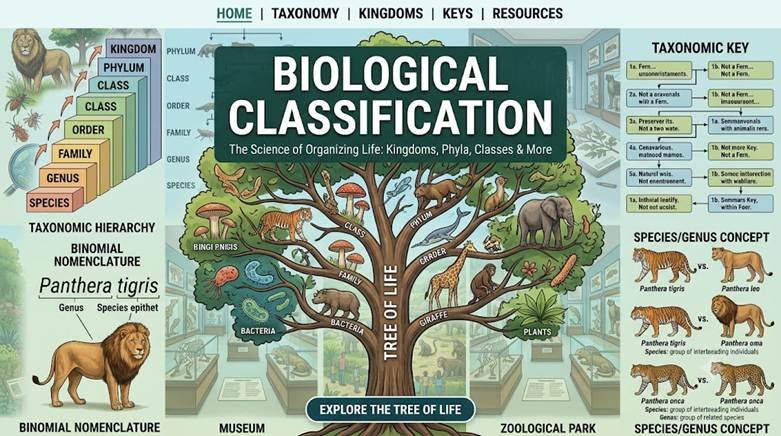
DISCLAIMER :
The content provided on this webpage/article on “BIOLOGICAL CLASSIFICATION” is intended strictly for educational, informational and examination-preparation purposes only. This material is designed to help students prepare for NEET and other competitive examinations.
This webpage may contain MCQ questions, answers, previous-year questions (PYQs), exam names, examination years, explanations, practice questions and NCERT-oriented study material. The questions and answers, including their exam names and years, have been compiled or presented for educational practice and revision. Although reasonable efforts have been made to maintain accuracy, the website owner does not guarantee that every question, answer, explanation, exam year, wording or classification is completely accurate or identical to the original official examination paper.
Some questions may be memory-based, reconstructed, adapted, paraphrased or compiled from publicly available educational/reference material. Therefore, students should verify the original question, answer, examination year and official examination details from the relevant official examination authority or original source wherever required.
The content relating to Biological Classification, including Monera, Protista, Fungi, viruses, viroids, prions, lichens, mycorrhiza and related topics, is presented primarily from an NCERT/NEET preparation perspective. Scientific classification and terminology may change with advances in scientific knowledge; therefore, the latest NCERT textbook and authoritative scientific sources should be consulted where applicable.
The website owner makes no representation or guarantee regarding the accuracy, completeness or current validity of any MCQ, answer, explanation, examination year or PYQ information provided on this webpage.
The website owner shall not be responsible or liable for any error, omission, incorrect answer, incorrect examination year, discrepancy, academic loss, examination result, or any other consequence arising from the use of these MCQs, answers, PYQs or study materials. Students are advised to verify important information with the latest NCERT textbook and official examination sources before relying upon it for examination purposes.
This website and its content are not affiliated with, endorsed by, sponsored by or officially associated with NTA, NEET, NCERT, the Government of India, or any examination authority, unless specifically stated.
For educational purposes only. Verify important questions, answers, exam years and syllabus information with official sources.
Website Owner: The website owner shall not be responsible for any discrepancy or consequence arising from the use of the information, MCQs, answers, PYQs or examination-year details provided on this webpage.
PART A : COMPLETE THEORY
2.1 Introduction
The living world contains an enormous variety of organisms. They differ in their structure, mode of nutrition, habitat, reproduction, cellular organisation and evolutionary relationships.
To study this enormous diversity systematically, organisms are classified into groups and sub-groups based on their similarities and differences.
The process of grouping organisms into convenient categories is called biological classification.
Classification helps us to:
Identify organisms.
Study their characteristics systematically.
Understand relationships among organisms.
Study evolutionary relationships.
Organise the enormous diversity of living organisms.
2.2 Early Systems of Classification
Two-Kingdom Classification
The earliest widely used classification system divided organisms into two kingdoms:
- Plantae
- Animalia
This system was associated with Carolus Linnaeus.
Major limitations
The two-kingdom system could not satisfactorily distinguish:
Prokaryotes from eukaryotes
Unicellular organisms from multicellular organisms
Autotrophs from heterotrophs
Organisms with different types of cell walls
Fungi from plants
Single-celled eukaryotic organisms
Therefore, more comprehensive classification systems were developed.
2.3 Three-Kingdom Classification
Ernst Haeckel proposed the three-kingdom classification.
The three kingdoms were:
- Plantae
- Animalia
- Protista
Protista was created mainly to accommodate organisms that did not fit properly into Plantae or Animalia.
2.4 Four-Kingdom Classification
H.F. Copeland proposed a four-kingdom system.
The four kingdoms were:
- Monera
- Protista
- Plantae
- Animalia
This system separated prokaryotic organisms from eukaryotic organisms.
2.5 Five-Kingdom Classification
The most important classification system for NEET is the five-kingdom classification proposed by R.H. Whittaker in 1969.
The five kingdoms are:
- Monera
- Protista
- Fungi
- Plantae
- Animalia
Major criteria used by Whittaker
Whittaker considered:
Cell structure
Body organisation
Mode of nutrition
Reproduction
Phylogenetic relationships
These criteria are repeatedly tested in NEET.
2.6 Five Kingdoms — Quick Comparison
| Kingdom | Cell type | Organisation | Nutrition | Cell wall |
| Monera | Prokaryotic | Mainly unicellular | Autotrophic/heterotrophic | Usually present |
| Protista | Eukaryotic | Mainly unicellular | Autotrophic/heterotrophic | Variable |
| Fungi | Eukaryotic | Mostly multicellular | Heterotrophic, absorptive | Chitin |
| Plantae | Eukaryotic | Multicellular | Mainly autotrophic | Cellulose |
| Animalia | Eukaryotic | Multicellular | Heterotrophic, ingestive | Absent |
2.7 KINGDOM MONERA
Kingdom Monera includes prokaryotic organisms.
Important examples include:
Bacteria
Cyanobacteria
Archaebacteria
Mycoplasma
General characteristics
Monerans generally:
Are prokaryotic.
Lack a true nucleus.
Lack membrane-bound organelles.
Usually possess a cell wall.
May be autotrophic or heterotrophic.
Are generally unicellular.
Their genetic material is not enclosed within a nuclear membrane.
2.8 Bacteria
Bacteria are extremely diverse organisms.
They can occur in:
Soil
Water
Air
Living organisms
Extreme environments
Based on shape, bacteria are commonly classified as:
1. Coccus
Spherical or nearly spherical.
2. Bacillus
Rod-shaped.
3. Vibrio
Comma-shaped.
4. Spirillum
Spiral-shaped.
2.9 Bacterial Cell Structure
A typical bacterial cell may contain:
Cell wall
Plasma membrane
Cytoplasm
Ribosomes
Genetic material
Flagellum
Pili
Fimbriae
Capsule/slime layer in some species
Important NEET point
Bacteria do not possess membrane-bound organelles such as:
Mitochondria
Chloroplasts
Endoplasmic reticulum
Golgi apparatus
2.10 Bacterial Cell Wall
The bacterial cell wall is generally composed of peptidoglycan.
The cell wall provides:
Shape
Mechanical support
Protection against osmotic pressure
2.11 Flagella
Some bacteria possess flagella for locomotion.
The bacterial flagellum has three main components:
- Filament
- Hook
- Basal body
2.12 Pili and Fimbriae
Pili and fimbriae are hair-like structures found on some bacteria.
They can have roles in:
Attachment
Conjugation
Interaction with surfaces
NEET trap
Pili and fimbriae should not simply be considered structures mainly responsible for bacterial locomotion.
2.13 Archaebacteria
Archaebacteria are distinctive prokaryotes that can live in extreme environments.
Important groups include:
Methanogens
They produce methane and occur in anaerobic environments.
They are found in:
Marshy areas
Anaerobic environments
Rumen of cattle and other ruminants
Halophiles
They live in environments with very high salt concentration.
Thermoacidophiles
They can survive high temperatures and acidic conditions.
Important difference
Archaebacterial cell walls differ chemically from those of typical eubacteria.
This difference is an important NEET topic.
2.14 EUBACTERIA
Eubacteria are often referred to as true bacteria.
They include a very large variety of bacterial forms.
Their cell wall generally contains peptidoglycan.
2.15 Cyanobacteria
Cyanobacteria are photosynthetic prokaryotes.
They are commonly called:
Blue-green algae
However, they are bacteria, not true algae.
Examples:
Nostoc
Anabaena
They contain photosynthetic pigments and can perform photosynthesis.
Nitrogen Fixation
Some cyanobacteria can fix atmospheric nitrogen.
Specialised cells called heterocysts are associated with nitrogen fixation in certain cyanobacteria.
Examples
Nostoc
Anabaena
2.16 Mycoplasma
Mycoplasma are unusual bacteria because they lack a cell wall.
Therefore:
They are very small.
They can pass through very fine filters.
They are resistant to antibiotics that target bacterial cell walls.
They possess a plasma membrane.
Extremely important NEET fact
Mycoplasma = wall-less bacteria.
2.17 KINGDOM PROTISTA
Kingdom Protista contains mainly unicellular eukaryotic organisms.
They possess:
True nucleus
Membrane-bound organelles
Important groups include:
Chrysophytes
Dinoflagellates
Euglenoids
Slime moulds
Protozoans
2.18 Chrysophytes
Chrysophytes include:
Diatoms
Golden algae
They are mostly found in:
Freshwater
Marine environments
Diatoms have a characteristic cell wall containing silica.
Their accumulated remains can form diatomaceous earth.
Uses of diatomaceous earth
It has applications including:
Filtration
Polishing
Insulation
2.19 Dinoflagellates
Dinoflagellates are primarily marine organisms.
Many are photosynthetic.
Their cell wall may contain cellulose plates.
Some dinoflagellates produce toxins.
Red tides
Rapid multiplication of certain red-coloured dinoflagellates can cause red tides.
Some species release toxins that may kill fish and other marine animals.
2.20 Euglenoids
Euglenoids are mostly freshwater organisms.
Important example:
Euglena
They possess a flexible covering called a:
Pellicle
The pellicle provides flexibility.
Nutrition
Euglenoids can show both:
Photosynthetic/autotrophic nutrition
Heterotrophic nutrition
Therefore, they are often described as mixotrophic.
2.21 Slime Moulds
Slime moulds are saprophytic protists.
They generally feed on:
Decaying organic matter
Microorganisms
Under favourable conditions they form a multinucleate mass called a plasmodium.
Under unfavourable conditions they may form fruiting structures that produce spores.
2.22 Protozoans
Protozoans are animal-like protists.
They are generally heterotrophic.
Important groups include:
Amoeboid protozoans
They move using pseudopodia.
Example:
Amoeba
Flagellated protozoans
They possess flagella.
Example:
Trypanosoma
Ciliated protozoans
They possess cilia.
Example:
Paramecium
Sporozoans
They generally possess an infectious spore-like stage.
Example:
Plasmodium
Plasmodium causes malaria.
2.23 KINGDOM FUNGI
Fungi are:
Eukaryotic
Heterotrophic
Mostly multicellular
Non-photosynthetic
Their cell wall is primarily composed of:
Chitin
Their nutrition is generally absorptive.
2.24 Fungal Body
The body of a fungus consists of thread-like structures called:
Hyphae
A network of hyphae is called:
Mycelium
Hyphae may be:
Septate
Aseptate/coenocytic
2.25 Fungal Nutrition
Fungi may be:
Saprophytic
Parasitic
Symbiotic
Saprophytic fungi
Obtain nutrients from dead and decaying organic matter.
Parasitic fungi
Obtain nutrients from living hosts.
Symbiotic fungi
Live in association with other organisms.
Examples include:
Lichens
Mycorrhiza
2.26 Fungal Reproduction
Fungi reproduce by:
Vegetative methods
Fragmentation
Fission
Budding
Asexual reproduction
Common asexual spores include:
Conidia
Sporangiospores
Zoospores
Sexual reproduction
The three major events are:
- Plasmogamy
- Karyogamy
- Meiosis
2.27 Plasmogamy
Fusion of the protoplasm of two compatible cells is called:
Plasmogamy
2.28 Karyogamy
Fusion of two nuclei is called:
Karyogamy
2.29 Meiosis
Meiosis restores the haploid condition and leads to the formation of haploid sexual spores in fungi.
NEET sequence
Plasmogamy → Karyogamy → Meiosis
However, the timing between these events varies among fungal groups.
2.30 Major Groups of Fungi
For traditional NCERT/NEET classification, fungi are discussed under:
- Phycomycetes
- Ascomycetes
- Basidiomycetes
- Deuteromycetes
Phycomycetes
Important characteristics include:
Aseptate/coenocytic mycelium
Asexual spores commonly produced in sporangia
Sexual reproduction may occur
Examples:
Rhizopus
Mucor
Albugo
Rhizopus
Commonly known as:
Bread mould
2.31 Ascomycetes
Ascomycetes are commonly called:
Sac fungi
Sexual spores are called:
Ascospores
They are produced inside:
Asci
Examples:
Aspergillus
Penicillium
Saccharomyces
Claviceps
Neurospora
2.32 Basidiomycetes
Basidiomycetes are commonly called:
Club fungi
Sexual spores are:
Basidiospores
They are produced externally on:
Basidia
Examples:
Agaricus
Ustilago
Puccinia
Important associations
Agaricus → Mushroom
Ustilago → Smut
Puccinia → Rust
2.33 Deuteromycetes
Deuteromycetes are commonly called:
Imperfect fungi
The term reflects the fact that the sexual stage was not known for the fungi placed in this group in the traditional classification.
They reproduce primarily through asexual spores.
Examples include:
Alternaria
Colletotrichum
Trichoderma
2.34 LICHENS
Lichens represent a symbiotic association between:
Alga + Fungus
The algal partner is called the:
Phycobiont
The fungal partner is called the:
Mycobiont
Functions
The algal partner:
Performs photosynthesis.
Provides organic food.
The fungal partner:
Provides shelter.
Helps absorb water and minerals.
NEET point
Lichens are good indicators of air pollution, particularly because they are sensitive to atmospheric pollutants.
2.35 MYCORRHIZA
Mycorrhiza represents a symbiotic association between:
Fungus + Roots of higher plants
The fungus helps in:
Water absorption
Mineral absorption, especially phosphorus
The plant provides organic nutrients to the fungus.
2.36 KINGDOM PLANTAE
Plants are:
Eukaryotic
Multicellular
Primarily autotrophic
Usually photosynthetic
Possess cellulose-containing cell walls
Their reserve food is generally:
Starch
2.37 KINGDOM ANIMALIA
Animals are:
Eukaryotic
Multicellular
Heterotrophic
Generally ingestive in nutrition
Without cell walls
2.38 VIRUSES
Viruses are acellular infectious entities.
They do not have a typical cellular organisation.
A virus generally consists of:
Genetic material
Protein coat
The genetic material may be:
DNA
RNA
A virus generally contains either DNA or RNA as its genetic material, not both as its genomic material.
2.39 Viral Nature
Viruses show a unique position between living and non-living systems.
Outside a host cell, they may behave like non-living particles.
Inside a suitable host cell, they replicate using the host’s machinery.
Important properties
Viruses:
Lack cellular organisation.
Lack independent metabolism.
Cannot reproduce independently outside a suitable host.
Can be crystallised in certain circumstances.
2.40 Bacteriophages
Viruses that infect bacteria are called:
Bacteriophages
They are also called:
Phages
2.41 VIROIDS
Viroids are smaller infectious agents than viruses.
They consist of:
Small circular RNA molecules without a protein coat.
They primarily cause diseases in plants.
Important example:
Potato spindle tuber disease
NEET key point
Viroid = naked infectious RNA.
2.42 PRIONS
Prions are infectious protein particles.
They are associated with certain neurodegenerative diseases.
Examples include:
Scrapie
Bovine spongiform encephalopathy (BSE), commonly called mad cow disease
Creutzfeldt–Jakob disease
Key distinction
| Agent | Basic nature |
| Virus | Nucleic acid + protein coat |
| Viroid | Naked RNA |
| Prion | Infectious protein |
2.43 MOST IMPORTANT NEET ONE-LINERS
- Five-kingdom classification → R.H. Whittaker
- Five kingdoms proposed → 1969
- Monera → Prokaryotic
- Protista → Mainly unicellular eukaryotes
- Fungi cell wall → Chitin
- Plant cell wall → Cellulose
- Mycoplasma → Wall-less bacteria
- Archaebacteria → Distinctive cell-wall chemistry
- Methanogens → Methane production
- Cyanobacteria → Photosynthetic bacteria
- Heterocysts → Nitrogen fixation in certain cyanobacteria
- Euglena → Mixotrophic
- Diatoms → Silica-containing cell walls
- Red tide → Certain dinoflagellates
- Plasmodium → Sporozoan
- Fungal body → Mycelium
- Hyphal network → Mycelium
- Fungal cell wall → Chitin
- Plasmogamy → Fusion of protoplasm
- Karyogamy → Fusion of nuclei
- Ascomycetes → Ascospores
- Basidiomycetes → Basidiospores
- Agaricus → Mushroom
- Ustilago → Smut
- Puccinia → Rust
- Rhizopus → Bread mould
- Lichen → Alga + fungus
- Mycorrhiza → Fungus + plant root
- Virus → Acellular infectious entity
- Bacteriophage → Virus infecting bacteria
- Viroid → Naked infectious RNA
- Prion → Infectious protein
PART B — NEET/AIPMT PREVIOUS-YEAR QUESTION BANK
PYQ 1 — Five Kingdom Classification
Exam: AIPMT 2009
The five-kingdom classification system was proposed by:
A. Linnaeus
B. R.H. Whittaker
C. Ernst Haeckel
D. Aristotle
Answer: B. R.H. Whittaker
Explanation: R.H. Whittaker proposed the five-kingdom classification in 1969. The kingdoms are Monera, Protista, Fungi, Plantae and Animalia.
PYQ 2 — Archaebacteria
Exam: AIPMT 2010
Archaebacteria differ from eubacteria particularly in their:
A. Nucleus
B. Ribosomes
C. Cell-wall composition
D. Genetic material
Answer: C. Cell-wall composition
Explanation: Archaebacteria possess a distinctive cell-wall composition different from the typical peptidoglycan-containing wall of eubacteria.
PYQ 3 — Five Kingdom Criteria
Exam: NEET 2026
Which set represents important criteria used by Whittaker for five-kingdom classification?
A. Cell structure, body organisation, nutrition, reproduction and phylogeny
B. Only habitat and reproduction
C. Only cell size and shape
D. Only locomotion and habitat
Answer: A
Explanation: Whittaker’s classification considered cell structure, body organisation, mode of nutrition, reproduction and phylogenetic relationships.
PYQ 4 — Complexity of Body Organisation
Exam: NEET 2025
Arrange the kingdoms represented by the following descriptions in increasing complexity:
Prokaryotic organisms
Unicellular eukaryotes
Multicellular fungi
Plants
Animals
A. Monera → Protista → Fungi → Plantae → Animalia
B. Protista → Monera → Fungi → Animalia → Plantae
C. Monera → Fungi → Protista → Plantae → Animalia
D. Fungi → Monera → Protista → Animalia → Plantae
Answer: A
Explanation: The progression begins with prokaryotic organisation in Monera, followed by unicellular eukaryotic organisation in Protista, then multicellular fungal organisation and finally the more complex tissue/organ organisation of plants and animals. The 2025 PYQ specifically tested this increasing-complexity concept.
PYQ 5 — Archaebacteria
Exam: NEET 2017
Archaebacteria are particularly notable because many members can survive:
A. Only in freshwater
B. Only inside animals
C. Extreme environmental conditions
D. Only in oxygen-rich environments
Answer: C. Extreme environmental conditions
Explanation: Archaebacteria include halophiles, thermoacidophiles and methanogens, many of which occupy unusual or extreme habitats.
PYQ 6 — Mycoplasma
Exam: NEET 2020
The distinctive feature of Mycoplasma is:
A. Absence of DNA
B. Absence of cell wall
C. Presence of mitochondria
D. Presence of a true nucleus
Answer: B. Absence of cell wall
Explanation: Mycoplasma are wall-less bacteria. They possess a plasma membrane but lack the typical bacterial cell wall.
PYQ 7 — Mycoplasma Statements
Exam: NEET 2022 Phase 1
Consider:
Statement I: Mycoplasma can pass through very fine filters.
Statement II: Mycoplasma possess a cell wall.
A. Both statements are correct
B. Both statements are incorrect
C. I is correct, II is incorrect
D. I is incorrect, II is correct
Answer: C
Explanation: Mycoplasma are exceptionally small and lack a cell wall. This is why the second statement is incorrect.
PYQ 8 — Protista Nutrition
Exam: NEET 2024 Re-Examination
Match:
Euglenoid
Dinoflagellate
Slime mould
Plasmodium
with their major nutritional modes.
Answer: Euglenoids can switch between photosynthetic and heterotrophic nutrition; dinoflagellates are commonly photosynthetic; slime moulds are saprophytic; Plasmodium is parasitic.
Explanation: This question tests the nutritional diversity within Protista.
PYQ 9 — Fungi Identification
Exam: NEET 2024
Match the following:
| Organism | Common identity |
| Rhizopus | Bread mould |
| Ustilago | Smut |
| Puccinia | Rust |
| Agaricus | Mushroom |
Answer: All four pairings are correctly matched.
Explanation: These are classic NCERT examples of fungal groups/organisms and are important for NEET identification questions.
PYQ 10 — Fungal Classification
Exam: NEET 2024
Which of the following is not used as a major criterion for traditional classification of fungi?
A. Mycelial organisation
B. Spore formation
C. Fruiting structures
D. Presence of chlorophyll
Answer: D. Presence of chlorophyll
Explanation: Fungi are non-photosynthetic organisms and lack chlorophyll. Traditional classification focuses on mycelial characteristics and reproductive structures, particularly spores.
PYQ 11 — Prions
Exam: NEET 2022 Phase 2
Mad cow disease and Creutzfeldt–Jakob disease are associated with:
A. Viroids
B. Prions
C. Bacteriophages
D. Protozoans
Answer: B. Prions
Explanation: Prions are infectious protein particles associated with transmissible neurodegenerative disorders, including BSE and Creutzfeldt–Jakob disease.
PYQ 12 — Viroids
Exam: NEET 2020 Phase 1
Viroids are best described as:
A. DNA enclosed in a protein coat
B. RNA enclosed in a protein coat
C. Small naked infectious RNA molecules
D. Infectious proteins
Answer: C. Small naked infectious RNA molecules
Explanation: Viroids are much simpler than viruses and consist of small infectious RNA molecules without a protein coat.
PYQ 13 — Scientific Name
Exam: NEET 2019
Which represents the correctly written scientific name of mango?
A. Mangifera Indica
B. mangifera indica
C. Mangifera indica
D. MANGIFERA INDICA
Answer: C. Mangifera indica
Explanation: In binomial nomenclature, the genus begins with a capital letter, the species name begins with a lowercase letter, and the complete scientific name is conventionally italicised when typed. The question database identifies this as a NEET 2019 PYQ.
PYQ 14 — Prokaryotes
Exam: NEET 2018
Which organism is not a prokaryote?
A. Bacterium
B. Cyanobacterium
C. Mycoplasma
D. Protozoan
Answer: D. Protozoan
Explanation: Bacteria, cyanobacteria and Mycoplasma are prokaryotic, whereas protozoans are eukaryotic organisms.
PYQ 15 — Cyanobacteria
Exam: NEET 2018
Which statement concerning cyanobacteria is correct?
A. They are eukaryotic algae
B. They are photosynthetic prokaryotes
C. They lack photosynthetic pigments
D. They possess chloroplasts
Answer: B. They are photosynthetic prokaryotes
Explanation: Cyanobacteria are bacteria capable of photosynthesis and do not possess chloroplasts.
PYQ 16 — Protozoans
Exam: NEET 2018
Ciliates differ from other major protozoan groups mainly because they possess:
A. Pseudopodia
B. Numerous cilia
C. Only spores
D. Cell walls made of chitin
Answer: B. Numerous cilia
Explanation: Cilia are the characteristic locomotory structures of ciliates. Paramecium is a classic example.
PYQ 17 — Basidiomycetes
Exam: NEET 2018
After karyogamy and meiosis, basidiomycetes produce sexual spores:
A. Inside asci
B. Externally on basidia
C. Inside sporangia
D. Inside conidiophores
Answer: B. Externally on basidia
Explanation: Basidiomycetes produce basidiospores externally on basidia.
PYQ 18 — Chief Producers in Oceans
Exam: NEET 2018
The organisms that constitute important primary producers in oceans include:
A. Diatoms
B. Protozoans
C. Slime moulds
D. Fungi
Answer: A. Diatoms
Explanation: Diatoms are photosynthetic organisms and are major components of marine phytoplankton.
REPEATED / FREQUENTLY TESTED CONCEPTS
REPEATED CONCEPT — Mycoplasma
Asked in: NEET 2020, NEET 2022 Phase 1
Core fact:
Mycoplasma lacks a cell wall.
REPEATED CONCEPT — Five Kingdom Classification
Asked in: AIPMT 2009, NEET 2025 and other papers
Core fact:
R.H. Whittaker → Five Kingdom Classification → 1969
REPEATED CONCEPT — Fungal Identification
Asked repeatedly across NEET/AIPMT papers
Remember:
Rhizopus → Bread mould
Agaricus → Mushroom
Ustilago → Smut
Puccinia → Rust
REPEATED CONCEPT — Viruses / Viroids / Prions
These distinctions have been repeatedly tested:
Virus → Nucleic acid + protein coat
Viroid → Naked RNA
Prion → Infectious protein
PYQ 19 — Archaebacteria
Exam: AIPMT 2014
Archaebacteria differ from eubacteria mainly in their:
A. Cell wall composition
B. Nuclear membrane
C. Ribosomes
D. DNA composition
Answer: A. Cell wall composition
Explanation: Archaebacteria possess a distinctive cell-wall composition and membrane chemistry. Their cell walls do not have the typical peptidoglycan characteristic of eubacteria.
Repeated concept: AIPMT 2010 + AIPMT 2014
PYQ 20 — Motility in Bacteria
Exam: AIPMT 2014
Motile bacteria generally move with the help of:
A. Pili
B. Flagella
C. Fimbriae
D. Capsule
Answer: B. Flagella
Explanation: Bacterial flagella are specialised structures involved primarily in locomotion. A bacterial flagellum consists of a filament, hook and basal body.
PYQ 21 — Five-Kingdom Classification
Exam: AIPMT 2014
Which of the following is not a major basis of R.H. Whittaker’s five-kingdom classification?
A. Cell structure
B. Mode of nutrition
C. Body organisation
D. Presence of flagella
Answer: D. Presence of flagella
Explanation: Whittaker considered cell structure, body organisation, mode of nutrition, reproduction and phylogenetic relationships. Presence of flagella was not a principal criterion.
Repeated concept: This concept is again tested in NEET 2026.
PYQ 22 — Virus Structure
Exam: AIPMT 2014
The protein coat surrounding the nucleic acid of a virus is called:
A. Capsid
B. Capsule
C. Cell wall
D. Envelope
Answer: A. Capsid
Explanation: The viral genetic material is enclosed by a protein coat called the capsid. The capsid is composed of protein subunits called capsomeres.
PYQ 23 — Anoxygenic Photosynthesis
Exam: AIPMT 2014
Anoxygenic photosynthesis is characteristic of:
A. Cyanobacteria
B. Green plants
C. Purple and green photosynthetic bacteria
D. Diatoms
Answer: C. Purple and green photosynthetic bacteria
Explanation: Certain photosynthetic bacteria perform anoxygenic photosynthesis, in which oxygen is not released as a by-product.
PYQ 24 — Archaebacterial Habitat
Exam: NEET 2017
Which group of organisms is particularly adapted to extreme saline conditions?
A. Methanogens
B. Halophiles
C. Cyanobacteria
D. Mycoplasma
Answer: B. Halophiles
Explanation: Halophiles are archaebacteria adapted to environments containing very high concentrations of salt.
Exam connection: The chapter database records this as a NEET 2017 question.
PYQ 25 — Viroids
Exam: NEET 2017
Viroids differ from viruses because viroids possess:
A. DNA with a protein coat
B. RNA with a protein coat
C. RNA without a protein coat
D. DNA without a protein coat
Answer: C. RNA without a protein coat
Explanation: Viroids are extremely small infectious agents consisting of naked RNA, without the protein coat found in viruses.
Repeated concept: Viroids were tested again in NEET 2020.
PYQ 26 — Mycoplasma
Exam: NEET 2017
Which organism is among the smallest known living cells and lacks a definite cell wall?
A. Nostoc
B. Mycoplasma
C. Rhizopus
D. Euglena
Answer: B. Mycoplasma
Explanation: Mycoplasma are extremely small bacteria and characteristically lack a cell wall. They can survive under anaerobic conditions.
Repeated: Mycoplasma was also tested in NEET 2020 and NEET 2022 Phase 1.
PYQ 27 — Bacterial Capsule
Exam: NEET 2017
Which bacterial structure provides a sticky character and can assist attachment?
A. Capsule/slime layer
B. Ribosome
C. Nucleoid
D. Mesosome
Answer: A. Capsule/slime layer
Explanation: Some bacteria possess a capsule or slime layer outside the cell wall. It can help in adhesion and may provide protection.
PYQ 28 — Fungi
Exam: NEET 2016 Phase 2
Which statement is incorrect regarding fungi?
A. They are heterotrophic
B. Their cell wall contains chitin
C. They are photosynthetic
D. They may reproduce sexually and asexually
Answer: C. They are photosynthetic
Explanation: Fungi lack chlorophyll and are heterotrophic. They obtain nutrients by absorption.
PYQ 29 — Methanogens
Exam: NEET 2016 Phase 2
Methanogens belong to:
A. Eubacteria
B. Archaebacteria
C. Cyanobacteria
D. Protista
Answer: B. Archaebacteria
Explanation: Methanogens are archaebacteria that produce methane under anaerobic conditions. They are found in marshy environments and in the rumen of ruminants.
Repeated concept: Methanogens were also tested in AIPMT 2010, AIPMT 2016 and other papers.
PYQ 30 — Protista
Exam: NEET 2016 Phase 1
Chrysophytes, Euglenoids, Dinoflagellates and Slime Moulds are placed in:
A. Monera
B. Protista
C. Fungi
D. Plantae
Answer: B. Protista
Explanation: These groups are included under Kingdom Protista in the NCERT five-kingdom classification.
PYQ 31 — Viroids
Exam: NEET 2016 Phase 1
Which statement about viroids is incorrect?
A. They are smaller than viruses
B. They consist of RNA
C. They possess a protein coat
D. They can cause plant diseases
Answer: C. They possess a protein coat
Explanation: Viroids consist of small circular RNA molecules without a protein coat.
Repeated: Viroids → NEET 2016 + 2017 + 2020.
PYQ 32 — Fungal Cell Wall
Exam: NEET 2016 Phase 1
A major component of the cell wall of most fungi is:
A. Cellulose
B. Chitin
C. Peptidoglycan
D. Silica
Answer: B. Chitin
Explanation: The fungal cell wall is primarily composed of chitin.
Repeated concept: Fungal cell wall → repeatedly tested.
PYQ 33 — Methanogens and Biogas
Exam: NEET 2016 Phase 1
The primitive prokaryotes responsible for methane production from the dung of ruminants belong to:
A. Cyanobacteria
B. Methanogens
C. Mycoplasma
D. Eubacteria
Answer: B. Methanogens
Explanation: Methanogens produce methane during anaerobic decomposition and are important in biogas production.
Repeated concept: Methanogens.
PYQ 34 — Pili and Fimbriae
Exam: AIPMT 2015
Structures that help certain bacteria attach to rocks or host tissues are:
A. Flagella
B. Fimbriae
C. Ribosomes
D. Mesosomes
Answer: B. Fimbriae
Explanation: Fimbriae are short, hair-like structures that help bacteria attach to surfaces. Pili can have additional roles, including conjugation.
PYQ 35 — Diatoms
Exam: AIPMT 2015
In which organisms do cell walls form two thin overlapping shells that fit together?
A. Dinoflagellates
B. Diatoms
C. Euglenoids
D. Protozoans
Answer: B. Diatoms
Explanation: Diatoms possess a characteristic silica-containing cell wall consisting of two overlapping halves, resembling a box with a lid.
Repeated concept: Diatom cell wall → NEET 2019 and NEET 2022 also tested this concept.
PYQ 36 — Cell Wall Absence
Exam: AIPMT 2015
Cell wall is absent in:
A. Mycoplasma
B. Cyanobacteria
C. Fungi
D. Eubacteria
Answer: A. Mycoplasma
Explanation: Mycoplasma are unusual bacteria because they lack a cell wall.
Repeated: Mycoplasma → multiple years.
PYQ 37 — Deuteromycetes
Exam: AIPMT 2015
The imperfect fungi that act as decomposers and contribute to mineral cycling belong to:
A. Phycomycetes
B. Ascomycetes
C. Deuteromycetes
D. Basidiomycetes
Answer: C. Deuteromycetes
Explanation: Deuteromycetes were traditionally called fungi imperfecti because their sexual reproductive stage was not known.
PYQ 38 — True Nucleus
Exam: AIPMT 2015 Cancelled Paper
True nucleus is absent in:
A. Amoeba
B. Bacteria
C. Euglena
D. Paramecium
Answer: B. Bacteria
Explanation: Bacteria are prokaryotes and therefore lack a membrane-bound true nucleus.
PYQ 39 — Viruses
Exam: AIPMT 2014
Viruses possess:
A. Both DNA and RNA as genetic material
B. Either DNA or RNA as genetic material
C. Only DNA
D. Only RNA
Answer: B. Either DNA or RNA as genetic material
Explanation: A virus contains either DNA or RNA as its genetic material, enclosed by a protein coat.
PYQ 40 — Bacterial Respiration
Exam: AIPMT 2014
Which structures perform functions analogous to mitochondria in bacteria?
A. Mesosomes
B. Ribosomes
C. Lysosomes
D. Golgi bodies
Answer: A. Mesosomes
Explanation: Mesosomes were described in older NCERT material as infoldings of the plasma membrane associated with respiration and other functions.
Important modern note: The mesosome is now regarded as an artefact of chemical fixation rather than a genuine bacterial organelle. For historical PYQs, however, the expected answer is mesosome.
HIGH-FREQUENCY REPEATED CONCEPTS SO FAR
| Concept | Exams/Papers |
| Mycoplasma lacks cell wall | NEET 2017, NEET 2020, NEET 2022 Phase 1 |
| Viroid = naked RNA | NEET 2016, NEET 2017, NEET 2020 |
| Methanogens | NEET 2016, AIPMT 2010 and others |
| Archaebacteria vs eubacteria | AIPMT 2010, AIPMT 2014 |
| Diatom silica wall | AIPMT 2015, NEET 2019, NEET 2022 |
| Whittaker classification criteria | AIPMT 2014, NEET 2026 |
| Fungal cell wall = chitin | NEET 2016 and repeated |
| Protista groups | NEET 2016 and repeated |
| Bacteriophage/virus concepts | Multiple AIPMT/NEET papers |
PYQ 41 — Kingdom Monera
Exam: AIPMT 2013
Which of the following groups contains only prokaryotic organisms?
A. Bacteria and cyanobacteria
B. Fungi and bacteria
C. Protozoans and bacteria
D. Cyanobacteria and fungi
Answer: A. Bacteria and cyanobacteria
Explanation: Bacteria and cyanobacteria are prokaryotes. They lack a membrane-bound nucleus and membrane-bound organelles.
PYQ 42 — Cyanobacteria
Exam: AIPMT 2013
Cyanobacteria are also commonly known as:
A. Golden algae
B. Blue-green algae
C. Brown algae
D. Red algae
Answer: B. Blue-green algae
Explanation: Cyanobacteria were historically called blue-green algae because of their photosynthetic pigments. However, they are prokaryotic bacteria, not true algae.
PYQ 43 — Nitrogen Fixation
Exam: AIPMT 2013
Which specialised cells of some cyanobacteria are associated with atmospheric nitrogen fixation?
A. Conidia
B. Heterocysts
C. Basidia
D. Asci
Answer: B. Heterocysts
Explanation: Heterocysts are specialised nitrogen-fixing cells found in cyanobacteria such as Nostoc and Anabaena.
PYQ 44 — Protista
Exam: AIPMT 2013
Which of the following is a characteristic feature of Kingdom Protista?
A. All organisms are multicellular
B. All organisms are prokaryotic
C. Members are primarily unicellular eukaryotes
D. Cell wall is always made of chitin
Answer: C. Members are primarily unicellular eukaryotes
Explanation: Protista mainly includes unicellular eukaryotic organisms. They possess a true nucleus and membrane-bound organelles.
PYQ 45 — Dinoflagellates
Exam: AIPMT 2013
Red tides in marine ecosystems are commonly associated with rapid multiplication of:
A. Diatoms
B. Dinoflagellates
C. Euglenoids
D. Slime moulds
Answer: B. Dinoflagellates
Explanation: Certain dinoflagellates multiply rapidly and may produce coloured substances and toxins, producing the phenomenon known as red tide.
Repeated concept: Red tide/dinoflagellates has been tested in multiple NEET/AIPMT papers.
PYQ 46 — Euglenoids
Exam: AIPMT 2013
The flexible covering present around Euglena is called:
A. Capsule
B. Pellicle
C. Cell wall
D. Cuticle
Answer: B. Pellicle
Explanation: Euglenoids possess a flexible protein-rich covering called a pellicle, which allows them to change their body shape.
PYQ 47 — Euglena Nutrition
Exam: AIPMT 2013
Euglena is considered mixotrophic because it can:
A. Only ingest food
B. Only perform photosynthesis
C. Show both autotrophic and heterotrophic nutrition
D. Only absorb minerals
Answer: C. Show both autotrophic and heterotrophic nutrition
Explanation: In the presence of light, Euglena can perform photosynthesis. Under unsuitable conditions, it can obtain organic nutrients heterotrophically.
PYQ 48 — Diatoms
Exam: AIPMT 2013
The cell walls of diatoms are mainly impregnated with:
A. Chitin
B. Silica
C. Cellulose
D. Peptidoglycan
Answer: B. Silica
Explanation: Diatom cell walls contain silica and form two overlapping shells. Their accumulated deposits form diatomaceous earth.
Repeated: This is a high-frequency Biological Classification concept.
PYQ 49 — Diatomaceous Earth
Exam: AIPMT 2013
Diatomaceous earth is formed mainly from the remains of:
A. Dinoflagellates
B. Diatoms
C. Euglenoids
D. Protozoans
Answer: B. Diatoms
Explanation: The silica-rich remains of dead diatoms accumulate over long periods to form diatomaceous earth.
PYQ 50 — Slime Moulds
Exam: AIPMT 2013
Slime moulds are generally:
A. Autotrophic
B. Saprophytic
C. Photosynthetic bacteria
D. Parasitic fungi
Answer: B. Saprophytic
Explanation: Slime moulds obtain nutrients from dead and decaying organic matter and microorganisms.
PYQ 51 — Plasmodium
Exam: AIPMT 2013
Plasmodium belongs to which group of protozoans?
A. Amoeboid protozoans
B. Flagellated protozoans
C. Ciliated protozoans
D. Sporozoans
Answer: D. Sporozoans
Explanation: Plasmodium is traditionally placed among sporozoans and is the causative organism of malaria.
PYQ 52 — Amoeboid Protozoans
Exam: AIPMT 2013
Amoeboid protozoans move with the help of:
A. Cilia
B. Flagella
C. Pseudopodia
D. Basidia
Answer: C. Pseudopodia
Explanation: Amoeboid protozoans such as Amoeba move and capture food using temporary cytoplasmic projections called pseudopodia.
PYQ 53 — Ciliated Protozoans
Exam: AIPMT 2013
Which organism is a typical example of a ciliated protozoan?
A. Amoeba
B. Trypanosoma
C. Paramecium
D. Plasmodium
Answer: C. Paramecium
Explanation: Paramecium possesses numerous cilia used for locomotion and feeding.
PYQ 54 — Flagellated Protozoans
Exam: AIPMT 2013
Trypanosoma is an example of:
A. Amoeboid protozoan
B. Flagellated protozoan
C. Ciliated protozoan
D. Sporozoan
Answer: B. Flagellated protozoan
Explanation: Trypanosoma possesses a flagellum and is traditionally classified among flagellated protozoans.
KINGDOM FUNGI — PYQs
PYQ 55 — Fungal Nutrition
Exam: AIPMT 2013
Fungi generally obtain their nutrition by:
A. Ingestion
B. Absorption
C. Photosynthesis
D. Chemosynthesis
Answer: B. Absorption
Explanation: Fungi secrete digestive enzymes onto their food source and absorb the resulting soluble nutrients. Thus, their nutrition is primarily absorptive heterotrophic nutrition.
PYQ 56 — Fungal Hyphae
Exam: AIPMT 2013
The thread-like structures constituting the fungal body are called:
A. Hyphae
B. Asci
C. Basidia
D. Conidia
Answer: A. Hyphae
Explanation: Individual thread-like structures are called hyphae, while a network of hyphae is called mycelium.
PYQ 57 — Mycelium
Exam: AIPMT 2013
A network of fungal hyphae is called:
A. Mycelium
B. Plasmodium
C. Protonema
D. Rhizoid
Answer: A. Mycelium
Explanation: Mycelium is the vegetative body of most fungi and consists of a network of hyphae.
PYQ 58 — Fungal Cell Wall
Exam: AIPMT 2013
The fungal cell wall is mainly composed of:
A. Cellulose
B. Chitin
C. Peptidoglycan
D. Silica
Answer: B. Chitin
Explanation: Chitin is the characteristic major structural component of the fungal cell wall.
Repeated concept: This has appeared in several NEET/AIPMT papers.
PYQ 59 — Asexual Spores
Exam: AIPMT 2013
Asexual spores produced externally on specialised structures in many fungi are called:
A. Conidia
B. Ascospores
C. Basidiospores
D. Zygospores
Answer: A. Conidia
Explanation: Conidia are asexual spores produced externally on specialised hyphae called conidiophores.
PYQ 60 — Ascomycetes
Exam: AIPMT 2013
Sexual spores of Ascomycetes are called:
A. Basidiospores
B. Ascospores
C. Conidia
D. Zoospores
Answer: B. Ascospores
Explanation: Ascomycetes produce sexual spores called ascospores, which are formed inside sac-like structures called asci.
PYQ 61 — Basidiomycetes
Exam: AIPMT 2013
Sexual spores of Basidiomycetes are called:
A. Ascospores
B. Basidiospores
C. Conidia
D. Sporangiospores
Answer: B. Basidiospores
Explanation: Basidiomycetes produce basidiospores externally on basidia.
PYQ 62 — Agaricus
Exam: AIPMT 2013
Agaricus is commonly known as:
A. Bread mould
B. Mushroom
C. Rust
D. Smut
Answer: B. Mushroom
Explanation: Agaricus includes common edible mushrooms and belongs to Basidiomycetes.
PYQ 63 — Puccinia
Exam: AIPMT 2013
Puccinia is associated with:
A. Rust disease
B. Smut disease
C. Bread mould
D. Malaria
Answer: A. Rust disease
Explanation: Puccinia is a rust fungus and belongs to Basidiomycetes.
PYQ 64 — Ustilago
Exam: AIPMT 2013
Ustilago is commonly associated with:
A. Rust
B. Smut
C. Mushroom
D. Bread mould
Answer: B. Smut
Explanation: Ustilago is a smut fungus belonging to Basidiomycetes.
PYQ 65 — Rhizopus
Exam: AIPMT 2013
Rhizopus is commonly called:
A. Bread mould
B. Rust
C. Smut
D. Mushroom
Answer: A. Bread mould
Explanation: Rhizopus is a common bread mould and is traditionally included among Phycomycetes.
PYQ 66 — Deuteromycetes
Exam: AIPMT 2013
Deuteromycetes are commonly known as:
A. Perfect fungi
B. Imperfect fungi
C. Club fungi
D. Sac fungi
Answer: B. Imperfect fungi
Explanation: Deuteromycetes were traditionally called imperfect fungi because their sexual reproductive stage was unknown.
PYQ 67 — Lichens
Exam: AIPMT 2013
Lichens represent a symbiotic association between:
A. Fungus and bacterium
B. Alga and fungus
C. Fungus and virus
D. Alga and protozoan
Answer: B. Alga and fungus
Explanation: A lichen consists of an algal partner (phycobiont) and a fungal partner (mycobiont) living in symbiotic association.
PYQ 68 — Air Pollution Indicator
Exam: AIPMT 2013
Lichens are considered good indicators of:
A. Water pollution
B. Soil pollution
C. Air pollution
D. Noise pollution
Answer: C. Air pollution
Explanation: Lichens are highly sensitive to atmospheric pollutants, particularly sulphur dioxide, and therefore can serve as indicators of air pollution.
Repeated concept: Lichens and air pollution are repeatedly tested.
PYQ 69 — Mycorrhiza
Exam: AIPMT 2013
Mycorrhiza represents an association between:
A. Algae and fungi
B. Fungi and plant roots
C. Bacteria and roots
D. Protozoans and roots
Answer: B. Fungi and plant roots
Explanation: Mycorrhiza is a mutualistic association between fungal hyphae and plant roots. The fungus helps the plant obtain water and minerals, particularly phosphorus.
PYQ 70 — Plasmogamy
Exam: AIPMT 2013
Fusion of the cytoplasm of two compatible fungal cells is called:
A. Karyogamy
B. Plasmogamy
C. Meiosis
D. Sporulation
Answer: B. Plasmogamy
Explanation: Plasmogamy = fusion of protoplasm/cytoplasm, whereas karyogamy = fusion of nuclei.
PYQ 71 — Karyogamy
Exam: AIPMT 2013
Fusion of two fungal nuclei is called:
A. Plasmogamy
B. Karyogamy
C. Budding
D. Fragmentation
Answer: B. Karyogamy
Explanation: During karyogamy, two compatible nuclei fuse to form a diploid nucleus.
PYQ 72 — Sequence in Sexual Reproduction
Exam: AIPMT 2013
The correct sequence in fungal sexual reproduction is:
A. Karyogamy → plasmogamy → meiosis
B. Plasmogamy → karyogamy → meiosis
C. Meiosis → plasmogamy → karyogamy
D. Plasmogamy → meiosis → karyogamy
Answer: B. Plasmogamy → karyogamy → meiosis
Explanation: The general sequence is:
Plasmogamy → Karyogamy → Meiosis
The timing between these stages varies among fungal groups.
PYQ 73 — Virus
Exam: AIPMT 2013
Viruses are best described as:
A. Unicellular organisms
B. Acellular infectious entities
C. Prokaryotic cells
D. Eukaryotic cells
Answer: B. Acellular infectious entities
Explanation: Viruses lack cellular organisation. They contain genetic material surrounded by a protein coat and replicate only within suitable host cells.
PYQ 74 — Bacteriophage
Exam: AIPMT 2013
A virus that infects bacteria is called:
A. Viroid
B. Bacteriophage
C. Prion
D. Mycoplasma
Answer: B. Bacteriophage
Explanation: Bacteriophages, or phages, are viruses that infect bacterial cells.
PYQ 75 — Viral Genetic Material
Exam: AIPMT 2013
The genetic material of a virus may be:
A. Only DNA
B. Only RNA
C. DNA or RNA
D. DNA and RNA together in every virus
Answer: C. DNA or RNA
Explanation: Viral genomes can be composed of DNA or RNA. A particular virus has one type of nucleic acid as its genome.
PYQ 76 — Prions
Exam: AIPMT 2013
Prions are infectious agents made primarily of:
A. DNA
B. RNA
C. Protein
D. Lipid
Answer: C. Protein
Explanation: Prions are infectious protein particles and lack the nucleic acid genome characteristic of viruses.
PYQ 77 — Bovine Spongiform Encephalopathy
Exam: AIPMT 2013
Bovine spongiform encephalopathy is associated with:
A. Viroids
B. Prions
C. Bacteria
D. Cyanobacteria
Answer: B. Prions
Explanation: BSE, commonly known as mad cow disease, is associated with abnormal infectious proteins called prions.
Repeated concept: Prion-related diseases have appeared in multiple NEET papers.
PYQ 78 — Potato Spindle Tuber Disease
Exam: AIPMT 2013
Potato spindle tuber disease is caused by:
A. Virus
B. Viroid
C. Bacterium
D. Prion
Answer: B. Viroid
Explanation: Potato spindle tuber disease is caused by a viroid, a small circular naked RNA molecule.
Repeated: Viroid → repeatedly tested.
PYQ 79 — Prokaryotic Organisms
Exam: AIPMT 2012
Which of the following is a prokaryotic organism?
A. Amoeba
B. Euglena
C. Nostoc
D. Paramecium
Answer: C. Nostoc
Explanation: Nostoc is a cyanobacterium and therefore a prokaryote.
PYQ 80 — Cyanobacteria
Exam: AIPMT 2012
Which of the following organisms can perform oxygenic photosynthesis but lacks chloroplasts?
A. Cyanobacterium
B. Euglena
C. Mushroom
D. Paramecium
Answer: A. Cyanobacterium
Explanation: Cyanobacteria are photosynthetic prokaryotes. Because they are prokaryotic, they do not possess chloroplasts.
IMPORTANT REPEATED-CONCEPT REGISTER
By this point in the chapter, these are particularly important for your ebook:
| Concept | Repeated in |
| Mycoplasma lacks cell wall | NEET 2017, 2020, 2022 |
| Viroid = naked RNA | NEET 2016, 2017, 2020 and other papers |
| Prion = infectious protein | Multiple NEET/AIPMT papers |
| Diatom = silica wall | Multiple papers |
| Lichen = algae + fungus | Multiple papers |
| Lichen = air-pollution indicator | Multiple papers |
| Fungal wall = chitin | Multiple papers |
| Plasmogamy → Karyogamy → Meiosis | Multiple papers |
| Methanogens = archaebacteria | Multiple papers |
| Cyanobacteria = photosynthetic prokaryotes | Multiple papers |
| Heterocyst = nitrogen fixation | Multiple papers |
| Euglena = mixotrophic | Multiple papers |
| Red tide = dinoflagellates | Multiple papers |
PYQ 81 — Archaebacteria
Exam: AIPMT 2012
Which group of organisms is commonly found in highly saline environments?
A. Methanogens
B. Halophiles
C. Cyanobacteria
D. Mycoplasma
Answer: B. Halophiles
Explanation: Halophiles are archaebacteria adapted to environments with very high salt concentration.
PYQ 82 — Thermoacidophiles
Exam: AIPMT 2012
Organisms capable of surviving high temperature and acidic conditions are called:
A. Halophiles
B. Methanogens
C. Thermoacidophiles
D. Cyanobacteria
Answer: C. Thermoacidophiles
Explanation: Thermoacidophiles are archaebacteria adapted to hot and acidic environments.
PYQ 83 — Methanogens
Exam: AIPMT 2012
Methanogens are commonly found in:
A. Human blood
B. Rumen of cattle
C. Leaf mesophyll
D. Marine algae
Answer: B. Rumen of cattle
Explanation: Methanogens occur in anaerobic environments, including the rumen of ruminant animals, where they contribute to methane production.
PYQ 84 — Bacterial Shape
Exam: AIPMT 2012
Comma-shaped bacteria are called:
A. Cocci
B. Bacilli
C. Vibrios
D. Spirilla
Answer: C. Vibrios
Explanation: Bacteria are commonly classified by shape:
Coccus → spherical
Bacillus → rod-shaped
Vibrio → comma-shaped
Spirillum → spiral-shaped
PYQ 85 — Rod-Shaped Bacteria
Exam: AIPMT 2012
Rod-shaped bacteria are called:
A. Cocci
B. Bacilli
C. Vibrios
D. Spirilla
Answer: B. Bacilli
Explanation: Bacilli are rod-shaped bacteria.
PYQ 86 — Spherical Bacteria
Exam: AIPMT 2012
Spherical bacteria are known as:
A. Cocci
B. Bacilli
C. Vibrios
D. Spirilla
Answer: A. Cocci
Explanation: Cocci are spherical or nearly spherical bacteria.
PYQ 87 — Bacterial Genetic Material
Exam: AIPMT 2012
In a typical bacterial cell, the genetic material is located in the:
A. Nucleus
B. Nucleoid region
C. Mitochondrion
D. Chloroplast
Answer: B. Nucleoid region
Explanation: Bacteria lack a membrane-bound nucleus. Their chromosome is located in a region called the nucleoid.
PYQ 88 — Bacterial Ribosomes
Exam: AIPMT 2012
The ribosomes of prokaryotic cells are:
A. 80S
B. 70S
C. 60S
D. 90S
Answer: B. 70S
Explanation: Prokaryotic ribosomes are 70S, consisting of 50S and 30S subunits.
PYQ 89 — Cyanobacteria
Exam: AIPMT 2012
Which of the following is a cyanobacterium?
A. Nostoc
B. Agaricus
C. Rhizopus
D. Paramecium
Answer: A. Nostoc
Explanation: Nostoc is a cyanobacterium capable of photosynthesis and, in suitable species, nitrogen fixation.
PYQ 90 — Heterocysts
Exam: AIPMT 2012
Heterocysts are characteristic specialised cells found in:
A. Rhizopus
B. Nostoc
C. Euglena
D. Paramecium
Answer: B. Nostoc
Explanation: Nostoc and Anabaena possess heterocysts associated with nitrogen fixation.
KINGDOM PROTISTA
PYQ 91 — Chrysophytes
Exam: AIPMT 2011
Diatoms belong to:
A. Chrysophytes
B. Dinoflagellates
C. Euglenoids
D. Slime moulds
Answer: A. Chrysophytes
Explanation: Diatoms are included among chrysophytes in the NCERT classification.
PYQ 92 — Diatomaceous Earth
Exam: AIPMT 2011
Diatomaceous earth is useful commercially because of its:
A. High protein content
B. Silica-rich nature
C. High nitrogen content
D. Chitin content
Answer: B. Silica-rich nature
Explanation: Diatom shells contain silica. Their accumulated remains form diatomaceous earth, which has applications in filtration, polishing and insulation.
PYQ 93 — Dinoflagellates
Exam: AIPMT 2011
The body covering of many dinoflagellates consists of:
A. Chitin plates
B. Cellulose plates
C. Peptidoglycan
D. Silica only
Answer: B. Cellulose plates
Explanation: Many dinoflagellates possess a cell wall containing cellulose plates.
PYQ 94 — Red Tide
Exam: AIPMT 2011
A sudden increase in the population of certain dinoflagellates can result in:
A. Green revolution
B. Red tide
C. Lichen formation
D. Diatomaceous earth
Answer: B. Red tide
Explanation: Certain dinoflagellates multiply rapidly and produce characteristic coloured blooms called red tides. Some species release toxins.
PYQ 95 — Euglenoids
Exam: AIPMT 2011
Euglenoids generally occur in:
A. Freshwater
B. Desert soil
C. Dry rocks
D. Highly saline oceans only
Answer: A. Freshwater
Explanation: Most euglenoids, including Euglena, are freshwater organisms.
PYQ 96 — Pellicle
Exam: AIPMT 2011
The pellicle of Euglena helps in:
A. Photosynthesis only
B. Maintaining flexibility of the body
C. Nitrogen fixation
D. Spore production
Answer: B. Maintaining flexibility of the body
Explanation: The pellicle is flexible and allows Euglena to change its body shape.
PYQ 97 — Slime Moulds
Exam: AIPMT 2011
During favourable conditions, slime moulds form a multinucleate structure called:
A. Mycelium
B. Plasmodium
C. Basidium
D. Ascocarp
Answer: B. Plasmodium
Explanation: Slime moulds can form a multinucleate, multinucleate mass called a plasmodium during their vegetative phase.
PYQ 98 — Protozoans
Exam: AIPMT 2011
Which protozoan group moves with the help of pseudopodia?
A. Ciliates
B. Amoeboid protozoans
C. Flagellates
D. Sporozoans
Answer: B. Amoeboid protozoans
Explanation: Amoeboid protozoans use pseudopodia for locomotion and food capture.
PYQ 99 — Trypanosoma
Exam: AIPMT 2011
Trypanosoma belongs to which group?
A. Amoeboid protozoans
B. Flagellated protozoans
C. Ciliated protozoans
D. Sporozoans
Answer: B. Flagellated protozoans
Explanation: Trypanosoma possesses a flagellum and is traditionally classified among flagellated protozoans.
PYQ 100 — Paramecium
Exam: AIPMT 2011
Paramecium is classified as a:
A. Ciliated protozoan
B. Flagellated protozoan
C. Amoeboid protozoan
D. Sporozoan
Answer: A. Ciliated protozoan
Explanation: Paramecium uses numerous cilia for locomotion and feeding.
PYQ 101 — Plasmodium
Exam: AIPMT 2011
Plasmodium is traditionally classified under:
A. Amoeboid protozoans
B. Flagellated protozoans
C. Ciliated protozoans
D. Sporozoans
Answer: D. Sporozoans
Explanation: Plasmodium is traditionally placed in the sporozoan group and causes malaria.
KINGDOM FUNGI
PYQ 102 — Fungal Mycelium
Exam: AIPMT 2011
The vegetative body of a fungus is generally known as:
A. Mycelium
B. Plasmodium
C. Protonema
D. Thallus only
Answer: A. Mycelium
Explanation: A fungal mycelium consists of a network of hyphae.
PYQ 103 — Septate Hyphae
Exam: AIPMT 2011
Hyphae divided into compartments by cross walls are called:
A. Coenocytic
B. Septate
C. Aseptate
D. Uninucleate
Answer: B. Septate
Explanation: Septate hyphae contain cross walls called septa that divide the hypha into compartments.
PYQ 104 — Coenocytic Hyphae
Exam: AIPMT 2011
Hyphae lacking septa and containing multinucleate cytoplasm are described as:
A. Septate
B. Coenocytic
C. Cellular
D. Diploblastic
Answer: B. Coenocytic
Explanation: Coenocytic/aseptate hyphae lack cross walls and contain continuous multinucleate cytoplasm.
PYQ 105 — Vegetative Reproduction in Fungi
Exam: AIPMT 2011
Vegetative reproduction in fungi may occur through:
A. Fragmentation
B. Budding
C. Fission
D. All of the above
Answer: D. All of the above
Explanation: Fungi can reproduce vegetatively through fragmentation, fission and budding, depending on the group.
PYQ 106 — Conidia
Exam: AIPMT 2011
Conidia are:
A. Sexual spores
B. Asexual spores
C. Bacterial cells
D. Viral particles
Answer: B. Asexual spores
Explanation: Conidia are non-motile asexual spores produced externally on specialised fungal structures.
PYQ 107 — Sporangiospores
Exam: AIPMT 2011
Sporangiospores are produced:
A. Inside sporangia
B. Inside asci
C. On basidia
D. Inside lichens
Answer: A. Inside sporangia
Explanation: As their name indicates, sporangiospores are spores produced within a sporangium.
PYQ 108 — Asci
Exam: AIPMT 2011
Ascospores are produced inside:
A. Basidia
B. Asci
C. Sporangia
D. Conidiophores
Answer: B. Asci
Explanation: In Ascomycetes, sexual spores called ascospores are formed within sac-like structures called asci.
PYQ 109 — Basidia
Exam: AIPMT 2011
Basidiospores are produced on:
A. Asci
B. Basidia
C. Sporangia
D. Conidiophores
Answer: B. Basidia
Explanation: Basidiomycetes produce their sexual spores, basidiospores, externally on basidia.
PYQ 110 — Mushroom
Exam: AIPMT 2011
Which of the following is a basidiomycete?
A. Agaricus
B. Rhizopus
C. Saccharomyces
D. Aspergillus
Answer: A. Agaricus
Explanation: Agaricus, the common mushroom, belongs to Basidiomycetes.
PYQ 111 — Sac Fungi
Exam: AIPMT 2011
Ascomycetes are commonly called:
A. Club fungi
B. Sac fungi
C. Imperfect fungi
D. Slime fungi
Answer: B. Sac fungi
Explanation: Ascomycetes are called sac fungi because their sexual spores are formed inside sac-like asci.
PYQ 112 — Club Fungi
Exam: AIPMT 2011
Basidiomycetes are commonly called:
A. Sac fungi
B. Club fungi
C. Imperfect fungi
D. Slime moulds
Answer: B. Club fungi
Explanation: Basidiomycetes are known as club fungi because their reproductive structures, basidia, are typically club-shaped.
PYQ 113 — Imperfect Fungi
Exam: AIPMT 2011
The traditional group called “fungi imperfecti” corresponds to:
A. Phycomycetes
B. Ascomycetes
C. Basidiomycetes
D. Deuteromycetes
Answer: D. Deuteromycetes
Explanation: Deuteromycetes were traditionally called imperfect fungi because their sexual reproductive stage was not known.
PYQ 114 — Lichen
Exam: AIPMT 2011
The algal component of a lichen is called:
A. Mycobiont
B. Phycobiont
C. Basidiobiont
D. Sporobiont
Answer: B. Phycobiont
Explanation: In a lichen:
Phycobiont → algal partner
Mycobiont → fungal partner
PYQ 115 — Lichen
Exam: AIPMT 2011
The fungal component of a lichen is called:
A. Phycobiont
B. Mycobiont
C. Cyanobiont
D. Photobiont
Answer: B. Mycobiont
Explanation: The fungal partner of a lichen is the mycobiont, while the photosynthetic partner is the phycobiont.
VIRUSES, VIROIDS AND PRIONS
PYQ 116 — Viral Nature
Exam: AIPMT 2010
Viruses can reproduce:
A. Independently in the soil
B. Only inside living host cells
C. Independently in water
D. Only inside dead cells
Answer: B. Only inside living host cells
Explanation: Viruses are obligate intracellular parasites and require a suitable living host cell for replication.
PYQ 117 — Virus Crystallisation
Exam: AIPMT 2010
Which characteristic of viruses supports their non-cellular nature?
A. They can be crystallised
B. They contain ribosomes
C. They possess mitochondria
D. They have cytoplasm
Answer: A. They can be crystallised
Explanation: Viruses can exist in a crystalline state outside a host, which is one reason they are considered to occupy a distinctive position between living and non-living systems.
PYQ 118 — Capsid
Exam: AIPMT 2010
The protein coat of a virus is called:
A. Capsid
B. Capsule
C. Cell wall
D. Pellicle
Answer: A. Capsid
Explanation: The viral nucleic acid is enclosed within a protein coat called the capsid, which consists of capsomeres.
PYQ 119 — Bacteriophage
Exam: AIPMT 2010
A virus that attacks bacteria is called:
A. Viroid
B. Bacteriophage
C. Prion
D. Mycoplasma
Answer: B. Bacteriophage
Explanation: Bacteriophages are viruses that infect bacteria.
PYQ 120 — Viroid
Exam: AIPMT 2010
A viroid consists of:
A. DNA and protein
B. RNA and protein
C. Naked RNA
D. Naked DNA
Answer: C. Naked RNA
Explanation: Viroids are small infectious circular RNA molecules without a protein coat.
PYQ 121 — Prion
Exam: AIPMT 2010
Which infectious agent consists primarily of protein?
A. Viroid
B. Virus
C. Prion
D. Bacteriophage
Answer: C. Prion
Explanation: Prions are infectious proteins and are associated with several transmissible neurodegenerative diseases.
PYQ 122 — Five Kingdoms
Exam: AIPMT 2010
Which sequence correctly represents the five kingdoms of Whittaker?
A. Monera, Protista, Fungi, Plantae, Animalia
B. Monera, Fungi, Plantae, Animalia, Protista
C. Protista, Monera, Fungi, Animalia, Plantae
D. Monera, Plantae, Protista, Fungi, Animalia
Answer: A
Explanation: Whittaker’s five kingdoms are:
Monera → Protista → Fungi → Plantae → Animalia
PYQ 123 — Classification Criteria
Exam: AIPMT 2010
Which combination contains important criteria used in five-kingdom classification?
A. Cell structure, body organisation and nutrition
B. Only habitat
C. Only colour and size
D. Only locomotion
Answer: A
Explanation: Whittaker considered cell structure, body organisation, mode of nutrition, reproduction and phylogenetic relationships.
REPEATED — Asked 2 Times
Mycoplasma lacks a cell wall.
Exams: NEET 2017, NEET 2020
and where applicable:
REPEATED — Asked 3+ Times
Viroid = naked infectious RNA.
Exams: multiple AIPMT/NEET papers.
FINAL HIGH-YIELD REVISION TABLE
| Topic | Must Remember |
| Five-kingdom classification | R.H. Whittaker, 1969 |
| Monera | Prokaryotic |
| Archaebacteria | Extreme environments |
| Halophiles | High salt |
| Thermoacidophiles | High temperature + acidic conditions |
| Methanogens | Methane + anaerobic conditions |
| Cyanobacteria | Photosynthetic prokaryotes |
| Heterocyst | Nitrogen fixation |
| Mycoplasma | No cell wall |
| Diatoms | Silica wall |
| Dinoflagellates | Red tide |
| Euglena | Pellicle + mixotrophic |
| Slime mould | Saprophytic + plasmodium |
| Amoeba | Pseudopodia |
| Paramecium | Cilia |
| Trypanosoma | Flagellum |
| Plasmodium | Sporozoan |
| Fungi | Chitinous wall |
| Hyphae | Fungal filaments |
| Mycelium | Network of hyphae |
| Ascomycetes | Ascospores in asci |
| Basidiomycetes | Basidiospores on basidia |
| Deuteromycetes | Imperfect fungi |
| Rhizopus | Bread mould |
| Agaricus | Mushroom |
| Ustilago | Smut |
| Puccinia | Rust |
| Lichen | Alga + fungus |
| Phycobiont | Algal partner |
| Mycobiont | Fungal partner |
| Mycorrhiza | Fungus + plant root |
| Virus | Acellular infectious entity |
| Capsid | Viral protein coat |
| Bacteriophage | Virus of bacteria |
| Viroid | Naked RNA |
| Prion | Infectious protein |
MCQ 124
Which of the following organisms is correctly associated with the kingdom Monera?
A. Amoeba
B. Nostoc
C. Paramecium
D. Euglena
Answer: B. Nostoc
Explanation: Nostoc is a cyanobacterium and therefore belongs to the prokaryotic group traditionally placed under Kingdom Monera.
MCQ 125
Which structure is primarily responsible for the slimy sheath surrounding many cyanobacteria?
A. Chitin
B. Cellulose
C. Mucilaginous sheath
D. Silica
Answer: C. Mucilaginous sheath
Explanation: Many cyanobacteria possess a mucilaginous sheath outside the cell wall. It provides protection and helps in colony formation.
MCQ 126
Which of the following is a characteristic feature of archaebacteria?
A. Cell wall always made of cellulose
B. Ability to survive in extreme habitats
C. Presence of a true nucleus
D. Absence of plasma membrane
Answer: B. Ability to survive in extreme habitats
Explanation: Archaebacteria are adapted to extreme environments such as high salt concentration, high temperature and highly acidic conditions.
MCQ 127
Which group of archaebacteria is commonly found in highly saline environments?
A. Methanogens
B. Halophiles
C. Thermoacidophiles
D. Cyanobacteria
Answer: B. Halophiles
Explanation: Halophiles are salt-loving archaebacteria that occur in environments having very high salt concentrations.
MCQ 128
Methanogenic archaebacteria are commonly associated with the production of:
A. Oxygen
B. Methane
C. Nitrogen
D. Hydrogen peroxide
Answer: B. Methane
Explanation: Methanogens produce methane as a metabolic product and are commonly found in anaerobic environments such as the rumen of cattle and anaerobic sludge.
MCQ 129
Which of the following organisms is particularly important in the rumen of cattle?
A. Methanogens
B. Dinoflagellates
C. Diatoms
D. Slime moulds
Answer: A. Methanogens
Explanation: Methanogenic archaebacteria occur in the rumen of cattle and other ruminants, where they contribute to methane production.
MCQ 130
The absence of a true nucleus in bacteria means that their genetic material is located in the:
A. Nucleolus
B. Nucleoid
C. Centrosome
D. Lysosome
Answer: B. Nucleoid
Explanation: Bacteria lack a membrane-bound nucleus. Their main chromosomal DNA occurs in a region called the nucleoid.
MCQ 131
Which of the following is NOT a membrane-bound organelle?
A. Mitochondrion
B. Golgi apparatus
C. Ribosome
D. Endoplasmic reticulum
Answer: C. Ribosome
Explanation: Ribosomes are non-membranous structures. Prokaryotic cells possess 70S ribosomes, while eukaryotic cytoplasm generally contains 80S ribosomes.
MCQ 132
The bacterial flagellum is primarily concerned with:
A. Photosynthesis
B. Locomotion
C. Protein synthesis
D. DNA replication
Answer: B. Locomotion
Explanation: Flagella provide motility to many bacteria by rotating and propelling the cell through its environment.
MCQ 133
Fimbriae in bacteria are primarily involved in:
A. Attachment to surfaces
B. ATP synthesis
C. Photosynthesis
D. Formation of endospores
Answer: A. Attachment to surfaces
Explanation: Fimbriae are short, hair-like structures that help bacteria attach to surfaces or host cells.
MCQ 134
Which bacterial structure is particularly associated with conjugation?
A. Sex pilus
B. Capsule
C. Mesosome
D. Endospore
Answer: A. Sex pilus
Explanation: Sex pili participate in bacterial conjugation by facilitating contact between bacterial cells and transfer of genetic material.
MCQ 135
Which of the following is a photosynthetic prokaryote?
A. Chlorella
B. Nostoc
C. Agaricus
D. Amoeba
Answer: B. Nostoc
Explanation: Nostoc is a cyanobacterium. Cyanobacteria are photosynthetic prokaryotes.
MCQ 136
Which cyanobacterial structure is specialized for nitrogen fixation?
A. Zoospore
B. Heterocyst
C. Conidium
D. Basidium
Answer: B. Heterocyst
Explanation: Heterocysts are specialized cells in certain cyanobacteria such as Nostoc and Anabaena and are associated with nitrogen fixation.
MCQ 137
Which of the following is a characteristic feature of diatoms?
A. Chitinous cell wall
B. Siliceous cell wall
C. Cellulose-only wall
D. Protein-only wall
Answer: B. Siliceous cell wall
Explanation: Diatom cell walls contain silica and form intricately sculptured structures known as frustules.
MCQ 138
The accumulated deposits of diatom shells are commercially useful as:
A. Diatomaceous earth
B. Peat
C. Humus
D. Coal
Answer: A. Diatomaceous earth
Explanation: Deposits of diatom shells form diatomaceous earth, which has several commercial applications, including filtration and polishing.
MCQ 139
Which group of protists is mainly characterized by the presence of a protein-rich pellicle?
A. Euglenoids
B. Diatoms
C. Slime moulds
D. Sporozoans
Answer: A. Euglenoids
Explanation: Euglenoids possess a flexible protein-rich pellicle instead of a typical rigid cell wall.
MCQ 140
The flexible body covering of Euglena is called:
A. Frustule
B. Pellicle
C. Capsule
D. Mycelium
Answer: B. Pellicle
Explanation: Euglena possesses a protein-rich pellicle that provides flexibility to the cell.
MCQ 141
Which characteristic enables Euglena to exhibit both autotrophic and heterotrophic modes of nutrition?
A. Presence of chitin
B. Mixotrophic nutrition
C. Absence of chloroplasts
D. Formation of basidia
Answer: B. Mixotrophic nutrition
Explanation: Euglena can perform photosynthesis in the presence of light and can obtain food heterotrophically under suitable conditions.
MCQ 142
Red tides are commonly associated with the rapid multiplication of:
A. Dinoflagellates
B. Diatoms
C. Cyanobacteria only
D. Slime moulds
Answer: A. Dinoflagellates
Explanation: Certain dinoflagellates multiply rapidly and may cause red tides. Some species release toxins that can harm marine organisms.
MCQ 143
Which of the following is a characteristic of dinoflagellates?
A. Silica wall in all species
B. Two flagella in many forms
C. Chitinous hyphae
D. Absence of pigments
Answer: B. Two flagella in many forms
Explanation: Dinoflagellates generally have two flagella, one longitudinal and another transverse, located in grooves of the cell.
MCQ 144
Slime moulds are generally:
A. Photosynthetic prokaryotes
B. Saprophytic protists
C. Multicellular fungi with chitinous walls throughout their life
D. Photosynthetic plants
Answer: B. Saprophytic protists
Explanation: Slime moulds are heterotrophic, saprophytic organisms traditionally included in Protista.
MCQ 145
Under suitable conditions, the vegetative phase of a slime mould may form a multinucleate structure called:
A. Plasmodium
B. Basidium
C. Ascocarp
D. Sporangium
Answer: A. Plasmodium
Explanation: The vegetative phase of plasmodial slime moulds is a multinucleate mass called plasmodium.
MCQ 146
Which protozoan group moves primarily by pseudopodia?
A. Amoeboid protozoans
B. Ciliated protozoans
C. Flagellated protozoans
D. Sporozoans
Answer: A. Amoeboid protozoans
Explanation: Amoeboid protozoans move and capture food using temporary cytoplasmic projections called pseudopodia.
MCQ 147
Paramecium belongs to which group of protozoans?
A. Amoeboid
B. Flagellated
C. Ciliated
D. Sporozoan
Answer: C. Ciliated
Explanation: Paramecium possesses numerous cilia that help in locomotion and movement of food particles.
MCQ 148
Which protozoan group is characterized by the absence of locomotory organelles in their adult forms?
A. Amoeboid protozoans
B. Flagellated protozoans
C. Ciliated protozoans
D. Sporozoans
Answer: D. Sporozoans
Explanation: Sporozoans generally lack specialized locomotory structures in their adult stages. Plasmodium is a well-known example.
MCQ 149
Which of the following is an example of a flagellated protozoan?
A. Trypanosoma
B. Paramecium
C. Amoeba
D. Plasmodium
Answer: A. Trypanosoma
Explanation: Trypanosoma is a flagellated protozoan possessing a flagellum for locomotion.
MCQ 150
The vegetative body of a typical fungus is called:
A. Thallus
B. Mycelium
C. Protonema
D. Prothallus
Answer: B. Mycelium
Explanation: The fungal body generally consists of a network of thread-like structures called hyphae. The interconnected mass of hyphae is called mycelium.
MCQ 151
A single thread-like structure of a fungus is called:
A. Hypha
B. Conidium
C. Basidium
D. Ascospore
Answer: A. Hypha
Explanation: Hyphae are the long, thread-like structures that collectively form the mycelium of a fungus.
MCQ 152
Hyphae that lack septa are called:
A. Septate hyphae
B. Aseptate or coenocytic hyphae
C. Flagellated hyphae
D. Ciliated hyphae
Answer: B. Aseptate or coenocytic hyphae
Explanation: Some fungi have continuous hyphae without septa. Such hyphae are described as aseptate or coenocytic.
MCQ 153
Which type of nutrition is characteristic of fungi?
A. Holozoic
B. Absorptive heterotrophic
C. Photoautotrophic only
D. Chemosynthetic only
Answer: B. Absorptive heterotrophic
Explanation: Fungi secrete digestive enzymes onto the substrate and absorb the resulting soluble nutrients.
CQ 154
Which substance is characteristically present in the fungal cell wall?
A. Chitin
B. Peptidoglycan only
C. Silica
D. Lignin only
Answer: A. Chitin
Explanation: Chitin is a major structural component of fungal cell walls.
MCQ 155
A fungus obtaining nutrients from dead organic matter is described as:
A. Autotrophic
B. Saprophytic
C. Holozoic
D. Photoheterotrophic
Answer: B. Saprophytic
Explanation: Saprophytic fungi obtain nutrients by decomposing and absorbing organic matter from dead organisms and organic remains.
MCQ 156
Which fungal reproductive structure produces conidia?
A. Conidiophore
B. Basidium
C. Ascogonium only
D. Rhizoid
Answer: A. Conidiophore
Explanation: Conidia are asexual spores formed externally on specialized hyphae called conidiophores.
MCQ 157
Asexual spores produced inside a sporangium are generally called:
A. Conidia
B. Sporangiospores
C. Basidiospores
D. Ascospores
Answer: B. Sporangiospores
Explanation: In fungi such as Rhizopus, asexual spores are produced within a sac-like structure called a sporangium and are called sporangiospores.
MCQ 158
Which reproductive spores are characteristic of Ascomycetes?
A. Basidiospores
B. Ascospores
C. Conidia only
D. Zoospores only
Answer: B. Ascospores
Explanation: Ascomycetes produce sexual spores called ascospores inside sac-like structures called asci.
MCQ 159
Which structure bears basidiospores?
A. Ascogonium
B. Basidium
C. Sporangium
D. Conidiophore
Answer: B. Basidium
Explanation: Basidiomycetes produce their sexual spores, called basidiospores, externally on basidia.
MCQ 160
Which of the following is correctly matched?
A. Ascomycetes — Basidiospores
B. Basidiomycetes — Ascospores
C. Ascomycetes — Ascospores
D. Deuteromycetes — Basidiospores
Answer: C. Ascomycetes — Ascospores
Explanation: Ascomycetes produce ascospores within asci, whereas basidiomycetes produce basidiospores on basidia.
MCQ 161
In fungal sexual reproduction, fusion of cytoplasm is known as:
A. Karyogamy
B. Plasmogamy
C. Meiosis
D. Budding
Answer: B. Plasmogamy
Explanation: Plasmogamy is the fusion of the cytoplasm of two compatible fungal cells.
MCQ 162
Fusion of two compatible nuclei during fungal sexual reproduction is called:
A. Plasmogamy
B. Karyogamy
C. Sporulation
D. Fragmentation
Answer: B. Karyogamy
Explanation: Karyogamy refers specifically to the fusion of two nuclei following plasmogamy.
MCQ 163
The dikaryotic condition in fungi is represented by:
A. n
B. 2n
C. n + n
D. 3n
Answer: C. n + n
Explanation: A dikaryotic cell contains two genetically distinct haploid nuclei, represented as n + n.
MCQ 164
Which sequence correctly represents major events in fungal sexual reproduction?
A. Karyogamy → plasmogamy → meiosis
B. Plasmogamy → karyogamy → meiosis
C. Meiosis → plasmogamy → karyogamy
D. Budding → meiosis → plasmogamy
Answer: B. Plasmogamy → karyogamy → meiosis
Explanation: In the generalized fungal sexual cycle, plasmogamy is followed by karyogamy, and meiosis occurs subsequently to restore the haploid condition.
MCQ 165
Which organism represents a symbiotic association between a fungus and an alga/cyanobacterium?
A. Lichen
B. Rhizopus
C. Agaricus
D. Puccinia
Answer: A. Lichen
Explanation: A lichen is a mutualistic association between a fungus and a photosynthetic partner, usually an alga or cyanobacterium.
MCQ 166
In a lichen, the photosynthetic partner is commonly called:
A. Mycobiont
B. Phycobiont
C. Sporophyte
D. Basidiobiont
Answer: B. Phycobiont
Explanation: The algal/photosynthetic component of a lichen is called the phycobiont, while the fungal component is called the mycobiont.
MCQ 167
The fungal partner in a lichen is called:
A. Phycobiont
B. Mycobiont
C. Photobiont only
D. Cyanobiont
Answer: B. Mycobiont
Explanation: The fungus forms the mycobiont and provides structural support, minerals and water to the association.
MCQ 168
Lichens are considered good indicators of:
A. Water hardness
B. Air pollution
C. Soil salinity only
D. Radioactivity only
Answer: B. Air pollution
Explanation: Lichens are sensitive to atmospheric pollutants, particularly sulphur dioxide, and therefore are useful bioindicators of air pollution.
MCQ 169
Mycorrhiza represents an association between:
A. Fungus and roots
B. Alga and roots
C. Bacterium and leaves
D. Fungus and flowers
Answer: A. Fungus and roots
Explanation: Mycorrhiza is a symbiotic association between fungal hyphae and plant roots. The fungus helps in nutrient and water absorption, while it receives organic nutrients from the plant.
MCQ 170
Which statement about viruses is correct?
A. They possess both DNA and RNA as genetic material simultaneously
B. They are cellular organisms
C. They contain either DNA or RNA as genetic material
D. They possess independent cellular metabolism
Answer: C. They contain either DNA or RNA as genetic material
Explanation: Viruses are acellular infectious entities containing either DNA or RNA as genetic material enclosed by a protein coat.
MCQ 171
The protein coat surrounding the genetic material of a virus is called:
A. Capsule
B. Capsid
C. Cell wall
D. Envelope in every virus
Answer: B. Capsid
Explanation: The viral genome is enclosed within a protein coat called the capsid. The capsid is composed of protein subunits called capsomeres.
MCQ 172
The individual protein subunits forming a viral capsid are called:
A. Capsomeres
B. Ribomeres
C. Peptomeres
D. Basidiospores
Answer: A. Capsomeres
Explanation: Capsomeres are the structural protein units that assemble to form the viral capsid.
MCQ 173
Which of the following is an example of a bacteriophage?
A. Virus infecting bacteria
B. Virus infecting only fungi
C. Bacterium infecting viruses
D. Fungus infecting bacteria
Answer: A. Virus infecting bacteria
Explanation: Bacteriophages, or phages, are viruses that infect bacterial cells.
MCQ 174
Which of the following is NOT a cellular organism?
A. Bacterium
B. Amoeba
C. Virus
D. Fungus
Answer: C. Virus
Explanation: Viruses are acellular entities. They do not possess the complete cellular organization found in bacteria, protists, fungi, plants or animals.
MCQ 175
Viroids differ from viruses mainly because viroids consist of:
A. DNA surrounded by capsid
B. Naked RNA without a protein coat
C. Protein without nucleic acid
D. RNA surrounded by a lipid envelope
Answer: B. Naked RNA without a protein coat
Explanation: Viroids are much smaller infectious agents consisting of small circular RNA molecules without a protein coat.
MCQ 176
Prions are primarily composed of:
A. DNA
B. RNA
C. Infectious protein
D. Lipid
Answer: C. Infectious protein
Explanation: Prions are infectious proteinaceous particles associated with certain neurodegenerative diseases.
MCQ 177
Which one represents an acellular infectious agent composed primarily of protein?
A. Viroid
B. Prion
C. Bacteriophage
D. Cyanobacterium
Answer: B. Prion
Explanation: Prions are infectious proteins and do not contain a nucleic acid genome like viruses and viroids.
MCQ 178
Which characteristic most clearly separates prokaryotes from eukaryotes?
A. Presence of DNA
B. Presence of ribosomes
C. Absence of a membrane-bound nucleus
D. Presence of cytoplasm
Answer: C. Absence of a membrane-bound nucleus
Explanation: Prokaryotic cells lack a membrane-bound nucleus, whereas eukaryotic cells possess a true nucleus enclosed by a nuclear membrane.
MCQ 179
Which of the following combinations represents only prokaryotic organisms?
A. Bacteria and cyanobacteria
B. Fungi and bacteria
C. Protists and cyanobacteria
D. Plants and archaebacteria
Answer: A. Bacteria and cyanobacteria
Explanation: Both bacteria and cyanobacteria are prokaryotic organisms.
MCQ 180
Which statement about the five-kingdom classification is correct?
A. It completely ignores cell structure
B. It recognizes Monera as a separate kingdom
C. It places bacteria under Plantae
D. It recognizes viruses as a sixth kingdom
Answer: B. It recognizes Monera as a separate kingdom
Explanation: Whittaker’s five-kingdom system separated prokaryotic organisms into Kingdom Monera and divided eukaryotic organisms among Protista, Fungi, Plantae and Animalia.
MCQ 181
Which kingdom includes organisms that are exclusively prokaryotic?
A. Protista
B. Monera
C. Fungi
D. Plantae
Answer: B. Monera
Explanation: In Whittaker’s five-kingdom classification, Monera consists of prokaryotic organisms.
MCQ 182
Which of the following is a major criterion used by Whittaker for classification?
A. Body colour
B. Cell structure
C. Habitat alone
D. Body size only
Answer: B. Cell structure
Explanation: Whittaker considered cell structure, body organisation, mode of nutrition, reproduction and phylogenetic relationships.
MCQ 183
Which kingdom primarily contains unicellular eukaryotic organisms?
A. Monera
B. Protista
C. Plantae
D. Animalia
Answer: B. Protista
Explanation: Protista traditionally includes predominantly unicellular eukaryotic organisms.
MCQ 184
Which of the following is NOT a characteristic of Kingdom Protista?
A. Eukaryotic organization
B. Mostly unicellular forms
C. Membrane-bound nucleus
D. All members are multicellular
Answer: D. All members are multicellular
Explanation: Protists are predominantly unicellular, although some colonial or simple multicellular forms occur.
MCQ 185
Which of the following groups contains organisms with both autotrophic and heterotrophic members?
A. Protista
B. Animalia only
C. Fungi only
D. Monera only
Answer: A. Protista
Explanation: Protista includes photosynthetic forms such as many algae as well as heterotrophic forms such as protozoans.
MCQ 186
Which protists possess a silica-impregnated cell wall?
A. Euglenoids
B. Diatoms
C. Slime moulds
D. Amoeboid protozoans
Answer: B. Diatoms
Explanation: Diatoms possess cell walls containing silica, forming their characteristic frustules.
MCQ 187
The two overlapping halves of a diatom frustule are comparable to:
A. Two leaves
B. A soap box
C. Two nuclei
D. Two flagella
Answer: B. A soap box
Explanation: The diatom cell wall consists of two overlapping halves, resembling the arrangement of a soap box.
MCQ 188
Diatoms are important components of:
A. Desert vegetation
B. Phytoplankton
C. Soil fauna
D. Fungal mycelium
Answer: B. Phytoplankton
Explanation: Diatoms are major photosynthetic organisms in aquatic ecosystems and form an important component of phytoplankton.
MCQ 189
Which organisms are among the major producers in aquatic ecosystems?
A. Diatoms
B. Tapeworms
C. Fungi
D. Protozoan parasites only
Answer: A. Diatoms
Explanation: Diatoms are photosynthetic and contribute significantly to primary production in aquatic ecosystems.
MCQ 190
Which group of protists contains organisms that may have cellulose plates on their cell surface?
A. Dinoflagellates
B. Euglenoids
C. Amoebae
D. Sporozoans
Answer: A. Dinoflagellates
Explanation: Many dinoflagellates have a stiff cell wall made of cellulose plates.
MCQ 191
The body of many dinoflagellates is generally:
A. Without pigments
B. Covered by cellulose plates
C. Made of chitinous hyphae
D. Surrounded by silica frustules
Answer: B. Covered by cellulose plates
Explanation: Many dinoflagellates have a cell wall composed of cellulose plates arranged in characteristic patterns.
MCQ 192
Which pigment combination is commonly responsible for the characteristic colour of many dinoflagellates?
A. Chlorophyll only
B. Various carotenoid pigments along with chlorophyll
C. Haemoglobin
D. Melanin only
Answer: B. Various carotenoid pigments along with chlorophyll
Explanation: Dinoflagellates possess chlorophyll and various accessory pigments, which may give them distinctive colours.
MCQ 193
Which protist is known for its ability to survive in nutrient-poor environments by changing its mode of nutrition?
A. Euglena
B. Agaricus
C. Rhizopus
D. Nostoc
Answer: A. Euglena
Explanation: Euglenoids can photosynthesize when light is available and may obtain nutrients heterotrophically under suitable conditions.
MCQ 194
Which of the following is characteristic of euglenoids rather than diatoms?
A. Pellicle
B. Silica wall
C. Frustule
D. Diatomaceous deposits
Answer: A. Pellicle
Explanation: Euglenoids possess a flexible protein-rich pellicle, whereas diatoms possess a silica-containing frustule.
MCQ 195
Which group of organisms has a plasmodial stage during its life cycle?
A. Slime moulds
B. Diatoms
C. Dinoflagellates
D. Cyanobacteria
Answer: A. Slime moulds
Explanation: Plasmodial slime moulds form a multinucleate, creeping plasmodium during their vegetative phase.
MCQ 196
Slime moulds generally feed on:
A. Dead organic matter
B. Atmospheric nitrogen only
C. Sunlight directly
D. Inorganic salts only
Answer: A. Dead organic matter
Explanation: Slime moulds are saprophytic and obtain nutrients from decaying organic material.
MCQ 197
Under unfavourable conditions, slime moulds may form:
A. Fruiting bodies
B. Basidia only
C. Root nodules
D. Heterocysts
Answer: A. Fruiting bodies
Explanation: During unfavourable conditions, slime moulds form fruiting structures bearing spores.
MCQ 198
Which of the following protozoans is associated with malaria?
A. Trypanosoma
B. Plasmodium
C. Paramecium
D. Amoeba
Answer: B. Plasmodium
Explanation: Plasmodium is a sporozoan protozoan responsible for malaria.
MCQ 199
Trypanosoma is classified among:
A. Amoeboid protozoans
B. Flagellated protozoans
C. Ciliated protozoans
D. Sporozoans
Answer: B. Flagellated protozoans
Explanation: Trypanosoma possesses a flagellum and belongs to the flagellated protozoans.
MCQ 200
Which organism is commonly used as an example of a ciliated protozoan?
A. Paramecium
B. Trypanosoma
C. Plasmodium
D. Entamoeba
Answer: A. Paramecium
Explanation: Paramecium moves with the help of numerous cilia.
MCQ 201
Which protozoan group commonly includes Amoeba-like organisms?
A. Amoeboid protozoans
B. Flagellated protozoans
C. Ciliated protozoans
D. Sporozoans
Answer: A. Amoeboid protozoans
Explanation: Amoeboid protozoans move using pseudopodia.
MCQ 202
Which of the following is a defining characteristic of fungi?
A. They are generally absorptive heterotrophs
B. They always perform photosynthesis
C. They lack a cell wall
D. They contain chlorophyll in all cells
Answer: A. They are generally absorptive heterotrophs
Explanation: Fungi obtain nutrients by secreting enzymes and absorbing dissolved organic substances.
MCQ 203
The fungal cell wall differs from the bacterial cell wall because the fungal wall characteristically contains:
A. Chitin
B. Peptidoglycan
C. Silica
D. Lignin
Answer: A. Chitin
Explanation: Chitin is a characteristic structural component of fungal cell walls.
MCQ 204
Which fungal form consists of a single-celled body?
A. Yeast
B. Mushroom
C. Rhizopus mycelium
D. Agaricus fruiting body
Answer: A. Yeast
Explanation: Yeasts are generally unicellular fungi, although some may form pseudohyphae under certain conditions.
MCQ 205
Which mode of reproduction is commonly associated with yeast?
A. Budding
B. Binary fission only
C. Fragmentation of basidia
D. Heterocyst formation
Answer: A. Budding
Explanation: Yeast commonly reproduces asexually by budding.
MCQ 206
Which of the following is an asexual method of reproduction in fungi?
A. Fragmentation
B. Karyogamy
C. Plasmogamy
D. Syngamy
Answer: A. Fragmentation
Explanation: Fungi can reproduce asexually through fragmentation, budding or formation of asexual spores.
MCQ 207
Which structure in fungi is primarily involved in absorption of nutrients?
A. Hyphae
B. Basidia only
C. Ascospores
D. Capsomeres
Answer: A. Hyphae
Explanation: The extensive hyphal network increases surface area for secretion of digestive enzymes and absorption of nutrients.
MCQ 208
Which fungal group is traditionally associated with bread mould Rhizopus?
A. Phycomycetes
B. Ascomycetes
C. Basidiomycetes
D. Deuteromycetes
Answer: A. Phycomycetes
Explanation: In the traditional NCERT classification, Rhizopus is included under Phycomycetes.
MCQ 209
Which organism is a common example of a mushroom?
A. Agaricus
B. Nostoc
C. Euglena
D. Plasmodium
Answer: A. Agaricus
Explanation: Agaricus is a well-known basidiomycete commonly represented by mushroom forms.
MCQ 210
Which fungal group traditionally includes rust fungi?
A. Basidiomycetes
B. Phycomycetes
C. Deuteromycetes
D. Euglenoids
Answer: A. Basidiomycetes
Explanation: Rust fungi such as Puccinia are traditionally classified under Basidiomycetes in the NCERT treatment.
MCQ 211
Puccinia is commonly known as:
A. Rust fungus
B. Bread mould
C. Mushroom
D. Yeast
Answer: A. Rust fungus
Explanation: Puccinia is a parasitic fungus associated with rust diseases of plants.
MCQ 212
Ustilago is associated with:
A. Smut disease
B. Malaria
C. Red tide
D. Ringworm only
Answer: A. Smut disease
Explanation: Ustilago species are traditionally recognized as smut fungi and cause smut diseases in plants.
MCQ 213
Which fungal group was traditionally called “fungi imperfecti”?
A. Ascomycetes
B. Basidiomycetes
C. Deuteromycetes
D. Phycomycetes
Answer: C. Deuteromycetes
Explanation: Deuteromycetes were traditionally called imperfect fungi because only their asexual or imperfect stage was known.
MCQ 214
The absence of a known sexual stage was historically the basis for placing fungi in:
A. Deuteromycetes
B. Basidiomycetes
C. Ascomycetes
D. Phycomycetes
Answer: A. Deuteromycetes
Explanation: Deuteromycetes was a traditional artificial group for fungi in which the sexual reproductive stage had not been observed.
MCQ 215
Which fungal reproductive structure contains asci?
A. Ascocarp
B. Basidiocarp
C. Sporangium
D. Conidiophore
Answer: A. Ascocarp
Explanation: In many ascomycetes, asci are contained within a fruiting body called an ascocarp.
MCQ 216
A fruiting body containing basidia is called:
A. Basidiocarp
B. Ascocarp
C. Sporangium
D. Conidium
Answer: A. Basidiocarp
Explanation: Basidiocarps are fruiting bodies of basidiomycetes that bear basidia.
MCQ 217
Which reproductive structure is characteristic of Basidiomycetes?
A. Basidium
B. Ascus
C. Sporangium only
D. Heterocyst
Answer: A. Basidium
Explanation: Basidia are specialized structures on which basidiospores are produced.
MCQ 218
Which structure is associated with the production of ascospores?
A. Ascus
B. Basidium
C. Heterocyst
D. Conidiophore
Answer: A. Ascus
Explanation: Ascospores are produced within sac-like structures called asci.
MCQ 219
Which of the following is NOT a fungal reproductive structure?
A. Ascus
B. Basidium
C. Conidiophore
D. Heterocyst
Answer: D. Heterocyst
Explanation: Heterocysts occur in certain cyanobacteria and are associated with nitrogen fixation, not fungal reproduction.
MCQ 220
Which fungal group is traditionally represented by both Rhizopus and Mucor?
A. Phycomycetes
B. Basidiomycetes
C. Deuteromycetes
D. Ascomycetes
Answer: A. Phycomycetes
Explanation: Rhizopus and Mucor are traditionally included in Phycomycetes in the NCERT classification.
MCQ 221
Which of the following is a symbiotic association involving a fungus and a photosynthetic organism?
A. Lichen
B. Plasmodium
C. Paramecium
D. Mycoplasma
Answer: A. Lichen
Explanation: Lichens consist of a fungal component and a photosynthetic partner.
MCQ 222
Which component of a lichen is primarily responsible for photosynthesis?
A. Mycobiont
B. Phycobiont
C. Fungal hyphae
D. Basidium
Answer: B. Phycobiont
Explanation: The photosynthetic algal or cyanobacterial partner is the phycobiont.
MCQ 223
Which component of a lichen provides the structural framework?
A. Phycobiont
B. Mycobiont
C. Chloroplast
D. Heterocyst
Answer: B. Mycobiont
Explanation: The fungal component forms the major structural framework of the lichen.
MCQ 224
Which of the following organisms is associated with mycorrhiza?
A. Fungus and plant roots
B. Fungus and animal skin
C. Alga and protozoan
D. Bacterium and virus
Answer: A. Fungus and plant roots
Explanation: Mycorrhiza is the symbiotic association of fungal hyphae with plant roots.
MCQ 225
A major benefit of mycorrhizal association to the plant is improved absorption of:
A. Water and minerals
B. Carbon dioxide only
C. Oxygen only
D. Nitrogen gas directly in all cases
Answer: A. Water and minerals
Explanation: Fungal hyphae increase the effective absorptive area of roots and can improve uptake of water and mineral nutrients, especially phosphorus.
MCQ 226
Which of the following is NOT a characteristic of viruses?
A. Acellular organization
B. Obligatory intracellular parasitism
C. Independent cellular metabolism
D. Genetic material
Answer: C. Independent cellular metabolism
Explanation: Viruses lack independent cellular metabolism and depend on host cells for replication.
MCQ 227
Viruses can multiply only when they are:
A. Inside suitable living host cells
B. In distilled water
C. On dead organic matter
D. In soil without host cells
Answer: A. Inside suitable living host cells
Explanation: Viruses are obligate intracellular parasites and require living host cells for multiplication.
MCQ 228
Outside a suitable host, viruses generally exist as:
A. Fully independent cells
B. Inert particles
C. Bacteria
D. Protozoans
Answer: B. Inert particles
Explanation: Outside host cells, viruses can remain as inert infectious particles and do not carry out independent cellular metabolism.
MCQ 229
Which component of a virus determines much of its structural specificity?
A. Capsid proteins
B. Cellulose wall
C. Peptidoglycan
D. Chitin
Answer: A. Capsid proteins
Explanation: Viral capsid proteins form the structural shell and are specific to particular viruses.
MCQ 230
Which statement correctly describes a viral genome?
A. It is always double-stranded DNA
B. It is always RNA
C. It may be DNA or RNA depending on the virus
D. It always contains both DNA and RNA
Answer: C. It may be DNA or RNA depending on the virus
Explanation: Viruses have either DNA or RNA as their genetic material.
MCQ 231
Which of the following is associated specifically with plant viral diseases?
A. Viroids
B. Basidia
C. Heterocysts
D. Mycelium
Answer: A. Viroids
Explanation: Viroids are small infectious RNA molecules and are known to cause diseases in plants.
MCQ 232
The genetic material of a viroid is:
A. Double-stranded DNA
B. Circular RNA
C. Linear protein
D. DNA-protein complex
Answer: B. Circular RNA
Explanation: Viroids consist of small, circular, single-stranded RNA molecules without a protein coat.
MCQ 233
Which infectious agent lacks both a capsid and a cellular structure?
A. Viroid
B. Bacterium
C. Fungus
D. Protozoan
Answer: A. Viroid
Explanation: Viroids are naked infectious RNA molecules without the protein capsid characteristic of viruses.
MCQ 234
Which infectious agent is associated with diseases such as Creutzfeldt-Jakob disease?
A. Viroid
B. Prion
C. Cyanobacterium
D. Dinoflagellate
Answer: B. Prion
Explanation: Prions are infectious proteins associated with several transmissible neurodegenerative diseases.
MCQ 235
Which of the following represents the simplest type of infectious biological entity among the listed options?
A. Viroid
B. Fungus
C. Bacterium
D. Protozoan
Answer: A. Viroid
Explanation: Viroids are extremely simple infectious agents consisting essentially of a small RNA molecule without a protein coat.
MCQ 236
Which kingdom contains organisms having chitinous cell walls and absorptive heterotrophic nutrition?
A. Protista
B. Fungi
C. Plantae
D. Animalia
Answer: B. Fungi
Explanation: Fungi characteristically possess chitin-containing cell walls and obtain nutrients through absorption.
MCQ 237
Which kingdom is characterized by autotrophic or heterotrophic nutrition and includes multicellular photosynthetic organisms?
A. Plantae
B. Monera
C. Protista
D. Animalia
Answer: A. Plantae
Explanation: Kingdom Plantae primarily contains multicellular photosynthetic organisms, although the details of modern classification are more complex.
MCQ 238
Which kingdom primarily contains multicellular organisms that ingest their food?
A. Fungi
B. Animalia
C. Monera
D. Protista
Answer: B. Animalia
Explanation: Animals are multicellular eukaryotes that generally obtain nutrition by ingestion and subsequent digestion.
MCQ 239
Which feature distinguishes fungi from green plants in the traditional five-kingdom classification?
A. Fungi generally lack chlorophyll and obtain food heterotrophically
B. Fungi possess true nuclei
C. Fungi are eukaryotic
D. Fungi have cytoplasm
Answer: A. Fungi generally lack chlorophyll and obtain food heterotrophically
Explanation: Both fungi and plants are eukaryotic, but fungi generally lack chlorophyll and obtain nutrients heterotrophically by absorption.
MCQ 240
Which of the following correctly represents the five kingdoms proposed by R.H. Whittaker?
A. Monera, Protista, Fungi, Plantae, Animalia
B. Monera, Viruses, Fungi, Plantae, Animalia
C. Bacteria, Protista, Fungi, Plantae, Animalia
D. Archaea, Bacteria, Protista, Plantae, Animalia
Answer: A. Monera, Protista, Fungi, Plantae, Animalia
Explanation: Whittaker proposed the five-kingdom system consisting of Monera, Protista, Fungi, Plantae and Animalia.
MCQ 241
Which feature of archaebacterial cell membranes helps them survive under extreme environmental conditions?
A. Presence of cellulose
B. Unique membrane lipid composition
C. Presence of chitin
D. Absence of lipids
Answer: B. Unique membrane lipid composition
Explanation: Archaebacteria possess distinctive membrane lipids that contribute to their ability to tolerate extreme environmental conditions.
MCQ 242
Which type of archaebacteria is characteristically associated with hot acidic environments?
A. Halophiles
B. Methanogens
C. Thermoacidophiles
D. Cyanobacteria
Answer: C. Thermoacidophiles
Explanation: Thermoacidophiles are adapted to environments characterized by high temperatures and acidic conditions.
MCQ 243
Which of the following habitats is most suitable for halophilic archaebacteria?
A. Highly saline environments
B. Freshwater ponds only
C. Dry plant tissues
D. Human blood
Answer: A. Highly saline environments
Explanation: Halophiles are adapted to environments with very high salt concentrations, such as salt-rich lakes and saline habitats.
MCQ 244
Which bacterial form is described as spherical?
A. Bacillus
B. Coccus
C. Vibrio
D. Spirillum
Answer: B. Coccus
Explanation: Cocci are spherical or approximately spherical bacteria.
MCQ 245
Rod-shaped bacteria are generally called:
A. Cocci
B. Bacilli
C. Vibrios
D. Spirochaetes
Answer: B. Bacilli
Explanation: Bacilli are rod-shaped bacteria.
MCQ 246
Which bacterial shape resembles a comma?
A. Coccus
B. Bacillus
C. Vibrio
D. Spirillum
Answer: C. Vibrio
Explanation: Vibrios are curved, comma-shaped bacteria.
MCQ 247
Spiral-shaped bacteria are commonly referred to as:
A. Cocci
B. Bacilli
C. Vibrios
D. Spirilla
Answer: D. Spirilla
Explanation: Spirilla are spiral-shaped bacteria.
MCQ 248
Which bacterial structure provides protection against adverse environmental conditions in some bacteria?
A. Capsule
B. Ribosome
C. Nucleoid
D. Mesosome
Answer: A. Capsule
Explanation: A capsule or slime layer may protect bacterial cells from desiccation and other environmental stresses and can contribute to pathogenicity.
MCQ 249
The bacterial capsule is located:
A. Inside the nucleoid
B. Outside the cell wall
C. Inside the ribosome
D. Between DNA molecules
Answer: B. Outside the cell wall
Explanation: The capsule is an external protective covering surrounding the bacterial cell wall in encapsulated bacteria.
MCQ 250
Which of the following is NOT present as a membrane-bound organelle in a typical bacterial cell?
A. Mitochondrion
B. Ribosome
C. Plasma membrane
D. Cytoplasm
Answer: A. Mitochondrion
Explanation: Bacteria are prokaryotes and lack membrane-bound organelles such as mitochondria and Golgi bodies.
MCQ 251
Bacterial ribosomes are generally:
A. 80S
B. 70S
C. 90S
D. 60S
Answer: B. 70S
Explanation: Prokaryotic cells contain 70S ribosomes, composed of 50S and 30S subunits.
MCQ 252
The genetic material of most bacteria is generally:
A. A single circular DNA molecule
B. Multiple linear chromosomes enclosed in a nucleus
C. RNA only
D. DNA enclosed in a nuclear membrane
Answer: A. A single circular DNA molecule
Explanation: Most bacteria possess a main circular chromosome located in the nucleoid region.
MCQ 253
Small additional circular DNA molecules found in many bacteria are called:
A. Plasmids
B. Capsomeres
C. Frustules
D. Conidia
Answer: A. Plasmids
Explanation: Plasmids are small extrachromosomal DNA molecules that can replicate independently of the bacterial chromosome.
MCQ 254
Plasmids are particularly important because they may carry genes responsible for:
A. Photosynthesis in all bacteria
B. Antibiotic resistance
C. Formation of fungal spores
D. Production of chlorophyll in animals
Answer: B. Antibiotic resistance
Explanation: Some plasmids carry antibiotic-resistance genes and can be transferred between bacterial cells.
MCQ 255
Which group of organisms is commonly capable of nitrogen fixation?
A. Certain cyanobacteria
B. All fungi
C. All protozoans
D. All viruses
Answer: A. Certain cyanobacteria
Explanation: Certain cyanobacteria, including Nostoc and Anabaena, can fix atmospheric nitrogen.
MCQ 256
Which pigment enables cyanobacteria to carry out oxygenic photosynthesis along with chlorophyll a?
A. Phycobilins
B. Haemoglobin
C. Melanin
D. Keratin
Answer: A. Phycobilins
Explanation: Cyanobacteria contain accessory pigments such as phycocyanin and phycoerythrin in addition to chlorophyll a.
MCQ 257
The blue colour of many cyanobacteria is primarily associated with:
A. Phycocyanin
B. Haemoglobin
C. Xanthophyll only
D. Melanin
Answer: A. Phycocyanin
Explanation: Phycocyanin is a blue phycobilin pigment characteristic of cyanobacteria.
MCQ 258
The red pigment found in some cyanobacteria is:
A. Phycoerythrin
B. Phycocyanin
C. Chlorophyll b
D. Carotene only
Answer: A. Phycoerythrin
Explanation: Phycoerythrin is a reddish phycobilin pigment found in certain cyanobacteria and algae.
MCQ 259
Which statement about cyanobacteria is correct?
A. They are eukaryotic algae
B. They possess membrane-bound chloroplasts
C. They are photosynthetic prokaryotes
D. They lack pigments
Answer: C. They are photosynthetic prokaryotes
Explanation: Cyanobacteria are prokaryotes capable of photosynthesis but do not possess chloroplasts.
MCQ 260
Which organism is traditionally described as a photosynthetic bacterium capable of forming colonies?
A. Nostoc
B. Amoeba
C. Agaricus
D. Euglena
Answer: A. Nostoc
Explanation: Nostoc is a filamentous cyanobacterium that can form colonies and contains specialized heterocysts in nitrogen-fixing species.
MCQ 261
Which group of protists contains organisms that may possess golden-yellow pigments?
A. Chrysophytes
B. Amoeboid protozoans
C. Sporozoans
D. Slime moulds
Answer: A. Chrysophytes
Explanation: Chrysophytes include diatoms and golden algae, which possess characteristic accessory pigments.
MCQ 262
Which of the following is included under chrysophytes?
A. Diatoms
B. Paramecium
C. Plasmodium
D. Trypanosoma
Answer: A. Diatoms
Explanation: Diatoms are included among chrysophytes in the traditional NCERT treatment of Protista.
MCQ 263
Which feature of diatoms makes their remains resistant to decomposition?
A. Silica-rich cell wall
B. Chitinous cell wall
C. Protein pellicle
D. Cellulose-free cytoplasm
Answer: A. Silica-rich cell wall
Explanation: Their silica-rich frustules are highly resistant and accumulate after the organisms die.
MCQ 264
Diatomaceous deposits are particularly rich in:
A. Silica
B. Chitin
C. Peptidoglycan
D. Keratin
Answer: A. Silica
Explanation: Diatomaceous earth consists largely of accumulated silica-containing remains of diatoms.
MCQ 265
Which protists commonly possess two flagella arranged in distinct grooves?
A. Dinoflagellates
B. Amoebae
C. Slime moulds
D. Diatoms
Answer: A. Dinoflagellates
Explanation: Dinoflagellates characteristically possess two flagella, usually one transverse and one longitudinal.
MCQ 266
A dinoflagellate bloom that discolours seawater is commonly called:
A. Green tide
B. Red tide
C. Black tide
D. White tide
Answer: B. Red tide
Explanation: Rapid multiplication of certain pigmented dinoflagellates can produce red tides.
MCQ 267
Some dinoflagellates cause ecological problems because they may release:
A. Toxins
B. Chitin
C. Antibiotics in all cases
D. Cellulose fibres
Answer: A. Toxins
Explanation: Certain dinoflagellate blooms produce toxins that can affect fish and other marine organisms.
MCQ 268
Which feature allows Euglena to maintain flexibility despite lacking a rigid cellulose cell wall?
A. Pellicle
B. Frustule
C. Capsule
D. Chitin layer
Answer: A. Pellicle
Explanation: The protein-rich pellicle gives euglenoids flexibility and supports their changing body shape.
MCQ 269
Which of the following is most characteristic of euglenoids?
A. Flexible pellicle
B. Silica frustule
C. Chitinous hyphae
D. Basidiospores
Answer: A. Flexible pellicle
Explanation: Euglenoids possess a proteinaceous pellicle instead of a rigid cell wall.
MCQ 270
Which protists are commonly considered decomposers in ecosystems?
A. Slime moulds
B. Dinoflagellates
C. Diatoms
D. Euglenoids only
Answer: A. Slime moulds
Explanation: Slime moulds are saprophytic organisms and feed on decaying organic material.
MCQ 271
Which characteristic is common to members of Kingdom Fungi?
A. Absorptive heterotrophic nutrition
B. Ingestion of solid food
C. Photosynthesis in all members
D. Absence of cell walls
Answer: A. Absorptive heterotrophic nutrition
Explanation: Fungi digest food externally by enzyme secretion and absorb the soluble products.
MCQ 272
Which of the following is NOT generally present in fungal cells?
A. Chlorophyll
B. Nucleus
C. Mitochondria
D. Cell wall
Answer: A. Chlorophyll
Explanation: Fungi generally lack chlorophyll and are therefore heterotrophic.
MCQ 273
Which fungal group is traditionally associated with sac fungi?
A. Ascomycetes
B. Basidiomycetes
C. Phycomycetes
D. Deuteromycetes
Answer: A. Ascomycetes
Explanation: Ascomycetes are commonly called sac fungi because their sexual spores develop inside sac-like asci.
MCQ 274
Which fungal group is traditionally called club fungi?
A. Basidiomycetes
B. Ascomycetes
C. Phycomycetes
D. Deuteromycetes
Answer: A. Basidiomycetes
Explanation: Basidiomycetes are commonly called club fungi because basidia are club-shaped reproductive structures.
CQ 275
Which group is traditionally called sac fungi?
A. Ascomycetes
B. Basidiomycetes
C. Deuteromycetes
D. Cyanobacteria
Answer: A. Ascomycetes
Explanation: Their characteristic reproductive structure, the ascus, is sac-like and contains ascospores.
MCQ 276
Which fungal group traditionally includes many moulds with coenocytic hyphae?
A. Phycomycetes
B. Basidiomycetes
C. Deuteromycetes
D. Ascomycetes only
Answer: A. Phycomycetes
Explanation: Traditional NCERT classification places Rhizopus and related forms with aseptate/coenocytic hyphae under Phycomycetes.
MCQ 277
Which fungal reproductive process results in restoration of the haploid state?
A. Meiosis
B. Plasmogamy
C. Karyogamy
D. Budding
Answer: A. Meiosis
Explanation: Meiosis reduces the chromosome number and restores the haploid condition following the diploid stage.
MCQ 278
The fusion of compatible fungal protoplasts before nuclear fusion is called:
A. Plasmogamy
B. Karyogamy
C. Meiosis
D. Sporulation
Answer: A. Plasmogamy
Explanation: Plasmogamy is the fusion of cytoplasm of compatible cells without immediate fusion of their nuclei.
MCQ 279
The stage between plasmogamy and karyogamy in many fungi is characterized by:
A. Dikaryotic condition
B. Triploid condition
C. Complete absence of nuclei
D. Tetraploid condition
Answer: A. Dikaryotic condition
Explanation: The two haploid nuclei remain separate after plasmogamy, producing the n+n dikaryotic condition.
MCQ 280
Which structure is primarily associated with the sexual reproduction of basidiomycetes?
A. Basidium
B. Sporangium
C. Conidiophore
D. Heterocyst
Answer: A. Basidium
Explanation: Basidium is the specialized reproductive structure on which basidiospores are formed.
MCQ 281
Which structure is primarily associated with sexual reproduction in ascomycetes?
A. Ascus
B. Basidium
C. Heterocyst
D. Sporangium
Answer: A. Ascus
Explanation: Ascospores develop within asci, the characteristic sexual reproductive structures of ascomycetes.
MCQ 282
Which fungal spores are generally produced externally on basidia?
A. Basidiospores
B. Ascospores
C. Sporangiospores
D. Zygospores
Answer: A. Basidiospores
Explanation: Basidiospores are formed externally on basidia.
MCQ 283
Which spores are formed inside asci?
A. Ascospores
B. Basidiospores
C. Conidia
D. Sporangiospores
Answer: A. Ascospores
Explanation: Ascospores are produced inside sac-like asci.
MCQ 284
Which fungal reproductive structure produces spores externally rather than within a sac-like structure?
A. Basidium
B. Sporangium
C. Ascus
D. Heterocyst
Answer: A. Basidium
Explanation: Basidiospores are produced externally on basidia.
MCQ 285
Which of the following is an example of a fungal disease-causing organism traditionally included under Basidiomycetes?
A. Puccinia
B. Rhizopus
C. Mucor
D. Saccharomyces
Answer: A. Puccinia
Explanation: Puccinia is a rust fungus traditionally classified under Basidiomycetes.
MCQ 286
Which fungal organism is associated with smut disease?
A. Ustilago
B. Agaricus
C. Rhizopus
D. Penicillium
Answer: A. Ustilago
Explanation: Ustilago species are traditionally recognized as smut fungi causing diseases in plants.
MCQ 287
Which organism is a traditional example of an imperfect fungus?
A. Alternaria
B. Agaricus
C. Puccinia
D. Rhizopus
Answer: A. Alternaria
Explanation: Alternaria was traditionally placed under Deuteromycetes because its sexual reproductive stage was not known in the traditional classification.
MCQ 288
Which type of fungal spores are commonly associated with asexual reproduction in Deuteromycetes?
A. Conidia
B. Basidiospores
C. Ascospores
D. Zygospores
Answer: A. Conidia
Explanation: Deuteromycetes were characterized mainly by their known asexual reproductive stage, commonly involving conidia.
MCQ 289
Which of the following is an important characteristic of lichens?
A. They are a symbiotic association
B. They are exclusively fungi
C. They are exclusively algae
D. They are viruses
Answer: A. They are a symbiotic association
Explanation: Lichens represent a symbiotic association between a fungus and a photosynthetic partner.
MCQ 290
Which lichen partner is responsible for providing carbohydrates through photosynthesis?
A. Photosynthetic partner
B. Mycobiont
C. Fungal hyphae only
D. Basidium
Answer: A. Photosynthetic partner
Explanation: The algal or cyanobacterial partner performs photosynthesis and supplies organic nutrients to the association.
MCQ 291
Which of the following can serve as the photosynthetic partner in a lichen?
A. Cyanobacterium
B. Basidium
C. Protozoan
D. Virus
Answer: A. Cyanobacterium
Explanation: The photosynthetic partner of a lichen may be a green alga or a cyanobacterium.
MCQ 292
Which association improves the mineral and water supply to the plant through fungal hyphae?
A. Mycorrhiza
B. Lichen
C. Red tide
D. Plasmogamy
Answer: A. Mycorrhiza
Explanation: Mycorrhizal fungi extend into the soil and increase the effective absorptive surface associated with plant roots.
MCQ 293
Which statement about viruses is incorrect?
A. Viruses are acellular
B. Viruses depend on host cells for multiplication
C. Viruses possess their own complete cellular machinery
D. Viruses contain nucleic acid
Answer: C. Viruses possess their own complete cellular machinery
Explanation: Viruses lack independent cellular machinery and depend on host cells for replication.
MCQ 294
The complete infectious virus particle is called a:
A. Virion
B. Viroid
C. Prion
D. Capsomere
Answer: A. Virion
Explanation: A complete mature infectious virus particle outside the host cell is called a virion.
MCQ 295
Which term refers specifically to the protein subunit of a viral capsid?
A. Capsomere
B. Virion
C. Viroid
D. Plasmid
Answer: A. Capsomere
Explanation: Capsomeres are the individual protein units that assemble to form the capsid.
MCQ 296
A virus that specifically infects bacterial cells is called a:
A. Bacteriophage
B. Viroid
C. Mycovirus
D. Cyanophage only
Answer: A. Bacteriophage
Explanation: Bacteriophages are viruses that infect bacteria.
MCQ 297
Which of the following is a major difference between a virus and a viroid?
A. Virus contains nucleic acid; viroid does not
B. Virus generally has a protein coat; viroid lacks one
C. Viroid is always a bacterium
D. Virus is always cellular
Answer: B. Virus generally has a protein coat; viroid lacks one
Explanation: Viruses possess nucleic acid enclosed by a protein capsid, whereas viroids are naked infectious RNA molecules.
MCQ 298
Which of the following is correctly matched?
A. Viroid — infectious RNA
B. Prion — infectious DNA
C. Capsomere — bacterial chromosome
D. Plasmid — viral protein
Answer: A. Viroid — infectious RNA
Explanation: Viroids are infectious, small circular RNA molecules lacking a protein coat.
MCQ 299
Which of the following is NOT a criterion used by Whittaker in the five-kingdom classification?
A. Cell structure
B. Mode of nutrition
C. Reproductive modes
D. Colour of the organism
Answer: D. Colour of the organism
Explanation: Whittaker considered cell structure, body organisation, mode of nutrition, reproduction and phylogenetic relationships—not organism colour.
MCQ 300
Which sequence correctly represents the kingdoms in Whittaker’s five-kingdom system?
A. Monera → Protista → Fungi → Plantae → Animalia
B. Monera → Fungi → Protista → Animalia → Plantae
C. Protista → Monera → Fungi → Animalia → Plantae
D. Monera → Plantae → Protista → Fungi → Animalia
Answer: A. Monera → Protista → Fungi → Plantae → Animalia
Explanation: Whittaker’s five kingdoms are Monera, Protista, Fungi, Plantae and Animalia.
MCQ 301
Which of the following organisms is best classified as a prokaryote?
A. Euglena
B. Nostoc
C. Amoeba
D. Yeast
Answer: B. Nostoc
Explanation: Nostoc is a cyanobacterium and therefore has prokaryotic cellular organization.
MCQ 302
Which cellular feature is absent in all prokaryotic organisms?
A. Plasma membrane
B. Cytoplasm
C. Membrane-bound nucleus
D. Ribosomes
Answer: C. Membrane-bound nucleus
Explanation: Prokaryotes do not possess a membrane-bound nucleus. Their DNA lies in the nucleoid region.
MCQ 303
Which of the following is characteristic of the prokaryotic cell wall?
A. It is made primarily of peptidoglycan in typical bacteria
B. It is made of chitin
C. It is made of silica
D. It is made exclusively of cellulose
Answer: A. It is made primarily of peptidoglycan in typical bacteria
Explanation: The cell wall of typical bacteria contains peptidoglycan (murein). Archaebacterial walls have a different composition.
MCQ 304
Which group differs from typical bacteria in the chemical nature of its cell wall?
A. Archaebacteria
B. Protozoans
C. Dinoflagellates
D. Basidiomycetes
Answer: A. Archaebacteria
Explanation: Archaebacteria possess distinctive cell-wall and membrane characteristics that differ from those of typical eubacteria.
MCQ 305
Which group is particularly adapted to anaerobic conditions and methane production?
A. Methanogens
B. Diatoms
C. Dinoflagellates
D. Euglenoids
Answer: A. Methanogens
Explanation: Methanogenic archaebacteria are anaerobic organisms that produce methane during their metabolism.
MCQ 306
Which of the following is most likely to contain methanogens?
A. Rumen of cattle
B. Upper atmosphere
C. Dry desert sand only
D. Human hair surface
Answer: A. Rumen of cattle
Explanation: Methanogens occur in anaerobic environments such as the rumen of ruminants.
MCQ 307
Which group of archaebacteria is adapted to extremely high salt concentrations?
A. Halophiles
B. Methanogens
C. Thermoacidophiles
D. Mycoplasma
Answer: A. Halophiles
Explanation: Halophiles are salt-loving archaebacteria adapted to highly saline environments.
MCQ 308
Which bacterial group is known for surviving without a rigid cell wall?
A. Mycoplasma
B. Nostoc
C. Bacillus
D. Rhizobium
Answer: A. Mycoplasma
Explanation: Mycoplasma lacks a cell wall and is therefore highly flexible and resistant to antibiotics that target bacterial cell-wall synthesis.
MCQ 309
The absence of a cell wall in Mycoplasma makes its shape:
A. Always spherical
B. Always rod-shaped
C. Highly variable
D. Always spiral
Answer: C. Highly variable
Explanation: Without a rigid cell wall, Mycoplasma can exhibit considerable variation in shape, a condition known as pleomorphism.
MCQ 310
Which term describes the ability of an organism such as Mycoplasma to occur in different shapes?
A. Pleomorphism
B. Plasmogamy
C. Karyogamy
D. Mixotrophy
Answer: A. Pleomorphism
Explanation: Pleomorphism means the occurrence of different forms or shapes within the same organism or species.
MCQ 311
Which bacterial structure is mainly responsible for maintaining cell shape in typical bacteria?
A. Cell wall
B. Ribosome
C. Nucleoid
D. Plasmid
Answer: A. Cell wall
Explanation: The rigid bacterial cell wall provides structural support and helps maintain cell shape.
MCQ 312
Which structure forms the selectively permeable boundary of a bacterial cell?
A. Plasma membrane
B. Capsule
C. Cell wall only
D. Flagellum
Answer: A. Plasma membrane
Explanation: The plasma membrane regulates movement of substances into and out of the bacterial cell.
MCQ 313
Which bacterial appendage is primarily associated with locomotion?
A. Flagellum
B. Fimbria
C. Capsule
D. Pilus
Answer: A. Flagellum
Explanation: Bacterial flagella are specialized structures that facilitate movement.
MCQ 314
Which bacterial appendages are generally shorter and more numerous than flagella?
A. Fimbriae
B. Pili
C. Endospores
D. Capsules
Answer: A. Fimbriae
Explanation: Fimbriae are short, hair-like structures that mainly help bacteria attach to surfaces.
MCQ 315
Which structure may facilitate genetic material transfer between bacterial cells?
A. Sex pilus
B. Capsule
C. Ribosome
D. Flagellar hook only
Answer: A. Sex pilus
Explanation: Sex pili can establish contact between bacterial cells during conjugation.
MCQ 316
Which of the following is NOT a nutritional mode characteristic of all bacteria?
A. Autotrophic nutrition
B. Heterotrophic nutrition
C. Saprophytic nutrition
D. Ingestion of food through a mouth-like opening
Answer: D. Ingestion of food through a mouth-like opening
Explanation: Bacteria do not possess a mouth or digestive tract. They absorb nutrients through their cell surface.
MCQ 317
A bacterium obtaining energy by oxidizing inorganic substances is an example of:
A. Chemoautotrophic nutrition
B. Holozoic nutrition
C. Saprophytic nutrition only
D. Parasitic nutrition only
Answer: A. Chemoautotrophic nutrition
Explanation: Chemoautotrophic bacteria obtain energy by oxidizing inorganic substances and use inorganic carbon sources for carbon assimilation.
MCQ 318
Which organisms can contribute significantly to nitrogen cycling through nitrogen fixation?
A. Certain cyanobacteria
B. All viruses
C. All fungi
D. All protozoans
Answer: A. Certain cyanobacteria
Explanation: Nitrogen-fixing cyanobacteria such as Nostoc and Anabaena contribute to nitrogen enrichment in ecosystems.
MCQ 319
Which structure in certain cyanobacteria provides a specialized environment for nitrogen fixation?
A. Heterocyst
B. Basidium
C. Ascus
D. Sporangium
Answer: A. Heterocyst
Explanation: Heterocysts are specialized cells associated with nitrogen fixation in certain filamentous cyanobacteria.
MCQ 320
Which statement about heterocysts is correct?
A. They are specialized nitrogen-fixing cells
B. They are fungal reproductive structures
C. They are viral protein coats
D. They are protozoan locomotory structures
Answer: A. They are specialized nitrogen-fixing cells
Explanation: Heterocysts are specialized cells in some cyanobacteria that provide conditions suitable for nitrogen fixation.
MCQ 321
Which group is primarily responsible for oxygenic photosynthesis among prokaryotes?
A. Cyanobacteria
B. Mycoplasma
C. Methanogens
D. Halophiles
Answer: A. Cyanobacteria
Explanation: Cyanobacteria perform oxygenic photosynthesis using chlorophyll a and release oxygen.
MCQ 322
Which of the following is a major ecological role of cyanobacteria?
A. Primary production and nitrogen fixation
B. Only decomposition of wood
C. Only parasitism of animals
D. Formation of fungal fruiting bodies
Answer: A. Primary production and nitrogen fixation
Explanation: Cyanobacteria contribute to photosynthetic primary production and, in some forms, nitrogen fixation.
MCQ 323
Which protist group is mainly photosynthetic and forms an important component of aquatic plankton?
A. Diatoms
B. Sporozoans
C. Amoebae
D. Slime moulds
Answer: A. Diatoms
Explanation: Diatoms are photosynthetic protists and important members of aquatic phytoplankton.
MCQ 324
Which of the following structures is unique to diatoms among the listed options?
A. Silica-containing frustule
B. Protein pellicle
C. Chitinous mycelium
D. Heterocyst
Answer: A. Silica-containing frustule
Explanation: Diatoms have a distinctive silica-impregnated cell wall called a frustule.
MCQ 325
Which protists are known for forming resistant silica-rich remains that accumulate in sediments?
A. Diatoms
B. Euglenoids
C. Amoebae
D. Sporozoans
Answer: A. Diatoms
Explanation: Silica-rich diatom frustules persist after death and accumulate to form diatomaceous deposits.
MCQ 326
Which protist group contains organisms with a proteinaceous pellicle rather than a rigid cell wall?
A. Euglenoids
B. Diatoms
C. Dinoflagellates
D. Slime moulds
Answer: A. Euglenoids
Explanation: Euglenoids have a flexible protein-rich pellicle.
MCQ 327
Which organism can switch between photosynthetic and heterotrophic nutrition depending on conditions?
A. Euglena
B. Agaricus
C. Rhizopus
D. Puccinia
Answer: A. Euglena
Explanation: Euglena can photosynthesize in light and obtain organic nutrients heterotrophically under suitable conditions.
MCQ 328
Which term best describes the nutritional flexibility of Euglena?
A. Mixotrophy
B. Holozoic nutrition
C. Chemolithotrophy
D. Autotrophy only
Answer: A. Mixotrophy
Explanation: Mixotrophy involves the ability to use more than one nutritional mode, as seen in Euglena.
MCQ 329
Which protist group is particularly associated with harmful algal blooms?
A. Dinoflagellates
B. Slime moulds
C. Amoebae
D. Ciliates
Answer: A. Dinoflagellates
Explanation: Rapid proliferation of some dinoflagellates produces harmful blooms, including red tides.
MCQ 330
The two flagella of typical dinoflagellates are usually arranged:
A. Both at the anterior end
B. One transversely and one longitudinally
C. Both inside the nucleus
D. One inside the chloroplast and one outside
Answer: B. One transversely and one longitudinally
Explanation: The transverse flagellum lies in a groove around the cell, while the longitudinal flagellum extends posteriorly.
MCQ 331
Which protist group develops a multinucleate plasmodium?
A. Slime moulds
B. Diatoms
C. Dinoflagellates
D. Euglenoids
Answer: A. Slime moulds
Explanation: Plasmodial slime moulds form multinucleate masses called plasmodia during their vegetative phase.
MCQ 332
Which of the following is a characteristic nutritional strategy of slime moulds?
A. Saprophytic nutrition
B. Photosynthesis only
C. Chemosynthesis only
D. Holozoic feeding through a mouth
Answer: A. Saprophytic nutrition
Explanation: Slime moulds feed on decaying organic matter.
MCQ 333
Which protozoan group includes organisms that use cilia for locomotion?
A. Ciliates
B. Amoeboids
C. Flagellates
D. Sporozoans
Answer: A. Ciliates
Explanation: Ciliates possess numerous short hair-like cilia used for locomotion and other functions.
MCQ 334
Which locomotory structure is characteristic of flagellated protozoans?
A. Flagellum
B. Pseudopodium
C. Cilium
D. Heterocyst
Answer: A. Flagellum
Explanation: Flagellated protozoans use one or more flagella for locomotion.
MCQ 335
Amoeboid movement is achieved primarily through:
A. Pseudopodia
B. Cilia
C. Flagella
D. Basidia
Answer: A. Pseudopodia
Explanation: Amoeboid protozoans extend temporary cytoplasmic projections called pseudopodia.
MCQ 336
Which protozoan group includes Plasmodium?
A. Sporozoans
B. Ciliates
C. Flagellates
D. Amoeboids
Answer: A. Sporozoans
Explanation: Plasmodium is traditionally placed among sporozoans.
MCQ 337
Which characteristic distinguishes fungi from animals?
A. Fungi generally absorb nutrients rather than ingesting food
B. Fungi are always prokaryotic
C. Fungi lack nuclei
D. Fungi contain no cell walls
Answer: A. Fungi generally absorb nutrients rather than ingesting food
Explanation: Fungi digest food externally and absorb dissolved nutrients, whereas animals generally ingest food.
MCQ 338
Which component of fungal hyphae increases the surface area available for nutrient absorption?
A. Extensive mycelial network
B. Viral capsid
C. Nucleoid
D. Heterocyst
Answer: A. Extensive mycelial network
Explanation: The branching mycelial network provides a large surface area for extracellular digestion and absorption.
MCQ 339
Which of the following is a typical fungal asexual reproductive structure?
A. Conidium
B. Basidium only
C. Heterocyst
D. Frustule
Answer: A. Conidium
Explanation: Conidia are asexual spores produced externally on specialized fungal structures called conidiophores.
MCQ 340
Conidia are generally:
A. Asexual spores
B. Sexual nuclei
C. Bacterial chromosomes
D. Viral capsids
Answer: A. Asexual spores
Explanation: Conidia are non-motile asexual spores produced by several groups of fungi.
MCQ 341
Which fungal structure is typically associated with production of conidia?
A. Conidiophore
B. Basidium
C. Ascus
D. Heterocyst
Answer: A. Conidiophore
Explanation: Conidiophores are specialized hyphae that bear conidia.
MCQ 342
Which reproductive process involves the fusion of two fungal nuclei?
A. Karyogamy
B. Plasmogamy
C. Fragmentation
D. Budding
Answer: A. Karyogamy
Explanation: Karyogamy is the fusion of two nuclei, generally following plasmogamy.
MCQ 343
Which event occurs first in the generalized fungal sexual cycle?
A. Plasmogamy
B. Karyogamy
C. Meiosis
D. Spore germination
Answer: A. Plasmogamy
Explanation: Plasmogamy generally precedes karyogamy, followed by meiosis in the sexual cycle.
MCQ 344
A cell containing two genetically distinct haploid nuclei is described as:
A. Dikaryotic
B. Diploid
C. Haploid
D. Polyploid
Answer: A. Dikaryotic
Explanation: A dikaryotic cell contains two separate haploid nuclei, represented as n+n.
MCQ 345
Which fungal group traditionally includes mushrooms?
A. Basidiomycetes
B. Phycomycetes
C. Deuteromycetes
D. Euglenoids
Answer: A. Basidiomycetes
Explanation: Mushrooms such as Agaricus are traditionally classified under Basidiomycetes.
MCQ 346
Which structure is commonly visible as the fruiting body of a mushroom?
A. Basidiocarp
B. Heterocyst
C. Sporangium
D. Ascus
Answer: A. Basidiocarp
Explanation: The mushroom fruiting body is a basidiocarp, which bears basidia.
MCQ 347
Which of the following is associated with rust disease?
A. Puccinia
B. Ustilago
C. Rhizopus
D. Mucor
Answer: A. Puccinia
Explanation: Puccinia is a parasitic rust fungus.
MCQ 348
Which organism is traditionally associated with smut disease?
A. Ustilago
B. Puccinia
C. Agaricus
D. Rhizopus
Answer: A. Ustilago
Explanation: Ustilago species are commonly known as smut fungi.
MCQ 349
Which fungal group traditionally includes organisms whose sexual reproductive stage was not known?
A. Deuteromycetes
B. Basidiomycetes
C. Ascomycetes
D. Phycomycetes
Answer: A. Deuteromycetes
Explanation: Deuteromycetes was a traditional grouping of fungi for which the sexual stage had not been observed.
MCQ 350
Which statement about Deuteromycetes is most appropriate for NCERT-based classification?
A. It was a traditional artificial group
B. It contained only prokaryotes
C. It contained only photosynthetic organisms
D. It was a kingdom separate from Fungi
Answer: A. It was a traditional artificial group
Explanation: Deuteromycetes was a traditional classification category based largely on the absence of a known sexual stage.
MCQ 351
Which organism is traditionally classified as a phycomycete?
A. Mucor
B. Agaricus
C. Puccinia
D. Alternaria
Answer: A. Mucor
Explanation: Mucor is traditionally included among Phycomycetes.
MCQ 352
Which organism is associated with bread mould?
A. Rhizopus
B. Agaricus
C. Puccinia
D. Ustilago
Answer: A. Rhizopus
Explanation: Rhizopus is commonly known as bread mould.
MCQ 353
Which fungal group commonly contains fungi with septate and branched hyphae?
A. Ascomycetes
B. All bacteria
C. Cyanobacteria
D. Viruses
Answer: A. Ascomycetes
Explanation: Members of Ascomycetes generally possess branched septate mycelium, although fungal diversity includes exceptions.
MCQ 354
Which structure separates many fungal hyphae into compartments?
A. Septa
B. Capsomeres
C. Heterocysts
D. Frustules
Answer: A. Septa
Explanation: Septa are cross-walls that divide hyphae into cellular compartments.
MCQ 355
Coenocytic hyphae are characterized by:
A. Absence of septa
B. Presence of many transverse septa
C. Absence of nuclei
D. Presence of chloroplasts
Answer: A. Absence of septa
Explanation: Coenocytic hyphae lack septa and contain a continuous cytoplasmic mass with multiple nuclei.
MCQ 356
Which of the following is NOT a fungal reproductive method?
A. Budding
B. Fragmentation
C. Spore formation
D. Binary fission as the characteristic method of all fungi
Answer: D. Binary fission as the characteristic method of all fungi
Explanation: Fungi reproduce through methods such as fragmentation, budding and spore formation; binary fission is not the characteristic reproductive method of fungi as a whole.
MCQ 357
Which fungal reproductive method is particularly characteristic of unicellular yeast?
A. Budding
B. Heterocyst formation
C. Plasmogamy only
D. Formation of frustules
Answer: A. Budding
Explanation: Yeast commonly reproduces asexually by budding.
MCQ 358
Which structure is absent in a viroid?
A. RNA
B. Protein capsid
C. Circular nucleic acid
D. Infectious genetic material
Answer: B. Protein capsid
Explanation: Viroids are naked circular RNA molecules and do not have a protein capsid.
MCQ 359
Which statement correctly distinguishes prions from viroids?
A. Prions are infectious proteins, whereas viroids are infectious RNA molecules
B. Prions are bacteria, whereas viroids are fungi
C. Both contain DNA
D. Both possess protein capsids
Answer: A. Prions are infectious proteins, whereas viroids are infectious RNA molecules
Explanation: Prions are infectious proteinaceous particles, while viroids are small infectious RNA molecules.
MCQ 360
Which of the following represents the correct increasing level of cellular organization?
A. Virus → prokaryotic cell → eukaryotic cell
B. Eukaryotic cell → virus → prokaryotic cell
C. Prokaryotic cell → virus → eukaryotic cell
D. Virus → eukaryotic cell → prokaryotic cell
Answer: A. Virus → prokaryotic cell → eukaryotic cell
Explanation: Viruses are acellular, prokaryotes have cellular organization without a membrane-bound nucleus, and eukaryotes possess a membrane-bound nucleus and membrane-bound organelles.
MCQ 361
Which feature most directly distinguishes prokaryotic cells from eukaryotic cells?
A. Presence of ribosomes
B. Presence of plasma membrane
C. Absence of a membrane-bound nucleus
D. Presence of genetic material
Answer: C. Absence of a membrane-bound nucleus
Explanation: Prokaryotic cells lack a membrane-bound nucleus. Their genetic material lies in a nucleoid region.
MCQ 362
Which component is characteristic of the cell wall of most eubacteria?
A. Chitin
B. Peptidoglycan
C. Cellulose
D. Silica
Answer: B. Peptidoglycan
Explanation: Most eubacterial cell walls contain peptidoglycan (murein), which provides structural strength.
MCQ 363
Archaebacteria differ from many eubacteria particularly in their
A. Absence of DNA
B. Membrane lipid composition and cell wall structure
C. Absence of ribosomes
D. Lack of plasma membrane
Answer: B. Membrane lipid composition and cell wall structure
Explanation: Archaeal membranes have distinctive ether-linked lipids, and their cell walls do not contain the typical bacterial peptidoglycan.
MCQ 364
Which group is especially associated with extremely saline habitats?
A. Methanogens
B. Halophiles
C. Cyanobacteria
D. Mycoplasmas
Answer: B. Halophiles
Explanation: Halophilic archaea thrive in highly saline environments such as salt lakes and salt-rich habitats.
MCQ 365
Methanogens are important contributors to the production of
A. Oxygen
B. Methane
C. Nitrogen
D. Hydrogen peroxide
Answer: B. Methane
Explanation: Methanogenic archaea produce methane as a metabolic end product under anaerobic conditions.
MCQ 366
Which organism is most appropriately associated with biogas production?
A. Methanobacterium
B. Amoeba
C. Chlamydomonas
D. Rhizopus
Answer: A. Methanobacterium
Explanation: Methanogens such as Methanobacterium occur in anaerobic environments and contribute to methane formation in biogas plants.
MCQ 367
The absence of a cell wall in Mycoplasma makes it particularly
A. Rigid
B. Flexible in shape
C. Photosynthetic
D. Multicellular
Answer: B. Flexible in shape
Explanation: Mycoplasmas lack a cell wall, so their plasma membrane allows considerable variation in cell shape.
MCQ 368
Which structure of bacteria primarily helps in attachment to surfaces?
A. Fimbriae
B. Nucleoid
C. Mesosome
D. Ribosome
Answer: A. Fimbriae
Explanation: Fimbriae are short, hair-like structures involved mainly in attachment to surfaces.
MCQ 369
The sex pilus of bacteria is mainly associated with
A. Photosynthesis
B. Conjugation
C. Respiration
D. Endospore formation
Answer: B. Conjugation
Explanation: Sex pili facilitate contact between bacterial cells during conjugative transfer of genetic material.
MCQ 370
Which bacterial structure is primarily involved in locomotion?
A. Capsule
B. Flagellum
C. Fimbria
D. Ribosome
Answer: B. Flagellum
Explanation: Bacterial flagella are locomotory structures that enable movement in suitable environments.
MCQ 371
A bacterium having a single flagellum at one pole is described as
A. Peritrichous
B. Monotrichous
C. Amphitrichous
D. Atrichous
Answer: B. Monotrichous
Explanation: Monotrichous bacteria possess a single flagellum, generally at one pole.
MCQ 372
Bacteria that obtain energy by oxidising inorganic substances are generally called
A. Photoheterotrophs
B. Chemoautotrophs
C. Saprophytes
D. Parasites
Answer: B. Chemoautotrophs
Explanation: Chemoautotrophic bacteria obtain energy by oxidising inorganic substances and use carbon dioxide as a carbon source.
MCQ 373
Which group is especially important for nitrogen fixation among cyanobacteria?
A. Cells of heterocysts
B. Gas vacuoles
C. Hormogonia only
D. Akinetes only
Answer: A. Cells of heterocysts
Explanation: Heterocysts are specialised cells in certain cyanobacteria and provide a suitable microenvironment for nitrogen fixation.
MCQ 374
The pigments called phycobilins are characteristic accessory pigments of
A. Cyanobacteria
B. Fungi
C. Protozoans
D. Archaea
Answer: A. Cyanobacteria
Explanation: Cyanobacteria contain phycobilin pigments such as phycocyanin and phycoerythrin in addition to chlorophyll-a.
MCQ 375
Which statement about cyanobacteria is correct?
A. They are eukaryotic algae
B. They possess a membrane-bound nucleus
C. They are prokaryotic organisms capable of photosynthesis
D. They lack photosynthetic pigments
Answer: C. They are prokaryotic organisms capable of photosynthesis
Explanation: Cyanobacteria are photosynthetic prokaryotes and are therefore included under Monera in the traditional five-kingdom classification.
MCQ 376
The silica-containing outer covering of diatoms is known as
A. Pellicle
B. Frustule
C. Capsule
D. Peridium
Answer: B. Frustule
Explanation: Diatoms possess a siliceous cell wall called a frustule, consisting of two overlapping halves.
MCQ 377
Diatomaceous earth is mainly formed from
A. Calcium carbonate shells
B. Siliceous remains of diatoms
C. Fungal spores
D. Bacterial capsules
Answer: B. Siliceous remains of diatoms
Explanation: Accumulated deposits of the silica-rich remains of diatoms form diatomaceous earth.
MCQ 378
Which property of diatomaceous deposits makes them useful for filtration?
A. High protein content
B. Porous nature
C. High carbohydrate content
D. Ability to photosynthesise
Answer: B. Porous nature
Explanation: Diatomaceous deposits are porous and can therefore be used as filtering material.
MCQ 379
A characteristic feature of dinoflagellates is the presence of
A. Two flagella
B. No cell covering
C. Chitinous hyphae
D. Pseudopodia only
Answer: A. Two flagella
Explanation: Dinoflagellates generally possess two flagella, with one lying longitudinally and the other transversely.
MCQ 380
The phenomenon of red tide is frequently associated with rapid multiplication of
A. Dinoflagellates
B. Basidiomycetes
C. Archaebacteria
D. Slime moulds
Answer: A. Dinoflagellates
Explanation: Certain dinoflagellates multiply rapidly and may release toxins, producing red or brown discoloration of seawater.
MCQ 381
The body covering of Euglena is called
A. Frustule
B. Pellicle
C. Capsule
D. Cellulose wall
Answer: B. Pellicle
Explanation: Euglenoids possess a flexible protein-rich pellicle instead of a conventional cellulose cell wall.
MCQ 382
Mixotrophic nutrition in Euglena means that it can
A. Only ingest bacteria
B. Only photosynthesise
C. Use both autotrophic and heterotrophic modes depending on conditions
D. Obtain food only from dead organisms
Answer: C. Use both autotrophic and heterotrophic modes depending on conditions
Explanation: Euglena can photosynthesise in light and may obtain organic nutrients heterotrophically under suitable conditions.
MCQ 383
Slime moulds are generally found on
A. Dry desert rocks only
B. Decaying organic matter
C. Living animal tissues only
D. Deep ocean sediments only
Answer: B. Decaying organic matter
Explanation: Slime moulds are saprophytic protists that commonly grow on decaying organic matter.
MCQ 384
The multinucleate feeding stage of a plasmodial slime mould is called
A. Mycelium
B. Plasmodium
C. Protonema
D. Basidium
Answer: B. Plasmodium
Explanation: The vegetative feeding phase of plasmodial slime moulds is a multinucleate mass of cytoplasm called plasmodium.
MCQ 385
Which protozoan group characteristically uses pseudopodia for locomotion?
A. Amoeboid protozoans
B. Ciliated protozoans
C. Flagellated protozoans
D. Sporozoans
Answer: A. Amoeboid protozoans
Explanation: Amoeboid protozoans move and capture food using temporary cytoplasmic projections called pseudopodia.
MCQ 386
The locomotory structures of ciliated protozoans are
A. Flagella
B. Cilia
C. Pseudopodia
D. Hyphae
Answer: B. Cilia
Explanation: Ciliated protozoans possess numerous short hair-like cilia that help in locomotion and, in some forms, feeding.
MCQ 387
Which nutritional mode is most characteristic of fungi?
A. Ingestive autotrophy
B. Absorptive heterotrophy
C. Photosynthetic autotrophy
D. Chemosynthetic autotrophy
Answer: B. Absorptive heterotrophy
Explanation: Fungi digest organic matter externally and absorb the resulting soluble nutrients.
MCQ 388
The fungal body is commonly composed of a network of
A. Rhizoids only
B. Hyphae
C. Pseudopodia
D. Cilia
Answer: B. Hyphae
Explanation: Individual thread-like fungal structures are called hyphae. A mass/network of hyphae forms the mycelium.
MCQ 389
A fungal mycelium consisting of hyphae without septa is described as
A. Septate
B. Coenocytic
C. Dikaryotic
D. Cellular
Answer: B. Coenocytic
Explanation: Coenocytic hyphae lack cross walls or septa and contain a continuous multinucleate cytoplasm.
MCQ 390
Which fungal reproductive structure produces conidia?
A. Conidiophore
B. Basidium
C. Ascocarp only
D. Zygote
Answer: A. Conidiophore
Explanation: Conidia are asexual spores produced externally on specialised hyphae called conidiophores.
MCQ 391
The fusion of cytoplasm between two compatible fungal cells is called
A. Karyogamy
B. Plasmogamy
C. Meiosis
D. Sporulation
Answer: B. Plasmogamy
Explanation: Plasmogamy is the fusion of cytoplasms. Nuclear fusion, which may occur later, is called karyogamy.
MCQ 392
The fusion of two fungal nuclei is termed
A. Plasmolysis
B. Karyogamy
C. Budding
D. Fragmentation
Answer: B. Karyogamy
Explanation: Karyogamy is the fusion of two compatible nuclei following plasmogamy.
MCQ 393
A dikaryotic fungal cell contains
A. No nucleus
B. One haploid nucleus
C. Two genetically compatible nuclei
D. Four diploid nuclei
Answer: C. Two genetically compatible nuclei
Explanation: A dikaryotic condition contains two separate nuclei, typically represented as n + n, before nuclear fusion.
MCQ 394
In basidiomycetes, sexual spores are generally produced externally on
A. Asci
B. Basidia
C. Sporangia
D. Conidiophores
Answer: B. Basidia
Explanation: Basidia are club-shaped reproductive structures on which basidiospores are produced externally.
MCQ 395
In ascomycetes, the characteristic sexual spores are
A. Basidiospores
B. Ascospores
C. Conidia
D. Zoospores
Answer: B. Ascospores
Explanation: Ascospores are produced inside sac-like structures called asci, characteristic of Ascomycetes.
MCQ 396
Which organism is traditionally placed among basidiomycetes?
A. Agaricus
B. Rhizopus
C. Saccharomyces
D. Mucor
Answer: A. Agaricus
Explanation: Agaricus, commonly represented by mushrooms, is traditionally classified under Basidiomycetes.
MCQ 397
Rust disease of plants is traditionally associated with
A. Puccinia
B. Rhizopus
C. Agaricus
D. Mucor
Answer: A. Puccinia
Explanation: Puccinia is a traditional example of Basidiomycetes and is associated with rust diseases of plants.
MCQ 398
Which fungal group was traditionally known as the “imperfect fungi” because only the asexual or vegetative stages were known?
A. Phycomycetes
B. Ascomycetes
C. Basidiomycetes
D. Deuteromycetes
Answer: D. Deuteromycetes
Explanation: Deuteromycetes was a traditional artificial group comprising fungi for which sexual stages were not known. Many have since been placed in other fungal groups based on modern classification.
MCQ 399
A lichen represents a symbiotic association between
A. Bacterium and protozoan
B. Fungus and alga/cyanobacterium
C. Fungus and virus
D. Alga and protozoan
Answer: B. Fungus and alga/cyanobacterium
Explanation: Lichens are mutualistic associations in which the fungal partner provides protection and structural support, while the photosynthetic partner contributes organic food.
MCQ 400
Which statement correctly describes a virus?
A. It is a cellular organism with a complete metabolic system
B. It contains both DNA and RNA as its genetic material simultaneously
C. It consists of nucleic acid enclosed within a protein coat
D. It possesses ribosomes for independent protein synthesis
Answer: C. It consists of nucleic acid enclosed within a protein coat
Explanation: A typical virus contains either DNA or RNA as genetic material enclosed within a protein coat called the capsid. Viruses lack cellular organisation and independent protein-synthesising machinery.
MCQ 401
Whittaker’s five-kingdom classification was primarily based on all of the following EXCEPT
A. Cell structure
B. Body organisation
C. Mode of nutrition
D. Economic importance
Answer: D. Economic importance
Explanation: Whittaker considered cell structure, body organisation, mode of nutrition, reproduction and phylogenetic relationships.
MCQ 402
Which kingdom includes organisms that are predominantly unicellular eukaryotes?
A. Monera
B. Protista
C. Fungi
D. Plantae
Answer: B. Protista
Explanation: Protista primarily includes unicellular eukaryotic organisms, although some forms have more complex organisation.
MCQ 403
Which combination is correctly matched?
A. Monera — eukaryotic
B. Protista — prokaryotic
C. Fungi — heterotrophic eukaryotes
D. Plantae — absorptive heterotrophs
Answer: C. Fungi — heterotrophic eukaryotes
Explanation: Fungi are eukaryotic and generally obtain nutrition by absorption of organic substances.
MCQ 404
The kingdom Monera differs fundamentally from Protista because Monerans
A. Lack DNA
B. Lack a membrane-bound nucleus
C. Lack ribosomes
D. Are always multicellular
Answer: B. Lack a membrane-bound nucleus
Explanation: Monerans are prokaryotes, whereas protists are eukaryotes with a membrane-bound nucleus.
MCQ 405
Which of the following is NOT a characteristic feature of prokaryotes?
A. Nucleoid
B. 70S ribosomes
C. Membrane-bound nucleus
D. Plasma membrane
Answer: C. Membrane-bound nucleus
Explanation: Prokaryotes have a nucleoid rather than a membrane-bound nucleus.
MCQ 406
The genetic material in a typical bacterial cell is primarily located in the
A. Nucleus
B. Nucleoid
C. Golgi apparatus
D. Endoplasmic reticulum
Answer: B. Nucleoid
Explanation: The bacterial chromosome is located in the nucleoid region, which is not surrounded by a nuclear membrane.
MCQ 407
Which combination represents the correct sequence of increasing organisational complexity?
A. Eukaryote → prokaryote → virus
B. Virus → prokaryote → eukaryote
C. Eukaryote → virus → prokaryote
D. Prokaryote → virus → eukaryote
Answer: B. Virus → prokaryote → eukaryote
Explanation: Viruses are acellular; prokaryotes are cellular but lack a membrane-bound nucleus; eukaryotes possess membrane-bound organelles and a nucleus.
MCQ 408
Which bacterial structure may protect a bacterial cell against desiccation and phagocytosis?
A. Capsule
B. Ribosome
C. Nucleoid
D. Flagellum
Answer: A. Capsule
Explanation: A capsule or slime layer can provide protection and may contribute to resistance against adverse conditions and host defence mechanisms.
MCQ 409
Which bacterial structure is primarily associated with genetic exchange rather than locomotion?
A. Flagellum
B. Sex pilus
C. Capsule
D. Endospore
Answer: B. Sex pilus
Explanation: Sex pili participate in conjugation, facilitating transfer of genetic material between bacterial cells.
MCQ 410
Which statement about bacterial ribosomes is correct?
A. They are 80S
B. They are 70S
C. They are absent
D. They are membrane-bound
Answer: B. They are 70S
Explanation: Typical prokaryotic ribosomes are 70S and consist of 50S and 30S subunits.
MCQ 411
Which bacterial nutritional category uses light energy but obtains carbon from organic compounds?
A. Photoheterotrophic
B. Chemoautotrophic
C. Photoautotrophic
D. Chemoautotrophic only
Answer: A. Photoheterotrophic
Explanation: Photoheterotrophs use light as an energy source but depend on organic compounds as their carbon source.
MCQ 412
Organisms that obtain both energy and carbon from organic compounds are generally
A. Photoautotrophs
B. Chemoheterotrophs
C. Chemoautotrophs
D. Photoautotrophs only
Answer: B. Chemoheterotrophs
Explanation: Chemoheterotrophs obtain energy through chemical compounds and use organic substances as carbon sources.
MCQ 413
Which of the following is a correct example of an oxygenic photosynthetic prokaryote?
A. Cyanobacterium
B. Mycoplasma
C. Methanogen
D. Amoeba
Answer: A. Cyanobacterium
Explanation: Cyanobacteria perform oxygenic photosynthesis and release oxygen.
MCQ 414
The oxygen released during photosynthesis by cyanobacteria originates primarily from
A. Carbon dioxide
B. Water
C. Glucose
D. Chlorophyll
Answer: B. Water
Explanation: In oxygenic photosynthesis, water is split during the light reactions, releasing oxygen.
MCQ 415
Which cyanobacterial structure is specialised for nitrogen fixation?
A. Heterocyst
B. Pellicle
C. Frustule
D. Basidium
Answer: A. Heterocyst
Explanation: Heterocysts provide specialised conditions suitable for nitrogen fixation by nitrogenase.
MCQ 416
Which one is correctly associated with cyanobacteria?
A. Chlorophyll-a and phycobilins
B. Chitin and ergosterol
C. Frustule and silica only
D. Pellicle and paramylon only
Answer: A. Chlorophyll-a and phycobilins
Explanation: Cyanobacteria contain chlorophyll-a and accessory pigments such as phycobilins.
MCQ 417
Which organism is traditionally placed in Monera despite sometimes being called a “blue-green alga”?
A. Nostoc
B. Amoeba
C. Euglena
D. Chlorella
Answer: A. Nostoc
Explanation: Nostoc is a cyanobacterium and therefore a prokaryote, not a true eukaryotic alga.
MCQ 418
Which protistan group is particularly important as a major component of marine phytoplankton?
A. Diatoms
B. Amoebae
C. Slime moulds
D. Sporozoans
Answer: A. Diatoms
Explanation: Diatoms are important photosynthetic organisms and major components of phytoplankton.
MCQ 419
The cell wall of diatoms is predominantly impregnated with
A. Chitin
B. Silica
C. Peptidoglycan
D. Lignin
Answer: B. Silica
Explanation: Diatom cell walls contain silica and form characteristic frustules.
MCQ 420
Diatoms are often considered important primary producers because they
A. Perform photosynthesis
B. Consume all other phytoplankton
C. Are heterotrophic fungi
D. Produce methane
Answer: A. Perform photosynthesis
Explanation: Diatoms are photosynthetic and contribute substantially to primary production in aquatic ecosystems.
MCQ 421
Which protists are commonly responsible for harmful algal blooms called red tides?
A. Dinoflagellates
B. Diatoms only
C. Slime moulds
D. Amoeboid protozoans
Answer: A. Dinoflagellates
Explanation: Certain dinoflagellates can multiply explosively and produce pigments and toxins, resulting in red tides.
MCQ 422
The two flagella of typical dinoflagellates are arranged
A. Both longitudinally
B. One longitudinally and one transversely
C. Both transversely
D. Around the nucleus
Answer: B. One longitudinally and one transversely
Explanation: One flagellum lies longitudinally and the other transversely in the characteristic dinoflagellate arrangement.
MCQ 423
Which protist has a flexible pellicle instead of a typical cell wall?
A. Euglena
B. Diatom
C. Dinoflagellate
D. Amoeba
Answer: A. Euglena
Explanation: Euglenoids possess a protein-rich pellicle that provides flexibility.
MCQ 424
The ability of Euglena to switch between nutritional modes demonstrates
A. Parasitism only
B. Mixotrophy
C. Saprophytism only
D. Chemosynthesis
Answer: B. Mixotrophy
Explanation: Euglena can photosynthesise in light and obtain organic nutrients heterotrophically under appropriate conditions.
MCQ 425
Which group is best known for forming a multinucleate plasmodial stage?
A. Slime moulds
B. Diatoms
C. Dinoflagellates
D. Cyanobacteria
Answer: A. Slime moulds
Explanation: Plasmodial slime moulds form a multinucleate, creeping feeding stage called plasmodium.
MCQ 426
Slime moulds generally obtain their nutrients by
A. Photosynthesis
B. Absorption of decaying organic matter
C. Nitrogen fixation
D. Methanogenesis
Answer: B. Absorption of decaying organic matter
Explanation: Slime moulds are saprophytic organisms associated with decaying organic material.
MCQ 427
Which protozoan group is generally characterised by flagella?
A. Flagellated protozoans
B. Ciliated protozoans
C. Amoeboid protozoans
D. Sporozoans
Answer: A. Flagellated protozoans
Explanation: Flagellated protozoans use one or more flagella for locomotion and sometimes food acquisition.
MCQ 428
Sporozoans are generally characterised by
A. Prominent locomotory organelles in adult stages
B. An exclusively photosynthetic mode of nutrition
C. An absence of prominent locomotory structures in many stages
D. Siliceous cell walls
Answer: C. An absence of prominent locomotory structures in many stages
Explanation: Sporozoans are generally non-motile in their adult stages and include parasitic forms.
MCQ 429
Which characteristic is common to fungi?
A. Photosynthetic nutrition in all members
B. Chitinous cell wall
C. Prokaryotic organisation
D. Siliceous cell wall
Answer: B. Chitinous cell wall
Explanation: The fungal cell wall is characteristically composed largely of chitin.
MCQ 430
The reserve food material commonly associated with fungi is
A. Starch
B. Glycogen
C. Cellulose
D. Sucrose
Answer: B. Glycogen
Explanation: Fungi generally store food reserves mainly in the form of glycogen and oils.
MCQ 431
Which mode of fungal nutrition involves obtaining nutrients from dead organic matter?
A. Saprophytic
B. Autotrophic
C. Photosynthetic
D. Chemosynthetic
Answer: A. Saprophytic
Explanation: Saprophytic fungi obtain nutrients from dead and decaying organic material.
MCQ 432
A fungus obtaining nutrients from a living host is described as
A. Saprophytic
B. Parasitic
C. Autotrophic
D. Photoheterotrophic
Answer: B. Parasitic
Explanation: Parasitic fungi obtain nutrients from living hosts and may cause diseases.
MCQ 433
A symbiotic association between fungal hyphae and photosynthetic organisms is represented by
A. Mycorrhiza
B. Lichen
C. Plasmodium
D. Frustule
Answer: B. Lichen
Explanation: Lichens consist of a fungal partner associated with an alga or cyanobacterium.
MCQ 434
In a lichen, the photosynthetic partner is called
A. Mycobiont
B. Phycobiont
C. Basidiobiont
D. Sporobiont
Answer: B. Phycobiont
Explanation: The algal or cyanobacterial partner is called the phycobiont, while the fungal partner is the mycobiont.
MCQ 435
The fungal partner of a lichen is called
A. Phycobiont
B. Mycobiont
C. Cyanobiont
D. Protobiont
Answer: B. Mycobiont
Explanation: The fungal component of the lichen is called the mycobiont.
MCQ 436
Lichens are useful as indicators of
A. Soil fertility only
B. Air pollution
C. Ocean salinity
D. Methane concentration
Answer: B. Air pollution
Explanation: Lichens are sensitive to air pollutants and are therefore useful bioindicators of air quality.
MCQ 437
Mycorrhiza represents an association between
A. Fungus and plant roots
B. Alga and fungus only
C. Bacterium and virus
D. Protozoan and plant root
Answer: A. Fungus and plant roots
Explanation: Mycorrhiza is a mutualistic association between fungal hyphae and plant roots.
MCQ 438
In mycorrhizal associations, the fungus can particularly assist the plant in
A. Absorption of water and minerals
B. Production of DNA
C. Formation of ribosomes
D. Conversion of oxygen into nitrogen
Answer: A. Absorption of water and minerals
Explanation: Fungal hyphae increase the effective absorptive area of roots and can improve mineral and water acquisition.
MCQ 439
Which fungal structure is specifically associated with asexual reproduction by conidia?
A. Conidiophore
B. Basidium
C. Ascogonium only
D. Zygospore
Answer: A. Conidiophore
Explanation: Conidiophores bear asexual spores called conidia externally.
MCQ 440
Which fungal reproductive structure contains ascospores?
A. Basidium
B. Ascus
C. Sporangium
D. Conidiophore
Answer: B. Ascus
Explanation: Ascospores are produced inside sac-like asci in ascomycetes.
MCQ 441
Basidiospores are produced
A. Inside asci
B. Externally on basidia
C. Inside bacterial capsules
D. Inside diatom frustules
Answer: B. Externally on basidia
Explanation: Basidia produce basidiospores externally.
MCQ 442
Which of the following is a characteristic feature of Basidiomycetes?
A. Basidiospores
B. Frustules
C. Pellicle
D. Heterocysts
Answer: A. Basidiospores
Explanation: Basidiospores are characteristic sexual spores of basidiomycetes.
MCQ 443
Which traditional fungal group includes bread moulds such as Rhizopus?
A. Phycomycetes
B. Basidiomycetes
C. Ascomycetes
D. Deuteromycetes
Answer: A. Phycomycetes
Explanation: In the traditional NCERT classification, Rhizopus is included under Phycomycetes.
MCQ 444
Rhizopus commonly reproduces asexually through
A. Basidiospores
B. Sporangiospores
C. Ascospores
D. Conidia only
Answer: B. Sporangiospores
Explanation: Rhizopus forms sporangia containing numerous sporangiospores.
MCQ 445
The reproductive structure containing sporangiospores in Rhizopus is the
A. Basidium
B. Sporangium
C. Ascus
D. Conidiophore
Answer: B. Sporangium
Explanation: Sporangiospores are formed inside sporangia.
MCQ 446
Which fungal genus is traditionally associated with yeast?
A. Saccharomyces
B. Puccinia
C. Agaricus
D. Ustilago
Answer: A. Saccharomyces
Explanation: Saccharomyces is a unicellular yeast traditionally classified among Ascomycetes.
MCQ 447
Asexual reproduction in yeast commonly occurs by
A. Budding
B. Fragmentation into basidia
C. Binary fission only
D. Formation of frustules
Answer: A. Budding
Explanation: Yeast commonly reproduces asexually by budding.
MCQ 448
Which of the following is a traditional example of an ascomycete?
A. Saccharomyces
B. Agaricus
C. Puccinia
D. Ustilago
Answer: A. Saccharomyces
Explanation: Saccharomyces is traditionally classified under Ascomycetes.
MCQ 449
The characteristic sexual reproductive structure of Ascomycetes is
A. Ascus
B. Basidium
C. Sporangium
D. Heterocyst
Answer: A. Ascus
Explanation: The ascus is the sac-like structure in which ascospores are formed.
MCQ 450
Which fungal group includes many mushrooms?
A. Basidiomycetes
B. Monera
C. Dinoflagellates
D. Deuteromycetes only
Answer: A. Basidiomycetes
Explanation: Many familiar mushrooms belong to Basidiomycetes.
MCQ 451
Which one is correctly matched?
A. Puccinia — rust
B. Ustilago — diatom
C. Agaricus — cyanobacterium
D. Rhizopus — dinoflagellate
Answer: A. Puccinia — rust
Explanation: Puccinia is traditionally associated with rust diseases.
MCQ 452
Ustilago is traditionally associated with
A. Smut diseases
B. Red tides
C. Methane production
D. Diatomaceous deposits
Answer: A. Smut diseases
Explanation: Ustilago is traditionally recognised as a basidiomycete associated with smut diseases.
MCQ 453
The dikaryotic phase is particularly well developed in
A. Basidiomycetes
B. Cyanobacteria
C. Dinoflagellates
D. Bacteria
Answer: A. Basidiomycetes
Explanation: In basidiomycetes, the dikaryotic phase is prolonged and forms a major part of the life cycle.
MCQ 454
Which sequence correctly represents major events in fungal sexual reproduction?
A. Karyogamy → plasmogamy → meiosis
B. Plasmogamy → karyogamy → meiosis
C. Meiosis → plasmogamy → karyogamy
D. Plasmogamy → meiosis → karyogamy in all fungi
Answer: B. Plasmogamy → karyogamy → meiosis
Explanation: In the general pattern, cytoplasmic fusion occurs first, followed by nuclear fusion and subsequently meiosis.
MCQ 455
The stage between plasmogamy and karyogamy in many fungi may be
A. Dikaryotic
B. Diploid permanently
C. Prokaryotic
D. Acellular
Answer: A. Dikaryotic
Explanation: After plasmogamy, two compatible nuclei may remain separate, producing an n+n dikaryotic stage.
MCQ 456
Which statement about Deuteromycetes is appropriate for NCERT-based preparation?
A. It is a traditional group containing fungi with unknown sexual stages
B. It contains only bacteria
C. It contains only cyanobacteria
D. It is another name for Basidiomycetes
Answer: A. It is a traditional group containing fungi with unknown sexual stages
Explanation: Deuteromycetes is a traditional artificial grouping. Modern fungal classification has reassigned many of its members.
MCQ 457
Which fungal group was historically called “imperfect fungi”?
A. Ascomycetes
B. Basidiomycetes
C. Deuteromycetes
D. Phycomycetes
Answer: C. Deuteromycetes
Explanation: The term “imperfect fungi” was historically applied because sexual reproductive stages were not known for these fungi.
MCQ 458
Which pair represents asexual fungal spores?
A. Conidia and sporangiospores
B. Ascospores and basidiospores
C. Zygospores and ascospores
D. Basidiospores and zygospores
Answer: A. Conidia and sporangiospores
Explanation: Conidia and sporangiospores are asexual spores, whereas ascospores and basidiospores are sexual spores.
MCQ 459
Which pair consists of sexual fungal spores?
A. Conidia and sporangiospores
B. Ascospores and basidiospores
C. Conidia and zoospores
D. Sporangiospores and conidia
Answer: B. Ascospores and basidiospores
Explanation: Ascospores are sexual spores of ascomycetes and basidiospores are sexual spores of basidiomycetes.
MCQ 460
Which statement about fungal hyphae is correct?
A. All fungal hyphae are necessarily unicellular
B. Hyphae may be septate or aseptate
C. Hyphae are characteristic of bacteria
D. Hyphae contain no cytoplasm
Answer: B. Hyphae may be septate or aseptate
Explanation: Fungal hyphae may possess septa or may be coenocytic and aseptate.
MCQ 461
A collection of fungal hyphae is called
A. Mycelium
B. Plasmodium
C. Frustule
D. Pellicle
Answer: A. Mycelium
Explanation: A network or mass of hyphae forms the mycelium.
MCQ 462
Which statement best distinguishes a virus from a cellular organism?
A. Virus contains genetic material
B. Virus can undergo genetic variation
C. Virus lacks cellular organisation
D. Virus contains proteins
Answer: C. Virus lacks cellular organisation
Explanation: Viruses contain nucleic acid and proteins but do not possess cellular organisation.
MCQ 463
A complete infectious virus particle outside a host cell is called a
A. Virion
B. Viroid
C. Prion
D. Capsomere
Answer: A. Virion
Explanation: A complete mature infectious viral particle is called a virion.
MCQ 464
The protein coat surrounding the viral genome is called
A. Capsid
B. Capsule
C. Cell wall
D. Pellicle
Answer: A. Capsid
Explanation: The capsid is the protein covering surrounding the viral nucleic acid.
MCQ 465
The individual protein subunits forming a viral capsid are called
A. Capsomeres
B. Ribosomes
C. Peptidoglycans
D. Basidia
Answer: A. Capsomeres
Explanation: Capsomeres are structural protein subunits that assemble to form the viral capsid.
MCQ 466
Which statement about viral genetic material is correct?
A. Every virus contains both DNA and RNA
B. Viruses contain either DNA or RNA as genetic material
C. Viruses never contain nucleic acid
D. Viral genetic material is always double-stranded DNA
Answer: B. Viruses contain either DNA or RNA as genetic material
Explanation: In the standard NCERT treatment, viral genomes are composed of either DNA or RNA.
MCQ 467
Which structure is characteristic of many bacteriophages?
A. Head and tail
B. Frustule
C. Pellicle
D. Heterocyst
Answer: A. Head and tail
Explanation: Many bacteriophages, such as T4, possess a protein head containing genetic material and a tail structure involved in attachment and genome delivery.
MCQ 468
A bacteriophage infects
A. Fungi
B. Bacteria
C. Plants only
D. Protozoans only
Answer: B. Bacteria
Explanation: Bacteriophages are viruses that infect bacterial cells.
MCQ 469
During viral replication, the host cell is primarily used for
A. Independent photosynthesis by the virus
B. Synthesis and assembly of viral components
C. Production of bacterial ribosomes by the virus
D. Formation of fungal hyphae
Answer: B. Synthesis and assembly of viral components
Explanation: Viruses depend on host cellular machinery for replication and synthesis of viral components.
MCQ 470
The ability of viruses to be crystallised outside a host was historically used as evidence of their
A. Cellular nature
B. Non-cellular nature
C. Photosynthetic nature
D. Bacterial nature
Answer: B. Non-cellular nature
Explanation: Viruses can exist in a crystallised state outside host cells, unlike typical cellular organisms.
MCQ 471
Which of the following is NOT a component of a typical naked virus?
A. Nucleic acid
B. Capsid
C. Ribosome
D. Capsomeres
Answer: C. Ribosome
Explanation: Viruses lack ribosomes and depend on host cells for protein synthesis.
MCQ 472
Viroids differ from viruses primarily because viroids
A. Contain protein capsids
B. Are composed of small naked RNA molecules
C. Always contain DNA
D. Possess ribosomes
Answer: B. Are composed of small naked RNA molecules
Explanation: Viroids are small, circular, single-stranded RNA molecules without a protein coat.
MCQ 473
Viroids are particularly associated with
A. Plant diseases
B. Bacterial conjugation
C. Methane production
D. Fungal nutrition
Answer: A. Plant diseases
Explanation: Viroids are known to cause various plant diseases.
MCQ 474
Which infectious agent is composed essentially of protein and lacks nucleic acid?
A. Virus
B. Viroid
C. Prion
D. Bacteriophage
Answer: C. Prion
Explanation: Prions are infectious misfolded proteins and do not contain DNA or RNA.
MCQ 475
Which condition is historically associated with prions?
A. Bovine spongiform encephalopathy
B. Malaria
C. Red tide
D. Rust disease
Answer: A. Bovine spongiform encephalopathy
Explanation: Bovine spongiform encephalopathy (BSE), commonly called mad cow disease, is associated with prions.
MCQ 476
Which sequence correctly represents the organisation from acellular to cellular?
A. Virus → prokaryote → eukaryote
B. Prokaryote → virus → eukaryote
C. Eukaryote → prokaryote → virus
D. Virus → eukaryote → prokaryote
Answer: A. Virus → prokaryote → eukaryote
Explanation: Viruses are acellular, prokaryotes are cellular without a membrane-bound nucleus, and eukaryotes possess a membrane-bound nucleus.
MCQ 477
Which pair is correctly matched?
A. Viroid — infectious protein
B. Prion — naked circular RNA
C. Virus — nucleic acid with protein coat
D. Bacterium — acellular particle
Answer: C. Virus — nucleic acid with protein coat
Explanation: Viruses contain nucleic acid enclosed within a protein coat; viroids are naked RNA and prions are infectious proteins.
MCQ 478
Which of the following combinations contains only acellular infectious agents?
A. Virus, viroid and prion
B. Bacterium, virus and viroid
C. Fungus, virus and prion
D. Protozoan, viroid and virus
Answer: A. Virus, viroid and prion
Explanation: Viruses, viroids and prions lack cellular organisation.
MCQ 479
Which kingdom contains organisms with absorptive heterotrophic nutrition and chitinous cell walls?
A. Monera
B. Protista
C. Fungi
D. Plantae
Answer: C. Fungi
Explanation: These are major distinguishing features of fungi.
MCQ 480
Which pair is INCORRECTLY matched?
A. Diatoms — silica-rich wall
B. Euglenoids — pellicle
C. Cyanobacteria — prokaryotic
D. Fungi — cellulose as the principal wall material
Answer: D. Fungi — cellulose as the principal wall material
Explanation: Fungal cell walls are characteristically rich in chitin rather than cellulose.
MCQ 481
Which pair is correctly matched?
A. Halophiles — high salt
B. Methanogens — oxygen-rich habitats
C. Diatoms — chitinous wall
D. Euglenoids — peptidoglycan wall
Answer: A. Halophiles — high salt
Explanation: Halophilic archaea are adapted to highly saline environments.
MCQ 482
Which of the following is a correct difference between diatoms and dinoflagellates?
A. Diatoms have siliceous walls; many dinoflagellates have cellulose plates
B. Both have identical cell coverings
C. Dinoflagellates are prokaryotic
D. Diatoms lack photosynthetic pigments
Answer: A. Diatoms have siliceous walls; many dinoflagellates have cellulose plates
Explanation: Diatoms have silica-containing frustules, while many dinoflagellates have cellulose plates embedded in their cell covering.
MCQ 483
Which protistan group possesses a protein-rich pellicle?
A. Euglenoids
B. Diatoms
C. Slime moulds
D. Sporozoans
Answer: A. Euglenoids
Explanation: Euglenoids have a flexible proteinaceous pellicle.
MCQ 484
Which combination is correctly matched with locomotion?
A. Amoeboid protozoans — pseudopodia
B. Ciliated protozoans — hyphae
C. Flagellated protozoans — frustules
D. Sporozoans — heterocysts
Answer: A. Amoeboid protozoans — pseudopodia
Explanation: Amoeboid protozoans use pseudopodia for locomotion and food capture.
MCQ 485
Which statement about lichens is correct?
A. They are a single photosynthetic organism
B. The fungal partner provides structural support and the photosynthetic partner contributes food
C. Both partners are bacteria
D. They are viruses infecting algae
Answer: B. The fungal partner provides structural support and the photosynthetic partner contributes food
Explanation: Lichens are symbiotic associations between fungi and algae/cyanobacteria.
MCQ 486
Which feature makes lichens particularly sensitive to air pollution?
A. Their dependence on atmospheric substances
B. Their complete absence of metabolism
C. Their ability to produce methane
D. Their bacterial cell wall
Answer: A. Their dependence on atmospheric substances
Explanation: Lichens absorb substances from the atmosphere and are consequently sensitive to pollutants.
MCQ 487
Which one is a mutualistic association rather than a fungal reproductive structure?
A. Mycorrhiza
B. Basidium
C. Ascus
D. Conidiophore
Answer: A. Mycorrhiza
Explanation: Mycorrhiza is a symbiotic association between fungi and plant roots.
MCQ 488
Which of the following represents the correct relationship?
A. Mycobiont — algal partner
B. Phycobiont — fungal partner
C. Mycobiont — fungal partner
D. Phycobiont — bacterial capsule
Answer: C. Mycobiont — fungal partner
Explanation: The fungal component of a lichen is called the mycobiont.
MCQ 489
Which traditional fungal group is characterised by organisms such as Rhizopus?
A. Phycomycetes
B. Basidiomycetes
C. Ascomycetes
D. Deuteromycetes
Answer: A. Phycomycetes
Explanation: In the traditional NCERT classification, Rhizopus is included in Phycomycetes.
MCQ 490
Which of the following is correctly matched?
A. Agaricus — mushroom
B. Puccinia — yeast
C. Saccharomyces — rust
D. Rhizopus — lichen
Answer: A. Agaricus — mushroom
Explanation: Agaricus includes common mushroom species and is traditionally classified among Basidiomycetes.
MCQ 491
Which statement about bacterial endospores is most appropriate?
A. They are the normal reproductive method of all bacteria
B. They can help certain bacteria survive unfavourable conditions
C. They are equivalent to fungal basidiospores
D. They are viral particles
Answer: B. They can help certain bacteria survive unfavourable conditions
Explanation: Certain bacteria form resistant endospores primarily for survival under adverse conditions, rather than as a reproductive mechanism.
MCQ 492
Which bacterial form is comma-shaped?
A. Coccus
B. Bacillus
C. Vibrio
D. Spirillum
Answer: C. Vibrio
Explanation: Vibrios are characteristically comma-shaped bacteria.
MCQ 493
Which bacterial form is spherical?
A. Coccus
B. Bacillus
C. Vibrio
D. Spirillum
Answer: A. Coccus
Explanation: Cocci are spherical or approximately spherical bacteria.
MCQ 494
Which bacterial form is rod-shaped?
A. Bacillus
B. Coccus
C. Vibrio
D. Spirillum
Answer: A. Bacillus
Explanation: Bacilli are rod-shaped bacteria.
MCQ 495
Which bacterial form is typically spiral-shaped?
A. Coccus
B. Bacillus
C. Spirillum
D. Vibrio
Answer: C. Spirillum
Explanation: Spirilla are spiral or helical bacteria.
MCQ 496
Which statement best explains why viruses are described as obligate intracellular parasites?
A. They reproduce only inside suitable living host cells
B. They always live independently in soil
C. They possess their own complete metabolic machinery
D. They can synthesise proteins independently
Answer: A. They reproduce only inside suitable living host cells
Explanation: Viruses depend on the machinery of living host cells for replication.
MCQ 497
Which of the following pairs contains a prokaryote and an acellular entity, respectively?
A. Nostoc and bacteriophage
B. Amoeba and Euglena
C. Agaricus and Rhizopus
D. Diatom and dinoflagellate
Answer: A. Nostoc and bacteriophage
Explanation: Nostoc is a cyanobacterium and hence prokaryotic, whereas a bacteriophage is an acellular virus.
MCQ 498
Which set contains organisms traditionally belonging to three different kingdoms?
A. Nostoc, Amoeba, Rhizopus
B. Amoeba, Euglena, Paramecium
C. Agaricus, Rhizopus, Puccinia
D. Nostoc, Anabaena, Mycoplasma
Answer: A. Nostoc, Amoeba, Rhizopus
Explanation: Nostoc belongs to Monera, Amoeba to Protista, and Rhizopus to Fungi in the traditional five-kingdom system.
MCQ 499
Which combination correctly represents the traditional sequence of major fungal groups discussed in NCERT?
A. Phycomycetes → Ascomycetes → Basidiomycetes → Deuteromycetes
B. Monera → Protista → Fungi → Plantae
C. Ascomycetes → Monera → Basidiomycetes → Protista
D. Deuteromycetes → Monera → Phycomycetes → Plantae
Answer: A. Phycomycetes → Ascomycetes → Basidiomycetes → Deuteromycetes
Explanation: These are the traditional fungal groups covered in the NCERT treatment of Biological Classification.
MCQ 500
Which statement provides the most appropriate overall distinction among virus, viroid and prion?
A. Virus = nucleic acid with protein coat; viroid = naked RNA; prion = infectious protein
B. Virus = naked RNA; viroid = protein; prion = DNA
C. Virus = bacteria; viroid = fungus; prion = protozoan
D. All three contain DNA and RNA
Answer: A. Virus = nucleic acid with protein coat; viroid = naked RNA; prion = infectious protein
Explanation: This is the key NCERT-level distinction: viruses contain nucleic acid enclosed in a protein coat, viroids are small naked circular RNA molecules, and prions are infectious proteins.