GUMROAD eBook link:-
BY SHAILENDRA KUMAR VERMA
| 1. | CHALLENGING SYLLOGISM |
| https://skverma29.gumroad.com/l/ktxvzi | |
| 2. | STRAIT OF HORMUZ: STRATEGIC & ECONOMIC ROLE |
| https://skverma29.gumroad.com/l/upobrv | |
| 4. | STATIC GENERAL KNOWLEDGE |
| https://skverma29.gumroad.com/l/kzmca | |
| 5. | SSC ENGLISH PREVIOUS YEAR QUESTIONS MCQ |
| https://skverma29.gumroad.com/l/vtotyp | |
| 6. | SSC REASONING PREVIOUS YEAR QUESTIONS MCQ |
| https://skverma29.gumroad.com/l/fsyvp | |
| 7. | SSC MATH PREVIOUS YEAR QUESTIONS (MCQ): TIER I |
| https://skverma29.gumroad.com/l/nesioq | |
| 8. | BANKING KNOWLEDGE QUESTIONS AND ANSWERS MCQ |
| https://skverma29.gumroad.com/l/sgbbul | |
| 9. | BIHAR ANM, GNM & PHARMACIST EXAM: PAST MCQ QUESTIONS & ANSWERS – |
| https://skverma29.gumroad.com/l/yotjat | |
| 10. | ARAVALLI MOUNTAIN RANGE: THE ANCIENT SPINE OF INDIA |
| https://skverma29.gumroad.com/l/khpakf | |
| 11. | मौर्य काल (322 ईसा पूर्व – 185 ईसा पूर्व): पीएसयू परीक्षा हेतु प्रश्नोत्तर सहित विस्तृत अध्ययन |
| https://skverma29.gumroad.com/l/kgmrw | |
| 12. | VOLCANOES AND EARTHQUAKES: A COMPLETE GUIDE |
| https://share.google/gMZLAnx4hcCV82NTI | |
| 13. | TERMINOLOGY: RAILWAY, COMPUTER, SHARE MARKET, BIOLOGY, BADMINTON, CRICKET, FOOTBALL, KABBADI AND HOCKEY |
| https://share.google/fvdFN53HtyXlqTCgd | |
| 14. | भारतीय संसद का सत्र: प्रक्रिया, नियमऔर एस ओ पी; पी एस यू परीक्षा के लिए संपूर्ण मार्ग दर्शिका |
| https://share.google/1HFwXZA3qUiKyrI1l | |
| 15. | REITs AND InvITs IN INDIA: COMPLETE GUIDE (SCOPE, RISKS & FUTURE) |
| https://share.google/EChDc9heQmPPeyhoi | |
| 16. | GK SSC TIER I PREVIOUS YEAR MCQ |
| https://share.google/5pLzqYKQtg822wk3Y | |
| 17. | PETROLEUM REFINERY PROCESS: WITH 200 MCQ |
| https://skverma29.gumroad.com/l/jgydi | |
| 18. | SET THEORY: A COMPLETE GUIDE WITH 400 MCQ |
| https://skverma29.gumroad.com/l/zkhqzm | |
| 19. | WORLD’S SMALLEST, LONGEST, THINNEST, THICKEST AND TALLEST |
| https://skverma29.gumroad.com/l/kzaenh | |
| 20. | HIGH TIDE AND LOW TIDE: A COMPLETE GUIDE https://skverma29.gumroad.com/l/virke |
| 21. | 1000 HISTORY QESTIONS & ANSWERS FOR PSU |
| https://skverma29.gumroad.com/l/fjapus | |
| 22. | नालंदा विश्वविद्यालय : सम्पूर्ण अध्ययन |
| https://skverma29.gumroad.com/l/pmjab?wanted=true | |
| 23. | भगवान शिव के 12 ज्योतिर्लिंग: इतिहास, महत्व और दर्शन क्रम |
| https://skverma29.gumroad.com/l/wdkgo | |
| 24 | NISM-SERIES-V-A MUTUAL FUND DISTRIBUTOR: COMPLETE STUDY GUIDE & EXAM PREPARATION |
| https://skverma29.gumroad.com/l/qgcviu | |
| 25. | WORKSHOP TECHNOLOGY & MANUFACTURING PROCESSES COMPLETE EXAM GUIDE |
| https://skverma29.gumroad.com/l/xvqxnp |
AMAZON eBook link:-
BY SHAILENDRA KUMAR VERMA
| 1. | SSC MATH PREVIOUS YEAR MCQ: SSC MATH |
| https://amzn.in/d/097Ocsnl | |
| 2. | SSC REASONING PREVIOUS YEAR MCQ: SSC REASONING |
| https://amzn.in/d/00EHQGE8 | |
| 3. | SSC ENGLISH PREVIOUS YEAR MCQ: SSC ENGLISH |
| https://amzn.in/d/0f8sxJoy | |
| 4. | STATIC GENERAL KNOWLEDGE : WITH 620 MCQs |
| https://amzn.in/d/09xNEWmt |
PLAYSTORE eBook link:-
BY SHAILENDRA KUMAR VERMA
| 1. | SSC MATH PREVIOUS YEAR MCQ | |
| https://share.google/KzWbvkFuNk51PEpiu | ||
| 2. | SSC REASONING PREVIOUS YEAR MCQ | |
| https://play.google.com/books/publish/a/12574378860292240754#book/GGKEY:EUPQZ9ZUAFR/review | ||
| 3. | STATIC GENERAL KNOWLEDGE | |
| https://play.google.com/books/publish/a/12574378860292240754#book/GGKEY:CQDT2G4CCQP/review | ||
| 4. | CHALLENGING SYLLOGISM | |
| https://share.google/w9xLMwyiJdNVnpHxI | ||
| 5. | STRAIT OF HORMUZ: STRATEGIC & ECONOMIC ROLE | |
| https://share.google/V10H7UKeTkstLIMmc | ||
| 6. | BIHAR TEACHER ELIGIBILITY TEST (BIHAR TET) : COMPLETE GUIDE | |
| https://share.google/AcCXPFa69dAWyYaZZ | ||
| 7. | SSC ENGLISH PREVIOUS YEAR MCQ | |
| https://share.google/pr7b0YhDoDwttaq2s | ||
| 8. | BANKING KNOWLEDGE QUESTIONS AND ANSWERS MCQ | |
| https://share.google/yqYOabKhNppcz89hl | ||
| 9. | BIHAR ANM, GNM & PHARMACIST EXAM: PAST MCQ QUESTIONS & ANSWERS – | |
| https://share.google/NFhtU1JoBfxPS4wa3 | ||
| 10. | ARAVALLI MOUNTAIN RANGE: THE ANCIENT SPINE OF INDIA | |
| https://share.google/Yo4RYnaZrbRu9qwzj | ||
| 11. | GK SSC TIER I PREVIOUS YEAR MCQ | |
| https://share.google/sBdCcsEeebM44QZ0X | ||
| 12. | REITs AND InvITs IN INDIA: COMPLETE GUIDE (SCOPE, RISKS & FUTURE) | |
| https://share.google/XAwUio1deUOxFe2M7 | ||
| 13. | भारतीय संसद का सत्र: प्रक्रिया, नियमऔर एस ओ पी ; पी एस यू परीक्षा के लिए संपूर्ण मार्ग दर्शिका | |
| https://share.google/6XVrfQ2PcuWmqvKol | ||
| 14. | मौर्य काल (322 ईसा पूर्व – 185 ईसा पूर्व): पीएसयू परीक्षा हेतु प्रश्नोत्तर सहित विस्तृत अध्ययन | |
| https://share.google/Lwu7JKHE54kxsL5e2 | ||
| 15. | TERMINOLOGY: RAILWAY, COMPUTER, SHARE MARKET, BIOLOGY, BADMINTON, CRICKET, FOOTBALL, KABBADI AND HOCKEY | |
| https://share.google/WWVO9ZFd81R9G9h69 | ||
| 16. | VOLCANOES AND EARTHQUAKES: A COMPLETE GUIDE | |
| https://share.google/aXi2evRVgmzpQguye | ||
| 17. | PETROLEUM REFINERY PROCESS: WITH 200 MCQ | |
| https://play.google.com/books/publish/u/0/a/12574378860292240754#book/GGKEY:P34SQBHUJ7F/review | ||
| 18. | SET THEORY: A COMPLETE GUIDE WITH 400 MCQ | SET THEORY: A COMPLETE GUIDE WITH 400 MCQ |
| https://play.google.com/books/publish/u/0/a/12574378860292240754#book/GGKEY:83LKH7QHRQH/review | ||
| 19. | WORLD’S SMALLEST, LONGEST, THINNEST, THICKEST AND TALLEST | |
| https://play.google.com/books/publish/u/0/a/12574378860292240754#book/GGKEY:9LE49HEDZJE/review | ||
| 20. | HIGH TIDE AND LOW TIDE: A COMPLETE GUIDE | |
| https://play.google.com/books/publish/u/0/a/12574378860292240754#book/GGKEY:TKR79QBDE7R/review | ||
| 21. | 1000 HISTORY QESTIONS & ANSWERS FOR PSU | |
| https://play.google.com/books/publish/u/0/a/12574378860292240754#book/GGKEY:1SGWQKT7BDF/review | ||
| 22. | नालंदा विश्वविद्यालय : सम्पूर्ण अध्ययन | |
| https://play.google.com/books/publish/u/0/a/12574378860292240754#book/GGKEY:RY0EDLDK7TL/review | ||
| 23. | भगवान शिव के 12 ज्योतिर्लिंग: इतिहास, महत्व और दर्शन क्रम | |
| https://play.google.com/books/publish/u/0/a/12574378860292240754#book/GGKEY:KNT0X6L8YCQ/review | ||
| 24. | NISM-SERIES-V-A MUTUAL FUND DISTRIBUTOR: COMPLETE STUDY GUIDE & EXAM PREPARATION | |
| https://play.google.com/books/publish/u/0/a/12574378860292240754#book/GGKEY:YP1PQ8RQY07/review | ||
| 25. | WORKSHOP TECHNOLOGY & MANUFACTURING PROCESSES COMPLETE EXAM GUIDE | |
| https://play.google.com/books/publish/u/0/a/12574378860292240754#book/GGKEY:PK621P1ZHXX/review |
| OPEN DMAT ACCONT FROM THI LINK IN ANGEL ONE:- |
| Open your Trading & Investment account with Angel One for FREE* |
| You will get: |
| All trades in Rs.20 |
| Quick SIP in Direct MF |
| 1Lac MTF @ 0% interest |
| Download only using my referral link to get Free Demat Account⬇ |
| https://angel-one.onelink.me/Wjgr/2o2au42h |
| _link may expire within 48hrs_ |
| _T&C Apply_ |
| CLICK TO APPLY: |
| Click the application link below: 👉 Apply Here for SBI Credit Card (Referral Code: 243zfQ0yYm3) |
| OPEN DMAT ACCOUNT FROM THIS LINK: |
| HI THERE, I SEE YOU HAVEN’T BOUGHT THE FREEDOM PLAN ON INDIAN BANK YET. DON’T MISS OUT ON UNLIMITED TRADING AT A POCKET-FRIENDLY COST. GO BROKERAGE-FREE AND SAVE BIG WITH THE FREEDOM PLAN. USE MY REFERRAL CODE, SHAI0634 TO DOWNLOAD THE APP NOW. |
| https://play.google.com/store/apps/details?id=com.finwizard.fisdom |
DISCLAIMER
This content on UNIT 1: DIVERSITY IN THE LIVING WORLD has been prepared for educational and examination-preparation purposes only. It includes multiple-choice questions (MCQs), answers and explanations intended to help students understand and revise important concepts.
While reasonable care has been taken to maintain accuracy, students are advised to verify important facts, terminology and concepts with their official syllabus, standard textbooks, NCERT publications and other authoritative educational sources.
The questions and explanations are provided for practice and learning purposes and should not be considered an official question paper, official answer key or material issued by any examination authority.
The author/website owner does not guarantee that the same questions will appear in any particular examination and shall not be responsible for any error, omission or difference in interpretation.
For NEET and other examinations, candidates should always follow the latest official syllabus and instructions issued by the concerned examination authority.
This material is intended solely to support learning, revision, and self-assessment.
CHAPTER 1
THE LIVING WORLD & TAXONOMIC CONCEPTS
Chapter Overview
The living world around us is extremely diverse. It includes microscopic organisms such as bacteria and large organisms such as trees, elephants, and whales. Organisms differ in their structure, form, size, habitat, nutrition, reproduction, and many other characteristics.
Because of this enormous diversity, it is necessary to identify, name, classify, and study organisms systematically.
This chapter deals with the fundamental concepts required to understand biological diversity:
What is Living?
Biodiversity
Need for Classification
Taxonomy
Systematics
Species Concept
Taxonomical Hierarchy
Binomial Nomenclature
1. WHAT IS LIVING?
1.1 Meaning of Living
A living organism is a biological entity that possesses characteristic features of life such as cellular organisation, metabolism, growth, reproduction and the ability to respond to stimuli.
However, no single characteristic alone can perfectly define all living organisms.
The major characteristics associated with living organisms are:
- Growth
- Reproduction
- Metabolism
- Cellular organisation
- Response to stimuli
- Consciousness
1.2 Growth
Growth refers to a permanent and irreversible increase in size, mass or number of cells of an organism.
In living organisms, growth generally occurs due to:
Cell division
Increase in cell size
Accumulation of cellular materials
Growth in Plants
Plants may continue to grow throughout their life because certain tissues, particularly meristematic tissues, retain the ability to divide.
Growth in Animals
In most animals, growth occurs mainly during the early stages of life and becomes limited after maturity.
1.3 Growth in Non-Living Objects
Growth is not exclusively a characteristic of living organisms.
Non-living objects can also increase in size through the external accumulation of materials.
Examples:
Crystals
Sand dunes
Mountains
In these cases, growth occurs through the deposition of materials from outside.
In living organisms, growth occurs mainly through internal biological processes such as cell division and synthesis of cellular components.
1.4 Reproduction
Reproduction is the biological process by which organisms produce new individuals of their own kind.
It is broadly divided into two types:
A. Asexual Reproduction
Asexual reproduction generally involves a single parent and does not involve the fusion of gametes.
Examples:
Binary fission in Amoeba
Budding in Yeast
Budding in Hydra
Vegetative propagation in plants
Asexual reproduction generally produces offspring that are genetically very similar to the parent.
B. Sexual Reproduction
Sexual reproduction generally involves the formation and fusion of male and female gametes.
It contributes significantly to genetic variation among offspring.
1.5 Is Reproduction a Defining Property of Life?
Reproduction is an important characteristic of living organisms, but it cannot be considered an all-inclusive defining property of life.
Examples:
Mule is generally sterile.
Worker bees are generally sterile females.
Some individuals may be incapable of reproduction.
Despite being unable to reproduce, such organisms are living.
1.6 Metabolism
Metabolism refers to the sum total of all chemical and biochemical reactions occurring within a living organism or cell.
Metabolic reactions are essential for:
Energy production
Growth
Repair
Synthesis of biomolecules
Maintenance of cellular activities
Metabolism is broadly divided into:
Anabolism
Anabolism involves the synthesis of complex molecules from simpler molecules.
Example:
Amino acids → Proteins
Anabolic reactions generally require energy.
Catabolism
Catabolism involves the breakdown of complex molecules into simpler molecules.
Example:
Glucose → Carbon dioxide + Water + Energy
Catabolic reactions often release energy.
Therefore:
Metabolism = Anabolism + Catabolism
1.7 Importance of Metabolism
All living cells continuously perform numerous metabolic reactions.
For example:
Plants perform photosynthesis.
Cells perform cellular respiration.
Proteins are synthesized.
Complex substances are broken down.
DNA and other biomolecules are produced.
1.8 Cellular Organisation
All living organisms are composed of cells or are cellular in their organisation.
The cell is regarded as the basic structural and functional unit of life.
Organisms can be broadly classified according to the number of cells as:
Unicellular Organisms
These organisms consist of a single cell.
Examples:
Amoeba
Paramecium
Many bacteria
Many unicellular algae
A single cell performs all essential life functions.
Multicellular Organisms
These organisms consist of many cells.
Examples:
Plants
Humans
Most animals
In multicellular organisms, cells may become specialised for different functions.
1.9 Response to Stimuli
Living organisms can detect and respond to changes in their surroundings.
Such changes are called stimuli.
Examples of stimuli include:
Light
Temperature
Touch
Sound
Chemicals
Water availability
Gravity
The ability of an organism to respond to stimuli is an important characteristic of life.
1.10 Response to Stimuli in Plants
Plants also respond to environmental stimuli.
Examples:
Phototropism
Geotropism
Thigmotropism
Response of Mimosa pudica to touch
Although plants do not possess a nervous system like animals, they can detect environmental changes and respond through various physiological mechanisms.
1.11 Consciousness
Consciousness refers to the ability to sense and respond to changes in the internal and external environment.
In humans, consciousness is highly developed.
Animals also respond to their surroundings through specialised sensory and nervous systems.
1.12 Viruses and the Living–Non-Living Boundary
Viruses occupy a special position when discussing the distinction between living and non-living entities.
Outside a host cell, viruses generally remain inactive and do not carry out independent metabolic activities.
Inside a suitable host cell, however, they can:
Replicate
Use the host’s cellular machinery
Produce viral components
Thus, viruses are often described as lying at the boundary between living and non-living states.
1.13 Major Characteristics of Living Organisms
| Characteristic | Description |
| Growth | Increase in size, mass, or cell number |
| Reproduction | Production of new individuals |
| Metabolism | Sum total of biochemical reactions |
| Cellular organisation | Cellular basis of life |
| Response to stimuli | Ability to respond to environmental changes |
| Consciousness | Ability to sense and respond to surroundings |
Important Conclusion
Growth and reproduction are important characteristics, but neither alone can be used as a universal defining property of life.
Metabolism and cellular organisation are particularly fundamental characteristics.
2. BIODIVERSITY
2.1 Definition of Biodiversity
The term biodiversity refers to the variety and variability of living organisms present on Earth.
The living world contains an enormous number of organisms that differ in:
Structure
Size
Shape
Habitat
Nutrition
Reproduction
Behaviour
Genetic composition
This variety is collectively referred to as biological diversity or biodiversity.
2.2 Levels of Biodiversity
Biodiversity can be studied at different levels.
1. Genetic Diversity
Variation in genetic composition among individuals or populations of the same species is called genetic diversity.
Examples:
Different varieties of rice
Different varieties of wheat
Genetic variation among human populations
2. Species Diversity
The variety of species present in a particular region or ecosystem is called species diversity.
For example, a forest may contain numerous species of:
Plants
Birds
Mammals
Insects
Microorganisms
3. Ecosystem Diversity
The variety of ecosystems present in a geographical region is called ecosystem diversity.
Examples:
Forest ecosystems
Grassland ecosystems
Desert ecosystems
Wetland ecosystems
Marine ecosystems
2.3 Importance of Biodiversity
Biodiversity is important because it:
Maintains ecological balance.
Provides food resources.
Provides medicinal resources.
Provides genetic resources.
Supports ecosystem functioning.
Provides raw materials.
Contributes to ecosystem stability.
Supports various ecological interactions.
3. NEED FOR CLASSIFICATION
3.1 Meaning of Classification
Classification is the systematic arrangement of organisms into groups and categories based on their similarities and differences.
The enormous diversity of organisms makes their individual study difficult.
Classification provides an organised framework for studying this diversity.
3.2 Why is Classification Necessary?
1. Easy Identification
Classification helps scientists identify unknown organisms based on their characteristics.
2. Easy Study
Similar organisms can be studied together.
3. Understanding Similarities and Differences
Classification helps identify common and contrasting characteristics among organisms.
4. Organisation of Biodiversity
The enormous diversity of organisms can be arranged into manageable groups.
5. Understanding Relationships
Classification helps scientists understand relationships among organisms.
6. Scientific Communication
Standard classification and scientific names allow scientists around the world to communicate about organisms without confusion caused by local names.
3.3 Identification vs Classification
These two terms should not be confused.
Identification
Identification is the process of determining the identity of an unknown organism.
Classification
Classification is the process of arranging organisms into groups based on their similarities and differences.
4. TAXONOMY
4.1 Definition
Taxonomy is the branch of biology concerned with the identification, nomenclature, and classification of organisms.
Therefore:
Taxonomy = Identification + Nomenclature + Classification
4.2 Identification
Identification is the process of recognising an organism and determining its correct identity.
Identification is generally based on:
Morphological characters
Anatomical characters
Physiological characters
Reproductive characters
Molecular characteristics
4.3 Nomenclature
Nomenclature is the process of assigning standard scientific names to organisms according to internationally accepted rules.
Examples:
Human — Homo sapiens
Mango — Mangifera indica
Tiger — Panthera tigris
4.4 Classification
Classification involves arranging organisms into groups based on their similarities, differences and relationships.
Classification provides a hierarchical framework for studying living organisms.
5. SYSTEMATICS
5.1 Definition
Systematics is the scientific study of biological diversity and the relationships among organisms, including their evolutionary relationships.
Systematics therefore has a broader scope than traditional taxonomy.
5.2 Taxonomy vs Systematics
| Taxonomy | Systematics |
| Deals with identification, nomenclature, and classification | Deals with diversity and relationships among organisms |
| Relatively narrower concept | Broader concept |
| Focuses strongly on classification | Includes evolutionary relationships |
| Forms an important part of systematic biology | Uses taxonomic and evolutionary information |
6. SPECIES CONCEPT
6.1 What is a Species?
Species is the basic unit of biological classification.
According to the biological species concept, a species is generally defined as a group of organisms that can interbreed under natural conditions and produce fertile offspring.
6.2 Important Features of a Species
Members of the same species generally:
Share several common characteristics.
Have a common gene pool.
Can interbreed under natural conditions.
Produce fertile offspring.
6.3 Example of a Species
Humans belong to the species:
Homo sapiens
Members of this species can reproduce with one another and normally produce fertile offspring.
6.4 Reproductive Isolation
Different species are generally separated by reproductive barriers.
If two populations cannot successfully reproduce and produce fertile offspring, they may be considered separate species under the biological species concept.
6.5 Mule as an Example
A horse and a donkey can produce a mule.
However, a mule is generally sterile.
This illustrates that producing an offspring is not sufficient for considering two organisms members of the same biological species; the ability to produce fertile offspring is important.
7. TAXONOMICAL HIERARCHY
7.1 Definition
Organisms are classified into a series of categories arranged in a definite order.
The arrangement of these taxonomic categories from lower to higher levels is called the taxonomical hierarchy.
7.2 Major Taxonomic Categories
The major taxonomic categories are:
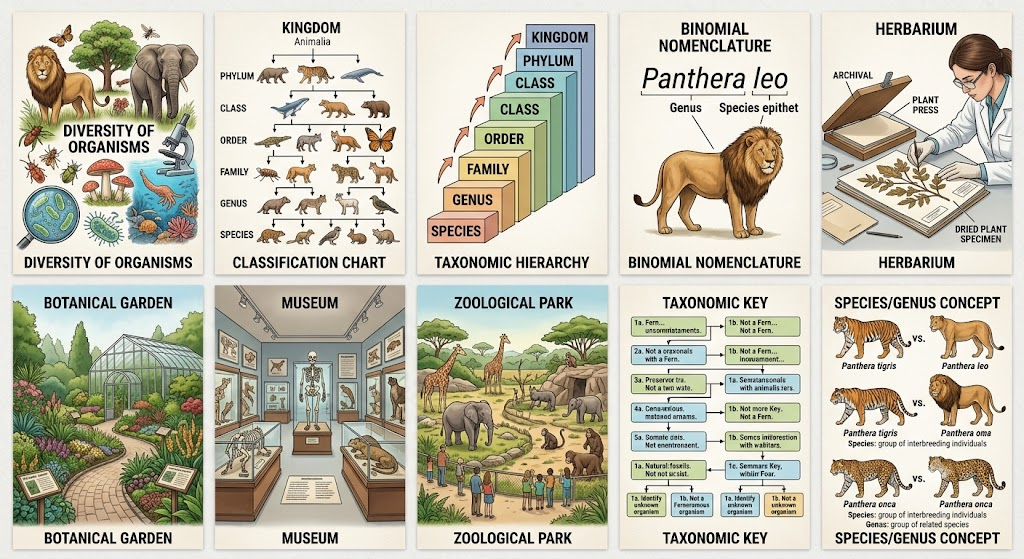
Species → Genus → Family → Order → Class → Phylum/Division → Kingdom
7.3 Species
Species is the lowest and most specific major taxonomic category.
Examples:
Homo sapiens
Panthera tigris
Mangifera indica
7.4 Genus
A genus is a group of closely related species.
Example:
The genus Panthera includes:
Panthera leo
Panthera tigris
Thus, closely related species are placed within the same genus.
7.5 Family
A family consists of one or more related genera.
For example:
Felidae is a family containing several genera of cats.
7.6 Order
An order consists of related families.
Example:
Carnivora is an order containing several related families.
7.7 Class
A class consists of related orders.
Example:
Mammalia is a class containing several orders.
7.8 Phylum
In animal classification, related classes are grouped into a phylum.
Example:
Chordata is a phylum containing several classes.
7.9 Division
In plant classification, the term division is traditionally used for a category comparable to phylum.
7.10 Kingdom
A kingdom is a broad taxonomic category containing related phyla or divisions.
Examples:
Plantae
Animalia
7.11 Hierarchy from Lower to Higher
The sequence is:
Species → Genus → Family → Order → Class → Phylum/Division → Kingdom
As we move upward:
The number of organisms generally increases.
Similarity among members generally decreases.
The category becomes broader.
7.12 Hierarchy from Higher to Lower
The reverse sequence is:
Kingdom → Phylum/Division → Class → Order → Family → Genus → Species
As we move downward:
The number of organisms generally decreases.
Similarity among members generally increases.
The category becomes more specific.
7.13 Taxon
A taxon is a group of organisms representing any category in the taxonomic hierarchy.
Examples:
Kingdom Animalia
Class Mammalia
Family Felidae
Genus Panthera
Species Homo sapiens
Each of these represents a taxon.
8. BINOMIAL NOMENCLATURE
8.1 Definition
Binomial nomenclature is the scientific system of naming organisms using two words.
The term “binomial” means:
Bi = two
Thus, each scientific name consists of two components.
8.2 Development of Binomial Nomenclature
Carolus Linnaeus (Carl Linnaeus) is widely associated with the development and standardisation of the binomial system of nomenclature.
He played a major role in establishing the systematic naming of organisms.
8.3 Components of a Scientific Name
A scientific name consists of:
1. Genus
The first word represents the genus.
Its first letter is capitalised.
2. Specific Epithet
The second word is the specific epithet.
It begins with a lowercase letter.
Example:
Homo sapiens
Homo = Genus
sapiens = Specific epithet
Together, the two words form the scientific name of the species.
8.4 Examples of Binomial Names
| Common Name | Scientific Name |
| Human | Homo sapiens |
| Mango | Mangifera indica |
| Tiger | Panthera tigris |
| Lion | Panthera leo |
| Potato | Solanum tuberosum |
8.5 Rules of Binomial Nomenclature
Rule 1: Two Words
The scientific name consists of two words.
Example:
Homo sapiens
Rule 2: Genus Begins with a Capital Letter
Example:
Homo
Rule 3: Specific Epithet Begins with a Lowercase Letter
Example:
sapiens
Rule 4: Italicisation
When printed or typed, the scientific name is written in italics.
Example:
Mangifera indica
Rule 5: Underlining in Handwriting
When handwritten, the two words are underlined separately.
Example:
Homo sapiens
Rule 6: Latin or Latinised Form
Scientific names are generally written in Latin or Latinised form.
8.6 Importance of Binomial Nomenclature
Common names vary between:
Countries
Regions
Languages
Local communities
A single organism may therefore have several common names.
Scientific names solve this problem by providing a standardised international name.
Advantages include:
Universal scientific communication
Avoidance of local-name confusion
Standardised identification
Better organisation of biological information
9. COMPLETE TAXONOMIC CLASSIFICATION OF HUMAN
| Taxonomic Category | Human |
| Kingdom | Animalia |
| Phylum | Chordata |
| Class | Mammalia |
| Order | Primates |
| Family | Hominidae |
| Genus | Homo |
| Species | Homo sapiens |
10. COMPLETE TAXONOMIC CLASSIFICATION OF MANGO
| Taxonomic Category | Mango |
| Kingdom | Plantae |
| Division | Angiospermae* |
| Class | Dicotyledonae* |
| Order | Sapindales |
| Family | Anacardiaceae |
| Genus | Mangifera |
| Species | Mangifera indica |
Note: The terms Angiospermae and Dicotyledonae represent traditional classification terminology commonly encountered in school-level biology. Modern classification systems may use different higher-level groupings.
11. IMPORTANT COMPARISONS
11.1 Taxonomy vs Systematics
| Taxonomy | Systematics |
| Identification, nomenclature and classification | Study of diversity and relationships |
| Relatively narrower | Broader |
| Classification is a major focus | Classification plus evolutionary relationships |
11.2 Classification vs Nomenclature
| Classification | Nomenclature |
| Arranges organisms into groups | Gives organisms scientific names |
| Based on similarities and differences | Based on internationally accepted naming rules |
| Helps organise biological diversity | Helps standardise biological communication |
11.3 Species vs Genus
| Species | Genus |
| Basic unit of classification | Category above species |
| More specific | More inclusive |
| Contains organisms belonging to the same species | Contains closely related species |
12. IMPORTANT NEET CONCEPTS
Concept 1
Growth alone is not a defining property of life.
Concept 2
Reproduction alone is not an all-inclusive defining property of life.
Concept 3
Metabolism is a fundamental characteristic of living organisms.
Concept 4
Cellular organisation is a fundamental feature of life.
Concept 5
Response to stimuli is an important characteristic of living organisms.
Concept 6
Species is the basic unit of biological classification.
Concept 7
Taxonomy includes identification, nomenclature, and classification.
Concept 8
Systematics is broader than taxonomy.
Concept 9
Scientific names follow internationally accepted rules.
Concept 10
The scientific name has two components: genus and specific epithet.
13. QUICK REVISION TABLE
| Topic | Key Point |
| Living | Shows characteristic features of life |
| Growth | Increase in size, mass, or cell number |
| Reproduction | Production of new individuals |
| Metabolism | Sum total of biochemical reactions |
| Biodiversity | Variety of living organisms |
| Classification | Arrangement of organisms into groups |
| Identification | Determination of the identity of an organism |
| Taxonomy | Identification + Nomenclature + Classification |
| Systematics | Diversity + relationships among organisms |
| Species | Basic unit of classification |
| Genus | Group of closely related species |
| Family | Group of related genera |
| Order | Group of related families |
| Class | Group of related orders |
| Phylum | Group of related classes |
| Division | Plant equivalent traditionally used for phylum |
| Kingdom | Broad taxonomic category |
| Binomial nomenclature | Two-word scientific naming system |
| Genus | First word; initial capital |
| Specific epithet | Second word; lowercase |
| Printed scientific name | Italicised |
| Handwritten scientific name | Words underlined separately |
14. CHAPTER SUMMARY
The living world contains enormous biological diversity. Organisms differ in their structure, function, habitat, behaviour, and genetic composition.
Living organisms generally exhibit characteristics such as cellular organisation, metabolism, growth, reproduction, response to stimuli, and consciousness. However, growth and reproduction individually cannot be considered universal defining characteristics of life.
The variety of organisms is called biodiversity. It can be considered at genetic, species, and ecosystem levels.
Because the number of organisms is enormous, classification is necessary to organise biological diversity. Classification makes identification, study, comparison, and scientific communication easier.
Taxonomy deals with the identification, nomenclature, and classification of organisms. Systematics has a broader scope and also considers relationships, particularly evolutionary relationships, among organisms.
The species is the basic unit of biological classification. Taxonomic categories are arranged in a hierarchy:
Species → Genus → Family → Order → Class → Phylum/Division → Kingdom
Scientific names are assigned using binomial nomenclature, in which each organism receives a two-word name consisting of a genus and a specific epithet.
For example:
Homo sapiens
Here, Homo is the genus and sapiens is the specific epithet.
Binomial nomenclature provides a standardised system of naming organisms and eliminates much of the confusion caused by different common or regional names.
15. EXAM-READY TAKEAWAYS
- The cell is the basic structural and functional unit of life.
- Metabolism includes all biochemical reactions occurring in an organism.
- Metabolism consists broadly of anabolism and catabolism.
- Growth alone cannot define life.
- Reproduction alone cannot define life.
- Biodiversity refers to the variety and variability of living organisms.
- Classification organises organisms into groups based on their characteristics.
- Identification determines the identity of an organism.
- Taxonomy includes identification, nomenclature, and classification.
- Systematics is broader than taxonomy.
- Species is the basic unit of biological classification.
- Genus is a group of closely related species.
- Family consists of related genera.
- Order consists of related families.
- Class consists of related orders.
- Phylum consists of related classes.
- Division is traditionally used for plants in place of phylum.
- Kingdom is a broad taxonomic category.
- Binomial nomenclature uses two words for the scientific name.
- The first word represents the genus.
- The genus begins with a capital letter.
- The second word is the specific epithet.
- The specific epithet begins with a lowercase letter.
- Printed scientific names are italicised.
- Handwritten scientific names are underlined separately.
- Homo sapiens is the scientific name of humans.
- Mangifera indica is the scientific name of mango.
- Panthera tigris is the scientific name of tiger.
- Panthera leo is the scientific name of lion.
- Solanum tuberosum is the scientific name of potato.
SECTION A — WHAT IS LIVING?
Q1. Which characteristic most reliably distinguishes living organisms from non-living objects?
A. Growth
B. Reproduction
C. Metabolic activity
D. Movement
Exam: AIPMT 2007
Answer: C. Metabolic activity
Explanation:
Living organisms possess metabolism, which includes all the biochemical reactions occurring inside their cells. Growth, reproduction and movement are not individually exclusive characteristics of living organisms. For example, non-living objects may increase in size by accumulation of material, and reproduction is not an essential characteristic of every individual organism.
NEET Concept:
Metabolism is one of the most important distinguishing features of living organisms.
Q2. Which feature is considered an exclusive characteristic of living organisms?
A. Isolated metabolic reactions can occur outside living organisms
B. Increase in mass from inside
C. Ability to perceive environmental events and retain information
D. Increase in mass by accumulation of material both externally and internally
Exam: AIPMT 2011 Mains
Answer: C. Ability to perceive environmental events and retain information
Explanation:
Living organisms can sense and respond to changes in their environment. This ability is associated with consciousness. Living organisms possess receptors and mechanisms that allow them to perceive environmental stimuli and respond appropriately.
NEET Concept:
Consciousness and response to stimuli are important characteristics of living organisms.
Q3. In which situation can reproduction be considered synonymous with growth?
A. Multicellular animals
B. Flowering plants
C. Unicellular organisms
D. Mammals only
Exam: NEET 2016 Phase 2
Answer: C. Unicellular organisms
Explanation:
In unicellular organisms, reproduction generally occurs by cell division. When one cell divides, it produces new individuals. Therefore, in such organisms, reproduction and growth can be closely associated.
The same question also tested two other important facts:
The biological species concept was given by Ernst Mayr.
Binomial nomenclature was not given by R.H. Whittaker; it is associated with Carolus Linnaeus.
Asked Again: The individual statements have been repeatedly tested in different forms.
SECTION B — BIODIVERSITY
Q4. According to Robert May, approximately how many species are estimated to exist globally?
A. 1.5 million
B. 7 million
C. 20 million
D. 50 million
Exam: NEET 2020
Answer: B. 7 million
Explanation:
According to Robert May’s estimate discussed in NCERT, the global species diversity is approximately 7 million. Only a fraction of the total number of species has been scientifically described.
NEET Concept:
Remember:
Estimated global species diversity ≈ 7 million
SECTION C — TAXONOMY AND SYSTEMATICS
Q5. Biosystematics primarily aims at:
A. Classification only on the basis of broad morphological characters
B. Establishing relationships only on the basis of cytological characters
C. Studying organisms using evolutionary relationships and evidence from different fields
D. Naming organisms using Latin names only
Exam: AIPMT 2003
Answer: C. Studying organisms using evolutionary relationships and evidence from different fields
Explanation:
Biosystematics is concerned with studying the diversity of organisms and their comparative and evolutionary relationships. It uses information from several areas, including morphology, cytology, genetics, ecology and evolutionary history.
NEET Concept:
Systematics is broader than simple naming and classification because it also considers evolutionary relationships.
Q6. Which statement correctly describes the relationship between taxonomy and systematics?
A. Taxonomy deals only with evolution
B. Systematics includes classification along with evolutionary relationships
C. Systematics is limited to nomenclature
D. Taxonomy and systematics are completely unrelated
Exam Concept Tested: AIPMT/NEET systematics questions
Answer: B. Systematics includes classification along with evolutionary relationships
Explanation:
Taxonomy traditionally includes identification, nomenclature and classification. Systematics has a broader perspective and attempts to understand diversity and evolutionary relationships among organisms.
SECTION D — SPECIES CONCEPT
Q7. Species are regarded as:
A. Artificial units created only by taxonomists
B. The basic units of biological classification
C. The highest units of classification
D. Groups containing several unrelated genera
Exam: AIPMT 2003
Answer: B. The basic units of biological classification
Explanation:
Species is the basic and lowest principal taxonomic category. Other taxonomic categories are generally arranged around species.
Examples:
Mangifera indica — mango
Solanum tuberosum — potato
Panthera leo — lion
NEET Concept:
Species → Genus → Family → Order → Class → Phylum/Division → Kingdom
Q8. The biological species concept is associated with:
A. R.H. Whittaker
B. Carolus Linnaeus
C. Ernst Mayr
D. Aristotle
Exam: NEET 2016 Phase 2
Answer: C. Ernst Mayr
Explanation:
Ernst Mayr is associated with the biological species concept. Under this concept, a species is generally a group of naturally interbreeding populations that are reproductively isolated from other such groups and produce fertile offspring.
SECTION E — TAXONOMICAL HIERARCHY
Q9. Which taxonomic category contains the greatest number of common characteristics?
A. Kingdom
B. Class
C. Family
D. Species
Exam Concept: AIPMT 2001 / taxonomic hierarchy
Answer: D. Species
Explanation:
As we move downward through the hierarchy, the number of common characteristics generally increases.
Kingdom → Phylum → Class → Order → Family → Genus → Species
Species is the lowest principal category and therefore contains organisms with the greatest similarity.
Q10. Which category is less general in its characteristics than genus?
A. Species
B. Division
C. Class
D. Family
Exam: AIPMT 2001
Answer: A. Species
Explanation:
A genus contains one or more closely related species. Therefore, species is more specific and has fewer but more closely shared characteristics.
Hierarchy:
Kingdom
↓
Phylum/Division
↓
Class
↓
Order
↓
Family
↓
Genus
↓
Species
Q11. Tomato and potato have the maximum number of common characteristics at which taxonomic level?
A. Family
B. Order
C. Division
D. Genus
Exam: NEET 2013 Karnataka
Answer: A. Family
Explanation:
Tomato and potato belong to different genera but the same family:
Tomato → Solanum
Potato → Solanum
Important correction: Modern accepted scientific treatment places both tomato and potato in the genus Solanum. Therefore, for the commonly used modern classification, their maximum similarity is at the genus level.
Because some older PYQ databases use older nomenclature/classification for tomato, this question should be handled carefully in an ebook. The underlying NEET concept is that the lower the taxonomic rank, the greater the similarity.
Q12. Which is the correct ascending order of taxonomic categories?
A. Species → Genus → Family → Order → Class → Phylum → Kingdom
B. Kingdom → Phylum → Class → Order → Family → Genus → Species
C. Genus → Species → Family → Class → Order → Phylum → Kingdom
D. Species → Family → Genus → Order → Class → Kingdom → Phylum
Exam: NEET 2022
Answer: A. Species → Genus → Family → Order → Class → Phylum → Kingdom
Explanation:
Ascending order means moving from the lowest/smallest category to the highest/largest category.
Species → Genus → Family → Order → Class → Phylum → Kingdom
The reverse is the descending order.
Q13. In the classification of the horse, which represents its order?
A. Equidae
B. Perissodactyla
C. Equus
D. Equus ferus
Exam: NEET 2017
Answer: B. Perissodactyla
Explanation:
The horse belongs to:
Kingdom — Animalia
Phylum — Chordata
Class — Mammalia
Order — Perissodactyla
Family — Equidae
Genus — Equus
Therefore, Perissodactyla is the order.
Q14. Which organism belongs to the family Muscidae?
A. Housefly
B. Firefly
C. Grasshopper
D. Cockroach
Exam: NEET 2021
Answer: A. Housefly
Explanation:
The housefly belongs to the family Muscidae.
Its classification includes:
Kingdom — Animalia
Phylum — Arthropoda
Class — Insecta
Order — Diptera
Family — Muscidae
Genus — Musca
Species — Musca domestica
The other insects belong to different families.
Q15. Match the taxonomic categories of the housefly correctly.
Column I
A. Family
B. Order
C. Class
D. Phylum
Column II
I. Diptera
II. Arthropoda
III. Muscidae
IV. Insecta
A. A-III, B-I, C-IV, D-II
B. A-III, B-II, C-IV, D-I
C. A-IV, B-III, C-II, D-I
D. A-IV, B-II, C-I, D-III
Exam: NEET 2016 Phase 2
Answer: A. A-III, B-I, C-IV, D-II
Explanation:
Family → Muscidae
Order → Diptera
Class → Insecta
Phylum → Arthropoda
Therefore:
A-III, B-I, C-IV, D-II
Q16. Which taxonomic sequence is correct for animals?
A. Kingdom → Phylum → Class → Order → Family → Genus → Species
B. Kingdom → Class → Phylum → Family → Order → Genus → Species
C. Kingdom → Order → Class → Phylum → Family → Genus → Species
D. Kingdom → Order → Phylum → Class → Family → Genus → Species
Exam: NEET 2022
Answer: A. Kingdom → Phylum → Class → Order → Family → Genus → Species
Explanation:
The standard taxonomic hierarchy for animals is:
Kingdom → Phylum → Class → Order → Family → Genus → Species
For plants, Division is commonly used instead of Phylum.
SECTION F — BINOMIAL NOMENCLATURE
Q17. Which statement is contrary to the rules of binomial nomenclature?
A. Biological names are written in Latin or Latinised form
B. Scientific names are italicised when printed
C. The genus name is written first and the specific epithet second
D. Biological names may be written in any language
Exam: NEET 2016 Phase 1
Answer: D. Biological names may be written in any language
Explanation:
Scientific names follow internationally accepted nomenclatural conventions and are generally Latin or Latinised in form.
In a binomial:
First word = Genus
Second word = Specific epithet
Example:
Homo sapiens
Homo → genus
sapiens → specific epithet
Q18. Which of the following is against the rules of scientific nomenclature?
A. Handwritten scientific names are separately underlined
B. Each species has a generic name and specific epithet
C. Scientific names are Latinised and italicised in print
D. Both the generic name and specific epithet begin with capital letters
Exam: NEET 2019 Odisha
Answer: D. Both the generic name and specific epithet begin with capital letters
Explanation:
The correct convention is:
Genus begins with a capital letter.
Specific epithet begins with a small letter.
Printed scientific names are italicised.
When handwritten, the two words are separately underlined.
Example:
Mangifera indica
Not:
Mangifera Indica
Q19. Which is the correctly written scientific name of mango associated with Carolus Linnaeus?
A. Mangifera indica Car. Linn.
B. Mangifera indica Linn.
C. Mangifera indica
D. Mangifera Indica
Exam: NEET 2019
Answer: B. Mangifera indica Linn.
Explanation:
The scientific name of mango is:
Mangifera indica
When the authority is included, Linn. indicates Carolus Linnaeus.
Important formatting:
Mangifera → capitalised genus
indica → lowercase specific epithet
Both are italicised in print.
Q20. In binomial nomenclature, the two components are:
A. Family name and genus name
B. Generic name and specific epithet
C. Species name and family name
D. Order name and genus name
Exam: NEET 2023 Phase 2
Answer: B. Generic name and specific epithet
Explanation:
The binomial name consists of two components:
Generic name + Specific epithet
Example:
Homo sapiens
Homo = generic name
sapiens = specific epithet
The system is associated with Carolus Linnaeus.
Q21. Which of the following statements about binomial nomenclature is incorrect?
A. Biological names are generally Latin or Latinised
B. Both words are italicised in printed form
C. The specific epithet begins with a small letter
D. The first word represents the specific epithet and the second represents the genus
Exam: NEET 2026
Answer: D. The first word represents the specific epithet and the second represents the genus
Explanation:
The statement reverses the correct order.
Correct rule:
First word → Genus
Second word → Specific epithet
Example:
Panthera tigris
Panthera → genus
tigris → specific epithet
Asked Again: The same fundamental nomenclature rule was tested in NEET 2016 and NEET 2019 in different forms.
SECTION G — 2026 RE-NEET / CURRENT PYQs
Q22. Arrange the following taxonomic categories in ascending order:
(a) Genus
(b) Class
(c) Order
(d) Phylum
(e) Family
(f) Kingdom
(g) Species
A. Species → Genus → Family → Order → Class → Phylum → Kingdom
B. Genus → Order → Phylum → Species → Kingdom → Class → Family
C. Species → Order → Phylum → Class → Family → Genus → Kingdom
D. Kingdom → Class → Phylum → Species → Order → Family → Genus
Exam: Re-NEET 2026
Answer: A. Species → Genus → Family → Order → Class → Phylum → Kingdom
Explanation:
Ascending means proceeding from the lowest taxonomic category to the highest.
Species → Genus → Family → Order → Class → Phylum → Kingdom
This is one of the most repeatedly tested areas of this chapter.
Q23. Genus represents:
A. An individual plant or animal
B. A population of unrelated organisms
C. A group of closely related species
D. A group of closely related families
Exam: Re-NEET 2026
Answer: C. A group of closely related species
Explanation:
A genus contains one or more closely related species.
For example:
Panthera leo — lion
Panthera tigris — tiger
Both belong to the genus Panthera.
Therefore:
Genus = group of closely related species
Q24. Match the following taxonomic categories with the appropriate examples:
Column I
A. Family
B. Genus
C. Class
D. Phylum
E. Order
Column II
I. Sapindales
II. Dicotyledonae
III. Anacardiaceae
IV. Angiospermae
V. Mangifera
A. A-I, B-V, C-II, D-IV, E-III
B. A-II, B-I, C-III, D-IV, E-V
C. A-II, B-III, C-V, D-I, E-IV
D. A-III, B-V, C-II, D-IV, E-I
Exam: Re-NEET 2026
Answer: D. A-III, B-V, C-II, D-IV, E-I
Explanation:
Family → Anacardiaceae
Genus → Mangifera
Class → Dicotyledonae
Phylum/Division → Angiospermae
Order → Sapindales
Thus:
A-III, B-V, C-II, D-IV, E-I
SECTION H — SCIENTIFIC NAME AND TAXONOMIC CATEGORY INTEGRATION
Q25. Which organism is correctly matched with its taxonomic category?
A. Tiger — tigris — species
B. Cuttlefish — Mollusca — class
C. Human — Primata — family
D. Housefly — Musca — order
Exam: AIPMT 2011 Prelims
Answer: A. Tiger — tigris — species
Explanation:
The scientific name of tiger is Panthera tigris.
Panthera = genus
tigris = specific epithet
In the traditional terminology used in such questions, the second component identifies the species within the genus.
The other options incorrectly match organisms with taxonomic categories.
Q26. Which organism was correctly identified, named and described in accordance with nomenclatural rules?
A. Musca domestica — house lizard
B. Plasmodium falciparum — protozoan causing severe malaria
C. Felis tigris — Indian tiger
D. E. coli — Entamoeba species
Exam: AIPMT 2012 Mains
Answer: B. Plasmodium falciparum — protozoan causing severe malaria
Explanation:
Plasmodium falciparum is a protozoan parasite responsible for falciparum malaria, the most severe form of human malaria.
The other options contain incorrect organism descriptions or incorrect scientific names.
SECTION I — NOMENCLATURE TERMINOLOGY
Q27. ICBN stands for:
A. International Code of Botanical Nomenclature
B. International Congress of Biological Names
C. Indian Code of Botanical Nomenclature
D. Indian Congress of Biological Names
Exam: AIPMT 2007
Answer: A. International Code of Botanical Nomenclature
Explanation:
ICBN traditionally referred to the International Code of Botanical Nomenclature, the set of rules governing botanical nomenclature.
Important: Modern botanical nomenclature is governed under the International Code of Nomenclature for algae, fungi, and plants (ICN). The older term ICBN appears in historical NEET/AIPMT questions.
SECTION J — HIGH-YIELD INTEGRATED PYQ CONCEPTS
Q28. Which sequence correctly represents the decreasing order of taxonomic rank?
A. Species → Genus → Family → Order → Class → Phylum → Kingdom
B. Kingdom → Phylum → Class → Order → Family → Genus → Species
C. Genus → Family → Species → Order → Class → Kingdom → Phylum
D. Kingdom → Class → Family → Phylum → Order → Genus → Species
Answer: B
Explanation:
The hierarchy from highest to lowest is:
Kingdom → Phylum/Division → Class → Order → Family → Genus → Species
As we move downward:
Number of organisms decreases.
Similarity generally increases.
Common characteristics increase.
REPEATED NEET CONCEPTS — DO NOT MISS
The following concepts have appeared repeatedly in the PYQ record:
1. Binomial Nomenclature
Asked in different forms in:
NEET 2016
NEET 2019
NEET 2023
NEET 2026
Core rule:
Genus first + specific epithet second.
2. Taxonomic Hierarchy
Repeated in:
NEET 2016
NEET 2017
NEET 2021
NEET 2022
Re-NEET 2026
Core sequence:
Kingdom → Phylum/Division → Class → Order → Family → Genus → Species
3. Species
Repeated through questions on:
Species as the basic unit
Biological species concept
Ernst Mayr
Species rank
Appeared in older AIPMT and NEET questions.
4. Characteristics of Living Organisms
Important questions have tested:
Consciousness
Response to stimuli
Metabolism
Reproduction
Growth
AIPMT 2007 and AIPMT 2011 are particularly important.
5. Genus
The 2026 examination directly tested:
Genus = group of closely related species
QUICK PYQ REVISION TABLE
| Concept | Correct Point |
| Basic unit of classification | Species |
| Group of related species | Genus |
| Group of related genera | Family |
| Group of related families | Order |
| Group of related orders | Class |
| Group of related classes | Phylum/Division |
| Highest major category | Kingdom |
| First component of binomial name | Genus |
| Second component | Specific epithet |
| Genus starts with | Capital letter |
| Specific epithet starts with | Small letter |
| Printed scientific name | Italicised |
| Handwritten scientific name | Separately underlined |
| Binomial nomenclature associated with | Carolus Linnaeus |
| Biological species concept | Ernst Mayr |
| Housefly family | Muscidae |
| Housefly order | Diptera |
| Housefly class | Insecta |
| Housefly phylum | Arthropoda |
| Horse order | Perissodactyla |
| Mango genus | Mangifera |
| Mango scientific name | Mangifera indica |
| Global species estimate in Robert May’s NCERT discussion | About 7 million |
| Biosystematics | Diversity + comparative/evolutionary relationships |
Q29. The living organisms can be distinguished from non-living things most reliably on the basis of their ability to:
A. Reproduce
B. Grow and move
C. Interact with the environment and undergo progressive evolution
D. Respond only to touch
Exam: AIPMT 2007
Answer: C. Interact with the environment and undergo progressive evolution
Explanation:
Living organisms continuously interact with their surroundings and show the ability to respond to environmental conditions. Growth, movement and reproduction are not individually universal criteria for defining life.
For example:
Non-living objects can increase in size by accumulation.
Some living organisms are unable to reproduce.
Movement can also occur in non-living systems.
Therefore, no single property such as growth or reproduction can universally distinguish all living organisms.
NCERT Focus:
Living organisms are characterised by properties such as cellular organisation, metabolism, growth, reproduction and consciousness. Among these, consciousness/response to environmental stimuli is particularly important.
Source verification: AIPMT 2007.
Q30. ICBN stands for:
A. International Code of Botanical Nomenclature
B. International Congress of Biological Names
C. Indian Code of Botanical Nomenclature
D. Indian Congress of Biological Names
Exam: AIPMT 2007
Answer: A. International Code of Botanical Nomenclature
Explanation:
ICBN historically stood for International Code of Botanical Nomenclature. It provided internationally accepted rules and recommendations for botanical nomenclature.
The modern name is International Code of Nomenclature for algae, fungi, and plants (ICN).
Important for NEET:
Do not confuse:
ICBN → historical botanical nomenclature code
ICZN → zoological nomenclature code
Source verification: AIPMT 2007.
Q31. Which of the following is the most appropriate objective of biosystematics?
A. Classification solely on broad morphological characters
B. Identification based only on cytological characters
C. Studying evolutionary history and establishing phylogenetic relationships using evidence from different fields
D. Naming organisms only according to their habitat
Exam: AIPMT 2003
Answer: C. Studying evolutionary history and establishing phylogenetic relationships using evidence from different fields
Explanation:
Biosystematics is broader than simple classification. It studies biological diversity together with comparative and evolutionary relationships.
It may use evidence from:
Morphology
Anatomy
Cytology
Genetics
Ecology
Embryology
Evolutionary history
Thus, biosystematics attempts to understand organisms in an evolutionary framework.
Source verification: AIPMT 2003.
Q32. Species are considered to be:
A. Artificial units created by taxonomists
B. The lowest and basic units of biological classification
C. Groups that cannot be distinguished from one another
D. Groups consisting of unrelated genera
Exam: AIPMT 2003
Answer: B. The lowest and basic units of biological classification
Explanation:
Species is the basic and lowest principal taxonomic category.
Examples:
Mangifera indica — mango
Solanum tuberosum — potato
Panthera leo — lion
According to the biological species concept, a species generally consists of naturally interbreeding populations that are reproductively isolated from other such groups.
Important:
Species → Genus → Family → Order → Class → Phylum/Division → Kingdom
Source verification: AIPMT 2003.
Q33. Which taxonomic category is less general in its characteristics than genus?
A. Species
B. Division
C. Class
D. Family
Exam: AIPMT 2001
Answer: A. Species
Explanation:
A genus contains one or more closely related species. Therefore, species is a more specific taxonomic category than genus.
The hierarchy is:
Kingdom → Phylum/Division → Class → Order → Family → Genus → Species
As we move downward:
Number of common characteristics increases.
Similarity increases.
Number of organisms included generally decreases.
Thus, species is less general than genus.
Source verification: AIPMT 2001.
IMPORTANT REPEATED-CONCEPT RECORD
1. Species
This concept has appeared in multiple forms:
AIPMT 2003 — species as basic/lowest unit
NEET 2016 Phase 2 — biological species concept
NEET 2023/other later records — basic unit of classification in different formulations
The wording may change, but the tested NCERT concept remains:
Species is the basic taxonomic category.
2. Taxonomic Hierarchy
Repeatedly tested through:
AIPMT 2001
AIPMT 2011
NEET 2013
NEET 2016
NEET 2021
NEET 2022
NEET 2026
Re-NEET 2026
The core sequence remains:
Species → Genus → Family → Order → Class → Phylum/Division → Kingdom
The 2026 database specifically records questions on ascending taxonomic order, genus, and matching taxonomic categories.
3. Living Characteristics
Important previous-year testing includes:
AIPMT 2007 — distinguishing living from non-living
AIPMT 2011 Mains — perception of environmental events and memory
NEET 2016 Phase 2 — reproduction in unicellular organisms and biological species concept
The most important NCERT points are:
Metabolism + cellular organisation + consciousness + growth + reproduction
However, no single one of these, taken alone, is sufficient in every case to define all living organisms.
4. Binomial Nomenclature
Repeatedly tested through:
Scientific-name formatting
Generic name
Specific epithet
Capitalisation
Italicisation
Linnaean nomenclature
Remember:
First word → Genus → Capital letter
Second word → Specific epithet → Small letter
Example:
Homo sapiens
Not:
Homo Sapiens
QUESTIONS EXCLUDED FROM THIS CHAPTER
The broad online “The Living World” PYQ databases also contain questions on:
Herbarium
Botanical gardens
Museums
Zoological parks
Taxonomic keys
Taxonomic catalogues
For example, the database lists AIPMT 2005 botanical-garden and NEET 2018 herbarium/key questions.
I am intentionally NOT putting those into your Chapter 1 PYQ section, because your finalized Chapter 1 contains:
- What is Living?
- Biodiversity
- Need for Classification
- Taxonomy
- Systematics
- Species Concept
- Taxonomical Hierarchy
- Binomial Nomenclature
Those Taxonomical Aids will not be artificially added to your chapter.
Q34. Which of the following is the correct ascending order of taxonomic categories?
A. Species → Genus → Family → Order → Class → Phylum → Kingdom
B. Kingdom → Phylum → Class → Order → Family → Genus → Species
C. Species → Family → Genus → Order → Class → Phylum → Kingdom
D. Genus → Species → Family → Order → Class → Phylum → Kingdom
Exam: NEET 2022
Answer: A. Species → Genus → Family → Order → Class → Phylum → Kingdom
Explanation
Taxonomic categories are arranged from the most specific to the most inclusive as:
Species → Genus → Family → Order → Class → Phylum/Division → Kingdom
Therefore, option A is correct.
As we move from species toward kingdom:
Number of organisms included increases.
Similarity between organisms generally decreases.
Common characteristics decrease.
NEET Trap
Do not confuse:
Ascending: Species → Kingdom
with
Descending: Kingdom → Species.
Q35. Genus represents:
A. A group of closely related species
B. A group of closely related families
C. A group of related orders
D. A group of unrelated species
Exam: Re-NEET 2026
Answer: A. A group of closely related species
Explanation
A genus is a taxonomic category that includes one or more closely related species.
For example:
Panthera leo — lion
Panthera tigris — tiger
Both belong to the genus Panthera.
Thus:
Genus = group of closely related species.
NEET Trap
Remember the sequence:
Species → Genus → Family → Order → Class → Phylum → Kingdom
So:
Species = basic unit
Genus = related species
Family = related genera
Order = related families
Q36. Match the taxonomic categories with the corresponding examples.
| Column I | Column II |
| A. Family | I. Sapindales |
| B. Genus | II. Dicotyledonae |
| C. Class | III. Anacardiaceae |
| D. Phylum/Division | IV. Angiospermae |
| E. Order | V. Mangifera |
A. A-III, B-V, C-II, D-IV, E-I
B. A-II, B-V, C-III, D-I, E-IV
C. A-III, B-I, C-V, D-IV, E-II
D. A-V, B-III, C-II, D-IV, E-I
Exam: Re-NEET 2026
Answer: A. A-III, B-V, C-II, D-IV, E-I
Explanation
For mango:
Family → Anacardiaceae
Genus → Mangifera
Class → Dicotyledonae in the traditional classification used by this question
Division → Angiospermae
Order → Sapindales
Therefore:
A-III, B-V, C-II, D-IV, E-I
NEET Trap
The question is testing whether you can identify the rank of a taxon, not merely remember the mango classification.
Q37. Which of the following statements is NOT correct regarding the universal rules of binomial nomenclature?
A. The first word represents the genus.
B. The second word represents the specific epithet.
C. The generic name begins with a capital letter.
D. Both words begin with capital letters.
Exam: Re-NEET 2026
Answer: D. Both words begin with capital letters.
Explanation
The correct rules are:
- Scientific names are binomial.
- The first word is the generic name.
- The second word is the specific epithet.
- The genus begins with a capital letter.
- The specific epithet begins with a small letter.
- Printed names are written in italics.
- Handwritten names are underlined separately.
- Names are Latin or Latinised.
Example:
Mangifera indica
Correct:
Mangifera → capital
indica → lowercase
Incorrect:
Mangifera Indica
Q38. Which of the following correctly represents the scientific name of a human being?
A. homo Sapiens
B. Homo Sapiens
C. Homo sapiens
D. homo sapiens
Exam: NEET/AIPMT nomenclature PYQ pattern
Answer: C. Homo sapiens
Explanation
Under binomial nomenclature:
Genus → first word → capital letter
Specific epithet → second word → lowercase letter
Therefore:
Homo sapiens
is correctly written.
Important
The complete binomial is the scientific name of the species.
Q39. Which one of the following pairs is correctly matched?
A. Mangifera indica — Mango
B. Solanum tuberosum — Tomato
C. Panthera leo — Tiger
D. Homo erectus — Modern human
Answer: A. Mangifera indica — Mango
Explanation
Correct examples:
Mangifera indica → Mango
Solanum tuberosum → Potato
Panthera leo → Lion
Panthera tigris → Tiger
Homo sapiens → Modern human
Therefore, A is correct.
REPEATED-CONCEPT MASTER LIST
The following concepts have already appeared in the PYQ section and will NOT be repeated as separate duplicate questions.
A. Taxonomic Hierarchy
Repeated in several examinations in different forms.
Master fact:
Kingdom → Phylum/Division → Class → Order → Family → Genus → Species
B. Genus
Repeated in different forms.
Master fact:
Genus = group of closely related species.
C. Species
Repeated in different forms.
Master fact:
Species is the basic unit of classification.
D. Binomial Nomenclature
Repeated in multiple examinations.
Master facts:
Two-word scientific name
Genus first
Specific epithet second
Genus capitalised
Specific epithet lowercase
Printed → italics
Handwritten → separately underlined
Latin/Latinised form
SECTION 1 — WHAT IS LIVING?
Q1. Which of the following is a characteristic feature of living organisms?
A. Increase in mass only by external accumulation
B. Metabolism
C. Absence of cellular organisation
D. Permanent absence of response to stimuli
Answer: B. Metabolism
Explanation:
All living organisms possess metabolism, which includes the totality of biochemical reactions occurring within an organism.
Non-living objects can increase in mass through external accumulation, but this is not biological growth.
Q2. Which statement regarding growth is correct?
A. Growth is completely absent in living organisms
B. Growth always occurs only from outside
C. Growth in living organisms generally occurs due to increase in cell number or cell size
D. Growth is an exclusive characteristic of non-living objects
Answer: C. Growth in living organisms generally occurs due to increase in cell number or cell size
Explanation:
In living organisms, growth occurs through processes such as cell division and enlargement.
In multicellular organisms, growth generally results from an increase in the number and/or size of cells.
However, increase in mass alone cannot be used as an absolute defining characteristic of life because non-living objects may also increase in size through accumulation of material.
Q3. Which of the following statements about reproduction is correct?
A. Every individual organism must reproduce to remain classified as living
B. Reproduction is the only defining property of life
C. Reproduction is an important characteristic of living organisms but is not an all-inclusive defining property
D. Non-living objects reproduce naturally
Answer: C. Reproduction is an important characteristic of living organisms but is not an all-inclusive defining property
Explanation:
Reproduction is an important characteristic of living organisms, but it cannot be considered an absolute defining property because:
Some living organisms are sterile.
Mule is a commonly cited sterile hybrid.
Worker bees are generally sterile.
Therefore, reproduction cannot alone define the living state.
Q4. Which of the following is a correct example of a living organism that normally does not reproduce?
A. Mule
B. Bacteria
C. Amoeba
D. Yeast
Answer: A. Mule
Explanation:
A mule is a hybrid produced from a horse and donkey. Mules are generally sterile.
This demonstrates why reproduction cannot be regarded as an essential property of every individual living organism.
Q5. The term metabolism refers to:
A. Only digestion
B. Only respiration
C. The sum total of all chemical reactions occurring in a living organism
D. Only excretion
Answer: C. The sum total of all chemical reactions occurring in a living organism
Explanation:
Metabolism is the sum total of all chemical reactions occurring within the body of an organism.
It includes:
Anabolism — constructive reactions
Catabolism — degradative reactions
Metabolism is an important defining characteristic of living organisms.
Q6. Which of the following represents an anabolic process?
A. Breakdown of glucose
B. Breakdown of glycogen
C. Formation of proteins from amino acids
D. Digestion of food
Answer: C. Formation of proteins from amino acids
Explanation:
Anabolism involves the synthesis of complex molecules from simpler molecules.
Example:
Amino acids → Proteins
Catabolism, in contrast, involves breakdown reactions.
Q7. Which of the following represents catabolism?
A. Formation of proteins
B. Formation of glycogen
C. Breakdown of glucose during cellular respiration
D. Formation of DNA from nucleotides
Answer: C. Breakdown of glucose during cellular respiration
Explanation:
Catabolism involves the breakdown of complex substances into simpler substances, generally releasing energy.
Glucose is broken down during cellular respiration to release energy.
Q8. Which characteristic of living organisms is associated with their ability to sense and respond to changes in their surroundings?
A. Reproduction
B. Consciousness
C. Growth
D. Excretion
Answer: B. Consciousness
Explanation:
Consciousness refers to the ability of an organism to sense and respond to its environment.
Living organisms respond to various stimuli such as:
Light
Temperature
Chemicals
Touch
Water availability
NCERT considers consciousness a defining property of living organisms.
Q9. Which statement is most appropriate regarding consciousness?
A. Only humans respond to environmental stimuli
B. All organisms are aware of their surroundings to some extent
C. Plants do not respond to stimuli
D. Microorganisms cannot sense their environment
Answer: B. All organisms are aware of their surroundings to some extent
Explanation:
NCERT states that organisms are aware of their surroundings and respond to environmental stimuli.
Plants respond to:
Light
Gravity
Water
Touch
Chemicals
Animals possess highly developed sensory and nervous systems.
Q10. Which property is considered a defining characteristic of living organisms?
A. Increase in mass
B. Reproduction alone
C. Consciousness
D. External accumulation
Answer: C. Consciousness
Explanation:
Growth and reproduction have limitations as universal defining properties.
NCERT specifically emphasises consciousness as a defining property of living organisms.
SECTION 2 — BIODIVERSITY
Q11. Biodiversity refers to:
A. Only the number of animals present on Earth
B. Only the number of plant species
C. The variety and variability of life forms
D. Only genetic differences within one species
Answer: C. The variety and variability of life forms
Explanation:
Biodiversity broadly represents the variety of living organisms.
It can be considered at different levels, including:
Genetic diversity
Species diversity
Ecosystem diversity
Q12. According to NCERT, approximately how many species have been described and identified?
A. 17,000–18,000
B. 1.7–1.8 million
C. 17–18 million
D. 170–180 million
Answer: B. 1.7–1.8 million
Explanation:
NCERT states that the number of species that are known and described is approximately 1.7–1.8 million.
A large number of organisms remain unidentified.
Q13. Which factor contributes most directly to the enormous biodiversity found on Earth?
A. Uniform environmental conditions
B. Variety of habitats and environmental conditions
C. Absence of evolutionary change
D. Complete similarity among organisms
Answer: B. Variety of habitats and environmental conditions
Explanation:
Living organisms occur in extremely diverse habitats such as:
Mountains
Forests
Oceans
Lakes
Deserts
Hot springs
Different environmental conditions contribute to the diversity of life.
SECTION 3 — NEED FOR CLASSIFICATION
Q14. Why is classification of living organisms necessary?
A. Because all organisms are identical
B. Because the number and diversity of organisms make their study difficult
C. Because classification eliminates biodiversity
D. Because organisms cannot be identified individually
Answer: B. Because the number and diversity of organisms make their study difficult
Explanation:
Millions of organisms exist on Earth.
It is practically impossible to study each organism individually without an organised system.
Classification groups organisms into convenient categories based on similarities and differences, making their study easier.
Q15. Classification mainly helps scientists to:
A. Eliminate species
B. Organise and simplify the study of organisms
C. Prevent reproduction
D. Change scientific names randomly
Answer: B. Organise and simplify the study of organisms
Explanation:
Classification provides an organised framework for studying the enormous diversity of organisms.
It helps in:
Identification
Comparison
Study
Communication
Understanding relationships
Q16. The scientific term for the convenient groups used to classify organisms is:
A. Cells
B. Tissues
C. Taxa
D. Organs
Answer: C. Taxa
Explanation:
A group or category used in biological classification is called a taxon.
The plural form is taxa.
Examples:
Species
Genus
Family
Order
Class
Phylum
Kingdom
Each represents a taxonomic category/taxon.
SECTION 4 — TAXONOMY
Q17. Taxonomy primarily deals with:
A. Identification, nomenclature and classification
B. Respiration and excretion
C. Photosynthesis only
D. Reproduction only
Answer: A. Identification, nomenclature and classification
Explanation:
According to NCERT, the basic processes of taxonomy include:
Characterisation → Identification → Classification → Nomenclature
Taxonomy is concerned with the study and organisation of biological diversity.
Q18. Which of the following is NOT a basic process of taxonomy?
A. Characterisation
B. Identification
C. Nomenclature
D. Photosynthesis
Answer: D. Photosynthesis
Explanation:
Photosynthesis is a physiological process occurring mainly in plants and photosynthetic organisms.
The basic processes associated with taxonomy include:
Characterisation
Identification
Classification
Nomenclature
Q19. Identification means:
A. Giving a new name to every organism
B. Determining the identity of an organism
C. Destroying unidentified organisms
D. Grouping all organisms into one category
Answer: B. Determining the identity of an organism
Explanation:
Identification means determining which organism is being studied by comparing its characteristics with known organisms.
Nomenclature comes after identification.
Q20. Nomenclature refers to:
A. Classification of cells
B. Giving scientifically accepted names to organisms
C. Studying metabolism
D. Measuring biodiversity
Answer: B. Giving scientifically accepted names to organisms
Explanation:
Nomenclature is the process of assigning scientific names to organisms according to internationally accepted rules.
For example:
Mango → Mangifera indica
SECTION 5 — SYSTEMATICS
Q21. Systematics differs from basic taxonomy mainly because systematics also considers:
A. Evolutionary relationships
B. Only body colour
C. Only habitat
D. Only size
Answer: A. Evolutionary relationships
Explanation:
Systematics has a broader scope than basic taxonomy.
It includes identification, nomenclature and classification and also considers the evolutionary relationships among organisms.
Q22. The term “systematics” is derived from the Latin word:
A. Species
B. Systema
C. Taxon
D. Natura
Answer: B. Systema
Explanation:
The word systematics is derived from the Latin word systema, meaning systematic arrangement.
Linnaeus used Systema Naturae as the title of his famous publication.
SECTION 6 — SPECIES CONCEPT
Q23. Which is the basic taxonomic category?
A. Kingdom
B. Family
C. Genus
D. Species
Answer: D. Species
Explanation:
Species is the lowest and basic principal taxonomic category.
The hierarchy is:
Species → Genus → Family → Order → Class → Phylum/Division → Kingdom
Q24. According to the biological species concept, members of a species generally:
A. Cannot reproduce
B. Can interbreed naturally and produce fertile offspring
C. Always belong to different genera
D. Must have completely different morphology
Answer: B. Can interbreed naturally and produce fertile offspring
Explanation:
Under the biological species concept, a species generally consists of naturally interbreeding populations that produce fertile offspring and are reproductively isolated from other groups.
Q25. The biological species concept is most closely associated with:
A. Ernst Mayr
B. Linnaeus
C. Whittaker
D. Aristotle
Answer: A. Ernst Mayr
Explanation:
Ernst Mayr is strongly associated with the biological species concept.
This is a high-yield NEET fact.
SECTION 7 — TAXONOMICAL HIERARCHY
Q26. Which is the correct hierarchy from lower to higher category?
A. Species → Genus → Family → Order → Class → Phylum → Kingdom
B. Species → Family → Genus → Order → Class → Kingdom → Phylum
C. Genus → Species → Family → Class → Order → Phylum → Kingdom
D. Kingdom → Phylum → Class → Order → Family → Genus → Species
Answer: A. Species → Genus → Family → Order → Class → Phylum → Kingdom
Explanation:
The ascending taxonomic hierarchy is:
Species → Genus → Family → Order → Class → Phylum/Division → Kingdom
Q27. As we move from species toward kingdom, the number of common characteristics generally:
A. Increases
B. Decreases
C. Remains exactly the same
D. Becomes zero immediately
Answer: B. Decreases
Explanation:
Lower taxa contain organisms with more common characteristics.
Higher taxa contain organisms with fewer common characteristics.
Therefore:
Lower taxon → greater similarity
Higher taxon → greater diversity
Q28. Which taxonomic category contains organisms having the maximum number of common characteristics?
A. Kingdom
B. Class
C. Genus
D. Species
Answer: D. Species
Explanation:
Species is the lowest principal taxonomic category.
Members of the same species share the greatest number of common characteristics among the listed categories.
Q29. A group of closely related species is called:
A. Family
B. Genus
C. Order
D. Class
Answer: B. Genus
Explanation:
Genus = group of closely related species
Example:
Panthera includes:
Panthera leo
Panthera tigris
Panthera pardus
Q30. A family is generally composed of:
A. Closely related species only
B. One or more related genera
C. One or more related kingdoms
D. Several unrelated orders
Answer: B. One or more related genera
Explanation:
Taxonomic hierarchy:
Species → Genus → Family → Order → Class → Phylum → Kingdom
Therefore:
Family = group of related genera
Q31. An order is generally composed of:
A. Related families
B. Related species only
C. Related kingdoms
D. Individual organisms
Answer: A. Related families
Explanation:
Order = group of related families
For example, an order may contain several related families.
Q32. A class consists of:
A. Related orders
B. Related species only
C. Related genera only
D. Related kingdoms
Answer: A. Related orders
Explanation:
The hierarchy is:
Family → Order → Class
Therefore:
Class = group of related orders
Q33. Which taxonomic category lies immediately above genus?
A. Species
B. Family
C. Order
D. Class
Answer: B. Family
Explanation:
The relevant sequence is:
Species → Genus → Family → Order
Therefore, family lies immediately above genus.
Q34. Which taxonomic category lies immediately below family?
A. Species
B. Genus
C. Order
D. Class
Answer: B. Genus
Explanation:
The sequence is:
Order → Family → Genus → Species
Thus genus lies immediately below family.
SECTION 8 — TAXON
Q35. The term “taxon” refers to:
A. Only the species category
B. A taxonomic group of any rank
C. Only the kingdom
D. Only an individual organism
Answer: B. A taxonomic group of any rank
Explanation:
Each category or unit of classification is called a taxon.
Examples:
Species can be a taxon.
Genus can be a taxon.
Family can be a taxon.
Kingdom can be a taxon.
Plural:
Taxon → Taxa
Q36. Which statement about taxonomic hierarchy is correct?
A. All taxonomic categories have exactly the same rank
B. Different categories represent different ranks
C. Only species represents a rank
D. Kingdom is below species
Answer: B. Different categories represent different ranks
Explanation:
Taxonomic classification is hierarchical.
The principal categories include:
Kingdom, Phylum/Division, Class, Order, Family, Genus and Species.
Each represents a different rank.
SECTION 9 — BINOMIAL NOMENCLATURE
Q37. The binomial system of nomenclature consists of:
A. One word
B. Two words
C. Three words
D. Four words
Answer: B. Two words
Explanation:
Bi = two
Binomial nomenclature gives each organism a two-word scientific name.
Example:
Mangifera indica
Q38. In Mangifera indica, “Mangifera” represents:
A. Family
B. Genus
C. Species
D. Order
Answer: B. Genus
Explanation:
Mangifera indica
Mangifera → genus
indica → specific epithet
Q39. In Mangifera indica, “indica” represents:
A. Genus
B. Family
C. Specific epithet
D. Order
Answer: C. Specific epithet
Explanation:
The second component of a binomial name is the specific epithet.
Thus:
Mangifera indica
First component → genus
Second component → specific epithet
Q40. Which scientific name is correctly written?
A. mangifera indica
B. Mangifera Indica
C. Mangifera indica
D. MANGIFERA INDICA
Answer: C. Mangifera indica
Explanation:
Rules:
Genus begins with a capital letter.
Specific epithet begins with a small letter.
Both words are italicised when printed.
Therefore:
Mangifera indica
is correct.
Q41. When a scientific name is handwritten, it should be:
A. Written entirely in capital letters
B. Written without any special marking
C. Underlined separately for each word
D. Enclosed in quotation marks
Answer: C. Underlined separately for each word
Explanation:
When handwritten, each component of the scientific name is separately underlined.
Example:
Mangifera indica
In printed material, the name is generally italicised.
Q42. Biological names are generally:
A. English only
B. Latin or Latinised
C. Hindi only
D. Sanskrit only
Answer: B. Latin or Latinised
Explanation:
Scientific names are generally written in Latin or Latinised form, irrespective of the language from which the name originated.
This gives scientific names international uniformity.
Q43. Who is associated with the binomial nomenclature system described in NCERT?
A. Darwin
B. Mendel
C. Carolus Linnaeus
D. Robert Hooke
Answer: C. Carolus Linnaeus
Explanation:
The two-word naming system called binomial nomenclature is associated with Carolus Linnaeus.
Example:
Mangifera indica
Q44. In the scientific name Homo sapiens Linn., “Linn.” indicates:
A. The family
B. The order
C. The author who described the species
D. The habitat of the organism
Answer: C. The author who described the species
Explanation:
NCERT states that the author’s name may appear after the specific epithet in abbreviated form.
Example:
Mangifera indica Linn.
Linn. indicates Linnaeus.
SECTION 10 — IDENTIFICATION AND NOMENCLATURE
Q45. Why must identification generally precede nomenclature?
A. An organism must first be correctly identified before an appropriate scientific name can be assigned
B. Scientific names are given randomly
C. Identification is performed only after classification is complete
D. Nomenclature does not require knowledge of the organism
Answer: A. An organism must first be correctly identified before an appropriate scientific name can be assigned
Explanation:
NCERT explains that nomenclature is possible only when the organism has been correctly described and identified.
Therefore:
Identification → Nomenclature
Q46. The primary purpose of using universally accepted scientific names is to:
A. Make names longer
B. Avoid confusion caused by different local names
C. Replace classification
D. Eliminate biodiversity
Answer: B. Avoid confusion caused by different local names
Explanation:
The same organism may have different common names in different regions.
A universal scientific name allows scientists worldwide to refer to the same organism consistently.
SECTION 11 — STATEMENT-BASED MCQs
Q47. Consider the following statements:
- Taxonomy includes identification, nomenclature and classification.
- Systematics considers evolutionary relationships.
- Species is a higher category than kingdom.
- Genus comprises closely related species.
Which statements are correct?
A. 1 and 2 only
B. 1, 2 and 4 only
C. 2 and 3 only
D. 1, 2, 3 and 4
Answer: B. 1, 2 and 4 only
Explanation:
Statement 1 — Correct.
Taxonomy includes identification, nomenclature and classification.
Statement 2 — Correct.
Systematics considers evolutionary relationships.
Statement 3 — Incorrect.
Species is below kingdom.
Statement 4 — Correct.
Genus consists of closely related species.
Q48. Consider the following statements about binomial nomenclature:
- The first word represents the genus.
- The second word represents the specific epithet.
- The genus starts with a capital letter.
- The specific epithet starts with a capital letter.
Choose the correct answer.
A. 1 and 2 only
B. 1, 2 and 3 only
C. 1, 3 and 4 only
D. All four
Answer: B. 1, 2 and 3 only
Explanation:
Statements 1, 2 and 3 are correct.
Statement 4 is incorrect.
The specific epithet begins with a lowercase letter.
Q49. Consider the following statements:
- Lower taxonomic categories generally have more common characteristics.
- Higher categories generally contain more organisms.
- Species is the lowest principal taxonomic category.
- Kingdom is below genus.
Which statements are correct?
A. 1 and 2 only
B. 1, 2 and 3 only
C. 2 and 4 only
D. All four
Answer: B. 1, 2 and 3 only
Explanation:
- Correct.
- Correct.
- Correct.
- Incorrect — kingdom is much higher than genus.
SECTION 12 — ASSERTION AND REASON
Q50. Assertion (A): Species is considered the basic unit of biological classification.
Reason (R): Members of a species generally show fundamental similarities and can be distinguished from other closely related species.
A. Both A and R are true, and R correctly explains A
B. Both A and R are true, but R does not correctly explain A
C. A is true, but R is false
D. A is false, but R is true
Answer: A. Both A and R are true, and R correctly explains A
Explanation:
Species is the basic taxonomic category because it represents a group of organisms with fundamental similarities and is distinguishable from other closely related groups.
Q51. Assertion (A): Scientific names are used internationally.
Reason (R): Local names of organisms can vary from one region to another.
A. Both A and R are true, and R correctly explains A
B. Both A and R are true, but R does not correctly explain A
C. A is true, but R is false
D. Both A and R are false
Answer: A. Both A and R are true, and R correctly explains A
Explanation:
Local/common names differ geographically and may create confusion.
Universal scientific names provide a standard method of communication.
Q52. Assertion (A): The number of common characteristics decreases as we move from species to kingdom.
Reason (R): Higher taxonomic categories contain organisms that are more diverse.
A. Both A and R are true, and R correctly explains A
B. Both A and R are true, but R does not correctly explain A
C. A is true, but R is false
D. A is false, but R is true
Answer: A. Both A and R are true, and R correctly explains A
Explanation:
Higher categories contain more diverse organisms.
Therefore, organisms belonging to a higher category share fewer common characteristics.
SECTION 13 — MATCH THE FOLLOWING
Q53. Match Column I with Column II.
| Column I | Column II |
| A. Species | I. Closely related species |
| B. Genus | II. Basic taxonomic category |
| C. Family | III. Related genera |
| D. Order | IV. Related families |
A. A-II, B-I, C-III, D-IV
B. A-I, B-II, C-IV, D-III
C. A-II, B-III, C-I, D-IV
D. A-IV, B-I, C-II, D-III
Answer: A. A-II, B-I, C-III, D-IV
Explanation:
Species → basic taxonomic category
Genus → group of closely related species
Family → group of related genera
Order → group of related families
Q54. Match the terms with their meanings.
| Column I | Column II |
| A. Taxonomy | I. Scientific naming |
| B. Nomenclature | II. Evolutionary relationships |
| C. Systematics | III. Identification, nomenclature and classification |
| D. Taxon | IV. Unit/category of classification |
A. A-III, B-I, C-II, D-IV
B. A-I, B-III, C-IV, D-II
C. A-II, B-I, C-III, D-IV
D. A-IV, B-II, C-I, D-III
Answer: A. A-III, B-I, C-II, D-IV
Explanation:
Taxonomy → identification, nomenclature and classification
Nomenclature → scientific naming
Systematics → broader study including evolutionary relationships
Taxon → unit/category of classification
SECTION 14 — TRICKY NEET QUESTIONS
Q55. Which one of the following is NOT sufficient by itself to define a living organism?
A. Metabolism
B. Reproduction
C. Cellular organisation
D. Consciousness
Answer: B. Reproduction
Explanation:
Reproduction is not an absolute defining property because some living organisms are sterile.
Examples include:
Mule
Sterile worker bees
Metabolism and cellular organisation are fundamental biological features, while consciousness is considered a defining characteristic in NCERT’s discussion.
Q56. Which pair is incorrectly matched?
A. Genus — closely related species
B. Family — related genera
C. Order — related families
D. Species — related kingdoms
Answer: D. Species — related kingdoms
Explanation:
Species is the lowest principal taxonomic category, not a group of kingdoms.
Correct relationships:
Species → Genus → Family → Order → Class → Phylum → Kingdom
Q57. Which of the following scientific names is correctly formatted?
A. panthera Tigris
B. Panthera Tigris
C. Panthera tigris
D. PANTHERA TIGRIS
Answer: C. Panthera tigris
Explanation:
Panthera → genus → capital
tigris → specific epithet → lowercase
Both words → italicised in print
Q58. Which sequence represents decreasing similarity among organisms?
A. Species → Genus → Family → Order → Class
B. Kingdom → Phylum → Class → Order → Family
C. Species → Family → Genus → Kingdom → Order
D. Genus → Species → Family → Order → Kingdom
Answer: A. Species → Genus → Family → Order → Class
Explanation:
Similarity generally decreases as we move upward through taxonomic hierarchy.
Therefore:
Species > Genus > Family > Order > Class > Phylum > Kingdom
in terms of the number of common characteristics.
SECTION 15 — CASE-BASED QUESTIONS
CASE STUDY
A student observes an organism with particular morphological and anatomical features. After comparing these features with descriptions of known organisms, the student determines its identity. The organism is then assigned a universally accepted scientific name and placed into an appropriate taxonomic group.
Q59. The process of determining the identity of the organism is called:
A. Classification
B. Identification
C. Nomenclature
D. Systematics
Answer: B. Identification
Explanation:
Identification means determining the correct identity of an organism using its characteristics.
Q60. Giving the organism a universally accepted scientific name is called:
A. Identification
B. Classification
C. Nomenclature
D. Metabolism
Answer: C. Nomenclature
Explanation:
Nomenclature is the process of assigning scientific names according to internationally accepted rules.
Q61. Placing the organism into a group based on similarities and differences is:
A. Classification
B. Reproduction
C. Metabolism
D. Growth
Answer: A. Classification
Explanation:
Classification involves grouping organisms into convenient categories based on their similarities and differences.
RAPID REVISION — CHAPTER 1 PRACTICE SECTION
Living World
Living organisms show cellular organisation.
Metabolism is a characteristic feature of living organisms.
Growth occurs through increase in cell number and/or size.
Reproduction is important but not universally applicable to every individual.
Consciousness is a defining property discussed by NCERT.
Organisms respond to environmental stimuli.
Biodiversity
Biodiversity = variety of life.
Known and described species in NCERT = approximately 1.7–1.8 million.
Many organisms remain unidentified.
Taxonomy
Characterisation + Identification + Classification + Nomenclature
Systematics
Broader than basic taxonomy.
Includes evolutionary relationships.
Derived from Latin systema.
Species
Basic taxonomic category.
Biological species concept associated with Ernst Mayr.
Naturally interbreeding populations generally produce fertile offspring.
Hierarchy
Kingdom → Phylum/Division → Class → Order → Family → Genus → Species
Reverse:
Species → Genus → Family → Order → Class → Phylum/Division → Kingdom
Binomial Nomenclature
Genus + Specific epithet
Example:
Mangifera indica
Mangifera → Genus
indica → Specific epithet
Genus → Capital
Specific epithet → Lowercase
Printed → Italics
Handwritten → Separate underlining
Scientific names → Latin/Latinised
Binomial nomenclature → associated with Carolus Linnaeus
Q62. Which combination correctly represents the major features used to describe living organisms?
A. Cellular organisation, metabolism, growth, reproduction and consciousness
B. Movement, colour, size, shape and reproduction only
C. Growth, locomotion, digestion and sleep only
D. Reproduction, external growth and movement only
Answer: A. Cellular organisation, metabolism, growth, reproduction and consciousness
Explanation:
Living organisms are characterised by several fundamental properties, including cellular organisation, metabolism, growth, reproduction and consciousness. No single feature, except in the broader NCERT sense of consciousness, should be used simplistically as the sole criterion for every living organism.
Q63. Which observation best demonstrates that growth alone cannot be considered an exclusive characteristic of living organisms?
A. Plants increase in height
B. Animals increase in body size
C. Crystals can increase in size by external deposition
D. Cells divide during growth
Answer: C. Crystals can increase in size by external deposition
Explanation:
Non-living objects such as crystals may increase in size by accumulation of material on their surface. Biological growth, in contrast, is associated with internal processes and cellular activity.
Q64. Which of the following is an example of growth in a non-living system?
A. Increase in the number of cells in a plant
B. Enlargement of a crystal by deposition of material
C. Increase in muscle cells
D. Cell division in bacteria
Answer: B. Enlargement of a crystal by deposition of material
Explanation:
Crystals can grow by the accumulation of material from outside. This is why growth alone is not sufficient to distinguish living organisms from non-living objects.
Q65. Which statement about reproduction is most scientifically appropriate?
A. Every living individual reproduces
B. Reproduction is completely absent in living organisms
C. Reproduction is an important characteristic but is not an all-inclusive defining property
D. Reproduction occurs only in multicellular organisms
Answer: C. Reproduction is an important characteristic but is not an all-inclusive defining property
Explanation:
Some living organisms or individuals may be sterile. Therefore, reproduction cannot be considered an essential characteristic of every individual organism.
Q66. Which of the following is an example of asexual reproduction?
A. Fusion of sperm and ovum
B. Binary fission in Amoeba
C. Fusion of two gametes in flowering plants
D. Fertilisation in humans
Answer: B. Binary fission in Amoeba
Explanation:
Asexual reproduction involves a single parent and does not involve fusion of gametes. Binary fission in Amoeba is a classic example.
Q67. Which statement correctly distinguishes metabolism from growth?
A. Metabolism refers only to increase in body size
B. Growth refers to all biochemical reactions
C. Metabolism includes the totality of biochemical reactions in an organism
D. Metabolism occurs only in multicellular organisms
Answer: C. Metabolism includes the totality of biochemical reactions in an organism
Explanation:
Metabolism includes both constructive and degradative biochemical reactions.
Metabolism = Anabolism + Catabolism
Q68. Which of the following is correctly matched?
A. Anabolism — breakdown of complex molecules
B. Catabolism — synthesis of complex molecules
C. Anabolism — synthesis of complex molecules
D. Metabolism — only digestion
Answer: C. Anabolism — synthesis of complex molecules
Explanation:
Anabolism is constructive metabolism in which simpler molecules are used to form complex molecules.
Catabolism involves breakdown reactions.
Q69. A scientist observes that an organism changes its behaviour in response to light intensity. This observation primarily demonstrates:
A. Nomenclature
B. Consciousness
C. Taxonomy
D. Classification
Answer: B. Consciousness
Explanation:
Response to environmental stimuli is associated with consciousness, an important defining property of living organisms.
Q70. Which of the following is NOT an example of a response to an environmental stimulus?
A. Plant bending toward light
B. Withdrawal of a hand from a hot object
C. Roots responding to gravity
D. A rock becoming warmer in sunlight
Answer: D. A rock becoming warmer in sunlight
Explanation:
A rock may undergo a physical change when heated, but it does not actively perceive and respond to the stimulus as a living organism does.
BIODIVERSITY — HIGHER LEVEL
Q71. Which level of biodiversity refers to variations among individuals of the same species?
A. Ecosystem diversity
B. Species diversity
C. Genetic diversity
D. Community diversity
Answer: C. Genetic diversity
Explanation:
Genetic diversity refers to variations in genetic composition among individuals or populations of the same species.
Q72. Variation among different species occurring in a particular region represents:
A. Genetic diversity
B. Species diversity
C. Molecular diversity
D. Cellular diversity
Answer: B. Species diversity
Explanation:
Species diversity refers to the variety of species present in a particular area or on Earth.
Q73. The variety of ecosystems such as forests, deserts, wetlands and oceans represents:
A. Genetic diversity
B. Species diversity
C. Ecosystem diversity
D. Individual diversity
Answer: C. Ecosystem diversity
Explanation:
Ecosystem diversity refers to variation among different ecosystems and ecological communities.
Q74. Which statement best explains why biodiversity makes biological classification necessary?
A. All organisms have identical characteristics
B. Organisms are extremely diverse and therefore require systematic grouping
C. Classification decreases the number of organisms
D. Biodiversity prevents identification
Answer: B. Organisms are extremely diverse and therefore require systematic grouping
Explanation:
The enormous diversity of organisms makes direct study of every organism difficult. Classification provides an organised framework for studying this diversity.
TAXONOMY AND SYSTEMATICS
Q75. Consider the following sequence:
Observation of characteristics → Identification → Classification → Scientific naming
Which branch of biology is primarily concerned with this organised study?
A. Taxonomy
B. Physiology
C. Ecology
D. Genetics
Answer: A. Taxonomy
Explanation:
Taxonomy deals with the identification, nomenclature and classification of organisms, based on their characteristics.
Q76. Which of the following would be most useful for identifying an unknown organism?
A. Comparison of its characteristics with known organisms
B. Assigning a random common name
C. Placing it immediately in Kingdom Animalia
D. Studying only its habitat
Answer: A. Comparison of its characteristics with known organisms
Explanation:
Identification involves determining the identity of an organism by studying and comparing its characteristics with those of known organisms.
Q77. Which statement best differentiates taxonomy from systematics?
A. Taxonomy studies only animals, whereas systematics studies only plants
B. Systematics has a broader evolutionary perspective
C. Taxonomy does not involve classification
D. Systematics deals only with scientific names
Answer: B. Systematics has a broader evolutionary perspective
Explanation:
Systematics includes the study of diversity and classification but also emphasises relationships among organisms, particularly evolutionary relationships.
Q78. A scientist groups two organisms together because evidence suggests they share a common evolutionary ancestor. This approach is most closely associated with:
A. Systematics
B. Nomenclature only
C. Growth
D. Reproduction
Answer: A. Systematics
Explanation:
Systematics attempts to understand biological diversity in relation to evolutionary history and relationships.
SPECIES CONCEPT
Q79. Which statement is most consistent with the biological species concept?
A. Species are groups based only on external appearance
B. Species consist of naturally interbreeding populations reproductively isolated from other such groups
C. Species are groups belonging to the same kingdom
D. Species are groups having identical DNA sequences
Answer: B. Species consist of naturally interbreeding populations reproductively isolated from other such groups
Explanation:
The biological species concept emphasises interbreeding, fertile offspring and reproductive isolation.
Complete genetic identity is not required.
Q80. Two populations can mate but consistently produce sterile offspring. Under the biological species concept, this observation suggests that they:
A. Must belong to the same species
B. May represent reproductively isolated species
C. Must belong to the same genus
D. Must belong to different kingdoms
Answer: B. May represent reproductively isolated species
Explanation:
The production of sterile offspring indicates reproductive isolation at the level of fertile reproduction. Therefore, the two populations may represent different species.
Q81. Which of the following is the most important criterion in the biological species concept?
A. Same habitat
B. Same colour
C. Ability to naturally interbreed and produce fertile offspring
D. Same body size
Answer: C. Ability to naturally interbreed and produce fertile offspring
Explanation:
The biological species concept is based primarily on reproductive compatibility and reproductive isolation.
TAXONOMIC HIERARCHY — ADVANCED
Q82. If two organisms belong to the same genus but different species, which statement is necessarily correct?
A. They belong to different kingdoms
B. They share the same genus but have different specific epithets
C. They must belong to different families
D. They must have identical morphology
Answer: B. They share the same genus but have different specific epithets
Explanation:
A genus contains closely related species.
Example:
Panthera leo
Panthera tigris
Both share Panthera as the genus but represent different species.
Q83. Two organisms belonging to the same family but different genera must necessarily:
A. Belong to the same family
B. Belong to the same species
C. Have the same genus
D. Have the same specific epithet
Answer: A. Belong to the same family
Explanation:
If two organisms are placed in different genera within the same family, their family is necessarily the same.
Q84. Which pair represents the closest taxonomic relationship?
A. Same kingdom
B. Same class
C. Same family
D. Same species
Answer: D. Same species
Explanation:
The lower the taxonomic category, the greater the similarity.
Thus:
Same species > same genus > same family > same order > same class > same phylum > same kingdom
in terms of closeness.
Q85. Organism A and B belong to the same order but different families. Organism C and D belong to the same genus but different species. Which pair is expected to have greater similarity?
A. A and B
B. C and D
C. Both have exactly the same similarity
D. Cannot be determined from taxonomy
Answer: B. C and D
Explanation:
Genus is a lower taxonomic category than order. Therefore, organisms belonging to the same genus are generally more closely related than organisms sharing only the same order.
Q86. If two organisms belong to the same species, which of the following must also be the same?
A. Genus
B. Family
C. Order
D. All of the above
Answer: D. All of the above
Explanation:
Taxonomic hierarchy is nested.
If two organisms belong to the same species, they necessarily share all higher categories:
Species → Genus → Family → Order → Class → Phylum → Kingdom
Q87. Which statement is incorrect regarding taxonomic hierarchy?
A. Species is below genus
B. Genus is below family
C. Family is below order
D. Kingdom is below phylum
Answer: D. Kingdom is below phylum
Explanation:
The correct order is:
Kingdom → Phylum → Class → Order → Family → Genus → Species
Therefore, kingdom is above, not below, phylum.
BINOMIAL NOMENCLATURE — ADVANCED
Q88. Which of the following names violates the capitalization rule?
A. Homo sapiens
B. Panthera tigris
C. Mangifera indica
D. Solanum Tuberosum
Answer: D. Solanum Tuberosum
Explanation:
The genus is capitalised, but the specific epithet must begin with a lowercase letter.
Correct:
Solanum tuberosum
Q89. Which of the following is correctly arranged?
A. Specific epithet + genus
B. Genus + specific epithet
C. Family + genus
D. Genus + family
Answer: B. Genus + specific epithet
Explanation:
A binomial scientific name contains:
Generic name + specific epithet
Example:
Homo sapiens
Q90. Which of the following statements about the specific epithet is correct?
A. It is always written first
B. It always begins with a capital letter
C. It follows the generic name
D. It represents the family
Answer: C. It follows the generic name
Explanation:
The specific epithet is the second component of a binomial name.
Example:
Panthera tigris
Panthera → genus
tigris → specific epithet
Q91. Why are scientific names generally Latinised?
A. Latin is the first language spoken by all scientists
B. Latin provides an internationally standardised naming system
C. Latin names cannot be changed under any circumstances
D. Latin is the only language with names for living organisms
Answer: B. Latin provides an internationally standardised naming system
Explanation:
Use of Latin or Latinised names allows scientists from different linguistic backgrounds to use a common naming system.
Q92. Which is the correctly formatted handwritten representation of a scientific name?
A. Both words underlined together as one continuous line
B. Each word separately underlined
C. Only the genus underlined
D. Only the specific epithet underlined
Answer: B. Each word separately underlined
Explanation:
When scientific names are handwritten, each component is separately underlined.
In printed text, both words are generally italicised.
INTEGRATED NEET-LEVEL QUESTIONS
Q93. A student writes the scientific name of mango as Mangifera Indica. Which correction is required?
A. Change Mangifera to lowercase
B. Change Indica to lowercase
C. Reverse the two words
D. Replace Mangifera with the family name
Answer: B. Change Indica to lowercase
Explanation:
The correct form is:
Mangifera indica
The genus begins with a capital letter, whereas the specific epithet begins with a lowercase letter.
Q94. A taxonomist determines that two organisms share the same genus but have different species. Which statement is most appropriate?
A. They are unrelated
B. They are generally closely related
C. They must belong to different kingdoms
D. They have identical scientific names
Answer: B. They are generally closely related
Explanation:
A genus consists of closely related species. Therefore, species within the same genus are generally more closely related than organisms sharing only higher categories.
Q95. Which combination correctly represents the relationship between the following?
Species — Genus — Family
A. Species contains genera; genera contain families
B. Genus contains species; family contains genera
C. Family contains species directly but not genera
D. Species and family are equivalent categories
Answer: B. Genus contains species; family contains genera
Explanation:
Species → Genus → Family
Therefore:
Genus contains related species.
Family contains related genera.
Q96. Which of the following would provide the strongest evidence for placing two populations in the same biological species?
A. They have the same colour
B. They live in the same ecosystem
C. They naturally interbreed and produce fertile offspring
D. They have the same common name
Answer: C. They naturally interbreed and produce fertile offspring
Explanation:
This directly addresses the biological species concept.
Morphological similarity, habitat and common names are not sufficient by themselves.
MULTIPLE-STATEMENT QUESTIONS
Q97. Consider the following statements:
- Taxonomic hierarchy provides different ranks of classification.
- Species is a higher category than genus.
- Family is higher than genus.
- Order is higher than family.
Which are correct?
A. 1 and 2 only
B. 1, 3 and 4 only
C. 2 and 3 only
D. All four
Answer: B. 1, 3 and 4 only
Explanation:
- Correct.
- Incorrect — species is below genus.
- Correct.
- Correct.
Correct hierarchy:
Kingdom → Phylum → Class → Order → Family → Genus → Species
Q98. Consider the following statements about scientific names:
- The genus is written first.
- The specific epithet is written second.
- The genus begins with a capital letter.
- The specific epithet generally begins with a lowercase letter.
- Printed scientific names are italicised.
Which option is correct?
A. 1, 2 and 3 only
B. 1, 2, 3 and 4 only
C. 1, 2, 3, 4 and 5
D. 2, 3 and 5 only
Answer: C. 1, 2, 3, 4 and 5
Explanation:
All five statements describe standard binomial nomenclature conventions.
Q99. Consider the following:
- Metabolism
- Growth
- Reproduction
- Consciousness
- Cellular organisation
Which combination contains characteristics discussed as properties of living organisms?
A. 1 and 2 only
B. 1, 2 and 3 only
C. 1, 2, 3, 4 and 5
D. 2 and 5 only
Answer: C. 1, 2, 3, 4 and 5
Explanation:
All five are associated with the characteristics of living organisms discussed in NCERT.
However, remember that growth and reproduction individually have limitations as universal defining properties.
ASSERTION–REASON
Q100. Assertion (A): Organisms belonging to the same genus are generally more closely related than organisms belonging only to the same family.
Reason (R): Genus is a lower taxonomic category than family.
A. Both A and R are true, and R correctly explains A
B. Both A and R are true, but R does not correctly explain A
C. A is true, but R is false
D. A is false, but R is true
Answer: A. Both A and R are true, and R correctly explains A
Explanation:
The hierarchy is:
Family → Genus → Species
Genus is lower than family and therefore generally represents greater similarity.
Q101. Assertion (A): Reproduction cannot be considered an absolute defining property of every living individual.
Reason (R): Some living organisms or individuals may be sterile.
A. Both A and R are true, and R correctly explains A
B. Both A and R are true, but R does not correctly explain A
C. A is true, but R is false
D. A is false, but R is true
Answer: A. Both A and R are true, and R correctly explains A
Explanation:
Sterile organisms demonstrate that reproduction is not an essential characteristic of every individual living organism.
Q102. Assertion (A): Scientific names reduce confusion in biological communication.
Reason (R): The same organism may have different common names in different regions.
A. Both A and R are true, and R correctly explains A
B. Both A and R are true, but R does not correctly explain A
C. A is true, but R is false
D. Both A and R are false
Answer: A. Both A and R are true, and R correctly explains A
Explanation:
Scientific names provide a standard international system and avoid ambiguity caused by different regional/common names.
HIGH-DIFFICULTY CONCEPTUAL QUESTIONS
Q103. Organisms A and B belong to the same family but different genera. Organisms C and D belong to the same genus but different species. Which statement is correct?
A. A and B must be more closely related than C and D
B. C and D are generally expected to be more closely related than A and B
C. Both pairs must have identical characteristics
D. Taxonomic categories cannot indicate relative similarity
Answer: B. C and D are generally expected to be more closely related than A and B
Explanation:
Genus is a lower taxonomic rank than family. Therefore, organisms sharing a genus generally have more characteristics in common than organisms sharing only a family.
Q104. Which situation best illustrates the importance of classification?
A. A researcher studies millions of organisms without grouping them
B. A researcher groups organisms according to shared characteristics to facilitate their study
C. A researcher gives each organism several unrelated names
D. A researcher ignores similarities among organisms
Answer: B. A researcher groups organisms according to shared characteristics to facilitate their study
Explanation:
Classification organises biological diversity and makes identification, comparison and study more manageable.
Q105. A scientific name is written as Panthera Leo. Which single change makes it conform to the capitalization rule?
A. Write Panthera leo
B. Write panthera Leo
C. Write panthera leo
D. Write PANTHERA LEO
Answer: A. Write Panthera leo
Explanation:
The first word, genus, begins with a capital letter. The second word, specific epithet, begins with lowercase.
Correct:
Panthera leo
RAPID REVISION — PART 2
Most Important NEET Rules
- Metabolism = totality of biochemical reactions.
- Anabolism = synthesis/building.
- Catabolism = breakdown.
- Growth alone is not an exclusive property of life.
- Reproduction is not an absolute property of every individual.
- Consciousness = ability to sense/respond to surroundings.
- Biodiversity includes variation at genetic, species and ecosystem levels.
- Classification makes the study of biodiversity easier.
- Taxon = a taxonomic group/category of any rank.
- Species = basic taxonomic category.
- Genus = group of closely related species.
- Family = group of related genera.
- Order = group of related families.
- Class = group of related orders.
- Binomial = two-word scientific name.
- First word = Genus.
- Second word = Specific epithet.
- Genus = capital letter.
- Specific epithet = lowercase.
- Printed name = italics.
- Handwritten name = separately underlined.
- Scientific names are generally Latin/Latinised.
- Binomial nomenclature = associated with Carolus Linnaeus.
- Biological species concept = associated with Ernst Mayr.
- Lower taxonomic rank = generally greater similarity.
Q106. Which of the following correctly represents the increasing order of taxonomic categories?
A. Species → Genus → Family → Order
B. Genus → Species → Family → Order
C. Species → Family → Genus → Order
D. Family → Species → Genus → Order
Answer: A. Species → Genus → Family → Order
Explanation:
The hierarchy proceeds upward as:
Species → Genus → Family → Order → Class → Phylum/Division → Kingdom
As we move upward, the number of organisms included generally increases while the degree of similarity decreases.
Q107. If a taxonomic group contains several related species, the most appropriate category for that group is:
A. Family
B. Genus
C. Order
D. Class
Answer: B. Genus
Explanation:
A genus consists of closely related species. Several related genera are grouped into a family.
Q108. Which one of the following represents the correct relationship?
A. Family contains related species directly and genus is above family
B. Genus contains related species and family contains related genera
C. Order contains species and family contains kingdoms
D. Species contains related genera
Answer: B. Genus contains related species and family contains related genera
Explanation:
The hierarchy is nested:
Species → Genus → Family → Order
Therefore, a genus contains related species, while a family contains related genera.
Q109. An organism is classified as follows:
Kingdom → Phylum → Class → Order → Family → Genus → Species
At which level would the organism be expected to share the greatest number of common characteristics with another organism belonging to the same category?
A. Kingdom
B. Class
C. Family
D. Species
Answer: D. Species
Explanation:
Species is the lowest major taxonomic category in this hierarchy. Organisms within the same species generally share the greatest number of common characteristics.
Q110. Which statement correctly describes the trend as one moves from species toward kingdom?
A. Similarity increases and number of organisms decreases
B. Similarity decreases and number of organisms increases
C. Both similarity and number of organisms decrease
D. Both similarity and number of organisms increase
Answer: B. Similarity decreases and number of organisms increases
Explanation:
Higher categories include progressively larger groups of organisms. Consequently, organisms placed together at higher ranks share fewer common characteristics.
Q111. Which of the following pairs belongs to the same taxonomic category at the lowest level?
A. Panthera leo and Panthera tigris — genus
B. Homo sapiens and Mangifera indica — kingdom
C. Solanum tuberosum and Panthera leo — family
D. Homo sapiens and Solanum tuberosum — genus
Answer: A. Panthera leo and Panthera tigris — genus
Explanation:
Both names contain Panthera as the genus. Their specific epithets are different.
Q112. Which statement about a taxon is correct?
A. A taxon can exist only at the species level
B. Taxon refers only to a genus
C. Taxon is a group of organisms assigned to a particular category
D. Taxon and species are always synonymous
Answer: C. Taxon is a group of organisms assigned to a particular category
Explanation:
A taxon is a taxonomic unit of any rank. Species, genus, family and kingdom can all be regarded as taxa.
Q113. Which of the following correctly identifies the plural form of “taxon”?
A. Taxons only
B. Taxa
C. Taxae
D. Taxones
Answer: B. Taxa
Explanation:
The standard plural of taxon is taxa.
Q114. A taxonomist studies external morphology, internal structure, cellular organisation and developmental characteristics before classifying an organism. This approach illustrates:
A. Use of multiple characters in taxonomy
B. Classification based only on habitat
C. Nomenclature without identification
D. Classification based only on common names
Answer: A. Use of multiple characters in taxonomy
Explanation:
Taxonomic studies may consider several characteristics, including external and internal structure, cellular organisation and developmental features.
Q115. Which sequence correctly represents major activities associated with taxonomy?
A. Nomenclature → identification → characterisation → classification
B. Characterisation → identification → classification → nomenclature
C. Classification → reproduction → identification → nomenclature
D. Identification → metabolism → classification → nomenclature
Answer: B. Characterisation → identification → classification → nomenclature
Explanation:
Taxonomy involves the study and description of characteristics, identification, classification and scientific naming.
Q116. Why is standardised nomenclature particularly important in biology?
A. It eliminates biological diversity
B. It provides a universally understood naming system
C. It prevents organisms from evolving
D. It makes all organisms belong to one species
Answer: B. It provides a universally understood naming system
Explanation:
Common names vary between regions and languages. Standard scientific names allow scientists worldwide to communicate about the same organism unambiguously.
Q117. Which of the following is NOT a valid reason for biological classification?
A. To organise biological diversity
B. To facilitate identification
C. To understand relationships among organisms
D. To eliminate differences between organisms
Answer: D. To eliminate differences between organisms
Explanation:
Classification does not eliminate biological differences. Instead, it organises and interprets diversity based on similarities and differences.
Q118. A student argues that organisms in the same kingdom must be very closely related. What is the best response?
A. Correct, because kingdom is the lowest category
B. Correct, because all organisms in a kingdom are identical
C. Incorrect, because kingdom is a very broad category
D. Incorrect, because organisms cannot be classified into kingdoms
Answer: C. Incorrect, because kingdom is a very broad category
Explanation:
Kingdom is one of the highest broad categories in the basic hierarchy. Organisms within the same kingdom can differ considerably.
Q119. Which of the following would generally indicate the greatest taxonomic similarity?
A. Same kingdom
B. Same phylum
C. Same family
D. Same genus
Answer: D. Same genus
Explanation:
Among the options, genus is the lowest category. Therefore, organisms sharing a genus generally have more characteristics in common.
Q120. Which of the following scientific names contains a correctly written generic name?
A. mangifera indica
B. Mangifera indica
C. MANGIFERA indica
D. mangifera Indica
Answer: B. Mangifera indica
Explanation:
The generic name Mangifera begins with a capital letter, while the specific epithet indica begins with lowercase.
INTEGRATED CONCEPT QUESTIONS
Q121. A researcher identifies an unknown plant and places it into a previously recognised species after comparing its characters. Which process has primarily occurred?
A. Identification
B. Reproduction
C. Metabolism
D. Growth
Answer: A. Identification
Explanation:
Identification means determining the identity of an organism by comparing its characteristics with known organisms.
Q122. A researcher gives a newly recognised organism a standard scientific name after determining its taxonomic position. This process is:
A. Characterisation
B. Nomenclature
C. Metabolism
D. Evolution
Answer: B. Nomenclature
Explanation:
Nomenclature is the process of assigning scientific names according to accepted rules.
Q123. Which combination is correctly matched?
A. Identification — assigning scientific name
B. Nomenclature — determining identity
C. Classification — arranging organisms into groups
D. Systematics — only spelling scientific names
Answer: C. Classification — arranging organisms into groups
Explanation:
Classification involves arranging organisms into groups based on similarities, differences and relationships.
Q124. Which statement most accurately describes systematics?
A. It is restricted to naming organisms
B. It includes the study of diversity and evolutionary relationships
C. It deals only with body size
D. It excludes classification
Answer: B. It includes the study of diversity and evolutionary relationships
Explanation:
Systematics is broader than taxonomy because it also considers relationships among organisms, including evolutionary relationships.
Q125. The term “systematics” is derived from a word referring to the systematic arrangement of organisms. Which term is associated with its origin?
A. Systema
B. Species
C. Taxon
D. Binomium
Answer: A. Systema
Explanation:
The term systematics has its origin in systema, referring to systematic arrangement.
BINOMIAL NOMENCLATURE — APPLICATION
Q126. A student writes a scientific name in a handwritten answer as follows:
Homo sapiens
but does not underline either word. What is the appropriate correction?
A. Capitalise both words
B. Underline both words separately
C. Underline only the second word
D. Join both words with a hyphen
Answer: B. Underline both words separately
Explanation:
In handwritten text, the two components of a scientific name should be underlined separately.
Q127. In the scientific name Solanum tuberosum, which statement is correct?
A. Solanum is the specific epithet
B. tuberosum is the genus
C. Solanum is the generic name
D. Both words represent the genus
Answer: C. Solanum is the generic name
Explanation:
The first word represents the genus, while the second word is the specific epithet.
Q128. Which pair correctly identifies the genus and specific epithet in Panthera tigris?
A. Panthera — specific epithet; tigris — genus
B. Panthera — genus; tigris — specific epithet
C. Both — genus
D. Both — specific epithets
Answer: B. Panthera — genus; tigris — specific epithet
Explanation:
In binomial nomenclature:
First word = genus
Second word = specific epithet
Q129. A scientific name is written in print as Homo sapiens. Which formatting feature is correct?
A. Only Homo is italicised
B. Only sapiens is italicised
C. Both words are italicised
D. Neither word should be italicised
Answer: C. Both words are italicised
Explanation:
Scientific names are conventionally written in italics when printed.
Q130. Which statement about the author citation following a scientific name is correct?
A. It forms the first word of the binomial
B. It is the family name
C. It may be written in abbreviated form after the scientific name
D. It replaces the specific epithet
Answer: C. It may be written in abbreviated form after the scientific name
Explanation:
The author who first validly described the species may be cited after the scientific name, often in abbreviated form.
MULTI-STATEMENT NEET QUESTIONS
Q131. Consider the following statements:
- Taxonomy deals with identification.
- Taxonomy deals with nomenclature.
- Taxonomy deals with classification.
- Systematics has no relationship with evolutionary history.
Which statements are correct?
A. 1, 2 and 3 only
B. 1 and 4 only
C. 2 and 4 only
D. All four
Answer: A. 1, 2 and 3 only
Explanation:
Statements 1, 2 and 3 are correct. Statement 4 is incorrect because systematics considers relationships, including evolutionary relationships.
Q132. Consider the following statements about taxonomic categories:
- Species is below genus.
- Genus is below family.
- Family is below order.
- Order is below class.
Which option is correct?
A. 1 and 2 only
B. 1, 2 and 3 only
C. 1, 2, 3 and 4
D. 2 and 4 only
Answer: C. 1, 2, 3 and 4
Explanation:
All four statements follow the correct hierarchy:
Class → Order → Family → Genus → Species
Q133. Consider the following statements:
- Scientific names are generally Latin or Latinised.
- The genus begins with a capital letter.
- The specific epithet begins with a capital letter.
- Printed scientific names are italicised.
Which are correct?
A. 1, 2 and 4 only
B. 1 and 3 only
C. 2 and 3 only
D. All four
Answer: A. 1, 2 and 4 only
Explanation:
Statement 3 is incorrect. The specific epithet normally begins with a lowercase letter.
Q134. Which of the following statements regarding species is incorrect?
A. Species is a basic taxonomic category
B. Members of a species generally show fundamental similarities
C. Biological species concept emphasises reproductive isolation
D. Species is a category above kingdom
Answer: D. Species is a category above kingdom
Explanation:
Species is the lowest major category in the basic hierarchy, while kingdom is the broadest category listed here.
ASSERTION–REASON
Q135. Assertion (A): Organisms belonging to the same genus generally share more characteristics than organisms belonging to the same family.
Reason (R): A family is a higher taxonomic category than a genus.
A. Both A and R are true, and R correctly explains A
B. Both A and R are true, but R does not correctly explain A
C. A is true, but R is false
D. A is false, but R is true
Answer: A. Both A and R are true, and R correctly explains A
Explanation:
The hierarchy is:
Order → Family → Genus → Species
Genus is a lower category than family and therefore generally represents greater similarity.
Q136. Assertion (A): The same scientific name can be used by scientists from different countries.
Reason (R): Scientific nomenclature provides a standardised system of naming organisms.
A. Both A and R are true, and R correctly explains A
B. Both A and R are true, but R does not correctly explain A
C. A is true, but R is false
D. A is false, but R is true
Answer: A. Both A and R are true, and R correctly explains A
Explanation:
Scientific names provide a common international language for biological identification and communication.
Q137. Assertion (A): Species generally show greater similarity than members belonging only to the same kingdom.
Reason (R): Species is a lower taxonomic category than kingdom.
A. Both A and R are true, and R correctly explains A
B. Both A and R are true, but R does not correctly explain A
C. A is true, but R is false
D. Both A and R are false
Answer: A. Both A and R are true, and R correctly explains A
Explanation:
Lower categories generally contain organisms with greater similarity. Species is much lower than kingdom in the hierarchy.
MATCH THE FOLLOWING
Q138. Match Column I with Column II.
| Column I | Column II |
| P. Species | 1. Group of related genera |
| Q. Genus | 2. Basic taxonomic category |
| R. Family | 3. Group of closely related species |
| S. Order | 4. Group of related families |
A. P-2, Q-3, R-1, S-4
B. P-3, Q-2, R-4, S-1
C. P-1, Q-3, R-2, S-4
D. P-2, Q-4, R-1, S-3
Answer: A. P-2, Q-3, R-1, S-4
Explanation:
Species → basic taxonomic category
Genus → related species
Family → related genera
Order → related families
Q139. Match the scientific-name component with its description.
| Column I | Column II |
| P. First word | 1. Specific epithet |
| Q. Second word | 2. Generic name |
| R. Printed format | 3. Italicised |
| S. Handwritten format | 4. Separately underlined |
A. P-2, Q-1, R-3, S-4
B. P-1, Q-2, R-4, S-3
C. P-2, Q-3, R-1, S-4
D. P-3, Q-1, R-2, S-4
Answer: A. P-2, Q-1, R-3, S-4
Explanation:
The first word is the genus, the second is the specific epithet, printed names are italicised and handwritten names are separately underlined.
CASE-BASED QUESTIONS
Q140–Q143. Read the case carefully.
A student is given four organisms with the following scientific names:
Panthera leo
Panthera tigris
Homo sapiens
Mangifera indica
The student is asked to compare their taxonomic relationships.
Q140. Which two organisms share the same genus?
A. Panthera leo and Homo sapiens
B. Panthera tigris and Mangifera indica
C. Panthera leo and Panthera tigris
D. Homo sapiens and Mangifera indica
Answer: C. Panthera leo and Panthera tigris
Explanation:
Both contain Panthera as the generic name.
Q141. In Mangifera indica, “indica” represents:
A. Family
B. Genus
C. Specific epithet
D. Order
Answer: C. Specific epithet
Explanation:
The second word of a binomial name is the specific epithet.
Q142. Which pair illustrates two different species belonging to the same genus?
A. Homo sapiens and Mangifera indica
B. Panthera leo and Panthera tigris
C. Homo sapiens and Panthera leo
D. Mangifera indica and Panthera tigris
Answer: B. Panthera leo and Panthera tigris
Explanation:
The shared genus Panthera indicates that these are species within the same genus, while leo and tigris distinguish the two species.
Q143. Which pair demonstrates two scientific names having completely different generic names?
A. Panthera leo and Panthera tigris
B. Homo sapiens and Mangifera indica
C. Panthera leo and Panthera tigris
D. Both A and C
Answer: B. Homo sapiens and Mangifera indica
Explanation:
The genera are Homo and Mangifera, respectively.
HIGH-DIFFICULTY APPLICATION
Q144. A taxonomist discovers two populations that look very similar. However, they are reproductively isolated and do not produce fertile offspring when crossed. Which conclusion is most consistent with the biological species concept?
A. They must always belong to the same species
B. They may represent separate species
C. They must belong to the same genus
D. Appearance alone proves they are identical species
Answer: B. They may represent separate species
Explanation:
The biological species concept emphasises reproductive compatibility. Reproductive isolation can indicate that two populations represent distinct species despite morphological similarity.
Q145. Which observation provides the weakest basis for defining two organisms as members of the same biological species?
A. Natural interbreeding
B. Production of fertile offspring
C. Reproductive compatibility
D. Similarity in common names
Answer: D. Similarity in common names
Explanation:
Common names have no reliable taxonomic significance and may vary geographically. Biological species concepts rely strongly on reproductive relationships.
Q146. A researcher classifies organisms solely according to their geographical location, without considering their characteristics or relationships. Why is this approach inadequate for taxonomy?
A. Geography is never associated with organisms
B. Taxonomy requires consideration of characteristics and relationships
C. Organisms cannot be found in different locations
D. Geography is a taxonomic category
Answer: B. Taxonomy requires consideration of characteristics and relationships
Explanation:
Taxonomy is based on characteristics and systematic grouping, not merely geographical location.
Q147. Which statement best explains why higher taxonomic categories are comparatively difficult to define precisely?
A. They contain fewer organisms
B. They contain organisms sharing fewer common characteristics
C. They contain only one species
D. They are below species
Answer: B. They contain organisms sharing fewer common characteristics
Explanation:
As we move upward in the hierarchy, categories become broader and organisms share fewer common characteristics. Therefore, their relationships can become more difficult to determine.
Q148. If a newly identified organism shares many characteristics with members of an established genus but differs sufficiently to be recognised as a separate species, it would most appropriately be:
A. Assigned to a different kingdom automatically
B. Placed in the existing genus with a distinct specific epithet
C. Given the same scientific name as an existing species
D. Placed above the family level
Answer: B. Placed in the existing genus with a distinct specific epithet
Explanation:
Closely related species can belong to the same genus. Their different specific epithets distinguish the species.
Q149. Which of the following represents the most appropriate scientific approach when two organisms have different local names but are found to be the same species?
A. Treat them as different species because their names differ
B. Assign unrelated scientific names
C. Use a standard scientific name to ensure consistent identification
D. Avoid classifying them
Answer: C. Use a standard scientific name to ensure consistent identification
Explanation:
Common names can vary between regions. Scientific nomenclature provides standardised communication.
Q150. Which one of the following statements provides the most comprehensive description of systematics?
A. Study of scientific spelling only
B. Study of organisms only through their common names
C. Study of diversity and relationships among organisms, including evolutionary relationships
D. Study of growth in non-living objects
Answer: C. Study of diversity and relationships among organisms, including evolutionary relationships
Explanation:
Systematics has a broader scope than simple nomenclature or classification. It seeks to understand biological diversity and the relationships among organisms, particularly their evolutionary relationships.
Q151. Which feature most directly distinguishes biological growth from the increase in size of a crystal?
A. Both occur through external deposition
B. Biological growth is associated with cellular processes
C. Crystal growth requires metabolism
D. Biological growth never involves increase in size
Answer: B. Biological growth is associated with cellular processes
Explanation:
Growth in living organisms is associated with cellular activity and internal biological processes. A crystal may increase in size through external deposition, so size increase alone cannot define life.
Q152. Which statement about metabolism is correct?
A. It occurs only during reproduction
B. It represents the sum total of biochemical reactions occurring in an organism
C. It refers only to breakdown reactions
D. It is restricted to plants
Answer: B. It represents the sum total of biochemical reactions occurring in an organism
Explanation:
Metabolism includes all biochemical reactions occurring within an organism, including both constructive and degradative reactions.
Q153. Which combination correctly represents metabolism?
A. Anabolism only
B. Catabolism only
C. Anabolism + Catabolism
D. Growth + reproduction
Answer: C. Anabolism + Catabolism
Explanation:
Metabolism is the totality of biochemical reactions and includes:
Anabolism + Catabolism
Q154. A biochemical pathway converts simple molecules into more complex cellular substances. This process is best classified as:
A. Catabolism
B. Anabolism
C. Classification
D. Nomenclature
Answer: B. Anabolism
Explanation:
Anabolism involves constructive reactions in which simpler substances are used to form more complex molecules.
Q155. Which situation represents catabolic activity?
A. Formation of proteins from amino acids
B. Formation of glycogen from glucose
C. Breakdown of complex molecules into simpler molecules
D. Formation of nucleic acids from nucleotides
Answer: C. Breakdown of complex molecules into simpler molecules
Explanation:
Catabolism involves degradation or breakdown of complex molecules into simpler products, generally accompanied by energy release.
Q156. Which property of living organisms is most closely associated with awareness of changes in the surrounding environment?
A. Consciousness
B. Nomenclature
C. Classification
D. Taxonomic hierarchy
Answer: A. Consciousness
Explanation:
Living organisms are aware of their surroundings and can respond to environmental stimuli. This property is described under consciousness.
Q157. Which statement most accurately describes human consciousness in comparison with the basic response of organisms to stimuli?
A. Humans show no response to external stimuli
B. Humans possess a high level of awareness, including self-consciousness
C. Only plants possess consciousness
D. Consciousness is identical to growth
Answer: B. Humans possess a high level of awareness, including self-consciousness
Explanation:
All organisms show responses to their surroundings, while humans exhibit a particularly advanced level of awareness, including self-consciousness.
Q158. Which of the following observations provides the strongest evidence that an entity is living?
A. It increases in size by accumulating material externally
B. It undergoes metabolism
C. It changes colour when heated
D. It occupies space
Answer: B. It undergoes metabolism
Explanation:
Metabolism is a fundamental characteristic of living systems and represents the biochemical activity occurring within cells.
Q159. Which statement is incorrect regarding living organisms?
A. They possess cellular organisation
B. They perform metabolic activities
C. Every individual living organism must reproduce
D. They can respond to stimuli
Answer: C. Every individual living organism must reproduce
Explanation:
Reproduction is an important characteristic of living organisms at the species level, but it is not an absolute defining property of every individual because some organisms may be sterile.
BIODIVERSITY AND CLASSIFICATION
Q160. The enormous variety of organisms on Earth creates a need for:
A. Elimination of species
B. Systematic organisation and classification
C. Replacement of scientific names by common names
D. Removal of taxonomic categories
Answer: B. Systematic organisation and classification
Explanation:
The immense diversity of organisms makes systematic classification essential for their identification, study and understanding of relationships.
Q161. Which statement best explains the relationship between biodiversity and taxonomy?
A. Taxonomy makes biodiversity disappear
B. Taxonomy provides an organised framework for studying biodiversity
C. Biodiversity prevents taxonomy
D. Taxonomy deals only with extinct organisms
Answer: B. Taxonomy provides an organised framework for studying biodiversity
Explanation:
Taxonomy helps organise the enormous diversity of organisms into manageable groups based on their characteristics and relationships.
Q162. A region contains numerous species, but the organisms are not systematically identified or classified. Which problem is most likely to arise?
A. Easier scientific communication
B. Difficulty in organising and studying the diversity
C. Automatic determination of evolutionary relationships
D. Elimination of common names
Answer: B. Difficulty in organising and studying the diversity
Explanation:
Without systematic identification and classification, the study and communication of biological diversity become difficult.
Q163. Which of the following is most directly concerned with assigning organisms to appropriate groups based on similarities and differences?
A. Classification
B. Respiration
C. Reproduction
D. Metabolism
Answer: A. Classification
Explanation:
Classification involves arranging organisms into groups based on similarities, differences and relationships.
TAXONOMIC CATEGORIES
Q164. Which category immediately precedes genus when moving upward through the basic hierarchy?
A. Species
B. Family
C. Order
D. Class
Answer: B. Family
Explanation:
The upward sequence is:
Species → Genus → Family → Order → Class
Therefore, family is immediately above genus.
Q165. Which category immediately follows family when moving upward?
A. Genus
B. Species
C. Order
D. Phylum
Answer: C. Order
Explanation:
The sequence is:
Genus → Family → Order → Class
Thus, order follows family when moving upward.
Q166. Which pair represents two consecutive categories in the hierarchy?
A. Species and Class
B. Genus and Family
C. Kingdom and Genus
D. Species and Order
Answer: B. Genus and Family
Explanation:
The consecutive sequence is:
Species → Genus → Family → Order → Class → Phylum → Kingdom
Genus and family are adjacent categories.
Q167. Which pair is separated by exactly one intermediate category?
A. Species and Family
B. Genus and Order
C. Species and Order
D. Family and Class
Answer: B. Genus and Order
Explanation:
Between genus and order lies exactly one category:
Genus → Family → Order
Therefore, family is the intermediate category.
Q168. Which pair is separated by two intermediate categories?
A. Species and Order
B. Genus and Family
C. Family and Order
D. Order and Class
Answer: A. Species and Order
Explanation:
The sequence is:
Species → Genus → Family → Order
Therefore, genus and family are the two intermediate categories.
Q169. If a taxon is described as belonging to the category “family,” which category is necessarily lower than it?
A. Order
B. Class
C. Genus
D. Kingdom
Answer: C. Genus
Explanation:
Genus is immediately below family in the hierarchy.
Q170. Which category contains the greatest diversity among the following?
A. Species
B. Genus
C. Family
D. Kingdom
Answer: D. Kingdom
Explanation:
Kingdom is the broadest category among the options and therefore contains the greatest diversity of organisms.
SPECIES AND GENUS — CONCEPTUAL
Q171. Which statement correctly explains why species is considered a fundamental taxonomic category?
A. It contains all organisms of a kingdom
B. It represents a basic unit of classification
C. It is always larger than a family
D. It contains several unrelated genera
Answer: B. It represents a basic unit of classification
Explanation:
Species is regarded as the basic or fundamental unit of classification in taxonomy.
Q172. Which situation would most strongly support placing two organisms in the same genus?
A. They have unrelated characteristics but live in the same country
B. They are closely related species sharing significant characteristics
C. They have identical common names
D. They belong to different kingdoms
Answer: B. They are closely related species sharing significant characteristics
Explanation:
A genus contains closely related species that share important characteristics.
Q173. Which statement about members of the same genus is most appropriate?
A. They must always be the same species
B. They represent closely related species
C. They must have identical specific epithets
D. They must belong to different families
Answer: B. They represent closely related species
Explanation:
A genus can contain multiple species. Members of the same genus are generally closely related.
Q174. If three species are placed within one genus, which statement is necessarily true?
A. The three species have different kingdoms
B. The three species share the same genus
C. The three species must have identical specific epithets
D. The three species must be identical organisms
Answer: B. The three species share the same genus
Explanation:
The defining feature of their placement in one genus is that they share the same generic category.
BINOMIAL NOMENCLATURE
Q175. Which of the following is NOT a component of the two-word binomial itself?
A. Generic name
B. Specific epithet
C. Author citation
D. Both A and B
Answer: C. Author citation
Explanation:
The basic binomial consists of:
Genus + specific epithet
An author’s name may be added after the scientific name but is not one of the two components of the binomial itself.
Q176. Which statement about the two words of a binomial is correct?
A. Both words represent separate taxonomic categories
B. The first identifies the genus and the second is the specific epithet
C. The first represents family and the second represents genus
D. Both words independently represent species
Answer: B. The first identifies the genus and the second is the specific epithet
Explanation:
A binomial scientific name has two components: the generic name followed by the specific epithet.
Q177. Which scientific name is correctly formatted?
A. homo Sapiens
B. Homo sapiens
C. HOMO sapiens
D. Homo SAPIENS
Answer: B. Homo sapiens
Explanation:
The genus begins with a capital letter, while the specific epithet begins with lowercase.
Q178. Which scientific name has an incorrectly capitalised specific epithet?
A. Panthera leo
B. Mangifera indica
C. Solanum tuberosum
D. Homo Sapiens
Answer: D. Homo Sapiens
Explanation:
The correct form is:
Homo sapiens
The specific epithet should begin with lowercase.
Q179. A student writes the name as Mangifera indica Linn. Which part represents the author citation?
A. Mangifera
B. indica
C. Linn.
D. Mangifera indica
Answer: C. Linn.
Explanation:
Linn. is an abbreviated author citation referring to Linnaeus. The binomial itself is Mangifera indica.
Q180. Which statement about author citation is correct?
A. It must always be placed before the genus
B. It follows the scientific name
C. It replaces the genus
D. It is the specific epithet
Answer: B. It follows the scientific name
Explanation:
The author citation is written after the scientific name when included.
HIGHER-ORDER QUESTIONS
Q181. A researcher changes the scientific name of an organism because its classification has been revised. What does this illustrate?
A. Scientific names are unrelated to classification
B. Nomenclature is connected with taxonomic understanding
C. Common names are mandatory
D. Species cannot be reclassified
Answer: B. Nomenclature is connected with taxonomic understanding
Explanation:
Scientific naming is part of taxonomy. As taxonomic understanding and classification change, nomenclature may also be revised according to accepted rules.
Q182. Which situation best demonstrates the usefulness of a taxonomic hierarchy?
A. It allows an organism to be described at several nested levels
B. It gives every organism only one characteristic
C. It prevents comparison between organisms
D. It removes the concept of species
Answer: A. It allows an organism to be described at several nested levels
Explanation:
An organism can simultaneously belong to a species, genus, family, order, class, phylum and kingdom. This nested arrangement makes classification systematic.
Q183. If an organism belongs to a particular genus, which statement must be true?
A. It also belongs to a family containing that genus
B. It cannot belong to a species
C. It belongs directly to a kingdom but not to a family
D. Genus is its highest possible category
Answer: A. It also belongs to a family containing that genus
Explanation:
Every genus occupies a position within a family, which in turn belongs to an order, class, phylum/division and kingdom.
Q184. Which statement correctly describes the nested nature of classification?
A. A species can contain several kingdoms
B. A genus can contain related species
C. A family is always contained within a species
D. A kingdom contains only one genus
Answer: B. A genus can contain related species
Explanation:
Taxonomic categories are nested. Several related species form a genus; several related genera form a family, and so on.
Q185. Which of the following would cause the greatest reduction in the number of common characteristics between two organisms?
A. Moving their classification comparison from species to genus
B. Moving from genus to family
C. Moving from family to order
D. Moving from species to kingdom
Answer: D. Moving from species to kingdom
Explanation:
The greater the upward movement in the hierarchy, the broader the category and the fewer the common characteristics generally shared.
MULTI-STATEMENT QUESTIONS
Q186. Consider the following statements:
- A genus may contain more than one species.
- A family may contain more than one genus.
- An order may contain more than one family.
- A species contains several genera.
Which are correct?
A. 1 and 2 only
B. 1, 2 and 3 only
C. 2, 3 and 4 only
D. All four
Answer: B. 1, 2 and 3 only
Explanation:
Statements 1, 2 and 3 correctly describe the hierarchical arrangement. Statement 4 is incorrect because a genus contains species, not the reverse.
Q187. Consider these statements about binomial nomenclature:
- The genus name is written first.
- The specific epithet is written second.
- Both components together constitute the binomial.
- The author citation is one of the two binomial components.
Which are correct?
A. 1 and 2 only
B. 1, 2 and 3 only
C. 2, 3 and 4 only
D. All four
Answer: B. 1, 2 and 3 only
Explanation:
The two components are the genus and specific epithet. Author citation may follow the binomial but is not one of its two components.
Q188. Consider the following statements:
- Classification facilitates identification.
- Classification helps organise biodiversity.
- Classification can help reveal relationships.
- Classification makes all organisms identical.
Which are correct?
A. 1 and 2 only
B. 1, 2 and 3 only
C. 2 and 4 only
D. All four
Answer: B. 1, 2 and 3 only
Explanation:
Classification organises diversity and facilitates study and understanding of relationships. It obviously does not make organisms identical.
ASSERTION–REASON
Q189. Assertion (A): A scientific name is more useful for international scientific communication than a local common name.
Reason (R): Scientific nomenclature follows standardised rules.
A. Both A and R are true, and R correctly explains A
B. Both A and R are true, but R does not correctly explain A
C. A is true, but R is false
D. A is false, but R is true
Answer: A. Both A and R are true, and R correctly explains A
Explanation:
Scientific names follow internationally accepted conventions, making communication more precise and consistent than the use of variable common names.
Q190. Assertion (A): The number of organisms included generally increases as one moves from species toward kingdom.
Reason (R): Higher categories are broader and include several lower categories.
A. Both A and R are true, and R correctly explains A
B. Both A and R are true, but R does not correctly explain A
C. A is true, but R is false
D. Both A and R are false
Answer: A. Both A and R are true, and R correctly explains A
Explanation:
A genus may include several species, a family several genera, and so on. Therefore, the number of organisms generally increases at higher ranks.
Q191. Assertion (A): A species generally has more common characteristics than a kingdom.
Reason (R): Species is a lower taxonomic category than kingdom.
A. Both A and R are true, and R correctly explains A
B. Both A and R are true, but R does not correctly explain A
C. A is true, but R is false
D. A is false, but R is true
Answer: A. Both A and R are true, and R correctly explains A
Explanation:
Lower taxonomic categories are narrower and contain organisms with greater similarity.
MATCH THE FOLLOWING
Q192. Match the category with its immediate higher category.
| Column I | Column II |
| P. Species | 1. Order |
| Q. Genus | 2. Family |
| R. Family | 3. Genus |
| S. Class | 4. Phylum/Division |
A. P-3, Q-2, R-1, S-4
B. P-2, Q-3, R-4, S-1
C. P-3, Q-1, R-2, S-4
D. P-4, Q-3, R-2, S-1
Answer: A. P-3, Q-2, R-1, S-4
Explanation:
Species → Genus
Genus → Family
Family → Order
Class → Phylum/Division
Q193. Match the term with the most appropriate description.
| Column I | Column II |
| P. Taxonomy | 1. Scientific naming |
| Q. Nomenclature | 2. Broader study including evolutionary relationships |
| R. Systematics | 3. Identification, classification and naming |
| S. Taxon | 4. Taxonomic unit |
A. P-3, Q-1, R-2, S-4
B. P-1, Q-3, R-2, S-4
C. P-3, Q-2, R-1, S-4
D. P-4, Q-1, R-3, S-2
Answer: A. P-3, Q-1, R-2, S-4
Explanation:
Taxonomy → identification, classification and nomenclature
Nomenclature → scientific naming
Systematics → broader study including evolutionary relationships
Taxon → taxonomic unit
CASE-BASED QUESTIONS
Q194–Q197. Case Study
A biology teacher writes the following names on the board:
Panthera leo
Panthera tigris
Solanum tuberosum
Homo sapiens
The teacher asks students to analyse the names according to binomial nomenclature and taxonomic hierarchy.
Q194. Which two names have the same first component?
A. Panthera leo and Solanum tuberosum
B. Panthera leo and Panthera tigris
C. Homo sapiens and Solanum tuberosum
D. Homo sapiens and Panthera tigris
Answer: B. Panthera leo and Panthera tigris
Explanation:
Both have Panthera as their generic name.
Q195. Which pair represents organisms belonging to different genera but each having a two-word binomial name?
A. Panthera leo and Panthera tigris
B. Solanum tuberosum and Homo sapiens
C. Panthera leo and Panthera tigris only
D. None
Answer: B. Solanum tuberosum and Homo sapiens
Explanation:
Their genera are Solanum and Homo, respectively, so they are different genera.
Q196. Which word is the specific epithet in Solanum tuberosum?
A. Solanum
B. tuberosum
C. Solanum tuberosum
D. Neither
Answer: B. tuberosum
Explanation:
The first word is the genus and the second word is the specific epithet.
Q197. Which name violates no basic capitalization rule?
A. panthera Leo
B. Panthera Leo
C. Panthera leo
D. PANTHERA LEO
Answer: C. Panthera leo
Explanation:
The genus begins with a capital letter and the specific epithet with lowercase.
CHALLENGING NEET QUESTIONS
Q198. A student claims that two organisms with the same genus must have the same species name. Which statement correctly evaluates the claim?
A. Correct, because genus and species are identical categories
B. Incorrect, because one genus can contain several species
C. Correct, because all species in a genus are identical
D. Incorrect, because genus is higher than kingdom
Answer: B. Incorrect, because one genus can contain several species
Explanation:
A genus can include multiple closely related species. Their specific epithets distinguish the individual species.
Q199. Which statement best explains why taxonomic categories are described as hierarchical?
A. Each category is completely independent of the others
B. Categories are arranged in successive levels from species to kingdom
C. Only species can be subdivided
D. All categories contain exactly the same organisms
Answer: B. Categories are arranged in successive levels from species to kingdom
Explanation:
Taxonomic hierarchy arranges categories in successive levels:
Species → Genus → Family → Order → Class → Phylum/Division → Kingdom
Q200. Which option represents the most scientifically complete relationship among taxonomy, systematics and nomenclature?
A. Nomenclature is broader than systematics
B. Taxonomy includes classification and naming, while systematics has a broader evolutionary perspective
C. Systematics is limited to scientific naming
D. Taxonomy and nomenclature are completely unrelated
Answer: B. Taxonomy includes classification and naming, while systematics has a broader evolutionary perspective
Explanation:
Taxonomy deals with identification, classification and nomenclature, while systematics has a broader scope that includes relationships and evolutionary history.
RAPID REVISION — Q151–Q200
Living World
Metabolism = totality of biochemical reactions.
Anabolism = constructive metabolism.
Catabolism = degradative metabolism.
Consciousness involves awareness and response to surroundings.
Growth alone does not define life.
Reproduction is not an absolute property of every individual.
Biodiversity & Classification
Biodiversity creates the need for systematic classification.
Classification organises diversity.
Identification determines the identity of an organism.
Nomenclature assigns scientific names.
Classification arranges organisms into groups.
Taxonomy combines these major activities.
Systematics additionally considers relationships, including evolutionary relationships.
Hierarchy
Species → Genus → Family → Order → Class → Phylum/Division → Kingdom.
Lower category = greater similarity.
Higher category = broader group and generally fewer common characteristics.
Taxon = taxonomic unit.
Taxa = plural of taxon.
Binomial Nomenclature
Two components: genus + specific epithet.
Genus first.
Specific epithet second.
Genus begins with capital letter.
Specific epithet begins with lowercase.
Printed names are italicised.
Handwritten names are separately underlined.
Author citation may follow the scientific name.
Scientific names are generally Latin or Latinised.
Q201. Which statement most accurately describes a biological species in the context of reproductive isolation?
A. A group of organisms having exactly the same morphology
B. A group of naturally interbreeding populations reproductively isolated from other such groups
C. A group of organisms occupying exactly the same habitat
D. A group of organisms having the same common name
Answer: B. A group of naturally interbreeding populations reproductively isolated from other such groups
Explanation:
The biological species concept emphasises natural interbreeding and reproductive isolation. Morphology, habitat and common names alone are not sufficient criteria.
Q202. If two populations remain geographically close but cannot naturally produce fertile offspring, which conclusion is most consistent with the biological species concept?
A. They must belong to one species
B. Reproductive isolation may indicate that they are different species
C. They must belong to different kingdoms
D. Geographic proximity proves they are identical
Answer: B. Reproductive isolation may indicate that they are different species
Explanation:
The biological species concept focuses on reproductive relationships rather than geographical proximity.
Q203. Which observation would provide the strongest evidence against considering two populations as members of the same biological species?
A. They have different body colours
B. They occupy slightly different habitats
C. They are reproductively isolated
D. They have different local names
Answer: C. They are reproductively isolated
Explanation:
Reproductive isolation is central to the biological species concept. Differences in colour, habitat or common names alone are not decisive.
Q204. Which of the following combinations contains characteristics that are NOT sufficient individually to establish that two organisms belong to the same biological species?
A. Similar colour and size
B. Natural interbreeding and fertile offspring
C. Reproductive compatibility
D. Natural interbreeding with reproductive continuity
Answer: A. Similar colour and size
Explanation:
Morphological similarity alone cannot establish biological species identity. Reproductive compatibility is much more important under the biological species concept.
Q205. A population contains individuals that differ slightly in appearance but regularly interbreed and produce fertile offspring. Which interpretation is most appropriate?
A. Morphological variation automatically creates different species
B. The individuals may belong to the same biological species
C. They must belong to different genera
D. They cannot be classified
Answer: B. The individuals may belong to the same biological species
Explanation:
Variation can occur within a species. Morphological differences alone do not necessarily indicate separate species if the populations remain reproductively compatible.
TAXONOMIC REASONING
Q206. Which of the following represents the correct direction when moving from a narrow taxonomic category to a broader one?
A. Kingdom → Phylum → Class
B. Species → Genus → Family
C. Family → Genus → Species
D. Order → Family → Genus
Answer: B. Species → Genus → Family
Explanation:
The hierarchy becomes progressively broader:
Species → Genus → Family → Order → Class → Phylum/Division → Kingdom
Q207. Which taxonomic category would normally include the largest number of organisms among these options?
A. Genus
B. Family
C. Order
D. Class
Answer: D. Class
Explanation:
Among the listed categories, class is the highest and broadest:
Genus → Family → Order → Class
Higher categories generally encompass more organisms.
Q208. Which statement about higher taxonomic categories is most appropriate?
A. They are based on progressively fewer shared characteristics
B. They always contain only one species
C. They are narrower than species
D. They have no relationship with classification
Answer: A. They are based on progressively fewer shared characteristics
Explanation:
As categories become higher and broader, the number of common characteristics shared by all members generally decreases.
Q209. A taxon contains organisms that share only a small number of broad characteristics. Which category is it most likely to represent?
A. Species
B. Genus
C. Family
D. Kingdom
Answer: D. Kingdom
Explanation:
Kingdom is a very broad category and contains organisms with substantial diversity and relatively fewer common characteristics.
Q210. Which statement correctly explains why species-level identification is generally more precise than kingdom-level classification?
A. Species contains more diverse organisms
B. Species is a lower and narrower category
C. Kingdom is below species
D. Species does not use characteristics
Answer: B. Species is a lower and narrower category
Explanation:
Species is the lowest major category in the basic hierarchy and therefore generally groups organisms with greater similarity.
TAXON VS TAXONOMIC CATEGORY
Q211. Which statement best distinguishes a taxon from a taxonomic category?
A. Taxon refers to an actual group assigned to a rank, whereas category refers to the rank itself
B. Taxon and category can never be related
C. Category is always a species, while taxon is always a kingdom
D. Taxon refers only to organisms that are extinct
Answer: A. Taxon refers to an actual group assigned to a rank, whereas category refers to the rank itself
Explanation:
A taxonomic category is a rank such as species, genus or family. A taxon is a particular group placed at such a rank.
Q212. “Family” in a taxonomic hierarchy is best regarded as:
A. A specific organism
B. A taxonomic category
C. A scientific name
D. A specific epithet
Answer: B. A taxonomic category
Explanation:
Family is a rank or category within the hierarchy.
Q213. “Panthera” as a recognised group containing closely related species represents:
A. A taxonomic category only
B. A taxon at the genus level
C. A kingdom
D. A specific epithet
Answer: B. A taxon at the genus level
Explanation:
A particular genus such as Panthera is an actual taxonomic group and therefore constitutes a taxon at the genus rank.
Q214. Which of the following correctly uses the term “taxa”?
A. “Species, genera and families are examples of taxa.”
B. “Taxa is the singular of taxon.”
C. “Taxa refers only to species.”
D. “Taxa is another word for nomenclature.”
Answer: A. “Species, genera and families are examples of taxa.”
Explanation:
Taxa is the plural form of taxon and can refer to groups at different taxonomic ranks.
IDENTIFICATION, CHARACTERISATION AND CLASSIFICATION
Q215. A biologist records the observable and measurable features of an unknown organism before assigning it to a group. This activity primarily represents:
A. Characterisation
B. Nomenclature
C. Reproduction
D. Catabolism
Answer: A. Characterisation
Explanation:
Characterisation involves studying and describing the features or characteristics of an organism. Such information supports identification and classification.
Q216. After studying its characteristics, a researcher determines that an unknown specimen belongs to a known species. Which process has occurred?
A. Identification
B. Anabolism
C. Growth
D. Biodiversity
Answer: A. Identification
Explanation:
Identification is the process of determining the identity of an organism by comparing its characteristics with known organisms.
Q217. After identification, a researcher places an organism within a sequence of nested groups. This process is:
A. Classification
B. Metabolism
C. Reproduction
D. Consciousness
Answer: A. Classification
Explanation:
Classification means arranging organisms into groups and categories according to similarities, differences and relationships.
Q218. Which sequence best represents the logical progression in a basic taxonomic investigation?
A. Naming → characterisation → identification → classification
B. Characterisation → identification → classification → nomenclature
C. Classification → metabolism → nomenclature → growth
D. Reproduction → classification → characterisation → respiration
Answer: B. Characterisation → identification → classification → nomenclature
Explanation:
An organism is first studied and characterised, then identified and classified, followed by scientific naming according to nomenclatural rules.
Q219. Why is identification important before assigning a scientific name?
A. A name should correspond to the correctly determined organism
B. Scientific names are assigned randomly
C. Classification has no relationship with identification
D. Identification changes the organism’s metabolism
Answer: A. A name should correspond to the correctly determined organism
Explanation:
Accurate identification establishes what organism is being studied. Scientific nomenclature can then be applied appropriately.
SYSTEMATICS
Q220. Which development most clearly moves a study from simple taxonomy toward systematics?
A. Recording only common names
B. Investigating evolutionary relationships among groups
C. Counting the number of organisms
D. Measuring body length alone
Answer: B. Investigating evolutionary relationships among groups
Explanation:
Systematics has a broader scope and includes evolutionary relationships among organisms.
Q221. A scientist reconstructs relationships among several groups using evidence of their common ancestry. This work is most closely associated with:
A. Systematics
B. Nomenclature alone
C. Growth
D. Characterisation alone
Answer: A. Systematics
Explanation:
Systematics seeks to understand biological diversity and relationships, including evolutionary relationships.
Q222. Which statement is most appropriate regarding modern systematic studies?
A. They depend only on common names
B. They may use multiple kinds of biological information
C. They ignore internal structure
D. They are restricted to reproduction
Answer: B. They may use multiple kinds of biological information
Explanation:
Taxonomic and systematic studies can consider external and internal structure, cellular organisation, developmental information and ecological information, among other characteristics.
Q223. Which combination contains information that can contribute to taxonomic studies?
A. External structure and cellular organisation
B. Developmental characteristics
C. Ecological information
D. All of the above
Answer: D. All of the above
Explanation:
Modern taxonomic studies may use several types of biological information rather than relying on one characteristic alone.
BINOMIAL NOMENCLATURE — TRICKY QUESTIONS
Q224. Which of the following statements about Panthera tigris is incorrect?
A. Panthera is the genus
B. tigris is the specific epithet
C. Panthera begins with a capital letter
D. tigris should normally begin with a capital letter
Answer: D. tigris should normally begin with a capital letter
Explanation:
The specific epithet begins with a lowercase letter. Therefore:
Panthera tigris
is correctly written.
Q225. A student says, “The second word of every binomial is itself the complete species name.” Which correction is most appropriate?
A. The second word is the specific epithet; the binomial consists of both words
B. The second word is always the genus
C. The first word is the species and the second is the family
D. Both words are family names
Answer: A. The second word is the specific epithet; the binomial consists of both words
Explanation:
A common NEET terminology trap is confusing the specific epithet with the complete scientific name. The complete binomial consists of the generic name and specific epithet.
Q226. Which statement is correct concerning the terms “generic name” and “specific epithet”?
A. Generic name is the first word; specific epithet is the second word
B. Generic name is the second word; specific epithet is the first word
C. Both terms refer to the complete binomial
D. Both terms refer to the author citation
Answer: A. Generic name is the first word; specific epithet is the second word
Explanation:
For example, in Homo sapiens:
Homo = generic name
sapiens = specific epithet
Q227. Which statement would make the scientific name Solanum Tuberosum incorrect?
A. The generic name is capitalised
B. The specific epithet is capitalised
C. The name contains two words
D. The name is Latinised
Answer: B. The specific epithet is capitalised
Explanation:
The second component should normally begin with lowercase:
Solanum tuberosum
Q228. Which change is required to correctly write the following printed scientific name?
HOMO sapiens
A. Make sapiens uppercase
B. Make Homo lowercase
C. Write it in italics with proper capitalization
D. Replace sapiens with a family name
Answer: C. Write it in italics with proper capitalization
Explanation:
The correct printed form is:
Homo sapiens
The genus is capitalised, the specific epithet is lowercase, and the binomial is italicised.
Q229. Which statement about scientific names is most appropriate?
A. Their format is governed by accepted nomenclatural conventions
B. Any two words can be used without rules
C. Regional language determines the universal scientific name
D. Scientific names are always common names translated into Latin
Answer: A. Their format is governed by accepted nomenclatural conventions
Explanation:
Scientific nomenclature follows internationally accepted conventions concerning formation and presentation of names.
INTEGRATED TAXONOMIC PROBLEMS
Q230. Four organisms are classified as follows:
A: same genus, different species
B: same family, different genera
C: same order, different families
D: same class, different orders
Which pair would generally be expected to have the greatest similarity?
A. A
B. B
C. C
D. D
Answer: A. A
Explanation:
Organisms sharing the same genus generally have more characteristics in common than organisms sharing only family, order or class.
Q231. Two organisms belong to the same family but different genera. Which additional statement would be impossible?
A. They belong to the same order
B. They belong to the same class
C. They belong to the same kingdom
D. They belong to the same genus
Answer: D. They belong to the same genus
Explanation:
The question states that they belong to different genera. Therefore, they cannot simultaneously belong to the same genus.
Q232. Two organisms belong to the same genus. Which statement is necessarily true?
A. They belong to the same family
B. They belong to the same species
C. They have identical specific epithets
D. They belong to different orders
Answer: A. They belong to the same family
Explanation:
Genera are grouped into families. Therefore, organisms belonging to the same genus necessarily share its family.
Q233. Two organisms belong to the same order. Which statement must be true?
A. They belong to the same genus
B. They belong to the same family
C. They belong to the same class
D. They belong to the same species
Answer: C. They belong to the same class
Explanation:
Order is below class:
Class → Order → Family → Genus → Species
Therefore, organisms sharing an order necessarily share the class containing that order.
Q234. Two organisms belong to the same class but different orders. Which statement must be true?
A. They belong to the same order
B. They belong to the same class
C. They belong to the same family
D. They belong to the same genus
Answer: B. They belong to the same class
Explanation:
The condition directly states that both belong to the same class, while their orders are different.
ASSERTION–REASON
Q235. Assertion (A): A genus can contain several species.
Reason (R): Species are grouped into genera on the basis of close similarities.
A. Both A and R are true, and R correctly explains A
B. Both A and R are true, but R does not correctly explain A
C. A is true, but R is false
D. A is false, but R is true
Answer: A. Both A and R are true, and R correctly explains A
Explanation:
A genus is a group of closely related species. Therefore, multiple species can occur within one genus.
Q236. Assertion (A): Two organisms belonging to the same genus must belong to the same family.
Reason (R): Family is a category immediately above genus.
A. Both A and R are true, and R correctly explains A
B. Both A and R are true, but R does not correctly explain A
C. A is true, but R is false
D. Both A and R are false
Answer: A. Both A and R are true, and R correctly explains A
Explanation:
A genus occupies a position within a family. Therefore, all members of a particular genus necessarily fall within the same family.
Q237. Assertion (A): Scientific names are generally written in Latin or Latinised form.
Reason (R): A standard language-based system helps provide uniformity in scientific communication.
A. Both A and R are true, and R correctly explains A
B. Both A and R are true, but R does not correctly explain A
C. A is true, but R is false
D. A is false, but R is true
Answer: A. Both A and R are true, and R correctly explains A
Explanation:
Latinised nomenclature provides a standardised system that can be used internationally irrespective of local languages.
Q238. Assertion (A): The specific epithet should not normally begin with a capital letter.
Reason (R): In binomial nomenclature, the generic name is conventionally capitalised while the specific epithet begins with lowercase.
A. Both A and R are true, and R correctly explains A
B. Both A and R are true, but R does not correctly explain A
C. A is true, but R is false
D. A is false, but R is true
Answer: A. Both A and R are true, and R correctly explains A
Explanation:
This is one of the fundamental formatting rules of binomial nomenclature.
MULTI-STATEMENT QUESTIONS
Q239. Consider the following statements:
- A genus may contain multiple species.
- A family may contain multiple genera.
- An order may contain multiple families.
- A kingdom may contain multiple classes.
Which are correct?
A. 1 and 2 only
B. 1, 2 and 3 only
C. 2, 3 and 4 only
D. 1, 2, 3 and 4
Answer: D. 1, 2, 3 and 4
Explanation:
Taxonomic hierarchy is nested. Each higher category can include multiple lower categories.
Q240. Consider the following statements:
- The first word of a binomial is the generic name.
- The second word is the specific epithet.
- The complete binomial consists of these two components.
- Author citation may be added after the binomial.
Which are correct?
A. 1 and 2 only
B. 1, 2 and 3 only
C. 1, 2, 3 and 4
D. 2 and 4 only
Answer: C. 1, 2, 3 and 4
Explanation:
All four statements correctly describe the structure and use of a scientific name.
MATCH THE FOLLOWING
Q241. Match the taxonomic category with its position.
| Column I | Column II |
| P. Species | 1. Broadest among the listed |
| Q. Genus | 2. Contains related species |
| R. Family | 3. Basic taxonomic category |
| S. Kingdom | 4. Contains related genera |
A. P-3, Q-2, R-4, S-1
B. P-2, Q-3, R-4, S-1
C. P-3, Q-4, R-2, S-1
D. P-1, Q-2, R-4, S-3
Answer: A. P-3, Q-2, R-4, S-1
Explanation:
Species → basic category
Genus → related species
Family → related genera
Kingdom → broadest among these options
Q242. Match each term with the correct description.
| Column I | Column II |
| P. Characterisation | 1. Assigning scientific name |
| Q. Identification | 2. Determining identity |
| R. Classification | 3. Describing characteristics |
| S. Nomenclature | 4. Arranging organisms into groups |
A. P-3, Q-2, R-4, S-1
B. P-2, Q-3, R-1, S-4
C. P-4, Q-2, R-3, S-1
D. P-3, Q-4, R-2, S-1
Answer: A. P-3, Q-2, R-4, S-1
Explanation:
Each term has a distinct role in taxonomic study.
CASE-BASED QUESTIONS
Q243–Q246. Read the case.
A researcher studies an unknown organism. First, the researcher records its structural and developmental characteristics. Next, these features are compared with previously known organisms. The organism is then placed in a suitable taxonomic group and assigned a scientific name according to accepted rules.
Q243. The initial recording of characteristics primarily represents:
A. Characterisation
B. Nomenclature
C. Reproduction
D. Catabolism
Answer: A. Characterisation
Explanation:
Characterisation involves describing the features of an organism.
Q244. Comparison with known organisms to determine its identity represents:
A. Identification
B. Growth
C. Metabolism
D. Biodiversity
Answer: A. Identification
Explanation:
Identification determines which known organism or taxonomic group the specimen corresponds to.
Q245. Placing the organism into an appropriate taxonomic group represents:
A. Classification
B. Reproduction
C. Anabolism
D. Consciousness
Answer: A. Classification
Explanation:
Classification arranges organisms into appropriate taxonomic groups based on similarities and relationships.
Q246. Assigning the standard scientific name according to accepted rules represents:
A. Nomenclature
B. Growth
C. Catabolism
D. Species formation
Answer: A. Nomenclature
Explanation:
Nomenclature is the formal process of assigning scientific names.
NEET TRICK QUESTIONS
Q247. Which statement is logically impossible under the standard taxonomic hierarchy?
A. Two species belong to the same genus
B. Two genera belong to the same family
C. Two families belong to the same order
D. Two genera belong to different families while remaining the same genus
Answer: D. Two genera belong to different families while remaining the same genus
Explanation:
A genus has one position within a family. If two organisms belong to the same genus, that genus belongs to the same family. The same genus cannot simultaneously occupy different families within the same classification.
Q248. An organism belongs to the same order as another organism but to a different family. Which conclusion is correct?
A. They must belong to the same genus
B. They must belong to different classes
C. They share the order but not the family
D. They must belong to different kingdoms
Answer: C. They share the order but not the family
Explanation:
The statement directly specifies that they share the same order but are placed in different families.
Q249. Which one of the following changes would make Homo sapiens taxonomically misleading if used as a binomial for a completely different organism?
A. Changing the font to italics
B. Using the same established binomial for another distinct species
C. Underlining the words separately when handwritten
D. Keeping the genus capitalised
Answer: B. Using the same established binomial for another distinct species
Explanation:
Scientific nomenclature is intended to provide a unique and standardised identity for an organism. Reusing an established binomial for another distinct species would create ambiguity.
Q250. Which statement provides the best overall summary of the purpose of taxonomy?
A. To increase the number of species
B. To provide an organised system for identifying, naming and classifying organisms
C. To study metabolism exclusively
D. To replace scientific classification with common names
Answer: B. To provide an organised system for identifying, naming and classifying organisms
Explanation:
Taxonomy provides a systematic framework for characterisation, identification, classification and nomenclature, allowing biological diversity to be studied and communicated effectively.
Q251. Which feature most directly explains why metabolism is regarded as a defining characteristic of living organisms?
A. It occurs only during reproduction
B. It represents the sum of biochemical reactions occurring in an organism
C. It is restricted to multicellular organisms
D. It occurs only in the presence of sunlight
Answer: B. It represents the sum of biochemical reactions occurring in an organism
Explanation: Metabolism includes all biochemical reactions occurring within a living organism. Both constructive reactions (anabolism) and degradative reactions (catabolism) are parts of metabolism. Its continuous occurrence is a fundamental characteristic of living systems.
Q252. A scientist observes an organism that continuously carries out biochemical reactions even when it is not growing visibly. Which conclusion is most appropriate?
A. The organism cannot be considered living
B. The organism is necessarily reproducing
C. The organism may still be living because metabolism continues
D. The organism must be unicellular
Answer: C. The organism may still be living because metabolism continues
Explanation: Visible growth is not essential for an organism to remain alive. Metabolic reactions occur continuously in living organisms and provide one of the strongest characteristics distinguishing living systems from non-living matter.
Q253. Which pair represents the two broad components of metabolism?
A. Growth and reproduction
B. Anabolism and catabolism
C. Classification and nomenclature
D. Identification and systematics
Answer: B. Anabolism and catabolism
Explanation: Metabolism comprises all biochemical reactions of an organism. Anabolism involves synthesis or construction of complex molecules, whereas catabolism involves breakdown of molecules.
Q254. Which statement best represents the limitation of using reproduction alone as a criterion for defining life?
A. All organisms reproduce sexually
B. Reproduction occurs only in plants
C. Some living organisms are unable to reproduce
D. Reproduction is a biochemical reaction
Answer: C. Some living organisms are unable to reproduce
Explanation: Reproduction is an important characteristic of living organisms, but it cannot be considered an all-inclusive defining property. For example, mules and sterile worker bees cannot reproduce, yet they are unquestionably living organisms.
Q255. Which of the following best distinguishes biological growth from the growth of a non-living object?
A. Biological growth always occurs by external deposition
B. Biological growth results from internal cellular processes
C. Non-living objects never increase in size
D. Biological growth occurs only after reproduction
Answer: B. Biological growth results from internal cellular processes
Explanation: In living organisms, growth occurs from within due to cell division and enlargement. Non-living objects may increase in size by accumulation of material on their external surface. Therefore, growth by itself is not an exclusive defining feature of life.
Q256. Which combination most appropriately represents different levels of biodiversity?
A. Genetic, species and ecosystem diversity
B. Cellular, tissue and organ diversity
C. Kingdom, phylum and class diversity
D. Growth, reproduction and metabolism
Answer: A. Genetic, species and ecosystem diversity
Explanation: Biodiversity is commonly considered at three major levels: genetic diversity within species, species diversity, and ecosystem diversity.
Q257. Two populations of the same species show differences in certain inherited characteristics. This variation primarily represents:
A. Ecosystem diversity
B. Genetic diversity
C. Taxonomic hierarchy
D. Ecosystem succession
Answer: B. Genetic diversity
Explanation: Genetic diversity refers to variations in genetic characteristics among individuals or populations belonging to the same species.
Q258. A region contains forests, grasslands, wetlands and deserts, each supporting different communities. The diversity described at this level is:
A. Genetic diversity
B. Species diversity only
C. Ecosystem diversity
D. Taxonomic diversity
Answer: C. Ecosystem diversity
Explanation: The presence of different types of ecosystems within a geographical region represents ecosystem diversity.
Q259. Why is classification particularly useful when studying a very large number of organisms?
A. It eliminates all variations between organisms
B. It provides an organised framework for studying similarities and differences
C. It converts all organisms into a single group
D. It prevents the discovery of new organisms
Answer: B. It provides an organised framework for studying similarities and differences
Explanation: Classification organises organisms into groups based on their similarities and differences. This makes the study and identification of enormous biological diversity more systematic.
Q260. Which sequence correctly represents the major activities included in taxonomy?
A. Classification → reproduction → growth → nomenclature
B. Characterisation → identification → classification → nomenclature
C. Identification → metabolism → classification → reproduction
D. Nomenclature → growth → characterisation → evolution
Answer: B. Characterisation → identification → classification → nomenclature
Explanation: Taxonomy involves characterisation of organisms, identification, classification into appropriate groups, and assigning scientifically accepted names.
Q261. A newly discovered organism is first examined for its observable and other relevant characteristics. This activity is called:
A. Characterisation
B. Nomenclature
C. Classification
D. Biodiversity
Answer: A. Characterisation
Explanation: Characterisation involves studying the features or characteristics of an organism. These characteristics provide the basis for subsequent identification and classification.
Q262. A researcher determines that an unknown specimen belongs to a previously known species. Which taxonomic activity has primarily been performed?
A. Nomenclature
B. Identification
C. Evolution
D. Biodiversity assessment
Answer: B. Identification
Explanation: Identification is the process of recognising an organism and determining its identity by comparing its characteristics with known organisms.
Q263. Assigning an organism to a particular taxonomic group on the basis of its similarities and differences is known as:
A. Classification
B. Metabolism
C. Reproduction
D. Consciousness
Answer: A. Classification
Explanation: Classification is the arrangement of organisms into groups or categories based on their similarities and differences.
Q264. The scientific naming of organisms is referred to as:
A. Characterisation
B. Nomenclature
C. Identification
D. Taxonomic hierarchy
Answer: B. Nomenclature
Explanation: Nomenclature is the process of assigning scientific names to organisms according to accepted rules and conventions.
Q265. Which statement most accurately differentiates taxonomy from systematics?
A. Taxonomy deals only with reproduction
B. Systematics also considers evolutionary relationships among organisms
C. Taxonomy excludes classification
D. Systematics deals only with scientific names
Answer: B. Systematics also considers evolutionary relationships among organisms
Explanation: Taxonomy deals with characterisation, identification, classification and nomenclature. Systematics has a broader scope and includes the study of evolutionary relationships among organisms.
Q266. The word systematics is derived from the Latin word:
A. Species
B. Systema
C. Taxon
D. Nomen
Answer: B. Systema
Explanation: The term systematics is derived from the Latin word “systema”, meaning systematic arrangement.
Q267. Which taxonomic category represents the basic unit of classification?
A. Family
B. Genus
C. Species
D. Kingdom
Answer: C. Species
Explanation: Species is regarded as the basic unit of classification. Members of a species generally share fundamental similarities and, in the biological species concept, are reproductively compatible under natural conditions.
Q268. Which feature is most important in recognising members of a biological species?
A. Identical body size
B. Identical colour
C. Reproductive compatibility
D. Occupation of the same habitat
Answer: C. Reproductive compatibility
Explanation: Under the biological species concept associated with Ernst Mayr, species are groups of actually or potentially interbreeding natural populations that are reproductively isolated from other such groups.
Q269. Two populations live in the same geographical area but cannot successfully interbreed to produce fertile offspring. According to the biological species concept, they are most appropriately considered:
A. Necessarily the same species
B. Reproductively isolated populations
C. Members of the same genus only
D. Identical organisms
Answer: B. Reproductively isolated populations
Explanation: Geographical proximity alone does not establish species identity. Reproductive isolation is a key criterion under the biological species concept.
Q270. Which scientist is most closely associated with the biological species concept?
A. Carolus Linnaeus
B. Ernst Mayr
C. Robert Hooke
D. Charles Darwin
Answer: B. Ernst Mayr
Explanation: Ernst Mayr is strongly associated with the biological species concept, which emphasises reproductive compatibility and reproductive isolation.
Q271. Which taxonomic category immediately contains a group of closely related species?
A. Family
B. Genus
C. Order
D. Class
Answer: B. Genus
Explanation: A genus comprises closely related species. Thus, several related species can be grouped within one genus.
Q272. If Species A and Species B belong to the same genus, which relationship is necessarily true?
A. They belong to different kingdoms
B. They are members of the same genus-level taxon
C. They must be identical species
D. They must have the same specific epithet
Answer: B. They are members of the same genus-level taxon
Explanation: Species placed within the same genus share the same generic name. They remain distinct species and generally have different specific epithets.
Q273. Which statement correctly describes a family?
A. It contains closely related genera
B. It always contains only one species
C. It is below species in hierarchy
D. It is narrower than genus
Answer: A. It contains closely related genera
Explanation: A family is a higher taxonomic category that generally contains one or more related genera.
Q274. Which category is immediately above family in the standard taxonomic hierarchy?
A. Species
B. Genus
C. Order
D. Kingdom
Answer: C. Order
Explanation: The standard sequence is species → genus → family → order → class → phylum/division → kingdom.
Q275. Which pair of categories is correctly arranged from lower to higher?
A. Family → genus
B. Species → genus
C. Order → family
D. Class → order
Answer: B. Species → genus
Explanation: The taxonomic hierarchy proceeds upward as species → genus → family → order → class → phylum/division → kingdom.
Q276. Which category generally has more common characteristics among its members?
A. Kingdom
B. Class
C. Order
D. Species
Answer: D. Species
Explanation: As one moves from higher to lower taxonomic categories, organisms generally share progressively more characteristics. Species is the narrowest basic category in the standard hierarchy.
Q277. Which category is generally the most inclusive among the following?
A. Genus
B. Family
C. Order
D. Kingdom
Answer: D. Kingdom
Explanation: Kingdom is a much broader category than genus, family or order and includes numerous subordinate taxa.
Q278. A taxonomic group at any rank is called a:
A. Taxon
B. Species epithet
C. Character
D. Systema
Answer: A. Taxon
Explanation: Any taxonomic group representing a particular rank or unit is referred to as a taxon. The plural form is taxa.
Q279. Which statement correctly distinguishes “taxon” from “taxonomic category”?
A. They always mean exactly the same thing
B. Taxonomic category is a rank, while a taxon is a group assigned to a rank
C. Taxon refers only to species
D. Taxonomic category refers only to kingdom
Answer: B. Taxonomic category is a rank, while a taxon is a group assigned to a rank
Explanation: Species, genus, family and kingdom are taxonomic categories or ranks. A particular group placed at one of these ranks is a taxon.
Q280. Which of the following is NOT a standard taxonomic category in the basic hierarchy?
A. Genus
B. Family
C. Species
D. Population density
Answer: D. Population density
Explanation: Species, genus and family are taxonomic categories. Population density is an ecological concept, not a taxonomic rank.
Q281. Which statement about binomial nomenclature is correct?
A. Every organism receives a two-word scientific name
B. The first word represents the family
C. Both words begin with capital letters
D. The second word is written in capital letters
Answer: A. Every organism receives a two-word scientific name
Explanation: Binomial nomenclature assigns a two-word scientific name. The first word is the genus and begins with a capital letter; the second is the specific epithet and begins with a lowercase letter.
Q282. In the scientific name Mangifera indica, which part identifies the genus?
A. indica
B. Mangifera
C. Mangifera indica
D. Neither word
Answer: B. Mangifera
Explanation: In a binomial name, the first word is the generic name. Therefore, Mangifera represents the genus.
Q283. In Mangifera indica, the word “indica” is correctly termed the:
A. Generic name
B. Family name
C. Specific epithet
D. Order name
Answer: C. Specific epithet
Explanation: The second word in a binomial is the specific epithet. The complete binomial is the scientific name of the species.
Q284. Which scientific name is correctly written according to standard binomial conventions?
A. mangifera indica
B. Mangifera Indica
C. Mangifera indica
D. MANGIFERA INDICA
Answer: C. Mangifera indica
Explanation: The generic name begins with a capital letter and the specific epithet begins with a lowercase letter. In printed text, the complete scientific name is italicised.
Q285. When a scientific name is handwritten, the usual convention is to:
A. Write both words in capital letters
B. Underline both words separately
C. Underline the complete binomial
D. Enclose the name in quotation marks
Answer: C. Underline the complete binomial
Explanation: Printed scientific names are italicised. When handwritten, the words of the scientific name are underlined separately as part of the standard convention.
Q286. Why are scientific names generally based on Latin or Latinised forms?
A. Latin is the only language spoken by scientists
B. It provides a standardised naming system for international communication
C. Latin names are easier to pronounce in every language
D. Scientific names cannot contain Greek-derived terms
Answer: B. It provides a standardised naming system for international communication
Explanation: The use of Latin or Latinised names provides stability and international uniformity in biological nomenclature, avoiding confusion caused by different local names.
Q287. Which person is historically associated with the widespread development of binomial nomenclature?
A. Carolus Linnaeus
B. Ernst Mayr
C. Gregor Mendel
D. Louis Pasteur
Answer: A. Carolus Linnaeus
Explanation: Carolus Linnaeus played a foundational role in establishing and popularising the binomial system of scientific naming.
Q288. A scientific name is followed by an abbreviated author citation. The author citation primarily indicates:
A. The habitat of the organism
B. The scientist associated with describing or naming the species
C. The taxonomic family
D. The geographical distribution
Answer: B. The scientist associated with describing or naming the species
Explanation: In formal nomenclature, the name of the author who described or named a species may follow the scientific name, generally in abbreviated form.
Q289. Which of the following combinations is correctly matched?
A. Characterisation — assigning a scientific name
B. Identification — determining the identity of an organism
C. Classification — studying metabolism
D. Nomenclature — determining reproductive isolation
Answer: B. Identification — determining the identity of an organism
Explanation: Identification determines the identity of an organism. Characterisation studies its features, classification places it into groups, and nomenclature assigns its scientific name.
Q290. Which situation most clearly demonstrates the practical importance of standard scientific names?
A. Different regions use different names for the same organism
B. All organisms have identical names
C. Every organism lives in only one ecosystem
D. Organisms cannot be classified
Answer: A. Different regions use different names for the same organism
Explanation: Common or local names may vary among regions and languages. Standard scientific names provide a universal means of communication.
Q291. Consider the following statements:
- Species is a basic unit of classification.
- Genus contains closely related species.
- Family contains closely related genera.
- Kingdom is narrower than species.
Which statements are correct?
A. 1, 2 and 3 only
B. 1 and 4 only
C. 2 and 4 only
D. 1, 2, 3 and 4
Answer: A. 1, 2 and 3 only
Explanation: Species is the basic unit, genera contain related species, and families contain related genera. Kingdom is much broader than species, so statement 4 is incorrect.
Q292. Consider the following statements about scientific names:
- The generic name begins with a capital letter.
- The specific epithet begins with a lowercase letter.
- The complete binomial is italicised in printed text.
- The specific epithet alone constitutes the complete scientific name.
Which statements are correct?
A. 1, 2 and 3 only
B. 1 and 4 only
C. 2 and 4 only
D. All four
Answer: A. 1, 2 and 3 only
Explanation: The first three statements follow standard binomial nomenclature conventions. The second word is the specific epithet, but the complete scientific name consists of the generic name plus specific epithet.
Q293. Consider the following sequence:
Species → X → Family → Y → Class
The correct identities of X and Y are:
A. Genus and Order
B. Order and Genus
C. Genus and Phylum
D. Family and Order
Answer: A. Genus and Order
Explanation: The standard hierarchy in this portion is species → genus → family → order → class.
Q294. A taxonomist discovers that two organisms share numerous structural and developmental characteristics but differ sufficiently to belong to separate species. Which category would be most appropriate for grouping them if they are closely related?
A. Genus
B. Kingdom
C. Ecosystem
D. Species
Answer: A. Genus
Explanation: Closely related species are grouped into a genus. Thus, organisms can belong to the same genus while remaining separate species.
Q295. Which relationship is represented correctly?
A. Several families → one species
B. Several related species → genus
C. Several kingdoms → one family
D. Several genera → one species
Answer: B. Several related species → genus
Explanation: A genus is composed of closely related species. Multiple related genera may then be grouped into a family.
Q296. A taxonomic study uses external morphology, internal structure, cellular characteristics and developmental information. This approach best reflects:
A. Modern systematic study
B. Reproduction alone
C. Common naming practice
D. Ecosystem diversity
Answer: A. Modern systematic study
Explanation: Modern systematics uses multiple types of information, including external and internal structure, cell structure, developmental processes and ecological information, to understand relationships among organisms.
Q297. Which observation would provide the strongest basis for separating two populations under the biological species concept?
A. They have slightly different body sizes
B. They occupy different microhabitats
C. They are reproductively isolated
D. They have different common names
Answer: C. They are reproductively isolated
Explanation: Reproductive isolation is central to the biological species concept. Differences in size, habitat or common names alone do not necessarily establish separate species.
Q298. A researcher assigns an organism to a group after comparing its characteristics with those of already known organisms. Which two taxonomic activities are most directly involved?
A. Identification and classification
B. Reproduction and growth
C. Metabolism and consciousness
D. Biodiversity and evolution
Answer: A. Identification and classification
Explanation: Comparison with known organisms helps determine identity, and the organism can then be placed into an appropriate taxonomic group through classification.
Q299. Which statement provides the best reason for arranging organisms in a hierarchy rather than simply placing all organisms in one list?
A. All organisms are unrelated
B. Hierarchy reflects varying degrees of similarity and relationship
C. Hierarchy eliminates species
D. Hierarchy is used only for naming organisms
Answer: B. Hierarchy reflects varying degrees of similarity and relationship
Explanation: Taxonomic hierarchy organises organisms into nested categories. Lower categories generally contain organisms with greater similarities, while higher categories encompass progressively broader groups.
Q300. Which of the following best summarises the relationship among taxonomy, systematics and nomenclature?
A. Nomenclature includes evolution, while taxonomy includes only naming
B. Taxonomy organises and identifies organisms; nomenclature provides scientific names; systematics additionally emphasises relationships
C. Systematics is limited to scientific names
D. Taxonomy and nomenclature are unrelated to classification
Answer: B. Taxonomy organises and identifies organisms; nomenclature provides scientific names; systematics additionally emphasises relationships
Explanation: Taxonomy includes characterisation, identification, classification and nomenclature. Nomenclature deals specifically with scientific naming, while systematics has a broader focus that includes relationships, particularly evolutionary relationships, among organisms.
NEET NCERT-BASED PRACTICE MCQs — PART 7
Q301. Which of the following most appropriately represents the relationship between a taxonomic category and a taxon?
A. Category is an individual organism, whereas taxon is a rank
B. Category is a rank, whereas taxon is the actual group placed at that rank
C. Both terms refer exclusively to species
D. Taxon refers only to the highest rank
Answer: B. Category is a rank, whereas taxon is the actual group placed at that rank
Explanation: Taxonomic categories such as species, genus, family and kingdom represent ranks. A taxon is a particular group of organisms assigned to one of these categories.
Q302. Which of the following would represent the narrowest grouping?
A. Organisms belonging to the same kingdom
B. Organisms belonging to the same class
C. Organisms belonging to the same family
D. Organisms belonging to the same species
Answer: D. Organisms belonging to the same species
Explanation: Species is the basic and generally narrowest category among the listed ranks. Members of the same species share the greatest degree of similarity compared with members grouped only at higher ranks.
Q303. An organism belongs to the same family as another organism but to a different genus. Which conclusion is valid?
A. They must belong to different orders
B. They are necessarily the same species
C. They can be distinct genera within the same family
D. They cannot belong to the same class
Answer: C. They can be distinct genera within the same family
Explanation: A family can contain several related genera. Therefore, two organisms may belong to different genera while remaining members of the same family.
Q304. Which sequence represents increasing inclusiveness of taxonomic categories?
A. Species → Genus → Family → Order
B. Order → Family → Genus → Species
C. Species → Family → Genus → Order
D. Genus → Species → Order → Family
Answer: A. Species → Genus → Family → Order
Explanation: As we move upward in the taxonomic hierarchy, each category becomes progressively more inclusive: species → genus → family → order → class → phylum/division → kingdom.
Q305. Which statement about higher taxonomic categories is most appropriate?
A. They generally contain organisms with more common characteristics
B. They generally contain more diverse organisms with fewer common characteristics
C. They always contain only closely related species
D. They are more precise than species
Answer: B. They generally contain more diverse organisms with fewer common characteristics
Explanation: Higher categories encompass broader groups. Consequently, organisms within them generally share fewer common characteristics than organisms grouped in lower categories.
Q306. A taxon contains organisms sharing only a limited number of broad characteristics. Which position would most likely represent such a taxon?
A. Species
B. Genus
C. Family
D. Kingdom
Answer: D. Kingdom
Explanation: Kingdom is a broad taxonomic category and contains a large diversity of organisms. Therefore, its members generally share fewer specific characteristics compared with members of lower categories.
Q307. Which pair correctly represents a category and an example of a taxon at that category?
A. Genus — Panthera
B. Species — family
C. Kingdom — genus
D. Family — species
Answer: A. Genus — Panthera
Explanation: Genus is a taxonomic category, while Panthera is a taxon belonging to the genus category. Similarly, a particular family or species can be a taxon at the corresponding rank.
Q308. Which statement regarding Panthera is correct?
A. It is a specific epithet
B. It is a genus containing closely related species
C. It is a taxonomic category above kingdom
D. It is the name of a family
Answer: B. It is a genus containing closely related species
Explanation: Panthera is a genus. Species such as lion and tiger are placed within this genus because of their close relationship.
Q309. Which of the following best illustrates why the genus is more inclusive than the species?
A. A genus can contain multiple species
B. A species can contain multiple genera
C. A species always contains several families
D. Genus is below species in hierarchy
Answer: A. A genus can contain multiple species
Explanation: Genus is a higher category than species. A genus may contain one or more closely related species.
Q310. If two organisms belong to the same genus, which statement is necessarily true?
A. They have exactly the same scientific name
B. They belong to the same family
C. They are members of the same species
D. They have identical genetic composition
Answer: B. They belong to the same family
Explanation: The hierarchy is nested. If organisms are in the same genus, they necessarily belong to the same family, order, class and higher categories, although they may represent different species.
Q311. If two organisms belong to the same order but different families, which conclusion is correct?
A. They cannot belong to the same class
B. They must belong to different kingdoms
C. They can belong to the same class
D. They must belong to the same genus
Answer: C. They can belong to the same class
Explanation: Order is immediately below class. Different families can occur within the same order, and therefore such organisms can belong to the same class.
Q312. Which category is immediately below class in the standard hierarchy?
A. Family
B. Order
C. Genus
D. Species
Answer: B. Order
Explanation: The sequence is kingdom → phylum/division → class → order → family → genus → species.
Q313. Which category is immediately above genus?
A. Species
B. Family
C. Order
D. Class
Answer: B. Family
Explanation: Genus is below family and above species. Thus, family is immediately above genus in the standard hierarchy.
Q314. Which of the following represents the correct relationship?
A. Species contains genera
B. Genus contains related species
C. Family contains unrelated kingdoms
D. Order is below species
Answer: B. Genus contains related species
Explanation: A genus is composed of closely related species. Several related genera can form a family.
Q315. Which statement about taxonomic hierarchy is incorrect?
A. Species is below genus
B. Genus is below family
C. Family is below order
D. Order is below family
Answer: D. Order is below family
Explanation: Order is above family in the hierarchy. The correct sequence is species → genus → family → order.
Q316. A student arranges the categories as: species → family → genus → order. What is the first error?
A. Species should be above family
B. Genus should occur between species and family
C. Order should occur before species
D. Family should be below species
Answer: B. Genus should occur between species and family
Explanation: The correct ascending sequence is species → genus → family → order. Therefore, genus has been incorrectly placed after family.
Q317. Which scientific name correctly demonstrates the difference between a generic name and a specific epithet?
A. Homo sapiens — Homo is generic name, sapiens is specific epithet
B. Homo sapiens — Homo is specific epithet, sapiens is generic name
C. Homo sapiens — both words are generic names
D. Homo sapiens — neither word has taxonomic significance
Answer: A. Homo is generic name, sapiens is specific epithet
Explanation: In binomial nomenclature, the first word is the generic name and the second word is the specific epithet.
Q318. Which statement about the second word of a binomial scientific name is correct?
A. It begins with a capital letter
B. It is always the name of the family
C. It is the specific epithet and normally begins with a lowercase letter
D. It represents the kingdom
Answer: C. It is the specific epithet and normally begins with a lowercase letter
Explanation: The second component of a binomial is the specific epithet and begins with a lowercase letter under standard nomenclatural convention.
Q319. Which of the following correctly identifies the two components of Solanum tuberosum?
A. Solanum = genus; tuberosum = specific epithet
B. Solanum = family; tuberosum = genus
C. Solanum = species; tuberosum = family
D. Solanum = order; tuberosum = genus
Answer: A. Solanum = genus; tuberosum = specific epithet
Explanation: In every standard binomial, the first word represents the generic name and the second represents the specific epithet.
Q320. Which one of the following violates the capitalization rule of binomial nomenclature?
A. Panthera leo
B. Homo sapiens
C. Solanum tuberosum
D. Panthera Leo
Answer: D. Panthera Leo
Explanation: The generic name begins with a capital letter, whereas the specific epithet begins with a lowercase letter. Therefore, “Leo” is incorrectly capitalised.
Q321. Which one of the following is correctly formatted?
A. homo Sapiens
B. Homo sapiens
C. HOMO SAPIENS
D. homo sapiens
Answer: B. Homo sapiens
Explanation: The first word begins with a capital letter and the second begins with a lowercase letter. In printed text, both are italicised.
Q322. If the scientific name of an organism is written by hand, which convention should be followed?
A. Both words should be capitalised
B. Both words should be separately underlined
C. Only the first word should be underlined
D. The second word should be written in quotation marks
Answer: B. Both words should be separately underlined
Explanation: When handwritten, the two words of the scientific name are underlined separately to indicate the italicised form used in printed text.
Q323. Which statement about the complete binomial is correct?
A. It consists only of the specific epithet
B. It consists of generic name plus specific epithet
C. It consists of family name plus genus
D. It consists of genus plus order
Answer: B. It consists of generic name plus specific epithet
Explanation: A binomial scientific name contains two parts: the generic name followed by the specific epithet.
Q324. A student says, “indica is the complete scientific name of mango.” What is the correct correction?
A. indica is the family name
B. indica is the specific epithet; Mangifera indica is the complete binomial
C. indica is the genus
D. indica is the kingdom
Answer: B. indica is the specific epithet; Mangifera indica is the complete binomial
Explanation: In Mangifera indica, Mangifera is the generic name and indica is the specific epithet. The complete binomial is Mangifera indica.
Q325. Which scientific name demonstrates the correct use of lowercase in the specific epithet?
A. Mangifera Indica
B. Mangifera indica
C. MANGIFERA indica
D. mangifera indica
Answer: B. Mangifera indica
Explanation: The generic name begins with a capital letter, while the specific epithet begins with a lowercase letter.
Q326. Which of the following is NOT a purpose served by scientific nomenclature?
A. Providing standard names
B. Avoiding confusion from local names
C. Facilitating universal communication
D. Making every organism belong to the same species
Answer: D. Making every organism belong to the same species
Explanation: Scientific nomenclature provides standardised names and facilitates communication. It does not alter the biological classification or species identity of organisms.
Q327. A local name used for an organism differs from one region to another. Which taxonomic practice best eliminates this communication problem?
A. Use of scientific nomenclature
B. Use of habitat names
C. Use of common colour names
D. Use of local dialects
Answer: A. Use of scientific nomenclature
Explanation: Scientific names are standardised internationally, whereas common names may differ between regions, languages and communities.
Q328. Which of the following is most closely associated with nomenclature rather than identification?
A. Determining which known organism a specimen resembles
B. Assigning an accepted scientific name according to rules
C. Comparing structural characteristics
D. Determining taxonomic relationships
Answer: B. Assigning an accepted scientific name according to rules
Explanation: Nomenclature specifically concerns the assignment and use of scientific names according to established rules.
Q329. Which sequence best represents the logical progression when studying an unknown organism?
A. Nomenclature → identification → characterisation → classification
B. Characterisation → identification → classification → nomenclature
C. Classification → nomenclature → characterisation → identification
D. Identification → nomenclature → classification → characterisation
Answer: B. Characterisation → identification → classification → nomenclature
Explanation: The organism is first studied for its characteristics, then identified, classified into the appropriate group, and finally given a scientific name according to nomenclatural rules.
Q330. Why is characterisation important before classification?
A. Classification requires knowledge of the organism’s characteristics
B. Classification occurs before any observation
C. Characteristics are irrelevant to taxonomy
D. Classification is based only on common names
Answer: A. Classification requires knowledge of the organism’s characteristics
Explanation: Taxonomic classification depends on characteristics of organisms. Therefore, examination and characterisation provide the information necessary for proper identification and classification.
Q331. Which statement best explains the importance of systematics?
A. It deals exclusively with scientific spelling
B. It helps understand relationships among organisms, including evolutionary relationships
C. It eliminates the need for classification
D. It deals only with ecosystem diversity
Answer: B. It helps understand relationships among organisms, including evolutionary relationships
Explanation: Systematics has a broader scope than basic taxonomy and considers relationships among organisms, particularly their evolutionary relationships.
Q332. Modern systematic studies may use information from which combination?
A. Only external appearance
B. Only habitat
C. External and internal structure, cellular features and developmental information
D. Only common names
Answer: C. External and internal structure, cellular features and developmental information
Explanation: Modern systematic studies can incorporate external and internal structure, cell structure, developmental processes and ecological information.
Q333. Which observation would be LEAST useful by itself for establishing that two organisms belong to the same species under the biological species concept?
A. Ability to interbreed naturally
B. Production of fertile offspring
C. Reproductive compatibility
D. Similar external colour alone
Answer: D. Similar external colour alone
Explanation: Similar colour alone is not sufficient to define a biological species. Reproductive compatibility and reproductive isolation are much more important under the biological species concept.
Q334. Two groups of organisms have similar body forms but remain reproductively isolated. Which conclusion is most scientifically appropriate?
A. Similar appearance alone proves they are one species
B. Reproductive isolation may indicate that they are separate species
C. They must have identical genotypes
D. They must belong to different kingdoms
Answer: B. Reproductive isolation may indicate that they are separate species
Explanation: Morphological similarity alone does not necessarily establish species identity. Reproductive isolation is a major criterion of the biological species concept.
Q335. Which statement best expresses the significance of species in biological classification?
A. It is the broadest taxonomic category
B. It is the basic unit of classification
C. It contains several kingdoms
D. It is always based solely on habitat
Answer: B. It is the basic unit of classification
Explanation: Species occupies the fundamental position in taxonomic classification and represents the basic unit used for grouping organisms.
Q336. Which of the following would generally indicate a higher degree of taxonomic similarity?
A. Same kingdom but different classes
B. Same class but different orders
C. Same family and same genus
D. Same kingdom only
Answer: C. Same family and same genus
Explanation: The lower the taxonomic category shared, the greater is generally the similarity. Organisms in the same genus are more closely related than organisms sharing only a higher category.
Q337. Two organisms belong to the same class but different orders. Which statement is most appropriate?
A. They necessarily belong to the same family
B. They necessarily belong to the same genus
C. They share the class-level category but can differ at lower categories
D. They must belong to different kingdoms
Answer: C. They share the class-level category but can differ at lower categories
Explanation: A class can contain multiple orders. Therefore, organisms in different orders may still belong to the same class.
Q338. Two organisms belong to different classes. What can be concluded about their order?
A. They must belong to the same order
B. They cannot belong to the same order within the same standard hierarchy
C. They must belong to the same genus
D. They must be the same species
Answer: B. They cannot belong to the same order within the same standard hierarchy
Explanation: Order is subordinate to class. A particular order belongs to one class in the hierarchy, so organisms in different classes cannot share the same order.
Q339. If two organisms belong to different genera, which statement is possible?
A. They may still belong to the same family
B. They must belong to different kingdoms
C. They must belong to the same species
D. They cannot belong to the same order
Answer: A. They may still belong to the same family
Explanation: A family can contain multiple related genera. Thus, different genera can be grouped within the same family.
Q340. Which statement about the taxonomic hierarchy is correct?
A. Every family contains only one genus
B. Every genus contains only one species
C. Higher categories generally encompass lower categories
D. Species is broader than kingdom
Answer: C. Higher categories generally encompass lower categories
Explanation: Taxonomic categories are arranged hierarchically. Higher categories include multiple subordinate groups and are therefore broader.
Q341. Assertion (A): Species is generally more precisely defined than kingdom.
Reason (R): Species represents a much narrower grouping and its members share more common characteristics.
A. Both A and R are true, and R correctly explains A
B. Both A and R are true, but R does not explain A
C. A is true, but R is false
D. A is false, but R is true
Answer: A. Both A and R are true, and R correctly explains A
Explanation: Species is a lower and narrower taxonomic category. Its members generally share many more characteristics than organisms grouped at the kingdom level.
Q342. Assertion (A): Scientific names help avoid confusion in biological communication.
Reason (R): Common names may vary among different regions and languages.
A. Both A and R are true, and R correctly explains A
B. Both A and R are true, but R does not explain A
C. A is true, but R is false
D. A is false, but R is true
Answer: A. Both A and R are true, and R correctly explains A
Explanation: Local names vary geographically. Standardised scientific names provide a common international reference and therefore reduce ambiguity.
Q343. Assertion (A): Members of the same genus are necessarily members of the same family.
Reason (R): Family is a higher category than genus in the taxonomic hierarchy.
A. Both A and R are true, and R correctly explains A
B. Both A and R are true, but R does not explain A
C. A is true, but R is false
D. Both A and R are false
Answer: A. Both A and R are true, and R correctly explains A
Explanation: The hierarchy is nested. Since family is above genus, all taxa belonging to a particular genus are necessarily included within a family.
Q344. Assertion (A): The second word in a binomial scientific name is written with a lowercase initial letter.
Reason (R): The second word represents the specific epithet.
A. Both A and R are true, and R correctly explains A
B. Both A and R are true, but R does not correctly explain A
C. A is true, but R is false
D. A is false, but R is true
Answer: B. Both A and R are true, but R does not correctly explain A
Explanation: Both statements are true, but the fact that the second word is the specific epithet does not itself explain the capitalization convention. The lowercase convention is a rule of binomial nomenclature.
Q345. Match Column I with Column II.
| Column I | Column II |
| P. Species | 1. Closely related genera |
| Q. Genus | 2. Basic unit of classification |
| R. Family | 3. Broader group containing related orders |
| S. Order | 4. Group containing related families |
A. P-2, Q-1, R-4, S-3
B. P-1, Q-2, R-3, S-4
C. P-2, Q-4, R-1, S-3
D. P-3, Q-1, R-4, S-2
Answer: A. P-2, Q-1, R-4, S-3
Explanation: Species is the basic unit; genus contains related species; family contains related genera; order contains related families. Thus P-2, Q-1, R-4 and S-3.
Q346. Match the taxonomic activity with its primary function.
| Column I | Column II |
| P. Characterisation | 1. Assigning scientific name |
| Q. Identification | 2. Studying characteristics |
| R. Classification | 3. Determining identity |
| S. Nomenclature | 4. Arranging into groups |
A. P-2, Q-3, R-4, S-1
B. P-3, Q-2, R-1, S-4
C. P-4, Q-3, R-2, S-1
D. P-2, Q-4, R-3, S-1
Answer: A. P-2, Q-3, R-4, S-1
Explanation: Characterisation concerns the study of characteristics; identification determines identity; classification arranges organisms into groups; nomenclature assigns scientific names.
Q347. A student is given four taxonomic categories: species, order, genus and family. Which arrangement represents increasing breadth?
A. Species → Genus → Family → Order
B. Order → Family → Genus → Species
C. Genus → Species → Family → Order
D. Species → Family → Genus → Order
Answer: A. Species → Genus → Family → Order
Explanation: Breadth increases upward through the hierarchy. Species is narrower than genus, genus is narrower than family, and family is narrower than order.
Q348. A researcher identifies an unknown specimen as Homo sapiens. Which statement correctly describes what has occurred?
A. Only ecosystem diversity has been measured
B. The specimen has been assigned a recognised species identity
C. The organism has been placed directly into a kingdom without identification
D. The scientific name has been replaced by a common name
Answer: B. The specimen has been assigned a recognised species identity
Explanation: Identifying an unknown specimen as Homo sapiens means that its identity has been determined and associated with a recognised species.
Q349. A taxonomist determines that an unknown organism belongs to a particular genus after comparing its characteristics with known organisms. Which conclusion follows?
A. The organism has automatically become a new species
B. The organism has been assigned to a genus-level taxon
C. The organism must belong to a different family
D. The organism’s scientific name is necessarily unknown
Answer: B. The organism has been assigned to a genus-level taxon
Explanation: Determining the genus places the organism within a genus-level taxonomic group. It does not by itself establish that the organism is a new species.
Q350. Which statement provides the most comprehensive description of the purpose of biological classification?
A. To eliminate biological variation
B. To organise the diversity of organisms and facilitate their study and identification
C. To ensure that every organism receives a local name
D. To replace species with higher taxonomic categories
Answer: B. To organise the diversity of organisms and facilitate their study and identification
Explanation: Biological classification provides an organised framework for dealing with the enormous diversity of life. It helps scientists study similarities and differences, identify organisms and understand their relationships.
STATEMENT-BASED QUESTIONS
Q351. Consider the following statements about living organisms:
- Growth is an increase in the mass and number of cells.
- Growth can occur in non-living objects through accumulation of material.
- Therefore, growth alone cannot be regarded as an exclusive defining property of life.
- All living organisms necessarily show unlimited growth throughout their lifetime.
Which of the above statements are correct?
A. 1, 2 and 3 only
B. 1 and 4 only
C. 2 and 3 only
D. 1, 2, 3 and 4
Answer: A. 1, 2 and 3 only
Explanation: Living organisms grow through an increase in cell number and/or cell mass. Non-living objects can also increase in size through external accumulation. Therefore, growth alone is not an exclusive defining characteristic. Statement 4 is incorrect because unlimited growth is not a universal feature of all organisms.
Q352. Consider the following statements regarding reproduction:
- Reproduction is an important characteristic of living organisms.
- Reproduction cannot be considered an all-inclusive defining characteristic.
- Sterile organisms such as mules provide an example of the limitation of reproduction as a defining property.
- Every living individual must reproduce in order to remain alive.
Which statements are correct?
A. 1, 2 and 3 only
B. 1 and 4 only
C. 2 and 4 only
D. All four
Answer: A. 1, 2 and 3 only
Explanation: Reproduction is characteristic of living organisms but is not an absolute criterion. Some living organisms are sterile. Therefore, statement 4 is incorrect.
Q353. Consider the following statements about metabolism:
- Metabolism consists of biochemical reactions occurring within living organisms.
- Anabolism is associated with constructive processes.
- Catabolism is associated with breakdown processes.
- Metabolism is found only in multicellular organisms.
Which statements are correct?
A. 1, 2 and 3 only
B. 1 and 4 only
C. 2 and 4 only
D. All four
Answer: A. 1, 2 and 3 only
Explanation: Metabolism occurs in living organisms, including unicellular organisms. It includes both anabolic and catabolic reactions. Therefore, statement 4 is incorrect.
Q354. Consider the following statements about consciousness:
- Living organisms can sense and respond to changes in their surroundings.
- Consciousness is an important characteristic of living organisms.
- Human beings show a particularly developed form of awareness called self-consciousness.
- Consciousness is restricted only to organisms having a nervous system.
Which statements are correct?
A. 1, 2 and 3 only
B. 1 and 4 only
C. 2 and 3 only
D. All four
Answer: A. 1, 2 and 3 only
Explanation: Living organisms show awareness of their surroundings and respond to stimuli. Humans also possess self-consciousness. Statement 4 is too restrictive because consciousness/response to stimuli is a characteristic of living organisms and cannot be limited only to organisms possessing a nervous system.
Q355. Consider the following statements about biodiversity:
- Biodiversity refers to the variety of living organisms.
- Biodiversity can be considered at genetic, species and ecosystem levels.
- Species diversity refers to variation among different species.
- Genetic diversity refers to differences among ecosystems.
Which statements are correct?
A. 1, 2 and 3 only
B. 1 and 4 only
C. 2 and 4 only
D. 1, 2, 3 and 4
Answer: A. 1, 2 and 3 only
Explanation: Biodiversity occurs at genetic, species and ecosystem levels. Genetic diversity concerns variation within species, not differences among ecosystems. Therefore, statement 4 is incorrect.
Q356. Consider the following statements about biological classification:
- Classification helps organise the enormous diversity of organisms.
- Classification facilitates the study of similarities and differences.
- Classification makes identification and systematic study easier.
- Classification eliminates variations among organisms.
Which statements are correct?
A. 1, 2 and 3 only
B. 1 and 4 only
C. 2 and 4 only
D. All four
Answer: A. 1, 2 and 3 only
Explanation: Classification does not eliminate biological variation. Instead, it organises organisms according to their similarities and differences, making their study easier.
Q357. Consider the following statements about taxonomy:
- Taxonomy includes characterisation.
- Taxonomy includes identification.
- Taxonomy includes classification.
- Taxonomy excludes nomenclature.
Which statements are correct?
A. 1, 2 and 3 only
B. 1 and 4 only
C. 2 and 4 only
D. All four
Answer: A. 1, 2 and 3 only
Explanation: Taxonomy includes characterisation, identification, classification and nomenclature. Hence, statement 4 is incorrect.
Q358. Consider the following statements:
- Characterisation involves studying the characteristics of an organism.
- Identification determines the identity of an organism.
- Classification places organisms into appropriate groups.
- Nomenclature assigns scientific names.
Which statements are correct?
A. 1 and 2 only
B. 2 and 3 only
C. 1, 2, 3 and 4
D. 1 and 4 only
Answer: C. 1, 2, 3 and 4
Explanation: All four statements correctly describe the principal activities associated with taxonomy.
Q359. Consider the following statements about systematics:
- Systematics has a broader scope than simple naming.
- Systematics considers relationships among organisms.
- Evolutionary relationships are important in modern systematics.
- Systematics is synonymous only with nomenclature.
Which statements are correct?
A. 1, 2 and 3 only
B. 1 and 4 only
C. 2 and 4 only
D. All four
Answer: A. 1, 2 and 3 only
Explanation: Systematics studies organismal diversity and relationships, including evolutionary relationships. It is not restricted to nomenclature.
Q360. Consider the following statements regarding the species concept:
- Species is the basic unit of classification.
- The biological species concept emphasises reproductive compatibility.
- Reproductive isolation can distinguish one species from another.
- Similar appearance alone always proves that two populations belong to the same species.
Which statements are correct?
A. 1, 2 and 3 only
B. 1 and 4 only
C. 2 and 4 only
D. All four
Answer: A. 1, 2 and 3 only
Explanation: Species is the basic unit of classification. Under the biological species concept, reproductive compatibility and reproductive isolation are important. Similar appearance alone is insufficient.
Q361. Consider the following statements about taxonomic hierarchy:
- Species is below genus.
- Genus is below family.
- Family is below order.
- Class is below order.
Which statements are correct?
A. 1, 2 and 3 only
B. 1, 2 and 4 only
C. 2, 3 and 4 only
D. All four
Answer: A. 1, 2 and 3 only
Explanation: The correct sequence is:
Species → Genus → Family → Order → Class → Phylum/Division → Kingdom
Therefore, class is above order, making statement 4 incorrect.
Q362. Consider the following statements:
- Lower taxonomic categories generally contain organisms with more common characteristics.
- Higher categories generally contain organisms with fewer common characteristics.
- Species is narrower than genus.
- Kingdom is narrower than species.
Which statements are correct?
A. 1, 2 and 3 only
B. 1 and 4 only
C. 2 and 4 only
D. All four
Answer: A. 1, 2 and 3 only
Explanation: Lower categories are more specific and generally show greater similarity. Kingdom is much broader than species, so statement 4 is incorrect.
Q363. Consider the following statements about taxa:
- A taxon is a group of organisms assigned to a particular taxonomic rank.
- Taxa is the plural form of taxon.
- Species, genus and family can each represent taxonomic categories.
- Every taxon must contain exactly the same number of species.
Which statements are correct?
A. 1, 2 and 3 only
B. 1 and 4 only
C. 2 and 4 only
D. All four
Answer: A. 1, 2 and 3 only
Explanation: Taxon refers to a taxonomic group, and taxa is its plural. Different taxa can contain very different numbers of organisms or subordinate groups. Therefore, statement 4 is incorrect.
Q364. Consider the following statements about genera:
- A genus may contain several closely related species.
- Species within the same genus share the same generic name.
- Two different genera can belong to the same family.
- All species belonging to different genera must belong to different families.
Which statements are correct?
A. 1, 2 and 3 only
B. 1 and 4 only
C. 2 and 4 only
D. All four
Answer: A. 1, 2 and 3 only
Explanation: A family can contain several related genera. Therefore, different genera can occur within the same family, making statement 4 incorrect.
Q365. Consider the following statements about binomial nomenclature:
- A scientific name generally consists of two words.
- The first word represents the generic name.
- The second word represents the specific epithet.
- Both words normally begin with capital letters.
Which statements are correct?
A. 1, 2 and 3 only
B. 1 and 4 only
C. 2 and 4 only
D. All four
Answer: A. 1, 2 and 3 only
Explanation: The generic name begins with a capital letter, whereas the specific epithet begins with a lowercase letter. Hence, statement 4 is incorrect.
Q366. Consider the following statements about scientific names:
- They are generally Latin or Latinised.
- They provide standardised international communication.
- In printed text, the complete binomial is italicised.
- In handwritten form, the two words are underlined separately.
Which statements are correct?
A. 1 and 2 only
B. 1, 2 and 3 only
C. 1, 2, 3 and 4
D. 2 and 4 only
Answer: C. 1, 2, 3 and 4
Explanation: All four statements correctly describe accepted conventions of scientific nomenclature.
Q367. Consider the following statements regarding Mangifera indica:
- Mangifera is the generic name.
- indica is the specific epithet.
- Mangifera indica is the complete binomial.
- Mangifera represents the family.
Which statements are correct?
A. 1, 2 and 3 only
B. 1 and 4 only
C. 2, 3 and 4 only
D. All four
Answer: A. 1, 2 and 3 only
Explanation: Mangifera is the genus, indica is the specific epithet, and together they form the complete binomial. Mangifera is not the family.
Q368. Consider the following statements:
- Homo sapiens follows the basic capitalization convention.
- Homo is the generic name.
- sapiens is the specific epithet.
- Homo and sapiens must both be written with initial capital letters.
Which statements are correct?
A. 1, 2 and 3 only
B. 1 and 4 only
C. 2 and 4 only
D. All four
Answer: A. 1, 2 and 3 only
Explanation: Homo begins with a capital letter, while sapiens begins with lowercase. Therefore, statement 4 is incorrect.
Q369. Consider the following statements about author citation:
- An author’s name may follow the scientific name.
- It may be written in abbreviated form.
- It identifies the scientist associated with describing or naming the species.
- It replaces the generic name.
Which statements are correct?
A. 1, 2 and 3 only
B. 1 and 4 only
C. 2 and 4 only
D. All four
Answer: A. 1, 2 and 3 only
Explanation: Author citation may follow the scientific name and indicates the scientist associated with its description or naming. It does not replace any part of the binomial.
Q370. Consider the following statements:
- Scientific nomenclature reduces confusion caused by different common names.
- Scientific names are internationally standardised.
- A scientific name can be freely changed according to local language.
- Binomial nomenclature gives organisms a standard two-part name.
Which statements are correct?
A. 1, 2 and 4 only
B. 1 and 3 only
C. 2 and 3 only
D. All four
Answer: A. 1, 2 and 4 only
Explanation: Scientific nomenclature provides standardised names and avoids the ambiguity of local names. Scientific names are not freely altered according to local languages.
Q371. Consider the following statements about modern systematic studies:
- External morphology can provide useful information.
- Internal structure can provide useful information.
- Cell structure can provide useful information.
- Developmental processes can provide useful information.
Which statements are correct?
A. 1 and 2 only
B. 2 and 3 only
C. 1, 2, 3 and 4
D. 1 and 4 only
Answer: C. 1, 2, 3 and 4
Explanation: Modern systematic studies use multiple sources of information, including external and internal structure, cellular characteristics and developmental processes.
Q372. Consider the following statements:
- Ecological information can contribute to systematic studies.
- Systematics is restricted to external morphology.
- Modern taxonomy/systematics may use several kinds of biological information.
- Evolutionary relationships are relevant to systematics.
Which statements are correct?
A. 1, 3 and 4 only
B. 1 and 2 only
C. 2 and 3 only
D. All four
Answer: A. 1, 3 and 4 only
Explanation: Modern systematics is multidisciplinary. Ecological information and several biological characteristics can be used, and evolutionary relationships are important. It is not restricted to external morphology.
Q373. Consider the following statements:
- A species may contain populations that differ in certain characteristics.
- Variation within a species is compatible with the existence of that species.
- Every difference between populations necessarily establishes different species.
- Reproductive isolation is important when applying the biological species concept.
Which statements are correct?
A. 1, 2 and 4 only
B. 1 and 3 only
C. 2 and 3 only
D. All four
Answer: A. 1, 2 and 4 only
Explanation: Members of a species can show variation. Differences alone do not necessarily create separate species. Under the biological species concept, reproductive isolation is a key criterion.
Q374. Consider the following statements:
- Organisms belonging to the same genus are more closely grouped than organisms sharing only the same kingdom.
- A genus is lower than a family in the hierarchy.
- A family may contain more than one genus.
- A genus is broader than kingdom.
Which statements are correct?
A. 1, 2 and 3 only
B. 1 and 4 only
C. 2 and 4 only
D. All four
Answer: A. 1, 2 and 3 only
Explanation: Genus is below family and much below kingdom. A family can contain several related genera. Therefore, statement 4 is incorrect.
Q375. Consider the following statements about the taxonomic hierarchy:
- Kingdom is a higher category than class.
- Class is a higher category than order.
- Order is a higher category than family.
- Genus is a higher category than family.
Which statements are correct?
A. 1, 2 and 3 only
B. 1 and 4 only
C. 2, 3 and 4 only
D. All four
Answer: A. 1, 2 and 3 only
Explanation: The correct sequence is kingdom → phylum/division → class → order → family → genus → species. Thus, genus is below family, making statement 4 incorrect.
Q376. Consider the following statements about classification:
- Classification groups organisms based on similarities and differences.
- Lower categories generally represent narrower groups.
- Higher categories generally encompass more diverse organisms.
- Classification requires no information about organismal characteristics.
Which statements are correct?
A. 1, 2 and 3 only
B. 1 and 4 only
C. 2 and 4 only
D. All four
Answer: A. 1, 2 and 3 only
Explanation: Classification depends on characteristics and relationships. Therefore, statement 4 is incorrect.
Q377. Consider the following statements:
- Identification and nomenclature are different taxonomic activities.
- Identification determines what an organism is.
- Nomenclature deals with assigning a scientific name.
- Identification means creating a new scientific name in every case.
Which statements are correct?
A. 1, 2 and 3 only
B. 1 and 4 only
C. 2 and 4 only
D. All four
Answer: A. 1, 2 and 3 only
Explanation: Identification establishes the identity of an organism, whereas nomenclature deals with scientific naming. Identification does not necessarily involve creating a new name.
Q378. Consider the following statements:
- Characterisation can involve studying observable characteristics.
- Identification may involve comparison with known organisms.
- Classification involves grouping organisms.
- Nomenclature determines whether an organism is living or non-living.
Which statements are correct?
A. 1, 2 and 3 only
B. 1 and 4 only
C. 2 and 4 only
D. All four
Answer: A. 1, 2 and 3 only
Explanation: The first three statements correctly describe taxonomic activities. Determining whether something is living is not the primary function of nomenclature.
Q379. Consider the following statements:
- Taxonomy is concerned with organisms and their classification.
- Systematics has a broader emphasis on relationships.
- Nomenclature is one component of taxonomic practice.
- Taxonomy and systematics are completely unrelated fields.
Which statements are correct?
A. 1, 2 and 3 only
B. 1 and 4 only
C. 2 and 4 only
D. All four
Answer: A. 1, 2 and 3 only
Explanation: Taxonomy and systematics are closely related fields. Systematics has a broader emphasis on relationships, including evolutionary relationships.
Q380. Consider the following statements:
- The number of known and described species is only a small fraction of all biological diversity.
- Classification helps manage the study of large biological diversity.
- Scientific names allow researchers from different regions to communicate about the same organism.
- Biological diversity makes classification unnecessary.
Which statements are correct?
A. 1, 2 and 3 only
B. 1 and 4 only
C. 2 and 4 only
D. All four
Answer: A. 1, 2 and 3 only
Explanation: The enormous diversity of life makes classification essential rather than unnecessary. Scientific names and classification provide a structured system for studying and communicating about organisms.
Q381. Consider the following statements about the hierarchy:
- A genus may contain multiple species.
- A family may contain multiple genera.
- An order may contain multiple families.
- A species normally contains multiple kingdoms.
Which statements are correct?
A. 1, 2 and 3 only
B. 1 and 4 only
C. 2 and 4 only
D. All four
Answer: A. 1, 2 and 3 only
Explanation: Taxonomic hierarchy is nested upward: species are grouped into genera, genera into families, and families into orders. A species does not contain kingdoms.
Q382. Consider the following statements about common characteristics:
- Members of a species generally share more characteristics than members of a kingdom.
- Members of a genus generally share more characteristics than members of an order.
- Higher taxonomic categories are usually more inclusive.
- Higher taxonomic categories always have more common characteristics.
Which statements are correct?
A. 1, 2 and 3 only
B. 1 and 4 only
C. 2 and 4 only
D. All four
Answer: A. 1, 2 and 3 only
Explanation: Similarity generally decreases as one moves upward in the hierarchy, while inclusiveness increases. Therefore, statement 4 is incorrect.
Q383. Consider the following statements about binomial nomenclature:
- The generic name is written first.
- The specific epithet is written second.
- The generic name begins with a capital letter.
- The specific epithet is normally written with an initial capital letter.
Which statements are correct?
A. 1, 2 and 3 only
B. 1 and 4 only
C. 2, 3 and 4 only
D. All four
Answer: A. 1, 2 and 3 only
Explanation: The specific epithet begins with a lowercase letter. Therefore, statement 4 is incorrect.
Q384. Consider the following statements about scientific-name formatting:
- Printed scientific names are italicised.
- Handwritten scientific names are underlined.
- The two components of the binomial are distinguishable as generic name and specific epithet.
- Both components are written as separate scientific names.
Which statements are correct?
A. 1, 2 and 3 only
B. 1 and 4 only
C. 2 and 4 only
D. All four
Answer: A. 1, 2 and 3 only
Explanation: The two components together form one binomial scientific name. They are not two separate scientific names.
Q385. Consider the following statements about scientific nomenclature:
- Standard scientific names reduce ambiguity.
- Local names may differ between geographical regions.
- Scientific names are generally Latin or Latinised.
- Scientific nomenclature makes taxonomic classification unnecessary.
Which statements are correct?
A. 1, 2 and 3 only
B. 1 and 4 only
C. 2 and 4 only
D. All four
Answer: A. 1, 2 and 3 only
Explanation: Scientific nomenclature and classification complement each other. Scientific naming does not eliminate the need for classification.
Q386. Consider the following statements about species:
- Species is a basic taxonomic category.
- Members of a species may show variation.
- The biological species concept emphasises reproductive isolation.
- Members of a species must be morphologically identical.
Which statements are correct?
A. 1, 2 and 3 only
B. 1 and 4 only
C. 2 and 4 only
D. All four
Answer: A. 1, 2 and 3 only
Explanation: Individuals belonging to the same species can show variation. They need not be morphologically identical. Reproductive compatibility and reproductive isolation are central to the biological species concept.
Q387. Consider the following statements:
- A taxonomic category is a rank in the hierarchy.
- A taxon is a particular group placed at a taxonomic rank.
- “Genus” is a category.
- A particular genus can be a taxon.
Which statements are correct?
A. 1, 2 and 3 only
B. 1, 2, 3 and 4
C. 1 and 4 only
D. 2 and 3 only
Answer: B. 1, 2, 3 and 4
Explanation: All four statements correctly describe the distinction between taxonomic categories and taxa.
Q388. Consider the following statements:
- Systematics can use ecological information.
- Systematics can use developmental information.
- Systematics can use cellular information.
- Systematics depends exclusively on common names.
Which statements are correct?
A. 1, 2 and 3 only
B. 1 and 4 only
C. 2 and 4 only
D. All four
Answer: A. 1, 2 and 3 only
Explanation: Modern systematic studies can incorporate ecological, developmental and cellular information. Common names are not the scientific basis of systematics.
Q389. Consider the following statements about classification:
- It facilitates the identification of organisms.
- It helps organise biological diversity.
- It allows similarities and differences to be studied systematically.
- It necessarily requires all organisms to have identical characteristics.
Which statements are correct?
A. 1, 2 and 3 only
B. 1 and 4 only
C. 2 and 4 only
D. All four
Answer: A. 1, 2 and 3 only
Explanation: Classification is based on similarities and differences; organisms do not need to be identical. Its purpose is to organise diversity and facilitate study and identification.
Q390. Consider the following statements:
- The taxonomic hierarchy proceeds from narrower to broader categories as one moves upward.
- Species is narrower than genus.
- Genus is narrower than family.
- Kingdom is the narrowest category.
Which statements are correct?
A. 1, 2 and 3 only
B. 1 and 4 only
C. 2 and 4 only
D. All four
Answer: A. 1, 2 and 3 only
Explanation: The hierarchy becomes broader upward. Kingdom is one of the broadest standard categories, not the narrowest.
Q391. Which of the following statements is the most appropriate conclusion from the taxonomic hierarchy?
A. The higher the category, the greater the specificity
B. The lower the category, the greater the number of unrelated organisms
C. The lower the category, the greater the similarity generally observed
D. All categories contain exactly the same number of organisms
Answer: C. The lower the category, the greater the similarity generally observed
Explanation: Lower categories such as genus and species are narrower and generally contain organisms sharing more characteristics.
Q392. A scientist observes an unknown organism and records its structural and developmental characteristics before comparing it with known organisms. Which taxonomic sequence is being followed?
A. Characterisation followed by identification
B. Nomenclature followed by reproduction
C. Classification followed by growth
D. Biodiversity followed by metabolism
Answer: A. Characterisation followed by identification
Explanation: The scientist first studies the organism’s characteristics, which is characterisation, and then compares those characteristics to determine its identity.
Q393. Which statement correctly explains why classification and nomenclature cannot be treated as exactly the same process?
A. Classification groups organisms, whereas nomenclature assigns names
B. Classification assigns names, whereas nomenclature studies metabolism
C. Both processes deal only with reproduction
D. Classification and nomenclature are unrelated to organisms
Answer: A. Classification groups organisms, whereas nomenclature assigns names
Explanation: Classification determines the placement of organisms into taxonomic groups, while nomenclature deals with assigning scientifically accepted names.
Q394. Which of the following would be the most appropriate basis for recognising two populations as separate species under the biological species concept?
A. Different local names
B. Different habitats alone
C. Persistent reproductive isolation
D. Difference in body colour alone
Answer: C. Persistent reproductive isolation
Explanation: The biological species concept emphasises reproductive compatibility within species and reproductive isolation between species.
Q395. Which statement about biological diversity and taxonomy is most appropriate?
A. Greater biological diversity increases the need for systematic classification
B. Greater biological diversity makes classification unnecessary
C. Taxonomy reduces biological diversity
D. Scientific nomenclature eliminates species differences
Answer: A. Greater biological diversity increases the need for systematic classification
Explanation: The enormous diversity of organisms makes a systematic framework necessary for identification, classification, naming and understanding relationships.
Q396. Which one of the following combinations is completely correct?
A. Species — broadest category; genus — scientific name; family — metabolism
B. Species — basic unit; genus — related species; family — related genera
C. Species — related kingdoms; genus — related families; family — specific epithet
D. Species — author citation; genus — biodiversity; family — nomenclature
Answer: B. Species — basic unit; genus — related species; family — related genera
Explanation: Species is the basic unit of classification. Related species form a genus, and related genera are grouped into a family.
Q397. Which statement correctly connects binomial nomenclature with taxonomic hierarchy?
A. The first word of the binomial corresponds to the genus-level identity
B. The second word corresponds to the family
C. The two words together represent the kingdom
D. The binomial contains the names of all seven taxonomic categories
Answer: A. The first word of the binomial corresponds to the genus-level identity
Explanation: The first word in binomial nomenclature is the generic name. The complete binomial identifies the species.
Q398. Which of the following would be the strongest reason for not using a local/common name as the universal scientific name of an organism?
A. Common names are always incorrect
B. Common names may vary between regions and languages
C. Common names cannot be pronounced
D. Common names contain two words in every case
Answer: B. Common names may vary between regions and languages
Explanation: A single organism can have different common names in different regions. Scientific nomenclature provides a standardised international naming system.
Q399. Which statement best integrates the concepts of taxonomy and biodiversity?
A. Taxonomy provides a framework for organising and studying biological diversity
B. Biodiversity prevents organisms from being classified
C. Taxonomy decreases the number of species
D. Biodiversity and taxonomy have no relationship
Answer: A. Taxonomy provides a framework for organising and studying biological diversity
Explanation: Taxonomy helps organise the enormous diversity of organisms into meaningful groups and provides a systematic basis for their identification and study.
Q400. Which statement gives the most complete understanding of Chapter 1?
A. Biology begins and ends with scientific naming
B. Living organisms show defining characteristics; biodiversity is organised through classification, taxonomy and nomenclature, while systematics helps understand relationships
C. Classification is required only for plants
D. Species, genus and kingdom are interchangeable terms
Answer: B. Living organisms show defining characteristics; biodiversity is organised through classification, taxonomy and nomenclature, while systematics helps understand relationships