GUMROAD eBook link:-
BY SHAILENDRA KUMAR VERMA
| 1. | CHALLENGING SYLLOGISM |
| https://skverma29.gumroad.com/l/ktxvzi | |
| 2. | STRAIT OF HORMUZ: STRATEGIC & ECONOMIC ROLE |
| https://skverma29.gumroad.com/l/upobrv | |
| 4. | STATIC GENERAL KNOWLEDGE |
| https://skverma29.gumroad.com/l/kzmca | |
| 5. | SSC ENGLISH PREVIOUS YEAR QUESTIONS MCQ |
| https://skverma29.gumroad.com/l/vtotyp | |
| 6. | SSC REASONING PREVIOUS YEAR QUESTIONS MCQ |
| https://skverma29.gumroad.com/l/fsyvp | |
| 7. | SSC MATH PREVIOUS YEAR QUESTIONS (MCQ): TIER I |
| https://skverma29.gumroad.com/l/nesioq | |
| 8. | BANKING KNOWLEDGE QUESTIONS AND ANSWERS MCQ |
| https://skverma29.gumroad.com/l/sgbbul | |
| 9. | BIHAR ANM, GNM & PHARMACIST EXAM: PAST MCQ QUESTIONS & ANSWERS – |
| https://skverma29.gumroad.com/l/yotjat | |
| 10. | ARAVALLI MOUNTAIN RANGE: THE ANCIENT SPINE OF INDIA |
| https://skverma29.gumroad.com/l/khpakf | |
| 11. | मौर्य काल (322 ईसा पूर्व – 185 ईसा पूर्व): पीएसयू परीक्षा हेतु प्रश्नोत्तर सहित विस्तृत अध्ययन |
| https://skverma29.gumroad.com/l/kgmrw | |
| 12. | VOLCANOES AND EARTHQUAKES: A COMPLETE GUIDE |
| https://share.google/gMZLAnx4hcCV82NTI | |
| 13. | TERMINOLOGY: RAILWAY, COMPUTER, SHARE MARKET, BIOLOGY, BADMINTON, CRICKET, FOOTBALL, KABBADI AND HOCKEY |
| https://share.google/fvdFN53HtyXlqTCgd | |
| 14. | भारतीय संसद का सत्र: प्रक्रिया, नियमऔर एस ओ पी; पी एस यू परीक्षा के लिए संपूर्ण मार्ग दर्शिका |
| https://share.google/1HFwXZA3qUiKyrI1l | |
| 15. | REITs AND InvITs IN INDIA: COMPLETE GUIDE (SCOPE, RISKS & FUTURE) |
| https://share.google/EChDc9heQmPPeyhoi | |
| 16. | GK SSC TIER I PREVIOUS YEAR MCQ |
| https://share.google/5pLzqYKQtg822wk3Y | |
| 17. | PETROLEUM REFINERY PROCESS: WITH 200 MCQ |
| https://skverma29.gumroad.com/l/jgydi | |
| 18. | SET THEORY: A COMPLETE GUIDE WITH 400 MCQ |
| https://skverma29.gumroad.com/l/zkhqzm | |
| 19. | WORLD’S SMALLEST, LONGEST, THINNEST, THICKEST AND TALLEST |
| https://skverma29.gumroad.com/l/kzaenh | |
| 20. | HIGH TIDE AND LOW TIDE: A COMPLETE GUIDE https://skverma29.gumroad.com/l/virke |
| 21. | 1000 HISTORY QESTIONS & ANSWERS FOR PSU |
| https://skverma29.gumroad.com/l/fjapus | |
| 22. | नालंदा विश्वविद्यालय : सम्पूर्ण अध्ययन |
| https://skverma29.gumroad.com/l/pmjab?wanted=true | |
| 23. | भगवान शिव के 12 ज्योतिर्लिंग: इतिहास, महत्व और दर्शन क्रम |
| https://skverma29.gumroad.com/l/wdkgo | |
| 24 | NISM-SERIES-V-A MUTUAL FUND DISTRIBUTOR: COMPLETE STUDY GUIDE & EXAM PREPARATION |
| https://skverma29.gumroad.com/l/qgcviu | |
| 25. | WORKSHOP TECHNOLOGY & MANUFACTURING PROCESSES COMPLETE EXAM GUIDE |
| https://skverma29.gumroad.com/l/xvqxnp |
AMAZON eBook link:-
BY SHAILENDRA KUMAR VERMA
| 1. | SSC MATH PREVIOUS YEAR MCQ: SSC MATH |
| https://amzn.in/d/097Ocsnl | |
| 2. | SSC REASONING PREVIOUS YEAR MCQ: SSC REASONING |
| https://amzn.in/d/00EHQGE8 | |
| 3. | SSC ENGLISH PREVIOUS YEAR MCQ: SSC ENGLISH |
| https://amzn.in/d/0f8sxJoy | |
| 4. | STATIC GENERAL KNOWLEDGE : WITH 620 MCQs |
| https://amzn.in/d/09xNEWmt |
PLAYSTORE eBook link:-
BY SHAILENDRA KUMAR VERMA
| 1. | SSC MATH PREVIOUS YEAR MCQ | |
| https://share.google/KzWbvkFuNk51PEpiu | ||
| 2. | SSC REASONING PREVIOUS YEAR MCQ | |
| https://play.google.com/books/publish/a/12574378860292240754#book/GGKEY:EUPQZ9ZUAFR/review | ||
| 3. | STATIC GENERAL KNOWLEDGE | |
| https://play.google.com/books/publish/a/12574378860292240754#book/GGKEY:CQDT2G4CCQP/review | ||
| 4. | CHALLENGING SYLLOGISM | |
| https://share.google/w9xLMwyiJdNVnpHxI | ||
| 5. | STRAIT OF HORMUZ: STRATEGIC & ECONOMIC ROLE | |
| https://share.google/V10H7UKeTkstLIMmc | ||
| 6. | BIHAR TEACHER ELIGIBILITY TEST (BIHAR TET) : COMPLETE GUIDE | |
| https://share.google/AcCXPFa69dAWyYaZZ | ||
| 7. | SSC ENGLISH PREVIOUS YEAR MCQ | |
| https://share.google/pr7b0YhDoDwttaq2s | ||
| 8. | BANKING KNOWLEDGE QUESTIONS AND ANSWERS MCQ | |
| https://share.google/yqYOabKhNppcz89hl | ||
| 9. | BIHAR ANM, GNM & PHARMACIST EXAM: PAST MCQ QUESTIONS & ANSWERS – | |
| https://share.google/NFhtU1JoBfxPS4wa3 | ||
| 10. | ARAVALLI MOUNTAIN RANGE: THE ANCIENT SPINE OF INDIA | |
| https://share.google/Yo4RYnaZrbRu9qwzj | ||
| 11. | GK SSC TIER I PREVIOUS YEAR MCQ | |
| https://share.google/sBdCcsEeebM44QZ0X | ||
| 12. | REITs AND InvITs IN INDIA: COMPLETE GUIDE (SCOPE, RISKS & FUTURE) | |
| https://share.google/XAwUio1deUOxFe2M7 | ||
| 13. | भारतीय संसद का सत्र: प्रक्रिया, नियमऔर एस ओ पी ; पी एस यू परीक्षा के लिए संपूर्ण मार्ग दर्शिका | |
| https://share.google/6XVrfQ2PcuWmqvKol | ||
| 14. | मौर्य काल (322 ईसा पूर्व – 185 ईसा पूर्व): पीएसयू परीक्षा हेतु प्रश्नोत्तर सहित विस्तृत अध्ययन | |
| https://share.google/Lwu7JKHE54kxsL5e2 | ||
| 15. | TERMINOLOGY: RAILWAY, COMPUTER, SHARE MARKET, BIOLOGY, BADMINTON, CRICKET, FOOTBALL, KABBADI AND HOCKEY | |
| https://share.google/WWVO9ZFd81R9G9h69 | ||
| 16. | VOLCANOES AND EARTHQUAKES: A COMPLETE GUIDE | |
| https://share.google/aXi2evRVgmzpQguye | ||
| 17. | PETROLEUM REFINERY PROCESS: WITH 200 MCQ | |
| https://play.google.com/books/publish/u/0/a/12574378860292240754#book/GGKEY:P34SQBHUJ7F/review | ||
| 18. | SET THEORY: A COMPLETE GUIDE WITH 400 MCQ | SET THEORY: A COMPLETE GUIDE WITH 400 MCQ |
| https://play.google.com/books/publish/u/0/a/12574378860292240754#book/GGKEY:83LKH7QHRQH/review | ||
| 19. | WORLD’S SMALLEST, LONGEST, THINNEST, THICKEST AND TALLEST | |
| https://play.google.com/books/publish/u/0/a/12574378860292240754#book/GGKEY:9LE49HEDZJE/review | ||
| 20. | HIGH TIDE AND LOW TIDE: A COMPLETE GUIDE | |
| https://play.google.com/books/publish/u/0/a/12574378860292240754#book/GGKEY:TKR79QBDE7R/review | ||
| 21. | 1000 HISTORY QESTIONS & ANSWERS FOR PSU | |
| https://play.google.com/books/publish/u/0/a/12574378860292240754#book/GGKEY:1SGWQKT7BDF/review | ||
| 22. | नालंदा विश्वविद्यालय : सम्पूर्ण अध्ययन | |
| https://play.google.com/books/publish/u/0/a/12574378860292240754#book/GGKEY:RY0EDLDK7TL/review | ||
| 23. | भगवान शिव के 12 ज्योतिर्लिंग: इतिहास, महत्व और दर्शन क्रम | |
| https://play.google.com/books/publish/u/0/a/12574378860292240754#book/GGKEY:KNT0X6L8YCQ/review | ||
| 24. | NISM-SERIES-V-A MUTUAL FUND DISTRIBUTOR: COMPLETE STUDY GUIDE & EXAM PREPARATION | |
| https://play.google.com/books/publish/u/0/a/12574378860292240754#book/GGKEY:YP1PQ8RQY07/review | ||
| 25. | WORKSHOP TECHNOLOGY & MANUFACTURING PROCESSES COMPLETE EXAM GUIDE | |
| https://play.google.com/books/publish/u/0/a/12574378860292240754#book/GGKEY:PK621P1ZHXX/review |
| OPEN DMAT ACCONT FROM THI LINK IN ANGEL ONE:- |
| Open your Trading & Investment account with Angel One for FREE* |
| You will get: |
| All trades in Rs.20 |
| Quick SIP in Direct MF |
| 1Lac MTF @ 0% interest |
| Download only using my referral link to get Free Demat Account⬇ |
| https://angel-one.onelink.me/Wjgr/2o2au42h |
| _link may expire within 48hrs_ |
| _T&C Apply_ |
| CLICK TO APPLY: |
| Click the application link below: 👉 Apply Here for SBI Credit Card (Referral Code: 243zfQ0yYm3) |
| OPEN DMAT ACCOUNT FROM THIS LINK: |
| HI THERE, I SEE YOU HAVEN’T BOUGHT THE FREEDOM PLAN ON INDIAN BANK YET. DON’T MISS OUT ON UNLIMITED TRADING AT A POCKET-FRIENDLY COST. GO BROKERAGE-FREE AND SAVE BIG WITH THE FREEDOM PLAN. USE MY REFERRAL CODE, SHAI0634 TO DOWNLOAD THE APP NOW. |
| https://play.google.com/store/apps/details?id=com.finwizard.fisdom |
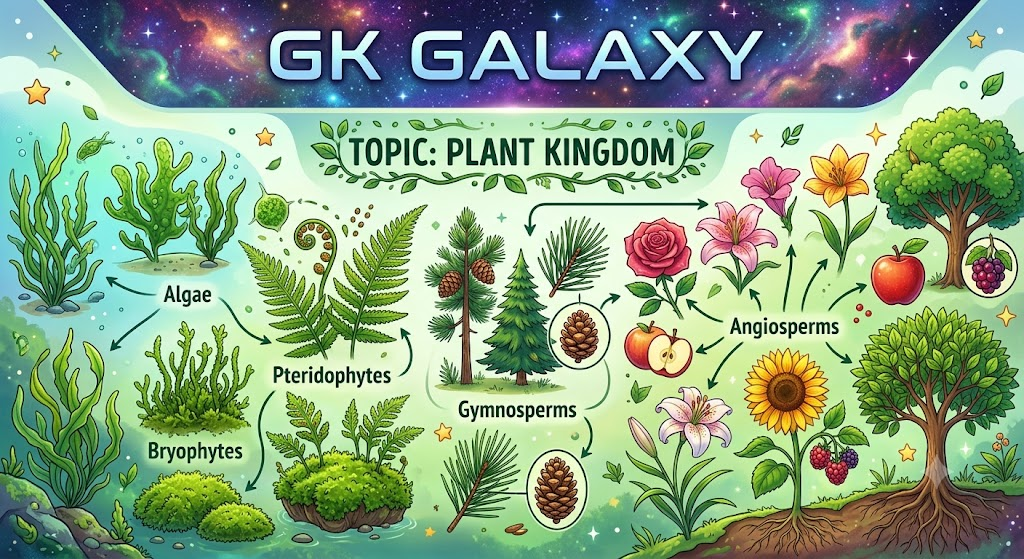
PLANT KINGDOM
NEET Biology — Complete Theory + Previous Year Questions
DISCLAIMER : PLANT KINGDOM
The content provided on this PLANT KINGDOM chapter is intended for educational and examination-preparation purposes only. It is designed to help students revise concepts and practice questions related to Plant Kingdom for NEET and other competitive examinations.
1. Educational Purpose
The theory, MCQs, explanations, revision notes, practice questions, diagrams and other study materials provided in this chapter are intended only as educational and reference material. Students are advised to refer to their official syllabus, NCERT textbooks and official examination notifications for authoritative information.
2. MCQ Questions and Answers
The MCQ questions, answer keys, explanations and practice material published on this website are prepared for educational and practice purposes. While reasonable care has been taken to maintain accuracy, the website owner does not guarantee that every question, answer, explanation or interpretation is completely error-free.
If any discrepancy, printing error, factual error or incorrect answer is identified, it may be corrected or updated when appropriate.
3. NEET Memory-Based Questions
Questions identified as NEET Previous Year Questions (PYQs), memory-based questions or questions reportedly asked in NEET examinations are presented based on available recollections, student feedback, reference material or other accessible sources.
Because memory-based questions may differ from the exact wording, options, sequence or format of the original examination paper, they should not be treated as an official reproduction of the NEET question paper.
The website owner does not claim that memory-based questions are the exact official questions unless specifically identified and verified through an official source.
4. NEET Official Examination
This website is not affiliated with, endorsed by, sponsored by or officially connected with the National Testing Agency (NTA), NEET or any government examination authority, unless expressly stated otherwise.
For official NEET information, candidates should always rely on the relevant official NTA/NEET notifications, information bulletins, answer keys and other official publications.
5. No Responsibility for Examination Results
The website owner shall not be responsible for any loss, error, misunderstanding, academic decision, examination result, rank, score, admission decision or other consequence arising from the use of the information, MCQs, answers, explanations, or memory-based questions published in this chapter.
Students should independently verify important information from NCERT and official examination sources before relying upon it for examination preparation.
6. Copyright and Third-Party Material
Any names, examination references, terminology or other material belonging to their respective owners remain the property of their respective copyright or trademark holders. This website does not claim ownership of third-party trademarks or official examination identities.
7. Content Updates
The website owner reserves the right to modify, correct, update, remove or add content in this chapter at any time without prior notice.
PART A — COMPLETE THEORY
1. INTRODUCTION TO PLANT KINGDOM
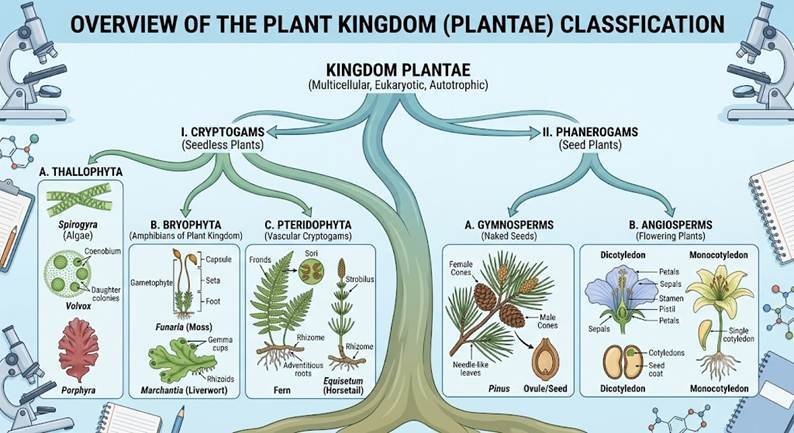
The plant kingdom includes a wide variety of organisms ranging from simple, unicellular or colonial algae to highly complex flowering plants.
The major groups traditionally studied in the Plant Kingdom are:
- Algae
- Bryophytes
- Pteridophytes
- Gymnosperms
- Angiosperms
These groups show a progressive increase in:
Body complexity
Development of vascular tissues
Differentiation of plant body
Independence from water for reproduction
Development of seeds
Development of flowers and fruits
Broad evolutionary sequence
Algae → Bryophytes → Pteridophytes → Gymnosperms → Angiosperms
This sequence represents increasing structural complexity, although plant evolution is not simply a straight ladder.
2. ALGAE
Algae are primarily aquatic, photosynthetic organisms.
They may occur in:
Freshwater
Marine water
Moist soil
Tree trunks
Rocks
Other moist habitats
The plant body of algae is generally a thallus, meaning it is not differentiated into true roots, stems and leaves.
Important characteristics
Mostly aquatic.
Photosynthetic.
Body is generally thalloid.
Vascular tissues are absent.
Reproduction may be vegetative, asexual or sexual.
Sexual reproduction may be isogamous, anisogamous or oogamous depending upon the group.
Examples
Chlamydomonas
Volvox
Ulothrix
Spirogyra
Chara
Ectocarpus
Fucus
Sargassum
Polysiphonia
3. CLASSIFICATION OF ALGAE
Algae are commonly divided into three major classes in NCERT:
- Chlorophyceae — Green algae
- Phaeophyceae — Brown algae
- Rhodophyceae — Red algae
4. CHLOROPHYCEAE — GREEN ALGAE
Green algae contain:
Chlorophyll a
Chlorophyll b
The green colour is mainly due to chlorophyll.
Reserve food
Starch
Cell wall
Generally composed of:
Cellulose
Pectose
Reproduction
May occur by:
Vegetative reproduction
Asexual reproduction
Sexual reproduction
Examples
Chlamydomonas
Volvox
Ulothrix
Spirogyra
Chara
Important examples
Chlamydomonas → unicellular
Volvox → colonial
Spirogyra → filamentous
5. PHAEOPHYCEAE — BROWN ALGAE
Brown algae are mostly marine.
Their characteristic brown colour is associated mainly with fucoxanthin.
Pigments
Chlorophyll a
Chlorophyll c
Carotenoids
Xanthophylls, including fucoxanthin
Reserve food
Laminarin
Mannitol
Cell wall
Contains:
Cellulose
Algin
Examples
Ectocarpus
Fucus
Sargassum
Laminaria
Reproduction
Vegetative reproduction generally occurs by fragmentation.
Asexual reproduction commonly occurs through biflagellate zoospores.
Sexual reproduction may be:
Isogamous
Anisogamous
Oogamous
depending upon the species.
A recent NEET question tested several of these Phaeophyceae characteristics together.
6. RHODOPHYCEAE — RED ALGAE
Red algae are predominantly marine.
Their red colour is mainly associated with phycoerythrin.
Pigments
Chlorophyll a
Chlorophyll d
Phycoerythrin
Reserve food
Floridean starch
Examples
Polysiphonia
Porphyra
Gracilaria
Important economic products
Red algae are important sources of hydrocolloids such as:
Agar
Carrageen
7. COMPARISON OF MAJOR ALGAL CLASSES
| Character | Chlorophyceae | Phaeophyceae | Rhodophyceae |
| Common name | Green algae | Brown algae | Red algae |
| Major pigments | Chl a, b | Chl a, c + fucoxanthin | Chl a, d + phycoerythrin |
| Reserve food | Starch | Laminarin, mannitol | Floridean starch |
| Habitat | Freshwater/marine | Mainly marine | Mainly marine |
| Examples | Chlamydomonas, Spirogyra | Fucus, Sargassum | Polysiphonia, Porphyra |
8. BRYOPHYTES
Bryophytes are small, non-vascular plants generally found in moist and shady habitats.
Examples:
Riccia
Marchantia
Funaria
Sphagnum
Anthoceros
They are commonly called the amphibians of the plant kingdom because they live on land but require water for sexual reproduction.
Major characteristics
Vascular tissues absent.
True roots absent.
Rhizoids may be present.
Gametophyte is dominant.
Sporophyte remains attached to the gametophyte.
Water is required for fertilisation.
9. BRYOPHYTE GAMETOPHYTE
The dominant plant body is the gametophyte.
It produces:
Antheridia → male sex organs
Archegonia → female sex organs
The male gametes are generally flagellated and require water to reach the egg.
10. LIVERWORTS
Examples:
Marchantia
Riccia
In Marchantia, asexual reproduction can occur through gemmae.
Gemmae
Gemmae are small multicellular structures involved in vegetative reproduction.
They are produced inside gemma cups in Marchantia.
11. MOSSES
Examples:
Funaria
Polytrichum
Sphagnum
The life cycle of moss includes:
Spore → protonema → leafy gametophore → gametangia → fertilisation → sporophyte → capsule → spores
Protonema
The protonema is the early gametophytic stage of moss.
It develops from the spore.
12. SPOROPHYTE OF FUNARIA
The sporophyte of Funaria consists of:
- Foot
- Seta
- Capsule
The foot remains embedded in the gametophyte and absorbs nutrients.
The seta supports the capsule.
The capsule produces spores.
13. PTERIDOPHYTES
Pteridophytes are the first terrestrial plants to possess well-developed vascular tissues.
Examples:
Psilotum
Selaginella
Equisetum
Pteris
Adiantum
Dryopteris
They are commonly referred to as vascular cryptogams.
Major characteristics
Vascular tissues present.
True roots, stems and leaves are present.
Sporophyte is dominant.
Reproduction occurs through spores.
Seeds are absent.
Flowers and fruits are absent.
Water is generally required for fertilisation.
14. PTERIDOPHYTE SPOROPHYTE
The dominant plant body is the sporophyte.
It is differentiated into:
Roots
Stem
Leaves
Leaves may be small or large.
In ferns, large leaves are called fronds.
15. PROTHALLUS
The gametophyte of many pteridophytes is called the prothallus.
It is generally:
Small
Green
Photosynthetic
Free-living
It produces:
Antheridia
Archegonia
Water is required for movement of the male gametes to the archegonia.
16. HOMOSPORY AND HETEROSPORY
Homospory
Production of only one type of spore.
Example:
Pteris
Heterospory
Production of two types of spores:
- Microspores
- Megaspores
Examples:
Selaginella
Salvinia
Heterospory is an important evolutionary step toward the development of the seed habit.
17. GYMNOSPERMS
Gymnosperms are seed-producing plants in which the ovules are not enclosed by an ovary wall.
Therefore, their seeds are called naked seeds.
Examples:
Cycas
Pinus
Ginkgo
Gnetum
Ephedra
Major characteristics
Well-developed vascular tissues.
Dominant sporophyte.
Seeds present.
Ovules exposed.
Flowers absent.
Fruits absent.
Cones or strobili generally present.
Pollination is commonly by wind.
18. PINUS
Pinus is a gymnosperm.
It generally possesses:
Male cones
Female cones
Male cone
Smaller
Produces pollen grains
Generally short-lived
Female cone
Larger
Contains ovules
Takes longer to mature
19. CYCAS
Cycas is a gymnosperm.
Important characteristics:
Dioecious.
Male and female plants are separate.
Large pinnate leaves.
Coralloid roots occur.
It is often described as a living fossil because of its retention of several primitive features.
20. ANGIOSPERMS
Angiosperms are flowering plants.
They are the most diverse group of plants.
Their characteristic feature is that:
Ovules are enclosed within an ovary.
After fertilisation:
Ovary → Fruit
and
Ovule → Seed
Major characteristics
Flowers present.
Seeds enclosed within fruits.
Well-developed vascular tissues.
Dominant sporophyte.
Double fertilisation occurs.
21. MONOCOTS AND DICOTS
Traditional angiosperm classification divides flowering plants into:
Monocotyledons
One cotyledon.
Parallel venation is common.
Fibrous/adventitious root system.
Floral parts generally in multiples of three.
Vascular bundles generally scattered in stem.
Examples:
Maize
Wheat
Rice
Lily
Dicotyledons
Two cotyledons.
Reticulate venation is common.
Tap root system is common.
Floral parts commonly in multiples of four or five.
Vascular bundles generally arranged in a ring.
Examples:
Pea
Gram
Mustard
Sunflower
22. ALTERNATION OF GENERATIONS
Plant life cycles generally involve alternation between:
Gametophyte
Haploid (n)
Produces gametes.
Sporophyte
Diploid (2n)
Produces spores through meiosis.
The relative dominance of these generations differs among plant groups.
23. LIFE CYCLE PATTERNS
Haploid life cycle
The haploid phase is dominant.
Example:
Spirogyra
Haplo-diplontic life cycle
Both haploid and diploid phases are multicellular.
Examples include:
Some algae
Bryophytes
Pteridophytes
Diplontic life cycle
Diploid sporophyte is dominant and the gametophytes are highly reduced.
Typical example:
Gymnosperms and angiosperms
24. IMPORTANT EVOLUTIONARY TRENDS
| Group | Vascular tissue | Seeds | Flowers | Fruits |
| Algae | No | No | No | No |
| Bryophytes | No | No | No | No |
| Pteridophytes | Yes | No | No | No |
| Gymnosperms | Yes | Yes | No | No |
| Angiosperms | Yes | Yes | Yes | Yes |
Key progression
No vascular tissue → vascular tissue → seed → flower → fruit
This table is especially useful for NEET revision.
PART B — NEET/AIPMT PREVIOUS YEAR QUESTIONS
PYQ 1
Exam: AIPMT 2009
Q1. Which of the following algae is rich in protein?
A. Chlorella
B. Chlamydomonas
C. Spirogyra
D. Ulothrix
Answer: A. Chlorella
Explanation:
Chlorella is a unicellular green alga that is rich in protein and has been investigated as a source of food and nutritional supplements.
PYQ 2
Exam: AIPMT 2010
Q2. Bryophytes are called amphibians of the plant kingdom because:
A. They live only in water
B. They require water for fertilisation
C. They have both aquatic and terrestrial forms
D. They are found only near water bodies
Answer: B. They require water for fertilisation
Explanation:
Bryophytes are predominantly terrestrial but require water for the movement of male gametes to the female reproductive organ. Hence they are called amphibians of the plant kingdom.
PYQ 3
Exam: AIPMT 2011
Q3. Which group is known as vascular cryptogams?
A. Bryophytes
B. Pteridophytes
C. Gymnosperms
D. Angiosperms
Answer: B. Pteridophytes
Explanation:
Pteridophytes possess well-developed vascular tissues but reproduce by spores rather than seeds. Therefore, they are called vascular cryptogams.
PYQ 4
Exam: AIPMT 2012
Q4. Which of the following is NOT a characteristic of gymnosperms?
A. Presence of ovules
B. Presence of seeds
C. Presence of fruits
D. Presence of vascular tissues
Answer: C. Presence of fruits
Explanation:
Gymnosperm ovules are not enclosed by an ovary. Consequently, fruits are absent.
PYQ 5
Exam: AIPMT 2013
Q5. Angiosperms differ from gymnosperms in having:
A. Ovules
B. Seeds
C. Fruits
D. Vascular tissues
Answer: C. Fruits
Explanation:
Both gymnosperms and angiosperms have vascular tissues, ovules and seeds. However, angiosperms possess an ovary that encloses the ovules, and the ovary develops into a fruit.
PYQ 6
Exam: NEET 2016 Phase 1
Q6. In bryophytes and pteridophytes, transport of male gametes requires:
A. Wind
B. Insects
C. Water
D. Birds
Answer: C. Water
Explanation:
The male gametes are flagellated and require a film of water to reach the female reproductive structure.
PYQ 7
Exam: NEET 2016 Phase 2
Q7. Conifers are adapted to tolerate extreme environmental conditions because of:
A. Thin cuticle
B. Needle-like leaves with thick cuticle
C. Absence of vascular tissues
D. Absence of roots
Answer: B. Needle-like leaves with thick cuticle
Explanation:
Conifer leaves are generally needle-like and possess a thick cuticle, adaptations that reduce water loss and help them tolerate cold and dry conditions.
PYQ 8
Exam: NEET 2017
Q8. Which of the following is an example of a colonial alga?
A. Chlamydomonas
B. Volvox
C. Spirogyra
D. Ulothrix
Answer: B. Volvox
Explanation:
Volvox forms a colony consisting of numerous cells embedded in a gelatinous matrix.
PYQ 9
Exam: NEET 2017
Q9. Zygotic meiosis is characteristic of:
A. Spirogyra
B. Funaria
C. Pinus
D. Cycas
Answer: A. Spirogyra
Explanation:
Spirogyra has a haplontic life cycle. The zygote is the only diploid stage and undergoes meiosis during germination. Thus, meiosis is zygotic.
PYQ 10
Exam: NEET 2017
Q10. The life cycles of Ectocarpus and Fucus are respectively:
A. Haploid and haploid
B. Haplo-diplontic and diplontic
C. Diplontic and haploid
D. Diplontic and haplo-diplontic
Answer: B. Haplo-diplontic and diplontic
Explanation:
Ectocarpus has alternating multicellular haploid and diploid phases, whereas Fucus has a predominantly diploid life cycle.
PYQ 11
Exam: NEET 2018
Q11. Which of the following is a red alga?
A. Fucus
B. Sargassum
C. Porphyra
D. Laminaria
Answer: C. Porphyra
Explanation:
Porphyra belongs to Rhodophyceae. Fucus, Sargassum and Laminaria are brown algae.
PYQ 12
Exam: NEET 2018
Q12. In Pinus, the male cone is:
A. Small and short-lived
B. Large and long-lived
C. Small and long-lived
D. Large and short-lived
Answer: A. Small and short-lived
Explanation:
Male cones of Pinus are relatively small and produce pollen grains. Female cones are larger and take considerably longer to mature.
PYQ 13
Exam: NEET 2019
Q13. Heterospory in Selaginella involves:
A. Production of two types of spores
B. Production of spores in two seasons
C. Production of spores in two different plants
D. Production of spores having identical sizes
Answer: A. Production of two types of spores
Explanation:
Selaginella produces microspores and megaspores. This condition is called heterospory and represents an important step toward seed habit.
PYQ 14
Exam: NEET 2019
Q14. Double fertilisation is a characteristic feature of:
A. Gymnosperms
B. Pteridophytes
C. Angiosperms
D. Bryophytes
Answer: C. Angiosperms
Explanation:
In angiosperms, one male gamete fuses with the egg, while the other fuses with the polar nuclei. These are called syngamy and triple fusion, respectively. Together they constitute double fertilisation.
PYQ 15
Exam: NEET 2020 Phase 1
Q15. Which of the following pairs consists of unicellular algae?
A. Chlamydomonas and Chlorella
B. Spirogyra and Ulothrix
C. Volvox and Spirogyra
D. Fucus and Sargassum
Answer: A. Chlamydomonas and Chlorella
Explanation:
Chlamydomonas and Chlorella are unicellular green algae. Spirogyra and Ulothrix are filamentous, while Fucus and Sargassum are multicellular brown algae.
PYQ 16
Exam: NEET 2020 Phase 1
Q16. Floridean starch resembles:
A. Glycogen
B. Starch of green plants
C. Cellulose
D. Chitin
Answer: A. Glycogen
Explanation:
Floridean starch, the reserve food of red algae, is chemically similar to glycogen.
PYQ 17
Exam: NEET 2020 Phase 1
Q17. Strobili or cones are found in:
A. Algae only
B. Bryophytes only
C. Some pteridophytes and gymnosperms
D. Angiosperms only
Answer: C. Some pteridophytes and gymnosperms
Explanation:
Strobili occur in certain pteridophytes such as Selaginella and Equisetum and are also characteristic reproductive structures in gymnosperms.
PYQ 18
Exam: NEET 2021
Q18. Gemmae are present in:
A. Marchantia
B. Pinus
C. Cycas
D. Chlamydomonas
Answer: A. Marchantia
Explanation:
Marchantia reproduces vegetatively by gemmae, which are produced inside gemma cups.
PYQ 19
Exam: NEET 2021
Q19. Which algae contains mannitol as reserve food?
A. Chlorophyceae
B. Phaeophyceae
C. Rhodophyceae
D. Cyanobacteria
Answer: B. Phaeophyceae
Explanation:
Brown algae store carbohydrates mainly as laminarin and mannitol.
PYQ 20
Exam: NEET 2021
Q20. Which of the following is commonly considered a living fossil?
A. Pinus
B. Cycas
C. Gnetum
D. Ephedra
Answer: B. Cycas
Explanation:
Cycas retains several primitive features and represents an ancient gymnosperm lineage.
PYQ 21
Exam: NEET 2022 Phase 1
Q21. Which of the following algae produces carrageen?
A. Chlorella
B. Gelidium
C. Spirogyra
D. Ulothrix
Answer: B. Gelidium
Explanation:
Carrageen is obtained from certain red algae. Gelidium is an important red algal source of hydrocolloids.
PYQ 22
Exam: NEET 2022 Phase 2
Q22. Match the following:
| Organism | Group |
| Chlamydomonas | Alga |
| Cycas | Gymnosperm |
| Selaginella | Pteridophyte |
| Sphagnum | Moss |
Which combination is correct?
A. All four
B. Only first and second
C. Only second and third
D. Only first and fourth
Answer: A. All four
Explanation:
Chlamydomonas is a green alga; Cycas is a gymnosperm; Selaginella is a pteridophyte; and Sphagnum is a moss.
PYQ 23
Exam: NEET 2022 Phase 1
Q23. Which of the following represents the dominant generation in a fern?
A. Gametophyte
B. Sporophyte
C. Zygote
D. Protonema
Answer: B. Sporophyte
Explanation:
The fern plant is the diploid sporophyte. Its gametophyte is the small, usually free-living prothallus.
PYQ 24
Exam: NEET 2023
Q24. Identify the pair of heterosporous pteridophytes.
A. Selaginella and Salvinia
B. Pteris and Dryopteris
C. Equisetum and Pteris
D. Adiantum and Dryopteris
Answer: A. Selaginella and Salvinia
Explanation:
Selaginella and Salvinia produce two types of spores—microspores and megaspores—and are therefore heterosporous pteridophytes.
PYQ 25
Exam: NEET 2023
Q25. The first stage of the gametophyte in the life cycle of moss is:
A. Capsule
B. Protonema
C. Seta
D. Sporogonium
Answer: B. Protonema
Explanation:
The spore germinates to produce the protonema, which subsequently develops into the leafy gametophore.
PYQ 26
Exam: NEET 2023 Manipur
Q26. Which classes of algae possess fucoxanthin and phycoerythrin respectively?
A. Chlorophyceae and Phaeophyceae
B. Phaeophyceae and Rhodophyceae
C. Rhodophyceae and Chlorophyceae
D. Chlorophyceae and Rhodophyceae
Answer: B. Phaeophyceae and Rhodophyceae
Explanation:
Fucoxanthin is characteristic of brown algae, whereas phycoerythrin is a major accessory pigment of red algae.
PYQ 27
Exam: NEET 2024
Q27. Which of the following statements regarding Phaeophyceae is correct?
A. They store food only as starch
B. They lack fucoxanthin
C. They commonly possess biflagellate zoospores
D. Their major reserve food is floridean starch
Answer: C. They commonly possess biflagellate zoospores
Explanation:
Brown algae commonly reproduce asexually through biflagellate zoospores. Their reserve food includes laminarin and mannitol, while fucoxanthin is an important pigment. The recent NEET 2024 question tested the same cluster of Phaeophyceae characteristics.
Q28. [AIPMT 2008]
Which of the following is correctly matched?
A. Chlamydomonas — Colonial alga
B. Volvox — Unicellular alga
C. Spirogyra — Filamentous alga
D. Fucus — Green alga
Answer: C. Spirogyra — Filamentous alga
Explanation:
Spirogyra is a filamentous green alga. Chlamydomonas is unicellular, Volvox is colonial, and Fucus belongs to brown algae.
Q29. [AIPMT 2009]
The reserve food material in brown algae is:
A. Starch and glycogen
B. Laminarin and mannitol
C. Floridean starch
D. Starch and protein
Answer: B. Laminarin and mannitol
Explanation:
Phaeophyceae store food mainly in the form of laminarin and mannitol.
Q30. [AIPMT 2010]
Which of the following is a characteristic feature of red algae?
A. Fucoxanthin as the principal pigment
B. Floridean starch as reserve food
C. Mannitol as reserve food
D. Cellulose absent from the cell wall
Answer: B. Floridean starch as reserve food
Explanation:
Rhodophyceae contain phycoerythrin and store food mainly as floridean starch.
Q31. [AIPMT 2011]
Which one of the following is a bryophyte?
A. Selaginella
B. Funaria
C. Pteris
D. Pinus
Answer: B. Funaria
Explanation:
Funaria is a moss belonging to Bryophyta. Selaginella and Pteris are pteridophytes, whereas Pinus is a gymnosperm.
Q32. [AIPMT 2012]
The dominant phase in the life cycle of bryophytes is:
A. Sporophyte
B. Gametophyte
C. Zygote
D. Embryo
Answer: B. Gametophyte
Explanation:
In bryophytes, the haploid gametophyte is the dominant and independent generation. The sporophyte remains attached to and nutritionally dependent upon it.
Q33. [AIPMT 2013]
Which one of the following is a characteristic feature of pteridophytes?
A. Seeds are present
B. Flowers are present
C. Vascular tissues are present
D. Fruits are present
Answer: C. Vascular tissues are present
Explanation:
Pteridophytes are the first major plant group with well-developed xylem and phloem. They reproduce by spores and do not produce seeds, flowers or fruits.
Q34. [AIPMT 2014]
The gametophyte of a fern is known as:
A. Protonema
B. Prothallus
C. Sporogonium
D. Capsule
Answer: B. Prothallus
Explanation:
The fern gametophyte is a small, generally green structure called the prothallus. It bears antheridia and archegonia.
Q35. [AIPMT 2014]
Which of the following plants is heterosporous?
A. Pteris
B. Selaginella
C. Lycopodium
D. Equisetum
Answer: B. Selaginella
Explanation:
Selaginella produces two types of spores—microspores and megaspores—and is therefore heterosporous.
Q36. [AIPMT 2015]
Heterospory is considered an important step in the evolution of:
A. Flowers
B. Fruits
C. Seed habit
D. Vascular tissue
Answer: C. Seed habit
Explanation:
The production of separate microspores and megaspores is associated with the evolutionary development of the seed habit.
Q37. [AIPMT 2015]
Which of the following is correctly matched?
A. Sphagnum — Liverwort
B. Marchantia — Moss
C. Funaria — Moss
D. Selaginella — Gymnosperm
Answer: C. Funaria — Moss
Explanation:
Funaria is a moss. Marchantia is a liverwort, while Selaginella is a pteridophyte.
Q38. [NEET 2016]
Which one of the following pairs is correctly matched?
A. Laminaria — Green algae
B. Fucus — Brown algae
C. Porphyra — Brown algae
D. Chara — Red algae
Answer: B. Fucus — Brown algae
Explanation:
Fucus belongs to Phaeophyceae (brown algae). Laminaria is also a brown alga, Porphyra is a red alga, and Chara is a green alga.
Q39. [NEET 2017]
Which of the following is correctly matched with its group?
A. Marchantia — Pteridophyte
B. Selaginella — Bryophyte
C. Cycas — Gymnosperm
D. Funaria — Angiosperm
Answer: C. Cycas — Gymnosperm
Explanation:
Cycas is a gymnosperm characterized by naked ovules and seeds. Marchantia and Funaria are bryophytes, while Selaginella is a pteridophyte.
Q40. [NEET 2017]
In which plant group is the sporophyte nutritionally dependent on the gametophyte?
A. Gymnosperms
B. Angiosperms
C. Bryophytes
D. Pteridophytes
Answer: C. Bryophytes
Explanation:
In bryophytes, the sporophyte remains attached to the gametophyte and derives nutrition from it. The gametophyte is the dominant generation.
Q41. [NEET 2018]
Which of the following statements is correct regarding gymnosperms?
A. Their ovules are enclosed within an ovary
B. They produce fruits
C. Their seeds are naked
D. They possess flowers
Answer: C. Their seeds are naked
Explanation:
In gymnosperms, the ovules are exposed and are not enclosed within an ovary. Therefore, their seeds are called naked seeds.
Q42. [NEET 2018]
Which of the following is correctly associated with gymnosperms?
A. Archegonia are absent in all gymnosperms
B. Pollination is generally by water
C. Ovules are not enclosed by an ovary
D. Fruits develop after fertilisation
Answer: C. Ovules are not enclosed by an ovary
Explanation:
The defining feature of gymnosperms is that their ovules remain exposed rather than being enclosed within an ovary.
Q43. [NEET 2019]
Which of the following is an example of a red alga?
A. Sargassum
B. Laminaria
C. Polysiphonia
D. Ectocarpus
Answer: C. Polysiphonia
Explanation:
Polysiphonia belongs to Rhodophyceae, the red algae. The other three are brown algae.
Q44. [NEET 2019]
The pigment mainly responsible for the red colour of red algae is:
A. Chlorophyll b
B. Fucoxanthin
C. Phycoerythrin
D. Xanthophyll
Answer: C. Phycoerythrin
Explanation:
Phycoerythrin, a phycobilin pigment, is responsible for the characteristic red appearance of many members of Rhodophyceae.
Q45. [NEET 2020]
Which of the following represents the correct sequence in the evolution of major plant groups?
A. Bryophytes → Algae → Pteridophytes → Gymnosperms
B. Algae → Bryophytes → Pteridophytes → Gymnosperms
C. Pteridophytes → Algae → Bryophytes → Angiosperms
D. Gymnosperms → Bryophytes → Algae → Angiosperms
Answer: B. Algae → Bryophytes → Pteridophytes → Gymnosperms
Explanation:
The broad evolutionary progression studied in Plant Kingdom proceeds from simpler thalloid forms toward vascular plants and subsequently seed-producing plants.
Q46. [NEET 2020]
Which of the following pairs is incorrectly matched?
A. Chara — Green alga
B. Sargassum — Brown alga
C. Gracilaria — Red alga
D. Volvox — Brown alga
Answer: D. Volvox — Brown alga
Explanation:
Volvox is a green alga belonging to Chlorophyceae. Sargassum is brown and Gracilaria is red.
Q47. [NEET 2021]
Which of the following structures is characteristic of the vegetative reproduction of Marchantia?
A. Gemma cup
B. Protonema
C. Prothallus
D. Cone
Answer: A. Gemma cup
Explanation:
Marchantia produces multicellular vegetative propagules called gemmae in specialised structures known as gemma cups.
Q48. [NEET 2021]
Which one of the following statements about mosses is correct?
A. The protonema develops from the zygote
B. The protonema develops from the spore
C. The sporophyte is completely independent
D. Mosses produce seeds
Answer: B. The protonema develops from the spore
Explanation:
A moss spore germinates to form the protonema, which subsequently develops into the leafy gametophore.
Q49. [NEET 2022]
Which of the following combinations represents the correct reserve food?
A. Green algae — Floridean starch
B. Brown algae — Laminarin and mannitol
C. Red algae — Mannitol
D. Brown algae — Glycogen
Answer: B. Brown algae — Laminarin and mannitol
Explanation:
The characteristic reserve food of brown algae is laminarin and mannitol. Green algae mainly store starch, while red algae store floridean starch.
Q50. [NEET 2023]
Which of the following statements about angiosperms is correct?
A. Ovules are exposed
B. Seeds are always naked
C. Ovules are enclosed within an ovary
D. Fruits are absent
Answer: C. Ovules are enclosed within an ovary
Explanation:
In angiosperms, ovules occur inside the ovary. Following fertilisation, the ovary generally develops into the fruit, while the ovule develops into the seed.
QUICK REVISION — Q28–50
| Topic | Key fact |
| Spirogyra | Filamentous green alga |
| Brown algae | Laminarin + mannitol |
| Red algae | Floridean starch |
| Funaria | Moss |
| Bryophytes | Gametophyte dominant |
| Pteridophytes | Vascular cryptogams |
| Fern gametophyte | Prothallus |
| Selaginella | Heterosporous |
| Heterospory | Related to seed habit |
| Fucus | Brown alga |
| Cycas | Gymnosperm |
| Marchantia | Gemma cups |
| Moss | Protonema develops from spore |
| Gymnosperms | Naked seeds |
| Angiosperms | Ovules enclosed in ovary |
Q51. [AIPMT 2005]
Which one of the following algae is correctly matched with its reserve food?
A. Chlorophyceae — Laminarin
B. Phaeophyceae — Floridean starch
C. Rhodophyceae — Floridean starch
D. Chlorophyceae — Mannitol
Answer: C. Rhodophyceae — Floridean starch
Explanation:
Red algae store their reserve food mainly as floridean starch. Green algae store starch, whereas brown algae store laminarin and mannitol.
Q52. [AIPMT 2006]
Which of the following algae is mainly marine?
A. Chlamydomonas
B. Spirogyra
C. Fucus
D. Volvox
Answer: C. Fucus
Explanation:
Fucus is a marine brown alga. Many brown algae are predominantly marine and are especially abundant in temperate and colder seas.
Q53. [AIPMT 2007]
The cell wall of brown algae generally contains:
A. Cellulose and algin
B. Chitin and lignin
C. Pectin and chitin
D. Silica and cellulose only
Answer: A. Cellulose and algin
Explanation:
The cell wall of brown algae contains cellulose and algin. Algin has important commercial applications.
Q54. [AIPMT 2008]
Which of the following is a characteristic feature of Chlorophyceae?
A. Chlorophyll a and b
B. Chlorophyll a and c only
C. Phycoerythrin as the principal pigment
D. Fucoxanthin as the main pigment
Answer: A. Chlorophyll a and b
Explanation:
Green algae contain chlorophyll a and b, which give them their characteristic green colour.
Q55. [AIPMT 2009]
The zoospores of brown algae are generally:
A. Non-motile
B. Uniflagellate
C. Biflagellate
D. Multiflagellate
Answer: C. Biflagellate
Explanation:
Asexual reproduction in brown algae commonly occurs through biflagellate zoospores.
Q56. [AIPMT 2010]
Which of the following is associated with vegetative reproduction in algae?
A. Fragmentation
B. Triple fusion
C. Double fertilisation
D. Seed formation
Answer: A. Fragmentation
Explanation:
Vegetative reproduction in algae commonly occurs through fragmentation, in which the parent body breaks into fragments and each fragment develops into a new individual.
Q57. [AIPMT 2011]
Which type of sexual reproduction occurs in Chlamydomonas?
A. Only oogamy
B. Isogamy in some species
C. Only anisogamy
D. Only oogamy and anisogamy
Answer: B. Isogamy in some species
Explanation:
Chlamydomonas exhibits different modes of sexual reproduction in different species, including isogamy, anisogamy and oogamy.
Q58. [AIPMT 2012]
In which of the following is oogamous reproduction found?
A. Volvox
B. Spirogyra
C. Ulothrix only
D. Chlorella only
Answer: A. Volvox
Explanation:
Volvox exhibits oogamous sexual reproduction, involving a large non-motile female gamete and a small motile male gamete.
Q59. [AIPMT 2013]
Which of the following is a characteristic feature of bryophytes?
A. They possess true vascular tissues
B. Sporophyte is dominant
C. Gametophyte is dominant
D. Seeds are produced
Answer: C. Gametophyte is dominant
Explanation:
The gametophyte is the dominant, photosynthetic and generally independent generation in bryophytes.
Q60. [AIPMT 2014]
The rhizoids of bryophytes primarily function in:
A. Seed formation
B. Anchorage and absorption
C. Production of pollen
D. Photosynthesis only
Answer: B. Anchorage and absorption
Explanation:
Bryophytes lack true roots. Their rhizoids mainly help in anchorage and absorption of water and minerals.
Q61. [AIPMT 2015]
Which of the following represents the correct sequence in the development of a moss?
A. Spore → protonema → leafy gametophore
B. Zygote → protonema → spore
C. Spore → sporophyte → protonema
D. Protonema → spore → gametophore
Answer: A. Spore → protonema → leafy gametophore
Explanation:
The moss spore germinates into a protonema, which subsequently develops into the leafy gametophore.
Q62. [NEET 2016]
Which of the following structures belongs to the sporophyte of Funaria?
A. Protonema
B. Rhizoid
C. Capsule
D. Antheridium
Answer: C. Capsule
Explanation:
The Funaria sporophyte consists of foot, seta and capsule. The capsule contains spore-producing tissue.
Q63. [NEET 2016]
Which of the following is correctly matched?
A. Riccia — Moss
B. Marchantia — Liverwort
C. Funaria — Liverwort
D. Sphagnum — Gymnosperm
Answer: B. Marchantia — Liverwort
Explanation:
Marchantia is a liverwort. Riccia is also a liverwort, while Funaria and Sphagnum are mosses.
Q64. [NEET 2017]
Which of the following represents a pteridophyte?
A. Marchantia
B. Funaria
C. Selaginella
D. Pinus
Answer: C. Selaginella
Explanation:
Selaginella is a pteridophyte and possesses vascular tissues while reproducing through spores.
Q65. [NEET 2017]
The main plant body of pteridophytes is:
A. Haploid gametophyte
B. Diploid sporophyte
C. Haploid zygote
D. Triploid endosperm
Answer: B. Diploid sporophyte
Explanation:
The dominant generation in pteridophytes is the diploid sporophyte, which is differentiated into roots, stems and leaves.
Q66. [NEET 2018]
Which one of the following is a heterosporous pteridophyte?
A. Lycopodium
B. Selaginella
C. Pteris
D. Dryopteris
Answer: B. Selaginella
Explanation:
Selaginella produces microspores and megaspores, making it heterosporous.
Q67. [NEET 2018]
Which structure develops from the microspore of a heterosporous pteridophyte?
A. Female gametophyte
B. Male gametophyte
C. Sporophyte directly
D. Zygote
Answer: B. Male gametophyte
Explanation:
In heterosporous plants, the microspore develops into the male gametophyte, whereas the megaspore develops into the female gametophyte.
Q68. [NEET 2019]
Which of the following is an example of a gymnosperm?
A. Gnetum
B. Funaria
C. Pteris
D. Marchantia
Answer: A. Gnetum
Explanation:
Gnetum belongs to Gymnosperms. Funaria and Marchantia are bryophytes, while Pteris is a pteridophyte.
Q69. [NEET 2019]
In gymnosperms, the ovules are:
A. Enclosed in an ovary
B. Enclosed in a fruit
C. Naked
D. Absent
Answer: C. Naked
Explanation:
Gymnosperm ovules are exposed and are not enclosed by an ovary wall. This gives rise to the term gymnosperm, meaning naked-seeded plant.
Q70. [NEET 2020]
Which of the following gymnosperms has coralloid roots?
A. Pinus
B. Cycas
C. Gnetum
D. Ephedra
Answer: B. Cycas
Explanation:
Cycas possesses specialised coralloid roots, which contain symbiotic cyanobacteria capable of nitrogen fixation.
Q71. [NEET 2020]
Which one of the following is correctly matched?
A. Pinus — Coralloid roots
B. Cycas — Mycorrhizal roots only
C. Cycas — Coralloid roots
D. Gnetum — Gemma cups
Answer: C. Cycas — Coralloid roots
Explanation:
Coralloid roots are a characteristic feature of Cycas and harbour nitrogen-fixing cyanobacteria.
Q72. [NEET 2021]
Which of the following statements about gymnosperms is correct?
A. They possess vessels in xylem in all groups
B. They have naked ovules
C. They produce fruits
D. They have typical flowers
Answer: B. They have naked ovules
Explanation:
Gymnosperms have exposed ovules. Unlike angiosperms, they do not possess an ovary enclosing the ovules.
Q73. [NEET 2022]
Which of the following represents the correct relationship?
A. Ovule → Fruit
B. Ovary → Seed
C. Ovule → Seed
D. Ovary → Pollen grain
Answer: C. Ovule → Seed
Explanation:
After fertilisation in angiosperms, the ovule develops into a seed, whereas the ovary generally develops into a fruit.
Q74. [NEET 2023]
Which of the following is a defining feature of angiosperms?
A. Naked seeds
B. Ovules enclosed within an ovary
C. Absence of vascular tissue
D. Reproduction only by spores
Answer: B. Ovules enclosed within an ovary
Explanation:
Angiosperms are flowering plants in which the ovules are enclosed within the ovary. After fertilisation, the ovary generally develops into a fruit.
Q75. [NEET 2024]
Consider the following statements:
- Bryophytes require water for fertilisation.
- Pteridophytes possess vascular tissues.
- Gymnosperms have naked seeds.
- Angiosperms possess enclosed ovules.
Which of the statements are correct?
A. 1 and 2 only
B. 2 and 3 only
C. 1, 2, 3 and 4
D. 1 and 4 only
Answer: C. 1, 2, 3 and 4
Explanation:
All four statements are correct:
- Bryophytes require water for fertilisation.
- Pteridophytes possess vascular tissues.
- Gymnosperm seeds are naked.
- Angiosperm ovules are enclosed within an ovary.
Therefore, all four statements are correct.
PLANT KINGDOM — RAPID REVISION TABLE
| Group | Dominant generation | Vascular tissue | Seeds | Important example |
| Algae | Variable | Absent | Absent | Chlamydomonas |
| Bryophytes | Gametophyte | Absent | Absent | Funaria |
| Pteridophytes | Sporophyte | Present | Absent | Selaginella |
| Gymnosperms | Sporophyte | Present | Present, naked | Cycas |
| Angiosperms | Sporophyte | Present | Present, enclosed | Maize |
Most Important NEET Facts
Chlorophyceae → Chlorophyll a & b → starch
Phaeophyceae → Fucoxanthin → laminarin + mannitol
Rhodophyceae → Phycoerythrin → floridean starch
Bryophytes → Amphibians of plant kingdom → gametophyte dominant
Pteridophytes → Vascular cryptogams → sporophyte dominant
Selaginella → Heterospory → seed-habit significance
Gymnosperms → Naked ovules/seeds
Cycas → Coralloid roots
Angiosperms → Ovary encloses ovules → fruit after fertilisation
Double fertilisation → Angiosperms
Moss → Spore → protonema
Fern → Gametophyte = prothallus
Marchantia → Gemma cups
Q76. [AIPMT 2004]
Which of the following exhibits a haplontic life cycle?
A. Fucus
B. Pinus
C. Spirogyra
D. Funaria
Answer: C. Spirogyra
Explanation:
Spirogyra has a haplontic life cycle. The main plant body is haploid, while the zygote is the only diploid stage and undergoes meiosis.
Q77. [AIPMT 2005]
Which one of the following has a diplontic life cycle?
A. Spirogyra
B. Fucus
C. Chlamydomonas
D. Marchantia
Answer: B. Fucus
Explanation:
Fucus has a diplontic life cycle in which the diploid plant body is dominant and the haploid stage is restricted to gametes.
Q78. [AIPMT 2006]
A haplo-diplontic life cycle is characterised by:
A. Only a haploid multicellular phase
B. Only a diploid multicellular phase
C. Both haploid and diploid multicellular phases
D. Absence of meiosis
Answer: C. Both haploid and diploid multicellular phases
Explanation:
In a haplo-diplontic life cycle, both gametophyte and sporophyte are multicellular and alternate with each other.
Q79. [AIPMT 2007]
Which of the following pairs represents organisms having haplo-diplontic life cycles?
A. Spirogyra and Chlamydomonas
B. Ectocarpus and Polysiphonia
C. Fucus and Spirogyra
D. Chlorella and Volvox
Answer: B. Ectocarpus and Polysiphonia
Explanation:
Ectocarpus and Polysiphonia exhibit alternation between multicellular haploid and diploid generations.
Q80. [AIPMT 2008]
The dominant phase in the life cycle of a fern is:
A. Haploid gametophyte
B. Diploid sporophyte
C. Haploid spore
D. Diploid gamete
Answer: B. Diploid sporophyte
Explanation:
The conspicuous fern plant is the diploid sporophyte. The gametophyte is the small prothallus.
Q81. [AIPMT 2009]
Which of the following statements about alternation of generations is correct?
A. Gametophyte always produces spores
B. Sporophyte produces spores
C. Sporophyte produces gametes directly
D. Gametophyte is always diploid
Answer: B. Sporophyte produces spores
Explanation:
The diploid sporophyte produces haploid spores by meiosis. These spores develop into gametophytes.
Q82. [AIPMT 2010]
The spores produced by a sporophyte are generally:
A. Diploid
B. Triploid
C. Haploid
D. Tetraploid
Answer: C. Haploid
Explanation:
Sporophyte cells are diploid, but meiosis during spore formation reduces the chromosome number by half. Therefore, spores are haploid.
Q83. [AIPMT 2011]
Which of the following is correctly matched?
A. Spirogyra — Diplontic
B. Fucus — Diplontic
C. Funaria — Haplontic
D. Pinus — Haplontic
Answer: B. Fucus — Diplontic
Explanation:
Fucus exhibits a diplontic life cycle. Spirogyra is haplontic, while Funaria and Pinus have more complex life cycles with dominant sporophytes/gametophytes as appropriate.
Q84. [AIPMT 2012]
In which of the following plants is the gametophyte generation nutritionally dependent on the sporophyte?
A. Bryophytes
B. Pteridophytes
C. Gymnosperms
D. Many algae
Answer: C. Gymnosperms
Explanation:
In seed plants, including gymnosperms, gametophytes are highly reduced and nutritionally dependent upon the sporophyte.
Q85. [AIPMT 2013]
Which of the following is an example of a non-seed-bearing vascular plant?
A. Cycas
B. Pinus
C. Pteris
D. Mango
Answer: C. Pteris
Explanation:
Pteris is a pteridophyte. Pteridophytes possess vascular tissues but reproduce through spores rather than seeds.
Q86. [AIPMT 2014]
Which of the following is an important difference between bryophytes and pteridophytes?
A. Bryophytes have chlorophyll but pteridophytes do not
B. Pteridophytes possess vascular tissues, while bryophytes lack them
C. Bryophytes produce seeds
D. Pteridophytes lack a sporophyte
Answer: B. Pteridophytes possess vascular tissues, while bryophytes lack them
Explanation:
The development of well-defined vascular tissues is a major distinction between pteridophytes and bryophytes.
Q87. [AIPMT 2015]
Which one of the following represents the correct sequence?
A. Spore → Gametophyte → Gametes → Zygote → Sporophyte
B. Gamete → Spore → Zygote → Sporophyte
C. Zygote → Gametophyte → Spore
D. Sporophyte → Gamete → Spore → Zygote
Answer: A. Spore → Gametophyte → Gametes → Zygote → Sporophyte
Explanation:
A typical alternation-of-generations cycle proceeds from spores to gametophyte, formation of gametes, fertilisation to form the zygote, and development of the sporophyte.
Q88. [NEET 2016]
Which of the following is associated with the female gametophyte of gymnosperms?
A. Pollen grain
B. Megaspore
C. Microspore
D. Antheridium
Answer: B. Megaspore
Explanation:
The megaspore develops into the female gametophyte, whereas the microspore develops into the male gametophyte.
Q89. [NEET 2017]
In gymnosperms, pollen grains are produced in:
A. Ovules
B. Microsporangia
C. Megasporangia
D. Archegonia
Answer: B. Microsporangia
Explanation:
Microsporangia are structures in which microspores/pollen grains are produced.
Q90. [NEET 2017]
The male gametophyte in gymnosperms is represented by:
A. Ovule
B. Pollen grain
C. Megaspore
D. Archegonium
Answer: B. Pollen grain
Explanation:
The microspore develops into the highly reduced male gametophyte, represented by the pollen grain/pollen tube system.
Q91. [NEET 2018]
Which of the following structures contains the female reproductive structures in gymnosperms?
A. Male cone
B. Female cone
C. Protonema
D. Gemma cup
Answer: B. Female cone
Explanation:
In many gymnosperms such as Pinus, female cones bear ovules on their ovuliferous scales.
Q92. [NEET 2018]
Which one of the following is NOT a characteristic of Pinus?
A. Needle-like leaves
B. Resin ducts
C. Naked seeds
D. Fruits enclosing seeds
Answer: D. Fruits enclosing seeds
Explanation:
Pinus is a gymnosperm and therefore does not produce true fruits. Its seeds remain naked.
Q93. [NEET 2019]
The needles of Pinus are advantageous because they:
A. Increase transpiration
B. Reduce water loss
C. Prevent photosynthesis
D. Eliminate vascular tissues
Answer: B. Reduce water loss
Explanation:
Needle-like leaves have a reduced surface area and are covered by a thick cuticle, helping to reduce transpiration.
Q94. [NEET 2020]
Which of the following is correctly matched?
A. Cycas — Dioecious
B. Pinus — Dioecious
C. Gnetum — Bryophyte
D. Ephedra — Pteridophyte
Answer: A. Cycas — Dioecious
Explanation:
Cycas is dioecious, meaning male and female reproductive structures occur on separate plants.
Q95. [NEET 2021]
Which of the following statements correctly describes angiosperms?
A. They lack vascular tissues
B. Their ovules are enclosed within the ovary
C. Their seeds are always naked
D. They reproduce only by spores
Answer: B. Their ovules are enclosed within the ovary
Explanation:
The ovary encloses the ovules in angiosperms. Following fertilisation, the ovary generally develops into a fruit.
Q96. [NEET 2022]
Which of the following is a feature shared by gymnosperms and angiosperms?
A. Naked ovules
B. Flowers
C. Seeds
D. Fruits
Answer: C. Seeds
Explanation:
Both gymnosperms and angiosperms are seed-producing plants. Gymnosperms have naked seeds, whereas angiosperm seeds are enclosed within fruits.
Q97. [NEET 2022]
Which of the following correctly represents the developmental relationship after fertilisation in an angiosperm?
A. Ovary → Seed
B. Ovule → Seed
C. Ovule → Fruit
D. Egg → Fruit
Answer: B. Ovule → Seed
Explanation:
The fertilised ovule develops into the seed, while the ovary generally develops into the fruit.
Q98. [NEET 2023]
Which of the following combinations contains only seed-producing plants?
A. Funaria and Pteris
B. Marchantia and Selaginella
C. Cycas and Pinus
D. Spirogyra and Chlamydomonas
Answer: C. Cycas and Pinus
Explanation:
Cycas and Pinus are gymnosperms and produce seeds. Bryophytes, pteridophytes and algae do not produce seeds.
Q99. [NEET 2024]
Consider the following statements:
- Algae are generally thalloid.
- Bryophytes lack true vascular tissues.
- Pteridophytes are vascular plants.
- Gymnosperms possess naked seeds.
Which option is correct?
A. Only 1 and 2
B. Only 2 and 3
C. Only 1, 3 and 4
D. 1, 2, 3 and 4
Answer: D. 1, 2, 3 and 4
Explanation:
All four statements are correct and represent fundamental differences among the major plant groups.
Q100. [NEET 2024]
Which of the following correctly represents the increasing complexity of the major plant groups?
A. Angiosperms → Gymnosperms → Pteridophytes → Bryophytes
B. Algae → Bryophytes → Pteridophytes → Gymnosperms → Angiosperms
C. Bryophytes → Algae → Gymnosperms → Pteridophytes
D. Pteridophytes → Bryophytes → Algae → Angiosperms
Answer: B. Algae → Bryophytes → Pteridophytes → Gymnosperms → Angiosperms
Explanation:
This is the broad sequence used to understand the increasing structural and reproductive complexity of the major plant groups studied in this chapter.
PLANT KINGDOM — QUESTIONS 76–100 REVISION
| Q. | High-yield concept | Answer |
| 76 | Haplontic life cycle | Spirogyra |
| 77 | Diplontic life cycle | Fucus |
| 78 | Haplo-diplontic cycle | Both multicellular phases |
| 79 | Haplo-diplontic examples | Ectocarpus & Polysiphonia |
| 80 | Fern dominant phase | Sporophyte |
| 81 | Sporophyte function | Produces spores |
| 82 | Spore ploidy | Haploid |
| 83 | Diplontic alga | Fucus |
| 84 | Reduced gametophyte | Gymnosperms |
| 85 | Vascular non-seed plant | Pteris |
| 86 | Bryophyte vs pteridophyte | Vascular tissue |
| 87 | Alternation sequence | Spore → gametophyte → gamete → zygote → sporophyte |
| 88 | Female gametophyte origin | Megaspore |
| 89 | Pollen production | Microsporangium |
| 90 | Male gametophyte | Pollen grain |
| 91 | Gymnosperm female structure | Female cone |
| 92 | Pinus | No fruit |
| 93 | Pine needles | Reduce water loss |
| 94 | Cycas | Dioecious |
| 95 | Angiosperm | Ovules enclosed |
| 96 | Gymnosperm + angiosperm | Seeds |
| 97 | Ovule after fertilisation | Seed |
| 98 | Seed-producing plants | Cycas + Pinus |
| 99 | Major plant-group features | All four statements |
| 100 | Broad progression | Algae → Bryophytes → Pteridophytes → Gymnosperms → Angiosperms |
Q101. [AIPMT 2003]
Which of the following green algae is unicellular and motile?
A. Spirogyra
B. Chlamydomonas
C. Ulothrix
D. Chara
Answer: B. Chlamydomonas
Explanation:
Chlamydomonas is a unicellular, motile green alga. It possesses flagella and chloroplasts and commonly occurs in freshwater habitats.
Q102. [AIPMT 2004]
The cup-shaped chloroplast is characteristic of:
A. Chlamydomonas
B. Spirogyra
C. Volvox
D. Sargassum
Answer: A. Chlamydomonas
Explanation:
Chlamydomonas typically possesses a large cup-shaped chloroplast containing a pyrenoid.
Q103. [AIPMT 2005]
The spiral-shaped chloroplast is characteristic of:
A. Chlamydomonas
B. Spirogyra
C. Volvox
D. Fucus
Answer: B. Spirogyra
Explanation:
Spirogyra is recognised by its spirally arranged chloroplasts, which extend along the filamentous cells.
Q104. [AIPMT 2006]
Which of the following algae is colonial?
A. Chlorella
B. Volvox
C. Spirogyra
D. Ulothrix
Answer: B. Volvox
Explanation:
Volvox forms a spherical colony consisting of numerous cells embedded in a gelatinous matrix.
Q105. [AIPMT 2007]
Which of the following is a filamentous green alga?
A. Volvox
B. Chlamydomonas
C. Ulothrix
D. Chlorella
Answer: C. Ulothrix
Explanation:
Ulothrix is a multicellular filamentous green alga. Chlamydomonas and Chlorella are unicellular, while Volvox is colonial.
Q106. [AIPMT 2008]
The characteristic pigment of brown algae responsible for their brown colour is:
A. Chlorophyll b
B. Phycoerythrin
C. Fucoxanthin
D. Phycocyanin
Answer: C. Fucoxanthin
Explanation:
Fucoxanthin, a xanthophyll pigment, masks the green colour of chlorophyll and gives brown algae their characteristic brown appearance.
Q107. [AIPMT 2009]
Which of the following is an important commercial product obtained from brown algae?
A. Algin
B. Floridean starch
C. Chitin
D. Cellulose only
Answer: A. Algin
Explanation:
Algin/alginates obtained from brown algae have several commercial uses, including as thickening and stabilising agents.
Q108. [AIPMT 2010]
Which of the following is an example of a brown alga?
A. Polysiphonia
B. Porphyra
C. Sargassum
D. Chlamydomonas
Answer: C. Sargassum
Explanation:
Sargassum belongs to Phaeophyceae (brown algae). Polysiphonia and Porphyra are red algae.
Q109. [AIPMT 2011]
Agar is commercially obtained mainly from:
A. Green algae
B. Red algae
C. Brown algae
D. Bryophytes
Answer: B. Red algae
Explanation:
Agar is obtained from certain red algae, particularly genera such as Gelidium and Gracilaria.
Q110. [AIPMT 2012]
Which of the following red algae is an important source of agar?
A. Gelidium
B. Fucus
C. Sargassum
D. Laminaria
Answer: A. Gelidium
Explanation:
Gelidium, a red alga, is an important commercial source of agar.
Q111. [AIPMT 2013]
The reserve food of green algae is mainly:
A. Laminarin
B. Mannitol
C. Starch
D. Floridean starch
Answer: C. Starch
Explanation:
Green algae generally store reserve food in the form of starch, often associated with the chloroplast.
Q112. [AIPMT 2014]
Which of the following combinations is correctly matched?
A. Chlorophyceae — Fucoxanthin
B. Phaeophyceae — Mannitol
C. Rhodophyceae — Chl a and b
D. Phaeophyceae — Floridean starch
Answer: B. Phaeophyceae — Mannitol
Explanation:
Brown algae store laminarin and mannitol. Fucoxanthin is characteristic of brown algae, while floridean starch belongs to red algae.
Q113. [AIPMT 2015]
The red colour of Rhodophyceae is mainly due to:
A. Chlorophyll b
B. Fucoxanthin
C. Phycoerythrin
D. Carotene
Answer: C. Phycoerythrin
Explanation:
Phycoerythrin is a major accessory pigment of red algae and contributes strongly to their characteristic colour.
Q114. [NEET 2016]
Which of the following is correctly matched?
A. Chlorella — Green alga
B. Sargassum — Red alga
C. Polysiphonia — Brown alga
D. Fucus — Green alga
Answer: A. Chlorella — Green alga
Explanation:
Chlorella belongs to Chlorophyceae. Sargassum and Fucus are brown algae, while Polysiphonia is a red alga.
Q115. [NEET 2016]
Which type of sexual reproduction is characterised by fusion of morphologically similar gametes?
A. Oogamy
B. Anisogamy
C. Isogamy
D. Syngamy only
Answer: C. Isogamy
Explanation:
In isogamy, the two fusing gametes are morphologically similar, although they may differ physiologically or in mating type.
Q116. [NEET 2017]
Which type of sexual reproduction involves fusion between morphologically different gametes?
A. Isogamy
B. Anisogamy
C. Fragmentation
D. Budding
Answer: B. Anisogamy
Explanation:
In anisogamy, the two gametes differ in size or morphology. Oogamy is a specialised form in which the female gamete is large and non-motile.
Q117. [NEET 2018]
In oogamy, the female gamete is generally:
A. Small and motile
B. Large and non-motile
C. Small and non-motile
D. Equal in size to the male gamete
Answer: B. Large and non-motile
Explanation:
Oogamy involves a large, non-motile female gamete (egg) and a smaller male gamete, usually motile.
Q118. [NEET 2019]
Which of the following is correctly matched?
A. Marchantia — Gemmae
B. Funaria — Naked seeds
C. Selaginella — Flowers
D. Pinus — Gemma cups
Answer: A. Marchantia — Gemmae
Explanation:
Marchantia reproduces vegetatively through gemmae produced in gemma cups.
Q119. [NEET 2020]
Which of the following structures is involved in spore production in ferns?
A. Sorus
B. Gemma cup
C. Archegonium only
D. Protonema
Answer: A. Sorus
Explanation:
A sorus is a cluster of sporangia, commonly found on the underside of fern fronds. The sporangia produce spores.
Q120. [NEET 2020]
A group of sporangia in a fern is called:
A. Strobilus
B. Sorus
C. Protonema
D. Cone
Answer: B. Sorus
Explanation:
A cluster of sporangia is called a sorus. Numerous sori may occur on the fertile leaves of ferns.
Q121. [NEET 2021]
Which of the following statements about pteridophytes is correct?
A. They are non-vascular plants
B. They produce seeds
C. Their dominant generation is the sporophyte
D. Their dominant generation is always the gametophyte
Answer: C. Their dominant generation is the sporophyte
Explanation:
Pteridophytes are vascular plants in which the diploid sporophyte is the dominant generation.
Q122. [NEET 2022]
Which of the following is associated with the formation of the male gametophyte in seed plants?
A. Megaspore
B. Microspore
C. Zygote
D. Megaspore mother cell only
Answer: B. Microspore
Explanation:
The microspore develops into the male gametophyte. In seed plants, the male gametophyte becomes highly reduced and is represented by the pollen grain.
Q123. [NEET 2023]
Which of the following statements correctly distinguishes gymnosperms from angiosperms?
A. Gymnosperms possess vascular tissue; angiosperms do not
B. Gymnosperms have naked ovules; angiosperm ovules are enclosed in an ovary
C. Gymnosperms produce seeds; angiosperms do not
D. Gymnosperms possess fruits; angiosperms lack fruits
Answer: B. Gymnosperms have naked ovules; angiosperm ovules are enclosed in an ovary
Explanation:
The key distinction is the enclosure of ovules. In gymnosperms, ovules are exposed; in angiosperms, they occur inside the ovary.
Q124. [NEET 2024]
Consider the following statements about plant groups:
- Algae generally have a thalloid body.
- Bryophytes lack vascular tissues.
- Pteridophytes possess vascular tissues but lack seeds.
- Gymnosperms possess seeds but their ovules are not enclosed within an ovary.
Which option is correct?
A. Only 1 and 2
B. Only 2 and 3
C. Only 1, 3 and 4
D. 1, 2, 3 and 4
Answer: D. 1, 2, 3 and 4
Explanation:
All four statements correctly describe the major distinguishing features of these plant groups.
Q125. [NEET 2025]
Which of the following correctly represents the relationship between the two generations in an alternation-of-generations life cycle?
A. Gametophyte produces spores by meiosis
B. Sporophyte produces spores by meiosis
C. Gametophyte produces seeds
D. Sporophyte produces gametes directly by mitosis in all plants
Answer: B. Sporophyte produces spores by meiosis
Explanation:
The diploid sporophyte produces haploid spores through meiosis. The spores germinate and develop into the haploid gametophyte.
QUICK REVISION — Q101–125
| Q. | Concept | Answer |
| 101 | Unicellular motile green alga | Chlamydomonas |
| 102 | Cup-shaped chloroplast | Chlamydomonas |
| 103 | Spiral chloroplast | Spirogyra |
| 104 | Colonial alga | Volvox |
| 105 | Filamentous green alga | Ulothrix |
| 106 | Brown-algal pigment | Fucoxanthin |
| 107 | Brown-algal commercial product | Algin |
| 108 | Brown alga | Sargassum |
| 109 | Agar source | Red algae |
| 110 | Agar-producing alga | Gelidium |
| 111 | Green-algal reserve food | Starch |
| 112 | Brown algae | Mannitol |
| 113 | Red-algal pigment | Phycoerythrin |
| 114 | Chlorella | Green alga |
| 115 | Similar gametes | Isogamy |
| 116 | Different gametes | Anisogamy |
| 117 | Oogamy | Large non-motile female gamete |
| 118 | Marchantia | Gemmae |
| 119 | Fern spore production | Sorus |
| 120 | Cluster of fern sporangia | Sorus |
| 121 | Pteridophyte dominant phase | Sporophyte |
| 122 | Male gametophyte origin | Microspore |
| 123 | Gymnosperm vs angiosperm | Naked vs enclosed ovules |
| 124 | Major plant-group characteristics | All four |
| 125 | Sporophyte | Produces spores by meiosis |
Q126. AIPMT 2015 Cancelled Paper
Read the following statements (A to E) and select the option with all correct statements:
A. Mosses and lichens are the first organisms to colonise a bare rock.
B. Selaginella is a homosporous pteridophyte.
C. Coralloid roots in Cycas have VAM.
D. Main plant body in bryophytes is gametophytic, whereas in pteridophytes it is sporophytic.
E. In gymnosperms, male and female gametophytes are present within sporangia located on sporophyte.
Options:
A. A, D and E
B. B, C and E
C. A, C and D
D. B, C and D
Correct Answer: A. A, D and E
Explanation:
Statement A is correct because lichens are pioneer colonisers of bare rocks and mosses may follow them. Statement B is incorrect because Selaginella is heterosporous, producing microspores and megaspores. Statement C is incorrect because coralloid roots of Cycas contain nitrogen-fixing cyanobacteria such as Nostoc and Anabaena, not VAM. Statements D and E are correct.
Q127. AIPMT 2015 Cancelled Paper
Male gametes are flagellated in:
A. Ectocarpus
B. Spirogyra
C. Polysiphonia
D. Anabaena
Correct Answer: A. Ectocarpus
Explanation:
Ectocarpus, a brown alga belonging to Phaeophyceae, produces flagellated male gametes. Its gametes possess two unequal lateral flagella. Spirogyra has non-flagellated gametes, while Polysiphonia has non-motile male gametes.
Q128. AIPMT 2014
Which of the following is responsible for peat formation?
A. Marchantia
B. Riccia
C. Funaria
D. Sphagnum
Correct Answer: D. Sphagnum
Explanation:
Sphagnum is commonly called peat moss. Its dead remains accumulate in waterlogged conditions and undergo incomplete decomposition, forming peat. Peat has been used as fuel and also has important horticultural applications.
Q129. AIPMT 2014
Male gametophyte with the least number of cells is present in:
A. Pteris
B. Funaria
C. Lilium
D. Pinus
Correct Answer: C. Lilium
Explanation:
The male gametophyte of Lilium is highly reduced and consists of two cells at the relevant stage—a tube cell and a generative cell. The male gametophyte of Pinus is also highly reduced but has more cells than the two-celled stage of Lilium. Pteris and Funaria have much more developed gametophytes.
Q130. AIPMT 2014
Which one of the following is wrong about Chara?
A. Upper oogonium and lower round antheridium
B. Globule and nucule present on the same plant
C. Upper antheridium and lower oogonium
D. Globule is male reproductive structure
Correct Answer: C. Upper antheridium and lower oogonium
Explanation:
In Chara, the globule (antheridium) is the male reproductive structure and occurs below the nucule (oogonium), the female reproductive structure. Therefore, the statement that the upper structure is the antheridium and the lower structure is the oogonium is incorrect.
Q131. NEET 2013 (Karnataka)
Syngamy can occur outside the body of the organism in:
A. Mosses
B. Algae
C. Ferns
D. Fungi
Correct Answer: B. Algae
Explanation:
In several algae, fertilisation or syngamy may occur externally in the surrounding water. This is particularly seen in aquatic algal forms. Bryophytes and pteridophytes require water for the movement of male gametes, but the gametes reach the archegonium on the plant body.
Q132. NEET 2013 (Karnataka)
The plant body is thalloid in:
A. Sphagnum
B. Salvinia
C. Marchantia
D. Funaria
Correct Answer: C. Marchantia
Explanation:
Marchantia is a liverwort belonging to Bryophyta. Its dominant gametophytic plant body is a dorsiventral, flattened thallus. Sphagnum and Funaria are mosses with leafy gametophytic structures, while Salvinia is a pteridophyte.
Q133. NEET 2013 (Karnataka)
What is common in all the three, Funaria, Dryopteris and Ginkgo?
A. Independent sporophyte
B. Presence of archegonia
C. Well-developed vascular tissues
D. Independent gametophyte
Correct Answer: B. Presence of archegonia
Explanation:
Funaria represents Bryophyta, Dryopteris represents Pteridophyta and Ginkgo represents Gymnosperms. All three possess archegonia, the female sex organs. However, their gametophyte dependence and vascular-tissue development differ.
Q134. NEET 2013 (Karnataka)
Which one of the following is wrongly matched?
A. Spirogyra — Motile gametes
B. Sargassum — Chlorophyll
C. Basidiomycetes — Puffballs
D. Nostoc — Water blooms
Correct Answer: A. Spirogyra — Motile gametes
Explanation:
Spirogyra reproduces sexually by conjugation. Its gametes are non-motile and do not possess flagella. Therefore, “Spirogyra — Motile gametes” is wrongly matched. Sargassum contains chlorophyll, puffballs are basidiomycetous fungi, and Nostoc may occur in water blooms.
Q135. NEET 2013
Select the wrong statement:
A. In Oomycetes, female gamete is smaller and motile, while male gamete is larger and non-motile.
B. Chlamydomonas exhibits both isogamy and anisogamy and Fucus shows oogamy.
C. Isogametes are similar in structure, function and behaviour.
D. Anisogametes differ either in structure, function or behaviour.
Correct Answer: A
Explanation:
The statement about Oomycetes is reversed. In oogamous reproduction, the female gamete is larger and non-motile, whereas the male gamete is smaller and motile. Isogametes are similar, while anisogametes differ in one or more characteristics. Chlamydomonas can show different types of sexual reproduction, and Fucus shows oogamy.
Q136. AIPMT 2012 Prelims
Which one of the following is a correct statement?
A. Pteridophyte gametophyte has a protonemal and leafy stage.
B. In gymnosperms, female gametophyte is free-living.
C. Antheridiophores and archegoniophores are present in pteridophytes.
D. Origin of seed habit can be traced in pteridophytes.
Correct Answer: D. Origin of seed habit can be traced in pteridophytes
Explanation:
Pteridophytes such as Selaginella and Salvinia show heterospory, an important evolutionary step toward the seed habit. Their production of microspores and megaspores represents an advancement toward the development of seed-bearing plants. The protonemal and leafy stages are characteristic of the bryophyte gametophyte, while antheridiophores and archegoniophores occur in Marchantia.
Q137. AIPMT 2012 Prelims
Cycas and Adiantum resemble each other in having:
A. Seeds
B. Motile sperms
C. Cambium
D. Vessels
Correct Answer: B. Motile sperms
Explanation:
Both Cycas (gymnosperm) and Adiantum (fern, pteridophyte) possess multiflagellate motile male gametes/sperms. This is an important primitive reproductive feature. Pteridophytes do not produce seeds, and true vessels are absent from both groups.
Q138. AIPMT 2011 Mains
Selaginella and Salvinia are considered to represent a significant step toward evolution of seed habit because:
A. Female gametophyte is free and gets dispersed like seeds.
B. Female gametophyte lacks archegonia.
C. Megaspores possess endosperm and embryo surrounded by seed coat.
D. Embryo develops in female gametophyte which is retained on the parent sporophyte.
Correct Answer: D. Embryo develops in female gametophyte which is retained on the parent sporophyte.
Explanation:
Selaginella and Salvinia are heterosporous pteridophytes. Their megaspores give rise to female gametophytes, which remain associated with the parent sporophyte. Retention and protection of the developing female gametophyte represent an important step toward the evolution of the seed habit.
Q139. AIPMT 2012 Prelims
Which of the following groups includes organisms that reproduce by fragmentation?
A. Algae and mosses
B. Gymnosperms and angiosperms
C. Ferns and gymnosperms
D. Angiosperms and mosses
Correct Answer: A. Algae and mosses
Explanation:
Fragmentation is a common vegetative mode of reproduction in many algae. It also occurs in some bryophytes, including mosses, where portions of the plant body can separate and develop into new plants. The question emphasizes vegetative reproduction rather than seed formation.
Q140. AIPMT 2011 Mains
Which of the following combinations correctly represents the dominant generation in the given plant groups?
A. Bryophytes — Sporophyte; Pteridophytes — Gametophyte
B. Bryophytes — Gametophyte; Pteridophytes — Sporophyte
C. Bryophytes — Sporophyte; Gymnosperms — Gametophyte
D. Pteridophytes — Gametophyte; Gymnosperms — Gametophyte
Correct Answer: B. Bryophytes — Gametophyte; Pteridophytes — Sporophyte
Explanation:
In bryophytes, the haploid gametophyte is the dominant, photosynthetic plant body, while the sporophyte remains attached to and nutritionally dependent on it. In pteridophytes, the diploid sporophyte is the dominant and independent generation. This represents an important evolutionary transition in the plant kingdom.
Q141. AIPMT 2011 Mains
Which of the following is a characteristic feature of heterosporous pteridophytes?
A. Production of only one kind of spore
B. Production of microspores and megaspores
C. Absence of vascular tissue
D. Formation of flowers and fruits
Correct Answer: B. Production of microspores and megaspores
Explanation:
Heterosporous pteridophytes such as Selaginella and Salvinia produce two distinct types of spores:
Microspores → male gametophytes
Megaspores → female gametophytes
Heterospory is an important evolutionary development associated with the origin of the seed habit.
Q142. AIPMT 2011 Mains
Which of the following represents the correct sequence in the life cycle of a typical fern?
A. Spore → gametophyte → gametes → zygote → sporophyte
B. Zygote → spore → gametophyte → sporophyte
C. Gametophyte → spore → zygote → sporophyte
D. Spore → sporophyte → gametophyte → zygote
Correct Answer: A. Spore → gametophyte → gametes → zygote → sporophyte
Explanation:
In a fern, the diploid sporophyte produces haploid spores by meiosis. The spore germinates into the haploid prothallus, which is the gametophyte. The gametophyte produces antheridia and archegonia, leading to fertilisation and formation of a diploid zygote. The zygote develops into the new sporophyte.
Q143. AIPMT 2011 Mains
The gametophyte of a fern is commonly called:
A. Protonema
B. Prothallus
C. Sporophyll
D. Strobilus
Correct Answer: B. Prothallus
Explanation:
The fern gametophyte is a small, usually green, independent structure called the prothallus. It develops from a spore and bears both male and female reproductive structures in many homosporous ferns. Protonema, in contrast, is the early filamentous stage of the moss gametophyte.
Q144. AIPMT 2011 Mains
Which of the following correctly describes the sporophyte of a bryophyte?
A. It is completely independent of the gametophyte.
B. It is dominant and long-lived.
C. It remains attached to and dependent on the gametophyte.
D. It produces flowers and seeds.
Correct Answer: C. It remains attached to and dependent on the gametophyte.
Explanation:
The gametophyte is the dominant generation in bryophytes. The sporophyte develops from the zygote and generally consists of structures such as foot, seta and capsule. It remains attached to the gametophyte and obtains nutrition from it.
Q145. AIPMT 2011 Mains
Which of the following is correctly matched?
A. Marchantia — Moss
B. Funaria — Liverwort
C. Sphagnum — Moss
D. Selaginella — Gymnosperm
Correct Answer: C. Sphagnum — Moss
Explanation:
Marchantia → Liverwort
Funaria → Moss
Sphagnum → Moss/peat moss
Selaginella → Pteridophyte
Sphagnum is particularly important because its dead remains contribute to the formation of peat.
Q146. AIPMT 2012 Mains
Which one of the following pairs is wrongly matched?
A. Ginkgo — Archegonia
B. Salvinia — Prothallus
C. Viroids — RNA
D. Mustard — Synergids
Correct Answer: B. Salvinia — Prothallus
Explanation:
Salvinia is a heterosporous pteridophyte. Its gametophytes are highly reduced and do not form the typical free-living prothallus seen in homosporous ferns. The other pairs are correctly matched: Ginkgo has archegonia, viroids contain RNA, and mustard is an angiosperm having synergids in its embryo sac.
Q147. AIPMT 2012 Mains
How many organisms in the following list are autotrophs?
Lactobacillus, Nostoc, Chara, Nitrosomonas, Nitrobacter, Streptomyces, Saccharomyces, Trypanosoma, Porphyra, Wolffia
A. Four
B. Five
C. Six
D. Three
Correct Answer: C. Six
Explanation:
The autotrophic organisms are:
Nostoc — photoautotroph
Chara — photoautotroph
Nitrosomonas — chemoautotroph
Nitrobacter — chemoautotroph
Porphyra — photoautotroph
Wolffia — photoautotroph
Thus, the total is 6 autotrophic organisms. The original AIPMT solution also gives six.
Q148. AIPMT 2012 Mains
Read the following statements and determine how many are correct:
A. In Equisetum, the female gametophyte is retained on the parent sporophyte.
B. In Ginkgo, the male gametophyte is not independent.
C. The sporophyte in Riccia is more developed than that in Polytrichum.
D. Sexual reproduction in Volvox is isogamous.
E. The spores of slime moulds lack cell walls.
A. One
B. Two
C. Three
D. Four
Correct Answer: B. Two
Explanation:
Statements B and E are correct.
Equisetum has a free-living gametophyte, so A is incorrect.
In Ginkgo, the male gametophyte is highly reduced and dependent on the sporophyte, so B is correct.
Riccia has a very simple sporophyte, while Polytrichum has a more differentiated sporophyte, so C is incorrect.
Volvox shows oogamy, not isogamy, so D is incorrect.
Slime-mould spores possess a cell wall, so E would ordinarily be treated as incorrect in standard NCERT-based interpretation.
Important: Historical answer keys/repositories for this question can differ in how statement E is treated. Therefore, for your ebook, this question should preferably be reproduced with a note that the answer key should be checked against the original paper. The original AIPMT 2012 solution material records the statement set and discusses the relevant corrections.
Q149. AIPMT 2011 Prelims
A prokaryotic autotrophic nitrogen-fixing symbiont is found in:
A. Alnus
B. Cycas
C. Cicer
D. Pisum
Correct Answer: B. Cycas
Explanation:
Cycas develops coralloid roots containing symbiotic nitrogen-fixing cyanobacteria such as Nostoc and Anabaena. These prokaryotic autotrophs fix atmospheric nitrogen and live in association with the roots of Cycas.
Q150. AIPMT 2011 Prelims
Archegoniophore is present in:
A. Marchantia
B. Chara
C. Adiantum
D. Funaria
Correct Answer: A. Marchantia
Explanation:
In Marchantia, the female reproductive structure is borne on a stalked structure called the archegoniophore. The archegonia are present on the underside of the lobes of the archegoniophore. The corresponding male structure is the antheridiophore.
Q151. AIPMT 2010 Mains
Which one of the following is monoecious?
A. Marchantia
B. Cycas
C. Pinus
D. Date palm
Correct Answer: C. Pinus
Explanation:
Pinus is monoecious, meaning male and female cones occur on the same plant, although on different branches. Cycas and date palm are dioecious.
Q152. AIPMT 2010 Mains
Examine the following plant identifications and select the option in which all four are correctly identified:
A. Funaria, Adiantum, Salvinia, Riccia
B. Equisetum, Ginkgo, Selaginella, Lycopodium
C. Chara, Marchantia, Fucus, Pinus
D. Selaginella, Equisetum, Salvinia, Ginkgo
Correct Answer: C. Chara, Marchantia, Fucus, Pinus
Explanation:
The correctly identified sequence is:
Chara → green alga
Marchantia → liverwort
Fucus → brown alga
Pinus → gymnosperm
The question is based on identification of the organisms shown in the original figures. The historical AIPMT listing records these four answer choices.
Q153. AIPMT 2010 Prelims
Male and female gametophytes are independent and free-living in:
A. Mustard
B. Castor
C. Pinus
D. Sphagnum
Correct Answer: D. Sphagnum
Explanation:
Sphagnum is a bryophyte, and its gametophyte is the dominant, independent generation. In gymnosperms and angiosperms, the male and female gametophytes are highly reduced and dependent on the sporophyte.
Q154. AIPMT 2010 Prelims
Algae have cell walls made up of:
A. Cellulose, galactans and mannans
B. Hemicellulose, pectins and proteins
C. Pectins, cellulose and proteins
D. Cellulose, hemicellulose and pectins
Correct Answer: A. Cellulose, galactans and mannans
Explanation:
Algal cell walls vary considerably among different groups. Many algae possess cellulose along with substances such as galactans and mannans. Brown algae additionally contain alginic acid, while red algae contain characteristic polysaccharides such as agar and carrageenan.
Q155. AIPMT 2009
Which one of the following plants is monoecious?
A. Pinus
B. Cycas
C. Papaya
D. Marchantia
Correct Answer: A. Pinus
Explanation:
Pinus is monoecious because both male and female cones occur on the same plant. Cycas and papaya are dioecious. This question specifically tests the distinction between monoecious and dioecious reproductive conditions.
Q156. AIPMT 2009
Which one of the following is a characteristic feature of red algae?
A. Presence of fucoxanthin
B. Presence of phycoerythrin
C. Reserve food as mannitol
D. Presence of chlorophyll b as the chief accessory pigment
Correct Answer: B. Presence of phycoerythrin
Explanation:
Red algae (Rhodophyceae) contain the accessory pigment phycoerythrin, which gives many members their characteristic reddish appearance. Fucoxanthin is characteristic of brown algae, while mannitol is an important reserve product of Phaeophyceae.
Q157. AIPMT 2009
Which of the following is an example of a red alga?
A. Sargassum
B. Ectocarpus
C. Polysiphonia
D. Laminaria
Correct Answer: C. Polysiphonia
Explanation:
Polysiphonia belongs to Rhodophyceae (red algae). Sargassum, Ectocarpus and Laminaria belong to Phaeophyceae (brown algae).
Q158. AIPMT 2008
The life cycle of which organism is typically haplontic?
A. Fucus
B. Spirogyra
C. Pinus
D. Funaria
Correct Answer: B. Spirogyra
Explanation:
Spirogyra has a haplontic life cycle. The main plant body is haploid. The zygote is the only diploid stage and undergoes meiosis during germination to restore the haploid condition.
Q159. AIPMT 2008
Which one of the following algae is known for its highly branched filamentous thallus?
A. Chlamydomonas
B. Volvox
C. Ulothrix
D. Cladophora
Correct Answer: D. Cladophora
Explanation:
Cladophora is a branched filamentous green alga. In contrast, Chlamydomonas is unicellular, Volvox is colonial, and Ulothrix generally has an unbranched filamentous thallus.
Q160. AIPMT 2008
Which structure is responsible for anchorage in many bryophytes?
A. True root
B. Rhizoid
C. Root cap
D. Haustorium
Correct Answer: B. Rhizoid
Explanation:
Bryophytes lack true roots, stems and leaves. They possess rhizoids, which primarily provide anchorage and may also assist in water and mineral absorption.
Q161. AIPMT 2007
Which of the following is a characteristic feature of gymnosperms?
A. Ovules enclosed within an ovary
B. Seeds enclosed within fruits
C. Ovules are naked
D. Presence of double fertilisation
Correct Answer: C. Ovules are naked
Explanation:
The defining reproductive feature of gymnosperms is that their ovules are not enclosed by an ovary. Consequently, their seeds are described as naked. Fruits and double fertilisation are characteristic features associated with angiosperms.
Q162. AIPMT 2007
Which of the following gymnosperms possesses coralloid roots?
A. Pinus
B. Cycas
C. Gnetum
D. Ginkgo
Correct Answer: B. Cycas
Explanation:
Cycas develops coralloid roots, which contain symbiotic nitrogen-fixing cyanobacteria. These roots are generally dichotomously branched and occur near the soil surface.
Q163. AIPMT 2007
In which of the following is the male gametophyte represented by pollen grains?
A. Pinus
B. Marchantia
C. Funaria
D. Selaginella
Correct Answer: A. Pinus
Explanation:
In seed plants, the pollen grain represents the male gametophyte. In Pinus, pollen grains are produced inside microsporangia borne on male cones. They are dispersed and ultimately participate in the formation of male gametes.
Q164. AIPMT 2006
Which of the following pairs is correctly matched?
A. Sphagnum — Peat moss
B. Marchantia — Horsetail
C. Selaginella — Liverwort
D. Cycas — Moss
Correct Answer: A. Sphagnum — Peat moss
Explanation:
Sphagnum is commonly called peat moss. Its partially decomposed remains accumulate to form peat. Marchantia is a liverwort, Selaginella is a pteridophyte, and Cycas is a gymnosperm.
Q165. AIPMT 2006
Which of the following represents a heterosporous pteridophyte?
A. Lycopodium
B. Equisetum
C. Selaginella
D. Pteris
Correct Answer: C. Selaginella
Explanation:
Selaginella is a heterosporous pteridophyte. It produces:
Microspores → male gametophytes
Megaspores → female gametophytes
Heterospory is considered an important step toward the evolution of the seed habit.
Q166. AIPMT 2005
Which one of the following is a characteristic feature of Phaeophyceae?
A. Reserve food is starch
B. Reserve food includes laminarin and mannitol
C. Reserve food is floridean starch
D. Reserve food is glycogen only
Correct Answer: B. Reserve food includes laminarin and mannitol
Explanation:
Brown algae (Phaeophyceae) characteristically store food mainly as laminarin and mannitol. Their characteristic brown colour is largely associated with the accessory pigment fucoxanthin.
Q167. AIPMT 2005
Which one of the following is an example of a brown alga?
A. Porphyra
B. Gelidium
C. Sargassum
D. Chlamydomonas
Correct Answer: C. Sargassum
Explanation:
Sargassum is a marine brown alga belonging to Phaeophyceae. Porphyra and Gelidium are red algae, whereas Chlamydomonas is a green alga.
Q168. AIPMT 2004
The pigment mainly responsible for the red colour of Rhodophyceae is:
A. Fucoxanthin
B. Phycoerythrin
C. Chlorophyll b
D. Xanthophyll
Correct Answer: B. Phycoerythrin
Explanation:
Phycoerythrin is a red phycobilin pigment that contributes strongly to the characteristic red colour of red algae. It can absorb wavelengths of light that penetrate deeper into water.
Q169. AIPMT 2004
Which of the following is a green alga?
A. Ulva
B. Laminaria
C. Polysiphonia
D. Sargassum
Correct Answer: A. Ulva
Explanation:
Ulva is a member of Chlorophyceae (green algae). It contains chlorophyll a and b and generally stores food as starch. The other three listed organisms are not green algae.
Q170. AIPMT 2003
Which of the following algae is unicellular and motile?
A. Spirogyra
B. Chlamydomonas
C. Ulothrix
D. Ulva
Correct Answer: B. Chlamydomonas
Explanation:
Chlamydomonas is a unicellular, motile green alga. It possesses flagella for movement and a characteristic cup-shaped chloroplast. Spirogyra and Ulothrix are filamentous, while Ulva is multicellular.
Q171. AIPMT 2003
The dominant phase in the life cycle of bryophytes is:
A. Diploid sporophyte
B. Haploid gametophyte
C. Diploid zygote
D. Haploid spore only
Correct Answer: B. Haploid gametophyte
Explanation:
The gametophyte is the dominant and photosynthetic generation in bryophytes. The sporophyte develops from the zygote and remains attached to and nutritionally dependent on the gametophyte.
Q172. AIPMT 2002
The gametophyte of a moss develops initially as:
A. Prothallus
B. Protonema
C. Sporophyll
D. Capsule
Correct Answer: B. Protonema
Explanation:
In mosses, the haploid spore germinates to form a filamentous protonema. Buds develop on the protonema and give rise to the leafy gametophore.
Q173. AIPMT 2002
Which structure in a moss produces spores?
A. Antheridium
B. Archegonium
C. Capsule
D. Rhizoid
Correct Answer: C. Capsule
Explanation:
The moss sporophyte consists essentially of foot, seta and capsule. The capsule contains spore-producing tissue and ultimately releases haploid spores following meiosis.
Q174. AIPMT 2001
The fern plant represents which generation predominantly?
A. Gametophytic generation
B. Sporophytic generation
C. Zygotic generation
D. Endospermic generation
Correct Answer: B. Sporophytic generation
Explanation:
In pteridophytes such as ferns, the diploid sporophyte is the dominant, independent plant body. It produces haploid spores by meiosis. The gametophyte is a small prothallus.
Q175. AIPMT 2000
Which of the following is characteristic of pteridophytes but absent in bryophytes?
A. Chlorophyll
B. Alternation of generations
C. Well-developed vascular tissue
D. Sexual reproduction
Correct Answer: C. Well-developed vascular tissue
Explanation:
Pteridophytes are vascular cryptogams. They possess differentiated xylem and phloem, allowing the sporophyte to develop true roots, stems and leaves. Bryophytes lack true vascular tissue.
Important Coverage Check
Q176. AIPMT 2009
Which of the following pairs represents algae that show oogamous reproduction?
A. Chlamydomonas and Spirogyra
B. Volvox and Fucus
C. Ulothrix and Spirogyra
D. Chara and Ulothrix
Correct Answer: B. Volvox and Fucus
Explanation:
Oogamy involves a large, non-motile female gamete and a small male gamete. Volvox and Fucus are classic examples showing oogamous sexual reproduction.
Q177. AIPMT 2008
Which type of sexual reproduction is found in Spirogyra?
A. Oogamy
B. Anisogamy
C. Isogamy
D. Conjugation
Correct Answer: D. Conjugation
Explanation:
Spirogyra reproduces sexually by conjugation. Two adjacent cells participate in the process, and the protoplast of one cell migrates into the other through a conjugation tube. The resulting zygospore is the diploid stage.
Q178. AIPMT 2007
Which of the following statements about bryophytes is correct?
A. Sporophyte is completely independent
B. Gametophyte is dominant and independent
C. Sporophyte is the dominant generation
D. They possess true roots and vascular tissue
Correct Answer: B. Gametophyte is dominant and independent
Explanation:
The haploid gametophyte is the dominant plant body in bryophytes. The sporophyte remains attached to the gametophyte and is nutritionally dependent on it. Bryophytes lack true roots and vascular tissues.
Q179. AIPMT 2006
In Marchantia, asexual reproduction commonly occurs by:
A. Seeds
B. Gemmae
C. Conidia
D. Zoospores
Correct Answer: B. Gemmae
Explanation:
Marchantia reproduces asexually through gemmae. These multicellular propagules develop in gemma cups present on the dorsal surface of the thallus. When detached and dispersed, gemmae can develop into new gametophytes.
Q180. AIPMT 2005
Which structure of Marchantia bears archegonia?
A. Antheridiophore
B. Archegoniophore
C. Protonema
D. Sporogonium
Correct Answer: B. Archegoniophore
Explanation:
The female reproductive organs (archegonia) of Marchantia are borne on the archegoniophore. The male reproductive organs are borne on the antheridiophore.
Q181. AIPMT 2004
Which of the following is a vascular cryptogam?
A. Marchantia
B. Funaria
C. Pteris
D. Sphagnum
Correct Answer: C. Pteris
Explanation:
Pteris is a fern belonging to Pteridophyta. Pteridophytes are called vascular cryptogams because they possess vascular tissues but reproduce through spores rather than seeds. Bryophytes such as Marchantia, Funaria and Sphagnum lack true vascular tissue.
Q182. AIPMT 2003
The male gametophyte of a pteridophyte develops from:
A. Megaspore
B. Microspore
C. Zygote
D. Ovule
Correct Answer: B. Microspore
Explanation:
In a heterosporous pteridophyte, microspores develop into male gametophytes, whereas megaspores develop into female gametophytes. The two-spore condition is an important step toward seed-habit evolution.
Q183. AIPMT 2002
Which of the following pteridophytes is heterosporous?
A. Pteris
B. Lycopodium
C. Selaginella
D. Dryopteris
Correct Answer: C. Selaginella
Explanation:
Selaginella produces microspores and megaspores, making it heterosporous. The distinction between microspores and megaspores is important in understanding the evolutionary origin of the seed habit.
Q184. AIPMT 2001
Which of the following structures produces pollen grains in gymnosperms?
A. Ovary
B. Microsporangium
C. Archegonium
D. Megasporangium
Correct Answer: B. Microsporangium
Explanation:
In gymnosperms, microsporangia occur on microsporophylls of male cones. Microspore mother cells undergo meiosis to produce microspores, which develop into pollen grains representing the male gametophyte.
Q185. AIPMT 2000
In gymnosperms, the female gametophyte develops from:
A. Microspore
B. Megaspore
C. Pollen grain
D. Zygote
Correct Answer: B. Megaspore
Explanation:
The megaspore develops into the female gametophyte within the ovule. In gymnosperms, the female gametophyte is retained within the megasporangium and is associated with the reproductive structures of the sporophyte.
Q186. AIPMT 2009
Which of the following is correctly matched with its characteristic feature?
A. Chlorophyceae — Fucoxanthin
B. Phaeophyceae — Floridean starch
C. Rhodophyceae — Phycoerythrin
D. Phaeophyceae — Chlorophyll b as the principal pigment
Correct Answer: C. Rhodophyceae — Phycoerythrin
Explanation:
Phycoerythrin is an important accessory pigment of red algae (Rhodophyceae). Fucoxanthin is characteristic of brown algae, while floridean starch is the reserve food of red algae.
Q187. AIPMT 2008
Which of the following substances is commercially obtained from red algae and used as a gelling agent?
A. Algin
B. Agar
C. Mannitol
D. Laminarin
Correct Answer: B. Agar
Explanation:
Agar is obtained mainly from certain red algae and is widely used as a culture medium and as a gelling agent. Algin is associated mainly with brown algae, while mannitol and laminarin are characteristic reserve products of brown algae.
Q188. AIPMT 2007
Which of the following is correctly matched?
A. Gelidium — Agar
B. Sargassum — Carrageenan
C. Chlamydomonas — Algin
D. Spirogyra — Mannitol
Correct Answer: A. Gelidium — Agar
Explanation:
Gelidium is a red alga used commercially for agar production. Brown algae such as Sargassum are important sources of algin and other algal products.
Q189. AIPMT 2006
Which of the following is an important characteristic of Chlorophyceae?
A. Brown colour due to fucoxanthin
B. Red colour due to phycoerythrin
C. Chlorophyll a and b are present
D. Reserve food is mannitol
Correct Answer: C. Chlorophyll a and b are present
Explanation:
Green algae (Chlorophyceae) possess chlorophyll a and chlorophyll b, giving them their characteristic green colour. Their reserve food is generally starch.
Q190. AIPMT 2005
The reserve food material in red algae is:
A. Starch
B. Laminarin
C. Floridean starch
D. Mannitol
Correct Answer: C. Floridean starch
Explanation:
Red algae (Rhodophyceae) store food mainly as floridean starch. This reserve material is chemically different from the starch characteristic of green algae.
Q191. AIPMT 2004
Which one of the following is a characteristic feature of Phaeophyceae?
A. Phycoerythrin is the dominant pigment
B. Fucoxanthin is an important accessory pigment
C. Floridean starch is the chief reserve food
D. Chlorophyll b is absent and phycoerythrin is present
Correct Answer: B. Fucoxanthin is an important accessory pigment
Explanation:
Brown algae contain fucoxanthin, which masks the green colour of chlorophyll and gives the thallus its characteristic brown appearance. Their principal reserve products include laminarin and mannitol.
Q192. AIPMT 2003
Which of the following is correctly associated with bryophytes?
A. Protonema — early stage of moss gametophyte
B. Prothallus — sporophyte of moss
C. Sorus — female gametophyte of liverwort
D. Strobilus — gametophyte of Marchantia
Correct Answer: A. Protonema — early stage of moss gametophyte
Explanation:
A moss spore germinates to produce the protonema, which subsequently develops buds that form leafy gametophores. A prothallus is the typical gametophyte of ferns.
Q193. AIPMT 2002
The sporophyte of a bryophyte is generally:
A. Completely independent and dominant
B. Attached to and nutritionally dependent on the gametophyte
C. Free-living and vascular
D. A seed-producing structure
Correct Answer: B. Attached to and nutritionally dependent on the gametophyte
Explanation:
In bryophytes, the gametophyte is dominant. The sporophyte develops after fertilisation and remains attached to the gametophyte. It obtains much or most of its nutrition from the gametophyte.
Q194. AIPMT 2001
Which of the following structures is characteristic of the sporophyte of Funaria?
A. Rhizoid, leaf and stem
B. Foot, seta and capsule
C. Protonema, rhizoid and antheridium
D. Archegonium, antheridium and gemma cup
Correct Answer: B. Foot, seta and capsule
Explanation:
The Funaria sporophyte is differentiated into three principal parts:
- Foot — embedded in the gametophyte and absorbs nutrients.
- Seta — stalk supporting the capsule.
- Capsule — contains spore-producing tissues.
Q195. AIPMT 2000
Which of the following represents the correct sequence in alternation of generations?
A. Gametophyte → gametes → zygote → sporophyte → spores
B. Sporophyte → gametes → zygote → gametophyte
C. Gametophyte → spores → zygote → sporophyte
D. Sporophyte → zygote → gametophyte → gametes
Correct Answer: A. Gametophyte → gametes → zygote → sporophyte → spores
Explanation:
In alternation of generations:
Gametophyte (n) → produces gametes → fertilisation → Zygote (2n) → Sporophyte (2n) → meiosis → Spores (n) → Gametophyte.
This alternation between a haploid gametophytic phase and a diploid sporophytic phase is a fundamental feature of the plant life cycle.
Q196. AIPMT 2009
Which one of the following pairs represents a haplo-diplontic life cycle?
A. Spirogyra and Chlamydomonas
B. Fucus and Volvox
C. Ectocarpus and Polysiphonia
D. Cycas and Pinus
Correct Answer: C. Ectocarpus and Polysiphonia
Explanation:
In a haplo-diplontic life cycle, both haploid gametophyte and diploid sporophyte are multicellular stages. Ectocarpus and Polysiphonia show alternation between these multicellular phases. Spirogyra is typically haplontic, while Fucus is diplontic.
Q197. AIPMT 2008
Which of the following has a diplontic life cycle?
A. Spirogyra
B. Fucus
C. Chlamydomonas
D. Ulothrix
Correct Answer: B. Fucus
Explanation:
In Fucus, the main plant body is diploid. The only haploid stages are the gametes. Therefore, Fucus represents a diplontic life cycle.
Q198. AIPMT 2007
In which of the following organisms is the zygote the only diploid stage of the life cycle?
A. Spirogyra
B. Fucus
C. Pinus
D. Funaria
Correct Answer: A. Spirogyra
Explanation:
Spirogyra has a haplontic life cycle. Its vegetative body is haploid, while the zygote is the principal diploid stage. The zygote undergoes meiosis during germination and restores the haploid condition.
Q199. AIPMT 2006
Which of the following correctly represents the ploidy of the dominant plant body in Fucus?
A. Haploid
B. Diploid
C. Triploid
D. Tetraploid
Correct Answer: B. Diploid
Explanation:
Fucus has a diploid dominant thallus. Gametogenesis produces haploid gametes, and fertilisation restores the diploid condition.
Q200. AIPMT 2005
Which of the following statements regarding pteridophytes is correct?
A. Their gametophyte is always dependent on the sporophyte
B. Their sporophyte is generally the dominant plant body
C. They produce flowers and fruits
D. They lack vascular tissue
Correct Answer: B. Their sporophyte is generally the dominant plant body
Explanation:
In pteridophytes, the sporophyte is dominant, independent and vascular. The gametophyte is generally much smaller and is represented by the prothallus in homosporous forms.
Q201. AIPMT 2004
Which of the following is an important evolutionary significance of heterospory?
A. It resulted in the complete loss of vascular tissue
B. It represents an important step toward seed habit
C. It resulted in the origin of flowers directly
D. It eliminated the gametophytic generation
Correct Answer: B. It represents an important step toward seed habit
Explanation:
Heterospory produces separate microspores and megaspores. In forms such as Selaginella, the female gametophyte develops from the megaspore and remains associated with the parent plant. These features represent important stages in the evolutionary pathway toward the seed habit.
Q202. AIPMT 2003
Which of the following pairs is correctly matched?
A. Lycopodium — Heterosporous
B. Selaginella — Heterosporous
C. Pteris — Heterosporous
D. Equisetum — Seed-producing
Correct Answer: B. Selaginella — Heterosporous
Explanation:
Selaginella produces two types of spores, microspores and megaspores. It is therefore heterosporous. Lycopodium and most commonly studied ferns such as Pteris are homosporous.
Q203. AIPMT 2002
The term “vascular cryptogams” is used for:
A. Bryophytes
B. Pteridophytes
C. Gymnosperms
D. Angiosperms
Correct Answer: B. Pteridophytes
Explanation:
Pteridophytes are called vascular cryptogams because they possess well-developed vascular tissues but do not produce seeds. They reproduce through spores.
Q204. AIPMT 2001
Which feature distinguishes gymnosperms from angiosperms?
A. Presence of vascular tissues
B. Production of seeds
C. Presence of naked ovules
D. Presence of an embryo
Correct Answer: C. Presence of naked ovules
Explanation:
Both gymnosperms and angiosperms are vascular seed plants. The major distinction is that in gymnosperms the ovules are not enclosed by an ovary, whereas in angiosperms the ovules are enclosed within the ovary.
Q205. AIPMT 2000
Which of the following statements about Cycas is correct?
A. It is monoecious
B. It has flowers and fruits
C. It is dioecious
D. Its ovules are enclosed in an ovary
Correct Answer: C. It is dioecious
Explanation:
Cycas is dioecious, meaning male and female reproductive structures occur on separate plants. It is a gymnosperm and therefore does not produce true flowers or fruits, and its ovules are naked.
Q206. AIPMT 2008
Which of the following is correctly matched with its reserve food?
A. Chlorophyceae — Floridean starch
B. Phaeophyceae — Laminarin
C. Rhodophyceae — Mannitol
D. Chlorophyceae — Algin
Correct Answer: B. Phaeophyceae — Laminarin
Explanation:
Brown algae (Phaeophyceae) store food mainly as laminarin and mannitol. Green algae generally store starch, while red algae store floridean starch.
Q207. AIPMT 2007
Which of the following algal groups contains members that are predominantly marine?
A. Phaeophyceae
B. Chlorophyceae
C. Charophyceae
D. Cyanobacteria
Correct Answer: A. Phaeophyceae
Explanation:
Most brown algae (Phaeophyceae) are marine, particularly abundant in colder seas. Examples include Laminaria, Sargassum, Fucus and Ectocarpus.
Q208. AIPMT 2006
The largest algae are generally found among:
A. Chlorophyceae
B. Phaeophyceae
C. Rhodophyceae
D. Euglenophyceae
Correct Answer: B. Phaeophyceae
Explanation:
Brown algae include some of the largest and most structurally complex algae, commonly referred to as kelps. Some kelps can form extensive underwater forests.
Q209. AIPMT 2005
Which of the following is a characteristic feature of red algae?
A. Most are freshwater organisms
B. They contain phycoerythrin and are mostly marine
C. They contain fucoxanthin as their major pigment
D. Their reserve food is mannitol
Correct Answer: B. They contain phycoerythrin and are mostly marine
Explanation:
Most red algae are marine and contain phycobilin pigments, particularly phycoerythrin. Their reserve food is mainly floridean starch.
Q210. AIPMT 2004
Which of the following is correctly matched?
A. Laminaria — Brown alga
B. Porphyra — Green alga
C. Chara — Red alga
D. Gelidium — Brown alga
Correct Answer: A. Laminaria — Brown alga
Explanation:
Laminaria belongs to Phaeophyceae. Porphyra and Gelidium are red algae, while Chara is a green alga.
Q211. AIPMT 2003
Which structure in a fern contains clusters of sporangia?
A. Rhizoid
B. Sorus
C. Protonema
D. Archegonium
Correct Answer: B. Sorus
Explanation:
A sorus is a cluster of sporangia, usually found on the lower surface or margins of fern fronds. The sporangia produce spores by meiosis.
Q212. AIPMT 2002
The spores in a fern are produced by:
A. Mitosis in gametophyte
B. Meiosis in sporangia
C. Fertilisation in archegonia
D. Binary fission
Correct Answer: B. Meiosis in sporangia
Explanation:
The diploid fern sporophyte bears sporangia. Spore mother cells within the sporangia undergo meiosis, producing haploid spores.
Q213. AIPMT 2001
Which of the following is associated with the reproductive biology of Pinus?
A. Antheridia and archegonia on a free-living gametophyte
B. Male and female cones
C. Flowers and fruits
D. Gemma cups
Correct Answer: B. Male and female cones
Explanation:
Pinus is a gymnosperm that produces male and female cones. Male cones bear microsporangia, whereas female cones bear ovuliferous scales carrying naked ovules.
Q214. AIPMT 2000
Which adaptation of Pinus helps reduce water loss?
A. Broad, thin leaves
B. Needle-like leaves with thick cuticle
C. Floating leaves
D. Large stomatal openings
Correct Answer: B. Needle-like leaves with thick cuticle
Explanation:
Pinus is adapted to relatively dry/cold conditions. Its needle-like leaves, thick cuticle and other xeromorphic features help reduce transpiration and conserve water.
Q215. AIPMT 2000
In gymnosperms, the ovules are generally borne on:
A. Carpels enclosed within an ovary
B. Ovuliferous scales or megasporophylls
C. Stamens of flowers
D. Sepals
Correct Answer: B. Ovuliferous scales or megasporophylls
Explanation:
Gymnosperm ovules are naked and are not enclosed in an ovary. In Pinus, the ovules are borne on ovuliferous scales of the female cone.
Q216. AIPMT 2008
Which pair of important features distinguishes Gnetum from Cycas and Pinus and shows its affinity with angiosperms?
A. Perianth and two integuments
B. Embryo development and apical meristem
C. Absence of resin ducts and leaf venation
D. Presence of vessel elements and absence of archegonia
Correct Answer: D. Presence of vessel elements and absence of archegonia
Explanation:
Gnetum belongs to Gnetales and shows some advanced features that resemble angiosperms. Its xylem contains vessel elements, unlike most other gymnosperms, and the female gametophyte lacks typical archegonia. These features show its relatively advanced position among gymnosperms.
Q217. AIPMT 2008
In which one of the following do the male and female gametophytes not have a free-living independent existence?
A. Polytrichum
B. Cedrus
C. Pteris
D. Funaria
Correct Answer: B. Cedrus
Explanation:
Cedrus is a gymnosperm. Its male and female gametophytes are highly reduced and remain dependent on the sporophyte. In bryophytes and homosporous pteridophytes such as Polytrichum, Funaria and Pteris, the gametophyte is capable of independent existence.
Q218. AIPMT 2007
If you are asked to classify various algae into distinct groups, which character should you choose?
A. Nature of stored food materials
B. Structural organisation of thallus
C. Chemical composition of cell wall
D. Types of pigments present in the cell
Correct Answer: D. Types of pigments present in the cell
Explanation:
The major algal classes in the NCERT treatment can be distinguished particularly by their photosynthetic pigments, along with differences in reserve food and cell-wall composition. For example, fucoxanthin is characteristic of brown algae, while phycoerythrin is prominent in red algae.
Q219. AIPMT 2007
Flagellated male gametes are present in all the three members of which set?
A. Zygnema, Saprolegnia and Hydrilla
B. Fucus, Marsilea and Calotropis
C. Riccia, Dryopteris and Cycas
D. Anthoceros, Funaria and Spirogyra
Correct Answer: A. Zygnema, Saprolegnia and Hydrilla
Explanation:
The set in option A contains organisms in which the male reproductive cells are flagellated. In contrast, Spirogyra has non-motile gametes involved in conjugation, and Calotropis is an angiosperm in which sperm cells are carried through the pollen tube rather than swimming freely.
Q220. AIPMT 2007
Spore dissemination in some liverworts is aided by:
A. Indusium
B. Calyptra
C. Peristome teeth
D. Elaters
Correct Answer: D. Elaters
Explanation:
Elaters are specialised elongated cells associated with the capsule of many liverworts. Their hygroscopic movements help in the dispersal of spores. Peristome teeth are particularly associated with spore release in mosses.
Q221. AIPMT 2007
In gymnosperms, the pollen chamber represents:
A. A cavity in the ovule in which pollen grains are stored after pollination
B. An opening in the megagametophyte through which the pollen tube approaches the egg
C. The microsporangium in which pollen grains develop
D. A cell in the pollen grain in which the sperms are formed
Correct Answer: A. A cavity in the ovule in which pollen grains are stored after pollination
Explanation:
In gymnosperms, the pollen chamber is a cavity in the ovule near the micropyle where pollen grains are received after pollination. The pollen tube subsequently grows toward the female gametophyte and the egg.
Q222. AIPMT 2007
In the prothallus of a vascular cryptogam, the antherozoids and eggs mature at different times. As a result:
A. There is a high degree of sterility
B. One can conclude that the plant is apomictic
C. Self-fertilisation is prevented
D. There is no change in the success rate of fertilisation
Correct Answer: C. Self-fertilisation is prevented
Explanation:
When male and female gametes mature at different times, self-fertilisation is reduced or prevented. This condition promotes cross-fertilisation and is known as temporal separation of sexual maturity.
Q223. AIPMT 2006
Peat moss is used as a packing material for sending flowers and living plants to distant places because:
A. It serves as a disinfectant
B. It is easily available
C. It is hygroscopic
D. It reduces transpiration
Correct Answer: C. It is hygroscopic
Explanation:
Sphagnum, commonly called peat moss, has a remarkable capacity to absorb and retain water. Its hygroscopic nature helps maintain moisture around flowers and living plants during transportation.
Q224. AIPMT 2006
Conifers differ from grasses in the:
A. Formation of endosperm before fertilisation
B. Production of seeds from ovules
C. Lack of xylem tracheids
D. Absence of pollen tubes
Correct Answer: A. Formation of endosperm before fertilisation
Explanation:
In gymnosperms such as conifers, the nutritive tissue commonly called the female gametophyte is formed before fertilisation and is haploid. In grasses, the endosperm develops after fertilisation through triple fusion and is generally triploid.
Q225. AIPMT 2006
In a moss, the sporophyte:
A. Manufactures food for itself as well as for the gametophyte
B. Is partially parasitic on the gametophyte
C. Produces gametes that give rise to the gametophyte
D. Arises from a spore produced from the gametophyte
Correct Answer: B. Is partially parasitic on the gametophyte
Explanation:
In mosses, the gametophyte is the dominant generation. The sporophyte develops from the zygote and remains attached to the gametophyte, receiving nourishment from it. Its major function is the production and dispersal of spores.
Q226. Ectophloic siphonostele is found in:
Exam: AIPMT 2005
A. Osmunda and Equisetum
B. Marsilea and Botrychium
C. Adiantum and Cucurbitaceae
D. Dicksonia and Maiden hair fern
Answer: A. Osmunda and Equisetum
Explanation:
An ectophloic siphonostele has a central pith surrounded successively by xylem, phloem, pericycle and endodermis. It occurs in Osmunda and Equisetum.
Q227. Auxospores and hormogonia are formed, respectively, by:
Exam: AIPMT 2005
A. Some diatoms and several cyanobacteria
B. Some cyanobacteria and many diatoms
C. Several cyanobacteria and several diatoms
D. Several diatoms and a few cyanobacteria
Answer: A. Some diatoms and several cyanobacteria
Explanation:
Auxospores are characteristic reproductive/restorative structures associated with diatoms. Hormogonia are short filamentous fragments formed in several cyanobacteria such as Nostoc and can develop into new filaments.
Q228. Match the following correctly:
| Column I | Column II |
| (A) Peritrichous flagellation | (J) Ginkgo |
| (B) Living fossil | (K) Macrocystis |
| (C) Rhizophore | (L) Escherichia coli |
| (D) Smallest flowering plant | (M) Selaginella |
| (E) Largest perennial alga | (N) Wolffia |
Choose the correct combination:
A. (A)-L, (B)-J, (C)-M, (D)-N, (E)-K
B. (A)-K, (B)-J, (C)-L, (D)-M, (E)-N
C. (A)-N, (B)-L, (C)-K, (D)-N, (E)-J
D. (A)-J, (B)-K, (C)-N, (D)-L, (E)-K
Exam: AIPMT 2005
Answer: A. (A)-L, (B)-J, (C)-M, (D)-N, (E)-K
Explanation:
Peritrichous flagellation → Escherichia coli
Living fossil → Ginkgo
Rhizophore → Selaginella
Smallest flowering plant → Wolffia
Largest perennial alga → Macrocystis
Therefore, Option A is correct.
Q229. Top-shaped multiciliate male gametes and seeds containing one embryo with two cotyledons are characteristic features of:
Exam: AIPMT 2005
A. Cycads
B. Conifers
C. Polypetalous angiosperms
D. Gamopetalous angiosperms
Answer: A. Cycads
Explanation:
Cycads, particularly Cycas, possess large, multiciliated, top-shaped male gametes. Their mature seeds generally contain a single embryo with two cotyledons. Cycads are gymnosperms.
Q230. Angiosperms have dominated the land flora primarily because of their:
Exam: AIPMT 2004
A. Power of adaptability in diverse habitats
B. Property of producing a large number of seeds
C. Nature of self-pollination
D. Domestication by man
Answer: A. Power of adaptability in diverse habitats
Explanation:
Angiosperms have diversified extensively because of their ability to adapt to a wide range of environmental conditions and habitats. Their advanced reproductive structures and efficient seed and fruit formation also contribute to their success. The historical AIPMT question keys adaptability in diverse habitats as the answer.
Q231. Diversification in plant life appeared:
Exam: AIPMT 2004
A. Due to long periods of evolutionary changes
B. Due to abrupt mutations
C. Suddenly on Earth
D. By seed dispersal
Answer: A. Due to long periods of evolutionary changes
Explanation:
Plant diversity developed progressively through long-term evolutionary changes. Broadly, plant evolution shows increasing differentiation and complexity from algae to bryophytes, pteridophytes, gymnosperms and finally angiosperms.
Q232. Which one of the following pairs of plants are not seed producers?
Exam: AIPMT 2003
A. Fern and Funaria
B. Funaria and Ficus
C. Ficus and Chlamydomonas
D. Funaria and Pinus
Answer: A. Fern and Funaria
Explanation:
Fern is a pteridophyte, while Funaria is a bryophyte. Both reproduce through spores and do not produce seeds. Ficus and Pinus, in contrast, are seed-producing angiosperm and gymnosperm respectively.
Q233. Sexual reproduction in Spirogyra is an advanced feature because it shows:
Exam: AIPMT 2003
A. Different sizes of motile sex organs
B. Same size of motile sex organs
C. Morphologically different sex organs
D. Physiologically differentiated sex organs
Answer: D. Physiologically differentiated sex organs
Explanation:
In Spirogyra, the gametes are morphologically similar but physiologically different. They are non-flagellated and participate in conjugation. One gamete functions as male and the other as female, demonstrating physiological differentiation.
Q234. Plants reproducing by spores such as mosses and ferns are grouped under the general term:
Exam: AIPMT 2003
A. Cryptogams
B. Bryophytes
C. Sporophytes
D. Thallophytes
Answer: A. Cryptogams
Explanation:
Plants that reproduce through spores and do not produce seeds are traditionally called cryptogams. Bryophytes and pteridophytes are included among the major cryptogamic plant groups. The term comes from Greek roots meaning hidden reproduction.
Q235. Which one pair of examples will correctly represent the grouping Spermatophyta according to one of the schemes of classifying plants?
Exam: AIPMT 2003
A. Acacia, Sugarcane
B. Pinus, Cycas
C. Rhizopus, Triticum
D. Ginkgo, Pisum
Answer: D. Ginkgo, Pisum
Explanation:
Spermatophyta is the seed-bearing plant group and includes both gymnosperms and angiosperms. Ginkgo represents a gymnosperm, while Pisum represents an angiosperm. Therefore, together they correctly represent Spermatophyta.
Q236. Which of the following is without exception in angiosperms?
Exam: AIPMT 2002
A. Presence of vessels
B. Double fertilisation
C. Secondary growth
D. Autotrophic nutrition
Answer: B. Double fertilisation
Explanation:
Double fertilisation is the characteristic reproductive feature of angiosperms. One male gamete fuses with the egg to form the zygote, while the other fuses with the polar nuclei to form the primary endosperm nucleus.
The other options are not universal: some angiosperms lack vessels, secondary growth is absent in many monocots, and some angiosperms have heterotrophic nutrition.
Q237. Which of the following plants produces seeds but not flowers?
Exam: AIPMT 2002
A. Maize
B. Mint
C. Peepal
D. Pinus
Answer: D. Pinus
Explanation:
Pinus is a gymnosperm. Gymnosperms produce seeds but do not produce true flowers or fruits. Their ovules are exposed, or “naked,” rather than enclosed within an ovary.
Maize, mint and peepal are angiosperms and therefore produce flowers.
Q238. Cycas has two cotyledons but is not included in angiosperms because of:
Exam: AIPMT 2001
A. Naked ovules
B. Seems like monocot
C. Circinate ptyxis
D. Compound leaves
Answer: A. Naked ovules
Explanation:
Cycas is a gymnosperm, not an angiosperm. Its ovules are naked, meaning they are not enclosed within an ovary. The presence of two cotyledons alone does not make a plant an angiosperm.
Thus, the important distinction is the naked ovules/seeds of gymnosperms.
Q239. A student observed an alga with chlorophyll a, b and phycoerythrin. It should belong to:
Exam: AIPMT 2000
A. Phaeophyta
B. Rhodophyta
C. Chlorophyta
D. Bacillariophyta
Answer: B. Rhodophyta
Explanation:
Rhodophyta (red algae) characteristically contain chlorophyll a and accessory pigments including phycoerythrin, which contributes to their red colour.
In the classification used in this question, the presence of phycoerythrin points to Rhodophyta.
Q240. In ferns, meiosis takes place at the time of:
Exam: AIPMT 2000
A. Spore formation
B. Spore germination
C. Gamete formation
D. Antheridia and archegonia formation
Answer: A. Spore formation
Explanation:
The dominant plant body of a fern is the diploid sporophyte. Its sporangia contain spore mother cells that undergo meiosis to produce haploid spores.
These spores subsequently germinate and develop into the haploid gametophyte or prothallus. Therefore, meiosis occurs during spore formation.
Q241. Plant group with largest ovule, largest tree, and largest gametes is:
Exam: AIPMT 2000
A. Gymnosperm
B. Angiosperm
C. Bryophyta
D. Pteridophyta
Answer: A. Gymnosperm
Explanation:
The traditional NEET/AIPMT example is Cycas, a gymnosperm. Cycas possesses very large ovules and exceptionally large male gametes. Gymnosperms also include Sequoia, among the tallest trees.
Therefore, the answer to this historical AIPMT question is Gymnosperm.
QUICK REVISION — Q235–Q241
| Concept | Correct Fact |
| Spermatophyta | Seed-bearing plants |
| Ginkgo + Pisum | Correct Spermatophyta representation |
| Universal angiosperm feature | Double fertilisation |
| Seeds but no flowers | Pinus |
| Cycas | Naked ovules |
| Phycoerythrin | Rhodophyta |
| Fern meiosis | Spore formation |
| Largest ovule/gametes | Gymnosperm |
Important Note
These questions are from the historical AIPMT 2000–2003 archive and have been kept separate from the earlier questions in this chapter to avoid deliberate duplication. The Plant Kingdom archive also lists these as the final historical entries of the older AIPMT sequence.
Q242. Given below are two statements:
Statement I: In gymnosperms, the male and female gametophytes remain within the sporangia.
Statement II: In gymnosperms, seeds are not covered.
In the light of the above statements, choose the most appropriate answer.
Exam: RE-NEET 2026
A. Statement I is incorrect but Statement II is correct
B. Both Statement I and Statement II are correct
C. Both Statement I and Statement II are incorrect
D. Statement I is correct but Statement II is incorrect
Answer: B. Both Statement I and Statement II are correct
Explanation:
In gymnosperms, the male and female gametophytes do not have an independent free-living existence. They remain associated with the sporophyte and develop within their respective sporangial structures.
Gymnosperm ovules are not enclosed by an ovary wall. Consequently, the seeds that develop from these ovules remain naked or uncovered.
Therefore, both statements are correct.
Q243. Sphenopsida class belongs to:
Exam: RE-NEET 2026
A. Pteridophytes
B. Bryophytes
C. Angiosperms
D. Gymnosperms
Answer: A. Pteridophytes
Explanation:
Sphenopsida is a class of pteridophytes. The classical pteridophyte classification includes groups such as Psilopsida, Lycopsida, Sphenopsida and Pteropsida.
Equisetum is the important living representative traditionally associated with Sphenopsida.
Therefore, the correct answer is Pteridophytes.
Q244. In which one of the following, the ovules are not enclosed by an ovary wall and remain exposed?
Exam: NEET 2026
A. Funaria
B. Pinus
C. Selaginella
D. Wolffia
Answer: B. Pinus
Explanation:
Pinus is a gymnosperm. In gymnosperms, the ovules are not enclosed by an ovary wall and remain exposed.
Funaria → Bryophyte
Pinus → Gymnosperm
Selaginella → Pteridophyte
Wolffia → Angiosperm
Thus, Pinus is the correct answer.
Q245. Which one of the following is the characteristic feature of gymnosperms?
Exam: NEET 2025
A. Seeds are absent
B. Gymnosperms have flowers for reproduction
C. Seeds are enclosed in fruits
D. Seeds are naked
Answer: D. Seeds are naked
Explanation:
The term gymnosperm literally refers to “naked seeds.” Their ovules are not enclosed within an ovary, and after fertilisation the seeds remain exposed rather than being enclosed inside a fruit.
Gymnosperms therefore differ fundamentally from angiosperms, in which seeds are enclosed within fruits.
Hence, naked seeds are the characteristic feature.
Q246. Match List-I with List-II.
| List-I | List-II |
| A. Pteridophyte | I. Salvia |
| B. Bryophyte | II. Ginkgo |
| C. Angiosperm | III. Polytrichum |
| D. Gymnosperm | IV. Salvinia |
Choose the option with all correct matches.
Exam: NEET 2025
A. A-III, B-IV, C-I, D-II
B. A-IV, B-III, C-II, D-I
C. A-III, B-IV, C-II, D-I
D. A-IV, B-III, C-I, D-II
Answer: D. A-IV, B-III, C-I, D-II
Explanation:
Pteridophyte → Salvinia
Bryophyte → Polytrichum
Angiosperm → Salvia
Gymnosperm → Ginkgo
Therefore, the correct combination is:
A-IV, B-III, C-I, D-II
Hence, Option D is correct.
Q247. In bryophytes, the gemmae help in which one of the following?
Exam: NEET 2025
A. Nutrient absorption
B. Gaseous exchange
C. Sexual reproduction
D. Asexual reproduction
Answer: D. Asexual reproduction
Explanation:
Gemmae are small, green, multicellular asexual propagules. In liverworts such as Marchantia, they are produced inside gemma cups.
When gemmae become detached and reach suitable conditions, they develop into new gametophytes. Thus, gemmae provide a means of asexual reproduction.
Therefore, the correct answer is D. Asexual reproduction.
Q248. Given below are the stages in the life cycle of pteridophytes. Arrange them in the correct sequence.
A. Prothallus stage
B. Meiosis in spore mother cells
C. Fertilisation
D. Formation of archegonia and antheridia in gametophyte
E. Transfer of antherozoids to the archegonia in presence of water
Choose the correct sequence.
Exam: NEET 2025
A. B, A, D, E, C
B. B, A, E, D, C
C. B, A, D, C, E
D. A, B, D, E, C
Answer: A. B, A, D, E, C
Explanation:
The correct sequence is:
Meiosis in spore mother cells → Prothallus → Formation of archegonia and antheridia → Transfer of antherozoids in water → Fertilisation
Thus:
B → A → D → E → C
After meiosis, haploid spores are formed. These germinate to produce the prothallus, the gametophyte. The gametophyte forms antheridia and archegonia. In the presence of water, antherozoids reach the archegonia and fertilisation takes place.
Q249. The correct sequence of events in the life cycle of bryophytes is:
A. Fusion of antherozoid with egg
B. Attachment of gametophyte to substratum
C. Reduction division to produce haploid spores
D. Formation of sporophyte
E. Release of antherozoids into water
Choose the correct answer.
Exam: NEET 2025
A. B, E, A, D, C
B. D, E, A, B, C
C. D, E, A, C, B
D. B, E, A, C, D
Answer: A. B, E, A, D, C
Explanation:
The correct sequence is:
- Attachment of gametophyte to substratum
- Release of antherozoids into water
- Fusion of antherozoid with egg
- Formation of sporophyte
- Reduction division producing haploid spores
Therefore:
B → E → A → D → C
This sequence represents the alternation between the gametophytic and sporophytic phases of the bryophyte life cycle.
QUICK REVISION — Q242–Q249
| Topic | Key Point |
| Gymnosperm gametophytes | Retained within sporophyte-associated structures |
| Gymnosperm seeds | Naked |
| Sphenopsida | Pteridophytes |
| Pinus | Ovules not enclosed by ovary |
| Gymnosperm characteristic | Naked seeds |
| Salvinia | Pteridophyte |
| Polytrichum | Bryophyte |
| Salvia | Angiosperm |
| Ginkgo | Gymnosperm |
| Gemmae | Asexual reproduction |
| Pteridophyte sequence | B → A → D → E → C |
| Bryophyte sequence | B → E → A → D → C |
Q250. Which one of the following is a wrong statement?
Exam: AIPMT 2015
A. Haploid endosperm is a typical feature of gymnosperms.
B. Brown algae have chlorophyll a and c and fucoxanthin.
C. Archegonia are found in Bryophyta, Pteridophyta and Gymnosperms.
D. Mucor has biflagellate zoospores.
Answer: D. Mucor has biflagellate zoospores.
Explanation:
Mucor belongs to the traditional group Zygomycetes. It does not produce motile zoospores or biflagellate reproductive cells. Its asexual spores are non-motile sporangiospores, while sexual reproduction involves formation of a zygospore.
The other statements are consistent with the traditional NEET/AIPMT treatment:
Gymnosperms have a haploid female gametophyte/endosperm-like nutritive tissue.
Brown algae contain chlorophyll a, chlorophyll c and fucoxanthin.
Archegonia occur in bryophytes, pteridophytes and gymnosperms.
Therefore, Option D is the wrong statement.
PLANT KINGDOM
FINAL RAPID REVISION + IMPORTANT ONE-LINERS
NEET Biology
PART A — ULTRA-RAPID REVISION
1. Plant Kingdom — Basic Classification
The major groups covered in this chapter are:
Algae → Bryophytes → Pteridophytes → Gymnosperms → Angiosperms
Major evolutionary trends
Simple thalloid body → differentiated plant body
No vascular tissue → vascular tissue
Gametophyte dominance → sporophyte dominance
Spores → seeds
Naked seeds → seeds enclosed within fruits
No flowers → flowers
Water-dependent fertilisation → pollen-tube-mediated fertilisation
2. ALGAE — QUICK REVISION
Algae are generally:
Chlorophyll-bearing
Autotrophic
Simple and thalloid
Mostly aquatic
Without true roots, stems and leaves
Mostly non-vascular
Three important classes
| Class | Common name | Main pigments | Stored food | Examples |
| Chlorophyceae | Green algae | Chlorophyll a, b | Starch | Chlamydomonas, Volvox, Ulothrix, Spirogyra, Chara |
| Phaeophyceae | Brown algae | Chlorophyll a, c, fucoxanthin | Laminarin, mannitol | Ectocarpus, Fucus, Sargassum, Laminaria |
| Rhodophyceae | Red algae | Chlorophyll a, d, phycoerythrin | Floridean starch | Polysiphonia, Porphyra, Gelidium, Gracilaria |
Algal reproduction
Vegetative reproduction → fragmentation
Asexual reproduction → spores
Sexual reproduction → gametes
Sexual reproduction may be:
Isogamous
Anisogamous
Oogamous
Important examples
Chlamydomonas → unicellular green alga
Volvox → colonial green alga
Ulothrix → filamentous green alga
Spirogyra → filamentous green alga
Chara → green alga
Ectocarpus → brown alga
Fucus → brown alga
Sargassum → brown alga
Laminaria → brown alga
Polysiphonia → red alga
Porphyra → red alga
Gelidium → red alga
Gracilaria → red alga
Commercial products
Algin → brown algae
Agar → red algae
Carrageenan → red algae
3. CHLOROPHYCEAE — ONE-LINERS
- Chlorophyceae are commonly called green algae.
- Their major photosynthetic pigments are chlorophyll a and b.
- Their reserve food is mainly starch.
- Their cell wall is generally made of cellulose and pectose.
- Chlamydomonas is generally unicellular.
- Volvox is colonial.
- Ulothrix is filamentous.
- Spirogyra is a filamentous green alga.
- Spirogyra characteristically has spiral chloroplasts.
- Chlamydomonas has a characteristic cup-shaped chloroplast.
- Volvox may show oogamy.
- Spirogyra commonly reproduces sexually by conjugation.
- The life cycle of Spirogyra is essentially haplontic.
- In a haplontic life cycle, the zygote is the only diploid stage.
4. PHAEOPHYCEAE — ONE-LINERS
- Phaeophyceae are commonly called brown algae.
- Brown colour is mainly due to fucoxanthin.
- Their major photosynthetic pigments include chlorophyll a and c.
- Their reserve food includes laminarin and mannitol.
- Their cell wall contains cellulose and algin.
- Most brown algae are marine.
- Ectocarpus is a brown alga.
- Fucus is a brown alga.
- Sargassum is a brown alga.
- Laminaria is a brown alga.
- Brown algal zoospores are generally biflagellate.
- Algin is commercially obtained from brown algae.
- Fucus shows a diplontic life cycle.
- Ectocarpus shows a haplo-diplontic life cycle.
5. RHODOPHYCEAE — ONE-LINERS
- Rhodophyceae are commonly called red algae.
- Their characteristic red pigment is r-phycoerythrin.
- They contain chlorophyll a and d.
- Their reserve food is floridean starch.
- Most red algae are marine.
- Red algae generally occur from shallow to relatively deep marine regions.
- Their reproductive cells are generally non-motile.
- Polysiphonia is a red alga.
- Porphyra is a red alga.
- Gelidium is a red alga.
- Gracilaria is a red alga.
- Agar is obtained commercially from certain red algae.
- Red algae generally show oogamous sexual reproduction.
6. BRYOPHYTES — QUICK REVISION
- Bryophytes are called the amphibians of the plant kingdom.
- They generally grow in damp, humid and shaded places.
- They require water for sexual reproduction.
- They lack true roots, stems and leaves.
- They possess rhizoids for attachment.
- The dominant plant body is the gametophyte.
- The gametophyte is haploid.
- The sporophyte is diploid.
- The sporophyte remains attached to and nutritionally dependent on the gametophyte, at least in part.
- Male sex organ → antheridium.
- Female sex organ → archegonium.
- Male gametes are called antherozoids.
- Water is required for movement of male gametes to the archegonium.
- Fertilisation produces a diploid zygote.
- Zygote develops into the sporophyte.
- Sporophyte produces haploid spores by meiosis.
7. LIVERWORTS — ONE-LINERS
- Liverworts are one major group of bryophytes.
- Marchantia is a liverwort.
- Liverworts may possess a thalloid plant body.
- Marchantia has a dorsiventral thallus.
- Gemma cups occur in Marchantia.
- Gemmae are a means of asexual reproduction.
- Gemmae develop into new gametophytes after detachment and suitable conditions.
- Archegoniophore is associated with Marchantia.
- Elaters help in spore dispersal in liverworts.
8. MOSSES — ONE-LINERS
- Funaria is a moss.
- Polytrichum is a moss.
- Sphagnum is a moss.
- The first stage of the moss gametophyte is the protonema.
- Protonema develops from a spore.
- Protonema is generally green and filamentous.
- The leafy gametophore develops from the protonema.
- Sphagnum is commonly called peat moss.
- Sphagnum contributes to peat formation.
- Moss sporophyte consists basically of foot, seta and capsule.
- The capsule produces spores.
- Moss spores germinate to form the protonema.
9. PTERIDOPHYTES — QUICK REVISION
- Pteridophytes are vascular cryptogams.
- They are the first terrestrial plants with well-developed vascular tissues.
- They possess xylem and phloem.
- Their main plant body is the sporophyte.
- The sporophyte is diploid.
- Sporophyte is differentiated into true root, stem and leaves.
- They reproduce by spores, not seeds.
- Their gametophyte is generally called the prothallus.
- Prothallus is haploid.
- Prothallus bears antheridia and archegonia.
- Water is required for fertilisation in typical pteridophytes.
- The zygote develops into the new sporophyte.
10. IMPORTANT PTERIDOPHYTE EXAMPLES
- Selaginella → pteridophyte.
- Salvinia → pteridophyte.
- Equisetum → pteridophyte.
- Pteris → pteridophyte.
- Dryopteris → fern.
- Ferns have a dominant sporophyte.
- A group of fern sporangia is called a sorus.
- Sporangia produce spores by meiosis.
- Selaginella is heterosporous.
- Salvinia is heterosporous.
- Heterospory means production of two different types of spores.
- Microspores give rise to male gametophytes.
- Megaspores give rise to female gametophytes.
- Heterospory is an important step toward the seed habit.
- Sphenopsida is traditionally associated with pteridophytes.
- Equisetum is the important living representative associated with Sphenopsida.
11. GYMNOSPERMS — QUICK REVISION
- Gymnosperm means naked-seeded plant.
- Their ovules are not enclosed by an ovary wall.
- Their seeds remain naked.
- Gymnosperms do not form true fruits.
- Gymnosperms do not have typical flowers.
- They are heterosporous.
- They produce microspores and megaspores.
- Microspores develop into male gametophytes.
- Megaspores give rise to female gametophytes.
- Microsporophylls bear microsporangia.
- Megasporophylls bear ovules/megasporangia.
- Male and female reproductive structures may occur in cones.
- Pollination is commonly by wind.
- Pollen grains reach the ovule through the micropyle.
- Pollen tube transports male gametes toward the egg.
- Gymnosperm gametophytes are highly reduced and dependent on the sporophyte.
- Gymnosperms have a dominant diploid sporophyte.
12. PINUS — IMPORTANT ONE-LINERS
- Pinus is a gymnosperm.
- Pinus is generally monoecious.
- Male and female cones occur on the same plant.
- Male cones are generally smaller and short-lived.
- Female cones are larger and more persistent.
- Pinus has needle-like leaves.
- Needle-like leaves reduce exposed surface area.
- Thick cuticle reduces water loss.
- Sunken stomata help reduce water loss.
- Pinus roots commonly show mycorrhizal association.
- Pinus produces pollen grains in microsporangia.
- The pollen grain represents the highly reduced male gametophyte.
13. CYCAS — IMPORTANT ONE-LINERS
- Cycas is a gymnosperm.
- Cycas is generally dioecious.
- Male and female reproductive structures occur on separate plants.
- Cycas has coralloid roots.
- Coralloid roots are associated with nitrogen-fixing cyanobacteria.
- Cycas has large pinnate leaves.
- Cycas exhibits circinate vernation/ptyxis in young leaves.
- Cycas has large, multiciliated male gametes.
- Cycas is often described as a living fossil in standard NEET preparation.
- Cycas has naked ovules.
- Cycas seeds are not enclosed within fruits.
14. ANGIOSPERMS — QUICK REVISION
- Angiosperms are flowering plants.
- Their reproductive structures are organised into flowers.
- Ovules are enclosed within the ovary.
- After fertilisation, the ovary generally develops into a fruit.
- Ovules develop into seeds.
- Angiosperms show double fertilisation.
- One male gamete fuses with the egg → syngamy.
- The other male gamete fuses with the polar nuclei → triple fusion.
- Syngamy produces the diploid zygote.
- Triple fusion produces the triploid primary endosperm nucleus.
- Double fertilisation is a characteristic feature of angiosperms.
- Angiosperms are divided into monocotyledons and dicotyledons.
- Wolffia is among the smallest flowering plants.
- Angiosperms occur in a very wide range of habitats.
15. MONOCOT VS DICOT — RAPID TABLE
| Feature | Monocot | Dicot |
| Cotyledons | One | Two |
| Root system | Usually fibrous | Usually tap root |
| Leaf venation | Parallel | Reticulate |
| Floral parts | Usually multiples of 3 | Usually multiples of 4 or 5 |
| Vascular bundles in stem | Generally scattered | Generally arranged in a ring |
| Secondary growth | Usually absent | Often present |
16. ALTERNATION OF GENERATIONS
- Plant life cycles alternate between gametophyte and sporophyte.
- Gametophyte is haploid.
- Sporophyte is diploid.
- Gametophyte produces gametes by mitosis.
- Sporophyte produces spores by meiosis.
- Fusion of gametes produces a diploid zygote.
- Zygote develops into the sporophyte.
Three major life-cycle patterns
Haplontic
Dominant phase → haploid gametophyte
Zygote → only major diploid phase
Example → Spirogyra
Diplontic
Dominant phase → diploid sporophyte
Gametophyte highly reduced
Example → Fucus, seed plants
Haplo-diplontic
Both gametophyte and sporophyte are multicellular
Examples include Ectocarpus and Polysiphonia in the standard NCERT treatment.
17. GAMETOPHYTE VS SPOROPHYTE
Gametophyte
Haploid
Produces gametes
Gametes formed by mitosis
Represents sexual phase
Sporophyte
Diploid
Produces spores
Spores formed by meiosis
Develops from zygote
18. HOMOSPORY VS HETEROSPORY
Homospory
Only one type of spore
Same type of spores generally produce bisexual gametophytes
Common in many pteridophytes
Heterospory
Two types of spores
Microspores
Megaspores
Microspore → male gametophyte
Megaspore → female gametophyte
Seen in Selaginella and Salvinia
Important evolutionary step toward seed habit
19. MASTER EXAMPLE TABLE
| Organism | Group |
| Chlamydomonas | Green alga |
| Volvox | Green alga |
| Ulothrix | Green alga |
| Spirogyra | Green alga |
| Chara | Green alga |
| Ectocarpus | Brown alga |
| Fucus | Brown alga |
| Sargassum | Brown alga |
| Laminaria | Brown alga |
| Polysiphonia | Red alga |
| Porphyra | Red alga |
| Gelidium | Red alga |
| Gracilaria | Red alga |
| Marchantia | Liverwort |
| Funaria | Moss |
| Polytrichum | Moss |
| Sphagnum | Moss |
| Selaginella | Pteridophyte |
| Salvinia | Pteridophyte |
| Equisetum | Pteridophyte |
| Pteris | Pteridophyte |
| Dryopteris | Pteridophyte |
| Cycas | Gymnosperm |
| Pinus | Gymnosperm |
| Cedrus | Gymnosperm |
| Ginkgo | Gymnosperm |
| Gnetum | Gymnosperm |
| Wolffia | Angiosperm |
20. MOST IMPORTANT “ONE-WORD ANSWERS”
- Amphibians of plant kingdom → Bryophytes
- First vascular plants → Pteridophytes
- Naked seeds → Gymnosperms
- Flowering plants → Angiosperms
- Green algae pigment → Chlorophyll b
- Brown algae pigment → Fucoxanthin
- Red algae pigment → Phycoerythrin
- Green algae reserve food → Starch
- Brown algae reserve food → Laminarin + Mannitol
- Red algae reserve food → Floridean starch
- Brown algae commercial product → Algin
- Red algae commercial product → Agar
- Marchantia asexual propagule → Gemma
- Moss first gametophytic stage → Protonema
- Fern gametophyte → Prothallus
- Fern sporangia cluster → Sorus
- Heterosporous pteridophyte → Selaginella
- Another heterosporous pteridophyte → Salvinia
- Gymnosperm with coralloid roots → Cycas
- Gymnosperm with mycorrhiza → Pinus
- Living fossil → Ginkgo/Cycas in standard textbook contexts
- Naked ovules → Gymnosperms
- Ovules enclosed in ovary → Angiosperms
- Double fertilisation → Angiosperms
- Haploid dominant life cycle example → Spirogyra
- Diplontic algal example → Fucus
- Haplo-diplontic examples → Ectocarpus, Polysiphonia
- Largest perennial alga → Macrocystis
- Smallest flowering plant → Wolffia
- Peat moss → Sphagnum
21. MOST CONFUSING PAIRS — DO NOT MIX
Protonema vs Prothallus
Protonema → Mosses → Bryophytes
Prothallus → Ferns/Pteridophytes
Gemma vs Protonema
Gemma → Asexual reproduction in Marchantia
Protonema → First stage of moss gametophyte
Microspore vs Megaspore
Microspore → Male gametophyte
Megaspore → Female gametophyte
Microsporophyll vs Megasporophyll
Microsporophyll → Microsporangia
Megasporophyll → Megasporangia/ovules
Algin vs Agar
Algin → Brown algae
Agar → Red algae
Floridean starch vs Laminarin
Floridean starch → Red algae
Laminarin → Brown algae
Fucoxanthin vs Phycoerythrin
Fucoxanthin → Brown algae
Phycoerythrin → Red algae
Bryophyte vs Pteridophyte
Bryophyte → Gametophyte dominant
Pteridophyte → Sporophyte dominant
Gymnosperm vs Angiosperm
Gymnosperm → Naked ovules/seeds
Angiosperm → Ovules enclosed in ovary; seeds enclosed in fruits
22. LAST-MINUTE NEET MEMORY CHAIN
Remember:
ALGAE
→ Simple thallus
→ Mostly aquatic
→ No vascular tissue
↓
BRYOPHYTES
→ Amphibians
→ No vascular tissue
→ Gametophyte dominant
→ Water needed for fertilisation
↓
PTERIDOPHYTES
→ First vascular plants
→ Sporophyte dominant
→ Spores
→ Prothallus
→ Heterospory in Selaginella/Salvinia
↓
GYMNOSPERMS
→ Vascular
→ Seeds
→ Naked ovules
→ Naked seeds
→ Cones
→ Heterosporous
↓
ANGIOSPERMS
→ Flowers
→ Ovules enclosed in ovary
→ Fruits
→ Double fertilisation
→ Monocots + dicots
23. 25 GOLDEN NEET FACTS
- Bryophytes are amphibians of the plant kingdom.
- Pteridophytes are vascular cryptogams.
- Gymnosperms possess naked seeds.
- Angiosperms possess flowers.
- Angiosperm ovules are enclosed in ovaries.
- Double fertilisation is characteristic of angiosperms.
- Chlorophyceae contain chlorophyll a and b.
- Phaeophyceae contain fucoxanthin.
- Rhodophyceae contain phycoerythrin.
- Green algae store starch.
- Brown algae store laminarin and mannitol.
- Red algae store floridean starch.
- Marchantia produces gemmae.
- Sphagnum is peat moss.
- Funaria is a moss.
- Selaginella is heterosporous.
- Salvinia is heterosporous.
- Fern gametophyte is called prothallus.
- Moss gametophyte begins with protonema.
- Cycas possesses coralloid roots.
- Pinus has needle-like leaves.
- Pinus commonly has mycorrhizal roots.
- Gymnosperms are heterosporous.
- Microspores form male gametophytes.
- Megaspores form female gametophytes.
PLANT KINGDOM
100 IMPORTANT PRACTICE MCQs
Not PYQs | NEET Biology
Q1. Which feature is common to most members of the plant group Algae?
A. Well-differentiated roots, stems and leaves
B. Thalloid plant body
C. Presence of vascular bundles
D. Seed formation
Answer: B. Thalloid plant body
Explanation:
Algae generally possess a simple thalloid body that is not differentiated into true roots, stems and leaves.
Q2. Which pigment is mainly responsible for the characteristic brown colour of brown algae?
A. Chlorophyll b
B. Phycoerythrin
C. Fucoxanthin
D. Phycocyanin
Answer: C. Fucoxanthin
Explanation:
Brown algae contain the accessory pigment fucoxanthin, which masks the green colour of chlorophyll and gives them their characteristic brown appearance.
Q3. The principal reserve food material of Rhodophyceae is:
A. Starch
B. Floridean starch
C. Laminarin
D. Mannitol
Answer: B. Floridean starch
Explanation:
Red algae store food mainly as floridean starch, which is chemically different from the starch commonly stored by green algae.
Q4. Which of the following is correctly matched?
A. Chlamydomonas — Brown alga
B. Fucus — Red alga
C. Polysiphonia — Red alga
D. Sphagnum — Green alga
Answer: C. Polysiphonia — Red alga
Explanation:
Polysiphonia is a well-known member of Rhodophyceae.
Q5. Which algal group is generally considered predominantly marine?
A. Phaeophyceae
B. Chlorophyceae
C. All Chlorophyceae
D. None of these
Answer: A. Phaeophyceae
Explanation:
Most brown algae are marine, particularly abundant in temperate and polar waters.
Q6. The green colour of Chlorophyceae is primarily associated with:
A. Chlorophyll a and b
B. Chlorophyll c and d
C. Fucoxanthin
D. Phycoerythrin
Answer: A. Chlorophyll a and b
Explanation:
Green algae contain chlorophyll a and chlorophyll b as their principal photosynthetic pigments.
Q7. Which organism is colonial?
A. Volvox
B. Spirogyra
C. Ulothrix
D. Chlamydomonas
Answer: A. Volvox
Explanation:
Volvox forms spherical colonies consisting of numerous cells embedded in a gelatinous matrix.
Q8. The characteristic spiral chloroplast is found in:
A. Chara
B. Spirogyra
C. Volvox
D. Fucus
Answer: B. Spirogyra
Explanation:
Spirogyra possesses distinctive spirally arranged chloroplasts, a useful identification feature.
Q9. Which substance is commercially obtained mainly from brown algae?
A. Agar
B. Algin
C. Floridean starch
D. Cellulose
Answer: B. Algin
Explanation:
Algin/alginates are important commercial products obtained from brown algae and are used as thickening and stabilising agents.
Q10. Agar is commercially obtained from:
A. Red algae
B. Green algae
C. Brown algae
D. Mosses
Answer: A. Red algae
Explanation:
Agar is obtained from certain red algae, especially genera such as Gelidium and Gracilaria.
Q11. Which type of sexual reproduction involves fusion of morphologically similar gametes?
A. Oogamy
B. Anisogamy
C. Isogamy
D. Parthenogenesis
Answer: C. Isogamy
Explanation:
In isogamy, the fusing gametes are morphologically similar, although they may differ physiologically.
Q12. Fusion of dissimilar gametes in which the female gamete is usually larger is called:
A. Isogamy
B. Anisogamy
C. Fragmentation
D. Sporulation
Answer: B. Anisogamy
Explanation:
Anisogamy involves fusion of morphologically different gametes, usually differing in size.
Q13. Oogamy is characterised by:
A. Fusion of two identical motile gametes
B. Fusion of two non-motile spores
C. Fusion of a large non-motile female gamete with a smaller male gamete
D. Formation of spores without fertilisation
Answer: C. Fusion of a large non-motile female gamete with a smaller male gamete
Explanation:
In oogamy, the female gamete is generally large and non-motile, while the male gamete is smaller.
Q14. Bryophytes are called amphibians of the plant kingdom because:
A. They live exclusively in water
B. They require water for sexual reproduction
C. They have aquatic roots
D. They possess vascular tissues
Answer: B. They require water for sexual reproduction
Explanation:
Bryophytes are mainly terrestrial but require water for the transfer of male gametes to the archegonium during fertilisation.
Q15. The dominant generation in bryophytes is:
A. Sporophyte
B. Gametophyte
C. Zygote
D. Embryo
Answer: B. Gametophyte
Explanation:
The haploid gametophyte is the dominant and conspicuous generation in bryophytes.
Q16. Which structure is responsible for anchorage in bryophytes?
A. True root
B. Rhizoid
C. Root hair
D. Rhizophore
Answer: B. Rhizoid
Explanation:
Bryophytes lack true roots. They possess rhizoids, which primarily provide anchorage and may also assist in absorption.
Q17. Which of the following is a liverwort?
A. Funaria
B. Marchantia
C. Polytrichum
D. Sphagnum
Answer: B. Marchantia
Explanation:
Marchantia is a representative liverwort belonging to Bryophyta.
Q18. Gemma cups are characteristic of:
A. Marchantia
B. Pinus
C. Selaginella
D. Funaria
Answer: A. Marchantia
Explanation:
Marchantia produces gemmae in specialised structures called gemma cups for asexual reproduction.
Q19. Gemmae primarily help in:
A. Sexual reproduction
B. Asexual reproduction
C. Pollination
D. Seed formation
Answer: B. Asexual reproduction
Explanation:
Gemmae are multicellular propagules that detach from the parent plant and develop into new gametophytes.
Q20. The first stage of the gametophytic generation in mosses is:
A. Prothallus
B. Protonema
C. Sporogonium
D. Archegonium
Answer: B. Protonema
Explanation:
A moss spore germinates to produce a filamentous protonema, from which the leafy gametophore develops.
Q21. Sphagnum is commonly known as:
A. Club moss
B. Peat moss
C. Spike moss
D. Whisk fern
Answer: B. Peat moss
Explanation:
Sphagnum is commonly called peat moss because its partially decomposed remains contribute to peat formation.
Q22. The bryophyte sporophyte is generally:
A. Completely independent of the gametophyte
B. Dependent on the gametophyte for nutrition
C. Haploid
D. Free-living and photosynthetically dominant
Answer: B. Dependent on the gametophyte for nutrition
Explanation:
The bryophyte sporophyte remains attached to the gametophyte and depends on it partly or largely for nutrition.
Q23. Which of the following is a moss?
A. Marchantia
B. Funaria
C. Selaginella
D. Cycas
Answer: B. Funaria
Explanation:
Funaria is a common representative of mosses.
Q24. The sporophyte of a typical moss consists of:
A. Root, stem and leaf
B. Foot, seta and capsule
C. Rhizoid, protonema and capsule
D. Antheridium, archegonium and capsule
Answer: B. Foot, seta and capsule
Explanation:
The moss sporophyte is differentiated into foot, seta and capsule. The capsule contains spore-producing structures.
Q25. Which statement correctly describes pteridophytes?
A. They are non-vascular seed plants
B. They are vascular cryptogams
C. They are flowering plants
D. They are non-vascular flowering plants
Answer: B. They are vascular cryptogams
Explanation:
Pteridophytes possess well-developed xylem and phloem but reproduce through spores rather than seeds. Hence, they are called vascular cryptogams.
QUICK REVISION — Q1–Q25
| No. | Key Fact |
| 1 | Algae → thalloid body |
| 2 | Brown colour → fucoxanthin |
| 3 | Red algae → floridean starch |
| 4 | Polysiphonia → red alga |
| 5 | Brown algae → predominantly marine |
| 6 | Green algae → chlorophyll a & b |
| 7 | Volvox → colonial |
| 8 | Spirogyra → spiral chloroplast |
| 9 | Algin → brown algae |
| 10 | Agar → red algae |
| 11 | Isogamy → similar gametes |
| 12 | Anisogamy → dissimilar gametes |
| 13 | Oogamy → large non-motile egg |
| 14 | Bryophytes → water needed for fertilisation |
| 15 | Bryophytes → gametophyte dominant |
| 16 | Bryophytes → rhizoids |
| 17 | Marchantia → liverwort |
| 18 | Marchantia → gemma cups |
| 19 | Gemmae → asexual reproduction |
| 20 | Moss → protonema |
| 21 | Sphagnum → peat moss |
| 22 | Bryophyte sporophyte → dependent |
| 23 | Funaria → moss |
| 24 | Moss sporophyte → foot + seta + capsule |
| 25 | Pteridophytes → vascular cryptogams |
Q26. The dominant plant body in pteridophytes is:
A. Haploid gametophyte
B. Diploid sporophyte
C. Haploid spore
D. Diploid gametophyte
Answer: B. Diploid sporophyte
Explanation:
In pteridophytes, the sporophyte is the dominant and independent plant body. It is diploid and differentiated into roots, stems and leaves.
Q27. The gametophyte of a typical fern is known as:
A. Protonema
B. Prothallus
C. Sporogonium
D. Rhizophore
Answer: B. Prothallus
Explanation:
The fern gametophyte is a small, generally green, free-living structure called the prothallus. It bears antheridia and archegonia.
Q28. Which of the following is a characteristic feature of pteridophytes?
A. Seeds are enclosed within fruits
B. Vascular tissues are present
C. Flowers are present
D. Ovules are enclosed by an ovary
Answer: B. Vascular tissues are present
Explanation:
Pteridophytes are the first major terrestrial plant group with well-developed vascular tissues, but they reproduce by spores and do not produce seeds.
Q29. A cluster of sporangia found on a fern leaf is called:
A. Sorus
B. Cone
C. Gemma
D. Protonema
Answer: A. Sorus
Explanation:
A group or cluster of sporangia on a fern sporophyll is called a sorus. Sori are commonly visible on the underside of fern fronds.
Q30. In a fern, spores are produced through:
A. Mitosis in the gametophyte
B. Meiosis in the sporophyte
C. Fertilisation in the prothallus
D. Binary fission
Answer: B. Meiosis in the sporophyte
Explanation:
The diploid sporophyte produces spore mother cells in its sporangia. These cells undergo meiosis to produce haploid spores.
Q31. Which pair consists entirely of heterosporous pteridophytes?
A. Selaginella and Salvinia
B. Pteris and Equisetum
C. Dryopteris and Pteris
D. Equisetum and Lycopodium
Answer: A. Selaginella and Salvinia
Explanation:
Selaginella and Salvinia are important heterosporous pteridophytes. They produce microspores and megaspores.
Q32. Heterospory means the production of:
A. Two kinds of gametes
B. Two kinds of spores
C. Two kinds of roots
D. Two kinds of leaves
Answer: B. Two kinds of spores
Explanation:
Heterosporous plants produce two distinct types of spores: microspores and megaspores.
Q33. The microspores of a heterosporous pteridophyte develop into:
A. Female gametophytes
B. Male gametophytes
C. Sporophytes directly
D. Embryos
Answer: B. Male gametophytes
Explanation:
Microspores develop into male gametophytes, whereas megaspores develop into female gametophytes.
Q34. The megaspore of a heterosporous pteridophyte develops into:
A. Male gametophyte
B. Female gametophyte
C. Pollen tube
D. Sporophyte directly
Answer: B. Female gametophyte
Explanation:
The megaspore gives rise to the female gametophyte. Retention of the female gametophyte and embryo within the parent sporophyte is an important step toward seed habit.
Q35. Heterospory is evolutionarily significant because it is associated with the origin of:
A. Flower habit
B. Seed habit
C. Fruit formation
D. Double fertilisation
Answer: B. Seed habit
Explanation:
Heterospory represents an important evolutionary step toward the seed habit, particularly through the differentiation of male and female spores and increasing protection of the female reproductive phase.
Q36. Which plant possesses a rhizophore?
A. Selaginella
B. Funaria
C. Cycas
D. Spirogyra
Answer: A. Selaginella
Explanation:
Selaginella possesses specialised leafless structures called rhizophores, which arise from the stem and bear roots at their distal ends.
Q37. Which of the following is traditionally classified under Sphenopsida?
A. Equisetum
B. Selaginella
C. Cycas
D. Marchantia
Answer: A. Equisetum
Explanation:
Equisetum is the living representative traditionally placed under Sphenopsida, a pteridophyte group.
Q38. Which plant group has the most conspicuous and dominant sporophyte among the following?
A. Bryophytes
B. Pteridophytes
C. Algae with haplontic life cycle
D. Liverworts
Answer: B. Pteridophytes
Explanation:
Pteridophytes have a well-developed, independent diploid sporophyte, while bryophytes are gametophyte-dominant.
Q39. Gymnosperms are characterised by:
A. Enclosed ovules
B. Naked ovules
C. Absence of vascular tissue
D. Absence of seeds
Answer: B. Naked ovules
Explanation:
The ovules of gymnosperms are not enclosed within an ovary wall. Consequently, their seeds are described as naked.
Q40. Which structure is absent in typical gymnosperms?
A. Pollen grains
B. Ovules
C. True flowers
D. Vascular tissues
Answer: C. True flowers
Explanation:
Gymnosperms possess vascular tissues, pollen grains and ovules, but they do not produce true flowers like angiosperms.
Q41. Gymnosperms are generally:
A. Homosporous
B. Heterosporous
C. Asexual
D. Non-spore-producing
Answer: B. Heterosporous
Explanation:
Gymnosperms produce two types of spores: microspores and megaspores, making them heterosporous.
Q42. In gymnosperms, microspores are produced in:
A. Megasporangia
B. Microsporangia
C. Archegonia
D. Ovary
Answer: B. Microsporangia
Explanation:
Microspore mother cells occur in microsporangia and undergo meiosis to form microspores, which develop into male gametophytes.
Q43. The pollen grain of a gymnosperm represents:
A. Sporophyte
B. Male gametophyte
C. Female gametophyte
D. Zygote
Answer: B. Male gametophyte
Explanation:
The gymnosperm pollen grain represents a highly reduced male gametophyte.
Q44. In gymnosperms, the female gametophyte develops from:
A. Microspore
B. Megaspore
C. Zygote
D. Pollen grain
Answer: B. Megaspore
Explanation:
A megaspore develops into the female gametophyte, which remains associated with the sporophyte and participates in sexual reproduction.
Q45. Which gymnosperm is generally dioecious?
A. Pinus
B. Cycas
C. Cedrus
D. Gnetum
Answer: B. Cycas
Explanation:
Cycas is generally dioecious, meaning male and female reproductive structures occur on separate plants. Pinus is generally monoecious.
Q46. Coralloid roots are characteristic of:
A. Pinus
B. Cycas
C. Ginkgo
D. Gnetum
Answer: B. Cycas
Explanation:
Cycas develops specialised coralloid roots that contain symbiotic nitrogen-fixing cyanobacteria.
Q47. The symbiotic microorganisms associated with coralloid roots of Cycas help in:
A. Phosphorus excretion
B. Nitrogen fixation
C. Fruit formation
D. Pollination
Answer: B. Nitrogen fixation
Explanation:
Coralloid roots of Cycas contain nitrogen-fixing cyanobacteria, particularly members of the genera Nostoc and Anabaena in standard textbook treatment.
Q48. Which adaptation of Pinus helps reduce water loss?
A. Broad floating leaves
B. Needle-like leaves and thick cuticle
C. Large thin leaves
D. Absence of stomata
Answer: B. Needle-like leaves and thick cuticle
Explanation:
Pinus has needle-like leaves, a thick cuticle and other xeromorphic adaptations that help reduce water loss.
Q49. Mycorrhizal association is particularly important in:
A. Pinus
B. Marchantia
C. Spirogyra
D. Funaria
Answer: A. Pinus
Explanation:
Roots of Pinus commonly form mycorrhizal associations with fungi. The fungal partner helps in mineral and water absorption, while receiving organic nutrients from the plant.
Q50. Which of the following correctly represents the increasing evolutionary trend in the major plant groups?
A. Angiosperms → algae → bryophytes → gymnosperms
B. Algae → bryophytes → pteridophytes → gymnosperms → angiosperms
C. Bryophytes → algae → angiosperms → pteridophytes
D. Gymnosperms → algae → bryophytes → angiosperms
Answer: B. Algae → bryophytes → pteridophytes → gymnosperms → angiosperms
Explanation:
For NEET-level comparative study, the broad progression is represented as:
Algae → Bryophytes → Pteridophytes → Gymnosperms → Angiosperms
This reflects increasing differentiation of the plant body, vascularisation, dominance of the sporophyte and development of seed and flower-related reproductive adaptations.
QUICK REVISION — Q26–Q50
| No. | Key Fact |
| 26 | Pteridophyte dominant phase → Sporophyte |
| 27 | Fern gametophyte → Prothallus |
| 28 | Pteridophytes → Vascular plants |
| 29 | Fern sporangia cluster → Sorus |
| 30 | Fern spores → Meiosis |
| 31 | Selaginella + Salvinia → Heterosporous |
| 32 | Heterospory → Two types of spores |
| 33 | Microspore → Male gametophyte |
| 34 | Megaspore → Female gametophyte |
| 35 | Heterospory → Seed habit significance |
| 36 | Rhizophore → Selaginella |
| 37 | Sphenopsida → Equisetum |
| 38 | Pteridophyte → Dominant sporophyte |
| 39 | Gymnosperm → Naked ovules |
| 40 | Gymnosperms → No true flowers |
| 41 | Gymnosperms → Heterosporous |
| 42 | Microspores → Microsporangia |
| 43 | Pollen grain → Male gametophyte |
| 44 | Female gametophyte → Megaspore |
| 45 | Cycas → Dioecious |
| 46 | Cycas → Coralloid roots |
| 47 | Coralloid roots → Nitrogen fixation |
| 48 | Pinus → Xeromorphic leaves |
| 49 | Pinus → Mycorrhiza |
| 50 | Broad progression → Algae → Bryophytes → Pteridophytes → Gymnosperms → Angiosperms |
Q51. The defining reproductive feature of angiosperms is:
A. Formation of spores
B. Formation of cones
C. Formation of flowers
D. Formation of rhizoids
Answer: C. Formation of flowers
Explanation:
Angiosperms are flowering plants. Their reproductive structures are organised into flowers, and their ovules are enclosed within an ovary.
Q52. In angiosperms, the ovules are enclosed within the:
A. Anther
B. Ovary
C. Stigma
D. Filament
Answer: B. Ovary
Explanation:
A major characteristic of angiosperms is that their ovules are enclosed within the ovary. After fertilisation, the ovary generally develops into a fruit.
Q53. Which structure develops into the fruit after fertilisation in a typical angiosperm?
A. Ovule
B. Ovary
C. Anther
D. Stigma
Answer: B. Ovary
Explanation:
In typical angiosperms, the ovary develops into the fruit, while the ovules develop into seeds.
Q54. After fertilisation, an ovule generally develops into a:
A. Fruit
B. Seed
C. Flower
D. Leaf
Answer: B. Seed
Explanation:
The ovule develops into a seed after fertilisation. The integuments generally form the seed coat.
Q55. Double fertilisation is characteristic of:
A. Bryophytes
B. Pteridophytes
C. Gymnosperms
D. Angiosperms
Answer: D. Angiosperms
Explanation:
Double fertilisation is a distinctive feature of angiosperms. It involves syngamy and triple fusion occurring within the same embryo sac.
Q56. In angiosperms, syngamy results in the formation of:
A. Endosperm
B. Zygote
C. Antipodals
D. Polar nuclei
Answer: B. Zygote
Explanation:
During syngamy, one male gamete fuses with the egg to form the diploid zygote.
Q57. Triple fusion involves the fusion of:
A. Egg + two male gametes
B. One male gamete + two polar nuclei
C. Two eggs + one male gamete
D. Two synergids + one male gamete
Answer: B. One male gamete + two polar nuclei
Explanation:
During triple fusion, the second male gamete fuses with the two polar nuclei in the central cell, producing the primary endosperm nucleus.
Q58. The product of triple fusion in a typical angiosperm is:
A. Haploid
B. Diploid
C. Triploid
D. Tetraploid
Answer: C. Triploid
Explanation:
The two polar nuclei are generally haploid, and their fusion with one haploid male gamete produces a triploid primary endosperm nucleus (3n).
Q59. Which combination correctly represents the two events of double fertilisation?
A. Syngamy and triple fusion
B. Meiosis and mitosis
C. Pollination and germination
D. Sporulation and conjugation
Answer: A. Syngamy and triple fusion
Explanation:
Double fertilisation consists of syngamy, which forms the zygote, and triple fusion, which initiates endosperm formation.
Q60. The endosperm in a typical angiosperm is generally:
A. Haploid
B. Diploid
C. Triploid
D. Tetraploid
Answer: C. Triploid
Explanation:
The primary endosperm nucleus formed after triple fusion is generally triploid (3n) and develops into the endosperm.
Q61. Which of the following represents the correct sequence in a typical angiosperm life cycle?
A. Seed → flower → zygote → pollen
B. Flower → gametophyte formation → fertilisation → seed
C. Spore → cone → fruit → flower
D. Fruit → spore → gametophyte → ovule
Answer: B. Flower → gametophyte formation → fertilisation → seed
Explanation:
In angiosperms, reproductive structures develop in the flower, gametophytes are formed, fertilisation occurs, and the resulting ovules develop into seeds.
Q62. Which one is a monocotyledonous plant?
A. Pea
B. Mustard
C. Maize
D. Gram
Answer: C. Maize
Explanation:
Maize is a monocotyledon. Its embryo has a single cotyledon called the scutellum.
Q63. Which one is a dicotyledonous plant?
A. Wheat
B. Maize
C. Rice
D. Pea
Answer: D. Pea
Explanation:
Pea is a dicotyledonous plant. Its embryo has two cotyledons.
Q64. The number of cotyledons in a typical monocot embryo is:
A. One
B. Two
C. Three
D. Four
Answer: A. One
Explanation:
Monocotyledons possess one cotyledon. In grasses such as maize, it is called the scutellum.
Q65. The number of cotyledons in a typical dicot embryo is:
A. One
B. Two
C. Three
D. Many
Answer: B. Two
Explanation:
A typical dicot embryo possesses two cotyledons, as seen in pea, gram and bean.
Q66. Parallel venation is commonly associated with:
A. Monocots
B. Dicots
C. Gymnosperms only
D. Bryophytes
Answer: A. Monocots
Explanation:
Parallel venation is a common characteristic of monocot leaves, whereas reticulate venation is commonly seen in dicots.
Q67. Reticulate venation is commonly found in:
A. Monocotyledons
B. Dicots
C. Mosses
D. Ferns
Answer: B. Dicots
Explanation:
Dicot leaves commonly show reticulate or net-like venation, although exceptions exist.
Q68. Fibrous root systems are characteristic of most:
A. Dicots
B. Monocots
C. Gymnosperms
D. Bryophytes
Answer: B. Monocots
Explanation:
Most monocotyledonous plants develop a fibrous root system, whereas dicots commonly develop a tap root system.
Q69. A typical tap root system is characteristic of:
A. Most dicotyledons
B. Most monocotyledons
C. Mosses
D. Algae
Answer: A. Most dicotyledons
Explanation:
Most dicots develop a tap root system, in which the primary root persists and produces lateral roots.
Q70. Which combination is correctly matched?
A. Maize — dicot
B. Pea — monocot
C. Wheat — monocot
D. Gram — monocot
Answer: C. Wheat — monocot
Explanation:
Wheat is a monocotyledonous grass. Maize and rice are also monocots, whereas pea and gram are dicots.
Q71. In a haplontic life cycle, the dominant multicellular phase is:
A. Diploid sporophyte
B. Haploid gametophyte
C. Diploid zygote
D. Triploid endosperm
Answer: B. Haploid gametophyte
Explanation:
In a haplontic life cycle, the multicellular organism is predominantly haploid. The zygote is generally the only diploid phase and undergoes meiosis.
Q72. Which organism is a suitable example of a haplontic life cycle?
A. Spirogyra
B. Fucus
C. Pinus
D. Angiosperm
Answer: A. Spirogyra
Explanation:
Spirogyra has a haplontic life cycle. The vegetative filament is haploid, while the zygote is the principal diploid stage.
Q73. A diplontic life cycle is characterised by:
A. Dominant haploid multicellular phase
B. Dominant diploid multicellular phase
C. Absence of meiosis
D. Absence of fertilisation
Answer: B. Dominant diploid multicellular phase
Explanation:
In a diplontic life cycle, the main multicellular plant body is diploid. Gametes are haploid and are produced by meiosis.
Q74. Which organism is commonly cited as having a diplontic life cycle?
A. Spirogyra
B. Fucus
C. Marchantia
D. Funaria
Answer: B. Fucus
Explanation:
Fucus exhibits a diplontic life cycle in which the dominant multicellular thallus is diploid.
Q75. A haplo-diplontic life cycle contains:
A. Only a haploid multicellular phase
B. Only a diploid multicellular phase
C. Both multicellular haploid and diploid phases
D. Only unicellular phases
Answer: C. Both multicellular haploid and diploid phases
Explanation:
In a haplo-diplontic life cycle, both gametophyte and sporophyte are multicellular and represent alternate generations. Their relative development varies among plant groups.
QUICK REVISION — Q51–Q75
| No. | Key Concept |
| 51 | Angiosperms → Flowering plants |
| 52 | Ovules enclosed → Ovary |
| 53 | Ovary → Fruit |
| 54 | Ovule → Seed |
| 55 | Double fertilisation → Angiosperms |
| 56 | Syngamy → Zygote |
| 57 | Triple fusion → Male gamete + two polar nuclei |
| 58 | Primary endosperm nucleus → Usually 3n |
| 59 | Double fertilisation → Syngamy + triple fusion |
| 60 | Typical angiosperm endosperm → Triploid |
| 61 | Flower → Gametophytes → Fertilisation → Seed |
| 62 | Maize → Monocot |
| 63 | Pea → Dicot |
| 64 | Monocot embryo → One cotyledon |
| 65 | Dicot embryo → Two cotyledons |
| 66 | Parallel venation → Common in monocots |
| 67 | Reticulate venation → Common in dicots |
| 68 | Fibrous roots → Common in monocots |
| 69 | Tap root → Common in dicots |
| 70 | Wheat → Monocot |
| 71 | Haplontic → Haploid dominant multicellular phase |
| 72 | Spirogyra → Haplontic |
| 73 | Diplontic → Diploid dominant multicellular phase |
| 74 | Fucus → Diplontic |
| 75 | Haplo-diplontic → Both multicellular phases |
Q76. In alternation of generations, the gametophyte produces:
A. Spores
B. Seeds
C. Gametes
D. Embryos
Answer: C. Gametes
Explanation:
The haploid gametophyte produces gametes by mitotic divisions. Fusion of male and female gametes produces the diploid zygote.
Q77. The sporophyte generation is responsible for producing:
A. Gametes
B. Spores
C. Zygotes
D. Endosperm
Answer: B. Spores
Explanation:
The diploid sporophyte produces haploid spores, generally through meiosis in the spore-producing structures.
Q78. Which sequence correctly represents the major stages of a typical alternation of generations?
A. Gametophyte → gametes → zygote → sporophyte → spores
B. Sporophyte → gametes → zygote → gametophyte
C. Gametophyte → spores → zygote → sporophyte
D. Zygote → gametophyte → spores → gametes
Answer: A. Gametophyte → gametes → zygote → sporophyte → spores
Explanation:
The gametophyte produces gametes. Fertilisation produces the zygote, which develops into the sporophyte. The sporophyte produces spores that give rise to new gametophytes.
Q79. Which phase is haploid in the life cycle of a plant?
A. Gametophyte
B. Sporophyte
C. Zygote
D. Embryo
Answer: A. Gametophyte
Explanation:
The gametophyte is haploid (n) and develops from a haploid spore. It produces gametes through mitosis.
Q80. Which structure marks the beginning of the diploid generation after fertilisation?
A. Spore
B. Gametophyte
C. Zygote
D. Pollen grain
Answer: C. Zygote
Explanation:
Fusion of two haploid gametes produces a diploid zygote (2n). The zygote develops into the sporophyte generation.
Q81. Which plant group has a free-living, photosynthetic gametophyte and a nutritionally dependent sporophyte?
A. Bryophytes
B. Gymnosperms
C. Angiosperms
D. Most pteridophytes
Answer: A. Bryophytes
Explanation:
In bryophytes, the gametophyte is dominant, green and photosynthetic. The sporophyte remains attached to and nutritionally dependent on the gametophyte.
Q82. Which plant group shows a well-developed independent sporophyte but requires water for fertilisation?
A. Pteridophytes
B. Gymnosperms
C. Angiosperms
D. Most seed plants
Answer: A. Pteridophytes
Explanation:
Pteridophytes possess an independent vascular sporophyte, but their male gametes generally require water to reach the archegonia for fertilisation.
Q83. Which development represents an important advancement from bryophytes to pteridophytes?
A. Loss of gametophyte
B. Development of vascular tissues
C. Loss of sporophyte
D. Development of flowers
Answer: B. Development of vascular tissues
Explanation:
Pteridophytes possess specialised xylem and phloem, allowing more efficient transport and supporting a larger, independent sporophyte.
Q84. Which feature separates gymnosperms from pteridophytes most clearly?
A. Presence of chlorophyll
B. Presence of a sporophyte
C. Formation of seeds
D. Presence of vascular tissues
Answer: C. Formation of seeds
Explanation:
Both groups have vascular tissues and dominant sporophytes, but gymnosperms produce seeds, whereas pteridophytes are seedless vascular plants.
Q85. Which feature distinguishes angiosperms from gymnosperms?
A. Presence of vascular tissue
B. Production of pollen
C. Ovules enclosed within an ovary
D. Formation of a sporophyte
Answer: C. Ovules enclosed within an ovary
Explanation:
Both gymnosperms and angiosperms are seed-producing vascular plants. The defining distinction is that in angiosperms the ovules are enclosed within an ovary.
Q86. Which sequence correctly represents increasing specialisation of the sporophyte?
A. Bryophytes → Pteridophytes → Gymnosperms → Angiosperms
B. Angiosperms → Gymnosperms → Pteridophytes → Bryophytes
C. Pteridophytes → Bryophytes → Angiosperms → Gymnosperms
D. Gymnosperms → Bryophytes → Pteridophytes → Angiosperms
Answer: A. Bryophytes → Pteridophytes → Gymnosperms → Angiosperms
Explanation:
This sequence broadly reflects increasing sporophyte dominance, vascular development, seed formation and reproductive specialisation.
Q87. Which combination represents seedless vascular plants?
A. Bryophytes
B. Pteridophytes
C. Gymnosperms
D. Angiosperms
Answer: B. Pteridophytes
Explanation:
Pteridophytes are vascular cryptogams. They have vascular tissues but reproduce through spores rather than seeds.
Q88. Which combination represents non-vascular land plants?
A. Bryophytes
B. Pteridophytes
C. Gymnosperms
D. Angiosperms
Answer: A. Bryophytes
Explanation:
Bryophytes lack true vascular tissues such as xylem and phloem and are therefore considered non-vascular plants.
Q89. Which pair is correctly matched with its dominant generation?
A. Bryophytes — Sporophyte
B. Pteridophytes — Gametophyte
C. Gymnosperms — Sporophyte
D. Angiosperms — Gametophyte
Answer: C. Gymnosperms — Sporophyte
Explanation:
In bryophytes, the gametophyte is dominant. In pteridophytes, gymnosperms and angiosperms, the sporophyte is the dominant generation.
Q90. Which plant group has the most reduced gametophytes?
A. Algae
B. Bryophytes
C. Pteridophytes
D. Seed plants
Answer: D. Seed plants
Explanation:
In gymnosperms and angiosperms, the gametophytes are highly reduced and nutritionally dependent on the sporophyte. The male gametophyte is represented by the pollen grain.
Q91. Which structure in seed plants protects the developing female gametophyte?
A. Megaspore
B. Ovule
C. Pollen grain
D. Anther
Answer: B. Ovule
Explanation:
The ovule contains the developing female gametophyte and provides protection through its integuments. In angiosperms, ovules are enclosed within the ovary.
Q92. Which structure develops from the integuments of an ovule?
A. Endosperm
B. Seed coat
C. Embryo
D. Fruit wall
Answer: B. Seed coat
Explanation:
After fertilisation, the integuments of the ovule generally develop into the seed coat, which protects the developing embryo.
Q93. In a typical angiosperm, the male gametophyte originates from:
A. Megaspore
B. Microspore
C. Zygote
D. Ovule
Answer: B. Microspore
Explanation:
A microspore develops into the male gametophyte, represented by the pollen grain and its subsequent stages.
Q94. In a typical angiosperm, the female gametophyte is commonly called:
A. Prothallus
B. Protonema
C. Embryo sac
D. Sorus
Answer: C. Embryo sac
Explanation:
The female gametophyte of a typical angiosperm is the embryo sac, which contains the egg apparatus, central cell and antipodal cells.
Q95. Which structure of the embryo sac contains the egg cell?
A. Egg apparatus
B. Antipodal group
C. Central cell
D. Endosperm
Answer: A. Egg apparatus
Explanation:
The egg apparatus at the micropylar end consists of one egg cell and two synergids.
Q96. The three cells located at the chalazal end of a typical embryo sac are:
A. Synergids
B. Antipodals
C. Egg cells
D. Polar nuclei
Answer: B. Antipodals
Explanation:
A typical mature embryo sac has three antipodal cells at the chalazal end and the egg apparatus at the micropylar end.
Q97. Which of the following is NOT a component of the egg apparatus?
A. Egg cell
B. Synergids
C. Antipodal cells
D. Two synergids
Answer: C. Antipodal cells
Explanation:
The egg apparatus consists of one egg cell and two synergids. Antipodal cells form a separate group at the opposite end of the embryo sac.
Q98. Which combination correctly identifies the four major plant groups as represented by their examples?
A. Marchantia—Bryophyte; Selaginella—Pteridophyte; Pinus—Gymnosperm; Mango—Angiosperm
B. Marchantia—Gymnosperm; Selaginella—Bryophyte; Pinus—Angiosperm; Mango—Pteridophyte
C. Marchantia—Pteridophyte; Selaginella—Gymnosperm; Pinus—Bryophyte; Mango—Alga
D. Marchantia—Alga; Selaginella—Angiosperm; Pinus—Pteridophyte; Mango—Gymnosperm
Answer: A. Marchantia—Bryophyte; Selaginella—Pteridophyte; Pinus—Gymnosperm; Mango—Angiosperm
Explanation:
The correct classification is:
Marchantia → Bryophyte
Selaginella → Pteridophyte
Pinus → Gymnosperm
Mango → Angiosperm
Q99. Which combination correctly represents the major reproductive progression in land plants?
A. Spores → seeds → flowers
B. Water-dependent fertilisation → seed habit → enclosed ovules and flowers
C. Flowers → vascular tissues → spores
D. Fruits → rhizoids → cones
Answer: B. Water-dependent fertilisation → seed habit → enclosed ovules and flowers
Explanation:
The broad evolutionary pattern studied in Plant Kingdom includes increasing independence from external water for fertilisation, development of the seed habit, and in angiosperms, flowers and enclosed ovules.
Q100. Which statement provides the most comprehensive description of the major evolutionary trend in the Plant Kingdom?
A. Increasing dependence of sporophyte on gametophyte
B. Reduction of reproductive specialisation from angiosperms to algae
C. Increasing dominance and complexity of the sporophyte with progressive reduction of the gametophyte
D. Complete disappearance of the gametophyte in all seed plants
Answer: C. Increasing dominance and complexity of the sporophyte with progressive reduction of the gametophyte
Explanation:
A major trend in plant evolution is the increasing dominance and complexity of the sporophyte, accompanied by progressive reduction of the gametophyte. However, the gametophyte is not completely absent in seed plants; it is highly reduced.
QUICK REVISION — Q76–Q100
| No. | Key Concept |
| 76 | Gametophyte → Gametes |
| 77 | Sporophyte → Spores |
| 78 | Gametophyte → Gametes → Zygote → Sporophyte → Spores |
| 79 | Gametophyte → Haploid |
| 80 | Zygote → Beginning of diploid generation |
| 81 | Bryophytes → Gametophyte dominant |
| 82 | Pteridophytes → Sporophyte dominant but water needed for fertilisation |
| 83 | Pteridophytes → Vascular tissues |
| 84 | Gymnosperms → Seeds |
| 85 | Angiosperms → Ovules enclosed in ovary |
| 86 | Bryophytes → Pteridophytes → Gymnosperms → Angiosperms |
| 87 | Pteridophytes → Seedless vascular plants |
| 88 | Bryophytes → Non-vascular plants |
| 89 | Gymnosperms → Sporophyte dominant |
| 90 | Seed plants → Highly reduced gametophytes |
| 91 | Ovule → Protects female gametophyte |
| 92 | Integuments → Seed coat |
| 93 | Microspore → Male gametophyte |
| 94 | Female gametophyte → Embryo sac |
| 95 | Egg apparatus → Egg + two synergids |
| 96 | Chalazal end → Three antipodals |
| 97 | Antipodals → Not part of egg apparatus |
| 98 | Marchantia/Selaginella/Pinus/Mango → Bryophyte/Pteridophyte/Gymnosperm/Angiosperm |
| 99 | Water-dependent fertilisation → Seed habit → Flowers/enclosed ovules |
| 100 | Sporophyte dominance + gametophyte reduction |
SECTION A — ASSERTION–REASON QUESTIONS
Directions
For each question, choose the correct option:
A. Both Assertion and Reason are true, and Reason is the correct explanation of Assertion.
B. Both Assertion and Reason are true, but Reason is not the correct explanation of Assertion.
C. Assertion is true, but Reason is false.
D. Assertion is false, but Reason is true.
Q1.
Assertion: Bryophytes are called amphibians of the plant kingdom.
Reason: They require water for the transfer of male gametes during fertilisation.
A. A
B. B
C. C
D. D
Answer: A
Explanation:
Both statements are true. Bryophytes are terrestrial plants but depend on water for sexual reproduction because their male gametes require water to reach the female reproductive structure.
Q2.
Assertion: Pteridophytes are called vascular cryptogams.
Reason: They possess vascular tissues but do not produce seeds.
A. A
B. B
C. C
D. D
Answer: A
Explanation:
Pteridophytes have xylem and phloem but reproduce through spores rather than seeds. Hence, they are vascular cryptogams.
Q3.
Assertion: The gametophyte is the dominant generation in bryophytes.
Reason: The bryophyte sporophyte is nutritionally dependent on the gametophyte.
A. A
B. B
C. C
D. D
Answer: A
Explanation:
The gametophyte is the dominant, photosynthetic phase. The sporophyte remains attached to and nutritionally dependent on the gametophyte.
Q4.
Assertion: Heterospory is considered an important step toward the evolution of seed habit.
Reason: Heterospory involves the production of microspores and megaspores.
A. A
B. B
C. C
D. D
Answer: A
Explanation:
Heterospory differentiates the reproductive pathway into male and female spores. This condition, particularly with retention and protection of the female gametophyte, contributed to the evolution of the seed habit.
Q5.
Assertion: Gymnosperm seeds are called naked seeds.
Reason: Their ovules are not enclosed by an ovary wall.
A. A
B. B
C. C
D. D
Answer: A
Explanation:
Gymnosperm ovules are exposed and are not enclosed within an ovary. Therefore, their seeds are described as naked seeds.
Q6.
Assertion: Angiosperms exhibit double fertilisation.
Reason: One male gamete fuses with the egg and the other fuses with the polar nuclei.
A. A
B. B
C. C
D. D
Answer: A
Explanation:
The two fertilisation events are syngamy and triple fusion. Together they constitute double fertilisation.
Q7.
Assertion: The endosperm of a typical angiosperm is triploid.
Reason: Triple fusion involves one haploid male gamete and two haploid polar nuclei.
A. A
B. B
C. C
D. D
Answer: A
Explanation:
n + n + n = 3n. The resulting primary endosperm nucleus is generally triploid.
Q8.
Assertion: Selaginella is important in the study of seed evolution.
Reason: Selaginella is heterosporous.
A. A
B. B
C. C
D. D
Answer: A
Explanation:
Selaginella produces microspores and megaspores. Heterospory is an important evolutionary precursor to the seed habit.
Q9.
Assertion: Pinus leaves are needle-like.
Reason: Needle-like leaves are associated with reduced surface area and help reduce water loss.
A. A
B. B
C. C
D. D
Answer: A
Explanation:
The narrow needle-like leaves of Pinus, together with thick cuticle and other adaptations, help minimise water loss.
Q10.
Assertion: Cycas has coralloid roots.
Reason: These roots contain symbiotic nitrogen-fixing cyanobacteria.
A. A
B. B
C. C
D. D
Answer: A
Explanation:
Coralloid roots of Cycas harbour nitrogen-fixing cyanobacteria and are an important characteristic of the plant.
Q11.
Assertion: Spirogyra has a haplontic life cycle.
Reason: Its zygote is the main diploid phase and undergoes meiosis.
A. A
B. B
C. C
D. D
Answer: A
Explanation:
The vegetative filament of Spirogyra is haploid. The zygote is diploid and undergoes meiosis, making the life cycle haplontic.
Q12.
Assertion: Fucus has a diplontic life cycle.
Reason: The dominant multicellular thallus of Fucus is diploid.
A. A
B. B
C. C
D. D
Answer: A
Explanation:
The mature thallus of Fucus is diploid. Its gametes are haploid, making the life cycle diplontic.
Q13.
Assertion: Red algae generally lack flagellated stages.
Reason: Their male gametes are non-motile.
A. A
B. B
C. C
D. D
Answer: A
Explanation:
Rhodophyceae characteristically lack flagellated cells. Their male gametes are non-motile and are transported by water currents.
Q14.
Assertion: Phaeophyceae are predominantly marine.
Reason: Most brown algae occur in marine environments, especially cooler waters.
A. A
B. B
C. C
D. D
Answer: A
Explanation:
Brown algae are predominantly marine, with many species occurring in temperate and colder marine habitats.
Q15.
Assertion: Chlorophyceae are commonly called green algae.
Reason: They contain chlorophyll a and chlorophyll b as their major photosynthetic pigments.
A. A
B. B
C. C
D. D
Answer: A
Explanation:
The characteristic green colour of Chlorophyceae is associated mainly with chlorophyll a and b.
SECTION B — MATCH-THE-COLUMN QUESTIONS
Q16. Match Column I with Column II.
| Column I | Column II |
| A. Chlamydomonas | 1. Colonial green alga |
| B. Volvox | 2. Unicellular green alga |
| C. Spirogyra | 3. Filamentous green alga |
| D. Sargassum | 4. Brown alga |
A. A-2, B-1, C-3, D-4
B. A-1, B-2, C-4, D-3
C. A-3, B-4, C-1, D-2
D. A-4, B-3, C-2, D-1
Answer: A
Explanation:
Chlamydomonas is unicellular, Volvox is colonial, Spirogyra is filamentous and Sargassum belongs to brown algae.
Q17. Match the algal group with its characteristic reserve food.
| Column I | Column II |
| A. Chlorophyceae | 1. Floridean starch |
| B. Phaeophyceae | 2. Starch |
| C. Rhodophyceae | 3. Laminarin and mannitol |
A. A-2, B-3, C-1
B. A-3, B-1, C-2
C. A-1, B-2, C-3
D. A-2, B-1, C-3
Answer: A
Explanation:
Green algae store starch, brown algae mainly store laminarin and mannitol, and red algae store floridean starch.
Q18. Match the pigment with the algal group in which it is characteristic.
| Column I | Column II |
| A. Fucoxanthin | 1. Rhodophyceae |
| B. Phycoerythrin | 2. Phaeophyceae |
| C. Chlorophyll b | 3. Chlorophyceae |
A. A-2, B-1, C-3
B. A-1, B-2, C-3
C. A-3, B-1, C-2
D. A-2, B-3, C-1
Answer: A
Explanation:
Fucoxanthin is characteristic of brown algae, phycoerythrin is prominent in red algae, and chlorophyll b occurs in green algae.
Q19. Match the plant with its group.
| Column I | Column II |
| A. Marchantia | 1. Gymnosperm |
| B. Selaginella | 2. Bryophyte |
| C. Pinus | 3. Pteridophyte |
| D. Maize | 4. Angiosperm |
A. A-2, B-3, C-1, D-4
B. A-3, B-2, C-4, D-1
C. A-1, B-4, C-2, D-3
D. A-4, B-1, C-3, D-2
Answer: A
Explanation:
Marchantia → Bryophyte; Selaginella → Pteridophyte; Pinus → Gymnosperm; Maize → Angiosperm.
Q20. Match the structure with its function or identity.
| Column I | Column II |
| A. Sorus | 1. Female gametophyte of angiosperm |
| B. Prothallus | 2. Cluster of fern sporangia |
| C. Embryo sac | 3. Fern gametophyte |
| D. Protonema | 4. Early moss gametophytic stage |
A. A-2, B-3, C-1, D-4
B. A-3, B-2, C-4, D-1
C. A-1, B-4, C-2, D-3
D. A-4, B-1, C-3, D-2
Answer: A
Explanation:
Sorus = cluster of fern sporangia; prothallus = fern gametophyte; embryo sac = angiosperm female gametophyte; protonema = early moss gametophyte.
Q21. Match the gymnosperm with its characteristic feature.
| Column I | Column II |
| A. Cycas | 1. Mycorrhiza |
| B. Pinus | 2. Living fossil |
| C. Ginkgo | 3. Coralloid roots |
| D. Gnetum | 4. Vessel elements |
A. A-3, B-1, C-2, D-4
B. A-1, B-2, C-4, D-3
C. A-2, B-3, C-1, D-4
D. A-4, B-1, C-3, D-2
Answer: A
Explanation:
Cycas → coralloid roots; Pinus → mycorrhizal association; Ginkgo → commonly described as a living fossil; Gnetum → shows several angiosperm-like features including vessel elements.
Q22. Match the reproductive term with its description.
| Column I | Column II |
| A. Isogamy | 1. Fusion involving two morphologically similar gametes |
| B. Anisogamy | 2. Fusion of dissimilar gametes |
| C. Oogamy | 3. Large non-motile female gamete and smaller male gamete |
| D. Heterospory | 4. Production of microspores and megaspores |
A. A-1, B-2, C-3, D-4
B. A-2, B-1, C-4, D-3
C. A-3, B-4, C-1, D-2
D. A-4, B-3, C-2, D-1
Answer: A
Explanation:
Each term describes a distinct reproductive condition. Heterospory concerns spore types, whereas the other three describe types of gamete fusion.
Q23. Match the plant group with its dominant generation.
| Column I | Column II |
| A. Bryophytes | 1. Sporophyte |
| B. Pteridophytes | 2. Gametophyte |
| C. Gymnosperms | 3. Sporophyte |
| D. Angiosperms | 4. Sporophyte |
A. A-2, B-1, C-3, D-4
B. A-1, B-2, C-4, D-3
C. A-3, B-4, C-1, D-2
D. A-4, B-3, C-2, D-1
Answer: A
Explanation:
Bryophytes are gametophyte-dominant. Pteridophytes, gymnosperms and angiosperms have dominant sporophytes.
Q24. Match the plant with its reproductive feature.
| Column I | Column II |
| A. Selaginella | 1. Gemmae |
| B. Marchantia | 2. Heterospory |
| C. Funaria | 3. Protonema |
| D. Angiosperms | 4. Double fertilisation |
A. A-2, B-1, C-3, D-4
B. A-1, B-2, C-4, D-3
C. A-3, B-4, C-1, D-2
D. A-4, B-3, C-2, D-1
Answer: A
Explanation:
Selaginella → heterospory; Marchantia → gemmae; Funaria → protonema; angiosperms → double fertilisation.
Q25. Match the life cycle with its example.
| Column I | Column II |
| A. Haplontic | 1. Fucus |
| B. Diplontic | 2. Spirogyra |
| C. Haplo-diplontic | 3. Ectocarpus |
A. A-2, B-1, C-3
B. A-1, B-3, C-2
C. A-3, B-2, C-1
D. A-2, B-3, C-1
Answer: A
Explanation:
Spirogyra → haplontic; Fucus → diplontic; Ectocarpus → haplo-diplontic