GUMROAD eBook link:-
BY SHAILENDRA KUMAR VERMA
| Affiliate link of GUMROAD eBook | |
| https://skverma29.gumroad.com/affiliates | |
| 1. | CHALLENGING SYLLOGISM |
| https://skverma29.gumroad.com/l/ktxvzi | |
| 2. | STRAIT OF HORMUZ: STRATEGIC & ECONOMIC ROLE |
| https://skverma29.gumroad.com/l/upobrv | |
| 4. | STATIC GENERAL KNOWLEDGE |
| https://skverma29.gumroad.com/l/kzmca | |
| 5. | SSC ENGLISH PREVIOUS YEAR QUESTIONS MCQ |
| https://skverma29.gumroad.com/l/vtotyp | |
| 6. | SSC REASONING PREVIOUS YEAR QUESTIONS MCQ |
| https://skverma29.gumroad.com/l/fsyvp | |
| 7. | SSC MATH PREVIOUS YEAR QUESTIONS (MCQ): TIER I |
| https://skverma29.gumroad.com/l/nesioq | |
| 8. | BANKING KNOWLEDGE QUESTIONS AND ANSWERS MCQ |
| https://skverma29.gumroad.com/l/sgbbul | |
| 9. | BIHAR ANM, GNM & PHARMACIST EXAM: PAST MCQ QUESTIONS & ANSWERS – |
| https://skverma29.gumroad.com/l/yotjat | |
| 10. | ARAVALLI MOUNTAIN RANGE: THE ANCIENT SPINE OF INDIA |
| https://skverma29.gumroad.com/l/khpakf | |
| 11. | मौर्य काल (322 ईसा पूर्व – 185 ईसा पूर्व): पीएसयू परीक्षा हेतु प्रश्नोत्तर सहित विस्तृत अध्ययन |
| https://skverma29.gumroad.com/l/kgmrw | |
| 12. | VOLCANOES AND EARTHQUAKES: A COMPLETE GUIDE |
| https://share.google/gMZLAnx4hcCV82NTI | |
| 13. | TERMINOLOGY: RAILWAY, COMPUTER, SHARE MARKET, BIOLOGY, BADMINTON, CRICKET, FOOTBALL, KABBADI AND HOCKEY |
| https://share.google/fvdFN53HtyXlqTCgd | |
| 14. | भारतीय संसद का सत्र: प्रक्रिया, नियमऔर एस ओ पी; पी एस यू परीक्षा के लिए संपूर्ण मार्ग दर्शिका |
| https://share.google/1HFwXZA3qUiKyrI1l | |
| 15. | REITs AND InvITs IN INDIA: COMPLETE GUIDE (SCOPE, RISKS & FUTURE) |
| https://share.google/EChDc9heQmPPeyhoi | |
| 16. | GK SSC TIER I PREVIOUS YEAR MCQ |
| https://share.google/5pLzqYKQtg822wk3Y | |
| 17. | PETROLEUM REFINERY PROCESS: WITH 200 MCQ |
| https://skverma29.gumroad.com/l/jgydi | |
| 18. | SET THEORY: A COMPLETE GUIDE WITH 400 MCQ |
| https://skverma29.gumroad.com/l/zkhqzm | |
| 19. | WORLD’S SMALLEST, LONGEST, THINNEST, THICKEST AND TALLEST |
| https://skverma29.gumroad.com/l/kzaenh | |
| 20. | HIGH TIDE AND LOW TIDE: A COMPLETE GUIDE https://skverma29.gumroad.com/l/virke |
| 21. | 1000 HISTORY QESTIONS & ANSWERS FOR PSU |
| https://skverma29.gumroad.com/l/fjapus | |
| 22. | नालंदा विश्वविद्यालय : सम्पूर्ण अध्ययन |
| https://skverma29.gumroad.com/l/pmjab?wanted=true | |
| 23. | भगवान शिव के 12 ज्योतिर्लिंग: इतिहास, महत्व और दर्शन क्रम |
| https://skverma29.gumroad.com/l/wdkgo | |
| 24 | NISM-SERIES-V-A MUTUAL FUND DISTRIBUTOR: COMPLETE STUDY GUIDE & EXAM PREPARATION |
| https://skverma29.gumroad.com/l/qgcviu | |
| 25. | WORKSHOP TECHNOLOGY & MANUFACTURING PROCESSES COMPLETE EXAM GUIDE |
| https://skverma29.gumroad.com/l/xvqxnp | |
AMAZON eBook link:-
BY SHAILENDRA KUMAR VERMA
| 1. | SSC MATH PREVIOUS YEAR MCQ: SSC MATH |
| https://amzn.in/d/097Ocsnl | |
| 2. | SSC REASONING PREVIOUS YEAR MCQ: SSC REASONING |
| https://amzn.in/d/00EHQGE8 | |
| 3. | SSC ENGLISH PREVIOUS YEAR MCQ: SSC ENGLISH |
| https://amzn.in/d/0f8sxJoy | |
| 4. | STATIC GENERAL KNOWLEDGE : WITH 620 MCQs |
| https://amzn.in/d/09xNEWmt |
PLAYSTORE eBook link:-
BY SHAILENDRA KUMAR VERMA
| 1. | SSC MATH PREVIOUS YEAR MCQ |
| https://share.google/KzWbvkFuNk51PEpiu | |
| 2. | SSC REASONING PREVIOUS YEAR MCQ |
| https://play.google.com/books/publish/a/12574378860292240754#book/GGKEY:EUPQZ9ZUAFR/review | |
| 3. | STATIC GENERAL KNOWLEDGE |
| https://play.google.com/books/publish/a/12574378860292240754#book/GGKEY:CQDT2G4CCQP/review | |
| 4. | CHALLENGING SYLLOGISM |
| https://share.google/w9xLMwyiJdNVnpHxI | |
| 5. | STRAIT OF HORMUZ: STRATEGIC & ECONOMIC ROLE |
| https://share.google/V10H7UKeTkstLIMmc | |
| 6. | BIHAR TEACHER ELIGIBILITY TEST (BIHAR TET) : COMPLETE GUIDE |
| https://share.google/AcCXPFa69dAWyYaZZ | |
| 7. | SSC ENGLISH PREVIOUS YEAR MCQ |
| https://share.google/pr7b0YhDoDwttaq2s | |
| 8. | BANKING KNOWLEDGE QUESTIONS AND ANSWERS MCQ |
| https://share.google/yqYOabKhNppcz89hl | |
| 9. | BIHAR ANM, GNM & PHARMACIST EXAM: PAST MCQ QUESTIONS & ANSWERS – |
| https://share.google/NFhtU1JoBfxPS4wa3 | |
| 10. | ARAVALLI MOUNTAIN RANGE: THE ANCIENT SPINE OF INDIA |
| https://share.google/Yo4RYnaZrbRu9qwzj | |
| 11. | GK SSC TIER I PREVIOUS YEAR MCQ |
| https://share.google/sBdCcsEeebM44QZ0X | |
| 12. | REITs AND InvITs IN INDIA: COMPLETE GUIDE (SCOPE, RISKS & FUTURE) |
| https://share.google/XAwUio1deUOxFe2M7 | |
| 13. | भारतीय संसद का सत्र: प्रक्रिया, नियमऔर एस ओ पी ; पी एस यू परीक्षा के लिए संपूर्ण मार्ग दर्शिका |
| https://share.google/6XVrfQ2PcuWmqvKol | |
| 14. | मौर्य काल (322 ईसा पूर्व – 185 ईसा पूर्व): पीएसयू परीक्षा हेतु प्रश्नोत्तर सहित विस्तृत अध्ययन |
| https://share.google/Lwu7JKHE54kxsL5e2 | |
| 15. | TERMINOLOGY: RAILWAY, COMPUTER, SHARE MARKET, BIOLOGY, BADMINTON, CRICKET, FOOTBALL, KABBADI AND HOCKEY |
| https://share.google/WWVO9ZFd81R9G9h69 | |
| 16. | VOLCANOES AND EARTHQUAKES: A COMPLETE GUIDE |
| https://share.google/aXi2evRVgmzpQguye | |
| 17. | PETROLEUM REFINERY PROCESS: WITH 200 MCQ |
| https://play.google.com/books/publish/u/0/a/12574378860292240754#book/GGKEY:P34SQBHUJ7F/review | |
| 18. | SET THEORY: A COMPLETE GUIDE WITH 400 MCQ |
| https://play.google.com/books/publish/u/0/a/12574378860292240754#book/GGKEY:83LKH7QHRQH/review | |
| 19. | WORLD’S SMALLEST, LONGEST, THINNEST, THICKEST AND TALLEST |
| https://play.google.com/books/publish/u/0/a/12574378860292240754#book/GGKEY:9LE49HEDZJE/review | |
| 20. | HIGH TIDE AND LOW TIDE: A COMPLETE GUIDE |
| https://play.google.com/books/publish/u/0/a/12574378860292240754#book/GGKEY:TKR79QBDE7R/review | |
| 21. | 1000 HISTORY QESTIONS & ANSWERS FOR PSU |
| https://play.google.com/books/publish/u/0/a/12574378860292240754#book/GGKEY:1SGWQKT7BDF/review | |
| 22. | नालंदा विश्वविद्यालय : सम्पूर्ण अध्ययन |
| https://play.google.com/books/publish/u/0/a/12574378860292240754#book/GGKEY:RY0EDLDK7TL/review | |
| 23. | भगवान शिव के 12 ज्योतिर्लिंग: इतिहास, महत्व और दर्शन क्रम |
| https://play.google.com/books/publish/u/0/a/12574378860292240754#book/GGKEY:KNT0X6L8YCQ/review | |
| 24. | NISM-SERIES-V-A MUTUAL FUND DISTRIBUTOR: COMPLETE STUDY GUIDE & EXAM PREPARATION |
| https://play.google.com/books/publish/u/0/a/12574378860292240754#book/GGKEY:YP1PQ8RQY07/review | |
| 25. | WORKSHOP TECHNOLOGY & MANUFACTURING PROCESSES COMPLETE EXAM GUIDE |
| https://play.google.com/books/publish/u/0/a/12574378860292240754#book/GGKEY:PK621P1ZHXX/review |
| OPEN DMAT ACCONT FROM THI LINK IN ANGEL ONE:- |
| Open your Trading & Investment account with Angel One for FREE* |
| You will get: |
| All trades in Rs.20 |
| Quick SIP in Direct MF |
| 1Lac MTF @ 0% interest |
| Download only using my referral link to get Free Demat Account⬇ |
| https://angel-one.onelink.me/Wjgr/2o2au42h |
| _link may expire within 48hrs_ |
| _T&C Apply_ |
| CLICK TO APPLY: |
| Click the application link below: 👉 Apply Here for SBI Credit Card (Referral Code: 243zfQ0yYm3) |
| OPEN DMAT ACCOUNT FROM THIS LINK: |
| HI THERE, I SEE YOU HAVEN’T BOUGHT THE FREEDOM PLAN ON INDIAN BANK YET. DON’T MISS OUT ON UNLIMITED TRADING AT A POCKET-FRIENDLY COST. GO BROKERAGE-FREE AND SAVE BIG WITH THE FREEDOM PLAN. USE MY REFERRAL CODE, SHAI0634 TO DOWNLOAD THE APP NOW. |
| https://play.google.com/store/apps/details?id=com.finwizard.fisdom |
DISCLAIMER
This chapter “Plant Families” has been prepared for educational and examination-preparation purposes only, especially for students preparing for NEET and other medical entrance examinations.
The chapter contains theoretical explanations, MCQ questions, answers, explanations and references to NEET/AIPMT questions with examination names and years. Some previous-year questions may be based on publicly available question papers and memory-based sources.
Every effort has been made to provide accurate and useful information; however, the website owner/author does not guarantee that all information, questions, answers, explanations, examination years or question wording are completely error-free.
The website owner/author is not responsible for any error, omission, discrepancy, or loss arising from the use of this educational material. Students are advised to verify important information with the latest NCERT Biology textbook, official NEET/NTA sources and other authentic educational sources before relying upon it for examination preparation.
The inclusion of any NEET/AIPMT question, examination name, or year does not imply any affiliation, authorization, endorsement, or association with NTA, NEET, AIPMT or any government examination authority.
This material should be used only as a supplementary study and revision resource and should not be considered a substitute for NCERT textbooks or official examination information.
Educational Purpose Only.
Website: https://vermajiallinone.org/
Website/Brand: GK GALAXY
CHAPTER — PLANT FAMILIES
1. Introduction
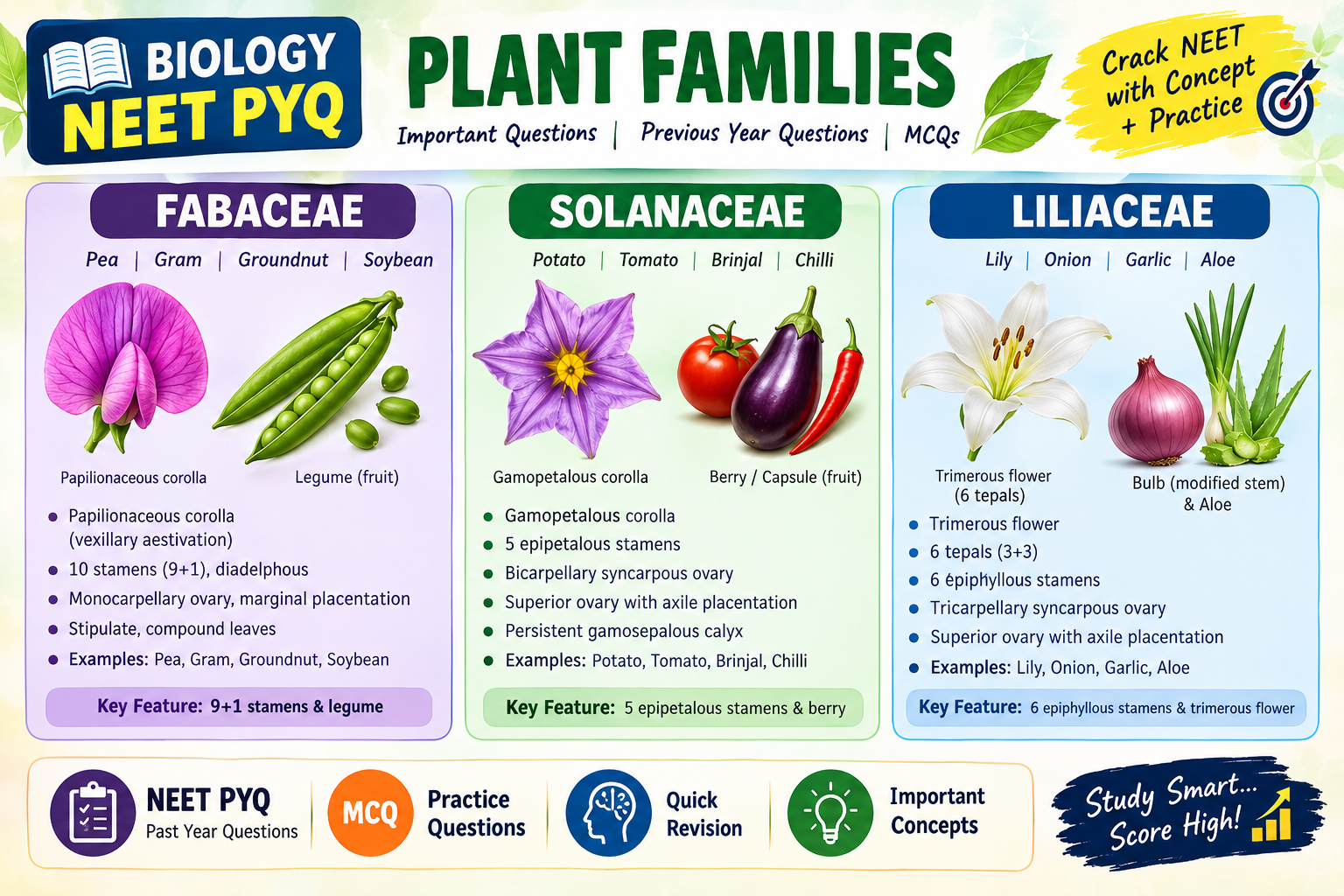
In flowering plants, several plants are grouped into families on the basis of similarities in their vegetative and reproductive characteristics. For NEET, the three families of greatest importance in this chapter are:
- Fabaceae
- Solanaceae
- Liliaceae
These families are specifically included in the NCERT curriculum for the study of flowering plants. NCERT also emphasizes their study through floral structures, anthers, ovaries, roots, stems, leaves and related characters.
For identification of a plant family, the following characters are particularly important:
Habit
Root
Stem
Leaves
Inflorescence
Flower
Calyx
Corolla or perianth
Aestivation
Androecium
Gynoecium
Placentation
Fruit
Floral formula
Economic importance
2. FAMILY FABACEAE
2.1 General Introduction
Fabaceae is an important dicot family containing many plants of agricultural, medicinal and economic importance.
Important examples include:
Pisum sativum — Pea
Cicer arietinum — Gram
Arachis hypogaea — Groundnut
Glycine max — Soybean
Cajanus cajan — Pigeon pea
Sesbania
Indigofera
Lupin
Fabaceae is particularly important for NEET because of its characteristic papilionaceous corolla, vexillary aestivation and diadelphous stamens.
2.2 Habit
Members of Fabaceae may be:
Herbs
Shrubs
Trees
The family therefore shows considerable diversity in growth habit.
2.3 Root
The root system is generally a tap root system.
Root nodules are commonly present in many members.
These nodules contain nitrogen-fixing bacteria, particularly Rhizobium, which helps in biological nitrogen fixation.
2.4 Stem
The stem may be:
Herbaceous
Woody
Erect
Climbing
The nature of the stem varies among different members.
2.5 Leaves
Leaves are generally:
Alternate
Compound
Usually pinnately compound
Stipulate
In some members, parts of the leaf may be modified into tendrils.
2.6 Inflorescence
The inflorescence is generally racemose, although variation occurs among different members.
2.7 Flower
The flower of Fabaceae is generally:
Bisexual
Zygomorphic
Complete
Hypogynous
Usually pentamerous
Zygomorphic
A zygomorphic flower can be divided into two equal halves in only one particular vertical plane.
The pea flower is a classic example.
2.8 Calyx
The calyx consists of five sepals.
The sepals are generally united.
Therefore, the calyx is:
Gamosepalous
The aestivation is generally imbricate.
2.9 Corolla
The corolla is the most characteristic feature of Fabaceae.
It is called papilionaceous corolla.
There are five petals arranged into three types:
1. Standard
One large posterior petal is called the:
Standard or Vexillum
2. Wings
Two lateral petals are called:
Wings
3. Keel
Two anterior petals form the:
Keel or Carina
Therefore:
1 + 2 + 2 = 5 petals
2.10 Vexillary Aestivation
The characteristic aestivation of the papilionaceous corolla is:
Vexillary or descending imbricate aestivation
The large standard overlaps the two wings, and the wings overlap the keel petals.
NEET Key Point
Fabaceae → Papilionaceous corolla → Vexillary aestivation
2.11 Androecium
The androecium generally consists of 10 stamens.
The characteristic arrangement is:
9 + 1
Nine stamens are united while one remains free.
This condition is called:
Diadelphous
Thus:
Fabaceae → 10 stamens → Diadelphous → 9 + 1
The anthers are generally dithecous.
2.12 Gynoecium
The gynoecium is generally:
Monocarpellary
Ovary superior
Unilocular
Usually containing several ovules
The placentation is:
Marginal
Important NEET Point
Fabaceae → Marginal placentation
2.13 Fruit
The characteristic fruit is a:
Legume or pod
Examples include the pods of:
Pea
Gram
Bean
2.14 Floral Formula
A commonly used representation of Fabaceae is:
% ⚥ K(5) C1+2+(2) A(9)+1 G1
Important symbols:
% → Zygomorphic
⚥ → Bisexual
K(5) → Five united sepals
C1+2+(2) → Papilionaceous corolla
A(9)+1 → Diadelphous stamens
G1 → Monocarpellary gynoecium
2.15 Economic Importance of Fabaceae
Fabaceae is one of the economically important plant families.
Pulses
Gram
Pea
Pigeon pea
Beans
Oil-producing plants
Groundnut
Soybean
Fibre
Sunhemp is an important fibre-producing member.
Dye
Indigofera provides indigo dye.
Fodder
Several members are used as fodder.
Soil fertility
Many members contribute to nitrogen enrichment of soil through symbiotic nitrogen fixation.
3. FAMILY SOLANACEAE
3.1 General Introduction
Solanaceae is commonly known as an important potato/tomato family.
Important members include:
Solanum tuberosum — Potato
Solanum lycopersicum — Tomato
Solanum melongena — Brinjal
Capsicum — Chilli
Nicotiana — Tobacco
Petunia
Datura
Withania
3.2 Habit
Members of Solanaceae may occur as:
Herbs
Shrubs
Small trees
3.3 Root
The root system is generally:
Tap root
3.4 Stem
The stem may be:
Herbaceous
Woody
Branched
Erect
An important example is potato, in which the underground tuber is a modified stem.
3.5 Leaves
Leaves are generally:
Alternate
Simple
Exstipulate
Venation is generally reticulate.
3.6 Inflorescence
Inflorescence may be:
Solitary
Cymose
Various modifications depending upon the genus
3.7 Flower
Flowers are generally:
Bisexual
Actinomorphic
Complete
Hypogynous
Pentamerous
Actinomorphic
An actinomorphic flower can be divided into approximately equal halves through more than one vertical plane passing through the centre.
3.8 Calyx
The calyx consists of:
Five sepals
The sepals are united.
Therefore, it is:
Gamosepalous
The calyx is generally persistent.
Aestivation is:
Valvate
3.9 Corolla
The corolla consists of:
Five petals
The petals are united.
Therefore, it is:
Gamopetalous
The corolla is generally rotate or funnel-shaped, depending on the species.
3.10 Androecium
There are generally:
Five stamens
The stamens are:
Epipetalous
Epipetalous
When stamens are attached to the petals, they are called epipetalous.
The stamens are generally arranged alternately with the petals.
3.11 Gynoecium
The gynoecium consists of:
Two carpels
Syncarpous
Ovary superior
Usually bilocular
The placentation is:
Axile
NEET Key Point
Solanaceae → Bicarpellary syncarpous → Superior ovary → Axile placentation
3.12 Fruit
The fruit may be:
Berry
Capsule
Examples:
Tomato → Berry
Brinjal → Berry
Potato → Berry botanically
Datura → Capsule
3.13 Floral Formula
A commonly used floral formula is:
⊕ ⚥ K(5) C(5) A5 G(2)
Important features:
⊕ → Actinomorphic
⚥ → Bisexual
K(5) → Five united sepals
C(5) → Five united petals
A5 → Five stamens
G(2) → Bicarpellary syncarpous gynoecium
The ovary is superior.
3.14 Economic Importance of Solanaceae
Food
Potato
Tomato
Brinjal
Chilli
Medicinal plants
Some members such as:
Datura
Atropa
Withania
have medicinal importance.
Tobacco
Nicotiana is the source of tobacco.
Ornamental plants
Petunia
Datura
4. FAMILY LILIACEAE
4.1 General Introduction
Liliaceae is an important monocot family.
Important examples include:
Lily
Tulip
Allium cepa — Onion
Garlic
Aloe
Asparagus
Colchicum
4.2 Habit
Members are generally:
Perennial herbs
Many members possess underground structures used for storage and vegetative propagation.
4.3 Root
The root system is generally:
Fibrous/adventitious
This is a typical monocot characteristic.
4.4 Stem
The stem may be modified into underground structures such as:
Bulbs
Rhizomes
Other storage structures
For example, onion has a bulb.
4.5 Leaves
Leaves are generally:
Simple
Alternate
Exstipulate
Often basal or cauline
Venation is generally:
Parallel
4.6 Inflorescence
Inflorescence varies among members and may be:
Racemose
Umbellate
Solitary
4.7 Flower
The flowers are generally:
Bisexual
Actinomorphic
Complete
Hypogynous
Trimerous
Trimerous
Floral parts are generally arranged in multiples of three.
4.8 Perianth
In Liliaceae, the perianth consists generally of:
Six tepals
Arranged in two whorls:
3 + 3
The tepals are usually similar to one another.
Thus, a separate calyx and corolla are not clearly differentiated.
4.9 Androecium
There are generally:
Six stamens
Arranged as:
3 + 3
The stamens are generally:
Epiphyllous
Epiphyllous
Stamens attached to the perianth/tepals are called epiphyllous.
4.10 Gynoecium
The gynoecium generally consists of:
Three carpels
Syncarpous
Ovary superior
Usually trilocular
The placentation is:
Axile
NEET Key Point
Liliaceae → Tricarpellary syncarpous → Superior ovary → Axile placentation
4.11 Fruit
The fruit is generally:
Capsule
Sometimes berry in some members
4.12 Floral Formula
A commonly used floral formula is:
⊕ ⚥ P3+3 A3+3 G(3)
Important points:
⊕ → Actinomorphic
⚥ → Bisexual
P3+3 → Six tepals
A3+3 → Six stamens
G(3) → Three fused carpels
The ovary is superior.
4.13 Economic Importance of Liliaceae
Food
Onion
Garlic
Medicinal importance
Aloe
Colchicum
Ornamental plants
Lily
Tulip
Other uses
Several members are cultivated for ornamental, medicinal and agricultural purposes.
5. COMPARATIVE TABLE — FABACEAE, SOLANACEAE AND LILIACEAE
| Character | Fabaceae | Solanaceae | Liliaceae |
| Major group | Dicot | Dicot | Monocot |
| Habit | Herbs/shrubs/trees | Herbs/shrubs | Mostly perennial herbs |
| Root | Tap | Tap | Fibrous/adventitious |
| Leaf venation | Usually reticulate | Reticulate | Parallel |
| Flower symmetry | Zygomorphic | Actinomorphic | Actinomorphic |
| Flower | Bisexual | Bisexual | Bisexual |
| Merosity | Usually pentamerous | Pentamerous | Trimerous |
| Calyx | 5, united | 5, united | Perianth present |
| Corolla/perianth | Papilionaceous | 5 united petals | 6 tepals |
| Aestivation | Vexillary | Valvate | Usually imbricate |
| Stamens | 10 | 5 | 6 |
| Stamen attachment | Diadelphous | Epipetalous | Epiphyllous |
| Carpels | 1 | 2 | 3 |
| Gynoecium | Monocarpellary | Bicarpellary syncarpous | Tricarpellary syncarpous |
| Ovary | Superior | Superior | Superior |
| Placentation | Marginal | Axile | Axile |
| Fruit | Legume | Berry/Capsule | Capsule/Berry |
| Typical example | Pea | Tomato | Lily |
The three-family comparison is also explicitly emphasized in the NCERT Exemplar, including comparison of gynoecium and floral characters.
6. NEET ONE-LINE REVISION
Fabaceae
Papilionaceous → Vexillary → Diadelphous → Marginal → Legume
Solanaceae
Actinomorphic → Gamopetalous → Epipetalous → Axile → Berry/Capsule
Liliaceae
Monocot → Trimerous → Tepals → Epiphyllous → Axile → Capsule/Berry
7. MOST IMPORTANT FAMILY IDENTIFICATION POINTS
If you see:
Vexillary aestivation + standard + wings + keel
→ Fabaceae
9 + 1 diadelphous stamens
→ Fabaceae
Marginal placentation
→ Fabaceae
5 epipetalous stamens + axile placentation
→ Solanaceae
Five fused petals + five stamens
→ Solanaceae
Berry or capsule
→ Solanaceae
Six tepals + six stamens + trimerous flower
→ Liliaceae
Epiphyllous stamens
→ Liliaceae
Parallel venation + monocot characters
→ Liliaceae