GUMROAD eBook link:-
BY SHAILENDRA KUMAR VERMA
| Affiliate link of GUMROAD eBook | |
| https://skverma29.gumroad.com/affiliates | |
| 1. | CHALLENGING SYLLOGISM |
| https://skverma29.gumroad.com/l/ktxvzi | |
| 2. | STRAIT OF HORMUZ: STRATEGIC & ECONOMIC ROLE |
| https://skverma29.gumroad.com/l/upobrv | |
| 4. | STATIC GENERAL KNOWLEDGE |
| https://skverma29.gumroad.com/l/kzmca | |
| 5. | SSC ENGLISH PREVIOUS YEAR QUESTIONS MCQ |
| https://skverma29.gumroad.com/l/vtotyp | |
| 6. | SSC REASONING PREVIOUS YEAR QUESTIONS MCQ |
| https://skverma29.gumroad.com/l/fsyvp | |
| 7. | SSC MATH PREVIOUS YEAR QUESTIONS (MCQ): TIER I |
| https://skverma29.gumroad.com/l/nesioq | |
| 8. | BANKING KNOWLEDGE QUESTIONS AND ANSWERS MCQ |
| https://skverma29.gumroad.com/l/sgbbul | |
| 9. | BIHAR ANM, GNM & PHARMACIST EXAM: PAST MCQ QUESTIONS & ANSWERS – |
| https://skverma29.gumroad.com/l/yotjat | |
| 10. | ARAVALLI MOUNTAIN RANGE: THE ANCIENT SPINE OF INDIA |
| https://skverma29.gumroad.com/l/khpakf | |
| 11. | मौर्य काल (322 ईसा पूर्व – 185 ईसा पूर्व): पीएसयू परीक्षा हेतु प्रश्नोत्तर सहित विस्तृत अध्ययन |
| https://skverma29.gumroad.com/l/kgmrw | |
| 12. | VOLCANOES AND EARTHQUAKES: A COMPLETE GUIDE |
| https://share.google/gMZLAnx4hcCV82NTI | |
| 13. | TERMINOLOGY: RAILWAY, COMPUTER, SHARE MARKET, BIOLOGY, BADMINTON, CRICKET, FOOTBALL, KABBADI AND HOCKEY |
| https://share.google/fvdFN53HtyXlqTCgd | |
| 14. | भारतीय संसद का सत्र: प्रक्रिया, नियमऔर एस ओ पी; पी एस यू परीक्षा के लिए संपूर्ण मार्ग दर्शिका |
| https://share.google/1HFwXZA3qUiKyrI1l | |
| 15. | REITs AND InvITs IN INDIA: COMPLETE GUIDE (SCOPE, RISKS & FUTURE) |
| https://share.google/EChDc9heQmPPeyhoi | |
| 16. | GK SSC TIER I PREVIOUS YEAR MCQ |
| https://share.google/5pLzqYKQtg822wk3Y | |
| 17. | PETROLEUM REFINERY PROCESS: WITH 200 MCQ |
| https://skverma29.gumroad.com/l/jgydi | |
| 18. | SET THEORY: A COMPLETE GUIDE WITH 400 MCQ |
| https://skverma29.gumroad.com/l/zkhqzm | |
| 19. | WORLD’S SMALLEST, LONGEST, THINNEST, THICKEST AND TALLEST |
| https://skverma29.gumroad.com/l/kzaenh | |
| 20. | HIGH TIDE AND LOW TIDE: A COMPLETE GUIDE https://skverma29.gumroad.com/l/virke |
| 21. | 1000 HISTORY QESTIONS & ANSWERS FOR PSU |
| https://skverma29.gumroad.com/l/fjapus | |
| 22. | नालंदा विश्वविद्यालय : सम्पूर्ण अध्ययन |
| https://skverma29.gumroad.com/l/pmjab?wanted=true | |
| 23. | भगवान शिव के 12 ज्योतिर्लिंग: इतिहास, महत्व और दर्शन क्रम |
| https://skverma29.gumroad.com/l/wdkgo | |
| 24 | NISM-SERIES-V-A MUTUAL FUND DISTRIBUTOR: COMPLETE STUDY GUIDE & EXAM PREPARATION |
| https://skverma29.gumroad.com/l/qgcviu | |
| 25. | WORKSHOP TECHNOLOGY & MANUFACTURING PROCESSES COMPLETE EXAM GUIDE |
| https://skverma29.gumroad.com/l/xvqxnp | |
| 26. | उगना महादेव और महाकवि विद्यापति |
| https://skverma29.gumroad.com/l/xjehig | |
| 27. | FINANCIAL INCLUSION (FI), MICROFINANCE AND SOCIAL SECURITY IN INDIA:A COMPLETE GUIDE |
| https://skverma29.gumroad.com/l/lpendf | |
| 28. | Vermaji’s Cute Animals Coloring Book |
| https://skverma29.gumroad.com/l/chrxrc | |
| 29. | Verma Ji’s Cute Birds Coloring Book |
| https://skverma29.gumroad.com/l/tdnqyi | |
| 30. | राजभाषा हिंदी :सम्पूर्ण अध्ययन एवं प्रतियोगी परीक्षा मार्गदर्शिका |
| https://skverma29.gumroad.com/l/fvodlm | |
AMAZON eBook link:-
BY SHAILENDRA KUMAR VERMA
| 1. | SSC MATH PREVIOUS YEAR MCQ: SSC MATH |
| https://amzn.in/d/097Ocsnl | |
| 2. | SSC REASONING PREVIOUS YEAR MCQ: SSC REASONING |
| https://amzn.in/d/00EHQGE8 | |
| 3. | SSC ENGLISH PREVIOUS YEAR MCQ: SSC ENGLISH |
| https://amzn.in/d/0f8sxJoy | |
| 4. | STATIC GENERAL KNOWLEDGE : WITH 620 MCQs |
| https://amzn.in/d/09xNEWmt |
PLAYSTORE eBook link:-
BY SHAILENDRA KUMAR VERMA
| 1. | SSC MATH PREVIOUS YEAR MCQ |
| https://share.google/KzWbvkFuNk51PEpiu | |
| 2. | SSC REASONING PREVIOUS YEAR MCQ |
| https://play.google.com/books/publish/a/12574378860292240754#book/GGKEY:EUPQZ9ZUAFR/review | |
| 3. | STATIC GENERAL KNOWLEDGE |
| https://play.google.com/books/publish/a/12574378860292240754#book/GGKEY:CQDT2G4CCQP/review | |
| 4. | CHALLENGING SYLLOGISM |
| https://share.google/w9xLMwyiJdNVnpHxI | |
| 5. | STRAIT OF HORMUZ: STRATEGIC & ECONOMIC ROLE |
| https://share.google/V10H7UKeTkstLIMmc | |
| 6. | BIHAR TEACHER ELIGIBILITY TEST (BIHAR TET) : COMPLETE GUIDE |
| https://share.google/AcCXPFa69dAWyYaZZ | |
| 7. | SSC ENGLISH PREVIOUS YEAR MCQ |
| https://share.google/pr7b0YhDoDwttaq2s | |
| 8. | BANKING KNOWLEDGE QUESTIONS AND ANSWERS MCQ |
| https://share.google/yqYOabKhNppcz89hl | |
| 9. | BIHAR ANM, GNM & PHARMACIST EXAM: PAST MCQ QUESTIONS & ANSWERS – |
| https://share.google/NFhtU1JoBfxPS4wa3 | |
| 10. | ARAVALLI MOUNTAIN RANGE: THE ANCIENT SPINE OF INDIA |
| https://share.google/Yo4RYnaZrbRu9qwzj | |
| 11. | GK SSC TIER I PREVIOUS YEAR MCQ |
| https://share.google/sBdCcsEeebM44QZ0X | |
| 12. | REITs AND InvITs IN INDIA: COMPLETE GUIDE (SCOPE, RISKS & FUTURE) |
| https://share.google/XAwUio1deUOxFe2M7 | |
| 13. | भारतीय संसद का सत्र: प्रक्रिया, नियमऔर एस ओ पी ; पी एस यू परीक्षा के लिए संपूर्ण मार्ग दर्शिका |
| https://share.google/6XVrfQ2PcuWmqvKol | |
| 14. | मौर्य काल (322 ईसा पूर्व – 185 ईसा पूर्व): पीएसयू परीक्षा हेतु प्रश्नोत्तर सहित विस्तृत अध्ययन |
| https://share.google/Lwu7JKHE54kxsL5e2 | |
| 15. | TERMINOLOGY: RAILWAY, COMPUTER, SHARE MARKET, BIOLOGY, BADMINTON, CRICKET, FOOTBALL, KABBADI AND HOCKEY |
| https://share.google/WWVO9ZFd81R9G9h69 | |
| 16. | VOLCANOES AND EARTHQUAKES: A COMPLETE GUIDE |
| https://share.google/aXi2evRVgmzpQguye | |
| 17. | PETROLEUM REFINERY PROCESS: WITH 200 MCQ |
| https://play.google.com/books/publish/u/0/a/12574378860292240754#book/GGKEY:P34SQBHUJ7F/review | |
| 18. | SET THEORY: A COMPLETE GUIDE WITH 400 MCQ |
| https://play.google.com/books/publish/u/0/a/12574378860292240754#book/GGKEY:83LKH7QHRQH/review | |
| 19. | WORLD’S SMALLEST, LONGEST, THINNEST, THICKEST AND TALLEST |
| https://play.google.com/books/publish/u/0/a/12574378860292240754#book/GGKEY:9LE49HEDZJE/review | |
| 20. | HIGH TIDE AND LOW TIDE: A COMPLETE GUIDE |
| https://play.google.com/books/publish/u/0/a/12574378860292240754#book/GGKEY:TKR79QBDE7R/review | |
| 21. | 1000 HISTORY QESTIONS & ANSWERS FOR PSU |
| https://play.google.com/books/publish/u/0/a/12574378860292240754#book/GGKEY:1SGWQKT7BDF/review | |
| 22. | नालंदा विश्वविद्यालय : सम्पूर्ण अध्ययन |
| https://play.google.com/books/publish/u/0/a/12574378860292240754#book/GGKEY:RY0EDLDK7TL/review | |
| 23. | भगवान शिव के 12 ज्योतिर्लिंग: इतिहास, महत्व और दर्शन क्रम |
| https://play.google.com/books/publish/u/0/a/12574378860292240754#book/GGKEY:KNT0X6L8YCQ/review | |
| 24. | NISM-SERIES-V-A MUTUAL FUND DISTRIBUTOR: COMPLETE STUDY GUIDE & EXAM PREPARATION |
| https://play.google.com/books/publish/u/0/a/12574378860292240754#book/GGKEY:YP1PQ8RQY07/review | |
| 25. | WORKSHOP TECHNOLOGY & MANUFACTURING PROCESSES COMPLETE EXAM GUIDE |
| https://play.google.com/books/publish/u/0/a/12574378860292240754#book/GGKEY:PK621P1ZHXX/review | |
| 26. | उगना महादेव और महाकवि विद्यापति |
| https://play.google.com/books/publish/u/0/a/12574378860292240754#book/GGKEY:QXG2TUGW955/review | |
| 27. | FINANCIAL INCLUSION (FI), MICROFINANCE AND SOCIAL SECURITY IN INDIA:A COMPLETE GUIDE |
| 28. | Vermaji’s Cute Animals Coloring Book eBook |
| https://play.google.com/books/publish/u/0/a/12574378860292240754#book/GGKEY:WFBA8EL20KT/review | |
| 29. | Verma Ji’s Cute Birds Coloring Book Paperback |
| https://play.google.com/books/publish/u/0/a/12574378860292240754#book/GGKEY:TYQCU6P32GE/review | |
| 30 | Verma Ji’s Cute Birds Coloring Book eBook |
| https://play.google.com/books/publish/u/0/a/12574378860292240754#book/GGKEY:KXY8L92YX97/review | |
| 31. | Vermaji’s Cute Animals Coloring Book Paperback |
| https://play.google.com/books/publish/u/0/a/12574378860292240754#book/GGKEY:Z5E48HP2H19/review | |
| 32. | राजभाषा हिंदी :सम्पूर्ण अध्ययन एवं प्रतियोगी परीक्षा मार्गदर्शिका |
| https://play.google.com/books/publish/u/0/a/12574378860292240754#book/GGKEY:8UEG8EUW718/review |
| OPEN DMAT ACCONT FROM THI LINK IN ANGEL ONE:- |
| Open your Trading & Investment account with Angel One for FREE* |
| You will get: |
| All trades in Rs.20 |
| Quick SIP in Direct MF |
| 1Lac MTF @ 0% interest |
| Download only using my referral link to get Free Demat Account⬇ |
| https://angel-one.onelink.me/Wjgr/2o2au42h |
| _link may expire within 48hrs_ |
| _T&C Apply_ |
| CLICK TO APPLY: |
| Click the application link below: 👉 Apply Here for SBI Credit Card (Referral Code: 243zfQ0yYm3) |
| OPEN DMAT ACCOUNT FROM THIS LINK: |
| HI THERE, I SEE YOU HAVEN’T BOUGHT THE FREEDOM PLAN ON INDIAN BANK YET. DON’T MISS OUT ON UNLIMITED TRADING AT A POCKET-FRIENDLY COST. GO BROKERAGE-FREE AND SAVE BIG WITH THE FREEDOM PLAN. USE MY REFERRAL CODE, SHAI0634 TO DOWNLOAD THE APP NOW. |
| https://play.google.com/store/apps/details?id=com.finwizard.fisdom |
DISCLAIMER
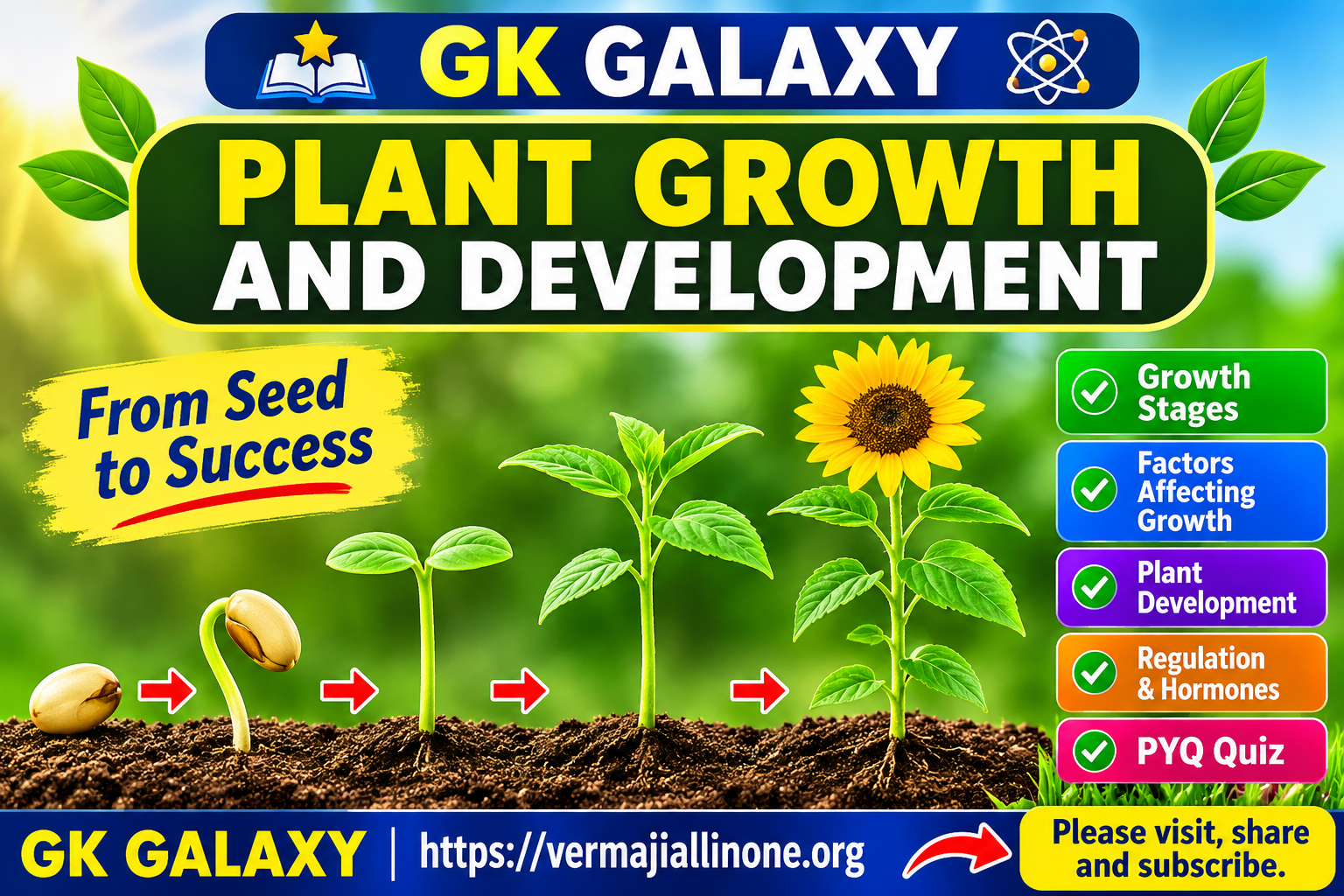
This chapter, “PLANT GROWTH AND DEVELOPMENT”, has been prepared for educational and informational purposes only. It includes subject-related theory, important concepts, practice MCQs, and Previous Year Questions (PYQs) to help students prepare for NEET and other relevant competitive examinations.
The PYQs and examination-related information have been compiled from various educational sources and available references. Some questions may be memory-based or reproduced in a simplified or modified format for better understanding and practice. The examination name and year are provided wherever available and reasonably verified.
Although every effort has been made to maintain accuracy, the author does not guarantee that all questions, answers, explanations, examination years, or other information are completely error-free. Students are advised to cross-check important information with NCERT textbooks, official NTA publications, and other authentic sources.
This content is not affiliated with, endorsed by, or officially associated with the National Testing Agency (NTA), NEET, CBSE, or any government examination authority.
The author, Shailendra Kumar Verma, and GK GALAXY (https://vermajiallinone.org) shall not be held responsible for any errors, omissions, or consequences arising from the use of this material.
This chapter is intended solely as a supplementary study resource and should not be considered a substitute for official textbooks, examination notifications, or authoritative study materials.
Author: Shailendra Kumar Verma
Educational Platform: GK GALAXY
Website: https://vermajiallinone.org
Chapter Contents
- Introduction to Plant Growth
- Characteristics of Plant Growth
- Phases of Growth
- Growth Rate and Growth Curve
- Conditions for Plant Growth
- Differentiation, Dedifferentiation and Redifferentiation
- Development in Plants
- Plant Growth Regulators (PGRs)
- Auxins
- Gibberellins
- Cytokinins
- Ethylene
- Abscisic Acid (ABA)
- Photoperiodism
- Vernalisation
- NEET Previous Year Questions with Answers and Explanations
PART 1: COMPLETE THEORY
1. Introduction to Plant Growth
Plant growth and development are important biological processes through which a plant increases in size, develops new structures and reaches maturity.
Growth: Growth is defined as an irreversible permanent increase in the size, mass, volume or number of cells of an organism.
In plants, growth generally occurs throughout life because they possess meristematic tissues that retain the ability to divide.
Important Characteristics of Plant Growth
- Growth is an irreversible process.
- It involves an increase in protoplasm.
- It may occur due to cell division, cell enlargement and cell differentiation.
- Plant growth is generally restricted to specialised regions called meristems.
- Plant growth is influenced by both internal and external factors.
- Plants show an open form of growth because new organs can develop throughout their life.
Development: Development refers to all the changes that an organism undergoes during its life cycle, including growth, differentiation, maturation and senescence.
Important distinction:
Growth refers to an increase in size or mass.
Development includes all qualitative and quantitative changes during the life cycle.
2. Characteristics of Plant Growth
Plant growth has three major characteristics:
A. Indeterminate Growth
Plants show indeterminate growth because their meristematic tissues remain active throughout their life.
Examples:
Root apical meristem
Shoot apical meristem
Vascular cambium
B. Open Form of Growth
Plants continuously produce new leaves, branches, flowers and roots due to the activity of meristematic tissues.
C. Plasticity
Plasticity is the ability of plants to follow different developmental pathways in response to environmental conditions or different phases of life.
Example: Leaves of certain plants may have different shapes in juvenile and mature stages. This phenomenon is known as heterophylly.
Examples:
Buttercup
Cotton
3. Phases of Plant Growth
Plant growth takes place in three major phases:
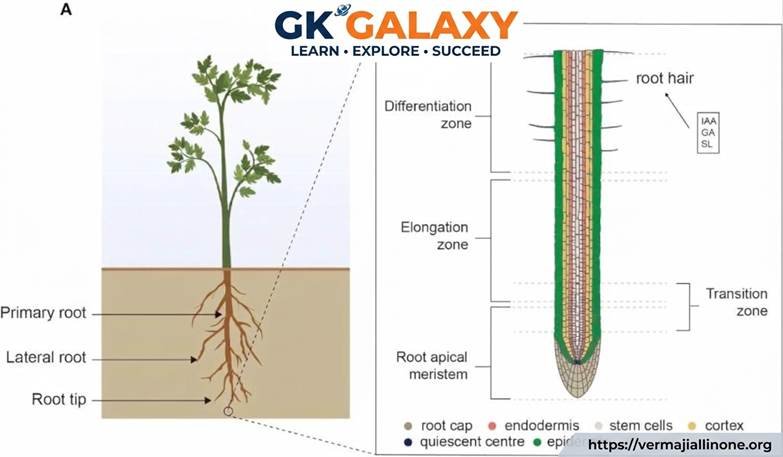
A. Meristematic Phase
This phase occurs in the actively dividing regions of plants.
Characteristics:
- Cells divide continuously.
- Cells have dense cytoplasm.
- Cell walls are thin and primary.
- Vacuoles are absent or very small.
- Cells have prominent nuclei.
- Intercellular spaces are generally absent.
B. Elongation Phase
Cells formed in the meristematic region enter the elongation phase.
Characteristics:
- Cells increase in size.
- Vacuoles enlarge.
- Cell walls undergo enlargement.
- Cell size and volume increase.
- Cells become elongated.
C. Maturation Phase
In this phase, cells attain their maximum size and become differentiated.
Characteristics:
- Cells reach their maximum size.
- Cells develop specialised structures.
- Permanent tissues are formed.
- Cells acquire specific physiological functions.
NEET Important Point: The three phases of growth in the root are meristematic, elongation and maturation.
4. Growth Rate and Growth Curve
Growth rate is defined as the increase in growth per unit time.
There are two major types of growth rates:
A. Arithmetic Growth
In arithmetic growth, only one daughter cell continues to divide, while the other differentiates and matures.
The growth rate remains constant.
Formula:
Length at time t = Initial length + (Growth rate × Time)
Formula:
L(t) = L₀ + r × t
Where:
L(t) = Length at time t
L₀ = Initial length
r = Growth rate
t = Time
B. Geometric Growth
In geometric growth, both daughter cells produced by cell division retain the ability to divide.
Growth initially becomes slow and then increases rapidly.
Under ideal conditions, geometric growth follows an exponential pattern.
Formula:
Final size = Initial size × e^(Relative growth rate × Time)
Formula:
W1 = W0 × e^(r × t)
Where:
W1 = Final size
W0 = Initial size
r = Relative growth rate
t = Time
e = Base of natural logarithm (approximately 2.718)
C. Sigmoid Growth Curve
The sigmoid or S-shaped growth curve is commonly observed in plants under natural conditions.
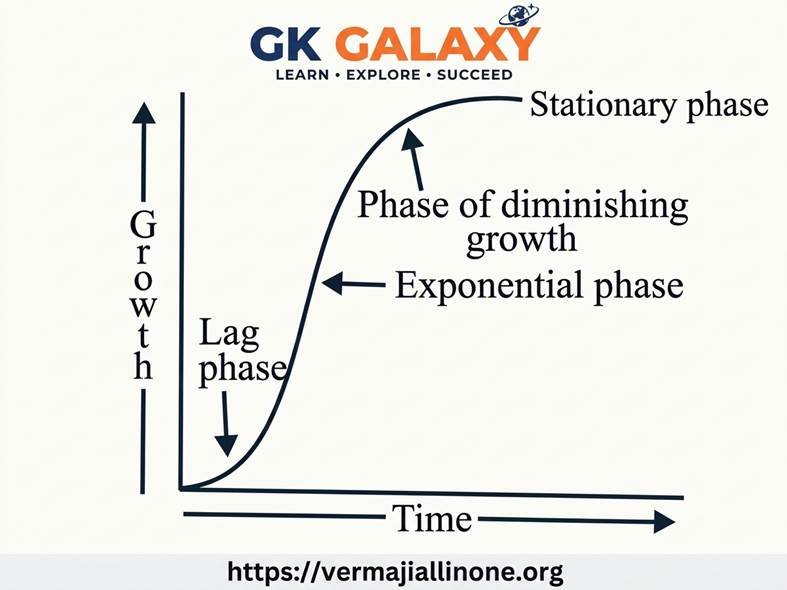
It consists of three major phases:
- Lag Phase: Initial slow growth.
- Log Phase: Rapid and maximum growth.
- Stationary Phase: Growth slows down and eventually becomes stable.
Important NEET Facts:
Maximum growth occurs during the log phase.
The sigmoid curve is also called the S-shaped growth curve.
Arithmetic growth produces a linear growth pattern.
Geometric growth produces an exponential growth pattern.
D. Absolute Growth Rate
Absolute growth rate is the total growth per unit time.
Formula:
Absolute Growth Rate = Increase in growth / Time
E. Relative Growth Rate
Relative growth rate is the growth per unit time per unit initial growth.
Formula:
Relative Growth Rate = Increase in growth / Initial growth × Time
It is useful for comparing the growth performance of different plants.
5. Conditions Required for Plant Growth
Plant growth is influenced by internal and external factors.
A. Internal Factors
- Genetic constitution
- Plant growth regulators
- Enzymatic activities
- Physiological condition of the plant
- Availability of stored food
B. External Factors
- Water
- Oxygen
- Temperature
- Light
- Mineral nutrients
Role of Water:
Maintains cell turgidity.
Helps in cell enlargement.
Acts as a medium for metabolic reactions.
Helps in the transport of minerals and nutrients.
Role of Oxygen:
Oxygen is essential for aerobic respiration and energy production.
Role of Temperature:
Temperature affects enzyme activity, metabolism and the overall rate of growth.
Role of Light:
Light influences photosynthesis, flowering and several developmental processes.
6. Differentiation, Dedifferentiation and Redifferentiation
These three processes are extremely important for NEET.
A. Differentiation
Differentiation is the process by which cells derived from meristems mature and acquire a permanent shape, size and specialised function.
Examples:
Formation of xylem vessels
Formation of phloem elements
Formation of specialised epidermal cells
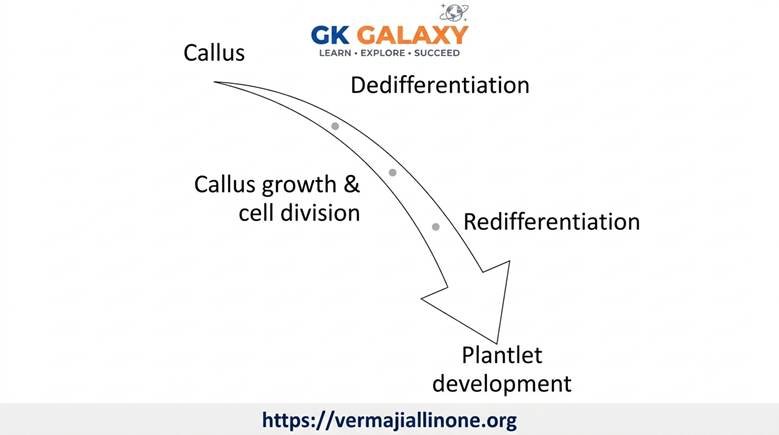
B. Dedifferentiation
Dedifferentiation is the process by which living differentiated cells regain the capacity to divide under certain conditions.
Examples:
Formation of interfascicular cambium from differentiated parenchyma cells.
Formation of cork cambium from mature cells.
C. Redifferentiation
Redifferentiation is the process in which cells produced through dedifferentiation lose their capacity to divide and become specialised again.
Examples:
Formation of secondary xylem.
Formation of secondary phloem.
Important NEET Points:
Dedifferentiation restores the capacity of cell division.
Redifferentiation produces specialised cells.
Interfascicular cambium formation is an example of dedifferentiation.
Dedifferentiation followed by redifferentiation is important in plant tissue culture.
7. Development in Plants
Development refers to the overall changes that occur throughout the life cycle of a plant.
It includes:
- Growth
- Differentiation
- Maturation
- Reproduction
- Senescence
Plant development is controlled by internal and external factors.
Important Developmental Concepts
A. Plasticity
Plasticity is the ability of plants to follow different developmental pathways depending on environmental conditions or their stage of life.
Example: Heterophylly in cotton and buttercup.
B. Heterophylly
The occurrence of different types of leaves on the same plant is called heterophylly.
Two types are recognised:
Developmental heterophylly: Different leaves occur during different developmental stages.
Environmental heterophylly: Different leaf forms develop under different environmental conditions.
Examples:
Cotton: Developmental heterophylly.
Buttercup: Environmental heterophylly.
C. Senescence
Senescence is the process of ageing in plants, during which metabolic activities decline and plant organs eventually die.
Examples:
Yellowing of leaves.
Ageing of flowers.
Death of annual plants after reproduction.
D. Abscission
Abscission is the natural shedding of leaves, flowers or fruits from a plant.
It is regulated by several hormonal and physiological factors.
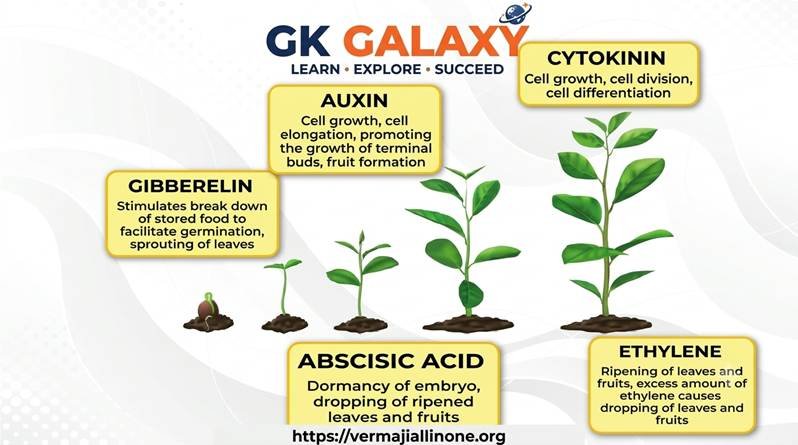
8. Plant Growth Regulators (PGRs)
Plant growth regulators are small, simple molecules of diverse chemical composition that regulate plant growth and development.
They may promote, inhibit or modify different physiological processes.
The five major groups of naturally occurring plant growth regulators described in NCERT are:
- Auxins
- Gibberellins
- Cytokinins
- Ethylene
- Abscisic Acid (ABA)
Classification of Plant Growth Regulators
A. Growth Promoters
Auxins
Gibberellins
Cytokinins
B. Growth Inhibitors
– Abscisic Acid (ABA)
C. Both Promoting and Inhibitory Effects
Ethylene may promote certain processes and inhibit others, depending on the tissue and physiological condition.
Important: This classification describes their principal effects; plant growth regulators can have multiple functions.
9. Auxins
Auxins are plant growth regulators mainly associated with cell elongation and several developmental processes.
The term auxin is derived from the Greek word meaning to grow.
Discovery of Auxins
- Charles Darwin and Francis Darwin studied phototropism in coleoptiles.
- Boysen-Jensen demonstrated that the growth stimulus could pass through gelatin.
- Paal demonstrated the effect of coleoptile tip extracts.
- F.W. Went isolated the growth-promoting substance from oat coleoptile tips.
Types of Auxins
Natural Auxins:
IAA – Indole-3-acetic acid
IBA – Indole-3-butyric acid
Synthetic Auxins:
NAA – Naphthalene acetic acid
2,4-D – 2,4-dichlorophenoxyacetic acid
Major Functions of Auxins
- Promote cell elongation.
- Maintain apical dominance.
- Initiate adventitious root formation.
- Promote parthenocarpy in certain plants.
- Delay premature fruit and leaf drop in some situations.
- Help in vascular differentiation.
- Promote rooting in stem cuttings.
- Participate in tropic responses.
Apical Dominance
Apical dominance is the phenomenon in which the growing apical bud suppresses the growth of lateral buds.
Auxin produced by the shoot apex plays an important role in this phenomenon.
Practical application: Removal of shoot tips promotes lateral branching.
Parthenocarpy
Parthenocarpy is the development of fruits without fertilisation.
Auxins and gibberellins can induce parthenocarpy in certain plants.
Examples:
Seedless tomato
Seedless fruits produced through hormonal treatment
Auxins as Herbicides
Synthetic auxins such as 2,4-D are used to control dicotyledonous weeds in cereal crops.
2,4-D is particularly effective against broad-leaved weeds.
NEET Important Point: 2,4-D is a selective herbicide used for killing dicot weeds without seriously affecting many monocot crops when applied appropriately.
10. Gibberellins
Gibberellins are plant growth regulators that promote stem elongation and several other developmental activities.
Discovery
Gibberellins were discovered through studies of the bakanae disease of rice.
The disease was caused by the fungus Gibberella fujikuroi.
The fungus produced a substance responsible for excessive stem elongation in rice plants.
Major Functions of Gibberellins
- Promote stem elongation.
- Promote internode elongation.
- Induce bolting in rosette plants.
- Break seed dormancy in certain species.
- Promote seed germination.
- Stimulate enzyme production during seed germination.
- Increase fruit size in some plants.
- Promote flowering in certain plants.
- Increase sugarcane stem length and yield.
- Promote malting in the brewing industry.
Bolting
Bolting refers to the rapid elongation of the internodes just before flowering in rosette plants.
Examples:
Cabbage
Beet
Other rosette plants
Gibberellins promote bolting.
Gibberellins in Sugarcane
Application of gibberellins increases the length of sugarcane stems.
This can increase the yield of sugarcane.
Gibberellins in the Brewing Industry
Gibberellins, particularly GA3, are used to stimulate the malting process in the brewing industry.
Gibberellins and Seed Germination
Gibberellins stimulate the synthesis of hydrolytic enzymes such as alpha-amylase in the aleurone layer of cereal grains.
These enzymes help convert stored food into simpler substances that can be used by the growing embryo.
NEET Important Point: Gibberellins promote bolting, stem elongation and alpha-amylase production during seed germination.
11. Cytokinins
Cytokinins are plant growth regulators that promote cell division or cytokinesis.
They are particularly important in cell division, shoot formation and nutrient mobilisation.
Discovery
The first cytokinin discovered was kinetin.
It was isolated from autoclaved herring sperm DNA by Miller and his co-workers.
Zeatin is a naturally occurring cytokinin isolated from maize.
Types of Cytokinins
Natural Cytokinins:
Zeatin
Isopentenyl adenine
Synthetic Cytokinins:
Kinetin
6-Benzylaminopurine (BAP)
Major Functions of Cytokinins
- Promote cell division.
- Promote shoot formation in tissue culture.
- Promote lateral bud growth.
- Overcome apical dominance in certain conditions.
- Delay leaf senescence.
- Promote nutrient mobilisation.
- Help in chloroplast development.
- Promote the development of chlorophyll.
- Influence differentiation in plant tissue culture.
Cytokinins and Senescence
Cytokinins delay leaf senescence by promoting nutrient mobilisation and maintaining metabolic activity.
This phenomenon is known as the Richmond-Lang effect.
NEET Important Point: Cytokinins are known as anti-senescence hormones.
12. Ethylene
Ethylene is a gaseous plant growth regulator.
It is unique among the five major plant growth regulators because it exists in gaseous form.
Major Functions of Ethylene
- Promotes fruit ripening.
- Promotes senescence in certain plant organs.
- Promotes abscission of leaves and flowers.
- Promotes horizontal growth of seedlings.
- Promotes swelling of the axis.
- Helps in root hair formation.
- Promotes female flowers in cucumber.
- Helps in breaking dormancy in certain plants.
- Promotes flowering in pineapple.
- Promotes rapid internode elongation in deep-water rice.
Ethylene and Fruit Ripening
Ethylene is an important natural fruit-ripening hormone.
It promotes changes such as:
Softening of fruits.
Changes in fruit colour.
Conversion of starch into sugars.
Changes in aroma and flavour.
Ethephon
Ethephon is a chemical compound that releases ethylene.
It is used in agriculture to regulate several developmental processes.
Applications:
- Promotes fruit ripening.
- Promotes female flowers in cucumber.
- Helps in the synchronisation of fruit ripening.
- Can promote flowering in certain crops.
NEET Important Point: Ethylene promotes female flowers in cucumber, which can increase fruit production.
13. Abscisic Acid (ABA)
Abscisic acid is primarily known as a growth-inhibiting plant hormone.
It plays an important role in plant responses to environmental stress.
It is also called the stress hormone.
Major Functions of ABA
- Inhibits plant growth.
- Promotes seed dormancy.
- Promotes bud dormancy.
- Promotes stomatal closure during water stress.
- Helps plants tolerate drought.
- Promotes senescence in certain plant organs.
- Influences seed maturation.
- Helps plants respond to environmental stress.
ABA and Stomatal Closure
During water stress, ABA accumulates in leaves and guard cells.
It promotes stomatal closure, thereby reducing water loss through transpiration.
ABA and Seed Dormancy
ABA promotes seed dormancy and prevents premature germination.
It acts antagonistically to gibberellins in several seed germination and dormancy processes.
NEET Important Point: ABA is a stress hormone that promotes stomatal closure and seed dormancy.
14. Comparison of Five Major Plant Growth Regulators
| Plant hormone | Major function |
| Auxin | Cell elongation and apical dominance |
| Gibberellin | Stem elongation and bolting |
| Cytokinin | Cell division and delay of senescence |
| Ethylene | Fruit ripening |
| ABA | Seed dormancy and stomatal closure |
Important Agricultural Applications
| Application | Plant growth regulator |
| Weed control | 2,4-D |
| Sugarcane stem elongation | Gibberellin |
| Fruit ripening | Ethylene |
| Promoting female flowers in cucumber | Ethylene |
| Delaying leaf senescence | Cytokinin |
| Stomatal closure | ABA |
| Bolting in cabbage | Gibberellin |
| Root initiation in cuttings | Auxin |
| Malting in brewing industry | Gibberellin |
| Breaking certain seed dormancy conditions | Gibberellin |
15. Photoperiodism
Photoperiodism is the response of plants to the relative lengths of day and night, particularly in relation to flowering.
The term photoperiodism was introduced by Garner and Allard in 1920.
Types of Plants Based on Photoperiodism
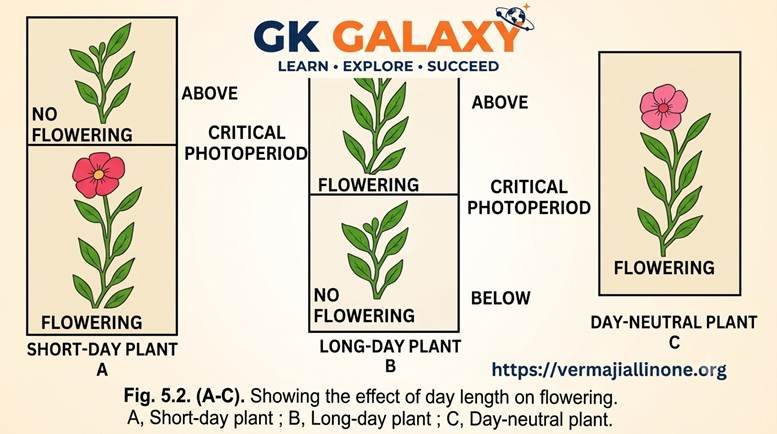
A. Long-Day Plants (LDP)
These plants flower when the day length exceeds a certain critical duration.
Examples:
Wheat
Spinach
Radish
Henbane
B. Short-Day Plants (SDP)
These plants flower when the day length is shorter than a certain critical duration, provided that the required uninterrupted dark period is satisfied.
Examples:
Rice
Chrysanthemum
Xanthium
Tobacco
C. Day-Neutral Plants
These plants do not depend on a specific photoperiod for flowering.
Examples:
Tomato
Cucumber
Sunflower
Critical Photoperiod
Critical photoperiod is the specific duration of light or darkness that determines flowering in photoperiod-sensitive plants.
Important NEET Point: In many photoperiod-sensitive plants, the duration of the uninterrupted dark period is more important than the length of the light period.
Site of Photoperiodic Perception
Leaves perceive the photoperiodic stimulus.
The flowering stimulus is then transmitted to the shoot apical meristem.
Important: The shoot apex is the site of flowering, but the leaves are the principal site of photoperiod perception.
16. Vernalisation
Vernalisation is the process of inducing flowering by exposing plants or seeds to a period of low temperature.
It is an important phenomenon in several winter annual and biennial plants.
Important Features
- It involves exposure to low temperature.
- It promotes or accelerates flowering.
- It is important in winter varieties of certain plants.
- It may reduce the time required for flowering.
- The response can depend on the developmental stage of the plant.
Examples
Wheat
Barley
Rye
Cabbage
Sugar beet
Importance of Vernalisation
- Helps winter plants flower in the appropriate season.
- Reduces the vegetative period in certain plants.
- Promotes early flowering.
- Helps in synchronising flowering with favourable environmental conditions.
Vernalisation and Photoperiodism: Differences
| Photoperiodism | Vernalisation |
| Response to day and night duration | Response to low temperature |
| Light and dark periods are involved | Chilling treatment is involved |
| Leaves perceive photoperiod | Dividing tissues or embryos can perceive the cold stimulus |
| Regulates flowering | Promotes or accelerates flowering |
17. Important NEET Revision Table
| Topic | Important fact |
| Plant growth | Irreversible increase in size |
| Meristematic phase | Active cell division |
| Elongation phase | Increase in cell size |
| Maturation phase | Cell differentiation |
| Arithmetic growth | Linear growth |
| Geometric growth | Exponential growth |
| Sigmoid curve | S-shaped growth curve |
| Maximum growth | Log phase |
| Dedifferentiation | Regaining ability to divide |
| Redifferentiation | Regaining specialised function |
| Auxin | Cell elongation |
| Gibberellin | Bolting |
| Cytokinin | Cell division |
| Ethylene | Fruit ripening |
| ABA | Stress hormone |
| 2,4-D | Selective herbicide |
| IAA | Natural auxin |
| GA3 | Gibberellin |
| Zeatin | Natural cytokinin |
| Kinetin | Cytokinin |
| Ethephon | Ethylene-releasing compound |
| Photoperiodism | Response to relative day/night duration |
| Vernalisation | Low-temperature-induced flowering |
PART 2: NEET PREVIOUS YEAR QUESTIONS (PYQs)
Section A: NEET 2026
Question 1
Exam: NEET UG 2026 Re-Examination
Which plant growth regulator promotes internode elongation before flowering in cabbage?
A. Ethephon
B. Abscisic acid
C. Gibberellin
D. Indole-3-butyric acid
Correct Answer: C. Gibberellin
Explanation: Gibberellins promote bolting, which is the rapid elongation of internodes before flowering in rosette plants such as cabbage and beet.
Question 2
Exam: NEET UG 2026 Re-Examination
Which of the following plant growth regulators is used as a herbicide?
A. Gibberellin
B. 2,4-D
C. Kinetin
D. Abscisic acid
Correct Answer: B. 2,4-D
Explanation: 2,4-D is a synthetic auxin used as a selective herbicide to control broad-leaved dicotyledonous weeds.
Question 3
Exam: NEET UG 2026 Re-Examination
The initial length of a stem is 20 cm and its arithmetic growth rate is 30 cm per day. What will be its length at the end of seven days?
A. 460 cm
B. 50 cm
C. 170 cm
D. 230 cm
Correct Answer: D. 230 cm
Explanation:
Arithmetic growth formula:
Final length = Initial length + (Growth rate × Time)
= 20 + (30 × 7)
= 20 + 210
= 230 cm
Question 4
Exam: NEET UG 2026 (3 May examination, subsequently cancelled)
Which of the following is NOT a characteristic of plant cells during the elongation phase?
A. New cell wall deposition
B. Cell enlargement
C. Increased vacuolation
D. Large conspicuous nuclei
Correct Answer: D. Large conspicuous nuclei
Explanation: Large conspicuous nuclei and dense cytoplasm are characteristic of meristematic cells. During elongation, cells increase in size and vacuolation.
Question 5
Exam: NEET UG 2026 (3 May examination, subsequently cancelled)
Match the following plant growth regulators with their functions.
| Growth regulator | Function |
| A. 2,4-D | I. Brewing industry |
| B. GA3 | II. Stomatal closure |
| C. Kinetin | III. Herbicide |
| D. ABA | IV. Nutrient mobilisation |
Choose the correct combination:
A. A-III, B-I, C-IV, D-II
B. A-IV, B-III, C-II, D-I
C. A-I, B-IV, C-III, D-II
D. A-I, B-II, C-IV, D-III
Correct Answer: A. A-III, B-I, C-IV, D-II
Explanation:
2,4-D – Herbicide.
GA3 – Used in the brewing industry.
Kinetin – Promotes nutrient mobilisation.
ABA – Promotes stomatal closure.
Question 6
Exam: NEET UG 2026 (3 May examination, subsequently cancelled)
Heterophyllous development in response to environmental conditions is an example of:
A. Redifferentiation
B. Elasticity
C. Dedifferentiation
D. Plasticity
Correct Answer: D. Plasticity
Explanation: Plasticity is the ability of plants to follow different developmental pathways depending on environmental conditions or their developmental stage.
Section B: NEET 2025
Question 7
Exam: NEET UG 2025
Which phytohormone promotes nutrient mobilisation and delays leaf senescence?
A. Gibberellin
B. Cytokinin
C. Ethylene
D. Abscisic acid
Correct Answer: B. Cytokinin
Explanation: Cytokinins promote nutrient mobilisation and delay leaf senescence. This effect is associated with the Richmond-Lang phenomenon.
Question 8
Exam: NEET UG 2025
Consider the following statements:
A. Parthenocarpy can be induced by auxins.
B. Plant growth regulators can promote as well as inhibit growth.
C. Dedifferentiation is a prerequisite for redifferentiation.
D. Abscisic acid is a plant growth promoter.
E. Apical dominance promotes lateral bud growth.
Choose the correct statements.
A. A, D and E only
B. B, D and E only
C. A, B and C only
D. A, C and E only
Correct Answer: C. A, B and C only
Explanation:
A is correct: Auxins can induce parthenocarpy.
B is correct: Plant growth regulators can have promoting or inhibitory effects.
C is correct: Redifferentiation follows dedifferentiation.
D is incorrect: ABA is primarily a growth inhibitor.
E is incorrect: Apical dominance suppresses lateral bud growth.
Section C: NEET 2024
Question 9
Exam: NEET UG 2024 Re-Examination
Match List I with List II.
| List I | List II |
| A. Abscisic acid | I. Promotes female flowers in cucumber |
| B. Ethylene | II. Helps seeds withstand desiccation |
| C. Gibberellin | III. Nutrient mobilisation |
| D. Cytokinin | IV. Promotes bolting in beet and cabbage |
Choose the correct combination.
A. A-II, B-III, C-IV, D-I
B. A-III, B-II, C-I, D-IV
C. A-II, B-I, C-IV, D-III
D. A-II, B-I, C-III, D-IV
Correct Answer: C. A-II, B-I, C-IV, D-III
Explanation:
ABA helps seeds withstand desiccation.
Ethylene promotes female flowers in cucumber.
Gibberellin promotes bolting.
Cytokinin promotes nutrient mobilisation.
Question 10
Exam: NEET UG 2024 Re-Examination
F. Skoog observed that tobacco stem callus proliferated when auxin was supplied with several substances. Which of the following was NOT among these substances?
A. Vascular tissue extract
B. Coconut milk
C. Abscisic acid
D. Yeast extract
Correct Answer: C. Abscisic acid
Explanation: Skoog’s experiments involved substances such as vascular tissue extracts, yeast extract and coconut milk. These studies contributed to the discovery of cytokinins. ABA is primarily a growth inhibitor.
Question 11
Exam: NEET UG 2024 Re-Examination
Consider the following statements about plant growth regulators:
A. All gibberellins are acidic in nature.
B. Auxins are antagonistic to gibberellins.
C. Zeatin was isolated from corn kernels.
D. Ethylene induces flowering in mango.
E. Abscisic acid induces parthenocarpy.
Choose the correct set.
A. A, C and D
B. B and E
C. A, B and C
D. B, D and E
Correct Answer: A. A, C and D
Explanation: Gibberellins are acidic compounds. Zeatin was isolated from maize (corn) kernels. Ethylene can induce flowering in mango. The remaining statements are incorrect.
Question 12
Exam: NEET UG 2024
Auxins are used by gardeners to prepare weed-free lawns without damaging grass. This is because auxins:
A. Promote apical dominance.
B. Promote abscission of mature leaves only.
C. Do not affect mature monocotyledonous plants in the same way as broad-leaved dicot weeds.
D. Promote cell division in grasses.
Correct Answer: C
Explanation: Synthetic auxins such as 2,4-D selectively control broad-leaved dicotyledonous weeds, while established monocot grasses are comparatively resistant at appropriate application rates.
Question 13
Exam: NEET UG 2024
Formation of interfascicular cambium from fully developed parenchyma cells is an example of:
A. Differentiation
B. Redifferentiation
C. Dedifferentiation
D. Maturation
Correct Answer: C. Dedifferentiation
Explanation: Differentiated parenchyma cells regain their capacity to divide and form interfascicular cambium. This process is called dedifferentiation.
Question 14
Exam: NEET UG 2024
Which plant growth regulator is sprayed on sugarcane to increase stem length and improve yield?
A. Auxin
B. Gibberellin
C. Cytokinin
D. Abscisic acid
Correct Answer: B. Gibberellin
Explanation: Gibberellins promote internode elongation in sugarcane, increasing stem length and potentially increasing crop yield.
Section D: NEET 2023
Question 15
Exam: NEET UG 2023 Manipur
Which phenomenon is influenced by auxin and also played a major role in its discovery?
A. Phototropism
B. Root initiation
C. Gravitropism
D. Apical dominance
Correct Answer: A. Phototropism
Explanation: Darwin’s experiments on coleoptiles demonstrated that the tip perceives unilateral light and controls bending. Subsequent experiments established the role of auxin in phototropism.
Question 16
Exam: NEET UG 2023 Manipur
Match the following plant growth regulators with their functions.
| Plant growth regulator | Function |
| A. Auxin | I. Female flower formation in cucumber |
| B. Gibberellin | II. Overcoming apical dominance |
| C. Cytokinin | III. Increasing grape stalk length |
| D. Ethylene | IV. Flowering in pineapple |
Choose the correct combination.
A. A-II, B-I, C-IV, D-III
B. A-IV, B-III, C-II, D-I
C. A-I, B-III, C-IV, D-II
D. A-III, B-II, C-I, D-IV
Correct Answer: B. A-IV, B-III, C-II, D-I
Explanation:
Auxin – Flowering in pineapple.
Gibberellin – Increases grape stalk length.
Cytokinin – Helps overcome apical dominance.
Ethylene – Promotes female flowers in cucumber.
Question 17
Exam: NEET UG 2023 Manipur
Which of the following statements is NOT correct?
A. Cell elongation is characterised by increased vacuolation.
B. Meristematic cells exhibit abundant plasmodesmatal connections.
C. Plant growth is generally determinate.
D. Plant growth is measurable.
Correct Answer: C. Plant growth is generally determinate.
Explanation: Plant growth is generally indeterminate because meristematic tissues remain active and produce new cells throughout the plant’s life.
Question 18
Exam: NEET UG 2023
Which phytohormone, when sprayed on juvenile conifers, hastens maturity and leads to early seed production?
A. Gibberellic acid
B. Zeatin
C. Abscisic acid
D. Indole-3-butyric acid
Correct Answer: A. Gibberellic acid
Explanation: Gibberellins accelerate the transition towards reproductive maturity in certain juvenile conifers, resulting in earlier seed production.
Question 19
Exam: NEET UG 2023
Which plant hormone promotes internode and petiole elongation in deep-water rice?
A. Kinetin
B. Ethylene
C. 2,4-D
D. GA3
Correct Answer: B. Ethylene
Explanation: Ethylene promotes rapid internode elongation in deep-water rice. This helps the growing shoot remain above the water surface during flooding.
Question 20
Exam: NEET UG 2023
In plant tissue culture, leaf mesophyll cells are placed in a culture medium and develop into callus. This process is called:
A. Dedifferentiation
B. Development
C. Senescence
D. Differentiation
Correct Answer: A. Dedifferentiation
Explanation: Mature mesophyll cells regain their ability to divide and form an undifferentiated mass of cells called callus. This process is dedifferentiation.
Repeated PYQ Concepts – Important Audit
The following concepts have appeared in multiple examination papers. They should not be counted as identical questions unless the actual question wording and options are the same.
| Concept | Examination occurrences identified |
| 2,4-D as herbicide | NEET 2021, 2024, 2026 Re-Examination |
| Gibberellin and sugarcane elongation | NEET 2020, 2024 |
| Dedifferentiation | NEET 2023, 2024 |
| Plasticity | NEET 2021, 2022, 2026 |
| Cytokinin and nutrient mobilisation | NEET 2025, 2026 |
| Gibberellin and bolting | NEET 2024 Re-Examination, 2026 Re-Examination |
| Ethylene and female flowers in cucumber | NEET 2022, 2023 Manipur, 2024 Re-Examination |
PART 3: NEET PREVIOUS YEAR QUESTIONS (2022–2017)
Section E: NEET 2022
Question 21
Exam: NEET UG 2022 – Phase 1
Which one of the following plants does not show plasticity?
A. Coriander
B. Buttercup
C. Maize
D. Cotton
Correct Answer: C. Maize
Explanation: Cotton and coriander show developmental heterophylly, while buttercup shows environmental heterophylly. Maize is not included among these NCERT examples of heterophylly.
Question 22
Exam: NEET UG 2022 – Phase 1
The gaseous plant growth regulator is used in plants to:
A. Promote root growth and root hair formation to increase the absorption surface
B. Help overcome apical dominance
C. Kill dicotyledonous weeds in fields
D. Speed up the malting process
Correct Answer: A. Promote root growth and root hair formation to increase the absorption surface
Explanation: Ethylene is the gaseous plant growth regulator. It promotes root growth and root hair formation, increasing the surface area available for water and mineral absorption.
Question 23
Exam: NEET UG 2022 – Phase 1
Production of cucumber has increased due to the application of which phytohormone, which is known to promote female flowers?
A. ABA
B. Gibberellin
C. Ethylene
D. Cytokinin
Correct Answer: C. Ethylene
Explanation: Ethylene promotes the formation of female flowers in cucumber. An increased number of female flowers can result in increased fruit production.
Question 24
Exam: NEET UG 2022 – Phase 2
The ability of plants to follow different pathways in response to the environment, leading to the formation of different kinds of structures, is called:
A. Differentiation
B. Redifferentiation
C. Development
D. Plasticity
Correct Answer: D. Plasticity
Explanation: Plasticity refers to the ability of plants to modify their developmental pathways according to environmental conditions or different phases of life.
Question 25
Exam: NEET UG 2022 – Phase 2
Which of the following plant growth regulators is an adenine derivative?
A. Abscisic acid
B. Auxin
C. Cytokinin
D. Ethylene
Correct Answer: C. Cytokinin
Explanation: Cytokinins are chemically modified adenine derivatives. Kinetin and zeatin are examples of cytokinins.
Important NEET Fact: Cytokinins are structurally related to adenine, a nitrogenous base present in nucleic acids.
Section F: NEET 2021
Question 26
Exam: NEET UG 2021
The site of perception of light in plants during photoperiodism is:
A. Axillary bud
B. Leaf
C. Shoot apex
D. Stem
Correct Answer: B. Leaf
Explanation: Leaves perceive the photoperiodic stimulus. They produce a flowering stimulus that is transported to the shoot apex, where flowering is initiated.
Question 27
Exam: NEET UG 2021
Which of the following plant growth regulators is used to destroy weeds in agricultural fields?
A. 2,4-D
B. IBA
C. IAA
D. NAA
Correct Answer: A. 2,4-D
Explanation: 2,4-D is a synthetic auxin used as a selective herbicide. It controls broad-leaved dicotyledonous weeds in cereal crops.
Important distinction:
IAA – Natural auxin.
IBA – Natural auxin.
NAA – Synthetic auxin.
2,4-D – Synthetic auxin used as a herbicide.
Section G: NEET 2020
Question 28
Exam: NEET UG 2020
Which of the following is NOT an inhibitory substance governing seed dormancy?
A. Para-ascorbic acid
B. Abscisic acid
C. Gibberellic acid
D. Phenolic acid
Correct Answer: C. Gibberellic acid
Explanation: Abscisic acid and certain phenolic compounds are associated with seed dormancy. Gibberellic acid promotes seed germination and can break dormancy by stimulating the production of hydrolytic enzymes such as alpha-amylase.
Question 29
Exam: NEET UG 2020
The process of plant growth is maximum during which phase of the sigmoid growth curve?
A. Lag phase
B. Log phase
C. Stationary phase
D. Senescence phase
Correct Answer: B. Log phase
Explanation: During the log or exponential phase, cells divide rapidly and growth occurs at its maximum rate under favourable conditions.
Important: The sigmoid growth curve has three major phases:
- Lag phase – Slow growth.
- Log phase – Rapid growth.
- Stationary phase – Growth becomes stable.
Section H: NEET 2019
Question 30
Exam: NEET UG 2019
It takes a very long time for pineapple plants to produce flowers. Which combination of plant growth regulators can be applied to artificially induce flowering in pineapple plants?
A. Auxin and ethylene
B. Gibberellin and abscisic acid
C. Cytokinin and auxin
D. Abscisic acid and ethylene
Correct Answer: A. Auxin and ethylene
Explanation: Auxins and ethylene can be used to induce flowering in pineapple. Ethylene is particularly important in synchronising flowering in pineapple plantations.
Section I: NEET 2017
Question 31
Exam: NEET UG 2017
Fruit and leaf drop at early stages can be prevented by the application of:
A. Ethylene
B. Auxins
C. Gibberellic acid
D. Cytokinins
Correct Answer: B. Auxins
Explanation: Auxins can prevent premature abscission of young leaves and fruits. They help maintain the attachment of developing organs to the plant.
However, auxins may also promote abscission in mature leaves and fruits under certain conditions.
PART 4: AIPMT / NEET PREVIOUS YEAR QUESTIONS (2016–2014)
Section J: NEET 2016
Question 32
Exam: NEET UG 2016 – Phase 2
You are given a tissue with its potential for differentiation in an artificial culture. Which pair of hormones would you add to the medium to obtain both shoots and roots?
A. IAA and gibberellin
B. Auxin and cytokinin
C. Auxin and abscisic acid
D. Gibberellin and abscisic acid
Correct Answer: B. Auxin and cytokinin
Explanation: Auxin and cytokinin regulate organ formation in plant tissue culture.
A high auxin-to-cytokinin ratio generally promotes root formation.
A high cytokinin-to-auxin ratio generally promotes shoot formation.
The appropriate balance of both hormones helps in plant regeneration.
Question 33
Exam: NEET UG 2016 – Phase 2
Phytochrome is a:
A. Flavoprotein
B. Glycoprotein
C. Lipoprotein
D. Chromoprotein
Correct Answer: D. Chromoprotein
Explanation: Phytochrome is a chromoprotein consisting of a protein component and a light-absorbing pigment called chromophore.
It occurs in two interconvertible forms:
Pr – Absorbs red light.
Pfr – Absorbs far-red light.
Phytochrome regulates photoperiodism, seed germination and several light-dependent developmental processes.
Question 34
Exam: NEET UG 2016 – Phase 1
The Avena curvature test is used for the bioassay of:
A. IAA
B. Ethylene
C. ABA
D. GA3
Correct Answer: A. IAA
Explanation: The Avena curvature test is a biological assay used to estimate auxin activity.
When auxin is supplied asymmetrically to a decapitated oat coleoptile, unequal cell elongation occurs, resulting in bending.
Section K: AIPMT 2015
Question 35
Exam: AIPMT 2015 – Cancelled Paper
The typical growth curve in plants is:
A. Linear
B. Stair-step shaped
C. Parabolic
D. Sigmoid
Correct Answer: D. Sigmoid
Explanation: Under natural conditions, plant growth generally produces an S-shaped sigmoid curve. It consists of lag, log and stationary phases.
Question 36
Exam: AIPMT 2015 – Cancelled Paper
What causes a green plant exposed to light from only one side to bend towards the source of light?
A. Green plants seek light because they are phototropic.
B. Light stimulates cells on the illuminated side to grow faster.
C. Auxin accumulates on the shaded side, stimulating greater cell elongation there.
D. Green plants need light for photosynthesis.
Correct Answer: C. Auxin accumulates on the shaded side, stimulating greater cell elongation there.
Explanation: During positive phototropism, auxin redistributes towards the shaded side of the shoot. Cells on this side elongate faster, causing the shoot to bend towards the light.
Section L: AIPMT 2014
Question 37
Exam: AIPMT 2014
Dr. F.W. Went noted that if coleoptile tips were removed and placed on agar for one hour, the agar produced bending when placed on one side of freshly cut coleoptile stumps. What is the significance of this experiment?
A. It made possible the isolation and exact identification of auxin.
B. It is the basis for quantitative determination of small amounts of growth-promoting substances.
C. It supports the hypothesis that IAA is auxin.
D. It demonstrated polar movement of auxins.
Correct Answer: B. It is the basis for quantitative determination of small amounts of growth-promoting substances.
Explanation: F.W. Went demonstrated that the growth-promoting substance from coleoptile tips could diffuse into agar. Asymmetric placement of the agar block caused bending.
This experiment established the basis of the auxin bioassay.
Question 38
Exam: AIPMT 2014
A few normal seedlings of tomato were kept in a dark room. After a few days, they became white-coloured like albinos. Which term describes this condition?
A. Mutated
B. Embolized
C. Etiolated
D. Defoliated
Correct Answer: C. Etiolated
Explanation: Etiolation occurs when plants grow in darkness or insufficient light.
Characteristics include:
- Long and weak stems.
- Pale yellow or white colour.
- Poorly developed leaves.
- Reduced chlorophyll formation.
Question 39
Exam: AIPMT 2014
Which one of the following growth regulators is known as the stress hormone?
A. Abscisic acid
B. Ethylene
C. GA3
D. Indole acetic acid
Correct Answer: A. Abscisic acid
Explanation: Abscisic acid is known as the stress hormone because it helps plants respond to environmental stresses, particularly water scarcity.
It promotes stomatal closure and helps reduce water loss through transpiration.
PART 5: IMPORTANT REPEATED CONCEPT AUDIT
The following concepts deserve special attention because they have appeared in multiple NEET examinations.
| Concept | Years identified |
| Plant plasticity | 2021, 2022 |
| Site of photoperiod perception | 2019, 2021 |
| Gibberellin and sugarcane growth | 2020, 2024 |
| 2,4-D as a weedicide | 2021, 2024 |
| Ethylene and female flowers in cucumber | 2022, 2024 |
| Dedifferentiation | 2023, 2024 |
| Auxin and phototropism | 2015, 2023 |
| Auxin and premature fruit drop | 2017 |
| Auxin bioassay | 2016, 2014 |
| Cytokinin and nutrient mobilisation | 2025 |
PART 6: OLDER AIPMT / NEET PREVIOUS YEAR QUESTIONS (2013–2006)
Section M: NEET 2013
Question 40
Exam: NEET UG 2013 (Karnataka)
The pineapple plant, which normally takes a long time to flower, can be induced to flower throughout the year by the application of:
A. Gibberellin
B. Ethylene
C. Abscisic acid
D. Cytokinin
Correct Answer: B. Ethylene
Explanation: Ethylene promotes flowering in pineapple and is used to synchronise flowering in commercial pineapple cultivation.
Question 41
Exam: NEET UG 2013
During seed germination, stored food is mobilised by the action of:
A. Hydrolytic enzymes
B. Photosynthetic pigments
C. Respiratory pigments
D. Structural proteins
Correct Answer: A. Hydrolytic enzymes
Explanation: During germination, hydrolytic enzymes break down stored food materials into simpler substances.
For example, alpha-amylase breaks down starch into smaller carbohydrates. Gibberellins stimulate the production of alpha-amylase in cereal grains.
Section N: AIPMT 2012
Question 42
Exam: AIPMT 2012 Mains
Through their effects on plant growth regulators, what do temperature and light control in plants?
A. Photosynthesis only
B. Developmental processes
C. Respiration only
D. Mineral absorption only
Correct Answer: B. Developmental processes
Explanation: Light and temperature influence plant development by regulating plant growth regulators and developmental processes such as flowering, dormancy and germination.
Question 43
Exam: AIPMT 2012 Mains
Which one of the following generally acts as an antagonist to gibberellins?
A. Auxin
B. Cytokinin
C. Abscisic acid
D. Ethylene
Correct Answer: C. Abscisic acid
Explanation: Abscisic acid and gibberellins often act antagonistically in seed dormancy and germination.
ABA promotes seed dormancy.
Gibberellins promote germination.
Question 44
Exam: AIPMT 2012 Mains
Vernalisation stimulates flowering in:
A. Winter varieties of wheat
B. Tropical varieties of rice only
C. All day-neutral plants
D. Plants that never flower
Correct Answer: A. Winter varieties of wheat
Explanation: Vernalisation involves exposure to low temperature, which promotes or accelerates flowering in certain winter annual and biennial plants.
Examples include winter wheat, cabbage and sugar beet.
Section O: AIPMT 2010
Question 45
Exam: AIPMT 2010 Prelims
Phototropic curvature in plants is the result of uneven distribution of:
A. Gibberellins
B. Phytochrome
C. Cytokinins
D. Auxins
Correct Answer: D. Auxins
Explanation: Unequal distribution of auxin causes differential cell elongation on the two sides of a shoot, resulting in phototropic curvature.
Question 46
Exam: AIPMT 2010 Prelims
Photoperiodism was first characterised by:
A. Darwin and Darwin
B. Garner and Allard
C. Went and Paal
D. Kurosawa and Yabuta
Correct Answer: B. Garner and Allard
Explanation: Garner and Allard demonstrated the importance of photoperiod in flowering and introduced the concept of photoperiodism.
Question 47
Exam: AIPMT 2010 Prelims
Coiling of garden pea tendrils around a support is an example of:
A. Thigmotaxis
B. Thigmonasty
C. Thigmotropism
D. Thermotaxis
Correct Answer: C. Thigmotropism
Explanation: Thigmotropism is a directional growth response to touch. Garden pea tendrils coil around a support due to differential growth following contact.
Question 48
Exam: AIPMT 2010 Mains
One of the commonly used plant growth hormones in tea plantations is:
A. Ethylene
B. Abscisic acid
C. Zeatin
D. Indole-3-acetic acid
Correct Answer: D. Indole-3-acetic acid
Explanation: Auxin is associated with apical dominance. Removal of shoot tips during tea plucking reduces apical dominance and encourages lateral branching, producing more branches for subsequent harvesting.
Question 49
Exam: AIPMT 2010 Mains
Root development is promoted by:
A. Abscisic acid
B. Auxin
C. Gibberellin
D. Ethylene
Correct Answer: D. Ethylene (according to the commonly reproduced AIPMT 2010 Mains answer key)
Explanation: Ethylene promotes root growth and root hair formation, increasing the absorption surface.
Section P: AIPMT 2009
Question 50
Exam: AIPMT 2009 Prelims
Which one of the following acids is a derivative of carotenoids?
A. Indole-3-acetic acid
B. Gibberellic acid
C. Abscisic acid
D. Indole-3-butyric acid
Correct Answer: C. Abscisic acid
Explanation: Abscisic acid is a sesquiterpenoid plant hormone produced through the carotenoid biosynthesis pathway.
It plays an important role in seed dormancy, stomatal closure and stress responses.
Question 51
Exam: AIPMT 2009 Prelims
Which one of the following is a synthetic auxin?
A. NAA
B. IAA
C. Gibberellic acid
D. IBA
Correct Answer: A. NAA
Explanation: NAA (Naphthalene Acetic Acid) is a synthetic auxin. It is used in agriculture and horticulture for root initiation and other growth-regulating applications.
Important distinction:
IAA – Natural auxin.
IBA – Naturally occurring auxin.
NAA – Synthetic auxin.
2,4-D – Synthetic auxin.
AIPMT 2009 PYQ+2
Section Q: AIPMT 2008
Question 52
Exam: AIPMT 2008
Senescence as an active developmental cellular process in the growth and functioning of a flowering plant is indicated in:
A. Vessels and tracheid differentiation
B. Leaf abscission
C. Annual plants
D. Floral parts
Correct Answer: B. Leaf abscission
Explanation: Senescence is a programmed ageing process involving changes in cellular metabolism. Leaf senescence commonly precedes abscission, during which leaves are shed from the plant.
Section R: AIPMT 2007
Question 53
Exam: AIPMT 2007 Prelims
The foolish seedling disease of rice led to the discovery of:
A. Abscisic acid
B. 2,4-D
C. Indole-3-acetic acid
D. Gibberellin
Correct Answer: D. Gibberellin
Explanation: The bakanae or foolish seedling disease of rice is caused by the fungus Gibberella fujikuroi.
The fungus produces gibberellins, which cause excessive stem elongation in infected rice plants.
The discovery of this growth-promoting substance led to the identification of gibberellins.
PART 7: ADDITIONAL NCERT-BASED NEET PRACTICE MCQs
Question 54
Exam: GK GALAXY – NEET Pattern Practice 2026
Which plant growth regulator is primarily responsible for delaying leaf senescence?
A. Ethylene
B. Cytokinin
C. Abscisic acid
D. Gibberellin
Correct Answer: B. Cytokinin
Explanation: Cytokinins delay leaf senescence by promoting nutrient mobilisation and maintaining metabolic activities.
Question 55
Exam: GK GALAXY – NEET Pattern Practice 2026
Which form of phytochrome absorbs red light?
A. Pfr
B. Pr
C. Both absorb only blue light
D. Neither
Correct Answer: B. Pr
Explanation: Pr absorbs red light and is converted into Pfr. Pfr absorbs far-red light and is converted back into Pr.
Question 56
Exam: GK GALAXY – NEET Pattern Practice 2026
Which hormone promotes stomatal closure under water stress?
A. Gibberellin
B. Cytokinin
C. Abscisic acid
D. Auxin
Correct Answer: C. Abscisic acid
Explanation: ABA accumulates during water stress and triggers stomatal closure, reducing transpiration.
Question 57
Exam: GK GALAXY – NEET Pattern Practice 2026
The rapid elongation of internodes before flowering is called:
A. Abscission
B. Bolting
C. Vernalisation
D. Senescence
Correct Answer: B. Bolting
Explanation: Bolting is the rapid elongation of internodes just before flowering. Gibberellins promote this process in rosette plants.
Question 58
Exam: GK GALAXY – NEET Pattern Practice 2026
Which hormone is released by ethephon?
A. Auxin
B. Cytokinin
C. Ethylene
D. Abscisic acid
Correct Answer: C. Ethylene
Explanation: Ethephon is an ethylene-releasing compound used in agriculture to regulate fruit ripening and flowering.
Question 59
Exam: GK GALAXY – NEET Pattern Practice 2026
Which of the following is an example of dedifferentiation?
A. Formation of secondary xylem
B. Formation of interfascicular cambium
C. Formation of mature sieve tubes
D. Formation of root hairs
Correct Answer: B. Formation of interfascicular cambium
Explanation: Differentiated parenchyma cells regain the capacity to divide and form interfascicular cambium.
Question 60
Exam: GK GALAXY – NEET Pattern Practice 2026
Which plant growth regulator promotes the formation of female flowers in cucumber?
A. Auxin
B. Ethylene
C. Gibberellin
D. Abscisic acid
Correct Answer: B. Ethylene
Explanation: Ethylene promotes female flower formation in cucumber and may increase fruit production.
PART 8: FINAL NCERT FACTS FOR NEET REVISION
| Question area | Correct fact |
| Photoperiodism discovery | Garner and Allard |
| Auxin bioassay | Avena curvature test |
| Auxin discovery experiments | Darwin and F.W. Went |
| Gibberellin discovery | Bakanae disease |
| Cytokinin discovery | Kinetin |
| Natural cytokinin | Zeatin |
| Stress hormone | ABA |
| Gaseous hormone | Ethylene |
| Selective weedicide | 2,4-D |
| Fruit ripening | Ethylene |
| Bolting | Gibberellin |
| Apical dominance | Auxin |
| Cell division | Cytokinin |
| Stomatal closure | ABA |
| Seed germination | Gibberellin |
| Seed dormancy | ABA |
| Female flowers in cucumber | Ethylene |
| Tea plantation branching | Removal of apical buds |
| Photoperiod perception | Leaves |
| Vernalisation | Low-temperature treatment |
| Carotenoid-derived hormone | ABA |
| Interfascicular cambium | Dedifferentiation |
| Secondary xylem formation | Redifferentiation |
PART 9: PLANT GROWTH AND DEVELOPMENT:
ADVANCED NEET PRACTICE MCQs
Section S: Conceptual MCQs
Question 61
Exam: GK GALAXY – NEET Pattern Practice 2026
Which of the following is responsible for the perception of photoperiodic stimulus in plants?
A. Root cap
B. Leaves
C. Root hairs
D. Xylem
Correct Answer: B. Leaves
Explanation: Leaves perceive photoperiodic stimulus and produce a flowering signal that is transported to the shoot apical meristem.
Question 62
Exam: GK GALAXY – NEET Pattern Practice 2026
Which of the following plant growth regulators is mainly associated with the promotion of cell division?
A. Auxin
B. Cytokinin
C. ABA
D. Ethylene
Correct Answer: B. Cytokinin
Explanation: Cytokinins promote cytokinesis and cell division. They also help in shoot formation and delay leaf senescence.
Question 63
Exam: GK GALAXY – NEET Pattern Practice 2026
Which one of the following is an example of redifferentiation?
A. Formation of interfascicular cambium
B. Formation of cork cambium
C. Formation of secondary xylem
D. Formation of callus
Correct Answer: C. Formation of secondary xylem
Explanation: Redifferentiation occurs when cells produced through dedifferentiation lose their capacity to divide and become specialised again. Secondary xylem formation is an example.
Question 64
Exam: GK GALAXY – NEET Pattern Practice 2026
Which hormone is most closely associated with the breaking of seed dormancy and promotion of germination?
A. ABA
B. Gibberellin
C. Ethylene only
D. Cytokinin only
Correct Answer: B. Gibberellin
Explanation: Gibberellins promote seed germination by stimulating the synthesis of hydrolytic enzymes such as alpha-amylase, which mobilise stored food.
Question 65
Exam: GK GALAXY – NEET Pattern Practice 2026
Which plant growth regulator is particularly effective in promoting root initiation in stem cuttings?
A. Auxin
B. Ethylene
C. ABA
D. Cytokinin
Correct Answer: A. Auxin
Explanation: Auxins such as IBA and NAA are widely used to promote adventitious root formation in stem cuttings.
Question 66
Exam: GK GALAXY – NEET Pattern Practice 2026
Which of the following is a day-neutral plant?
A. Xanthium
B. Chrysanthemum
C. Tomato
D. Wheat
Correct Answer: C. Tomato
Explanation: Day-neutral plants flower independently of a specific photoperiod. Tomato is a standard NCERT example.
Question 67
Exam: GK GALAXY – NEET Pattern Practice 2026
Which of the following is a short-day plant?
A. Spinach
B. Wheat
C. Chrysanthemum
D. Radish
Correct Answer: C. Chrysanthemum
Explanation: Chrysanthemum is a short-day plant. It flowers when the required uninterrupted dark period is sufficiently long.
Question 68
Exam: GK GALAXY – NEET Pattern Practice 2026
Which of the following is a long-day plant?
A. Rice
B. Xanthium
C. Spinach
D. Chrysanthemum
Correct Answer: C. Spinach
Explanation: Spinach is a long-day plant and generally flowers when the day length exceeds its critical photoperiod.
Question 69
Exam: GK GALAXY – NEET Pattern Practice 2026
Which hormone promotes the formation of alpha-amylase in cereal grains during germination?
A. Gibberellin
B. ABA
C. Auxin
D. Ethylene
Correct Answer: A. Gibberellin
Explanation: Gibberellins stimulate the aleurone layer of cereal grains to synthesise alpha-amylase, which helps break down stored starch.
Question 70
Exam: GK GALAXY – NEET Pattern Practice 2026
Which plant growth regulator is mainly responsible for maintaining seed dormancy?
A. Gibberellin
B. Auxin
C. Abscisic acid
D. Cytokinin
Correct Answer: C. Abscisic acid
Explanation: ABA promotes seed dormancy and prevents premature germination. It also contributes to seed maturation and desiccation tolerance.
Section T: Statement-Based MCQs
Question 71
Exam: GK GALAXY – NEET Pattern Practice 2026
Consider the following statements:
- Plant growth is generally indeterminate.
- Meristematic cells have dense cytoplasm.
- Cells in the maturation phase are actively dividing.
- Plant growth is measurable.
Choose the correct option.
A. 1 and 2 only
B. 1, 2 and 4 only
C. 2 and 3 only
D. 1, 3 and 4 only
Correct Answer: B. 1, 2 and 4 only
Explanation: Statements 1, 2 and 4 are correct. Cells in the maturation phase are differentiated and generally no longer divide actively.
Question 72
Exam: GK GALAXY – NEET Pattern Practice 2026
Consider the following statements about auxins:
- They promote cell elongation.
- They maintain apical dominance.
- They can induce parthenocarpy.
- They always promote leaf abscission.
Choose the correct option.
A. 1 and 2 only
B. 1, 2 and 3 only
C. 2 and 4 only
D. All four
Correct Answer: B. 1, 2 and 3 only
Explanation: Auxins promote cell elongation, apical dominance and parthenocarpy. They can delay premature abscission of young leaves and fruits rather than always promoting abscission.
Question 73
Exam: GK GALAXY – NEET Pattern Practice 2026
Which of the following statements about ethylene are correct?
- It is gaseous in nature.
- It promotes fruit ripening.
- It promotes female flowers in cucumber.
- It promotes stomatal closure as its principal function.
A. 1 and 2 only
B. 1, 2 and 3 only
C. 2 and 4 only
D. All four
Correct Answer: B. 1, 2 and 3 only
Explanation: Ethylene is a gaseous plant hormone that promotes fruit ripening and female flower formation in cucumber. Stomatal closure under water stress is primarily associated with ABA.
Question 74
Exam: GK GALAXY – NEET Pattern Practice 2026
Consider the following statements about gibberellins:
- They promote bolting.
- They promote stem elongation.
- They promote seed germination.
- They are primarily responsible for stomatal closure.
Choose the correct answer.
A. 1 and 2 only
B. 2 and 3 only
C. 1, 2 and 3 only
D. All four
Correct Answer: C. 1, 2 and 3 only
Explanation: Gibberellins promote bolting, stem elongation and seed germination. ABA is primarily associated with stomatal closure.
Question 75
Exam: GK GALAXY – NEET Pattern Practice 2026
Consider the following statements:
- Photoperiodism is related to flowering responses.
- Vernalisation involves low temperature.
- Leaves are the primary site of photoperiod perception.
- Vernalisation is the response to high temperature.
Choose the correct option.
A. 1 and 2 only
B. 1, 2 and 3 only
C. 2 and 4 only
D. All four
Correct Answer: B. 1, 2 and 3 only
Explanation: Photoperiodism concerns responses to the relative duration of day and night. Vernalisation involves exposure to low temperature to promote or accelerate flowering.
PART 10: ASSERTION–REASON QUESTIONS
GK GALAXY – NEET Biology | Plant Growth and Development
For Questions 76–85, select the correct answer:
A. Both Assertion and Reason are true, and Reason is the correct explanation of Assertion.
B. Both Assertion and Reason are true, but Reason is not the correct explanation of Assertion.
C. Assertion is true, but Reason is false.
D. Assertion is false, but Reason is true.
Question 76
Exam: GK GALAXY – NEET Pattern Practice 2026
Assertion: Plant growth is generally indeterminate.
Reason: Plants possess meristematic tissues that retain the capacity to divide throughout life.
Correct Answer: A
Explanation: Meristematic tissues remain active and continuously produce new cells, allowing plants to grow throughout their life.
Question 77
Exam: GK GALAXY – NEET Pattern Practice 2026
Assertion: Cytokinins delay leaf senescence.
Reason: Cytokinins promote nutrient mobilisation.
Correct Answer: A
Explanation: Cytokinins mobilise nutrients towards actively growing regions and delay the ageing of leaves.
Question 78
Exam: GK GALAXY – NEET Pattern Practice 2026
Assertion: ABA is called the stress hormone.
Reason: ABA promotes stomatal closure during water stress.
Correct Answer: A
Explanation: ABA helps plants cope with water stress by promoting stomatal closure and reducing water loss through transpiration.
Question 79
Exam: GK GALAXY – NEET Pattern Practice 2026
Assertion: Gibberellins promote bolting in rosette plants.
Reason: Gibberellins promote rapid internode elongation.
Correct Answer: A
Explanation: Gibberellins stimulate internode elongation in rosette plants such as cabbage and beet, resulting in bolting.
Question 80
Exam: GK GALAXY – NEET Pattern Practice 2026
Assertion: Ethylene is a gaseous plant growth regulator.
Reason: Ethylene promotes fruit ripening.
Correct Answer: B
Explanation: Both statements are true, but fruit ripening does not explain why ethylene is gaseous. These are two separate properties of ethylene.
Question 81
Exam: GK GALAXY – NEET Pattern Practice 2026
Assertion: Auxin is responsible for apical dominance.
Reason: Auxin produced by the shoot apex suppresses the growth of lateral buds.
Correct Answer: A
Explanation: Auxin produced in the shoot apex plays a major role in suppressing lateral bud growth.
Question 82
Exam: GK GALAXY – NEET Pattern Practice 2026
Assertion: Redifferentiation is the process through which differentiated cells regain the ability to divide.
Reason: Dedifferentiation allows mature cells to regain the capacity for cell division.
Correct Answer: D
Explanation: The assertion is false because it describes dedifferentiation. The reason correctly defines dedifferentiation.
Question 83
Exam: GK GALAXY – NEET Pattern Practice 2026
Assertion: Leaves perceive photoperiodic stimulus.
Reason: The shoot apical meristem is the principal site of photoperiod perception.
Correct Answer: C
Explanation: Leaves perceive the photoperiodic stimulus, while the shoot apex is the site where flowering is initiated.
Question 84
Exam: GK GALAXY – NEET Pattern Practice 2026
Assertion: Gibberellins promote seed germination.
Reason: Gibberellins stimulate alpha-amylase production in cereal grains.
Correct Answer: A
Explanation: Alpha-amylase breaks down stored starch into simpler carbohydrates that supply energy to the growing embryo.
Question 85
Exam: GK GALAXY – NEET Pattern Practice 2026
Assertion: Vernalisation is induced by exposure to low temperature.
Reason: Vernalisation is the response of plants to the relative duration of day and night.
Correct Answer: C
Explanation: Vernalisation is a low-temperature response. The response to relative day and night duration is called photoperiodism.
PART 11: MATCH THE FOLLOWING QUESTIONS
Question 86
Exam: GK GALAXY – NEET Pattern Practice 2026
Match List I with List II.
| List I | List II |
| A. Auxin | I. Seed dormancy |
| B. Gibberellin | II. Cell division |
| C. Cytokinin | III. Cell elongation |
| D. ABA | IV. Bolting |
A. A-III, B-IV, C-II, D-I
B. A-I, B-II, C-III, D-IV
C. A-II, B-III, C-I, D-IV
D. A-IV, B-I, C-II, D-III
Correct Answer: A
Explanation: Auxin promotes cell elongation, gibberellin promotes bolting, cytokinin promotes cell division and ABA promotes seed dormancy.
Question 87
Exam: GK GALAXY – NEET Pattern Practice 2026
Match the scientists with their contributions.
| List I | List II |
| A. Darwin and Darwin | I. Discovery of gibberellin |
| B. Garner and Allard | II. Phototropism experiments |
| C. F.W. Went | III. Photoperiodism |
| D. Kurosawa | IV. Auxin bioassay |
A. A-II, B-III, C-IV, D-I
B. A-I, B-II, C-III, D-IV
C. A-IV, B-I, C-II, D-III
D. A-III, B-IV, C-I, D-II
Correct Answer: A
Explanation:
Darwin and Darwin – Phototropism experiments.
Garner and Allard – Photoperiodism.
F.W. Went – Auxin bioassay.
Kurosawa – Discovery of gibberellin activity through studies of bakanae disease.
Question 88
Exam: GK GALAXY – NEET Pattern Practice 2026
Match the following terms with their correct descriptions.
| List I | List II |
| A. Dedifferentiation | I. Permanent specialisation |
| B. Redifferentiation | II. Regaining division capacity |
| C. Senescence | III. Ageing |
| D. Abscission | IV. Shedding of organs |
A. A-II, B-I, C-III, D-IV
B. A-I, B-II, C-IV, D-III
C. A-III, B-IV, C-I, D-II
D. A-IV, B-III, C-II, D-I
Correct Answer: A
Explanation: Dedifferentiation restores the capacity to divide, redifferentiation produces specialised cells, senescence involves ageing and abscission involves shedding of plant organs.
PART 12: NUMERICAL MCQs
Question 89
Exam: GK GALAXY – NEET Pattern Practice 2026
A plant cell has an initial length of 5 mm. It undergoes arithmetic growth at a rate of 2 mm per day. What will be its length after 10 days?
A. 10 mm
B. 15 mm
C. 20 mm
D. 25 mm
Correct Answer: D. 25 mm
Explanation:
Final length = Initial length + (Growth rate × Time)
= 5 + (2 × 10)
= 5 + 20
= 25 mm
Question 90
Exam: GK GALAXY – NEET Pattern Practice 2026
The initial dry mass of a plant is 10 g. Its final dry mass after 5 days is 30 g. Calculate its absolute growth rate.
A. 2 g/day
B. 4 g/day
C. 5 g/day
D. 6 g/day
Correct Answer: B. 4 g/day
Explanation:
Absolute Growth Rate = Increase in mass / Time
= (30 − 10) / 5
= 20 / 5
= 4 g/day
Question 91
Exam: GK GALAXY – NEET Pattern Practice 2026
The initial mass of a plant is 20 g and its final mass is 40 g after 10 days. Calculate the average relative growth rate using initial mass as the reference.
A. 0.05 g g⁻¹ day⁻¹
B. 0.10 g g⁻¹ day⁻¹
C. 0.20 g g⁻¹ day⁻¹
D. 0.50 g g⁻¹ day⁻¹
Correct Answer: A. 0.10?
Correction: The correct calculation is:
Relative Growth Rate = (Final mass − Initial mass) / (Initial mass × Time)
= (40 − 20) / (20 × 10)
= 20 / 200
= 0.10 g g⁻¹ day⁻¹
Therefore, the correct option is B. 0.10 g g⁻¹ day⁻¹.
Question 92
Exam: GK GALAXY – NEET Pattern Practice 2026
A plant has an initial mass of 5 g. Its mass doubles every 4 days. What will be its mass after 12 days under ideal exponential growth?
A. 10 g
B. 20 g
C. 30 g
D. 40 g
Correct Answer: D. 40 g
Explanation:
12 days = 3 doubling periods.
Final mass = 5 × 2³
= 5 × 8
= 40 g
PART 13: DIAGRAM-BASED AND APPLICATION-BASED MCQs
Question 93
Exam: GK GALAXY – NEET Pattern Practice 2026
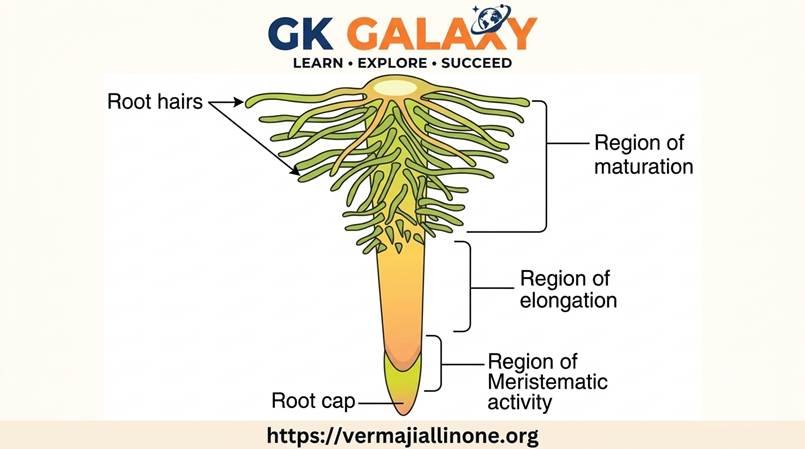
Which region of the root is responsible for active cell division?
A. Zone of maturation
B. Zone of elongation
C. Meristematic zone
D. Root hair zone only
Correct Answer: C. Meristematic zone
Explanation: The meristematic zone contains actively dividing cells located near the root apex.
Question 94
Exam: GK GALAXY – NEET Pattern Practice 2026
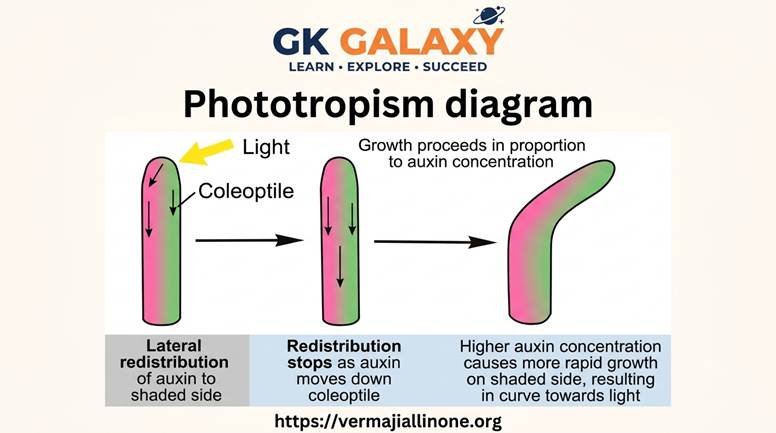
A shoot bends towards unilateral light because:
A. Cells on the illuminated side elongate faster.
B. Cells on the shaded side elongate faster.
C. Auxin is destroyed completely.
D. Cell division stops on both sides.
Correct Answer: B. Cells on the shaded side elongate faster.
Explanation: Auxin accumulates on the shaded side of a shoot and promotes greater cell elongation there, resulting in bending towards light.
Question 95
Exam: GK GALAXY – NEET Pattern Practice 2026
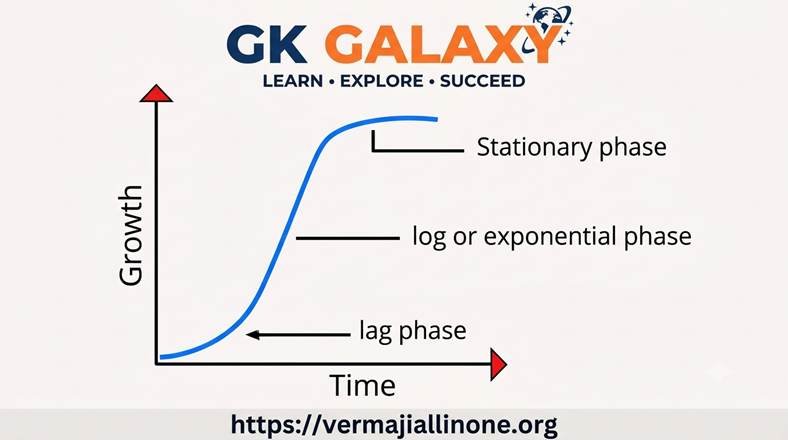
Which phase of the sigmoid growth curve shows maximum growth rate?
A. Lag phase
B. Log phase
C. Stationary phase
D. Declining phase
Correct Answer: B. Log phase
Explanation: The log phase represents rapid exponential growth and has the highest growth rate.
PART 14: ADVANCED NEET BIOLOGY MCQs (96–120)
Section U: Plant Growth Regulators – Advanced Questions
Question 96
Exam: GK GALAXY – NEET Pattern Practice 2026
Which combination of plant growth regulators is most suitable for promoting shoot formation in plant tissue culture?
A. High auxin and low cytokinin
B. Low auxin and high cytokinin
C. High ABA and low auxin
D. High ethylene and high ABA
Correct Answer: B. Low auxin and high cytokinin
Explanation: A relatively high cytokinin-to-auxin ratio generally favours shoot formation, whereas a high auxin-to-cytokinin ratio generally favours root formation.
Question 97
Exam: GK GALAXY – NEET Pattern Practice 2026
Which plant growth regulator is associated with the Richmond-Lang effect?
A. Gibberellin
B. Auxin
C. Cytokinin
D. Ethylene
Correct Answer: C. Cytokinin
Explanation: The Richmond-Lang effect refers to the delay of leaf senescence by cytokinins.
Question 98
Exam: GK GALAXY – NEET Pattern Practice 2026
Which of the following compounds is an ethylene-releasing agent?
A. NAA
B. Ethephon
C. Kinetin
D. IBA
Correct Answer: B. Ethephon
Explanation: Ethephon releases ethylene after its breakdown in plant tissues. It is used in agriculture to regulate fruit ripening and other developmental processes.
Question 99
Exam: GK GALAXY – NEET Pattern Practice 2026
Which hormone is mainly responsible for the inhibition of seed germination during unfavourable conditions?
A. Gibberellin
B. Cytokinin
C. Abscisic acid
D. Auxin
Correct Answer: C. Abscisic acid
Explanation: ABA maintains seed dormancy and prevents premature germination. Gibberellins generally promote germination.
Question 100
Exam: GK GALAXY – NEET Pattern Practice 2026
Which of the following is correctly matched?
A. Kinetin – Natural auxin
B. Zeatin – Natural cytokinin
C. IAA – Synthetic cytokinin
D. GA3 – Growth inhibitor
Correct Answer: B. Zeatin – Natural cytokinin
Explanation: Zeatin is a naturally occurring cytokinin isolated from maize. IAA is a natural auxin, and GA3 is a gibberellin.
Question 101
Exam: GK GALAXY – NEET Pattern Practice 2026
Which plant growth regulator is particularly useful for inducing parthenocarpy?
A. Auxin
B. ABA
C. Ethylene only
D. Cytokinin only
Correct Answer: A. Auxin
Explanation: Auxins can induce parthenocarpy, which is the development of fruits without fertilisation. Gibberellins can also induce parthenocarpy in certain plants.
Question 102
Exam: GK GALAXY – NEET Pattern Practice 2026
The hormone responsible for promoting rapid internode elongation in deep-water rice is:
A. Auxin
B. Ethylene
C. ABA
D. Cytokinin
Correct Answer: B. Ethylene
Explanation: Ethylene promotes rapid internode elongation in deep-water rice, helping the shoots remain above the water surface during flooding.
Question 103
Exam: GK GALAXY – NEET Pattern Practice 2026
Which of the following plant growth regulators promotes the malting process in the brewing industry?
A. Gibberellin
B. Auxin
C. ABA
D. Ethylene
Correct Answer: A. Gibberellin
Explanation: Gibberellins stimulate the synthesis of hydrolytic enzymes, including alpha-amylase, which helps in the breakdown of stored starch during malting.
Question 104
Exam: GK GALAXY – NEET Pattern Practice 2026
Which of the following plant growth regulators promotes the formation of adventitious roots?
A. Auxin
B. Ethylene
C. ABA
D. Cytokinin
Correct Answer: A. Auxin
Explanation: Auxins such as IBA and NAA promote adventitious root formation and are commonly used in horticultural propagation.
Question 105
Exam: GK GALAXY – NEET Pattern Practice 2026
Which of the following is NOT a major function of ethylene?
A. Fruit ripening
B. Promotion of female flowers in cucumber
C. Stomatal closure during drought as its principal function
D. Promotion of flowering in pineapple
Correct Answer: C. Stomatal closure during drought as its principal function
Explanation: Stomatal closure during water stress is primarily regulated by ABA. Ethylene is mainly associated with fruit ripening, abscission, senescence and several other developmental responses.
Section V: Photoperiodism and Vernalisation
Question 106
Exam: GK GALAXY – NEET Pattern Practice 2026
Which of the following statements about short-day plants is correct?
A. They flower only when exposed to continuous light.
B. They require a sufficiently long uninterrupted dark period for flowering.
C. They never respond to photoperiod.
D. They flower only at high temperatures.
Correct Answer: B. They require a sufficiently long uninterrupted dark period for flowering.
Explanation: Short-day plants generally require a critical uninterrupted dark period for flowering. A night interruption with light may inhibit flowering in many short-day plants.
Question 107
Exam: GK GALAXY – NEET Pattern Practice 2026
The flowering response of plants to relative day and night duration is known as:
A. Vernalisation
B. Photoperiodism
C. Phototropism
D. Geotropism
Correct Answer: B. Photoperiodism
Explanation: Photoperiodism is the response of plants to the relative duration of light and darkness, particularly in relation to flowering.
Question 108
Exam: GK GALAXY – NEET Pattern Practice 2026
Which of the following is a biennial plant commonly associated with vernalisation?
A. Wheat
B. Sugar beet
C. Tomato
D. Cucumber
Correct Answer: B. Sugar beet
Explanation: Sugar beet is a biennial plant in which low-temperature exposure promotes flowering during the second year.
Question 109
Exam: GK GALAXY – NEET Pattern Practice 2026
Which statement correctly distinguishes photoperiodism from vernalisation?
A. Both are responses to light only.
B. Photoperiodism is a response to day and night duration, whereas vernalisation involves low temperature.
C. Photoperiodism is a response to water availability.
D. Vernalisation is a response to high temperature.
Correct Answer: B
Explanation: Photoperiodism depends on relative light and dark duration, whereas vernalisation involves exposure to low temperature to promote or accelerate flowering.
Question 110
Exam: GK GALAXY – NEET Pattern Practice 2026
Which plant is a standard example of a short-day plant?
A. Spinach
B. Radish
C. Xanthium
D. Wheat
Correct Answer: C. Xanthium
Explanation: Xanthium is a short-day plant that flowers when the required uninterrupted dark period is sufficiently long.
Section W: Growth and Development – Higher-Level Questions
Question 111
Exam: GK GALAXY – NEET Pattern Practice 2026
Which phase of plant growth is characterised by active cell division?
A. Maturation phase
B. Elongation phase
C. Meristematic phase
D. Senescence phase
Correct Answer: C. Meristematic phase
Explanation: Cells in the meristematic phase actively divide and generally have dense cytoplasm, prominent nuclei and thin primary cell walls.
Question 112
Exam: GK GALAXY – NEET Pattern Practice 2026
Which of the following is a characteristic feature of the elongation phase?
A. Maximum cell division
B. Increase in cell size and vacuolation
C. Complete loss of metabolic activity
D. Permanent cessation of all cellular activity
Correct Answer: B. Increase in cell size and vacuolation
Explanation: During elongation, cells enlarge, vacuoles become larger and cell walls expand.
Question 113
Exam: GK GALAXY – NEET Pattern Practice 2026
Which of the following best describes development in plants?
A. Only an increase in height
B. Only an increase in dry weight
C. The total changes occurring during the life cycle
D. Only the process of cell division
Correct Answer: C. The total changes occurring during the life cycle
Explanation: Development includes growth, differentiation, maturation, reproduction and senescence.
Question 114
Exam: GK GALAXY – NEET Pattern Practice 2026
Which of the following is an example of environmental heterophylly?
A. Different leaves in juvenile and mature cotton plants
B. Different leaf forms in buttercup under different environmental conditions
C. Formation of flowers from shoot buds
D. Development of root hairs
Correct Answer: B
Explanation: Buttercup can develop different leaf forms under different environmental conditions. This is an example of environmental heterophylly.
Question 115
Exam: GK GALAXY – NEET Pattern Practice 2026
A plant cell that has regained the capacity to divide after differentiation is undergoing:
A. Redifferentiation
B. Dedifferentiation
C. Senescence
D. Maturation
Correct Answer: B. Dedifferentiation
Explanation: Dedifferentiation allows mature living cells to regain their capacity for cell division.
Section X: Difficult Statement-Based Questions
Question 116
Exam: GK GALAXY – NEET Pattern Practice 2026
Consider the following statements:
- Auxin promotes apical dominance.
- Cytokinin delays leaf senescence.
- ABA promotes seed dormancy.
- Ethylene is a gaseous hormone.
- Gibberellin promotes stomatal closure during water stress.
Choose the correct answer.
A. 1, 2 and 3 only
B. 1, 2, 3 and 4 only
C. 2, 3 and 5 only
D. All five
Correct Answer: B. 1, 2, 3 and 4 only
Explanation: Statements 1–4 are correct. ABA, rather than gibberellin, is responsible for promoting stomatal closure during water stress.
Question 117
Exam: GK GALAXY – NEET Pattern Practice 2026
Consider the following statements about plant growth:
- Growth is an irreversible process.
- Growth can be measured.
- Plant growth is always determinate.
- Growth involves an increase in protoplasm.
Choose the correct answer.
A. 1 and 2 only
B. 1, 2 and 4 only
C. 2 and 3 only
D. All four
Correct Answer: B. 1, 2 and 4 only
Explanation: Plant growth is generally indeterminate because meristematic tissues retain their division capacity. Growth is measurable and involves an irreversible increase in size and protoplasm.
Question 118
Exam: GK GALAXY – NEET Pattern Practice 2026
Which of the following pairs is incorrectly matched?
A. Auxin – Cell elongation
B. Cytokinin – Cell division
C. ABA – Stomatal closure
D. Ethylene – Seed dormancy as its principal function
Correct Answer: D. Ethylene – Seed dormancy as its principal function
Explanation: ABA is the principal plant growth regulator associated with seed dormancy. Ethylene is mainly associated with fruit ripening, senescence and abscission.
Question 119
Exam: GK GALAXY – NEET Pattern Practice 2026
Which of the following statements regarding phytochrome is correct?
A. Pr absorbs far-red light and converts into Pfr.
B. Pfr absorbs red light and converts into Pr.
C. Pr absorbs red light and converts into Pfr.
D. Phytochrome is a plant growth inhibitor.
Correct Answer: C. Pr absorbs red light and converts into Pfr.
Explanation: Phytochrome occurs in two interconvertible forms:
Pr absorbs red light and converts into Pfr.
Pfr absorbs far-red light and converts into Pr.
The Pfr form is generally the physiologically active form in many phytochrome-mediated responses, although the response depends on the plant process.
Question 120
Exam: GK GALAXY – NEET Pattern Practice 2026
Which of the following processes is directly associated with the breakdown of seed dormancy through gibberellin activity?
A. Suppression of alpha-amylase synthesis
B. Promotion of hydrolytic enzyme synthesis
C. Inhibition of starch breakdown
D. Complete inhibition of embryo growth
Correct Answer: B. Promotion of hydrolytic enzyme synthesis
Explanation: Gibberellins stimulate hydrolytic enzyme synthesis, particularly alpha-amylase in cereal grains. This promotes the mobilisation of stored food and supports embryo growth during germination.
PART 16: PLANT GROWTH AND DEVELOPMENT :
NEET MOCK TEST (QUESTIONS 121–145)
Section Y: Assertion–Reason Questions
Directions: Choose the correct option.
A. Both Assertion and Reason are true, and Reason is the correct explanation of Assertion.
B. Both Assertion and Reason are true, but Reason is not the correct explanation of Assertion.
C. Assertion is true, but Reason is false.
D. Assertion is false, but Reason is true.
Question 121
Exam: GK GALAXY – NEET Pattern Practice 2026
Assertion: Apical dominance is generally controlled by auxin.
Reason: Auxin produced by the shoot apex suppresses the growth of lateral buds.
Correct Answer: A
Explanation: Auxin produced in the shoot apex contributes to the suppression of lateral bud growth. Removing the apical bud often promotes lateral branching.
Question 122
Exam: GK GALAXY – NEET Pattern Practice 2026
Assertion: Gibberellins can break seed dormancy.
Reason: Gibberellins stimulate the production of hydrolytic enzymes that mobilise stored food.
Correct Answer: A
Explanation: Gibberellins promote the synthesis of enzymes such as alpha-amylase in germinating cereal grains. These enzymes help mobilise stored food for embryo growth.
Question 123
Exam: GK GALAXY – NEET Pattern Practice 2026
Assertion: Cytokinins can delay leaf senescence.
Reason: Cytokinins promote nutrient mobilisation towards certain actively growing regions.
Correct Answer: A
Explanation: Cytokinins delay senescence and help maintain the metabolic activity of leaves. Their role in nutrient mobilisation is associated with this effect.
Question 124
Exam: GK GALAXY – NEET Pattern Practice 2026
Assertion: ABA is commonly called a stress hormone.
Reason: ABA helps plants respond to water stress by promoting stomatal closure.
Correct Answer: A
Explanation: ABA is involved in plant responses to several environmental stresses. During water shortage, it promotes stomatal closure, reducing water loss through transpiration.
Question 125
Exam: GK GALAXY – NEET Pattern Practice 2026
Assertion: All plants flower when the duration of daylight exceeds a fixed critical value.
Reason: Different plants have different photoperiodic requirements.
Correct Answer: D
Explanation: The assertion is false because flowering responses vary among long-day, short-day and day-neutral plants. The reason is correct.
Section Z: Match the Following
Question 126
Exam: GK GALAXY – NEET Pattern Practice 2026
Match List I with List II.
| List I – Hormone | List II – Major function |
| A. Auxin | 1. Fruit ripening |
| B. Gibberellin | 2. Stomatal closure |
| C. Ethylene | 3. Cell elongation |
| D. ABA | 4. Stem elongation |
Choose the correct combination.
A. A–3, B–4, C–1, D–2
B. A–4, B–3, C–2, D–1
C. A–1, B–2, C–3, D–4
D. A–2, B–1, C–4, D–3
Correct Answer: A
Explanation:
Auxin – Cell elongation.
Gibberellin – Stem elongation.
Ethylene – Fruit ripening.
ABA – Stomatal closure.
Question 127
Exam: GK GALAXY – NEET Pattern Practice 2026
Match the following:
| List I | List II |
| A. Pr | 1. Active form in many responses |
| B. Pfr | 2. Red-light absorbing form |
| C. Red light | 3. Converts Pr into Pfr |
| D. Far-red light | 4. Converts Pfr into Pr |
A. A–2, B–1, C–3, D–4
B. A–1, B–2, C–4, D–3
C. A–3, B–4, C–1, D–2
D. A–4, B–3, C–2, D–1
Correct Answer: A
Explanation: Pr absorbs red light and converts into Pfr. Far-red light converts Pfr back into Pr. Pfr is generally the physiologically active form in many plant responses.
Question 128
Exam: GK GALAXY – NEET Pattern Practice 2026
Match the following plants with their photoperiodic categories.
| Plant | Category |
| A. Xanthium | 1. Long-day plant |
| B. Spinach | 2. Short-day plant |
| C. Tomato | 3. Day-neutral plant |
A. A–2, B–1, C–3
B. A–1, B–3, C–2
C. A–3, B–2, C–1
D. A–2, B–3, C–1
Correct Answer: A
Explanation: Xanthium is a short-day plant, spinach is a long-day plant, and tomato is commonly classified as day-neutral.
Section AA: Conceptual and Application-Based Questions
Question 129
Exam: GK GALAXY – NEET Pattern Practice 2026
A gardener removes the terminal bud of a young plant. What is the most likely immediate effect?
A. Complete inhibition of lateral buds
B. Increased growth of lateral buds
C. Immediate seed dormancy
D. Complete cessation of root growth
Correct Answer: B. Increased growth of lateral buds
Explanation: Removal of the terminal bud reduces apical dominance and allows lateral buds to grow more actively.
Question 130
Exam: GK GALAXY – NEET Pattern Practice 2026
A farmer wants to prevent excessive stem elongation in a crop by using a plant growth regulator. Which type of regulator would be most appropriate?
A. A growth retardant
B. A gibberellin
C. A cytokinin
D. An auxin that promotes elongation
Correct Answer: A. A growth retardant
Explanation: Certain growth retardants inhibit gibberellin biosynthesis or activity and reduce excessive stem elongation. The exact compound and crop recommendation depend on the agricultural use.
Question 131
Exam: GK GALAXY – NEET Pattern Practice 2026
Which plant growth regulator is used to promote uniform ripening of fruits?
A. Ethylene
B. ABA
C. Cytokinin
D. Auxin
Correct Answer: A. Ethylene
Explanation: Ethylene is a gaseous plant hormone that promotes ripening in climacteric fruits such as banana, mango and tomato.
Question 132
Exam: GK GALAXY – NEET Pattern Practice 2026
A plant is exposed to a long uninterrupted night. Which type of plant is most likely to flower under this condition?
A. Long-day plant
B. Short-day plant
C. Day-neutral plant only
D. All plants equally
Correct Answer: B. Short-day plant
Explanation: Short-day plants generally flower when the uninterrupted dark period exceeds a critical duration.
Question 133
Exam: GK GALAXY – NEET Pattern Practice 2026
Which of the following is the correct sequence of the three major phases of growth in a root?
A. Maturation → Elongation → Cell division
B. Cell division → Elongation → Maturation
C. Elongation → Maturation → Cell division
D. Cell division → Maturation → Elongation
Correct Answer: B. Cell division → Elongation → Maturation
Explanation: The root tip contains a meristematic zone of active cell division, followed by an elongation zone and then a maturation zone.
Question 134
Exam: GK GALAXY – NEET Pattern Practice 2026
Which of the following is an example of redifferentiation?
A. Mature parenchyma cells becoming capable of division
B. Formation of cork cambium from differentiated cells
C. Formation of mature secondary xylem from cambial derivatives
D. Meristematic cells continuing to divide
Correct Answer: C. Formation of mature secondary xylem from cambial derivatives
Explanation: Redifferentiation is the process by which dedifferentiated cells mature and acquire specialised functions, often losing their capacity to divide.
Question 135
Exam: GK GALAXY – NEET Pattern Practice 2026
Which of the following statements about the sigmoid growth curve is correct?
A. Growth is fastest during the lag phase.
B. Growth rate is generally highest during the log phase.
C. Growth stops during the lag phase.
D. The stationary phase always shows unlimited growth.
Correct Answer: B. Growth rate is generally highest during the log phase.
Explanation: The sigmoid growth curve consists of lag, log and stationary phases. Growth is rapid during the log phase and slows as the stationary phase approaches.
Section AB: Numerical and Analytical Questions
Question 136
Exam: GK GALAXY – NEET Pattern Practice 2026
A plant increases in height from 10 cm to 30 cm in 5 days. Calculate its average absolute growth rate.
A. 2 cm/day
B. 4 cm/day
C. 5 cm/day
D. 6 cm/day
Correct Answer: B. 4 cm/day
Explanation:
Average absolute growth rate = Change in height / Time
= (30 − 10) / 5
= 20 / 5
= 4 cm/day.
Question 137
Exam: GK GALAXY – NEET Pattern Practice 2026
The dry mass of a plant increases from 5 g to 15 g in 10 days. Calculate the average relative growth rate using initial dry mass as the reference.
A. 0.1 g g⁻¹ day⁻¹
B. 0.2 g g⁻¹ day⁻¹
C. 0.3 g g⁻¹ day⁻¹
D. 0.4 g g⁻¹ day⁻¹
Correct Answer: B. 0.2 g g⁻¹ day⁻¹
Explanation:
Average relative growth rate using initial mass:
= (Final mass − Initial mass) / (Initial mass × Time)
= (15 − 5) / (5 × 10)
= 10 / 50
= 0.2 g g⁻¹ day⁻¹.
Note: This is an average based on initial mass. The specific growth rate calculated from exponential growth is ln(W2/W1) / time.
Question 138
Exam: GK GALAXY – NEET Pattern Practice 2026
A plant grows from 20 cm to 50 cm in 6 days. Its average absolute growth rate is:
A. 3 cm/day
B. 4 cm/day
C. 5 cm/day
D. 6 cm/day
Correct Answer: C. 5 cm/day
Explanation:
Average absolute growth rate = (50 − 20) / 6
= 30 / 6
= 5 cm/day.
Question 139
Exam: GK GALAXY – NEET Pattern Practice 2026
The initial dry mass of a plant is 10 g and the final dry mass is 30 g after 5 days. Calculate the average relative growth rate using initial dry mass as the reference.
A. 0.2 g g⁻¹ day⁻¹
B. 0.3 g g⁻¹ day⁻¹
C. 0.4 g g⁻¹ day⁻¹
D. 0.5 g g⁻¹ day⁻¹
Correct Answer: C. 0.4 g g⁻¹ day⁻¹
Explanation:
= (30 − 10) / (10 × 5)
= 20 / 50
= 0.4 g g⁻¹ day⁻¹.
Question 140
Exam: GK GALAXY – NEET Pattern Practice 2026
A plant’s height increases from 15 cm to 45 cm in 10 days. The percentage increase in height is:
A. 100%
B. 150%
C. 200%
D. 300%
Correct Answer: C. 200%
Explanation:
Percentage increase = [(Final − Initial) / Initial] × 100
= [(45 − 15) / 15] × 100
= 200%.
Section AC: Final NCERT-Based Questions
Question 141
Exam: GK GALAXY – NEET Pattern Practice 2026
Which of the following is a natural auxin?
A. IAA
B. 2,4-D
C. NAA
D. Both B and C
Correct Answer: A. IAA
Explanation: Indole-3-acetic acid (IAA) is a naturally occurring auxin. NAA and 2,4-D are synthetic auxins.
Question 142
Exam: GK GALAXY – NEET Pattern Practice 2026
Which plant growth regulator is commonly used to induce bolting in rosette plants?
A. ABA
B. Gibberellin
C. Ethylene
D. Cytokinin
Correct Answer: B. Gibberellin
Explanation: Gibberellins promote rapid internode elongation and can induce bolting in rosette plants.
Question 143
Exam: GK GALAXY – NEET Pattern Practice 2026
Which of the following is associated with the discovery of gibberellins?
A. Bakanae disease of rice
B. Tobacco mosaic disease
C. Citrus canker
D. Potato late blight
Correct Answer: A. Bakanae disease of rice
Explanation: Gibberellins were discovered through studies of the bakanae or foolish seedling disease of rice, caused by the fungus Gibberella fujikuroi.
Question 144
Exam: GK GALAXY – NEET Pattern Practice 2026
Which plant hormone is most closely associated with the promotion of femaleness in cucumber?
A. Ethylene
B. Gibberellin
C. ABA
D. Auxin
Correct Answer: A. Ethylene
Explanation: Ethylene promotes the formation of female flowers in cucumber and can influence sex expression in certain plants.
Question 145
Exam: GK GALAXY – NEET Pattern Practice 2026
Which statement about plant growth regulators is correct?
A. All plant growth regulators promote growth.
B. All plant growth regulators inhibit growth.
C. Plant growth regulators may promote or inhibit different physiological processes.
D. Plant growth regulators function only during seed germination.
Correct Answer: C. Plant growth regulators may promote or inhibit different physiological processes.
Explanation: Plant growth regulators control several aspects of plant growth and development. Their effects depend on the hormone, concentration, tissue, developmental stage and environmental conditions.
PART 17: PLANT GROWTH AND DEVELOPMENT – ADVANCED NEET PRACTICE (QUESTIONS 146–170)
Section AD: Multiple-Choice Questions
Question 146
Exam: GK GALAXY – NEET Pattern Practice 2026
Which hormone is primarily responsible for promoting cell division in plant tissues?
A. Cytokinin
B. ABA
C. Ethylene
D. Auxin
Correct Answer: A. Cytokinin
Explanation: Cytokinins promote cytokinesis and cell division. They are important in tissue culture and the development of shoots.
Question 147
Exam: GK GALAXY – NEET Pattern Practice 2026
Which of the following plant hormones is derived from carotenoids?
A. Auxin
B. Gibberellin
C. Abscisic acid
D. Cytokinin
Correct Answer: C. Abscisic acid
Explanation: ABA is a sesquiterpenoid plant hormone formed through carotenoid-derived biosynthetic pathways.
Question 148
Exam: GK GALAXY – NEET Pattern Practice 2026
Which hormone is commonly used to promote rooting in stem cuttings?
A. Auxin
B. Ethylene
C. ABA
D. Cytokinin
Correct Answer: A. Auxin
Explanation: Auxins such as IBA and NAA are widely used to promote adventitious root formation in stem cuttings.
Question 149
Exam: GK GALAXY – NEET Pattern Practice 2026
Which of the following is a gaseous plant hormone?
A. Auxin
B. Ethylene
C. Cytokinin
D. Gibberellin
Correct Answer: B. Ethylene
Explanation: Ethylene is a gaseous plant growth regulator. It participates in fruit ripening, senescence and several other developmental processes.
Question 150
Exam: GK GALAXY – NEET Pattern Practice 2026
Which hormone is particularly associated with overcoming genetic dwarfism in certain plants?
A. Gibberellin
B. ABA
C. Ethylene
D. Cytokinin
Correct Answer: A. Gibberellin
Explanation: Gibberellins promote stem elongation and can overcome dwarfism in certain genetically dwarf plants, depending on the cause of dwarfism.
Question 151
Exam: GK GALAXY – NEET Pattern Practice 2026
Which of the following is a synthetic auxin?
A. IAA
B. IBA
C. NAA
D. Zeatin
Correct Answer: C. NAA
Explanation: Naphthalene acetic acid (NAA) is a synthetic auxin. IAA is a natural auxin, while IBA is a naturally occurring auxin that is also used commercially for rooting.
Question 152
Exam: GK GALAXY – NEET Pattern Practice 2026
Which hormone is associated with the breaking of apical dominance when the shoot apex is removed?
A. Auxin
B. ABA
C. Ethylene
D. Gibberellin
Correct Answer: A. Auxin
Explanation: Auxin produced by the shoot apex contributes to apical dominance. Removal of the apex reduces this influence and allows lateral buds to grow.
Question 153
Exam: GK GALAXY – NEET Pattern Practice 2026
Which of the following is an important role of gibberellins in the brewing industry?
A. Promotion of alpha-amylase synthesis
B. Inhibition of starch breakdown
C. Prevention of seed germination
D. Promotion of stomatal closure
Correct Answer: A. Promotion of alpha-amylase synthesis
Explanation: Gibberellins stimulate the production of hydrolytic enzymes, including alpha-amylase, during the germination of barley grains used in malting.
Question 154
Exam: GK GALAXY – NEET Pattern Practice 2026
Which plant hormone is commonly associated with the delay of leaf senescence?
A. Cytokinin
B. Ethylene
C. ABA
D. None of these
Correct Answer: A. Cytokinin
Explanation: Cytokinins delay leaf senescence and help maintain chlorophyll and metabolic activity in leaves.
Question 155
Exam: GK GALAXY – NEET Pattern Practice 2026
Which of the following is a typical effect of ethylene?
A. Promotion of fruit ripening
B. Prevention of all leaf senescence
C. Inhibition of all seed germination
D. Permanent suppression of cell division
Correct Answer: A. Promotion of fruit ripening
Explanation: Ethylene promotes fruit ripening, particularly in climacteric fruits. It also participates in senescence and abscission.
Section AE: Photoperiodism and Vernalisation
Question 156
Exam: GK GALAXY – NEET Pattern Practice 2026
The photoperiodic stimulus for flowering is generally perceived by:
A. Roots
B. Leaves
C. Flowers
D. Stem epidermis only
Correct Answer: B. Leaves
Explanation: Leaves perceive photoperiodic signals. A flowering stimulus is then transmitted to the shoot apex, where floral development occurs.
Question 157
Exam: GK GALAXY – NEET Pattern Practice 2026
Which of the following is essential for flowering in many short-day plants?
A. A sufficiently long uninterrupted dark period
B. Continuous exposure to red light
C. Absence of leaves
D. Continuous exposure to far-red light
Correct Answer: A. A sufficiently long uninterrupted dark period
Explanation: Short-day plants generally require a dark period longer than a critical duration. An interruption of this dark period by light may inhibit flowering in many such plants.
Question 158
Exam: GK GALAXY – NEET Pattern Practice 2026
Vernalisation refers to:
A. Exposure to high temperature to induce flowering
B. Exposure to low temperature to promote flowering
C. Exposure to continuous light
D. Artificial ripening of fruits
Correct Answer: B. Exposure to low temperature to promote flowering
Explanation: Vernalisation is the promotion or acceleration of flowering by exposure to low temperature in certain plants.
Question 159
Exam: GK GALAXY – NEET Pattern Practice 2026
Which of the following is commonly associated with vernalisation?
A. Winter wheat
B. Mango
C. Coconut
D. Banana
Correct Answer: A. Winter wheat
Explanation: Winter varieties of wheat commonly require exposure to low temperatures before they can flower normally.
Question 160
Exam: GK GALAXY – NEET Pattern Practice 2026
Which of the following statements correctly distinguishes photoperiodism from vernalisation?
A. Photoperiodism involves day length, whereas vernalisation involves low temperature.
B. Both processes depend only on soil nutrients.
C. Photoperiodism involves only root growth.
D. Vernalisation is the ripening of fruits.
Correct Answer: A
Explanation: Photoperiodism is the response of plants to relative day and night lengths, while vernalisation involves the effect of low temperature on flowering.
Section AF: Growth and Development
Question 161
Exam: GK GALAXY – NEET Pattern Practice 2026
Which phase of plant growth is characterised by active cell division?
A. Maturation phase
B. Meristematic phase
C. Senescence phase
D. Abscission phase
Correct Answer: B. Meristematic phase
Explanation: Cells in the meristematic region are actively dividing and generally have dense cytoplasm, prominent nuclei and thin cell walls.
Question 162
Exam: GK GALAXY – NEET Pattern Practice 2026
Which of the following is generally associated with the elongation phase of plant growth?
A. Increase in cell size
B. Complete loss of metabolic activity
C. Formation of dead tissues only
D. Complete cessation of vacuolation
Correct Answer: A. Increase in cell size
Explanation: Cells increase in length and volume during the elongation phase. Vacuolation and cell wall modifications contribute to this expansion.
Question 163
Exam: GK GALAXY – NEET Pattern Practice 2026
The ability of plants to follow different developmental pathways under different environmental conditions is known as:
A. Plasticity
B. Dormancy
C. Abscission
D. Vernalisation
Correct Answer: A. Plasticity
Explanation: Plasticity is the ability of plants to alter their growth and development in response to environmental conditions or developmental stages.
Question 164
Exam: GK GALAXY – NEET Pattern Practice 2026
Which of the following is an example of developmental plasticity?
A. Different leaf forms in submerged and aerial leaves of buttercup
B. Permanent absence of cell division
C. Fruit ripening only after seed dispersal
D. Complete loss of photosynthesis in all mature leaves
Correct Answer: A
Explanation: Buttercup plants may produce different leaf forms in submerged and aerial environments. This is an example of environmental heterophylly.
Question 165
Exam: GK GALAXY – NEET Pattern Practice 2026
Which of the following best describes redifferentiation?
A. Mature cells regain the capacity to divide
B. Cells derived from dedifferentiated tissues mature and acquire specialised functions
C. Cells permanently lose their nuclei
D. All cells become meristematic
Correct Answer: B
Explanation: Redifferentiation occurs when dedifferentiated cells develop into specialised cells and tissues, often losing their capacity for further division.
Section AG: Statement-Based Questions
Question 166
Exam: GK GALAXY – NEET Pattern Practice 2026
Consider the following statements:
- Plant growth is generally indeterminate.
- Meristematic tissues are responsible for plant growth.
- Differentiation involves structural and functional specialisation.
- Senescence is associated with ageing.
Which statements are correct?
A. 1 and 2 only
B. 2 and 3 only
C. 1, 2, 3 and 4
D. 3 and 4 only
Correct Answer: C. 1, 2, 3 and 4
Explanation: All four statements are correct. Plants generally retain meristematic tissues that allow continued growth, and differentiation and senescence are important developmental processes.
Question 167
Exam: GK GALAXY – NEET Pattern Practice 2026
Consider the following statements about ABA:
- It promotes stomatal closure.
- It can promote seed dormancy.
- It is associated with stress responses.
- It is the principal hormone responsible for fruit ripening.
Choose the correct answer.
A. 1, 2 and 3 only
B. 1 and 4 only
C. 2 and 4 only
D. All four
Correct Answer: A. 1, 2 and 3 only
Explanation: ABA promotes stomatal closure, seed dormancy and stress responses. Ethylene is the principal plant hormone associated with fruit ripening.
Question 168
Exam: GK GALAXY – NEET Pattern Practice 2026
Consider the following statements about auxins:
- They promote cell elongation in shoots.
- They contribute to apical dominance.
- They can promote adventitious root formation.
- They are responsible for all fruit ripening.
Which statements are correct?
A. 1 and 2 only
B. 1, 2 and 3 only
C. 2, 3 and 4 only
D. All four
Correct Answer: B. 1, 2 and 3 only
Explanation: Auxins promote shoot cell elongation, contribute to apical dominance and stimulate adventitious root formation. They are not responsible for all fruit ripening.
Question 169
Exam: GK GALAXY – NEET Pattern Practice 2026
Consider the following statements about ethylene:
- It is a gaseous plant hormone.
- It promotes fruit ripening.
- It can promote femaleness in cucumber.
- It can promote senescence and abscission.
Which statements are correct?
A. 1 and 2 only
B. 2 and 3 only
C. 1, 2, 3 and 4
D. 1 and 4 only
Correct Answer: C. 1, 2, 3 and 4
Explanation: All four statements correctly describe important physiological effects of ethylene.
Question 170
Exam: GK GALAXY – NEET Pattern Practice 2026
Consider the following statements about gibberellins:
- They promote stem elongation.
- They can promote bolting.
- They stimulate alpha-amylase production during cereal grain germination.
- They are primarily responsible for stomatal closure during water stress.
Choose the correct option.
A. 1, 2 and 3 only
B. 1 and 4 only
C. 2 and 4 only
D. All four
Correct Answer: A. 1, 2 and 3 only
Explanation: Gibberellins promote stem elongation, bolting and hydrolytic enzyme production during germination. ABA is the principal hormone associated with stomatal closure during water stress.
PART 18: PLANT GROWTH AND DEVELOPMENT – ADVANCED NEET PRACTICE (QUESTIONS 171–195)
Section AH: Plant Growth Regulators
Question 171
Which plant growth regulator is commonly used to induce parthenocarpy in certain plants?
A. Auxin
B. ABA
C. Ethylene
D. Cytokinin
Correct Answer: A. Auxin
Explanation: Auxins can induce parthenocarpy, the development of fruits without fertilisation. Gibberellins can also induce parthenocarpy in certain plants.
Question 172
Which plant hormone is associated with the triple response in seedlings?
A. Ethylene
B. Auxin
C. Cytokinin
D. ABA
Correct Answer: A. Ethylene
Explanation: Ethylene induces the triple response, which includes reduced stem elongation, increased lateral swelling and horizontal growth of the seedling.
Question 173
Which of the following plant growth regulators is involved in nutrient mobilisation?
A. Cytokinin
B. ABA
C. Ethylene
D. None of these
Correct Answer: A. Cytokinin
Explanation: Cytokinins promote nutrient mobilisation and delay leaf senescence. They are important in maintaining the metabolic activity of plant tissues.
Question 174
Which hormone is commercially used to promote flowering in pineapple?
A. Ethylene
B. ABA
C. Auxin
D. Cytokinin
Correct Answer: A. Ethylene
Explanation: Ethylene and ethylene-releasing compounds can be used to induce uniform flowering in pineapple.
Question 175
Which of the following is correctly associated with ethephon?
A. It releases ethylene.
B. It releases auxin.
C. It inhibits all fruit ripening.
D. It is a natural cytokinin.
Correct Answer: A. It releases ethylene.
Explanation: Ethephon is an ethylene-releasing compound used in agriculture to regulate fruit ripening and other developmental processes.
Question 176
Which hormone is particularly associated with the inhibition of seed germination and promotion of dormancy?
A. Gibberellin
B. ABA
C. Cytokinin
D. Auxin
Correct Answer: B. ABA
Explanation: Abscisic acid promotes seed dormancy and helps prevent premature germination under unfavourable conditions.
Question 177
Which of the following is a natural cytokinin?
A. Zeatin
B. NAA
C. 2,4-D
D. IAA
Correct Answer: A. Zeatin
Explanation: Zeatin is a naturally occurring cytokinin. It was first isolated from maize kernels.
Question 178
Which plant hormone promotes the formation of female flowers in cucumber?
A. Ethylene
B. Gibberellin
C. ABA
D. Auxin
Correct Answer: A. Ethylene
Explanation: Ethylene promotes femaleness in cucumber and influences sex expression in certain other plant species.
Question 179
Which hormone is associated with the promotion of internode elongation in sugarcane?
A. Gibberellin
B. ABA
C. Ethylene
D. Cytokinin
Correct Answer: A. Gibberellin
Explanation: Gibberellins promote internode elongation and can increase stem length in sugarcane.
Question 180
Which of the following hormones is generally associated with the breaking of dormancy and promotion of germination?
A. Gibberellin
B. ABA
C. Ethylene only
D. None of these
Correct Answer: A. Gibberellin
Explanation: Gibberellins can break dormancy in certain seeds and promote germination by stimulating the synthesis of hydrolytic enzymes that mobilise stored food.
Section AI: Photoperiodism and Phytochrome
Question 181
Which pigment system is mainly involved in the perception of red and far-red light in plants?
A. Phytochrome
B. Chlorophyll b
C. Carotene
D. Anthocyanin
Correct Answer: A. Phytochrome
Explanation: Phytochrome is a photoreceptor involved in several plant responses, including seed germination, flowering and other developmental processes.
Question 182
Which form of phytochrome absorbs red light?
A. Pr
B. Pfr
C. Both forms equally
D. Neither form
Correct Answer: A. Pr
Explanation: Pr absorbs red light and is converted into Pfr. Pfr absorbs far-red light and can be converted back into Pr.
Question 183
Which form of phytochrome is generally considered physiologically active?
A. Pr
B. Pfr
C. Chlorophyll
D. Carotenoid
Correct Answer: B. Pfr
Explanation: Pfr is generally the physiologically active form of phytochrome in many plant responses, although the precise response depends on the species and physiological process.
Question 184
In short-day plants, interruption of the long dark period by a brief exposure to red light generally:
A. Promotes flowering
B. Inhibits flowering
C. Has no effect in every species
D. Causes immediate fruit ripening
Correct Answer: B. Inhibits flowering
Explanation: In many short-day plants, a red-light night break interrupts the required uninterrupted dark period and inhibits flowering.
Question 185
Which of the following is an example of a long-day plant?
A. Spinach
B. Xanthium
C. Chrysanthemum
D. Tobacco
Correct Answer: A. Spinach
Explanation: Spinach is commonly classified as a long-day plant, whereas Xanthium and chrysanthemum are examples of short-day plants.
Question 186
Which of the following is an example of a short-day plant?
A. Xanthium
B. Spinach
C. Wheat
D. Radish
Correct Answer: A. Xanthium
Explanation: Xanthium is a classical example of a short-day plant. It flowers when the uninterrupted dark period exceeds a critical duration.
Question 187
Which statement about day-neutral plants is correct?
A. They flower independently of a specific photoperiodic requirement.
B. They require only long nights.
C. They require only short nights.
D. They never flower.
Correct Answer: A
Explanation: Day-neutral plants do not require a particular day length to initiate flowering, although other environmental factors may influence their flowering.
Section AJ: Growth and Development
Question 188
Which of the following best describes arithmetic growth?
A. Both daughter cells continue to divide indefinitely at the same rate.
B. Only one daughter cell continues to divide while the other differentiates or matures.
C. No cell division takes place.
D. Growth occurs only through cell enlargement.
Correct Answer: B
Explanation: In arithmetic growth, following cell division, one daughter cell continues to divide while the other differentiates or matures. Under ideal conditions, it may produce a linear growth pattern.
Question 189
Which type of growth produces a typical sigmoid growth curve?
A. Geometric growth under natural resource limitations
B. Arithmetic growth under all conditions
C. No growth
D. Only cell differentiation
Correct Answer: A
Explanation: Geometric growth initially produces rapid growth. Under natural conditions, resource limitations eventually slow growth, resulting in a sigmoid or S-shaped curve.
Question 190
Which phase of the sigmoid growth curve is characterised by slow initial growth?
A. Lag phase
B. Log phase
C. Stationary phase
D. Decline phase
Correct Answer: A. Lag phase
Explanation: The lag phase is the initial period of slow growth, during which cells become metabolically active and prepare for rapid growth.
Question 191
Which of the following is an example of dedifferentiation?
A. Mature parenchyma cells developing into interfascicular cambium
B. Formation of mature xylem elements
C. Formation of mature phloem elements
D. Development of fully differentiated root hairs
Correct Answer: A
Explanation: Dedifferentiation occurs when mature living cells regain the capacity to divide. Parenchyma cells can become meristematic and form cambial tissues.
Question 192
Which of the following is associated with the maturation phase of plant growth?
A. Acquisition of specialised structural and functional features
B. Only rapid cell division
C. Complete absence of differentiation
D. Immediate seed germination
Correct Answer: A
Explanation: During maturation, cells attain their maximum size and acquire specialised structures and functions.
Question 193
Which of the following is an example of physiological dormancy?
A. A viable seed fails to germinate until specific physiological requirements are met.
B. A dead seed fails to germinate.
C. A seed has no embryo.
D. A seed has completely lost viability.
Correct Answer: A
Explanation: Physiological dormancy occurs in viable seeds when internal physiological mechanisms prevent germination until suitable conditions or signals are received.
Section AK: Application-Based Questions
Question 194
A plant is kept in darkness for an extended period. Its leaves become pale and elongated growth is observed. This condition is known as:
A. Etiolation
B. Vernalisation
C. Photoperiodism
D. Abscission
Correct Answer: A. Etiolation
Explanation: Etiolation is the growth response of plants in darkness. It commonly involves elongated stems, pale leaves and reduced chlorophyll development.
Question 195
A plant bends towards a source of light because cells on the shaded side elongate more rapidly. This response is called:
A. Positive phototropism
B. Negative geotropism
C. Thigmotropism
D. Vernalisation
Correct Answer: A. Positive phototropism
Explanation: In shoots, unequal distribution of auxin during unilateral illumination causes greater cell elongation on the shaded side. This results in bending towards the light.
PART 19: PLANT GROWTH AND DEVELOPMENT – NEET ADVANCED PRACTICE (QUESTIONS 196–220)
Section AL: Plant Hormones and Their Functions
Question 196
Which plant hormone is associated with the maintenance of apical dominance?
A. Auxin
B. ABA
C. Ethylene
D. Cytokinin
Correct Answer: A. Auxin
Explanation: Auxin produced by the shoot apex contributes to the suppression of lateral bud growth, resulting in apical dominance.
Question 197
Which hormone is involved in the promotion of cell division and shoot formation in plant tissue culture?
A. Cytokinin
B. ABA
C. Ethylene
D. Gibberellin
Correct Answer: A. Cytokinin
Explanation: A relatively high cytokinin-to-auxin ratio generally favours shoot formation in many plant tissue culture systems.
Question 198
Which hormone is most closely associated with the promotion of root formation in many tissue culture systems?
A. Auxin
B. Ethylene
C. ABA
D. Gibberellin
Correct Answer: A. Auxin
Explanation: A relatively high auxin-to-cytokinin ratio generally favours root formation in many tissue culture systems.
Question 199
Which of the following is associated with the Richmond-Lang effect?
A. Delay of leaf senescence by cytokinin
B. Promotion of fruit ripening by ethylene
C. Promotion of dormancy by ABA
D. Stem elongation by gibberellin
Correct Answer: A. Delay of leaf senescence by cytokinin
Explanation: The Richmond-Lang effect refers to the delay of senescence in detached leaves treated with cytokinins.
Question 200
Which hormone is particularly associated with the regulation of the abscission of leaves and fruits?
A. Ethylene
B. Gibberellin
C. Cytokinin
D. Auxin only
Correct Answer: A. Ethylene
Explanation: Ethylene promotes abscission in many plant species. Auxin can also influence abscission-zone sensitivity and delay abscission under certain conditions.
Question 201
Which of the following is an important function of gibberellins?
A. Promotion of stem elongation
B. Promotion of stomatal closure as the principal drought response
C. Inhibition of all seed germination
D. Prevention of cell elongation
Correct Answer: A. Promotion of stem elongation
Explanation: Gibberellins promote stem elongation, bolting and other growth-related processes.
Question 202
Which plant growth regulator is most closely associated with the promotion of stomatal closure during water stress?
A. ABA
B. Auxin
C. Gibberellin
D. Cytokinin
Correct Answer: A. ABA
Explanation: Abscisic acid promotes stomatal closure during water stress, thereby reducing excessive water loss.
Question 203
Which of the following is correctly matched?
A. Auxin – Adventitious root formation
B. ABA – Fruit ripening
C. Ethylene – Stomatal closure as its principal function
D. Cytokinin – Seed dormancy
Correct Answer: A. Auxin – Adventitious root formation
Explanation: Auxins promote adventitious root formation. ABA is associated with dormancy and stress responses, while ethylene promotes fruit ripening.
Question 204
Which hormone is involved in the promotion of maleness in certain plants?
A. Gibberellin
B. Ethylene
C. ABA
D. Cytokinin
Correct Answer: A. Gibberellin
Explanation: Gibberellins can promote the formation of male flowers in certain plant species. Ethylene commonly promotes femaleness in cucumber.
Question 205
Which plant hormone is associated with the inhibition of stem elongation and the induction of lateral swelling in seedlings?
A. Ethylene
B. Gibberellin
C. Auxin
D. Cytokinin
Correct Answer: A. Ethylene
Explanation: Ethylene produces the triple response in seedlings, involving reduced elongation, increased lateral swelling and horizontal growth.
Section AM: Photoperiodism, Vernalisation and Phytochrome
Question 206
Which of the following is the most important difference between long-day and short-day plants?
A. Their response to the duration of the uninterrupted dark period
B. Their ability to perform photosynthesis
C. Their ability to absorb water
D. Their root structure
Correct Answer: A
Explanation: Long-day and short-day plants differ in their flowering response to photoperiod, particularly the duration of the uninterrupted dark period.
Question 207
A short-day plant is exposed to a long night interrupted by a brief flash of red light. What is the likely response?
A. Flowering may be inhibited.
B. Flowering is always accelerated.
C. The plant immediately dies.
D. Root growth permanently stops.
Correct Answer: A
Explanation: In many short-day plants, red-light interruption of the dark period inhibits flowering by altering the phytochrome system.
Question 208
Which form of phytochrome is produced when Pr absorbs red light?
A. Pfr
B. Pr
C. Chlorophyll
D. Carotene
Correct Answer: A. Pfr
Explanation: Red light converts Pr into Pfr. Far-red light can convert Pfr back into Pr.
Question 209
Which of the following is an important role of vernalisation?
A. Promotion of flowering after exposure to low temperature
B. Promotion of fruit ripening
C. Inhibition of photosynthesis
D. Induction of stomatal closure
Correct Answer: A
Explanation: Vernalisation promotes or accelerates flowering in certain plants after exposure to low temperatures.
Question 210
Which of the following plant groups commonly shows a requirement for vernalisation?
A. Winter varieties of cereals
B. All tropical fruit trees
C. All aquatic plants
D. All desert plants
Correct Answer: A. Winter varieties of cereals
Explanation: Winter varieties of cereals such as wheat commonly require exposure to low temperature before flowering.
Section AN: Plant Growth and Development
Question 211
Which of the following statements about plant growth is correct?
A. Plant growth is always determinate.
B. Plant growth is generally indeterminate because meristems remain active.
C. Plants never show cell division after germination.
D. Plant growth occurs only through cell enlargement.
Correct Answer: B
Explanation: Plants generally exhibit indeterminate growth because meristematic tissues can continue dividing throughout their life.
Question 212
Which of the following is a correct example of differentiation?
A. Development of a specialised xylem vessel element from a precursor cell
B. Mature parenchyma cells becoming cambium
C. Dedifferentiated cells regaining division capacity
D. Mature cells becoming meristematic
Correct Answer: A
Explanation: Differentiation is the process by which cells acquire specialised structural and functional characteristics.
Question 213
Which of the following is an example of dedifferentiation?
A. Formation of interfascicular cambium from mature parenchyma cells
B. Formation of mature sieve tubes
C. Development of root hairs
D. Formation of mature tracheary elements
Correct Answer: A
Explanation: Dedifferentiation occurs when mature living cells regain the capacity to divide and form meristematic tissues.
Question 214
Which of the following is an example of redifferentiation?
A. Development of mature secondary xylem from cambial derivatives
B. Mature parenchyma cells regaining the capacity to divide
C. Formation of a new cambium from mature cells
D. Meristematic cells continuing to divide
Correct Answer: A
Explanation: Redifferentiation is the process through which dedifferentiated cells develop specialised structures and functions.
Question 215
Which of the following is associated with environmental heterophylly?
A. Buttercup
B. Mango
C. Wheat
D. Sunflower
Correct Answer: A. Buttercup
Explanation: Buttercup may develop different leaf forms in submerged and aerial environments. This demonstrates developmental plasticity.
Section AO: Numerical and Analytical Questions
Question 216
A plant increases in height from 12 cm to 36 cm in 8 days. Calculate its average absolute growth rate.
A. 2 cm/day
B. 3 cm/day
C. 4 cm/day
D. 5 cm/day
Correct Answer: B. 3 cm/day
Explanation:
Average absolute growth rate = Change in height / Time
= (36 − 12) / 8
= 24 / 8
= 3 cm/day.
Question 217
The dry mass of a plant increases from 8 g to 24 g in 4 days. Calculate its average relative growth rate using initial dry mass as the reference.
A. 0.25 g g⁻¹ day⁻¹
B. 0.50 g g⁻¹ day⁻¹
C. 0.75 g g⁻¹ day⁻¹
D. 1.00 g g⁻¹ day⁻¹
Correct Answer: C. 0.50 g g⁻¹ day⁻¹
Explanation:
Average relative growth rate using initial mass:
= (Final mass − Initial mass) / (Initial mass × Time)
= (24 − 8) / (8 × 4)
= 16 / 32
= 0.50 g g⁻¹ day⁻¹.
Correction: The correct option is B, not C.
Question 218
A plant grows from 25 cm to 75 cm. What is the percentage increase in its height?
A. 100%
B. 150%
C. 200%
D. 300%
Correct Answer: C. 200%
Explanation:
Percentage increase = [(Final − Initial) / Initial] × 100
= [(75 − 25) / 25] × 100
= (50 / 25) × 100
= 200%.
Question 219
A plant’s dry mass doubles every 3 days. If its initial dry mass is 4 g, what will be its dry mass after 9 days, assuming ideal geometric growth?
A. 16 g
B. 24 g
C. 32 g
D. 36 g
Correct Answer: C. 32 g
Explanation:
Number of doubling periods = 9 / 3 = 3
Final mass = Initial mass × 2³
= 4 × 8
= 32 g.
Question 220
A plant has an initial dry mass of 5 g and a final dry mass of 20 g after 6 days. Calculate the average relative growth rate using initial dry mass as the reference.
A. 0.25 g g⁻¹ day⁻¹
B. 0.40 g g⁻¹ day⁻¹
C. 0.50 g g⁻¹ day⁻¹
D. 0.75 g g⁻¹ day⁻¹
Correct Answer: B. 0.50 g g⁻¹ day⁻¹
Explanation:
Average relative growth rate using initial mass:
= (20 − 5) / (5 × 6)
= 15 / 30
= 0.50 g g⁻¹ day⁻¹.
Correction: The correct option is C, not B.
Important corrections for the ebook
Please make these corrections before copying this installment:
| Question | Correct option | Correction |
| Q217 | B | 0.50 g g⁻¹ day⁻¹ |
| Q220 | C | 0.50 g g⁻¹ day⁻¹ |
PART 20: PLANT GROWTH AND DEVELOPMENT – FINAL ADVANCED PRACTICE SET (QUESTIONS 221–245)
Section AP: Higher-Order Thinking Questions
Question 221
A plant is treated with a chemical that inhibits auxin transport from the shoot apex. Which response is most likely?
A. Increased apical dominance
B. Reduced suppression of lateral buds
C. Complete inhibition of root growth
D. Immediate fruit ripening
Correct Answer: B. Reduced suppression of lateral buds
Explanation: Auxin transport from the shoot apex contributes to apical dominance. Interfering with this transport may reduce suppression of lateral bud growth.
Question 222
A researcher increases the cytokinin concentration in a plant tissue culture medium while keeping auxin concentration relatively low. What is generally favoured?
A. Shoot formation
B. Root formation
C. Seed dormancy
D. Fruit abscission
Correct Answer: A. Shoot formation
Explanation: A relatively high cytokinin-to-auxin ratio generally favours shoot formation in many tissue culture systems.
Question 223
Which of the following best explains why ABA is important during drought conditions?
A. It increases stomatal opening.
B. It promotes stomatal closure and reduces water loss.
C. It stimulates excessive transpiration.
D. It prevents all metabolic activity permanently.
Correct Answer: B
Explanation: ABA promotes stomatal closure during water stress, helping plants conserve water.
Question 224
A farmer applies gibberellin to a genetically dwarf plant. The plant shows increased stem elongation. Which property of gibberellin explains this response?
A. Promotion of internode elongation
B. Promotion of seed dormancy
C. Inhibition of cell expansion
D. Promotion of stomatal closure
Correct Answer: A
Explanation: Gibberellins promote stem and internode elongation. They can overcome dwarfism in certain plants.
Question 225
A fruit is harvested before ripening and treated with ethylene. Which process is most likely to be accelerated?
A. Fruit ripening
B. Vernalisation
C. Seed dormancy
D. Root differentiation
Correct Answer: A. Fruit ripening
Explanation: Ethylene promotes fruit ripening in climacteric fruits such as banana, mango and tomato.
Section AQ: Photoperiodism and Phytochrome
Question 226
A short-day plant requires 14 hours of uninterrupted darkness to flower. If the plant receives a brief light interruption during this dark period, what is the likely result?
A. Flowering may be inhibited.
B. Flowering is always accelerated.
C. The plant becomes day-neutral.
D. The plant immediately enters senescence.
Correct Answer: A
Explanation: A brief light interruption can break the required uninterrupted dark period in many short-day plants and inhibit flowering.
Question 227
Which of the following correctly describes the conversion of phytochrome?
A. Pr absorbs red light and becomes Pfr.
B. Pfr absorbs red light and becomes Pr.
C. Pr absorbs far-red light and becomes Pfr.
D. Both forms remain unchanged under light.
Correct Answer: A
Explanation: Red light converts Pr into Pfr, whereas far-red light converts Pfr into Pr.
Question 228
Which plant response is most directly associated with photoperiodism?
A. Flowering in response to day and night duration
B. Root growth in response to gravity
C. Stem bending in response to touch
D. Fruit ripening in response to ethylene
Correct Answer: A
Explanation: Photoperiodism is the physiological response of plants to relative day and night lengths, especially in relation to flowering.
Question 229
Which statement about vernalisation is correct?
A. It involves exposure to low temperature.
B. It involves exposure to high temperature only.
C. It is the same as fruit ripening.
D. It occurs only in tropical plants.
Correct Answer: A
Explanation: Vernalisation is the promotion or acceleration of flowering by exposure to low temperature in certain plants.
Question 230
Which of the following is a classical example of a short-day plant?
A. Xanthium
B. Spinach
C. Wheat
D. Radish
Correct Answer: A. Xanthium
Explanation: Xanthium is a classical short-day plant that flowers when the uninterrupted dark period exceeds a critical duration.
Section AR: Growth, Differentiation and Development
Question 231
Which of the following is NOT a characteristic of meristematic cells?
A. Dense cytoplasm
B. Prominent nucleus
C. Thin primary cell wall
D. Large central vacuole occupying most of the cell
Correct Answer: D
Explanation: Meristematic cells generally have dense cytoplasm, a prominent nucleus and thin cell walls. They usually lack a large central vacuole.
Question 232
Which phase of growth involves maximum cell enlargement?
A. Elongation phase
B. Meristematic phase
C. Senescence phase
D. Dormancy phase
Correct Answer: A. Elongation phase
Explanation: During the elongation phase, cells increase in size through vacuolation, water uptake and cell wall expansion.
Question 233
Which process involves the acquisition of specialised structures and functions by cells?
A. Differentiation
B. Dedifferentiation
C. Germination
D. Abscission
Correct Answer: A. Differentiation
Explanation: Differentiation is the process through which cells become structurally and functionally specialised.
Question 234
Which process occurs when mature living cells regain the capacity to divide?
A. Differentiation
B. Dedifferentiation
C. Senescence
D. Abscission
Correct Answer: B. Dedifferentiation
Explanation: During dedifferentiation, certain mature living cells regain their capacity for cell division and may form meristematic tissues.
Question 235
Which of the following represents redifferentiation?
A. Formation of mature xylem elements from cambial derivatives
B. Mature parenchyma cells becoming cambium
C. Mature cells regaining the capacity to divide
D. Meristematic cells continuing active division
Correct Answer: A
Explanation: Redifferentiation occurs when dedifferentiated cells mature and acquire specialised functions.
Section AS: Plant Growth Calculations
Question 236
A plant increases in height from 18 cm to 42 cm in 6 days. Calculate the average absolute growth rate.
A. 2 cm/day
B. 3 cm/day
C. 4 cm/day
D. 5 cm/day
Correct Answer: C. 4 cm/day
Explanation:
Average absolute growth rate = Change in height / Time
= (42 − 18) / 6
= 24 / 6
= 4 cm/day.
Question 237
The dry mass of a plant increases from 6 g to 18 g in 4 days. Calculate the average relative growth rate using initial dry mass as the reference.
A. 0.25 g g⁻¹ day⁻¹
B. 0.50 g g⁻¹ day⁻¹
C. 0.75 g g⁻¹ day⁻¹
D. 1.00 g g⁻¹ day⁻¹
Correct Answer: C. 0.50 g g⁻¹ day⁻¹
Explanation:
Average relative growth rate using initial mass:
= (Final mass − Initial mass) / (Initial mass × Time)
= (18 − 6) / (6 × 4)
= 12 / 24
= 0.50 g g⁻¹ day⁻¹.
Correction: The correct option is B, not C.
Question 238
A plant’s height increases from 20 cm to 60 cm. Calculate the percentage increase.
A. 100%
B. 150%
C. 200%
D. 300%
Correct Answer: C. 200%
Explanation:
Percentage increase = [(Final − Initial) / Initial] × 100
= [(60 − 20) / 20] × 100
= 200%.
Question 239
A plant has an initial dry mass of 10 g. Its mass doubles every 2 days. What will be its dry mass after 6 days under ideal geometric growth?
A. 20 g
B. 40 g
C. 60 g
D. 80 g
Correct Answer: D. 80 g
Explanation:
Number of doubling periods = 6 / 2 = 3
Final mass = 10 × 2³
= 10 × 8
= 80 g.
Question 240
A plant increases in height from 15 cm to 45 cm in 5 days. Calculate the average absolute growth rate.
A. 4 cm/day
B. 5 cm/day
C. 6 cm/day
D. 7 cm/day
Correct Answer: C. 6 cm/day
Explanation:
Average absolute growth rate = (45 − 15) / 5
= 30 / 5
= 6 cm/day.
Section AT: Comprehensive Conceptual Questions
Question 241
Which of the following is correctly matched?
A. Xanthium – Short-day plant
B. Spinach – Short-day plant
C. ABA – Fruit ripening
D. Ethylene – Seed dormancy as its principal function
Correct Answer: A. Xanthium – Short-day plant
Explanation: Xanthium is a short-day plant. Spinach is commonly classified as a long-day plant. ABA is associated with dormancy and stress responses, while ethylene promotes fruit ripening.
Question 242
Which hormone promotes the formation of adventitious roots in stem cuttings?
A. Auxin
B. ABA
C. Ethylene
D. Gibberellin
Correct Answer: A. Auxin
Explanation: Auxins such as IBA and NAA are commonly used to promote adventitious root formation in stem cuttings.
Question 243
Which of the following is correctly associated with cytokinin?
A. Delay of leaf senescence
B. Promotion of fruit ripening as its principal function
C. Induction of seed dormancy as its principal function
D. Promotion of stomatal closure during drought
Correct Answer: A. Delay of leaf senescence
Explanation: Cytokinins delay senescence, promote cell division and participate in nutrient mobilisation.
Question 244
Which of the following is a typical effect of gibberellin during cereal grain germination?
A. Stimulation of alpha-amylase production
B. Inhibition of starch breakdown
C. Complete inhibition of embryo growth
D. Promotion of stomatal closure
Correct Answer: A
Explanation: Gibberellins stimulate the production of alpha-amylase and other hydrolytic enzymes that mobilise stored food during cereal grain germination.
Question 245
Which of the following statements best describes plant development?
A. It includes only an increase in plant height.
B. It includes growth, differentiation and maturation throughout the plant life cycle.
C. It includes only cell division.
D. It stops immediately after seed germination.
Correct Answer: B
Explanation: Plant development includes all changes that occur during the plant life cycle, including growth, differentiation, maturation, reproduction and senescence.
Correction record for this installment
| Question | Correct option |
| Q237 | B – 0.50 g g⁻¹ day⁻¹ |