GUMROAD eBook link:-
BY SHAILENDRA KUMAR VERMA
| Affiliate link of GUMROAD eBook | |
| https://skverma29.gumroad.com/affiliates | |
| 1. | CHALLENGING SYLLOGISM |
| https://skverma29.gumroad.com/l/ktxvzi | |
| 2. | STRAIT OF HORMUZ: STRATEGIC & ECONOMIC ROLE |
| https://skverma29.gumroad.com/l/upobrv | |
| 4. | STATIC GENERAL KNOWLEDGE |
| https://skverma29.gumroad.com/l/kzmca | |
| 5. | SSC ENGLISH PREVIOUS YEAR QUESTIONS MCQ |
| https://skverma29.gumroad.com/l/vtotyp | |
| 6. | SSC REASONING PREVIOUS YEAR QUESTIONS MCQ |
| https://skverma29.gumroad.com/l/fsyvp | |
| 7. | SSC MATH PREVIOUS YEAR QUESTIONS (MCQ): TIER I |
| https://skverma29.gumroad.com/l/nesioq | |
| 8. | BANKING KNOWLEDGE QUESTIONS AND ANSWERS MCQ |
| https://skverma29.gumroad.com/l/sgbbul | |
| 9. | BIHAR ANM, GNM & PHARMACIST EXAM: PAST MCQ QUESTIONS & ANSWERS – |
| https://skverma29.gumroad.com/l/yotjat | |
| 10. | ARAVALLI MOUNTAIN RANGE: THE ANCIENT SPINE OF INDIA |
| https://skverma29.gumroad.com/l/khpakf | |
| 11. | मौर्य काल (322 ईसा पूर्व – 185 ईसा पूर्व): पीएसयू परीक्षा हेतु प्रश्नोत्तर सहित विस्तृत अध्ययन |
| https://skverma29.gumroad.com/l/kgmrw | |
| 12. | VOLCANOES AND EARTHQUAKES: A COMPLETE GUIDE |
| https://share.google/gMZLAnx4hcCV82NTI | |
| 13. | TERMINOLOGY: RAILWAY, COMPUTER, SHARE MARKET, BIOLOGY, BADMINTON, CRICKET, FOOTBALL, KABBADI AND HOCKEY |
| https://share.google/fvdFN53HtyXlqTCgd | |
| 14. | भारतीय संसद का सत्र: प्रक्रिया, नियमऔर एस ओ पी; पी एस यू परीक्षा के लिए संपूर्ण मार्ग दर्शिका |
| https://share.google/1HFwXZA3qUiKyrI1l | |
| 15. | REITs AND InvITs IN INDIA: COMPLETE GUIDE (SCOPE, RISKS & FUTURE) |
| https://share.google/EChDc9heQmPPeyhoi | |
| 16. | GK SSC TIER I PREVIOUS YEAR MCQ |
| https://share.google/5pLzqYKQtg822wk3Y | |
| 17. | PETROLEUM REFINERY PROCESS: WITH 200 MCQ |
| https://skverma29.gumroad.com/l/jgydi | |
| 18. | SET THEORY: A COMPLETE GUIDE WITH 400 MCQ |
| https://skverma29.gumroad.com/l/zkhqzm | |
| 19. | WORLD’S SMALLEST, LONGEST, THINNEST, THICKEST AND TALLEST |
| https://skverma29.gumroad.com/l/kzaenh | |
| 20. | HIGH TIDE AND LOW TIDE: A COMPLETE GUIDE https://skverma29.gumroad.com/l/virke |
| 21. | 1000 HISTORY QESTIONS & ANSWERS FOR PSU |
| https://skverma29.gumroad.com/l/fjapus | |
| 22. | नालंदा विश्वविद्यालय : सम्पूर्ण अध्ययन |
| https://skverma29.gumroad.com/l/pmjab?wanted=true | |
| 23. | भगवान शिव के 12 ज्योतिर्लिंग: इतिहास, महत्व और दर्शन क्रम |
| https://skverma29.gumroad.com/l/wdkgo | |
| 24 | NISM-SERIES-V-A MUTUAL FUND DISTRIBUTOR: COMPLETE STUDY GUIDE & EXAM PREPARATION |
| https://skverma29.gumroad.com/l/qgcviu | |
| 25. | WORKSHOP TECHNOLOGY & MANUFACTURING PROCESSES COMPLETE EXAM GUIDE |
| https://skverma29.gumroad.com/l/xvqxnp | |
| 26. | उगना महादेव और महाकवि विद्यापति |
| https://skverma29.gumroad.com/l/xjehig | |
| 27. | FINANCIAL INCLUSION (FI), MICROFINANCE AND SOCIAL SECURITY IN INDIA:A COMPLETE GUIDE |
| https://skverma29.gumroad.com/l/lpendf | |
| 28. | Vermaji’s Cute Animals Coloring Book |
| https://skverma29.gumroad.com/l/chrxrc | |
| 29. | Verma Ji’s Cute Birds Coloring Book |
| https://skverma29.gumroad.com/l/tdnqyi | |
| 30. | राजभाषा हिंदी :सम्पूर्ण अध्ययन एवं प्रतियोगी परीक्षा मार्गदर्शिका |
| https://skverma29.gumroad.com/l/fvodlm | |
| 31. | NEET BOTANY: COMPLETE STUDY GUIDE & PYQ BANK AND COMPLETE CHAPTERWISE STRUCTURE |
| https://skverma29.gumroad.com/l/hhalpz | |
AMAZON eBook link:-
BY SHAILENDRA KUMAR VERMA
| 1. | SSC MATH PREVIOUS YEAR MCQ: SSC MATH |
| https://amzn.in/d/097Ocsnl | |
| 2. | SSC REASONING PREVIOUS YEAR MCQ: SSC REASONING |
| https://amzn.in/d/00EHQGE8 | |
| 3. | SSC ENGLISH PREVIOUS YEAR MCQ: SSC ENGLISH |
| https://amzn.in/d/0f8sxJoy | |
| 4. | STATIC GENERAL KNOWLEDGE : WITH 620 MCQs |
| https://amzn.in/d/09xNEWmt |
PLAYSTORE eBook link:-
BY SHAILENDRA KUMAR VERMA
| 1. | SSC MATH PREVIOUS YEAR MCQ |
| https://share.google/KzWbvkFuNk51PEpiu | |
| 2. | SSC REASONING PREVIOUS YEAR MCQ |
| https://play.google.com/books/publish/a/12574378860292240754#book/GGKEY:EUPQZ9ZUAFR/review | |
| 3. | STATIC GENERAL KNOWLEDGE |
| https://play.google.com/books/publish/a/12574378860292240754#book/GGKEY:CQDT2G4CCQP/review | |
| 4. | CHALLENGING SYLLOGISM |
| https://share.google/w9xLMwyiJdNVnpHxI | |
| 5. | STRAIT OF HORMUZ: STRATEGIC & ECONOMIC ROLE |
| https://share.google/V10H7UKeTkstLIMmc | |
| 6. | BIHAR TEACHER ELIGIBILITY TEST (BIHAR TET) : COMPLETE GUIDE |
| https://share.google/AcCXPFa69dAWyYaZZ | |
| 7. | SSC ENGLISH PREVIOUS YEAR MCQ |
| https://share.google/pr7b0YhDoDwttaq2s | |
| 8. | BANKING KNOWLEDGE QUESTIONS AND ANSWERS MCQ |
| https://share.google/yqYOabKhNppcz89hl | |
| 9. | BIHAR ANM, GNM & PHARMACIST EXAM: PAST MCQ QUESTIONS & ANSWERS – |
| https://share.google/NFhtU1JoBfxPS4wa3 | |
| 10. | ARAVALLI MOUNTAIN RANGE: THE ANCIENT SPINE OF INDIA |
| https://share.google/Yo4RYnaZrbRu9qwzj | |
| 11. | GK SSC TIER I PREVIOUS YEAR MCQ |
| https://share.google/sBdCcsEeebM44QZ0X | |
| 12. | REITs AND InvITs IN INDIA: COMPLETE GUIDE (SCOPE, RISKS & FUTURE) |
| https://share.google/XAwUio1deUOxFe2M7 | |
| 13. | भारतीय संसद का सत्र: प्रक्रिया, नियमऔर एस ओ पी ; पी एस यू परीक्षा के लिए संपूर्ण मार्ग दर्शिका |
| https://share.google/6XVrfQ2PcuWmqvKol | |
| 14. | मौर्य काल (322 ईसा पूर्व – 185 ईसा पूर्व): पीएसयू परीक्षा हेतु प्रश्नोत्तर सहित विस्तृत अध्ययन |
| https://share.google/Lwu7JKHE54kxsL5e2 | |
| 15. | TERMINOLOGY: RAILWAY, COMPUTER, SHARE MARKET, BIOLOGY, BADMINTON, CRICKET, FOOTBALL, KABBADI AND HOCKEY |
| https://share.google/WWVO9ZFd81R9G9h69 | |
| 16. | VOLCANOES AND EARTHQUAKES: A COMPLETE GUIDE |
| https://share.google/aXi2evRVgmzpQguye | |
| 17. | PETROLEUM REFINERY PROCESS: WITH 200 MCQ |
| https://play.google.com/books/publish/u/0/a/12574378860292240754#book/GGKEY:P34SQBHUJ7F/review | |
| 18. | SET THEORY: A COMPLETE GUIDE WITH 400 MCQ |
| https://play.google.com/books/publish/u/0/a/12574378860292240754#book/GGKEY:83LKH7QHRQH/review | |
| 19. | WORLD’S SMALLEST, LONGEST, THINNEST, THICKEST AND TALLEST |
| https://play.google.com/books/publish/u/0/a/12574378860292240754#book/GGKEY:9LE49HEDZJE/review | |
| 20. | HIGH TIDE AND LOW TIDE: A COMPLETE GUIDE |
| https://play.google.com/books/publish/u/0/a/12574378860292240754#book/GGKEY:TKR79QBDE7R/review | |
| 21. | 1000 HISTORY QESTIONS & ANSWERS FOR PSU |
| https://play.google.com/books/publish/u/0/a/12574378860292240754#book/GGKEY:1SGWQKT7BDF/review | |
| 22. | नालंदा विश्वविद्यालय : सम्पूर्ण अध्ययन |
| https://play.google.com/books/publish/u/0/a/12574378860292240754#book/GGKEY:RY0EDLDK7TL/review | |
| 23. | भगवान शिव के 12 ज्योतिर्लिंग: इतिहास, महत्व और दर्शन क्रम |
| https://play.google.com/books/publish/u/0/a/12574378860292240754#book/GGKEY:KNT0X6L8YCQ/review | |
| 24. | NISM-SERIES-V-A MUTUAL FUND DISTRIBUTOR: COMPLETE STUDY GUIDE & EXAM PREPARATION |
| https://play.google.com/books/publish/u/0/a/12574378860292240754#book/GGKEY:YP1PQ8RQY07/review | |
| 25. | WORKSHOP TECHNOLOGY & MANUFACTURING PROCESSES COMPLETE EXAM GUIDE |
| https://play.google.com/books/publish/u/0/a/12574378860292240754#book/GGKEY:PK621P1ZHXX/review | |
| 26. | उगना महादेव और महाकवि विद्यापति |
| https://play.google.com/books/publish/u/0/a/12574378860292240754#book/GGKEY:QXG2TUGW955/review | |
| 27. | FINANCIAL INCLUSION (FI), MICROFINANCE AND SOCIAL SECURITY IN INDIA:A COMPLETE GUIDE |
| 28. | Vermaji’s Cute Animals Coloring Book eBook |
| https://play.google.com/books/publish/u/0/a/12574378860292240754#book/GGKEY:WFBA8EL20KT/review | |
| 29. | Verma Ji’s Cute Birds Coloring Book Paperback |
| https://play.google.com/books/publish/u/0/a/12574378860292240754#book/GGKEY:TYQCU6P32GE/review | |
| 30 | Verma Ji’s Cute Birds Coloring Book eBook |
| https://play.google.com/books/publish/u/0/a/12574378860292240754#book/GGKEY:KXY8L92YX97/review | |
| 31. | Vermaji’s Cute Animals Coloring Book Paperback |
| https://play.google.com/books/publish/u/0/a/12574378860292240754#book/GGKEY:Z5E48HP2H19/review | |
| 32. | राजभाषा हिंदी :सम्पूर्ण अध्ययन एवं प्रतियोगी परीक्षा मार्गदर्शिका |
| https://play.google.com/books/publish/u/0/a/12574378860292240754#book/GGKEY:8UEG8EUW718/review | |
| 33. | NEET BOTANY: COMPLETE STUDY GUIDE & PYQ BANK AND COMPLETE CHAPTERWISE STRUCTURE |
| OPEN DMAT ACCONT FROM THI LINK IN ANGEL ONE:- |
| Open your Trading & Investment account with Angel One for FREE* |
| You will get: |
| All trades in Rs.20 |
| Quick SIP in Direct MF |
| 1Lac MTF @ 0% interest |
| Download only using my referral link to get Free Demat Account⬇ |
| https://angel-one.onelink.me/Wjgr/2o2au42h |
| _link may expire within 48hrs_ |
| _T&C Apply_ |
| CLICK TO APPLY: |
| Click the application link below: 👉 Apply Here for SBI Credit Card (Referral Code: 243zfQ0yYm3) |
| OPEN DMAT ACCOUNT FROM THIS LINK: |
| HI THERE, I SEE YOU HAVEN’T BOUGHT THE FREEDOM PLAN ON INDIAN BANK YET. DON’T MISS OUT ON UNLIMITED TRADING AT A POCKET-FRIENDLY COST. GO BROKERAGE-FREE AND SAVE BIG WITH THE FREEDOM PLAN. USE MY REFERRAL CODE, SHAI0634 TO DOWNLOAD THE APP NOW. |
| https://play.google.com/store/apps/details?id=com.finwizard.fisdom |
DISCLAIMER
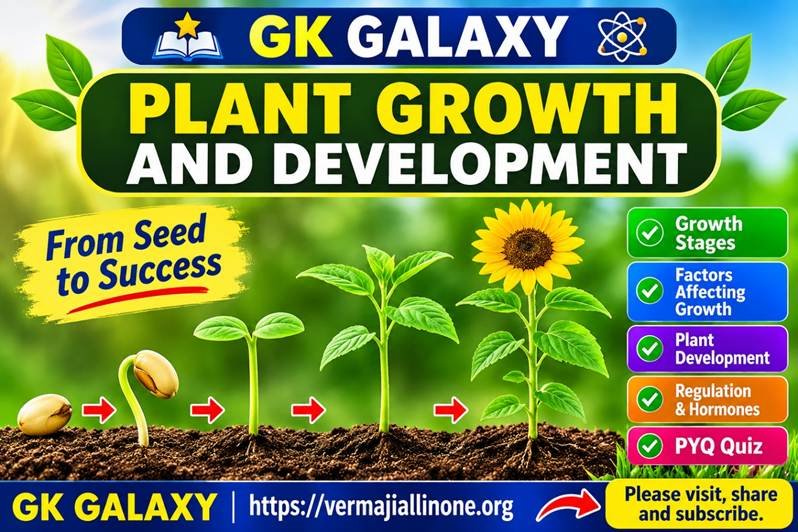
This chapter, “PLANT GROWTH AND DEVELOPMENT”, has been prepared for educational and informational purposes only. It includes subject-related theory, important concepts, practice MCQs, and Previous Year Questions (PYQs) to help students prepare for NEET and other relevant competitive examinations.
The PYQs and examination-related information have been compiled from various educational sources and available references. Some questions may be memory-based or reproduced in a simplified or modified format for better understanding and practice. The examination name and year are provided wherever available and reasonably verified.
Although every effort has been made to maintain accuracy, the author does not guarantee that all questions, answers, explanations, examination years, or other information are completely error-free. Students are advised to cross-check important information with NCERT textbooks, official NTA publications, and other authentic sources.
This content is not affiliated with, endorsed by, or officially associated with the National Testing Agency (NTA), NEET, CBSE, or any government examination authority.
The author, Shailendra Kumar Verma, and GK GALAXY (https://vermajiallinone.org) shall not be held responsible for any errors, omissions, or consequences arising from the use of this material.
This chapter is intended solely as a supplementary study resource and should not be considered a substitute for official textbooks, examination notifications, or authoritative study materials.
Author: Shailendra Kumar Verma
Educational Platform: GK GALAXY
Website: https://vermajiallinone.org
Chapter Contents
- Introduction to Plant Growth
- Characteristics of Plant Growth
- Phases of Growth
- Growth Rate and Growth Curve
- Conditions for Plant Growth
- Differentiation, Dedifferentiation and Redifferentiation
- Development in Plants
- Plant Growth Regulators (PGRs)
- Auxins
- Gibberellins
- Cytokinins
- Ethylene
- Abscisic Acid (ABA)
- Photoperiodism
- Vernalisation
- NEET Previous Year Questions with Answers and Explanations
PART 1: COMPLETE THEORY
1. Introduction to Plant Growth
Plant growth and development are important biological processes through which a plant increases in size, develops new structures and reaches maturity.
Growth: Growth is defined as an irreversible permanent increase in the size, mass, volume or number of cells of an organism.
In plants, growth generally occurs throughout life because they possess meristematic tissues that retain the ability to divide.
Important Characteristics of Plant Growth
- Growth is an irreversible process.
- It involves an increase in protoplasm.
- It may occur due to cell division, cell enlargement and cell differentiation.
- Plant growth is generally restricted to specialised regions called meristems.
- Plant growth is influenced by both internal and external factors.
- Plants show an open form of growth because new organs can develop throughout their life.
Development: Development refers to all the changes that an organism undergoes during its life cycle, including growth, differentiation, maturation and senescence.
Important distinction:
Growth refers to an increase in size or mass.
Development includes all qualitative and quantitative changes during the life cycle.
2. Characteristics of Plant Growth
Plant growth has three major characteristics:
A. Indeterminate Growth
Plants show indeterminate growth because their meristematic tissues remain active throughout their life.
Examples:
Root apical meristem
Shoot apical meristem
Vascular cambium
B. Open Form of Growth
Plants continuously produce new leaves, branches, flowers and roots due to the activity of meristematic tissues.
C. Plasticity
Plasticity is the ability of plants to follow different developmental pathways in response to environmental conditions or different phases of life.
Example: Leaves of certain plants may have different shapes in juvenile and mature stages. This phenomenon is known as heterophylly.
Examples:
Buttercup
Cotton
3. Phases of Plant Growth
Plant growth takes place in three major phases:
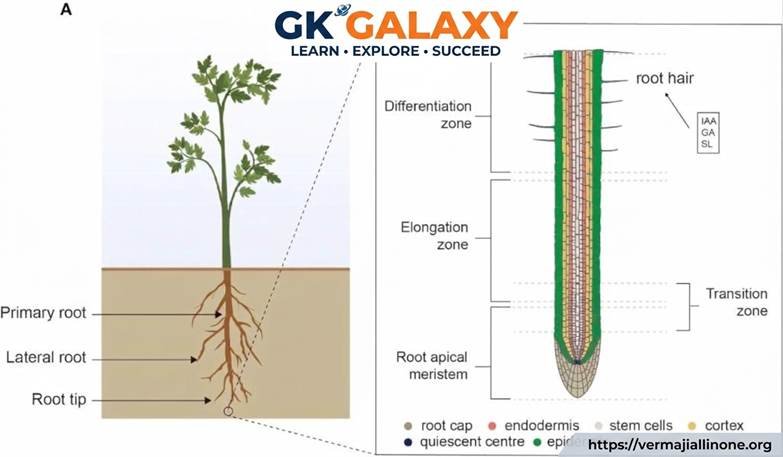
A. Meristematic Phase
This phase occurs in the actively dividing regions of plants.
Characteristics:
- Cells divide continuously.
- Cells have dense cytoplasm.
- Cell walls are thin and primary.
- Vacuoles are absent or very small.
- Cells have prominent nuclei.
- Intercellular spaces are generally absent.
B. Elongation Phase
Cells formed in the meristematic region enter the elongation phase.
Characteristics:
- Cells increase in size.
- Vacuoles enlarge.
- Cell walls undergo enlargement.
- Cell size and volume increase.
- Cells become elongated.
C. Maturation Phase
In this phase, cells attain their maximum size and become differentiated.
Characteristics:
- Cells reach their maximum size.
- Cells develop specialised structures.
- Permanent tissues are formed.
- Cells acquire specific physiological functions.
NEET Important Point: The three phases of growth in the root are meristematic, elongation and maturation.
4. Growth Rate and Growth Curve
Growth rate is defined as the increase in growth per unit time.
There are two major types of growth rates:
A. Arithmetic Growth
In arithmetic growth, only one daughter cell continues to divide, while the other differentiates and matures.
The growth rate remains constant.
Formula:
Length at time t = Initial length + (Growth rate × Time)
Formula:
L(t) = L₀ + r × t
Where:
L(t) = Length at time t
L₀ = Initial length
r = Growth rate
t = Time
B. Geometric Growth
In geometric growth, both daughter cells produced by cell division retain the ability to divide.
Growth initially becomes slow and then increases rapidly.
Under ideal conditions, geometric growth follows an exponential pattern.
Formula:
Final size = Initial size × e^(Relative growth rate × Time)
Formula:
W1 = W0 × e^(r × t)
Where:
W1 = Final size
W0 = Initial size
r = Relative growth rate
t = Time
e = Base of natural logarithm (approximately 2.718)
C. Sigmoid Growth Curve
The sigmoid or S-shaped growth curve is commonly observed in plants under natural conditions.
It consists of three major phases:
- Lag Phase: Initial slow growth.
- Log Phase: Rapid and maximum growth.
- Stationary Phase: Growth slows down and eventually becomes stable.
Important NEET Facts:
Maximum growth occurs during the log phase.
The sigmoid curve is also called the S-shaped growth curve.
Arithmetic growth produces a linear growth pattern.
Geometric growth produces an exponential growth pattern.
D. Absolute Growth Rate
Absolute growth rate is the total growth per unit time.
Formula:
Absolute Growth Rate = Increase in growth / Time
E. Relative Growth Rate
Relative growth rate is the growth per unit time per unit initial growth.
Formula:
Relative Growth Rate = Increase in growth / Initial growth × Time
It is useful for comparing the growth performance of different plants.
5. Conditions Required for Plant Growth
Plant growth is influenced by internal and external factors.
A. Internal Factors
- Genetic constitution
- Plant growth regulators
- Enzymatic activities
- Physiological condition of the plant
- Availability of stored food
B. External Factors
- Water
- Oxygen
- Temperature
- Light
- Mineral nutrients
Role of Water:
Maintains cell turgidity.
Helps in cell enlargement.
Acts as a medium for metabolic reactions.
Helps in the transport of minerals and nutrients.
Role of Oxygen:
Oxygen is essential for aerobic respiration and energy production.
Role of Temperature:
Temperature affects enzyme activity, metabolism and the overall rate of growth.
Role of Light:
Light influences photosynthesis, flowering and several developmental processes.
6. Differentiation, Dedifferentiation and Redifferentiation
These three processes are extremely important for NEET.
A. Differentiation
Differentiation is the process by which cells derived from meristems mature and acquire a permanent shape, size and specialised function.
Examples:
Formation of xylem vessels
Formation of phloem elements
Formation of specialised epidermal cells
B. Dedifferentiation
Dedifferentiation is the process by which living differentiated cells regain the capacity to divide under certain conditions.
Examples:
Formation of interfascicular cambium from differentiated parenchyma cells.
Formation of cork cambium from mature cells.
C. Redifferentiation
Redifferentiation is the process in which cells produced through dedifferentiation lose their capacity to divide and become specialised again.
Examples:
Formation of secondary xylem.
Formation of secondary phloem.
Important NEET Points:
Dedifferentiation restores the capacity of cell division.
Redifferentiation produces specialised cells.
Interfascicular cambium formation is an example of dedifferentiation.
Dedifferentiation followed by redifferentiation is important in plant tissue culture.
7. Development in Plants
Development refers to the overall changes that occur throughout the life cycle of a plant.
It includes:
- Growth
- Differentiation
- Maturation
- Reproduction
- Senescence
Plant development is controlled by internal and external factors.
Important Developmental Concepts
A. Plasticity
Plasticity is the ability of plants to follow different developmental pathways depending on environmental conditions or their stage of life.
Example: Heterophylly in cotton and buttercup.
B. Heterophylly
The occurrence of different types of leaves on the same plant is called heterophylly.
Two types are recognised:
Developmental heterophylly: Different leaves occur during different developmental stages.
Environmental heterophylly: Different leaf forms develop under different environmental conditions.
Examples:
Cotton: Developmental heterophylly.
Buttercup: Environmental heterophylly.
C. Senescence
Senescence is the process of ageing in plants, during which metabolic activities decline and plant organs eventually die.
Examples:
Yellowing of leaves.
Ageing of flowers.
Death of annual plants after reproduction.
D. Abscission
Abscission is the natural shedding of leaves, flowers or fruits from a plant.
It is regulated by several hormonal and physiological factors.
8. Plant Growth Regulators (PGRs)
Plant growth regulators are small, simple molecules of diverse chemical composition that regulate plant growth and development.
They may promote, inhibit or modify different physiological processes.
The five major groups of naturally occurring plant growth regulators described in NCERT are:
- Auxins
- Gibberellins
- Cytokinins
- Ethylene
- Abscisic Acid (ABA)
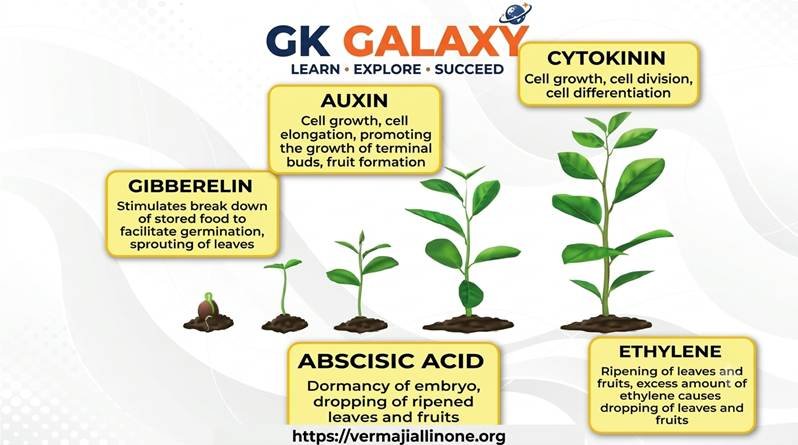
Classification of Plant Growth Regulators
A. Growth Promoters
Auxins
Gibberellins
Cytokinins
B. Growth Inhibitors
– Abscisic Acid (ABA)
C. Both Promoting and Inhibitory Effects
Ethylene may promote certain processes and inhibit others, depending on the tissue and physiological condition.
Important: This classification describes their principal effects; plant growth regulators can have multiple functions.
9. Auxins
Auxins are plant growth regulators mainly associated with cell elongation and several developmental processes.
The term auxin is derived from the Greek word meaning to grow.
Discovery of Auxins
- Charles Darwin and Francis Darwin studied phototropism in coleoptiles.
- Boysen-Jensen demonstrated that the growth stimulus could pass through gelatin.
- Paal demonstrated the effect of coleoptile tip extracts.
- F.W. Went isolated the growth-promoting substance from oat coleoptile tips.
Types of Auxins
Natural Auxins:
IAA – Indole-3-acetic acid
IBA – Indole-3-butyric acid
Synthetic Auxins:
NAA – Naphthalene acetic acid
2,4-D – 2,4-dichlorophenoxyacetic acid
Major Functions of Auxins
- Promote cell elongation.
- Maintain apical dominance.
- Initiate adventitious root formation.
- Promote parthenocarpy in certain plants.
- Delay premature fruit and leaf drop in some situations.
- Help in vascular differentiation.
- Promote rooting in stem cuttings.
- Participate in tropic responses.
Apical Dominance
Apical dominance is the phenomenon in which the growing apical bud suppresses the growth of lateral buds.
Auxin produced by the shoot apex plays an important role in this phenomenon.
Practical application: Removal of shoot tips promotes lateral branching.
Parthenocarpy
Parthenocarpy is the development of fruits without fertilisation.
Auxins and gibberellins can induce parthenocarpy in certain plants.
Examples:
Seedless tomato
Seedless fruits produced through hormonal treatment
Auxins as Herbicides
Synthetic auxins such as 2,4-D are used to control dicotyledonous weeds in cereal crops.
2,4-D is particularly effective against broad-leaved weeds.
NEET Important Point: 2,4-D is a selective herbicide used for killing dicot weeds without seriously affecting many monocot crops when applied appropriately.
10. Gibberellins
Gibberellins are plant growth regulators that promote stem elongation and several other developmental activities.
Discovery
Gibberellins were discovered through studies of the bakanae disease of rice.
The disease was caused by the fungus Gibberella fujikuroi.
The fungus produced a substance responsible for excessive stem elongation in rice plants.
Major Functions of Gibberellins
- Promote stem elongation.
- Promote internode elongation.
- Induce bolting in rosette plants.
- Break seed dormancy in certain species.
- Promote seed germination.
- Stimulate enzyme production during seed germination.
- Increase fruit size in some plants.
- Promote flowering in certain plants.
- Increase sugarcane stem length and yield.
- Promote malting in the brewing industry.
Bolting
Bolting refers to the rapid elongation of the internodes just before flowering in rosette plants.
Examples:
Cabbage
Beet
Other rosette plants
Gibberellins promote bolting.
Gibberellins in Sugarcane
Application of gibberellins increases the length of sugarcane stems.
This can increase the yield of sugarcane.
Gibberellins in the Brewing Industry
Gibberellins, particularly GA3, are used to stimulate the malting process in the brewing industry.
Gibberellins and Seed Germination
Gibberellins stimulate the synthesis of hydrolytic enzymes such as alpha-amylase in the aleurone layer of cereal grains.
These enzymes help convert stored food into simpler substances that can be used by the growing embryo.
NEET Important Point: Gibberellins promote bolting, stem elongation and alpha-amylase production during seed germination.
11. Cytokinins
Cytokinins are plant growth regulators that promote cell division or cytokinesis.
They are particularly important in cell division, shoot formation and nutrient mobilisation.
Discovery
The first cytokinin discovered was kinetin.
It was isolated from autoclaved herring sperm DNA by Miller and his co-workers.
Zeatin is a naturally occurring cytokinin isolated from maize.
Types of Cytokinins
Natural Cytokinins:
Zeatin
Isopentenyl adenine
Synthetic Cytokinins:
Kinetin
6-Benzylaminopurine (BAP)
Major Functions of Cytokinins
- Promote cell division.
- Promote shoot formation in tissue culture.
- Promote lateral bud growth.
- Overcome apical dominance in certain conditions.
- Delay leaf senescence.
- Promote nutrient mobilisation.
- Help in chloroplast development.
- Promote the development of chlorophyll.
- Influence differentiation in plant tissue culture.
Cytokinins and Senescence
Cytokinins delay leaf senescence by promoting nutrient mobilisation and maintaining metabolic activity.
This phenomenon is known as the Richmond-Lang effect.
NEET Important Point: Cytokinins are known as anti-senescence hormones.
12. Ethylene
Ethylene is a gaseous plant growth regulator.
It is unique among the five major plant growth regulators because it exists in gaseous form.
Major Functions of Ethylene
- Promotes fruit ripening.
- Promotes senescence in certain plant organs.
- Promotes abscission of leaves and flowers.
- Promotes horizontal growth of seedlings.
- Promotes swelling of the axis.
- Helps in root hair formation.
- Promotes female flowers in cucumber.
- Helps in breaking dormancy in certain plants.
- Promotes flowering in pineapple.
- Promotes rapid internode elongation in deep-water rice.
Ethylene and Fruit Ripening
Ethylene is an important natural fruit-ripening hormone.
It promotes changes such as:
Softening of fruits.
Changes in fruit colour.
Conversion of starch into sugars.
Changes in aroma and flavour.
Ethephon
Ethephon is a chemical compound that releases ethylene.
It is used in agriculture to regulate several developmental processes.
Applications:
- Promotes fruit ripening.
- Promotes female flowers in cucumber.
- Helps in the synchronisation of fruit ripening.
- Can promote flowering in certain crops.
NEET Important Point: Ethylene promotes female flowers in cucumber, which can increase fruit production.
13. Abscisic Acid (ABA)
Abscisic acid is primarily known as a growth-inhibiting plant hormone.
It plays an important role in plant responses to environmental stress.
It is also called the stress hormone.
Major Functions of ABA
- Inhibits plant growth.
- Promotes seed dormancy.
- Promotes bud dormancy.
- Promotes stomatal closure during water stress.
- Helps plants tolerate drought.
- Promotes senescence in certain plant organs.
- Influences seed maturation.
- Helps plants respond to environmental stress.
ABA and Stomatal Closure
During water stress, ABA accumulates in leaves and guard cells.
It promotes stomatal closure, thereby reducing water loss through transpiration.
ABA and Seed Dormancy
ABA promotes seed dormancy and prevents premature germination.
It acts antagonistically to gibberellins in several seed germination and dormancy processes.
NEET Important Point: ABA is a stress hormone that promotes stomatal closure and seed dormancy.
14. Comparison of Five Major Plant Growth Regulators
| Plant hormone | Major function |
| Auxin | Cell elongation and apical dominance |
| Gibberellin | Stem elongation and bolting |
| Cytokinin | Cell division and delay of senescence |
| Ethylene | Fruit ripening |
| ABA | Seed dormancy and stomatal closure |
Important Agricultural Applications
| Application | Plant growth regulator |
| Weed control | 2,4-D |
| Sugarcane stem elongation | Gibberellin |
| Fruit ripening | Ethylene |
| Promoting female flowers in cucumber | Ethylene |
| Delaying leaf senescence | Cytokinin |
| Stomatal closure | ABA |
| Bolting in cabbage | Gibberellin |
| Root initiation in cuttings | Auxin |
| Malting in brewing industry | Gibberellin |
| Breaking certain seed dormancy conditions | Gibberellin |
15. Photoperiodism
Photoperiodism is the response of plants to the relative lengths of day and night, particularly in relation to flowering.
The term photoperiodism was introduced by Garner and Allard in 1920.
Types of Plants Based on Photoperiodism
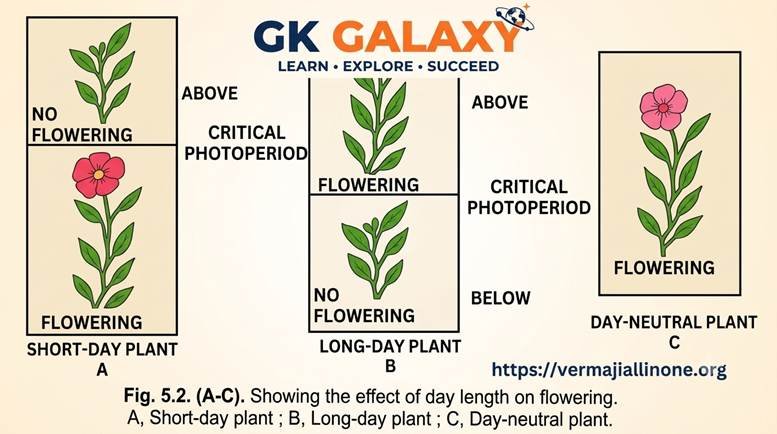
A. Long-Day Plants (LDP)
These plants flower when the day length exceeds a certain critical duration.
Examples:
Wheat
Spinach
Radish
Henbane
B. Short-Day Plants (SDP)
These plants flower when the day length is shorter than a certain critical duration, provided that the required uninterrupted dark period is satisfied.
Examples:
Rice
Chrysanthemum
Xanthium
Tobacco
C. Day-Neutral Plants
These plants do not depend on a specific photoperiod for flowering.
Examples:
Tomato
Cucumber
Sunflower
Critical Photoperiod
Critical photoperiod is the specific duration of light or darkness that determines flowering in photoperiod-sensitive plants.
Important NEET Point: In many photoperiod-sensitive plants, the duration of the uninterrupted dark period is more important than the length of the light period.
Site of Photoperiodic Perception
Leaves perceive the photoperiodic stimulus.
The flowering stimulus is then transmitted to the shoot apical meristem.
Important: The shoot apex is the site of flowering, but the leaves are the principal site of photoperiod perception.
16. Vernalisation
Vernalisation is the process of inducing flowering by exposing plants or seeds to a period of low temperature.
It is an important phenomenon in several winter annual and biennial plants.
Important Features
- It involves exposure to low temperature.
- It promotes or accelerates flowering.
- It is important in winter varieties of certain plants.
- It may reduce the time required for flowering.
- The response can depend on the developmental stage of the plant.
Examples
Wheat
Barley
Rye
Cabbage
Sugar beet
Importance of Vernalisation
- Helps winter plants flower in the appropriate season.
- Reduces the vegetative period in certain plants.
- Promotes early flowering.
- Helps in synchronising flowering with favourable environmental conditions.
Vernalisation and Photoperiodism: Differences
| Photoperiodism | Vernalisation |
| Response to day and night duration | Response to low temperature |
| Light and dark periods are involved | Chilling treatment is involved |
| Leaves perceive photoperiod | Dividing tissues or embryos can perceive the cold stimulus |
| Regulates flowering | Promotes or accelerates flowering |
17. Important NEET Revision Table
| Topic | Important fact |
| Plant growth | Irreversible increase in size |
| Meristematic phase | Active cell division |
| Elongation phase | Increase in cell size |
| Maturation phase | Cell differentiation |
| Arithmetic growth | Linear growth |
| Geometric growth | Exponential growth |
| Sigmoid curve | S-shaped growth curve |
| Maximum growth | Log phase |
| Dedifferentiation | Regaining ability to divide |
| Redifferentiation | Regaining specialised function |
| Auxin | Cell elongation |
| Gibberellin | Bolting |
| Cytokinin | Cell division |
| Ethylene | Fruit ripening |
| ABA | Stress hormone |
| 2,4-D | Selective herbicide |
| IAA | Natural auxin |
| GA3 | Gibberellin |
| Zeatin | Natural cytokinin |
| Kinetin | Cytokinin |
| Ethephon | Ethylene-releasing compound |
| Photoperiodism | Response to relative day/night duration |
| Vernalisation | Low-temperature-induced flowering |