https://skverma29.gumroad.com/affiliates
GUMROAD eBook link:-
BY SHAILENDRA KUMAR VERMA
| 1. | CHALLENGING SYLLOGISM |
| https://skverma29.gumroad.com/l/ktxvzi | |
| 2. | STRAIT OF HORMUZ: STRATEGIC & ECONOMIC ROLE |
| https://skverma29.gumroad.com/l/upobrv | |
| 4. | STATIC GENERAL KNOWLEDGE |
| https://skverma29.gumroad.com/l/kzmca | |
| 5. | SSC ENGLISH PREVIOUS YEAR QUESTIONS MCQ |
| https://skverma29.gumroad.com/l/vtotyp | |
| 6. | SSC REASONING PREVIOUS YEAR QUESTIONS MCQ |
| https://skverma29.gumroad.com/l/fsyvp | |
| 7. | SSC MATH PREVIOUS YEAR QUESTIONS (MCQ): TIER I |
| https://skverma29.gumroad.com/l/nesioq | |
| 8. | BANKING KNOWLEDGE QUESTIONS AND ANSWERS MCQ |
| https://skverma29.gumroad.com/l/sgbbul | |
| 9. | BIHAR ANM, GNM & PHARMACIST EXAM: PAST MCQ QUESTIONS & ANSWERS – |
| https://skverma29.gumroad.com/l/yotjat | |
| 10. | ARAVALLI MOUNTAIN RANGE: THE ANCIENT SPINE OF INDIA |
| https://skverma29.gumroad.com/l/khpakf | |
| 11. | मौर्य काल (322 ईसा पूर्व – 185 ईसा पूर्व): पीएसयू परीक्षा हेतु प्रश्नोत्तर सहित विस्तृत अध्ययन |
| https://skverma29.gumroad.com/l/kgmrw | |
| 12. | VOLCANOES AND EARTHQUAKES: A COMPLETE GUIDE |
| https://share.google/gMZLAnx4hcCV82NTI | |
| 13. | TERMINOLOGY: RAILWAY, COMPUTER, SHARE MARKET, BIOLOGY, BADMINTON, CRICKET, FOOTBALL, KABBADI AND HOCKEY |
| https://share.google/fvdFN53HtyXlqTCgd | |
| 14. | भारतीय संसद का सत्र: प्रक्रिया, नियमऔर एस ओ पी; पी एस यू परीक्षा के लिए संपूर्ण मार्ग दर्शिका |
| https://share.google/1HFwXZA3qUiKyrI1l | |
| 15. | REITs AND InvITs IN INDIA: COMPLETE GUIDE (SCOPE, RISKS & FUTURE) |
| https://share.google/EChDc9heQmPPeyhoi | |
| 16. | GK SSC TIER I PREVIOUS YEAR MCQ |
| https://share.google/5pLzqYKQtg822wk3Y | |
| 17. | PETROLEUM REFINERY PROCESS: WITH 200 MCQ |
| https://skverma29.gumroad.com/l/jgydi | |
| 18. | SET THEORY: A COMPLETE GUIDE WITH 400 MCQ |
| https://skverma29.gumroad.com/l/zkhqzm | |
| 19. | WORLD’S SMALLEST, LONGEST, THINNEST, THICKEST AND TALLEST |
| https://skverma29.gumroad.com/l/kzaenh | |
| 20. | HIGH TIDE AND LOW TIDE: A COMPLETE GUIDE https://skverma29.gumroad.com/l/virke |
| 21. | 1000 HISTORY QESTIONS & ANSWERS FOR PSU |
| https://skverma29.gumroad.com/l/fjapus | |
| 22. | नालंदा विश्वविद्यालय : सम्पूर्ण अध्ययन |
| https://skverma29.gumroad.com/l/pmjab?wanted=true | |
| 23. | भगवान शिव के 12 ज्योतिर्लिंग: इतिहास, महत्व और दर्शन क्रम |
| https://skverma29.gumroad.com/l/wdkgo | |
| 24 | NISM-SERIES-V-A MUTUAL FUND DISTRIBUTOR: COMPLETE STUDY GUIDE & EXAM PREPARATION |
| https://skverma29.gumroad.com/l/qgcviu | |
| 25. | WORKSHOP TECHNOLOGY & MANUFACTURING PROCESSES COMPLETE EXAM GUIDE |
| https://skverma29.gumroad.com/l/xvqxnp |
AMAZON eBook link:-
BY SHAILENDRA KUMAR VERMA
| 1. | SSC MATH PREVIOUS YEAR MCQ: SSC MATH |
| https://amzn.in/d/097Ocsnl | |
| 2. | SSC REASONING PREVIOUS YEAR MCQ: SSC REASONING |
| https://amzn.in/d/00EHQGE8 | |
| 3. | SSC ENGLISH PREVIOUS YEAR MCQ: SSC ENGLISH |
| https://amzn.in/d/0f8sxJoy | |
| 4. | STATIC GENERAL KNOWLEDGE : WITH 620 MCQs |
| https://amzn.in/d/09xNEWmt |
PLAYSTORE eBook link:-
BY SHAILENDRA KUMAR VERMA
| 1. | SSC MATH PREVIOUS YEAR MCQ | |
| https://share.google/KzWbvkFuNk51PEpiu | ||
| 2. | SSC REASONING PREVIOUS YEAR MCQ | |
| https://play.google.com/books/publish/a/12574378860292240754#book/GGKEY:EUPQZ9ZUAFR/review | ||
| 3. | STATIC GENERAL KNOWLEDGE | |
| https://play.google.com/books/publish/a/12574378860292240754#book/GGKEY:CQDT2G4CCQP/review | ||
| 4. | CHALLENGING SYLLOGISM | |
| https://share.google/w9xLMwyiJdNVnpHxI | ||
| 5. | STRAIT OF HORMUZ: STRATEGIC & ECONOMIC ROLE | |
| https://share.google/V10H7UKeTkstLIMmc | ||
| 6. | BIHAR TEACHER ELIGIBILITY TEST (BIHAR TET) : COMPLETE GUIDE | |
| https://share.google/AcCXPFa69dAWyYaZZ | ||
| 7. | SSC ENGLISH PREVIOUS YEAR MCQ | |
| https://share.google/pr7b0YhDoDwttaq2s | ||
| 8. | BANKING KNOWLEDGE QUESTIONS AND ANSWERS MCQ | |
| https://share.google/yqYOabKhNppcz89hl | ||
| 9. | BIHAR ANM, GNM & PHARMACIST EXAM: PAST MCQ QUESTIONS & ANSWERS – | |
| https://share.google/NFhtU1JoBfxPS4wa3 | ||
| 10. | ARAVALLI MOUNTAIN RANGE: THE ANCIENT SPINE OF INDIA | |
| https://share.google/Yo4RYnaZrbRu9qwzj | ||
| 11. | GK SSC TIER I PREVIOUS YEAR MCQ | |
| https://share.google/sBdCcsEeebM44QZ0X | ||
| 12. | REITs AND InvITs IN INDIA: COMPLETE GUIDE (SCOPE, RISKS & FUTURE) | |
| https://share.google/XAwUio1deUOxFe2M7 | ||
| 13. | भारतीय संसद का सत्र: प्रक्रिया, नियमऔर एस ओ पी ; पी एस यू परीक्षा के लिए संपूर्ण मार्ग दर्शिका | |
| https://share.google/6XVrfQ2PcuWmqvKol | ||
| 14. | मौर्य काल (322 ईसा पूर्व – 185 ईसा पूर्व): पीएसयू परीक्षा हेतु प्रश्नोत्तर सहित विस्तृत अध्ययन | |
| https://share.google/Lwu7JKHE54kxsL5e2 | ||
| 15. | TERMINOLOGY: RAILWAY, COMPUTER, SHARE MARKET, BIOLOGY, BADMINTON, CRICKET, FOOTBALL, KABBADI AND HOCKEY | |
| https://share.google/WWVO9ZFd81R9G9h69 | ||
| 16. | VOLCANOES AND EARTHQUAKES: A COMPLETE GUIDE | |
| https://share.google/aXi2evRVgmzpQguye | ||
| 17. | PETROLEUM REFINERY PROCESS: WITH 200 MCQ | |
| https://play.google.com/books/publish/u/0/a/12574378860292240754#book/GGKEY:P34SQBHUJ7F/review | ||
| 18. | SET THEORY: A COMPLETE GUIDE WITH 400 MCQ | SET THEORY: A COMPLETE GUIDE WITH 400 MCQ |
| https://play.google.com/books/publish/u/0/a/12574378860292240754#book/GGKEY:83LKH7QHRQH/review | ||
| 19. | WORLD’S SMALLEST, LONGEST, THINNEST, THICKEST AND TALLEST | |
| https://play.google.com/books/publish/u/0/a/12574378860292240754#book/GGKEY:9LE49HEDZJE/review | ||
| 20. | HIGH TIDE AND LOW TIDE: A COMPLETE GUIDE | |
| https://play.google.com/books/publish/u/0/a/12574378860292240754#book/GGKEY:TKR79QBDE7R/review | ||
| 21. | 1000 HISTORY QESTIONS & ANSWERS FOR PSU | |
| https://play.google.com/books/publish/u/0/a/12574378860292240754#book/GGKEY:1SGWQKT7BDF/review | ||
| 22. | नालंदा विश्वविद्यालय : सम्पूर्ण अध्ययन | |
| https://play.google.com/books/publish/u/0/a/12574378860292240754#book/GGKEY:RY0EDLDK7TL/review | ||
| 23. | भगवान शिव के 12 ज्योतिर्लिंग: इतिहास, महत्व और दर्शन क्रम | |
| https://play.google.com/books/publish/u/0/a/12574378860292240754#book/GGKEY:KNT0X6L8YCQ/review | ||
| 24. | NISM-SERIES-V-A MUTUAL FUND DISTRIBUTOR: COMPLETE STUDY GUIDE & EXAM PREPARATION | |
| https://play.google.com/books/publish/u/0/a/12574378860292240754#book/GGKEY:YP1PQ8RQY07/review | ||
| 25. | WORKSHOP TECHNOLOGY & MANUFACTURING PROCESSES COMPLETE EXAM GUIDE | |
| https://play.google.com/books/publish/u/0/a/12574378860292240754#book/GGKEY:PK621P1ZHXX/review |
| OPEN DMAT ACCONT FROM THI LINK IN ANGEL ONE:- |
| Open your Trading & Investment account with Angel One for FREE* |
| You will get: |
| All trades in Rs.20 |
| Quick SIP in Direct MF |
| 1Lac MTF @ 0% interest |
| Download only using my referral link to get Free Demat Account⬇ |
| https://angel-one.onelink.me/Wjgr/2o2au42h |
| _link may expire within 48hrs_ |
| _T&C Apply_ |
| CLICK TO APPLY: |
| Click the application link below: 👉 Apply Here for SBI Credit Card (Referral Code: 243zfQ0yYm3) |
| OPEN DMAT ACCOUNT FROM THIS LINK: |
| HI THERE, I SEE YOU HAVEN’T BOUGHT THE FREEDOM PLAN ON INDIAN BANK YET. DON’T MISS OUT ON UNLIMITED TRADING AT A POCKET-FRIENDLY COST. GO BROKERAGE-FREE AND SAVE BIG WITH THE FREEDOM PLAN. USE MY REFERRAL CODE, SHAI0634 TO DOWNLOAD THE APP NOW. |
| https://play.google.com/store/apps/details?id=com.finwizard.fisdom |
PLANT FAMILIES
DISCLAIMER
This chapter “Plant Families” has been prepared for educational and examination-preparation purposes only, especially for students preparing for NEET and other medical entrance examinations.
The chapter contains theoretical explanations, MCQ questions, answers, explanations and references to NEET/AIPMT questions with examination names and years. Some previous-year questions may be based on publicly available question papers and memory-based sources.
Every effort has been made to provide accurate and useful information; however, the website owner/author does not guarantee that all information, questions, answers, explanations, examination years or question wording are completely error-free.
The website owner/author is not responsible for any error, omission, discrepancy, or loss arising from the use of this educational material. Students are advised to verify important information with the latest NCERT Biology textbook, official NEET/NTA sources and other authentic educational sources before relying upon it for examination preparation.
The inclusion of any NEET/AIPMT question, examination name, or year does not imply any affiliation, authorization, endorsement, or association with NTA, NEET, AIPMT or any government examination authority.
This material should be used only as a supplementary study and revision resource and should not be considered a substitute for NCERT textbooks or official examination information.
Educational Purpose Only.
Website: https://vermajiallinone.org/
Website/Brand: GK GALAXY
CHAPTER — PLANT FAMILIES
1. Introduction
In flowering plants, several plants are grouped into families on the basis of similarities in their vegetative and reproductive characteristics. For NEET, the three families of greatest importance in this chapter are:
- Fabaceae
- Solanaceae
- Liliaceae
These families are specifically included in the NCERT curriculum for the study of flowering plants. NCERT also emphasizes their study through floral structures, anthers, ovaries, roots, stems, leaves and related characters.
For identification of a plant family, the following characters are particularly important:
Habit
Root
Stem
Leaves
Inflorescence
Flower
Calyx
Corolla or perianth
Aestivation
Androecium
Gynoecium
Placentation
Fruit
Floral formula
Economic importance
2. FAMILY FABACEAE
2.1 General Introduction
Fabaceae is an important dicot family containing many plants of agricultural, medicinal and economic importance.
Important examples include:
Pisum sativum — Pea
Cicer arietinum — Gram
Arachis hypogaea — Groundnut
Glycine max — Soybean
Cajanus cajan — Pigeon pea
Sesbania
Indigofera
Lupin
Fabaceae is particularly important for NEET because of its characteristic papilionaceous corolla, vexillary aestivation and diadelphous stamens.
2.2 Habit
Members of Fabaceae may be:
Herbs
Shrubs
Trees
The family therefore shows considerable diversity in growth habit.
2.3 Root
The root system is generally a tap root system.
Root nodules are commonly present in many members.
These nodules contain nitrogen-fixing bacteria, particularly Rhizobium, which helps in biological nitrogen fixation.
2.4 Stem
The stem may be:
Herbaceous
Woody
Erect
Climbing
The nature of the stem varies among different members.
2.5 Leaves
Leaves are generally:
Alternate
Compound
Usually pinnately compound
Stipulate
In some members, parts of the leaf may be modified into tendrils.
2.6 Inflorescence
The inflorescence is generally racemose, although variation occurs among different members.
2.7 Flower
The flower of Fabaceae is generally:
Bisexual
Zygomorphic
Complete
Hypogynous
Usually pentamerous
Zygomorphic
A zygomorphic flower can be divided into two equal halves in only one particular vertical plane.
The pea flower is a classic example.
2.8 Calyx
The calyx consists of five sepals.
The sepals are generally united.
Therefore, the calyx is:
Gamosepalous
The aestivation is generally imbricate.
2.9 Corolla
The corolla is the most characteristic feature of Fabaceae.
It is called papilionaceous corolla.
There are five petals arranged into three types:
1. Standard
One large posterior petal is called the:
Standard or Vexillum
2. Wings
Two lateral petals are called:
Wings
3. Keel
Two anterior petals form the:
Keel or Carina
Therefore:
1 + 2 + 2 = 5 petals
2.10 Vexillary Aestivation
The characteristic aestivation of the papilionaceous corolla is:
Vexillary or descending imbricate aestivation
The large standard overlaps the two wings, and the wings overlap the keel petals.
NEET Key Point
Fabaceae → Papilionaceous corolla → Vexillary aestivation
2.11 Androecium
The androecium generally consists of 10 stamens.
The characteristic arrangement is:
9 + 1
Nine stamens are united while one remains free.
This condition is called:
Diadelphous
Thus:
Fabaceae → 10 stamens → Diadelphous → 9 + 1
The anthers are generally dithecous.
2.12 Gynoecium
The gynoecium is generally:
Monocarpellary
Ovary superior
Unilocular
Usually containing several ovules
The placentation is:
Marginal
Important NEET Point
Fabaceae → Marginal placentation
2.13 Fruit
The characteristic fruit is a:
Legume or pod
Examples include the pods of:
Pea
Gram
Bean
2.14 Floral Formula
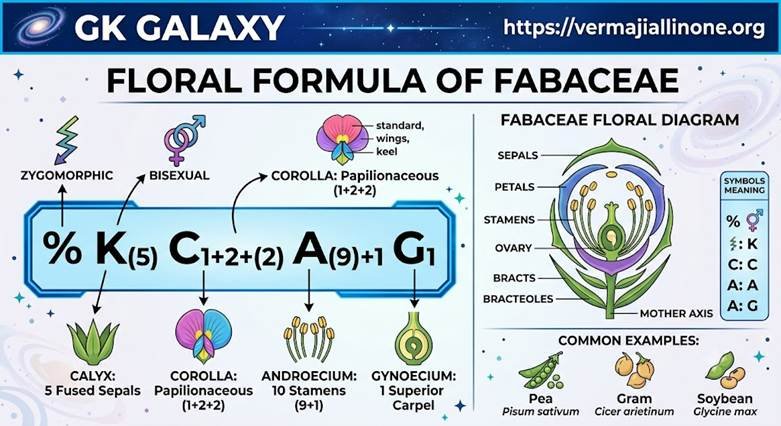
A commonly used representation of Fabaceae is:
% ⚥ K(5) C1+2+(2) A(9)+1 G1
Important symbols:
% → Zygomorphic
⚥ → Bisexual
K(5) → Five united sepals
C1+2+(2) → Papilionaceous corolla
A(9)+1 → Diadelphous stamens
G1 → Monocarpellary gynoecium
2.15 Economic Importance of Fabaceae
Fabaceae is one of the economically important plant families.
Pulses
Gram
Pea
Pigeon pea
Beans
Oil-producing plants
Groundnut
Soybean
Fibre
Sunhemp is an important fibre-producing member.
Dye
Indigofera provides indigo dye.
Fodder
Several members are used as fodder.
Soil fertility
Many members contribute to nitrogen enrichment of soil through symbiotic nitrogen fixation.
3. FAMILY SOLANACEAE
3.1 General Introduction
Solanaceae is commonly known as an important potato/tomato family.
Important members include:
Solanum tuberosum — Potato
Solanum lycopersicum — Tomato
Solanum melongena — Brinjal
Capsicum — Chilli
Nicotiana — Tobacco
Petunia
Datura
Withania
3.2 Habit
Members of Solanaceae may occur as:
Herbs
Shrubs
Small trees
3.3 Root
The root system is generally:
Tap root
3.4 Stem
The stem may be:
Herbaceous
Woody
Branched
Erect
An important example is potato, in which the underground tuber is a modified stem.
3.5 Leaves
Leaves are generally:
Alternate
Simple
Exstipulate
Venation is generally reticulate.
3.6 Inflorescence
Inflorescence may be:
Solitary
Cymose
Various modifications depending upon the genus
3.7 Flower
Flowers are generally:
Bisexual
Actinomorphic
Complete
Hypogynous
Pentamerous
Actinomorphic
An actinomorphic flower can be divided into approximately equal halves through more than one vertical plane passing through the centre.
3.8 Calyx
The calyx consists of:
Five sepals
The sepals are united.
Therefore, it is:
Gamosepalous
The calyx is generally persistent.
Aestivation is:
Valvate
3.9 Corolla
The corolla consists of:
Five petals
The petals are united.
Therefore, it is:
Gamopetalous
The corolla is generally rotate or funnel-shaped, depending on the species.
3.10 Androecium
There are generally:
Five stamens
The stamens are:
Epipetalous
Epipetalous
When stamens are attached to the petals, they are called epipetalous.
The stamens are generally arranged alternately with the petals.
3.11 Gynoecium
The gynoecium consists of:
Two carpels
Syncarpous
Ovary superior
Usually bilocular
The placentation is:
Axile
NEET Key Point
Solanaceae → Bicarpellary syncarpous → Superior ovary → Axile placentation
3.12 Fruit
The fruit may be:
Berry
Capsule
Examples:
Tomato → Berry
Brinjal → Berry
Potato → Berry botanically
Datura → Capsule
3.13 Floral Formula
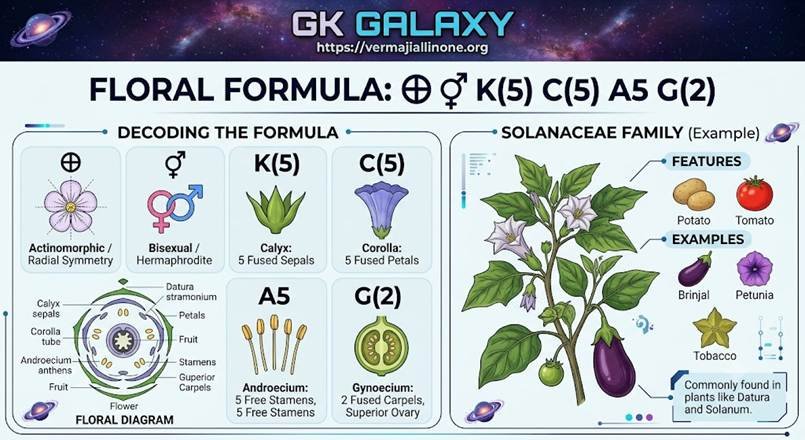
A commonly used floral formula is:
⊕ ⚥ K(5) C(5) A5 G(2)
Important features:
⊕ → Actinomorphic
⚥ → Bisexual
K(5) → Five united sepals
C(5) → Five united petals
A5 → Five stamens
G(2) → Bicarpellary syncarpous gynoecium
The ovary is superior.
3.14 Economic Importance of Solanaceae
Food
Potato
Tomato
Brinjal
Chilli
Medicinal plants
Some members such as:
Datura
Atropa
Withania
have medicinal importance.
Tobacco
Nicotiana is the source of tobacco.
Ornamental plants
Petunia
Datura
4. FAMILY LILIACEAE
4.1 General Introduction
Liliaceae is an important monocot family.
Important examples include:
Lily
Tulip
Allium cepa — Onion
Garlic
Aloe
Asparagus
Colchicum
4.2 Habit
Members are generally:
Perennial herbs
Many members possess underground structures used for storage and vegetative propagation.
4.3 Root
The root system is generally:
Fibrous/adventitious
This is a typical monocot characteristic.
4.4 Stem
The stem may be modified into underground structures such as:
Bulbs
Rhizomes
Other storage structures
For example, onion has a bulb.
4.5 Leaves
Leaves are generally:
Simple
Alternate
Exstipulate
Often basal or cauline
Venation is generally:
Parallel
4.6 Inflorescence
Inflorescence varies among members and may be:
Racemose
Umbellate
Solitary
4.7 Flower
The flowers are generally:
Bisexual
Actinomorphic
Complete
Hypogynous
Trimerous
Trimerous
Floral parts are generally arranged in multiples of three.
4.8 Perianth
In Liliaceae, the perianth consists generally of:
Six tepals
Arranged in two whorls:
3 + 3
The tepals are usually similar to one another.
Thus, a separate calyx and corolla are not clearly differentiated.
4.9 Androecium
There are generally:
Six stamens
Arranged as:
3 + 3
The stamens are generally:
Epiphyllous
Epiphyllous
Stamens attached to the perianth/tepals are called epiphyllous.
4.10 Gynoecium
The gynoecium generally consists of:
Three carpels
Syncarpous
Ovary superior
Usually trilocular
The placentation is:
Axile
NEET Key Point
Liliaceae → Tricarpellary syncarpous → Superior ovary → Axile placentation
4.11 Fruit
The fruit is generally:
Capsule
Sometimes berry in some members
4.12 Floral Formula
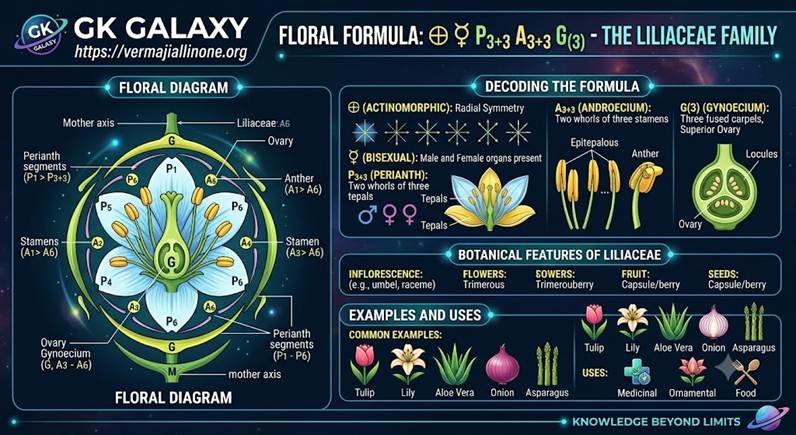
A commonly used floral formula is:
⊕ ⚥ P3+3 A3+3 G(3)
Important points:
⊕ → Actinomorphic
⚥ → Bisexual
P3+3 → Six tepals
A3+3 → Six stamens
G(3) → Three fused carpels
The ovary is superior.
4.13 Economic Importance of Liliaceae
Food
Onion
Garlic
Medicinal importance
Aloe
Colchicum
Ornamental plants
Lily
Tulip
Other uses
Several members are cultivated for ornamental, medicinal and agricultural purposes.
5. COMPARATIVE TABLE — FABACEAE, SOLANACEAE AND LILIACEAE
| Character | Fabaceae | Solanaceae | Liliaceae |
| Major group | Dicot | Dicot | Monocot |
| Habit | Herbs/shrubs/trees | Herbs/shrubs | Mostly perennial herbs |
| Root | Tap | Tap | Fibrous/adventitious |
| Leaf venation | Usually reticulate | Reticulate | Parallel |
| Flower symmetry | Zygomorphic | Actinomorphic | Actinomorphic |
| Flower | Bisexual | Bisexual | Bisexual |
| Merosity | Usually pentamerous | Pentamerous | Trimerous |
| Calyx | 5, united | 5, united | Perianth present |
| Corolla/perianth | Papilionaceous | 5 united petals | 6 tepals |
| Aestivation | Vexillary | Valvate | Usually imbricate |
| Stamens | 10 | 5 | 6 |
| Stamen attachment | Diadelphous | Epipetalous | Epiphyllous |
| Carpels | 1 | 2 | 3 |
| Gynoecium | Monocarpellary | Bicarpellary syncarpous | Tricarpellary syncarpous |
| Ovary | Superior | Superior | Superior |
| Placentation | Marginal | Axile | Axile |
| Fruit | Legume | Berry/Capsule | Capsule/Berry |
| Typical example | Pea | Tomato | Lily |
The three-family comparison is also explicitly emphasized in the NCERT Exemplar, including comparison of gynoecium and floral characters.
6. NEET ONE-LINE REVISION
Fabaceae
Papilionaceous → Vexillary → Diadelphous → Marginal → Legume
Solanaceae
Actinomorphic → Gamopetalous → Epipetalous → Axile → Berry/Capsule
Liliaceae
Monocot → Trimerous → Tepals → Epiphyllous → Axile → Capsule/Berry
7. MOST IMPORTANT FAMILY IDENTIFICATION POINTS
If you see:
Vexillary aestivation + standard + wings + keel
→ Fabaceae
9 + 1 diadelphous stamens
→ Fabaceae
Marginal placentation
→ Fabaceae
5 epipetalous stamens + axile placentation
→ Solanaceae
Five fused petals + five stamens
→ Solanaceae
Berry or capsule
→ Solanaceae
Six tepals + six stamens + trimerous flower
→ Liliaceae
Epiphyllous stamens
→ Liliaceae
Parallel venation + monocot characters
→ Liliaceae
PLANT FAMILIES — NEET/AIPMT PREVIOUS YEAR QUESTIONS
PYQ 1
Exam: NEET 2023
Topic: Fabaceae vs. Solanaceae vs. Liliaceae
Question
Fabaceae differs from Solanaceae and Liliaceae. Which characteristic is specific to Fabaceae with respect to its stamens?
- Epiphyllous and dithecous anthers
- Diadelphous and dithecous anthers
- Polyadelphous and epipetalous stamens
- Monadelphous and monothecous anthers
Answer:
2. Diadelphous and dithecous anthers
Explanation
Fabaceae generally possesses 10 stamens arranged as 9 + 1.
Nine stamens are united and one is free. This condition is called diadelphous.
Its anthers are generally dithecous.
Comparison:
Fabaceae → Diadelphous
Solanaceae → Epipetalous
Liliaceae → Epiphyllous
Therefore, option 2 is correct.
PYQ 2
Exam: NEET 2015
Topic: Floral formula and family identification
Question
A particular floral formula represents a member of which of the following?
- Allium
- Sesbania
- Petunia
- Brassica
Answer:
3. Petunia
Explanation
Petunia belongs to Solanaceae.
The characteristic Solanaceae floral features include:
Actinomorphic flower
Bisexual flower
Five united sepals
Five united petals
Five epipetalous stamens
Bicarpellary syncarpous gynoecium
Superior ovary
Axile placentation
Thus, the given floral formula corresponds to Solanaceae → Petunia.
PYQ 3
Exam: NEET 2015
Topic: Fabaceae
Question
Which of the following plants belongs to Fabaceae?
- Allium
- Sesbania
- Petunia
- Brassica
Answer:
2. Sesbania
Explanation
Sesbania belongs to Fabaceae.
Other options:
Allium → Liliaceae
Petunia → Solanaceae
Brassica → Brassicaceae
Fabaceae is characterized by a papilionaceous corolla, vexillary aestivation and diadelphous stamens.
PYQ 4
Exam: NEET 2006
Topic: Solanaceae
Question
Pentamerous, actinomorphic flowers, bicarpellary ovary with oblique septa and fruit as capsule or berry are characteristic features of:
- Brassicaceae
- Solanaceae
- Liliaceae
- Asteraceae
Answer:
2. Solanaceae
Explanation
The characteristic features of Solanaceae include:
Pentamerous flowers
Actinomorphic symmetry
Bicarpellary syncarpous gynoecium
Superior ovary
Axile placentation
Fruit generally berry or capsule
Therefore, the correct answer is Solanaceae.
PYQ 5
Exam: NEET 2019
Topic: Floral symmetry
Question
Zygomorphic flower is found in:
- Mustard
- Datura
- Pea
- Tomato
Answer:
3. Pea
Explanation
Pea belongs to Fabaceae and possesses a characteristic zygomorphic, papilionaceous flower.
The flower has:
One standard
Two wings
Two keel petals
In contrast, Datura and tomato belong to Solanaceae and have actinomorphic flowers.
PYQ 6
Exam: AIPMT 2012
Topic: Placentation
Question
How many plants in the following list have marginal placentation?
Mustard, Gram, Tulip, Asparagus, Arhar, Sunhemp, Chilli, Colchicine, Onion, Moong, Pea, Tobacco, Lupin
- Four
- Five
- Six
- Three
Answer:
3. Six
Explanation
Marginal placentation is characteristic of Fabaceae.
From the list, the Fabaceae members are:
- Gram
- Arhar
- Sunhemp
- Moong
- Pea
- Lupin
Therefore:
Total = 6
Hence, option 3 is correct.
PYQ 7
Exam: AIPMT 2011
Topic: Fabaceae
Question
Which of the following plants possesses a zygomorphic flower?
- Mustard
- Pea
- Datura
- Tomato
Answer:
2. Pea
Explanation
Pea is a member of Fabaceae.
Its flower is:
Bisexual
Zygomorphic
Papilionaceous
The characteristic papilionaceous corolla consists of:
Standard + Wings + Keel
Therefore, pea is the correct answer.
PYQ 8
Exam: AIPMT 2012
Topic: Fabaceae
Question
Vexillary aestivation is characteristic of:
- Solanaceae
- Liliaceae
- Fabaceae
- Brassicaceae
Answer:
3. Fabaceae
Explanation
The corolla of Fabaceae is papilionaceous.
Its petals show vexillary or descending imbricate aestivation.
The large standard overlaps the wings, while the wings overlap the keel.
Therefore:
Vexillary aestivation → Fabaceae
PYQ 9
Exam: NEET/AIPMT chapterwise PYQ
Topic: Family identification
Question
Which family is characterized by a papilionaceous corolla?
- Solanaceae
- Fabaceae
- Liliaceae
- Asteraceae
Answer:
2. Fabaceae
Explanation
The papilionaceous corolla is characteristic of Fabaceae.
It consists of:
1 standard
2 wings
2 keel petals
The arrangement is associated with vexillary aestivation.
PYQ 10
Exam: NEET/AIPMT chapterwise PYQ
Topic: Solanaceae
Question
Which one of the following is characteristic of Solanaceae?
- Pentamerous actinomorphic flowers
- Trimerous zygomorphic flowers
- Tetramerous actinomorphic flowers
- Pentamerous zygomorphic flowers
Answer:
1. Pentamerous actinomorphic flowers
Explanation
Solanaceae flowers are generally:
Pentamerous
Actinomorphic
Bisexual
Hypogynous
The gynoecium is generally bicarpellary and syncarpous, with a superior ovary.
Therefore, option 1 is correct.
PYQ 11
Exam: NEET/AIPMT chapterwise PYQ
Topic: Fabaceae — Gynoecium
Question
Which combination correctly represents the gynoecium of Fabaceae?
- Bicarpellary, syncarpous, inferior ovary
- Monocarpellary, superior ovary, marginal placentation
- Tricarpellary, syncarpous, inferior ovary
- Bicarpellary, syncarpous, superior ovary with axile placentation
Answer:
2. Monocarpellary, superior ovary, marginal placentation
Explanation
Fabaceae has:
One carpel
Monocarpellary gynoecium
Superior ovary
Marginal placentation
This is an important distinction from Solanaceae and Liliaceae. NCERT/SATHEE specifically describes Fabaceae as having a monocarpellary superior ovary with marginal placentation.
PYQ 12
Exam: NEET/AIPMT chapterwise PYQ
Topic: Liliaceae
Question
Which combination correctly represents the gynoecium of Liliaceae?
- Monocarpellary, superior ovary
- Bicarpellary, inferior ovary
- Tricarpellary, syncarpous, superior ovary
- Bicarpellary, syncarpous, inferior ovary
Answer:
3. Tricarpellary, syncarpous, superior ovary
Explanation
Liliaceae is a monocot family.
Its gynoecium is generally:
Tricarpellary
Syncarpous
Ovary superior
Usually trilocular
Placentation axile
The floral formula contains G(3).
PYQ 13
Exam: NEET/AIPMT chapterwise PYQ
Topic: Androecium comparison
Question
Which combination correctly matches the family with its characteristic stamens?
- Fabaceae — epiphyllous
- Solanaceae — diadelphous
- Liliaceae — epiphyllous
- Fabaceae — monadelphous
Answer:
3. Liliaceae — epiphyllous
Explanation
The characteristic stamen conditions are:
| Family | Stamens |
| Fabaceae | Diadelphous |
| Solanaceae | Epipetalous |
| Liliaceae | Epiphyllous |
Therefore, Liliaceae — epiphyllous is correct. NCERT describes the Liliaceae androecium as six stamens arranged in two whorls.
PYQ 14
Exam: NEET/AIPMT chapterwise PYQ
Topic: Floral formula
Question
The floral formula ⊕ ⚥ K(5) C(5) A5 G(2) represents:
- Fabaceae
- Solanaceae
- Liliaceae
- Poaceae
Answer:
2. Solanaceae
Explanation
The formula indicates:
Actinomorphic flower
Bisexual
Five united sepals
Five united petals
Five stamens
Bicarpellary syncarpous gynoecium
These are characteristic of Solanaceae. SATHEE’s NCERT Exemplar also identifies this formula as Solanaceae.
PYQ 15
Exam: NEET/AIPMT
Topic: Floral formula
Question
The floral formula containing K(5), C1+2+2, A(9)+1 and G1 represents:
- Solanaceae
- Fabaceae
- Liliaceae
- Asteraceae
Answer:
2. Fabaceae
Explanation
The formula represents:
Five united sepals
Papilionaceous corolla
10 stamens arranged 9 + 1
Monocarpellary gynoecium
Therefore, it represents Fabaceae. NCERT Exemplar specifically identifies this floral formula with Fabaceae.
QUICK PYQ REVISION TABLE
| Feature | Fabaceae | Solanaceae | Liliaceae |
| Symmetry | Zygomorphic | Actinomorphic | Actinomorphic |
| Corolla | Papilionaceous | Gamopetalous | Tepals |
| Aestivation | Vexillary | Valvate | Usually imbricate |
| Stamens | 10, diadelphous | 5, epipetalous | 6, epiphyllous |
| Carpels | 1 | 2 | 3 |
| Ovary | Superior | Superior | Superior |
| Placentation | Marginal | Axile | Axile |
| Fruit | Legume | Berry/Capsule | Capsule/Berry |
| Example | Pea | Tomato/Potato | Lily/Onion |
PYQ 16
Exam: NEET 2015
Topic: Fabaceae — Floral structure
Question
Which one of the following plants has a papilionaceous corolla?
- Petunia
- Allium
- Pea
- Datura
Answer:
3. Pea
Explanation
Pea belongs to Fabaceae.
Its corolla is papilionaceous and consists of:
One large standard/vexillum
Two lateral wings
Two anterior keel petals
This is one of the most characteristic features of Fabaceae.
PYQ 17
Exam: NEET 2015
Topic: Fabaceae — Keel
Question
The keel is a characteristic feature of the corolla of:
- Fabaceae
- Solanaceae
- Liliaceae
- Brassicaceae
Answer:
1. Fabaceae
Explanation
In the papilionaceous corolla of Fabaceae, the two anterior petals form the keel or carina.
The three components are:
Standard + Wings + Keel
Hence, Fabaceae is correct.
PYQ 18
Exam: NEET 2015
Topic: Family identification
Question
Which of the following pairs is correctly matched?
- Petunia — Fabaceae
- Pea — Solanaceae
- Allium — Liliaceae
- Potato — Fabaceae
Answer:
3. Allium — Liliaceae
Explanation
Allium belongs to Liliaceae in the traditional NCERT family treatment.
Other pairs are incorrect:
Petunia → Solanaceae
Pea → Fabaceae
Potato → Solanaceae
Therefore, option 3 is correct.
PYQ 19
Exam: NEET 2014
Topic: Placentation
Question
Which type of placentation is characteristic of Fabaceae?
- Axile
- Marginal
- Parietal
- Free central
Answer:
2. Marginal
Explanation
Fabaceae generally possesses a monocarpellary superior ovary with marginal placentation.
A useful NEET comparison is:
Fabaceae → Marginal
Solanaceae → Axile
Liliaceae → Axile
PYQ 20
Exam: NEET 2014
Topic: Solanaceae — Placentation
Question
The placentation found in the ovary of Solanaceae is:
- Marginal
- Axile
- Basal
- Parietal
Answer:
2. Axile
Explanation
Solanaceae has a bicarpellary syncarpous ovary.
The ovary is generally bilocular and possesses axile placentation.
Therefore:
Solanaceae → Axile placentation
PYQ 21
Exam: NEET 2013
Topic: Liliaceae
Question
Which of the following is a characteristic feature of Liliaceae?
- Five epipetalous stamens
- Six epiphyllous stamens
- Ten diadelphous stamens
- Four tetradynamous stamens
Answer:
2. Six epiphyllous stamens
Explanation
Liliaceae is a monocot family.
Its typical flower has:
Six tepals
Six stamens
Stamens generally epiphyllous
Three carpels
Superior ovary
Axile placentation
Hence, option 2 is correct.
PYQ 22
Exam: NEET 2013
Topic: Monocot family
Question
Which one of the following families represents a monocot family among the following?
- Fabaceae
- Solanaceae
- Liliaceae
- Brassicaceae
Answer:
3. Liliaceae
Explanation
Liliaceae is a monocot family.
Important monocot characteristics include:
Fibrous/adventitious roots
Parallel venation
Trimerous flowers
Six tepals
Six stamens
Fabaceae and Solanaceae are dicot families.
PYQ 23
Exam: NEET 2012
Topic: Fabaceae — Stamens
Question
The stamens of Fabaceae are generally:
- Monadelphous
- Diadelphous
- Polyadelphous
- Syngenesious
Answer:
2. Diadelphous
Explanation
Fabaceae generally possesses 10 stamens arranged as:
9 + 1
The nine stamens are united while one is free.
This condition is called diadelphous.
Remember:
Fabaceae → A(9)+1
PYQ 24
Exam: NEET 2012
Topic: Solanaceae — Stamens
Question
The stamens of Solanaceae are:
- Epiphyllous
- Epipetalous
- Diadelphous
- Polyadelphous
Answer:
2. Epipetalous
Explanation
In Solanaceae, the five stamens are attached to the petals.
Such stamens are called:
Epipetalous stamens
Therefore:
Solanaceae → 5 epipetalous stamens
PYQ 25
Exam: NEET 2012
Topic: Liliaceae — Perianth
Question
The perianth of a typical Liliaceae flower consists of:
- Four tepals
- Five tepals
- Six tepals
- Eight tepals
Answer:
3. Six tepals
Explanation
Liliaceae is generally trimerous.
Its perianth consists of two whorls:
3 + 3 = 6 tepals
The tepals are generally similar in appearance.
PYQ 26
Exam: AIPMT 2011
Topic: Fabaceae — Corolla
Question
The large posterior petal of a papilionaceous corolla is called:
- Wing
- Keel
- Standard
- Carina
Answer:
3. Standard
Explanation
The papilionaceous corolla consists of:
One large posterior petal → Standard/Vexillum
Two lateral petals → Wings
Two anterior petals → Keel/Carina
Thus, the large posterior petal is the standard.
PYQ 27
Exam: AIPMT 2010
Topic: Fabaceae — Aestivation
Question
In Fabaceae, the standard petal overlaps the wings and the wings overlap the keel. This type of aestivation is called:
- Valvate
- Twisted
- Vexillary
- Quincuncial
Answer:
3. Vexillary
Explanation
The papilionaceous corolla shows:
Vexillary or descending imbricate aestivation
The order of overlapping is:
Standard → Wings → Keel
This is a highly important NEET fact.
PYQ 28
Exam: AIPMT 2010
Topic: Solanaceae — Floral symmetry
Question
The flowers of Solanaceae are generally:
- Zygomorphic
- Actinomorphic
- Asymmetric
- Irregular
Answer:
2. Actinomorphic
Explanation
Solanaceae flowers are generally actinomorphic.
They are also:
Bisexual
Complete
Hypogynous
Pentamerous
This should be contrasted with Fabaceae, whose typical papilionaceous flower is zygomorphic.
PYQ 29
Exam: AIPMT 2009
Topic: Liliaceae — Floral symmetry
Question
The flowers of Liliaceae are generally:
- Zygomorphic and pentamerous
- Actinomorphic and trimerous
- Asymmetric and tetramerous
- Zygomorphic and trimerous
Answer:
2. Actinomorphic and trimerous
Explanation
Liliaceae flowers are generally:
Actinomorphic
Bisexual
Trimerous
Hypogynous
Their floral parts commonly occur in multiples of three.
PYQ 30
Exam: AIPMT 2009
Topic: Fabaceae — Fruit
Question
The characteristic fruit of Fabaceae is:
- Berry
- Capsule
- Legume
- Caryopsis
Answer:
3. Legume
Explanation
The characteristic fruit of Fabaceae is a legume or pod.
Examples include the pods of:
Pea
Gram
Bean
Therefore, option 3 is correct.
PYQ 31
Exam: AIPMT 2008
Topic: Solanaceae — Fruit
Question
The fruit in Solanaceae may commonly be:
- Legume or caryopsis
- Berry or capsule
- Siliqua or silicula
- Drupe only
Answer:
2. Berry or capsule
Explanation
Solanaceae produces different types of fruits.
Examples:
Tomato → Berry
Brinjal → Berry
Potato → Berry
Datura → Capsule
Therefore, berry or capsule is correct.
PYQ 32
Exam: AIPMT 2008
Topic: Liliaceae — Fruit
Question
The characteristic fruit of many members of Liliaceae is:
- Legume
- Capsule
- Siliqua
- Caryopsis
Answer:
2. Capsule
Explanation
A capsule is a common fruit type in Liliaceae.
Some members may produce berries, but capsule is the standard family-level characteristic emphasized in NCERT.
PYQ 33
Exam: AIPMT 2007
Topic: Family identification
Question
Which one of the following combinations is correctly matched?
- Fabaceae — marginal placentation
- Solanaceae — marginal placentation
- Liliaceae — marginal placentation
- Solanaceae — free-central placentation
Answer:
1. Fabaceae — marginal placentation
Explanation
The correct family-wise relationship is:
Fabaceae → Marginal
Solanaceae → Axile
Liliaceae → Axile
This is one of the most frequently tested comparison points.
PYQ 34
Exam: AIPMT 2006
Topic: Liliaceae — Stamens
Question
The stamens of Liliaceae are generally:
- Epipetalous
- Epiphyllous
- Diadelphous
- Monadelphous
Answer:
2. Epiphyllous
Explanation
In Liliaceae, the stamens are attached to the tepals/perianth members.
Such stamens are called:
Epiphyllous
Do not confuse this with Solanaceae:
Solanaceae → Epipetalous
PYQ 35
Exam: AIPMT 2005
Topic: Family comparison
Question
Which family is correctly associated with diadelphous stamens and marginal placentation?
- Solanaceae
- Liliaceae
- Fabaceae
- Asteraceae
Answer:
3. Fabaceae
Explanation
Fabaceae possesses both:
Diadelphous stamens
Marginal placentation
This combination is highly characteristic of the family.
PYQ 36
Exam: AIPMT 2004
Topic: Family identification
Question
A plant possesses a papilionaceous corolla, diadelphous stamens and marginal placentation. It most probably belongs to:
- Fabaceae
- Solanaceae
- Liliaceae
- Brassicaceae
Answer:
1. Fabaceae
Explanation
The combination is diagnostic:
Papilionaceous corolla + diadelphous stamens + marginal placentation → Fabaceae
PYQ 37
Exam: AIPMT 2003
Topic: Solanaceae
Question
Which combination is characteristic of Solanaceae?
- Papilionaceous corolla + diadelphous stamens
- Five epipetalous stamens + axile placentation
- Six epiphyllous stamens + marginal placentation
- Four tetradynamous stamens + parietal placentation
Answer:
2. Five epipetalous stamens + axile placentation
Explanation
Solanaceae has:
Five stamens
Epipetalous attachment
Bicarpellary syncarpous gynoecium
Superior ovary
Axile placentation
Therefore, option 2 is correct.
PYQ 38
Exam: AIPMT 2002
Topic: Liliaceae
Question
Which combination correctly represents Liliaceae?
- Dicot, pentamerous, marginal placentation
- Monocot, trimerous, axile placentation
- Dicot, tetramerous, parietal placentation
- Monocot, pentamerous, marginal placentation
Answer:
2. Monocot, trimerous, axile placentation
Explanation
Liliaceae is a monocot family.
Its typical flowers are trimerous, and the tricarpellary syncarpous ovary generally has axile placentation.
PYQ 39
Exam: AIPMT 2001
Topic: Family identification from floral characters
Question
A flower has one standard, two wings and two keel petals. The plant belongs to:
- Solanaceae
- Liliaceae
- Fabaceae
- Poaceae
Answer:
3. Fabaceae
Explanation
The three-part papilionaceous corolla is unique and highly characteristic:
1 Standard + 2 Wings + 2 Keel
Hence, the family is Fabaceae.
PYQ 40
Exam: AIPMT 2000
Topic: Comparative family characters
Question
Which of the following is correctly matched?
- Fabaceae — 5 epipetalous stamens
- Solanaceae — 10 diadelphous stamens
- Liliaceae — 6 epiphyllous stamens
- Fabaceae — 6 epiphyllous stamens
Answer:
3. Liliaceae — 6 epiphyllous stamens
Explanation
The correct family-wise stamen characteristics are:
Fabaceae → 10, diadelphous
Solanaceae → 5, epipetalous
Liliaceae → 6, epiphyllous
Therefore, option 3 is correct.
VERY IMPORTANT — FINAL FAMILY MEMORY TABLE
| NEET Trigger | Immediate Answer |
| Standard + wings + keel | Fabaceae |
| Vexillary aestivation | Fabaceae |
| Diadelphous 9+1 | Fabaceae |
| Marginal placentation | Fabaceae |
| Legume | Fabaceae |
| Five epipetalous stamens | Solanaceae |
| Actinomorphic + pentamerous | Solanaceae |
| Axile placentation + bicarpellary ovary | Solanaceae |
| Berry/capsule | Solanaceae |
| Six tepals | Liliaceae |
| Six epiphyllous stamens | Liliaceae |
| Trimerous flower | Liliaceae |
| Monocot family | Liliaceae |
| Axile placentation + tricarpellary ovary | Liliaceae |
Q41
Exam: NEET 2023
Topic: Fabaceae vs Solanaceae vs Liliaceae
Family Fabaceae differs from Solanaceae and Liliaceae with respect to its stamens. Which characteristic is specific to Fabaceae?
A) Polyadelphous and epipetalous stamens
B) Monoadelphous and monothecous anthers
C) Epiphyllous and dithecous anthers
D) Diadelphous and dithecous anthers
Answer: D) Diadelphous and dithecous anthers
Explanation:
Fabaceae generally possesses 10 stamens arranged as 9+1, making them diadelphous. The anthers are dithecous. Solanaceae has epipetalous stamens, whereas Liliaceae has epiphyllous stamens.
Q42
Exam: NEET 2015
Topic: Solanaceae — Floral Formula
The floral formula shown in the question represents which plant?
A) Allium
B) Sesbania
C) Petunia
D) Brassica
Answer: C) Petunia
Explanation:
Petunia belongs to Solanaceae. The family is characterized by a gamosepalous calyx, gamopetalous corolla, five epipetalous stamens and a bicarpellary syncarpous superior ovary with axile placentation.
Q43
Exam: NEET 2015
Topic: Fabaceae — Keel
Keel is a characteristic feature of the flower of:
A) Tulip
B) Indigofera
C) Aloe
D) Tomato
Answer: B) Indigofera
Explanation:
Indigofera belongs to Fabaceae and possesses a papilionaceous corolla. The two anterior petals form the keel or carina. The other major components are the standard and two wings.
Q44
Exam: AIPMT 2012 Prelims
Topic: Fabaceae — Aestivation
Vexillary aestivation is characteristic of:
A) Fabaceae
B) Solanaceae
C) Liliaceae
D) Brassicaceae
Answer: A) Fabaceae
Explanation:
Fabaceae characteristically shows vexillary or descending imbricate aestivation. The large standard petal overlaps the two wings, while the wings overlap the keel petals.
Q45
Exam: NEET 2016 Phase 1
Topic: Fabaceae — Papilionaceous Corolla
The standard petal of a papilionaceous corolla is also known as:
A) Carina
B) Vexillum
C) Wing
D) Corona
Answer: B) Vexillum
Explanation:
The large posterior petal of the papilionaceous corolla is called the standard or vexillum. Two lateral petals are called wings and the two anterior petals form the keel.
Q46
Exam: NEET 2022 Phase 1
Topic: Zygomorphic Flowers
Which of the following combinations contains plants having zygomorphic flowers?
A) Mustard and Datura
B) Gulmohar and Cassia
C) Datura and Chilli
D) Mustard and Chilli
Answer: B) Gulmohar and Cassia
Explanation:
Gulmohar and Cassia possess zygomorphic flowers. A zygomorphic flower can be divided into two equal halves through only one particular vertical plane.
Q47
Exam: NEET 2006
Topic: Solanaceae — Diagnostic Characters
A family having pentamerous, actinomorphic flowers, a bicarpellary syncarpous ovary and axile placentation is:
A) Fabaceae
B) Solanaceae
C) Liliaceae
D) Poaceae
Answer: B) Solanaceae
Explanation:
Solanaceae generally has five-membered actinomorphic flowers, five united petals and stamens, and a bicarpellary syncarpous superior ovary with axile placentation.
Q48
Exam: NEET 2019
Topic: Fabaceae — Zygomorphic Flower
Which one of the following plants has a zygomorphic flower?
A) Pea
B) Datura
C) Chilli
D) Mustard
Answer: A) Pea
Explanation:
Pea (Pisum sativum) belongs to Fabaceae and has a typical zygomorphic papilionaceous flower. Datura, chilli and mustard have actinomorphic flowers.
Q49
Exam: AIPMT 2012 Prelims
Topic: Fabaceae — Marginal Placentation
Marginal placentation is characteristically associated with:
A) Fabaceae
B) Solanaceae
C) Liliaceae
D) Asteraceae
Answer: A) Fabaceae
Explanation:
Fabaceae generally has a monocarpellary, unilocular ovary with marginal placentation. The ovules are arranged along the fused margin of the single carpel.
Q50
Exam: NEET 2015
Topic: Plant Families — Identification
Sesbania and Petunia belong respectively to:
A) Solanaceae and Fabaceae
B) Fabaceae and Solanaceae
C) Liliaceae and Fabaceae
D) Fabaceae and Liliaceae
Answer: B) Fabaceae and Solanaceae
Explanation:
Sesbania is a member of Fabaceae, whereas Petunia belongs to Solanaceae. Family identification is based on characteristic vegetative and floral features.
QUICK REVISION — Q41–Q50
| Question | Main Concept | Correct Answer |
| Q41 | Fabaceae stamens | Diadelphous, dithecous |
| Q42 | Solanaceae | Petunia |
| Q43 | Fabaceae | Indigofera |
| Q44 | Fabaceae aestivation | Vexillary |
| Q45 | Papilionaceous corolla | Vexillum |
| Q46 | Zygomorphic flowers | Gulmohar + Cassia |
| Q47 | Solanaceae characters | Solanaceae |
| Q48 | Zygomorphic flower | Pea |
| Q49 | Fabaceae placentation | Marginal |
| Q50 | Family identification | Sesbania–Fabaceae, Petunia–Solanaceae |
Q51
Exam: NEET 2023
Topic: Fabaceae — Stamens
Family Fabaceae differs from Solanaceae and Liliaceae with respect to the stamens. Which characteristic is specific to Fabaceae?
A) Polyadelphous and epipetalous stamens
B) Monoadelphous and monothecous anthers
C) Epiphyllous and dithecous anthers
D) Diadelphous and dithecous anthers
Answer: D) Diadelphous and dithecous anthers
Explanation:
Fabaceae generally has 10 stamens arranged as 9+1, making them diadelphous. The anthers are dithecous. Solanaceae has epipetalous stamens, whereas Liliaceae has epiphyllous stamens.
Q52
Exam: NEET 2015
Topic: Fabaceae — Papilionaceous Corolla
Keel is a characteristic feature of the flower of:
A) Tulip
B) Indigofera
C) Aloe
D) Tomato
Answer: B) Indigofera
Explanation:
Indigofera belongs to Fabaceae. Its papilionaceous corolla consists of one standard, two wings and two anterior petals forming the keel.
Q53
Exam: NEET 2015
Topic: Solanaceae — Floral Formula
The floral formula representing which of the following plants belongs to Solanaceae?
A) Allium
B) Sesbania
C) Petunia
D) Brassica
Answer: C) Petunia
Explanation:
Petunia is a member of Solanaceae. Important family characters include a five-membered gamosepalous calyx, gamopetalous corolla, five epipetalous stamens and a bicarpellary syncarpous superior ovary.
Q54
Exam: NEET 2016 Phase 1
Topic: Fabaceae — Standard Petal
The standard petal of a papilionaceous corolla is also called:
A) Carina
B) Vexillum
C) Wing
D) Corona
Answer: B) Vexillum
Explanation:
The large posterior petal is called the standard or vexillum. The two lateral petals are wings and the two anterior petals form the keel.
Q55
Exam: AIPMT 2012 Prelims
Topic: Fabaceae — Aestivation
Vexillary aestivation is characteristic of:
A) Fabaceae
B) Solanaceae
C) Liliaceae
D) Brassicaceae
Answer: A) Fabaceae
Explanation:
Vexillary aestivation is characteristic of the papilionaceous corolla of Fabaceae. The standard overlaps the wings, and the wings overlap the keel.
Q56
Exam: NEET 2019
Topic: Fabaceae — Floral Symmetry
Which one of the following plants possesses a zygomorphic flower?
A) Pea
B) Datura
C) Chilli
D) Mustard
Answer: A) Pea
Explanation:
Pea (Pisum sativum) belongs to Fabaceae and has a zygomorphic papilionaceous flower. Datura, chilli and mustard have actinomorphic flowers.
Q57
Exam: NEET 2022 Phase 1
Topic: Zygomorphic Flowers
Which pair of plants has zygomorphic flowers?
A) Mustard and Datura
B) Gulmohar and Cassia
C) Datura and Chilli
D) Mustard and Chilli
Answer: B) Gulmohar and Cassia
Explanation:
Gulmohar and Cassia have zygomorphic flowers. Zygomorphic flowers can be divided into two equal halves through only one particular vertical plane.
Q58
Exam: AIPMT 2012 Prelims
Topic: Fabaceae — Placentation
Which type of placentation is characteristic of Fabaceae?
A) Axile
B) Marginal
C) Parietal
D) Free central
Answer: B) Marginal
Explanation:
Fabaceae generally possesses a monocarpellary, unilocular ovary with marginal placentation. The ovules occur along the ventral margin of the carpel.
Q59
Exam: NEET 2023
Topic: Plant Families — Comparison
Which combination correctly distinguishes Fabaceae from Solanaceae and Liliaceae?
A) Fabaceae — epipetalous stamens
B) Fabaceae — epiphyllous stamens
C) Fabaceae — diadelphous stamens
D) Fabaceae — six stamens
Answer: C) Fabaceae — diadelphous stamens
Explanation:
Fabaceae generally has 10 stamens arranged in two bundles, 9+1, hence they are diadelphous. Solanaceae has five epipetalous stamens, while Liliaceae generally has six epiphyllous stamens.
Q60
Exam: NEET 2015
Topic: Family Identification
Sesbania and Petunia belong respectively to:
A) Solanaceae and Fabaceae
B) Fabaceae and Solanaceae
C) Liliaceae and Fabaceae
D) Fabaceae and Liliaceae
Answer: B) Fabaceae and Solanaceae
Explanation:
Sesbania belongs to Fabaceae, while Petunia belongs to Solanaceae. This type of family-identification question is important for NEET because the examples of each family are frequently tested.
RAPID REVISION — Q51–Q60
| Q. No. | Key Concept | Answer |
| Q51 | Fabaceae stamens | Diadelphous, dithecous |
| Q52 | Keel | Indigofera |
| Q53 | Solanaceae | Petunia |
| Q54 | Standard petal | Vexillum |
| Q55 | Vexillary aestivation | Fabaceae |
| Q56 | Zygomorphic flower | Pea |
| Q57 | Zygomorphic pair | Gulmohar + Cassia |
| Q58 | Fabaceae placentation | Marginal |
| Q59 | Fabaceae distinction | Diadelphous stamens |
| Q60 | Family identification | Sesbania–Fabaceae; Petunia–Solanaceae |
Q61
Exam: NEET 2023
Topic: Fabaceae — Staminal Condition
The stamens of Fabaceae are characteristically:
A) Monadelphous
B) Diadelphous
C) Polyadelphous
D) Epiphyllous
Answer: B) Diadelphous
Explanation:
In Fabaceae, the ten stamens are commonly arranged as 9+1, forming two bundles. This condition is called diadelphous. This is an important distinguishing feature of Fabaceae.
Q62
Exam: NEET 2015
Topic: Fabaceae — Keel
Which one of the following is associated with the keel of a papilionaceous flower?
A) Two anterior petals
B) One posterior petal
C) Two lateral petals
D) Five fused petals
Answer: A) Two anterior petals
Explanation:
In the typical papilionaceous corolla of Fabaceae, the two anterior petals form the keel or carina. The large posterior petal is the standard or vexillum, while the two lateral petals are the wings.
Q63
Exam: NEET 2015
Topic: Solanaceae — Example
Which one of the following belongs to the family Solanaceae?
A) Petunia
B) Pisum
C) Allium
D) Sesbania
Answer: A) Petunia
Explanation:
Petunia is a well-known member of Solanaceae. Pisum and Sesbania belong to Fabaceae, while Allium belongs to Liliaceae.
Q64
Exam: NEET 2015
Topic: Liliaceae — Example
Which one of the following belongs to Liliaceae?
A) Petunia
B) Allium
C) Pisum
D) Solanum
Answer: B) Allium
Explanation:
Allium includes onion and garlic and belongs to Liliaceae. Liliaceae is a monocot family characterized by trimerous flowers, six tepals and six stamens.
Q65
Exam: NEET 2016 Phase 1
Topic: Papilionaceous Corolla
The large posterior petal of a papilionaceous corolla is called:
A) Keel
B) Wing
C) Standard
D) Carpel
Answer: C) Standard
Explanation:
The large posterior petal is the standard or vexillum. The two lateral petals are wings, and the two anterior petals constitute the keel.
Q66
Exam: NEET 2019
Topic: Fabaceae — Symmetry
The flower of pea is:
A) Actinomorphic
B) Zygomorphic
C) Asymmetric
D) Radially irregular
Answer: B) Zygomorphic
Explanation:
Pea (Pisum sativum) has a characteristic zygomorphic papilionaceous flower. It can be divided into two equal halves only through one particular vertical plane.
Q67
Exam: NEET 2022 Phase 1
Topic: Zygomorphic Flowers
Which pair represents plants with zygomorphic flowers?
A) Datura and chilli
B) Mustard and Datura
C) Gulmohar and Cassia
D) Chilli and mustard
Answer: C) Gulmohar and Cassia
Explanation:
Gulmohar and Cassia possess zygomorphic flowers. This floral symmetry is particularly important in identifying members of Fabaceae and related groups.
Q68
Exam: NEET 2023
Topic: Fabaceae — Anther
The anthers in the stamens of Fabaceae are generally:
A) Monothecous
B) Dithecous
C) Polythecous
D) Athecous
Answer: B) Dithecous
Explanation:
Fabaceae generally has dithecous anthers, meaning each anther consists of two thecae. Along with the diadelphous condition of the stamens, this feature helps characterize the family.
Q69
Exam: NEET 2015
Topic: Solanaceae — Family Identification
Petunia belongs to:
A) Fabaceae
B) Solanaceae
C) Liliaceae
D) Brassicaceae
Answer: B) Solanaceae
Explanation:
Petunia is a member of Solanaceae. Important Solanaceae examples include tomato, potato, brinjal, chilli, tobacco, Datura and Petunia.
Q70
Exam: NEET 2015
Topic: Fabaceae — Family Identification
Indigofera belongs to:
A) Liliaceae
B) Solanaceae
C) Fabaceae
D) Asteraceae
Answer: C) Fabaceae
Explanation:
Indigofera belongs to Fabaceae. Its flowers show the characteristic papilionaceous corolla with standard, wings and keel.
RAPID REVISION — Q61–Q70
| Q. No. | Concept | Correct Answer |
| Q61 | Fabaceae stamens | Diadelphous |
| Q62 | Keel | Two anterior petals |
| Q63 | Solanaceae example | Petunia |
| Q64 | Liliaceae example | Allium |
| Q65 | Posterior petal | Standard/Vexillum |
| Q66 | Pea symmetry | Zygomorphic |
| Q67 | Zygomorphic pair | Gulmohar + Cassia |
| Q68 | Fabaceae anther | Dithecous |
| Q69 | Petunia family | Solanaceae |
| Q70 | Indigofera family | Fabaceae |
Q71
Exam: NEET 2024 (Re-Examination)
Topic: Plant Families — Aestivation and Stamens
Match List-I with List-II:
| List-I | List-II |
| A. Vexillary aestivation | I. Brinjal |
| B. Epipetalous stamens | II. Peach |
| C. Epiphyllous stamens | III. Pea |
| D. Perigynous flower | IV. Lily |
Choose the correct option:
A) A-III, B-I, C-IV, D-II
B) A-III, B-IV, C-I, D-II
C) A-III, B-II, C-I, D-IV
D) A-II, B-I, C-IV, D-III
Answer: A) A-III, B-I, C-IV, D-II
Explanation:
Vexillary aestivation → Pea → Fabaceae
Epipetalous stamens → Brinjal → Solanaceae
Epiphyllous stamens → Lily → Liliaceae
Perigynous flower → Peach
Thus, the correct matching is A-III, B-I, C-IV, D-II.
Q72
Exam: NEET 2024 (Re-Examination)
Topic: Fabaceae — Gynoecium
Which of the following examples show a monocarpellary, unilocular ovary with many ovules?
A. Sesbania
B. Brinjal
C. Indigofera
D. Tobacco
E. Asparagus
Choose the correct answer:
A) B and E only
B) C, D and E only
C) A, B and D only
D) A and C only
Answer: D) A and C only
Explanation:
Sesbania and Indigofera belong to Fabaceae. Their gynoecium is monocarpellary, with a unilocular ovary containing many ovules and marginal placentation. Brinjal and tobacco belong to Solanaceae, while Asparagus belongs to Liliaceae.
Q73
Exam: NEET 2023 Manipur
Topic: Fabaceae — Papilionaceous Corolla
In a pea flower, five petals are arranged in a specialized manner with one posterior, two lateral and two anterior. These are named respectively as:
A) Standard, wings and keel
B) Wings, standard and keel
C) Keel, wings and standard
D) Standard, keel and wings
Answer: A) Standard, wings and keel
Explanation:
The papilionaceous corolla of pea has:
One posterior large petal → Standard/Vexillum
Two lateral petals → Wings
Two anterior petals → Keel/Carina
This arrangement is characteristic of Fabaceae. The question is listed as a NEET 2023 Manipur PYQ in the chapterwise database.
Q74
Exam: NEET 2024
Topic: Placentation — Family Identification
Match List-I with List-II:
| List-I | List-II |
| A. China rose | I. Free central |
| B. Mustard | II. Basal |
| C. Primrose | III. Axile |
| D. Marigold | IV. Parietal |
Choose the correct option:
A) A-IV, B-III, C-II, D-I
B) A-II, B-III, C-IV, D-I
C) A-III, B-IV, C-I, D-II
D) A-III, B-II, C-IV, D-I
Answer: A) A-IV, B-III, C-II, D-I
Explanation:
The correct associations are:
China rose → Parietal placentation
Mustard → Axile placentation
Primrose → Free-central placentation
Marigold → Basal placentation
This question tests the identification of placentation types through familiar flowering plants.
Q75
Exam: RE-NEET 2026
Topic: Solanaceae — Family Characters
Which of the following are characteristic features of the Solanaceae family?
(a) Flowers are bisexual and actinomorphic
(b) Calyx has five sepals and they are united
(c) Androecium has five stamens and they are epipetalous
(d) Ovary is inferior
Choose the correct answer:
A) (a), (b) and (c) only
B) (d) only
C) (a) and (b) only
D) (b), (c) and (d) only
Answer: A) (a), (b) and (c) only
Explanation:
Solanaceae generally possesses:
Bisexual, actinomorphic flowers
Five united sepals
Five epipetalous stamens
Superior ovary, not inferior
Therefore, statements (a), (b) and (c) are correct, while statement (d) is incorrect.
RAPID REVISION — Q71–Q75
| Q. No. | Main Concept | Answer |
| Q71 | Family characters | A |
| Q72 | Fabaceae gynoecium | D |
| Q73 | Papilionaceous corolla | A |
| Q74 | Placentation | A |
| Q75 | Solanaceae characters | A |
HIGH-YIELD FAMILY CONNECTION
Fabaceae:
Vexillary aestivation → Standard + Wings + Keel → Diadelphous stamens → Monocarpellary ovary → Marginal placentation.
Solanaceae:
Actinomorphic → Gamosepalous calyx → Gamopetalous corolla → Epipetalous stamens → Bicarpellary syncarpous superior ovary → Axile placentation.
Liliaceae:
Trimerous → Six tepals → Six epiphyllous stamens → Tricarpellary syncarpous superior ovary → Axile placentation.
Q76
Exam: NEET 2024
Topic: Types of Stamens — Plant Families
Match List-I with List-II:
| List-I — Type of Stamens | List-II — Example |
| A. Monoadelphous | I. Citrus |
| B. Diadelphous | II. Pea |
| C. Polyadelphous | III. Lily |
| D. Epiphyllous | IV. China rose |
Choose the correct option:
A) A-IV, B-II, C-I, D-III
B) A-II, B-IV, C-I, D-III
C) A-IV, B-I, C-II, D-III
D) A-III, B-II, C-IV, D-I
Answer: A) A-IV, B-II, C-I, D-III
Explanation:
Monoadelphous → China rose
Diadelphous → Pea
Polyadelphous → Citrus
Epiphyllous → Lily
Thus, option A is correct.
Q77
Exam: NEET 2023 Manipur
Topic: Fabaceae — Papilionaceous Corolla
In a pea flower, the five petals are arranged as one posterior, two lateral and two anterior petals. They are respectively called:
A) Standard, wings and keel
B) Wings, standard and keel
C) Keel, wings and standard
D) Standard, keel and wings
Answer: A) Standard, wings and keel
Explanation:
A typical papilionaceous corolla consists of:
One posterior standard/vexillum
Two lateral wings
Two anterior keel/carinal petals
This arrangement is characteristic of Fabaceae.
Q78
Exam: NEET 2023 Manipur
Topic: Floral Symmetry and Plant Families
Match the type of flower with its example:
| Type of Flower | Example |
| A. Zygomorphic | I. Mustard |
| B. Hypogynous | II. Plum |
| C. Perigynous | III. Cassia |
| D. Epigynous | IV. Cucumber |
Choose the correct option:
A) A-III, B-I, C-II, D-IV
B) A-I, B-III, C-II, D-IV
C) A-III, B-II, C-I, D-IV
D) A-IV, B-I, C-II, D-III
Answer: A) A-III, B-I, C-II, D-IV
Explanation:
Cassia has a zygomorphic flower. Mustard has a hypogynous flower, plum has a perigynous flower, and cucumber has an epigynous flower. The question is useful for distinguishing floral characters associated with different plant groups.
Q79
Exam: NEET 2023
Topic: Solanaceae — Floral Characters
Which of the following is a characteristic feature of family Solanaceae?
A) Pentamerous actinomorphic flowers
B) Trimerous zygomorphic flowers
C) Tetramerous actinomorphic flowers
D) Pentamerous zygomorphic flowers
Answer: A) Pentamerous actinomorphic flowers
Explanation:
Solanaceae generally has pentamerous, actinomorphic, bisexual flowers. Its other important characters include a gamosepalous calyx, gamopetalous corolla, five epipetalous stamens and a bicarpellary syncarpous superior ovary.
Q80
Exam: NEET 2026
Topic: Solanaceae — Floral Formula
A given floral formula represents the family:
A) Fabaceae
B) Liliaceae
C) Solanaceae
D) Brassicaceae
Answer: C) Solanaceae
Explanation:
The floral formula of Solanaceae represents a bisexual, actinomorphic and pentamerous flower, with a gamosepalous calyx, gamopetalous corolla and five epipetalous stamens. The ovary is superior and bicarpellary syncarpous.
Q81
Exam: NEET 2022 Phase 2
Topic: Floral Diagram — Family Identification
A floral diagram showing parietal placentation represents which family?
A) Liliaceae
B) Fabaceae
C) Brassicaceae
D) Solanaceae
Answer: C) Brassicaceae
Explanation:
The floral diagram in this PYQ represents Brassicaceae, identified particularly by its parietal placentation. This question is from the broader Morphology of Flowering Plants chapter rather than being exclusively restricted to the three standard families.
Q82
Exam: AIPMT 2010 Mains
Topic: Fabaceae — Vexillary Aestivation
Consider the following statements:
- In vexillary aestivation, the large posterior petal is called the standard.
- The two lateral petals are called wings.
- The two anterior petals are called the keel.
- The stamens of pea are monadelphous.
Which statement is incorrect?
A) 1 only
B) 2 only
C) 3 only
D) 4 only
Answer: D) 4 only
Explanation:
Statements 1, 2 and 3 correctly describe the papilionaceous corolla. The stamens of pea are diadelphous (9+1), not monadelphous. Therefore, statement 4 is incorrect.
Q83
Exam: AIPMT 2010 Prelims
Topic: Fabaceae — Keel
Keel is characteristic of the flowers of:
A) Bean
B) Mustard
C) Datura
D) Lily
Answer: A) Bean
Explanation:
Bean belongs to Fabaceae and has a papilionaceous corolla. The two anterior petals form the keel, which is a characteristic feature of the family.
Q84
Exam: AIPMT 2009
Topic: Axile Placentation
Which of the following is an example of axile placentation?
A) Pea
B) Tomato
C) Mustard
D) Marigold
Answer: B) Tomato
Explanation:
Tomato belongs to Solanaceae and has a syncarpous ovary with axile placentation. In axile placentation, the placenta occurs along the central axis of a multilocular ovary.
Q85
Exam: AIPMT 2008
Topic: Solanaceae — Fruit
The fruit of which plant is a berry?
A) Tomato
B) Mustard
C) Pea
D) Lily
Answer: A) Tomato
Explanation:
Tomato belongs to Solanaceae, and its botanical fruit is a berry. Pea produces a legume, mustard produces a siliqua, while members of Liliaceae commonly produce capsules or berries depending on the genus.
RAPID REVISION — Q76–Q85
| Q. No. | Important Concept | Answer |
| Q76 | Types of stamens | A |
| Q77 | Papilionaceous corolla | Standard, wings, keel |
| Q78 | Floral types | A |
| Q79 | Solanaceae | Pentamerous actinomorphic |
| Q80 | Solanaceae floral formula | Solanaceae |
| Q81 | Parietal placentation | Brassicaceae |
| Q82 | Pea stamens | Diadelphous |
| Q83 | Keel | Bean |
| Q84 | Axile placentation | Tomato |
| Q85 | Berry | Tomato |
FAMILY-BASED MEMORY TABLE
| Family | Most Important NEET Identification Point |
| Fabaceae | Papilionaceous corolla, vexillary aestivation, diadelphous stamens, marginal placentation |
| Solanaceae | Pentamerous actinomorphic flower, epipetalous stamens, axile placentation, berry/capsule |
| Liliaceae | Trimerous flower, six tepals, six epiphyllous stamens, axile placentation |
Q86
Exam: NEET 2024 (Re-Examination)
Topic: Fabaceae — Gynoecium
Which of the following plants has a monocarpellary, unilocular ovary with many ovules?
A) Brinjal
B) Sesbania
C) Tobacco
D) Asparagus
Answer: B) Sesbania
Explanation:
Sesbania belongs to Fabaceae. The gynoecium is generally monocarpellary and the ovary is unilocular with marginal placentation. Brinjal and tobacco belong to Solanaceae, while Asparagus belongs to Liliaceae.
Q87
Exam: NEET 2024 (Re-Examination)
Topic: Fabaceae — Gynoecium
Which pair of plants belongs to the family in which the gynoecium is generally monocarpellary?
A) Brinjal and tobacco
B) Sesbania and Indigofera
C) Lily and Asparagus
D) Tomato and Petunia
Answer: B) Sesbania and Indigofera
Explanation:
Sesbania and Indigofera are members of Fabaceae. The gynoecium in the family is generally monocarpellary, with a superior ovary and marginal placentation.
Q88
Exam: NEET 2024 (Re-Examination)
Topic: Plant Families — Epipetalous and Epiphyllous Stamens
Which pair is correctly matched?
A) Brinjal — epiphyllous stamens
B) Lily — epipetalous stamens
C) Brinjal — epipetalous stamens
D) Pea — epiphyllous stamens
Answer: C) Brinjal — epipetalous stamens
Explanation:
Brinjal belongs to Solanaceae, in which the stamens are epipetalous, meaning they are attached to the petals. In Liliaceae, such as lily, stamens are generally epiphyllous, attached to the tepals. Pea has diadelphous stamens.
Q89
Exam: NEET 2024 (Re-Examination)
Topic: Liliaceae — Stamens
Which one of the following represents the correct relationship?
A) Lily — epipetalous stamens
B) Lily — epiphyllous stamens
C) Pea — epiphyllous stamens
D) Brinjal — epiphyllous stamens
Answer: B) Lily — epiphyllous stamens
Explanation:
Liliaceae is characterized by six stamens, generally arranged in two whorls of three each. They are epiphyllous, meaning they are attached to the perianth/tepals.
Q90
Exam: NEET 2024 (Re-Examination)
Topic: Fabaceae — Vexillary Aestivation
Vexillary aestivation is associated with which of the following plants?
A) Pea
B) Brinjal
C) Lily
D) Tobacco
Answer: A) Pea
Explanation:
Pea belongs to Fabaceae and possesses a characteristic papilionaceous corolla with vexillary aestivation. The standard overlaps the wings and the wings overlap the keel.
Q91
Exam: NEET 2024 (Re-Examination)
Topic: Solanaceae — Epipetalous Stamens
Which of the following plants has epipetalous stamens?
A) Pea
B) Lily
C) Brinjal
D) Onion
Answer: C) Brinjal
Explanation:
Brinjal belongs to Solanaceae. The five stamens are epipetalous, meaning they are attached to the petals. Pea has diadelphous stamens, whereas Liliaceae members such as lily and onion generally have epiphyllous stamens.
Q92
Exam: NEET 2024 (Re-Examination)
Topic: Liliaceae — Family Identification
Which of the following combinations is characteristic of Liliaceae?
A) Papilionaceous corolla and diadelphous stamens
B) Five epipetalous stamens and bicarpellary ovary
C) Six tepals and six epiphyllous stamens
D) Monocarpellary ovary and marginal placentation
Answer: C) Six tepals and six epiphyllous stamens
Explanation:
Liliaceae is a typical monocot family. Its flowers are generally trimerous, with six tepals and six stamens, the latter usually epiphyllous. The ovary is generally tricarpellary, syncarpous and superior.
Q93
Exam: NEET 2024 (Re-Examination)
Topic: Solanaceae — Gynoecium
Which feature correctly describes the gynoecium of Solanaceae?
A) Monocarpellary and unilocular
B) Bicarpellary and syncarpous
C) Tricarpellary and apocarpous
D) Multicarpellary and unilocular
Answer: B) Bicarpellary and syncarpous
Explanation:
The gynoecium of Solanaceae is generally bicarpellary and syncarpous. The ovary is superior and usually bilocular, with axile placentation.
Q94
Exam: NEET 2024 (Re-Examination)
Topic: Fabaceae — Gynoecium
Which combination correctly describes the gynoecium of Fabaceae?
A) Bicarpellary, syncarpous, axile
B) Tricarpellary, syncarpous, axile
C) Monocarpellary, superior, marginal
D) Monocarpellary, inferior, parietal
Answer: C) Monocarpellary, superior, marginal
Explanation:
Fabaceae generally has a monocarpellary, superior ovary with marginal placentation. This is an important feature for distinguishing Fabaceae from Solanaceae and Liliaceae.
Q95
Exam: NEET 2024 (Re-Examination)
Topic: Comparison of Three Important Families
Which combination is correctly matched?
A) Fabaceae — axile placentation
B) Solanaceae — marginal placentation
C) Liliaceae — axile placentation
D) Fabaceae — epiphyllous stamens
Answer: C) Liliaceae — axile placentation
Explanation:
Liliaceae generally has a tricarpellary, syncarpous, superior ovary with axile placentation. Fabaceae generally has marginal placentation, while Solanaceae generally has axile placentation and epipetalous stamens.
RAPID REVISION — Q86–Q95
| Q. No. | Key Point | Answer |
| Q86 | Monocarpellary ovary | Sesbania |
| Q87 | Fabaceae gynoecium | Sesbania + Indigofera |
| Q88 | Epipetalous stamens | Brinjal |
| Q89 | Epiphyllous stamens | Lily |
| Q90 | Vexillary aestivation | Pea |
| Q91 | Epipetalous stamens | Brinjal |
| Q92 | Liliaceae | Six tepals + six epiphyllous stamens |
| Q93 | Solanaceae gynoecium | Bicarpellary, syncarpous |
| Q94 | Fabaceae gynoecium | Monocarpellary, superior, marginal |
| Q95 | Liliaceae placentation | Axile |
Q96
Exam: NEET 2024 (Re-Examination)
Topic: Plant Families — Matching
Match the plant with its characteristic:
| Plant | Characteristic |
| A. Pea | I. Epipetalous stamens |
| B. Brinjal | II. Vexillary aestivation |
| C. Lily | III. Epiphyllous stamens |
| D. Tomato | IV. Berry |
Choose the correct option:
A) A-II, B-I, C-III, D-IV
B) A-I, B-II, C-IV, D-III
C) A-II, B-III, C-I, D-IV
D) A-IV, B-I, C-III, D-II
Answer: A) A-II, B-I, C-III, D-IV
Explanation:
Pea shows vexillary aestivation, Brinjal has epipetalous stamens, Lily has epiphyllous stamens, and Tomato produces a berry.
Q97
Exam: NEET 2024 (Re-Examination)
Topic: Fabaceae — Examples
Which of the following combinations contains only members of Fabaceae?
A) Pea, Sesbania, Indigofera
B) Pea, Petunia, Indigofera
C) Tomato, Sesbania, Pea
D) Lily, Onion, Pea
Answer: A) Pea, Sesbania, Indigofera
Explanation:
Pisum (pea), Sesbania and Indigofera are members of Fabaceae. Petunia and tomato belong to Solanaceae, while lily and onion belong to Liliaceae.
Q98
Exam: NEET 2024 (Re-Examination)
Topic: Solanaceae — Examples
Which combination contains only members of Solanaceae?
A) Tomato, brinjal, Petunia
B) Tomato, pea, Petunia
C) Brinjal, onion, tobacco
D) Petunia, lily, tomato
Answer: A) Tomato, brinjal, Petunia
Explanation:
Tomato, brinjal and Petunia are all important members of Solanaceae. Pea belongs to Fabaceae, while onion and lily belong to Liliaceae.
Q99
Exam: NEET 2024 (Re-Examination)
Topic: Liliaceae — Examples
Which combination contains only members of Liliaceae?
A) Pea, onion, lily
B) Onion, garlic, lily
C) Tomato, garlic, lily
D) Petunia, onion, pea
Answer: B) Onion, garlic, lily
Explanation:
Onion, garlic and lily are examples of Liliaceae. This family is a monocot family characterized by trimerous flowers, six tepals and six stamens.
Q100
Exam: NEET 2024 (Re-Examination)
Topic: Family Identification
A flower has a papilionaceous corolla, vexillary aestivation and diadelphous stamens. It most likely belongs to:
A) Solanaceae
B) Liliaceae
C) Fabaceae
D) Asteraceae
Answer: C) Fabaceae
Explanation:
The combination of papilionaceous corolla + vexillary aestivation + diadelphous stamens is highly characteristic of Fabaceae.
Q101
Exam: NEET 2024 (Re-Examination)
Topic: Family Identification
A flower possesses five epipetalous stamens and a bicarpellary syncarpous superior ovary with axile placentation. The plant most likely belongs to:
A) Fabaceae
B) Solanaceae
C) Liliaceae
D) Poaceae
Answer: B) Solanaceae
Explanation:
These are characteristic features of Solanaceae. The stamens are five and epipetalous, while the gynoecium is generally bicarpellary, syncarpous and superior with axile placentation.
Q102
Exam: NEET 2024 (Re-Examination)
Topic: Family Identification
A flower is trimerous and has six tepals and six epiphyllous stamens. It belongs most probably to:
A) Fabaceae
B) Solanaceae
C) Liliaceae
D) Brassicaceae
Answer: C) Liliaceae
Explanation:
Trimerous flowers with six tepals and six epiphyllous stamens are characteristic of Liliaceae. It is an important monocot family.
Q103
Exam: NEET 2024 (Re-Examination)
Topic: Fabaceae — Floral Characters
Which combination is characteristic of a typical Fabaceae flower?
A) Actinomorphic, gamopetalous, five epipetalous stamens
B) Zygomorphic, papilionaceous, diadelphous stamens
C) Trimerous, six tepals, six epiphyllous stamens
D) Epigynous, inferior ovary, five stamens
Answer: B) Zygomorphic, papilionaceous, diadelphous stamens
Explanation:
A typical Fabaceae flower is zygomorphic and has a papilionaceous corolla with vexillary aestivation. Its ten stamens are commonly diadelphous, arranged as 9+1.
Q104
Exam: NEET 2024 (Re-Examination)
Topic: Solanaceae — Floral Characters
Which combination is characteristic of Solanaceae?
A) Zygomorphic flower, papilionaceous corolla
B) Trimerous flower, six epiphyllous stamens
C) Actinomorphic flower, gamopetalous corolla and five epipetalous stamens
D) Monocarpellary ovary and marginal placentation
Answer: C) Actinomorphic flower, gamopetalous corolla and five epipetalous stamens
Explanation:
Solanaceae generally has actinomorphic, bisexual, pentamerous flowers. The corolla is gamopetalous and the five stamens are epipetalous.
Q105
Exam: NEET 2024 (Re-Examination)
Topic: Liliaceae — Floral Characters
Which combination correctly describes Liliaceae?
A) Papilionaceous corolla and 10 stamens
B) Five united petals and five epipetalous stamens
C) Six tepals and six epiphyllous stamens
D) Monocarpellary ovary with marginal placentation
Answer: C) Six tepals and six epiphyllous stamens
Explanation:
Liliaceae is a monocot family. Its flowers are usually trimerous and possess six tepals and six stamens, generally epiphyllous. The ovary is typically tricarpellary, syncarpous and superior with axile placentation.
RAPID REVISION — Q96–Q105
| Q. No. | Key Concept | Answer |
| Q96 | Family-character matching | A |
| Q97 | Fabaceae examples | Pea, Sesbania, Indigofera |
| Q98 | Solanaceae examples | Tomato, Brinjal, Petunia |
| Q99 | Liliaceae examples | Onion, Garlic, Lily |
| Q100 | Fabaceae identification | C |
| Q101 | Solanaceae identification | B |
| Q102 | Liliaceae identification | C |
| Q103 | Fabaceae characters | B |
| Q104 | Solanaceae characters | C |
| Q105 | Liliaceae characters | C |
FINAL FAMILY IDENTIFICATION RULE
FABACEAE → Papilionaceous → Vexillary → Diadelphous → Marginal → Legume
SOLANACEAE → Actinomorphic → Gamopetalous → Epipetalous → Axile → Berry/Capsule
LILIACEAE → Trimerous → Six Tepals → Epiphyllous → Axile → Capsule/Berry
Q106
Exam: AIPMT 2012 Mains
Topic: Plant Family Identification
Which one of the following organisms is correctly matched with its three characteristics?
A) Pea: C₃ pathway, endospermic seed, vexillary aestivation
B) Tomato: Twisted aestivation, axile placentation, berry
C) Onion: Bulb, imbricate aestivation, axile placentation
D) Maize: C₃ pathway, closed vascular bundles, scutellum
Answer: B) Tomato: Twisted aestivation, axile placentation, berry
Explanation:
Tomato belongs to Solanaceae. It has a berry fruit and axile placentation. The other options contain incorrect combinations. In particular, onion belongs to Liliaceae and maize follows the C₄ pathway, not C₃.
Q107
Exam: NEET 2016 Phase 2
Topic: Staminal Characters
How many plants among Indigofera, Sesbania, Salvia, Allium, Aloe, mustard, groundnut, radish, gram and turnip have stamens with different lengths in their flowers?
A) Three
B) Four
C) Five
D) Six
Answer: B) Four
Explanation:
The four plants having stamens of different lengths are Salvia, mustard, radish and turnip. Mustard, radish and turnip have tetradynamous stamens, while Salvia has didynamous stamens. The Fabaceae members in the list, such as Indigofera, Sesbania, groundnut and gram, do not provide this condition.
Q108
Exam: NEET 2013 (Karnataka)
Topic: Aestivation — Family Characters
Among the flowers of Calotropis, tulip, Sesbania, Asparagus, Colchicum, sweet pea, Petunia, Indigofera, mustard, soybean, tobacco and groundnut, how many plants have corolla with valvate aestivation?
A) Six
B) Seven
C) Eight
D) Five
Answer: B) Seven
Explanation:
The plants listed as having valvate aestivation are:
- Calotropis
- Tulip
- Asparagus
- Colchicum
- Petunia
- Mustard
- Tobacco
Therefore, the total is seven.
The Fabaceae members in the list—Sesbania, sweet pea, Indigofera, soybean and groundnut—show the characteristic vexillary aestivation, not valvate aestivation.
Q109
Exam: AIPMT 2015
Topic: Ovary Position — Important Family Comparison
Among China rose, mustard, brinjal, potato, guava, cucumber, onion and tulip, how many plants have a superior ovary?
A) Three
B) Four
C) Five
D) Six
Answer: D) Six
Explanation:
The plants with superior ovaries are:
China rose
Mustard
Brinjal
Potato
Onion
Tulip
Thus, the total is six.
Guava and cucumber have inferior ovaries. Brinjal and potato belong to Solanaceae, while onion and tulip belong to Liliaceae.
Q110
Exam: AIPMT 2011 Prelims
Topic: Solanaceae — Floral Formula
The correct floral formula of chilli is:
A) Floral formula representing Fabaceae
B) Floral formula representing Liliaceae
C) Floral formula representing Solanaceae
D) Floral formula representing Brassicaceae
Answer: C) Floral formula representing Solanaceae
Explanation:
Chilli (Capsicum) belongs to Solanaceae. Its flower is generally bisexual, actinomorphic and pentamerous, with a gamosepalous calyx, gamopetalous corolla, five epipetalous stamens and a bicarpellary syncarpous superior ovary with axile placentation.
RAPID REVISION — Q106–Q110
| Q. No. | Concept | Correct Answer |
| Q106 | Plant-family characteristics | Tomato |
| Q107 | Stamens of different lengths | Four |
| Q108 | Valvate aestivation | Seven |
| Q109 | Superior ovary | Six |
| Q110 | Chilli floral formula | Solanaceae |
IMPORTANT FAMILY POINTS FROM THESE PYQs
Fabaceae:
Vexillary aestivation → pea, Sesbania, Indigofera, soybean, groundnut → papilionaceous corolla → diadelphous stamens.
Solanaceae:
Tomato, brinjal, potato, chilli and Petunia → generally actinomorphic, pentamerous flowers → five epipetalous stamens → superior ovary → axile placentation.
Liliaceae:
Onion, tulip, Asparagus and related members → monocot family → trimerous flowers → six tepals → six epiphyllous stamens → superior ovary.
Q111. AIPMT 2012 Mains
How many plants in the following list have marginal placentation?
Mustard, Gram, Tulip, Asparagus, Arhar, Sun hemp, Chilli, Colchicum, Onion, Moong, Pea, Tobacco, Lupin
A. Four
B. Five
C. Six
D. Three
Answer: C. Six
Explanation:
The plants showing marginal placentation in the given list are:
Gram
Arhar
Sun hemp
Moong
Pea
Lupin
All these belong to Fabaceae and possess a monocarpellary ovary with marginal placentation.
Therefore, the correct number is six.
Q112. NEET 2013 (Karnataka)
Inflorescence is racemose in:
A. Brinjal
B. Tulip
C. Aloe
D. Soybean
Answer: D. Soybean
Explanation:
Soybean (Glycine max) belongs to the family Fabaceae. Its inflorescence is generally racemose.
In a racemose inflorescence, the main axis continues to grow and flowers are generally arranged in acropetal succession, with older flowers towards the base and younger flowers towards the apex.
Therefore, Soybean is the correct answer.
Q113. AIPMT 2014
When the margins of sepals or petals overlap one another without any particular direction, the condition is termed:
A. Vexillary
B. Imbricate
C. Twisted
D. Valvate
Answer: B. Imbricate
Explanation:
In imbricate aestivation, the margins of sepals or petals overlap one another, but there is no particular direction or fixed pattern of overlapping.
Examples include Cassia and Gulmohur.
Important distinction:
Valvate → margins touch but do not overlap.
Twisted → one margin overlaps the next and the pattern continues regularly.
Vexillary → special descending imbricate arrangement seen in Fabaceae.
Imbricate → overlapping occurs without a particular direction.
Q114. AIPMT 2001
Bicarpellary gynoecium and an oblique ovary occur in:
A. Mustard
B. Banana
C. Pisum
D. Brinjal
Answer: D. Brinjal
Explanation:
Brinjal (Solanum melongena) belongs to the family Solanaceae.
Its gynoecium is:
Bicarpellary
Syncarpous
Ovary superior
Usually bilocular
Axile placentation
The ovary is characteristically obliquely placed.
Therefore, the correct answer is Brinjal.
Q115. AIPMT 2006
Pentamerous actinomorphic flowers, a bicarpellary ovary with oblique septa, and capsule or berry as the fruit are characteristic features of:
A. Liliaceae
B. Asteraceae
C. Brassicaceae
D. Solanaceae
Answer: D. Solanaceae
Explanation:
These are characteristic features of the Solanaceae family.
Important characters include:
Flowers generally pentamerous
Actinomorphic
Bisexual
Calyx 5, gamosepalous
Corolla 5, gamopetalous
Stamens 5, epipetalous
Gynoecium bicarpellary and syncarpous
Ovary superior
Axile placentation
Fruit generally berry or capsule
Examples include tomato, brinjal, chilli, potato, Petunia and Datura.
Therefore, the correct answer is Solanaceae.
Quick Revision from Q111–Q115
| Family/Concept | Key Point |
| Fabaceae | Marginal placentation |
| Fabaceae | Soybean has racemose inflorescence |
| Fabaceae | Vexillary is a special type of imbricate aestivation |
| Solanaceae | Brinjal has bicarpellary syncarpous gynoecium |
| Solanaceae | Oblique ovary and axile placentation |
| Solanaceae | Fruit generally berry or capsule |
| Aestivation | Imbricate = overlapping without a fixed direction |
Q116. RE-NEET 2026
Which of the following are characteristic features of the Solanaceae family?
(a) Flowers are bisexual and actinomorphic
(b) Calyx has five sepals and they are united
(c) Androecium has five stamens and is epipetalous
(d) Ovary is inferior
Choose the correct answer from the options given below:
A. (a), (b) and (c) only
B. (d) only
C. (a) and (b) only
D. (b), (c) and (d) only
Answer: A. (a), (b) and (c) only
Explanation:
Solanaceae generally has:
Bisexual, actinomorphic flowers
Five united sepals
Five epipetalous stamens
A superior, not inferior, ovary
Therefore, statements (a), (b) and (c) are correct.
Q117. NEET 2025
Which of the following is an example of a zygomorphic flower?
A. Pea
B. Chilli
C. Petunia
D. Datura
Answer: A. Pea
Explanation:
A zygomorphic flower can be divided into two equal halves only through one particular vertical plane.
Pea (Pisum sativum) has a zygomorphic, papilionaceous flower.
In contrast, chilli, Petunia and Datura have actinomorphic flowers.
Thus, the correct answer is Pea.
Q118. NEET 2025
Given below are two statements:
Statement I: In a floral formula, the symbol for actinomorphic nature represents zygomorphic nature, and the symbol indicating ovary position represents an inferior ovary.
Statement II: In a floral formula, the symbol for actinomorphic nature represents radial symmetry and the symbol indicating a superior ovary represents a superior ovary.
In the light of the above statements, choose the correct answer.
A. Statement I is correct but Statement II is incorrect
B. Statement I is incorrect but Statement II is correct
C. Both Statement I and Statement II are correct
D. Both Statement I and Statement II are incorrect
Answer: B. Statement I is incorrect but Statement II is correct
Explanation:
In standard floral formula notation:
⊕ represents an actinomorphic/radially symmetrical flower.
% represents a zygomorphic/bilaterally symmetrical flower.
The position of the gynoecium symbol indicates whether the ovary is superior or inferior.
Therefore, the first statement reverses the meanings of the symbols and is incorrect, whereas the second statement is correct.
Q119. NEET 2024 (Re-Examination)
Which of the following examples show a monocarpellary, unilocular ovary with many ovules?
A. Sesbania
B. Brinjal
C. Indigofera
D. Tobacco
E. Asparagus
Choose the correct answer from the options given below:
A. B and E only
B. C, D and E only
C. A, B and D only
D. A and C only
Answer: D. A and C only
Explanation:
Sesbania → monocarpellary, unilocular ovary with many ovules.
Indigofera → monocarpellary, unilocular ovary with many ovules.
Brinjal → bicarpellary and syncarpous.
Tobacco → bicarpellary and syncarpous.
Asparagus → tricarpellary and syncarpous.
Therefore, the correct combination is A and C only.
Q120. NEET 2026
Match List-I with List-II:
| List-I: Placentation | List-II: Example |
| A. Marginal | I. Mustard |
| B. Axile | II. Pea |
| C. Parietal | III. Marigold |
| D. Basal | IV. Lemon |
Choose the correct answer:
A. A-II, B-IV, C-I, D-III
B. A-I, B-III, C-II, D-IV
C. A-III, B-I, C-IV, D-II
D. A-IV, B-II, C-I, D-III
Answer: D. A-IV, B-II, C-I, D-III
Explanation:
The correct associations are:
Marginal → Pea
Axile → Lemon
Parietal → Mustard
Basal → Marigold
Therefore:
A-IV, B-II, C-I, D-III
Hence, Option D is correct.
QUICK REVISION — Q116–Q120
| Question | Key Concept |
| Q116 | Solanaceae: actinomorphic, epipetalous, superior ovary |
| Q117 | Pea: zygomorphic flower |
| Q118 | Floral formula symbols for symmetry and ovary position |
| Q119 | Sesbania + Indigofera: monocarpellary, unilocular |
| Q120 | Placentation: Pea–marginal, Lemon–axile, Mustard–parietal, Marigold–basal |
Q121. AIPMT 2014
An example of an edible underground stem is:
A. Carrot
B. Groundnut
C. Sweet potato
D. Potato
Answer: D. Potato
Explanation:
Potato (Solanum tuberosum) belongs to the family Solanaceae. The potato tuber is a modified underground stem.
Important distinguishing features:
Potato → modified stem
Carrot → modified root
Sweet potato → modified root
Groundnut → edible seed
The presence of eyes on the potato tuber also indicates its stem nature, because the eyes represent nodes bearing buds.
Therefore, the correct answer is Potato.
Q122. AIPMT 2008
Endosperm is consumed by the developing embryo in the seed of:
A. Pea
B. Maize
C. Coconut
D. Castor
Answer: A. Pea
Explanation:
In pea (Pisum sativum), the endosperm is consumed during embryo development. Food reserves become stored mainly in the cotyledons.
Therefore, the mature pea seed is non-endospermic (exalbuminous).
Pea is also an important member of Fabaceae.
Thus, the correct answer is Pea.
Q123. AIPMT 2008
Replum is present in the ovary of the flower of:
A. Sunflower
B. Pea
C. Lemon
D. Mustard
Answer: D. Mustard
Explanation:
A replum is a false septum-like structure that develops in the ovary of members of Brassicaceae.
Mustard (Brassica) has a bicarpellary, syncarpous ovary with parietal placentation. A false septum called the replum divides the ovary into two chambers.
Therefore, the correct answer is Mustard.
Exam point:
Do not confuse mustard with Fabaceae:
Mustard → parietal placentation + replum
Pea → marginal placentation
Lemon → axile placentation
Q124. AIPMT 2009
The floral formula shown in the original question represents which one of the following?
A. Soybean
B. Sunhemp
C. Tobacco
D. Tulip
Answer: C. Tobacco
Explanation:
The floral formula in the original AIPMT question represents Tobacco (Nicotiana), a member of Solanaceae.
The Solanaceae flower is characteristically:
Actinomorphic
Bisexual
Pentamerous
Calyx 5, gamosepalous
Corolla 5, gamopetalous
Stamens 5, epipetalous
Gynoecium bicarpellary and syncarpous
Ovary superior
Axile placentation
Q125. AIPMT 2006
Pentamerous actinomorphic flowers, a bicarpellary ovary with oblique septa, and capsule or berry as the fruit are characteristic features of:
A. Liliaceae
B. Asteraceae
C. Brassicaceae
D. Solanaceae
Answer: D. Solanaceae
Explanation:
These are characteristic features of the Solanaceae family.
Important characters include:
Flowers generally pentamerous
Actinomorphic
Bisexual
Calyx 5, united
Corolla 5, united
Stamens 5, epipetalous
Gynoecium bicarpellary and syncarpous
Ovary superior
Axile placentation
Fruit generally a berry or capsule
Examples include potato, tomato, brinjal, chilli, tobacco, Petunia and Datura.
Therefore, the correct answer is Solanaceae.
QUICK REVISION — Q121–Q125
| Question | Exam | Key Concept |
| Q121 | AIPMT 2014 | Potato = modified underground stem |
| Q122 | AIPMT 2008 | Pea = non-endospermic seed |
| Q123 | AIPMT 2008 | Mustard = replum + parietal placentation |
| Q124 | AIPMT 2009 | Tobacco = Solanaceae floral formula |
| Q125 | AIPMT 2006 | Solanaceae = pentamerous, actinomorphic, bicarpellary |
HIGH-YIELD FAMILY LINKS
Fabaceae
→ Pea
→ Marginal placentation
→ Papilionaceous corolla
→ Vexillary aestivation
→ Diadelphous stamens
→ Legume fruit
Solanaceae
→ Potato, tomato, brinjal, chilli, tobacco
→ Actinomorphic
→ Epipetalous stamens
→ Bicarpellary syncarpous ovary
→ Axile placentation
→ Berry/capsule
Liliaceae
→ Monocot family
→ Trimerous flowers
→ 6 tepals
→ 6 epiphyllous stamens
→ Tricarpellary syncarpous ovary
→ Axile placentation
Q126. AIPMT 2010 Mains
Consider the following four statements:
(i) In vexillary aestivation, the large posterior petal is called the standard, two lateral petals are wings, and two anterior petals form the keel.
(ii) The floral formula represented for Liliaceae corresponds to a trimerous flower with six tepals and six stamens.
(iii) In pea flower, the stamens are monadelphous.
(iv) The floral formula represented for Solanaceae corresponds to an actinomorphic, pentamerous flower with five epipetalous stamens and a superior ovary.
The correct statements are:
A. (i) and (iii)
B. (i) and (ii)
C. (ii) and (iii)
D. (iii) and (iv)
Answer: B. (i) and (ii)
Explanation:
Statement (i) is correct because Fabaceae has vexillary aestivation. The large posterior petal is the standard, the two lateral petals are the wings, and the two anterior petals form the keel.
Statement (ii) correctly describes the characteristic floral organization of Liliaceae.
Statement (iii) is incorrect because pea has diadelphous stamens, generally arranged as 9 + 1, not monadelphous.
Statement (iv) describes Solanaceae correctly in general, but the original AIPMT question depended on the specific floral-formula diagram shown in the options; the keyed combination is (i) and (ii).
Q127. AIPMT 2002
Geocarpic fruit is found in:
A. Potato
B. Peanut
C. Onion
D. Garlic
Answer: B. Peanut
Explanation:
Peanut or groundnut (Arachis hypogaea) belongs to the family Fabaceae.
After fertilisation, the gynophore elongates and pushes the developing pod into the soil, where the fruit matures. Such fruits are called geocarpic fruits.
Therefore, the correct answer is Peanut.
NEET point:
Groundnut is an important Fabaceae example associated with geocarpy.
Q128. AIPMT 2001
Which of the following represents the correct family–plant pairing?
A. Brassicaceae — Sunflower
B. Malvaceae — Cotton
C. Papilionaceae — Catechu
D. Liliaceae — Wheat
Answer: B. Malvaceae — Cotton
Explanation:
Cotton (Gossypium) → Malvaceae
Sunflower → Asteraceae/Compositae
Catechu → traditionally placed in Mimosaceae in the classification used in the original question
Wheat → Poaceae
Thus, Malvaceae — Cotton is the correctly matched pair.
Q129. AIPMT 2001
Tetradynamous stamens occur in:
A. Cruciferae
B. Malvaceae
C. Solanaceae
D. Liliaceae
Answer: A. Cruciferae
Explanation:
Tetradynamous means that there are six stamens, of which:
Four are long.
Two are short.
This is a characteristic feature of Brassicaceae, traditionally called Cruciferae.
Example: Mustard (Brassica).
Do not confuse this with the three major families of this chapter:
Fabaceae → generally diadelphous, 9 + 1
Solanaceae → 5 epipetalous stamens
Liliaceae → 6 epiphyllous stamens
Q130. AIPMT 2001
What is the eye of potato?
A. Axillary bud
B. Accessory bud
C. Adventitious bud
D. Apical bud
Answer: A. Axillary bud
Explanation:
The potato tuber is a modified underground stem.
The “eyes” of a potato are buds located at the nodes of the tuber. These buds are axillary in nature and can grow into new shoots.
Therefore, the correct answer is Axillary bud.
Important Family Connection
Potato → Solanaceae → modified stem (tuber) → eyes are buds.
QUICK REVISION — Q126–Q130
| Question | Exam | Key Concept |
| Q126 | AIPMT 2010 Mains | Fabaceae vexillary aestivation; Liliaceae floral features |
| Q127 | AIPMT 2002 | Groundnut → Fabaceae → geocarpic fruit |
| Q128 | AIPMT 2001 | Cotton → Malvaceae |
| Q129 | AIPMT 2001 | Brassicaceae → tetradynamous stamens |
| Q130 | AIPMT 2001 | Potato → Solanaceae → eyes are axillary buds |
THREE-FAMILY MEMORY TABLE
| Feature | Fabaceae | Solanaceae | Liliaceae |
| Symmetry | Zygomorphic | Actinomorphic | Actinomorphic |
| Flower | Papilionaceous | Gamopetalous | Trimerous |
| Aestivation | Vexillary | Usually twisted/other depending on description | Imbricate |
| Stamens | Usually 10, 9+1 | 5, epipetalous | 6, epiphyllous |
| Gynoecium | Monocarpellary | Bicarpellary, syncarpous | Tricarpellary, syncarpous |
| Placentation | Marginal | Axile | Axile |
| Fruit | Legume | Berry/capsule | Capsule/berry |
| Examples | Pea, gram, soybean, groundnut | Potato, tomato, brinjal, chilli | Lily, onion, garlic, Aloe |
Q131. NEET 2024
Match List I with List II:
| List I — Type of stamen | List II — Example |
| A. Monadelphous | I. Citrus |
| B. Diadelphous | II. Pea |
| C. Polyadelphous | III. Lily |
| D. Epiphyllous | IV. China rose |
Choose the correct answer:
A. A-IV, B-II, C-I, D-III
B. A-IV, B-I, C-II, D-III
C. A-I, B-II, C-IV, D-III
D. A-III, B-I, C-IV, D-II
Answer: A. A-IV, B-II, C-I, D-III
Explanation:
Monadelphous → China rose
Diadelphous → Pea
Polyadelphous → Citrus
Epiphyllous → Lily
Therefore, the correct matching is A-IV, B-II, C-I, D-III.
Family connection:
Pea → Fabaceae → diadelphous stamens
Lily → Liliaceae → epiphyllous stamens
Q132. NEET 2024 (Re-Examination)
Match List I with List II:
| List I | List II |
| A. Vexillary aestivation | I. Brinjal |
| B. Epipetalous stamens | II. Peach |
| C. Epiphyllous stamens | III. Pea |
| D. Perigynous flower | IV. Lily |
Choose the correct answer:
A. A-III, B-I, C-IV, D-II
B. A-III, B-IV, C-I, D-II
C. A-III, B-II, C-I, D-IV
D. A-II, B-I, C-IV, D-III
Answer: A. A-III, B-I, C-IV, D-II
Explanation:
Vexillary aestivation → Pea
Epipetalous stamens → Brinjal
Epiphyllous stamens → Lily
Perigynous flower → Peach
Thus:
A-III, B-I, C-IV, D-II
is the correct combination.
Q133. NEET 2023
Family Fabaceae differs from Solanaceae and Liliaceae. With respect to the stamens, which characteristic is specific to Fabaceae but not found in Solanaceae or Liliaceae?
A. Polyadelphous and epipetalous stamens
B. Monadelphous and monothecous anthers
C. Epiphyllous and dithecous anthers
D. Diadelphous and dithecous anthers
Answer: D. Diadelphous and dithecous anthers
Explanation:
In Fabaceae, the stamens are generally diadelphous, commonly arranged as 9 + 1, and the anthers are dithecous.
Comparison:
Fabaceae → diadelphous, dithecous
Solanaceae → epipetalous, dithecous
Liliaceae → epiphyllous, dithecous
Therefore, the characteristic combination specific to Fabaceae is:
Diadelphous + dithecous
Q134. NEET 2023 Manipur
Match the following:
| Type of flower | Example |
| A. Zygomorphic | I. Mustard |
| B. Hypogynous | II. Plum |
| C. Perigynous | III. Cassia |
| D. Epigynous | IV. Cucumber |
Choose the correct option:
A. A-III, B-I, C-II, D-IV
B. A-I, B-III, C-IV, D-II
C. A-II, B-IV, C-I, D-III
D. A-IV, B-II, C-III, D-I
Answer: A. A-III, B-I, C-II, D-IV
Explanation:
Zygomorphic → Cassia
Hypogynous → Mustard
Perigynous → Plum
Epigynous → Cucumber
Therefore:
A-III, B-I, C-II, D-IV
is correct.
Family relevance:
Cassia is a useful comparison with Fabaceae because zygomorphic flowers are characteristic of several members of the family, while Mustard belongs to Brassicaceae.
Q135. NEET 2022 Phase 2
The given floral diagram represents which one of the following families?
A. Liliaceae
B. Fabaceae
C. Brassicaceae
D. Solanaceae
Answer: C. Brassicaceae
Explanation:
The floral diagram represents Brassicaceae.
A major identifying feature is parietal placentation with the characteristic arrangement of the gynoecium and the replum.
The family is commonly represented by mustard (Brassica).
Important comparison:
Fabaceae → marginal placentation
Solanaceae → axile placentation
Liliaceae → axile placentation
Brassicaceae → parietal placentation
QUICK REVISION — Q131–Q135
| Question | Exam | Key Point |
| Q131 | NEET 2024 | Pea → diadelphous; Lily → epiphyllous |
| Q132 | NEET 2024 Re-Examination | Pea → vexillary; Brinjal → epipetalous; Lily → epiphyllous |
| Q133 | NEET 2023 | Fabaceae → diadelphous, dithecous |
| Q134 | NEET 2023 Manipur | Cassia → zygomorphic; Mustard → hypogynous |
| Q135 | NEET 2022 Phase 2 | Brassicaceae → parietal placentation |
ULTRA-HIGH-YIELD FAMILY REVISION
FABACEAE
Zygomorphic
Papilionaceous corolla
Vexillary aestivation
Diadelphous stamens
Marginal placentation
Legume fruit
SOLANACEAE
Actinomorphic
Gamopetalous corolla
Epipetalous stamens
Bicarpellary, syncarpous gynoecium
Axile placentation
Berry or capsule
LILIACEAE
Actinomorphic
Trimerous
Six tepals
Six epiphyllous stamens
Tricarpellary, syncarpous gynoecium
Axile placentation
Capsule or berry
Q136. NEET 2022 Phase 1
Which of the following pairs of plants have zygomorphic flowers?
A. Pea and Cassia
B. Tomato and Chilli
C. Lily and Onion
D. Potato and Brinjal
Answer: A. Pea and Cassia
Explanation:
A zygomorphic flower can be divided into two equal halves through only one particular vertical plane.
Pea (Pisum sativum) → zygomorphic
Cassia → zygomorphic
Tomato, chilli, potato and brinjal → generally actinomorphic
Lily and onion → actinomorphic
Thus, Pea and Cassia are the correct pair.
Q137. NEET 2022 Phase 1
In Fabaceae, the large posterior petal is known as:
A. Keel
B. Standard
C. Wing
D. Carina
Answer: B. Standard
Explanation:
Fabaceae has a characteristic papilionaceous corolla consisting of:
One large posterior petal → Standard/Vexillum
Two lateral petals → Wings
Two anterior petals → Keel/Carina
The standard is the largest petal and overlaps the two wings.
Therefore, the correct answer is Standard.
Q138. NEET 2022 Phase 1
Which of the following correctly describes the stamens of pea?
A. Five epipetalous stamens
B. Six epiphyllous stamens
C. Ten diadelphous stamens arranged as 9 + 1
D. Ten monadelphous stamens arranged as 5 + 5
Answer: C. Ten diadelphous stamens arranged as 9 + 1
Explanation:
The androecium of pea, a member of Fabaceae, generally consists of 10 stamens.
They are diadelphous, with:
Nine stamens united into one bundle
One stamen remaining free
Hence the characteristic arrangement is 9 + 1.
Q139. NEET 2022 Phase 2
Match the following types of aestivation with their examples:
| Aestivation | Example |
| A. Vexillary | I. Cassia |
| B. Twisted | II. Pea |
| C. Valvate | III. Calotropis |
| D. Imbricate | IV. China rose |
Choose the correct option:
A. A-II, B-IV, C-III, D-I
B. A-IV, B-II, C-III, D-I
C. A-II, B-IV, C-I, D-III
D. A-I, B-IV, C-II, D-III
Answer: A. A-II, B-IV, C-III, D-I
Explanation:
Vexillary → Pea
Twisted → China rose
Valvate → Calotropis
Imbricate → Cassia
Therefore:
A-II, B-IV, C-III, D-I
is correct.
Family connection: Vexillary aestivation is particularly important for identifying Fabaceae.
Q140. NEET 2022 Phase 2
Which of the following statements about Fabaceae is NOT correct?
A. The flower is generally zygomorphic.
B. The corolla is papilionaceous.
C. The stamens are generally diadelphous.
D. The ovary is inferior with epigynous flowers.
Answer: D. The ovary is inferior with epigynous flowers.
Explanation:
Fabaceae generally possesses a superior ovary and the flowers are hypogynous.
Important features:
Zygomorphic flower
Papilionaceous corolla
Vexillary aestivation
Usually 10 stamens, commonly diadelphous
Monocarpellary superior ovary
Marginal placentation
Legume fruit
Therefore, the statement that Fabaceae has an inferior ovary with epigynous flowers is incorrect.
QUICK REVISION — Q136–Q140
| Question | Exam | Key Concept |
| Q136 | NEET 2022 Phase 1 | Pea + Cassia → zygomorphic |
| Q137 | NEET 2022 Phase 1 | Large posterior petal → standard/vexillum |
| Q138 | NEET 2022 Phase 1 | Pea → 10 stamens, 9 + 1, diadelphous |
| Q139 | NEET 2022 Phase 2 | Vexillary → pea; twisted → China rose |
| Q140 | NEET 2022 Phase 2 | Fabaceae → superior ovary, hypogynous |
FABACEAE — 10-SECOND REVISION
Pea → Zygomorphic → Papilionaceous → Vexillary → 9+1 → Diadelphous → Marginal → Legume
This sequence is one of the most important memory chains for NEET Plant Families.
PLANT FAMILIES — NEET PYQs
Q141. NEET 2016 Phase 2
Radial symmetry is found in the flowers of:
A. Brassica
B. Trifolium
C. Pisum
D. Cassia
Answer: A. Brassica
Explanation:
Radial symmetry is also called actinomorphic symmetry. A flower with radial symmetry can be divided into two equal halves through more than one vertical plane passing through the centre.
Brassica (mustard) has an actinomorphic flower.
In contrast:
Pisum → zygomorphic
Trifolium → zygomorphic
Cassia → zygomorphic
Therefore, Brassica is correct.
Q142. NEET 2016 Phase 1
The standard petal is characteristic of the corolla of:
A. Solanaceae
B. Fabaceae
C. Liliaceae
D. Brassicaceae
Answer: B. Fabaceae
Explanation:
The corolla of Fabaceae is papilionaceous and consists of:
One large posterior petal → standard/vexillum
Two lateral petals → wings
Two anterior petals → keel/carina
The presence of the standard is therefore a characteristic feature used to identify Fabaceae.
Q143. NEET 2016 Phase 1
A tricarpellary, syncarpous gynoecium is found in:
A. Pea
B. Mustard
C. Lily
D. Brinjal
Answer: C. Lily
Explanation:
Lily, a member of Liliaceae, possesses a:
Tricarpellary
Syncarpous
Superior ovary
Usually trilocular ovary
Axile placentation
Comparison:
Pea → monocarpellary
Mustard → bicarpellary
Lily → tricarpellary
Brinjal → bicarpellary
Thus, the correct answer is Lily.
Q144. NEET 2016 Phase 1
The gynoecium of Fabaceae is:
A. Bicarpellary and syncarpous
B. Tricarpellary and syncarpous
C. Monocarpellary and superior
D. Multicarpellary and inferior
Answer: C. Monocarpellary and superior
Explanation:
The gynoecium of Fabaceae is characteristically:
Monocarpellary
Syncarpous is not applicable, because only one carpel is present
Ovary superior
Ovary generally unilocular
Marginal placentation
Examples include pea, gram, soybean and groundnut.
Therefore, the correct answer is monocarpellary and superior.
Q145. NEET 2015
Which of the following is correctly matched?
A. Potato — Modified root
B. Pea — Monocarpellary ovary
C. Lily — Bicarpellary ovary
D. Brinjal — Monocarpellary ovary
Answer: B. Pea — Monocarpellary ovary
Explanation:
Pea (Pisum sativum) belongs to Fabaceae and has a monocarpellary, superior ovary with marginal placentation.
The other options are incorrect:
Potato → modified stem, not root.
Lily → tricarpellary syncarpous gynoecium.
Brinjal → bicarpellary syncarpous gynoecium.
Therefore, Pea — monocarpellary ovary is the correct pairing.
QUICK REVISION — Q141–Q145
| Question | Exam | Key Concept |
| Q141 | NEET 2016 Phase 2 | Brassica → actinomorphic |
| Q142 | NEET 2016 Phase 1 | Fabaceae → standard/vexillum |
| Q143 | NEET 2016 Phase 1 | Lily → tricarpellary syncarpous |
| Q144 | NEET 2016 Phase 1 | Fabaceae → monocarpellary superior ovary |
| Q145 | NEET 2015 | Pea → monocarpellary ovary |
FAMILY-WISE GYNOECIUM MEMORY TRICK
Fabaceae → 1 carpel → monocarpellary
Solanaceae → 2 carpels → bicarpellary, syncarpous
Liliaceae → 3 carpels → tricarpellary, syncarpous
Q146. NEET 2015
Which one of the following pairs is correctly matched?
A. Solanaceae — Marginal placentation
B. Fabaceae — Axile placentation
C. Solanaceae — Axile placentation
D. Fabaceae — Parietal placentation
Answer: C. Solanaceae — Axile placentation
Explanation:
The gynoecium of Solanaceae is generally bicarpellary and syncarpous, with a superior ovary and axile placentation.
The comparison is important:
Fabaceae → marginal placentation
Solanaceae → axile placentation
Liliaceae → axile placentation
Therefore, Solanaceae — axile placentation is correct.
Q147. NEET 2015
The keel is a characteristic feature of the flower of:
A. Potato
B. Pea
C. Lily
D. Brinjal
Answer: B. Pea
Explanation:
The keel or carina is formed by the two anterior petals of the papilionaceous corolla of Fabaceae.
The three components are:
Standard/vexillum → 1 large posterior petal
Wings → 2 lateral petals
Keel/carina → 2 anterior petals
Therefore, Pea is correct.
Q148. NEET 2015
Which of the following plants has a superior ovary?
A. Pea
B. None of these
C. Both A and B
D. Both pea and lily
Answer: D. Both pea and lily
Explanation:
Both pea (Fabaceae) and lily (Liliaceae) have superior ovaries.
In fact, all three principal families covered in this chapter generally have superior ovaries:
Fabaceae → superior
Solanaceae → superior
Liliaceae → superior
This is an important distinction because the ovary is inferior in families such as Asteraceae and Cucurbitaceae.
Q149. NEET 2013
Which of the following has valvate aestivation?
A. Pea
B. Mustard
C. Calotropis
D. China rose
Answer: C. Calotropis
Explanation:
In valvate aestivation, the margins of sepals or petals touch one another but do not overlap.
Calotropis is a standard example of valvate aestivation.
Comparison:
Pea → vexillary
China rose → twisted
Calotropis → valvate
Therefore, Calotropis is correct.
Q150. NEET 2013
How many plants in the following list possess valvate aestivation?
Calotropis, Tulip, Sesbania, Asparagus, Colchicum, Sweet pea, Petunia, Indigofera, Mustard, Soybean, Tobacco and Groundnut
A. Five
B. Six
C. Seven
D. Eight
Answer: C. Seven
Explanation:
The plants in the list showing valvate aestivation are counted as seven according to the examination key.
This question is useful because it tests the ability to identify aestivation across different plant families rather than simply recalling one example.
Remember the important family associations:
Fabaceae → vexillary aestivation
Solanaceae → generally valvate in the calyx
Liliaceae → commonly valvate/imbricate depending on the floral whorls being described
Therefore, the examination answer is Seven.
QUICK REVISION — Q146–Q150
| Question | Exam | Key Concept |
| Q146 | NEET 2015 | Solanaceae → axile placentation |
| Q147 | NEET 2015 | Pea → keel/carinal petals |
| Q148 | NEET 2015 | Pea and Lily → superior ovary |
| Q149 | NEET 2013 | Calotropis → valvate aestivation |
| Q150 | NEET 2013 | Valvate-aestivation counting question |
PLANT FAMILY MEMORY CHAIN
FABACEAE
Pea → zygomorphic → papilionaceous → vexillary → 9+1 → diadelphous → marginal → legume
SOLANACEAE
Brinjal/Potato/Tomato → actinomorphic → gamopetalous → epipetalous → axile → berry/capsule
LILIACEAE
Lily/Onion/Garlic → monocot → trimerous → 6 tepals → 6 epiphyllous stamens → axile → capsule/berry
Next question number: Q151
Q151. AIPMT 2009
The floral formula shown in the original question is that of:
A. Soybean
B. Sunhemp
C. Tobacco
D. Tulip
Answer: C. Tobacco
Explanation:
The floral formula represents Tobacco (Nicotiana), which belongs to the family Solanaceae.
Important Solanaceae characters include:
Actinomorphic flower
Bisexual
Pentamerous
Gamosepalous calyx
Gamopetalous corolla
Five epipetalous stamens
Bicarpellary, syncarpous gynoecium
Superior ovary
Axile placentation
Soybean and sunhemp belong to Fabaceae, while tulip belongs to Liliaceae.
Q152. AIPMT 2009
An example of axile placentation is:
A. Dianthus
B. Lemon
C. Marigold
D. Argemone
Answer: B. Lemon
Explanation:
In axile placentation, the ovules are attached to the central axis of a multilocular ovary.
Lemon (Citrus) is an example of axile placentation.
Important comparisons:
Pea → marginal
Mustard → parietal
Lemon → axile
Dianthus → free central
Thus, Lemon is correct.
Q153. AIPMT 2008
Replum is present in the ovary of the flower of:
A. Sunflower
B. Pea
C. Lemon
D. Mustard
Answer: D. Mustard
Explanation:
Mustard (Brassica) belongs to the family Brassicaceae.
Its ovary is bicarpellary and syncarpous and shows parietal placentation. A false partition called the replum develops between the two parietal placentas.
Therefore:
Mustard → Brassicaceae → parietal placentation → replum
Hence, the correct answer is Mustard.
Q154. AIPMT 2015 Cancelled Paper
Leaves become modified into spines in:
A. Onion
B. Silk cotton
C. Opuntia
D. Pea
Answer: C. Opuntia
Explanation:
In Opuntia, the leaves are modified into spines. The stem becomes flattened, green and photosynthetic and is called a phylloclade.
This is an important example of division of labour between modified plant organs:
Stem → photosynthesis and water storage
Leaves → spines, mainly for protection and reduction of water loss
Q155. AIPMT 2014
Placenta and pericarp are both edible portions in:
A. Apple
B. Banana
C. Tomato
D. Potato
Answer: C. Tomato
Explanation:
Tomato (Solanum lycopersicum) belongs to Solanaceae and develops as a berry.
The fleshy fruit contains edible:
Pericarp
Placental tissue
The placenta becomes swollen and fleshy and surrounds the seeds.
Therefore, Tomato is the correct answer.
Solanaceae connection
Tomato is an important Solanaceae example and also illustrates:
Bicarpellary, syncarpous gynoecium
Superior ovary
Axile placentation
Berry fruit
QUICK REVISION — Q151–Q155
| Question | Exam | Key Concept |
| Q151 | AIPMT 2009 | Tobacco → Solanaceae floral formula |
| Q152 | AIPMT 2009 | Lemon → axile placentation |
| Q153 | AIPMT 2008 | Mustard → replum |
| Q154 | AIPMT 2015 Cancelled Paper | Opuntia → leaves modified into spines |
| Q155 | AIPMT 2014 | Tomato → edible placenta and pericarp |
IMPORTANT PLACENTATION TABLE
| Type | Typical Example |
| Marginal | Pea |
| Axile | Tomato, Lemon, Lily |
| Parietal | Mustard |
| Free central | Dianthus, Primrose |
| Basal | Marigold |
IMPORTANT FAMILY LINKS
Fabaceae
→ Pea → marginal placentation → papilionaceous corolla → vexillary aestivation → diadelphous stamens
Solanaceae
→ Tomato → axile placentation → superior ovary → epipetalous stamens → berry
Liliaceae
→ Lily → axile placentation → tricarpellary syncarpous ovary → six epiphyllous stamens
Q156. AIPMT 2011 Mains
Whorled, simple leaves with reticulate venation are present in:
A. Calotropis
B. Neem
C. China rose
D. Alstonia
Answer: D. Alstonia
Explanation:
Alstonia shows whorled phyllotaxy. Its leaves are simple and possess reticulate venation.
The other options do not show this particular combination:
Calotropis → opposite leaves
Neem → alternate, compound leaves
China rose → alternate leaves
Alstonia → whorled, simple leaves with reticulate venation
Exam point: Alstonia commonly has five leaves in a whorl, whereas Nerium commonly has three.
Q157. AIPMT 2011 Prelims
Which one of the following statements is correct?
A. In tomato, the fruit is a capsule.
B. Seeds of orchids have oil-rich endosperm.
C. Placentation in primrose is basal.
D. Flower of tulip is a modified shoot.
Answer: D. Flower of tulip is a modified shoot.
Explanation:
The tulip plant possesses a bulb, which is a modified underground stem. In the context of morphology, the floral shoot arises from the stem system.
The other statements are incorrect:
Tomato produces a berry, not a capsule.
Orchid seeds are extremely small and generally non-endospermic.
Primrose has free-central placentation, not basal placentation.
Therefore, Option D is correct.
Liliaceae connection: Tulip is an important member of the Liliaceae family.
Q158. AIPMT 2012 Prelims
Cymose inflorescence is present in:
A. Solanum
B. Sesbania
C. Trifolium
D. Brassica
Answer: A. Solanum
Explanation:
Solanum belongs to the family Solanaceae.
Its inflorescence can be cymose, in which the main axis terminates in a flower and further growth continues through lateral branches.
A cymose inflorescence is therefore also called a definite or determinate inflorescence.
Family connection
Solanum → Solanaceae → cymose inflorescence
Examples of Solanum include:
Potato
Brinjal
Tomato
Q159. AIPMT 2014
Which one of the following statements is correct?
A. The seed in grasses is not endospermic.
B. Mango is a parthenocarpic fruit.
C. A proteinaceous aleurone layer is present in maize grain.
D. A sterile pistil is called a staminode.
Answer: C. A proteinaceous aleurone layer is present in maize grain.
Explanation:
The aleurone layer is a protein-rich layer surrounding the endosperm in cereal grains such as maize.
The other statements are incorrect:
Most grass seeds are endospermic.
Mango is a normal drupe, not generally described as a parthenocarpic fruit.
A sterile stamen is called a staminode, not a sterile pistil.
Therefore, Option C is correct.
Q160. AIPMT 2011 Prelims
A drupe develops in:
A. Mango
B. Wheat
C. Pea
D. Tomato
Answer: A. Mango
Explanation:
Mango develops as a drupe, a fleshy fruit with a hard inner endocarp enclosing the seed.
The other examples represent different fruit types:
Wheat → caryopsis
Pea → legume
Tomato → berry
This question is useful for distinguishing the legume of Fabaceae from the berry of Solanaceae.
Family comparison
Fabaceae → Pea → Legume
Solanaceae → Tomato → Berry
Anacardiaceae → Mango → Drupe
QUICK REVISION — Q156–Q160
| Question | Exam | Key Concept |
| Q156 | AIPMT 2011 Mains | Alstonia → whorled, simple leaves, reticulate venation |
| Q157 | AIPMT 2011 Prelims | Tulip → Liliaceae; bulb as modified stem |
| Q158 | AIPMT 2012 Prelims | Solanum → cymose inflorescence |
| Q159 | AIPMT 2014 | Maize → proteinaceous aleurone layer |
| Q160 | AIPMT 2011 Prelims | Mango → drupe |
IMPORTANT FRUIT COMPARISON
| Family / Plant | Fruit |
| Fabaceae — Pea | Legume |
| Fabaceae — Groundnut | Legume/pod |
| Solanaceae — Tomato | Berry |
| Solanaceae — Brinjal | Berry |
| Solanaceae — Potato | Berry botanically |
| Solanaceae — Datura | Capsule |
| Liliaceae — Lily | Capsule |
| Liliaceae — Aloe | Capsule |
Q161. AIPMT 2012 Prelims
Which of the following plants has a cymose inflorescence?
A. Solanum
B. Brassica
C. Sesbania
D. Trifolium
Answer: A. Solanum
Explanation:
Solanum belongs to the family Solanaceae and commonly shows a cymose inflorescence.
In a cymose inflorescence:
The main axis terminates in a flower.
Growth is therefore determinate.
Younger flowers are generally towards the base and older flowers towards the centre/top depending on the cymose arrangement.
Thus, Solanum is correct.
Q162. AIPMT 2012 Prelims
A plant with many free carpels in its gynoecium is:
A. Tomato
B. Aloe
C. Papaver
D. Michelia
Answer: D. Michelia
Explanation:
Michelia has a gynoecium composed of many free carpels, making it an example of an apocarpous gynoecium.
In contrast:
Tomato → bicarpellary, syncarpous
Aloe → tricarpellary, syncarpous
Papaver → multicarpellary, syncarpous
Therefore, Michelia is correct.
This question is useful for distinguishing apocarpous and syncarpous gynoecia.
Q163. AIPMT 2012 Mains
Which of the following is correctly matched?
A. Tomato — twisted aestivation, axile placentation, berry
B. Pea — valvate aestivation, axile placentation, capsule
C. Lily — vexillary aestivation, marginal placentation, legume
D. Mustard — vexillary aestivation, marginal placentation, berry
Answer: A. Tomato — twisted aestivation, axile placentation, berry
Explanation:
The correct combination for tomato (Solanum) is:
Twisted aestivation
Axile placentation
Berry fruit
Tomato belongs to Solanaceae.
The other combinations incorrectly mix characters belonging to different families.
High-yield combination:
Solanaceae → axile placentation → berry/capsule
Q164. AIPMT 2012 Mains
Which of the following has marginal placentation?
A. Mustard
B. Pea
C. Tomato
D. Lily
Answer: B. Pea
Explanation:
Pea (Pisum sativum) belongs to Fabaceae and possesses a monocarpellary ovary with marginal placentation.
The other examples:
Mustard → parietal placentation
Tomato → axile placentation
Lily → axile placentation
Therefore, Pea is correct.
Q165. AIPMT 2011 Prelims
Flowers are zygomorphic in:
A. Pea
B. Datura
C. Petunia
D. Chilli
Answer: A. Pea
Explanation:
Pea has a characteristic zygomorphic, papilionaceous flower.
Its corolla consists of:
One standard/vexillum
Two wings
Two keel petals
The other listed Solanaceae plants—Datura, Petunia and Chilli—generally have actinomorphic flowers.
Therefore, Pea is the correct answer.
QUICK REVISION — Q161–Q165
| Question | Exam | Key Concept |
| Q161 | AIPMT 2012 Prelims | Solanum → cymose inflorescence |
| Q162 | AIPMT 2012 Prelims | Michelia → many free carpels |
| Q163 | AIPMT 2012 Mains | Tomato → twisted, axile, berry |
| Q164 | AIPMT 2012 Mains | Pea → marginal placentation |
| Q165 | AIPMT 2011 Prelims | Pea → zygomorphic flower |
FAMILY IDENTIFICATION — RAPID REVISION
FABACEAE
Pea → zygomorphic → papilionaceous → vexillary → diadelphous → marginal → legume
SOLANACEAE
Tomato → actinomorphic → gamopetalous → epipetalous → axile → berry
LILIACEAE
Lily → actinomorphic → trimerous → 6 tepals → 6 epiphyllous stamens → axile → capsule
Q166. AIPMT 2010 Prelims
Keel is characteristic of the flowers of:
A. Bean
B. Tomato
C. Lily
D. Mustard
Answer: A. Bean
Explanation:
The keel (carina) is formed by the two anterior petals of the papilionaceous corolla of Fabaceae.
The three components are:
Standard/vexillum → one large posterior petal
Wings → two lateral petals
Keel/carina → two anterior petals
Bean is a member of Fabaceae and therefore has this characteristic papilionaceous corolla.
Q167. AIPMT 2010 Mains
The correct floral formula of soybean represents:
A. A zygomorphic, bisexual flower with papilionaceous corolla and diadelphous stamens
B. An actinomorphic, unisexual flower with epiphyllous stamens
C. An actinomorphic, bisexual flower with five epipetalous stamens
D. A trimerous flower with six tepals and six stamens
Answer: A. A zygomorphic, bisexual flower with papilionaceous corolla and diadelphous stamens
Explanation:
Soybean (Glycine max) belongs to Fabaceae.
Its characteristic floral features include:
Bisexual
Zygomorphic
Papilionaceous corolla
Vexillary aestivation
Ten stamens, generally diadelphous (9 + 1)
Monocarpellary superior ovary
Marginal placentation
Therefore, Option A correctly describes soybean.
Q168. AIPMT 2010 Mains
Which of the following statements about Fabaceae is correct?
A. The corolla is generally papilionaceous.
B. The stamens are epipetalous and five in number.
C. The ovary is inferior.
D. The fruit is generally a capsule.
Answer: A. The corolla is generally papilionaceous.
Explanation:
The characteristic corolla of Fabaceae is papilionaceous.
It consists of:
One standard
Two wings
Two keel petals
Fabaceae generally has:
Superior ovary
Marginal placentation
Ten stamens, commonly diadelphous
Legume fruit
Hence, Option A is correct.
Q169. AIPMT 2010 Prelims
Which of the following is a characteristic feature of Solanaceae?
A. Papilionaceous corolla
B. Five epipetalous stamens
C. Ten diadelphous stamens
D. Six epiphyllous stamens
Answer: B. Five epipetalous stamens
Explanation:
Solanaceae generally possesses five stamens that are epipetalous, meaning they are attached to the petals.
Comparison:
Fabaceae → generally 10, diadelphous
Solanaceae → 5, epipetalous
Liliaceae → 6, epiphyllous
Therefore, five epipetalous stamens is the correct identification feature.
Q170. AIPMT 2010 Prelims
Which one of the following is correctly matched?
A. Pea — Axile placentation
B. Tomato — Marginal placentation
C. Lily — Axile placentation
D. Mustard — Marginal placentation
Answer: C. Lily — Axile placentation
Explanation:
Lily, a member of Liliaceae, has a tricarpellary, syncarpous, superior ovary with axile placentation.
The other combinations are incorrect:
Pea → marginal
Tomato → axile
Mustard → parietal
Thus, Lily — axile placentation is correct.
QUICK REVISION — Q166–Q170
| Question | Exam | Key Concept |
| Q166 | AIPMT 2010 Prelims | Bean → keel/papilionaceous corolla |
| Q167 | AIPMT 2010 Mains | Soybean → Fabaceae floral characters |
| Q168 | AIPMT 2010 Mains | Fabaceae → papilionaceous corolla |
| Q169 | AIPMT 2010 Prelims | Solanaceae → 5 epipetalous stamens |
| Q170 | AIPMT 2010 Prelims | Lily → axile placentation |
THREE FAMILY — STAMEN COMPARISON
| Family | Stamens | Attachment |
| Fabaceae | Usually 10 | Diadelphous, commonly 9 + 1 |
| Solanaceae | 5 | Epipetalous |
| Liliaceae | 6 | Epiphyllous |
One-line NEET memory rule
Fabaceae → 10 → 9+1
Solanaceae → 5 → epipetalous
Liliaceae → 6 → epiphyllous
Next question number: Q171
Q171. Placenta and pericarp are both edible portions in:
Exam: AIPMT 2014
A. Apple
B. Banana
C. Tomato
D. Potato
Answer: C. Tomato
Explanation:
In tomato, the edible fleshy portion includes the pericarp and placenta. Tomato belongs to the family Solanaceae and develops as a berry. The placenta bears the ovules/seeds and forms part of the edible fruit tissue.
Q172. Which one of the following statements is correct regarding the Solanaceae-related characters?
Exam: AIPMT 2014
A. The seed in grasses is not endospermic.
B. Mango is a parthenocarpic fruit.
C. A proteinaceous aleurone layer is present in maize grain.
D. A sterile pistil is called a staminode.
Answer: C. A proteinaceous aleurone layer is present in maize grain.
Explanation:
Maize is a monocotyledonous grain in which the endosperm is surrounded by a protein-rich aleurone layer. A sterile stamen, not a pistil, is called a staminode.
Q173. Which of the following is a flowering plant with nodules containing filamentous nitrogen-fixing microorganisms?
Exam: AIPMT 2007
A. Crotalaria juncea
B. Cycas revoluta
C. Cicer arietinum
D. Casuarina equisetifolia
Answer: D. Casuarina equisetifolia
Explanation:
Casuarina equisetifolia belongs to the family Casuarinaceae. Its roots contain nodules associated with the nitrogen-fixing actinomycete Frankia, a filamentous bacterium. Therefore, it is the correct answer.
Important distinction:
Fabaceae members such as Cicer arietinum also form nitrogen-fixing root nodules, but their symbiotic bacterium is Rhizobium, not Frankia. Thus, the specific wording about filamentous nitrogen-fixing microorganisms points to Casuarina.
Q174. The floral formula shown in the original AIPMT question represents which family/plant?
Exam: AIPMT 2009
A. Soybean
B. Sunhemp
C. Tobacco
D. Tulip
Answer: C. Tobacco
Explanation:
Tobacco belongs to the family Solanaceae. Its flower is actinomorphic, bisexual, pentamerous and hypogynous, with a gamosepalous calyx, gamopetalous corolla, five epipetalous stamens and a bicarpellary syncarpous superior ovary. The original PYQ used a floral-formula image; the answer is tobacco.
Q175. Which of the following correctly identifies a characteristic feature of Fabaceae?
A. Five epipetalous stamens
B. Papilionaceous corolla with vexillary aestivation
C. Six epiphyllous stamens
D. Trimerous perianth with three tepals in each whorl
Answer: B. Papilionaceous corolla with vexillary aestivation
Explanation:
The Fabaceae flower typically has a papilionaceous corolla consisting of one standard, two wings and two keel petals. The arrangement is called vexillary (descending imbricate) aestivation.
A → characteristic of Solanaceae.
C → characteristic of Liliaceae.
D → also points toward the trimerous floral plan of Liliaceae.
Q176. Pentamerous actinomorphic flowers, bicarpellary ovary with oblique septa, and fruit capsule or berry are characteristic features of:
Exam: AIPMT 2006
A. Liliaceae
B. Asteraceae
C. Brassicaceae
D. Solanaceae
Answer: D. Solanaceae
Explanation:
These are characteristic features of Solanaceae. The flowers are generally pentamerous and actinomorphic. The gynoecium is bicarpellary and syncarpous, forming a superior ovary. Fruits are commonly berries or capsules. The ovary may show an obliquely placed septum.
Q177. Bicarpellary gynoecium and an oblique ovary occur in:
Exam: AIPMT 2001
A. Mustard
B. Banana
C. Pisum
D. Brinjal
Answer: D. Brinjal
Explanation:
Brinjal (Solanum melongena) belongs to Solanaceae. Its gynoecium is bicarpellary and syncarpous, and the ovary is characteristically oblique. The ovary is superior and shows axile placentation.
Q178. What is the eye of potato?
Exam: AIPMT 2001
A. Axillary bud
B. Accessory bud
C. Adventitious bud
D. Apical bud
Answer: A. Axillary bud
Explanation:
The potato tuber is a modified underground stem. The small depressions or “eyes” on the tuber represent axillary buds. Each eye can give rise to a new shoot under suitable conditions.
Important NEET Point:
Potato → modified stem → tuber → eyes are axillary buds.
Q179. Geocarpic fruit is found in:
Exam: AIPMT 2002
A. Potato
B. Peanut
C. Onion
D. Garlic
Answer: B. Peanut
Explanation:
The fruit of peanut/groundnut (Arachis hypogaea) develops underground and is therefore called geocarpic.
Arachis belongs to Fabaceae.
After fertilisation, the gynophore elongates and pushes the developing fruit into the soil.
The pod then develops underground.
Important NEET Point:
Groundnut → Arachis hypogaea → Fabaceae → underground fruit → geocarpy.
Q180. Which of the following correctly identifies the family of the given plant–family pair?
A. Potato — Liliaceae
B. Brinjal — Solanaceae
C. Pea — Solanaceae
D. Onion — Fabaceae
Answer: B. Brinjal — Solanaceae
Explanation:
Brinjal (Solanum melongena) belongs to the family Solanaceae.
The other pairs are incorrect:
Potato → Solanaceae
Brinjal → Solanaceae
Pea → Fabaceae
Onion → Liliaceae
Q181. An example of an edible underground stem is:
Exam: AIPMT 2014
A. Carrot
B. Groundnut
C. Sweet potato
D. Potato
Answer: D. Potato
Explanation:
Potato is an underground modified stem called a tuber. The eyes present on the tuber are axillary buds. Carrot and sweet potato are modified roots, whereas the edible part of groundnut is primarily the seed.
Potato belongs to the family Solanaceae.
Q182. When the margins of sepals or petals overlap one another without any particular direction, the condition is termed:
Exam: AIPMT 2014
A. Vexillary
B. Imbricate
C. Twisted
D. Valvate
Answer: B. Imbricate
Explanation:
In imbricate aestivation, the margins of sepals or petals overlap one another without following a particular direction.
Examples include Cassia and Gulmohur.
Comparison:
Vexillary → pea, bean, other papilionaceous flowers
Twisted → cotton, China rose
Valvate → margins touch but do not overlap
Imbricate → irregular overlapping
Q183. Which one of the following statements is correct?
Exam: AIPMT 2014
A. The seed in grasses is not endospermic.
B. Mango is a parthenocarpic fruit.
C. A proteinaceous aleurone layer is present in maize grain.
D. A sterile pistil is called a staminode.
Answer: C. A proteinaceous aleurone layer is present in maize grain.
Explanation:
In maize, the endosperm is surrounded by a protein-rich aleurone layer.
The other statements are incorrect:
Most cereal grains, including maize, are endospermic.
Mango is a drupe, not a parthenocarpic fruit in the usual NCERT description.
A sterile stamen is called a staminode, not a sterile pistil.
Q184. Which of the following represents the edible part of the fruit of litchi?
Exam: AIPMT 2005
A. Mesocarp
B. Endocarp
C. Pericarp
D. Juicy aril
Answer: D. Juicy aril
Explanation:
The edible, juicy portion of litchi is the aril, an outgrowth associated with the seed. It is not the ordinary fleshy mesocarp or endocarp.
NEET Point:
Litchi → edible part → aril.
Q185. Which of the following plants belongs to the family Liliaceae?
A. Pea
B. Brinjal
C. Onion
D. Tomato
Answer: C. Onion
Explanation:
Onion (Allium cepa) is a member of Liliaceae in the traditional NCERT family treatment used for NEET preparation.
Family identification:
Pea → Fabaceae
Brinjal → Solanaceae
Onion → Liliaceae
Tomato → Solanaceae
Q186. Which of the following combinations correctly represents characteristic features of Solanaceae?
Exam: RE-NEET 2026
A. Bisexual and actinomorphic flowers; united five-sepalled calyx; five epipetalous stamens
B. Unisexual flowers; free five sepals; six epiphyllous stamens
C. Bisexual and zygomorphic flowers; papilionaceous corolla; diadelphous stamens
D. Trimerous flowers; six tepals; six epiphyllous stamens
Answer: A. Bisexual and actinomorphic flowers; united five-sepalled calyx; five epipetalous stamens
Explanation:
The flowers of Solanaceae are generally bisexual and actinomorphic. The calyx consists of five united sepals, and the androecium has five epipetalous stamens. The ovary is superior, so any option stating an inferior ovary is incorrect.
Q187. Which of the following examples show a monocarpellary, unilocular ovary with many ovules?
Exam: NEET 2024 (Re-Examination)
A. Sesbania and Brinjal
B. Brinjal and Tobacco
C. Tobacco and Asparagus
D. Sesbania and Indigofera
Answer: D. Sesbania and Indigofera
Explanation:
Sesbania and Indigofera, both members of Fabaceae, possess a monocarpellary, unilocular ovary containing many ovules.
By contrast:
Brinjal → bicarpellary, syncarpous
Tobacco → bicarpellary, syncarpous
Asparagus → tricarpellary, syncarpous
Thus, Sesbania + Indigofera is the correct combination.
Q188. Match the types of stamens with their appropriate examples:
Exam: NEET 2024
List I — Type of stamens
A. Monoadelphous
B. Diadelphous
C. Polyadelphous
D. Epiphyllous
List II — Example
I. Citrus
II. Pea
III. Lily
IV. China rose
Choose the correct combination:
A. A-IV, B-II, C-I, D-III
B. A-IV, B-I, C-II, D-III
C. A-I, B-II, C-IV, D-III
D. A-III, B-I, C-IV, D-II
Answer: A. A-IV, B-II, C-I, D-III
Explanation:
Monoadelphous → China rose
Diadelphous → Pea
Polyadelphous → Citrus
Epiphyllous → Lily
Therefore, the correct matching is A-IV, B-II, C-I, D-III.
NEET Family Link:
Pea → Fabaceae → diadelphous stamens
Lily → Liliaceae → epiphyllous stamens
Q189. Which of the following is an example of an actinomorphic flower?
Exam: NEET 2024
A. Datura
B. Cassia
C. Pisum
D. Sesbania
Answer: A. Datura
Explanation:
Datura belongs to Solanaceae and has an actinomorphic (radially symmetrical) flower.
The other plants listed—Cassia, Pisum and Sesbania—have zygomorphic flowers.
Thus:
Datura → Solanaceae → actinomorphic
Pisum/Sesbania → Fabaceae → zygomorphic.
Q190. Which of the following correctly represents the family-wise relationship of the three important NEET plant families?
A. Fabaceae — diadelphous; Solanaceae — epipetalous; Liliaceae — epiphyllous
B. Fabaceae — epipetalous; Solanaceae — diadelphous; Liliaceae — monadelphous
C. Fabaceae — epiphyllous; Solanaceae — polyadelphous; Liliaceae — diadelphous
D. Fabaceae — monadelphous; Solanaceae — epiphyllous; Liliaceae — polyadelphous
Answer: A. Fabaceae — diadelphous; Solanaceae — epipetalous; Liliaceae — epiphyllous
Explanation:
Fabaceae
The stamens are generally diadelphous, commonly arranged as 9 + 1.
Solanaceae
The five stamens are epipetalous, meaning they are attached to the petals.
Liliaceae
The six stamens are generally epiphyllous, meaning they are attached to the perianth/tepals.
Therefore, Option A correctly summarizes the important androecium characters of all three families.
Q191. In which of the following sets of families are the pollen grains viable for months?
Exam: NEET 2023 Manipur
A. Solanaceae, Poaceae and Liliaceae
B. Brassicaceae, Liliaceae and Poaceae
C. Rosaceae, Liliaceae and Poaceae
D. Leguminosae, Solanaceae and Rosaceae
Answer: D. Leguminosae, Solanaceae and Rosaceae
Explanation:
Pollen grains of some members of Leguminosae (Fabaceae), Solanaceae and Rosaceae can remain viable for months.
In contrast, pollen grains of several cereals belonging to Poaceae, such as rice and wheat, lose viability very rapidly after release.
Therefore, the correct combination is Leguminosae, Solanaceae and Rosaceae.
NEET Point:
Fabaceae + Solanaceae + Rosaceae → pollen can remain viable for months.
Q192. Which combination correctly represents the three major family characters?
A. Fabaceae — papilionaceous corolla; Solanaceae — epipetalous stamens; Liliaceae — epiphyllous stamens
B. Fabaceae — epiphyllous stamens; Solanaceae — diadelphous stamens; Liliaceae — papilionaceous corolla
C. Fabaceae — monadelphous stamens; Solanaceae — epiphyllous stamens; Liliaceae — diadelphous stamens
D. Fabaceae — gamopetalous corolla; Solanaceae — vexillary aestivation; Liliaceae — papilionaceous corolla
Answer: A. Fabaceae — papilionaceous corolla; Solanaceae — epipetalous stamens; Liliaceae — epiphyllous stamens
Explanation:
The important distinguishing characters are:
Fabaceae → papilionaceous corolla and generally diadelphous stamens.
Solanaceae → five epipetalous stamens.
Liliaceae → six epiphyllous stamens.
Q193. Which family is characterized by a monocarpellary, unilocular ovary with marginal placentation?
A. Solanaceae
B. Liliaceae
C. Fabaceae
D. Asteraceae
Answer: C. Fabaceae
Explanation:
In the typical Fabaceae flower, the gynoecium is monocarpellary, with a single carpel forming a unilocular superior ovary. The ovules are attached along the ventral suture, producing marginal placentation.
By comparison:
Solanaceae → bicarpellary, syncarpous, axile placentation
Liliaceae → tricarpellary, syncarpous, axile placentation
Q194. Which one of the following combinations is correctly matched?
A. Pea — Solanaceae — epipetalous stamens
B. Tomato — Fabaceae — diadelphous stamens
C. Lily — Liliaceae — epiphyllous stamens
D. Onion — Solanaceae — five epipetalous stamens
Answer: C. Lily — Liliaceae — epiphyllous stamens
Explanation:
Lily belongs to Liliaceae. Its six stamens are generally epiphyllous, meaning they are attached to the perianth/tepals.
The other combinations are incorrect:
Pea → Fabaceae
Tomato → Solanaceae
Onion → Liliaceae
Q195. Which sequence correctly represents the gynoecium characters of Fabaceae, Solanaceae and Liliaceae respectively?
A. Monocarpellary → bicarpellary syncarpous → tricarpellary syncarpous
B. Bicarpellary → monocarpellary → tricarpellary
C. Tricarpellary → bicarpellary → monocarpellary
D. Monocarpellary → tricarpellary → bicarpellary
Answer: A. Monocarpellary → bicarpellary syncarpous → tricarpellary syncarpous
Explanation:
| Family | Gynoecium |
| Fabaceae | Monocarpellary |
| Solanaceae | Bicarpellary, syncarpous |
| Liliaceae | Tricarpellary, syncarpous |
This is a very important family-identification point for NEET.
Q196. Consider the following statements:
(i) In vexillary aestivation, the large posterior petal is called the standard.
(ii) The two lateral petals are called wings.
(iii) The two anterior petals are called keel.
(iv) The stamens of pea are monadelphous.
Which of the following is correct?
Exam: AIPMT 2010 Mains
A. Statements (i), (ii) and (iii) are correct
B. Statements (i) and (iv) are correct
C. Statements (ii) and (iv) are correct
D. All four statements are correct
Answer: A. Statements (i), (ii) and (iii) are correct
Explanation:
The corolla of a typical Fabaceae flower is papilionaceous:
One large posterior petal → standard/vexillum
Two lateral petals → wings
Two anterior petals → keel
The stamens of pea are diadelphous, generally arranged as 9 + 1, not monadelphous. Therefore, statement (iv) is incorrect.
Q197. Which one of the following represents a characteristic feature of the flower of Fabaceae?
A. Five epipetalous stamens
B. Six epiphyllous stamens
C. Papilionaceous corolla and diadelphous stamens
D. Gamopetalous corolla and axile placentation only
Answer: C. Papilionaceous corolla and diadelphous stamens
Explanation:
Fabaceae is recognized by its typical papilionaceous corolla and diadelphous stamens, usually arranged as 9 + 1.
This combination is one of the most important family-identification features for NEET.
PYQ Status: Practice MCQ — Not a PYQ.
Q198. Which family has flowers with six tepals arranged in two whorls of three each?
A. Fabaceae
B. Solanaceae
C. Liliaceae
D. Asteraceae
Answer: C. Liliaceae
Explanation:
The typical flower of Liliaceae is trimerous. Its perianth consists of six tepals, arranged as two whorls of three:
P3 + 3
The six stamens are generally arranged as A3 + 3.
PYQ Status: Practice MCQ — Not a PYQ.
Q199. Which combination correctly identifies the placentation in the three major families?
A. Fabaceae — marginal; Solanaceae — axile; Liliaceae — axile
B. Fabaceae — axile; Solanaceae — marginal; Liliaceae — free central
C. Fabaceae — free central; Solanaceae — marginal; Liliaceae — parietal
D. Fabaceae — parietal; Solanaceae — free central; Liliaceae — marginal
Answer: A. Fabaceae — marginal; Solanaceae — axile; Liliaceae — axile
Explanation:
| Family | Placentation |
| Fabaceae | Marginal |
| Solanaceae | Axile |
| Liliaceae | Axile |
This is an important distinguishing feature because Fabaceae differs from both
Q200. Which statement correctly compares the ovaries of Fabaceae, Solanaceae and Liliaceae?
A. All three have inferior ovaries
B. Fabaceae has a monocarpellary superior ovary, while Solanaceae and Liliaceae have syncarpous superior ovaries
C. Fabaceae and Solanaceae have inferior ovaries, while Liliaceae has a superior ovary
D. Fabaceae has a tricarpellary ovary, while Solanaceae has a monocarpellary ovary
Answer: B. Fabaceae has a monocarpellary superior ovary, while Solanaceae and Liliaceae have syncarpous superior ovaries
Explanation:
Fabaceae
Gynoecium → monocarpellary
Ovary → superior
Placentation → marginal
Solanaceae
Gynoecium → bicarpellary, syncarpous
Ovary → superior
Placentation → axile
Liliaceae
Gynoecium → tricarpellary, syncarpous
Ovary → superior
Placentation → axile
Thus, Option B correctly compares the three families.
Q201. Replum is present in the ovary of the flower of:
Exam: AIPMT 2008
A. Sunflower
B. Pea
C. Lemon
D. Mustard
Answer: D. Mustard
Explanation:
Mustard belongs to the family Brassicaceae. Its ovary is bicarpellary and syncarpous, and a false septum called the replum divides the ovary into two chambers.
The other options do not show the characteristic replum of Brassicaceae.
NEET Point:
Brassicaceae → bicarpellary syncarpous ovary → parietal placentation → replum.
Q202. Which one of the following is a correct family-character combination?
A. Fabaceae — marginal placentation
B. Solanaceae — marginal placentation
C. Liliaceae — marginal placentation
D. Solanaceae — free-central placentation
Answer: A. Fabaceae — marginal placentation
Explanation:
The typical placentation patterns are:
Fabaceae → marginal
Solanaceae → axile
Liliaceae → axile
Therefore, Option A is correct.
Q203. A flower having one standard, two wings and two keel petals belongs typically to:
A. Solanaceae
B. Fabaceae
C. Liliaceae
D. Brassicaceae
Answer: B. Fabaceae
Explanation:
A typical Fabaceae flower has a papilionaceous corolla consisting of:
One large posterior standard/vexillum
Two lateral wings
Two anterior keel petals
This arrangement is associated with vexillary aestivation.
Q204. Which of the following correctly describes the androecium of a typical Solanaceae flower?
A. Six epiphyllous stamens
B. Ten diadelphous stamens
C. Five epipetalous stamens
D. Five monadelphous stamens
Answer: C. Five epipetalous stamens
Explanation:
The typical Solanaceae flower has five stamens that are epipetalous, meaning they are attached to the petals.
Comparison:
Fabaceae → generally 10, usually diadelphous (9+1)
Solanaceae → 5 epipetalous
Liliaceae → 6 epiphyllous
Q205. Which of the following correctly describes the floral plan of Liliaceae?
A. Dicotyledonous, pentamerous, papilionaceous
B. Monocotyledonous, trimerous, with six tepals
C. Dicotyledonous, tetramerous, gamopetalous
D. Monocotyledonous, pentamerous, with five sepals
Answer: B. Monocotyledonous, trimerous, with six tepals
Explanation:
Liliaceae is a monocot family. Its typical flowers are trimerous and possess a perianth of six tepals, arranged in two whorls of three:
P3 + 3
The androecium generally contains six stamens (A3 + 3).
The gynoecium is typically tricarpellary and syncarpous, with a superior ovary and axile placentation.
Q206. Which of the following is correctly matched with Fabaceae?
A. Fruit — Berry
B. Fruit — Legume
C. Fruit — Capsule
D. Fruit — Caryopsis
Answer: B. Fruit — Legume
Explanation:
The characteristic fruit of Fabaceae is a legume or pod, which generally develops from a monocarpellary ovary. Pea, gram, soybean and groundnut are examples of Fabaceae members.
Solanaceae → berry or capsule
Liliaceae → generally capsule, sometimes berry
Q207. Which one of the following combinations correctly represents the leaf characters of the three families?
A. Fabaceae — stipulate; Solanaceae — exstipulate; Liliaceae — exstipulate
B. Fabaceae — exstipulate; Solanaceae — stipulate; Liliaceae — stipulate
C. Fabaceae — exstipulate; Solanaceae — exstipulate; Liliaceae — stipulate
D. Fabaceae — stipulate; Solanaceae — stipulate; Liliaceae — stipulate
Answer: A. Fabaceae — stipulate; Solanaceae — exstipulate; Liliaceae — exstipulate
Explanation:
Fabaceae
Leaves are generally stipulate and commonly compound.
Solanaceae
Leaves are generally exstipulate and usually simple.
Liliaceae
Leaves are generally exstipulate, simple and often show parallel venation.
Thus, Option A is correct.
Q208. Which family is characterized by a papilionaceous corolla in which the standard petal is external to the two wings?
A. Solanaceae
B. Liliaceae
C. Fabaceae
D. Asteraceae
Answer: C. Fabaceae
Explanation:
In the typical Fabaceae flower, the corolla is papilionaceous. It consists of:
One large standard/vexillum
Two wings
Two keel petals
The arrangement is called vexillary or descending imbricate aestivation. The standard overlaps the two wings, while the wings overlap the keel petals.
PYQ Status: Practice MCQ — Not a PYQ.
Q209. Which of the following combinations correctly identifies the typical fruit and placentation of Solanaceae?
A. Legume and marginal
B. Berry/capsule and axile
C. Capsule and marginal
D. Caryopsis and basal
Answer: B. Berry/capsule and axile
Explanation:
The typical Solanaceae flower has a bicarpellary, syncarpous, superior ovary with axile placentation. The fruit is commonly a berry or capsule.
Examples:
Tomato → berry
Brinjal → berry
Potato → berry botanically
Datura → capsule
Q210. Which one of the following correctly distinguishes Liliaceae from Fabaceae and Solanaceae?
A. Liliaceae has a monocarpellary ovary
B. Liliaceae has a papilionaceous corolla
C. Liliaceae generally has six tepals and six epiphyllous stamens
D. Liliaceae has ten diadelphous stamens
Answer: C. Liliaceae generally has six tepals and six epiphyllous stamens
Explanation:
Liliaceae is a monocot family with a typical trimerous floral plan.
Its important characters include:
Perianth → 6 tepals (3 + 3)
Androecium → 6 stamens (3 + 3)
Stamens → generally epiphyllous
Gynoecium → tricarpellary, syncarpous
Ovary → superior
Placentation → axile
In contrast:
Fabaceae → papilionaceous corolla and generally 10 diadelphous stamens
Solanaceae → 5 epipetalous stamens
Q211. Which of the following correctly describes the root system generally found in Fabaceae?
A. Fibrous root system with no lateral roots
B. Tap root system, often bearing nitrogen-fixing nodules
C. Adventitious roots only
D. Pneumatophores with respiratory pores
Answer: B. Tap root system, often bearing nitrogen-fixing nodules
Explanation:
Fabaceae generally possesses a tap root system. In many members, the roots develop nodules containing Rhizobium, which carries out biological nitrogen fixation.
Examples include pea, gram, soybean and pigeon pea.
Q212. Which one of the following correctly matches the modified stem with its family?
A. Potato tuber — Solanaceae
B. Onion bulb — Fabaceae
C. Pea tendril — Liliaceae
D. Garlic bulb — Solanaceae
Answer: A. Potato tuber — Solanaceae
Explanation:
The potato tuber is a modified underground stem and belongs to Solanaceae. The eyes on the tuber are axillary buds.
Onion and garlic are associated with Liliaceae in the traditional NCERT family treatment.
Q213. Which of the following floral characters is most useful for identifying Liliaceae?
A. Papilionaceous corolla
B. Five epipetalous stamens
C. Six tepals and six epiphyllous stamens
D. Ten diadelphous stamens
Answer: C. Six tepals and six epiphyllous stamens
Explanation:
The typical Liliaceae flower is trimerous and possesses six tepals arranged in two whorls of three. The six stamens are generally epiphyllous.
The other combinations are characteristic of other floral groups:
Papilionaceous corolla → Fabaceae
Five epipetalous stamens → Solanaceae
Ten diadelphous stamens → Fabaceae
Q214. Which of the following is correctly matched with its family and type of aestivation?
A. Pea — Fabaceae — Vexillary
B. Tomato — Solanaceae — Vexillary
C. Lily — Liliaceae — Papilionaceous
D. Potato — Solanaceae — Imbricate papilionaceous
Answer: A. Pea — Fabaceae — Vexillary
Explanation:
The typical corolla of Fabaceae is papilionaceous and shows vexillary aestivation.
The standard petal overlaps the wings, and the wings overlap the keel petals.
Tomato and potato belong to Solanaceae and do not possess a papilionaceous corolla.
Q215. Which of the following represents the correct floral formula pattern of Liliaceae?
A. ⊕ ⚥ K(5) C(5) A5 G(2)
B. % ⚥ K(5) C1+2+(2) A(9)+1 G1
C. ⊕ ⚥ P3+3 A3+3 G(3)
D. % ♂ K5 C5 A5 G0
Answer: C. ⊕ ⚥ P3+3 A3+3 G(3)
Explanation:
The typical floral formula of Liliaceae represents:
⊕ → actinomorphic
⚥ → bisexual
P3+3 → six tepals in two whorls
A3+3 → six stamens
G(3) → tricarpellary, syncarpous gynoecium
The ovary is generally superior.
Q216. Which of the following correctly describes the inflorescence of Solanaceae?
A. Always a raceme
B. Always a spike
C. It may be solitary or cymose, depending on the member
D. Always an umbel
Answer: C. It may be solitary or cymose, depending on the member
Explanation:
The inflorescence in Solanaceae is variable. Flowers may occur singly or in cymose inflorescences. Therefore, it cannot be described as always racemose, spicate or umbellate.
Examples include members such as Solanum, Datura and Petunia, which show variation in floral arrangement.
Q217. Which of the following correctly describes the calyx of a typical Solanaceae flower?
A. Five free sepals with imbricate aestivation
B. Five united sepals with valvate aestivation, usually persistent
C. Six free tepals with twisted aestivation
D. Two united sepals with open aestivation
Answer: B. Five united sepals with valvate aestivation, usually persistent
Explanation:
The calyx of Solanaceae generally consists of five united sepals. It is gamosepalous, commonly shows valvate aestivation, and is usually persistent.
The persistent calyx can remain attached to the fruit, as seen in several Solanaceae members.
Q218. Which feature distinguishes the leaves of Liliaceae from those of many Fabaceae members?
A. Liliaceae generally has parallel venation, whereas Fabaceae commonly has reticulate venation
B. Liliaceae always has compound leaves
C. Fabaceae always has parallel venation
D. Liliaceae leaves are always stipulate
Answer: A. Liliaceae generally has parallel venation, whereas Fabaceae commonly has reticulate venation
Explanation:
Liliaceae is a monocot family, and its leaves generally show parallel venation.
Fabaceae is a dicot family, and its leaves generally show reticulate venation.
This difference is useful when distinguishing monocot and dicot family characters.
Q219. Which one of the following correctly identifies the type of symmetry of a typical Fabaceae flower?
A. Actinomorphic
B. Zygomorphic
C. Asymmetric
D. Radially asymmetric
Answer: B. Zygomorphic
Explanation:
The typical flower of Fabaceae is zygomorphic, meaning it can generally be divided into two equal halves through only one particular vertical plane.
Its papilionaceous corolla—with standard, wings and keel—produces the characteristic bilateral symmetry.
In contrast:
Solanaceae → generally actinomorphic
Liliaceae → generally actinomorphic
Q220. Which of the following correctly compares the floral symmetry and merosity of the three families?
A. Fabaceae — zygomorphic; Solanaceae — actinomorphic and pentamerous; Liliaceae — actinomorphic and trimerous
B. Fabaceae — actinomorphic and trimerous; Solanaceae — zygomorphic; Liliaceae — pentamerous
C. Fabaceae — actinomorphic and pentamerous; Solanaceae — zygomorphic; Liliaceae — tetramerous
D. Fabaceae — zygomorphic and trimerous; Solanaceae — actinomorphic and dimerous; Liliaceae — pentamerous
Answer: A. Fabaceae — zygomorphic; Solanaceae — actinomorphic and pentamerous; Liliaceae — actinomorphic and trimerous
Explanation:
Fabaceae
Zygomorphic
Generally pentamerous
Papilionaceous corolla
Solanaceae
Actinomorphic
Generally pentamerous
Five united petals
Liliaceae
Actinomorphic
Trimerous
Six tepals arranged as 3 + 3
Therefore, Option A correctly compares all three families.
Q221. Which of the following correctly describes the corolla of a typical Solanaceae flower?
A. Five free petals forming a papilionaceous corolla
B. Five united petals forming a gamopetalous corolla
C. Six free tepals arranged in two whorls
D. One standard, two wings and two keel petals
Answer: B. Five united petals forming a gamopetalous corolla
Explanation:
In Solanaceae, the corolla generally consists of five united petals, making it gamopetalous. The corolla may form a rotate, funnel-shaped or tubular structure depending on the genus.
Papilionaceous corolla → Fabaceae
Six tepals → Liliaceae
Q222. Which of the following correctly identifies the number and arrangement of stamens in typical Fabaceae?
A. 5, epipetalous
B. 6, epiphyllous
C. 10, generally diadelphous as 9 + 1
D. 4, didynamous
Answer: C. 10, generally diadelphous as 9 + 1
Explanation:
The typical androecium of Fabaceae consists of 10 stamens. They are commonly diadelphous, with nine stamens united into one group and the tenth remaining free:
(9) + 1
This is one of the most important diagnostic characters of Fabaceae.
Q223. In a typical Solanaceae flower, the stamens are positioned:
A. Opposite to the petals and free from them
B. Alternate with the petals and epipetalous
C. On the tepals and arranged in two whorls
D. United into two bundles of 5 each
Answer: B. Alternate with the petals and epipetalous
Explanation:
Solanaceae generally has five stamens. They are:
Epipetalous → attached to the petals
Alternipetalous → alternate with the petals
Usually dithecous
This arrangement is an important family-identification feature.
Q224. Which of the following correctly describes the gynoecium of Liliaceae?
A. Monocarpellary and apocarpous
B. Bicarpellary and monocarpous
C. Tricarpellary and syncarpous
D. Pentacarpellary and apocarpous
Answer: C. Tricarpellary and syncarpous
Explanation:
The typical gynoecium of Liliaceae consists of three fused carpels, hence it is:
Tricarpellary + syncarpous
The ovary is generally superior and usually trilocular, with axile placentation.
Q225. Which of the following correctly compares the type of ovary and placentation in Fabaceae, Solanaceae and Liliaceae?
A. Fabaceae — superior, marginal; Solanaceae — superior, axile; Liliaceae — superior, axile
B. Fabaceae — inferior, marginal; Solanaceae — inferior, axile; Liliaceae — superior, basal
C. Fabaceae — superior, axile; Solanaceae — superior, marginal; Liliaceae — inferior, parietal
D. Fabaceae — inferior, axile; Solanaceae — superior, free central; Liliaceae — inferior, marginal
Answer: A. Fabaceae — superior, marginal; Solanaceae — superior, axile; Liliaceae — superior, axile
Explanation:
Fabaceae
Ovary → superior
Usually monocarpellary
Placentation → marginal
Solanaceae
Ovary → superior
Bicarpellary and syncarpous
Placentation → axile
Liliaceae
Ovary → superior
Tricarpellary and syncarpous
Placentation → axile
Therefore, Option A is correct.
PLANT FAMILIES — FINAL HIGH-YIELD REVISION & LEFTOVER MICRO-TOPICS
1. Fabaceae — Final High-Yield Revision
Identification
Fabaceae = Papilionaceous + Vexillary + Diadelphous + Marginal + Legume
Important characters
Usually herbs, shrubs or trees.
Root system generally tap root.
Root nodules commonly contain Rhizobium.
Leaves generally alternate and stipulate.
Leaves are often compound.
Tendrils may occur in some members.
Flowers are generally bisexual, complete, hypogynous and zygomorphic.
Calyx consists of 5 united sepals.
Corolla is papilionaceous.
One large petal → standard/vexillum.
Two lateral petals → wings.
Two anterior petals → keel.
Aestivation → vexillary/descending imbricate.
Stamens → generally 10, diadelphous (9+1).
Gynoecium → monocarpellary.
Ovary → superior and unilocular.
Placentation → marginal.
Fruit → legume/pod.
Important examples
Pea → Pisum sativum
Gram/chickpea → Cicer arietinum
Groundnut → Arachis hypogaea
Soybean → Glycine max
Pigeon pea → Cajanus cajan
Sunhemp → Crotalaria juncea
Indigo → Indigofera
Economic importance
Pulses → gram, pea, pigeon pea
Oil → groundnut, soybean
Fibre → sunhemp
Dye → indigo
Fodder → several legumes
Soil fertility → nitrogen fixation
2. Solanaceae — Final High-Yield Revision
Identification
Solanaceae = Actinomorphic + Gamopetalous + 5 Epipetalous + Axile + Berry/Capsule
Important characters
Herbs, shrubs or small trees.
Root system generally tap root.
Stem may be herbaceous or woody.
Potato develops an underground stem tuber.
Leaves generally alternate, simple and exstipulate.
Venation generally reticulate.
Flowers are generally bisexual, complete, actinomorphic and hypogynous.
Calyx → 5 united sepals.
Calyx aestivation → generally valvate.
Calyx is usually persistent.
Corolla → 5 united petals.
Corolla is gamopetalous.
Stamens → 5.
Stamens → epipetalous.
Stamens are generally alternate with the petals.
Gynoecium → bicarpellary and syncarpous.
Ovary → superior.
Ovary generally bilocular.
Placentation → axile.
Fruit → generally berry or capsule.
Important examples
Potato → Solanum tuberosum
Tomato → Solanum lycopersicum
Brinjal → Solanum melongena
Chilli → Capsicum
Tobacco → Nicotiana
Datura → Datura
Petunia → Petunia
Ashwagandha → Withania
Economic importance
Food → potato, tomato, brinjal, chilli
Medicine → several members contain important alkaloids
Tobacco → Nicotiana
Ornamentals → Petunia, Datura
3. Liliaceae — Final High-Yield Revision
Identification
Liliaceae = Monocot + Trimerous + 6 Tepals + 6 Epiphyllous + Axile
Important characters
Mostly perennial herbs.
Root system → fibrous/adventitious.
Underground stems may occur as bulbs, rhizomes or other storage structures.
Onion has a bulb.
Leaves are generally simple and exstipulate.
Leaves commonly show parallel venation.
Flowers are generally bisexual, complete, actinomorphic and hypogynous.
Flowers are typically trimerous.
Perianth → 6 tepals (3+3).
Tepals are usually similar in appearance.
Stamens → 6 (3+3).
Stamens → generally epiphyllous.
Gynoecium → tricarpellary and syncarpous.
Ovary → superior.
Usually trilocular.
Placentation → axile.
Fruit → generally capsule, sometimes berry.
Important examples
Lily → Lilium
Tulip → Tulipa
Onion → Allium cepa
Garlic → Allium sativum
Aloe → Aloe
Asparagus → Asparagus
Colchicum → Colchicum
Economic importance
Onion → food
Garlic → food and medicinal uses
Aloe → medicinal/cosmetic uses
Colchicum → source of colchicine
Lily and tulip → ornamentals
4. Most Important Three-Family Comparison
| Character | Fabaceae | Solanaceae | Liliaceae |
| Major group | Dicot | Dicot | Monocot |
| Symmetry | Zygomorphic | Actinomorphic | Actinomorphic |
| Merosity | Usually pentamerous | Pentamerous | Trimerous |
| Corolla/perianth | Papilionaceous | Gamopetalous | 6 tepals |
| Aestivation | Vexillary | Valvate | Usually imbricate/varied |
| Stamens | 10, generally 9+1 | 5 | 6 |
| Stamen attachment | Diadelphous | Epipetalous | Epiphyllous |
| Carpels | 1 | 2 | 3 |
| Ovary | Superior | Superior | Superior |
| Placentation | Marginal | Axile | Axile |
| Fruit | Legume | Berry/capsule | Capsule/berry |
5. Commonly Confused Points
Fabaceae vs Solanaceae
Fabaceae
→ zygomorphic
→ papilionaceous
→ vexillary
→ 10 stamens
→ diadelphous
→ monocarpellary
→ marginal
→ legume
Solanaceae
→ actinomorphic
→ gamopetalous
→ 5 stamens
→ epipetalous
→ bicarpellary syncarpous
→ axile
→ berry/capsule
Solanaceae vs Liliaceae
Solanaceae
→ dicot
→ pentamerous
→ 5 petals
→ 5 stamens
→ epipetalous
Liliaceae
→ monocot
→ trimerous
→ 6 tepals
→ 6 stamens
→ epiphyllous
6. Scientific Names Worth Memorising
| Common name | Scientific name | Family |
| Pea | Pisum sativum | Fabaceae |
| Gram | Cicer arietinum | Fabaceae |
| Groundnut | Arachis hypogaea | Fabaceae |
| Soybean | Glycine max | Fabaceae |
| Pigeon pea | Cajanus cajan | Fabaceae |
| Potato | Solanum tuberosum | Solanaceae |
| Tomato | Solanum lycopersicum | Solanaceae |
| Brinjal | Solanum melongena | Solanaceae |
| Tobacco | Nicotiana | Solanaceae |
| Chilli | Capsicum | Solanaceae |
| Onion | Allium cepa | Liliaceae |
| Garlic | Allium sativum | Liliaceae |
| Lily | Lilium | Liliaceae |
| Tulip | Tulipa | Liliaceae |
| Aloe | Aloe | Liliaceae |
7. Final One-Line Memory Tricks
Fabaceae:
“Papilionaceous – Vexillary – 9+1 – Marginal – Legume.”
Solanaceae:
“5 petals – 5 epipetalous stamens – Axile – Berry/Capsule.”
Liliaceae:
“3+3 tepals – 3+3 stamens – Epiphyllous – Axile.”
8. Leftover Micro-Topics — Final Checklist
Before closing this chapter, remember these smaller but potentially testable details:
- Potato eye → axillary bud
- Potato → modified stem tuber
- Onion → bulb
- Groundnut → geocarpic
- Fabaceae root nodules → commonly associated with Rhizobium
- Fabaceae → papilionaceous corolla
- Standard → vexillum
- Lateral petals → wings
- Two anterior petals → keel
- Fabaceae → vexillary aestivation
- Fabaceae → generally diadelphous
- Solanaceae → epipetalous stamens
- Liliaceae → epiphyllous stamens
- Fabaceae → marginal placentation
- Solanaceae → axile placentation
- Liliaceae → axile placentation
- Solanaceae → persistent calyx
- Liliaceae → parallel venation
- Fabaceae → generally stipulate leaves
- Solanaceae → generally exstipulate leaves
- Liliaceae → generally exstipulate leaves
- Fabaceae → monocarpellary
- Solanaceae → bicarpellary syncarpous
- Liliaceae → tricarpellary syncarpous
- Fabaceae → legume
- Solanaceae → berry/capsule
- Liliaceae → capsule/berry
Q226. NEET 2023 — Previous Year Question
Family Fabaceae differs from Solanaceae and Liliaceae with respect to its stamens. Which combination is characteristic specifically of Fabaceae?
A. Polyadelphous and epipetalous stamens
B. Monadelphous and monothecous anthers
C. Epiphyllous and dithecous stamens
D. Diadelphous and dithecous stamens
Answer: D. Diadelphous and dithecous stamens
Explanation:
Fabaceae characteristically has 10 stamens, commonly arranged as 9+1 and diadelphous, with dithecous anthers. Solanaceae has epipetalous stamens, whereas Liliaceae has epiphyllous stamens. Therefore, option D is correct.
Q227. Practice MCQ — Not a PYQ
A student observes a flower having the following combination of characters:
- Zygomorphic and bisexual
- Papilionaceous corolla
- Vexillary aestivation
- Stamens arranged as 9+1
- Monocarpellary superior ovary
The flower most likely belongs to:
A. Solanaceae
B. Liliaceae
C. Fabaceae
D. Brassicaceae
Answer: C. Fabaceae
Explanation:
The combination of zygomorphic flower + papilionaceous corolla + vexillary aestivation + 9+1 diadelphous stamens + monocarpellary superior ovary is characteristic of Fabaceae.
This combination is more useful for identification than relying on any single character.
Q228. Practice MCQ — Not a PYQ
Which of the following combinations correctly distinguishes Solanaceae from Liliaceae?
A. Both are monocotyledonous and have six tepals
B. Solanaceae generally has five epipetalous stamens, whereas Liliaceae generally has six epiphyllous stamens
C. Solanaceae has diadelphous stamens, whereas Liliaceae has monadelphous stamens
D. Solanaceae has marginal placentation, whereas Liliaceae has free-central placentation
Answer: B. Solanaceae generally has five epipetalous stamens, whereas Liliaceae generally has six epiphyllous stamens
Explanation:
Solanaceae is a dicot family with generally five epipetalous stamens. Liliaceae is a monocot family with generally six stamens, arranged in two whorls of three, and they are usually epiphyllous.
Q229. Practice MCQ — Not a PYQ
A plant has parallel venation, trimerous flowers, six tepals, six epiphyllous stamens, and a tricarpellary syncarpous superior ovary. Which additional feature would most strongly support its identification as a member of Liliaceae?
A. Papilionaceous corolla with vexillary aestivation
B. Usually axile placentation
C. Ten stamens arranged as 9+1
D. Monocarpellary ovary with marginal placentation
Answer: B. Usually axile placentation
Explanation:
The given characters strongly indicate Liliaceae. Its gynoecium is generally tricarpellary and syncarpous, with a superior ovary and axile placentation.
The other options describe characteristic features of Fabaceae.
Q230. Practice MCQ — Not a PYQ
Consider the following statements:
- Potato is a modified stem.
- The eyes of potato represent axillary buds.
- Onion is a modified root.
- Groundnut is associated with geocarpy.
Which of the above statements are correct?
A. 1 and 2 only
B. 1, 2 and 4 only
C. 2, 3 and 4 only
D. 1, 2, 3 and 4
Answer: B. 1, 2 and 4 only
Explanation:
Statement 1 — Correct: Potato is a modified underground stem called a tuber.
Statement 2 — Correct: The eyes of potato are axillary buds.
Statement 3 — Incorrect: Onion is a modified underground stem (bulb), not a root.
Statement 4 — Correct: Groundnut shows geocarpy, in which the developing fruit is carried underground.
Therefore, 1, 2 and 4 are correct.
Q231. Practice MCQ — Not a PYQ
Consider the following statements about Fabaceae:
- The corolla is papilionaceous.
- The posterior petal is called the standard or vexillum.
- The two lateral petals are called wings.
- The two anterior petals form the keel.
- The keel encloses the reproductive organs.
Which of the following is correct?
A. 1, 2 and 3 only
B. 1, 2, 3 and 4 only
C. 2, 3, 4 and 5 only
D. 1, 2, 3, 4 and 5
Answer: D. 1, 2, 3, 4 and 5
Explanation:
The papilionaceous corolla of Fabaceae consists of:
One large posterior standard/vexillum
Two lateral wings
Two anterior petals forming the keel
The keel generally encloses the androecium and gynoecium. The arrangement is associated with vexillary aestivation.
Q232. Practice MCQ — Not a PYQ
A flower has the following floral organization:
Actinomorphic
Bisexual
Pentamerous
Gamopetalous
Five epipetalous stamens
Bicarpellary, syncarpous, superior ovary
Axile placentation
Which combination of family and fruit type is most appropriate?
A. Fabaceae — Legume
B. Solanaceae — Berry or capsule
C. Liliaceae — Capsule only
D. Fabaceae — Caryopsis
Answer: B. Solanaceae — Berry or capsule
Explanation:
The combination is characteristic of Solanaceae. Its flowers are generally actinomorphic and pentamerous, with a gamopetalous corolla and five epipetalous stamens. The gynoecium is generally bicarpellary and syncarpous with a superior ovary and axile placentation. The fruit may be a berry or capsule.
Q233. Practice MCQ — Not a PYQ
Match Column I with Column II.
| Column I | Column II |
| P. Fabaceae | 1. Epiphyllous stamens |
| Q. Solanaceae | 2. Diadelphous stamens |
| R. Liliaceae | 3. Epipetalous stamens |
| S. Fabaceae | 4. Marginal placentation |
Which option gives the correct matching?
A. P–2, Q–3, R–1, S–4
B. P–3, Q–2, R–1, S–4
C. P–2, Q–1, R–3, S–4
D. P–4, Q–3, R–2, S–1
Answer: A. P–2, Q–3, R–1, S–4
Explanation:
Fabaceae → diadelphous stamens
Solanaceae → epipetalous stamens
Liliaceae → epiphyllous stamens
Fabaceae → marginal placentation
This combination is a useful family-identification framework.
Q234. Practice MCQ — Not a PYQ
A student is given three unknown flowering plants:
Plant X: papilionaceous corolla, marginal placentation and legume fruit.
Plant Y: gamopetalous corolla, epipetalous stamens and axile placentation.
Plant Z: six tepals, six epiphyllous stamens and trimerous flower.
Which sequence correctly identifies X, Y and Z?
A. Solanaceae, Fabaceae, Liliaceae
B. Fabaceae, Solanaceae, Liliaceae
C. Fabaceae, Liliaceae, Solanaceae
D. Liliaceae, Solanaceae, Fabaceae
Answer: B. Fabaceae, Solanaceae, Liliaceae
Explanation:
Plant X → Fabaceae: papilionaceous corolla, marginal placentation and legume fruit.
Plant Y → Solanaceae: gamopetalous corolla, five epipetalous stamens and axile placentation.
Plant Z → Liliaceae: monocot family with trimerous flowers, six tepals and six epiphyllous stamens.
Q235. Practice MCQ — Not a PYQ
Which statement correctly explains why potato is classified as a stem modification rather than a root modification?
A. Potato stores starch in its underground portion.
B. Potato develops underground and therefore must be a root.
C. Potato possesses nodes and axillary buds represented by its eyes.
D. Potato lacks any recognizable stem characters.
Answer: C. Potato possesses nodes and axillary buds represented by its eyes.
Explanation:
The decisive morphological evidence is that a potato tuber has nodes and axillary buds, called eyes. These buds can produce new shoots. Therefore, potato is a modified underground stem, specifically a tuber.
Simply being underground or storing food does not make an organ a root.
QUICK REVISION FROM Q231–Q235
Fabaceae:
Papilionaceous → vexillary → standard + wings + keel → diadelphous → marginal placentation → legume.
Solanaceae:
Actinomorphic → gamopetalous → 5 epipetalous stamens → bicarpellary syncarpous ovary → axile placentation → berry/capsule.
Liliaceae:
Monocot → trimerous → 6 tepals → 6 epiphyllous stamens → tricarpellary syncarpous ovary → axile placentation → capsule/berry.
Modification clue:
Potato → tuber → underground stem → eyes = axillary buds.
Q236. Practice MCQ — Not a PYQ
Assertion–Reason
Assertion (A): In Fabaceae, the standard petal is usually the largest petal of the papilionaceous corolla.
Reason (R): In vexillary aestivation, the standard overlaps the two wings, and the wings overlap the keel.
Choose the correct answer:
A. Both A and R are true, and R is the correct explanation of A.
B. Both A and R are true, but R is not the correct explanation of A.
C. A is true, but R is false.
D. A is false, but R is true.
Answer: B. Both A and R are true, but R is not the correct explanation of A.
Explanation:
The standard or vexillum is characteristically the largest petal in a papilionaceous corolla. The reason correctly describes the overlapping relationship in vexillary aestivation, but this arrangement does not explain why the standard is the largest petal.
Q237. Practice MCQ — Not a PYQ
Assertion–Reason
Assertion (A): Potato is considered a stem modification.
Reason (R): The eyes of potato are axillary buds arranged at nodes of the tuber.
Choose the correct answer:
A. Both A and R are true, and R is the correct explanation of A.
B. Both A and R are true, but R is not the correct explanation of A.
C. A is true, but R is false.
D. A is false, but R is true.
Answer: A. Both A and R are true, and R is the correct explanation of A.
Explanation:
The presence of nodes and axillary buds is a fundamental stem character. In potato, these buds appear externally as eyes. Thus, the reason directly supports the identification of potato as a modified stem.
Q238. Practice MCQ — Not a PYQ
Consider the following statements:
- Papilionaceous corolla is characteristic of Fabaceae.
- The stamens of Fabaceae are commonly arranged in a 9+1 configuration.
- The ovary of Fabaceae is generally monocarpellary.
- Fabaceae generally shows axile placentation.
Which statements are correct?
A. 1 and 2 only
B. 1, 2 and 3 only
C. 2, 3 and 4 only
D. 1, 2, 3 and 4
Answer: B. 1, 2 and 3 only
Explanation:
Fabaceae generally has:
Papilionaceous corolla
10 stamens, commonly 9+1 and diadelphous
Monocarpellary, unilocular superior ovary
Marginal placentation
Therefore, statement 4 is incorrect because axile placentation is characteristic of Solanaceae and Liliaceae, not Fabaceae.
Q239. Practice MCQ — Not a PYQ
A botanist identifies a plant with the following combination:
Herbaceous habit
Alternate simple exstipulate leaves
Bisexual, actinomorphic flowers
Five united sepals
Five united petals
Five epipetalous stamens
Bicarpellary syncarpous superior ovary
Axile placentation
Which additional observation would most strongly support its identification?
A. Fruit is commonly a berry or capsule.
B. Corolla is papilionaceous.
C. Stamens are generally 9+1 and diadelphous.
D. Flowers are distinctly trimerous.
Answer: A. Fruit is commonly a berry or capsule.
Explanation:
The given combination is characteristic of Solanaceae. Its fruit is commonly a berry or capsule.
Examples include:
Tomato → berry
Brinjal → berry
Potato → berry botanically, although its underground tuber is the economically important organ
Datura → capsule
The other options represent Fabaceae or Liliaceae characters.
Q240. Practice MCQ — Not a PYQ
Match the following
| Column I | Column II |
| P. Potato | 1. Bulb |
| Q. Onion | 2. Tuber |
| R. Groundnut | 3. Geocarpy |
| S. Colchicum | 4. Medicinally important Liliaceae member |
Select the correct combination:
A. P–2, Q–1, R–3, S–4
B. P–1, Q–2, R–3, S–4
C. P–2, Q–3, R–1, S–4
D. P–3, Q–1, R–2, S–4
Answer: A. P–2, Q–1, R–3, S–4
Explanation:
Potato → tuber
Onion → bulb
Groundnut → geocarpy
Colchicum → medicinally important member traditionally placed in Liliaceae
These associations are useful for application-based questions because they combine plant modifications, family identification and economic importance.
QUICK REVISION — Q236–Q240
| Concept | Key Point |
| Standard/vexillum | Largest petal of papilionaceous corolla |
| Vexillary aestivation | Standard overlaps wings; wings overlap keel |
| Potato | Modified stem |
| Potato eyes | Axillary buds |
| Fabaceae ovary | Monocarpellary |
| Fabaceae placentation | Marginal |
| Solanaceae fruit | Berry or capsule |
| Onion | Bulb |
| Groundnut | Geocarpic |
| Colchicum | Medicinally important traditional Liliaceae member |
Q241. Practice MCQ — Not a PYQ
A flower possesses six tepals arranged in two whorls of three, six stamens attached to the tepals, and a tricarpellary syncarpous superior ovary. Which combination best identifies the family?
A. Fabaceae — papilionaceous corolla
B. Solanaceae — gamopetalous corolla
C. Liliaceae — epiphyllous stamens
D. Brassicaceae — tetradynamous stamens
Answer: C. Liliaceae — epiphyllous stamens
Explanation:
The presence of six tepals arranged as 3+3, six epiphyllous stamens, and a tricarpellary syncarpous superior ovary is characteristic of Liliaceae in the traditional NCERT treatment.
Q242. Practice MCQ — Not a PYQ
Which one of the following combinations contains only correct family–character associations?
A. Fabaceae — axile placentation; Solanaceae — marginal placentation; Liliaceae — free-central placentation
B. Fabaceae — marginal placentation; Solanaceae — axile placentation; Liliaceae — axile placentation
C. Fabaceae — basal placentation; Solanaceae — marginal placentation; Liliaceae — parietal placentation
D. Fabaceae — free-central placentation; Solanaceae — basal placentation; Liliaceae — marginal placentation
Answer: B. Fabaceae — marginal placentation; Solanaceae — axile placentation; Liliaceae — axile placentation
Explanation:
The standard NEET family comparison is:
Fabaceae → marginal placentation
Solanaceae → axile placentation
Liliaceae → axile placentation
The distinction between marginal in Fabaceae and axile in Solanaceae/Liliaceae is particularly important.
Q243. Practice MCQ — Not a PYQ
A student is given a flower with a superior, unilocular, monocarpellary ovary containing numerous ovules arranged along the ventral suture. Which family is most likely represented?
A. Fabaceae
B. Solanaceae
C. Liliaceae
D. Asteraceae
Answer: A. Fabaceae
Explanation:
Fabaceae generally has a monocarpellary, unilocular, superior ovary with marginal placentation. The numerous ovules are arranged along the ventral suture/margin of the single carpel.
Solanaceae and Liliaceae have syncarpous, multicarpellary ovaries with axile placentation.
Q244. Practice MCQ — Not a PYQ
Which sequence correctly represents the progression from corolla type → androecium → gynoecium → fruit in Fabaceae?
A. Papilionaceous → diadelphous → monocarpellary → legume
B. Gamopetalous → epipetalous → bicarpellary → berry
C. Tepaloid → epiphyllous → tricarpellary → capsule
D. Cruciform → tetradynamous → bicarpellary → siliqua
Answer: A. Papilionaceous → diadelphous → monocarpellary → legume
Explanation:
Fabaceae is characterized by a papilionaceous corolla, generally diadelphous stamens (9+1), a monocarpellary superior ovary, and a legume as the characteristic fruit.
Q245. Practice MCQ — Not a PYQ
Assertion–Reason
Assertion (A): Solanaceae and Liliaceae both generally show axile placentation.
Reason (R): In both families, the ovary is generally syncarpous and divided internally into locules by septa.
Choose the correct answer:
A. Both A and R are true, and R is the correct explanation of A.
B. Both A and R are true, but R is not the correct explanation of A.
C. A is true, but R is false.
D. A is false, but R is true.
Answer: A. Both A and R are true, and R is the correct explanation of A.
Explanation:
In both Solanaceae and Liliaceae, the gynoecium is generally syncarpous and the superior ovary is divided into locules by septa. The ovules arise from the central axis, giving axile placentation.
This provides an important contrast with Fabaceae, where the monocarpellary ovary generally shows marginal placentation.
HIGH-YIELD TAKEAWAY — Q241–Q245
Fabaceae
Papilionaceous corolla
Vexillary aestivation
10 stamens, usually 9+1
Diadelphous
Monocarpellary ovary
Marginal placentation
Legume
Solanaceae
Gamopetalous corolla
5 epipetalous stamens
Bicarpellary syncarpous ovary
Axile placentation
Berry/capsule
Liliaceae
6 tepals in 3+3 arrangement
6 epiphyllous stamens
Tricarpellary syncarpous ovary
Axile placentation
Capsule/berry
PLANT FAMILIES — ADVANCED MIXED QUESTIONS
Q246. Practice MCQ — Not a PYQ
A plant has zygomorphic, bisexual and hypogynous flowers with a papilionaceous corolla. The stamens are 10 in number, with nine united and one free. Which combination correctly identifies its family and characteristic fruit?
A. Solanaceae — Berry
B. Liliaceae — Capsule
C. Fabaceae — Legume
D. Brassicaceae — Siliqua
Answer: C. Fabaceae — Legume
Explanation:
The combination of zygomorphic flower + papilionaceous corolla + 10 stamens arranged as 9+1 is characteristic of Fabaceae. Its characteristic fruit is a legume or pod.
Q247. Practice MCQ — Not a PYQ
Which of the following is the best distinguishing combination for Solanaceae?
A. Zygomorphic flower + papilionaceous corolla + diadelphous stamens
B. Actinomorphic flower + gamopetalous corolla + five epipetalous stamens
C. Trimerous flower + six tepals + six epiphyllous stamens
D. Zygomorphic flower + tetradynamous stamens + siliqua
Answer: B. Actinomorphic flower + gamopetalous corolla + five epipetalous stamens
Explanation:
Solanaceae generally possesses actinomorphic, bisexual, pentamerous flowers, a gamopetalous corolla, and five epipetalous stamens.
Option A describes Fabaceae, while option C describes Liliaceae.
Q248. Practice MCQ — Not a PYQ
Consider the following statements regarding Liliaceae:
- It is traditionally treated as a monocotyledonous family.
- Flowers are generally trimerous.
- Perianth consists of six tepals.
- Stamens are generally epiphyllous.
- Ovary is generally tricarpellary and syncarpous.
Which of the following is correct?
A. 1 and 2 only
B. 1, 2 and 3 only
C. 1, 2, 3 and 4 only
D. 1, 2, 3, 4 and 5
Answer: D. 1, 2, 3, 4 and 5
Explanation:
All five statements correctly describe the traditional Liliaceae treatment used in standard NEET-level morphology:
Monocotyledonous
Trimerous flowers
Six tepals
Six epiphyllous stamens
Tricarpellary, syncarpous gynoecium
Q249. Practice MCQ — Not a PYQ
A student incorrectly states:
“All underground food-storing plant organs are roots.”
Which observation provides the strongest direct evidence against this statement?
A. Underground organs always absorb water.
B. Potato tuber possesses eyes that represent axillary buds.
C. Roots can store food.
D. Underground organs are generally non-green.
Answer: B. Potato tuber possesses eyes that represent axillary buds.
Explanation:
The presence of nodes and axillary buds is a characteristic stem feature. Potato tuber has eyes, each representing a bud associated with a node. Therefore, potato is a modified stem, despite being underground and storing food.
This is an important application of morphology rather than simply memorising “potato = stem.”
Q250. Practice MCQ — Not a PYQ
Match the following economic products with their appropriate family/member:
| Column I | Column II |
| P. Soybean | 1. Fabaceae |
| Q. Tobacco | 2. Solanaceae |
| R. Onion | 3. Liliaceae |
| S. Indigo | 4. Fabaceae |
Which combination is correct?
A. P–1, Q–2, R–3, S–4
B. P–2, Q–1, R–3, S–4
C. P–1, Q–3, R–2, S–4
D. P–3, Q–2, R–1, S–4
Answer: A. P–1, Q–2, R–3, S–4
Explanation:
Soybean → Fabaceae
Tobacco → Solanaceae
Onion → Liliaceae in the traditional NCERT treatment
Indigo → Fabaceae
Economic importance can therefore also help in identifying members of these families.
RAPID REVISION — Q246–Q250
| Family | Key identification |
| Fabaceae | Zygomorphic + papilionaceous + 9+1 stamens + legume |
| Solanaceae | Actinomorphic + gamopetalous + 5 epipetalous stamens |
| Liliaceae | Trimerous + 6 tepals + 6 epiphyllous stamens |
| Potato | Underground stem tuber; eyes = axillary buds |
| Soybean | Fabaceae |
| Tobacco | Solanaceae |
| Onion | Liliaceae in traditional NCERT treatment |
| Indigo | Fabaceae |
PLANT FAMILIES — ADVANCED MIXED QUESTIONS
Q251. Practice MCQ — Not a PYQ
A flower has a papilionaceous corolla, but its stamens are found to be 10, all united into a single bundle. Which conclusion is most appropriate?
A. This is the normal androecium of Fabaceae.
B. The flower cannot belong to Fabaceae because its characteristic staminal condition is generally diadelphous.
C. The flower must belong to Liliaceae.
D. The flower must have a tricarpellary ovary.
Answer: B. The flower cannot belong to Fabaceae because its characteristic staminal condition is generally diadelphous.
Explanation:
Fabaceae generally has 10 stamens, commonly arranged as 9+1 and diadelphous. Therefore, a monadelphous condition would not represent the typical Fabaceae androecium.
The question tests whether a student can distinguish a major family character from a superficially matching character.
Q252. Practice MCQ — Not a PYQ
A plant shows the following features:
Leaves with parallel venation
Flowers with three sepals and three petals
Six stamens
Three fused carpels
Superior ovary
Which additional feature would be most consistent with this plant?
A. Stamens epiphyllous
B. Stamens arranged as 9+1
C. Papilionaceous corolla
D. Monocarpellary ovary
Answer: A. Stamens epiphyllous
Explanation:
The given characters indicate a monocotyledonous, trimerous flower, consistent with Liliaceae. Liliaceae generally has six stamens arranged in two whorls of three, and the stamens are usually epiphyllous, meaning attached to the tepals.
Q253. Practice MCQ — Not a PYQ
Which of the following observations would allow a student to distinguish Fabaceae from both Solanaceae and Liliaceae most reliably?
A. Presence of a superior ovary
B. Presence of bisexual flowers
C. Presence of marginal placentation in a monocarpellary ovary
D. Presence of a complete flower
Answer: C. Presence of marginal placentation in a monocarpellary ovary
Explanation:
A superior ovary, bisexual flowers and complete flowers occur in all three families in their typical descriptions and therefore do not distinguish Fabaceae effectively.
Fabaceae is distinguished by its monocarpellary, unilocular superior ovary with marginal placentation, whereas Solanaceae and Liliaceae generally have syncarpous ovaries with axile placentation.
Q254. Practice MCQ — Not a PYQ
Assertion–Reason
Assertion (A): The same type of placentation cannot be used alone to distinguish Solanaceae from Liliaceae.
Reason (R): Both families generally possess axile placentation.
Choose the correct answer:
A. Both A and R are true, and R is the correct explanation of A.
B. Both A and R are true, but R is not the correct explanation of A.
C. A is true, but R is false.
D. A is false, but R is true.
Answer: A. Both A and R are true, and R is the correct explanation of A.
Explanation:
Both Solanaceae and Liliaceae generally show axile placentation. Therefore, placentation by itself does not reliably distinguish these two families.
Other characters should be considered, such as:
Solanaceae → 5 epipetalous stamens, gamopetalous corolla
Liliaceae → 6 epiphyllous stamens, six tepals, trimerous organisation
Q255. Practice MCQ — Not a PYQ
A student receives four specimens:
Specimen P: Pea
Specimen Q: Tomato
Specimen R: Lily
Specimen S: Groundnut
Which pair belongs to the same family but differs in their economically important products?
A. P and Q
B. Q and R
C. P and S
D. R and Q
Answer: C. P and S
Explanation:
Pea (Pisum sativum) → Fabaceae
Groundnut (Arachis hypogaea) → Fabaceae
They belong to the same family. Pea is primarily important as a pulse/vegetable, while groundnut is important as an oilseed and food crop.
Tomato belongs to Solanaceae and lily to Liliaceae.
HIGH-YIELD APPLICATION POINTS
1. One character is often insufficient
For family identification, combine:
habit + leaves + floral symmetry + corolla/perianth + stamens + gynoecium + placentation + fruit.
2. Most useful distinguishing characters
Fabaceae
→ papilionaceous
→ vexillary
→ 9+1, diadelphous
→ monocarpellary
→ marginal
→ legume
Solanaceae
→ actinomorphic
→ gamopetalous
→ 5 epipetalous
→ bicarpellary syncarpous
→ axile
→ berry/capsule
Liliaceae
→ trimerous
→ 6 tepals
→ 6 epiphyllous
→ tricarpellary syncarpous
→ axile
→ capsule/berry
3. Important examination trap
Axile placentation occurs in both Solanaceae and Liliaceae.
Therefore, axile placentation alone does not identify the family.
Q256. Practice MCQ — Not a PYQ
A specimen has the following characters:
- Leaves are generally stipulate.
- Flowers are zygomorphic.
- Corolla is papilionaceous.
- Stamens are commonly diadelphous.
- Ovary is monocarpellary and superior.
- Fruit is a legume.
Which family is represented?
A. Solanaceae
B. Liliaceae
C. Fabaceae
D. Poaceae
Answer: C. Fabaceae
Explanation:
The combination of stipulate leaves, zygomorphic flowers, papilionaceous corolla, diadelphous stamens, monocarpellary superior ovary and legume fruit is characteristic of Fabaceae.
The combination is much more diagnostic than any individual character.
Q257. Practice MCQ — Not a PYQ
Which one of the following pairs is incorrectly matched?
A. Fabaceae — Vexillary aestivation
B. Solanaceae — Valvate aestivation of calyx
C. Liliaceae — Trimerous flowers
D. Fabaceae — Epiphyllous stamens
Answer: D. Fabaceae — Epiphyllous stamens
Explanation:
Epiphyllous stamens are characteristic of Liliaceae, where the six stamens are generally attached to the tepals.
Fabaceae generally has diadelphous stamens, while Solanaceae generally has epipetalous stamens.
Q258. Practice MCQ — Not a PYQ
Consider the following statements about Solanaceae:
- The calyx is generally persistent.
- The corolla is generally gamopetalous.
- The stamens are generally five and epipetalous.
- The ovary is generally bicarpellary and syncarpous.
- The fruit is always a capsule.
Which statements are correct?
A. 1, 2 and 3 only
B. 1, 2, 3 and 4 only
C. 2, 3, 4 and 5 only
D. 1, 2, 3, 4 and 5
Answer: B. 1, 2, 3 and 4 only
Explanation:
Statements 1–4 correctly describe Solanaceae.
Statement 5 is incorrect because Solanaceae produces berry or capsule, depending on the member.
Examples:
Tomato → berry
Brinjal → berry
Datura → capsule
Q259. Practice MCQ — Not a PYQ
A student observes a plant with simple, alternate, exstipulate leaves, parallel venation, a trimerous bisexual flower and six tepals. Which combination would provide the strongest additional evidence for Liliaceae?
A. Five epipetalous stamens and bicarpellary ovary
B. Nine united stamens and one free stamen
C. Six epiphyllous stamens and tricarpellary syncarpous ovary
D. Papilionaceous corolla and monocarpellary ovary
Answer: C. Six epiphyllous stamens and tricarpellary syncarpous ovary
Explanation:
The initial characters already indicate a monocotyledonous, trimerous plant. Liliaceae is further confirmed by:
Six epiphyllous stamens
Tricarpellary syncarpous gynoecium
Usually superior ovary
Axile placentation
Q260. Practice MCQ — Not a PYQ
Assertion–Reason
Assertion (A): The fruit type is useful for distinguishing the three major NEET plant families, but it should not normally be used as the sole identification character.
Reason (R): Different members within the same family may produce different fruit types.
Choose the correct answer:
A. Both A and R are true, and R is the correct explanation of A.
B. Both A and R are true, but R is not the correct explanation of A.
C. A is true, but R is false.
D. A is false, but R is true.
Answer: A. Both A and R are true, and R is the correct explanation of A.
Explanation:
Fruit type is useful but should be considered along with other morphological characters.
For example:
Fabaceae → generally legume
Solanaceae → berry or capsule
Liliaceae → generally capsule, sometimes berry
Because variation can occur among members, identification should use a combination of characters rather than fruit type alone.
EXAM-ORIENTED REVISION — Q256–Q260
Fabaceae
Stipulate → zygomorphic → papilionaceous → vexillary → 9+1 diadelphous → monocarpellary → marginal → legume
Solanaceae
Actinomorphic → gamopetalous → 5 epipetalous → bicarpellary syncarpous → axile → berry/capsule
Liliaceae
Monocot → trimerous → 6 tepals → 6 epiphyllous → tricarpellary syncarpous → axile → capsule/berry
Important trap
Do not confuse:
Epipetalous → Solanaceae
Epiphyllous → Liliaceae
Diadelphous → Fabaceae
PLANT FAMILIES — ADVANCED MIXED QUESTIONS
Q261. Practice MCQ — Not a PYQ
A flower has the following characters:
Bisexual
Zygomorphic
Hypogynous
Papilionaceous corolla
Vexillary aestivation
Ten stamens
Nine stamens united and one free
Monocarpellary superior ovary
Which additional character is most likely to be present?
A. Axile placentation
B. Marginal placentation
C. Parietal placentation
D. Free-central placentation
Answer: B. Marginal placentation
Explanation:
The given combination clearly identifies Fabaceae. Its typical gynoecium consists of a single carpel forming a unilocular superior ovary, with marginal placentation.
Q262. Practice MCQ — Not a PYQ
Which of the following sets contains one characteristic from each of the three families in the correct order: Fabaceae → Solanaceae → Liliaceae?
A. Epipetalous → diadelphous → epiphyllous
B. Diadelphous → epipetalous → epiphyllous
C. Epiphyllous → epipetalous → diadelphous
D. Diadelphous → epiphyllous → epipetalous
Answer: B. Diadelphous → epipetalous → epiphyllous
Explanation:
Fabaceae → diadelphous stamens
Solanaceae → epipetalous stamens
Liliaceae → epiphyllous stamens
This is one of the most useful three-family comparison sequences for NEET.
Q263. Practice MCQ — Not a PYQ
Assertion–Reason
Assertion (A): A tomato fruit is botanically classified as a berry.
Reason (R): Tomato develops from a superior ovary and generally has a fleshy pericarp with seeds embedded in the fruit.
Choose the correct answer:
A. Both A and R are true, and R is the correct explanation of A.
B. Both A and R are true, but R is not the correct explanation of A.
C. A is true, but R is false.
D. A is false, but R is true.
Answer: A. Both A and R are true, and R is the correct explanation of A.
Explanation:
Tomato is a member of Solanaceae and its fruit is a berry. It develops from the superior ovary and becomes fleshy at maturity, with seeds embedded within the fruit.
Q264. Practice MCQ — Not a PYQ
A student wants to identify a plant as Fabaceae rather than Solanaceae. Which combination would provide the strongest evidence?
A. Superior ovary + bisexual flower
B. Complete flower + hypogynous condition
C. Papilionaceous corolla + diadelphous stamens + marginal placentation
D. Five sepals + five petals + superior ovary
Answer: C. Papilionaceous corolla + diadelphous stamens + marginal placentation
Explanation:
Several general characters such as bisexual flowers, complete flowers and superior ovaries occur in both families and therefore have low diagnostic value.
The combination in option C is highly characteristic of Fabaceae:
Papilionaceous corolla + diadelphous stamens + marginal placentation.
Q265. Practice MCQ — Not a PYQ
Which of the following correctly pairs an economically important plant with its family and major importance?
A. Arachis hypogaea — Fabaceae — oilseed
B. Nicotiana — Liliaceae — fibre
C. Allium cepa — Solanaceae — tobacco
D. Solanum tuberosum — Fabaceae — pulse
Answer: A. Arachis hypogaea — Fabaceae — oilseed
Explanation:
Arachis hypogaea (groundnut) belongs to Fabaceae and is an important oilseed and food crop.
Other options are incorrect:
Nicotiana → Solanaceae
Allium cepa (onion) → Liliaceae in the traditional NCERT treatment
Solanum tuberosum (potato) → Solanaceae
HIGH-YIELD REVISION — Q261–Q265
Three important androecium clues
| Family | Staminal character |
| Fabaceae | 10, commonly 9+1, diadelphous |
| Solanaceae | 5, epipetalous |
| Liliaceae | 6, epiphyllous |
Three important gynoecium clues
| Family | Gynoecium | Placentation |
| Fabaceae | Monocarpellary | Marginal |
| Solanaceae | Bicarpellary, syncarpous | Axile |
| Liliaceae | Tricarpellary, syncarpous | Axile |
Economic examples
Arachis hypogaea → Fabaceae → oilseed
Nicotiana → Solanaceae → tobacco
Solanum tuberosum → Solanaceae → tuber
- Allium cepa → Liliaceae → onion
Q266. Practice MCQ — Not a PYQ
A botanist observes a flower in which the largest petal is posterior, two smaller petals are lateral, and two anterior petals form a keel. The stamens are arranged as nine fused + one free. Which statement about the gynoecium is most appropriate?
A. It is bicarpellary and syncarpous with axile placentation.
B. It is tricarpellary and syncarpous with axile placentation.
C. It is monocarpellary with marginal placentation.
D. It is multicarpellary and apocarpous with free-central placentation.
Answer: C. It is monocarpellary with marginal placentation.
Explanation:
The floral characters identify Fabaceae. Its gynoecium is generally monocarpellary, with a superior, unilocular ovary and marginal placentation.
Q267. Practice MCQ — Not a PYQ
A specimen has a persistent, five-lobed calyx, a gamopetalous corolla, five epipetalous stamens and a bicarpellary syncarpous superior ovary. Which feature would be least useful for distinguishing this specimen from a typical Liliaceae member?
A. Number of stamens
B. Type of staminal attachment
C. Number and arrangement of tepals/petals
D. Presence of a superior ovary
Answer: D. Presence of a superior ovary
Explanation:
A superior ovary occurs in the standard descriptions of both Solanaceae and Liliaceae, so it has relatively low diagnostic value for distinguishing them.
In contrast:
Solanaceae → 5 epipetalous stamens
Liliaceae → 6 epiphyllous stamens
Solanaceae → 5 united petals
Liliaceae → 6 tepals in two whorls
These provide stronger distinguishing evidence.
Q268. Practice MCQ — Not a PYQ
Assertion–Reason
Assertion (A): Fabaceae and Solanaceae can both contain plants with economically important edible fruits or seeds.
Reason (R): Economic importance is not restricted to a single morphological character or a single plant organ.
Choose the correct answer:
A. Both A and R are true, and R is the correct explanation of A.
B. Both A and R are true, but R is not the correct explanation of A.
C. A is true, but R is false.
D. A is false, but R is true.
Answer: A. Both A and R are true, and R is the correct explanation of A.
Explanation:
Members of different families can be economically important for different plant parts.
Examples:
Fabaceae: pea, gram, soybean, groundnut
Solanaceae: tomato, brinjal, potato
Liliaceae: onion, garlic
Thus, economic importance cannot be inferred from family morphology alone.
Q269. Practice MCQ — Not a PYQ
A plant is identified as a monocot because of its parallel venation and trimerous flowers. Further examination shows a six-part perianth and six stamens attached to the perianth. Which conclusion is most appropriate for a NEET-level classification?
A. It is most consistent with Liliaceae.
B. It must be Fabaceae.
C. It must be Solanaceae.
D. It must be Brassicaceae.
Answer: A. It is most consistent with Liliaceae.
Explanation:
The combination of:
monocot → trimerous flower → six-part perianth → six stamens → epiphyllous attachment
is characteristic of the traditional Liliaceae description used in NEET-oriented morphology.
Q270. Practice MCQ — Not a PYQ
Which sequence represents the correct increasing number of carpels in the typical gynoecium of the three families?
Fabaceae → Solanaceae → Liliaceae
A. 1 → 2 → 3
B. 2 → 1 → 3
C. 3 → 2 → 1
D. 1 → 3 → 2
Answer: A. 1 → 2 → 3
Explanation:
Fabaceae → monocarpellary → 1 carpel
Solanaceae → bicarpellary → 2 carpels
Liliaceae → tricarpellary → 3 carpels
Thus:
Fabaceae → 1 → Solanaceae → 2 → Liliaceae → 3
This is a useful numerical memory sequence for family comparison.
RAPID MEMORY GRID — Q266–Q270
| Character | Fabaceae | Solanaceae | Liliaceae |
| Carpels | 1 | 2 | 3 |
| Stamens | 10 | 5 | 6 |
| Placentation | Marginal | Axile | Axile |
| Corolla/Perianth | Papilionaceous | Gamopetalous | 6 tepals |
| Staminal attachment | Diadelphous | Epipetalous | Epiphyllous |
| Floral symmetry | Zygomorphic | Actinomorphic | Actinomorphic |
| Merosity | Usually pentamerous | Pentamerous | Trimerous |
Memory sequence:
Fabaceae = 1 carpel
Solanaceae = 2 carpels
Liliaceae = 3 carpels
Q271. Practice MCQ — Not a PYQ
A flower has a superior ovary and is hypogynous. Its corolla consists of five fused petals, and five stamens are attached to the corolla. The stamens alternate with the petals. Which additional combination is most likely?
A. Bicarpellary syncarpous ovary and axile placentation
B. Monocarpellary ovary and marginal placentation
C. Tricarpellary syncarpous ovary and marginal placentation
D. Apocarpous ovary and free-central placentation
Answer: A. Bicarpellary syncarpous ovary and axile placentation
Explanation:
The combination of gamopetalous corolla + five epipetalous stamens points strongly toward Solanaceae. Its typical gynoecium is bicarpellary, syncarpous, superior, with axile placentation.
Q272. Practice MCQ — Not a PYQ
A researcher wants to distinguish a typical Fabaceae flower from a typical Solanaceae flower without examining the ovary. Which combination provides the strongest evidence?
A. Bisexual + hypogynous
B. Complete + superior ovary
C. Zygomorphic + papilionaceous corolla + diadelphous stamens
D. Five sepals + five petals
Answer: C. Zygomorphic + papilionaceous corolla + diadelphous stamens
Explanation:
Several characters in options A, B and D can occur in both families. The combination in C is strongly characteristic of Fabaceae:
zygomorphic flower + papilionaceous corolla + diadelphous stamens.
Q273. Practice MCQ — Not a PYQ
Assertion–Reason
Assertion (A): Liliaceae is readily distinguished from Fabaceae by floral symmetry and merosity.
Reason (R): Liliaceae generally has actinomorphic, trimerous flowers, whereas Fabaceae generally has zygomorphic, pentamerous flowers.
Choose the correct answer:
A. Both A and R are true, and R is the correct explanation of A.
B. Both A and R are true, but R is not the correct explanation of A.
C. A is true, but R is false.
D. A is false, but R is true.
Answer: A. Both A and R are true, and R is the correct explanation of A.
Explanation:
The floral symmetry and merosity provide strong clues:
Fabaceae → generally zygomorphic and pentamerous
Liliaceae → generally actinomorphic and trimerous
Thus, the reason directly explains the assertion.
Q274. Practice MCQ — Not a PYQ
Which of the following combinations contains two characters of Fabaceae and two characters of Liliaceae, in that order?
A. Vexillary aestivation, marginal placentation; epiphyllous stamens, six tepals
B. Epipetalous stamens, axile placentation; papilionaceous corolla, diadelphous stamens
C. Gamopetalous corolla, five stamens; vexillary aestivation, marginal placentation
D. Six tepals, epiphyllous stamens; monocarpellary ovary, legume
Answer: A. Vexillary aestivation, marginal placentation; epiphyllous stamens, six tepals
Explanation:
Fabaceae:
Vexillary aestivation
Marginal placentation
Liliaceae:
Epiphyllous stamens
Six tepals
Therefore, option A correctly groups the characters.
Q275. Practice MCQ — Not a PYQ
A plant has a fleshy underground storage organ. The structure bears distinct buds from which new aerial shoots can develop. Which inference is most appropriate if the organ is a potato tuber?
A. It is a modified tap root because it stores starch.
B. It is a modified adventitious root because it occurs underground.
C. It is a modified stem because the buds represent axillary buds.
D. It is a modified leaf because it performs storage.
Answer: C. It is a modified stem because the buds represent axillary buds.
Explanation:
The decisive evidence is the presence of eyes, which are axillary buds associated with nodes. This establishes the stem nature of the potato tuber.
The location underground and its storage function are not sufficient to classify an organ as a root.
HIGH-YIELD CONCEPT CONNECTIONS — Q271–Q275
Solanaceae identification
Gamopetalous + 5 epipetalous stamens → Solanaceae
Fabaceae identification
Zygomorphic + papilionaceous + diadelphous → Fabaceae
Liliaceae identification
Actinomorphic + trimerous + 6 tepals + epiphyllous → Liliaceae
Gynoecium sequence
Fabaceae → 1 carpel → marginal
Solanaceae → 2 carpels → axile
Liliaceae → 3 carpels → axile
Modification
Potato tuber → stem → eyes = axillary buds
Q276. Practice MCQ — Not a PYQ
A specimen has five united sepals with valvate aestivation, a five-lobed gamopetalous corolla, and five epipetalous stamens. The ovary is bicarpellary and syncarpous. Which additional observation would most strongly support its placement in Solanaceae?
A. The ovary is superior and shows axile placentation.
B. The ovary is monocarpellary and shows marginal placentation.
C. The flower has six tepals and six epiphyllous stamens.
D. The corolla is papilionaceous.
Answer: A. The ovary is superior and shows axile placentation.
Explanation:
The given characters already strongly indicate Solanaceae. A typical Solanaceae gynoecium is bicarpellary, syncarpous and superior, with axile placentation.
The other alternatives describe Fabaceae or Liliaceae characters.
Q277. Practice MCQ — Not a PYQ
Which of the following correctly describes the relationship between vexillary aestivation and the structure of a papilionaceous corolla?
A. The keel overlaps the wings, while the wings overlap the standard.
B. The standard overlaps the wings, while the wings overlap the keel.
C. All petals remain completely separate without overlap.
D. The standard is enclosed completely by the keel.
Answer: B. The standard overlaps the wings, while the wings overlap the keel.
Explanation:
In vexillary (descending imbricate) aestivation of Fabaceae:
Standard → overlaps wings → wings overlap keel.
The standard is usually the largest posterior petal, while the keel consists of the two anterior petals.
Q278. Practice MCQ — Not a PYQ
A question gives the following clues:
Monocotyledonous plant
Perianth not differentiated into distinct sepals and petals
Six tepals
Six stamens
Three fused carpels
Superior ovary
Axile placentation
Which pair of characters would provide the strongest additional confirmation of Liliaceae?
A. Parallel venation and epiphyllous stamens
B. Reticulate venation and epipetalous stamens
C. Stipulate leaves and diadelphous stamens
D. Papilionaceous corolla and marginal placentation
Answer: A. Parallel venation and epiphyllous stamens
Explanation:
The given features indicate a typical monocot floral plan. In Liliaceae, the leaves generally show parallel venation, while the six stamens are generally epiphyllous, meaning attached to the tepals.
Q279. Practice MCQ — Not a PYQ
Which of the following represents the most appropriate family → characteristic floral feature → fruit sequence?
A. Fabaceae → papilionaceous corolla → legume
B. Solanaceae → papilionaceous corolla → siliqua
C. Liliaceae → vexillary aestivation → capsule
D. Fabaceae → gamopetalous corolla → berry
Answer: A. Fabaceae → papilionaceous corolla → legume
Explanation:
The combination in option A is characteristic of Fabaceae.
Fabaceae → papilionaceous corolla → legume
Solanaceae → gamopetalous corolla → berry/capsule
Liliaceae → six tepals → generally capsule/berry
Q280. Practice MCQ — Not a PYQ
Assertion–Reason
Assertion (A): A plant with parallel venation should not automatically be identified as Liliaceae.
Reason (R): Parallel venation occurs in many monocotyledonous plants belonging to families other than Liliaceae.
Choose the correct answer:
A. Both A and R are true, and R is the correct explanation of A.
B. Both A and R are true, but R is not the correct explanation of A.
C. A is true, but R is false.
D. A is false, but R is true.
Answer: A. Both A and R are true, and R is the correct explanation of A.
Explanation:
Parallel venation is a common monocot feature and is not exclusive to Liliaceae. Therefore, family identification should use a combination of characters, such as:
trimerous flowers + six tepals + six epiphyllous stamens + tricarpellary syncarpous ovary + axile placentation.
IMPORTANT ELIMINATION RULES — Q276–Q280
When solving a difficult family-identification question, use the following order:
Step 1 — Check monocot or dicot
Parallel venation + trimerous flower → think monocot
Reticulate venation + pentamerous flower → often dicot
Step 2 — Examine the corolla/perianth
Papilionaceous → Fabaceae
Gamopetalous → often Solanaceae
Six tepals → Liliaceae
Step 3 — Examine stamens
9+1, diadelphous → Fabaceae
5, epipetalous → Solanaceae
6, epiphyllous → Liliaceae
Step 4 — Examine gynoecium
1 carpel, marginal → Fabaceae
2 carpels, axile → Solanaceae
3 carpels, axile → Liliaceae
Q281. Practice MCQ — Not a PYQ
A plant belonging to Fabaceae has a papilionaceous corolla. Which sequence correctly describes the petals from the posterior side toward the anterior side?
A. Wings → standard → keel
B. Standard → wings → keel
C. Keel → wings → standard
D. Standard → keel → wings
Answer: B. Standard → wings → keel
Explanation:
In a typical papilionaceous corolla:
Standard/vexillum → large posterior petal
Wings → two lateral petals
Keel → two anterior petals
The arrangement is associated with vexillary aestivation.
Q282. Practice MCQ — Not a PYQ
Which of the following combinations contains only correct statements?
- Potato tuber is a modified stem.
- Onion bulb is a modified underground stem.
- The eyes of potato are axillary buds.
- Groundnut shows geocarpy.
- Tomato is botanically a berry.
A. 1, 2 and 3 only
B. 1, 3 and 4 only
C. 1, 2, 3 and 4 only
D. 1, 2, 3, 4 and 5
Answer: D. 1, 2, 3, 4 and 5
Explanation:
All five statements are correct.
Potato → tuber, modified stem
Onion → bulb, modified underground stem
Potato eyes → axillary buds
Groundnut → geocarpy
Tomato → berry
This question integrates morphology with examples from the three families.
Q283. Practice MCQ — Not a PYQ
A specimen has a superior ovary with axile placentation. The flower is actinomorphic and pentamerous, with five epipetalous stamens. Which of the following observations would make the identification least consistent with Solanaceae?
A. Gamopetalous corolla
B. Persistent gamosepalous calyx
C. Papilionaceous corolla
D. Bicarpellary syncarpous gynoecium
Answer: C. Papilionaceous corolla
Explanation:
A papilionaceous corolla is characteristic of Fabaceae, not Solanaceae.
Solanaceae generally has:
Gamopetalous corolla
Five epipetalous stamens
Persistent gamosepalous calyx
Bicarpellary syncarpous superior ovary
Axile placentation
Q284. Practice MCQ — Not a PYQ
Assertion–Reason
Assertion (A): The number of stamens can be a useful diagnostic character when distinguishing Fabaceae, Solanaceae and Liliaceae.
Reason (R): The typical numbers and attachment conditions differ among these families.
Choose the correct answer:
A. Both A and R are true, and R is the correct explanation of A.
B. Both A and R are true, but R is not the correct explanation of A.
C. A is true, but R is false.
D. A is false, but R is true.
Answer: A. Both A and R are true, and R is the correct explanation of A.
Explanation:
Typical patterns are:
Fabaceae → 10 stamens, commonly 9+1, diadelphous
Solanaceae → 5 stamens, epipetalous
Liliaceae → 6 stamens, epiphyllous
Thus, both number and attachment can provide strong diagnostic evidence.
Q285. Practice MCQ — Not a PYQ
Which of the following pairs contains plants that are both traditionally placed in Liliaceae in the NCERT treatment?
A. Potato and tomato
B. Pea and groundnut
C. Onion and Aloe
D. Tobacco and Datura
Answer: C. Onion and Aloe
Explanation:
In the traditional NCERT treatment of plant families:
Onion (Allium cepa) → Liliaceae
Aloe → Liliaceae
Other pairs belong to different families:
Potato and tomato → Solanaceae
Pea and groundnut → Fabaceae
Tobacco and Datura → Solanaceae
ADVANCED MEMORY TABLE — Q281–Q285
| Feature | Fabaceae | Solanaceae | Liliaceae |
| Corolla/perianth | Papilionaceous | Gamopetalous | 6 tepals |
| Stamens | 10, usually 9+1 | 5 | 6 |
| Attachment | Diadelphous | Epipetalous | Epiphyllous |
| Carpels | 1 | 2 | 3 |
| Placentation | Marginal | Axile | Axile |
| Typical fruit | Legume | Berry/capsule | Capsule/berry |
Important examples
Fabaceae: Pea, gram, groundnut, soybean, pigeon pea, Indigofera
Solanaceae: Potato, tomato, brinjal, chilli, tobacco, Datura
Liliaceae: Lily, tulip, onion, garlic, Aloe, Asparagus, Colchicum
Q286. Practice MCQ — Not a PYQ
A flower is described as:
Zygomorphic, bisexual, pentamerous, papilionaceous, with 10 stamens arranged as 9+1 and a monocarpellary superior ovary.
Which combination correctly completes its description?
A. Axile placentation and berry fruit
B. Marginal placentation and legume fruit
C. Parietal placentation and capsule fruit
D. Free-central placentation and capsule fruit
Answer: B. Marginal placentation and legume fruit
Explanation:
The description identifies Fabaceae. Its characteristic gynoecium is monocarpellary with marginal placentation, and the characteristic fruit is a legume.
Q287. Practice MCQ — Not a PYQ
Consider the following simplified floral formula clues:
Actinomorphic
Bisexual
K(5)
C(5)
A5
G(2), superior
Which additional feature would be most consistent with this floral plan?
A. Papilionaceous corolla and diadelphous stamens
B. Six tepals and six epiphyllous stamens
C. Five epipetalous stamens and axile placentation
D. Monocarpellary ovary and marginal placentation
Answer: C. Five epipetalous stamens and axile placentation
Explanation:
The formula describes the typical floral organization of Solanaceae:
Actinomorphic
Bisexual
Five united sepals
Five united petals
Five stamens
Bicarpellary syncarpous superior ovary
The stamens are generally epipetalous, and the ovary shows axile placentation.
Q288. Practice MCQ — Not a PYQ
Which combination would make a specimen least likely to belong to Liliaceae?
A. Six tepals + six epiphyllous stamens
B. Trimerous flower + parallel venation
C. Tricarpellary syncarpous ovary + axile placentation
D. Papilionaceous corolla + 9+1 diadelphous stamens
Answer: D. Papilionaceous corolla + 9+1 diadelphous stamens
Explanation:
A papilionaceous corolla with 9+1 diadelphous stamens is strongly characteristic of Fabaceae, not Liliaceae.
The other three combinations are consistent with the traditional description of Liliaceae.
Q289. Practice MCQ — Not a PYQ
A student is asked to identify a plant using only its fruit. The specimen has a berry. Which conclusion is scientifically safest?
A. It must belong to Solanaceae.
B. It must belong to Fabaceae.
C. It must belong to Liliaceae.
D. Fruit type alone is insufficient for definitive family identification.
Answer: D. Fruit type alone is insufficient for definitive family identification.
Explanation:
Although berry is common in several Solanaceae members, such as tomato and brinjal, fruit type alone should not be used as the sole basis of family identification.
Morphological classification should use a combination of characters.
This is an important examination principle: avoid over-identification from a single character.
Q290. Practice MCQ — Not a PYQ
Match the following
| Column I | Column II |
| P. Fabaceae | 1. Papilionaceous corolla |
| Q. Solanaceae | 2. Five epipetalous stamens |
| R. Liliaceae | 3. Six epiphyllous stamens |
| S. Fabaceae | 4. Legume |
Which option is correct?
A. P–1, Q–2, R–3, S–4
B. P–2, Q–1, R–3, S–4
C. P–1, Q–3, R–2, S–4
D. P–4, Q–2, R–1, S–3
Answer: A. P–1, Q–2, R–3, S–4
Explanation:
Fabaceae → papilionaceous corolla
Solanaceae → five epipetalous stamens
Liliaceae → six epiphyllous stamens
Fabaceae → legume
All four associations in option A are correct.
EXAM TRAPS TO REMEMBER — Q286–Q290
Trap 1
Berry ≠ automatically Solanaceae.
Use multiple characters for family identification.
Trap 2
Axile placentation ≠ automatically Solanaceae.
Liliaceae also generally has axile placentation.
Trap 3
Superior ovary ≠ family-specific.
It occurs in the standard descriptions of all three families.
Trap 4
The most diagnostic combinations are stronger than isolated characters:
Fabaceae:
Papilionaceous + vexillary + 9+1 + diadelphous + marginal
Solanaceae:
Gamopetalous + 5 epipetalous + bicarpellary + axile
Liliaceae:
Trimerous + 6 tepals + 6 epiphyllous + tricarpellary + axile
Q291. Practice MCQ — Not a PYQ
A plant has stipulate, usually pinnately compound leaves, a papilionaceous corolla, and marginal placentation. Which additional feature would most strongly support its identification?
A. Five epipetalous stamens
B. Six epiphyllous stamens
C. Ten stamens, commonly arranged as 9+1
D. Three stamens opposite the outer tepals
Answer: C. Ten stamens, commonly arranged as 9+1
Explanation:
These characters strongly indicate Fabaceae. The family typically has a papilionaceous corolla and 10 stamens, commonly arranged in a 9+1 diadelphous condition. Marginal placentation is also characteristic.
Q292. Practice MCQ — Not a PYQ
Which combination correctly describes the calyx and corolla of Solanaceae?
A. Calyx 5, free; corolla 5, free
B. Calyx 5, united; corolla 5, united
C. Calyx 6, united; corolla 6, free
D. Calyx 5, free; corolla 6, united
Answer: B. Calyx 5, united; corolla 5, united
Explanation:
In the standard description of Solanaceae, the calyx consists of five united sepals, while the corolla consists of five united petals. Thus both the calyx and corolla are generally gamosepalous and gamopetalous, respectively.
Q293. Practice MCQ — Not a PYQ
A student observes a flower with six similar perianth members arranged in two whorls of three each. The stamens are attached to the perianth, and the ovary is tricarpellary and syncarpous. Which family is most consistent with these characters?
A. Fabaceae
B. Solanaceae
C. Liliaceae
D. Brassicaceae
Answer: C. Liliaceae
Explanation:
The description is characteristic of Liliaceae:
Perianth: 6 tepals, arranged as 3+3
Androecium: 6 stamens, generally epiphyllous
Gynoecium: tricarpellary and syncarpous
Placentation: generally axile
Flowers: typically trimerous
Q294. Practice MCQ — Not a PYQ
Which of the following pairs correctly represents an economically important product and its family?
A. Soybean — Fabaceae
B. Tomato — Liliaceae
C. Onion — Solanaceae
D. Potato — Fabaceae
Answer: A. Soybean — Fabaceae
Explanation:
Soybean (Glycine max) belongs to Fabaceae and is an important protein- and oil-rich crop.
The other pairs are incorrect:
Tomato → Solanaceae
Onion → traditionally placed in Liliaceae in the standard NEET/NCERTtreatment
- Potato → Solanaceae
Q295. Practice MCQ — Not a PYQ
Which statement best distinguishes the androecium of Fabaceae from that of Solanaceae?
A. Fabaceae generally has six epiphyllous stamens, whereas Solanaceae has ten stamens.
B. Fabaceae commonly has ten stamens with a 9+1 arrangement, whereas Solanaceae generally has five epipetalous stamens.
C. Both families generally have six epiphyllous stamens.
D. Both families generally have five epipetalous stamens.
Answer: B. Fabaceae commonly has ten stamens with a 9+1 arrangement, whereas Solanaceae generally has five epipetalous stamens.
Explanation:
This is an important diagnostic distinction:
Fabaceae:
→ 10 stamens
→ commonly 9+1
→ generally diadelphous
Solanaceae:
→ 5 stamens
→ epipetalous
→ alternate with the petals
This difference is frequently useful in family-identification questions.
QUICK REVISION — Q291–Q295
| Family | Important clue |
| Fabaceae | Papilionaceous corolla + 9+1 stamens |
| Solanaceae | Five epipetalous stamens |
| Liliaceae | Six epiphyllous stamens |
| Fabaceae | Marginal placentation |
| Solanaceae | Axile placentation |
| Liliaceae | Axile placentation |
| Fabaceae | Soybean |
| Solanaceae | Tomato, potato |
| Liliaceae | Onion, lily |
Q296. Practice MCQ — Not a PYQ
A specimen has alternate, compound, stipulate leaves, a zygomorphic flower, and a vexillary arrangement of petals. Which additional combination would most strongly confirm its family?
A. Bicarpellary ovary and axile placentation
B. Monocarpellary ovary and marginal placentation
C. Tricarpellary ovary and axile placentation
D. Bicarpellary ovary and free-central placentation
Answer: B. Monocarpellary ovary and marginal placentation
Explanation:
The described features indicate Fabaceae. Its gynoecium is generally monocarpellary, with a superior unilocular ovary and marginal placentation. The fruit is typically a legume.
Q297. Practice MCQ — Not a PYQ
Which of the following combinations contains only correct associations?
A. Fabaceae — valvate calyx; Solanaceae — vexillary aestivation
B. Fabaceae — vexillary aestivation; Solanaceae — valvate calyx
C. Liliaceae — vexillary aestivation; Fabaceae — valvate calyx
D. Solanaceae — vexillary aestivation; Liliaceae — papilionaceous corolla
Answer: B. Fabaceae — vexillary aestivation; Solanaceae — valvate calyx
Explanation:
Fabaceae characteristically has vexillary (descending imbricate) aestivation in its papilionaceous corolla.
Solanaceae generally has valvate aestivation in the calyx.
The other combinations incorrectly interchange characters belonging to different families.
Q298. Practice MCQ — Not a PYQ
A plant has simple, exstipulate leaves with generally reticulate venation, a gamopetalous corolla, and five epipetalous stamens. Which feature would be most consistent with its gynoecium?
A. Monocarpellary ovary with marginal placentation
B. Bicarpellary syncarpous ovary with axile placentation
C. Tricarpellary syncarpous ovary with marginal placentation
D. Monocarpellary ovary with free-central placentation
Answer: B. Bicarpellary syncarpous ovary with axile placentation
Explanation:
The characters identify Solanaceae. Its gynoecium is generally:
Bicarpellary
Syncarpous
Superior
Usually bilocular
Axile placentation
Examples include tomato, brinjal, chilli and potato.
Q299. Practice MCQ — Not a PYQ
Which observation would provide the strongest evidence that a specimen belongs to Liliaceae rather than Fabaceae?
A. Superior ovary
B. Bisexual flower
C. Six epiphyllous stamens associated with a trimerous flower
D. Axile placentation
Answer: C. Six epiphyllous stamens associated with a trimerous flower
Explanation:
A superior ovary, bisexual flowers and even axile placentation are not sufficient by themselves to distinguish the two families.
The combination of trimerous flowers + six tepals + six epiphyllous stamens is strongly characteristic of Liliaceae.
Q300. Practice MCQ — Not a PYQ
Consider the following statements:
- Potato is a modified stem.
- The eyes of potato represent axillary buds.
- Onion is a bulb.
- Groundnut exhibits geocarpy.
Which of the following is correct?
A. Only statements 1 and 2 are correct
B. Only statements 2 and 3 are correct
C. Statements 1, 2, 3 and 4 are correct
D. Only statements 1, 3 and 4 are correct
Answer: C. Statements 1, 2, 3 and 4 are correct
Explanation:
All four statements are correct:
Potato tuber is a modified underground stem.
The eyes of potato are associated with axillary buds.
Onion forms a bulb, an underground storage structure.
Groundnut (peanut) shows geocarpy, because its developing pods are carried into the soil.
These are important application-based facts associated with morphology questions.
RAPID REVISION — Q296–Q300
Fabaceae
Vexillary → papilionaceous → 9+1 → diadelphous → monocarpellary → marginal → legume
Solanaceae
Gamopetalous → 5 epipetalous → bicarpellary syncarpous → axile → berry/capsule
Liliaceae
Trimerous → 6 tepals → 6 epiphyllous → tricarpellary syncarpous → axile → capsule/berry
Important modification facts
Potato → tuber → modified stem
Potato eyes → axillary buds
Onion → bulb
Groundnut → geocarpy