GUMROAD eBook link:-
BY SHAILENDRA KUMAR VERMA
| Affiliate link of GUMROAD eBook | |
| https://skverma29.gumroad.com/affiliates | |
| 1. | CHALLENGING SYLLOGISM |
| https://skverma29.gumroad.com/l/ktxvzi | |
| 2. | STRAIT OF HORMUZ: STRATEGIC & ECONOMIC ROLE |
| https://skverma29.gumroad.com/l/upobrv | |
| 4. | STATIC GENERAL KNOWLEDGE |
| https://skverma29.gumroad.com/l/kzmca | |
| 5. | SSC ENGLISH PREVIOUS YEAR QUESTIONS MCQ |
| https://skverma29.gumroad.com/l/vtotyp | |
| 6. | SSC REASONING PREVIOUS YEAR QUESTIONS MCQ |
| https://skverma29.gumroad.com/l/fsyvp | |
| 7. | SSC MATH PREVIOUS YEAR QUESTIONS (MCQ): TIER I |
| https://skverma29.gumroad.com/l/nesioq | |
| 8. | BANKING KNOWLEDGE QUESTIONS AND ANSWERS MCQ |
| https://skverma29.gumroad.com/l/sgbbul | |
| 9. | BIHAR ANM, GNM & PHARMACIST EXAM: PAST MCQ QUESTIONS & ANSWERS – |
| https://skverma29.gumroad.com/l/yotjat | |
| 10. | ARAVALLI MOUNTAIN RANGE: THE ANCIENT SPINE OF INDIA |
| https://skverma29.gumroad.com/l/khpakf | |
| 11. | मौर्य काल (322 ईसा पूर्व – 185 ईसा पूर्व): पीएसयू परीक्षा हेतु प्रश्नोत्तर सहित विस्तृत अध्ययन |
| https://skverma29.gumroad.com/l/kgmrw | |
| 12. | VOLCANOES AND EARTHQUAKES: A COMPLETE GUIDE |
| https://share.google/gMZLAnx4hcCV82NTI | |
| 13. | TERMINOLOGY: RAILWAY, COMPUTER, SHARE MARKET, BIOLOGY, BADMINTON, CRICKET, FOOTBALL, KABBADI AND HOCKEY |
| https://share.google/fvdFN53HtyXlqTCgd | |
| 14. | भारतीय संसद का सत्र: प्रक्रिया, नियमऔर एस ओ पी; पी एस यू परीक्षा के लिए संपूर्ण मार्ग दर्शिका |
| https://share.google/1HFwXZA3qUiKyrI1l | |
| 15. | REITs AND InvITs IN INDIA: COMPLETE GUIDE (SCOPE, RISKS & FUTURE) |
| https://share.google/EChDc9heQmPPeyhoi | |
| 16. | GK SSC TIER I PREVIOUS YEAR MCQ |
| https://share.google/5pLzqYKQtg822wk3Y | |
| 17. | PETROLEUM REFINERY PROCESS: WITH 200 MCQ |
| https://skverma29.gumroad.com/l/jgydi | |
| 18. | SET THEORY: A COMPLETE GUIDE WITH 400 MCQ |
| https://skverma29.gumroad.com/l/zkhqzm | |
| 19. | WORLD’S SMALLEST, LONGEST, THINNEST, THICKEST AND TALLEST |
| https://skverma29.gumroad.com/l/kzaenh | |
| 20. | HIGH TIDE AND LOW TIDE: A COMPLETE GUIDE https://skverma29.gumroad.com/l/virke |
| 21. | 1000 HISTORY QESTIONS & ANSWERS FOR PSU |
| https://skverma29.gumroad.com/l/fjapus | |
| 22. | नालंदा विश्वविद्यालय : सम्पूर्ण अध्ययन |
| https://skverma29.gumroad.com/l/pmjab?wanted=true | |
| 23. | भगवान शिव के 12 ज्योतिर्लिंग: इतिहास, महत्व और दर्शन क्रम |
| https://skverma29.gumroad.com/l/wdkgo | |
| 24 | NISM-SERIES-V-A MUTUAL FUND DISTRIBUTOR: COMPLETE STUDY GUIDE & EXAM PREPARATION |
| https://skverma29.gumroad.com/l/qgcviu | |
| 25. | WORKSHOP TECHNOLOGY & MANUFACTURING PROCESSES COMPLETE EXAM GUIDE |
| https://skverma29.gumroad.com/l/xvqxnp | |
AMAZON eBook link:-
BY SHAILENDRA KUMAR VERMA
| 1. | SSC MATH PREVIOUS YEAR MCQ: SSC MATH |
| https://amzn.in/d/097Ocsnl | |
| 2. | SSC REASONING PREVIOUS YEAR MCQ: SSC REASONING |
| https://amzn.in/d/00EHQGE8 | |
| 3. | SSC ENGLISH PREVIOUS YEAR MCQ: SSC ENGLISH |
| https://amzn.in/d/0f8sxJoy | |
| 4. | STATIC GENERAL KNOWLEDGE : WITH 620 MCQs |
| https://amzn.in/d/09xNEWmt |
PLAYSTORE eBook link:-
BY SHAILENDRA KUMAR VERMA
| 1. | SSC MATH PREVIOUS YEAR MCQ |
| https://share.google/KzWbvkFuNk51PEpiu | |
| 2. | SSC REASONING PREVIOUS YEAR MCQ |
| https://play.google.com/books/publish/a/12574378860292240754#book/GGKEY:EUPQZ9ZUAFR/review | |
| 3. | STATIC GENERAL KNOWLEDGE |
| https://play.google.com/books/publish/a/12574378860292240754#book/GGKEY:CQDT2G4CCQP/review | |
| 4. | CHALLENGING SYLLOGISM |
| https://share.google/w9xLMwyiJdNVnpHxI | |
| 5. | STRAIT OF HORMUZ: STRATEGIC & ECONOMIC ROLE |
| https://share.google/V10H7UKeTkstLIMmc | |
| 6. | BIHAR TEACHER ELIGIBILITY TEST (BIHAR TET) : COMPLETE GUIDE |
| https://share.google/AcCXPFa69dAWyYaZZ | |
| 7. | SSC ENGLISH PREVIOUS YEAR MCQ |
| https://share.google/pr7b0YhDoDwttaq2s | |
| 8. | BANKING KNOWLEDGE QUESTIONS AND ANSWERS MCQ |
| https://share.google/yqYOabKhNppcz89hl | |
| 9. | BIHAR ANM, GNM & PHARMACIST EXAM: PAST MCQ QUESTIONS & ANSWERS – |
| https://share.google/NFhtU1JoBfxPS4wa3 | |
| 10. | ARAVALLI MOUNTAIN RANGE: THE ANCIENT SPINE OF INDIA |
| https://share.google/Yo4RYnaZrbRu9qwzj | |
| 11. | GK SSC TIER I PREVIOUS YEAR MCQ |
| https://share.google/sBdCcsEeebM44QZ0X | |
| 12. | REITs AND InvITs IN INDIA: COMPLETE GUIDE (SCOPE, RISKS & FUTURE) |
| https://share.google/XAwUio1deUOxFe2M7 | |
| 13. | भारतीय संसद का सत्र: प्रक्रिया, नियमऔर एस ओ पी ; पी एस यू परीक्षा के लिए संपूर्ण मार्ग दर्शिका |
| https://share.google/6XVrfQ2PcuWmqvKol | |
| 14. | मौर्य काल (322 ईसा पूर्व – 185 ईसा पूर्व): पीएसयू परीक्षा हेतु प्रश्नोत्तर सहित विस्तृत अध्ययन |
| https://share.google/Lwu7JKHE54kxsL5e2 | |
| 15. | TERMINOLOGY: RAILWAY, COMPUTER, SHARE MARKET, BIOLOGY, BADMINTON, CRICKET, FOOTBALL, KABBADI AND HOCKEY |
| https://share.google/WWVO9ZFd81R9G9h69 | |
| 16. | VOLCANOES AND EARTHQUAKES: A COMPLETE GUIDE |
| https://share.google/aXi2evRVgmzpQguye | |
| 17. | PETROLEUM REFINERY PROCESS: WITH 200 MCQ |
| https://play.google.com/books/publish/u/0/a/12574378860292240754#book/GGKEY:P34SQBHUJ7F/review | |
| 18. | SET THEORY: A COMPLETE GUIDE WITH 400 MCQ |
| https://play.google.com/books/publish/u/0/a/12574378860292240754#book/GGKEY:83LKH7QHRQH/review | |
| 19. | WORLD’S SMALLEST, LONGEST, THINNEST, THICKEST AND TALLEST |
| https://play.google.com/books/publish/u/0/a/12574378860292240754#book/GGKEY:9LE49HEDZJE/review | |
| 20. | HIGH TIDE AND LOW TIDE: A COMPLETE GUIDE |
| https://play.google.com/books/publish/u/0/a/12574378860292240754#book/GGKEY:TKR79QBDE7R/review | |
| 21. | 1000 HISTORY QESTIONS & ANSWERS FOR PSU |
| https://play.google.com/books/publish/u/0/a/12574378860292240754#book/GGKEY:1SGWQKT7BDF/review | |
| 22. | नालंदा विश्वविद्यालय : सम्पूर्ण अध्ययन |
| https://play.google.com/books/publish/u/0/a/12574378860292240754#book/GGKEY:RY0EDLDK7TL/review | |
| 23. | भगवान शिव के 12 ज्योतिर्लिंग: इतिहास, महत्व और दर्शन क्रम |
| https://play.google.com/books/publish/u/0/a/12574378860292240754#book/GGKEY:KNT0X6L8YCQ/review | |
| 24. | NISM-SERIES-V-A MUTUAL FUND DISTRIBUTOR: COMPLETE STUDY GUIDE & EXAM PREPARATION |
| https://play.google.com/books/publish/u/0/a/12574378860292240754#book/GGKEY:YP1PQ8RQY07/review | |
| 25. | WORKSHOP TECHNOLOGY & MANUFACTURING PROCESSES COMPLETE EXAM GUIDE |
| https://play.google.com/books/publish/u/0/a/12574378860292240754#book/GGKEY:PK621P1ZHXX/review |
| OPEN DMAT ACCONT FROM THI LINK IN ANGEL ONE:- |
| Open your Trading & Investment account with Angel One for FREE* |
| You will get: |
| All trades in Rs.20 |
| Quick SIP in Direct MF |
| 1Lac MTF @ 0% interest |
| Download only using my referral link to get Free Demat Account⬇ |
| https://angel-one.onelink.me/Wjgr/2o2au42h |
| _link may expire within 48hrs_ |
| _T&C Apply_ |
| CLICK TO APPLY: |
| Click the application link below: 👉 Apply Here for SBI Credit Card (Referral Code: 243zfQ0yYm3) |
| OPEN DMAT ACCOUNT FROM THIS LINK: |
| HI THERE, I SEE YOU HAVEN’T BOUGHT THE FREEDOM PLAN ON INDIAN BANK YET. DON’T MISS OUT ON UNLIMITED TRADING AT A POCKET-FRIENDLY COST. GO BROKERAGE-FREE AND SAVE BIG WITH THE FREEDOM PLAN. USE MY REFERRAL CODE, SHAI0634 TO DOWNLOAD THE APP NOW. |
| https://play.google.com/store/apps/details?id=com.finwizard.fisdom |
DISCLAIMER:
This educational content has been prepared for students preparing for NEET-UG and other biology-related examinations. It includes chapter theory, multiple-choice questions (MCQs), answers and explanations for learning and revision.
Questions identified as previous-year questions (PYQs) are based on available examination records and where applicable, memory-based question compilations. The wording of some questions may be adapted for clarity. Exam names and years are provided where they can be reliably identified. Repeated questions appearing in different examinations or years will be listed with their known exam/year occurrences instead of being unnecessarily duplicated.
GK GALAXY does not claim ownership of official examination questions. No guarantee is made regarding the completeness or accuracy of every reconstructed or memory-based question. Students should consult official NTA/NEET documents and NCERT textbooks for verification. The website owner shall not be responsible for errors, omissions or any decisions made based on this educational material.
This content is intended for educational purposes only and does not represent an official publication of NTA or any government examination authority.
Part 1: Complete Chapter Theory
1. Introduction to the Cell
The cell is the basic structural and functional unit of life. All living organisms are composed of cells and essential life processes take place within cells.
The cell theory was developed through the work of several scientists.
Robert Hooke (1665): Observed small box-like compartments in a thin slice of cork and named them cells.
Antonie van Leeuwenhoek (1674): Observed living cells and microorganisms using a microscope.
Robert Brown (1831): Discovered the nucleus in plant cells.
Matthias Schleiden (1838): Proposed that plants are composed of cells.
Theodor Schwann (1839): Concluded that animals are composed of cells and helped establish cell theory.
Rudolf Virchow (1855): Emphasised that new cells arise from pre-existing cells (Omnis cellula e cellula).
Cell theory
The classical cell theory states:
- All living organisms are composed of cells and cell products.
- The cell is the basic structural and functional unit of life.
- New cells arise from pre-existing cells.
Modern cell theory also recognises that cells contain hereditary information, carry out metabolism, and pass genetic information to daughter cells during cell division.
2. Cell Size and Shape
Cells vary greatly in size and shape according to their functions.
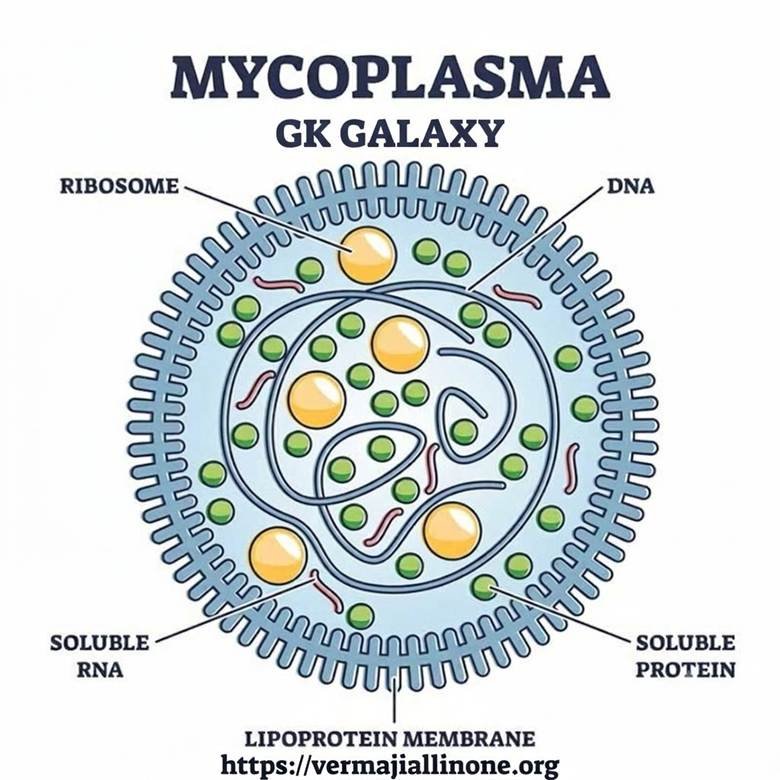
Smallest living cellular organisms
Mycoplasma are among the smallest known living cellular organisms, commonly described as approximately 0.1–0.3 µm in size.
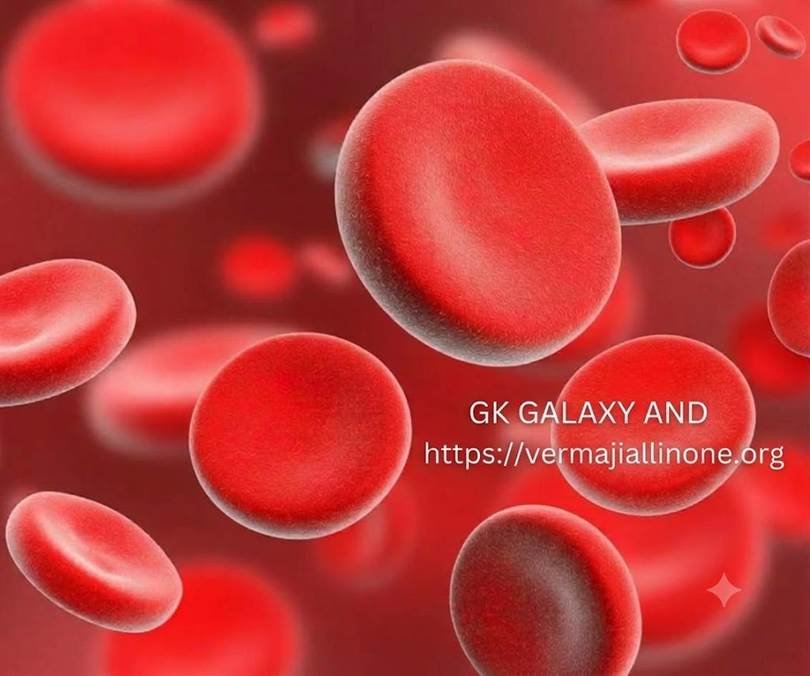
Red blood cell (RBC)
A typical human RBC is about 7–8 µm in diameter and has a biconcave shape that helps in gas transport.
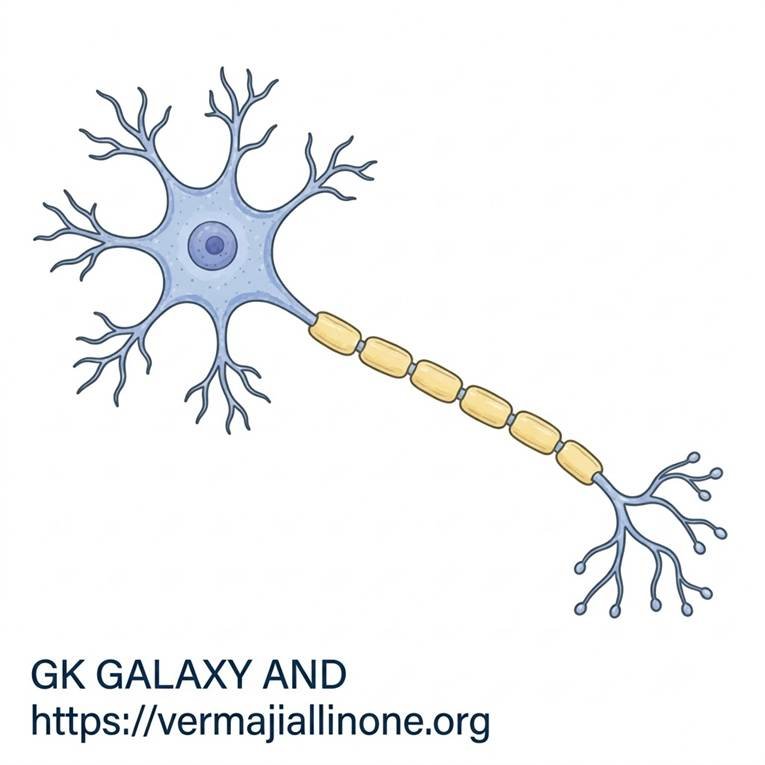
Neuron
Neurons possess specialised extensions for transmitting nerve impulses. Some neurons have very long axons.
Important NEET facts
Small size generally helps cells exchange materials efficiently.
Cell shape is related to its function.
The ostrich egg is a familiar example of a very large single cell.
Some cells, such as mature mammalian RBCs, lack a nucleus.
3. Types of Cells
Cells are broadly classified into two categories.
A. Prokaryotic cells
Examples: bacteria, cyanobacteria and mycoplasmas.
Characteristics:
No membrane-bound nucleus.
Genetic material lies in a region called the nucleoid.
Membrane-bound organelles such as mitochondria, Golgi apparatus and endoplasmic reticulum are absent.
Ribosomes are generally 70S.
Most bacteria possess a cell wall, but mycoplasmas lack one.
Bacterial genetic material is usually a circular DNA molecule; plasmids may also occur.
B. Eukaryotic cells
Examples: protists, fungi, plants and animals.
Characteristics:
Genetic material is enclosed within a membrane-bound nucleus.
Membrane-bound organelles are present.
Cytoplasmic ribosomes include 80S ribosomes; mitochondria and chloroplasts contain 70S-type ribosomes.
Mitosis and meiosis are forms of eukaryotic nuclear division.
| Feature | Prokaryotic cell | Eukaryotic cell |
| True nucleus | Absent | Present |
| Nuclear membrane | Absent | Present |
| Membrane-bound organelles | Absent | Present |
| Cytoplasmic ribosomes | 70S | 80S |
| DNA location | Nucleoid | Mainly nucleus |
| Examples | Bacteria | Plants and animals |
NEET caution: 70S and 80S refer to sedimentation coefficients, not simple additive measurements.
4. Cell Envelope: Glycocalyx, Cell Wall and Plasma Membrane
A. Cell envelope of prokaryotes
The bacterial cell envelope generally consists of three layers:
- Glycocalyx
- Cell wall
- Plasma membrane
Glycocalyx: The outermost covering may occur as a loose slime layer or a thick, tough capsule. A capsule generally provides better protection.
Cell wall: Maintains cell shape and protects against osmotic bursting. In bacteria, it is usually made of peptidoglycan.
Plasma membrane: A selectively permeable membrane that regulates the movement of substances into and out of the cell.
B. Plasma membrane
The plasma membrane is composed mainly of lipids and proteins. Phospholipids form a bilayer, with hydrophilic heads facing the aqueous environments and hydrophobic tails directed inward.
The fluid mosaic model was proposed by S. J. Singer and G. L. Nicolson in 1972.
Important functions:
Selective transport of substances.
Maintenance of the cellular environment.
Cell signalling and recognition.
Endocytosis and exocytosis in appropriate eukaryotic cells.
Transport across membranes includes diffusion, facilitated diffusion and active transport. Active transport can move substances against their concentration or electrochemical gradients and requires energy.
C. Cell wall
Plant cell walls are primarily composed of cellulose, hemicellulose and pectin.
Fungal cell walls contain chitin.
Bacterial cell walls generally contain peptidoglycan.
The middle lamella of plant cells is rich in calcium pectate.
Plasmodesmata connect neighbouring plant cells and permit communication and transport between them.
5. Cytoplasm and Cell Organelles
The cytoplasm includes the cytosol and cellular structures outside the nucleus. Eukaryotic cells contain specialised organelles that perform different functions.
A. Endoplasmic reticulum (ER)
The ER is a network of membrane-bound tubules and sacs.
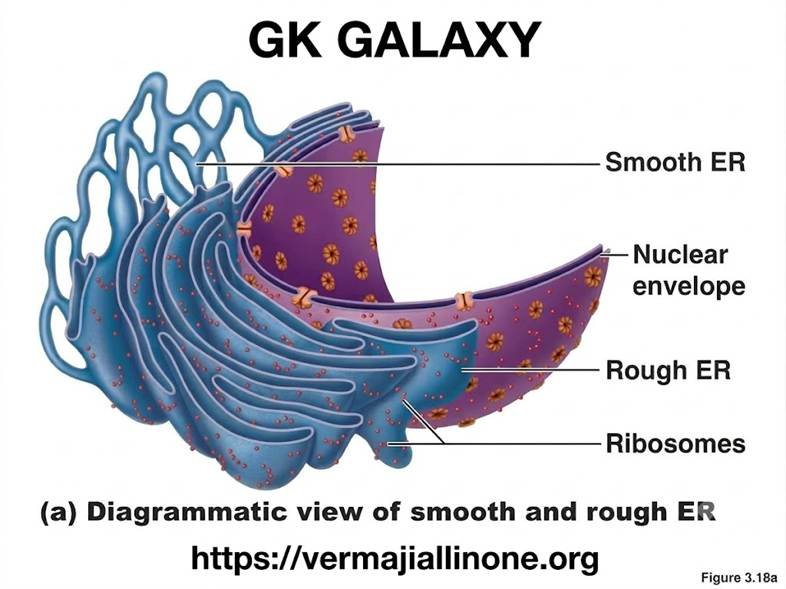
Rough ER (RER)
Ribosomes are attached to its surface.
Synthesises proteins destined for secretion, membranes and certain organelles.
Helps in protein folding and processing.
Smooth ER (SER)
Lacks attached ribosomes.
Participates in lipid synthesis.
In certain cells, helps in detoxification and calcium storage.
B. Golgi apparatus
Discovered by Camillo Golgi in 1898, the Golgi apparatus consists of stacks of flattened membrane-bound sacs called cisternae.
Functions:
Modifies proteins and lipids received from the ER.
Sorts and packages cellular products.
Forms secretory vesicles.
Contributes to lysosome formation.
In plants, participates in the production of certain cell-wall polysaccharides.
The cis face is generally the receiving face, while the trans face is the shipping face.
C. Lysosomes
Lysosomes contain hydrolytic enzymes that digest biological materials.
Functions:
Intracellular digestion.
Breakdown of damaged organelles.
Recycling of cellular components.
Defence against certain engulfed particles.
Lysosomal enzymes work best in an acidic environment. Lysosomes are formed through the endomembrane trafficking system.
D. Vacuoles
Vacuoles are membrane-bound compartments. Their surrounding membrane is called the tonoplast.
Functions:
Storage of water, ions, pigments, nutrients and waste products.
Maintenance of turgor pressure in plant cells.
Regulation of internal conditions.
A large central vacuole is characteristic of many mature plant cells.
E. Mitochondria
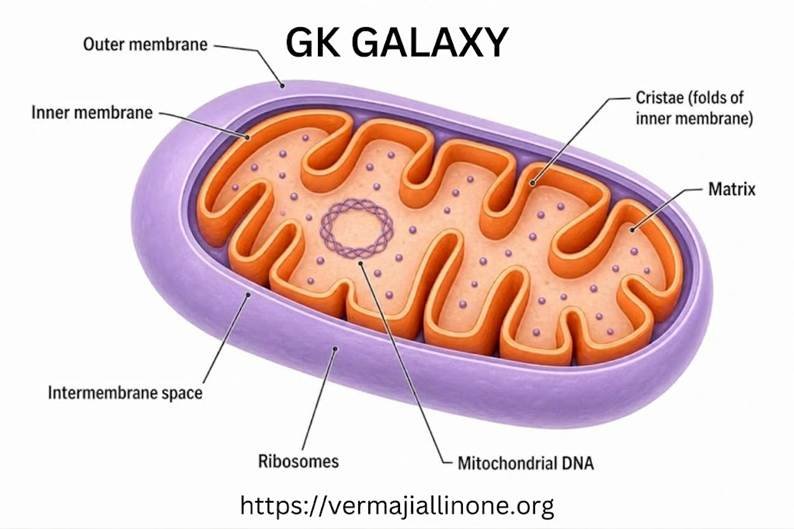
Mitochondria are major sites of aerobic respiration and ATP production in eukaryotic cells.
Structure:
Outer membrane: relatively smooth.
Inner membrane: folded into cristae.
Intermembrane space: space between the two membranes.
Matrix: contains enzymes, mitochondrial DNA and ribosomes.
Functions:
Krebs cycle reactions occur in the matrix.
The electron transport chain and ATP synthesis machinery are associated with the inner membrane.
Mitochondria contain their own DNA and ribosomes and can divide within cells.
They are called semi-autonomous organelles because they possess some genetic and protein-synthesis machinery but depend on the cell for many proteins and functions.
F. Plastids
Plastids are found in plant cells and algae.
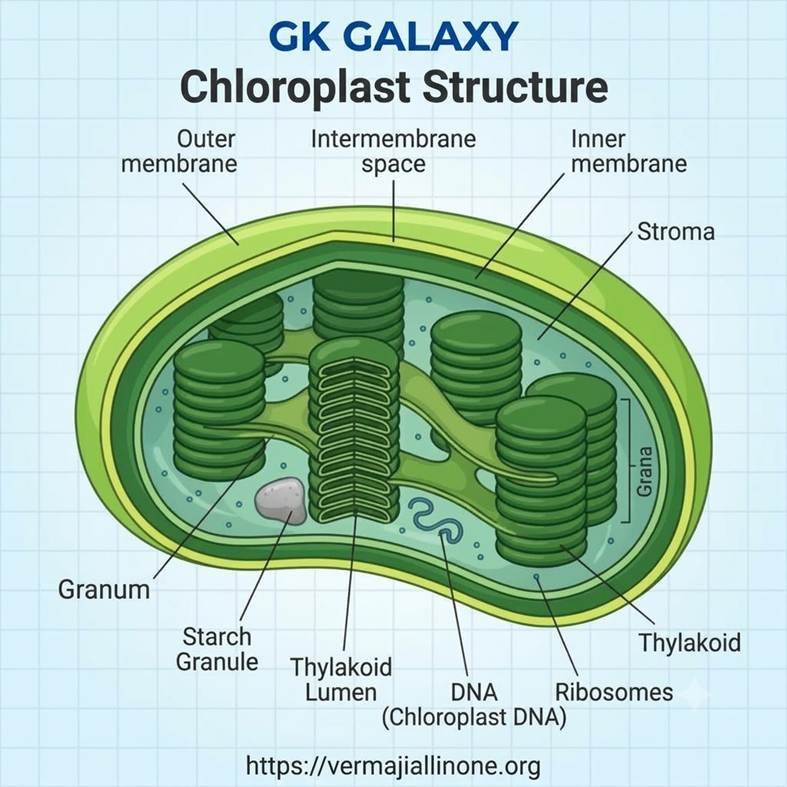
Chloroplasts
Contain chlorophyll and perform photosynthesis.
Thylakoid membranes are arranged in stacks called grana.
Stroma surrounds the thylakoid system.
Chloroplasts possess their own DNA and ribosomes.
Other plastids:
Chromoplasts: contain pigments other than chlorophyll that contribute to yellow, orange or red colours.
Leucoplasts: colourless plastids mainly involved in storage.
| Leucoplast type | Stored substance |
| Amyloplast | Starch |
| Elaioplast | Oils and fats |
| Aleuroplast / protein-storing leucoplast | Proteins |
G. Ribosomes
Ribosomes are the sites of protein synthesis.
Prokaryotic ribosomes: 70S = 50S + 30S.
Eukaryotic cytoplasmic ribosomes: 80S = 60S + 40S.
Mitochondria and chloroplasts contain 70S-type ribosomes in the standard NCERT account.
Ribosomes consist of ribosomal RNA and proteins. The S values are sedimentation coefficients, so the subunit numbers are not arithmetically additive.
H. Cytoskeleton
The cytoskeleton is a network of protein filaments that helps maintain cell shape and organisation.
Microtubules: composed of tubulin; important in spindle formation, cilia and flagella.
Microfilaments: composed mainly of actin; important in movement and contraction.
Intermediate filaments: provide mechanical strength and structural stability.
6. Cilia, Flagella and Centrosome
Cilia and flagella
Eukaryotic cilia and flagella generally contain a 9 + 2 arrangement of microtubules in their axoneme: nine peripheral microtubule doublets surrounding two central microtubules.
Cilia are usually short and numerous.
Flagella are usually longer and fewer.
Dynein arms help produce movement.
The basal body has a different arrangement, typically nine microtubule triplets and no central pair.
Centrosome and centrioles
The centrosome is an important microtubule-organising centre in animal cells.
It usually contains two centrioles arranged approximately at right angles.
Each centriole has nine peripheral microtubule triplets arranged in a ring.
7. Nucleus and Chromosomes
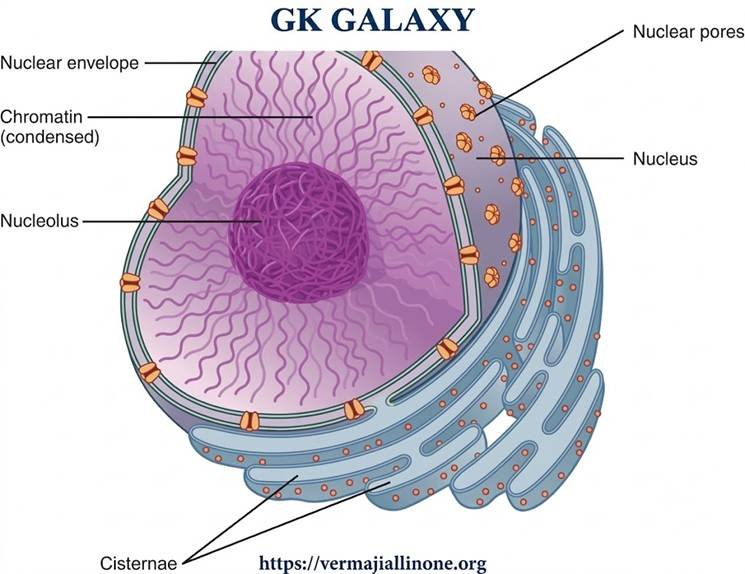
The nucleus contains most of the genetic material in a eukaryotic cell.
Its main components are:
Nuclear envelope: double membrane surrounding the nucleus.
Nuclear pores: regulate transport between nucleus and cytoplasm.
Nucleoplasm: internal fluid matrix.
Chromatin: DNA associated with proteins.
Nucleolus: region involved in ribosomal RNA production and ribosome-subunit assembly.
During cell division, chromatin becomes more condensed and forms visible chromosomes.
A chromosome consists of DNA and associated proteins. After DNA replication, a duplicated chromosome consists of two sister chromatids joined at the centromere region.
8. Prokaryotic Cell Structures
Important bacterial structures include:
Nucleoid: region containing the main chromosome.
Plasmids: extra-chromosomal DNA molecules that can replicate independently.
Inclusion bodies: store materials such as phosphate or glycogen.
Pili and fimbriae: involved in attachment; specialised pili can participate in DNA transfer.
Flagella: help in locomotion in many bacteria.
Mesosomes: described in older textbook accounts as membrane infoldings, but these are now generally regarded as preparation artefacts rather than genuine structures in living bacteria.
9. Endomembrane System
The endomembrane system includes the endoplasmic reticulum, Golgi apparatus, lysosomes and vacuoles.
These components work together in the synthesis, modification, packaging, transport and digestion of cellular materials.
Not included in the classical NCERT endomembrane system: mitochondria, chloroplasts and peroxisomes.
10. Quick Revision Table
| Structure | Key function / identification |
| Nucleus | Genetic control and DNA storage |
| Nucleolus | rRNA production and ribosome assembly |
| Ribosome | Protein synthesis |
| RER | Synthesis of secreted and membrane proteins |
| SER | Lipid synthesis |
| Golgi apparatus | Modification, sorting and packaging |
| Lysosome | Intracellular digestion |
| Mitochondrion | Aerobic respiration and ATP synthesis |
| Chloroplast | Photosynthesis |
| Vacuole | Storage and, in plants, turgor maintenance |
| Cytoskeleton | Shape, organisation and movement |
| Centriole | Microtubule organisation in relevant cells |
Part 2: NEET Previous-Year MCQs (PYQs)
Section A: Cell Theory and Types of Cells
Q1. Cell theory was formulated by whom?
Exam: NEET-UG 2026 Re-examination
A. Robert Brown
B. Schleiden and Schwann
C. Singer and Nicolson
D. Antonie van Leeuwenhoek
Correct Answer: B. Schleiden and Schwann
Explanation: Matthias Schleiden studied plants, while Theodor Schwann studied animals. Their work established that plants and animals are composed of cells. Virchow later emphasised that new cells arise from pre-existing cells.
Q2. Which of the following are characteristics of prokaryotic cells?
Exam: NEET-UG 2026 Re-examination
(a) Ribosomes have 50S and 30S subunits.
(b) They can possess plasmids.
(c) They contain mesosomes as genuine structures in living cells.
(d) They have peroxisomes.
Choose the correct option.
A. (a) and (b) only
B. (a), (b) and (c) only
C. (b), (c) and (d) only
D. (a), (b), (c) and (d)
Correct Answer: A. (a) and (b) only
Explanation: Prokaryotic ribosomes have 50S and 30S subunits, and many prokaryotes possess plasmids. Mesosomes described in older accounts are generally regarded as preparation artefacts, and prokaryotes do not possess membrane-bound peroxisomes.
Q3. Which scientist discovered the nucleus?
Exam: NEET/AIPMT
A. Robert Hooke
B. Robert Brown
C. Theodor Schwann
D. Rudolf Virchow
Correct Answer: B. Robert Brown
Explanation: Robert Brown described the nucleus in plant cells in 1831. Robert Hooke had earlier observed cork compartments and introduced the term cell.
Q4. Which statement about Mycoplasma is correct?
Exam: NEET/AIPMT
A. It possesses a cellulose cell wall.
B. It possesses a peptidoglycan cell wall.
C. It lacks a cell wall.
D. It has a membrane-bound nucleus.
Correct Answer: C. It lacks a cell wall.
Explanation: Mycoplasmas are wall-less prokaryotic organisms. They do not possess a membrane-bound nucleus or typical eukaryotic membrane-bound organelles.
Section B: Plasma Membrane and Cell Envelope
Q5. Who proposed the fluid mosaic model of the plasma membrane?
Exam: NEET/AIPMT
A. Schleiden and Schwann
B. Singer and Nicolson
C. Watson and Crick
D. Meselson and Stahl
Correct Answer: B. Singer and Nicolson
Explanation: S. J. Singer and G. L. Nicolson proposed the fluid mosaic model in 1972. It describes the membrane as a fluid lipid bilayer containing embedded proteins.
Q6. The bacterial cell wall is primarily composed of which substance?
Exam: NEET/AIPMT
A. Cellulose
B. Chitin
C. Peptidoglycan
D. Calcium pectate
Correct Answer: C. Peptidoglycan
Explanation: Most bacterial cell walls contain peptidoglycan. Plant cell walls are mainly cellulose-based, fungal cell walls contain chitin, and the plant middle lamella is rich in calcium pectate.
Section C: Endoplasmic Reticulum and Golgi Apparatus
Q7. Smooth endoplasmic reticulum is primarily associated with which function?
Exam: NEET-UG 2026 Re-examination
A. Protein synthesis by attached ribosomes
B. Lipid synthesis
C. Chromosome separation
D. Formation of the mitotic spindle
Correct Answer: B. Lipid synthesis
Explanation: Smooth ER lacks attached ribosomes and participates in lipid synthesis. Rough ER bears ribosomes and is involved in synthesising proteins destined for secretion, membranes and certain organelles.
Q8. The flattened sacs of the Golgi apparatus are called:
Exam: NEET/AIPMT
A. Cristae
B. Cisternae
C. Thylakoids
D. Grana
Correct Answer: B. Cisternae
Explanation: Cisternae are the flattened membrane-bound sacs of the Golgi apparatus. Cristae are folds of the mitochondrial inner membrane, while thylakoids are membrane compartments in chloroplasts.
Section D: Mitochondria and Plastids
Q9. The inner membrane of a mitochondrion encloses which compartment?
Exam: NEET-UG 2026 Re-examination
A. Nucleoplasm
B. Matrix
C. Chloroplast stroma
D. Cytosol only
Correct Answer: B. Matrix
Explanation: The mitochondrial inner membrane surrounds the matrix. The matrix contains enzymes involved in the Krebs cycle, mitochondrial DNA and ribosomes. The inner membrane contains components of the electron transport chain and ATP synthase.
Q10. Which plastid is associated with storing starch?
Exam: NEET/AIPMT
A. Chromoplast
B. Amyloplast
C. Chloroplast
D. Elaioplast
Correct Answer: B. Amyloplast
Explanation: Amyloplasts are starch-storing leucoplasts. Elaioplasts store oils and fats, while chromoplasts contain pigments that contribute to the colour of plant parts.
Q11. Which statement correctly describes mitochondria and chloroplasts?
Exam: NEET/AIPMT
A. Both lack their own DNA.
B. Both are semi-autonomous organelles.
C. Both occur in all animal cells.
D. Both lack ribosomes.
Correct Answer: B. Both are semi-autonomous organelles.
Explanation: Mitochondria and chloroplasts possess their own DNA and ribosomes and can divide within cells. However, many of their proteins are encoded by nuclear genes and supplied by the cell.
Section E: Ribosomes, Nucleus and Cell Structures
Q12. The ribosomes found in the prokaryotic cytoplasm are generally:
Exam: NEET-UG 2025
A. 50S
B. 60S
C. 70S
D. 80S
Correct Answer: C. 70S
Explanation: Prokaryotic cytoplasmic ribosomes are 70S, consisting of 50S and 30S subunits. Eukaryotic cytoplasmic ribosomes are 80S, consisting of 60S and 40S subunits. The S values are sedimentation coefficients.
Q13. Which nuclear structure is primarily involved in ribosomal RNA production and ribosome-subunit assembly?
Exam: NEET/AIPMT
A. Nuclear pore
B. Nucleolus
C. Centromere
D. Plasma membrane
Correct Answer: B. Nucleolus
Explanation: The nucleolus is a region within the nucleus where most ribosomal RNA is produced and ribosomal subunits are assembled.
Q14. The typical axoneme of a eukaryotic cilium has which microtubule arrangement?
Exam: NEET/AIPMT
A. 9 + 0
B. 9 + 2
C. 8 + 2
D. 9 + 3
Correct Answer: B. 9 + 2
Explanation: The typical motile eukaryotic ciliary or flagellar axoneme contains nine peripheral microtubule doublets and two central microtubules. The basal body generally has nine peripheral triplets.
Q15. Which of the following belongs to the classical endomembrane system?
Exam: NEET-UG 2026
A. Mitochondria, chloroplasts and peroxisomes
B. ER, Golgi apparatus, lysosomes and vacuoles
C. Mitochondria, ribosomes and nucleus
D. Chloroplasts, centrioles and ribosomes
Correct Answer: B. ER, Golgi apparatus, lysosomes and vacuoles
Explanation: These structures coordinate synthesis, modification, packaging, transport and intracellular digestion. Mitochondria, chloroplasts and peroxisomes are not included in the classical NCERT endomembrane system.
16. Which of the following is NOT a cell organelle?
Exam: NEET-UG 2018
A. Golgi apparatus
B. Lysosomes
C. Mitochondria
D. Viruses
Correct Answer: D. Viruses
Explanation: Viruses are acellular infectious agents, not cellular organelles. They lack the complete cellular machinery required for independent metabolism and reproduction. Golgi apparatus, lysosomes and mitochondria are cellular organelles.
Q17. Which of the following is NOT a function of the cell membrane?
Exam: NEET-UG 2017
A. Protection of the cell
B. Transport of materials
C. Cell division
D. Regulation of substances entering and leaving the cell
Correct Answer: C. Cell division
Explanation: The plasma membrane protects the cell and regulates material transport. Cell division is a coordinated process involving cellular structures and regulatory machinery; it is not a primary function of the plasma membrane.
Q18. Which of the following is NOT a component of the plant cell wall?
Exam: NEET-UG 2016
A. Cellulose
B. Chitin
C. Lignin
D. Peptidoglycan
Correct Answer: B. Chitin
Explanation: Cellulose is a major structural component of plant cell walls, while lignin strengthens many specialised plant cell walls. Chitin is characteristic of fungal cell walls. Peptidoglycan is characteristic of most bacterial cell walls.
Q19. Which of the following is a characteristic of plasmids?
Exam: NEET-UG 2016 Phase I
A. They cannot replicate independently.
B. They are always single-stranded DNA molecules.
C. They may replicate independently of the main bacterial chromosome.
D. They are membrane-bound organelles.
Correct Answer: C. They may replicate independently of the main bacterial chromosome.
Explanation: Plasmids are extra-chromosomal DNA molecules, commonly circular and double-stranded in bacteria. They possess replication origins that allow them to replicate independently of the main chromosome. Some plasmids carry genes associated with antibiotic resistance.
Q20. Select the INCORRECT statement about bacterial cells.
Exams: NEET-UG 2016 Phase II and NEET-UG 2018
A. The bacterial cell wall generally contains peptidoglycan.
B. Pili and fimbriae are mainly involved in the motility of bacterial cells.
C. Cyanobacteria lack flagellated cells.
D. Mycoplasma is a wall-less microorganism.
Correct Answer: B. Pili and fimbriae are mainly involved in the motility of bacterial cells.
Explanation: Pili and fimbriae primarily assist attachment to surfaces or other cells. Some specialised pili participate in DNA transfer, and certain pili can contribute to surface-associated movement. Bacterial flagella are the principal locomotory structures in many motile bacteria.
Q21. Which cell organelle contains hydrolytic enzymes responsible for intracellular digestion?
Exam: NEET-UG 2016 Phase I
A. Lysosome
B. Microsome
C. Ribosome
D. Mesosome
Correct Answer: A. Lysosome
Explanation: Lysosomes contain hydrolytic enzymes that digest macromolecules, engulfed material and damaged cellular components. Their acidic internal environment supports the activity of these enzymes.
Section G: Additional NCERT-Based Practice MCQs
Q22. Which organelle modifies and packages proteins received from the endoplasmic reticulum?
A. Golgi apparatus
B. Centriole
C. Nucleolus
D. Peroxisome
Correct Answer: A. Golgi apparatus
Explanation: The Golgi apparatus modifies, sorts and packages proteins and lipids into vesicles for delivery to appropriate destinations.
Q23. Which structure connects adjacent plant cells through their cell walls?
A. Cristae
B. Plasmodesmata
C. Centromeres
D. Nuclear pores
Correct Answer: B. Plasmodesmata
Explanation: Plasmodesmata are microscopic channels that pass through plant cell walls and facilitate communication and transport between neighbouring cells.
Q24. Which structure is responsible for ATP synthesis during oxidative phosphorylation in mitochondria?
A. Outer mitochondrial membrane
B. Inner mitochondrial membrane
C. Nuclear envelope
D. Golgi membrane
Correct Answer: B. Inner mitochondrial membrane
Explanation: The electron transport chain establishes a proton gradient across the inner mitochondrial membrane. ATP synthase uses this gradient to synthesise ATP.
Q25. The middle lamella of plant cells is mainly associated with which substance?
A. Calcium pectate
B. Peptidoglycan
C. Chitin
D. Tubulin
Correct Answer: A. Calcium pectate
Explanation: The middle lamella is rich in pectic substances, especially calcium pectate, which helps cement adjacent plant cells together.
Q26. Which of the following is correctly matched?
A. Cristae — Golgi apparatus
B. Thylakoids — Chloroplast
C. Cisternae — Mitochondrial matrix
D. Nucleolus — Lipid synthesis
Correct Answer: B. Thylakoids — Chloroplast
Explanation: Thylakoids are flattened membrane compartments in chloroplasts. Cristae are folds of the mitochondrial inner membrane, cisternae are flattened sacs in structures such as the Golgi apparatus, and the nucleolus is involved in ribosome production.
Section H: Confirmed NEET PYQs — 2024 and 2026
Q27. Match List I with List II.
Exam: NEET-UG 2024
| List I | List II |
| A. Nucleolus | I. Site of formation of glycolipid |
| B. Centriole | II. Organisation like a cartwheel |
| C. Leucoplasts | III. Site of active ribosomal RNA synthesis |
| D. Golgi apparatus | IV. For storing nutrients |
Choose the correct matching.
A. A–III, B–II, C–IV, D–I
B. A–II, B–III, C–I, D–IV
C. A–IV, B–I, C–III, D–II
D. A–I, B–IV, C–II, D–III
Correct Answer: A. A–III, B–II, C–IV, D–I
Explanation:
Nucleolus: involved in rRNA synthesis and ribosome-subunit assembly.
Centriole: has nine peripheral microtubule triplets arranged in a cartwheel-like pattern.
Leucoplasts: colourless plastids involved in nutrient storage.
Golgi apparatus: involved in the formation and processing of glycolipids and other cellular products.
Q28. The DNA present in chloroplasts is generally:
Exam: NEET-UG 2024
A. Linear and single-stranded
B. Circular and double-stranded
C. Linear and double-stranded, with no replication
D. Absent from mature chloroplasts
Correct Answer: B. Circular and double-stranded
Explanation: Chloroplasts possess their own DNA, generally circular and double-stranded, along with ribosomes. This supports their semi-autonomous nature. They nevertheless depend on nuclear genes for many of their proteins.
Q29. Match List I with List II.
Exam: NEET-UG 2024
| List I | List II |
| A. Axoneme | I. Centriole |
| B. Cartwheel pattern | II. Cilia and flagella |
| C. Crista | III. Chromosome |
| D. Satellite | IV. Mitochondria |
Choose the correct matching.
A. A–II, B–I, C–IV, D–III
B. A–I, B–II, C–III, D–IV
C. A–IV, B–III, C–I, D–II
D. A–III, B–IV, C–II, D–I
Correct Answer: A. A–II, B–I, C–IV, D–III
Explanation:
Axoneme: structural core of eukaryotic cilia and flagella.
Cartwheel pattern: characteristic arrangement of centriole microtubules.
Cristae: folds of the inner mitochondrial membrane.
Chromosomal satellite: a small chromosome segment separated from the main body by a secondary constriction.
Q30. Consider the following statements.
Exam: NEET-UG 2024
Statement I: Mitochondria and chloroplasts are both surrounded by double membranes.
Statement II: The inner membrane of mitochondria is relatively less permeable than the outer membrane.
Choose the correct answer.
A. Both statements are correct.
B. Both statements are incorrect.
C. Statement I is correct, but Statement II is incorrect.
D. Statement I is incorrect, but Statement II is correct.
Correct Answer: A. Both statements are correct.
Explanation: Both mitochondria and chloroplasts possess outer and inner membranes. The mitochondrial inner membrane is highly selective and maintains the proton gradient needed for ATP synthesis. The outer membrane is comparatively more permeable to small molecules.
Section I: More NEET-Level Practice Questions
Q31. Which of the following correctly describes the nuclear envelope?
A. It consists of a single membrane without pores.
B. It consists of two membranes and contains nuclear pores.
C. It is composed exclusively of cellulose.
D. It is absent in all eukaryotic cells.
Correct Answer: B. It consists of two membranes and contains nuclear pores.
Explanation: The nuclear envelope consists of inner and outer membranes. Nuclear pores regulate the exchange of molecules between the nucleus and cytoplasm.
Q32. Which structure is directly involved in the formation of the spindle apparatus in typical animal cells?
A. Centrioles and associated microtubule-organising machinery
B. Lysosomes
C. Golgi cisternae
D. Smooth ER only
Correct Answer: A. Centrioles and associated microtubule-organising machinery
Explanation: The centrosome is a major microtubule-organising centre in animal cells. Its centrioles are associated with spindle organisation, although the centrioles themselves do not directly form the spindle microtubules.
Q33. Which cellular structure is primarily responsible for the selective movement of substances across the cell boundary?
A. Nucleolus
B. Plasma membrane
C. Chromatin
D. Ribosome
Correct Answer: B. Plasma membrane
Explanation: The plasma membrane is selectively permeable and regulates the movement of ions, nutrients, gases and waste products.
Q34. Which of the following organelles is associated with intracellular detoxification and lipid synthesis?
A. Smooth endoplasmic reticulum
B. Nucleolus
C. Centriole
D. Chromosome
Correct Answer: A. Smooth endoplasmic reticulum
Explanation: Smooth ER synthesises lipids and participates in detoxification in certain cells, including liver cells.
Q35. Which statement about the Golgi apparatus is correct?
A. The cis face is generally associated with receiving material from the ER.
B. The trans face is the principal site of DNA replication.
C. Golgi cisternae contain the cell’s main chromosome.
D. The Golgi apparatus is the primary site of aerobic respiration.
Correct Answer: A. The cis face is generally associated with receiving material from the ER.
Explanation: The cis face receives transport vesicles from the ER. The Golgi apparatus modifies, sorts and packages materials, which are then directed to their appropriate destinations.
Q37. Which statement correctly describes eukaryotic and prokaryotic ribosomes?
Exam: NEET-UG 2025
A. Eukaryotic cytoplasmic ribosomes are 70S, while prokaryotic ribosomes are 80S.
B. Eukaryotic cytoplasmic ribosomes are 80S, while prokaryotic ribosomes are 70S.
C. Both are 80S.
D. Both are 70S.
Correct Answer: B. Eukaryotic cytoplasmic ribosomes are 80S, while prokaryotic ribosomes are 70S.
Explanation: Eukaryotic cytoplasmic ribosomes consist of 60S and 40S subunits. Prokaryotic ribosomes consist of 50S and 30S subunits. Mitochondria and chloroplasts contain 70S-type ribosomes in the standard NCERT account.
Section K: NCERT-Based Practice MCQs
Q38. Which of the following is a protein-storing leucoplast?
A. Amyloplast
B. Elaioplast
C. Aleuroplast
D. Chloroplast
Correct Answer: C. Aleuroplast
Explanation: Leucoplasts are colourless plastids. Amyloplasts store starch, elaioplasts store oils and fats, and aleuroplasts store proteins.
Q39. Which of the following structures is associated with the breakdown of hydrogen peroxide in cells?
A. Peroxisome
B. Ribosome
C. Nucleolus
D. Centriole
Correct Answer: A. Peroxisome
Explanation: Peroxisomes contain oxidative enzymes, including catalase, which helps convert hydrogen peroxide into water and oxygen. They are distinct from lysosomes, which contain hydrolytic enzymes.
Q40. Which component of a chromosome is primarily responsible for holding sister chromatids together and providing the region where the kinetochore forms?
A. Nucleolus
B. Centromere
C. Nuclear pore
D. Ribosome
Correct Answer: B. Centromere
Explanation: The centromere is the specialised chromosome region where the kinetochore forms. Spindle microtubules attach to the kinetochore during cell division. Cohesin proteins help maintain sister-chromatid cohesion until separation.
Q41. Which of the following is NOT a major component of the cytoskeleton?
A. Microtubules
B. Microfilaments
C. Intermediate filaments
D. Chromatin fibres
Correct Answer: D. Chromatin fibres
Explanation: The cytoskeleton consists principally of microtubules, microfilaments and intermediate filaments. Chromatin is composed of DNA and associated proteins and is located primarily in the nucleus.
Q42. Which type of membrane transport requires cellular energy to move substances against their electrochemical gradient?
A. Simple diffusion
B. Osmosis
C. Active transport
D. Facilitated diffusion
Correct Answer: C. Active transport
Explanation: Active transport moves substances against their concentration or electrochemical gradients and requires energy, directly or indirectly. Simple diffusion, osmosis and facilitated diffusion are passive processes.
Q43. Which of the following is correctly matched?
A. Peroxisome — oxidative enzymes
B. Ribosome — lipid storage
C. Lysosome — photosynthesis
D. Nucleolus — ATP production by oxidative phosphorylation
Correct Answer: A. Peroxisome — oxidative enzymes
Explanation: Peroxisomes contain enzymes involved in oxidative reactions and hydrogen peroxide breakdown. Ribosomes synthesise proteins, lysosomes digest cellular materials, and oxidative phosphorylation occurs at the inner mitochondrial membrane.
Question 44. Which of the following cell organelles is primarily responsible for the modification, packaging, and dispatch of proteins?
(A) Lysosome
(B) Golgi apparatus
(C) Mitochondrion
(D) Ribosome
Correct Answer: (B) Golgi apparatus
Explanation: The Golgi apparatus modifies, sorts, packages, and dispatches proteins and lipids received from the endoplasmic reticulum. It also participates in the formation of lysosomes and secretory vesicles.
Question 45. Which of the following organelles contains hydrolytic enzymes responsible for intracellular digestion?
(A) Peroxisome
(B) Lysosome
(C) Ribosome
(D) Centrosome
Correct Answer: (B) Lysosome
Explanation: Lysosomes contain hydrolytic enzymes that digest macromolecules, worn-out organelles, and certain foreign materials. They function best in an acidic internal environment and are often described as the digestive compartments of the cell.
Question 46. The 70S ribosome consists of which two subunits?
(A) 40S and 30S
(B) 50S and 30S
(C) 60S and 40S
(D) 50S and 40S
Correct Answer: (B) 50S and 30S
Explanation: A 70S ribosome consists of a large 50S subunit and a small 30S subunit. The Svedberg (S) unit measures sedimentation behaviour, so the values are not arithmetically additive in the ordinary sense. Prokaryotic ribosomes are typically 70S, whereas cytoplasmic ribosomes of eukaryotes are typically 80S.
Question 47. Which of the following structures is present in both prokaryotic and eukaryotic cells?
(A) Membrane-bound nucleus
(B) Mitochondrion
(C) Ribosome
(D) Golgi apparatus
Correct Answer: (C) Ribosome
Explanation: Ribosomes occur in both prokaryotic and eukaryotic cells and are the sites of protein synthesis. Prokaryotes lack a membrane-bound nucleus and membrane-bound organelles such as mitochondria and the Golgi apparatus.
Question 48. Which component of the plasma membrane is mainly responsible for its selective permeability and structural framework?
(A) Phospholipid bilayer
(B) Cellulose layer
(C) Peptidoglycan layer
(D) Nuclear envelope
Correct Answer: (A) Phospholipid bilayer
Explanation: The plasma membrane is primarily composed of a phospholipid bilayer with embedded proteins. Its hydrophobic interior restricts the free passage of many polar and charged substances, while membrane proteins help transport specific molecules across it.
Question 49. Which organelle is associated with the synthesis of lipids, including many membrane lipids?
(A) Rough endoplasmic reticulum
(B) Smooth endoplasmic reticulum
(C) Lysosome
(D) Nucleolus
Correct Answer: (B) Smooth endoplasmic reticulum
Explanation: The smooth endoplasmic reticulum (SER) participates in lipid synthesis and detoxification of certain chemicals. The rough endoplasmic reticulum (RER), which bears ribosomes, is primarily involved in the synthesis and processing of proteins destined for secretion, membranes, or certain organelles.
Question 50. Which of the following is the primary site of aerobic respiration in a typical eukaryotic cell?
(A) Golgi apparatus
(B) Mitochondrion
(C) Lysosome
(D) Vacuole
Correct Answer: (B) Mitochondrion
Explanation: Mitochondria are the principal sites of aerobic respiration in eukaryotic cells. The Krebs cycle occurs mainly in the mitochondrial matrix, while the electron transport chain and oxidative phosphorylation occur at the inner mitochondrial membrane. Glycolysis takes place in the cytoplasm.
Question 51. The nucleolus is primarily involved in which cellular activity?
(A) Lipid synthesis
(B) Ribosomal RNA synthesis and ribosome subunit assembly
(C) ATP production
(D) Intracellular digestion
Correct Answer: (B) Ribosomal RNA synthesis and ribosome subunit assembly
Explanation: The nucleolus is a dense region inside the nucleus where most ribosomal RNA (rRNA) is produced and ribosomal subunits are assembled. These subunits are subsequently transported to the cytoplasm, where they participate in protein synthesis.
Question 52. Which of the following structures is characteristic of plant cells and is mainly composed of cellulose?
(A) Plasma membrane
(B) Cell wall
(C) Nuclear membrane
(D) Tonoplast
Correct Answer: (B) Cell wall
Explanation: The plant cell wall provides mechanical strength, protection, and shape. Its main structural component is cellulose. The tonoplast, by contrast, is the membrane surrounding the vacuole.
Question 53. Which of the following organelles contains catalase and participates in the breakdown of hydrogen peroxide?
(A) Peroxisome
(B) Ribosome
(C) Golgi apparatus
(D) Nucleolus
Correct Answer: (A) Peroxisome
Explanation: Peroxisomes contain oxidative enzymes, including catalase, which converts hydrogen peroxide into water and oxygen. This helps protect cells from the harmful effects of hydrogen peroxide.
Question 54. Which statement about prokaryotic cells is correct?
(A) They possess a membrane-bound nucleus.
(B) They contain mitochondria.
(C) Their genetic material is located in a nucleoid region.
(D) They always possess a cell wall made of cellulose.
Correct Answer: (C) Their genetic material is located in a nucleoid region.
Explanation: Prokaryotic cells lack a membrane-bound nucleus. Their principal genetic material is located in a region called the nucleoid. Bacteria generally possess peptidoglycan cell walls, whereas archaeal cell walls lack bacterial peptidoglycan. Some prokaryotes do not have a cell wall.
Question 55. Which of the following statements about mitochondria is correct?
(A) They lack their own genetic material.
(B) They possess their own DNA and ribosomes.
(C) They are the sites of photosynthesis in all eukaryotic cells.
(D) They are surrounded by a single membrane.
Correct Answer: (B) They possess their own DNA and ribosomes.
Explanation: Mitochondria contain their own DNA and ribosomes and are surrounded by two membranes. Their ability to replicate and express some of their own genetic information supports the endosymbiotic theory of their evolutionary origin.
Question 56. Which of the following is the correct function of the centrosome in many animal cells?
(A) Synthesis of cellulose
(B) Organisation of microtubules and participation in spindle formation
(C) Production of digestive enzymes
(D) Modification of secretory proteins
Correct Answer: (B) Organisation of microtubules and participation in spindle formation
Explanation: The centrosome is a major microtubule-organising centre in many animal cells. It helps organise the mitotic spindle during cell division. A typical animal-cell centrosome contains a pair of centrioles surrounded by pericentriolar material.
Exam reference: NEET-UG practice question
Question 57. Which of the following structures is directly involved in the movement of cilia and flagella in eukaryotic cells?
(A) Microtubules
(B) Cellulose microfibrils
(C) Intermediate filaments alone
(D) Peptidoglycan
Correct Answer: (A) Microtubules
Explanation: Eukaryotic cilia and flagella generally possess a characteristic arrangement of microtubules called the 9+2 arrangement in their motile axoneme. Dynein motor proteins generate sliding between microtubule doublets, producing movement.
Exam reference: NEET-UG practice question
Question 58. Which of the following is the correct statement regarding the plant vacuole?
(A) It is surrounded by the tonoplast.
(B) It contains the cell’s chromosomes in all plant cells.
(C) It is the main site of ribosome assembly.
(D) It is absent from mature plant cells.
Correct Answer: (A) It is surrounded by the tonoplast.
Explanation: The tonoplast is the membrane surrounding the vacuole. The central vacuole of many mature plant cells stores water, ions, pigments, and other substances and helps maintain turgor pressure.
Exam reference: NEET-UG practice question
Question 59. Which of the following is NOT a component of the endomembrane system of a eukaryotic cell?
(A) Endoplasmic reticulum
(B) Golgi apparatus
(C) Lysosome
(D) Mitochondrion
Correct Answer: (D) Mitochondrion
Explanation: The endomembrane system includes structures such as the endoplasmic reticulum, Golgi apparatus, lysosomes, and vesicles that coordinate synthesis, modification, packaging, and transport. Mitochondria are not considered part of this system because their functions and membrane organisation are distinct.
Exam reference: NEET-UG practice question
Question 60. Which of the following is correctly matched?
(A) Ribosome — Lipid synthesis
(B) Lysosome — Intracellular digestion
(C) Nucleolus — ATP production
(D) Golgi apparatus — Photosynthesis
Correct Answer: (B) Lysosome — Intracellular digestion
Explanation: Lysosomes contain digestive enzymes. Ribosomes synthesise proteins, the nucleolus participates in ribosome biogenesis, and photosynthesis occurs in chloroplasts in photosynthetic eukaryotes.
Exam reference: NEET-UG practice question
Quick Revision: Questions 44–60
| Structure or organelle | Main function |
| Golgi apparatus | Modification, sorting and packaging |
| Lysosome | Intracellular digestion |
| Ribosome | Protein synthesis |
| Plasma membrane | Selective transport and cell boundary |
| Smooth ER | Lipid synthesis and detoxification |
| Mitochondrion | Aerobic respiration |
| Nucleolus | rRNA production and ribosome assembly |
| Plant cell wall | Support and protection |
| Peroxisome | Oxidative reactions; hydrogen peroxide breakdown |
| Centrosome | Microtubule organisation |
| Cilia and flagella | Movement |
| Vacuole | Storage and maintenance of turgor |
| Endomembrane system | Intracellular synthesis and transport |
Question 61. Which of the following is a characteristic feature of the fluid mosaic model of the plasma membrane?
(A) Proteins form a rigid layer outside the phospholipids.
(B) Phospholipids and many membrane proteins can move laterally within the membrane.
(C) The membrane consists exclusively of proteins.
(D) The membrane is completely impermeable to all substances.
Correct Answer: (B) Phospholipids and many membrane proteins can move laterally within the membrane.
Explanation: The fluid mosaic model, proposed by Singer and Nicolson in 1972, describes the plasma membrane as a dynamic phospholipid bilayer containing proteins. Many membrane components can move laterally, although some are restricted by interactions with the cytoskeleton or other structures.
Exam reference: NEET-UG practice question
Question 62. Which type of junction prevents the leakage of substances between adjacent epithelial cells?
(A) Gap junction
(B) Tight junction
(C) Plasmodesmata
(D) Desmosome
Correct Answer: (B) Tight junction
Explanation: Tight junctions form seals between adjacent cells and help prevent substances from passing through the spaces between them. Gap junctions allow communication between neighbouring animal cells, while desmosomes provide strong mechanical attachment.
Exam reference: NEET-UG practice question
Question 63. Which of the following is correctly associated with the rough endoplasmic reticulum?
(A) Protein synthesis by attached ribosomes
(B) ATP production by oxidative phosphorylation
(C) Intracellular digestion by hydrolytic enzymes
(D) Photosynthetic carbon fixation
Correct Answer: (A) Protein synthesis by attached ribosomes
Explanation: The rough endoplasmic reticulum has ribosomes attached to its cytoplasmic surface. It helps synthesise and process proteins destined for secretion, membranes, and certain cellular compartments. ATP production by oxidative phosphorylation occurs at the inner mitochondrial membrane.
Exam reference: NEET-UG practice question
Question 64. Which of the following structures is present in the chloroplast and contains chlorophyll?
(A) Stroma
(B) Thylakoid membrane
(C) Outer mitochondrial membrane
(D) Nuclear matrix
Correct Answer: (B) Thylakoid membrane
Explanation: Chlorophyll and other photosynthetic pigments are embedded in the thylakoid membranes of chloroplasts. The light-dependent reactions of photosynthesis take place in these membranes. The stroma contains enzymes involved in the Calvin cycle.
Exam reference: NEET-UG practice question
Question 65. Which cellular structure forms the boundary between the cytoplasm and the nucleus?
(A) Plasma membrane
(B) Nuclear envelope
(C) Tonoplast
(D) Cell wall
Correct Answer: (B) Nuclear envelope
Explanation: The nuclear envelope consists of two membranes and surrounds the nucleus in eukaryotic cells. Nuclear pores regulate the movement of RNA, proteins, and other molecules between the nucleus and cytoplasm.
Exam reference: NEET-UG practice question
Question 66. Which of the following is a function of the cytoskeleton?
(A) Providing structural support and facilitating intracellular movement
(B) Producing all cellular ATP
(C) Storing hereditary information exclusively
(D) Synthesising cellulose in every cell
Correct Answer: (A) Providing structural support and facilitating intracellular movement
Explanation: The cytoskeleton consists mainly of microtubules, microfilaments, and intermediate filaments. It helps maintain cell shape, organise organelles, support intracellular transport, and participate in cell division and movement.
Exam reference: NEET-UG practice question
Question 67. Which of the following is the main structural component of the cell wall of most fungi?
(A) Cellulose
(B) Peptidoglycan
(C) Chitin
(D) Glycogen
Correct Answer: (C) Chitin
Explanation: Chitin is an important structural component of the cell walls of most fungi. Plant cell walls primarily contain cellulose, whereas bacterial cell walls typically contain peptidoglycan. Glycogen is a storage carbohydrate, not a major cell-wall component.
Exam reference: NEET-UG practice question
Question 68. Which of the following statements about the bacterial nucleoid is correct?
(A) It is surrounded by a double membrane.
(B) It contains the principal chromosomal DNA and lacks a surrounding nuclear envelope.
(C) It is the main site of lipid synthesis.
(D) It contains only ribosomal RNA and no DNA.
Correct Answer: (B) It contains the principal chromosomal DNA and lacks a surrounding nuclear envelope.
Explanation: The nucleoid is the region of a prokaryotic cell containing its principal chromosomal DNA. Unlike the eukaryotic nucleus, it is not enclosed by a nuclear envelope. Many bacteria also possess additional genetic elements, such as plasmids.
Exam reference: NEET-UG practice question
Question 69. Which of the following organelles is directly involved in the synthesis of ribosomal subunits?
(A) Nucleolus
(B) Lysosome
(C) Peroxisome
(D) Centrosome
Correct Answer: (A) Nucleolus
Explanation: The nucleolus is the principal site of rRNA production and early ribosomal subunit assembly in eukaryotic cells. The subunits undergo further maturation before participating in protein synthesis in the cytoplasm.
Exam reference: NEET-UG practice question
Question 70. Which of the following correctly describes the function of plasmodesmata?
(A) They connect adjacent plant cells and facilitate intercellular communication.
(B) They digest worn-out organelles.
(C) They synthesise proteins in the cytoplasm.
(D) They generate ATP in mitochondria.
Correct Answer: (A) They connect adjacent plant cells and facilitate intercellular communication.
Explanation: Plasmodesmata are microscopic channels through plant cell walls. They connect the cytoplasm of adjacent cells and facilitate the movement of certain substances and signalling molecules between them.
Exam reference: NEET-UG practice question
Question 71. Which of the following is the principal function of microfilaments composed mainly of actin?
(A) Formation of the bacterial cell wall
(B) Participation in cell movement and cytokinesis
(C) Synthesis of ribosomal RNA
(D) Formation of the nuclear envelope alone
Correct Answer: (B) Participation in cell movement and cytokinesis
Explanation: Actin microfilaments contribute to cell shape, movement, muscle contraction in association with myosin, and the formation of the contractile ring during cytokinesis in many animal cells.
Exam reference: NEET-UG practice question
Question 72. Which of the following statements about the mitochondrial matrix is correct?
(A) It contains enzymes involved in the Krebs cycle.
(B) It is the location of the Golgi apparatus.
(C) It is enclosed by the plasma membrane.
(D) It contains the thylakoid system.
Correct Answer: (A) It contains enzymes involved in the Krebs cycle.
Explanation: The mitochondrial matrix contains enzymes involved in the Krebs cycle, mitochondrial DNA, ribosomes, and other molecules. The electron transport chain is located in the inner mitochondrial membrane, not freely in the matrix.
Exam reference: NEET-UG practice question
Question 73. Which of the following statements about prokaryotic ribosomes is correct?
(A) They are 80S and consist of 60S and 40S subunits.
(B) They are generally 70S and consist of 50S and 30S subunits.
(C) They occur only inside the nucleus.
(D) They are surrounded by a double membrane.
Correct Answer: (B) They are generally 70S and consist of 50S and 30S subunits.
Explanation: Typical bacterial ribosomes are 70S, composed of 50S and 30S subunits. The Svedberg unit represents sedimentation behaviour, so the subunit values do not add arithmetically. Eukaryotic cytoplasmic ribosomes are generally 80S.
Exam reference: NEET-UG practice question
Question 74. Which of the following is the major function of the middle lamella in plant tissues?
(A) Producing ATP
(B) Cementing adjacent plant cells together
(C) Synthesising DNA
(D) Controlling nuclear transport
Correct Answer: (B) Cementing adjacent plant cells together
Explanation: The middle lamella is a pectin-rich layer located between the primary walls of adjacent plant cells. It helps bind neighbouring cells together and contributes to tissue cohesion.
Exam reference: NEET-UG practice question
Question 75. Which of the following organelles is involved in intracellular detoxification and contains oxidative enzymes?
(A) Peroxisome
(B) Ribosome
(C) Nucleolus
(D) Centriole
Correct Answer: (A) Peroxisome
Explanation: Peroxisomes contain oxidases and catalase. They participate in several oxidative reactions, including the breakdown of hydrogen peroxide and, in appropriate cell types, the oxidation of fatty acids.
Exam reference: NEET-UG practice question
Question 76. Which of the following correctly distinguishes the plasma membrane from the plant cell wall?
(A) Both are composed exclusively of cellulose.
(B) The plasma membrane is selectively permeable, whereas the cell wall provides structural support.
(C) The cell wall controls all cellular transport through protein pumps.
(D) The plasma membrane is present only in animal cells.
Correct Answer: (B) The plasma membrane is selectively permeable, whereas the cell wall provides structural support.
Explanation: The plasma membrane regulates the movement of substances into and out of the cell. The plant cell wall provides mechanical strength, protection, and shape. Plant cells possess both structures.
Exam reference: NEET-UG practice question
Question 77. Which of the following is a major difference between eukaryotic and prokaryotic cells?
(A) Only eukaryotic cells contain DNA.
(B) Only prokaryotic cells contain ribosomes.
(C) Eukaryotic cells possess a membrane-bound nucleus, whereas prokaryotic cells do not.
(D) Prokaryotic cells always contain mitochondria.
Correct Answer: (C) Eukaryotic cells possess a membrane-bound nucleus, whereas prokaryotic cells do not.
Explanation: Eukaryotic cells have a membrane-bound nucleus and generally contain membrane-bound organelles. Prokaryotic cells lack a membrane-bound nucleus, and their principal chromosomal DNA lies in the nucleoid region. Both cell types contain DNA and ribosomes.
Exam reference: NEET-UG practice question
Quick Revision: Questions 61–77
| Topic | Key fact for NEET |
| Fluid mosaic model | Singer and Nicolson, 1972 |
| Tight junctions | Prevent leakage between adjacent cells |
| Rough ER | Protein synthesis and processing |
| Thylakoid membrane | Chlorophyll and light-dependent reactions |
| Nuclear envelope | Double membrane with nuclear pores |
| Cytoskeleton | Cell shape, movement and intracellular organisation |
| Fungal cell wall | Contains chitin |
| Nucleoid | Prokaryotic chromosomal DNA region |
| Nucleolus | rRNA production and ribosomal subunit assembly |
| Plasmodesmata | Connections between adjacent plant cells |
| Actin microfilaments | Movement and cytokinesis |
| Mitochondrial matrix | Krebs cycle enzymes |
| Middle lamella | Cell adhesion in plant tissues |
Question 78. Which of the following statements about the cell membrane is correct?
(A) It is composed exclusively of phospholipids.
(B) It contains lipids and proteins arranged in a dynamic structure.
(C) It is freely permeable to all ions.
(D) It is present only in eukaryotic cells.
Correct Answer: (B) It contains lipids and proteins arranged in a dynamic structure.
Explanation: The plasma membrane consists mainly of a lipid bilayer and proteins, with carbohydrates associated with some lipids and proteins. Its selective permeability enables the cell to regulate the movement of substances between the cytoplasm and its surroundings.
Exam reference: NEET-UG practice question
Question 79. Which of the following structures is responsible for the synthesis of secretory proteins in eukaryotic cells?
(A) Ribosomes attached to the rough endoplasmic reticulum
(B) Smooth endoplasmic reticulum alone
(C) Lysosomes
(D) Centrioles
Correct Answer: (A) Ribosomes attached to the rough endoplasmic reticulum
Explanation: Ribosomes attached to the rough endoplasmic reticulum synthesise many proteins destined for secretion, insertion into membranes, or delivery to certain organelles. These proteins enter the endoplasmic reticulum for processing and are often transported to the Golgi apparatus.
Exam reference: NEET-UG practice question
Question 80. Which of the following is a characteristic feature of the Golgi apparatus?
(A) It consists of stacks of flattened membrane-bound sacs.
(B) It contains the principal chromosomal DNA of the cell.
(C) It is the main site of glycolysis.
(D) It is composed entirely of cellulose.
Correct Answer: (A) It consists of stacks of flattened membrane-bound sacs.
Explanation: The Golgi apparatus consists of flattened membrane-bound sacs called cisternae. It modifies, sorts, and packages proteins and lipids. Its cis face generally receives material from the endoplasmic reticulum, while the trans face helps direct processed material to its destinations.
Exam reference: NEET-UG practice question
Question 81. Which of the following organelles is directly associated with the formation of the mitotic spindle in many animal cells?
(A) Centrosome
(B) Lysosome
(C) Golgi apparatus
(D) Peroxisome
Correct Answer: (A) Centrosome
Explanation: In many animal cells, the centrosome acts as a major microtubule-organising centre. It helps organise microtubules that form the mitotic spindle, which separates chromosomes during cell division.
Exam reference: NEET-UG practice question
Question 82. Which of the following is the principal role of the large central vacuole in a mature plant cell?
(A) Formation of ribosomal subunits
(B) Maintenance of turgor pressure and storage
(C) Synthesis of chromosomal DNA
(D) Formation of the mitotic spindle
Correct Answer: (B) Maintenance of turgor pressure and storage
Explanation: The central vacuole stores water, ions, pigments, metabolites, and waste products. By regulating its water content, it helps maintain turgor pressure, which supports non-woody plant tissues.
Exam reference: NEET-UG practice question
Question 83. Which of the following correctly describes the function of the nuclear pores?
(A) They synthesise DNA.
(B) They regulate transport between the nucleus and cytoplasm.
(C) They produce ATP.
(D) They digest intracellular materials.
Correct Answer: (B) They regulate transport between the nucleus and cytoplasm.
Explanation: Nuclear pore complexes occur in the nuclear envelope. They regulate the movement of proteins, RNA, and other molecules between the nucleus and cytoplasm. Small molecules may pass more freely, while many larger molecules require regulated transport mechanisms.
Exam reference: NEET-UG practice question
Question 84. Which of the following is an example of a non-membrane-bound cellular structure?
(A) Lysosome
(B) Golgi apparatus
(C) Ribosome
(D) Mitochondrion
Correct Answer: (C) Ribosome
Explanation: Ribosomes are complexes of ribosomal RNA and proteins that synthesise proteins. They are not enclosed by a membrane. Lysosomes, Golgi bodies, and mitochondria are membrane-bound structures.
Exam reference: NEET-UG practice question
Question 85. Which of the following statements about the bacterial cell wall is correct?
(A) It is generally made of cellulose.
(B) It typically contains peptidoglycan.
(C) It is identical in composition to the nuclear envelope.
(D) It is present in every bacterial species without exception.
Correct Answer: (B) It typically contains peptidoglycan.
Explanation: Most bacterial cell walls contain peptidoglycan, a polymer that provides strength and helps maintain cell shape. However, not all bacteria possess a cell wall; for example, Mycoplasma lacks one. Archaeal cell walls also differ from typical bacterial peptidoglycan walls.
Exam reference: NEET-UG practice question
Question 86. Which of the following is the correct function of the inner mitochondrial membrane?
(A) It contains components of the electron transport chain.
(B) It surrounds the nucleolus.
(C) It is the site of ribosomal subunit assembly in the nucleus.
(D) It forms the primary plant cell wall.
Correct Answer: (A) It contains components of the electron transport chain.
Explanation: The inner mitochondrial membrane contains the electron transport chain complexes and ATP synthase. These structures participate in oxidative phosphorylation, which produces ATP using energy derived from electron transfer and the proton gradient.
Exam reference: NEET-UG practice question
Question 87. Which of the following structures is found in both mitochondria and chloroplasts?
(A) Cristae
(B) Thylakoids
(C) Their own DNA and ribosomes
(D) Grana
Correct Answer: (C) Their own DNA and ribosomes
Explanation: Mitochondria and chloroplasts contain their own DNA and ribosomes and are surrounded by two membranes. These features support the endosymbiotic theory. Cristae are folds of the inner mitochondrial membrane, while thylakoids and grana are associated with chloroplasts.
Exam reference: NEET-UG practice question
Question 88. Which of the following correctly identifies the site of glycolysis?
(A) Mitochondrial matrix
(B) Cytosol
(C) Golgi cisternae
(D) Chloroplast thylakoid lumen
Correct Answer: (B) Cytosol
Explanation: Glycolysis occurs in the cytosol and converts glucose into pyruvate through a series of enzymatic reactions. It produces a net gain of two ATP molecules and two NADH molecules per glucose molecule under the standard pathway description.
Exam reference: NEET-UG practice question
Question 89. Which of the following is the major function of the bacterial capsule when present?
(A) Direct synthesis of ribosomal RNA
(B) Protection and assistance in attachment to surfaces
(C) Formation of the eukaryotic spindle
(D) Production of chlorophyll in every bacterium
Correct Answer: (B) Protection and assistance in attachment to surfaces
Explanation: Some bacteria possess an external capsule, commonly composed of polysaccharides or, in certain species, polypeptides. It may help protect the bacterium from environmental stresses, assist attachment, and contribute to resistance against host immune defences.
Exam reference: NEET-UG practice question
Question 90. Which of the following is a correct statement about the bacterial flagellum?
(A) It has the same 9+2 microtubule arrangement as a typical motile eukaryotic cilium.
(B) It commonly consists of a filament, hook, and basal body.
(C) It is made entirely of cellulose.
(D) It is responsible for protein synthesis.
Correct Answer: (B) It commonly consists of a filament, hook, and basal body.
Explanation: A typical bacterial flagellum consists of a filament, hook, and basal body. It is structurally different from a eukaryotic flagellum, which contains a microtubule-based axoneme. Many bacterial flagella rotate to generate movement.
Exam reference: NEET-UG practice question
Question 91. Which of the following correctly describes the function of gap junctions in animal tissues?
(A) They cement plant cells together.
(B) They allow communication between adjacent animal cells.
(C) They form the bacterial nucleoid.
(D) They synthesise lipids in the endoplasmic reticulum.
Correct Answer: (B) They allow communication between adjacent animal cells.
Explanation: Gap junctions form channels between neighbouring animal cells, allowing certain ions and small molecules to pass directly from one cell to another. They help coordinate activities in tissues such as cardiac muscle.
Exam reference: NEET-UG practice question
Question 92. Which of the following best describes the function of intermediate filaments?
(A) They provide mechanical strength and structural stability.
(B) They perform all protein synthesis.
(C) They directly produce glucose during photosynthesis.
(D) They form the phospholipid bilayer.
Correct Answer: (A) They provide mechanical strength and structural stability.
Explanation: Intermediate filaments are components of the eukaryotic cytoskeleton. They help cells resist mechanical stress and maintain structural stability. Their protein composition varies among cell types; keratins are examples found in epithelial cells.
Exam reference: NEET-UG practice question
Question 93. Which of the following statements about the cell wall of plants is correct?
(A) It is the principal site of oxidative phosphorylation.
(B) Its main structural component is cellulose.
(C) It is present only in animal cells.
(D) It completely replaces the plasma membrane.
Correct Answer: (B) Its main structural component is cellulose.
Explanation: Cellulose microfibrils provide tensile strength to plant cell walls. The wall also contains other substances, including hemicelluloses and pectins. The plasma membrane remains present beneath the cell wall and regulates transport into and out of the cell.
Exam reference: NEET-UG practice question
Question 94. Which of the following is a major role of lysosomes in cellular maintenance?
(A) Recycling cellular components through degradation
(B) Producing chlorophyll
(C) Replicating the bacterial chromosome
(D) Forming the middle lamella of plants
Correct Answer: (A) Recycling cellular components through degradation
Explanation: Lysosomes contain hydrolytic enzymes that degrade macromolecules and damaged cellular components. This process contributes to cellular recycling and autophagy, helping cells remove and reuse materials.
Exam reference: NEET-UG practice question
Quick Revision: Questions 78–94
| Topic | Important NEET fact |
| Plasma membrane | Dynamic lipid bilayer with proteins |
| Rough ER | Synthesis of many secretory and membrane proteins |
| Golgi apparatus | Flattened cisternae; modification and sorting |
| Centrosome | Microtubule organisation in many animal cells |
| Central vacuole | Storage and turgor maintenance |
| Nuclear pores | Regulated transport between nucleus and cytoplasm |
| Ribosomes | Non-membrane-bound structures |
| Bacterial cell wall | Usually contains peptidoglycan |
| Inner mitochondrial membrane | Electron transport chain and ATP synthase |
| Mitochondria and chloroplasts | Own DNA and ribosomes |
| Glycolysis | Occurs in the cytosol |
| Bacterial capsule | May aid protection and attachment |
| Bacterial flagellum | Filament, hook and basal body |
| Gap junctions | Communication between animal cells |
| Intermediate filaments | Mechanical strength |
| Plant cell wall | Cellulose-based structural support |
| Lysosomes | Degradation and cellular recycling |
Question 95. Which of the following best describes facilitated diffusion across the plasma membrane?
(A) Movement of substances against their concentration gradient using ATP
(B) Movement of substances down their concentration or electrochemical gradient through membrane proteins
(C) Movement of substances exclusively through the phospholipid bilayer
(D) Movement of water only through aquaporins
Correct Answer: (B) Movement of substances down their concentration or electrochemical gradient through membrane proteins
Explanation: Facilitated diffusion is a passive transport process that uses channel or carrier proteins to move substances down their concentration or electrochemical gradient. It does not directly require ATP. In contrast, active transport moves substances against a gradient and requires an energy source.
Exam reference: NEET-UG practice question
Question 96. Which of the following is an example of active transport across a biological membrane?
(A) Oxygen moving down its concentration gradient
(B) Carbon dioxide diffusing through the lipid bilayer
(C) The sodium-potassium pump transporting ions using ATP
(D) Water moving by osmosis
Correct Answer: (C) The sodium-potassium pump transporting ions using ATP
Explanation: The sodium-potassium pump uses energy from ATP hydrolysis to transport three sodium ions out of an animal cell and two potassium ions into it per cycle. This maintains important ion gradients across the plasma membrane.
Exam reference: NEET-UG practice question
Question 97. Which statement correctly describes osmosis?
(A) Movement of solute particles from high to low concentration through any membrane
(B) Net movement of water across a selectively permeable membrane in response to a difference in water potential
(C) Movement of proteins against their concentration gradient
(D) ATP-dependent movement of ions through pumps
Correct Answer: (B) Net movement of water across a selectively permeable membrane in response to a difference in water potential
Explanation: Osmosis is the net movement of water across a selectively permeable membrane down its water-potential gradient. Under comparable conditions, water moves toward the region with lower water potential. Osmosis is a passive process.
Exam reference: NEET-UG practice question
Question 98. What happens when a typical plant cell is placed in a strongly hypertonic solution?
(A) It becomes fully turgid.
(B) It undergoes plasmolysis as water leaves the cell.
(C) Its cell wall dissolves immediately.
(D) It permanently increases its internal water content.
Correct Answer: (B) It undergoes plasmolysis as water leaves the cell.
Explanation: In a hypertonic solution, the external water potential is lower than that of the cell under the stated conditions. Water leaves the protoplast, causing it to shrink away from the cell wall. This process is called plasmolysis.
Exam reference: NEET-UG practice question
Question 99. Which of the following structures controls the movement of substances into and out of the nucleus?
(A) Nuclear pore complexes
(B) Cristae
(C) Thylakoid membranes
(D) Lysosomal membranes
Correct Answer: (A) Nuclear pore complexes
Explanation: Nuclear pore complexes are embedded in the nuclear envelope. They regulate the exchange of RNA, proteins, and other molecules between the nucleus and cytoplasm.
Exam reference: NEET-UG practice question
Question 100. Which of the following is correctly matched with its principal function?
(A) Nucleolus — ATP synthesis
(B) Ribosome — Protein synthesis
(C) Lysosome — Photosynthesis
(D) Chloroplast — Intracellular digestion
Correct Answer: (B) Ribosome — Protein synthesis
Explanation: Ribosomes translate messenger RNA into polypeptide chains. The nucleolus is involved in ribosome biogenesis, lysosomes perform intracellular digestion, and chloroplasts carry out photosynthesis in plants and other photosynthetic eukaryotes.
Exam reference: NEET-UG practice question
Question 101. Which of the following is a characteristic feature of a eukaryotic chromosome?
(A) It consists only of free RNA.
(B) It contains DNA associated with proteins, including histones in typical nuclear chromosomes.
(C) It is always located outside the nucleus.
(D) It lacks hereditary information.
Correct Answer: (B) It contains DNA associated with proteins, including histones in typical nuclear chromosomes.
Explanation: Eukaryotic nuclear chromosomes consist of DNA associated with histones and other proteins. DNA and histones form chromatin, which becomes more condensed into recognisable chromosomes during cell division.
Exam reference: NEET-UG practice question
Question 102. Which of the following statements about plasmids is correct?
(A) They are membrane-bound digestive organelles.
(B) They are extra-chromosomal DNA molecules found in many bacteria.
(C) They are present only in plant chloroplasts.
(D) They are the main components of the bacterial cell wall.
Correct Answer: (B) They are extra-chromosomal DNA molecules found in many bacteria.
Explanation: Plasmids are DNA molecules separate from the main bacterial chromosome. Many plasmids replicate independently and may carry genes that provide advantages, such as antibiotic resistance. Not all bacteria possess plasmids.
Exam reference: NEET-UG practice question
Question 103. Which of the following is a major function of the bacterial mesosome according to older textbook descriptions?
(A) Formation of a membrane-bound nucleus
(B) Infoldings of the plasma membrane historically associated with several cellular functions
(C) Formation of the eukaryotic Golgi apparatus
(D) Production of chlorophyll in every bacterium
Correct Answer: (B) Infoldings of the plasma membrane historically associated with several cellular functions
Explanation: Older descriptions of prokaryotic cells, including traditional textbook accounts, described mesosomes as infoldings of the plasma membrane and attributed various functions to them. However, mesosomes observed in conventionally prepared bacterial samples are generally understood to be artefacts of chemical fixation rather than genuine cellular structures.
Exam reference: NEET-UG practice question
Question 104. Which of the following correctly describes the bacterial chromosome in a typical bacterial cell?
(A) It is enclosed within a nuclear envelope.
(B) It is located in the nucleoid region.
(C) It is contained within a mitochondrion.
(D) It is composed entirely of proteins.
Correct Answer: (B) It is located in the nucleoid region.
Explanation: The main bacterial chromosome is located in the nucleoid, a region that lacks a surrounding nuclear membrane. Many bacteria possess a circular chromosome, although exceptions exist.
Exam reference: NEET-UG practice question
Question 105. Which of the following is the main role of the glycocalyx on the outer surface of many animal cells?
(A) Synthesis of mitochondrial DNA
(B) Cell recognition, adhesion, and interaction with the surroundings
(C) Production of ribosomal subunits
(D) Formation of the bacterial nucleoid
Correct Answer: (B) Cell recognition, adhesion, and interaction with the surroundings
Explanation: The glycocalyx is a carbohydrate-rich coating formed by carbohydrate chains attached to membrane proteins and lipids. Depending on the cell type, it contributes to cell recognition, adhesion, and protection.
Exam reference: NEET-UG practice question
Question 106. Which of the following is directly involved in the transport of vesicles along microtubules in eukaryotic cells?
(A) Motor proteins such as kinesin and dynein
(B) Cellulose synthase alone
(C) Peptidoglycan
(D) Histone proteins alone
Correct Answer: (A) Motor proteins such as kinesin and dynein
Explanation: Kinesin and dynein are motor proteins that move cargo along microtubules using energy from ATP. They participate in intracellular transport, including the movement of vesicles and organelles. Their direction of movement depends on the motor protein and cellular context.
Exam reference: NEET-UG practice question
Question 107. Which of the following statements about the cell wall of archaea is correct?
(A) It always contains typical bacterial peptidoglycan.
(B) It may contain substances such as pseudopeptidoglycan or protein-based surface layers.
(C) It is always composed entirely of cellulose.
(D) All archaea lack any external cell covering.
Correct Answer: (B) It may contain substances such as pseudopeptidoglycan or protein-based surface layers.
Explanation: Archaeal cell envelopes vary considerably. Some archaea possess pseudopeptidoglycan, while others have protein or glycoprotein surface layers. Typical bacterial peptidoglycan is not a universal component of archaeal cell walls.
Exam reference: NEET-UG practice question
Question 108. Which of the following structures is characteristic of the chloroplast stroma?
(A) Enzymes involved in the Calvin cycle
(B) The bacterial 9+2 flagellar arrangement
(C) The contractile ring of an animal cell
(D) The principal site of lysosomal digestion
Correct Answer: (A) Enzymes involved in the Calvin cycle
Explanation: The chloroplast stroma is the fluid-filled region surrounding the thylakoids. It contains enzymes involved in the Calvin cycle, along with chloroplast DNA, ribosomes, and other molecules. The Calvin cycle uses ATP and NADPH generated by the light-dependent reactions.
Exam reference: NEET-UG practice question
Question 109. Which of the following is a correct statement about the middle lamella?
(A) It is the inner membrane of mitochondria.
(B) It is rich in pectic substances and helps bind adjacent plant cells.
(C) It forms the bacterial chromosome.
(D) It is the main site of glycolysis.
Correct Answer: (B) It is rich in pectic substances and helps bind adjacent plant cells.
Explanation: The middle lamella lies between adjacent plant cell walls and is rich in pectic substances, particularly calcium and magnesium pectates. It helps hold neighbouring plant cells together.
Exam reference: NEET-UG practice question
Question 110. Which of the following is the most appropriate description of the endosymbiotic theory?
(A) Mitochondria and chloroplasts originated from ancestral prokaryotes that became established within ancestral eukaryotic cells.
(B) All cellular organelles originated directly from the nucleus.
(C) Ribosomes evolved from lysosomes in modern animal cells.
(D) The plasma membrane originated exclusively from the cell wall.
Correct Answer: (A) Mitochondria and chloroplasts originated from ancestral prokaryotes that became established within ancestral eukaryotic cells.
Explanation: The endosymbiotic theory proposes that mitochondria originated from ancestral bacteria and chloroplasts from ancestral photosynthetic bacteria. Their own DNA, ribosomes, division, and double-membrane organisation provide evidence supporting this theory.
Exam reference: NEET-UG practice question
Question 111. Which of the following correctly distinguishes cilia and flagella in many eukaryotic cells from bacterial flagella?
(A) Eukaryotic cilia and flagella generally contain a microtubule-based axoneme, whereas bacterial flagella use a different structural and motility mechanism.
(B) Both always possess an identical 9+2 arrangement.
(C) Bacterial flagella are made of microtubules and dynein.
(D) Eukaryotic cilia contain peptidoglycan.
Correct Answer: (A) Eukaryotic cilia and flagella generally contain a microtubule-based axoneme, whereas bacterial flagella use a different structural and motility mechanism.
Explanation: Motile eukaryotic cilia and flagella commonly contain a 9+2 microtubule arrangement and use dynein-driven movement. Bacterial flagella are typically made of flagellin and move through rotation powered by an ion gradient or, in some systems, another energy-coupling mechanism.
Exam reference: NEET-UG practice question
Quick Revision: Questions 95–111
| Topic | Key fact |
| Facilitated diffusion | Passive transport through membrane proteins |
| Sodium-potassium pump | Uses ATP; moves 3 Na⁺ out and 2 K⁺ in per cycle |
| Osmosis | Net water movement down a water-potential gradient |
| Plasmolysis | Shrinkage of the protoplast following water loss |
| Nuclear pores | Regulate nuclear-cytoplasmic transport |
| Ribosomes | Sites of protein synthesis |
| Eukaryotic chromosomes | DNA associated with histones and other proteins |
| Plasmids | Extra-chromosomal DNA in many bacteria |
| Mesosomes | Historically described infoldings; commonly fixation artefacts |
| Nucleoid | Region containing the main bacterial chromosome |
| Glycocalyx | Cell recognition, adhesion, and protection |
| Kinesin and dynein | Motor proteins involved in intracellular transport |
| Archaeal cell walls | Variable composition; typical bacterial peptidoglycan absent |
| Chloroplast stroma | Contains Calvin-cycle enzymes |
| Middle lamella | Helps bind adjacent plant cells |
| Endosymbiotic theory | Explains the evolutionary origin of mitochondria and chloroplasts |
| Eukaryotic vs bacterial flagella | Different structures and movement mechanisms |
Question 112. Which of the following statements about the fluidity of the plasma membrane is correct?
(A) Membrane lipids and all membrane proteins are permanently fixed in position. (B) The lateral movement of many membrane components contributes to membrane fluidity.
(C) The membrane contains no lipids.
(D) Membrane fluidity is independent of lipid composition and temperature.
Correct Answer: (B) The lateral movement of many membrane components contributes to membrane fluidity.
Explanation: The plasma membrane is dynamic. Many phospholipids and some proteins can move laterally within the membrane. Membrane fluidity is influenced by temperature, lipid composition, cholesterol in animal cells, and interactions with other cellular structures.
Exam reference: NEET-UG practice question
Question 113. Which of the following best describes receptor-mediated endocytosis?
(A) Uptake of specific substances through membrane receptors and vesicle formation
(B) Movement of water through a selectively permeable membrane
(C) Release of substances from a cell through vesicle fusion
(D) Passive movement of oxygen through the lipid bilayer
Correct Answer: (A) Uptake of specific substances through membrane receptors and vesicle formation
Explanation: Receptor-mediated endocytosis allows cells to take up selected molecules after they bind to specific receptors on the plasma membrane. The membrane then forms vesicles that carry the material into the cell. This process is important for the uptake of substances such as LDL particles.
Exam reference: NEET-UG practice question
Question 114. Which process releases substances from a cell when intracellular vesicles fuse with the plasma membrane?
(A) Osmosis
(B) Exocytosis
(C) Facilitated diffusion
(D) Plasmolysis
Correct Answer: (B) Exocytosis
Explanation: During exocytosis, intracellular vesicles fuse with the plasma membrane and release their contents outside the cell. This process is used in secretion, including the release of hormones, neurotransmitters, and certain enzymes.
Exam reference: NEET-UG practice question
Question 115. Which of the following statements about the periplasmic space of Gram-negative bacteria is correct?
(A) It is the space between the inner and outer membranes.
(B) It is the interior of the bacterial nucleoid.
(C) It is the space inside a mitochondrion.
(D) It is the fluid-filled region inside the plant vacuole.
Correct Answer: (A) It is the space between the inner and outer membranes.
Explanation: Gram-negative bacteria possess an inner membrane and an outer membrane, with a periplasmic compartment between them. This compartment contains the thin peptidoglycan layer and various proteins involved in nutrient processing, transport, and other functions.
Exam reference: NEET-UG practice question
Question 116. Which of the following structures is responsible for the attachment of many bacteria to host cells?
(A) Adhesins on the bacterial surface
(B) Mitochondrial cristae
(C) The eukaryotic nucleolus
(D) Chloroplast grana
Correct Answer: (A) Adhesins on the bacterial surface
Explanation: Adhesins are surface molecules that enable bacteria to attach to host cells or other surfaces. They may occur on pili, fimbriae, or other bacterial surface structures. Attachment can help bacteria colonise particular environments or host tissues.
Exam reference: NEET-UG practice question
Question 117. Which of the following is a major role of the extracellular matrix in animal tissues?
(A) Providing structural support and influencing cell adhesion and signalling
(B) Performing all cellular DNA replication
(C) Producing ATP inside the nucleus
(D) Forming the bacterial 70S ribosome
Correct Answer: (A) Providing structural support and influencing cell adhesion and signalling
Explanation: The extracellular matrix (ECM) consists of molecules such as collagen, proteoglycans, and glycoproteins. It provides mechanical support, helps cells attach to their surroundings, and participates in signalling that influences cell behaviour.
Exam reference: NEET-UG practice question
Question 118. Which of the following statements about membrane carbohydrates is correct?
(A) They occur only on the inner surface of the plasma membrane.
(B) They are commonly associated with lipids and proteins on the outer surface of the plasma membrane.
(C) They replace all membrane phospholipids.
(D) They form the mitochondrial electron transport chain.
Correct Answer: (B) They are commonly associated with lipids and proteins on the outer surface of the plasma membrane.
Explanation: Carbohydrate chains attached to membrane proteins and lipids form part of the cell’s glycocalyx. These molecules contribute to cell recognition, adhesion, and interactions with the extracellular environment.
Exam reference: NEET-UG practice question
Question 119. Which of the following is the principal role of aquaporins in cell membranes?
(A) Facilitating the movement of water across membranes
(B) Synthesising phospholipids
(C) Producing ribosomal RNA
(D) Breaking down chromosomal DNA
Correct Answer: (A) Facilitating the movement of water across membranes
Explanation: Aquaporins are membrane channel proteins that facilitate rapid water movement across biological membranes. They help regulate water transport in many organisms and tissues. Their presence does not mean that all water movement must occur through aquaporins.
Exam reference: NEET-UG practice question
Question 120. Which of the following correctly describes the function of the bacterial outer membrane?
(A) It is present in all bacteria without exception.
(B) In Gram-negative bacteria, it acts as an additional protective barrier and contains lipopolysaccharide.
(C) It is identical to the inner mitochondrial membrane.
(D) It is the site of eukaryotic ribosome assembly.
Correct Answer: (B) In Gram-negative bacteria, it acts as an additional protective barrier and contains lipopolysaccharide.
Explanation: Gram-negative bacteria have an outer membrane containing lipopolysaccharide (LPS), phospholipids, and proteins. The outer membrane contributes to barrier properties and influences interactions with the environment. Gram-positive bacteria lack this characteristic outer membrane.
Exam reference: NEET-UG practice question
Question 121. Which of the following is the most appropriate description of a transmembrane protein?
(A) A protein that spans the lipid bilayer
(B) A protein found exclusively in the nucleolus
(C) A carbohydrate that forms the plant cell wall
(D) A protein that cannot interact with lipids
Correct Answer: (A) A protein that spans the lipid bilayer
Explanation: Transmembrane proteins extend across the lipid bilayer. They may function as channels, carriers, receptors, or enzymes. Their membrane-spanning regions contain amino acids suited to the hydrophobic interior of the membrane.
Exam reference: NEET-UG practice question
Question 122. Which of the following is a characteristic feature of a channel protein?
(A) It provides a selective pathway for certain ions or molecules across a membrane. (B) It always hydrolyses ATP to move every substance against its gradient.
(C) It forms the principal component of chromosomal DNA.
(D) It functions exclusively in the Golgi apparatus.
Correct Answer: (A) It provides a selective pathway for certain ions or molecules across a membrane.
Explanation: Channel proteins form selective pathways through membranes. Many permit passive movement down an electrochemical gradient. Some channels are gated and open or close in response to voltage, ligand binding, or mechanical stimuli.
Exam reference: NEET-UG practice question
Question 123. Which of the following is a major function of the bacterial plasma membrane?
(A) Regulating transport and supporting important energy-conversion processes in many bacteria
(B) Enclosing a membrane-bound nucleus
(C) Forming the eukaryotic Golgi apparatus
(D) Producing cellulose in every bacterial species
Correct Answer: (A) Regulating transport and supporting important energy-conversion processes in many bacteria
Explanation: The bacterial plasma membrane regulates the movement of substances into and out of the cell. In many bacteria, it also houses the electron transport chain and ATP-generating machinery because bacteria lack mitochondria.
Exam reference: NEET-UG practice question
Question 124. Which of the following best describes a contractile vacuole in many freshwater protists?
(A) It helps remove excess water from the cell.
(B) It synthesises nuclear DNA.
(C) It forms the bacterial cell wall.
(D) It carries out the Calvin cycle.
Correct Answer: (A) It helps remove excess water from the cell.
Explanation: Freshwater protists often gain water by osmosis because their surroundings are relatively dilute. A contractile vacuole collects and expels excess water, helping maintain osmotic balance.
Exam reference: NEET-UG practice question
Question 125. Which of the following correctly describes the relationship between the cell wall and the plasma membrane in a typical plant cell?
(A) The cell wall lies outside the plasma membrane.
(B) The plasma membrane lies outside the cell wall.
(C) The cell wall replaces the plasma membrane entirely.
(D) Both are made exclusively of phospholipids.
Correct Answer: (A) The cell wall lies outside the plasma membrane.
Explanation: In a typical plant cell, the cell wall surrounds the plasma membrane. The wall provides mechanical strength and support, whereas the plasma membrane acts as a selectively permeable boundary controlling the movement of substances.
Exam reference: NEET-UG practice question
Question 126. Which of the following is the main function of the contractile ring during animal-cell cytokinesis?
(A) Separating the cytoplasm by constricting the cell membrane
(B) Synthesising ribosomal RNA
(C) Forming the nuclear envelope before DNA replication
(D) Producing digestive enzymes in lysosomes
Correct Answer: (A) Separating the cytoplasm by constricting the cell membrane
Explanation: During animal-cell cytokinesis, an actin–myosin contractile ring forms beneath the plasma membrane at the cell equator. Its contraction creates a cleavage furrow that separates the cytoplasm into two daughter cells.
Exam reference: NEET-UG practice question
Question 127. Which of the following statements about the 80S ribosome is correct?
(A) It consists of 50S and 30S subunits.
(B) It is typical of eukaryotic cytoplasmic ribosomes and consists of 60S and 40S subunits.
(C) It is found only in bacteria.
(D) It is surrounded by a double membrane.
Correct Answer: (B) It is typical of eukaryotic cytoplasmic ribosomes and consists of 60S and 40S subunits.
Explanation: Typical eukaryotic cytoplasmic ribosomes are 80S, composed of a 60S large subunit and a 40S small subunit. Mitochondria and chloroplasts contain ribosomes that are generally smaller and more similar to bacterial ribosomes, although their precise properties vary among organisms.
Exam reference: NEET-UG practice question
Question 128. Which of the following correctly identifies the main role of the peroxisomal enzyme catalase?
(A) Converting hydrogen peroxide into water and oxygen
(B) Synthesising cellulose microfibrils
(C) Producing ribosomal subunits
(D) Building the bacterial flagellar filament
Correct Answer: (A) Converting hydrogen peroxide into water and oxygen
Explanation: This reaction helps protect cells from oxidative damage. Peroxisomes contain catalase and other enzymes involved in oxidative metabolism.
Exam reference: NEET-UG practice question
Quick Revision: Questions 112–128
| Topic | Key fact |
| Membrane fluidity | Depends on lipid composition, temperature, and other factors |
| Receptor-mediated endocytosis | Selective uptake using receptors and vesicles |
| Exocytosis | Vesicle fusion releases substances outside the cell |
| Gram-negative bacteria | Possess an outer membrane and periplasmic compartment |
| Adhesins | Help bacteria attach to surfaces or host cells |
| Extracellular matrix | Structural support, adhesion, and signalling |
| Membrane carbohydrates | Often associated with proteins and lipids |
| Aquaporins | Facilitate water transport |
| Transmembrane proteins | Span the lipid bilayer |
| Channel proteins | Provide selective transport pathways |
| Bacterial plasma membrane | Transport and energy conversion |
| Contractile vacuole | Osmoregulation in many freshwater protists |
| Plant cell wall | Lies outside the plasma membrane |
| Contractile ring | Helps animal cells divide their cytoplasm |
| Eukaryotic cytoplasmic ribosome | 80S = 60S + 40S |
| Catalase | Breaks down hydrogen peroxide |
Question 129. Which of the following statements about the phospholipid bilayer is correct?
(A) Hydrophilic heads face the interior of the bilayer, while hydrophobic tails face the aqueous surroundings.
(B) Hydrophilic heads face the aqueous surroundings, while hydrophobic tails generally face the interior of the bilayer.
(C) Both heads and tails are completely hydrophobic.
(D) The bilayer consists entirely of proteins.
Correct Answer: (B) Hydrophilic heads face the aqueous surroundings, while hydrophobic tails generally face the interior of the bilayer.
Explanation: Phospholipids are amphipathic molecules. Their hydrophilic heads interact with water, while their hydrophobic fatty-acid tails are oriented away from the aqueous environments. This arrangement forms the basic structure of biological membranes.
Exam reference: NEET-UG practice question
Question 130. Which of the following is a principal function of membrane-bound carrier proteins?
(A) Binding specific substances and helping transport them across membranes
(B) Producing chromosomal DNA in every cell
(C) Forming the cellulose cell wall
(D) Digesting all proteins outside the cell
Correct Answer: (A) Binding specific substances and helping transport them across membranes
Explanation: Carrier proteins bind particular molecules or ions and undergo conformational changes to transport them across membranes. Depending on the carrier and transport mechanism, this movement may occur through facilitated diffusion or active transport.
Exam reference: NEET-UG practice question
Question 131. Which of the following statements about cholesterol in animal-cell membranes is correct?
(A) It always makes membranes completely rigid.
(B) It helps regulate membrane fluidity and permeability.
(C) It replaces all membrane proteins.
(D) It is the principal structural component of bacterial peptidoglycan.
Correct Answer: (B) It helps regulate membrane fluidity and permeability.
Explanation: Cholesterol is an important component of many animal-cell membranes. Its effect depends on temperature and membrane composition. It can restrain excessive phospholipid movement at higher temperatures and help prevent tight packing at lower temperatures.
Exam reference: NEET-UG practice question
Question 132. Which of the following organelles is associated with the processing and sorting of proteins received from the endoplasmic reticulum?
(A) Golgi apparatus
(B) Nucleolus
(C) Centrosome
(D) Mitochondrial matrix
Correct Answer: (A) Golgi apparatus
Explanation: The Golgi apparatus receives proteins and lipids from the endoplasmic reticulum. It modifies, sorts, and packages them for delivery to different destinations, including the plasma membrane, secretory vesicles, and lysosomes.
Exam reference: NEET-UG practice question
Question 133. Which of the following statements about the cytoplasm of a eukaryotic cell is correct?
(A) It includes the cytosol and the organelles outside the nucleus.
(B) It consists only of chromosomal DNA.
(C) It is surrounded by the nuclear envelope but not the plasma membrane.
(D) It contains no enzymes.
Correct Answer: (A) It includes the cytosol and the organelles outside the nucleus.
Explanation: In standard cell biology usage, the cytoplasm comprises the cytosol and the structures suspended within it outside the nucleus. Many metabolic reactions occur in the cytoplasm, including glycolysis.
Exam reference: NEET-UG practice question
Question 134. Which of the following is a characteristic feature of the prokaryotic cell?
(A) A membrane-bound nucleus
(B) A nucleoid region without a surrounding nuclear envelope
(C) A Golgi apparatus in every cell
(D) Mitochondria in every cell
Correct Answer: (B) A nucleoid region without a surrounding nuclear envelope
Explanation: Prokaryotes lack a membrane-bound nucleus. Their principal chromosomal DNA is located in the nucleoid region. They also lack the typical membrane-bound organelles found in eukaryotic cells.
Exam reference: NEET-UG practice question
Question 135. Which of the following is the correct function of the cristae of mitochondria?
(A) Increasing the surface area of the inner mitochondrial membrane
(B) Forming the outer bacterial capsule
(C) Producing cellulose in plant cell walls
(D) Storing chromosomes inside the nucleus
Correct Answer: (A) Increasing the surface area of the inner mitochondrial membrane
Explanation: Cristae are folds of the inner mitochondrial membrane. They increase the membrane surface area available for the electron transport chain and ATP synthase, supporting oxidative phosphorylation.
Exam reference: NEET-UG practice question
Question 136. Which of the following structures is associated with the formation of lysosomes in animal cells?
(A) Golgi apparatus
(B) Nucleolus alone
(C) Centriole alone
(D) Nuclear pore complex
Correct Answer: (A) Golgi apparatus
Explanation: The Golgi apparatus processes and sorts lysosomal enzymes and participates in the trafficking pathways that deliver them to lysosomes. Lysosome formation involves coordinated activity among the endoplasmic reticulum, Golgi apparatus, and endosomal compartments.
Exam reference: NEET-UG practice question
Question 137. Which of the following is a major function of ribosomal RNA (rRNA)?
(A) Forming part of ribosomes and participating in protein synthesis
(B) Acting as the principal storage carbohydrate in plants
(C) Forming the phospholipid bilayer
(D) Constructing the cellulose cell wall
Correct Answer: (A) Forming part of ribosomes and participating in protein synthesis
Explanation: Ribosomal RNA is a major structural and functional component of ribosomes. It contributes to ribosome organisation and catalyses peptide-bond formation in the large ribosomal subunit.
Exam reference: NEET-UG practice question
Question 138. Which of the following statements about the bacterial plasma membrane is correct?
(A) It is absent from all bacteria.
(B) It regulates the exchange of substances between the cell and its surroundings. (C) It is identical to the nuclear envelope of eukaryotes.
(D) It is made exclusively of cellulose.
Correct Answer: (B) It regulates the exchange of substances between the cell and its surroundings.
Explanation: The bacterial plasma membrane acts as a selectively permeable barrier. It regulates the movement of nutrients, ions, and waste products and supports several essential cellular processes.
Exam reference: NEET-UG practice question
Question 139. Which of the following correctly describes the function of the nucleoid-associated proteins in bacteria?
(A) They help organise and compact bacterial DNA.
(B) They form the membrane of the Golgi apparatus.
(C) They synthesise cellulose microfibrils.
(D) They form the contractile vacuole.
Correct Answer: (A) They help organise and compact bacterial DNA.
Explanation: Nucleoid-associated proteins help organise, bend, compact, and regulate bacterial DNA. Although bacterial DNA organisation differs from that of typical eukaryotic nuclear chromosomes, it still involves proteins that contribute to chromosome structure and gene regulation.
Exam reference: NEET-UG practice question
Question 140. Which of the following statements about chloroplasts is correct?
(A) They contain thylakoid membranes and a surrounding stroma.
(B) They are present in every animal cell.
(C) They lack genetic material.
(D) They perform intracellular digestion as their principal function.
Correct Answer: (A) They contain thylakoid membranes and a surrounding stroma.
Explanation: Chloroplasts are photosynthetic organelles found in plants and many algae. Their thylakoid membranes house the photosynthetic machinery involved in light-dependent reactions, while the stroma contains enzymes involved in carbon fixation.
Exam reference: NEET-UG practice question
Question 141. Which of the following is the principal function of the primary cell wall in a growing plant cell?
(A) Providing support while allowing growth and expansion
(B) Producing ATP by oxidative phosphorylation
(C) Forming the nuclear pores
(D) Synthesising ribosomal RNA
Correct Answer: (A) Providing support while allowing growth and expansion
Explanation: The primary cell wall is relatively flexible and can expand as the plant cell grows. It provides structural support while permitting cell enlargement. Secondary walls, when present, are generally deposited later and may provide additional strength.
Exam reference: NEET-UG practice question
Question 142. Which of the following statements about the tonoplast is correct?
(A) It surrounds the plant-cell vacuole.
(B) It forms the bacterial nucleoid.
(C) It is the main site of protein translation.
(D) It forms the inner mitochondrial cristae.
Correct Answer: (A) It surrounds the plant-cell vacuole.
Explanation: The tonoplast is the membrane surrounding the vacuole. It contains transport proteins that regulate the movement of ions and other substances between the cytoplasm and vacuolar contents.
Exam reference: NEET-UG practice question
Question 143. Which of the following is a characteristic function of the proteasome in eukaryotic cells?
(A) Degradation of many proteins marked with ubiquitin
(B) Synthesis of phospholipids in the plasma membrane
(C) Formation of the plant middle lamella
(D) Production of chlorophyll in all eukaryotic cells
Correct Answer: (A) Degradation of many proteins marked with ubiquitin
Explanation: The proteasome is a large protein complex that degrades many proteins tagged with ubiquitin. It helps regulate protein quality control and the turnover of proteins involved in cellular processes. Unlike lysosomes, proteasomes are not membrane-bound organelles.
Exam reference: NEET-UG practice question
Question 144. Which of the following statements about the bacterial cell wall is correct?
(A) It prevents all movement of water across the plasma membrane.
(B) It contributes to cell shape and protection against osmotic stress.
(C) It performs all functions of bacterial ribosomes.
(D) It is always composed of chitin.
Correct Answer: (B) It contributes to cell shape and protection against osmotic stress.
Explanation: The bacterial cell wall provides structural strength, maintains cell shape, and helps prevent osmotic lysis. In most bacteria, its principal structural component is peptidoglycan. Some bacteria, such as Mycoplasma, lack a cell wall.
Exam reference: NEET-UG practice question
Question 145. Which of the following is the most appropriate distinction between lysosomes and proteasomes?
(A) Both are membrane-bound organelles with identical structures.
(B) Lysosomes use hydrolytic enzymes within a membrane-bound compartment, whereas proteasomes degrade many ubiquitin-tagged proteins without being membrane-bound.
(C) Lysosomes synthesise proteins, whereas proteasomes produce ATP.
(D) Proteasomes are found only in bacteria and never in eukaryotes.
Correct Answer: (B) Lysosomes use hydrolytic enzymes within a membrane-bound compartment, whereas proteasomes degrade many ubiquitin-tagged proteins without being membrane-bound.
Explanation: Lysosomes are membrane-bound compartments containing hydrolytic enzymes that digest a range of cellular materials. Proteasomes are non-membrane-bound protein complexes that degrade many proteins marked for destruction, particularly through the ubiquitin system.
Exam reference: NEET-UG practice question
Quick Revision: Questions 129–145
| Topic | Key NEET fact |
| Phospholipid bilayer | Hydrophilic heads face aqueous surroundings |
| Carrier proteins | Transport specific substances across membranes |
| Cholesterol | Helps regulate animal-membrane fluidity |
| Golgi apparatus | Processes and sorts proteins and lipids |
| Cytoplasm | Cytosol and structures outside the nucleus |
| Prokaryotic cells | Lack a membrane-bound nucleus |
| Mitochondrial cristae | Increase inner-membrane surface area |
| Lysosome formation | Involves Golgi and endosomal trafficking |
| rRNA | Structural and catalytic role in ribosomes |
| Bacterial plasma membrane | Selective transport and cellular processes |
| Nucleoid-associated proteins | Organise bacterial DNA |
| Chloroplast | Thylakoids and stroma |
| Primary cell wall | Supports growth and expansion |
| Tonoplast | Vacuolar membrane |
| Proteasome | Degrades many ubiquitin-tagged proteins |
| Bacterial cell wall | Shape and protection against osmotic stress |
| Lysosome vs proteasome | Membrane-bound digestion vs protein-complex degradation |
Question 146. Which of the following structures is primarily responsible for the selective permeability of the plasma membrane?
A. Cellulose layer
B. Phospholipid bilayer and membrane proteins
C. Nuclear matrix
D. Ribosomal subunits
Correct Answer: B. Phospholipid bilayer and membrane proteins
Explanation: The plasma membrane consists mainly of a phospholipid bilayer with embedded proteins. Its hydrophobic interior restricts the movement of many polar and charged substances, while specific membrane proteins facilitate the transport of selected molecules and ions.
Question 147. Which of the following is a characteristic feature of prokaryotic ribosomes?
A. They are 80S ribosomes composed of 60S and 40S subunits.
B. They are 70S ribosomes composed of 50S and 30S subunits.
C. They are composed entirely of proteins.
D. They are surrounded by a double membrane.
Correct Answer: B. They are 70S ribosomes composed of 50S and 30S subunits.
Explanation: Typical prokaryotic ribosomes are 70S, consisting of a large 50S subunit and a small 30S subunit. The letter S represents the Svedberg unit, which measures sedimentation rate. It is not an additive unit, so 50S and 30S together form a 70S ribosome.
Question 148. Which cell organelle contains enzymes that help break down hydrogen peroxide?
A. Golgi apparatus
B. Peroxisome
C. Nucleolus
D. Centrosome
Correct Answer: B. Peroxisome
Explanation: Peroxisomes contain oxidative enzymes, including catalase. Catalase converts hydrogen peroxide into water and oxygen, helping protect the cell from oxidative damage.
Question 149. Which of the following is the principal structural component of the plant cell wall?
A. Chitin
B. Glycogen
C. Cellulose
D. Peptidoglycan
Correct Answer: C. Cellulose
Explanation: Cellulose is the principal structural polysaccharide of most plant cell walls. Chitin is characteristic of fungal cell walls, whereas peptidoglycan is a major component of bacterial cell walls. Glycogen is a storage polysaccharide.
Question 150. Which of the following is directly involved in the formation of the mitotic spindle in typical animal cells?
A. Centrosome
B. Lysosome
C. Golgi apparatus
D. Peroxisome
Correct Answer: A. Centrosome
Explanation: In typical animal cells, the centrosome acts as the main microtubule-organising centre. It helps organise the microtubules that form the mitotic spindle, which separates chromosomes during cell division. Most higher plant cells lack typical centrosomes with centrioles but can still form mitotic spindles.
Question 151. Which of the following statements about the nucleolus is correct?
A. It is the site of most cellular ATP synthesis.
B. It is involved in ribosomal RNA synthesis and ribosome subunit assembly.
C. It is surrounded by its own double membrane.
D. It is responsible for lipid digestion.
Correct Answer: B. It is involved in ribosomal RNA synthesis and ribosome subunit assembly.
Explanation: The nucleolus is a dense region inside the nucleus where ribosomal RNA is produced and ribosomal subunits are assembled. It is not surrounded by a membrane.
Question 152. Which of the following organelles is directly associated with the synthesis of membrane lipids?
A. Smooth endoplasmic reticulum
B. Nucleolus
C. Lysosome
D. Ribosome
Correct Answer: A. Smooth endoplasmic reticulum
Explanation: The smooth endoplasmic reticulum (SER) participates in lipid synthesis, including the production of phospholipids and, in many cells, steroid-related lipids. It also performs detoxification and calcium storage functions in specialised cells.
Question 153. Which component of the bacterial cell envelope is mainly responsible for maintaining cell shape and resisting osmotic pressure?
A. Peptidoglycan layer
B. Ribosomal RNA
C. Cytoplasmic DNA
D. Phospholipid-free protein coat
Correct Answer: A. Peptidoglycan layer
Explanation: Peptidoglycan forms a strong, mesh-like structure in the cell wall of most bacteria. It helps maintain cell shape and prevents the cell from bursting under excessive osmotic pressure. Archaea do not possess typical bacterial peptidoglycan.
Question 154. Which of the following is a major function of the cytoskeleton?
A. Storage of hereditary information exclusively
B. Maintenance of cell shape and intracellular movement
C. Production of all cellular enzymes
D. Formation of the phospholipid bilayer only
Correct Answer: B. Maintenance of cell shape and intracellular movement
Explanation: The cytoskeleton consists of protein filaments, including microtubules, actin filaments and intermediate filaments. It supports cell shape, organelle positioning, intracellular transport, cell movement and cell division.
Question 155. Which of the following is the correct statement about mitochondrial DNA?
A. It is always identical in structure to nuclear DNA.
B. It is generally circular in many studied eukaryotes and encodes some mitochondrial components.
C. It is located inside lysosomes.
D. It encodes every protein required by mitochondria.
Correct Answer: B. It is generally circular in many studied eukaryotes and encodes some mitochondrial components.
Explanation: Mitochondria possess their own DNA and protein-synthesising machinery, supporting the endosymbiotic theory. Mitochondrial DNA is commonly circular, although its organisation can vary among organisms. Most mitochondrial proteins are encoded by nuclear genes and imported into the organelle.
Question 156. Which of the following best describes the function of the nuclear pore complex?
A. It synthesises phospholipids for the plasma membrane.
B. It regulates the movement of molecules between the nucleus and cytoplasm.
C. It digests damaged mitochondria directly.
D. It forms the bacterial cell wall.
Correct Answer: B. It regulates the movement of molecules between the nucleus and cytoplasm.
Explanation: Nuclear pore complexes are protein assemblies embedded in the nuclear envelope. They regulate the exchange of RNA, proteins and other molecules between the nucleus and cytoplasm. Small molecules can pass more readily, while the transport of many larger molecules is selectively regulated.
Question 157. Which organelle is primarily responsible for modifying, sorting and packaging many proteins for secretion?
A. Golgi apparatus
B. Mitochondrion
C. Nucleoid
D. Centrosome
Correct Answer: A. Golgi apparatus
Explanation: The Golgi apparatus receives proteins and lipids, often from the endoplasmic reticulum. It modifies, sorts and packages many of these molecules into vesicles for delivery to their destinations, including the plasma membrane, lysosomes and outside the cell.
Question 158. Which of the following structures is found in both mitochondria and chloroplasts?
A. A nucleoid containing the main bacterial chromosome
B. An internal membrane system and their own genetic material
C. A peptidoglycan cell wall
D. A single membrane with no internal compartments
Correct Answer: B. An internal membrane system and their own genetic material
Explanation: Both mitochondria and chloroplasts are double-membrane-bound organelles containing their own DNA and ribosomes. Mitochondria have an inner membrane folded into cristae, while chloroplasts contain thylakoid membranes organised into structures that include grana.
Question 159. Which of the following is an example of a membrane-bound organelle in a eukaryotic cell?
A. Ribosome
B. Nucleoid
C. Lysosome
D. Bacterial chromosome
Correct Answer: C. Lysosome
Explanation: Lysosomes are membrane-bound organelles containing hydrolytic enzymes that digest macromolecules and cellular material. Ribosomes are not membrane-bound, while a nucleoid and bacterial chromosome are associated with prokaryotic genetic material rather than membrane-bound organelles.
Question 160. Which statement correctly describes the difference between prokaryotic and eukaryotic cells?
A. All prokaryotic cells lack DNA.
B. Eukaryotic cells possess a membrane-bound nucleus, whereas prokaryotic cells do not.
C. All eukaryotic cells contain a cell wall.
D. Prokaryotic cells always contain mitochondria.
Correct Answer: B. Eukaryotic cells possess a membrane-bound nucleus, whereas prokaryotic cells do not.
Explanation: Eukaryotic cells have a membrane-bound nucleus and typically contain several membrane-bound organelles. Prokaryotic cells lack a membrane-bound nucleus; their genetic material is located in a nucleoid region. Both groups contain DNA and ribosomes. Cell walls occur in many, but not all, eukaryotic cells.
Quick revision table
| Topic | Key fact for NEET |
| Plasma membrane | Phospholipid bilayer with proteins |
| Prokaryotic ribosome | 70S = 50S + 30S |
| Peroxisome | Contains catalase |
| Plant cell wall | Cellulose is the principal structural component |
| Centrosome | Main microtubule-organising centre in typical animal cells |
| Nucleolus | rRNA production and ribosomal subunit assembly |
| Smooth ER | Lipid synthesis |
| Bacterial cell wall | Peptidoglycan in most bacteria |
| Cytoskeleton | Shape, transport, movement and division |
| Mitochondria | Own DNA; most proteins are nuclear-encoded |
| Nuclear pore complex | Regulates nuclear–cytoplasmic transport |
| Golgi apparatus | Modification, sorting and packaging |
| Lysosome | Intracellular digestion |
Question 161. Which of the following best describes the function of microtubules in a eukaryotic cell?
A. Synthesis of phospholipids
B. Formation of the spindle apparatus and intracellular transport tracks
C. Storage of genetic information
D. Digestion of cellular waste
Correct Answer: B. Formation of the spindle apparatus and intracellular transport tracks
Explanation: Microtubules are components of the cytoskeleton made of tubulin proteins. They participate in spindle formation during cell division, provide tracks for motor proteins and form the structural core of cilia and flagella.
Question 162. Which of the following is a characteristic feature of the endoplasmic reticulum?
A. It is a network of membranous tubules and sacs.
B. It is composed exclusively of DNA.
C. It is always present in bacteria.
D. It is the site of chromosome separation during mitosis.
Correct Answer: A. It is a network of membranous tubules and sacs.
Explanation: The endoplasmic reticulum (ER) is an interconnected network of membrane-bound tubules and flattened sacs in eukaryotic cells. Rough ER bears ribosomes and participates in the synthesis and processing of many proteins, while smooth ER is involved in lipid synthesis and other functions.
Question 163. Which of the following is the main function of the large central vacuole in a typical mature plant cell?
A. DNA replication
B. Maintenance of turgor pressure and storage
C. Synthesis of ribosomal subunits
D. Formation of the mitotic spindle
Correct Answer: B. Maintenance of turgor pressure and storage
Explanation: The large central vacuole stores water, ions, pigments, metabolites and waste materials. Its contents contribute to turgor pressure, helping maintain the rigidity and shape of many plant cells. The vacuole is surrounded by a membrane called the tonoplast.
Question 164. Which of the following is a major component of the extracellular matrix in many animal tissues?
A. Cellulose
B. Collagen
C. Peptidoglycan
D. Chitin
Correct Answer: B. Collagen
Explanation: Collagen is an important structural protein of the extracellular matrix in many animal tissues. It provides tensile strength and support. The extracellular matrix may also contain elastin, proteoglycans, fibronectin and laminin, depending on the tissue.
Question 165. Which of the following structures is responsible for the attachment of many animal cells to the extracellular matrix?
A. Integrins
B. Histones
C. Peptidoglycan
D. Chlorophyll
Correct Answer: A. Integrins
Explanation: Integrins are transmembrane proteins that connect the extracellular matrix to the cell’s internal cytoskeleton. They help cells attach to their surroundings and participate in signalling, migration and tissue organisation.
Question 166. What is the primary function of a bacterial capsule in many bacteria?
A. To carry out photosynthesis in all bacterial species
B. To provide protection and assist attachment
C. To synthesise eukaryotic ribosomes
D. To form the nuclear envelope
Correct Answer: B. To provide protection and assist attachment
Explanation: A bacterial capsule is an outer covering found in some bacteria, commonly composed of polysaccharides, although other compositions occur. It may help protect bacteria from desiccation and host immune defences and may assist attachment to surfaces. Not all bacteria possess a capsule.
Question 167. Which statement about plasmids is correct?
A. Plasmids are always essential for basic bacterial survival.
B. Plasmids are usually extrachromosomal DNA molecules that can replicate independently.
C. Plasmids are membrane-bound organelles.
D. Plasmids occur only in animal cells.
Correct Answer: B. Plasmids are usually extrachromosomal DNA molecules that can replicate independently.
Explanation: Plasmids are DNA molecules separate from the main chromosome and commonly replicate independently. They may carry genes that provide advantages under particular conditions, such as antibiotic resistance. They are especially well known in bacteria but also occur in some other organisms.
Question 168. Which of the following is the primary role of histone proteins in eukaryotic chromosomes?
A. To digest cellular proteins
B. To help package DNA into chromatin
C. To synthesise ATP in mitochondria
D. To form the phospholipid bilayer
Correct Answer: B. To help package DNA into chromatin
Explanation: Histones are proteins around which eukaryotic DNA is wrapped to form nucleosomes, the basic repeating units of chromatin. This packaging helps organise the large DNA molecules within the nucleus and contributes to the regulation of gene activity.
Question 169. Which of the following is directly involved in the synthesis of proteins on the rough endoplasmic reticulum?
A. Ribosomes attached to its cytosolic surface
B. Lysosomal hydrolytic enzymes alone
C. The nuclear envelope’s lipid layer alone
D. Cellulose microfibrils
Correct Answer: A. Ribosomes attached to its cytosolic surface
Explanation: Ribosomes attached to the cytosolic surface of rough ER synthesise proteins that enter the ER during or shortly after synthesis. Many of these proteins are destined for secretion, insertion into membranes or delivery to parts of the endomembrane system.
Question 170. Which of the following statements about the middle lamella of plant cells is correct?
A. It is mainly associated with calcium pectate and helps cement adjacent cells together.
B. It is the principal site of ATP synthesis.
C. It forms the inner membrane of mitochondria.
D. It is a DNA-containing region in bacteria.
Correct Answer: A. It is mainly associated with calcium pectate and helps cement adjacent cells together.
Explanation: The middle lamella is a pectin-rich layer between the primary walls of adjacent plant cells. Calcium pectate is an important component, and the middle lamella helps hold neighbouring cells together.
Question 171. Which of the following correctly describes facilitated diffusion?
A. It always requires direct ATP hydrolysis.
B. It moves substances down their concentration or electrochemical gradient with the help of membrane proteins.
C. It transports every substance against its gradient.
D. It occurs only through the nuclear envelope.
Correct Answer: B. It moves substances down their concentration or electrochemical gradient with the help of membrane proteins.
Explanation: Facilitated diffusion is a type of passive transport. Channel or carrier proteins help specific substances cross a membrane down their concentration or electrochemical gradient. Unlike primary active transport, facilitated diffusion does not directly require ATP hydrolysis.
Question 172. Which organelle is especially abundant in many steroid-secreting cells?
A. Smooth endoplasmic reticulum
B. Nucleolus
C. Lysosome
D. Cell wall
Correct Answer: A. Smooth endoplasmic reticulum
Explanation: Smooth ER participates in lipid metabolism and steroid synthesis. It is particularly well developed in many steroid-producing cells, such as cells of the adrenal cortex and certain reproductive tissues.
Question 173. Which of the following is a correct feature of the bacterial flagellum?
A. It is typically made of tubulin arranged in a 9 + 2 pattern.
B. It commonly contains the protein flagellin and can provide motility.
C. It is surrounded by a nuclear envelope.
D. It is present in every bacterial species.
Correct Answer: B. It commonly contains the protein flagellin and can provide motility.
Explanation: A typical bacterial flagellum contains a filament made of flagellin, a hook and a basal body. In many bacteria, rotation of the flagellum enables movement. The eukaryotic cilium and flagellum, by contrast, commonly possess a microtubule-based 9 + 2 arrangement. Not all bacteria have flagella.
Question 174. Which of the following structures is directly involved in the degradation of ubiquitin-tagged proteins in the cytosol and nucleus?
A. Proteasome
B. Chloroplast grana
C. Nuclear pore alone
D. Middle lamella
Correct Answer: A. Proteasome
Explanation: The proteasome is a large protein complex that degrades many proteins marked with ubiquitin. It helps regulate protein quality control and cellular processes by removing damaged, misfolded or no-longer-needed proteins. It differs from lysosomes, which use hydrolytic enzymes to digest material within a membrane-bound compartment.
Question 175. Which of the following correctly describes the function of plasmodesmata?
A. They connect neighbouring plant cells through channels across their cell walls.
B. They produce ATP in the mitochondrial matrix.
C. They form the bacterial chromosome.
D. They digest proteins inside lysosomes.
Correct Answer: A. They connect neighbouring plant cells through channels across their cell walls.
Explanation: Plasmodesmata are microscopic channels that pass through the cell walls of adjacent plant cells. They enable communication and the movement of certain substances between cells. Many plasmodesmata contain a central element derived from the endoplasmic reticulum called the desmotubule.
Quick revision table
| Structure or process | Key NEET fact |
| Microtubules | Tubulin-based; spindle, transport tracks, cilia and flagella |
| Endoplasmic reticulum | Membranous network in eukaryotic cells |
| Central vacuole | Storage and turgor maintenance |
| Extracellular matrix | Collagen is a major structural component |
| Integrins | Connect extracellular matrix with the cytoskeleton |
| Bacterial capsule | Protection and attachment in many bacteria |
| Plasmids | Usually independently replicating extrachromosomal DNA |
| Histones | DNA packaging into nucleosomes |
| Middle lamella | Pectin-rich layer between adjacent plant cell walls |
| Facilitated diffusion | Passive, protein-assisted transport |
| Bacterial flagellum | Commonly contains flagellin |
| Proteasome | Degrades many ubiquitin-tagged proteins |
| Plasmodesmata | Communication channels between plant cells |
Question 176. Which of the following statements about the cell membrane is correct?
A. It is completely impermeable to all substances.
B. It is selectively permeable and regulates the movement of substances into and out of the cell.
C. It is composed exclusively of cellulose.
D. It is present only in eukaryotic cells.
Correct Answer: B. It is selectively permeable and regulates the movement of substances into and out of the cell.
Explanation: The plasma membrane is present in both prokaryotic and eukaryotic cells. Its lipid bilayer and membrane proteins regulate the movement of ions, nutrients, wastes and other substances, helping maintain cellular homeostasis.
Question 177. Which of the following is the principal function of the mitochondrial matrix?
A. Synthesis of cellulose
B. Participation in the Krebs cycle and other metabolic reactions
C. Formation of the plant cell wall
D. Storage of digestive enzymes in a membrane-bound compartment
Correct Answer: B. Participation in the Krebs cycle and other metabolic reactions
Explanation: The mitochondrial matrix contains enzymes involved in the Krebs cycle, as well as mitochondrial DNA, RNA and ribosomes. Several other metabolic reactions also occur in the matrix. The electron transport chain, by contrast, is located in the inner mitochondrial membrane.
Question 178. Which of the following is the correct sequence of structures through which a newly synthesised secretory protein commonly passes?
A. Golgi apparatus → nucleus → rough ER → plasma membrane
B. Rough ER → transport vesicles → Golgi apparatus → secretory vesicles
C. Lysosome → mitochondrion → Golgi apparatus → nucleus
D. Cytoskeleton → nucleolus → chloroplast → plasma membrane
Correct Answer: B. Rough ER → transport vesicles → Golgi apparatus → secretory vesicles
Explanation: Many secretory proteins enter the rough endoplasmic reticulum during synthesis. They are transported to the Golgi apparatus for further processing and sorting, then packaged into vesicles that carry them towards the plasma membrane for secretion.
Question 179. Which of the following is a characteristic feature of the eukaryotic cilium or flagellum?
A. A typical axoneme with nine peripheral microtubule doublets and two central microtubules
B. A filament composed entirely of peptidoglycan
C. A structure made exclusively of cellulose
D. A chromosome surrounded by a nuclear envelope
Correct Answer: A. A typical axoneme with nine peripheral microtubule doublets and two central microtubules
Explanation: Many motile eukaryotic cilia and flagella possess a characteristic 9 + 2 axoneme. Dynein motor proteins help generate movement through interactions between microtubules. Some specialised cilia have different arrangements, so the 9 + 2 pattern is not universal.
Question 180. Which of the following best describes the function of lysosomal hydrolytic enzymes?
A. They synthesise DNA from amino acids.
B. They break down macromolecules into smaller components.
C. They directly produce chlorophyll in animal cells.
D. They assemble the bacterial cell wall in all organisms.
Correct Answer: B. They break down macromolecules into smaller components.
Explanation: Lysosomes contain acid hydrolases that digest proteins, nucleic acids, lipids and carbohydrates. Their acidic interior supports the activity of these enzymes. Lysosomes also participate in the breakdown and recycling of cellular components delivered to them.
Question 181. Which statement correctly describes the endosymbiotic theory?
A. Mitochondria and chloroplasts originated from ancestral bacteria that became associated with early eukaryotic cells.
B. All cell organelles originated directly from the cell wall.
C. Ribosomes evolved from lysosomes in animal cells.
D. The nucleus originated from a bacterial capsule.
Correct Answer: A. Mitochondria and chloroplasts originated from ancestral bacteria that became associated with early eukaryotic cells.
Explanation: The endosymbiotic theory proposes that mitochondria originated from ancestral aerobic bacteria and chloroplasts from ancestral photosynthetic bacteria. Supporting evidence includes their own genetic material, bacterial-like ribosomes, division by fission and double membranes.
Question 182. Which of the following is a function of the Golgi apparatus in plant cells?
A. Formation of the bacterial nucleoid
B. Processing and packaging of molecules, including certain cell-wall polysaccharides
C. Direct replication of all nuclear chromosomes
D. Formation of the mitochondrial electron transport chain
Correct Answer: B. Processing and packaging of molecules, including certain cell-wall polysaccharides
Explanation: The Golgi apparatus modifies, sorts and packages proteins and lipids. In plant cells, it also participates in the production and transport of certain polysaccharides used in the cell wall and in the formation of cell-plate materials during cytokinesis.
Question 183. Which of the following correctly describes the function of aquaporins?
A. They transport water across biological membranes.
B. They synthesise ribosomal RNA.
C. They digest proteins inside the nucleus.
D. They form chromosomes during cell division.
Correct Answer: A. They transport water across biological membranes.
Explanation: Aquaporins are membrane channel proteins that facilitate rapid water movement across membranes. They are important in processes such as water balance in kidney cells and water transport in plants. Their activity helps regulate water movement according to osmotic conditions.
Question 184. Which of the following structures is associated with the initiation of protein synthesis?
A. Ribosome
B. Lysosome
C. Peroxisome
D. Middle lamella
Correct Answer: A. Ribosome
Explanation: Ribosomes are the cellular structures responsible for translating messenger RNA into polypeptides. Translation begins when the ribosomal machinery assembles with the mRNA and initiator transfer RNA. Ribosomes contain ribosomal RNA and proteins.
Question 185. Which of the following is a correct statement about the cell wall of fungi?
A. It is primarily composed of peptidoglycan.
B. It commonly contains chitin and glucans.
C. It is composed entirely of phospholipids.
D. It is absent from all fungal cells.
Correct Answer: B. It commonly contains chitin and glucans.
Explanation: Fungal cell walls commonly contain chitin and glucans, along with other components depending on the species. This distinguishes them from typical bacterial cell walls, which contain peptidoglycan, and plant cell walls, whose principal structural component is cellulose.
Question 186. Which of the following is the main role of the contractile ring during animal-cell cytokinesis?
A. To replicate nuclear DNA
B. To constrict the cell and help separate the daughter cells
C. To produce ribosomal subunits
D. To synthesise mitochondrial DNA
Correct Answer: B. To constrict the cell and help separate the daughter cells
Explanation: During cytokinesis in animal cells, a contractile ring composed mainly of actin filaments and myosin forms beneath the plasma membrane. Its contraction creates a cleavage furrow that deepens until the cytoplasm is divided between the daughter cells.
Question 187. Which of the following statements about chloroplast stroma is correct?
A. It is the fluid-filled region surrounding the thylakoids.
B. It is the space inside the nucleus.
C. It is the principal component of the bacterial capsule.
D. It is the lumen of the endoplasmic reticulum.
Correct Answer: A. It is the fluid-filled region surrounding the thylakoids.
Explanation: The chloroplast stroma contains enzymes, chloroplast DNA, ribosomes and other molecules. Enzymatic reactions of the Calvin cycle occur in the stroma, while the light-dependent reactions of photosynthesis occur in the thylakoid membranes.
Question 188. Which of the following correctly describes the function of a membrane receptor?
A. It recognises specific signalling molecules and can initiate a cellular response.
B. It always transports DNA into mitochondria.
C. It forms the cellulose framework of plant cell walls.
D. It destroys every molecule that binds to the plasma membrane.
Correct Answer: A. It recognises specific signalling molecules and can initiate a cellular response.
Explanation: Membrane receptors bind particular signalling molecules, such as hormones or growth factors. Binding can trigger intracellular signalling pathways that change cellular activity. Receptors differ in their structures, locations and mechanisms of action.
Question 189. Which of the following is a correct feature of the nuclear envelope?
A. It is a single membrane without pores.
B. It consists of two membranes and contains nuclear pore complexes.
C. It is composed entirely of peptidoglycan.
D. It is present in typical bacterial cells.
Correct Answer: B. It consists of two membranes and contains nuclear pore complexes.
Explanation: The nuclear envelope consists of inner and outer membranes separated by a perinuclear space. Nuclear pore complexes regulate transport between the nucleus and cytoplasm. The outer nuclear membrane is continuous with the endoplasmic reticulum.
Question 190. Which of the following best explains why mitochondria and chloroplasts are considered semiautonomous organelles?
A. They can perform every cellular function independently.
B. They contain their own DNA and ribosomes but depend on nuclear genes for many proteins.
C. They lack membranes and genetic material.
D. They can survive indefinitely outside the cell.
Correct Answer: B. They contain their own DNA and ribosomes but depend on nuclear genes for many proteins.
Explanation: Mitochondria and chloroplasts possess their own DNA and ribosomes and can synthesise some of their proteins. However, many proteins required for their structure and function are encoded by nuclear genes and imported from the cytoplasm. Therefore, these organelles are described as semiautonomous rather than fully independent.
Quick revision table
| Topic | Key fact for NEET |
| Mitochondrial matrix | Krebs cycle and other metabolic reactions |
| Secretory pathway | Rough ER → Golgi → secretory vesicles |
| Eukaryotic motile cilium | Typical 9 + 2 axoneme |
| Lysosomes | Intracellular digestion and recycling |
| Endosymbiotic theory | Explains the evolutionary origin of mitochondria and chloroplasts |
| Aquaporins | Facilitate water transport |
| Fungal cell wall | Commonly contains chitin and glucans |
| Contractile ring | Helps divide animal-cell cytoplasm |
| Chloroplast stroma | Contains enzymes for the Calvin cycle |
| Nuclear envelope | Two membranes with nuclear pore complexes |
| Semiautonomous organelles | Possess DNA and ribosomes but depend on nuclear genes |
Question 191. Which of the following best describes the function of the nuclear lamina in animal cells?
A. It synthesises ATP during cellular respiration.
B. It supports the inner nuclear membrane and helps organise nuclear structure.
C. It digests proteins inside lysosomes.
D. It forms the bacterial cell wall.
Correct Answer: B. It supports the inner nuclear membrane and helps organise nuclear structure.
Explanation: The nuclear lamina is a network of intermediate filament proteins called lamins located beneath the inner nuclear membrane. It provides structural support to the nucleus and contributes to the organisation of chromatin and nuclear functions.
Question 192. Which of the following is a major function of the rough endoplasmic reticulum?
A. Synthesis and initial processing of many secreted and membrane proteins
B. Direct production of glucose during photosynthesis
C. Formation of the bacterial nucleoid
D. Storage of hereditary information exclusively
Correct Answer: A. Synthesis and initial processing of many secreted and membrane proteins
Explanation: Ribosomes attached to the rough endoplasmic reticulum synthesise many proteins destined for secretion, membranes or the endomembrane system. These proteins enter the ER, where folding and initial modifications occur before further processing and sorting.
Question 193. Which of the following statements about the bacterial chromosome is correct?
A. It is always enclosed within a nuclear envelope.
B. It is located in a nucleoid region that lacks a surrounding membrane.
C. It is housed inside mitochondria.
D. It is made entirely of RNA.
Correct Answer: B. It is located in a nucleoid region that lacks a surrounding membrane.
Explanation: In bacteria, the chromosome is located in the nucleoid, a region of the cytoplasm that is not enclosed by a nuclear membrane. The chromosome is generally double-stranded DNA, commonly circular, although exceptions in chromosome structure occur.
Question 194. Which of the following is a characteristic function of the Golgi apparatus in animal cells?
A. Modification and sorting of proteins and lipids
B. Replication of the entire nuclear genome
C. Direct synthesis of all cellular ATP
D. Formation of the bacterial flagellar filament
Correct Answer: A. Modification and sorting of proteins and lipids
Explanation: The Golgi apparatus receives molecules from the endoplasmic reticulum, modifies them, sorts them and packages them into transport vesicles. It is also involved in the formation and trafficking of materials destined for lysosomes and the plasma membrane.
Question 195. Which of the following structures forms the main diffusion barrier of the inner mitochondrial membrane?
A. Cellulose microfibrils
B. Lipid bilayer containing specialised membrane proteins
C. Peptidoglycan meshwork
D. Nuclear lamina
Correct Answer: B. Lipid bilayer containing specialised membrane proteins
Explanation: The inner mitochondrial membrane is a lipid bilayer containing respiratory-chain complexes, ATP synthase and transport proteins. Its low permeability to many ions and small polar molecules helps maintain the proton gradient required for ATP synthesis.
Question 196. Which of the following is the correct function of the nuclear localisation signal in many proteins?
A. It directs proteins towards the nucleus.
B. It directs proteins exclusively into lysosomes.
C. It converts proteins into phospholipids.
D. It attaches bacterial chromosomes to the cell wall.
Correct Answer: A. It directs proteins towards the nucleus.
Explanation: A nuclear localisation signal is a sequence of amino acids recognised by cellular transport machinery. It helps direct proteins through nuclear pore complexes into the nucleus. Nuclear localisation signals are particularly important because many nuclear proteins are synthesised in the cytoplasm.
Question 197. Which of the following best describes the function of clathrin in vesicular transport?
A. It forms a protein coat involved in the budding of certain transport vesicles.
B. It synthesises ribosomal RNA in the nucleolus.
C. It forms the cellulose component of plant cell walls.
D. It produces ATP in the mitochondrial matrix.
Correct Answer: A. It forms a protein coat involved in the budding of certain transport vesicles.
Explanation: Clathrin is a coat protein involved in the formation of certain vesicles during processes such as receptor-mediated endocytosis and transport from the Golgi. The clathrin coat helps shape the budding vesicle and organise cargo selection through associated proteins.
Question 198. Which of the following is an important role of the endosomal system in eukaryotic cells?
A. Sorting internalised material and directing it towards recycling or degradation pathways
B. Producing peptidoglycan in every eukaryotic cell
C. Replacing the function of nuclear DNA
D. Synthesising chlorophyll in animal cells
Correct Answer: A. Sorting internalised material and directing it towards recycling or degradation pathways
Explanation: Endosomes receive material taken into cells through endocytosis. They sort cargo for recycling to the plasma membrane or for delivery to lysosomes and other destinations. This system helps regulate membrane composition, nutrient uptake and receptor signalling.
Question 199. Which of the following is the primary role of the nuclear pore complex in the export of messenger RNA?
A. It facilitates the regulated movement of mRNA from the nucleus to the cytoplasm.
B. It converts mRNA into DNA.
C. It synthesises amino acids from glucose.
D. It packages mRNA inside mitochondria permanently.
Correct Answer: A. It facilitates the regulated movement of mRNA from the nucleus to the cytoplasm.
Explanation: In eukaryotic cells, messenger RNA is produced and processed in the nucleus. Properly processed mRNA is exported through nuclear pore complexes into the cytoplasm, where ribosomes translate it into protein.
Question 200. Which of the following is a major structural feature of the cell wall in many archaea?
A. It always contains typical bacterial peptidoglycan.
B. It may contain protein or glycoprotein layers, and some archaea have other wall materials such as pseudomurein.
C. It is always composed entirely of cellulose.
D. It is identical to the wall of every plant cell.
Correct Answer: B. It may contain protein or glycoprotein layers, and some archaea have other wall materials such as pseudomurein.
Explanation: Archaeal cell envelopes vary among groups. Many archaea possess an S-layer composed of proteins or glycoproteins, while some have other wall materials. Typical bacterial peptidoglycan is absent from archaea, an important distinction between the two domains.
Question 201. Which of the following best describes the function of the mitochondrial intermembrane space during oxidative phosphorylation?
A. It is the site where protons accumulate to help establish the proton-motive force.
B. It is the site of cellulose synthesis in plants.
C. It contains the nucleolus.
D. It is the location of the bacterial nucleoid.
Correct Answer: A. It is the site where protons accumulate to help establish the proton-motive force.
Explanation: During mitochondrial electron transport, protons are pumped from the matrix into the intermembrane space. The resulting electrochemical gradient across the inner mitochondrial membrane drives ATP synthesis when protons flow back through ATP synthase.
Question 202. Which of the following is the main function of the signal recognition particle (SRP) in many eukaryotic cells?
A. It helps target certain newly synthesised proteins to the rough endoplasmic reticulum.
B. It digests damaged DNA inside lysosomes.
C. It forms the bacterial cell wall.
D. It synthesises phospholipids in the plasma membrane directly.
Correct Answer: A. It helps target certain newly synthesised proteins to the rough endoplasmic reticulum.
Explanation: The signal recognition particle recognises signal sequences emerging from ribosomes during the synthesis of many secreted and membrane proteins. It temporarily directs the ribosome–nascent protein complex to the ER membrane, allowing the protein to enter the appropriate pathway.
Question 203. Which of the following is a characteristic feature of the bacterial cell membrane?
A. It contains the main respiratory electron transport machinery in many bacteria.
B. It always contains chloroplasts.
C. It is surrounded by a nuclear envelope.
D. It is absent from all prokaryotic cells.
Correct Answer: A. It contains the main respiratory electron transport machinery in many bacteria.
Explanation: Bacteria lack mitochondria. In many bacteria, the plasma membrane contains components of the electron transport chain and ATP synthase used in energy conservation. The precise energy-generating arrangements vary among bacterial groups.
Question 204. Which of the following best describes the function of the actin cytoskeleton in animal cells?
A. It contributes to cell movement, changes in cell shape and cytokinesis.
B. It stores the entire genome inside a membrane-bound compartment.
C. It produces ribosomal RNA in the nucleolus.
D. It forms the bacterial peptidoglycan layer.
Correct Answer: A. It contributes to cell movement, changes in cell shape and cytokinesis.
Explanation: Actin filaments are dynamic components of the cytoskeleton. They help cells change shape, form protrusions, move, maintain specialised structures and divide their cytoplasm through the contractile ring during animal-cell cytokinesis.
Question 205. Which of the following statements about the peroxisome is correct?
A. It is a membrane-bound organelle involved in oxidative metabolism.
B. It is the site of protein synthesis by 80S ribosomes.
C. It contains the chromosomes of all eukaryotic cells.
D. It is the principal location of glycolysis in every organism.
Correct Answer: A. It is a membrane-bound organelle involved in oxidative metabolism.
Explanation: Peroxisomes are membrane-bound organelles that carry out oxidative reactions, including the breakdown of certain fatty acids. They contain enzymes such as catalase, which helps convert hydrogen peroxide into water and oxygen. Glycolysis takes place in the cytosol rather than inside peroxisomes.
Quick revision table
| Topic | Key fact for NEET |
| Nuclear lamina | Supports the inner nuclear membrane |
| Bacterial nucleoid | DNA-containing region without a surrounding membrane |
| Clathrin | Coat protein involved in vesicle formation |
| Endosomal system | Sorting and recycling of internalised material |
| Nuclear pore complex | Regulated nuclear–cytoplasmic transport |
| Archaea | Lack typical bacterial peptidoglycan |
| Mitochondrial intermembrane space | Proton accumulation during oxidative phosphorylation |
| Signal recognition particle | Targets many proteins to the ER |
| Bacterial plasma membrane | Supports respiration in many bacteria |
| Actin filaments | Cell movement, shape changes and cytokinesis |
| Peroxisome | Oxidative metabolism and hydrogen peroxide breakdown |
Question 206. Who proposed that all plants are composed of cells?
A. Theodor Schwann
B. Matthias Schleiden
C. Rudolf Virchow
D. Robert Brown
Correct Answer: B. Matthias Schleiden
Explanation: Matthias Schleiden, a botanist, proposed in 1838 that all plants are composed of cells. Theodor Schwann subsequently extended the cellular concept to animals in 1839.
Question 207. Which scientist stated that new cells arise from pre-existing cells?
A. Robert Hooke
B. Robert Brown
C. Rudolf Virchow
D. Antonie van Leeuwenhoek
Correct Answer: C. Rudolf Virchow
Explanation: Rudolf Virchow popularised the principle Omnis cellula e cellula, meaning that every cell arises from a pre-existing cell. This became an important component of modern cell theory.
Question 208. Which of the following is correctly matched?
A. Robert Hooke — Discovery of the nucleus
B. Robert Brown — Discovery of the nucleus
C. Schleiden — Discovery of viruses
D. Schwann — Discovery of mitochondria
Correct Answer: B. Robert Brown — Discovery of the nucleus
Explanation: Robert Brown described the nucleus in plant cells in 1831. Robert Hooke observed cork and introduced the term “cell” in 1665. Antonie van Leeuwenhoek observed living microscopic organisms.
Question 209. Which of the following statements about the smallest cells is correct?
A. Mycoplasma species are among the smallest known cellular organisms.
B. Every bacterial cell is smaller than every virus.
C. All Mycoplasma species possess a peptidoglycan cell wall.
D. Mycoplasma cells contain a membrane-bound nucleus.
Correct Answer: A. Mycoplasma species are among the smallest known cellular organisms.
Explanation: Mycoplasmas are very small prokaryotic organisms and lack a cell wall. They possess a plasma membrane and genetic material but do not have a membrane-bound nucleus. Viruses are acellular and are not classified as cellular organisms.
Question 210. Which of the following is a characteristic feature of a typical bacterial cell?
A. Membrane-bound nucleus
B. Membrane-bound Golgi apparatus
C. 70S ribosomes
D. Mitochondria
Correct Answer: C. 70S ribosomes
Explanation: Typical bacteria contain 70S ribosomes, consisting of 50S and 30S subunits. They lack a membrane-bound nucleus and the conventional membrane-bound organelles found in eukaryotic cells.
Question 211. Which of the following is the correct function of fimbriae in many bacteria?
A. Protein synthesis
B. Attachment to surfaces or host cells
C. ATP production inside mitochondria
D. Formation of the nuclear envelope
Correct Answer: B. Attachment to surfaces or host cells
Explanation: Fimbriae are short, hair-like bacterial structures that commonly assist attachment to surfaces or host cells. They differ from flagella, which are primarily associated with motility, and from specialised pili involved in processes such as DNA transfer.
Question 212. Which of the following is correctly associated with the bacterial cell envelope?
A. The glycocalyx may occur as a capsule or slime layer.
B. Every bacterium has a thick cellulose wall.
C. The nuclear envelope is its innermost component.
D. Every bacterium possesses chloroplasts.
Correct Answer: A. The glycocalyx may occur as a capsule or slime layer.
Explanation: In the NCERT description of bacterial cell structure, the glycocalyx is described as a capsule or slime layer, depending on its nature. It can provide protection and assist attachment. The detailed composition and organisation of the bacterial envelope vary among species.
Question 213. Which of the following is a major function of the cytosol?
A. It provides the aqueous medium for many cellular metabolic reactions.
B. It forms the double membrane of every organelle.
C. It is exclusively responsible for storing DNA in eukaryotic cells.
D. It produces cellulose in every organism.
Correct Answer: A. It provides the aqueous medium for many cellular metabolic reactions.
Explanation: Cytosol is the fluid component of the cytoplasm, excluding membrane-bound organelles and other large structures. It contains dissolved ions, metabolites and proteins, and many metabolic reactions, including glycolysis, occur in it.
Question 214. Which of the following statements about plant plastids is correct?
A. All plastids contain chlorophyll.
B. Leucoplasts are colourless plastids commonly involved in storage.
C. Chromoplasts are the only plastids involved in storage of starch.
D. Plastids occur in typical bacterial cells.
Correct Answer: B. Leucoplasts are colourless plastids commonly involved in storage.
Explanation: Leucoplasts are colourless plastids associated with the storage of substances such as starch, oils and proteins. Chloroplasts contain chlorophyll and perform photosynthesis, while chromoplasts contain pigments responsible for many yellow, orange or red colours in plant tissues.
Question 215. Which of the following is correctly matched?
A. Amyloplast — Storage of starch
B. Elaioplast — Storage of genetic information
C. Aleuroplast — Photosynthesis in all cells
D. Chloroplast — Storage of animal glycogen
Correct Answer: A. Amyloplast — Storage of starch
Explanation: Amyloplasts are starch-storing leucoplasts. Elaioplasts are associated with oil storage, while protein-storing leucoplasts are often called proteinoplasts or aleuroplasts. Chloroplasts carry out photosynthesis in photosynthetic plant and algal cells.
Question 216. Which of the following best describes the grana of a chloroplast?
A. Stacks of thylakoids
B. Stacks of nuclear pores
C. Collections of bacterial chromosomes
D. Layers of peptidoglycan
Correct Answer: A. Stacks of thylakoids
Explanation: Grana are stacks of flattened, membrane-bound thylakoids inside chloroplasts. The thylakoid membranes contain chlorophyll and other components of the photosynthetic electron transport system. Grana are connected by stroma lamellae.
Question 217. Which of the following is the correct function of stroma lamellae?
A. They connect grana within the chloroplast’s thylakoid membrane system.
B. They form the nuclear envelope.
C. They connect neighbouring bacterial cells through cell walls.
D. They form the inner membrane of lysosomes.
Correct Answer: A. They connect grana within the chloroplast’s thylakoid membrane system.
Explanation: Stroma lamellae are thylakoid membrane regions connecting grana. Together, the grana and stroma lamellae form an interconnected internal membrane system within chloroplasts.
Question 218. Which of the following statements about ribosomes is correct?
A. Ribosomes contain ribosomal RNA and proteins.
B. Ribosomes are surrounded by a double membrane.
C. Ribosomes are found only in eukaryotic cells.
D. Ribosomes are the principal storage sites of lipids.
Correct Answer: A. Ribosomes contain ribosomal RNA and proteins.
Explanation: Ribosomes are ribonucleoprotein complexes composed of ribosomal RNA and proteins. They carry out protein synthesis in both prokaryotic and eukaryotic cells. They are not surrounded by a membrane.
Question 219. Which of the following is a correct difference between rough and smooth endoplasmic reticulum?
A. Rough ER bears ribosomes; smooth ER lacks ribosomes on its surface.
B. Rough ER contains DNA, whereas smooth ER contains no proteins.
C. Smooth ER is present only in bacteria.
D. Rough ER performs photosynthesis in all cells.
Correct Answer: A. Rough ER bears ribosomes; smooth ER lacks ribosomes on its surface.
Explanation: Rough ER has ribosomes attached to its cytosolic surface and is involved in the production and processing of many proteins. Smooth ER lacks attached ribosomes and participates in lipid synthesis, detoxification and calcium handling in specialised cells.
Question 220. Which of the following is the best description of the endomembrane system?
A. A coordinated group of organelles involved in synthesis, processing, transport and digestion
B. A collection consisting exclusively of mitochondria and chloroplasts
C. A group of structures found only in bacteria
D. A system containing only the nuclear chromosomes
Correct Answer: A. A coordinated group of organelles involved in synthesis, processing, transport and digestion
Explanation: The endomembrane system includes the endoplasmic reticulum, Golgi apparatus, lysosomes, vacuoles and associated vesicles. These structures work together in the synthesis, modification, sorting, transport and digestion of cellular materials. Mitochondria and chloroplasts are generally not considered part of this system.
Question 221. Which of the following correctly distinguishes cilia from flagella in the typical NCERT description of eukaryotic cells?
A. Cilia are always longer than flagella.
B. Cilia are generally short and numerous, whereas flagella are generally longer and fewer.
C. Cilia contain peptidoglycan, whereas flagella contain cellulose.
D. Cilia occur only in prokaryotes.
Correct Answer: B. Cilia are generally short and numerous, whereas flagella are generally longer and fewer.
Explanation: In the standard NCERT description, cilia are short, hair-like structures that usually occur in large numbers, while flagella are longer and generally fewer. Both can help in movement and possess a microtubule-based structure in typical eukaryotic cells.
Question 222. Which of the following is correctly matched with its cellular location?
A. Glycolysis — Cytosol
B. Krebs cycle — Nuclear envelope
C. Photosynthetic light reactions — Mitochondrial matrix
D. Translation in the nucleus — Lysosomal lumen
Correct Answer: A. Glycolysis — Cytosol
Explanation: Glycolysis occurs in the cytosol. In eukaryotic cells, the Krebs cycle occurs mainly in the mitochondrial matrix, photosynthetic light reactions occur in thylakoid membranes, and translation occurs on ribosomes in the cytoplasm or associated with certain organelles.
Question 223. Which of the following statements about the outer mitochondrial membrane is correct?
A. It contains proteins, including porins, that permit the passage of many small molecules.
B. It is made entirely of peptidoglycan.
C. It contains the nucleolus.
D. It is the only membrane involved in maintaining the proton gradient for ATP synthesis.
Correct Answer: A. It contains proteins, including porins, that permit the passage of many small molecules.
Explanation: The outer mitochondrial membrane contains porin proteins that allow many small molecules and ions to pass through. The inner mitochondrial membrane is much less permeable and is the principal membrane across which the proton gradient used for ATP synthesis is maintained.
Question 224. Which of the following is a correct feature of a nucleosome?
A. DNA is wrapped around a core of histone proteins.
B. RNA is wrapped around a cellulose core.
C. Peptidoglycan surrounds a bacterial chromosome.
D. Lipids surround every ribosome.
Correct Answer: A. DNA is wrapped around a core of histone proteins.
Explanation: A nucleosome consists of DNA wrapped around a histone octamer. Nucleosomes are fundamental units of eukaryotic chromatin and help package DNA within the nucleus. Linker histones and other proteins contribute to higher levels of chromatin organisation.
Question 225. Which of the following is the main function of the centrosome in many animal cells?
A. Organising microtubules
B. Synthesising chlorophyll
C. Digesting extracellular cellulose
D. Producing ribosomal RNA exclusively
Correct Answer: A. Organising microtubules
Explanation: The centrosome is a major microtubule-organising centre in typical animal cells. It commonly contains a pair of centrioles surrounded by pericentriolar material. It helps organise the microtubule network and the mitotic spindle.
Question 226. Which of the following is a correct statement about centrioles?
A. They are typically arranged as nine peripheral microtubule triplets.
B. They are made of nine pairs of peripheral microtubule doublets and two central microtubules.
C. They are membrane-bound organelles containing chlorophyll.
D. They are the main site of protein synthesis.
Correct Answer: A. They are typically arranged as nine peripheral microtubule triplets.
Explanation: A typical centriole has nine peripheral microtubule triplets arranged in a cylindrical pattern, often described as a 9 × 3 arrangement. This differs from the typical 9 + 2 arrangement of motile eukaryotic cilia and flagella.
Question 227. Which of the following statements about the plant cell wall is correct?
A. The primary cell wall is generally formed while the cell is growing.
B. The primary cell wall is made entirely of peptidoglycan.
C. Every plant cell has a thick secondary wall.
D. The plant cell wall replaces the plasma membrane.
Correct Answer: A. The primary cell wall is generally formed while the cell is growing.
Explanation: The primary wall is usually relatively thin and flexible, allowing a growing plant cell to expand. Some cells later develop a secondary wall inside the primary wall. Not all plant cells develop a secondary wall, and the plasma membrane remains present beneath the cell wall.
Question 228. Which of the following best describes plasmolysis?
A. Shrinkage of the protoplast away from the cell wall due to water loss in a hypertonic solution
B. Division of the nucleus into two daughter nuclei
C. Formation of ribosomes inside the nucleolus
D. Swelling of a cell caused by unrestricted water entry in every condition
Correct Answer: A. Shrinkage of the protoplast away from the cell wall due to water loss in a hypertonic solution
Explanation: When a plant cell is placed in a sufficiently hypertonic solution, water leaves the cell by osmosis. The protoplast shrinks and may pull away from the cell wall. This process is called plasmolysis.
Question 229. Which of the following correctly describes osmosis?
A. Net movement of water across a selectively permeable membrane driven by a difference in water potential
B. Movement of proteins exclusively through nuclear pores
C. Active transport of all substances using ATP
D. Movement of solutes only from low concentration to high concentration
Correct Answer: A. Net movement of water across a selectively permeable membrane driven by a difference in water potential
Explanation: Osmosis is the net movement of water across a selectively permeable membrane in response to a difference in water potential. In the simplest textbook description, water moves from a region of higher water potential towards a region of lower water potential.
Question 230. Which of the following is a major function of the perinuclear space?
A. It separates the inner and outer nuclear membranes.
B. It separates the two subunits of every ribosome permanently.
C. It forms the interior of the bacterial nucleoid.
D. It stores starch inside chloroplasts.
Correct Answer: A. It separates the inner and outer nuclear membranes.
Explanation: The perinuclear space is the narrow space between the inner and outer membranes of the nuclear envelope. The outer nuclear membrane is continuous with the endoplasmic reticulum.
Question 231. Which of the following is correctly matched with its main function?
A. Proteasome — Degradation of many ubiquitin-tagged proteins
B. Ribosome — Storage of cellular lipids
C. Nucleolus — Production of ATP by oxidative phosphorylation
D. Tonoplast — Formation of bacterial peptidoglycan
Correct Answer: A. Proteasome — Degradation of many ubiquitin-tagged proteins
Explanation: The proteasome degrades many proteins marked for destruction by ubiquitin. Ribosomes synthesise proteins, the nucleolus is involved in ribosome biogenesis, and the tonoplast is the membrane surrounding the plant vacuole.
Question 232. Which of the following is the correct role of the tonoplast?
A. It surrounds the central vacuole and regulates exchange between the vacuole and cytoplasm.
B. It surrounds the bacterial chromosome.
C. It forms the nuclear pore complex.
D. It connects the grana of neighbouring chloroplasts.
Correct Answer: A. It surrounds the central vacuole and regulates exchange between the vacuole and cytoplasm.
Explanation: The tonoplast is the vacuolar membrane in plant cells. It contains transport proteins that regulate the movement of ions, metabolites and other substances into and out of the vacuole, helping maintain cellular pH, ion balance and turgor.
Question 233. Which of the following is a correct statement about the bacterial nucleoid?
A. It is enclosed by a double membrane.
B. It contains the bacterial chromosome in a region not surrounded by a nuclear membrane.
C. It contains the Golgi apparatus.
D. It is the location of the eukaryotic nucleolus.
Correct Answer: B. It contains the bacterial chromosome in a region not surrounded by a nuclear membrane.
Explanation: The nucleoid is the region of a prokaryotic cell where its chromosome is located. It is not enclosed by a membrane. DNA-associated proteins help organise the chromosome within this region.
Question 234. Which of the following statements about plastids is correct?
A. Plastids are characteristic of plants and many algae.
B. Every plastid contains chlorophyll.
C. Plastids occur in all animal cells.
D. Plastids are the main sites of glycolysis in bacteria.
Correct Answer: A. Plastids are characteristic of plants and many algae.
Explanation: Plastids are organelles found in plants and many algae. Chloroplasts perform photosynthesis, chromoplasts contain coloured pigments, and leucoplasts are generally colourless and often involved in storage. Not all plastids contain chlorophyll.
Question 235. Which of the following best explains the importance of membrane compartmentalisation in eukaryotic cells?
A. It allows different cellular reactions to occur in specialised environments.
B. It prevents all substances from moving between organelles.
C. It eliminates the need for enzymes.
D. It means that every organelle contains a complete copy of the nuclear genome.
Correct Answer: A. It allows different cellular reactions to occur in specialised environments.
Explanation: Membrane-bound compartments provide specialised chemical environments for different cellular processes. For example, lysosomes maintain an acidic interior for digestion, while mitochondria maintain a proton gradient across their inner membrane for ATP synthesis.
Quick revision table
| Concept | Key fact |
| Cilia and flagella | Typical eukaryotic motile structures have a microtubule-based axoneme |
| Glycolysis | Cytosol |
| Mitochondrial proton gradient | Across the inner mitochondrial membrane |
| Nucleosome | DNA wrapped around histone proteins |
| Centriole | Typically nine microtubule triplets |
| Primary plant cell wall | Allows growth and expansion |
| Plasmolysis | Protoplast shrinks after water loss |
| Perinuclear space | Between the two nuclear membranes |
| Tonoplast | Vacuolar membrane |
| Plastids | Include chloroplasts, chromoplasts and leucoplasts |
| Compartmentalisation | Separates and organises cellular processes |
Question 236. Which of the following best describes the glycocalyx of an animal cell?
A. A carbohydrate-rich component associated with the outer surface of the plasma membrane
B. A layer of peptidoglycan surrounding every animal cell
C. A membrane-bound compartment containing DNA
D. A stack of thylakoid membranes
Correct Answer: A. A carbohydrate-rich component associated with the outer surface of the plasma membrane
Explanation: The glycocalyx is a carbohydrate-rich coating associated with the external surface of many animal cells. It contains carbohydrate chains attached to membrane proteins and lipids and contributes to cell recognition, adhesion and protection.
Question 237. Which of the following processes directly requires energy to move a substance against its electrochemical gradient?
A. Simple diffusion
B. Osmosis
C. Primary active transport
D. Facilitated diffusion
Correct Answer: C. Primary active transport
Explanation: Primary active transport uses energy, commonly from ATP hydrolysis, to move substances against their electrochemical gradients. Simple diffusion, osmosis and facilitated diffusion are passive processes and do not directly require ATP hydrolysis.
Question 238. Which of the following is a characteristic feature of a channel protein in a biological membrane?
A. It provides a selective pathway for particular ions or molecules to cross the membrane.
B. It permanently seals the membrane against all substances.
C. It synthesises DNA in the nucleus.
D. It forms the middle lamella between plant cells.
Correct Answer: A. It provides a selective pathway for particular ions or molecules to cross the membrane.
Explanation: Channel proteins form selective pathways through membranes. Many ion channels regulate the passage of specific ions, while aquaporins facilitate water transport. Channel-mediated transport is generally passive when substances move down their electrochemical gradients.
Question 239. Which of the following statements about the sodium–potassium pump is correct?
A. It transports three sodium ions into the cell and two potassium ions out.
B. It transports three sodium ions out of the cell and two potassium ions into the cell per ATP hydrolysed.
C. It transports sodium and potassium without using energy.
D. It transports only water across the membrane.
Correct Answer: B. It transports three sodium ions out of the cell and two potassium ions into the cell per ATP hydrolysed.
Explanation: The sodium–potassium ATPase is a primary active transporter found in many animal-cell membranes. Each transport cycle typically moves three Na⁺ ions out and two K⁺ ions into the cell using energy from ATP hydrolysis. It helps maintain ion gradients and contributes to the membrane potential.
Question 240. Which of the following best describes receptor-mediated endocytosis?
A. Uptake of selected substances through receptor-dependent formation of membrane vesicles
B. Uncontrolled diffusion of all molecules through the lipid bilayer
C. Synthesis of proteins by free ribosomes
D. Movement of water through aquaporins only
Correct Answer: A. Uptake of selected substances through receptor-dependent formation of membrane vesicles
Explanation: Receptor-mediated endocytosis allows cells to take up specific substances that bind to receptors on the plasma membrane. The membrane invaginates and forms vesicles containing the selected cargo. Clathrin participates in many, but not all, receptor-mediated uptake pathways.
Question 241. Which of the following is a major role of membrane carbohydrates?
A. Cell recognition and interactions between cells
B. Replication of mitochondrial DNA
C. Direct synthesis of ATP by glycolysis
D. Formation of the bacterial nucleoid
Correct Answer: A. Cell recognition and interactions between cells
Explanation: Carbohydrates attached to proteins and lipids on the external surface of the plasma membrane form part of the cell’s recognition system. They contribute to cell–cell recognition, adhesion and interactions with the extracellular environment.
Question 242. Which of the following best describes the function of gap junctions in animal tissues?
A. They provide channels for direct communication between adjacent cells.
B. They cement adjacent plant cell walls together.
C. They form the bacterial chromosome.
D. They synthesise proteins inside mitochondria.
Correct Answer: A. They provide channels for direct communication between adjacent cells.
Explanation: Gap junctions connect adjacent animal cells through channels formed by connexin proteins. These channels permit the passage of certain ions and small molecules, enabling electrical and metabolic communication between cells.
Question 243. Which of the following is a characteristic function of tight junctions?
A. Preventing or restricting the passage of substances between adjacent epithelial cells
B. Connecting plant cells through plasmodesmata
C. Producing ribosomal RNA
D. Forming the inner membrane of chloroplasts
Correct Answer: A. Preventing or restricting the passage of substances between adjacent epithelial cells
Explanation: Tight junctions form seals between adjacent epithelial cells and regulate the movement of substances through the spaces between them. They help maintain tissue barriers and the separation of different membrane domains.
Question 244. Which of the following is the correct function of desmosomes?
A. Providing strong adhesion between neighbouring cells
B. Synthesising phospholipids in the smooth ER
C. Replicating DNA inside the nucleus
D. Transporting proteins through nuclear pores
Correct Answer: A. Providing strong adhesion between neighbouring cells
Explanation: Desmosomes are cell–cell junctions that provide mechanical strength by linking the cytoskeletons of adjacent cells. They are particularly important in tissues exposed to mechanical stress, such as the skin and cardiac muscle.
Question 245. Which of the following statements about the extracellular matrix is correct?
A. It consists only of DNA and RNA.
B. It can provide structural support and influence cell adhesion and signalling.
C. It is found only inside the nucleus.
D. It is identical to the bacterial nucleoid.
Correct Answer: B. It can provide structural support and influence cell adhesion and signalling.
Explanation: The extracellular matrix is a network of molecules outside animal cells, including proteins such as collagen and elastin and carbohydrate-rich components such as proteoglycans. It supports tissues and participates in cell adhesion, migration and signalling.
Question 246. Which of the following statements about the mitochondrial cristae is correct?
A. They are folds of the inner mitochondrial membrane that increase its surface area.
B. They are stacks of chloroplast thylakoids.
C. They are folds of the bacterial cell wall.
D. They contain the chromosomes of the nucleus.
Correct Answer: A. They are folds of the inner mitochondrial membrane that increase its surface area.
Explanation: Cristae are folds of the inner mitochondrial membrane. They accommodate components of the electron transport chain and ATP synthase, providing a large membrane surface for oxidative phosphorylation.
Question 247. Which of the following is a correct difference between mitochondria and chloroplasts?
A. Mitochondria contain cristae, whereas chloroplasts contain thylakoids.
B. Mitochondria contain cellulose walls, whereas chloroplasts contain peptidoglycan walls.
C. Chloroplasts lack membranes, whereas mitochondria have only one membrane.
D. Only mitochondria contain genetic material.
Correct Answer: A. Mitochondria contain cristae, whereas chloroplasts contain thylakoids.
Explanation: Mitochondria have an inner membrane folded into cristae, while chloroplasts contain an internal thylakoid membrane system. Both organelles are surrounded by two envelope membranes and possess their own DNA and ribosomes.
Question 248. Which of the following best describes the role of the lysosomal membrane?
A. It encloses lysosomal enzymes and helps maintain the acidic interior.
B. It allows all lysosomal enzymes to freely enter the cytosol.
C. It forms the plant cell wall.
D. It contains the main bacterial chromosome.
Correct Answer: A. It encloses lysosomal enzymes and helps maintain the acidic interior.
Explanation: The lysosomal membrane separates digestive enzymes from the cytosol and contains transport proteins and proton pumps. These pumps help maintain the acidic lumen required for optimal activity of many lysosomal hydrolases.
Question 249. Which of the following statements about cell size is correct?
A. Every cell has the same size and shape.
B. Cell size and shape vary according to the organism, cell type and function.
C. All cells are visible to the naked eye.
D. All cells contain the same number of organelles.
Correct Answer: B. Cell size and shape vary according to the organism, cell type and function.
Explanation: Cells vary considerably in size and shape. These differences reflect their functions and biological organisation. Some cells are microscopic, while certain specialised cells can be much larger or longer than typical cells.
Question 250. Which of the following best describes the relationship between cell structure and function?
A. Cellular structures are organised in ways that support specialised functions.
B. Cell structure has no relationship to biological function.
C. All cell types perform every function at the same rate.
D. Only the nucleus determines every aspect of cell function without contributions from other structures.
Correct Answer: A. Cellular structures are organised in ways that support specialised functions.
Explanation: Cell structure and function are closely related. For example, the extensive membrane system of a secretory cell supports protein processing, while the abundant mitochondria in many energy-demanding cells help meet their ATP requirements. Different structures work together to maintain cell function.
Quick revision table
| Topic | Key NEET fact |
| Glycocalyx | Cell recognition, adhesion and protection |
| Primary active transport | Direct use of energy, commonly ATP |
| Sodium–potassium pump | 3 Na⁺ out, 2 K⁺ in per ATP |
| Receptor-mediated endocytosis | Selective uptake through receptors |
| Gap junctions | Communication between adjacent animal cells |
| Tight junctions | Restrict passage between epithelial cells |
| Desmosomes | Strong cell–cell adhesion |
| Extracellular matrix | Structural support and cell signalling |
| Cristae | Folds of the inner mitochondrial membrane |
| Lysosomal membrane | Maintains separation and supports acidic lumen |
PART 6: DIAGRAM-BASED MCQs
Q251. Identification of a Mitochondrion
Diagram:
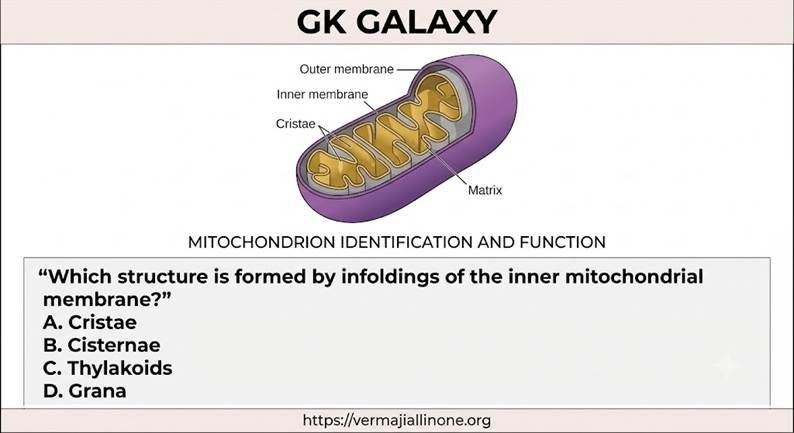
Which structure is formed by infoldings of the inner mitochondrial membrane?
A. Cristae
B. Cisternae
C. Thylakoids
D. Grana
Correct Answer: A. Cristae
Explanation: Cristae are infoldings of the inner mitochondrial membrane. They increase the membrane surface area and contain components involved in cellular respiration and ATP synthesis.
Q252. Identification of a Chloroplast
Diagram:
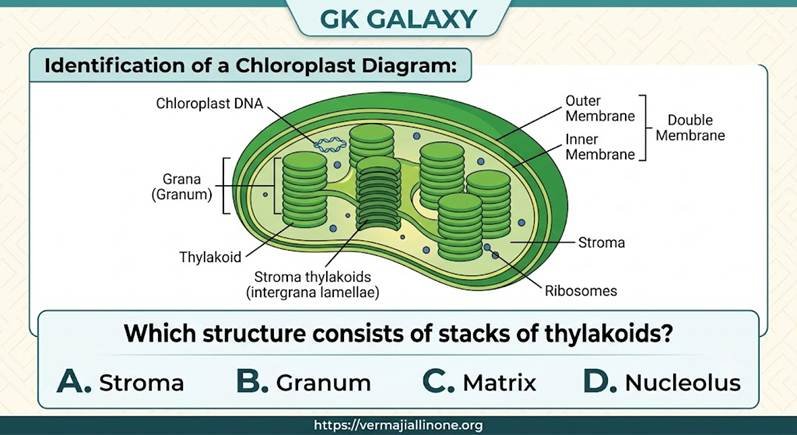
Which structure consists of stacks of thylakoids?
A. Stroma
B. Granum
C. Matrix
D. Nucleolus
Correct Answer: B. Granum
Explanation: A granum is a stack of thylakoids. Multiple stacks are called grana. The stroma is the fluid-filled region surrounding the thylakoids.
Q253. Structure of the Nucleus
Diagram:
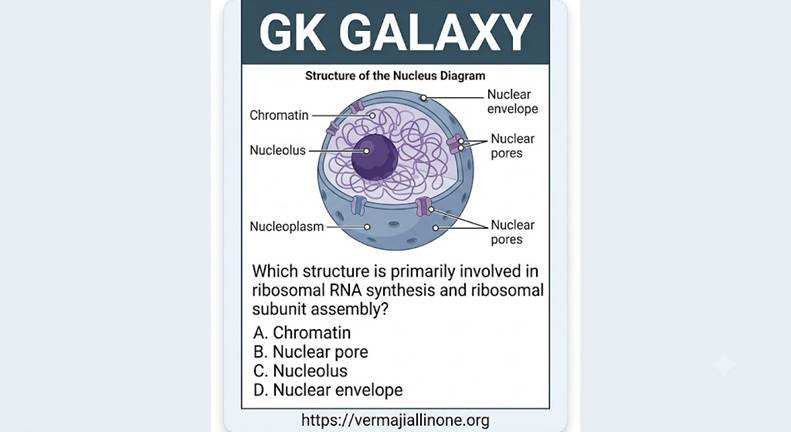
Which structure is primarily involved in ribosomal RNA synthesis and ribosomal subunit assembly?
A. Chromatin
B. Nuclear pore
C. Nucleolus
D. Nuclear envelope
Correct Answer: C. Nucleolus
Explanation: The nucleolus is the principal site of ribosomal RNA synthesis and ribosomal subunit assembly. The subunits are subsequently transported to the cytoplasm through nuclear pores.
Q254. Rough Endoplasmic Reticulum
Diagram:
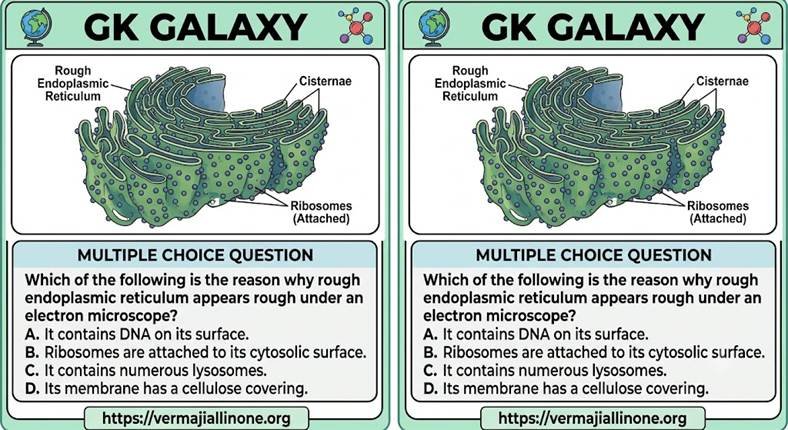
Why does rough endoplasmic reticulum appear rough under an electron microscope?
A. It contains DNA on its surface
B. Ribosomes are attached to its cytosolic surface
C. It contains numerous lysosomes
D. Its membrane has a cellulose covering
Correct Answer: B. Ribosomes are attached to its cytosolic surface
Explanation: Ribosomes attached to the cytosolic surface give rough endoplasmic reticulum its characteristic appearance. It plays an important role in the synthesis and processing of many proteins.
Q255. Golgi Apparatus
Diagram:
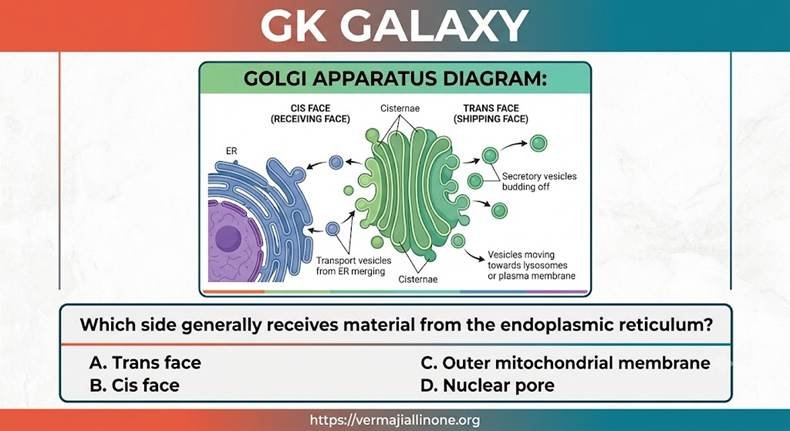
Which side generally receives material from the endoplasmic reticulum?
A. Trans face
B. Cis face
C. Outer mitochondrial membrane
D. Nuclear pore
Correct Answer: B. Cis face
Explanation: The cis face is generally the receiving side of the Golgi apparatus. The trans face is associated with the sorting and dispatch of processed materials.
Q256. Prokaryotic Cell
Diagram:
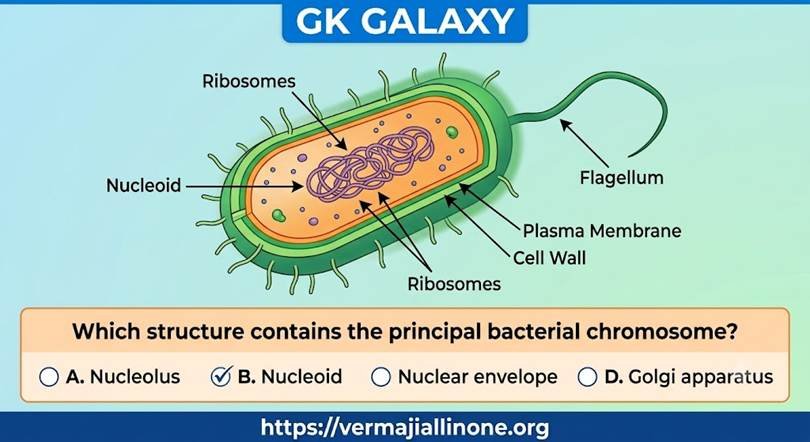
Which structure contains the principal bacterial chromosome?
A. Nucleolus
B. Nucleoid
C. Nuclear envelope
D. Golgi apparatus
Correct Answer: B. Nucleoid
Explanation: Prokaryotic cells do not have a membrane-bound nucleus. Their principal chromosome is located in the nucleoid region. Many bacteria also contain additional DNA molecules called plasmids.
Q257. Plasma Membrane
Diagram:
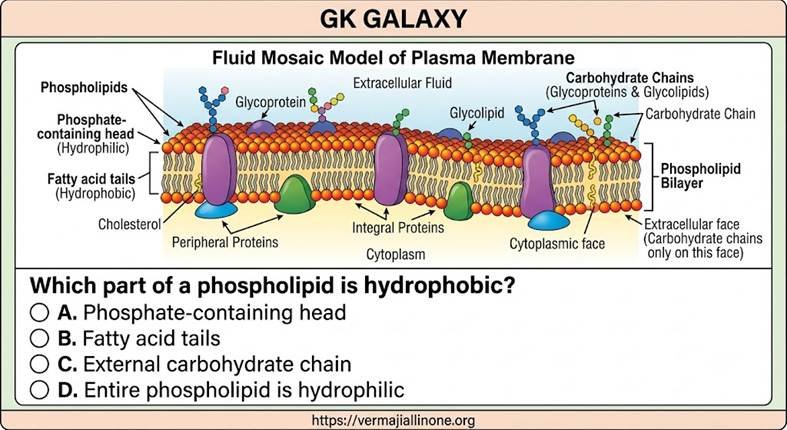
Which part of a phospholipid is hydrophobic?
A. Phosphate-containing head
B. Fatty acid tails
C. External carbohydrate chain
D. Entire phospholipid is hydrophilic
Correct Answer: B. Fatty acid tails
Explanation: The fatty acid tails are hydrophobic, whereas the phosphate-containing head is hydrophilic. This arrangement contributes to the formation of a lipid bilayer in an aqueous environment.
Q258. Centriole
Diagram:
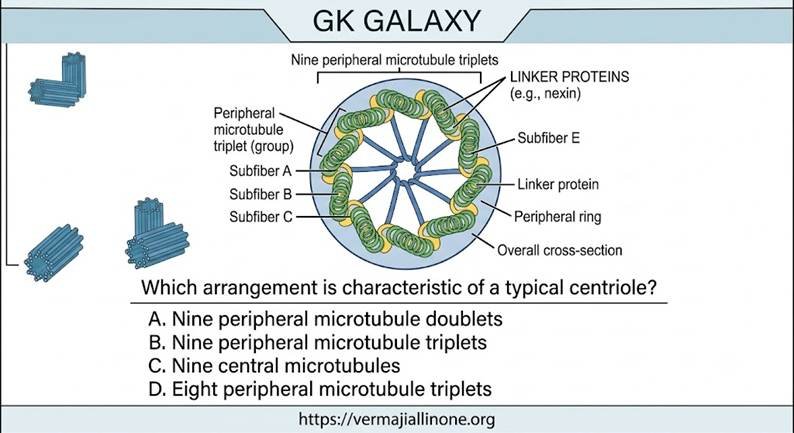
Which arrangement is characteristic of a typical centriole?
A. Nine peripheral microtubule doublets
B. Nine peripheral microtubule triplets
C. Nine central microtubules
D. Eight peripheral microtubule triplets
Correct Answer: B. Nine peripheral microtubule triplets
Explanation: A typical centriole has nine peripheral microtubule triplets arranged in a cylindrical pattern, without the central pair found in the usual 9 + 2 axoneme of motile cilia and flagella.
Q259. Cilia and Flagella
Diagram:
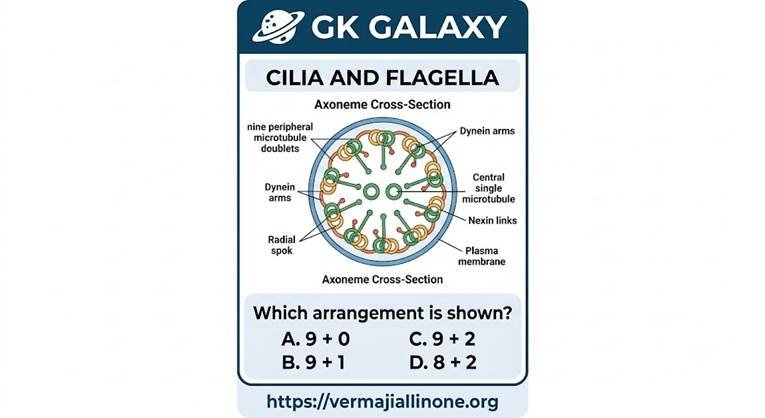
Which arrangement is shown?
A. 9 + 0
B. 9 + 1
C. 9 + 2
D. 8 + 2
Correct Answer: C. 9 + 2
Explanation: The typical axoneme of motile eukaryotic cilia and flagella has nine peripheral microtubule doublets surrounding two central microtubules. Some specialised cilia have different arrangements.
Q260. Plant Cell
Diagram:
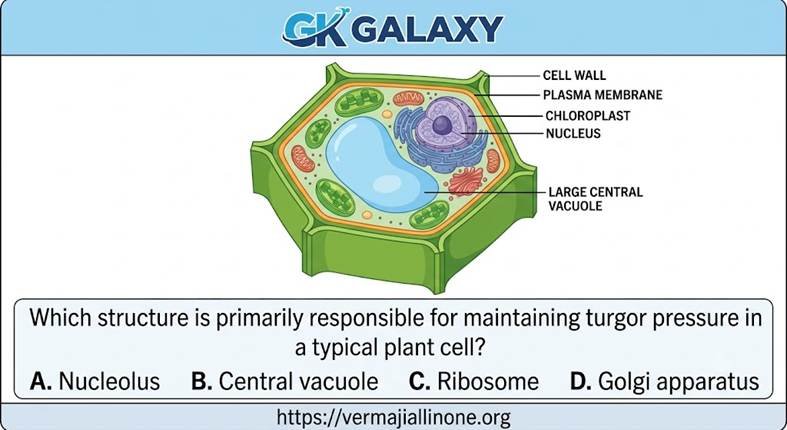
Which structure is primarily responsible for maintaining turgor pressure in a typical plant cell?
A. Nucleolus
B. Central vacuole
C. Ribosome
D. Golgi apparatus
Correct Answer: B. Central vacuole
Explanation: Water in the central vacuole contributes to turgor pressure, helping maintain the firmness of plant tissues. The cell wall resists expansion and helps prevent the cell from bursting under normal conditions.
PART 7: ASSERTION–REASON MCQs
Use the following options for Questions 261–270.
A. Both Assertion and Reason are true, and Reason correctly explains Assertion.
B. Both Assertion and Reason are true, but Reason does not correctly explain Assertion.
C. Assertion is true, but Reason is false.
D. Assertion is false, but Reason is true.
Q261. Mitochondrial Membrane
Assertion: The inner mitochondrial membrane forms cristae.
Reason: Cristae increase the surface area of the inner mitochondrial membrane.
Correct Answer: A
Explanation: Both statements are true. The inner membrane forms cristae, which increase its surface area for respiratory processes and ATP synthesis.
Q262. Prokaryotic Cells
Assertion: Prokaryotic cells lack a membrane-bound nucleus.
Reason: Their genetic material is located in a nucleoid region.
Correct Answer: A
Explanation: Prokaryotic cells do not possess a membrane-bound nucleus. Their genetic material is located in the nucleoid region, so the Reason correctly explains the Assertion.
Q263. Ribosomes
Assertion: Ribosomes are involved in protein synthesis.
Reason: Ribosomes contain proteins and ribosomal RNA.
Correct Answer: B
Explanation: Both statements are true. Ribosomes carry out protein synthesis and are composed of ribosomal RNA and proteins. However, their composition alone does not fully explain their role in protein synthesis.
Q264. Lysosomes
Assertion: Lysosomal enzymes function effectively under acidic conditions.
Reason: Lysosomes maintain an acidic internal environment.
Correct Answer: A
Explanation: Lysosomes contain acid hydrolases that function optimally at an acidic pH. This internal environment supports the breakdown of macromolecules.
Q265. Golgi Apparatus
Assertion: The Golgi apparatus participates in the modification and sorting of cellular products.
Reason: The Golgi apparatus consists of stacks of membrane-bound cisternae.
Correct Answer: B
Explanation: Both statements are true, but the stacked cisternae do not, by themselves, fully explain the modification and sorting functions of the Golgi apparatus.
Q266. Plant Cell Wall
Assertion: The plant cell wall provides mechanical support.
Reason: Cellulose is an important structural component of most plant cell walls.
Correct Answer: A
Explanation: Cellulose microfibrils contribute to the strength of plant cell walls. The wall supports the cell and helps it resist excessive expansion.
Q267. Plasma Membrane
Assertion: The plasma membrane is selectively permeable.
Reason: All substances cross the plasma membrane at the same rate without regulation.
Correct Answer: C
Explanation: The Assertion is true, but the Reason is false. Membrane permeability depends on properties such as molecular size, charge, lipid solubility and the presence of specific transport proteins.
Q268. Chloroplasts
Assertion: Chloroplasts contain their own genetic material.
Reason: Chloroplasts are surrounded by a double-membrane envelope and contain their own DNA and ribosomes.
Correct Answer: B
Explanation: Both statements are true. The Reason describes several features of chloroplasts but does not uniquely explain why they possess their own genetic material.
Q269. Centrioles
Assertion: A typical centriole has nine peripheral microtubule triplets.
Reason: The usual axoneme of a motile eukaryotic cilium has nine peripheral doublets and two central microtubules.
Correct Answer: B
Explanation: Both statements are true, but they describe different structures. A centriole typically has nine triplets, whereas a typical motile ciliary axoneme has a 9 + 2 arrangement.
Q270. Endoplasmic Reticulum
Assertion: Smooth endoplasmic reticulum is involved in lipid synthesis.
Reason: Smooth endoplasmic reticulum has ribosomes attached to its cytosolic surface.
Correct Answer: C
Explanation: The Assertion is true, but the Reason is false. Smooth endoplasmic reticulum lacks attached ribosomes and participates in lipid synthesis. Rough endoplasmic reticulum has ribosomes attached to its surface.
PART 8: MATCH-THE-COLUMN MCQs
Q271. Match the Organelle with Its Major Function
| Column I | Column II |
| A. Ribosome | 1. Intracellular digestion |
| B. Lysosome | 2. Protein synthesis |
| C. Golgi apparatus | 3. Modification and sorting of cellular products |
| D. Mitochondrion | 4. Major site of aerobic ATP production |
Choose the correct option.
A. A–2, B–1, C–3, D–4
B. A–1, B–2, C–4, D–3
C. A–3, B–4, C–1, D–2
D. A–4, B–3, C–2, D–1
Correct Answer: A
Explanation: Ribosomes synthesise proteins; lysosomes digest materials; the Golgi apparatus modifies and sorts cellular products; mitochondria are major sites of aerobic ATP production.
Q272. Match the Cell Structure with Its Description
| Column I | Column II |
| A. Nucleoid | 1. Stacked thylakoids |
| B. Granum | 2. Genetic region of a prokaryotic cell |
| C. Cristae | 3. Infoldings of the inner mitochondrial membrane |
| D. Nucleolus | 4. Ribosomal RNA synthesis and subunit assembly |
A. A–2, B–1, C–3, D–4
B. A–1, B–3, C–2, D–4
C. A–4, B–2, C–1, D–3
D. A–3, B–4, C–2, D–1
Correct Answer: A
Explanation: The nucleoid contains the principal genetic material of a prokaryotic cell; a granum is a stack of thylakoids; cristae are mitochondrial inner-membrane infoldings; and the nucleolus is involved in ribosome biogenesis.
Q273. Match the Cell Type with Its Characteristic
| Column I | Column II |
| A. Prokaryotic cell | 1. Cellulose-rich cell wall in typical examples |
| B. Typical plant cell | 2. No membrane-bound nucleus |
| C. Typical animal cell | 3. Lacks a cell wall |
| D. Mature mammalian red blood cell | 4. Lacks a nucleus |
A. A–2, B–1, C–3, D–4
B. A–1, B–3, C–4, D–2
C. A–3, B–2, C–1, D–4
D. A–4, B–1, C–2, D–3
Correct Answer: A
Explanation: Prokaryotes lack a membrane-bound nucleus. Typical plant cells have cellulose-rich walls, typical animal cells lack cell walls, and mature mammalian red blood cells lack nuclei. These are general characteristics, with specialised exceptions in cell biology.
Q274. Match the Structure with Its Membrane Arrangement
| Column I | Column II |
| A. Mitochondrion | 1. Double-membrane nuclear envelope |
| B. Chloroplast | 2. Double-membrane envelope with internal thylakoid membranes |
| C. Nucleus | 3. Double-membrane envelope with inner-membrane cristae |
| D. Lysosome | 4. Single limiting membrane |
A. A–3, B–2, C–1, D–4
B. A–2, B–3, C–4, D–1
C. A–1, B–4, C–2, D–3
D. A–4, B–1, C–3, D–2
Correct Answer: A
Explanation: Mitochondria have cristae formed by the inner membrane, chloroplasts contain internal thylakoids, the nucleus is enclosed by a double-membrane nuclear envelope, and lysosomes have a single limiting membrane.
Q275. Match the Ribosome Type with Its Typical Location
| Column I | Column II |
| A. 70S ribosomes | 1. Free in the cytosol of typical eukaryotic cells |
| B. 80S ribosomes | 2. Prokaryotic cytoplasm |
| C. Mitochondrial ribosomes | 3. Mitochondrial interior |
| D. Chloroplast ribosomes | 4. Chloroplast interior |
A. A–2, B–1, C–3, D–4
B. A–1, B–2, C–4, D–3
C. A–4, B–3, C–1, D–2
D. A–3, B–4, C–2, D–1
Correct Answer: A
Explanation: Prokaryotic cytoplasm typically contains 70S ribosomes, whereas free cytosolic ribosomes in typical eukaryotic cells are 80S. Mitochondria and chloroplasts contain bacterial-type ribosomes, although their exact properties can vary among organisms.
Q276. Match the Cell Junction with Its Main Role
| Column I | Column II |
| A. Tight junction | 1. Communication between adjacent cells through channels |
| B. Adhering junction | 2. Prevents or restricts leakage through the intercellular space |
| C. Gap junction | 3. Mechanical attachment between cells |
| D. Desmosome | 4. Strong spot-like cell-to-cell adhesion |
A. A–2, B–3, C–1, D–4
B. A–1, B–4, C–2, D–3
C. A–3, B–2, C–4, D–1
D. A–4, B–1, C–3, D–2
Correct Answer: A
Explanation: Tight junctions restrict paracellular leakage, adhering junctions and desmosomes provide mechanical adhesion, and gap junctions permit communication between adjacent animal cells.
Q277. Match the Cell Component with Its Major Chemical Feature
| Column I | Column II |
| A. Plasma membrane | 1. Cellulose in most plant cell walls |
| B. Plant cell wall | 2. Phospholipid bilayer with proteins |
| C. Chromatin | 3. DNA associated with proteins |
| D. Ribosome | 4. Ribosomal RNA and proteins |
A. A–2, B–1, C–3, D–4
B. A–1, B–2, C–4, D–3
C. A–3, B–4, C–1, D–2
D. A–4, B–3, C–2, D–1
Correct Answer: A
Explanation: The plasma membrane is primarily a lipid bilayer containing proteins. Cellulose is an important component of most plant cell walls, chromatin consists of DNA and associated proteins, and ribosomes contain rRNA and proteins.
Q278. Match the Organelle with Its Internal Structure
| Column I | Column II |
| A. Mitochondrion | 1. Thylakoids |
| B. Chloroplast | 2. Cristae |
| C. Golgi apparatus | 3. Cisternae |
| D. Endoplasmic reticulum | 4. Membrane-bound tubules and cisternae |
A. A–2, B–1, C–3, D–4
B. A–1, B–3, C–4, D–2
C. A–4, B–2, C–1, D–3
D. A–3, B–4, C–2, D–1
Correct Answer: A
Explanation: Cristae occur in mitochondria, thylakoids occur in chloroplasts, and the Golgi apparatus consists of stacked cisternae. The endoplasmic reticulum forms an interconnected membrane system of tubules and cisternae.
Q279. Match the Transport Process with Its Characteristic
| Column I | Column II |
| A. Simple diffusion | 1. Movement against a concentration gradient using energy |
| B. Facilitated diffusion | 2. Movement down a gradient through membrane proteins |
| C. Active transport | 3. Movement down a gradient without a transport protein |
| D. Osmosis | 4. Net movement of water across a selectively permeable membrane |
A. A–3, B–2, C–1, D–4
B. A–2, B–1, C–4, D–3
C. A–4, B–3, C–2, D–1
D. A–1, B–4, C–3, D–2
Correct Answer: A
Explanation: Simple diffusion does not require a transport protein, facilitated diffusion uses membrane proteins but does not directly require metabolic energy, active transport can move substances against a gradient, and osmosis is the net movement of water across a selectively permeable membrane.
Q280. Match the Scientist with the Contribution
| Column I | Column II |
| A. Robert Hooke | 1. Observed living cells in cork-free plant material and described them |
| B. Antonie van Leeuwenhoek | 2. Coined the term “cell” after observing cork |
| C. Matthias Schleiden | 3. Proposed that plants are composed of cells |
| D. Theodor Schwann | 4. Proposed that animals are composed of cells |
A. A–2, B–1, C–3, D–4
B. A–1, B–2, C–4, D–3
C. A–4, B–3, C–2, D–1
D. A–3, B–4, C–1, D–2
Correct Answer: A
Explanation: Robert Hooke coined the term “cell” after observing cork. Antonie van Leeuwenhoek observed living microscopic organisms and cells. Schleiden studied plants, and Schwann studied animals in the development of cell theory.